Token economy (TE) systems effectively increase daily functioning in both psychiatric and forensic settings. Yet, limited research is available on the applicability of TE for forensic psychiatric patients. Therefore, this pilot study aims to assess the feasibility and effectiveness of a TE program for forensic psychiatric inpatients with (among others) a diagnosis of schizophrenia spectrum disorder (SSD).
Using an uncontrolled pre-post design, the effect of TE on the achievement of target behaviours was assessed in a forensic psychiatric unit where 13 inpatients with SSD resided. Interviews with patients and staff were analysed with a thematic phenomenological approach to evaluate experiences with and the feasibility of TE.
Compared to baseline, there was a significant increase in the frequency of target behaviours during TE. The number of achieved target behaviours did, however, not differ between baseline and follow-up measurements. The thematic analysis indicated that both staff and participants had positive experiences with the TE. However, the decrease in motivation over time and lack of persisting effects were reasons for concern.
The TE was well appreciated and seemed to induce positive behavioural changes, yet these did not persist once tokens are no longer given. Successful improvement of daily functioning of patients with SSD may reduce recidivism rates.
A good understanding of the potential of TE to aid in this process may therefore improve forensic psychiatric care. Future studies are needed to optimise the maintenance strategy for this population to establish longer-lasting behavioural changes.
1. Introduction
Via the Dutch Entrustment Act, the Dutch judicial system has the option to sentence individuals to mandatory mental health treatment when they committed a crime that was at least partially mediated by their mental health status at the time of the offense. The goal of this trajectory is to protect society from individuals who due to their mental health disorder are deemed to have a high likelihood to reoffend with a serious crime (De Ruiter and Petrila, 2017). Treatment of these individuals at forensic psychiatric hospitals is aimed at the reduction of the symptoms of their mental disorder(s) and decreasing dynamic risk factors to lower recidivism risk. Forensic psychiatric hospitals admit patients with a wide range of mental health disorders, such as type B personality disorders, paraphyllia, substance-use disorders, autism spectrum disorders and schizophrenia spectrum disorders (SSDs). One of the challenges for these institutions/hospitals is that treatment is involuntary, and motivation for required behavioural changes is typically low (Koeyvoets et al., 2024). For patients with limited intrinsic motivation offering extrinsic motivation for desired behaviours in the form of a reward might be beneficial.
Contingency management (CM) programmes are based on the operant conditioning principle that when, particularly, positive reinforcement is immediately made contingent upon a specific behaviour this will strengthen the respective behaviour (Spiegler and Guevremont, 2010). The most used CM method is token economy (TE), which is characterised by tokens/points that can be earned by exhibiting appropriate behaviour and can later be exchanged for backup reinforcers like money or desirable activities. Hereby, the targeted behaviour will elicit immediate reward signalling in the brain, which will enhance motivation to use the behaviour in the future. The notion is that this intrinsic motivation will grow with every repetition of the targeted behaviour and habit formation is initiated. Additionally, the patients are provided the experience of the (long term) benefits of the adaptive behaviour itself, which will further increase their motivation to continue with the newly learned behavioural pattern (Ayllon and Azrin, 1968).
The efficacy of CM has been widely demonstrated in several randomised controlled trials and meta-analyses of CM programmes used for the reduction of substance use (e.g. Dutra et al., 2008; Pendergast et al., 2006; Bolívar et al., 2021). Furthermore, also for other outcomes, CM programmes have been shown effective. For example, a meta-analysis of studies on the effects of CM programmes (nearly all TE) in settings ranging from prison to psychiatric hospitals and a wide range of targeted behaviours, revealed prominent improvements, with a global effect size of 54%, in behaviours such as personal hygiene, pro-social and educational and work-related behaviours (Gendreau et al., 2014). A subpopulation that might be particularly susceptible for the benefits of programmes using external rewards are people with SSD. For these patients, the challenges with commitment to behavioural alterations might be exacerbated by the negative symptoms associated with their disorder, such as a loss of interest in daily activities, social withdrawal and general impairments in daily functioning (Buchanan, 2007). Research in general psychiatric hospitals has shown that rewarding adaptive behaviour using a CM-based programme frequently improves daily functioning and decreases treatment attrition of patients with SSD (Dickerson et al., 2005). Yet, most evidence for the beneficial effects of CM programmes in forensic settings comes from studies in inmates without a mental health diagnosis. A meta-analysis of CM-based interventions in penitentiary institutions indicates that such interventions effectively stimulate pro-social behaviours as well as dedication to education and work assignments (Gendreau et al., 2014). In addition, some studies covered in this meta-analysis also revealed improvements in general daily functioning such as appropriate personal hygiene and performance of daily (household) tasks (e.g. Milan and McKee, 1976). The possible effects of TE on daily functioning might be especially relevant since several aspects of functioning, such as social and coping skills and self-care, are considered risk-factors for recidivism (Douglas et al., 2013; Webster, 2015).
Although there is thus a myriad of studies suggesting that CM programmes, and TE in particular, might be effective in improving daily functioning in both psychiatric and forensic settings, this type of programmes seems to only be sparingly used for this purpose in forensic psychiatric hospitals. This leaves one wondering what may impede the implementation of CM in forensic psychiatric institutes, as similar issues with daily functioning are common in these settings. A Dutch report (Merkx et al., 2015) (published in Dutch language) identified obstacles and limitations to the implementation of CM for patients with substance abuse in an out-patient forensic psychiatric facility. Several logistic obstacles were identified, including unclarities about the targets themself, for example what does compliance with group treatment entail, is attendance sufficient or is active participation needed or the way and timing of reward exchange. Furthermore, a serious constraint was financial, given the inevitable costs of rewards that are often not covered by insurance (Merkx et al., 2015). These obstacles are comparable to those reported in a feasibility study of a CM programme for substance users in five American community correctional facilities (Rudes et al., 2012). This study also identified some moral issues staff raised surrounding implementation of a “reward” system in a forensic setting: “why should I reward someone for what they should be doing anyways?” Whether similar limitations apply to the use of CM programmes aimed at improving daily functioning in inpatient forensic psychiatric hospitals or other forensic psychiatric target groups has not yet been elucidated.
Given the generally limited intrinsic motivation for behavioural change in patients with mental health problems residing in a forensic facility, and its shown effectiveness in improving daily functioning of individuals with SSD, a CM-based programme such as a TE system might be a good fit for forensic units where these types of patients are cared for. Yet, too little is known about the feasibility and acceptability of TE in this specific population. Therefore, the feasibility and effectiveness of a TE programme for forensic psychiatric hospital inpatients with SSD were evaluated in a quasi-experimental mixed-methods pilot study.
2. Methods
2.1 Population
All patients residing at the “Plecht”, a unit at the forensic psychiatric hospital, received oral and written information about participation in the research study. Ten out of the 13 residents of the unit provided informed consent and participated in the quantitative study (Study 1), and six of these patients also provided informed consent for and participated in the qualitative study (Study 2). Both studies were performed in accordance with the Declaration of Helsinki (World medical association, 2013) and approved by a local ethics committee (University of Groningen, PSY-2324-S-0026). Diagnoses of the patients were obtained from the patient medical files (diagnosis according to DMS-V (American Psychiatric Association, 2013). All participating patients were male and had an SSD diagnosis (seven schizophrenia, two schizoaffective disorder and one SSD not otherwise specified). Nine out of the ten participants had a co-morbid substance-use disorder (alcohol, cannabis and/or stimulants), and two participants had a mild intellectual disability. Antipsychotic medication (Aripiprazole, Zuclopentixol, Flupentixol, Olanzapine and/or Clozapine) was taken by nine out of the ten patients, with six participants taking more than one type of anti-psychotic drug. Four participants were prescribed an antidepressant (Amitriptyline, Escitalopram or Fluvoxamine), and four patients took a benzodiazepine (Lorazepam, Oxazepam or Midazolam), when needed. The average age was 42 ± 13 years (range 29–71). At the start of the intervention, the participants were in care at the forensic psychiatric hospital for 28 months on average (range 2–88 months).
2.2 Token economy
For each patient, three to four different individual target-behaviours were determined in a treatment-strategy meeting between patient, psychologist, psychiatrist (where applicable) and coach (unit nurse responsible for care of the patient). Target behaviours were aimed at improvement of social skills, daily functioning or treatment adherence/attendance. Some examples of target behaviours are: being present at the day opening at 10 a.m., inviting a group member for a conversation or an activity; taking a shower; or discussing your thought record (part of CBT) with a staff member (see Appendix 1 for more examples of specific target behaviours). The number and frequency of tokens could vary per target behaviour, yet each patient could earn a maximum of 25 tokens each week. Upon showing the desired target behaviour, the patient was required to indicate this to the nursing staff, who would then place a token in the individual patient’s token container (piggy bank) and register it in the token log. Weekly, each Saturday, the tokens in the container could be exchanged for cash money (€0.20 per token, maximally €5 for 25 tokens per week). If a patient has shown a specific target behaviour consistently (> 50% of the time) for at least six consecutive weeks, a thinning process for this target behaviour could be started. Participants were tapered off by slowly reducing the number of tokens that could be earned by exhibiting the target behaviour until tokens were no longer given. When a specific target behaviour was tapered down, a new target behaviour was defined so that the maximum number of tokens that could be earned remained 25.
2.3 Study 1: effects of token economy
Study 1 aimed to evaluate the effects of TE on the attainment of participants’ specific behavioural goals. It was hypothesised that TE would result in an increase in the number of achieved goal behaviours, and that this improvement would be sustained even after participants no longer received tokens for a particular behaviour.
2.3.1 Study design.
Prior to the implementation of TE, the target behaviours for each patient were determined. During the three weeks before the start of TE, the nursing staff registered for each patient which of the future target behaviours were achieved. Registration was done on two moments each day at the end of the nurses-shifts (± 7:30 a.m. and 3:30 p.m.). These notes were used for the baseline measurement. Hereafter, the TE was implemented, and the number of tokens received was recorded (upon retrieval of the token) for a period of 30 weeks (n = 10). Token thinning was done with the five participants who reached the threshold for the thinning procedure. For these participants, post-TE measurements for the specific thinned target behaviours were performed in Weeks 42–45 by the nursing staff in a similar fashion to the baseline measurement. At this timepoint, all participants included in the post-TE measurement were tapered down to the point that they did not receive tokens for the investigated target behaviour any longer.
2.3.2 Data analysis.
For each participant, the number of target behaviours (tokens) they achieved are summed over three-week periods, and from this, the percentage of achieved target behaviours was calculated for 30 weeks. To assess the effect of token thinning, the average percentage of achieved target behaviours was calculated for the three-week period prior to the start of token thinning for each participant separately; this measurement is referred to as the point of change. The average percentage of target behaviours achieved during follow-up was also calculated for a period of three weeks (Weeks 48–51). Data are presented either as means with standard deviation or in a boxplot.
All statistical analyses were performed using SPSS software (IMB SPSS Statistics 29.0, New York, USA). A repeated-measures ANOVA was performed with the 11 timepoints (baseline, Weeks 1–3, 4–6, 7–9, 10–12, 13–15, 16–18, 19–21, 22–24, 25–27 and 28–30), as within-subjects factor. Post-hoc paired t-tests with Bonferroni correction were performed comparing the baseline measurement to each specific timepoint. A second repeated-measures ANOVA was performed to assess change during TE. This analysis contained ten timepoints (Weeks 1–3, 4–6, 7–9, 10–12, 13–15, 16–18, 19–21, 22–24, 25–27 and 28–30). For the analysis of token tapering, a repeated measures ANOVA with the three timepoints (baseline, point of change, follow-up) was performed. Two post-hoc paired t-tests with Bonferroni correction were done to compare baseline measurements with the point of change and follow-up measurements. Partial-eta squared and Hedge’s G effect sizes were calculated for the ANOVA and t-test analyses, respectively. For all analyses, a confidence of 95% was used. For the t-test results, Bonferroni-corrected p-values are displayed.
2.4 Study 2: experiences with token economy
Study 2 sought to explore how both patients and staff members experienced TE. Specifically, the study examined which positive and negative experiences participants associated with TE and what factors contributed to these experiences being perceived as either positive or negative.
2.4.1 Study design.
To evaluate the experiences of staff and patients with TE, semi-structed interviews were conducted. All interviews took place between 60 and 65 weeks after the start of TE. Interviews were verbatim transcribed and analysed according to Colaizzi’s phenomenological approach (Colaizzi, 1978).
2.4.2 Interviews.
The semi-structured interviews were performed by one (or both) of the authors of the article (YS or RN). During the interviews, an experienced worker was present to support the patient. Interviews were conducted in a small conference room on the unit of the patients. The interviews were recorded with a tape recorder (Lifegoods). The interview guideline outlined three main topics for the interview: experiences with TE in general, implementation of TE and future perspectives for TE. The average duration of the interviews was 16.36 min (range 12.00–20.33 min) for staff and 16.21 min (range 6.17–22.44 min) for patients.
2.4.3 Participants.
Staff members were recruited via an invitation through email and via a sign-in sheet in the nurses’ station. Eleven staff members signed informed consent and participated in the study. This included ten psychiatric nurses and one psychologist. On average, the participants had been working at the studied unit for 3.5 ± 2.6 years (range 0.3–8 years) and had been working in a forensic psychiatric hospital for 6.5 ± 3.9 years (range 0.3–18 years).
Patients were informed about the study during a patient–staff meeting. Hereafter, patients were asked whether they wanted to participate by their coach on the unit. Six patients agreed to participate in the interviews and signed informed consent. All patients had an SSD diagnosis. On average, patients were 2.3 ± 1.9 years in care in the forensic psychiatric hospital.
2.4.4 Interviewers.
At the time of the interview, both interviewers were in the final year of the Clinical Forensic Psychology and Victimology master at the University of Groningen. The interviewers were not associated with the forensic psychiatric hospital prior to this study and were not involved in the development or implementation of the TE.
2.4.5 Data analysis.
The interviewer manually transcribed transcripts. The researchers read transcripts to familiarise themselves with the data. Each transcript was coded by at least two persons (YS, RN or GB) using Atlas.ti Mac/Windows 23.1.1 software (Atlas.ti GmbH, Madrid Spain). Coding was both inductive and deductive. Codes were first categorised to form a codebook, and subsequently, overarching themes within the codebook were identified. These potential themes were formulated by GB in consultation with YS and RN. Hereafter, the themes were discussed and reviewed by all authors. Quotes from the interviews displayed in this paper were translated, as literal as possible, from Dutch to English by GB. Square brackets are used to indicate omitted text (e.g. text identifiable to a person). Curly brackets are used to clarify text.
3. Results
3.1 Study 1: effects of token economy of target behaviour
3.1.1 Baseline and token economy.
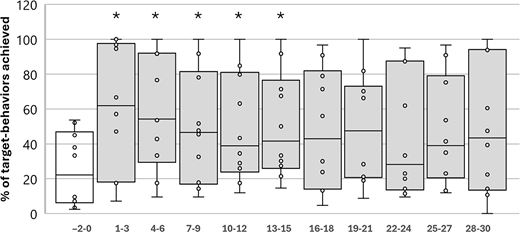
Figure 1 shows the percentage of target behaviours achieved during the baseline period (Weeks −2–0) and during the implementation of TE. During the first weeks of TE, the percentage of achieved target behaviours increased significantly compared to the baseline period (F(10,90) = 2.34, p = 0.017; partial eta-squared = 0.209). This increase remained significant until the 16th week (p < 0.05) (Hedge’s G range 0.923–0.595). Hereafter, paired t-tests did not reveal statistical significance any longer.
To analyse whether there was a decline in the number of target behaviours achieved during the period the tokens were given (Week 1–30), a second repeated-measures ANOVA was performed, which did not reveal a significant difference over time (F(9,81) = 0.983 p = 0.461).
3.1.2 Follow up.
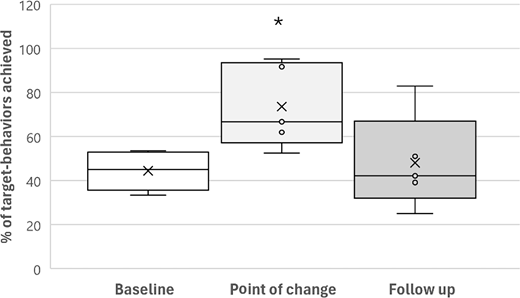
Token thinning started for two participants on Week 28 and for the other three participants on Weeks 30, 32 and 37, respectively. There was a significant difference in the percentage of tokens achieved across time (F(2,8) = 6.166, p = 0.024; partial eta-squared = 0.607). The percentage of target behaviours achieved was significantly higher during point-of-change measurement compared to the baseline (t(4) = –3.480, p = 0.013; Hedge’s G = 1.242) and the follow-up measurement (t(4) = –3.798, p = 0.010; Hedge’s G = 1.355). There was no significant difference between the baseline and follow-up measurement (Figure 2).
3.2 Study 2: experiences with the token economy
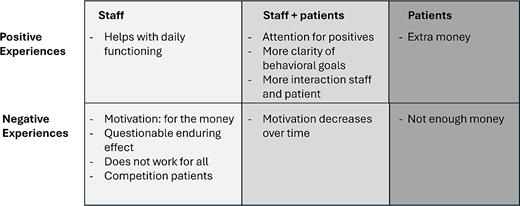
Prior to the start of the analysis, two overarching themes were identified, positive experiences and negative experiences with the TE program. With these overarching themes in mind, an initial coding round of six randomly selected transcripts (three patient and three staff) resulted in 111 independent codes. During a consensus meeting, codes were merged when content overlapped, resulting in 43 codes that fit within the overarching themes and are meaningful for the research question. A codebook was constructed of these codes, and this was used to code the remaining transcripts. Nine additional codes were identified and added to the final codebook ( Appendix 2 displays all 52 codes organised by subthemes). From the coding, 11 subthemes emerged, which are presented in Figure 3. Below, a more detailed description of these themes and examples of how participants discussed them is provided. Five codes did not align with the identified subthemes (no added workload pressure, demographic information, relevance for other populations, the necessity of staff training and initial staff resistance) but were included in the codebook as they were considered relevant for evaluating the feasibility of TE. The identified themes and their interpretations were discussed in a meeting attended by all participating staff members, along with two additional staff members. This consultation did not lead to the emergence of new themes or alternative interpretations of the existing themes. A member check was offered to participating patients, in the form of either an oral or written summary of the results to which they could respond with feedback. However, five of the six participants declined to take part in the member check. An oral consultation with the patient who did wish to provide feedback did not yield any additional themes.
3.2.1 Positive experiences.
Within the central theme of positive experiences, five subthemes were identified. Firstly, both staff and patients mentioned that with the TE, there was more attention for the things that patients did well. In a forensic setting, a lot of attention is paid to undesirable behaviour, and thus, the TE placing emphasis on the positives was experienced as a benefit of the programme. A patient said for example: “well, [name nurse] always says: ‘Topper {term of endearment}, you are doing well’, or uhm, ‘good that you thought of it’. I don’t know, […] everybody says at least something positive when you pick them {tokens} up. I like that” (Patient 5). Another patient commented: “It is not the reward {tokens} themselves, that is a bonus off course, but it is more the idea behind it, that there is attention for that” (Patient 4). A staff member described it as: “I’ve seen from the patients that they feel seen by the tokens” and “even though it isn’t a lot of money, it shows that there is a lot of appreciation for them, that they feel appreciated” (Staff 6). Staff member 8 said: “But I think it is also the psychological, the reward of doing something and receiving something nice for that. And whether that is money well, we give them compliments as well, we say something like: ‘hey, how good, I see that you did it this way all week’” (Staff 8).
Patients and staff members also mentioned that TE provides them clarity on what their (behavioural) goals are. Due to the TE, behavioural goals are made explicit, are reported in the medical file of the patients and are frequently evaluated. Participants said: “It is just, it is just this is what you need to apply yourself to, and when it is done you even get a reward for it” (Patient 1), and “it is about the idea that you, uhm, you make a deal with someone that you will do something and then you know to do that thing” (Patient 4). “It rewards the patient, but it also makes that every time I see the cans {token-container}, or when patient stops by to ask for a token, it helps to keep it sharp that the patient has a goal, and what is the purpose of this goal for this patient” (Staff 5).
A third positive mentioned by staff was that they felt that TE aided with the daily functioning of the patients. Staff member mentioned seeing improvements in healthy eating, sleeping and physical activity practices as well as social behaviours and personal hygiene after implementation of TE. Especially for those patients who experienced negative symptoms of SSD. Regarding this, a staff member said: “I do think it helps to get some people in motion. [interviewer: do you mean literally get into motion?] Yes, literally, yes. To do things. It is targeted at a group with negative symptoms, so for some it is getting out of bed, getting up, be at coffee break, but also being outdoors, walking around, those sorts of things. It helps with that. Uhm, but […] when the tokens are removed, we do see they relapse in the old behaviour” (Staff 11).
Another positive endorsed by staff was that the TE resulted in more interaction between staff and patients. Staff reported that they are reminded to initiate social contact, and that TE reduced potential conflict because it opens up conversation about daily chores and tasks that could otherwise lead to an argument. Patients reported that TE helped them to initiate contact. Staff member 2 mentioned: “Yes, and some of them talk to us more, they get a token for it. For example, that a very closed person who never wanted to talk, invites one of us for a conversation and talks about their day”.
For the patients, a positive they mentioned often was that they got some extra money to spend. Several participants mentioned that they have limited financial means, and that TE provides them with an opportunity to earn money. Patient 3 said: “Actually what I mentioned before, for the people that have little to spend it may be interesting because then you can buy certain things from the shop that you couldn’t before” (Patient 3). And, Patient 1 remarked: “it is nice pocket-money” (Patient 1).
3.2.2 Negative experiences.
Within the theme of negative experiences, six subthemes were identified. Only one theme was endorsed by both staff and patients. Both groups mentioned that the motivation to actively participate in TE reduced over time, which may harm potential enduring effects. Participants indicated that the initial excitement about TE wore off over time, that patients got bored with the focus on one goal for a long period of time and staff member remarked that their priority shifted from the TE back to the daily hassles. One of the staff members remarked: “Yes, what I find a pity is that for some patients it declines, the goals, I am seeing that. At the beginning everybody was really positive, and they all went for it and now most are a little less positive, or well, to do something for it, let me say it that way” (Staff 4). Another staff member said: “After a while it dwindles down and then we lose track of the goals as well, and then it {effect of TE} is gone” (Staff 3). And, Patient 4 said: “It is, uhm, at a certain moment I think I do have something like, well I am done with that goal” (Patient 4).
The patients identified one other clear negative of TE, namely, that they perceived the monetary reward as too small. For some patients, this was linked to the desire to earn enough money to obtain a specific product. Patients specified that they believed that a higher reward would have helped them more. Patient 2 worded it as follows: “I find it strange that I only earn a quarter {25 ct.} per time, thus that is 5 euro per week. Now 5 euro is quite nice. And my feeling says that if I would have gotten more, I could have included it systematically in my program. Like, now I earn 50 cents and tomorrow 3 times 50 cents. Yes, in the end just 10 euro per week. If you as an inmate get an allowance of 15 euro in the week, and then this time 5 euro. And I just can’t find the motivation to really go for these tokens, because I actually have to walk 2 kilometers for a euro then I think this could be done another way”. And, in response to a question about what they would change about the current TE, Patient 5 answered: “Yes, then uhm, I would, uhm uhm, yeah, I don’t know, they pay already for us, so to say, five euro maximally per week. But maybe it could be ten euros?”
Staff members identified several other negative aspects of the TE. Firstly, they mentioned that, at this point, the enduring effects are still questionable, which makes them question the usefulness of the system. Staff doubted whether beneficial habits were actually formed during the TE, and they observed patients falling back into old behavioural patterns as soon as the token reinforcement was ended. Some examples of what they said about this are: “Only, well, with some things I wonder if it will stay upright if we stop giving tokens. So I am not sure, sometimes it is hard to estimate if the behavioural change will really stick” (Staff 1). “Well, you hope off course that the old goals have been so ingrained that it remains when new goals are introduced, uhm, but with that I am not sure whether that is the case” (Staff 10). “Because it works so well, I wonder at times how long-lasting it is, because it a very difficult target group with a lot of problems, but I do think that during the period they get the reward the goals are being reached, so that is a great result, but I think the question is how long-lasting it is when the reward is removed” (Staff 3).
Additionally, they indicated that some of the patients only participate for the money. Hereby it was mentioned that efficacy of the TE was largely dependent on the financial status of the patient, whether they needed money or not. One staff member remembered a conversation with a patient: “He did participate but was not always motivated. After a while he said: ‘Oh yeah, it was quite chill that I received this money for things that I would have normally done anyways’” (Staff 9). Another said: “For example a patient would say: ‘Come [name staff-member] we are going for a walk.’ And then I would tease him and ask, do you really like walking with me or is it solely for the tokens, he’d say: ‘No, god, it is solely for those tokens.’ In itself really good, because before the tokens they didn’t walk those rounds, but […]” (Staff 6).
One staff member also mentioned that they believed the tokens lead to unwanted competition between patients, leading to an undesirable group dynamic: “I do think sometimes that, uhm, patients continuously compare themselves to others. They don’t talk about it, but I do think it plays a role in the group and that it could demotivate them in their work if they focus a lot on others” (Staff 8).
Lastly, several staff members observed that the TE programme is not effective for all patients. They noted that effectivity seemed lower for patients with more financial means. And that it might fit better with patients with a lower IQ or patients with more severe negative symptoms (related to Schizophrenia). “I wonder whether it would work with another population. I do think for those with a mild cognitive deficit and those with another psychosis disorder, but umh with a target group with a slightly higher IQ, than I think not. I don’t think that this works then” (Staff 3).
4. Discussion
The current study evaluated a TE system in a unit where forensic psychiatric patients with an SSD (and often other co-morbid diagnoses) reside. Both the qualitative and quantitative data suggest that the TE programme successfully induced behavioural changes for the majority of the patients. However, over time, the motivation for the target behaviours declines, and more importantly, when tokens for a specific target behaviour were faded out, the behavioural pattern often returned to what it was prior to TE. Therefore, there are questions about the enduring benefits of the TE on mental health and recidivism risk for this specific target group. Yet, both patients and staff spoke predominantly positive about the programme as it seemed to improve patients’ daily functioning and thereby positively influencing the atmosphere on the unit while the TE system was in effect. This optimistic view is most likely related to the successful implementation and the immediate effects of the TE. Patients especially appreciated that the TE system puts focus on things that go well, which in a forensic care setting is not self-evident. In addition, TE served as a reminder of daily targets of the patient and helped the staff to keep paying attention to the small successes.
4.1 Immediate effects
Large individual variations in the effects of TE were noted, which may be mediated by several patient characteristics. When asked about this, the staff suggested that the TE programme might be more beneficial to patients with a mild intellectual disability. TE programmes lend themselves well for psychiatric patients with an intellectual disability (Comaty et al., 2001); however, to what extent its success depends on the IQ of the participant has not been elucidated yet. It may be a reasonable hypothesis that IQ does play a role in the susceptibility to the benefits of a reward-based system such as TE. Neuro-imaging studies, for instance, have shown stronger neurophysiological response to reward in individuals with a lower IQ, particularly when there is no delay between the cue (behaviour) and reward (Hawes et al., 2014).
A second characteristic mentioned by staff that could potentially moderate the benefit of TE is the level of negative symptoms experienced by the participants. This is in line with previous studies demonstrating that the level of social withdrawal a patient with schizophrenia experiences was predictive of the success of TE, with patients who were most socially withdrawn being the least successful both during TE and during thinning of TE (Butler, 1979). Although not mentioned in this paper, this may possibly be related to severity of psychopathology or the sedative effects of (high doses of) anti-psychotic medications.
Furthermore, patients suggested that the success of TE is dependent on the income of the participants, as the height of the reward is relative to the financial wealth of the individual. At a minimum, residents of the unit had €15 spending money per week available to them, and so they could earn 25% extra spending money with the TE. However, some residents had their own additional funds available (e.g. from savings, a job, social benefits or a gift from loved ones), so for them, the relative earnings by the TE were much lower. To make TE successful, it is important that the incentive provided is properly balanced with the burden that is put on the participant (Ayllon and Azrin, 1968). Thus, it is likely that the rewarding properties of a monetary incentive in relation to the financial circumstance of the participant may mediate the effectiveness of the TE. Evidently, raising the amount of money for a token for those with more financial means would be very unjust. Other (non-financial) rewards have been considered, such as access to education or leisure activities, or getting privileges on the ward. However, due to the limitations in forensic settings, these were not deemed feasible.
There is also evidence that the extrinsic value of the reward is not solely reliant on the monetary reward, the feedback on the performance provided when a reward is given can be an equally strong reinforcer (Turner and Luber, 1980). This notion was underscored by some of the participating patients, who specifically mentioned the importance of the compliments given by the staff when a token was retrieved.
4.2 Enduring effect and maintenance
Upon thinning, the advantageous changes in behaviour due to the TE rapidly disappear. This suggests that the purpose of TE, increasing the intrinsic motivation for the required behaviour by giving patients positive experiences with that behaviour using extrinsic motivation, was not achieved. This contrasts with previous studies in psychiatric populations, for example, LePage et al. (2003) showed persistent effects of a long-lasting (two years) TE program in the number of aggression incidents occurring in a psychiatric unit. One may argue that this study used different outcome measures. We did check whether there was a reduction in the number of incidents from the year prior to implementation of TE to the period during the TE pilot; however, there was not.
In the current study, a relatively straightforward approach to maintenance, namely, thinning, was chosen, where the requirements to receive a token were slowly increased, and the reward was gradually removed. In a systematic review on maintenance strategies Regneir et al. (2022) suggested that the popularity of the maintenance strategy is dependent on the goal of the behavioural change, with thinning being most popular when the goal is to decrease a behaviour, while a combination of thinning and for example transfer of control were most popular when the desire is to increase a behaviour. Unfortunately, little research is available where a direct comparison is made between different maintenance strategies to evaluate what is the most effective approach. A maintenance strategy that might improve long-term effectiveness could be an ABA design, where the non-contingent period is followed by a second contingent period. Meta-analyses have shown that this process allows for better consolidation of the learnt behaviour (Gendreau et al., 2014; Sio and Ormerod, 2009).
To maintain the desired behavioural changes after cessation of the TE, the individual needs to build intrinsic motivation for the behaviour to replace the extrinsic motivation previously provided by the TE. There is some debate about the potential of CM based programmes to induce intrinsic motivation, and there are even questions whether offering extrinsic motivation might do the opposite and reduce intrinsic motivation. There are two contrasting theories about how rewards influence intrinsic motivation. The first suggests that contingent reward (contingent monetary payment) decreases intrinsic motivation (Deci, 1972). The second assumes no negative effects of contingent rewards, as provided in CM programmes, on intrinsic motivation (Mawhinney et al., 1989). The jury is still out on this topic, yet more recent studies imply that the impact of rewards on intrinsic motivation is highly dependent on the situational factors (for an in-depth discussion, read Lindenberg, 2001).
Although not mentioned by either patients or staff, a key factor to consider in the efficacy of the TE is the use of anti-psychotic medications by most of the participants. Given that many of these medications have a sedative effect (European Medicines Agency, 2025), one could argue that this could impede motivation for behavioural change. Furthermore, as one of the mechanisms of action of these drugs (among others) is antagonism of the Dopamine 2 (D2) receptor, and this receptor plays a role in the mesolimbic reward pathway (Beninger et al., 1989), reward-related learning might be affected by antipsychotics’ use. However, studies, predominantly in animal models, have shown that reward-related learning is more reliant on the Dopamine 1 than the D2 receptor (Beninger and Miller, 1998). And more importantly, previous research found no association between the use of antipsychotics and the level of motivation for goal-directed behaviour for any of the antipsychotic drugs used by participant is the current study (Fervaha et al., 2015; Lieberman et al., 2005).
4.3 Acceptability and feasibility of token economy in a forensic psychiatric hospital
The acceptability and feasibility of the TE programme was evaluated in the qualitative study. In general, TE was deemed a feasible intervention in the forensic psychiatric inpatient setting it was tested in. When asked to rate the operational aspects of the TE (e.g. time investment, financial investment and administrative demands) on a scale of 1 to 10, staff members gave an average score of 7.5 ± 0.9. They noted that the TE programme did not lead to a substantial increase in their workload, as was feared by some prior to the implementation of the programme. Staff member 7, for instance said about this: “In the execution it was better than I expected. It felt less like yet another job added. Yeah, no doubt I did feel that at one point, but mostly it is now just a part of your work”. Some staff members did mention that they experienced an increase in the workload but indicated that they believed that the benefits they saw for their patients were “worth it”. The importance of a balance between experienced workload and perceived effectiveness indicated by the staff is in line with the theoretical framework of acceptability of health-care interventions, which in addition underlines to take intervention coherence, self-efficacy and affective attitude into account (Sekhorn et al., 2017). Future research is needed to evaluate these aspects of acceptability of the TE intervention.
4.4 Limitations
There are several limitations of the quantitative study to note. Firstly, given the pilot nature of the study, the number of participants was limited, and a larger study is needed to fully elucidate the efficacy of the TE for this specific mental health population. Furthermore, no control group was included, thereby limiting the conclusions that can be drawn from this study. And lastly, given that forensic psychiatric treatment ultimately aims at reducing crime recidivism, a measurement of the effects of the TE on forensic risk and protective behaviour or recidivism rates would have been highly informative. For the qualitative study, limitations include the use of a convenience sample of patients, which likely has led to a biased view with inclusion of patients with a higher level of functioning. Moreover, one person involved in the coding of the interviews was also involved in the implementation of the TE on the unit.
4.5 Conclusions and future directions
This pilot study suggests that it is feasible to use a TE programme on a unit for forensic psychiatry patients with (among other mental health diagnoses) SSD. Both patients and staff spoke largely favourably about their experience with TE on their unit. The TE seems to induce positive behavioural changes, yet these do not persist once tokens are no longer given for the desired behaviour. Apart from studies with a larger sample size, more information is thus needed to elucidate whether another maintenance strategy will fit better with this population and could lead to enduring behavioural change. Furthermore, given the financial burden associated with the TE system, a cost–benefit analysis will be essential to provide a justified recommendation for/against the implementation of the TE programme in the forensic psychiatric setting.
Although this study evaluated TE within the specific context of the Dutch forensic psychiatric system, it is likely that the experiences described here are transferable to other forensic settings, both within The Netherlands and internationally. Particular attention should be given to the formulation of appropriate behavioural goals in different contexts. For instance, in correctional facilities where autonomy is more restricted, goals aimed at fostering independence in household or other daily functioning tasks may be less suitable. Moreover, as a core principle of TE involves reinforcing desired behaviours rather than punishing undesirable ones, implementing this approach requires a consistent and collective commitment from all staff members involved. Achieving such alignment can be particularly challenging in larger or highly secure facilities.
Implications for forensic practice:
Implementing a TE is feasible within a forensic psychiatric hospital or comparable forensic settings.
A TE can produce short-term behavioural changes in patients with SSD residing in forensic settings; however, its long-term effectiveness remains uncertain.
Further research is needed to develop maintenance strategies that can support sustained behavioural change following the implementation of a TE in forensic contexts.
References
Further reading
Appendix 1. Examples of goal behaviors
Daily functioning
Put your plate and utensils in the dishwasher after using it.
Be present at the unit 30 minutes prior to a group activity and let unit nurses know you are there.
Clean my room twice per week, without prompting from staff.
Get up at 9:30 each day.
Exercising on the cross-trainer for 30 min, twice per week.
Do relaxation exercises using the virtual reality system for 30 min each day.
Attend the group sport session.
Walk three rounds on the courtyard.
Walk the “A” hiking route (± 2 km).
Brush your teeth in the evening.
Take a shower twice a week.
Do not order fast food for a week.
Do your weekly group household chores.
Open your curtains in the morning.
Social skills
Call coach to check in while on leave.
Invite a unit nurse for a conversation.
Invite your case manager for a conversation about your progress.
Talk to a unit nurse about your experiences on leave (within 30 min after returning from leave).
Attend the group coffee/tea moment in the evening.
Invite a group member for an activity (walking, table tennis, board game).
Treatment adherence/attendance
Discus your feelings about a therapy session with a unit nurse.
Fill out my thought record and discus it with case manager.
Go to your therapy sessions without prompting.
Actively participate in the group therapy session.
Attend the day opening session.
Attend the patient–staff meeting.
Initiate a meeting about your upcoming leave.
Source(s): Authors’ own creation