


Collapsible soils such as gypseous soil are problematic in geotechnical engineering because their volume changes significantly upon saturation. Foundations constructed on gypseous soil undergo sudden and large settlement if the underlying soil experiences unanticipated moisture. The present study aims to improve the gypseous soil behaviour so that it can be used to support shallow foundations. To understand the mechanisms of stabilisation better, a laboratory study is performed to evaluate how polyurethane foam in different amounts influences the volumetric strain, collapse potential and mechanical behaviour of gypseous soil. Physical models of a footing on treated gypseous soil with polyurethane foam are examined to determine the effective treatment zone. Based on the obtained results, 3% polyurethane foam can be recommended to improve the gypseous soil behaviour; the particular reason is its effectiveness in decreasing the change in volumetric strain and collapse potential. The present study develops a theoretical approach that depends on a non-dimensional parameter to predict the ultimate bearing capacity for a footing on the surface of treated gypseous soil using the existing conventional theories.
Notations
- B
width of footing
- Cc
curvature coefficient
- Cp
collapse potential
- Cu
uniformity coefficient
- D50
median grain size
- e0
initial void ratio
- e1
equilibrium void ratio before saturation
- e2
equilibrium void ratio after saturation
- Gs
specific density
- k
coefficient of permeability
- Nc and Nγ
bearing capacity factors
- q
theoretical ultimate bearing capacity of untreated dry soil
- qT
theoretical ultimate bearing capacity of treated soil
- RBC
bearing capacity ratio
- S
settlement of foundation
- sc and sγ
shape factors
- γdry
dry unit weight
- γdry max
maximum dry unit weight
- γdry min
minimum dry unit weight
- Δe
change in void ratio
- Δϵ
change in volumetric strain
- σ′w
inundation stress
- φ
angle of internal friction
Introduction
Soils can be problematic in geotechnical applications because they collapse, undergo excessive settlement and have a distinct loss of strength or solubility (Bell and Culshaw, 2001); one of these soils is the collapsible soil. Clemence and Finbar (1981) defined the collapsible soil as any unsaturated soil that goes through a radical rearrangement of particles and great loss of volume upon wetting with or without additional loading.
In general, sudden changes in volume develop in collapsible soils, which leads to collapse due to the increase in their moisture contents with or without loading; this occurs when the degree of saturation reaches above 50% (Abbeche et al., 2010). In this regard, Lawton et al. (1992) pointed out that the collapsible soils are susceptible to large volumetric strains when they become saturated. Bell (2000) asserted that the increase in moisture content is the primary mechanism that triggers the volume reduction of collapsible soils. The collapsible soil structure means that it has low mass density and false rigidity when dry but undergoes large deformation upon wetting (Silveira and Rodrigues, 2020). It is worth noting here that one of the several types of collapsible soil is gypseous soil, and this type of soil is usually found in arid and semi-arid areas (Boyadgiev and Verheye, 1996).
The soil collapse potential, Cp, is the most influential factor considered to achieve economically feasible and safe foundation on collapsible soils (Kalantari, 2013). Jennings and Knight (1975) presented a method based on oedometer tests to determine the collapse potential upon wetting, where the simple oedometer tests involve soaking at a specific load.
Several investigations have proposed various methods to improve the gypseous soil performance, but the techniques that have been developed to date cannot be used properly in the field. Some of these methods involve mechanical stabilisation using compaction (Lutenegger, 1986; Silveira and Rodrigues, 2020). This technique can be used when the wetting depth is ∼1.5–2 m.
The other method is chemical stabilisation; many researchers have used this technique to improve the collapsible soil properties. O’Flaherty (1988) studied the effect of cement material on the collapsible soil behaviour; Parto and Kalantari (2011) used different types of admixture cement along with polypropylene fibres to stabilise collapsible soil. Lime stabilisation is the most commonly used technique to enhance the geotechnical properties of collapsible soil (Aldaood et al., 2014).
In many cases, chemically stabilised collapsible soils can be transformed into problematic soils during their service life. With time, the characteristics of lime-stabilised gypseous soils can be affected by environmental conditions and cause damage to the pavement structures founded on those soils due to the formation of expansive minerals that cause the swell of soil and crack formation (Aldaood et al., 2021). Semkin et al. (1986) stabilised loessial soil chemically using a carbon dioxide–sodium silicate–carbon dioxide injection scheme. The rising of groundwater can affect the effectiveness of stabilisation because carbon dioxide is soluble in water. Haeri and Valishzadeh (2021) presented a laboratory study to investigate the effect of using nano-calcium carbonate, nano-silica and nano-clay on the properties of collapsible soils.
All the previous studies have not dealt with a comprehensive analysis of all the main effects of material treatment on the change in volumetric strain and bearing capacity; each study analysed a few aspects of the treated soil behaviour, focusing only on the effectiveness of the treatment to improve the soil behaviour. However, in view of on-site applications, it is necessary to consider the changes in volumetric strain and bearing capacity as a consequence of treatment.
The present study involves a detailed investigation of the behaviour of gypseous soil treated for the first time with polyurethane foam (PF), which can be used in a liquid state. Experimental tests are performed to study how PF affects the volumetric strain, collapse potential and strength of gypseous soil. The literature to date contains no investigations of the bearing capacity behaviour of footings on collapsible soils where improvement is necessary. A theoretical approach is also presented to determine the theoretical ultimate capacity of foundations on treated collapsible soils.
Experimental program and materials
Samples of untreated and treated gypseous soil were tested to evaluate the effect of PF on the behaviour of soil. A more comprehensive range of PF content (0, 0.75, 1, 3 and 5%) was used in performing oedometer tests to investigate how PF treatment affected the soil volumetric strain and collapse potential, which were considered an important aspect in this study. Furthermore, the same range of PF content was used to perform California bearing ratio (CBR) tests to investigate how the PF treatment affected the strength of the gypseous soil. The effect of the optimum value of PF on the bearing capacity behaviour of the gypseous soil was also investigated.
A natural gypseous soil with a gypsum content of 30%, classified as highly gypsiferous (Barazanji, 1973), was used for all the tests. The grain size distribution of the soil is shown in Figure 1. This soil is mainly sand classified as SP according to the Unified Soil Classification System, which is characterised by a specific density, Gs, of 2.4, a coefficient of uniformity, Cu, of 5.3 and a coefficient of curvature, Cc, of 1.3. The physical properties of the soil are given in Table 1. The direct shear test was conducted on the untreated and treated gypseous soil with PF in liquid state according to ASTM D3080-98 (ASTM, 1998) specifications; the strength parameters are shown in Table 2.
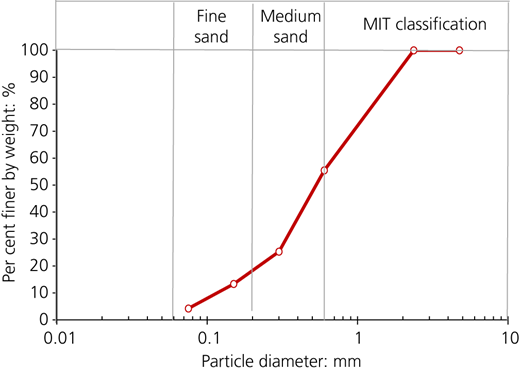
Grain size distribution of gypseous soil. MIT, Massachusetts Institute of Technology
Grain size distribution of gypseous soil. MIT, Massachusetts Institute of Technology
Physical properties of gypseous soil
| Property | Value |
|---|---|
| Maximum dry unit weight, γdry max: kN/m3 | 13.87 |
| Minimum dry unit weight, γdry min: kN/m3 | 11.42 |
| Median grain size, D50 :mm | 0.51 |
| Dry unit weight, γdry: kN/m3 | 13.2 |
| Coefficient of permeability, k: cm/s | 0.5 |
| Initial void ratio, e0 | 0.783 |
Strength parameters of untreated and treated gypseous soil
| Type of soil | Apparent cohesion, c: kN/m2 | Angle of internal friction, φ: ° |
|---|---|---|
| Untreated | 4 | 34 |
| Treated, 1% PF | 9 | 33.8 |
| Treated, 3% PF | 12 | 33.6 |
| Treated, 5% PF | 16 | 32 |
PF resins are used widely to stabilise mines and tunnels because they offer strong adhesion and firm foam. They are also used to stabilise disintegrated rock with a high void content and to fill smaller cavities. PF is supplied as a clear solution. It is a fast-foaming and solvent-free water-reactive polyurethane injection foam resin; thus, it can be injected as a liquid that then foams and expands to fill voids and smaller cavities in soil. Table 3 gives the properties of the PF material.
One-dimensional confined compression test
The behaviour of the treated gypseous soil with a PF content in the range 0.75–5% by weight of the dry soil was investigated. A reconstitution method was used to obtain the specimens for the test. Based on the dry unit weight of the soil specified previously, the mass of the gypseous soil required to fill a specified volume of the oedometer cell ring was determined. Then, the specimen was formed by tamping the soil in the form of three equal layers into a rigid confining ring, which did not allow any lateral displacement of the soil sample during the process of compaction or loading, to achieve the initial void ratio of 0.783 with a unit weight of 13.2 kN/m3. For the treated gypseous soil specimens, each prepared soil was mixed thoroughly with the required amount of PF in a liquid state by the weight of the dry soil and then compacted with three equal layers into the rigid ring.
A one-dimensional confined compression test (oedometer test) was performed by applying different loads and measuring the deformation response to a change in effective stress according to the ASTM D5333-03 (ASTM, 2003) specifications.
In the consolidation tests, step loads were applied to the soil up to an inundation stress, σ′w, of 200 kPa, at which the equilibrium void ratio was e1. At that pressure, water was introduced into the specimen for saturation and left for 24 h, after which the equilibrium void ratio at the same inundation stress σ′w was e2. The change in volumetric strain due to saturation is given by
where Δϵ is the change in volumetric strain, Δe is the change in void ratio and e0 is the initial void ratio.
For the treated soil, the PF material was added as a liquid; therefore, it was considered as a void in calculating the initial void ratio. Subsequently, collapse potential, CP, was determined at inundation stress (σ′w = 200 kPa) using
where ΔH is the change in the sample height and H0 is the initial sample height. The values of the collapse potential according to ASTM D5333-03 (ASTM, 2003) specifications are given in Table 4.
Collapse potential classification, according to ASTM D5333-03 (ASTM, 2003)
| Degree of specimen collapse | Collapse potential: % |
|---|---|
| None | 0 |
| Slight | 0.1–2.0 |
| Moderate | 2.1–6.0 |
| Moderately severe | 6.1–10.0 |
| Severe | >10 |
CBR test
The pavement design is based on pavement thickness as a cover that depends on the subgrade soil with a given CBR value to accommodate higher traffic loads. Therefore, in this study, the CBR experiments were carried out to evaluate the gypseous soil stiffness when treated with different amounts of PF.
The CBR tests were conducted according to ASTM D1883-16 (ASTM, 2016a) specifications, using the bearing capacity at optimum water content only method. The penetration resistance of the soil was determined at the optimum water content determined from the compaction test according to specifications. The treated soil was cured for 24 h before the test to ensure the distribution of the moisture for CBR stabilisation.
The plunger penetration with a constant rate of 1.27 mm/min was applied to the sample, and the load required to resist the plunger penetration was measured.
Physical model
Physical modelling is conducted to provide specific performance data for the design and analysis of footings on gypseous soil and to clarify the fundamental aspects of using PF for practical applications. The gypseous soil at the base of a structure can be exposed to moisture from several sources, such as broken water pipes, and the resulting settlement can cause considerable structural damage. Therefore, for such foundations, it is crucial to identify the settlement based on the ultimate bearing capacity (UBC).
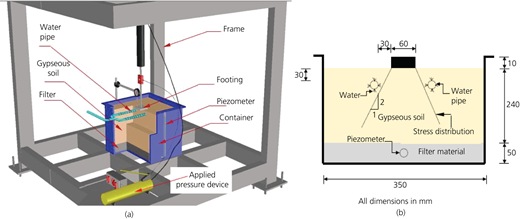
Load tests were carried out on untreated (PF = 0%) and treated (PF = 3%) gypseous soil to investigate the effects of PF on the UBC of gypseous soil. The physical model comprised a rigid foundation modelled by a square footing of size 60 × 60 mm in a steel container, with internal dimensions of 350 mm length, 350 mm width and 300 mm height, to avoid lateral yielding during the soil placement and loading of the foundation model.
The boundary effects during the test can be avoided by considering that the length of the test container must not be less than five times the footing width, such that the rupture zones are free and the interference from the sides is negligible (Ueno et al., 1998). In this study, the maximum available extent for the rupture zone was 2.5B on each side of the footing, and approximately 5B below the footing, with B being the width of footing. Moreover, during the test, the square footing selection reduced the dimensional effects (Adams and Collin, 1997).
At first, a 50 mm thick filter material was placed under the soil to prevent the erosion of soil particles while flooding the soil for saturation. The test container was filled with the soil of a total thickness of 240 mm divided into eight 30 mm thick layers for both treated and untreated soil using the dynamic compaction technique. For each layer, a specific volume of the container (a height of 30 mm with a cross-sectional area of the container) was filled with a mass of the soil, to satisfy a unit weight of 13.2 kN/m3 with the initial void ratio of 0.783, then compacted to the required height.
To perform the bearing capacity tests of the treated soil, the gypseous soil was treated at three different depths under the footing: 0.5B where the maximum strain in the soil occurred, B and 2B where the strain in the soil vanished. For each layer of the treated soil with a thickness of 30 mm, a mass of the dry soil was mixed with the PF material in liquid state and compacted within a specific volume of the container to satisfy a unit weight of 13.2 kN/m3. In this definition, because the PF material was mixed in a liquid state, the volume contained both solid particles of the soil and voids between soil particles.
The footing was placed on levelled surface at a predefined alignment so that the applied load transferred concentrically to the footing. After immersing the soil with water, a load increment was applied at a constant rate to the foundation according to ASTM D1196-12 (ASTM, 2016b) specifications, and the settlement of footing under the effect of the applied load was recorded. The moisture content of saturated treated and untreated gypseous were 30 and 33%, respectively.
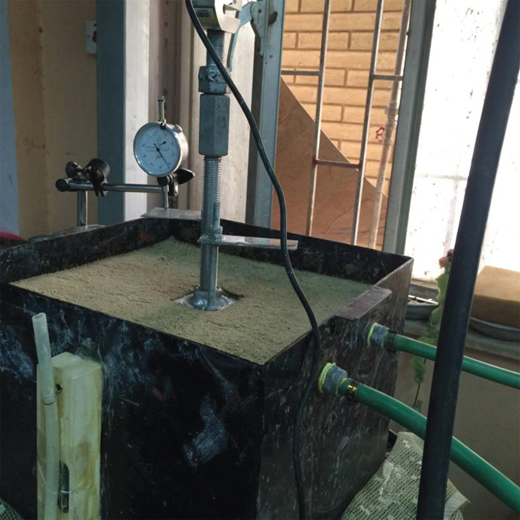
In the design of the test model, a network of water pipes of 10 mm diameter was placed at a distance of 30 mm from the edge of the footing and at a depth of 30 mm to be outside the rupture zone. During flow, the boiling phenomenon was prevented by specifying the pipe discharge and the seepage velocity as 1.76 ml/s and 1.34 cm/s, respectively. The height of water in the container was monitored using a piezometer. The detailed section of the physical model is shown in Figure 2.
Limitations
The bearing capacity ratio (R BC) presented in this study is based on a small-scale model, whereas the problems confronted in the field involve prototype foundations. Small-scale models are used widely to study the behaviour of full-scale foundations (Choudhary et al., 2010). The main differences between small-scale models and prototypes are their stress levels and the influence of the ratio of the footing width to the size of particles. Jha and Shukla (2015) stated that at low stress, the internal friction angle is higher than the friction angle at a higher stress level for granular soils, which is why the mobilised shear strength along a slip line under a foundation decreases with increasing footing size. The scale effect occurs in 1g modelling because of the variation in stress compared with the prototype. Although the use of small-scale models in predicting the behaviour of prototypes is limited, 1g modelling can be used to predict the general behaviour of foundations.
Another factor that should be considered is the scale effect due to the ratio of the footing width to the size of particles. For a footing subjected to central vertical loading, Okamura and Matsuo (2002) noted that the scale effect of the footing on the bearing capacity has been explored extensively by many experiments conducted at 1g as well as in geotechnical centrifuges. Ovesen (1979) investigated the scaling effects in centrifuge tests on models of footings in sand and found no scale effect on a footing model diameter (D) or width (B) larger than 30D 50. In the present study, the ratio B/D 50 was greater than 30; therefore, the influence of scale effects on the results of the physical model could be neglected.
Results and discussion
Compressibility and collapsibility behaviour
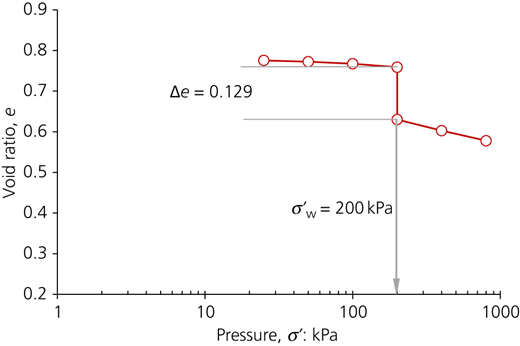
The results of the simple oedometer test on the samples of untreated gypseous soil shown in Figure 3 and gypseous soil treated with PF (Figures 4–7) are presented in the form of e plotted against log σ′, where e and σ′ are the void ratio and effective stress, respectively. Each specimen behaved differently under additional load after saturation.
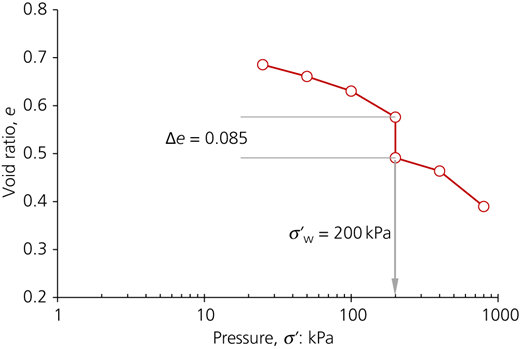
e plotted against log σ′ from simple oedometer test on soil with 0.75% polyurethane foam (PF)
e plotted against log σ′ from simple oedometer test on soil with 0.75% polyurethane foam (PF)
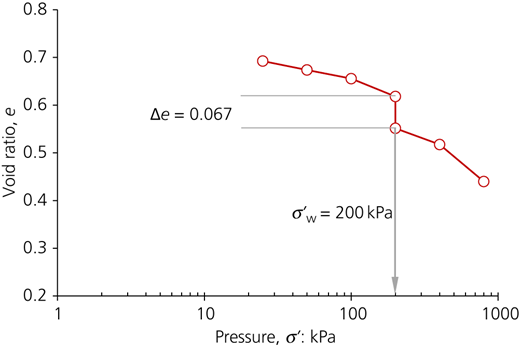
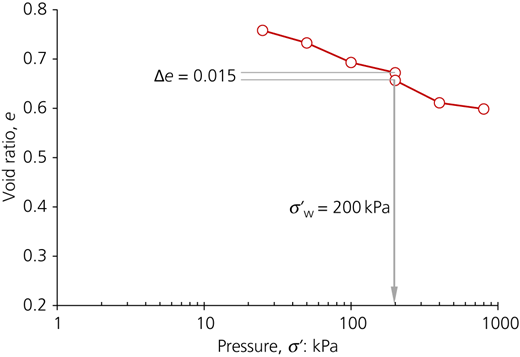
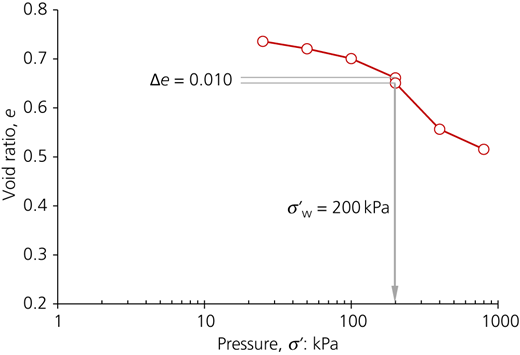
Figure 8 shows how the PF treatment affected the change in the volumetric strain of the gypseous soil. As can be seen, the volumetric strain decreases with increasing PF content, and the optimum value of 3% is when the curve reaches an asymptotic value.
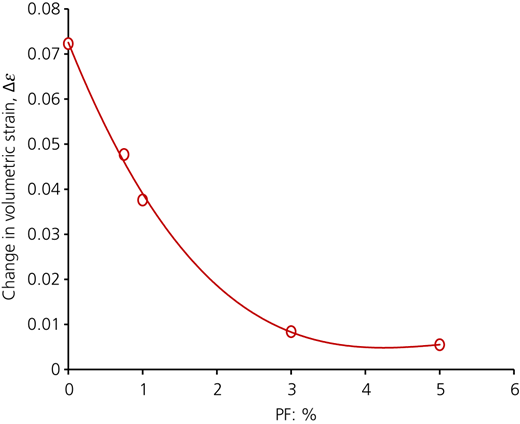
The results of the consolidation test show that the collapse potential changed from C p = 7.23% for the untreated soil to C p = 0.84% for the soil treated with 3% PF. The values of C P according to diverse criteria as given in Table 5 show that the collapsibility was improved from moderately severe to slight according to ASTM D5333-03 (ASTM, 2003).
Degree of collapse according to diverse criteria
| Type of sample | Collapse potential: % | Degree of collapse based on different criteria | |
|---|---|---|---|
| Jennings and Knight (1975) | ASTM D5333-03 (ASTM, 2003) | ||
| Untreated | 7.23 | Trouble | Moderately severe |
| Treated, 0.75% PF | 4.77 | Moderate | Moderate |
| Treated, 1% PF | 3.76 | Moderate | Moderate |
| Treated, 3% PF | 0.84 | No problem | Slight |
| Treated, 5% PF | 0.55 | No problem | Slight |
From the results of the one-dimensional confined compression test, it can be observed that there was a higher void ratio change (0.7 to 0.4) during pre-inundation loading for treated soil. This behaviour can be attributed to the fact that the PF material reacts with water and transforms to foam. In this case, it is considered as a solid particle in the voids; therefore, the value of the void ratio decreases due to the presence of those particles. This behaviour led to decrease in the permeability of the soil and an increase in the bearing capacity due to the cohesive effect between particles.
The collapse potential for gypseous soil with a moisture content of 33% was 7.23%, while for treated gypseous soil (PF = 3%) with a moisture content of 30%, the collapse potential was 0.84%.
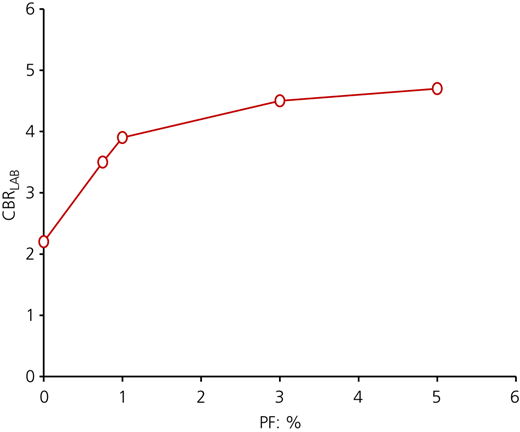
The penetration resistance of the soil samples according to the required force from the CBR test is shown in Figure 9. The CBR values corresponding to penetrations of 2.54 and 5.08 mm were calculated, and the larger value was taken as CBRLAB. The analysis of the CBR test results in Figure 10 shows how the CBRLAB value of the gypseous soil varied with PF content. With the optimum moisture content, the CBRLAB value of the gypseous soil increased with increasing PF content. The increase was more rapid up to 1% PF, and then CBRLAB reached its asymptotic value after 3% PF.
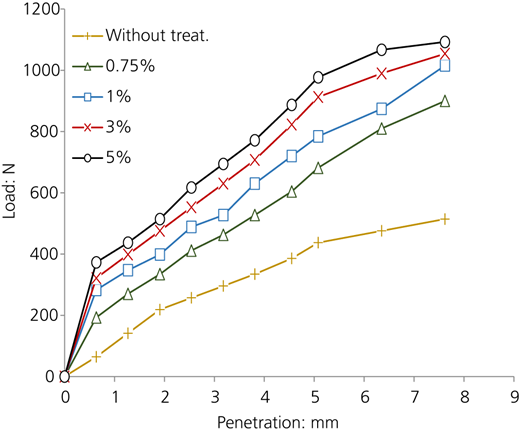
Load-against-penetration curves from CBR test on treated and untreated gypseous soil
Load-against-penetration curves from CBR test on treated and untreated gypseous soil
Bearing capacity behaviour
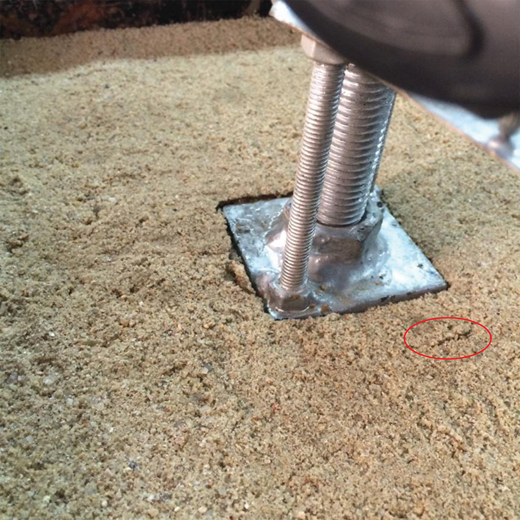
In this study, the tangent intersection method was used to determine the bearing capacity of the foundation. Trautmann and Kulhawy (1998) used this method to determine the load that corresponds to a particular change in the settlement. Figure 11 shows the normalised load–settlement curves of the treated and untreated gypseous soil. As can be seen, the UBC of the foundation on saturated untreated gypseous soil is lower than that on dry and saturated treated gypseous soil. Moreover, the failure is transformed from punching shear failure (Figure 12) to general shear failure (Figure 13). This behaviour is due to the solvent of salts present in the gypseous soil upon saturation with water, which can affect the bonds between particles, resulting in soil dissolution and leading to possible subsidence and cavity formation.
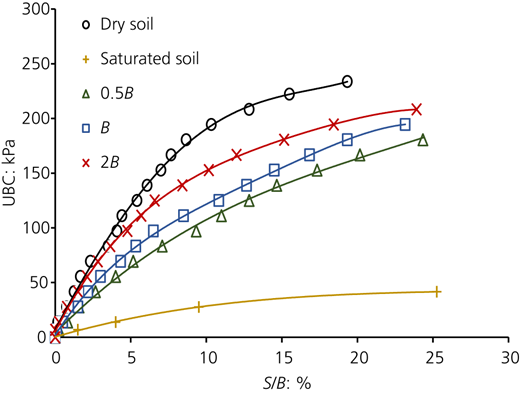
The experimentally obtained results were analysed to determine a non-dimensional parameter called the bearing capacity ratio (R BC). This parameter estimates the UBC of the footings on the surface of treated gypseous soil with PF. The R BC is defined as the ratio of the UBC of saturated treated gypseous soil (q T) to that of dry untreated gypseous soil (q ult). According to the experimental data plotted in Figure 11, the values of R BC are 0.5, 0.75 and 0.8 for foundations on gypseous soil treated at depths of 0.5B, B and 2B, respectively.
The theoretical UBC of a square footing on the surface of a dry soil can be calculated using the following equation (Terzaghi, 1943):
The theoretical UBC of a square footing of different widths can be calculated by substituting the values of the shape factors, s c and s γ, of a square footing and the bearing capacity factors, N c and N γ. Based on the bearing capacity ratio, the theoretical UBC of the foundation on saturated treated soil can be related to that calculated from Equation 3 by using the bearing capacity ratio (R BC) which depends on the treated layer depth. Accordingly, the ultimate bearing capacity of the saturated treated soil (q T) can be calculated directly by multiplying a bearing capacity ratio (R BC) by the bearing capacity of the footing (q ult):
Effect of polyurethane foam
The results obtained in this study indicate that treating gypseous soil with PF minimises the volumetric strain change compared with pure gypseous soil. The behaviour of gypseous soil in terms of collapse potential and strength improves when the soil is treated with PF. This behaviour can be attributed to the foam providing a water-proofing coat around the gypseous soil particles and preventing structural collapse under saturation. The foam also provides a cohesive bond between the gypseous soil particles.
Practical applications
The soil grouting with liquid materials could be recognised as a solution for gypseous soils at various depths in-site (Mori et al., 1989). Therefore, in view of practical applications to improve the behaviour of gypseous soil, polyurethane foam grouting is advisable because it allows the volumetric strain of the treated material to be minimised and reduces the collapse potential. From this study, PF = 3% of the dry unit weight of the soil seems to be able to improve the behaviour of gypseous material under saturation and loading conditions; the collapsibility was improved from moderately severe to slight.
Conclusions
This paper has presented an alternative novel material for improving the collapsible soil behaviour. An experimental laboratory campaign and a physical model were used to analyse the main effects of treating collapsible soils with PF. The effectiveness of the treatment on the change in the volumetric strain of the soil was shown by a one-dimensional confined compression test (oedometer test). The effects of PF on the strength under the effect of static loading were then evaluated by means of a CBR test. Also, a physical model of footings on treated and untreated collapsible soil was used to provide a theoretical approach for the design and analysis. According to the obtained results, the following conclusions are drawn.
Filling the collapsible soil’s pores with PF foam improves its behaviour under saturation and loading.
The results of the direct shear tests indicate that the PF liquid affects the shear strength parameters of the gypseous soil by increasing the apparent cohesion and the angle of internal friction relatively decreased.
The results of one-dimensional confined compression test showed that the change in volumetric strain of treated collapsible soil is less than the untreated soil, and 3% PF content reduces the volumetric strain considerably.
The collapse potential of gypseous soil treated with 3% PF is reduced to less than one, which generally means no problems for foundations.
Because the CBR of soil measured in the laboratory provides an index for the soil strength, the present study shows that 3% PF content is effective in collapsible soils.
There is a considerable increase in the value of the UBC of foundations when the underlying collapsible soil that is liable to moisture is treated with 3% PF. The increase in UBC depends on the depth of the effective treatment zone.
In conclusion, regarding practical applications, 3% PF can be used to improve the behaviour of collapsible soils under saturation and loading, and the behaviour does not improve further significantly as the PF percentage is increased above this threshold. Also, it provides a theoretical approach to determining the theoretical UBC of footings on treated collapsible soils.

