

This paper aims to evaluate the construction supply chain (CSC) by examining its relationships with various key areas and its development, identifying gaps and outlining potential future research directions that affect the implementation of CSC standards during the timeframe of the United Nations’ “Decade of Action” plans in the past two decades.
This paper reports on a systematic literature review with bibliometric analysis that investigates publications from around the world on various aspects of CSC. These aspects include research methodology/data collection technique, inquiry mode, country-specific research, focused areas of study, the research aims and publication periods.
The findings of the study reveal that information technology, information sharing, collaboration, performance measurement and CSC configuration have received considerable attention and analysis. However, financial management, supply chain resilience, logistics, vendor managed inventory and rural CSC have been identified as significant areas that require further investigation since limited attention has been given to them in the existing literature.
CSC is a very dominant topic in the current study, but there are some limitations to it. Scopus and Web of Science databases were used to conduct the study. A future study can therefore consider papers related to other databases. As the focus was specifically dedicated to construction material SC only, the papers associated with SCs of labours and equipment have been eradicated.
To the best of the authors’ knowledge, this is the first structured and systematic literature review that identifies the issues related to the CSC during the timeframe of the United Nations’ “Decade of Action” plans and proposes future research directions to enhance the effectiveness and efficiency of CSC.
1. Introduction and background
A vision of sustainability, development and economic growth was outlined in the United Nations’ “Decade of Action” plan in 2000 to achieve the highest number of outputs in industries, innovations and infrastructure with economic growth. In 2010 and 2020, it has been continued as the next phase of the plan (Decade of Action, 2020). Economic growth is typically measured by the annual percentage change in gross domestic product (GDP) (Henderson et al., 2011). The construction industry is a significant contributor to the GDP of most nations and is continuously growing (Onat and Kucukvar, 2020). Therefore, many countries seriously promote their construction sector for rapid economic development (Darko et al., 2019; Enshassi, 2000). The construction industry in the USA, the United Kingdom, Japan, India and China represents approximately half the global construction output (World Bank, 2011). While developed economies like the United Kingdom, the USA and Japan have recently increased their focus on the construction sector, developing economies like India and China are rapidly catching up (Marsh, 2021). The construction industry provides significant employment opportunities for both skilled and unskilled labour, particularly for daily wage labourers, and is the second-largest employer in many developing nations (Farooqui et al., 2018; Goel et al., 2019). Despite this, the construction sector faces several challenges, such as poor coordination among project stakeholders, fragmented raw material supplies and poor traceability, resulting in delays, wastage and quality issues (Mohd Nawi et al., 2014), making the construction industry complex and underperforming (Yeo and Ning, 2006). To address these challenges, modern management practices such as supply chain management (SCM) can be used to make construction a continuous and project-based industry, ensuring the timely completion of projects and client satisfaction (Eriksson, 2010).
Although the application of SCM practices was introduced in the construction industry in the late 1980s (Vrijhoef and Koskela, 2000), the combined approach of SCM in construction, referred to as Construction Supply Chain Management (CSCM), gained the momentum in the mid-2000s (Abas et al., 2020). The CSCM offers operational, strategic and tactical planning in the construction project to achieve a better relationship with stakeholders and high operating efficiency (O’Brien et al., 2008). The CSCM also reinforces the construction sector through effective communication, collaboration, integration and coordination among all stakeholders (Segerstedt and Olofsson, 2010). The major challenge for the CSCM is to understand the system due to its complex, fragmented and dynamic nature (Cheng et al., 2010). Thus, developed nations have identified the different perspectives and challenges of CSCM to make it more responsive (Chen et al., 2020), while the developing nations have confined research concerning the CSCM (Abas et al., 2020; Singh et al., 2022). Many remarkable literature reviews in the construction industry over the past year have improved resource use and client service, including decision-making, performance enhancement, risk assessment, outsourcing and partnerships (Le et al., 2020).
There are a few issues with CSCM practices raised by various construction organisations in developing nations, including incorrect forecasting of raw materials and improper storage of fragile construction materials like bricks, glass and tiles (Gunarathne et al., 2021). The studies related to CSCM practices are in a nascent stage and need to be properly analysed and discussed from a supply perspective. Hence, there is an urgent need for a comprehensive and systematic review of the status to ensure the appropriateness of the CSC (Chen et al., 2020).
The study addresses the following research questions:
How has the academic literature addressed the intersection of materials in CSC and the construction industry?
What are the main emerging research topics in this area, and how are they interconnected?
What are the critical areas where improvements are required in the construction industry?
2. Literature work
2.1 Connotation of construction supply chain
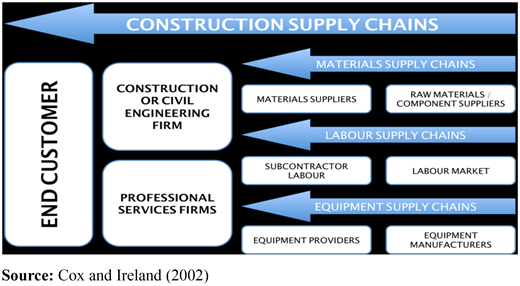
In CSC, materials and equipment related to construction are produced, transported and used, while manpower is appointed on a permanent or contractual basis. The CSC starts with the three parallel echelons, namely, material supplier, manpower/labour contractor and manufacturer of equipment, and ends at the client (user) to meet a need through a particular delivery channel; these are said to be types of CSC as shown in Figure 1. The implementation of CSC offers total SC profitability through the quality of transformative ideas, increasingly advanced with modern tools and techniques, which involve all three SC flows (material, information and cash) between upstream members and downstream members (Ha and Krishnan, 2008).
2.2 Review methodology
A systematic review is a methodical and structured approach to reviewing the literature on a specific subject instead of conventional or narrative reviews (Dixit et al., 2019; Kumar and Singh, 2022). It involves a comprehensive and systematic search of relevant literature and a critical appraisal and synthesis of the evidence. Systematic reviews are designed to minimise bias and provide a transparent and reproducible process for synthesising the evidence on a specific research question.
2.2.1 Data-collection.
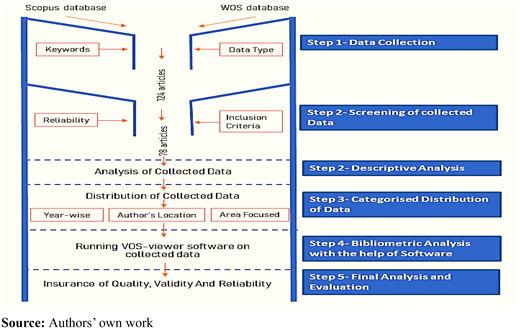
The data for this study were collected through an extensive literature review process. The Scopus and Web of Science databases were used to identify high-quality research articles related to the topic. Using three primary keywords, namely “construction supply chain”, “supply chain in construction” and “supply chain in civil”, a total of 124 significant and relevant research papers published between 2000 and 2020 were selected for analysis.
2.2.2 Data-selection.
124 significant and relevant research papers were downloaded in a year-wise format with the help of Mendeley’s software. Many papers were found with the keyword “construction supply chain”. After the primary phase of the search of the papers from 2000 to 2020, 78 research papers were finalised. In the present study, the major attention was dedicated to the materials in CSC. At the same time, the papers associated with the labour SC and equipment SC have been eradicated (as mentioned in the PRISMA framework, Figure 1). Figure 2 shows the complete systematic literature review process with a downward flow diagram, and Table 1 shows the overall criteria for data collection and selection.
Data collection and data selection criteria
| Criteria | Inclusion | Exclusion | Reliability |
|---|---|---|---|
| Data source | Reliable databases: SCOPUS and WoS | Unreliable source(s) | Ensure academic requirements and reliability of the source material |
| Data type | Papers published in prestigious peer-reviewed journals and international conferences | Editorial papers, professional guidelines, assessment reports | Ease of validation for material’s reliability |
| Publication period | From 2000 to 2020 | Out of period | Includes all CSC changes and updates |
| Keywords | Papers, book chapters and articles mentioned described and analysed the keywords’ content | Articles only mentioned the keywords | Assurance of articles’ content in terms of reliability and suitability |
3. Analysis and classification of the data
A critical analysis of all the selected data are presented in this section, along with some of its findings and discussion, which are classified under different aspects:
3.1 Based on the research methodology
Papers are sorted into three types, i.e.:
Empirical: Empirical research refers to the collection of comprehensive data, author perspectives and fundamental information to formulate and validate theories through experimentation and testing;
Case study: A case study is a detailed account of real-life experiences and contributions within a specific group or industry; and
Literature review: A literature review is an extensive and systematic analysis of the existing body of literature on construction project management that explores different approaches and perspectives while considering the various stages of development in the field.
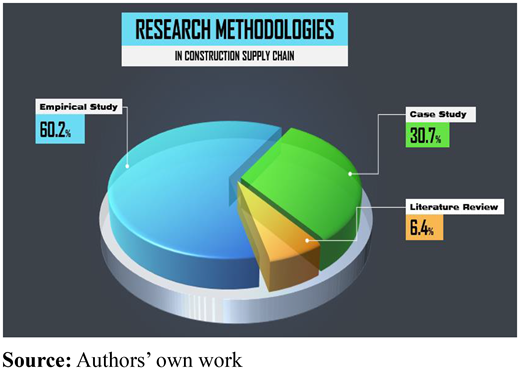
Different authors incorporated various research methodologies into their research papers. Figure 3 shows that 60.2% of papers are related to empirical studies. Different authors incorporated various research methodologies into their research papers, and many authors proposed a selection of new methodologies to foster various aspects of CSC. Figure 3 also discloses that very few papers were performed on literature reviews on CSC (approximately 6%), while case study holds the second position with 30.7% of research papers.
3.2 Based on region
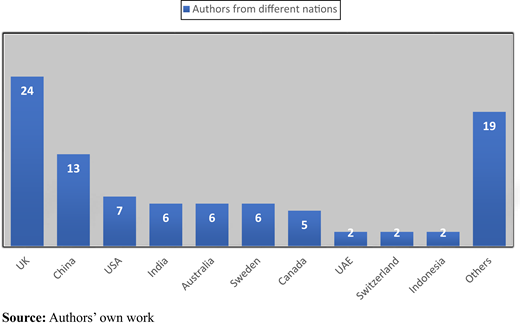
Figure 4 shows that research work on CSC by authors across various nations is completed in developed nations, developing nations and under-developing nations. It is noticed that most of the studies originated from UK, China and USA. The works from developing nations like India and China focus on their agility, overall performance measurement, accessibility, etc., while the least researchers focused on CSC in rural areas. Researchers from developed nations such as UK, Sweden and USA are focusing on the various techniques associated with problems of CSC, such as information technology (IT), logistics, tracking, information sharing (IS) and costing (Briscoe and Dainty, 2005).
3.3 Based on the inquiry mode
The systematic review of the literature is also explained by the appropriate inquiry mode in which data are collected, analysed and interpreted. The inquiry mode recommends researchers’ suitable methodology and techniques. Based on the inquiry mode analysis, papers on CSC are classified into three types. i.e.:
Qualitative research: It is a deliberate and purposeful approach aimed at obtaining critical data for a specific sector, institution or event rather than collecting superficial explanations based on the general population;
Quantitative research: Quantitative research is a systematic and practical study of social phenomena using statistical, mathematical or computational methods; and
Mixed research: Mixed-methods research is a strategic research approach that involves collecting, analysing and integrating both qualitative and quantitative data to understand research topics from multiple perspectives.
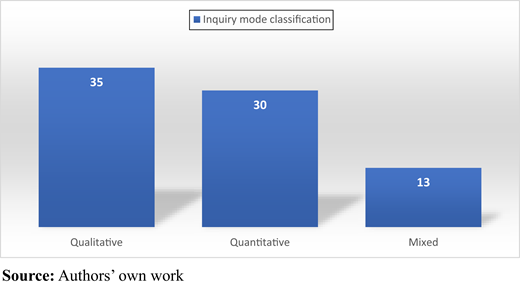
Figure 5 shows these classifications in a bar graph manner, and the exact reference of papers is shown in Table 3. Researchers’ focus is seen to be qualitative research, followed by quantitative research; 35 papers are qualitative, 30 papers are quantitative and 13 papers are mentioned mixed research (both qualitative and quantitative) out of 78 research papers. Both qualitative and quantitative content analysis are approached to support each other to achieve effective research results.
Distribution of literature based on research aim and data collection method
| Author(s) | Research type | Research aim | Methodology type |
|---|---|---|---|
| Golpîra (2020) | Empirical | Develop an original integer mixed linear programming to integrate VMI strategy into common problems of multi-project and multi-resource CCS network design with minimum cost | Quantitative |
| Getuli et al. (2016) | Empirical | Monitor the construction activities with the help of cloud computing and BIM | Quantitative |
| Xie et al. (2010) | Case study | Investigate how constructive design in CS partnerships could be improved by communication issues | Qualitative |
| Love et al. (2002) | Case study | Examine the advantages of long-term strategic alliances | Qualitative |
| Tamošaitiene et al. (2017) | Empirical | Investigate the inherent interconnectivity of the processes | Qualitative |
| Zhou et al. (2019) | Empirical | Identify the suitable strategy to implement prefab houses in rural areas | Quantitative |
| Cheng et al. (2010) | Empirical | Examine the role of flexible coordination of CSC by Web technology | Quantitative |
| Shin et al. (2011) | Empirical | Develop an integrated information management framework that could provide stakeholders with logistical information for decision-making | Quantitative |
| Kim and Nguyen (2018b) | Empirical | Explore the relational characteristics of the CSC and their impact on performance | Qualitative |
| Xue et al. (2005) | Empirical | Finding problems in SC to solve these problems and improve build performance, an agent-based framework for coordinating SC build is designed based on the technology of agents and multi-attribute negotiation and multi-attribute utility theory | Qualitative |
| Kim and Nguyen (2018a) | Empirical | Evaluate CSC Relationships by an AHP Framework | Qualitative |
| Wang et al. (2007b) | Case study | Presents a combined fundamental method of selecting partners by value assessment and performance evaluation | Qualitative |
| Naim and Barlow (2003) | Empirical | Explore the lean and agile SC strategy for customised housing | Quantitative |
| Das et al. (2015) | Empirical | Classifying stream information with long the CSC and integrating SCs into a centralised collaboration system | Quantitative |
| Demiralp et al. (2012) | Case study | Explore the approaches to solve the problems by RFID in the construction sector | Mixed |
| Bajpai et al. (2016) | Empirical | Identify issues for slowing down road construction and aids SC reconfiguration and reorganisation | Qualitative |
| Ahmed et al. (2020) | Empirical | Assess the barriers and opportunities faced by green SCM in the construction sector of developing nations | Quantitative |
| Shemov et al. (2020) | Case study | Emphasise the role of blockchain as a possible solution to CSC’s challenges, regardless of the risks associated with the security and robustness of information flows and privacy | Case study |
| Thunberg and Fredriksson (2018) | Empirical | Explore how to explain the relationship between common issues in CSC and how to deal with them through proper planning | Qualitative |
| Saini et al. (2019) | Empirical | Investigate potential challenges that impede the effective transmission and sharing of tacit knowledge | Qualitative |
| Meng (2013) | Empirical | Investigate the changes in UK construction by SC collaboration | Qualitative |
| Briscoe et al. (2004) | Empirical | Investigate the client’s role in ensuring a higher level of SC integration | Quantitative |
| Xue et al. (2011) | Empirical | Measure the value of IS across various inventory policies to improve the management of CSC materials and equipment | Quantitative |
| Pan et al. (2011) | Case study | Develop performance assessment methods to help improve Management in CSC | Qualitative |
| Briscoe and Dainty (2005) | Case study | Measure the issues encountered to combine SCs into UK enterprise and contexts of the SC control partnering | Quantitative |
| Briscoe et al. (2001) | Case study | Examines the skills required for an effective SC partnership in the UK construction industry | Qualitative |
| Davis (2008) | Empirical | Establish the influence of relational variables on CSCs. | Quantitative |
| Wang et al. (2007a) | Empirical | Develop an RFID-based dynamic SC management system (MConRDSCM) for mobile construction to improve the efficiency and economy of project management and improve practical communication between stakeholders, delivery time and project response | Quantitative |
| Fernie and Thorpe (2007) | Empirical | Explore the changes in CSCM | Qualitative |
| Ofori (2000) | Empirical | Explores the possibility of applying SCM to mainstream Singapore’s construction process, thereby addressing pressing issues, including the weaknesses of the environment | Qualitative |
| Ismail (2020) | Empirical | Examine the role of a hybrid intelligent vehicle system for CSCM in the precast concrete building | Quantitative |
| Chen et al. (2020) | Case study | Identify the enablers for coordination across CSC processes | Qualitative |
| Ekanayake et al. (2020) | Empirical | Examines how SCR can be enhanced through defining relevant and relevant SC capabilities (SCCs) that companies build. It should then be maintained and/or further developed | Quantitative |
| Seth et al. (2018) | Case study | Focuses on the SC of a large scale that illustrates the role of competitiveness and supplier profile and its influence on supplier evaluation based on supply and condition. Current market conditions | Qualitative |
| Pala et al. (2016) | Case study | Implement the commercial information exchange on CSC | Qualitative |
| Bag et al. (2018) | Case study | Measure the effect of the adoption of Industry 4.0 and SC sustainability | Qualitative |
| Edum-Fotwe et al. (2001) | Empirical | Identify the information procurement practices of key actors in CSC | Qualitative |
| Yildiz and Ahi (2020) | case study | Develop an innovative decision support model for CSC performance management using a variety of methodologies | Quantitative |
| Irizarry et al. (2013) | Empirical | Investigate the role of BIM and GIS integration in improving CSCM visual monitoring | Quantitative |
| Ding et al. (2015) | Empirical | Explore the key factors for the adoption of BIM in construction drawings by architects | Qualitative |
| Cox and Ireland (2002) | Empirical | Develop a theoretical framework to understand the industry structure and its composition, buyer attributes and supplier power; the appropriateness of a particular relationship depends on the position of the company’s power in CSC | Qualitative |
| Titus and Bröchner (2005) | Case study | Provide a better understanding of construction procurement and information flow model development in the SCM framework | Quantitative |
| Motawa and Kaka (2009) | Empirical | Introduce a computer system designed to model various payment mechanisms so that SC stakeholders can determine the appropriate payment mechanism | Quantitative |
| Tennant and Fernie (2013) | Empirical | Examine current organisational theory and practice in UK CSC | Quantitative |
| Le et al. (2020) | Literature review | Explore the future direction of decision-making in CSCM | Mixed |
| Zhai et al. (2017) | Empirical | Describe a coordination scheme to solve production lead time hedging (PLTH) coverage issues in prefabricated SCM | Quantitative |
| Khalfan et al. (2001) | Empirical | Improve the concurrent engineering deployment plans to conduct a preparatory assessment of the organisation and its SC participants to determine willingness to adopt competitive engineering techniques | Qualitative |
| Kumaraswamy et al. (2000) | Empirical | Shows the aspects of choice in CSC optimisation | Quantitative |
| Duryan and Smyth (2019) | Empirical | Explore the functional feature for knowledge management between projects and stakeholders within an organisation, with customer and customer’s SC service design at the program level | Mixed |
| Hatmoko and Scott (2010) | Empirical | Develop a model for quantifying the impact of CSC delays on the performance | Quantitative |
| Ebrahimy et al. (2011) | Empirical | Develop a simulation model that can capture complex variables that affect the productivity of tunnelling projects | Mixed |
| Al-Bazi and Dawood (2012) | Case study | Develop an innovative team allocation system that could efficiently assign groups of workers to iterative and labour-intensive processes | Quantitative |
| Romagnoli et al. (2019) | Literature review | A detailed review of the Wood SC from forest to end consumption point | Mixed |
| Yan and Zhangong1) | Case study | Examines the main issues of implementing this IT-based LCSCM model, including building node businesses in lean SCs and establishing linkages in lean procurement SC between parties | Qualitative |
| Briscoe et al. (2004) | Case study | Highlights the subcontractor concerns lead to fundamental mistrust and scepticism in existing relationships in the SC | Qualitative |
| Neeraja et al. (2014) | Case study | Highlights the importance of logistics in SC in present-day business development | Qualitative |
| Albaloushi and Skitmore (2008) | Empirical | Explore the SCM in the UAE Construction industry | Mixed |
| Park et al. (2011) | Empirical | Develop an SCM model for ready-mixed concrete | Mixed |
| Čuš-Babič et al. (2014) | Case study | Explain how to make CSC more transparent by using IT/IS | Mixed |
| Zainal Abidin and Ingirige (2018) | Empirical | Investigate this dynamic by assessing critical vulnerabilities and the ability of SC to shape resilience in managing disruption events in projects | Qualitative |
| Wang and Shi (2019) | Empirical | Promote knowledge sharing based on the monitoring mechanism among member companies of Industrial CSC | Mixed |
| Vidalakis et al. (2011a) | Empirical | Improve the understanding of CSC by examining the applicability of construction work and production valuation from the perspective of construction logistics and by examining the logistics capabilities of merchants | Quantitative |
| Aloini et al. (2012) | Literature review | Investigation of risk factors influencing the implementation of SCM principles | Qualitative |
| Broft et al. (2016) | Empirical | Expand existing discussions by adopting an alternative approach that focuses specifically on the internal SCM organisations of the main subcontractors and their interrelationships | Quantitative |
| Feng et al. (2018) | Empirical | Optimise the global equilibrium in construction | Qualitative |
| Love et al. (2004) | Empirical | Investigate the implementation of management in CSC | Quantitative |
| Manikandan et al. (2020) | Case study | Focuses on sustainable business practices in CSC | Quantitative |
| Wibowo and Sholeh (2015) | Case study | Measure the performance of the SC using the SC Operations References model | Quantitative |
| Vrijhoef and Koskela (2000) | Empirical | Clarify the role and potential of management in CSC | Qualitative |
| Bäckstrand and Fredriksson (2020) | Mixed | Brings knowledge about coordination within the CSC and how lack of information can affect the operations | Mixed |
| Barker et al. (2000) | Empirical | Assess individual business processes and whole SCs | Qualitative |
| Singh and Misra (2020) | Empirical | Identify the factors and their relative importance in implementing the Green SC Management (GSCM) process | Quantitative |
| Bankvall et al. (2010) | Case study | Consider the management of CSCs, focusing on the different types of dependencies that exist in construction projects | Qualitative |
| Mojumder and Singh (2021) | Case study | Study the adaptability of GSC practices by various categories of Indian construction companies, followed by finding the correlation of enablers, drivers and barriers | Mixed |
| Abas et al. (2020) | Empirical | Identify key risks and success factors affecting SC performance in construction projects in Pakistan | Qualitative |
| Saad et al. (2002) | Literature review | Examine the early progress and adoption of “5G innovation.” | Mixed |
| Eriksson (2010) | Case study | Improve SC collaboration and performance is central to achieving short-term business goals and long-term competitive advantage | Qualitative |
| Segerstedt and Olofsson (2010) | Literature review | Discuss and show some possible similarities between traditional manufacturing and its SC | Qualitative |
3.4 Based on the time-period (in years)
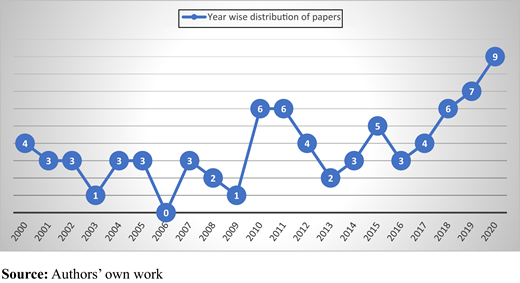
Figure 6 depicts the yearly distribution of research endeavours over a span of two decades, ranging from 2000 to 2020. It is apparent from the chart that the preponderance of research papers was published in the most recent decade, specifically between 2010 and 2020. Furthermore, the graphical representation in Figure 6 displays a discrete pattern, suggesting that researchers were not consistently engaged in the study of the CSC.
3.5 Based on regional area (rural area and urban area)
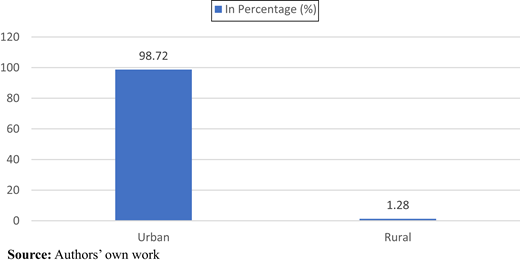
Figure 7 illustrates that a majority of research on the CSC was conducted in urban areas, either individually or collectively, while considering both urban and rural areas. It is noteworthy that the number of research papers focusing solely on rural areas is significantly lower in all countries.
3.6 Based on the research area focused
A total of 19 different areas have been identified and ranked accordingly based on the highest number of paper counts to the lowest manner to identify less focused areas (critical areas); if two or more areas found an equal number of paper counts, then the earliest study performed (date of publishing) is considered highest ranking, as shown in Table 2. It has been observed that primary attention is given to the IT, IS, collaboration, performance measurement and CSC configuration in most of the research, while financial management, supply chain resilience (SCR), logistics, vendor managed inventory (VMI) and rural CSC (RCSC) are considered important, but little work has been done; however, these areas can play a critical role.
Distribution of the references on various aspects of the CSC area
*Ranking is given from the highest number of papers to the lowest manner. In case two or more areas found an equal number of papers, then the earliest study performed on that area (date of publishing) is considered the highest ranking
3.7 Based on research aims and methodologies
A total of 78 research articles on CSC were analysed, and the research aim and data collection methodology of all the articles were mentioned in Table 3. It was noted that the research aims are distributed to different extents of CSC.
4. Critical analysis of the significant areas of construction supply chain
To enlighten the significant areas of CSC, a critical-analysis approach was adopted. Based on the data output from Table 2, various significant areas and major issues of CSC are highlighted and discussed in detail.
4.1 Information technology
IT in SCM plays an important role in optimising the flow decisions of a supply network to attain organisational competitiveness, reduce inventory, improve service levels and cost and reduce e-risks (Yan and Zhangong1, 2012). Similarly, IT in CSC also provides effective integration and sharing of information within and outside organisations (Cheng et al., 2010; Getuli et al., 2016). CSC uses numerous applications of IT like RFID, EDI, barcode, e-commerce, business intelligence support systems, ERP packages, etc., to enhance its performance (Demiralp et al., 2012; Wang et al., 2007a). The merits have already been proved in the two areas of construction (Modular Integrated Construction) to reduce the risk of CSC (Al-Bazi and Dawood, 2012). Hence, the implementation of an advanced IT system in the CSC has a scope of future work for reforming and advancing the CSC.
4.2 Information sharing
The role of the information system is to deliver the aggregate and relevant information to all stages of CSC at the right time (Wang et al., 2007a). The efficient IS among the stakeholders (such as the client, suppliers, consultant, contractor and sub-contractors) of CSC improves the performance of CSC by developing the ability to take the right decisions, increase visibility at every stage and reduce the operating cost (Irizarry et al., 2013; Das et al., 2015; Pala et al., 2016). Although the IS among the stakeholders of CSC is a complex task (Saini et al., 2019; Xue et al., 2011), nowadays, the IS has become easier with the advancements in IT (Das et al., 2015; Irizarry et al., 2013; Shin et al., 2011).
4.3 Collaboration and partnership
It is ideal if the SC delivers the services at the right price, quantity and time. To achieve this, CSC has adopted several strategies (Eriksson, 2010). Among these strategies, collaboration and partnership are identified as crucial (Meng, 2013). Collaboration and partnership in CSC can reduce costs, improve responsiveness to change and facilitate decision-making (Das et al., 2015). Hence, the CSC should develop a collaboration and partnership system to enhance the efficiency and productivity of the system.
4.4 Performance measurement
The business environment for the construction sector has become difficult, and its growth relies on continuous performance measurement in globalisation (Yitmen, 2007). Performance measurement is an integrated approach for monitoring and controlling an organisation’s activities to achieve its objectives (Wibowo and Sholeh, 2015). There are different ways for performance measurement of the SC Operations Reference model (Pan et al., 2011; Wibowo and Sholeh, 2015; Yan and Zhangong1, 2012; Yildiz and Ahi, 2020); analytic hierarchy process (AHP) (Seth et al., 2018), DEMATEL-modified analytic network process (Yildiz and Ahi, 2020), data envelopment analysis (Tatari and Kucukvar, 2012a), etc. The major problem that occurs with the performance measurement of CSC is not considering every associated aspect. Therefore, the CSC should develop a holistic performance measurement system to monitor and evaluate the system.
4.5 Supply chain resilience
SCR has developed as a core element in SC risk management as a strategy to protect against SC risks and disruptions. Resilience can be defined as “the adaptive capability of a system to respond to disruptions in a better way or even gain an advantage during disruptive events” (Romagnoli et al., 2019). After a natural disaster, resilience becomes more important. A natural disaster may increase the cost, delay construction, lower quality standards, etc., at the CSC. CSC network vulnerability is reduced by SCR (Ekanayake et al., 2020). Table 2 shows only two papers are related to SCR in CSC, which started in 2018. Although SCR is an important research topic for CSC in the current volatile natural conditions, it is in a nascent stage.
4.6 Vendor managed inventory
Vendor Managed Inventory (VMI) works together with the upstream and downstream members to attain an efficient SC by reducing the bullwhip effect. VMI is an effective solution for responding to the volatile demand for construction materials on sites (Golpîra, 2020). Only a single scholarly work related to VMI in CSC has been conducted, while few papers demonstrate the role of VMI in the construction sector in specific (Golpîra, 2020). It is demanded to implement the VMI approach in CSC.
4.7 Logistics
Logistics management is the management of the flow, storage and information of materials across SCs (Vidalakis et al., 2011b). The logistics cost is exponentially related to the levels of material demand and movement of vehicles. Although construction logistics is a critical part of CSC (Ying et al., 2014), the research dedicated to logistics application in the construction sector is in a nascent stage, and it is a prerequisite to understanding the elementary problems of CSC (Vidalakis et al., 2011a). However, Ekeskär and Rudberg proposed the third party logistic solution to facilitate productive work at the construction site itself, a reduction of costs and increased use of site assets (Ekeskär and Rudberg, 2016). The papers related to logistics in CSC are available in the literature, as shown in Table 2, which also recommends future work in this direction.
4.8 Rural construction supply chain
The International Fund for Agricultural Development (IFAD) has reported that 45% of humanity lives in rural areas of developing countries and that the rural region plays a vital role in improving productivity, achieving socioeconomic equality and fostering ambition and stability. (Abas et al., 2020; IFAD “Rural Development Report 2021”). Construction in the rural area is considered of top importance for any developing nation’s development process (Mishra 2017). It can be achieved by the highly efficient RCSC. However, it is clear from Table 2 that only a single paper has been published in this area until 2020. Thus, RCSC is highly important, especially for developing countries, and has a lot of potential to strengthen the construction economy in general and rural in specific.
5. Bibliometric analysis
The study uses bibliometric analysis to visualise the latest trends and recent hotspots on CSC and includes four sub-parts: overlay mapping for authors (including co-authors), research areas, major repeating keywords in titles and abstracts in all referenced papers and a density map of major keywords in all papers, further illustrating the study results.
5.1 Collaboration mapping of authors
Figure 8 shows the following key points regarding the mapping of authors who published their notorious work on CSC:
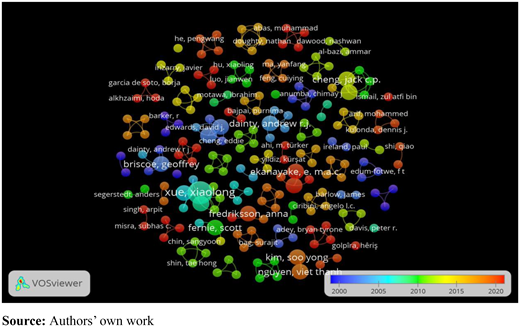
Bibliometric concatenation of all 211 authors (including co-authors) referenced in this work with the help of VOS-viewer in a systematic network of related and linked keywords depending on the work area;
The overlay of all publications and colour scales from 2000 to 2020 by which it can be easily checked that most of the colour is red or near to red (orange, reddish, maroon, etc.), which indicates that major research work has been done in recent years; and
Very few circles are inter-connected, which implies a lack of collaboration among researchers.
5.2 Overlay mapping of frequently used keywords
5.2.1 Mapping of frequently used keywords in the whole paper.
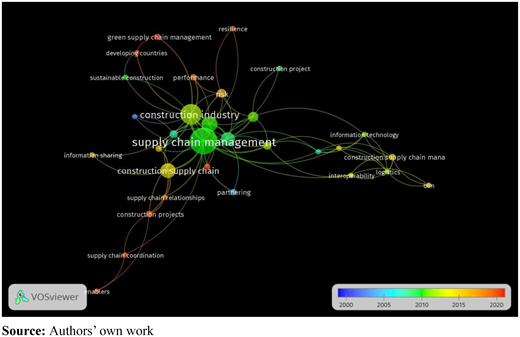
In total, 18 keywords appear most often in this study (repeating more than or equal to two papers). An overlay visualisation of the keyword co-occurrence networks map (Figure 9) shows that some keyword circles are big, and most of the work done on those keywords like “supply chain management” and “construction industry”, which are widely used as a keyword in green colour and red colour on the scale, represents keywords like “green supply chain management”, “enablers”, “resilience” and “developing countries” that have only appeared in recent years of research studies related to CSC and not directly connected “supply chain management” and “construction industry” circles which implies negligible research has been done related to these keywords in CSC.
5.2.2 Mapping of co-occurrence of keywords in title and abstract only.
The mapping of the occurrence of inter-related keywords in “Title” and “Abstract” of the research papers (at least ten papers) is depicted in Figure 10. By this analysis, there are a total of 34 different keywords have been identified.
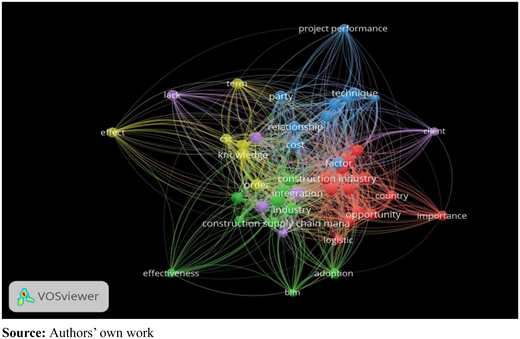
Mapping of co-occurrence of keywords in all the research papers in their “Title” and “Abstract”
Mapping of co-occurrence of keywords in all the research papers in their “Title” and “Abstract”
6. Results and discussions
A review of 78 research papers from two decades, i.e. 2000–2020, according to the United Nations’ Decade of action’ plan, was conducted to analyse CSC’s recent developments, critical areas, methodologies and goals. Several interesting results come out of this study. The results from the prevailing review are particularised below:
Most published studies are empirical, followed by case studies based on uniform distributions, and few researchers worked on literature reviews;
This review is conducted uniformly on developed, developing and underdeveloped nations and revealed that UK and China are doing well, respectively;
The study discovered that work in mixed research is next to negligible. Most of the authors’ work is purely qualitative research followed by quantitative research;
Year-wise distribution of papers in Figure 6 shows that the graph is discrete, which implies researchers are not consistent in the CSC area;
Although, according to the report of the United Nations agency- IFAD, approximately 45% of the world’s population lives in rural areas of developing countries; still research in CSC-related to Rural areas is negligible;
The primarily focused areas have been seen in collaboration, performance measurement, IS and IT in most research studies. Financial management, VMI, logistics, SCR and RCSC are considered important, as little work has been done since there is a lot of scope for future research in these directions;
In the bibliometric analysis, the number of search results has been seen to increase over the years. However, most of the work related to CSC was done after 2010, which implies first United Nations’ Decade of action plan played its role in the construction sector;
Most of the published articles are from only one country, i.e. the UK, which implies that CSC is a new concept worldwide and is still being implemented in most countries. However, developing countries like China and India have come up with a CSC approach to enhance their performance;
The bibliometric analysis also shows a lack of collaboration among authors, which could deaccelerate innovation in research; and
Keywords related to CSC like “Green Supply Chain Management”, “Enablers”, “Resilience” and “Developing Countries” have only appeared in recent years of research studies, which implies negligible research has been done related to these keywords.
7. Implication and future scope
This study makes some distinct contributions to future research in the construction sector, and the results can provide researchers and engineers with useful direction for developing the next stage of research in the field:
Implementing SC in construction is both unique and essential, particularly in rural areas of developing countries;
A substantial number of published studies are empirical, followed by case studies based on uniform distributions, and few researchers have conducted literature reviews, so in-depth literature reviews of high quality are essential in this sector since literature reviews are critical to innovation;
To improve CSC performance, stakeholders should focus on financial management, SCR, logistics, VMI and RCSC. In addition to having an impact on decision-making, developing and implementing the CSC framework, these issues are also important in several other areas;
In recent years of research, keywords such as “Green Supply Chain Management”, “Enablers”, “Resilience” and “Developing Countries” have appeared in few numbers and should be considered in future research work;
Bibliometric maps indicate a lack of collaboration among authors. To accelerate innovation, large collaborations are necessary for research; and
There is a need for the next “Decade of Action” plan of the United Nations to focus more on developing countries and to extend work to rural areas as well as Green-CSC, both of which are prominent in the findings of this study.
8. Conclusion
The study analysed CSC’s recent developments, critical areas, methodologies and goals. In total, 78 research papers from the last two decades were reviewed in accordance with the United Nations “Decade of Action” plan, which revealed research gaps and critical areas and provided directions for future research. Most published studies are empirical, followed by case studies based on uniform distributions, and only a few authors conducted literature reviews. Most of the authors’ work consists of qualitative research, followed by quantitative research, while their contributions to mixed research are minimal. There is evidence that the United Kingdom and China are performing well in developed countries and developing countries, respectively, but other nations have yet to follow suit. Year-wise distribution graph of papers in Figure 6 is discrete, which implies researchers are not consistent in the CSC area, which is a major issue. CSC does not conduct significant research on rural areas, despite the fact that approximately 45% of the world’s population lives in rural areas, according to a report by the United Nations agency IFAD. In most research studies, collaboration, performance measurement, IS and IT are considered important, while financial management, VMI, logistics, SCR and RCSC are considered important but receive less attention. There is a great deal of scope for future research in these areas. According to bibliometric maps, the number of search results has increased over the years. However, most of the work on CSC has been done since 2010, and the most significant key areas are SCM and the construction industry. Most of the published articles are from the UK, suggesting that CSC is a new concept and is still being implemented in most countries, although developing countries like China and India have developed a CSC approach to improving CSC performance. It also shows a lack of collaboration among authors, which could deaccelerate innovation in research. Further, keywords relating to CSC, such as “Green Supply Chain Management”, “Enablers”, “Resilience” and “Developing Countries”, have only appeared in recent years of studies, indicating that little research has been conducted on these subjects.
CSC is a very dominant topic in the current study, but there are some limitations to it. Scopus and Web of Science databases were used to conduct the study. A future study can therefore consider papers related to other databases. As the focus was specifically dedicated to construction material SC only, the papers associated with SCs of labours and equipment have been eradicated.
Conflict of interest: On behalf of all authors, the corresponding author states that there is no conflict of interest.

