This study aims to test the impact of the coronavirus (Covid-19) pandemic on large firms, with regard to a supply disruption, productivity, customer satisfaction and firm performance.
A cross-sectional survey design and stratified sampling technique were implemented for employee selection and data gathering. Confirmatory factor analysis (CFA) was used to examine the data and model fitness, while the structural equation model was used for hypotheses testing.
The pandemic triggered supply disruptions, but did not significantly impact the productivity of manufacturing firms directly. However, supply disruption positively and significantly impacted productivity. Organisational productivity had no significant impact on customer satisfaction, however, when mediating the relationship between Covid-19 and customer satisfaction, it produces a positive indirect effect. Finally, Covid-19 and supply disruption when mediated by organisational productivity both had negative significant relationships on performance.
Having a unique model, it creates a trail for future researchers to explore further. Though customer satisfaction was expected to be affected by the pandemic, it is interesting to find out that customer satisfaction when mediated by organisational productivity was positively influenced.
Disruptions are inevitable, managers must balance the pursuit of customer satisfaction and productivity so that one does not erode the other. Emphasis must be channelled towards managing the productivity of the firm to maintain customer satisfaction during these uncertain times. Deliberate steps like manufacturing flexibility investments should be initiated.
The first study to examine Covid-19, supply disruption, customer satisfaction, organisational productivity and performance in the Nigerian manufacturing sector.
Introduction
No one bargained for a disruption of this magnitude when they began the brand-new decade in 2020. The novel coronavirus (Covid-19) virus has brought in its wake an unprecedented supply chain disruption, the type you hypothesise, the type you simulate, but you never wish it actually happens. Disruption is said to occur when there is an unplanned stoppage in the movement of goods, both finished and work in progress goods within a supply chain (Revilla and Saenz, 2017). There is a growing interest in mitigating strategies to supply disruption as it, unfortunately, continues to rise (Jüttner and Maklan, 2011; Polyviou et al., 2019) especially in the manufacturing sector (Martins et al., 2019; Revilla and Saenz, 2017). As reported by the Business Continuity Institute (2011) 85% of manufacturing firms have experienced supply chain disruption. In 2013, BCI (Business Continuity Institute, 2013) found that over a million euros loss recorded in single disruption incidents was high. Several million dollars in manufacturing disruption have been recorded in the last few years such as the Nissan disruption and the Land Rover disruption. Disruptions are caused by a variety of events; including natural disasters (Gunessee et al., 2017), delivery failure by suppliers (BCI, 2018), riots and protests (Pereira et al. Silva, 2014), loss/withdrawal of financial capital (Hendricks and Singhal, 2003), plant-related issues (Marley et al., 2014), epidemics and disease (Natarajarathinam et al., 2009) and employee union strikes, (Addison and Hirsh, 1989), etc. Supply disruption has been said to have a great negative impact on productivity and performance as a whole (Marley et al., 2014). This is a special concern considering the magnitude of disruption that has been experienced in the last few months globally due to the Covid-19 virus. Over time, managers across the globe are asking for insights into strategies and methods to mitigate damage to production schedules in the face of disruptions (Kumar et al., 2020), the event of the Covid-19 pandemic simply amplified this need. Though there are a few studies that had investigated the relationship between special events, supply chain disruption and performance (Gunessee et al., 2017; MacDonald and Corsi, 2013; Babatunde, 2020), there is no study that has empirically researched the relationship between the Covid-19 pandemic, supply disruption, organisational productivity, customer satisfaction and organisational performance. This concern has inspired the research into the impact of supply disruptions on productivity, customer satisfaction and performance in Nigeria as a result of the Covid-19 pandemic.
Literature review
Theoretical framework
Systems theory.
The systems theory is a theory that is applicable to several disciplines. It is a holistic approach to understanding a phenomenon (Mele et al., 2010). While the organisation might seem exclusive and independent, it is a part of a larger whole, the society and the interaction between them; if not carefully understood, might be the undoing of the organisation. Though the systems theory has been strongly linked to the ideals of Aristotle who believed that the study of parts would not produce the results of studying the sum (Bertalanffy, 1972), systems theory in management was made popular by the study of Kenneth Boulding in 1956 (published in the journal called Management Science), who tried to unravel how the systems thinking would apply to management and benefit industry practitioners (Boulding, 1956). The systems thinking was further emphasised by the philosophy of quality management in the 1960s, as Deming taught quality practitioners to view the pursuit of quality as an organisational task and all departments were interrelated in the quest for quality and superior performance to gain market share (Devor et al., 1992).
Though systems theory is quite extensive in the application and presents lacunas for management application research (Teece, 2018), it is widely accepted as a mainstay management theory in explaining the complexities in relationships within the organisation, as well as its interaction with the external environment (Bertalanffy, 1972; Cordon, 2013; Mele et al., 2010). This theory is very relevant to the study because the understanding of systems theory; being an interaction focus theory (Mele et al., 2010) gives meaning to the complex intricate tethered relationship between the occurrence of an event outside of managerial control in the external environment and an organisation, that is, how these events can affect suppliers/customers and cause disruptions that affect the firm productivity and its customers. The understanding of systems theory will aid preparedness towards identifying events with such potential impacts and managing the ripple effects that come in its wake.
Conceptual framework
Supply disruptions in the wake of COVID-19.
As globalisation spread and was embraced, so did supply chains. Supply chains are now across countries, regions and continents (Tse et al., 2016) and while supply chains expand and become incredibly complex, the risk of a supply disruption becomes inherent (Tang and Musa, 2011; Revilla and Saenz, 2017). The possibility of supply disruptions over the years for manufacturers has become a case of when, rather than if, leading to a growing interest in research within that sphere (Natarajarathinam et al., 2009; Marley et al., 2014; Ivanov et al., 2017; Kumar et al., 2015; Polyviou et al., 2019). While the country is dealing with the craziness that came with Covid-19, including the loss of life and the new way of living as we have experienced in the month of April. The manufacturing sector has been hit really badly because of its dependence on foreign firms for raw materials. An estimated 100m dollars worth of supplies are stuck in China (Babatunde, 2020), this is a direct impact of suspended sea freights from China due to containment strategies. Studies show that the global economy relies on China, the origin of the novel virus, for a lot of its inputs. The United Nations, 2019 studies reveal that about a third of the world’s production is made in China and transported to the world, Nigeria inclusive. This means that a virus that threatens China or Asia as a whole would have an expected adverse effect on manufacturers who relied on them for inputs. Unfortunately, the virus travelled around the world, affecting multiple countries simultaneously, bringing an unprecedented supply disruption across different industries in the manufacturing sector.
The Nigerian pharmaceutical industry amongst others has been an industry growing incapacity to produce, as it produces a significant portion of the pharmaceuticals in the Western African region (Wakeel and Ekundayo, 2016; Ikon and Chika, 2017). That said, the entire world’s pharmaceutical manufacturers are heavily reliant on the Asian continent (specifically China and India) for their pharmaceutical raw materials (Ibis, 2020). It is expected that the pharmaceutical industry would be the most hit from the supply disruption caused by the Covid-19 novel virus. In a similar fashion, China also produces ninety percent of the world’s intermittent parts for the creation of personal computers (PC), as well ninety percent of mobile phone supplies (McKinsey Global Institute, 2019). This means that whenever production in the Asian giant nation is grounded, the global manufacturing community of personal computers and mobile phones are gravely affected. Nigeria being one of the countries big on the importation of these parts will also feel the brunt in these industries. In addition, China is also a majority producer in television parts and finished well. An estimated 70% of the global television parts are produced in China (McKinsey Global Institute, 2019), translating to tremendous supply disruption in the industry. China is also responsible for roughly 14% of Brazil’s imports (Jenkins, 2012). With China working below par due to lockdowns across several cities, this will inevitably spark a supply disruption to manufacturers in Brazil.
The global textile and apparel industry is not left out of this disruption. In 2005 China was producing over a third of the world’s textile (Shen, 2008), today, a report puts Chinese production at 53% of global production in textile and apparel, with the majority of this production going to other countries (McKinsey Global Institute, 2019), a reduction in the production of textile and apparel will spell supply disruption for several fashion firms in Nigeria and the world. Nigeria, being a major consumer of wheat-based consumer food is expected to also experience major supply disruptions in this industry. KPMG’s (2016) report puts Nigeria as the 13th in line for wheat importations globally. The largest exporters of wheat are the European Union, Russia and the USA. All of them were severely hit by the novel virus, hence, an incredible reduction in production and an accompanying supply disruption to wheat-based consumer food producers around the world, especially in a country like Nigeria, where the majority of their material came from these countries with very severe death tolls.
Organisational productivity.
Concerns over organisational productivity date back to the first scientific methods in management. Measuring and improving productivity is always at the heart of management goals because without it the organisation goes into losses (Shahiduzzaman et al., 2017). This is large because productivity drives the competitiveness of any firm (Dresh et al., 2018). Productivity is a rich blend of efficiency and effectiveness (Khan, 2003) and without it, there is no achievement of organisational goals in manufacturing firms (Ali et al., 2011).
Customer satisfaction.
Customer satisfaction is an emotional response that validates the pleasure felt in consuming a product (Giese and Cote, 2000), it is the difference between successful firms and failed business establishments. In practical terms, the experiences and expectations of a customer form the fulcrum of his or her measurement of product performance and subsequent satisfaction or dissatisfaction (Emrah, 2010; Udofia, 2019). In other words, a very subjective exercise. As customer satisfaction is the bedrock of customer loyalty, which yields repurchase and higher market share (Gustaffsson et al., 2005), it is to be considered a paramount objective.
Organisational performance.
The concept of performance is a commonly used word by management scholars and industry professionals (Bayo-Moriones et al., 2013) especially for the purpose of research that has to do with examining either employee and or organisation performance. This has made many researchers categorise organisation performance with elements such as productivity, profitability, efficiency and customer satisfaction (Gu and Jung, 2013; Gruber-Muecke and Hofer, 2015). Although, in the work done by Madrid et al. (2007) when performance is poorly measured by organisations, it leads to poor competitive positioning and results in a lack of sustainable competitive advantage. However, Murphy et al. (1996) as corroborated by (Gu and Jung, 2013) affirmed that the most commonly used measures of SMEs performance in literature are growth-efficiency and profitability. In the wake of the Covid-19 pandemic that has caused a global lockdown of the economy and restriction of international trading, the manufacturing sector today is struggling with some measures of performance such as productivity, customer satisfaction and profitability (Nkengasong and Mankoula, 2020). This is because manufacturing firms who produce at a large scale have now had to reduce production capacity especially those considered to be essential service producers, while all others are asked to shut down temporarily. The effect of these especially for those firms who have not been able to integrate technology into all their production and supply chain capabilities is reflecting in the company capacity to continue operations as a result of consistent production of goods and services leading to lack of customer satisfaction, revenue and profitability (Gruber-Muecke and Hofer, 2015; Nkengasong and Mankoula, 2020).
Hypotheses development
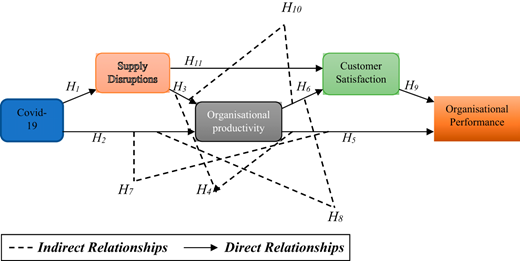
The role of China in the value chain of production cannot be over-emphasised. China recorded a major decline in its production by end of February 2020 as reported by the National Bureau of Statistics of China (UNCTAD, 2020). Though the Chinese Government shut down movements came sometime in February 2020, before that, there was the Lunar new year break in January that rolled over into the outbreak (Deloitte, 2020), in other words, an extended unplanned supply disruption. While China has cemented its place as the world’s factory (Deloitte, 2020), a decline in work hours in China can pose problems for the productivity of those reliant on Chinese suppliers (UNCTAD, 2020). That said, the concern remains how much of an impact does the reduced production in China have on supplies and productivity for manufacturers in Nigeria, and how does supply disruption, in turn, impact organisational productivity and organisational performance as a whole. Epidemics being a major supply chain risk for firms with global networks is an interesting research context underexplored because of its rare occurrence. This prompted early simulations (Ivanov, 2020) to predict the impact of Covid-19 and the subsequent ripple effect on global supplies. The simulation results were a massive profit loss (90%) for local manufacturers and supply disruption worldwide, however, a spread (across continents) will be accompanied by unprecedented supply disruption and major reductions across all performance indices for firms with global chains. Such predictions are yet to be empirically tested; thus, this study contributes to that growing literature of epidemic effect on manufacturing firms. The study of Ikon and Chika (2017) examined the impact of production constraint, specifically; material scarcity on organisational performance. It found a negative significant relationship. While the study focussed on the scarcity caused by the volatile economic environment, this study is a focus on disruptions caused by a pandemic and is a more robust understanding of the impact of material scarcity. Kumar et al. (2020) affirmed a negative impact of Covid-19 on organisational productivity, however, this result is yet to be substantiated across other countries and industries. A comprehensive literature review reveals that irrespective of industry focus, geographical region or methodologies, studies into the understanding of epidemic outbreaks on supply chains are of the essence (Queiroz et al., 2020), this discussion leads to the first four hypotheses of this study:
There is a positive significant relationship between Covid-19 and supply disruption.
There is a negative significant relationship between Covid-19 and organisational productivity.
There is a negative significant relationship between supply disruption and organisational productivity.
There is a negative significant indirect relationship between Supply disruption and organisation performance through organisational productivity.
Kumar et al. (2015) understudied supply chain disruption and company performance. The study revealed that firms in India understudy recorded a financial loss due to disruption. The study called for more investigation of disruption effects on the performance of organisations in developing nations. The relevance of the international market on organisational productivity was examined by Caliendo and Rossi-Hansberg (2012), and it was revealed that there is a positive impact on organisational productivity by its presence in the international markets. Therefore, this implies that the absence thereof, as witnessed by the presence of Covid-19 might hamper productivity and by extension its performance. Irrespective of ample literature that highlights the relevance of achieving customer satisfaction and organisational productivity to unlock sustainable profit growth (Anderson et al., 1997; Tanninen et al., 2010), the investigation into the relationship between both variables are minimal (Lee et al., 2017), as well as their resulting impact on overall performance. Studies by Shehzadi et al. (2020) and Khan and Hashim (2020) evaluated customer satisfaction and firm performance in service firms (education and Tourism, respectively). Both studies revealed that Covid-19 triggered intensive social media content and information quality to sustain customer satisfaction, and customer satisfaction had positive impacts on performance through brand image and customer loyalty. Babatunde (2020) conducted an earlier study on Covid-19 impact on organisational performance in Nigeria, however, his finding (significantly negative) was largely domiciled in the aviation industry. An extension of this study would be that of Alonso et al. (2020) that focussed on the hospitality industry, as dictated by transportation. Its conclusion was massive shutdowns of hospitality firms as fostered by restricted movements. Shen et al. (2020) early investigations into the impact of Covid-19 on firm performance in China revealed a negative significant relationship, and the impact was mostly felt in service (catering, tourism and transportation) industries. However, because the study was conducted in the early parts of the second quarter to assess the first quarter, they were of the opinion that managers with foresight in other parts of the world will study the early trend and implement strategies to mitigate devastating impacts. While it is important to replicate their study in other climes and industries, it is also important to assess the proactive nature of managers in Nigeria (as the world was aware of Covid-19 in January) to implement strategies that will mitigate the impact of Covid-19 on firm performance as opined by Shen et al. (2020). Most of the early studies conducted on the pandemic and firm performance were focussed on service industries (Alonso, 2020; Babatunde, 2020; Shen et al., 2020). it is important to investigate the impact of Covid-19 across manufacturing industries. The performances of manufacturing firms are dictated by their productivity (Ali et al., 2011), however, there are factors outside the control of a firm that may affect their productivity and overall performance. It is important to identify these factors to better mitigate them. Also, studies on customer satisfaction are usually under normal circumstances, thus studies assessing their relationship with variables like organisational productivity and performance during a pandemic is a significant contribution to the body of knowledge in the field of management sciences:
There is a positive significant relationship between organisational productivity and organisational performance.
There is a positive significant relationship between organisational productivity and customer satisfaction.
There is a negative significant indirect relationship between Covid-19 and organisation performance through organisational productivity.
There is a negative significant indirect relationship between Covid-19 and customer satisfaction through organisational productivity.
There is a positive significant relationship between customer satisfaction and organisational performance.
There is a negative significant indirect relationship between Supply disruption and customer satisfaction through organisational productivity.
There is a negative significant relationship between supply disruption and customer satisfaction (Figure 1).
Methodology
A cross-sectional survey research design was used to gather the needed data as the study population comprises of employees within the manufacturing firms in Nigeria. In total,10 manufacturing firms with 500 staff and above were selected for sampling in the manufacturing industries and 100 employees (senior and management staff only) were selected from each firm making a total of 1,000 employees selected for sampling. The study used a stratified sampling method to prune down the type of organisation and respondents that could participate in the questionnaire response. To secure the interest of these firms in the various manufacturing industries, a mail was first sent to the management of about 32 firms requesting permission to include them in the research and only 16 firms showed interest to be part of the research. However, due to the selection criteria, only 10 firms were selected from amongst the 16 firms and 100 employees were selected from each of the 10 firms making a total of 1,000 respondents selected for sampling. Due to the Covid-19 pandemic that has brought about a social distancing policy all over the world, the questionnaire was drafted in a google form and the link was shared across the management and senior staffs of these manufacturing firms. The study collected responses from only 898 participants and the responses from these employees were then used for the analyses. Confirmatory factor analysis (CFA) was used to examine the data and model fitness and structural equation model was used to test the stated hypotheses in the study.
Data analysis
Two important steps are executed for the data analysis, and they involve the data-reduction step which involves the use of confirmatory factor analysis to prune the questionnaire items for each construct to a more sizeable model and data fitness. This is important for the second stage that involves testing the hypotheses with a structural equation model to examine the structural-relationship existing between variables (latent and observed).
Measurement model
Besides measurement items on Covid-19, the research instrument consisted of carefully adapted measurement items. Measurement items on supply disruptions were adapted from Chaudhuri et al. (2018) and Mishra et al. (2017). Items on organisational productivity were adapted from Kim et al. (2012), Lakhal et al. (2006), Grayson et al. (2016) and Zhang et al. (2000). Items on customer satisfaction were adapted from Lee et al. (2017), Chavez et al. (2016) and Vasić et al. (2019). Finally, items on organisational performance were adapted from Kim et al. (2012), Tarí et al. (2007), Zhang et al. (2000), Yan et al. (2019) and Sadikoglu and Olcay (2014).
The measurement model is achieved through the data reduction stage using CFA. The measurement model, therefore, involves examining the construct validity to assess how each variable item fits the model. This involves conducting the reliability analysis, composite reliability and convergent validity. Cronbach alpha is the acceptable analysis for conducting reliability analysis for each variable in a study and having a figure from 0.70 and above is the acceptable recommended threshold (Amin et al., 2014). Hence, Table 1 shows the reliability analysis for each variable, and it is above the recommended threshold of acceptance. Similarly, convergent validity is the extent to which multiple constructs are in agreement at measuring the same models (Nusair and Hua, 2010). Convergent validity is measured using three approaches such as the calculation of normed fit index (NFI), factor loadings for each item and average variance extracted. The normed fit index as suggested by (Orçan and Yang, 2016) must be above 0.90 as the recommended threshold of acceptance and as shown in Table 1, the NFI values for each construct are greater than 0.90. Also, the factor loading for each item which is the second approach for measuring convergent validity must be above 0.50 as the minimum recommended values and given the value of 0.50 to 0.76 as shown in Table 1, hence, all items for the measurement model are beyond the acceptable values. Similarly, the average variance extracted for each variable as suggested by (Orçan and Yang, 2016; Nusair and Hua, 2010) must have values equal to or greater than 0.5. Furthermore, composite reliability is mostly used to examine the internal consistency of both the observed and latent variables in a study. Hence, a constructed value that is ≥0.70 has internal consistency, and as shown in (Table 1), all five constructs have values between 0.705 and 0.728 (Tables 2 and 3).
Given the results in Table 2 above, the summary of the CFA results shows that the model perfectly fits the data set and is good to conduct the structural relationship existing amongst variables in the study using the structural equation model to test stated hypotheses. Furthermore, the literature supports that a GFI, CFI, IFI, NFI and TLI value that is above 0.90 is acceptable and (Yana, 2007; Field, 2005) recommended for assessing model/data fitness at the data reduction stage and as shown in Table 2 that all the elements of CFA measures have a value that is above 0.90. Also, RMSEA must have a value between 0.40 and 0.80 before it can be deemed acceptable and given the value of 0.053 as shown in Table 2, then the assumption for assessing model fitness for this study is not violated.
Hypotheses testing
The fitness of the model was made possible after some items of the variables were deleted such as Covid-19 items had one deleted (COV7), customer satisfaction having seven items had three items deleted (CS4, CS5, CS7), organisational productivity having six items had one item deleted (OP6) and organisational performance having five items had one deleted (OPE1). The study had seven direct and four indirect hypotheses, making it a total of 11 hypotheses (Table 4).
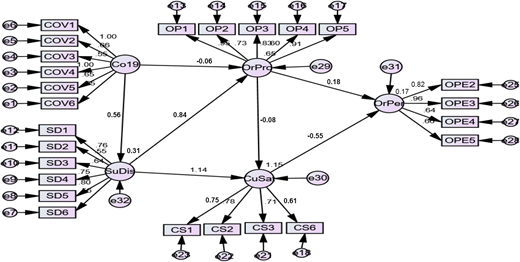
H1 and H2 examined Covid-19 pandemic on supply disruption and organisational productivity and the result shows that Covid-19 pandemic significantly impacts supply disruption for H1 at (t-values = 9.084, β = 0.561 at p = 0.005) but not organisational productivity for H2 at (t-values = −1.794, β = −0.061 at p = 0.073). Hence, H1 is positively supported but H2 is negative and shows no support. H1 aligned with the findings of Gunessee et al. (2017), who state that natural or unforeseen circumstances have the tendency to trigger supply disruption of organisations and thereby impact organisation performance. The result also aligns with the finding of Singh et al. (2020) whose study showed Covid-19 had a positive significant impact on supply disruption. However, the Covid-19 pandemic has no direct impact on organisational productivity, negating the findings of Caliendo and Rossi-Hansberg (2012), whose result revealed the positive influence of international availability of product on the productivity of the firm. Similarly, the result from H3 shows that supply disruption positively significantly impacts organisational productivity at (t-values = 13.030, β = 0.841 at p = 0.000), hence, the hypothesis is not supported. While H5 and H6 examined organisational productivity on organisation performance and customer satisfaction and the results show that organisational productivity significantly impacts organisation performance at (t-values = 2.250, β = 0.176 at p = 0.005) but not customer satisfaction at (t-values = −1.565, β = −0.078 at p = 0.005) (Table 5).
Hence, H5 is positively supported but H6 is negative and shows no support. H6 aligns with the finding of Anderson et al. (1997) whose study revealed that in most firms the pursuit of customer satisfaction hampers productivity and vice-versa., H9 examined if there is a significant relationship between customer satisfaction and organisation performance and the result shows negative significant support at (t-values = −6.642, β = −0.548 at p = 0.005) and this could be as a result of the lockdown which affected many organisation supply chain activities that are created to serve customers. Furthermore, H11 examined if there is a significant relationship between supply disruption and customer satisfaction and the result shows a significant positive relationship at (t-values = 10.993, β = 1.135 at p = 0.005).
H4 and H10 examined if there is a significant indirect relationship between supply disruption and organisation performance and customer satisfaction as mediated by organisational productivity and the results of H4 and H10 show a negative significant indirect effect and a negative insignificant effect, respectively. Hence, organisational productivity mediated the relationship between supply disruption and organisation performance and customer satisfaction negatively. Furthermore, H7 and H8 examined if there is a significant indirect impact between the Covid-19 pandemic and organisation performance and customer satisfaction. The results show that H7 has a negative and significant indirect effect, while H8 shows a positive significant indirect effect between the Covid-19 pandemic and customer satisfaction, which aligns with the findings of Macdonald and Corsi (2013) whose results proved that after experiencing rare severe events, motivating firms sometime go far and beyond to please customers, in a bid to show gratitude for sticking with the brand in difficult times (Figure 2).
Discussion of findings
The study is the first of its kind to examine supply disruption in the wake of the Covid-19 crisis and organisational performance as mediated by organisational productivity and customer satisfaction. This study becomes very important knowing fully well the extent of the disruption that the Covid-19 pandemic has had on firms’ supply chain activities and the relative effect on firm productivity and customer satisfaction. In total, 11 hypotheses were proposed for this study with seven direct and four indirect hypotheses as in-sighted from literature and the findings show that eight hypotheses were statistically significant, while three were insignificant. That said, based on the direction of proposed hypotheses, four hypotheses were supported and seven were not. Rejected hypotheses may be a reflection of certain factors not considered in this study.
The findings of the study show that supply disruption is inevitable in the wake of the Covid-19 pandemic, hence, its effect on organisational performance. This effect is evident in the firm’s productivity, performance, customer-satisfaction and eventual survival of firms in the industry. Although, numerous literature support the findings of H1, H2, H7 and H8 with regard to the possibility of unforeseen events such as the Covid-19 pandemic having a significant direct and indirect effect on the supply chain activities of an organisation, its productivity, customer satisfaction and the overall performance of firms. The negative insignificant result of H2 for this study directly contrasts with the work of Ikon and Chika (2017). However, Babatunde (2020) argued that a significant disruption in the supply of an organisation will have an adverse effect on the organisation so much that it may lead to the eventual closure of such a business organisation. This finding directly relates to the findings of this study for H3, H4, H10 and H11 as the findings of the study shows that supply disruption has significant direct and indirect effects on firm productivity, customer-satisfaction and firm performance and give credence to the theoretical framework of this study such that the disruption of this magnitude as experienced by many firms in the wake of Covid-19 pandemic is practically an external factor that is beyond the control of the firm management.
Similarly, H5 shows that a significant positive relationship exists between firm productivity and firm performance and directly corroborate the work of (Ali et al., 2011; Dresh et al., 2018), who states that firm productivity is one of the significant measures of firm performance and if not properly cared and catered for in the organisation may affect significantly the overall performance of the firm. Furthermore, customer satisfaction H9 is another important measure of firm performance (Nkengasong and Mankoula, 2020), and as findings showed in the study that there is a significant negative relationship between customer satisfaction and firm performance. The negative relationship is, however, in contrast with the submission in some works (Caliendo and Rossi-Hansberg, 2012; Nkengasong and Mankoula, 2020). Finally, findings for H6 show an insignificant negative relationship between organisational productivity and customer satisfaction and although contrast with many findings in the literature that state that organisational productivity has a significant positive relationship with customer satisfaction (Ikon and Chika, 2017). The result for H6 could be as a result of the Covid-19 pandemic that caused a global lockdown of the economy and restriction of movement of people and proper functioning and continuous operations of many organisations leading to temporary openings of firms considered to be essential producers of goods and services necessary for every-day living.
With regard to organisational productivity and customer satisfaction serving as a mediated relationship between supply disruption and organisational performance. The findings from the study show a positive and negative indirect mediated relationship amongst variables leading to the acceptance of three proposed mediated hypotheses. Overall, the findings of the study have theoretical implications as posited in this study such that every organisation exist within a functional system and is controlled by both internal and external forces and most external events like the Covid-19 pandemic are mostly beyond the control of an organisation (Teece, 2018; Cordon, 2013). These external occurrences are usually dealt with by organisation via dynamic resilience strategies put in place by the organisation to curb the adverse effect of an unforeseen event such as the Covid-19 pandemic that may negatively affect firm operations and continuous survival in the industry.
Conclusion, implications and further research
Supply disruption in the wake of the Covid-19 pandemic is an inevitable occurrence to firms all over the world and the major determinant of continuous operations and survival of firms especially for small and medium firms will be the ability to remain productive in the wake of an event as severe as the Covid-19 pandemic. Findings from the study have been able to harmonise with empirical literature regarding the effect of unforeseen events such as the Covid-19 pandemic on supplies and other organisational facets.
Research implications
This study is the first to examine the relationship between the variables under study and provides a path for other researchers to investigate the relationship amongst the variables. Though customer satisfaction was expected to be affected by the pandemic, it is interesting to find out that customer satisfaction when mediated by organisational productivity was positively influenced, this could be those extra efforts by organisations to satisfy the customers, being cognisant of the depleted disposable income of customers and the scramble for the few who have purchasing power. This study empirically tests the relationship amongst Covid-19, supply disruption, organisational productivity, customer satisfaction and organisational performance and it reveals that firms can achieve customer satisfaction despite the challenges faced, though this has not translated into better performance. However, it is expected that if customer satisfaction is sustained, when the economy becomes vibrant again and disposable income is higher, organisational performance will improve and customer loyalty would be secured. In addition, the conceptual model in this study is unique and should be tested on different forms and sizes of businesses.
Managerial implications
Supply disruptions are technically beyond the control of the firm in some cases, as revealed by the current pandemic. Managers must balance the scale of the pursuit of customer satisfaction and productivity so that one does entirely sacrifice the other. As revealed by the H6 result and Anderson et al. (1997) the pursuit of absolute CS will diminish productivity. Emphasis must be channelled towards managing the productivity of the firm to maintain customer satisfaction during these uncertain times. Practically, an offsite customer complaint team should be enacted to collate customer complaints and address them, to prevent distraction and diversion of manpower onsite towards addressing customer complaints. This will ensure customers do not feel their concern is relegated, and their satisfaction is maintained during these times as seen in H11; while managing commendable productivity levels. In addition, deliberate steps can be taken to ensure that when disruption occurs, the organisation can continue to function and satisfy its customers. This will be a direct response to H1, H2 and H3. Efforts in production and labour flexibility must be made to ensure disruptions do not ground the firm. Production flexibility enables a firm produce a range of products from the same floor with a minimal equipment change, while labour flexibility ensures the labour force (especially machine operators) is abreast with several systems, machines and tasks (Stevenson and Spring, 2007).
A car production/assembly plant that almost seamlessly switches its production to ventilators (medical appliances) for the time being is evidence of investment in production flexibility. While it shifts the customer base, it ensures the firm remains in business and is highly relevant as ventilators are in very high demand globally. Also, machine flexibility should be considered moving forward, as it deals with a machine being capable of producing with more than one input (Jain et al., 2013). Practically, organisations that rely exclusively on wheat flour should invest in configuring their machine to be capable of producing cassava flour (or other flours), as that could be more accessible (in Nigeria). This is taking cognisance of the fact that an international supply disruption (which could be triggered by a plethora of circumstances) will hamper the importation of wheat flour. Manufacturing flexibility is applicable to several manufacturing industries. In addition, initiating an IT system that enables non-production floor workers to work from home would support operational flexibility and prevent a total breakdown when the government insists on minimal staff presence in manufacturing firms. Also, a comprehensive IT system would enable accurate and real-time information synchronisation for faster and better decision-making in uncertain circumstances (Stevenson and Spring, 2007). All these cannot be done without labour flexibility, as it ensures training and exposure to all these equipment, different machine configurations and processes in anticipation of rapid adaptability and a need for resilience. An investment into a more flexible system internally and across the supply chain is recommended to keep the organisation a step ahead of any future disruption that may occur.
Suggestions for further research
The study examined supply disruption in the wake of the Covid-19 crisis and organisational performance as mediate d by organisational productivity and customer satisfaction by selecting respondents from manufacturing firms in Nigeria. Further research can be done on the same subject matter by extending the sample framework beyond the 898 sample sizes and beyond Nigeria as a whole. Also, the study focus is specifically on manufacturing firms, hence, further research can be conducted to extend to other business sectors to have a holistic view of the effect of the Covid-19 pandemic and the disruption it has caused in other business sectors. Further research can also be done to look at a comparative impact of the Covid-19 pandemic and supply disruption on organisation performance in developed and developing economies. This would serve as an insight to government all over the world especially in developing economies such as Nigeria about the importance of creating an enabling business environment that can support firms to withstand external or unforeseen crises such as the Covid-19 pandemic.