Humanitarian relief organisations such as charities count on donations to provide assistance to people in need when disasters occur. In the UK, about 11,200 charity shops collect second-hand goods from donors to raise funds for their parent charity to support target beneficiaries. As their numbers increase, charity shops are finding it difficult to secure good quality stock. Furthermore, they may need to plan ahead to secure sufficient stock when the economy experiences a downturn. This paper identifies the charity shop's role and its donation flow in the multi-tier supply chain and empirically assesses the barriers that influence intention to donate with a mixed-methods approach.
In order to explore the charity shop's role within the multi-tier supply chain, this study begins with a literature review and then develops a conceptual model. In order to empirically evaluate the barriers that influence intention to donate, the authors conducted semi-structured interviews with 14 charity shop managers and collected 222 usable questionnaires from donors. The interpretive structural modelling (ISM) approach was applied to examine the interrelationship among barriers and rank their priority.
This paper identifies ten significant barriers that influence intention to donate: lack of good quality items for donation; lack of information on how charity shops make use of donations; lack of familiarity with the donation process; lack of information of what items can be accepted by charity shops; lack of awareness of the impact that donations make; the difficulty of being available at the scheduled times for charity shops' free pick-up services; the difficulty of donating during shops' opening hours; the difficulty of finding parking to access charity shops; and living too far away from charity shops. In particular, the questionnaires' results indicate that lack of good quality items is the most significant barrier. This is also reflected in the ISM model, and thus needs more attention.
The results are very useful for charity shops themselves to understand current barriers to securing good quality stock and to develop potential stock-securing interventions based on these barriers' priority.
Although charity shops have been investigated by several researchers, their supply chain remains insufficiently explored. This paper fills this gap by identifying the charity shop's role and its donation flow in the supply chain and by empirically assessing the supply-side barriers with a mixed-methods approach.
Introduction
Charity shops are retail outlets that sell donated goods to raise funds; they also function as a means of raising awareness of the parent charity. In the latter part of the 19th century, the Salvation Army first provided people on low incomes with cheap second-hand clothing (Podkalicka, 2012). After the Second World War, other charities started to run shops to raise funds to relieve the hardships of the needy: Oxfam opened its first shop in 1947, and the Sue Ryder Foundation began to open shops in the early 1950s (Horne, 1998). British charity shops represent an “untraditional distributive form” in retail terms, and have become a successful sector since the late 1980s (Horne, 1998). In the initial stages, they had an image of being a low-end market, due to the goods sold (second-hand clothes and household goods), and the lack of professional management skills. In the late 1980s, their image changed from poor secondary trading outlets to primary high street shops (Parsons, 2000). Many charity shops started to employ paid managers and imported merchandising and display techniques from the commercial retail sector. These changes led to charity shops becoming popular in the UK (Hibbert, 2005; Parsons and Broadbridge, 2004). Today, there are around 11,200 in the UK more than £295 million was raised by British charity shops in 2019 (Charity Retail Association, 2020b). As their numbers increase, charity shops are finding it more difficult to obtain good quality items. Furthermore, they may need to plan ahead to secure sufficient good quality stock when the economy experiences a downturn. Although charity shops have been investigated by several researchers, the supply chain side remains insufficiently explored. Therefore, this paper aims to (1) understand the role of the charity shop and its donation flow within the multi-tier supply chain and (2) assess barriers that influence intention to donate. In order to achieve the research goal and fill the research gaps, this study addresses the following research questions: Q1: What are the key barriers that influence intention to donate? Q2: What are the relationships among the key barriers that influence intention to donate?
The rest of the paper is structured as follows: in the next section, the theoretical framework for exploring the role of charity shops is established based on agency theory and stakeholder theory. The conceptual framework is then developed and discussed before a literature review of the barriers influencing intention to donate. The third section reports on semi-structured interviews conducted with 14 charity shop managers and the results of a questionnaire survey collected from 222 donors, and also the results of interpretive structural modelling (ISM), used to assess the relationships among the identified barriers. In the final section, the conclusion, contributions and limitations are presented.
Literature review
In the 19th century, the Salvation Army started to operate charity shops to relieve hardship. Later, at the outbreak of Second World War, some charities such as the British Red Cross also ran charity shops as a way to raise fund for the war effort (Charity Retail Association, 2021). Nowadays, organisations such as Oxfam and British Red Cross still use funding from charity shops for humanitarian interventions. With an increase in the number of people in the Middle East affected by complex emergencies in recent history, international charities start to look for effective ways to provide humanitarian assistance to meet the specific demands of the crisis-affected people. For example, after years of civil war, millions of people in Syria continue to face significant life challenges. The British Red Cross has been providing humanitarian assistance in Syria since the start of the civil war ten years ago and working with their partners to support the Syrian refugees in Lebanon. Together with the Syrian Arab Red Crescent, the British Red Cross has helped over 5 million people since the crisis began (BRC, 2021). Also, Oxfam is on the ground in Syria providing humanitarian assistance including Cash Base Assistance (Oxfam GB, 2021). In most post-disaster situations, many people need humanitarian assistance in a short period. The refugees call for quick and simple ways of prioritizing needs. Nowadays, the nature of humanitarian crises is changing. As more people are in need and for a long time, both natural and man-made crises are putting humanitarian assistance under severe strain. Providing Cash Base Assistance is often a highly effective way to provide humanitarian assistance and to make limited funding go further (Margolies and Hoddinott, 2014). Cash Base Assistance is among the most rigorously evaluated humanitarian tools of the last decade (Overseas Development Institute Report, 2015). The analysis of 200 resources and studies provide evidence about the effectiveness, feasibility and cost of cash transfers in humanitarian settings for poverty reduction. The cash transfers make the humanitarian system more accountable to its beneficiaries and make humanitarian aid more transparent (Overseas Development Institute Report, 2015). Traditionally, charities helped refugees with physical commodities: water, food, clothing, shelter and medical help. However, this is gradually changing. Nowadays, the crisis-affected people may instead receive cash, with which they can buy what they need most. The evidence from humanitarian settings shows that people receiving cash assistance tend to buy what they most need to survive and do not waste it on anti-social purposes, such as alcohol, tobacco (Evans and Popova, 2014). Changes in cash transfer technology provide humanitarian organisations unprecedented opportunities for humanitarian assistance. In emergencies ranging from famine in Somalia, refugees in Lebanon to disasters in the Philippines and Pakistan, evidence shows that Cash Base Assistance can be one of the most effective ways to meet help recover from humanitarian crises (Cabot Venton et al., 2015; Pongracz, 2014; Overseas Development Institute Report, 2015). In particular, humanitarian organisations used remittance companies to transfer cash to more than 1.5 million people who are affected during the 2011 famine in Somalia to help them to recover (Overseas Development Institute Report, 2015). Instead of receiving in-kind aid, more than a million Lebanon refugees use smart card vouchers or ATM cards to spend cash base assistance at local shops (Pongracz, 2014). Nearly half a million people received cash assistance in the response to Typhoon Haiyan in the Philippines to rebuild their livelihoods (Overseas Development Institute Report, 2015).
Charity shops sell mainly donated goods to raise money for the parent charities to further their humanitarian assistance. However, charity shops lack a conventional supply chain. Instead, their stock relying heavily on donors' donations. The role of the charity shop within the multi-tier supply chain and its donation flow are useful to understand the unique aspects of charity supply chains. These help to assess the charity shops' supply-side barriers. The literature review proceeded as follows. First, the theoretical framework for identifying the role of charity shops is established based on agency theory and stakeholder theory. Next, the conceptual framework and donation flow are discussed. Last, the barriers that influence intention to donate are discussed.
Theoretical framework
Agency theory
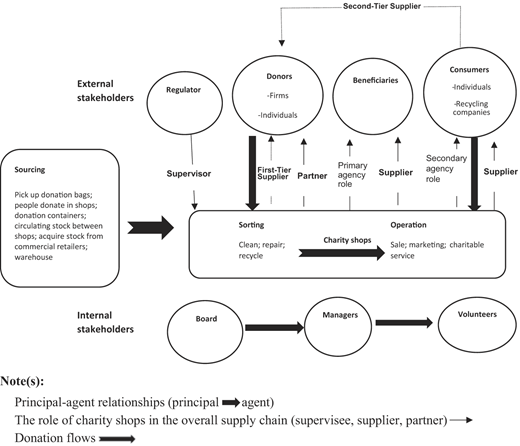
Agency theory is widely applied in social science research to describe the relationship between principles and agents. It creates problems when the agent (e.g. the charity shop) represents the principal (e.g. the donor) in a business operation (Jensen and Meckling, 1976; Eisenhardt, 1989). Due to information asymmetry, it is difficult for the principal (donor) to track what the agent (charity shop) is doing, which may create risks for the principal and conflict among the two parties (Wright et al., 2001; Zsidisin and Ellram, 2003). In order to deal with the above principal-agent problem, corporate governance is usually applied to guarantee the principal's interests. Charity shops operate in different contexts, including receiving donations from donors, and they sell donated goods and support target beneficiaries. Building up solid governance and accountability has become the main goal of UK-based charity commissions to ensure the continuity of donations (Hyndman and Mcdonnell, 2009). Agency theory is the dominant theory used in the finance literature. From the finance standpoint, corporate governance concerns how suppliers of finance to corporations ensure that they make a yield on their investment (Shleifer and Vishny, 1997). Charity shops raise funds through selling donations for their parent charity to support the latter's target beneficiaries. Therefore, the yield on the investment is the funds raised to support target beneficiaries (Hyndman and Mcdonnell, 2009). From this point of view, corporate governance within the charity sector may be considered as the way charity shops discharge their accountability to donors (how they distribute funds to the intended beneficiaries). In the process of discharging accountability, charity shops function as the middleman dealing with donations. They receive items from donors and sell them to amass funds to support target beneficiaries. Thus, following the notion of double agency (Arthurs et al., 2008; Child and Rodrigues, 2003), charity shops act as an agent both toward donors when supporting target beneficiaries (the primary agency role) and in receiving and selling donations (the secondary agency role) (see Figure 1). This is discussed further below in the section “The Role of Charity Shops in Multi-tier Supply Chain and Donation Flow”.
Stakeholder theory
The relationships between charity shops and key stakeholder groups are identified from the perspective of the latter in this paper. A stakeholder in a company is a party who can make a claim on the company's operations, or who is affected by the company (Friedman and Miles, 2006; Lewis, 2001). Before developing appropriate strategies to manage stakeholder groups, it is essential for companies to first identify their key stakeholders (Friedman and Miles, 2006). In the case of charity shops, the board of trustees, managers and employees are internal stakeholders, and customers, donors, beneficiaries and regulators are external stakeholders (Figure 1). Hill and Jones (1992) argue that the principal-agent relationship is a subset of the stakeholder relationship, as many notions of agency theory can be applied to the stakeholder relationship. Van Puyvelde et al. (2012) follow this line of reasoning and identify possible principals of charity shops from the stakeholder perspective. Based on the principal-agent relationship that Van Puyvelde et al. (2012) propose, four principal-agent relationships are identified in this paper: external principal-agent relationships (donor-charity shop; beneficiary-charity shop); internal principal-agent relationships (board-manager; manager-volunteer) (Figure 1). This is discussed further below in the section “The Role of Charity Shops in Multi-tier Supply Chain and Donation Flow”.
Conceptual model
The conceptual model based on agency and stakeholder theory to identify the role of charity shops is shown in Figure 1.
External stakeholders: donors, beneficiaries, consumers and the regulator
Donors
The donor is an important external stakeholder for charity shops. Unlike other types of economic transaction, donors do not provide items in return for money. Donated items are sold by charity shops to raise funds for their target beneficiaries (Hyndman and Mcdonnell, 2009). Donors thus simultaneously give items and delegate decision-making authority to the charity shops. In this scenario, donors are the principals and charity shops the agents. Therefore, in the process of supporting beneficiaries, the charity shop is viewed as the first-tier supplier to donors in providing the collection points and, to some extent, donors become the “lead firm”.
Beneficiaries
The primary agency role of charity shops is to raise funds for parent charities to support beneficiaries. Regarding the latter, the key issue for charity shops' decision-makers is the extent to which beneficiaries should be involved (Hyndman and Mcdonnell, 2009). Beneficiary involvement in charity shops has worked well in the past three decades, and changes in charity shops' operational environment have also facilitated the development of user involvement (Hyndman and Mcdonnell, 2009; Locke et al., 2003). For example, the Charity Commission (2000) suggested that one-third of charity boards should be beneficiaries. Considering the form that beneficiaries' involvement may take, Beresford and Croft (1993) proposed the “consumerism” and “democracy” principle. Here, “consumerism” means that the beneficiary is viewed as a “consumer” regarding beneficiary involvement, which implies that their involvement should be restricted to service information and evaluation, the identification of consumers' needs, market research and complaints procedures (Beresford and Croft, 1993; Locke et al., 2003). And, “democracy” means that the beneficiary is viewed as a citizen in the “democratic” context of companies' decision-making processes, which include determining the mission of a charity or board representation (Hyndman and Mcdonnell, 2009). Also, it should be noted that not in all cases beneficiaries are available for direct contact, for example, participation in the charity boards. In some charities, such as Oxfam UK and British Red Cross, part of the fund is going for helping overseas refugees to rebuild their livelihoods and beneficiaries are not located in the UK.
Consumers
The secondary agency role of charity shops is to supply donated goods to consumers. Through selling donated goods to consumers, charity shops raise funds for parent charities to support target beneficiaries. In the process of supporting beneficiaries, the donor becomes the “lead firm”, and the charity shop is viewed as the first-tier supplier in providing donors with a collection point for donations. The consumer is viewed as the second-tier supplier in providing funds through shopping from charity shops. But, when considering the donation flow between the charity shop and the consumer, in proposing donated goods the charity shop is the supplier. Furthermore, following agency theory, the consumer becomes the principle, and the charity shop the agent. The main agency problem between consumers and charity shops is consumers' informational disadvantage, which means that they cannot accurately evaluate the quality of charity shops' services (Hansmann, 1980) . However, research has demonstrated that technological advances have reduced consumers' informational disadvantage, as they gain information more easier and are more able to influence charity shops' operational efficiency to avoid agency problems (Ben-Ner, 2002).
Regulator
Charity shops are subject to a certain amount of government regulation. Due to the information asymmetry between them and their donors, Andreoni (1990) asserts that charity shops should follow government regulation and disclose performance-related information to attract donors. Government regulation is important, especially for charity shops that have weak internal governance (Hyndman and Mcdonnell, 2009). If donors have little information about a charity shop, they might not donate. External regulators' effective monitoring and supervision could improve donors' confidence, thus encouraging donation. From this point of view, regulations are in the interest of both charity shops and donors. Furthermore, it is necessary to examine whether the regulations to which charity shops are subject are appropriate to provide good governance or not. They may cause problems when charity shops' accountability to the regulator outweighs that to donors. If there are too many regulations governing charity shops, they may spend too much time or money on compliance instead of satisfying the demands of donors (Hyndman and Mcdonnell, 2009).
Internal stakeholders: boards, managers and volunteers
Four external stakeholders (donors, beneficiaries, consumers and regulators) in charity governance are discussed in the previous section. The analysis proceeds in this section by focusing on three internal stakeholders: boards, managers and volunteers. The links between these three stakeholder groups are a key feature of charities' governance. According to principal-agency theory, there are two internal principal-agent relationships (board-manager and manager-volunteer) (see Figure 1).
Boards
Based on stakeholder theory, the role of the board is to represent the interests of the stakeholder groups the charity serves. The board should incorporate as broad a range of stakeholder groups as possible to achieve the goal of supporting beneficiaries (Cornforth, 2003; Donaldson and Preston, 1995). The inclusion of beneficiaries and donors on the board has been suggested to monitor the operational efficiency of a charity (Callen et al., 2003; Connolly and Hyndman, 2003). The boards of charities might have a wider role than boards in business corporations. Resource dependency theory suggests that a larger board could help to raise funds and develop key contacts for charity shops (Pfeffer and Salancik, 1978).
Managers
According to agency theory, the board is the principal and the manager is the agent. The board hires a manager to run the charity shop. It becomes a challenge to find a balance between controlling and partnering mode in the charity shops' operation (Cornforth, 2003). If the board controls too much, managers' intrinsic motivation could be crowded out. But the potential for opportunism may increase with insufficient control. The principal-agent problem exists when the controlling function of the board is hindered by managers' power (Van Puyvelde et al., 2012). To deal with principal-agent problems, charities' boards may need to find a balance between controlling and partnering. Appropriate methods could be introducing pay-for-performance systems or applying a selection policy for potential managers (Van Puyvelde et al., 2012).
Volunteers
Handy et al. (2000) suggest that a lack of time and interest and health problems may be the key barriers to volunteering. Thus, managers may need to understand the motivations and barriers for volunteering. Managers should also find a balance between controlling and partnering with volunteers to avoid principal-agent problems. The professionalism of managers could help volunteers to overcome problems, such as feeling frustrated, expecting external gratitude or constraints to the autonomy they expect (Jegers, 2008; Van Puyvelde et al., 2012).
The role of charity shops in the multi-tier Supply Chain and Donation Flow
Charity shops lack a conventional supply chain, instead, their stock relying heavily on donors' donations. In order to understand the charity supply chain, it is essential to explore the role of charity shops in the multi-tier supply chain and the donation flows. This study conceptualises and summarises the following three roles of charity shops: to serve as the supplier of consumers and beneficiaries, the partner of donors and the supervisee of the regulator (see Figure 1). Also, this study identifies the donation flow from the sourcing of items to the point where charitable services reach the beneficiary (Figure 1).
The first role of the charity shop is that of supplier. Charity shops supply to two stakeholders: consumers and beneficiaries. They supply donated goods to consumers, and thus raise funds for their parent charity to support their beneficiaries. The second role of the charity shop is that of partner of donors. Charity shops work with donors to create a win-win outcome. They provide a platform to enable charitable giving, which contributes to the circular flow of donated items and helps individuals to get rid of unwanted goods. The charity shops enable used items to be returned for recovery operations, including reusing or recycling. After recovery, the used items can go back into the forward supply chain. This creates a circular flow of these doated items. For donating firms, this platform also contributes to corporate social responsibility, cost reduction, advertising and reduction of price sensitivity. For the charity shops themselves, donations support growth and build a reputation to attract more donors. The third role of the charity shop is that of regulator supervisee. The regulator provides a legal framework to guide charity shops' good governance and help reduce information asymmetry to assure donors' confidence. The rate of firms' charitable giving in the UK has increased by over 46%, but the rate of individual donations has declined significantly (Brammer and Millington, 2005). A more recent report indicates there is a decline in donations of electronic and electrical equipment and furniture for UK charities despite a increasing demand for second-hand goods (Charity Retail Association, 2020c). Charity shops' cooperation with regulator helps to set regulations to observe firms' charitable giving and encourage individuals to donate.
Donation flows (sourcing, sorting, operation)
Charity shops' donations come from donors, however, charity shops have limited control over the quantity and quality of the donations. Due to the uncertainty of the quantity and quality of the donations, the donated items are highly stochastic in nature. Thus, it is essential to explore the donation flows to track how charity shops deal with donations from the collection stage to the operation stage (Figure 1). Charity shops lack a conventional forward supply chain, their supply chain is more related to the reverse supply chain (Sadrnia et al., 2020).
Three main stages are included in the reverse supply chains, namely, the collection stage, the selection and sorting stages, and operation stage (Beh et al., 2016). These three stages have five key components: product acquisition; reverse logistics; inspection and disposition; reconditioning; and distribution and sales (Beh et al., 2016). The collection stage consists of two processes, namely the product acquisition process and the reverse logistics process. The product acquisition is the process of obtaining used products. Charity shops actively seek extra stock through various sourcing methods, including individuals' donations in shops, bought-in merchandise and circulating stock between shops (Horne, 1998; Parsons, 2004). More recently, some big charity shops have used book and clothes banks/donation containers to tackle the “reverse distribution” problem. Some large charity shops post donation bags and offer free pick-up. Some, such as Oxfam, have their own warehouses, so donations sold in charity shops may also come from a central warehouse. However, due to the operation cost, some small charity shops might not be able to afford to offer the free pick up service or display book and clothes banks. Furthermore, the increased professionalism of charity shops brought more revenue but also created competition. The most obvious competition is to satisfy the demand of customers. If there is no continuity of stock, consumers may move to the next shop (Horne, 1998). With the number of charity shops increasing, the sourcing of good quality donations becomes more difficult. Hence, it is necessary for charity shops to understand the barriers that inhibit the obtaining of donations. This is explored in the following sections. The reverse logistics is the process of transporting end of life products to reprocessing companies (Santana et al., 2021). Donations are usually collected through four channels: local people visit shops to donate; people drop bags in clothing and book banks; charity shops offer free pick up service; and charity shop post donation bags. With the increase of pedestrianisation in the towns, the number of donated goods decreased as people could not “park and drop” any more (Parsons and Broadbridge, 2004). To solve this problem, some charity retailers built their own distribution systems, such as offering the free pick up service and displaying books and clothing banks. These help to control the distribution system and record the quality of donations from the donation area (Horne, 1998; Parsons 2004).
The selection and sorting stage involves two processes: the inspection and disposition process and the reconditioning process. The inspection and disposition is the process of inspecting used products (and deciding whether to reuse, remanufacture or recycle them) (Beh et al., 2016; Nikolaidis, 2013). Once it has been decided whether the used products are to be remanufactured or upcycled, they move to reconditioning. Compared with traditional manufacturing, reconditioning is less predictable due to the quality of returned products, variations among them and a large degree of timing uncertainty. Therefore, companies may put efforts into the sorting stage to reduce manufacturing variability (Beh et al., 2016; Nikolaidis, 2013). After receiving donations, charity shops keep good quality items and recycle the poor quality items. Donations might need to be cleaned or repaired in the storage before selling in the shops, which require a high workload. Hence, most charity shops rely on volunteers to do the selection and sorting work. Items that cannot be reused will be transported to recycling companies and disposed of. Items that can be reused will be cleaned before charity shops offering them for sale.
The last stage is the operation stage, which involves the process of distribution and sale. The scrap or end-of-life product could be used for manufacturing another different product, which created new opportunities for business and research (Sadrnia et al., 2020; Fu et al., 2021). Hence, companies need to decide whether there is a need to create a new market or demand for remanufactured products or upcycled products (Beh et al., 2016; Nikolaidis, 2013). For example, based on the previous charity shops studies, clothing at the end of its life can be upcycled to make car upholstery, new fabric and paper (Horne, 2000). Nowadays, some large charity shops, such as Oxfam, The Salvation Army, and The British heart foundation have routes to reuse or recycle items that cannot be sold in the charity shops. This helps divert some items away from the waste stream, which in turn benefits the environment. Furthermore, in the operation stage, charity shops raise brand awareness through marketing. This helps them to attract donations. By selling these donations, charity shops are able to raise funds for their parent charity. Finally, parent charities are able to provide charitable services for beneficiaries. This is the donation flow from sourcing to the beneficiary. The role of the charity shop and its donation flow are useful to understand charity supply chains. These help to assess the charity shops' supply-side barriers.
Barriers that influence intention to donate
The increased professionalism of charity shops has brought more revenue but has also brought competition. The most obvious is the competition to attract donations. Thus, as the number of charity shops increases, they are finding it increasingly difficult to secure stock. Furthermore, the current UK economic downturn may affect charity shops' operations. It is reported that 59% of charity shops are affected by the economic downturn and the total dollar value that charity shops receive declined by 13% at the peak of the recession (Osterley and Williams, 2018). As people may tend to hold on to old items for longer or sell them for cash during a recession, charity shops face the challenge of meeting increasing demand with a decreasing supply of donated items (Osterley and Williams, 2018). Charity shops may need to plan ahead to secure sufficient stock for when the economy experiences a downturn. Thus, it is important for charity shops to understand the factors that inhibit individuals from donating.
In order to identify the factors that might affect donation, four categories of variables are proposed by Trussel and Parsons (2007) from an analysis of a sample of 4,727 charity shops in the USA All four categories of variables have a positive impact on donation: efficiency variables relating to the extent that charity shops meet their missions; financial stability variables that represent operational capabilities if facing a shortage of donations; fundraising variables that to what extent the donors could access the information to track the fundraising goal; and the variables that act as the charity shops' reputation. Similarly, to identify the factors that might affect donations, Kitching (2009) analysed a sample of 228 charity shops in the USA and asserts that donors prefer to give more to charity shops that are audited by a high-quality auditor. Furthermore, to develop a positive relationship between charity shops and donors, three strategies following the stewardship-based approach are proposed by Kelly (2001), including reciprocity, which requires that charity shops show gratitude to donors, such as sending donors a note of thanks; responsibility, which requires charity shops to be socially responsive to donors, such as explaining the missions of their projects; reporting, which requires charity shops to inform donors how exactly they use their donation. In order to explore the barriers that influence intention to donate in the UK, this study first identifies ten barriers based on semi-structured interviews conducted with 14 charity shop managers and surveys with 222 donors; it then applies the ISM approach to examine the interrelationships among these ten barriers and ranks them by priority.
Research methods
In order to empirically evaluate the barriers that influence intention to donate and answer research question 1, What are the barriers that influence intention to donate? (Q1), and research question 2, What are the interrelationships among the barriers that influence intention to donate? (Q2), this study conducts semi-structured interviews with 15 charity shop managers and collected 222 useable questionnaires from donors in the UK Data are drawn together using grounded theory analysis of interview transcripts and survey analysis to identify 10 barriers influencing intention to donate. Then, this study applies the interpretive structural modelling (ISM) approach to examine the interrelationship among barriers. Last, this study ranks the priority of these barriers based on the analysis of the ISM model and survey results.
Semi-structured interviews
We conducted semi-structured interviews with 14 managers working for charity shops during 2016 and 2018 in the north-east of the England, to explore the current barriers that are influencing intention to donate. To increase data diversity, we selected managers from different charity shops ( Appendix 1). These charity shops differ in business mission, size and maturity. 14 managers worked for the following charity shops: Oxfam Boutique (1), British Heart Foundation (2), Scope (1), The Salvation Army (2), The Children's Society (1), Age UK (1), St Cuthbert's Hospice industrial park (1), NSPCC (1), RSPCA (1), St Cuthbert's Hospice high street shop (2), and Emmaus (1).
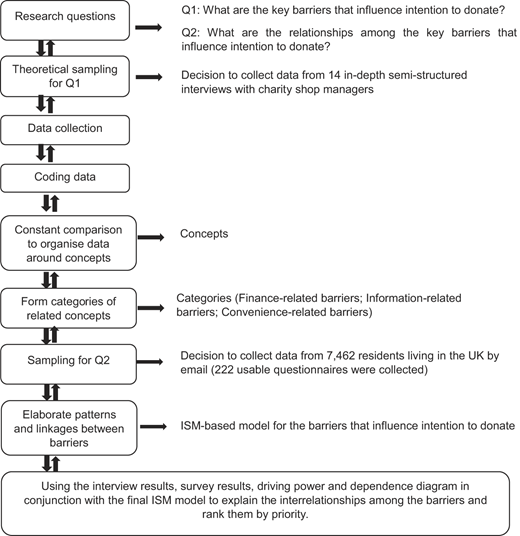
Grounded Theory is one of the qualitative methods that is applicable to social science research (Ralph et al., 2015; Oktay, 2012). The method could transform the unknown phenomena into cohesive concepts through the discovery of empirical data from the ground. This study applies the grounded theory to underpin data collection and data analysis ( Appendix 2). The first step is to collect data from 14 in-depth semi-structured interviews with charity shop managers. The second step is to code data to identify potential analytic concepts. Initial coding was performed applying Saldaña (2016) methods in NVivo with a focus on content and process codes. The third step is to organise data around similar concepts. A constant comparative approach was used to engage in selective coding to distil barriers into categories. The constant comparative analysis includes explicit coding and analytical procedures, which supported the development of the grounded theory (Oktay, 2012). The fourth step is to form categories of related concepts (Oktay, 2012). Three categories (finance-related barriers, information-related barriers, convenience-related barriers) were formed to support a core concept (barriers that influence the intention to donate). The interviews assisted in the creation of the survey questions. Table 1 shows how the related interview questions served as input to identify ten barriers.
Survey
After conducting the semi-structured interviews with charity shops' managers, a total of ten barriers were first identified. Then we assessed these ten barriers (Table 2) with a questionnaire survey using a five-point Likert scale (1 = very low; 5 = very high). Respondents were asked to indicate the level of each of these barriers' influence on intention to donate, and answer a few closed-ended questions related to the respondents' profiles. During the interviews, some managers mentioned that people with higher levels of education donate more often. Thus, we collected email lists from British universities. The survey was sent to 7,462 residents living in the UK by email, and 222 useable questionnaires were collected. The Cronbach's alpha was calculated to test the reliability of the responses and the internal consistency of the questionnaire; the result was 0.676. This shows a reasonable degree of internal consistency, as Nunnally (1978) identifies 0.5 is the minimum value for such exploratory work.
The questionnaires were collected from 123 (55.4%) female and 99 (44.6%) male. Respondents who were aged over 45, employed and had a higher level of education donated more often than younger people, the unemployed and people with less education. A large majority (78.9%) chose to donate when they considered disposal of items and 66% had donated more than once in the previous 12 months. Most of the donations were of clothing (78%). When choosing which charity shops to donate to, most trusted their friends (40.9%) and their own knowledge (34.6%). Only 10% of respondents indicated that they were likely to be encouraged to donate by charity shops' publicity; 69.8% would recommend charity shops to a friend or colleague.
In Table 2, the barriers are listed in decreasing order of significance. For example, Barrier 1, lack of good quality items for donation, is the highest-level barrier in the survey, and thus ranks 1 in the table.
Interpretive structural modelling methodology
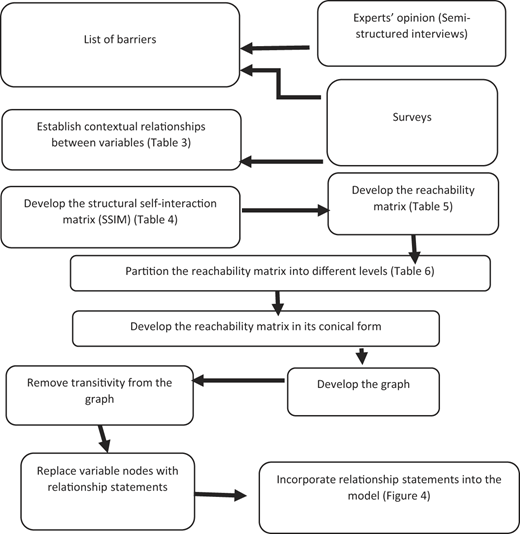
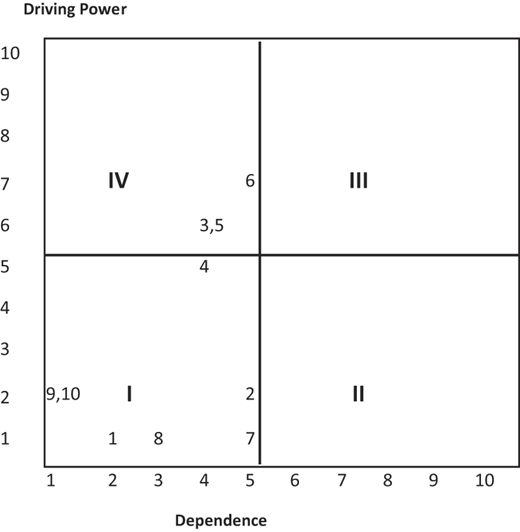
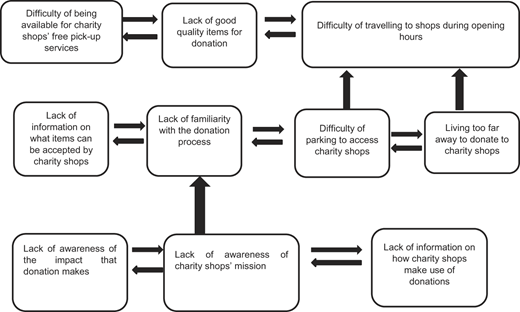
Although individual factors could explain this complex problem, the interrelationships among the factors could explain far more accurately (Attri et al., 2013). The ISM method is a means to identify the interrelationships among variables (Agarwal et al., 2007). We used ISM method to identify the relationships among the barriers and rank their priority. The flow diagram for preparing the ISM model is presented in Figure 2. It explains the data collection process and the ISM method step by step. We first identified ten barriers (Table 2) that influence intention to donate from semi-structured interviews and a survey. The second step of ISM is to find the correlations among the barriers (Table 3): Spearman's bi-variate two-tailed correlation test was conducted based on the survey results. Next, the structural self-interaction matrix (Table 4) was developed based on the pairwise relationships (Table 3). The next step was to convert the structural self-interaction matrix into a reachability matrix (Table 5), and then partition the reachability matrix into different levels (Table 6). In Table 6, Barrier 1 (lack of good quality items for donation), Barrier 7 (Difficulty of being available for charity shops' free pick-up services) and Barrier 8 (Difficulty of travelling to shops during opening hours) are found at level I. Therefore, these three barriers are positioned at the top of the ISM model. Furthermore, to analyse the driving power and dependency of these barriers, they can be classified into four groups (Figure 3): autonomous barriers, dependent barriers, independent barriers and linkage barriers (Jharkharia and Shankar, 2005). Barriers with weak driving power and weak dependence were classified as autonomous barriers. Barriers with weak driving power but strong dependence were clustered as dependent barriers. The barriers with both strong driving power and strong dependence were classified as linkage barriers. The barriers with strong driving power but weak dependence (i.e. 3, 5 and 6) were classified as independent barriers. The final step was to draw the direct graph (Figure 4) based on the reachability matrix.
Research analysis and research implications
Finance-related barriers (lack of good quality items for donation)
The survey results indicate that only 44.7% of the respondents believed the overall quality of their donated goods to be good. Previous studies (Parsons and Broadbridge, 2004; Horne, 1998) show most charity shops receive donations from local residents and only a few receive regular deliveries from central warehouses. Based on the interview results, the donations of local charity shops (such as St Cuthbert's Hospice) rely on local residents. Some large charity shops do receive deliveries from central warehouses (For example, the Oxfam). Today, low-quality fast fashion brands, such as Primark, are popular in Britain. When such brands become popular, it affects the quality of goods donated to charity shops. Furthermore, based on the results of the interview, most charity shops managers stated the overall quality of donated items are not very good, they need volunteers to do the up-cycling, cleaning, and ironing. For example, manager from St Cuthbert's Hospice said, “…the quality of donated apparels are not quite good… We usually need to weight them and sell to one recycling company called RAG…”. And managers from Scope mentioned, “…they are not very good…washing machine upstairs to clean the clothing … our volunteers will iron the clothing …”. Also, manager from Emmaus claimed that “the quality of donated goods is poor as people hold onto things longer during economic uncertainty”. Hence, as people may tend to hold on to old items for longer or sell them for cash during recessions, they might not have any good quality items left for charity shops.
Information-related barriers (lack of information on what items can be accepted by charity shops; lack of awareness of charity shops' mission; lack of awareness of the impact that donation makes; lack of familiarity with the donation process; lack of information on how charity shops make use of donations)
The survey results indicate that only 11.3% of the respondents were familiar with the kinds of items that can be accepted by charity shops. Only 28.2% were familiar with different charity shops' missions and only 9.3% of people felt that their donations have an impact. Only 16.7% of the respondents were familiar with the donation process, and only 19.6% felt that charity shops explain clearly how they make use of donations. One of the important factors that influence people to donate used items to charity shops is the convenience of being able to get rid of large numbers of items in one accessible place (Albinsson and Yasanthi Perrera, 2009). However, there are certain items that charity shops cannot accept for various reasons. For example, the British Red Cross states that the following items cannot be accepted: jelly shoes and flip-flops, toys without the CE mark, religious items and items of clothing made of fur (BRC, 2020). Thus, it is necessary to inform donors about the items that charity shops can accept. Potential donors are encouraged to check shops' list of accepted items before donating. Furthermore, managers from St Cuthbert's Hospice and Emmaus mentioned, “we are small, so cannot react immediately to collect the goods when people just want rid of the furniture on the day…”, and “we are a homeless charity and not well known so not the first charity people think of…”. Thus, Charity shops may need to invest in advertisement to raise awareness of their mission, the donation process and the impact of donation makes.
Regarding charity shops' mission, Stallworth Williams (2008) notes that, for a brand to flourish, it is essential to raise awareness of its mission to let both customers and potential supporters know who they are and what they do. Research shows that the clarity of company mission positively relates to company performance. A comprehensive and direct mission statement helps to attract loyal customers (Dermol and Sirca, 2018). People are donating to charity shops in increasing numbers because of the growing interest in promoting reuse and the environmental and ethical benefits (Parsons and Broadbridge, 2004; Chattoe, 2000). Due to a lack of information from charity shops, people are more likely to donate to the shop that is closest or most convenient. Since the competition among charity shops is increasing, they may need to raise awareness of their mission. Social media is growing exponentially and social networks may help charity shops spread information about their mission.
In terms of the impact of donations, charity shops provide significant economic, social and environmental benefits through a stabilising influence on high street retailing, providing opportunities for volunteering and employment, and reusing and recycling goods (Osterley and Williams, 2018). Increasing numbers of people are donating to charity shops because of the environmental benefits of reusing goods. Nearly 95% of the clothing donated to charity shops is sold or recycled (Harrison-Evans, 2017). Approximately 323,000 tonnes of clothing are donated to charity shops that would otherwise go to landfill. This saves British councils around £27 million in landfill tax and reduces CO2 emissions by nearly 6.8 million tonnes (Osterley and Williams, 2018). When people know exactly what impact their donation makes, they may be more likely to donate. Thus, it is necessary for charity shops to inform people about the impact of their donations. Furthermore, based on the interview results, most charity shops introduce the impact of the donations makes, through online advertisement, email, and posting donation bags and leaflets. For example, managers from The Salvation Army mentioned, “we are clear in our marketing for donation appeals… and our charity shop staff are well-trained to recognise quality as they sort through in-store identifying what will be acceptable to our customer… we do the advertisement to encourage donations…we have signs outside of the window…”. Also, manager from The Children's Society said, “the company does online advertisement… we also communicate with donors by email…”. The manager from The British Heart Foundation said “ we have clothing banks… we do online advertisement… we do as a company…The head office will do…”. Besides, manager from Oxfam stated, “our company usually has programs to recycle poor quality goods…usually unsold items go to Oxfam Wastesaver recycling plant … The Frip Ethique plan is to sort and reuse…”. Furthermore, previous studies analysing the role of social media have shown that networks such as Twitter and Facebook are useful tools with which to attract donations (Wallace et al., 2017). Thus, instead of posting letters to raise awareness of the impact of donations, charity shops may shift their focus to social media.
In terms of the donation process, there are a few things donors need to know before donating. The process is set out on most charities' official website. First, donors are highly recommended to call or visit a charity shop before donating to ask about what is needed, the free collection schedule, the items that are not accepted and so on. For example, based on the interview results, particularly regarding the method of collecting donations from people, managers from the Oxfam and the British Heart Foundation mentioned, “…We offer free pick up service, the home clearance service, people need to call to book an appointment first”, and “…people call to book the appointment and we will pick it…”. Second, items should be cleaned and repaired before donating. Fragrance-free laundry detergent may be used to protect consumers who have sensitive skin. Items should be inspected for broken zips and missing buttons as most charity shops are not able to replace these. Third, donors should consider whether their items are worth buying. The better the quality of the donations, the more funds charity shops can raise from their sale. Fourth, as most charity shops do not have large storage facilities, donors are recommended to give items that are appropriate for the current season. For example, based on the interview results, managers from the British Heart Foundation and Scope mentioned most goods received are not for the current season, and noncurrent season clothing will be cleaned and packed in storage room. However, as these charity shops are located in high street, they have very limited storage space. Finally, donors are required to remove all personal items from pocket or wallets before donating.
Charity shops make use of donated items on two levels: reuse and recycling (Horne, 2000). They sell donated items and help to extend their life cycle. Clothing at the end of its life can be upcycled to make car upholstery, new fabric and paper (Horne, 2000). For example, based on the interview results, when dealing with the poor quality donations, most charity shops will recycle them or weight them and sold to recycling company. In particular, manager form the Salvation Army said, “…we also have alternative routes to reuse or recycle items that cannot be sold in our charity shops and this also helps divert some items away from the waste stream, which in turn benefits the environment… in the case of furniture, we have a number of volunteers who enjoy up-cycling or repairing damaged items so they can be used again…”. Also, the manager from the Oxfam said, “…our company usually has programs to recycle poor quality goods… Usually, unsold items go to Oxfam Wastesaver recycling plant to be recycles… The Frip Ethique plan is to sort and reuse…”. Thus, charity shops may need to spread the information on how they make use of the donations. When people are informed of how charity shops use their donations, they may be convinced to donate.
Convenience-related barriers (difficulty of being available for charity shops' free pick-up services; difficulty of travelling to shops during opening hours; difficulty of parking to access charity shops; living too far away to donate to charity shops) X2
The survey results show that most of the respondents preferred to visit charity shops rather than using clothes banks or booking a free pick-up service. The reasons they gave for not visiting shops to donate were that the goods they wanted to donate were too heavy or too large (25.7%); they did not have time (25%); they lived too far away (21.4%); parking outside the shop is difficult (16.4%); they were not available during opening hours (16.4%). A large majority (84.8%) of the respondents had never used a free pick-up service; of those who had, 53.1% stated that they often missed the scheduled time slot. Almost half (45.5%) had used clothes banks; and 47.5% of these did so because it is easy, the banks are open all hours; 20.9% chose to use clothes banks because it saves time. These results are largely consistent with previous studies. Horne and Maddrell (2002) suggest that convenience is the most significant factor influencing intention to donate. Free pick-up services provide convenience for donors and help charity shops cover a larger geographic area (Reyes and Meade, 2006). However, it is hard for charity shops to decide collection frequency and collection time slots because of the lack of information from donors. Based on the interview results, some large charity shops, such as Oxfam and British Heart Foundation offer free pick up service or door to door collection, the home clearance service, but people need to call to book an appointment first. However, some smaller charity shops, such as Scope, Age UK, currently could not afford free pick up service. What is more, charity shops offer free pick-up services only for certain time slots. As donors cannot choose the time, they may miss the pick-up.`
Volunteers are involved in charity shops' day-to-day operational activities. More than 230,000 volunteers are currently working in British charity shops. Some shops are even run entirely by a small group of volunteers (Charity Retail Association, 2020a). Due to a lack of volunteers, some charity shops might not open every day. For example, based on the interview results, manager from St Cuthberts Hospice mentioned, ”… we need more volunteers… If the volunteers are not available, some products will wait to be sorted in the storage for a couple of days…”. And, manager from Scope said, ”… it requires lots of workloads to sort…some goods are not for the current season. We need more volunteers to sort the goods…”. Furthermore, many charity shops are not open during the weekend. The opening hours of charity shops are usually shorter than high street shops. Some people might not bother to donate due to these time constraints.
In the late 1980s, the British charity shop's image changed from poor secondary trading outlet to primary high street shop (Parsons, 2000). The presence of charity shops on the high street increases awareness of their parent charity. Research shows that 59% of people believe the presence of charity shops on the high street encourages people to donate (Osterley and Williams, 2018). Based on the interview results, some managers mentioned due to the lack of online shops, people need to visit shop and donate; and due to limited parking slots and parking fee, donors might not bother to donate. With the increasing pedestrianisation of towns, people can no longer park for free to drop off bags of donations. This may influence people's intention to donate.
Also, location is one of the most important factors affecting charity shops' ability to attract donations. Location has a significant effect on awareness and exposure of charity shops (Alexander et al., 2008; Horne, 1998, 2000). Most charity shops are located on the high street and so donors live too far away and may find it inconvenient to donate (Horne, 1998). Based on the interview results, some managers mentioned they are high street shops and donors might feel difficult to park to access their shops, and because of the location, mainly local people visit their shops. People living too far away might not bother to visit their shop to donate.
Research implications
Using the driving power and dependence diagram in Figure 3 in conjunction with the final ISM model (Figure 4) and survey results (Table 2), it is possible to explain the interrelationships among the barriers and rank them by priority. The questionnaire results (Table 2) indicate that the lack of good quality items for donation is the top barrier. This is also reflected in the ISM model (Figure 4). Hence, this barrier is accorded the highest priority and needs the most attention. Thus, one of the managerial implications deriving from the results and discussion is the need for the charity shop to develop potential interventions to secure good quality donations. Charity shops may use the online platform and social media. Selling online and promoting through social media may enable charity shops to be viewed by a bigger audience of donors. It is important to give online presence lots of personalities. Charity shops could get the volunteers and staff involved to make varied content and interactions that may reach wider potential donors. The active social media presence could provide charity shops valuable insights into the follower base, enable to make meaningful engagement, and turn this engagement into possible good quality donations. Charity shops could ask followers what kind of items they prefer to see in your charity shop. This might not only increase the engagement with potential donors but also potentially see the things you will have to prepare. Securing items in high demand may be a good spot to begin. Charity shops could issue an online appeal for particular items needed currently. This kind of posts could serve as a reminder for potential donors to check things they are planning to declutter. Charity shops could encourage followers to tag their official social media accounts, this may boost online presence and increase the chance of securing good quality donations. Particularly, taking advantage of the online platform and social media may help a charity shop that does not have a large high street presence to be known by a broad customer base and obtain possible good quality donations.
Though the lack of awareness of charity shops' mission is lower down the hierarchy of the ISM framework (Figure 4), it is the most important barrier in the survey results (Table 2). This barrier has strong driver power and low dependence (Figure 3). Hence, this barrier is the strong driver and might be the root causes of all other barriers. This might be the reason why respondents still regarded this barrier as one of the most significant. Thus, lack of mission awareness is accorded high priority. Donors may tend to donate for charity shops they identify with. A well-crafted mission statement helps to set a charity shop apart from competitors without limiting its business purpose. Charity shops may use images and videos to raise awareness of their missions. Visuals may make a mission statement more engaging. This could obtain high rates of social visibility and sharing, and ultimately substantially boost their brand awareness.
Lack of familiarity with the donation process and the items that can be accepted by charity shops are mid-level barriers according to both ISM model (Figure 4) and survey results (Table 2). Lack of familiarity with the donation process has high driving power, and lack of information of the items can be accepted by charity shops has high dependence power. These two barriers are also mutually reinforcing. Thus, they are accorded medium priority. It is further observed from the ISM-based model that lack of awareness of donations' impact and lack of information on how charity shops make use of donations are both at the bottom of the ISM model (Figure 4), but mid-level barriers based on the survey results. These barriers have a significant influence on intention to donate. Thus, they are accorded medium priority. Therefore, charity shops should develop strategies to raise awareness of donations' impact and inform potential donors on how charity shops make use of donations. Using an online platform or using social media can easily provide donors with the visibility on understanding the donation process, raising awareness of donations' impact, and informing potential donors on how charity shops make use of donations. Social media is a powerful tool that may enable charity shops to reach many potential donors at once. Charity shops could ask donors to share their donation experience on social media. This helps to achieve great exposure, which is more effective than traditional posting letters for informing the donation process and the use of donations and raising awareness of donations' impact.
As shown in Figure 3, the barriers of living too far away to donate, the difficulty of parking, of being available for free pick-up services, and of donating during opening hours have weak driving power and dependent power (Figure 3). The survey results also identify them as low-level barriers (Table 2), and thus they are accorded low priority. Charity shop may implement a system, a webpage or App, where donors could book for free pick-up services and choose the collection time online. If there is a shortage of funds for local or small charity shops to implement such a system, managers could engage with the local community and online followers to gather ideas for fundraising through opening up a discussion. Whether this is a yard sale or sponsored run, it is a great opportunity to engage with them. They and their friends may be delighted to support the fundraising efforts.
Conclusion, contribution and limitations
This paper empirically assessed supply-side barriers with a mixed-methods approach. To do so, a theoretical framework was developed based on the literature on agency theory and stakeholder theory to explore the charity shop's role and its donation flow in the multi-tier supply chain. Charity shops lack a conventional supply chain, instead, their stock relying heavily on donors' donations. The role of the charity shop within the multi-tier supply chain and its donation flow are useful to understand the unique aspects of charity supply chains. These help to assess the charity shops' supply-side barriers. Three roles of the charity shop were discussed: customers' and beneficiaries' supplier, donors' partner and the regulator's supervisee. The donation flow, from the sourcing of items to the provision of charitable services to the beneficiary, was explained. To analyse the barriers that influence intention to donate, firstly, in-depth semi-structured interviews were conducted with 14 charity shop managers. Second, 222 useable questionnaires were collected from donors to further understand the relationships among the barriers identified. Finally, the ISM approach was applied to examine the interrelationships among barriers. The survey and ISM framework both identified the lack of good quality items for donation as the most significant barrier. Thus it needs the most attention.
This research contributes to the literature by exploring charity shops' roles and donation flow within the multi-tier supply chain. This information is useful to understand the unique aspects of charity supply chains. Most importantly, this study used a mixed methods approach, including survey and ISM, to analyse the interrelationships among the barriers that influence intention to donate, and ranked their priority. These results are very useful for charity managers to understand current barriers to securing good quality stock and developing potential stock-securing interventions based on these barriers' priority.
This research has the following limitations. First, we collected only 222 useable questionnaires. This small sample might not reflect the real situation of British donors' behaviours. Second, the data were collected at one point in time, and so might only reflect certain phenomena of that moment. Future research, such as a longitudinal study of British charities to track changes in barriers, can overcome these limitations to some extent. Third, this research applied the ISM methodology. However, the ISM model is not always statistically validated (Attri et al., 2013; Agarwal et al., 2007). Structural equation modelling could test the validity of a theoretical model that has already been developed, but it cannot develop an initial model for testing. Thus, future research could apply ISM first to develop an initial model and further corroborate the relationships derived from ISM method with structural equation modelling.