The purpose of this study is to show that the current complexity of humanitarian operations has only increased the usefulness of system dynamics (SD) in helping decision-makers better understand the challenges they face.
A critical analysis to evaluate how SD methodology has been applied to humanitarian operations.
Today's humanitarian operations are characterized by huge complexity given the increased number of stakeholders, feedback loops, uncertainty, scarce resources and multiple objectives. The authors argue that SD's tools (causal-loop diagram, data layer, simulation model) have the capacity to appropriately capture this complexity, thereby enhancing intuition and understanding.
Researchers and practitioners hesitate to use system dynamics when data is missing. The authors suggest alternatives to deal with this common situation.
1. Introduction
To the best of our knowledge, the earliest papers on humanitarian operations were published back in 2006 by Van Wassenhove (2006) and Altay and Green (2006). They described how humanitarian logistics work in practice and argued for more research on disaster management. Since these pioneering publications, the number of papers has increased exponentially. Clearly the establishment of the Journal of Humanitarian Logistics and Supply Chain Management (JHLSCM), in 2011, strongly contributed to the increased academic focus on this important and neglected subject.
One reason for the many publications on humanitarian operations in the past decade is their intriguing context to operations management researchers. Humanitarian supply chains involve multiple stakeholders with different objectives (Tomasini and Van Wassenhove, 2009). Through their interactions, these stakeholders exchange information and resources, creating feedback loops, making the problem a dynamic system. Moreover, humanitarian supply chains are characterized by uncertainty, for example, the location and timing of the next emergency are unknown. To both, humanitarian supply chains operate under scarce financial and time resources, that is, these dynamic systems are complex to manage.
The multitude of stakeholders with different objectives, feedback loops, uncertainty and resource constraints has grown in recent times, thereby substantially increasing the already high complexity of humanitarian operations, making it very hard to take the right decisions. Besiou et al. (2011), one of the papers published in the inauguration issue of the JHLSCM, argue that because of this complexity, decision-making is often driven by experience and intuition. It is hard for the human mind to properly include complexity. Therefore, Besiou et al. (2011) suggest system dynamics (SD) as a suitable methodology. After all, SD was created as a tool to study the behavior of dynamic systems characterized by multiple stakeholders and feedback loops (Forrester, 1961; Sterman, 2000). Besiou et al. (2011) go one step further in showing the method's suitability for research in humanitarian operations by developing a simulation model for fleet management and a conceptual model to analyze how donations arise during disaster response. They also provide some ideas for future research.
To prepare the current paper, we screened all issues of the JHLSCM since 2011 to better understand if and how SD has indeed been used, that is, how well the encouragements of Besiou et al. (2011) have been followed. We also discuss how humanitarian operations have changed this last decade. We then argue that current challenges are an order of magnitude more complex than a decade ago, that is, methodologies that can handle complexity are more important than ever. We suggest that SD methodology may also be the way forward to help close the increasing gap between academia and practice.
Section 2 explains the reasons why SD is an appropriate methodology to study humanitarian operations. Section 3 presents the papers that have been published in the JHLSCM since its origins in 2011. Section 4 discusses how humanitarian operations have changed, and Section 5 concludes with the way forward.
2. System dynamics for humanitarian operations
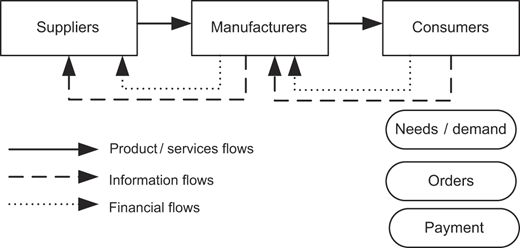
Back in 2011, Besiou et al. (2011) discussed the characteristics of humanitarian operations that set them apart from commercial supply chains and increase their complexity. First, humanitarian supply chains involve multiple stakeholders including humanitarian organizations (HOs), donors, suppliers and beneficiaries. While these stakeholders can also be found in modern commercial supply chains, there are some crucial differences. For example, in a commercial supply chain (Figure 1), the needs for specific goods or services arise from consumers. They place orders to manufacturers, in case of goods, who transmit them to their suppliers. The goods/services flow from suppliers to manufacturers and then to consumers, while the information and financials flow from consumers backward to manufacturers and then suppliers. If consumers end up with the wrong product, financial flows will be interrupted.
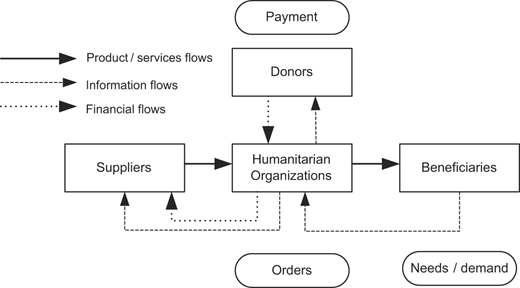
Similar to the commercial supply chain, beneficiaries in the humanitarian supply chain have needs for specific goods or services (Figure 2). However, since they typically cannot afford placing an order and/or markets have been disrupted due to the emergency, HOs come in and order what they believe is needed from suppliers. Donors financially support the HOs to satisfy the demand of the beneficiaries. It follows that in the humanitarian supply chain the needs, orders and payments do not originate from the same stakeholder, making satisfaction of the real needs more challenging.
Apart from the stakeholders captured in Figure 2, there are more actors that play critical roles in the humanitarian supply chain (Van Wassenhove, 2006). For example, the local government is the only actor that can invite HOs to come into the country and support their efforts during disaster response or development activities. The military can also support disaster response. The media communicate on the progress of operations and affect public opinion. Besides, needs of beneficiaries may be satisfied by a multitude of hundreds or even thousands of organizations not always working in perfect harmony to maximize service at minimal cost (Altay and Labonte, 2014).
All these stakeholders have distinct roles and objectives (Tomasini and Van Wassenhove, 2009). HOs are governed by the principles of humanity, neutrality, impartiality and independence. However, not all the other stakeholders operate under the same principles. Local actors such as the government or the military may not be neutral, complicating the coordination among the different stakeholders or jeopardizing the humanitarian principles. Moreover, governance among the stakeholders is much less formalized compared to commercial supply chains, creating an additional hurdle to swift operations, which already face difficult and sometimes tricky operating environments including difficult access and security concerns.
Second, HOs operate in an effort to save more lives in case of emergency or to improve quality of life of populations of concern before or after an emergency. Hence, many HOs run two types of programs: development and relief (Besiou et al., 2011). Oversimplifying, the objective during relief operations is fast response, that is, effectiveness at any cost, while development operations focus on cost-efficient ways to improve quality of life, for example, access to food or health care. (Van Wassenhove, 2006). There are also different types of disasters depending on their cause (man-made versus natural disasters), onset (slow vs sudden) and how often they happen (cyclicality). All these different types affect stakeholder behaviors in different ways. For example, media are more interested in relief rather than development programs and so are many donors (Turrini et al., 2020). Furthermore, the impact of a disaster on the local population depends on how vulnerable the country is. Economic underdevelopment and political instability both cause and increase the impact of humanitarian disasters (Besiou et al., 2011).
Third, HOs are very decentralized with headquarters traditionally in safe locations in developed countries, closer to the largest donors, while their operations are in very different environments in terms of security or level of development (Besiou et al., 2011). Clear communication may not always be easy. Finally, HOs typically operate under limited funding, time and skills. All these pressures cause high staff turnover, making recruiting and training challenging. Consequently, cumulative institutional knowledge building is hard and decision-making in humanitarian supply chains is understandably often based on intuition and experience. It is not always sufficiently fact-based using analytical processing and therefore sometimes misses the necessary holistic perspective on the impact of decisions.
Besiou et al. (2011) suggest SD as an appropriate tool to capture all this complexity. SD was developed back in the 1950s to support construction of better mental models. It is based on feedback loop/control theory, computer simulation and differential equations (Sterman, 2000). The relationships among the stakeholders can be graphically depicted by diagrams. There are two phases when building an SD model. In the conceptual phase, the focus is on understanding the complexity of the real system by identifying the stakeholders, their objectives, incentives, actions and behaviors. The phase ends by building a causal-loop diagram that pictures all the important stakeholders and their interactions. No quantitative data is necessary. In the technical phase, a stock and flow diagram is built and, using numerical data and assumptions concerning the functional forms, the system is simulated. Hence, SD can be used by humanitarian decision-makers to simulate and compare the impact of alternative decisions on the system's behavior. Such experimentation would not be possible in real-life situations.
3. Publications in the JHLSCM using SD
We went through the 171 papers published in the JHLSCM from the inaugural issue in 2011 to May 2021 to check whether our original call for using SD methodology to facilitate decision-making in humanitarian operations was followed by researchers. What we found is that on top of Besiou et al. (2011), five more papers used SD.
Diedrichs et al. (2016) develop a SD model to quantitatively measure the impact of communication and logistical coordination between stakeholders participating in a disaster response operation on the number of lives saved and money spent. They consider delivery of items of different priorities to the field and assume limited transportation capacity and specific demand. The time period considered is the first two weeks following a disaster. The model includes multiple stakeholders, feedbacks caused by the product, information and monetary flows and their breakdowns and time delays for deliveries, making SD an appropriate tool. The results confirm that poor communication and indiscriminate shipping of goods without considering any prioritization increase material convergence and shortage of critical goods. Their analysis was not based on a real case study.
Anjomshoae et al. (2017) realized that although there are interdependencies among the key performance indicators used in humanitarian supply chains, no framework was actually considering them. Therefore, the authors analyzed case studies published in international journals between 1996 and 2017 to better understand these interdependencies. Going into the qualitative phase of SD modeling, they build a conceptual model including dynamic interactions, making the use of SD appropriate. However, they did not have the opportunity to validate the model through a real case study.
Obaze (2019) focuses on understanding the complexity of supplying, distributing and transporting charitable resources to underserved communities. The author combines a literature search with qualitative information collected from a community-based enterprise in the USA to identify humanitarian service exchanges within communities. She finds that when HOs look at their operations as services to beneficiaries instead of mere distribution of donated goods, this helps the community to become more sustainable in the long term. To better understand this complexity, the paper developed a causal-loop diagram. Due to the multiple stakeholders and feedbacks over time, SD is a suitable tool to use. However, due to lack of quantitative data, the author could not develop a simulation model.
Allahi et al. (2021) study the impact of three different measures on improving health and education in refugee camps during COVID-19. The alternative measures are isolation, social distance/hygiene behavior and financial aid. They find that by promoting social distancing and increased hygiene behavior among refugees, the camp authorities can delay the peak time of the outbreak and reduce the number of infections and casualties. The authors use a case study of Syrian refugees in Turkey. The model is dynamic and contains multiple feedback loops, including a model that studies the impact of the epidemic on the population, so the choice of SD is appropriate.
Harpring et al. (2021) identify the factors affecting the risk of a cholera outbreak in case of complex emergencies. Conflicts damage infrastructure, cause the displacement of beneficiaries and disrupt the supply chains of commercial companies and HOs operating in the area. The authors use the civil war in Yemen as a case study. They build a conceptual model using qualitative descriptions collected from academic literature, HOs, nongovernmental organizations and practitioners active in this area. The model's interactions are validated through multiple semistructured interviews with a field expert. The authors find that when the humanitarian aid does not only provide short-term relief but also considers infrastructure development, preventing and controlling future cholera outbreaks is easier. The conceptual model includes dynamic interactions of the factors that affect outbreaks, making SD an appropriate method for this study. However, the authors could not collect quantitative data to build a simulation model.
Three of the six JHLSCM papers were published in regular issues. Obaze (2019) was published in the special issue (SI) of Research Methods in Humanitarian Logistics, while Allahi et al. (2021) and Harpring et al. (2021) were included in the SI of Preparing the Humanitarian Supply Chain for Epidemics and Pandemic Responses.
Table 1 summarizes how SD has been used in the six papers published in the JHLSCM. We notice that SD helped Anjomshoae et al. (2017), Obaze (2019) and Harpring et al. (2021) to show system complexity even if they were missing numerical data by developing conceptual models through CLD, while only Besiou et al. (2011), Diedrichs et al. (2016) and Allahi et al. (2021) managed to develop simulation models that actually show the dynamic behaviors.
From these six papers we also realize that all authors decided to use SD methodology because of the complexity of the problem they wanted to better understand. We note that three of the six papers were published in the last three years, two of them appearing in the latest issue of JHLSCM. Perhaps this is a reflection of the increasing complexity of humanitarian problems making system dynamics more useful than ever before.
4. Future of humanitarian operations
Besiou and Van Wassenhove (2020) identify three eras in humanitarian operations. HUMLOG 1.0, up to the response to the 2004 Asian tsunami, was mainly characterized by a humanitarian sector populated by people with great hearts, field experience, intuition and vision, but not necessarily with technical expertise in logistics or the right software and systems. HUMLOG 2.0 followed the not too successful response to the 2004 Asian tsunami. From then on, media attention and hence also donors were attracted after every catastrophe, providing more funding, some of which could be used for capacity building through trainings, hiring experts, using more advanced supply chain software, so as to improve preparedness for the next emergency.
However, even if the sector has professionalized by learning from commercial supply chains, the humanitarian context is very dynamic and volatile leading us to HUMLOG 3.0. Besiou and Van Wassenhove (2020) identified seven characteristics that reflect this volatility and dynamics: “changes in the number and role of stakeholders in humanitarian supply chains, disaster lifecycle, disaster type, objectives, technology, type of aid delivered to beneficiaries, and business models.”
Specifically, the increased number of stakeholders is pointing to a higher level of complexity, and the changing situations over time demand the use of a methodology that can capture both multiple, different stakeholders and the interactions among them in a dynamic way.
HOs continue operating during all four phases of the disaster life cycle [mitigation, preparedness, response and rehabilitation (Tomasini and Van Wassenhove, 2009)] but since the emphasis is no longer mainly on disaster response, a tool that can include both short-term and long-term time horizons is necessary. Lewin et al. (2018) also emphasize that even if the funding for development and relief operations is typically in silos, HOs usually operate these programs at the same time, so a more holistic approach spanning disaster phases is needed.
Depending on the type of programs, humanitarian supply chains prioritize different objectives. For example, cost is critical during development, while response time prevails during disaster response (Besiou et al., 2014). At the same time access to beneficiaries and equity are critical during man-made disasters (Lewin et al., 2018), which means a method is required to deal with multiple objective functions.
Considering the characteristics of HUMLOG 3.0, we argue that the study of humanitarian operations requires a methodology that can capture multiple, different stakeholders, the interactions among them in a dynamic way, both short-term and long-term time horizons, multiple objectives and cyclicality in a holistic way. Unfortunately, there is a danger that because of the increased complexity of humanitarian operations and the problems practitioners face, academics may decide to go for the “easy” solution of focusing on manageable subproblems for which they can develop results using conventional optimization, to improve their chances of publication (Besiou and Van Wassenhove, 2015). If this happens, and assuming little information transparency and collaboration among academics and practitioners, everybody will be touching a different small part of a big elephant without understanding the whole dimension of the real problem. Consequently, the current gap between theory and practice (Besiou and Van Wassenhove, 2020) might grow even more. To avoid this, we posit that SD is a suitable methodology, able to holistically capture the above characteristics and to help practice see the relevance of academia.
5. Way forward
As much as it is necessary for research and practice to collaborate in an increasingly complex world, it sounds much easier than it is. Humanitarian practitioners want to find solutions to their problems within a short time-frame, and they frequently do not mind if this solution is not generalizable to a different context. The solution just needs to be easily implementable and therefore simple to understand and communicate. Moreover, they rarely have time to help the researcher understand the challenges they face or access to funding for data collection, cleaning and analysis. Cherry on top: humanitarian operations occur in environments typically characterized by poor and scarce data. Researchers are not subject to the same time pressures. Research projects typically have a time horizon of several years from the moment the researcher identifies the research question till the paper's acceptance for publication. Rigor is a necessity, together with generalizability, while the importance of relevance depends on the journal's vision. Researchers often identify rigor with closed-form analytical solutions that may require abstracted operations research (OR) methods, which are difficult for nonacademics to understand and trust. Traveling to the field to better understand the context and for data collection does not only require time but also financial resources that the researcher may not have. Better or more data typically make it easier for the researcher to work on the publication.
These differences between academic and humanitarian practice are not easy to bridge. Efforts are required from both sides. Practitioners should learn how to trust academics, their usage of rigorous scientific methods and to rely on evidence-based research. They need to realize that if they do not at least invest part of their time to build this relationship, they cannot expect researchers to be very helpful. Very often this requires to open up or adjust their software to collect the right data and to approach donors together with the academics to secure financial support for the project. Donors have to understand they need to invest in data and analytics, that is, in building a research infrastructure to move the field ahead. Researchers should, in turn, be willing to invest time to understand the humanitarian context if they want their research to be relevant and impactful. Besiou and Van Wassenhove (2015) suggest that when researchers engage in new research topics, they should perhaps start with surveys, case studies, field trips, that is, methods that are not so popular in hard core OR academic outlets but very important to better understand practice. The lack of data sometimes motivates researchers to steer away from developing a comprehensive mathematical model and focus on a much smaller and manageable subsystem, a bit like the drunk searching for his lost house keys under the streetlamp.
However, Anjomshoae et al. (2017), Obaze (2019) and Harpring et al. (2021) use the findings from case studies to show how even without quantitative data and only using the causal-loop diagram of the SD methodology they can help practitioners better comprehend the complexity they face. Besiou et al. (2011), Diedrichs et al. (2016) and Allahi et al. (2021), using simulation models, are examples of a typical more complete use of the SD methodology. In a more traditional usage of methodology, Besiou et al. (2014) develop a SD model to study the performance of three different vehicle supply chain structures – centralized, hybrid and decentralized – on cost efficiency and service level during development and relief programs. The authors conducted case studies of four different HOs whose vehicle supply chains are representatives of these three structures. The case studies made the data collection easier, in order for the authors to not only develop CLDs but also to run simulations. Blair et al. (2021) suggest a different and novel use of system dynamics. Following five years of work with USAID in Uganda to understand how local markets are working, Blair et al. (2021) set out to better map the real system's full complexity. After building the causal-loop diagram they realized, not surprisingly, that some data were missing, preventing full-scale simulation in a second step. They decided to augment the causal-loop diagram with a data layer, using available inputs, which provided them with better insights about the subsystems suffering from poor data quality and deserving more research. Specifically, Blair et al. (2021) added data to each variable in the CLD to show the dynamic behavior of these variables and to help build trust with practitioners. For every variable they use different color codes: one that shows the current status of the variable, for example, how many smallholder farmers have a loan, and one that shows the trend of the variable, for example, how the number of smallholder farmers with a loan changes over time. Then Blair et al. (2021) validate the CLD by receiving feedback from practitioners. This approach helps researchers better understand which subsystems of a model require attention and potential adaptation. This methodology is a promising hybrid between just using a CLD to capture complexity and simulating the outcomes of scenarios for which full and reliable data are necessary.
Working five years on a research project without the “assurance” of a publication is very risky for young academics. This risk can be partially compensated by the humanitarian context, which is attractive to researchers along with the potential impact on practice. Practitioners and academics should collaborate to point out the critical subsystems that require more analysis to donors and convince them to fund projects solidifying system knowledge and reliable data capture. This would facilitate research collaboration on complex problems over a longer period of time, developing solutions that can be tested and subsequently implemented in order to secure impact. SD is a suitable method to use in this joint research and development trip since it can depict the system in a holistic way, conceptual diagrams capture complexity nicely, are easy to understand, and they can be combined either with a data layer (Blair et al., 2021) or with a simulation model.
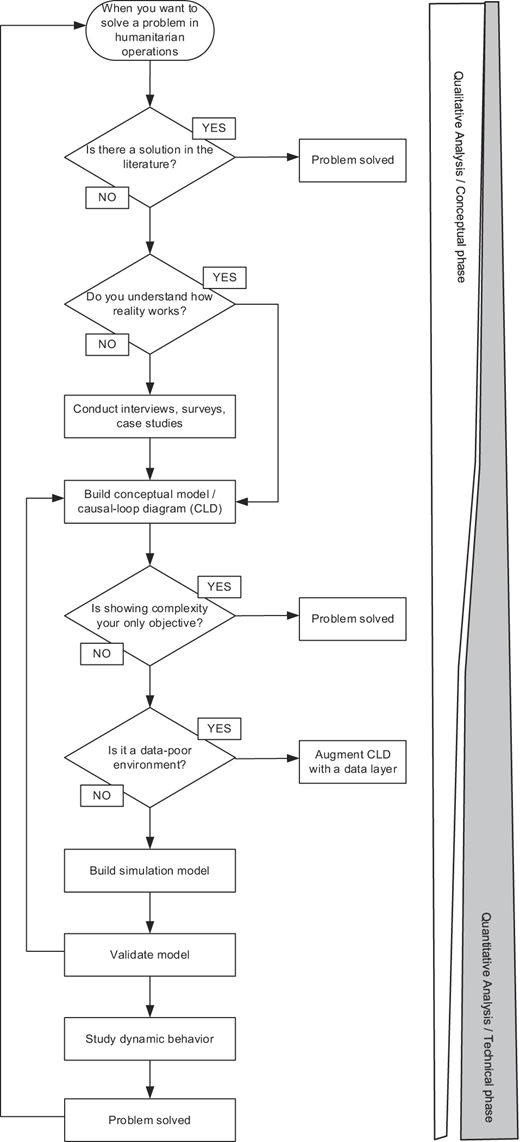
To help SD researchers decide how to move forward, we suggest using Figure 3. It is built on Towill's (1995) and on Besiou et al.'s (2011) general description of how SD methodology is used. We augment the whole approach by suggesting researchers can stop the analysis before the simulation model depending on their objective and data availability, like Blair et al. (2021) did. The conceptual phase consists of a literature review, the description of qualitative data using, for example, case studies, the causal-loop diagram and the data layer in case of poor data. If the objective of the research is predominantly to better understand the system's complexity, then stopping with the causal-loop diagram would suffice. In the technical phase, the simulation model is built and validated. Then the simulation is executed to better understand the SD behavior and alternative future scenarios can be evaluated.
To conclude, in this paper we revisit our 10-year-old suggestion that SD is an appropriate methodology to study humanitarian operations. We discuss how SD has been used since then in papers published in JHLSCM and note that problems have become a magnitude more complex. Consequently, the use of SD is more promising than ever.