Disasters pose a significant threat to healthcare systems, underscoring the need for evidence based operational frameworks to enhance the efficiency and effectiveness of pharmaceutical supply operations. Therefore, an operational framework for managing pharmaceutical supply was developed and validated through a multi-stage process, including scoping reviews, in-depth interviews and world cafe discussion methods. This study aims to further evaluate the effectiveness of the operational framework through a tabletop exercise.
A multi-hazard tabletop exercise was developed by the research team from March to July 2024 and conducted during a three-day workshop in August 2024. The exercise involved 25 participants from various operational levels, who were exposed to the scenarios first without the aid of the operational framework and then with the operational framework. Participants’ perceptions of disaster management activities, the framework’s effectiveness and the conduct and design of the exercise were gathered through a pre- and post-survey and hot wash assessment.
Participants’ understanding and capability in disaster management activities were significantly improved after being introduced to the operational framework (p < 0.001). Most participants strongly agreed and agreed that the operational framework was comprehensive (96%, 24/25), easy to understand (100%, 25/25), enhanced efficiency (96%, 24/25) and facilitated effective coordination (96%, 24/25) and communication (96%, 24/25). All participants also strongly agreed and agreed that the tabletop exercise was well-structured, realistic and met its objectives.
This study demonstrated that the operational framework enhances policymakers and practitioners understanding and capabilities in managing pharmaceutical supply operations in multi-hazard disaster scenarios. The operational framework provides valuable guidance for efficient decision-making among practitioners and policymakers, enhancing effectiveness, efficiency and resilience in pharmaceutical supply operations.
There is a notable gap in the literature concerning the practical application and evaluation of frameworks in managing pharmaceutical supply operations in disaster settings. While conceptual models exist, few studies have rigorously tested their effectiveness in real-world or simulated disaster contexts. This paper aims to address this gap by presenting a practical and comprehensive operational framework that has been rigorously tested across multiple hazard scenarios throughout all phases of the disaster management cycle and at multiple operational levels.
Introduction
Pharmaceutical supply management refers to the strategic planning, coordination and implementation of activities to ensure uninterrupted pharmaceutical supply, which includes ensuring the pharmaceutical is delivered to the right place, in the right quality and quantity, at the right time and at the right price to meet the needs of the affected population during a disaster (Raj et al., 2022). It involves various activities such as supply chain coordination, resource management and allocation, and inventory management, all of which demand robust and responsive operations to meet the healthcare needs of affected individuals during a disaster (Uthayakumar and Priyan, 2013). Under normal conditions, the complexity of the pharmaceutical supply chain operations is often invisible, owing to stable production flows and routine operations governed by established standard operating procedures (Adsanver et al., 2024). However, the presence of multiple stakeholders, regulatory complexities, specific operational requirements and the unpredictable nature of disasters can put tremendous strain on standard operations, resulting in ineffective management (Wahab et al., 2024).
Past disasters have highlighted that effective preparedness and response efforts must extend beyond individual organisations or isolated levels within the supply chain (Kovács and Sigala, 2021). Disaster response typically involves a wide range of responders, each fulfilling specific roles essential to disaster management, with each group contributing critically at different stages of disaster response (Hoang et al., 2024). As secondary responders, pharmaceutical supply operational teams play a vital role in ensuring the continuity of healthcare operations. Effective collaboration and coordination between first and second responders ensure that victims receive timely, appropriate and safe medical care during disasters. The integration of pharmaceutical supply operational teams into the disaster response framework is especially significant, given their expertise in logistics and supply chain management (Adsanver et al., 2024). Therefore, strengthening the capabilities of pharmaceutical supply operational teams is a critical component of disaster risk reduction efforts, enabling more effective preparedness, response and recovery.
Although a disaster is inevitable, research in disaster operations can play a crucial role in enhancing decision-making and management processes, thereby improving the efficiency and effectiveness of supply chain performance (Altay and Green, 2006; Tippong et al., 2022). Several operational inefficiencies have been identified in managing pharmaceutical supply operations during disasters, including inadequate response to sudden surges in demand, poor coordination among stakeholders within supply chain networks, and inefficiency in warehousing, distribution, monitoring and disposal processes (Dolinskaya et al., 2018; Papalexi et al., 2020). An operational framework that provides a structured approach to implementing and managing processes, clearly defining key components, workflows and their interconnections, can effectively support pharmaceutical supply operations during disasters (Paciarotti et al., 2021).
Several studies have provided valuable insights into frameworks for managing supply operations during disasters (Negi and Negi, 2021; Timperio et al., 2016; Raillani et al., 2020; Kaur and Singh, 2020; Husain et al., 2016). Negi and Negi (2021) explored humanitarian logistics during the disaster preparedness and response phases. Similarly, Timperio et al. (2016) developed a decision-making framework in the same disaster phase. Raillani et al. (2020) introduced a framework centred on risk management within the supply chain, while Kaur and Singh (2022) proposed a disaster-resilient framework specifically for the procurement process, and Husain et al. (2016) focused on a framework for flood disaster relief. Organisations such as the United States Agency for International Development (USAID) and the Administration for Strategic Preparedness and Response (ASPR TRACIE) have published several guidelines to enhance pharmaceutical supply operations in disaster preparedness and response (USAID, 2019; ASPR TRACIE, 2024). Despite increasing recognition of the importance of pharmaceutical supply operations in disaster contexts, there remains a lack of in-depth studies and comprehensive operational guidelines that clearly outline the essential components and practical steps for implementation (Negi and Negi, 2021; Timperio et al., 2016; Raillani et al., 2020; Kaur and Singh, 2020; Husain et al., 2016). In response to this gap, the research team developed a comprehensive operational framework through a scoping review aimed at supporting pharmaceutical supply management across all phases of the disaster management cycle – mitigation, preparedness, response and recovery (Ahmad Hamdi et al., 2024). While the operational framework is conceptually robust, it has yet to be tested for its usability and effectiveness in real-world or simulated disaster settings. To advance its practical application, there is a need to adopt an implementation science approach, which considers the contextual factors that influence the adoption and integration of evidence-based strategies into routine practice (Bauer and Kirchner, 2020). This approach helps bridge the persistent gap between theoretical development and operational realities, making it particularly relevant for disaster preparedness and response.
In this context, disaster simulation exercises have emerged as essential tools for enhancing disaster readiness (Skryabina et al., 2017). Specifically, tabletop exercises offer a controlled yet realistic environment to test procedures, clarify roles, and identify potential gaps in disaster response. A systematic review by Mahdi et al. (2023) underscores the value of such simulation exercises in disaster medicine, while earlier work by Skryabina et al. (2017) highlights their critical role in health sector preparedness. However, despite a growing body of literature on simulation-based training, there is a noticeable lack of empirical studies focusing on pharmaceutical supply management among secondary responders. Existing studies by Ghiga et al. (2021) and Gralla et al. (2015), though informative, often focus on a single hazard type or a specific phase of disaster management and do not involve multiple operational teams collaboratively managing pharmaceutical operations.
To ensure that the operational framework meets the complex demands of real disaster settings, a tabletop exercise was identified as the most appropriate platform for evaluation. This method enables rigorous testing of the operational framework’s practicality, relevance and adaptability across various disaster phases and stakeholder roles (Schumacher et al., 2022; Watson et al., 2021; WHO, 2017). To facilitate the practical application of the operational framework, a tabletop exercise incorporating a multi-hazard scenario was designed to test its usability and train participants in its implementation. Hence, this study aims to evaluate the effectiveness of the newly developed operational framework for managing pharmaceutical supply during disaster scenarios while examining how well the operational framework supports coordination and decision-making among multiple stakeholders through their engagement in the simulation exercise across various phases of the disaster management cycle.
Methods
Study design
This study was conducted as a mixed-methods study approach, combining both quantitative and qualitative methods, to evaluate the effectiveness of the operational framework for managing pharmaceutical supply operations during disasters through designing and conducting a simulated tabletop exercise. Through realistic scenarios, tabletop exercises enable participants to evaluate the operational framework usefulness in disaster management and assess their understanding and response capabilities related to pharmaceutical supply operations management during a disaster. This study presents a unique tabletop exercise that adopts a multi-hazard approach by integrating diverse disaster scenarios, promoting cross-level interaction through role-specific cards, encompassing all phases of the disaster management cycle and applying an operational framework to guide decision-making and response activities.
Participant selection and recruitment
The operational framework and tabletop exercise were developed between March and July 2024 with various expert team members, including representatives from the disaster units and management of the Ministry of Health (MoH), the Ministry of Defence (MoD), the National Defence University of Malaysia (NUDM) and Health-related Non-Governmental Organisations (HNGOs). The real tabletop simulation was conducted in a three-day workshop from 13 to 15 August 2024. During the tabletop exercise, a total of 25 pharmacists who manage pharmaceutical supply operations at the district, state or national levels within Malaysia's public healthcare system, with diverse practice levels and geographic representation, were purposively invited to participate in the tabletop exercise study. The participants consist of health-system pharmacists, state pharmacists, hospital pharmacists, district health office pharmacists and health clinic pharmacists. Before the study, participants were contacted via email, informed about the study, and invited to participate. In this study, the roles assigned to players during the tabletop exercise aligned with their actual responsibilities, enhancing the realism and effectiveness of the training and strengthening the validity of its outcomes. This study was conducted in collaboration with the Pharmacy Practice and Development Division, Ministry of Health Malaysia.
Study instruments
Pharmaceutical supply operations management framework for a disaster
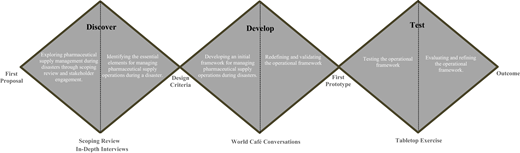
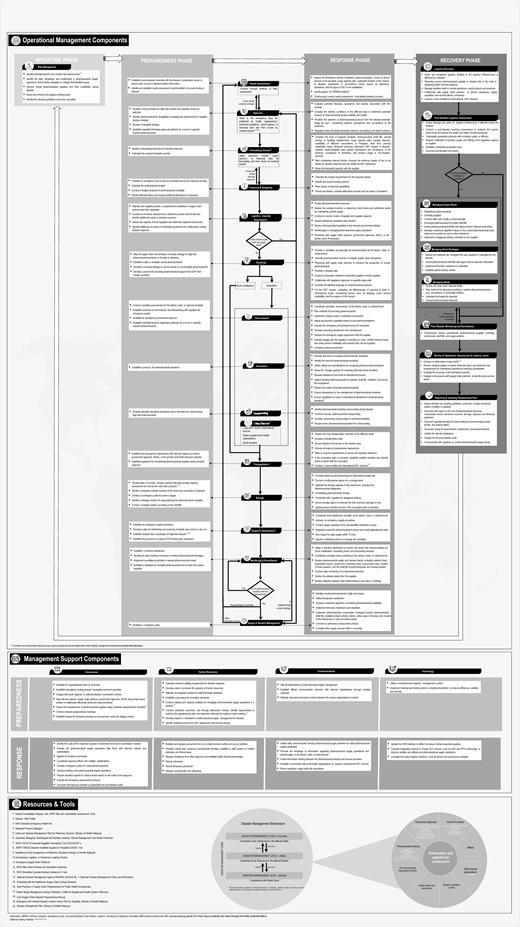
This study introduced participants to a newly developed operational framework for managing pharmaceutical supplies for a disaster. The operational framework was developed using the triple diamond design process model (Pyykkö et al., 2021), as presented in Figure 1. A scoping review and in-depth interviews with interdisciplinary experts were conducted to identify and integrate evidence (Ahmad Hamdi et al., 2024). These findings were then analysed and synthesised to develop the operational framework, which was further validated through a World Cafe conversation method among experts in the area (Ahmad Hamdi et al., 2025). The operational framework outlines the essential components and strategies for managing pharmaceutical supply operations across the mitigation, preparedness, response and disaster recovery phases. It was designed in a flowchart format to provide healthcare supply chain managers, policymakers and operational teams with a structured approach, serving as a comprehensive reference for decision-making. This operational framework adopts a multi-hazard approach to address a range of disaster scenarios, including pandemics, chemical, biological, radiological, nuclear and explosive (CBRNE) incidents, mass casualty events and floods, with a specific focus on downstream activities within the pharmaceutical supply chain. It comprises three key components: operational management, management support, resources and tools. The operational framework addresses surges in pharmaceutical demand, logistical challenges, supply disruptions and the need for emergency medical team support. The operational framework utilised in this study is presented in Figure 2.
A self-developed tabletop exercise module to evaluate the effectiveness of the pharmaceutical supply operations management framework for a disaster
Tabletop exercise design and conduct
In this study, a tabletop exercise module was developed to train participants and simultaneously evaluate the effectiveness of the operational framework (Ahmad Hamdi et al., 2024). The tabletop exercise was developed following the design steps outlined by the World Health Organisation (WHO, 2017). The tabletop scenarios were initially developed by the academic team, consisting of HH, EH and MMB, and subsequently refined by the seven expert team members, who had experience in managing pharmaceutical supply operations during disasters and expertise in conducting tabletop exercises. A content validation of the tabletop exercise was then sought from four expert panels from the Humanitarian Assistance and Disaster Relief Research Centre at NUDM to ensure that the scenario was realistic. An outline of the tabletop exercise design is presented in Table 1. The tabletop exercise included various exercise materials, including the participant’s guide, master scenario, exercise briefing presentations, exercise evaluation guide, facilitator guide and participant feedback form. The blueprint of the tabletop exercise, outlining the scenario and the specific capabilities evaluated during the exercise, is presented in Appendix 1.
Exercise evaluation
The pre-post survey was designed to assess changes in participants’ knowledge, confidence and understanding before and after the tabletop exercise, thereby contributing to the evaluation of both the operational framework and the exercise itself. While this method provides valuable quantitative data, it has limitations in capturing the underlying rationale behind participants’ decisions and the contextual challenges encountered during the exercise. Therefore, a hot wash session is essential to complement the pre-post survey. Conducted immediately following the tabletop exercise, this session enables participants to reflect on their actions and share insights into their experiences. The hot wash generates rich qualitative data that helps contextualise and explain the findings of the pre-post survey. Together, these evaluation methods provide a more comprehensive understanding of the effectiveness of the operational framework.
Using literature review and expert input, a self-administered questionnaire was developed to evaluate the pre-post participants’ understanding and capabilities in operational management during a disaster (Watson et al., 2021), with questions related to exercise design and conduct were used based on the WHO guidelines for evaluating tabletop exercise (WHO, 2017). Six experts in the field, consisting of academia and MoH practitioners, evaluated the construct and content validity of the survey. The pre-workshop survey contained seven demographic questions, such as participants' primary role, state or territory of practice, years of practice, prior disaster management training, prior disaster experience and eight Likert-scale questions on perceptions of their own capability and understanding in managing pharmaceutical supply operations during a disaster. The post-survey comprised 36 questions of the following: 10 questions to re-evaluate participant capability and understanding regarding pharmaceutical supply operations in a disaster, 15 questions on the operational framework’s usefulness and 11 questions for effectiveness evaluation of the tabletop exercise. Participants were also given an open-ended question to share general comments about the operational framework and the tabletop exercise. During the exercise, hot wash activities were conducted immediately after its completion to gather qualitative feedback from participants on the operational framework. The study instrument used in this study is available in Appendix 2.
Data collection and intervention
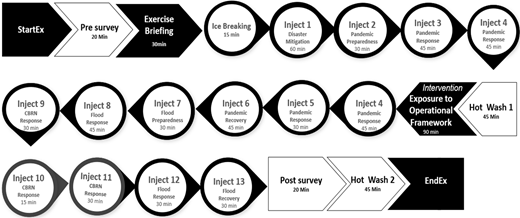
Participants who agreed to participate were first required to sign an informed consent form. Before the tabletop exercise began, participants received a briefing on its objectives, structure, flow and the roles they would be expected to play. They were then divided into four groups, with six to seven members in each group. Based on their backgrounds (practice setting), participants were then given their individual role cards with fictional facility profiles and assigned roles to play throughout the tabletop exercise. Before the simulation took place, the participants received a self-administered pre-survey to evaluate their baseline understanding and capability in managing pharmaceutical supply operations during a disaster and undergo an icebreaking session to create a comfortable and collaborative atmosphere among participants. Facilitators introduced multiple injects containing information and challenges that simulated a real disaster, and participants were required to respond according to their assigned roles using available resources and capacity, such as plans and guidelines, as they would in a real situation. They navigated challenges across various disaster phases and made critical decisions to ensure the continuous supply of medications. In total, participants were exposed to three disaster scenarios, including a pandemic, floods and a CBRNE event, which consisted of 13 total injections containing information, scenario updates and challenges introduced during the exercise. At first, they were asked to respond to the scenario without the guide of the operational framework, and after a few injections, they were introduced to the operational framework and received a briefing about the operational framework. Following this, the participants completed the rest of the scenarios and injections with the operational framework.
Hot wash activities were conducted to allow participants to discuss their experiences in facing the disaster scenario. Participants were informed to actively participate in the group discussion to complete all 13 injections. Participants were then asked to rate their perceptions of their own capabilities and understanding of managing pharmaceutical supply operations during a disaster and assess the usefulness of the pharmaceutical supply operations management framework in the post-survey collected electronically from participants via Google Forms. Pre- and post-responses were matched by information on the unique roles of participants within their groups during the tabletop exercise. Participants’ views and feedback on performance analysis, lessons learned and improvement plans were gathered during the hot wash activities and debriefing session at the end of the exercise, in which they were asked to write on a sticky note and present it during a large group presentation. An overview of the tabletop exercise flow is provided in Figure 3.
Data analysis
Quantitative data gathered in this study were analysed descriptively and inferentially using SPSS Version 27 Software. Demographic data and participants’ responses were analysed descriptively using frequencies, percentages, mean or median where appropriate. The pre-post Likert-scale survey responses were compared using the Wilcoxon signed-rank test. A significance level of 0.05 was set for the p-value in this study. In this study, hot wash sessions were conducted using a phenomenological approach combined with framework analysis (Goldsmith, 2021). Qualitative data were visually captured using sticky notes and later subjected to coding with framework analysis using a phenomenological study approach. This approach enabled a focused exploration of participants’ experiences, decision-making processes and the operational challenges they faced throughout the exercise. Ethical approval for the study was granted by the Medical Research and Ethics Committees of the Ministry of Health Malaysia (NMRR ID-24-00574-6UJ (IIR)) and Universiti Kebangsaan Malaysia (JEP-2024-306).
Results
Participants demographics
This study involved pharmaceutical supply operations management stakeholders within Malaysia’s public healthcare system, comprising Health System Pharmacists (n = 4, 16%), State Pharmacists (n = 4, 16%), Hospital Pharmacists (n = 4, 16%), District Health Office Pharmacists (n = 5, 20%) and Health Clinic Pharmacists (n = 8, 32%,). All participants completed pre- and post-surveys, achieving a 100% response rate. Of the 25 participants (n = 11, 44%) had prior experience in managing pharmaceutical supply operations during a disaster in their practice settings, and none of the participants (n = 25, 100%) had received formal training in managing pharmaceutical supply operations during a disaster. Table 2 summarises the participants’ work contexts, detailing primary roles, gender, years of experience, practice locations, as well as their training and disaster-related experience.
Changes in perceptions pre- and post-exposure to the operational framework
The tabletop exercise, centred around an operational framework, serves as a structured intervention designed to enhance the effectiveness and efficiency of pharmaceutical supply operations during disasters. Participant responses before and after the intervention were compared to assess changes in key domains, including understanding and capability in disaster management activities. The pre and post survey questions found that the majority of the participants strongly agreed and agreed that their capabilities had improved in in mitigating (88%, 22/25), preparing for (92%, 23/25), responding to (92%, 23/25) and recovering from disasters (96%, 24/25). A Wilcoxon signed-rank test indicated a statistically significant increase in participants’ own capabilities and understanding in disaster management activities before and after engaging with the operational framework (p < 0.001), as shown in Table 3.
Following the tabletop exercise, a hot wash was conducted to capture immediate feedback from participants regarding their experiences in handling disaster scenarios with and without the operational framework regarding decision-making, communication, coordination and knowledge and understanding. Participant feedback on their experiences in managing disaster scenarios during the hot wash sessions was summarised in Table 4.
Before being introduced to the operational framework, participants described their decision-making processes as hesitant and reactive, often hindered by a lack of structured protocols, unclear procedures and limited access to decision-support tools. Participants often waited for direction and experienced delays in critical response actions. After the intervention, participants reported increased confidence and a more proactive approach to decision-making, guided by structured protocols and supported by evidence-based references. Furthermore, decision-making was faster and better prioritised:
"After using the operational framework, decision-making becomes more focused and organised". (State pharmacist, female, 10–15 years of service)
"Greater confidence in the decisions made due to guidance from the operational framework". (Hospital pharmacist, male, 10–15 years of service)
Improvements in communication were observed, as before the intervention, participants highlighted a disorganised and inefficient information flow with no clearly defined channels or command structures. This led to inconsistency and duplication of effort. Following the implementation of the operational framework, communication became significantly more organised and efficient, with clear vertical and horizontal information flows aligned with the command structure, thereby facilitating smoother pharmaceutical supply operations during disasters:
"There was a clear guide for communication pathways, both vertically and horizontally". (State pharmacist, male, 10–15 years of service)
"Following the introduction of the operational framework, active discussions emerged among team members". (Health clinic pharmacist, female, 10–15 years of service)
Coordination was also reported to have improved, as participants had initially operated in silos with limited clarity on roles, responsibilities and delegation structures. After applying the operational framework, coordination became more integrated across different levels of operation. Participants recognised the establishment of a clear chain of command, improved collaboration across stakeholders and better-defined roles, aligning with the critical need for effective supply operations management during disasters:
"There is better collaboration between various parties after using the operational framework". (Health system pharmacist, female, >15 years of service)
"Coordination was effective because roles and responsibilities at each operational level were clearly understood". (Health clinic pharmacist, female, >15 years of service)
Prior to the intervention, participants highlighted a lack of a comprehensive guide for pharmaceutical management in disaster scenarios, as well as limited knowledge and understanding of supply chain operations during a disaster. Following the intervention, participants reported an enhanced ability to identify relevant tools, an improved understanding of pharmaceutical challenges and a clearer understanding of the required actions in pharmaceutical supply operations during disasters:
"Improved understanding of effective disaster response". (Health clinic pharmacist, female, 10–15 years of service)
"Reducing the knowledge gap among all members within all the facilities". (Health system pharmacist, female, 10–15 years of service)
Participants’ perceptions on the usefulness of the operational framework
All participants were found to strongly agreed and agreed that the operational framework improved their knowledge and skills in managing pharmaceutical supply operations during a disaster (100%, 25/25). Most participants found that the operational framework is comprehensive (96%, 24/25), easy to understand (100%, 25/25) and useful in guiding their decision-making process in managing pharmaceutical supply operations during a disaster (100%, 25/25). Furthermore, they believed the operational framework could facilitate effective coordination (96%, 24/25) and communication (96%, 24/25). The operational framework was well received, with 96% (24/25) of participants suggesting it may enhance the efficiency of pharmaceutical supply operations during a disaster. The overwhelming number of participants believed the operational framework increased their confidence in disaster mitigation (96%, 24/25), preparedness (100%, 25/25), response (100%, 25/25) and recovery (100%, 25/25). Most participants also believed that an operational framework may reduce the risk of medication wastage (88%, 22/25) and shortage (92%, 23/25) during a disaster. Participant responses on the operational framework’s usefulness are presented in Table 5.
Participants’ perceptions on exercise design and conduct
In terms of the participants’ perspective on the exercise design and conduct, all participants either strongly agreed or agreed that the exercise was well-structured and organised (25/25,100%). They found the scenario was realistic, allowing them to test their response plans and systems, thus achieving their intended objectives. By the end of the exercise, the majority of participants expressed that they felt to be better prepared in responding to disaster (96%, 24/25). Participant responses on the exercise design and conduct are presented in Table 6. Some participants shared their feedback on the design and implementation of the exercise through open-ended responses. They highlighted several positive aspects of the tabletop exercise, including capacity building, practical simulation, role clarity, and improved logistics communication and coordination (Refer to Appendix 3).
Discussion
This study aimed to evaluate the usefulness of a newly developed operational framework for managing pharmaceutical supply operations during disasters by developing and implementing a tabletop exercise. It involved multiple operational teams from across the country who were responsible for managing pharmaceutical supply operations within Malaysia’s public healthcare system. A significant increase in participants’ understanding and capability of disaster management activities was observed between the pre- and post-evaluation. The pre-survey showed a low baseline in participants’ own capabilities and understanding of managing pharmaceutical supply operations during a disaster. Despite their extensive experience in managing pharmaceutical supply within their respective settings, many have had limited direct exposure to supply chain management during disaster scenarios (Alkhalili et al., 2017). This distinction is important, as it highlights that while participants brought substantial operational knowledge to the exercise, their feedback suggests that the operational framework provided instructive value by highlighting critical gaps, decision-making nuances and coordination challenges unique to disaster contexts. This supports the notion that familiarity with routine systems does not automatically translate into readiness for disaster driven disruptions, where agility, inter-agency coordination and contingency planning are paramount (Ahmad Suleiman et al., 2022). This suggests that the operational framework may enhance the ability of experienced personnel to contextualise and apply their knowledge more effectively in disaster settings.
The hot wash conducted before and after exposure to the operational framework indicated that it could enhance coordination, communication and decision-making processes among participants. Disaster management often involves multiple stakeholders, requiring coordination, communication and quick decision-making to ensure an effective and efficient response (Trias and Cook, 2021). By using an operational framework, organisations can promote a structured and streamlined approach to managing pharmaceutical supply operations across multiple stakeholders, thereby enhancing disaster management by addressing common challenges such as poor coordination, ineffective communication and delayed decision-making (Paciarotti et al., 2021). It can also complement existing policies and guidelines, such as “Best Practices in Supply Chain Preparedness for Public Health Emergencies” published by USAID and “Partnering with the Healthcare Supply Chain During Disasters” by ASPR TRACIE (USAID, 2019; ASPR TRACIE, 2024). This, in turn, contributes to minimising the impact of disasters, enhancing preparedness and enabling more efficient and timely responses, thereby facilitating faster disaster recovery (Tippong et al., 2022).
Participants in this study highly valued the operational framework, with all participants indicating that it was useful for managing pharmaceutical supply operations across three disaster types: pandemic, flood, and CBRNE incidents, across the phases of mitigation, preparedness, response and recovery. This demonstrates that despite the differences in disaster types, there are similarities in their impact on pharmaceutical supply operations, allowing for standard management practices to be implemented (Raj et al., 2022). This supports the multi-hazard approach, as defined by Bodas et al. (2020), wherein implementing actions to prepare for and respond to one type of hazard often contributes to the planning and response efforts for other types of hazards as well. Although several frameworks have been developed, most focus only on specific types of disasters, disaster phases and specific components of operations (Negi and Negi, 2021; Husain et al., 2016; Kaur and Singh, 2020; Raillani et al., 2020; Timperio et al., 2016). This study addresses the complexities and interconnections of various hazards and disaster phases, offering a robust, comprehensive, holistic and integrative operational framework. While this study embraces a multi-hazard approach, hazard-specific challenges often emerge. This tabletop exercise delves deeper, particularly within the context of a pandemic scenario involves a surge in pharmaceutical demand, especially for antivirals, steroids and critical care medicines such as sedatives, neuromuscular-blocking agents, and vasopressors driven by the unexpected rise in patient numbers and logistical challenges due to movement restrictions (Moosavi et al., 2022). In contrast, flood situations primarily disrupt transportation networks and lead to increased demand for pharmaceuticals related to trauma care, wound management and antibiotics, along with the deployment of mobile healthcare teams to temporary shelters. Meanwhile, in CBRNE incidents, the operational focus shifts toward sourcing and distributing emergency antidotes (Villacorta-Linaza, 2009).
Participants provided positive feedback on the design and conduct of the tabletop exercise, with the majority agreeing that it successfully achieved its objectives and enhanced their preparedness for future disasters. By simulating a controlled disaster scenario, the exercise enabled participants to test the operational framework without the risks and disruptions of real events, supporting both evaluation and training. This dual-purpose approach supports and facilitates the transfer of knowledge into practice, particularly in the context of pharmaceutical supply operations (Caviglia et al., 2023). The role card format used in this tabletop exercise allowed the involvement of diverse groups of stakeholders involved in pharmaceutical supply operations at the district, state and national levels. This finding aligns with previous research, which highlights that the level of discourse and inter-agency collaboration organically fostered through the diverse composition of participants in tabletop exercises represents one of the most valuable components of disaster response preparedness initiatives (Skryabina et al., 2017; Mahdi et al., 2023). Applying the operational framework and using the developed tabletop exercise provides significant support to the pharmacy profession, helping to close the existing gap in the involvement of pharmacy personnel in conducting tabletop exercise, as reported in previous studies by McCourt and Watson (2023). The detailed design, implementation and evaluation process provides actionable insights for strengthening pharmaceutical supply preparedness and response capabilities across various operational levels.
Despite its contributions, this study is subject to several limitations. While this study offers valuable insights, its scope is primarily focused on the management of pharmaceutical supply operations at the downstream level of the healthcare supply chain. Owing to the types of disasters tested in this study, namely, pandemics, floods and CBRNE incidents, it is essential to acknowledge the potential limitations in generalising the findings to other types of disasters, such as earthquakes, typhoons and tsunamis. The specificity of the context and the nature of each disaster may impact the applicability of the results beyond the types of disasters already tested. In addition, even though the operational framework provides detailed guidance without being constrained by specific governance structures, it enables broad applicability across diverse healthcare systems and disaster management contexts globally. Nevertheless, local adaptation and contextual validation are recommended to ensure effective implementation. While the tabletop exercise is a facilitated, discussion-based activity that provides a controlled and simulated environment to assess the operational framework, it is essential to note that the findings may be limited in their scope of realism. Future research could explore the practical implementation of the operational framework in more complex simulation settings, such as functional or full-scale exercises. Its scalability and adaptability across different types of disasters also warrant further investigation. Moreover, replicating the exercise with participants who have formal disaster-response training may provide deeper insights into the applicability of the operational framework across varying levels of preparedness. Even among experienced personnel, differences in training, protocols and inter-agency expectations can impede coordination. Assessing the operational framework in such contexts can offer valuable evidence on its ability to enhance interoperability and foster a shared operational understanding.
Conclusion
This study evaluated a newly developed operational framework for managing pharmaceutical supply during disaster scenarios using a multi-hazard tabletop exercise. The findings indicate that the operational framework effectively supports communication, coordination and decision-making across all disaster phases. Participants reported significant improvements in knowledge, confidence and perceived capability, particularly in areas of decision-making, communication, coordination and understanding. The tabletop exercise was also well-received, with all participants affirming its structured design, realistic scenarios, and value in strengthening disaster preparedness. Overall, the operational framework offers a practical tool for policymakers, healthcare supply managers and operational teams to strengthen disaster readiness, while the tabletop exercise model can be used to further support future training and evaluation, contributing to more efficient and resilient pharmaceutical supply operations during disaster.
The authors thank the Faculty of Pharmacy Universiti Kebangsaan Malaysia (UKM) and the Quality Use of Medicine Management Research Center, UKM for the support and infrastructure facilities in helping with the completion of this study. The authors extend heartfelt gratitude to the experts from the Humanitarian Aid and Disaster Relief Research Center at the National Defense University of Malaysia and the Pharmaceutical Logistics Management Branch, Pharmaceutical Services Program, Ministry of Health Malaysia, for their invaluable constructive feedback, which greatly enhanced the quality of this paper. The authors would like to thank the Director General of Health Malaysia for his permission to publish this article.
Funding
This research received no specific grant from funding agencies in the public, commercial or non-profit sectors. This tabletop exercise was conducted collaboratively between the Faculty of Pharmacy Universiti Kebangsaan Malaysia (UKM) and the Pharmaceutical Services Programme, Ministry of Health Malaysia. A.H. received a study scholarship from the Public Service Department, Ministry of Health Malaysia.
References
Appendix 1
Appendix 2
Data collection form
Tabletop exercise in managing pharmaceutical supply operations during a disaster
(pre-survey)
Section 1: Demographic information
Please state your group in this tabletop exercise:
Sonora
Volta
Koda
Toria
Please specify your role in this tabletop exercise:
Health System Pharmacy
State Pharmacy
Hospital Pharmacy
District Health Office Pharmacy
Health Clinic Pharmacy (Type 1)
Health Clinic Pharmacy (Type 4)
Gender?
Male
Female
How many years of working experience do you have?
<5 years
5–< 10 years
10–< 15 years
>15 years
Before this tabletop exercise, have you received any specific training on managing pharmaceutical supply operations during a disaster?
Yes
No
Have you previously managed pharmaceutical supply operations during a disaster?
Yes
No
If yes, please specify the disaster(s) you have previously experienced. You may select more than one answer.
Pandemics
Floods
Chemical, Biological, Radiological, Nuclear, and Explosives (CBRNE) Incidents
Mass Casualty Incidents
Other:
Section 2:
Table 2: Your understanding and capability in managing pharmaceutical supply operations for a disaster.
On a scale of 1–5, where 1 means you do not agree at all with the statement and 5 means you strongly agree with the statement, please evaluate your understanding and capability on the following questions:
Tabletop exercise in managing pharmaceutical supply operations during a disaster (post-survey)
Please state your group in this tabletop exercise:
Sonora
Volta
Koda
Toria
Please specify your role in this tabletop exercise:
Health System Pharmacy
State Pharmacy
Hospital Pharmacy
District Health Office Pharmacy
Health Clinic Pharmacy (Type 1)
Health Clinic Pharmacy (Type 4)
Section 2:
Table A3 Your understanding and capability in managing pharmaceutical supply operations for a disaster.
On a scale of 1–5, where 1 means you do not agree at all with the statement and 5 means you strongly agree with the statement, please evaluate your understanding and capability on the following questions:
Section 3:
Table A4 Your perspectives on the usefulness of the “Pharmaceutical Supply Operations Management Framework for a Disaster”
On a scale of 1–5, where 1 means you do not agree at all with the statement and 5 means you strongly agree with the statement, please evaluate your understanding and capability on the following questions:
Section 4:
Table A5 Your perspectives on the conduct and relevance of the simulation exercise.
On a scale of 1–5, where 1 means you do not agree at all with the statement and 5 means you strongly agree with the statement, please evaluate your understanding and capability on the following questions:
Appendix 3
Participants’ open-ended responses on the design and implementation of the tabletop exercise
The tabletop exercise was recognised as an effective tool for building core competencies in disaster management, particularly in pharmaceutical supply operations. It enhanced participants’ theoretical knowledge and practical skills through structured, hands-on learning. The exercise was seen as highly effective in enhancing disaster management knowledge, skills and awareness in managing pharmaceutical supply operations during disasters:
“Allows us to assess our disaster preparedness and improve any weaknesses before an actual disaster strikes” (State Pharmacist, Male, 10–15 years of service)
“Helps build mental readiness and highlights the importance of effective communication” (Health clinic Pharmacist, Female, 10–15 years of service)
Participants valued the exercise for its realistic simulation of disaster scenarios tailored to pharmacy and healthcare settings. It provided practical, scenario-based exposure, enabling the application of operational frameworks in real-life settings and generating valuable experiential learning. By applying the operational framework in a controlled environment, participants reinforced their understanding and explored practical uses in real disaster contexts. The exercise also fostered innovation and proactive thinking, allowing healthcare personnel to anticipate challenges and test solutions in a low-risk setting:
"Structured training and exposure are crucial". (State Pharmacist, Female, >15 years of service)
"Scenario-based exercises provide valuable ideas and practical experience for disaster management". (Hospital Pharmacist, Female, >15 years of service)
"The time allocated to respond during the injection scenario truly challenged my thinking, pushing me to act faster and be more responsive". (District Pharmacist, Female, >15 years of service)
A key benefit of the tabletop exercise was its ability to clarify the roles and responsibilities of stakeholders in pharmaceutical supply operations during disasters. Many participants acknowledged previously having a lack of clarity about their duties. Scenario-based discussions helped illuminate interdependencies and expectations across command levels, reinforcing the importance of a clear, top-down command structure. This improved coordination reduced confusion and strengthened operational discipline during disaster response. In addition, it enhanced operational readiness by improving response efficiency, clarifying roles and responsibilities, and reinforcing structured communication and command lines:
"Able to identify the roles and responsibilities of other parties". (Health Clinic Pharmacist, Female, 10–15 years of service)
"Provide exposure and enhance knowledge and skills in disaster management". (Hospital Pharmacist, Male, 10–15 years of service)
Improved communication and collaboration were key outcomes identified by participants. The exercise brought together multiple agencies in a simulated disaster setting, revealing bottlenecks and promoting proactive information sharing. It fostered inter-agency dialogue, strengthened working relationships and reinforced a shared understanding of roles and objectives. These enhancements were viewed as crucial for ensuring seamless, coordinated operations during actual disasters. The exercise also promoted inter-agency coordination and communication, ultimately contributing to a more prepared, confident and capable disaster response workforce:
"Provides a complete guide on how to communicate during a disaster". (Health Clinic Pharmacist, Female, 10–15 years of service)
"It helps improve coordination because everyone understands their tasks and responsibilities". (Health System Pharmacist, Female, > 15 years of service)
Source(s): Authors’ own work