– The purpose of this paper is to highlight the need for an entity to manage airborne relief when a nation’s civil aviation authorities are overwhelmed or incapacitated due to a major rapid-onset disaster.
– The paper examines why relief airflow management was so vital during the 2010 Haiti earthquake and how this management was accomplished. The author uses a case study methodology that includes interviews with logistics and aviation experts within the humanitarian and military communities involved in the Haiti relief effort.
– The research highlighted an airflow management capability gap within the humanitarian community. The author sets forth several possible alternatives for resolving this gap.
– The research is a single case study of the 2010 Haiti earthquake. While performing a multiple case study may have provided more widely applicable conclusions, this case study provides in-depth information applicable to the worst of disasters, where an airflow management capability is most likely to be needed.
– While host nation civil aviation authorities retain responsibility for airspace/airflow management after a disaster, these can oft be overwhelmed by the volume of airborne relief flooding the area. Without an entity to assist the affected nation with airflow management, smooth logistical flow of relief goods to those in need can be catastrophically impeded.
– Little research exists on disaster relief airflow management or the legitimate need for this capability to be developed within the humanitarian community.
Introduction
Major rapid-onset disasters such as earthquakes, hurricanes, and tsunamis have the ability to overwhelm even the most prepared and robust of countries. In such cases, the value of responsive, agile airborne relief from global donors cannot be overstated. Despite its usefulness however, airborne relief can create other logistical issues such as surpassing airport capacity to park and offload aircraft (Tomasini and Van Wassenhove, 2004). Airflow management, or the ability to coordinate aircraft arrival slot times to optimize use of airport ramp space and offload capacity, is an invaluable remedy to this malady. The preferred solution, according to United Nations (UN) policy (United Nations, 1991), is for local civil aviation authorities to retain responsibility for airflow management. Unfortunately, according to a panel of subject matter experts interviewed for this research, many developing countries do not possess the capability to quickly stand up robust airflow management during a crisis. As such, the development of a rapidly deployable civilian airflow management capability to assist nations in ensuring smooth flow of airborne relief in the midst of a crisis is critically important. This research addresses which civilian entities are best suited to possess airflow management capabilities. Furthermore, it uses a case study methodology to glean lessons learned from the airflow management during the 2010 earthquake in Haiti.
The paper will begin with a brief background of the airflow management in Haiti in response to the 2010 earthquake. The background will be followed by a literature review and then analysis of the data obtained during interviews with humanitarian assistance/disaster relief (HA/DR) (or response) experts regarding how to best approach disaster airflow management. The goal of the data analysis was to find answers to the following investigative questions:
RQ1. How effective was the Haiti Flight Operations Coordination Center (HFOCC) in performing the airflow management mission? What were the drawbacks to their performing this mission?
RQ2. If a disaster similar to Haiti were to occur tomorrow, could another organization perform this mission instead of the US Air Force? If so, who and how?
RQ3. Which organization is best suited to handle short-term airflow management following a major disaster? Why?
Finally, the conclusion section will contain suggested areas for future research as well as the investigators’ final recommendations.
Background
On January 12, 2010, a massive 7.0 earthquake shook the Haitian capital of Port-au-Prince to its core, killing over 215,000 people and leaving another two million people homeless (Jones, 2011). The world responded immediately with a massive outpouring of humanitarian relief. With the seaport destroyed, the only viable airport, Port-au-Prince’s Toussaint Louverture International Airport (MTPP), became the logistical hub and chokepoint for the international relief effort. Airborne traffic rapidly spiked from an average of 18-300 flights daily at the height of the relief effort (Jones, 2011). Without radar or a functioning tower, only one runway, and very limited ramp capacity, demand for access quickly dwarfed capacity. In addition, the government of Haiti was largely incapacitated and the civil aviation authority was unavailable to manage inbound airborne relief. As a result, the airspace surrounding Port-au-Prince became a frenzy of aircraft in holding patterns or being forced to divert, leading to a myriad of frustrated relief donors (Whiting, 2012). In an attempt to assuage the chaos in the sky around MTPP, the Federal Aviation Administration (FAA) instituted a ground stop for all aircraft departing the US bound for Haiti (601 AOC/AMD, 2010). The dire need for an entity to deconflict the massive relief airflow was readily apparent.
On January 15, the Haitian government signed a memorandum allowing the US Department of Defense to coordinate airflow into MTPP, though they reserved the right to terminate the agreement at any time. Early the following day, the 601st Air and Space Operations Center/Air Mobility Division (601 Air Operations Center (AOC)/AMD) Regional Air Movement Control Center (RAMCC), renamed the Haiti Flight Operations Coordination Center (HFOCC) for this operation, began assigning landing slot times to civilian and military aircraft seeking to land in Haiti. The HFOCC’s slot management system, comprised of one-, two-, and four-hour slots, allowed deconfliction and metering of aircraft into the airfield based on aircraft size, available parking spaces (only enough for ten narrow body aircraft at one time), and the capacity of the Joint Task Force-Port Opening to offload aircraft and move relief cargo away from the parking areas to avoid overcrowding (Whiting, 2012). Within the first 24 hours of HFOCC operation, slot requests exceeded 1,000 daily, yet the confusion, chaos, and frustration in the airspace around MTPP was greatly minimized.
Since the 601 AOC/AMD RAMCC was originally designed for a domestic contingency and not for employment at a sovereign nation’s busiest airport, the learning curve was steep. For example, the HFOCC saw the need to integrate with the FAA and the UN World Food Program (WFP), as the former owned the airspace abutting Haitian airspace and the latter was the conduit for communicating priority of inbound relief as the Logistics Global Cluster Lead (Davidson and Smith, 2011). Despite their best efforts, the HFOCC had many critics to include the Presidents of Venezuela and Bolivia and a high-level minister within the French government, all of who accused the USA of mis-prioritizing inbound aircraft and using the earthquake as an excuse to invade Haiti (Poe, 2010). Case study interviewees, however, portrayed the HFOCC effort as an overall success. As the single entity and focal point for airflow management into Haiti, and through coordination with many of the players involved in the relief effort, both civilian and military, the HFOCC successfully coordinated 3,940 international flights into Haiti, enabling the delivery of 18,000 short tons of relief supplies and evacuation of 29,000 passengers over its two-month operation (Davidson and Smith, 2011). The Haiti disaster highlights the value of airborne relief and the benefit of optimizing its logistical flow into a disaster region. It also provides a poignant example of a situation where an entity other than the affected nation performed the important airflow management mission.
Literature review
Despite the importance of agile airborne relief to an HA/DR effort and the numerous articles on the criticality of transportation support during these crises (Kunz and Reiner, 2012), a review of the literature (Overstreet et al., 2011; Kunz and Reiner, 2012) finds that very little research exists on the subject. The researchers found only one paper that focussed on DR airflow management (Robins, 2012). This section will provide an overview of that paper’s key points, briefly discuss UN HA/DR policies, and finish with a discussion of the military’s role in HA/DR.
Robins posed that three options existed as to where an airflow management capability could reside – the UN WFP Aviation Service; a team comprised of a USAID Office of US Foreign Disaster Assistance (OFDA) Disaster Assistance Response Team (DART) and the FAA; and the US Air Force RAMCC. Furthermore, he identified and weighted three criteria – performance, cost, and acceptability (in that order) – in an attempt to objectively determine which of these options was best suited to perform airspace deconfliction following a disaster. Robins concluded that the Air Force RAMCC was the best option to perform this mission during DR operations because they scored highest in performance (based on experience, readiness, and risk) and cost (based on availability of resources). However, it is important to note that the RAMCC scored the lowest of the three options in regards to political acceptability (Robins, 2012, p. 3). This research will examine a similar question, but instead use data gathered from interviews with subject matter experts to determine whether an airflow management capability is needed and, if needed, where it should reside. In addition, this paper differs from the Robins paper in that it will examine the performance of the RAMCC in Haiti using a case study methodology. Finally, this research considers a broader range of potential solutions than does Robins’ work.
UN General Assembly Resolution 46/182 lists several guiding principles which are helpful in understanding when the military should be used in HA/DR scenarios. First, any HA effort must adhere to the principles of humanity, neutrality and impartiality (United Nations, 1991). Second, respect of state sovereignty, territorial integrity, and national unity is paramount. Finally, each country is primarily responsible to care for disaster victims within its borders; this includes initiation, organization, coordination, and implementation of HA within its territory (United Nations, 1991).
Regarding the use of military forces in HA/DR scenarios, the UN has published several applicable guidelines, the most notable of which are the “Oslo Guidelines.” This document was created to formalize and improve the effectiveness and efficiency of the use of military and civil defense assets (MCDA) in international DR operations and clearly sets the conditions and limits under which military involvement can be requested. Specifically, MCDA are a tool of “last resort” in HA/DR. They are to complement existing humanitarian relief mechanisms in response to an acknowledged humanitarian gap between the needs of the affected country and the resources available to meet them. As such, foreign MCDA should be requested only when no viable civilian alternative exists and when required to meet a critical humanitarian need, i.e. the MCDA must be unique in capability and availability (United Nations, 2007, italics added).
The palpable hesitancy with which the humanitarian community considers involving the military in HA/DR stems from several factors. First and foremost, the use of military resources can compromise neutrality, impartiality, and other humanitarian principles. This loss of neutrality, or even the perception of such loss, can adversely affect the safety of relief workers and the affected population, particularly in a complex emergency, where they can become targets of belligerent forces in the vicinity (United Nations, 2008). In an attempt to minimize the hasty or inappropriate use of MCDA, the UN developed a list of questions that flow naturally from the Oslo Guidelines:
Are (the MCDA) the option of last resort, indispensable and appropriate?
Based on the need, is a military or civil defense unit capable of the task?
How long will they be needed?
Can they be deployed without weapons or additional security forces?
How will this association impact the security of UN personnel and other humanitarian workers?
How will this impact the perceptions of UN neutrality and/or impartiality?
What control and coordination arrangements are necessary?
How and when will transition back to civilian responsibility be achieved?
What are the consequences for the beneficiaries, other humanitarian actors, and humanitarian operations in the mid to long term? (United Nations, 2008, p. 20)
This list is valuable in helping decision-makers objectively determine whether MCDA involvement is warranted. Additionally, these questions will be of assistance in an analysis of where the airflow management capability should reside and whether a military entity should be relied upon to carry out this task in future disasters. The guidelines, standards, and processes put in place by the humanitarian community clearly demonstrate that military involvement in the HA/DR realm is not the primary option, nor the desired one. However, the documents quoted above also acknowledge that the military brings capabilities to bear that are unique, rapidly deployable, and even life-saving. In light of this, how does the humanitarian community decide to develop capabilities currently possessed only by the military?
One of the ways in which the UN has attempted to fill identified humanitarian capability gaps is through the global cluster system. Clusters aim to bolster coordination of effort by clearly identifying roles and responsibilities and improving the predictability, efficiency, and effectiveness of humanitarian response capacity. They can be activated for any of three reasons: in response to a dramatic event or emergency; to fill major gaps in humanitarian needs identified by the agencies and by a host government; or by the initiative and guidance of the responsible UN Office for the Coordination of Humanitarian Affairs (OCHA) Humanitarian Coordinator (HC)/Resident Coordinator (RC) in consultation with the Country Team members (United Nations, 2008). Each global cluster lead is responsible for promoting predictable and effective interagency responses within their area of activity; for example, the UN WFP is the Logistics Global Cluster Lead. This cluster is tasked with filling gaps in logistics capacity, coordinating logistics services, and acting as the provider of last resort through the lead agency (WFP) (Logistics Cluster, 2013). However, while the cluster system continues to enhance efficiency and coordination throughout the humanitarian community in emergency response operations, capability gaps still exist which the military is uniquely qualified to fill.
The US military, for example, provides support in approximately 10-15 percent of the 70-80 natural disasters to which the USA responds each year (Department of Defense, 2011, p. i). Though the percentage of disasters in which they respond is relatively small, these disasters tend to be those of greatest magnitude and/or complexity. Some fairly recent examples include the 2004 Southeast Asia tsunami, the Pakistan earthquake and flooding in 2005 and 2012, respectively, the Haiti earthquake in 2010, and the 2013 tsunami in the Philippines. Other foreign militaries also make their forces available for HA/DR efforts. For example, European militaries have responded to disasters in Africa, Central America, the Middle East and Asia. On the other hand, countries such as Australia, Canada, India, Japan and South Africa tend to respond to disasters in neighboring countries rather than to those outside their region (Wiharta et al., 2008). The tendency for foreign militaries to assist in the worst HA/DR scenarios exists for several reasons. First, they provide unique capabilities that are especially applicable to major disasters, where host nation capabilities are overwhelmed and needs move beyond those which the humanitarian community can provide. Second, military forces are rapidly deployable, allowing them to provide quick support in the immediate aftermath of a devastating disaster. Third, military assets are designed to operate in austere conditions, allowing them to be effective in areas where disasters have severely damaged or destroyed critical infrastructure. Finally, they can operate in less secure areas than can their civilian counterparts (Department of Defense, 2011).
Methodology
To gain a deeper understanding of airflow management as performed after the Haiti earthquake as well as the perceptions of airflow management within the humanitarian community, an exploratory case study methodology was used. In determining what research approach is most appropriate, Yin suggests consideration of the following three conditions: the type of research question posed, the extent of control an investigator has over the actual behavioral events, and the degree of focus on contemporary as opposed to historical events. In addition, the case study method involves direct interviews with people who are involved in current events being investigated (Yin, 2009). Also, Ellram writes, “excellent opportunity exists for using case study research methodology in many areas of logistics and purchasing” (Ellram, 1996). Finally, the meta-analysis of HA/DR literature conducted by Kunz and Reiner (2012) calls for more case study research on this topic.
In addition to satisfying Yin’s criteria for a case study methodology, a single case study approach is applied in this research because it generates in-depth information on a single event using a variety of sources, including interviews, documents and archival material, to triangulate the data within the case. The triangulation of data acquired via distinct collection methods and from different organizational sources increases the reliability and validity of the results (Yin, 2009; Rowley, 2002). Consequently, the researchers used multiple sources of evidence in the data collection process.
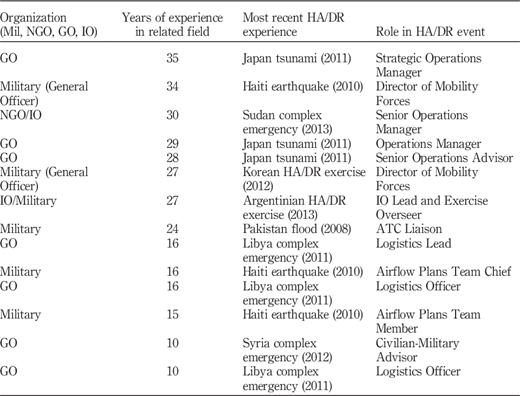
First, 14 semi-structured interviews were conducted with logistics and/or airflow management experts involved in the Haiti relief effort or possessing unique or in-depth insight on disaster airflow management (see Table I). Interviewees included members of the military as well as international organizations (IO), governmental organizations (GO), and non-governmental organizations (NGO) with experience in aviation operations and/or humanitarian logistics. More specifically, they included members of the FAA, UN WFP, USAID/OFDA, and the System of Cooperation Among the American Air Forces (SICOFAA, original Spanish name translated by researchers) among others. A number of these interviews were recorded and transcripts sent back to interviewees in the interest of promoting transparency and confirming veracity. In addition to the semi-structured interviews, another twenty-three informal interviews were conducted with members of various organizations that helped the researcher gain a broader understanding of HA/DR and civil-military coordination. Second, various documents with detailed information on the Haiti relief effort and the pertinent humanitarian and/or aviation IOs, GOs, and NGOs were studied. These documents included, among others, after-action reports, organizational documents, regulatory and guidance materials, and journal articles. Third, ethnography was used to a limited extent by including the perspectives of the interviewees and the interaction and perceived relationships between their organizations. For example, it allowed the researchers to identify whether relationships between two humanitarian organizations or between a humanitarian organization and a military one was cooperative or adversarial. This in turn allowed the researchers to identify feasible solutions later in the paper.
Airflow management during the Haiti earthquake relief effort was selected as the focus of the single case study for several reasons. First, it is the clearest recent example of the need for airflow management in HA/DR. Second, the HFOCC’s performance of the airflow management mission serves to highlight both successes and challenges applicable to the performance of this capability in the future. Third, the severity of the Haiti disaster brought many of the most experienced humanitarian logistics, aviation, and military experts into the same operating environment. Case study interviews sought to capitalize upon this pooled expertise in order to provide feasible solution recommendations.
Results and analysis
In their article on applying agile and lean principles to the humanitarian supply chain, Cozzolino et al. (2012) write, “An agile supply chain is the most appropriate response to the extreme conditions faced by humanitarian emergency; it must be effective and respond as quickly as possible.” Facilitating an agile supply chain involves not only having relief supplies readily available, but also transporting the supplies to the disaster area and distributing it to those in need. The transportation and distribution links in the supply chain have the ability to affect one another in several critical ways. If aircraft bearing relief supplies flood the disaster area in an uncoordinated fashion, the flow of relief supplies to be distributed can be greatly reduced or not be the items needed most. Similarly, if the distribution functions in and around the airport are uncoordinated or overwhelmed, the space available for aircraft parking and the personnel/equipment available to offload aircraft can be severely limited. Airflow management accounts for both of these issues at it seeks to coordinate aircraft landings based on parking availability and airport capacity to offload aircraft. While the roles of offloading aircraft and moving relief supplies away from the airfield are separate from the role of airflow management, they require close coordination as the latter considers the former’s limitations in assigning ground reservations (i.e. landing slot times) to aircraft.
When asking interviewees about the importance of airflow management in DR, all interviewees agreed that it is an important aspect of humanitarian logistics. Despite the consensus on this question, there were several important caveats. First, most interviewees quickly pointed out the criticality of national sovereignty. Even though airflow management is important in most disasters, the responsibility for airflow management falls squarely upon the affected nation. Only if and when the host nation capabilities are overwhelmed and they request assistance can any other entity assist in this effort. In speaking about this HA/DR issue, one interviewee stated, “No matter how helpful you are trying to be or how pure your intentions are, if you come into a country uninvited, that’s called an invasion.” Second, interviewees in the humanitarian community held that if the host nation was unable to conduct airflow management themselves, the preferred solution was for a neighboring country to assist them with this task due to the presence of cultural ties. Admittedly, relationships between affected countries and their neighbors vary greatly, but in general, that solution was expressed as the preferred one. A final concern expressed by interviewees regarding airflow management was its use in Haiti as a model due to that disaster’s uniqueness. While every disaster is unique, this case study seeks to identify commonalities through which helpful and more generally applicable solutions can be gleaned. As such, an analysis of airflow management as conducted by the HFOCC after the Haiti earthquake will follow. The subsequent analysis sections will define and examine the airflow management triad, the principal stakeholders, and conclude with potential solutions to this capability gap.
Airflow management in Haiti
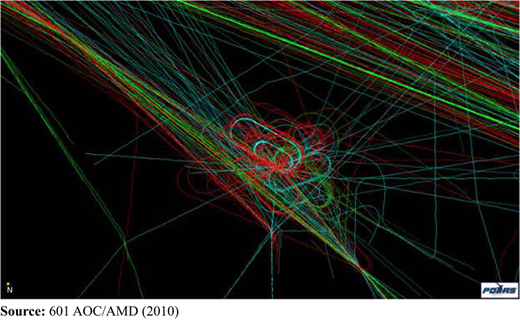
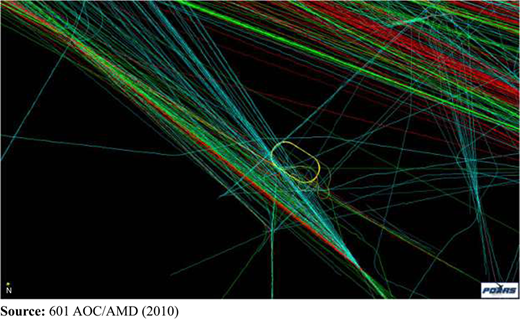
“The greatest lesson from Haiti is that the world will want to come.” One high-ranking military interviewee who was heavily involved in the airflow management aspect of the DR effort in Haiti stated this anecdotally during his interview. The manner in which the world showed its support for Haiti’s earthquake victims was by sending vast amounts of relief goods via airborne transportation. While not a perfect solution, interviewees agreed the HFOCC alleviated much of the chaos caused by this swell of inbound airborne relief. The HFOCC acquired host nation approval to operate the airfield, integrated with airspace and humanitarian entities (namely, the FAA and WFP) to assist in the deconfliction and prioritization of aircraft, and managed to restore a semblance of order to the crowded Haitian airspace despite heavy media scrutiny. For example, Figure 1 shows the chaotic airspace surrounding MTPP, with each line representing a single aircraft’s flight path. It shows hundreds of aircraft in uncoordinated holding patterns awaiting clearance to land. The high number of scattered lines around the airfield indicates that many of these aircraft were forced to divert to other countries as their fuel supply ran low. In contrast, Figure 2 shows MTPP airspace once the HFOCC began operations. It shows a semblance of order in the airspace above MTPP, with aircraft engaged in a single published holding pattern and few diverting aircraft.
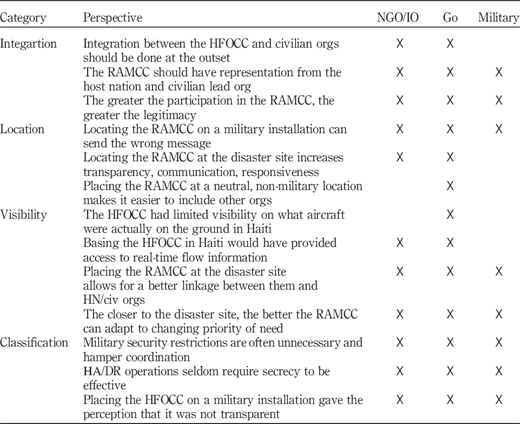
However, the respondents also had several complaints about the HFOCC’s approach and limitations. The researchers performed content analysis on these perspectives, which led to their classification into the following four categories: integration, location, visibility, and classification (see Table II).
First, HFOCC integration with humanitarian entities occurred later than ideal. The HFOCC took several days to invite members of the humanitarian community, particularly the WFP, to assist in airflow management efforts. Specifically, the first WFP member arrived at the HFOCC 12 days after the disaster and eight days after HFOCC operations began (601 AOC/AMD, 2010). The WFP representative could voice priority of need requirements to the HFOCC as a member of the Logistics Cluster Lead; those priorities were passed down from the host nation and the UN OCHA HC/RC. However, there was no host nation representation at the HFOCC. This was the case for several reasons. First, due to the earthquake’s magnitude and its vast devastation, finding members of the Haitian government to prioritize efforts and direct the relief efforts proved a difficult task. Second, the HFOCC was not physically located at the disaster site; rather, it was located at the 601 AOC at Tyndall Air Force Base (AFB) in Florida. Third, though not insurmountable, the security requirements present at the AOC would have presented an obstacle to including a Haitian representative in the HFOCC.
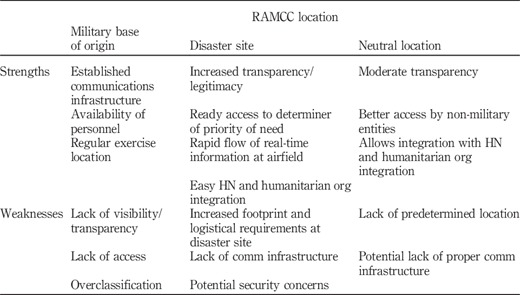
In terms of location, three main options were voiced by interviewees. The first option was the status quo: keeping the HFOCC at Tyndall AFB. This was a good option because the 601 AOC/AMD exercised the RAMCC concept (renamed the HFOCC for Haiti) regularly out of their compound at Tyndall. In addition, they possessed the necessary communication infrastructure and personnel at that location. Remaining at Tyndall was less desirable for some respondents for two of the other complaint categories which will be discussed later: visibility and classification. Another popular location option among interviewees was Haiti itself. This option would have alleviated visibility issues and would have allowed the HFOCC to be closer to the point of determination for priority of need, thereby allowing them to be more responsive to changing needs and conditions. In addition, placing the HFOCC in Haiti would have allowed them easier integration with host nation and humanitarian decision makers. This also would have had the secondary, but critically important, effect of allowing members of the HFOCC to build relationships with Haitian and humanitarian entities, thereby increasing their perceived transparency and legitimacy. The main drawback of this option, however, is the increased footprint and logistical requirements in Haiti. The larger the personnel footprint at a disaster site, the more airlift is used for care and feeding of relief personnel rather than the transport of relief supplies. The final, more nebulous option would have been to place the HFOCC at a neutral location off of a military base to allow for easier access and integration by Haitian and humanitarian partners (see Table III).
Because of their location, the HFOCC had limited visibility on what aircraft were actually on the ground in Haiti. They were able to reconcile their records with visual confirmations from members of the FAA and the military on the ground in Haiti, but both of these entities had other responsibilities which did not make reporting to the HFOCC their top priority. This issue of visibility will reemerge as a key portion of the airflow management triad.
Finally, the issue of classification is one which resurfaces often when civilian and military organizations interact. In a 2009 case study of inter-organizational communication in civil-military cooperation, the authors posited that confidentiality and security restrictions of information held by the military often exacerbate already poor civil-military relationships and hamper cooperation (Rietjens et al., 2009). In the case of the HFOCC, none of their operations were confidential nor secret. Nevertheless, the fact that the HFOCC was located at a secure facility within a military installation adversely affected perceptions of the HFOCC’s transparency as evidenced by several scathing media articles and political statements stating that the HFOCC was being partial in their slot assignments (Poe, 2010). Though these accusations lacked proof and seemed to be unfounded, the articles and statements served to incense already present sensitivities about military involvement in the Haiti relief effort. Yet another issue that added to the opinion that the HFOCC was not being transparent was the lack of an internet-based slot management program by which users could make slot requests. As a result, HFOCC personnel had to take slot requests by phone and record them in an ad hoc Excel spreadsheet. This topic will be revisited in the next section.
The airflow management triad
A common theme that arose from the interviews was that of the essential ingredients for any effective airflow management effort. These can be grouped into three major elements which form the airflow management triad: an airflow management team with the necessary equipment, rapid access to someone on the ground at the disaster location to provide real-time information, and a direct link to the entity determining priority of need.
The US Air Force RAMCC, for example, is a robust entity intended for combat deconfliction of airspace and airflow. Its beginnings can be traced back to the Berlin Airlift, though the capability was used as recently as the Kosovo, Afghanistan, and Iraq conflicts. Air Force Doctrine Document (AFDD) 6-0 describes the RAMCC as “a specialty team that provides a centralized function to deconflict both military and civilian air traffic in a particular airspace control area” (United States Air Force, 2011). Nevertheless, the airflow management capability required for an HA/DR scenario need not be this robust for several reasons. First, the airflow management capability discussed here involves deconfliction by way of ground reservations for inbound aircraft; this HA/DR capability does not directly manage airspace. Second, the nature of a rapid-onset disaster usually requires an airflow management team to deconflict only cargo aircraft, rather than fighters and tankers involved in wartime operations as well. Third, the size of an airflow management entity will vary depending on the world’s response to a particular disaster. Nonetheless, the original RAMCC team at the 601 AOC/AMD was comprised of only ten individuals. These included the RAMCC (HFOCC) Chief, Deputy Chief, as well as three members on the airflow plans team, three on the airflow operations team, and two on the reports team. The size of the HFOCC increased and remained steady at approximately 25 personnel, which included three representatives from the WFP and two from the FAA (601 AOC/AMD, 2010). This small 25-person team fielded over 4,000 slot requests in less than twenty days. Despite the severity of the Haiti earthquake and the overwhelming number of aircraft requesting access to MTPP, the HFOCC demonstrated that a small trained corps of personnel (as little as ten) with the proper equipment, and an ability to augment that corps (if required) is all that is needed to run a successful airflow management operation.
The three sections of the HFOCC – airflow plans, airflow operations, and reports – are also important parts of the airflow management team construct. The airflow plans team is responsible for fielding and prioritizing airfield slot requests beyond 24 hours from execution. This team interacts closely with the entity delineating priority of need in order to successfully sequence aircraft based on cargo content or political mandate. The airflow operations team manages current-day ground reservations and makes short-notice changes to assigned slots in near-real time based on aircraft maintenance or other delays, mission handling equipment or personnel shortages, or a variety of other reasons. Lastly, the reports team is responsible for creating reports requested by superiors for situational awareness.
Another aspect of this first triad element is equipment. The HFOCC handled over 500 daily phone calls at the height of the relief effort using only seven phones.
While more phones would have been optimal, the HFOCC was able to operate effectively with what they had. Though the exact number of phones required will depend on several factors, multiple phone lines with phones that can cue waiting callers is necessary for a successful airflow management operation. Another important “equipment” requirement is that of a web-based slot management program. Due to the lack of a commercially available software program, the HFOCC developed an ad hoc Excel spreadsheet instead. This spreadsheet served its purpose as a slot tracking tool, but possessed several limitations. First, the initial program contained many opportunities for error associated with free-form text entry into spreadsheet fields. The team mitigated this issue by redefining text boxes as drop-down list boxes with specified entry options. Second, the spreadsheet allowed for only one planner to enter information into the program at a time. This was a significant issue as seven planners received slot requests and assigned ground reservations using the same spreadsheet. Conversion to a SharePoint-based list provided a means for simultaneous entry by multiple users eliminating this procedural chokepoint. Lastly, documenting changes and keeping track of the latest version of the spreadsheet was a challenge. No concrete solution was found to this problem.
A web-based slot management program would solve all of these particular issues. Additionally, such a program would increase transparency and allow the airflow management team to handle slot requests more effectively. When asked, the interviewees admitted that no program meeting this requirement is currently in operation. However, several respondents associated with the HFOCC in Haiti remembered a program being developed by US Southern Command during the Haiti relief effort for precisely that purpose. The program was fielded, but it was never used due to the fact that it was released near the end of the major relief effort, after the seaport had been reopened. The program contains a web-based customer interface for aircraft slot requests as well as an internal interface for slot tracking and management. This internal interface can also produce reports and statistics based on the myriad of data points entered in the program. In addition, the platform is capable of calculating the number of slots available each day based on parameters entered by the airflow management team. Finally, customers are required to register on the site to request slots, allowing the airflow management team to keep track of carriers who are not being honest brokers.
The second element of the triad is access to someone on the ground at the disaster location to provide real-time information. This is important for two primary reasons. First, this direct linkage decreases confusion and increases the airflow management team’s ability to be more responsive in making adjustments to the schedule. One interviewee shared that during the Haiti relief effort, he was standing on the side of the parking ramp at Port-au-Prince looking at two C-17 aircraft that he said, “showed up out of nowhere.” When he called the HFOCC to ask about the aircraft, the HFOCC looked at their slot tracking spreadsheet and said, “There are no C-17s there,” to which the interviewee responded, “Who are you going to believe, me or your lying eyes?” While funny, this anecdote demonstrates the legitimate need for a contact person at the disaster airfield, particularly in a dynamic HA/DR environment. Another reason why this element is critically important is because it provides increased legitimacy to the airflow management operation by allowing direct contact between a member of the team (at the disaster airfield) and those determining priority of need; namely, the host nation and the humanitarian lead. One of the main criticisms about the HFOCC was the perception that they failed to build relationships and work closely with the host nation in prioritizing airflow. The reasons for this were listed above, but this contact is critically important no matter who performs the airflow management task. In fact, the importance of state sovereignty makes this contact a must. One interviewee used the following analogy to generally express this idea and the usual effect: “You go into someone else’s house, you rearrange their furniture, you knock over everything, even if their house was on fire and you’re here to save them, you don’t bother to talk to the owner of the house and you wonder why they react badly.” One practical approach to satisfying this element of the triad would be to place a portion of the RAMCC reports team at the disaster airfield as the primary conduit of real-time information to the HFOCC. This team could also maintain a record of delinquent carriers who have either “no-showed” at the airfield without canceling their ground reservation or arrived at the airfield carrying different cargo than stated on their slot request form.
The final but equally important leg of the triad is a direct connection to those determining priority of need. Such determinations will normally be made by the affected nation in coordination with the UN OCHA HC/RC. In addressing this coordination and the role of the HC/RCs, the UN OCHA states:
Effective coordination of humanitarian action in the field hinges upon humanitarian coordination leaders: the Humanitarian Coordinators (HCs) or Resident Coordinators (RCs). In effect, while the primary responsibility for coordinating humanitarian assistance rests with national authorities, if international humanitarian assistance is required, the HC or RC is responsible for leading and coordinating the efforts of humanitarian organizations (both UN and non-UN) with a view to ensuring that they are principled, timely, effective and efficient, and contribute to longer-term recovery (United Nations Office for the Coordination of Humanitarian Affairs, 2011).
Several of the interviewees expressed that the determination of priority of need is clean in principal but messy in practice. Particularly once the relief effort is well under way, how does one prioritize between the HA priorities (rebuilding roads, homes, etc.) and the DR ones (food, health, shelter etc.)? In addition, how does one resolve prioritization conflicts between inbound relief supplies and aircraft carrying political leaders or delivering security forces? Finally, how do the priority needs translate into slot apportionment for inbound aircraft? For example, if medical supplies, food, and shelter are the top priorities (in that order), are only aircraft carrying medical supplies to be given ground reservations for that day, or do those priorities translate to a 40/30/30 (or some other combination) slot apportionment? The fact is that no guidance exists addressing this issue. This highlights the necessity of a suitable body to determine (in coordination with the host nation) and execute priority of need through the airflow management entity.
The HFOCC struggled with slot prioritization at the start of operations because they had no direct link to those determining priority of need and were offered no guidance in this regard despite repeated requests. They prioritized aircraft as they deemed appropriate through contact with the US Contingency Response Group on the ground in Haiti, but the solution arrived eight days after HFOCC operations began in the form of the UN WFP (601 AOC/AMD, 2010). As the Logistics Cluster Lead, the WFP is responsible for promoting coordination of effort through clearly identified logistics roles and responsibilities among the involved humanitarian organizations. The presence of the WFP team was an integral part of the airflow management operation because it provided a direct link to the HC with priority of need information. In addition, by placing the burden of slot prioritization on the humanitarian Logistics Cluster Lead, the HFOCC was able to perform its mandate without being accused of favoritism, hence gaining them instant legitimacy and transparency.
The HFOCC is certainly one option to manage airflow during HA/DR. The next section will briefly cover what other candidates may be viable options to execute this capability.
Candidates for airflow management capability development
Robins (2012) identified three options as to where a disaster airspace management capability could reside: UN WFP Aviation Service;) a team comprised of an OFDA DART and the FAA; or the US Air Force RAMCC. One of the ways in which this research attempts to add to Robins’ work is by determining whether these options can feasibly fill the airflow management capability gap. The short answer is both yes and no. The research uncovered that both WFP Aviation and the Air Force RAMCC could potentially fill the airflow management role; however, the DART/FAA team proposed by Robins proved not to be a feasible option for international HA/DR scenarios.
WFP Aviation is the air division of WFP Logistics and supports UN agencies and NGOs through the transport of food supplies and humanitarian aid workers involved in assessments and food distribution. Through the UN Humanitarian Air Service (UNHAS), considered the world’s leading humanitarian airline, WFP Aviation has direct access to a global fleet of 54 chartered fixed-wing aircraft and helicopters which can deploy within 48 hours. Though globally capable, their current operations are concentrated in Africa and the Middle East. Additionally, WFP Aviation is in charge of aviation operations to include flight scheduling, passenger booking, and cargo ground handling. They have over 400 personnel with aviation operations training and have flown over 45,000 flying hours (World Food Programme, 2013). There is little doubt that the WFP Aviation Service possesses the expertise to conduct airflow management if required. After the Pakistan floods in 2010, for example, WFP Aviation deconflicted the airspace by delineating what helicopters would be operating in what areas on a given day. Though less constrained of an environment than Haiti from an airfield capacity standpoint, WFP Aviation’s actions during the Pakistan relief effort demonstrated their capacity to undertake an airflow management capability. Robins (2012) recommends that WFP Aviation institutionalize airspace management to “support the UNHAS and, when relevant, the assets of foreign militaries in support of humanitarian activities.” When asked if they could perform airflow management, a WFP respondent stated, “If we were asked to do it, yes, we could. We were asked already to do it before and we did it, but it will not be at a moment’s notice.” In fact, he went on to say that if a disaster occurred today that required airflow management, he would strongly advocate creating a team comprised of the US Air Force RAMCC, UN WFP, and maybe even the International Civil Aviation Organization (ICAO). He argued that such integration would create a team with skill and legitimacy.
The next option proposed by Robins was a team comprised of an OFDA DART and the FAA. After a disaster, OFDA can deploy a DART comprised of specialists trained in a variety of DR skills to assist the US Chief of Mission with the management of the US response to a disaster. Though every team is tailored for a specific disaster, each DART can contain specialists from six functional areas – management/liaison, operations, planning, logistics, administration, and communications. Several of these functional areas contain personnel with aviation experience. Following the Indonesia earthquake in 2009, the DART assisted with the coordination of helicopter operations via the cluster system (United States Agency for International Development, 2010). However, management of aviation operations is not currently part of their mission set.
The FAA, on the other hand, has significant experience with disaster and emergency relief aviation operations. While they possess the expertise to perform airflow management internationally, an FAA interviewee pointed out that, unlike the humanitarian community or even the military, they do not have an international assistance mission except in the context of a specific request from the State Department or USAID. In addition, he stated that as a civilian agency, the FAA is not “funded to build expeditionary resources.” As such, other options exist to provide disaster airflow management internationally. One such option is the US Air Force RAMCC.
Air Force Doctrine governing the RAMCC capability reveals that it is primarily a combat capability. As mentioned previously, its beginnings can be traced back to the Berlin Airlift, though the capability was more recently employed in the Balkan, Afghanistan, and Iraq conflicts. AFDD 6-0 describes the RAMCC as “a specialty team that provides a centralized function to deconflict both military and civilian air traffic in a particular airspace control area” (United States Air Force, 2011). However, Air Force doctrine also acknowledges that the RAMCC capability can be useful in HA/DR scenarios as well. Regarding the airflow management topic specifically, AFDD 3-52 states that the RAMCC deconflicts military, coalition, and NGO air traffic by issuing slot times at airfields and air control points based on an assessment of an airfield’s limitations (on/offload rate, parking capacity, etc.) and, as applicable, air traffic control separation capability. Beyond “simple” deconfliction, this document highlights the RAMCC’s intent in this way: “By managing ramp capacity at theater airfields, the RAMCC ensures the maximum capacity for parking aircraft at an airfield or that the maximum on ground capability for aircraft is not exceeded” (United States Air Force, 2011). Of note, the RAMCC (HFOCC) performing airflow management in Haiti successfully met that intent; they minimized the chaos caused by the overwhelming rush of inbound aircraft to Port-au-Prince while optimizing the available ramp space to maximize logistical flow of relief supplies. Lastly, AFDD 3-52 affirms that the ideal RAMCC should include a wide variety of specialties to reflect the user-base of the organization. These specialties include rated aircrew, air traffic controllers, transportation and aerial port specialists, command and control specialists, communication technicians, and administrative support. Most importantly, this document emphasizes the importance of diverse manning (i.e. coalition partners and GOs, IOs, and NGOs when applicable), which “allows the RAMCC to execute its mission as an honest broker, given the broad range of RAMCC customers” (United States Air Force, 2011).
In the interest of promoting rapid disaster response, UN General Assembly Resolution 46/182 states the following as its 27th guiding principle:
The United Nations should, building upon the existing capacities of relevant organizations, establish a central register of all specialized personnel and teams of technical specialists, as well as relief supplies, equipment and services available within the United Nations system and from Governments and intergovernmental and non-governmental organizations that can be called upon at short notice by the United Nations (United Nations, 1991).
The Air Force RAMCC – as the only rapidly and globally deployable airflow management capability currently in existence – seems to be the very type of specialized capacity that should be listed on the UN register. Interestingly, the UN Civil-Military Coordination Officer Field Handbook lists the “Air Movement Control Center” as one of the services which the military might be counted on to provide. They describe the Air Movement Control Center’s role as that of managing the flow of aircraft into and out of the area of operations. The handbook goes on to say that “if the military controls an airfield or the airspace in a particular emergency, they will manage access to the airspace and allocate slot times for humanitarian aircraft (United Nations, 2008). Additionally, the document lists “Slot-Time Coordination” as a task that can be shared or coordinated between civil and military entities. Most importantly, in addressing the transportation and logistics realms of military support (to which the Air Movement Control Center and Slot-Time Coordination belong) and their impact on humanitarian neutrality and impartiality, the UN handbook posits that:
The areas of transportation and logistics are two areas in which a reasonable amount of tasks and activities can be shared or coordinated [between civil and military entities] without major risk to the perceived neutrality and impartiality of humanitarian actors (United Nations, 2008).
Though this point of view does not seem to be shared by all humanitarian entities, this statement speaks to the political acceptability of this solution.
The key players discussed here are not all-inclusive. Rather, they reflect the organizations that routinely provide a rapid response to natural disasters and/or have performed airflow management in disaster environments in the past. Nevertheless, other organizations that may not be considered key players for purposes of this discussion still present viable and even attractive solutions to this capability gap. One such option would be the use of a third-party logistics provider with expertise in air traffic control and airflow management services, particularly if contracted by a humanitarian entity such as the UN WFP or USAID/OFDA. Though several such companies exist, Skylink USA provides a useful example. Founded in 1998 as a leading international third-party logistics provider, Skylink USA has nine regional offices across the globe and has a strong presence in Afghanistan, Sudan, and Iraq. In addition to these, Skylink counts Saudi Arabia, Lebanon, Kuwait, Somalia, Democratic Republic of Congo, Mozambique, Angola, Rwanda, Peru, and Cambodia (and others) among its key theaters of operation. Skylink’s capabilities span a variety of mission sets to include aircraft operations, air and logistical supply, fuel services, and management of ground and air movements. (SkyLink USA, 2013). In addition, Skylink routinely works with humanitarian entities. For example, in 2003, USAID hired Skylink to provide airport management services for three major airports in Iraq (United States Agency for International Development, 2003). Also, Skylink lists missions for the UN Office for Project Services and the WFP among its special support missions (SkyLink USA, 2013). While a company like Skylink USA certainly has the potential to become an airflow management solution, it also possesses some drawbacks, such as that of security. As one interviewee pointed out, “The disadvantage of civilian contractors is that they can’t go everywhere. They need to have certain security guarantees. For example, now in Damascus, are those guys going to go to Damascus?” Another limitation of this option is their ability to mobilize and begin management quickly after a disaster. While such a concern can be minimized through standing partnerships, such as those that UN OCHA and USAID/OFDA have with international search and rescue (SAR) teams for urban SAR after disasters, such agreements, contracts, or partnerships take time to develop and no such agreements currently exist (United Nations Office for the Coordination of Humanitarian Affairs, 2013; Virginia Task Force 1: International Urban Search and Rescue, 2013). Nevertheless, such a partnership with a humanitarian entity would make a third-party logistics provider with air traffic control and airflow management expertise a solution worth consideration.
Another viable option, albeit on a regional rather than global scale, is the System of Cooperation Among the American Air Forces (SICOFAA), a conglomerate of air forces throughout the Western Hemisphere. SICOFAA had its genesis in 1961 at a meeting of American Air Force Commanders. In its 2007 constitutional charter, the organization states that it is a voluntary, apolitical organization with the primary goal of promoting and strengthening friendships, cooperation, and the mutual assistance of its 19 member states hailing from Canada to Argentina. SICOFAA’s HA/DR mandate is reflected in its primary guiding principle: “The utilization of aviation modes is of vital importance for the defense and development of its countries. These modes are the most efficient to promptly react to emergency situations” (System of Cooperation Among the American Air Forces, 2007, researcher’s translation). In addition, a SICOFAA’s interviewee stated, “SICOFAA started as an HA/DR concept because it was one on which all [American] air forces could agree.” The organization possesses a 156-page HA/DR manual that provides a common framework for how the organization will respond to countries that request help (System of Cooperation Among the American Air Forces, 2011). Though SICOFAA consists of military air forces, it presents a politically acceptable option because of how militaries are viewed in that hemisphere, particularly in Central and South America. When discussing the perception that military involvement in HA/DR is often frowned upon by the humanitarian community, the highly placed SICOFAA interviewee was surprised and somewhat perplexed. He said, “In Central and South America, militaries are expected to do HA/DR because they have the best capabilities.” He went on to equate Latin American militaries to the US National Guard, whose primary mission is responding to emergencies in their home state. Finally, he said that in that area of responsibility (i.e. Central and South America), citizens expect the military to come to their aid in disaster situations. SICOFAA also has recent airflow management experience from the Chile earthquake in 2010. In addition, they continue to exercise this capability; they practiced airflow management in April of this year in Mendoza, Argentina in Exercise “Cooperación Dos” (Cooperation Two). While not a global capability, SICOFAA would be very effective as an airflow management entity in the Western Hemisphere and, as a conglomerate of militaries, also possesses self-contained security.
Overall, several viable options exist that currently possess or are capable of developing an airflow management capability. Among these, the Air Force RAMCC has a standing capability, while other entities such as the UN WFP, a third-party logistics provider such as SkyLink USA and a coalition of air forces such as SICOFAA are also worth considering.
Evaluation criteria
Evaluation criteria allow researchers to objectively compare entity suitability for a given outcome – airflow management in this case. In seeking to define criteria by which to evaluate organizations’ to determine which is best suited to possess a disaster airflow management capability, interviewees were first asked an open ended question as to which criteria should be used. Next, they were presented with several different considerations to include cost, capability, flexibility, security, technology, acceptability, proximity, neutrality and performance. Several of these criteria overlapped to some degree. Nonetheless, Robins’ three criteria of performance, cost, and acceptability emerged as the ones on which all interviewees agreed were most important.
The most remarkable research finding however, one markedly different than those in Robins’ research, was the importance of Acceptability in the HA/DR realm. In fact, every interviewee agreed that Acceptability is the most critical criterion of all. Both from a governmental and humanitarian standpoint, the political acceptability of involving certain organizations in an HA/DR effort is a grave consideration, one that might prevent the most capable organization for a given capability from being employed. While neither sensible nor pragmatic, the reality that political considerations color every relief effort cannot be ignored. Interviewees believed that the next most important criterion was that of Performance. Lastly, respondents placed Cost lowest of the three criteria because it is not a hugely limiting factor after a disaster strikes. While cost certainly plays an important role when considering resource allocation for capability development, the cost of DR is not a primary consideration when contemplating who should participate in the effort.
Though this case study yielded much more comprehensive information regarding these evaluation criteria and their applicability to the previously delineated candidates (and to HA/DR capability development in general), this discussion is beyond the scope of this paper and is treated in a subsequent forum. Based on these criteria, the UN WFP emerged as the best candidate for development and possession of an airflow management capability. Nevertheless, each candidate possesses unique advantages making them worth consideration.
Conclusion
Logistics is the life’s blood of a humanitarian operation. The critical tasks of acquiring, transporting and distributing the right items to the right people at the right place and time may not be all there is to relief operations, but it is absolutely certain that without effective logistics there is no relief (United Nations, 2008).
This quote from the UN Civil-Military Coordination Officer Field Handbook emphasizes the criticality of humanitarian logistics to an HA/DR effort. If the primary aim of a DR effort is to save lives and deliver humanitarian relief into the hands of disaster victims, then smooth and effective logistical flow of relief supplies is vitally important.
Because of its role as the Logistics Cluster Lead, its global access and political acceptability, its built-in access to the priority of need and real-time information legs of the airflow management triad, and ample aviation expertise to develop the third leg, the UN WFP is clearly the entity of choice for development and possession of an expeditionary airflow management capability. Though cost presents a hurdle to the development of such a capability, creating and exercising an airflow management capability need not be a costly endeavor. With adequate funding, WFP’s role as Logistics Cluster Lead and their inherent aviation expertise would likely allow them to match or exceed the Air Force RAMCC capability for HA/DR purposes.
Until said capability is developed, the Air Force RAMCC should be considered the partner of choice for airflow management provision in HA/DR scenarios due to the “uniqueness of their capability and availability,” as well as their experience and resources. While they may be the least politically acceptable option, this need not remain so. One humanitarian IO interviewee with extensive aircraft operations experience advocates leveraging the RAMCC (HFOCC) expertise and legitimizing their involvement by making them part of an airflow management team comprised of multiple entities (such as WFP, OFDA and ICAO). He said:
The more entities you have, the easier it is to manage the results of any action which the [airflow management] cell is taking. As we saw in Haiti, it’s so easy to put the blame on the guys who are doing perfect work. If you have three entities, it would be more difficult to [assign] blame.
In addition, several actions could make use of the RAMCC more palatable. First, the key stakeholders, particularly the WFP, OFDA, and the US Air Force (and perhaps ICAO), should make combined airflow management exercises a priority. Such exercises would serve to increase relationship-building, interoperability, crosstalk, and effectiveness. The importance of cross-fertilization within military, NGO and IGO training programs and contingency planning cannot be overstated (Heaslip et al., 2012). Second, the military should seek to educate and train its personnel regarding their role in HA/DR if called upon to assist in that mission. Specifically, military members involved in HA/DR should disengage from their default “take charge” attitude and learn to work as a supporting entity to the humanitarian lead agency. Third, the Air Force should decide to make the RAMCC a standardized capability advertised as available for HA/DR needs. This would prevent the undependable availability of this important capability based on rotating combatant commander priorities and would allow the humanitarian community to forecast its needs and options more accurately. Fourth, discussions between WFP, OFDA, and the military to expedite the OFDA validation process for this particular military capability, which is unique in capability and availability, would be essential. Speaking about the HFOCC (RAMCC) in Haiti, a senior WFP interviewee stated, “The US forces are best suited to do it. I don’t see any other forces who could replicate what [they] did.” Additionally, the Air Force RAMCC can easily stand up to the MCDA involvement questions presented in the UN Civil-Military Coordination Officer Field Handbook (United Nations, 2008). Yes, the RAMCC is the option of last resort, indispensable, and appropriate. Yes, they can deploy (in many cases) without weapons or additional security forces. Yes, they can and will either assist the host nation civil aviation authorities in providing airflow management or transition the capability back to the host nation as soon as the affected nation is ready. Yes, they can operate without negatively impacting the perceptions of UN neutrality and/or impartiality (United Nations, 2008). With all of these considerations in mind, a more long-term option could be to develop a standing agreement (such as that recommended with a 3PL above) between UN WFP, OFDA and the RAMCC that would allow the WFP to “sub-contract” the airflow management function to the RAMCC after major disasters, but remain as the lead organization conveying priority of need for aircraft slot apportionment and prioritization. While the political acceptability of using the RAMCC will continue to be an issue for some, these sensitivities can continue to be ameliorated by increased collaboration between the humanitarian community and the military, particularly in regards to the airflow management capability.
Finally, while waiting for the WFP airflow management capability to be developed, strong consideration should be given to establishing standing agreements with third-party logistics companies that can provide airflow management at a moment’s notice as long as security issues are not present. In addition, due to the different view on military involvement in HA/DR in Central/South America, SICOFAA stands out as an excellent choice to provide airflow management in that region. Not only do they already possess this capability, but they also see its value, exercise it regularly, and have legitimacy among its member states.
This research highlighted the importance of airflow management to successful humanitarian logistics. Whether performed by an affected nation, its neighboring country, or an external entity, airflow management is critical to the success of the relief supply chain. Since even the most robust of countries can become overwhelmed in the face of a massive rapid-onset disaster, and neighbors may not always be capable or willing to provide this type of assistance, the development of a deployable humanitarian airflow management capability to assist affected states is crucially important. In addition, the fact that every disaster is different and that the Haiti disaster was unique is not a valid reason not to plan for a future airflow management need. In fact, past disasters where an airflow management capability was not “needed” may have flowed more smoothly if such a capability had been employed. The case study methodology employed in this research treated both current and potential HA/DR airflow management capabilities. In the end, the humanitarian community, most likely the UN, must decide whether it will choose to develop this important capability internally or rely on an external entity, such as the military, to be its provider.
References
Further reading
About the authors
Michael Morales, CTL, has a BS in Legal Studies from the US Air Force Academy and a MS in Logistics from the Air Force Institute of Technology (AFIT). He has flown C-17 and C-130 aircraft around the world. In his current position, he is the Lead Planner for United States Southern Command’s only multinational disaster relief exercise, focussed on building partner nation capacity to collaborate with regional and international NGOs, IGOs, private sector organizations and military/security forces in responding to major disasters throughout Central America, South America and the Caribbean. Michael Morales is the corresponding author and can be contacted at: mikemorales11@gmail.com
Dr Doral Edward Sandlin, PhD, is an Assistant Professor of Logistics and Supply Chain Management at AFIT. He has a BS from the US Air Force Academy, masters degrees from Rutgers, AFIT, and the Ohio State University, and doctorate in Logistics from the Ohio State University.
The views expressed in this paper are those of the authors and do not reflect the official policy or position of the US Air Force, Department of Defense, or the US Government.