


The aim of this paper was to investigate the criteria and sub-criteria with the most impact on determining a suitable location for refugee camps. This paper also analysed the relationships between the main criteria used in the selection process.
This study applied a combination of fuzzy methods and the Decision-Making Trial and Evaluation Laboratory (DEMATEL) and Analytical Network Process (ANP) methods as tools for multiple-criteria decision analysis. A questionnaire was distributed to field workers in an international humanitarian organization team.
Five main criteria and twenty sub-criteria were defined. Between them, the highest ranked sub-criteria were long-term planning, optimal distribution and opportunity for growth. These findings were specific to the interviewed respondents of presented research at the time the data were collected and offer a potential research design for future research examining different organizations and teams.
The methods and evaluation were based on human opinions that were potentially biased.
The results of this study could be useful to government organizations, UN agencies, humanitarian organizations and other decision-making parties in selecting camp locations for refugees or internally displaced people according to how the importance of particular sub-criteria is understood.
New sub-criteria were included in this research. To date, the combination of fuzzy, DEMATEL and ANP methods has not been previously used in relation to these issues. Scientific knowledge concerning refugee camp siting problems is limited. This research extends this knowledge with the involvement of humanitarian workers as respondents. This paper also offers organizations a process for solving complex decision-making problems with long-term results or effect.
1. Introduction
Every year, the number of refugees and internally displaced people (IDPs) worldwide increases. According to the Office of the United Nations High Commissioner for Refugees (UNHCR), there were a total of 68.5 million forcibly displaced people (2018) in 2018. This number includes 40 million internally displaced people, 25.4 million refugees and 3.1 million asylum-seekers and is the highest number of involuntarily displaced people since 1955. Another 10 million people are stateless without any access to education, healthcare and freedom of movement (UNHCR, 2017). These displacements have been observed to be of long term. In 2014, there were people who had been living in conditions of internal displacement for more than ten years in almost 90% of the 60 observed countries (IDMC, 2015). As a result, the anonymous tents in the camps are transformed into households, cultural hubs and social spaces (Dzeamesi, 2008; Dalal, 2015).
It is vital to explore what factors affect the existence of refugee camps as it could help to locate them more effectively considering that in the future, the number of such camps may be higher. The case of the Kutupalong settlement in Bangladesh in 2018 is an example of a consequence resulting from choosing an unsuitable location for a refugee camp. In March 2018, more than 670,000 Rohingya refugees have fled Rakhine State in Myanmar and settled in the Kutupalong area. This area is prone to monsoon rains that reach a peak in July and August. More than 150,000 residents of this settlement are at risk of flooding and landslides, and thus the relocation of threatened occupants began in March 2018 (Gaynor, 2018). In addition, the Kutupalong camp is situated on the traditional migratory path for elephants. In March 2018, several elephants wandered into the camp, damaged shelters, injured their occupants and killed at least ten refugees (Gluck, 2018). This was not the first such accident. In September 2017, two refugees were killed, and seven occupants were injured under the same circumstances (Gaynor, 2017).
Camps are “a form of settlement in which refugees or IDPs reside and can receive centralised protection, humanitarian assistance, and other services from host governments and other humanitarian actors” (UNHCR, 2015c, p. 1) until “a durable solution can be found to their situation” (Ramadan, 2012, p. 65). Approximately 40% of all refugees live in camps, mostly because there are no other alternatives (UNHCR, 2014b). The camps are frequently perceived as a short-term solution. Yet, the reality and history indicate that the average lifespan of camps was seven years, and now it stands at 20 years (Kennedy, 2004). The acceleration and extension of the refugee crisis and the lengthening of conflicts worldwide have resulted in steady increase in the lifespan of refugee camps. These camps come into existence in different ways: some of them are planned, while others are self-settled (Sen, 2013; UNHCR, 2014b; Card et al., 2015) and they are isolated in many ways. The most obvious is physical isolation. The camps are often located in remote areas. The host countries give up land that would otherwise be used for their own objectives, and thus this land does not tend to be of the highest quality and does not have great potential. One example is the Kyangwali Refugee Settlement in Uganda that is more than 80 km away from the town of Hoima, where refugees sell their produce (Werker, 2007). The host community could potentially benefit from the improved infrastructure through the operations of humanitarian organizations. Kakuma town in Kenya relies on the infrastructure provided by agencies working in the nearby refugee camp (Mahamud et al., 2012). However, this utilization does not often happen since the camps are sited in isolated areas (Alloush et al., 2017). Indeed, the expenditure on infrastructure is lost when the refugees go home because the camps are too remote for the local community to make use of the new infrastructure (UNHCR, 2014).
Hence, the aim of this paper was to address refugee camp siting problems by analysing which criteria and sub-criteria have the greatest importance in selecting the most suitable location. This analysis is feasible because of the hybrid fuzzy MCDM approach described below. An additional aim of the paper was to analyse the relationships between these main criteria. The remainder of the paper is organized as follows. Section 2 provides a review of the literature. This section is sub-divided into three other sections. Section 3 presents the methods used in this research, and Section 4 describes the data collection process together with results of the analysis. Section 5 contains a discussion, followed by Section 6, which concludes and highlights the most important points of this research.
2. Literature review
The literature review is separated into three parts – refugee camps and settlements, the siting problem in humanitarian logistics and the siting problem of refugee camps. The first stage of the literature review commenced in October 2017 and was revised in June 2018 and April 2019. The keywords refugee camp(s), location problem, siting problem, temporary shelter(s), refugees, location, allocation, humanitarian logistics, living conditions, evacuation, shelter(s) were used in different combinations. ProQuest Central, EBSCO, JSTOR, SCOPUS and Google Scholar databases were used to search the full-text papers.
2.1 Refugee camps and settlements
A refugee camp is more than an anonymous terrain or humanitarian space (Ramadan, 2012). Many research articles about refugee camps are focused on health conditions, security risks, social or economic impact, aid effort, exclusion, protection frameworks or quality of life of refugees; see Table 1 for details.
Literature review–refugee camps and settlements (personally collected)
| Author(s) | Content of research |
|---|---|
| Werker (2007) | Analysis of the economy of the Kyangwali refugee camp in Uganda |
| Dzeamesi (2008) | Empirical evidence from Buduburam camp in Ghana to examine the options for transforming refugee communities into more developed societies |
| Horn (2010) | Exploration how refugees in Kakuma refugee camp in Kenya deal with intimate partner violence |
| Mahamud et al. (2012) | A case–control study to describe the cholera outbreak in the Kakuma camp |
| Ramadan (2012) | Spatial analysis of the refugee camp and daily life of the refugee population |
| Versluis (2014) | Tracking the distribution of material assistance in five refugee camps |
| Dalal (2015) | Description of the socio-economic dynamics in Zaatari camp in Jordan in relation to urbanisation and the economy of Jordan |
| Albadra et al. (2017) | Social and thermal comfort during summer and winter in camps for Syrian refugees in Jordan |
| Alloush et al. (2017) | Comparison of the economic life in three refugee camps in Rwanda for Congolese refugees and their interactions with the host community |
| Barbieri et al. (2017) | Analysis of the importance of food processing and cooking technologies in informal settlements and refugee camps |
| Dhesi et al. (2017) | Examining the health problems and health exclusion caused by poor health conditions in the camps |
| Gengo et al. (2017) | Analysis of the effects of refugee presence on the nutritional status of the host community |
| Wachter et al. (2017) | Qualitative study describing the intimate partner violence in refugee camps in Iraq, South Sudan and Kenya |
| Carta et al. (2018) | A cross-sectional study to analyse the psychiatric symptoms and post-traumatic stress of a refugee camp population in Burkina Faso |
| Listo (2018) | The question of prevention of violence against women and girls in refugee camps |
2.1.1 Living conditions in refugee camps
The living conditions inside refugee camps are usually not optimal because of various reasons including lack of humanitarian assistance during the initial phase (Versluis, 2014), limited social and thermal comfort (Albadra et al., 2017), lack of space (Hermans et al., 2017) or undignified treatment (Arsenijević et al., 2018).
According to the opinion of residents from the Zaatari and Azraq refugee camps in Jordan (Albadra et al., 2017), the most important parameter in the design of a shelter is the provision of security and safety, followed by thermal comfort and privacy. However, tension exists between privacy, security, the need for ventilation and the effort to avoid the sand ingress. Despite the fact that refugees have a significant thermal adaptability, and their comfort band is from 17.2°C to 28.4°C, the majority of respondents reported that their shelters are extremely hot during summer and freezing during the winter. The discomfort during the winter was caused mainly because of draughts and gaps in the structure of shelters, and due to safety and a lack of resources that mean the gas heater can be used only for an average of 10 h a day.
Hermans et al. (2017) recalls the living conditions at Moria refugee camp in Greece where young men share a small tent with plenty of other persons and about 25 persons live inside the family tents.
2.1.2 Mental and physical health of refugees living inside the camps
Research shows a considerable degree of psychological stress among the refugee population. Banal et al. (2014) deal with the psychiatric morbidity of Kashmiri migrants in the Muthi camp at Jammu where 996 families lived. In total, some sort of psychiatric disorder was found in 41.5% of respondents from the 45- to 54-year age group and the highest value was among the unemployed (46.42%) and undergraduates (38.39%). These results resemble those of Sundquist et al. (2005) and are significant. Refugees and internally displaced people are traumatized because of forced exodus and this psychological burden is deepened by inappropriate living conditions, e.g. a lack of clean water, poor housing, overcrowding, lack of healthcare facilities or joblessness (Banal et al., 2014; Albadra et al., 2017). The anxiety connected with unsuitable food distribution can lead to psychological consequences (Adaku et al., 2016). The improvement of physical conditions could ease the psychological symptoms as well (Carta et al., 2018).
Previous emergencies have demonstrated that displacement often leads to the deterioration of the nutritional status of refugees or internally displaced people (Hossain et al., 2016). The World Health Organization (2017) elaborates on the double burden of malnutrition; undernutrition on one side and overweight and obesity on the other. In the Jabalia refugee camp in the Gaza Strip, there is a significant prevalence of the combination of overweight mother/underweight child (El Kishawi et al., 2016) and the same phenomenon is observed in refugee camps in Algeria (Grijalva-Eternod et al., 2012).
2.1.3 Refugee camp economies
Refugees face a range of restrictions, although they are economic actors who come with productive capabilities. The economy of refugee camps could be positively affected by reducing the bureaucratic costs, improving the freedom of refugees to work and move and reducing the isolation of the camps (Werker, 2007). That could be achieved by lobbying to place new camps closer to urban areas or by decreasing the barriers to enter or leave the camps.
Dalal (2015) explains the provision of humanitarian aid and income generating activities of the refugee population in the Zaatari refugee camp. Despite the fact that the Jordanian government restricts the involvement of Syrian refugees in the labour market (Dalal, 2015), many Syrians worked in the construction, service or agriculture sectors (UNHCR, 2014). Alongside the absence of policies about the distribution of aid and funds to improve local development, the social tensions between local community and refugees appear.
The common income generating activities of refugees in the camps are the selling of humanitarian aid items (Montclos and Kagwanja, 2000; Dalal, 2015; Alloush et al., 2017), cash for work (MercyCorps, 2013; Dalal, 2015; Alloush et al., 2017), agricultural production (Werker, 2007; Alloush et al., 2017), selling activities at the market or in a public space (Werker, 2007; Dalal, 2015). Other possibilities include smuggling of goods or people (Dalal, 2015) and remittances from family or friends living abroad (Werker, 2007).
2.2 Siting problem in humanitarian logistics
The trend in the amount and impact of disasters have brought significant attention to the need of effective response operations (Balcik and Beamon, 2008). The unpredictability of disasters could mean that relief operations focus more on response rather than preparedness (Roh et al., 2015). As a result, systems are reactive rather than proactive. However, humanitarian logistics cannot be improvised because of the lack of time after a disaster outbreak (Ukkusuri and Yushimito, 2008).
There are two approaches to solving the location problem (Guan et al., 2017). The first approach includes models based on operational research using mathematical programming methods; the second applies the multiple-criteria decision-making (MCDM) approach. Table 2 shows articles focused on the siting problem in humanitarian logistics. These articles can be divided into two groups. In the first group, the articles deal with the facility location problem. In the second group, the articles focus on the siting problem of evacuation or temporary shelters.
Literature review–siting problem in humanitarian logistics (personally collected)
| Author(s) | Content of research |
|---|---|
| Jia et al. (2007) | Examining the problem of location of medical services that are suited for large-scale emergencies |
| Ukkusuri and Yushimito (2008) | Model of the prepositioning of supplies during disaster response as a facility location problem |
| Bell et al. (2013) | Applying game theory to depot location in Sichuan province which is prone to earthquakes |
| Omidvar et al. (2013) | Case study that considers 13 criteria and 14 alternative locations before the earthquake outbreak in Iran |
| Roh et al. (2015) | Examining the pre-positioning of warehouses for humanitarian and relief organizations from macro- and micro- perspectives |
| Xu et al. (2016) | Proposing a multi-criteria constraint location model to solve the siting problem of earthquake evacuation shelters in urban planning |
| Celik (2017) | Examining the location of temporary shelters |
| Pérez-Galarce et al. (2017) | An optimization model for the siting of disaster shelters |
| Boonmee et al. (2017) | Examining the pre- and post-disaster environment in connection to the facility location |
| Guan et al. (2017) | Using the hybrid multi-attribute decision-making method for a location model of earthquake emergency service depots |
| Maharjan and Hanaoka (2017) | A study focused on the optimal number and locations of warehouses after the sudden-onset disasters in Nepal |
| Mazraeh Farahani et al. (2018) | Examining the evacuation-location problem by using the mathematical model |
| Loree and Aros-Vera (2018) | Applying the mathematical model to determine an inventory allocation and the location of points of distribution in post-disaster situation |
2.2.1 Facility location problem in humanitarian logistics
Facility location problems can be applied to many problems such as “evacuation, vehicle movements, transportation routes, relief distribution logistics, stock pre-positioning, casualty transportation, resource allocation, commodity flows, traffic control, and warehouse locations” (Boonmee et al., 2017, p. 491). Generally, network problems are of three types: minsum, minmax and coverage (Bell et al., 2013), and the models for facility location problems should consider the facility location objective, service quality and facility quantity (Jia et al., 2007).
Inventory pre-positioning is one of the crucial activities because it affects the lead time needed to reach the people in need (Ukkusuri and Yushimito, 2008), and it requires long-term planning to achieve sufficient disaster response (Balcik and Beamon, 2008). The pre-positioning problem addresses finding the most suitable location for the pre-positioning of humanitarian supplies as well as minimizing the response time or maximizing the possibility that humanitarian aid reaches all demand points from the selected location (Ukkusuri and Yushimito, 2008). Therefore, the most reliable path is considered rather than the shortest one. The pre-positioning of aid in a suitable location can improve the capacity of agencies (Roh et al., 2015) despite the fact that it can be costly (Balcik and Beamon, 2008). The need to effectively place facilities is growing with the increasing trend of natural disasters (UN, 2007). Jia et al. (2007) demonstrate the framework for facility location in the case of a dirty bomb attack, an anthrax terrorist attack and a smallpox terrorist attack as well.
According to Roh et al. (2015), the pre-positioning of warehouses for humanitarian and relief organizations can be considered from macro- and micro-perspectives. From the macro-perspective, the factors of “location”, “national stability”, “cost”, “cooperation” and “logistics” influence the selection of the location; from the micro-perspective the list of criteria is different, and it includes “distance”, “security”, “office facilities”, “warehouse facilities” and “convenience”.
2.2.2 Siting problem of evacuation and temporary shelters
Post-disaster phase logistics models can be split into two groups: relief delivery/casualty transport models and models for mass evacuation (Mazraeh Farahani et al., 2018). The mass evacuation models cover traffic flow management, car evacuation and evacuation through public transit (Özdamar and Ertem, 2015).
Evacuation shelters can be divided into different categories such as emergency evacuation/refuge bases, regional refuge shelters and city refuge shelters (Tsai and Yeh, 2016) or emergency shelters, fixed shelters and central shelters (Dunn and Newton, 1992). Pérez-Galarce et al. (2017) considered other classifications and came up with two types of services of disaster shelters. The first type includes basic resources for shelter and the second also covers medical and psychological help for affected people. However, this model assumes that affected people would stay at these shelters for several days. This assumption contradicts the growing average lifespan of camps for refugees. As a result, this model is not appropriate for each type of disaster or location. For example, after the massive earthquake in Japan, 300,000 people were living in temporary housing even two years after the disaster (An et al., 2013).
The paper by Celik (2017) investigated the location of temporary shelters. The author considered 14 critical factors in his analysis and involved AFAD experts in the study. The factor application of modern logistics technology in the cause group and the factor optimal distribution in the effect group had the highest values. The presented case study could have also referred to refugee camps, but it was not clearly stated in the paper.
2.3 Siting problem of refugee camps
Even though the number of published articles focused on humanitarian logistics is rising, there are just a few papers focused on the siting problem of refugee camps; these are listed in Table 3. Refugee camps and evacuation shelters have different functions and the requirements that they face are also different. For example, Xu et al. (2016) describe the “nearest evacuation principle” which implies that evacuation shelters should be near residential areas and easily accessible to affected inhabitants. Even though the refugee camps should not be situated in a remote area, their accessibility does not have to be at the same level as the accessibility of evacuation shelters. Therefore, they are considered separately in this paper.
Literature review–siting problem of refugee camps (personally collected)
| Author | Content of research |
|---|---|
| Cetinkaya et al. (2016) | Solving the location problem of refugee camps in south-eastern Turkey |
| Drakaki et al. (2018) | Addressing the siting problem of refugee settlements and evaluating the methodology with a case study in Greece |
Cetinkaya et al. (2016) use the GIS-based fuzzy MCDA approach in their paper to solve the location problem of refugee camps in South-eastern Turkey. The authors define four main and 19 sub-criteria, and they rate the current locations of camps and also suggest locations for alternative camps. The most important sub-criteria are “Acreage”, “Proximity to water sources”, “Proximity to local population” and “Distance to conflict zones”. Their results also show that the alternative locations are more convenient than the current locations.
Drakaki et al. (2018) address the siting problem of refugee camps by using an intelligent multi-agent system. These agents use MCDM methods to rank alternative locations for refugee camps. The authors defined three groups of key factors and 28 key factors, complemented by risk criteria and minimum standards. For their case study, the authors selected 11 key factors and demonstrated their method by evaluating locations in Greece accommodating refugees.
3. Methodology
The presented research is classed as interpretive research. This research is based on the assumption that social reality is not objective but rather shaped by human experiences. An interpretive framework implies that “understanding must be based on the experience of those who work in organizations” (Bryman and Bell, 2015, p. 35). According to interpretivism, reality does not exist, and knowledge is established through the research process. At the same time, knowledge is interpreted through the assumptions and values of the researcher (Peck and Secker, 1999). Therefore, reality is interpreted rather through a “sense-making” process than a process of testing hypothesis. A single, interpretive case study was selected as a tool for understanding the expert opinions of respondents working for an international humanitarian organization. This research design implies that the findings were specific to the team of respondents at the time the data were collected.
The research was process oriented. According to Reynold et al. (2011, p. 7), the principles of a process-oriented approach are “reflexivity, transparency, comprehensiveness, responsibility, ethical practice, and a systematic approach”. These principles support the quality of the presented research. Other criteria for quality are sensitivity to context, impact and importance (Yardley, 2000), worthy topic, sincerity, resonance, meaningful coherence (Tracy, 2010), credibility and transferability (Bryman and Bell, 2015). Transferability is an important criterion. As mentioned above, the findings were specific to the team of respondents; however, they are transferable.
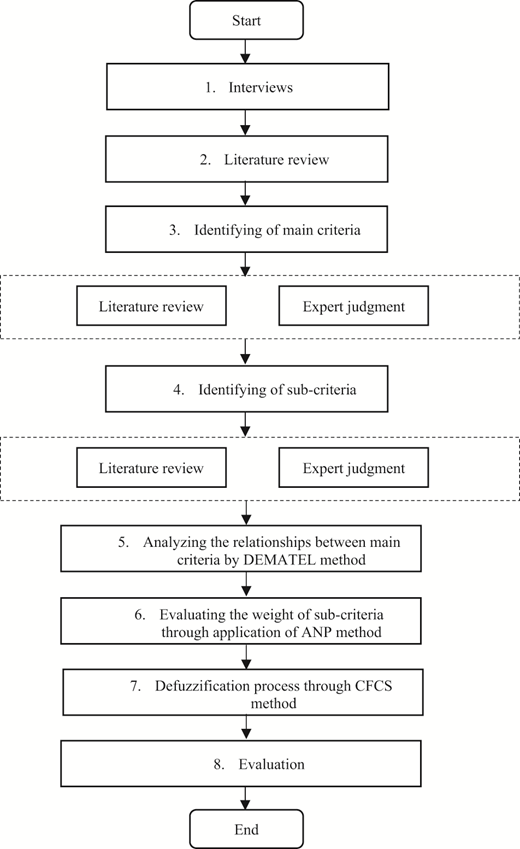
In order to discover which criteria had the greatest impact on selecting a suitable refugee camp location, a combination of the fuzzy, DEMATEL and analytical network process (ANP) methods was used. Significances were calculated by implementing these methods. The methods are defined below. This process is shown in Figure 1.
3.1 The DEMATEL method
DEMATEL method is an effective tool for analysing structure and relations between few alternatives or system components (Gül et al., 2014). The method is based on graph theory and categorizes the influence factors into two groups: the cause group and the effect group (Hung, 2010). In this study, DEMATEL method is used for analysing the relations between five main criteria.
The DEMATEL method consists of five steps (Tsai et al., 2009). At the beginning, experts evaluate the effects of each pair of criteria. The effect is ranked as: 0 (zero influence), 1 (moderate influence), 2 (medium influence), 3 (strong influence) and 4 (very strong influence). Pair-wise comparisons are made, and the direct-relation matrix H is formed. This matrix presents which criteria affect other criteria. During the second step, the direct-relation matrix is normalized. The next step includes the creation of a causal diagram. The fifth step is focused on generating a cause and effect relation diagram. This diagram visualizes a detailed interrelationship between the criteria (Celik, 2017).
3.2 The ANP method
The objective of the ANP method is to evaluate the weights of variations (Hung, 2010) and Saaty (1996) proposed to use this method to solve the problem of dependence among criteria or eventualities. In this paper, ANP method is used for evaluating the weight of sub-criteria.
During the first phase, the relative importance weights are generated through pairwise comparisons for each of the dependency relationships. This comparison is accomplished through the questioning “How much importance does one criterion have compared to another criterion with the respect to our interests or preferences?” (Ju et al., 2015, p. 353). When the pairwise comparisons are finished, the relative importance weight for each component is calculated. These weights are made into a pairwise comparison matrix A (Hung, 2010). The second phase is focused on the calculation of the supermatrix W. The supermatrix is composed of the priority vectors of each pairwise comparison matrix (Hung, 2010) and represents the inter-relationships between all network components (Azizi et al., 2014). During the last phase, the weighted supermatrix is converted into the limit supermatrix. The weighted supermatrix has to be multiplied n times until the limit supermatrix is achieved (Azizi et al., 2014). The solution is reached when the columns of the limit supermatrix are equal and they represent the global priority vectors (Nekhay et al., 2009).
3.3 The fuzzy DEMATEL–ANP methods
Decision-makers work in the real world. In daily situations, the goals and consequences of possible conducts are often unknown or are not known exactly (Bellman and Zadeh, 1970). According to Hung (2010, p. 9,057), “the goals of the decision makers may be fuzzy for the consideration of flexibility and vagueness in the preferences”. Therefore, the main goal of fuzzy theories is to remove this vagueness of human thinking and decision making.
The disadvantage of the DEMATEL method is presented by using crisp values for a description of the systems and their relationships. In the real world, crisp values are insufficient (Büyüközkan and Cifci, 2012). This is why an application of fuzzy theory to the DEMATEL method is beneficial for many types of MCDM problems.
The ANP method uses ratio scales measurements based on pairwise comparisons without a strict hierarchical structure (Büyüközkan and Cifci, 2012). The essence of the ANP method is the evaluation of the weights of variations according to experts’ judgment. However, human judgment on preferences is frequently unclear and it is hard to represent this estimation through exact numerical values (Büyüközkan and Cifci, 2012). Again, fuzzy theories are needed to handle problems characterized by imprecision.
The indispensable step is defuzzification. The method most used is the CFCS method (Converting Fuzzy Numbers into Crisp Scores). For calculation, it is necessary to reflect the fuzzy linguistic scale contained in Table 4.
The fuzzy linguistic scale (amended from Tabrizi et al., 2016, p. 2,949, p. 2,949)
| Linguistic term | Triangular fuzzy numbers |
|---|---|
| Zero influence Moderate influence Medium influence Strong influence Very strong influence | (0; 0; 0.25) (0; 0.25; 0.5) (0.25; 0.5; 0.75) (0.5; 0.75; 1) (0.75; 1; 1) |
The CFCS defuzzification method has five steps which are normalization, calculation of left and right normalized values, calculation of total normalized crisp value, calculation of crisp value and integration of crisp values (Kazançoğlu and Aksoy, 2011).
This paper has some limitations. The first is the elementary substance of the combination of the fuzzy, DEMATEL and ANP methods. The DEMATEL method and ANP method are based on human judgment. The results could be different in different time or with different people. Despite the defuzzification, the values of weights are reliant on expert evaluations. On the other hand, decision-makers in the real world and during real humanitarian operations are people. As mentioned by Celik (2017), the expert judgment should be applied as alternative option for evaluation, and it is used in many papers. Also, the potential relationships between the sub-criteria have not been examined. This creates opportunity for future research using DEMATEL method. There could also be a higher number of experts involved in the research, although the values would average themselves out from a certain number of respondents. Moreover, the same combination of methods has been used before and the similar number of respondents has been involved (Tzeng and Huong, 2011; Ju et al., 2015; Fazli et al., 2015; Bongo and Ocampo, 2017; Mediouni et al., 2018). All experts work for the same humanitarian organization. Although this organization works in refugee camps and provides lifesaving aid to refugees, it is not responsible for choosing the location for these camps or settlements. However, the opinion of these workers supplements the knowledge while workers from AFAD participated in previous research. At the same time, sub-criteria that would reflect the ownership of the land or cooperation between various stakeholders have not been covered by this study compared to previous research (Roh et al., 2015; Drakaki et al., 2018).
4. Data collection and results
First, the criteria were determined. The topic of selecting refugee camp locations was discussed with an expert from the Norwegian Refugee Council and two experts from Doctors Without Borders. These discussions aimed to determine the crucial aspects of building a refugee camp, the greatest challenges facing refugees and humanitarian organizations, and how the locations of these camps would be selected. A literature review was then completed. This review included scientific papers (Cetinkaya et al., 2016; Celik, 2017) and the UNHCR standards (2015a, 2015b, 2015c, 2015d, 2015e, 2015f). Five main criteria and twenty sub-criteria were then defined. These criteria and sub-criteria reflected the UNHCR requirements, such as the necessity of planning camps in order to “prevent hazard risks such as landslides and floods” (UNHCR, 2015c, p. 3), “provide the necessary privacy, psychological comfort, and emotional safety” (UNHCR, 2015d, p. 5), “the layout and size should provide adequate living conditions” (UNHCR, 2015d, p. 3), “designs should take into account: climate, topography, hazards and environmental risks” (UNHCR, 2015d, p. 3) and “durable solutions are the ultimate goal” (UNHCR, 2015c, p. 3).
The process of data collection commenced in January 2018, and the results were presented at the EurOMA conference in June 2018. At the time, studies presented by Cetinkaya et al. (2016) and Celik (2017) were the only published research. The sub-criteria opportunity for growth, distance to facilities, danger of aggression, distance to country of origin, economic aspects and long-term planning were not covered by these papers. These sub-criteria were defined according to expert opinion. Research by Drakaki et al. (2018), however, also proposed the sub-criteria distance to facilities and danger of aggression.
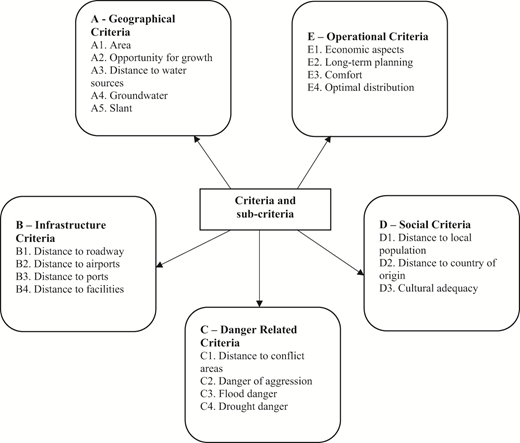
Figure 2 shows the complete list of criteria and sub-criteria used in this case study and the detailed description of all sub-criteria is included in Table 5. The criteria and sub-criteria consider common complications connected with refugee camps. According to field workers who worked in a refugee camps, the two main problems are a lack of space for refugees and a lack of clean water. Some sub-criteria are interconnected. For example, cultural adequacy can influence the danger of aggression, or the distance to water sources can have an impact on flood danger. These links have to be taken into account when siting a camp.
The detailed description of sub-criteria (personally collected)
| Sub-criterion | Detailed description |
|---|---|
| A1. Area | The potential location for a refugee camp has to be large enough in relation to the number of refugees, e.g. 45 sq. m per person (UNHCR, 2015e) and the critical range is 29 sq. m (UNHCR, 2015a) |
| A2. Opportunity for growth | Refugee camps are often not constructed for a large number of people and this makes living conditions for refugees much worse |
| A3. Distance to water sources | e.g. Rivers or lakes, this sub-criterion reflects the problem of a lack of clean water for the refugee population inside the camps and the recommendation of UNHCR (2015a, p. 6) that “trucking water over long distances should be avoided if possible” as well |
| A4. Groundwater | Another source of water for people in the camps and the groundwater table should be minimum 3 m below the surface (UNHCR, 2015a) |
| A5. Slant | The area for refugee camps should be a plane with a gradient ideally 2–4% (UNHCR, 2015e) |
| B1. Distance to roadway | Refugee camps should be situated near a main or at least a bigger roadway |
| B2. Distance to airports | Refugee camps should be situated near airports |
| B3. Distance to ports | Refugee camps should be situated near ports |
| B4. Distance to facilities | Refugee camps should be situated near facilities (such as warehouses or distribution centres) and also near educational or health facilities |
| C1. Distance to conflict areas | Refugee camps should be located in a safe and secure place (e.g. far away from conflict zones, without landmines), “at least 50 km or one day’s travel from potentially sensitive areas such military bases” (UNHCR, 2015b, p. 4) |
| C2. Danger of aggression | Even if refugee camps are situated in a secure area, there is still a danger of aggression (demonstrated in 2017 in some security incidents) and refugees could be also blamed for criminal acts or they can be verbally or physically abused (UNHCR, 2015d) |
| C3. Flood danger | Refugee camps should be situated far away from areas where there is a danger of flooding |
| C4. Drought danger | Refugee camps should be located outside of zones susceptible to drought |
| D1. Distance to local population | Refugee camps should be located near the host community for the prevention of exclusion, UNHCR (2015e) speak about the potential of full integration with the host communities |
| D2. Distance to country of origin | Refugee camps should be situated closer to the country of origin if there is a significant will of refugees to return |
| D3. Cultural adequacy | It is necessary to understand the culture and habits of the refugees and the host community |
| E1. Economic aspects | Refugee camps have an impact on the economic environment of the host country, e.g. UNHCR point out that the camps could “distort local economies and in the long run adversely affect development planning” (2015e, p. 5) |
| E2. Long-term planning | There is a significant possibility that the camps will exist for a longer period of time than the initial estimate |
| E3. Comfort | Refugee camps should be able to provide thermal comfort and protect refugees against sun, rainfall, or frost, and this sub-criterion reflects the previous field data (e.g. 90.2% of 600 respondents from Azraq refugee camp were dissatisfied with the temperature in the shelters during the summer, and 44.8% during the winter (REACH, 2015)) |
| E4. Optimal distribution | The location of refugee camps should take into consideration the effort to minimize the travel distance between the camp and other important points in the region (e.g. markets, other refugee camps) |
Six respondents participated in this study. All of the respondents worked for the same humanitarian organization. They were selected in collaboration with a human resources specialist on the grounds of two factors—the first associated with the level of knowledge about refugee camps and refugee situations, the second with field experience at refugee camps. Only respondents with the theoretical and practical experience could participate in the research. This requirement reflected the reality that refugee crises and camps are a context-specific topic. Humanitarian workers with field experience at a particular refugee camp could therefore have distorted opinions. However, the respondents had experience from different countries, refugee camps and situations. The combination of field staff and personnel from HQ was also deliberate. Despite all of the respondents having had field experience, their current job placements at HQ could have affect their evaluations. Moreover, logisticians should be involved in “site selection”, “settlement layout” and “implementation” stage of planning (UNHCR, 2015c). Therefore, it is essential to involve them in this research. Table 6 contains the profiles of the respondents.
Profiles of experts (personally collected)
| Expert | Position | Education level | Placement | Experience (years) |
|---|---|---|---|---|
| X1 | Director | Graduate | HQ/field | 25 |
| X2 | Logistics manager | Graduate | Field | 8 |
| X3 | HR manager | Undergraduate | HQ/field | 23 |
| X4 | Fundraising specialist | Undergraduate | HQ/field | 3 |
| X5 | Logistician | Undergraduate | Field | 12 |
| X6 | Logistician | Graduate | Field | 6 |
The research itself was conducted in two stages. The first stage applied the DEMATEL method. The aim was to determine whether each criterion belonged to the cause or effect group. Each respondent made pairwise comparisons, from which the direct-relation matrices were then formed. The second stage involved evaluating the weights of sub-criteria according to the ANP method. The respondents received an online questionnaire with verbal formulations for evaluations. These evaluations were later converted into numerical values by the author. This procedure was applied because respondents would have found it excessively complicated to work with these numerical values in the questionnaire. As mentioned by Kovács and Moshtari (2018), user friendliness is important for practitioners. The respondents had approximately one month to complete the questionnaire on account of its demanding character. Because of this extent, respondent number seven declined to participate in the research. All of the respondents, however, expressed the need to improve humanitarian operations taking place in refugee camps.
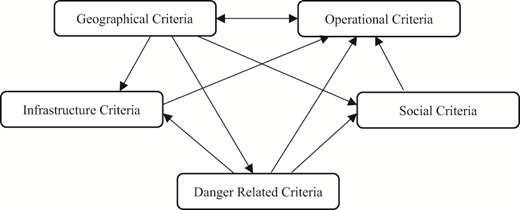
The application of the DEMATEL method shows that the geographical criteria and danger related criteria fall into the cause group which means the infrastructure criteria, social criteria and operational criteria fall into effect group. The cause and effect relation diagram is depicted in Figure 3.
Afterwards, the relative importance weights were generated from the pairwise comparisons for each dependency relationship. These values were obtained by applying the ANP method. The sub-criterion long-term planning had the highest weight (0.119). This was a very interesting finding, because this sub-criterion had not been covered by previous research investigating refugee camp siting. Also, as mentioned above, refugee camps are usually considered a temporary solution. The high weighting denoted the importance of this sub-criterion in practice. Constructing infrastructure in an unsuitable area is an inappropriate and costly process, especially with a long-term horizon. The sub-criteria distance to airports and distance to ports had the lowest weights (both 0.013). Even though distance to airports and distance to ports had the lowest weights, their importance was covered by the impact of the optimal distribution sub-criterion. Obviously, suitable infrastructure plays a key role in optimal distribution.
The application of the CFCS method for defuzzification did not significantly alter the values of the weights. The weights of only five sub-criteria changed: opportunity for growth, distance to water sources, distance to local population, cultural adequacy and long-term planning. These variances were less than 0.01. The new weight of the long-term planning sub-criterion was 0.118. Table 7 shows a complete list of values of the weights after defuzzification.
The weights of sub-criteria (personally collected)
| Main criteria | Sub-criteria | Weight |
|---|---|---|
| A – Geographical criteria | A1. Area | 0.071 |
| A2. Opportunity for growth | 0.080 | |
| A3. Distance to water sources | 0.076 | |
| A4. Groundwater | 0.073 | |
| A5. Slant | 0.050 | |
| B – Infrastructure criteria | B1. Distance to roadway | 0.043 |
| B2. Distance to airports | 0.013 | |
| B3. Distance to ports | 0.013 | |
| B4. Distance to facilities | 0.034 | |
| C – Danger related criteria | C1. Distance to conflict areas | 0.024 |
| C2. Danger of aggression | 0.024 | |
| C3. Flood danger | 0.022 | |
| C4. Drought danger | 0.017 | |
| D – Social criteria | D1. Distance to local population | 0.047 |
| D2. Distance to country of origin | 0.023 | |
| D3. Cultural adequacy | 0.039 | |
| E − Operational criteria | E1. Economic aspects | 0.079 |
| E2. Long-term planning | 0.118 | |
| E3. Comfort | 0.057 | |
| E4. Optimal distribution | 0.096 |
The value of the weight of the distance to country of origin sub-criterion is also fascinating. The generally valid opinion seems to be that refugee camps should be located near the country of origin (or place of origin when it comes to internally displaced people). As a result, refugee camps are often situated in remote areas, as mentioned earlier. On the other hand, the distance to local population sub-criterion has double the value of weight than the distance to country of origin sub-criterion. Obviously, these two sub-criteria could be contradictory. In some ways, it could be more beneficial to compare only sub-criteria in the same group of criteria, or to compare the sub-criteria that are somehow connected. This could have a greater impact on concrete potential locations with specific parameters.
5. Discussion of findings and potential limitations
As mentioned above, the sub-criterion long-term planning had the highest weight (0.119). Despite constructing a camp being thought of as the final action, the long-term provision of services should be considered (UNHCR, 2015b). Furthermore, “camps are rarely occupied for the short-term” (UNHCR, 2015e, p. 5) and “most refugee operations last longer than expected” (UNHCR, 2015e, p. 7). Long-term planning is therefore crucial, and it is due to various reasons. From one perspective, camps can contribute to the hosting community (Jansen, 2009). However, these camps can affect development planning in the long term (UNHCR, 2015e). Long-term planning is associated with a number of activities. For example, water supply systems must be sustainable in the longer term (UNHCR, 2015f) and the number of toilet amenities must be sufficient (UNHCR, 2015a). The expected lifespan of the entire facility also affects the services that may need to be developed or expanded (Sphere Handbook, 2018). Also, health-care problems differ according to the horizon of the camp’s lifespan (Elias et al., 1990), which affects the character of the aid provided at the facility. Perkins et al. (2017) described innovative camp greening at Domiz, which is a camp for Syrian refugees in the north of the Kurdistan region in Iraq. The authors mentioned the recognition that this camp was a city “that would be home to thousands of refugees for much of their lives” (Perkins et al., 2017, p. 46) and that one of the challenges was “overcoming the idea that camps are temporary spaces” (p. 48).
The long-term planning criterion is associated with the sub-criterion opportunity for growth (weight 0.080). The importance of this sub-criterion grows with the protracted character of refugee crises and rising numbers of refugees. The size of a camp is critical in its planning (UNHCR, 2015a), and a land use plan should also exist. This plan should ensure sufficient space for all the required functions (Sphere Handbook, 2018). Obviously, the required space grows with the number of people living at the camp. The average camp area is 45 square metres per person in camp-type settlements, including household plots, or 30 square metres per person, including household plots, where communal services can be provided outside the settlement (Sphere Handbook, 2018). Various facilities are dictated by the number of people living in a camp. For example, one health centre for every 20,000 people and one school and one distribution centre for every 5,000 people is essential (UNHCR, 2015a). All of these facilities require additional space. In addition, crowded conditions lead to increased stress and morbidity (UNHCR, 2015a). Therefore, considering the expansion of the camp when the location is selected is vital. This aspect has not been previously researched. Cetinkaya et al. (2016) and Celik (2017) only mentioned the necessity to provide enough space for refugees, the required facilities and people’s belongings. Drakaki et al. (2018) discussed the number of potential inhabitants or the length of stay.
The sub-criterion optimal distribution (weight 0.096) had the second highest weight. This aspect has only been discussed by Celik (2017) and is affected significantly by other factors included in his research. This factor is therefore an effect factor. This result agreed with the results presented in this paper, where the operational criteria fell into the effect group.
Accessibility to water has significant impact on the existence of refugee camps and the well-being of the people living there. The average volume of water must be at least 15 L per person per day (Sphere Handbook, 2018). However, according to UNHCR (2015f), water supply systems must deliver 20 L per person per day in order to maintain long-term sustainability. If water supply, sanitation and hygiene facilities are unavailable, the harmful short and long-term effects on health may occur together with increasing security risks or the adoption of unsafe coping strategies by refugees in order to obtain water (UNHCR, 2015f). In previous research, Cetinkaya et al. (2016) defined the sub-criterion proximity to a water source, stating that a camp should be near “water sources such as lakes or rivers” (p. 220). Drakaki et al. (2018) included the factor water availability in their analysis, discussing “water sources” (p. 578) near camps. In presented research, water accessibility was grouped into two sub-criteria: distance to water sources, for example, lakes and rivers and groundwater. Groundwater is an important source of water for refugee camps. For example, the Dadaab camp relies on groundwater from the Merti Aquifer (Burt et al., 2013). Refugees relying on groundwater can also have an influence on their host community.
Another sub-criterion not covered by previous research is economic aspects (weight 0.079). This sub-criterion reflects impact of refugee camps on the economic environment of the host community. Celik (2017) also applied the factor economic aspects/financial support. His research, however, focused on minimizing the costs for acquiring and distributing relief goods. The presence of a refugee population has various economic consequences for the surrounding local community. The existence of a camp can have benefits for its host community (Jansen, 2009; Alix-Garcia et al., 2019). The presence of refugees in general can lead to economic expansion and innovation (Refugee Studies Centre, 2011). Refugees can be also a source of inexpensive labour, increase the level of aid received from abroad or expand consumer markets (Whitaker, 2002). According to Jansen (2009), most local people living around the Kakuma camp believed they would be worse off without the refugees. Loschmann et al. (2019) examined the influence of Congolese refugees on host communities in Rwanda. Their research studied economic welfare and labour market activity. The results showed that local people living within 10 km of the camp were more likely to be engaged in employment for wages than in livestock production or farming. Women also living near the camp had a higher rate of self-employment. By contrast, camps can also disturb local economies (UNHCR, 2015e). According to Whitaker (2002), refugees in general pose a burden on local resources, the environment and infrastructure. Maystadt and Verwimp (2014) discovered that the presence of refugees led to growing competition for local agricultural workers in Tanzania. Self-employed agricultural producers profited because of the availability of inexpensive labour. Obviously, the existence of camps can affect the host community either adversely or beneficially, and it is a context-specific question. It is therefore vital to respect this aspect when siting a camp.
The sub-criterion economic aspect is not the only associated with the host community. The sub-criteria distance to local population (weight 0.047) and cultural adequacy (0.039) also reflect the importance of the local community. According to the Sphere Handbook (2018), the local context affects shelter and settlement response.
As mentioned above, the number of papers studying refugee camp siting problems is limited. Compared to existing studies, new sub-criteria were used in our research. A MCDM approach was also applied, although a different, hybrid method was used to analyse the collected data. This study combined fuzzy, DEMATEL and ANP methods. One of the MCDM methods used by Drakaki et al. (2018) was the Fuzzy Analytical Hierarchy Process (FAHP). Cetinkaya et al. (2016) used the same method for prioritizing indicators. The main limitation of this method, however, is that the criteria are considered independent (Mediouni et al., 2018). The ANP removes this limitation. All of the respondents involved in research by Cetinkaya et al. (2016) and Celik (2017) worked for the Disaster and Emergency Management Authority (AFAD) in Turkey. Only the opinions of workers for a Turkish governmental body were thus covered by the research. Celik (2017) also did not include any logisticians in the group of experts. As mentioned above, logisticians should be involved in selecting sites (UNHCR, 2015c). Therefore, in presented research, humanitarian workers and logisticians were involved in order to supplement knowledge.
Comparability between the studies varies. The results published by Cetinkaya et al. (2016) are more comparable to this study. In both papers, for example, the second highest weight was the sub-criteria reflecting accessibility to sources of water in the group related to geography, and the sub-criterion describing distance to conflict areas had the highest weight in the group related to danger. The sub-criteria for distance to ports or airports also had the lowest weight in both analyses. Drakaki et al. (2018) included 11 sub-criteria from the entire list in their analysis. However, the sub-criterion water availability had a priority weight of 0.28 (the sixth highest weight) and accessibility to roads had a priority weight of 0.07 (the tenth highest weight) compared to the results of our study, where the sub-criteria distance to water sources and groundwater had the fifth and sixth highest weights, respectively, from 20 sub-criteria. Furthermore, the sub-criterion distance to roads had the eleventh highest weight. If the proposed papers are viewed from both macro- and micro-perspectives, according to Roh et al. (2015) the macro-perspective criteria are superior. From the micro-perspective criteria, the authors of different papers converge with the distance criterion, and Drakaki et al. (2018) also suggest fire safety.
The contribution of this study is in the use of an innovative combination of methods for decision making. This hybrid fuzzy MCDM approach, i.e. a combination of fuzzy, DEMATEL and ANP methods, has not been previously used in relation to refugee camp siting issues. The DEMATEL method includes indirect relationships in a cause and effect model, which also represents its main advantage (Fazli et al., 2015). The ANP method is applicable in a hierarchical structure and can solve problems dependent on several criteria. As mentioned by Bongo and Ocampo (2017), a more comprehensive representation of the decision-making problem is obtained when this hybrid fuzzy MCDM approach is used. Trivedi and Singh (2017) furthermore highlight that qualitative factors are included in a limited number of papers using MCDM techniques, while mathematical formulations have addressed this issue mostly through quantifiable factors. Qualitative factors were therefore incorporated into this research. New sub-criteria recognized as issues by practitioners and in the literature were also included in the analysis.
6. Conclusion
The key objective of this paper was to identify which sub-criteria have the highest importance for siting refugee camps. Every day, 44,400 people are forced to flee their homes due to persecution or conflict (UNHCR, 2018). Providing adequate shelter and protection is one way to ensure the dignity of those people.
The application of the DEMATEL method showed that the geographical criteria and criteria related to danger fall into the cause group. The relative importance weights were generated by applying the ANP method. The sub-criterion long-term planning had the highest weight (0.119), followed by the sub-criteria optimal distribution (0.096), opportunity for growth (0.080) and economics aspects (0.079). The complete results of this study are comparable to the results presented by Cetinkaya et al. (2016).
In order to address refugee camp siting problems using the hybrid fuzzy MCDM approach, fuzzy DEMATEL–ANP was applied. The results of this research are valuable in two distinct ways to organizations such as governments, UN agencies and other humanitarian organizations and potential decision-makers. First, the results contribute to selecting suitable camp locations for refugees and internally displaced people according to how the importance of particular sub-criteria is understood, following on from the previous research mentioned above. Unfortunately, no single option is ideal, because settlement planning is context specific (UNHCR, 2015c). However, selecting suitable camp locations is a crucial aspect in providing a safe environment for refugees and internally displaced people (UNHCR, 2015b). Second, this research demonstrated the application of an uncommon MCDM approach for dealing with decision-making problems in humanitarian operations. The DEMATEL and ANP methods bring different points of view to these problems and offer deep analysis when applied in combination. Because of the demanding character of applying these methods, using this hybrid fuzzy MCDM approach is an advantage in complex decision-making problems where the weights and relations obtained can be used repeatedly and where there is no need to make decisions quickly. As pointed out by Kovács and Moshtari (2018), the suitability of the type of approach depends on the characteristics of the crisis, and therefore, on the context. Both methods are based on human opinions. It is therefore important to select participants accordingly, and for this reason, respondents from two different countries with field work experience in over ten countries were selected to participate in this study.
The secondary objective is to bring attention to this topic. The amount of research papers focused on the siting problem of refugee camps is extremely limited. The Office of the United Nations High Commissioner for Refugees (2014) admits that the need to build refugee camps will not disappear. Many governments do not allow to refugees live outside the camps, and, at the onset of emergencies, camps could be a necessary solution. Thus, the best practices for building refugee camps should be set out and, which is perhaps even more important, followed in practice. In the end, the substance of the question of refugee camps is not statistics or estimates but humans. The effort to provide shelter and dignified living conditions, even for a short time, should be standard.
The author would like to express her gratitude to all respondents for their time, willingness, and kindness. The author would like to thank Reena Sattar for editing this paper and all her support, and Dr. Wojciech Piotrowicz and Petr Kolář for their comments which greatly improved the paper together with two anonymous reviewers. Any errors and omissions are the author’s. The research project was co-financed by the University of Economics, Prague.

