


Finding efficient disaster recovery center location-allocation-routing (DRCLAR) network schemes play a vital role in the disaster recovery logistics network (DRLN) design. The purpose of this paper is to propose and demonstrate how to design efficient DRCLAR network schemes under the risk of facility disruptions as a part of the disaster relief activities.
A goal programming (GP) model is formulated to consider four performance measures simultaneously for the DRCLAR design. The cross-evaluation based-super efficiency data envelopment analysis (DEA) approach is applied to better evaluate the DRCLAR network schemes generated by solving the GP model so that more efficient network schemes can be identified.
The proposed approach identifies more efficient DRCLAR network schemes consistently among various network schemes generated by GP. We find that combining these two methods compensates for each method's weaknesses and enhances the discriminating power of the DEA method for effectively identifying and ranking the network schemes.
This study presents how to generate balanced DRCLAR network schemes and how to evaluate various network schemes for identifying efficient ones. The proposed procedure of developing and evaluating them could be extended for designing some disaster recovery/relief supply chain systems with conflicting performance measures.
1. Introduction
The United States and its economy are challenged by weather and climate-related disasters and human-made disasters that impart high social and economic costs (NCDC National Climatic Data Center, 2020). These disasters have drawn attention to the need for a resilient and agile disaster recovery logistics network (DRLN), which needs to be robust to and recover from the disruption quickly to mitigate the damages and save people's lives (Day et al., 2012; Shavarani, 2019). Emergency (or disaster) management is a discipline of avoiding, mitigating and managing risk, and it is also a discipline to prepare for disasters before they happen, responding to them immediately, supporting and reconstructing the affected area after disasters have occurred (Haddow et al., 2020). Thus, designing a good DRLN is a part of the “preparedness” phase, affecting “response” through delivering relief items from sources to destinations promptly and efficiently, which is one of the most important disaster relief operations or activities from the logistics perspective. Due to today's globalized, more complex supply chain systems and highly-uncertain business environment, supply chains have become susceptible to disruptions (see Peng et al., 2011). A significant stream of research on supply chain network structure related to emergency management focuses on facility location-allocation (FLA) and routing decisions (see Rachaniotis et al., 2013). Boonmee et al. (2017) support this stream of research on the disaster relief supply chain network structure by asserting that the FLA problem has become the preferred approach for dealing with emergency humanitarian logistical problems. Shavarani (2019) support what Boonmee et al.'s (2017) assertion, by studying a multi-level FLA to find the optimum number of relief centers and refuel stations and their location. Rachaniotis et al. (2013) stress the importance of disaster recovery center location-allocation-routing (DRCLAR) by saying that facility location-allocation and routing (FLAR) is one of the most crucial humanitarian organizations' activities.
The data in Figure 1, developed by the NOAA's National Climatic Data Center (NCDC), shows that, on average, the United States experiences ten severe weather events per year exceeding one billion dollars in damage, compared to an annual average of only two such events throughout the 1980s. This analysis quantifies the loss from numerous weather and climate disasters, including tropical cyclones, floods, drought and heat waves, severe local storms (i.e. tornado, hail and straight-line wind damage), wildfires, crop freeze events and winter storms. Only weather and climate disasters, which cause losses of greater than or equal to 1 billion-dollars in calculated damage, including consumer price index (CPI) inflation adjustment, are included in this dataset. While this threshold is arbitrary, these billion-dollar events account for roughly 80% of the total US losses for all combined severe weather and climate events (see Figure 2). 2017 has become a historic year of weather and climate disasters for the US, after experiencing 16 separate billion-dollar disaster events.
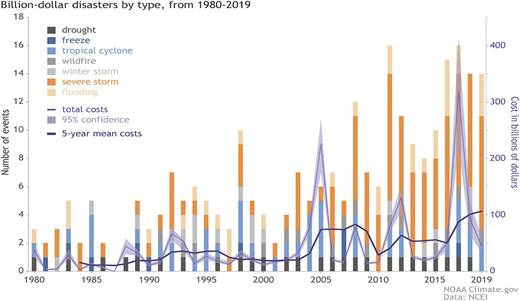
Billion-dollar disasters by type, from 1980 to 2019
Billion-dollar disasters by type, from 1980 to 2019
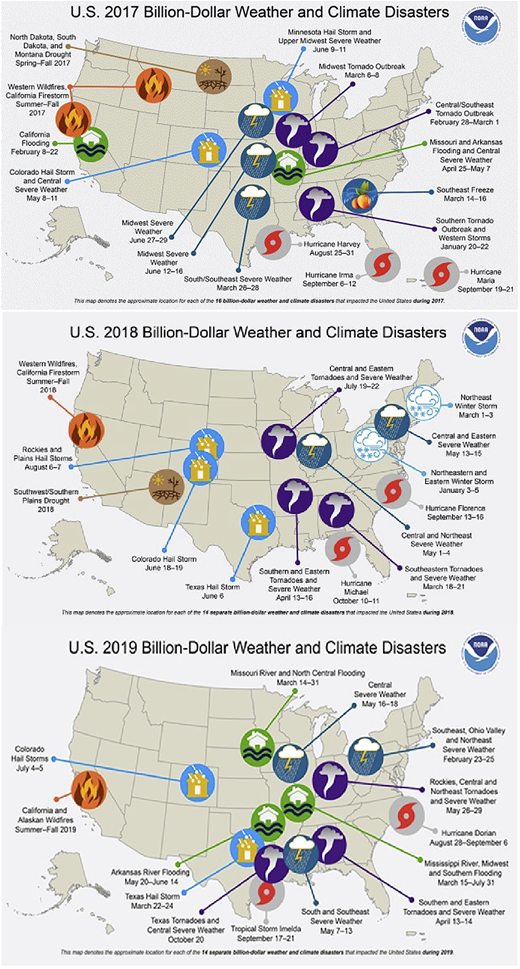
US billion-dollar weather and climate disasters, 2017-2019
US billion-dollar weather and climate disasters, 2017-2019
After catastrophic events such as natural disasters or terrorist attacks happened, it would be critical to have disaster recovery centers (DRCs) nearby such that emergency supplies can be sent to the affected area promptly for a rapid recovery. As a part of such an endeavor, the Federal Emergency Management Agency (FEMA) in 2001 required every Florida County to identify potential locations of DRCs (Dekle et al., 2005). A DRC is a readily accessible facility or mobile office where evacuees and victims of catastrophic events can obtain assistance and relief goods. A DRC may provide several services, such as guidance regarding disaster recovery, the status of applications being processed by FEMA, housing assistance and rental resource information.
As a result, DRCLAR decisions under the risks of facility disruptions have become one of the main issues in the area of disaster relief activities (see Hong and Jeong, 2019; Haddow et al., 2020). DRCLAR decisions inherently consist of two kinds of decision plans. One is a strategic decision plan on the facility location, while the other one is an operational decision plan on the allocation of the facility to the customers and the routing decision. Daskin (2013) says that the routing decision includes (1) which customers to assign to which routes and (2) in what order customers should be served on each route. The traditional models for the strategic DRCLAR design focused primarily on cost-efficiency, assuming that the facilities are supposed to work and ignoring the fact that the facilities are under the risk of disruptions.
As several references cited in Farahani et al. (2010, 2015), Fang and Li (2015) and Hong and Jeong (2019) demonstrate, the FLA problems are inherently multi-objective, where those objectives sometimes conflict with each other in nature. Multi-objective programming (MOP) technique provides an analytical framework where a variety of objectives can be focused on simultaneously so that a decision-maker can use to provide optimal solutions. For efficient DRLN design, this study formulates the DRCLAR network design problem with four objectives under the risk of facility disruption as a goal programming (GP) model, which is a widely used MOP model. Contrary to a single objective optimization problem that can define the best solution, the notion of the best solution does not exist in the MOP model. Most of the MOP techniques require decision-makers' judgment to provide weights assigned to the deviational variables from the target values in the objective function for appropriately reflecting the importance and desirability of deviations from the various target values. As the number of performance measures increases, solving the GP model will yield a high number of alternative options. The reason is that each different weight factor set for performance measures may generate a different option. Similarly, it would be possible for the decision-makers to develop many network schemes, changing the values of those weights.
Evaluating various DRCLAR network alternatives and identifying the most efficient options would be an essential part of the efficient DRLN. The reason is that each network scheme is related to FLAR decisions, which are very difficult to be changed later due to the expensive fixed costs and operating costs of locating DRCs. No standard procedure is available to assign values to the weight factors in a way that guarantees the decision-makers find the most desirable solution. Evaluating alternatives generated by solving the GP model can be viewed as a multiple-criteria decision-making (MCDM) problem, requiring a systematic solution evaluation system. The question is how to evaluate these network schemes without any biased preferences or decision maker's subjective judgment and how to identify the most efficient DRCLAR network schemes for the decision-makers to consider adopting.
Data envelopment analysis (DEA) is one of the methodologies that has been widely accepted and used to evaluate the relative efficiency of a set of peer organizations called decision-making units (DMUs), which make use of their inputs and produce outputs. See Chen et al. (2019) for DEA's applications in operations and data analytics. Since DEA models need not recourse to the exact behavior function of those organizations regarding the transformation of multiple inputs to outputs, it is considered as an effective technique. The DEA method eventually determines which of the DMUs make efficient use of their inputs and produce outputs effectively and which do not. Thus, the conventional DEA (C-DEA) models classify DMUs into two groups, which would separate relatively efficient DMUs from inefficient DMUs. Applying C-DEA for evaluating DRCLAR network alternatives will be the initial step to identify efficient schemes.
Developing a mathematical programming model for the DRCLAR network problem will be an important first step of efficient DRLN design. This paper proposes a framework consisting of how to formulate this design problem as a GP model and how to evaluate to identify the most efficient network scheme(s), which are generated by the GP model. To evaluate and identify the most efficient scheme(s), applying the C-DEA method is not good enough due to a weakness of the C-DEA-based assessment, because C-DEA may classify a considerable number of DMUs as efficient so that it may suffer from a lack of discrimination. This paper proposes a cross-evaluation based-super efficiency (CEBSE) DEA approach to better evaluate the network alternatives and rank the most efficient ones consistently. To the best of our knowledge, no literature on the DEA methods, which show the effect of self- and peer evaluation on the ranking of DMUs, is available.
Thus, the research questions for this study are (1) how to develop a GP model for DRCLAR network design, (2) how to classify the four objectives considered in this study into inputs or outputs for the proposed DEA method to be applied, (3) the proposed CEBSE DEA approach works to evaluate DMUs more fairly and rank them more consistently than the mentioned DEA methods, which the proposed approach is based on, (4) the effect of self- and peer-evaluation on the rankings of DMUs and (5) what the main factors for the decision-makers to consider for adopting the final one from efficient network schemes are.
This paper is organized as follows. After the literature review of the multi-objective DRCLAR models in the following section, we provide a brief background for general DRCLAR models with GP and CEBSE method. Then, the proposed method of combining a GP model and DEA techniques are discussed. Next, we demonstrate our proposed method by GP model formulation and DEA evaluation through a case study using actual data in South Carolina (SC), followed by conclusions.
2. Literature review
Several review papers on various disaster/humanitarian relief logistics, such as Balcik and Beamon (2008), Overstreet et al. (2011), Wisetjindawat et al. (2014), Gutjahr and Nolz (2016), Daud et al. (2016), Boonmee et al. (2017) and Amideo et al. (2019), demonstrate a significant rise in articles focusing on such emergency relief activity related decisions. According to Lukosch and Comes (2019), even gaming is a suitable research method to explore and analyze behavior and decisions in emergent settings that require teamwork and collaborative problem-solving. They propose a design thinking approach that highlights how games can be used for different research purposes and develop two different game setups that are of increasing fidelity and complexity. Besides, the recent articles note that many works of literature use various applications of mathematical techniques or statistical methods to add some of pressing issues, such as locations for the storage and distribution of relief goods, vehicle routing problems and optimization of resources (see Maharjan and Hanaoka, 2018; Ozen and Krishnamurthy, 2018; Dubey et al., 2019; Jabbour et al., 2019; Kovacs et al., 2019; Zhang et al., 2019). It is evident from several review papers or these recent articles that the common topics of the literature on disaster relief operation or humanitarian logistics problems are the disaster FLAR models with different objective functions.
For FLA domain of disaster/humanitarian relief logistics, Trivedi and Singh (2018) conduct a systematic review of existing literature is carried out over a period from 2005 to 2015 by classifying it exhaustively on the basis of several dimensions such as disaster types, speed of occurrence, the methodology adopted, model structure, objective functions, constraints and solution technique. This paper is motivated by Klimberg and Ratick (2008) and Fang and Li (2015), who consider the FLA problems and apply the DEA method for finding the optimal FLA in terms of efficiency. Klimberg and Ratick (2008) postulate that locating facilities at different potential sites may affect the performance of the facility's ability to transform inputs into outputs. Based on this postulation, they develop and test facility location modeling formulations by applying DEA. Following Kimberg and Ratick (2008) and Fang and Li (2015) present a multiple objective linear programming model where the DEA method is integrated with the FLA problem. But these two approaches assume both inputs and outputs are pre-fixed for DEA to be used. The model of Klimberg and Ratick (2008) requires a considerable amount of the pre-determined input and output data and, consequently, the huge number of the constraints for their simultaneous DEA model, as the numbers of facilities and their potential sites increase. Hong and Jeong (2019) consider FLA problems with a different approach. Contrary to the pre-fixed inputs and outputs, they generate inputs and outputs by solving a MOP model and then apply the DEA methods.
For FLAR domain of disaster/humanitarian relief logistics, Rachaniotis et al. (2013) stress the importance of the “last mile distribution,” i.e. the delivery of aid to beneficiaries, which implies transporting relief supplies and services from DRCs to beneficiaries. They also insist that humanitarian organizations have not directly assessed the impact of optimizing their vehicle routing and scheduling, and operational research techniques are rarely applied. Various authors consider the FLAR problem for disaster/humanitarian relief logistics. Table 1 summarizes the research contributions of the existing literature on the DRCLAR network systems/models.
Summary of the research contribution to the existing literature related to the DRCLAR design problem
| Authors | Title | Model objective | Tool/Methods | Major findings |
|---|---|---|---|---|
| Ukkusuri and Yushimito (2008) | “Location routing approach for the humanitarian prepositioning problem” | Minimizing the fixed costs and the routing costs and maximizing the probability of the inventory to reach all the demand points | A combination of the most reliable path and integer programming model | The proposed method can reduce the problem complexity and solve the problem efficiently |
| Lin et al. (2011) | “A logistic model for emergency supply of critical items in the aftermath of a disaster” | Minimizing the total unsatisfied demand, the total travel time and the difference in the satisfaction between the demand nodes | A genetic algorithm based-heuristic and decomposition and assignment heuristic | The proposed model performs well in the disaster relief operation, where prioritizing delivery is important for the emergency supply of critical items |
| Rath and Gutjahr (2014) | “A math-heuristic for the warehouse location-routing problem in disaster relief” | Minimizing the total fixed costs and operative costs and maximizing the covered demand | Mixed-integer linear programming and math heuristic technique based on the adaptive ε-constraint algorithm | The results of the math heuristic technique are compared to those obtained from an application of the NSGA-II metaheuristic |
| Zhang et al. (2018) | “Sustainable multi-depot emergency facilities location-routing problem with uncertain information” | Minimizing travel time, emergency travel relief costs and carbon dioxide emissions | A hybrid intelligent algorithm that integrates simulation and a genetic algorithm | Illustrating the optimization ideas and robustness and effectiveness of the proposed algorithm |
| Liu et al. (2019) | “Location-routing problem for relief distribution in the early post-earthquake stage from the perspective of fairness” | Minimizing the maximum loss of demand node, the total loss of demand node and the maximum time required for the demand node to receive relief | Lexicographic order object optimization method with a hybrid heuristic algorithm | A proposed hybrid heuristic algorithm not only quickly solve the problem but also take fairness and utility into consideration |
| Alinaghian et al. (2019) | “A mathematical model for location of temporary relief centers and dynamic routing of aerial rescue vehicles” | Minimizing the arrival time at the last designated temporary relief center | A hybrid metaheuristic algorithm based on scatter search combined with variable neighborhood search | The proposed algorithm performs well after being compared with an exact method, scatter search and genetic algorithm |
| Ghasemi et al. (2019) | “Uncertain multi-objective multi-commodity multi-period multi-vehicle location-allocation model for earthquake evacuation planning” | Minimizing the amount of shortage of relief supplies and the total costs consisting of the cost of establishing relief facilities and the cost of human casualties | Modified multiple-objective particle swarm optimization, non-dominated sorting genetic algorithm-II and ε-constraint method | The three combined methods successfully solve the model. The sensitivity analysis shows that the increase in the number of affected people will lead to an increase in the accommodation centers |
| Khorsi et al. (2020) | “A multi-objective multi-period for humanitarian relief logistics with split delivery and multiple uses of vehicles” | Minimizing the total amount of unsatisfied demand, the total travel time, the sum of the absolute deviations of a fraction of unsatisfied demands | An augmented ε-constraint method (AUGMECON) | The Pareto solutions generated by AUGMECON suggest that the simultaneous consideration of three objectives will improve the effectiveness of distribution efforts |
| Current paper | “Cross-evaluation based-super efficiency DEA approach to designing disaster recovery center location-allocation-routing network schemes” | Minimizing the total cost, total routing distance and the longest delivery distance. Maximizing the expected demand covered | Goal programming and cross-evaluation based-super-efficiency data envelopment analysis | The proposed approach helps decision-makers design efficient disaster recovery center location-allocation-routing network schemes |
As shown in Table 1, most of the papers on the FLAR model consider multiple objectives and concentrate on developing hybrid heuristic methods based on genetic algorithm, ε-constraint method and some search methods. This paper considers the topic of designing FLAR network schemes, which is a missing topic from the existing literature in the area of FLAR modeling problems. Solving the GP model with a fixed weight assigned on each goal yields a FLAR network scheme. Among multiple network schemes generated by solving the GP model with various values of weights, this paper combines two DEA methods to eliminate each method's weakness to identify efficient FLAR network schemes, which would help the decision-makers select the final one.
3. Combined DRCLAR model with goal programming approach
The following nomenclature is used:
Sets:
M: index set of potential facility sites (j, k, i = 1, 2, …, M)
Parameters:
minimum number of sites that facility j should cover
maximum number of sites that facility j can cover
capacity of facility j
distance between facility j and site m
demand of site m
amortized cost for constructing and operating facility j
maximum number of facilities can be built
c: unit penalty cost per unsatisfied demand
number of vehicles assigned to facility j
Decision variables:
binary variable deciding whether a facility is located at facility site j
: binary variable deciding whether site m is covered by facility j
: binary variable deciding whether site i precedes site k (i < k) on a route from facility j
In the above nomenclature, facility j denotes the facility located at site j. We assume that equals to Besides, equals to zero and consequently = 1, . It is also assumed that the capacity of a transportation model operating at each facility is equivalent to that of the facility. The two parameters, and , the minimum and maximum number of sites that each DRC will cover, along with its capacity, , decide the boundary of the number of sites for the DRC with a certain capacity to perform its disaster relief activity efficiently. To enhance the efficiency of DRC's disaster relief activity, each DRC should not cover too few or too many sites. The distance between a DRC and a site, , is also an important factor of the efficient disaster relief operations, since, generally speaking, the shorter the distance is, the faster the delivery time.
To enhance the facility's resilience, it would be essential to locate facilities to the locations with the lowest probabilities of disruption if possible, so that the chances of facilities' being disrupted are minimized. We assume that if a facility is disrupted, it is shut down or unavailable, so it cannot handle the supplies being delivered to the demand points. Letting denotes the risk probability of facility's being disrupted, which is located at facility site j, we express the expected demands covered/satisfied (EDC) from distribution facilities as
where and note that since both and in (1) are decision variables, Eq. (1) is no more a linear combination. To linearize it, we define and rewrite Eq. (1) as:
where,
Now, the expected demands uncovered/unsatisfied demands (EDU) is obtained by subtracting EDC in (2) from the total demand. That is,
Then, the expected total penalty cost for uncovered demand,, is obtained from multiplying a unit penalty cost, c, by , which is expressed as:
The total relevant cost, TRC, which has been the traditional objective of most FLA models, consists of the cost of locating and operating facilities plus TPC in (4), which is given by:
The total routing distance from all DRCs to the affected sites, TRD, is given by:
Ideally, each DRC should be located near the affected sites or demand points to deliver within some time range. Thus, it would be important to minimize not only TRD but also the maximum of the delivery distance from each DRC for DRCLAR design. Thus, our next goal is to minimize the maximum delivery distance (MDD) from each DRC so that the MDD from each DRC is within the endogenously determined distance. In other words, the objective is equivalent to attempting to minimize the longest delivery distance (LDD) from a DRC. Then the LLD is given by:
Let the nonnegative deviation variables, , denote the amounts by which each value of the four performance metrics deviates from the target values for the four performance measures, EDC*, TRC*, TRD* and LDD*. Then, the deviation variables are given by (see Ragsdale, 2018):
where and are relative importance weights attached to the overachievement and underachievement deviation variables. For analysis, we set the sum of all weights equal to one, i.e. , and each weight is a value between 0 and 1. Then, the weighted sum of the percentage deviations is defined as:
Setting up Equation (12) as an objective function, we formulate the DRCLAR design problem as a mixed-integer quadratic programming (MIQP) model. See Appendix for the formulation.
To solve the GP model, it is required to find the target values of the four performance measures first. The following solution procedure for solving the GP is proposed:
3.1 Procedure I
[Finding each target value]
Let the target values of four performance measures (TARG) be numbered from 1 to 4. Set and equal to arbitrary values of EDC, TRC, TRD and LDD. Set ℓ = 0.
Set .
Let ℓ = ℓ + 1. If b ≤ 4, set and go to (4). Otherwise, set and Go to Step 2.
Solving the GP model with the constraints (8)–(11) with replacing each target value with .
If and , then go to (6). If , increase by . If , reduce by . Go to (4).
Setting , go to (3).
[Solving the model for the given weights]
Set , such that .
Set = = 0.
Solve the GP model given in the Appendix.
Repeat (1) and (3) for all configuration of .
4. Super efficiency–based cross-evaluation data envelopment model
When the facilities are under the risk of disruptions, the EDC would be one of the most critical performance measures to be maximized. Minimizing the other three performance measures, TRC, TDD and LDD can be considered as inputs, while EDC as an output. Solving the GP model with these four performance measures will generate several alternative options as the weight given to each performance measure. The following question is which alternative option is the most efficient one and the next efficient one and so on. Thus, the method for ranking the generated options in terms of efficiency is necessary for the decision-makers to compare the options and adopt the best suitable DRCLAR network scheme.
This paper utilizes DEA methodology, which yields relative efficiency scores (ESs) of comparable units, DMUs employing multiple outputs and inputs. DEA produces an ES for a specified DMU, which is defined as the ratio of the sum of weighted outputs to the sum of weighted inputs. As described before, the proposed procedure is different from the approach of Klimberg and Ratick (2008) and Fang and Li (2015), in that the inputs and outputs of DMUs are generated directly by solving the GP model for various values of the weight factor. In contrast, Klimberg and Ratick (2008) and Fang and Li (2015) assume those inputs and outputs are given or known.
However, a weakness of the C-DEA-based assessment is that a considerable number of DMUs are classified as efficient so that it may significantly suffer from a lack of discrimination. The main reason is that the C-DEA, with its nature of the self-evaluation, allows each DMU to be evaluated with its most favorable weights and even to ignore unfavorable inputs/outputs. As a DEA extension, the cross-efficiency (CE) method is suggested by Sexton et al. (1986) to rank DMUs with the main idea of using DEA to do peer-evaluation, rather than pure self-evaluation in DMU's usual DEA efficiency. But, the first issue for applying the CE method is the proportion/percentage of self-evaluation in computing the CE score (ES). Doyle and Green (1994) eliminate diagonal elements in the CE matrix to compute CE scores, which implies the weight of self-evaluation included in the resulting CE scores is zero. Some authors suggest that the percentage of self-evaluation be 1/n, where n denotes the number of DMUs being evaluated. Thus, as n increases, the weight for self-evaluation decreases. The second issue is that the non-uniqueness of CE scores due to the often-present multiple optimal DEA weights. It means that the cross efficiency score (CES) generated by the CE-DEA depends upon the kinds of optimization software. In other words, CES of the particular DMU can be changed, depending on the optimization software used. The third issue is that the CE method frequently ranks DMUs inconsistently.
If a DMU under evaluation is excluded in the reference set of the DEA models, the resulting model is called as a super-efficiency DEA (SE-DEA) model, which has significance for discriminating among efficient DMUs, eliminating the critical weakness of CE-DEA method, non-uniqueness of CES. Charnes et al. (1992) use the SE model to study the sensitivity of the efficiency classification. Anderson and Peterson (1993) propose the SE model for especially ranking the efficient DMUs. But the critical issue of using the model is that the SE score of an efficient DMU is decided by the adjacent DMUs, so it would be unreasonable for DMUs to be ranked by the SE scores. Table 2 summarizes each DEA method's weaknesses as well as strengths.
DEA methods with strength and weakness
| DEA method | |||
|---|---|---|---|
| Conventional DEA | Cross efficiency DEA | Super efficiency DEA | |
| Strength | (1)Can separate efficient DMUs from DMUs to be evaluated | (1)Can use cross efficiency score (CES) as a relative evaluation between any pair of DMUs (2)Can provide a full ranking for the DMUs to be evaluated | (1)Can more accurately reflect differences among efficient DMUs than simple efficiency |
| Weakness | (1)Poor discriminating power by rating frequently too many efficient DMUs (2)All efficient DMUs are treated equally in terms of efficiency | (1)Non-uniqueness of CES. (2)Can't generate consistent rankings for DMUs with many inputs and many outputs | (1)Can't use super efficiency score (SES) as a relative evaluation between any pair of DMUs |
This paper proposes to combine CE and SE DEA techniques with GP models to evaluate the network schemes for designing DRCLAR decisions. In addition, the effect of self- and peer-evaluation on the rankings of DMUs being evaluated. For the DRCLAR model, we consider EDC as an output and the other three performance measures, TRC, TRD and LLD, as inputs. Now, based on the CRS (Constant-Returns-to-Scale) multiplier DEA (m-DEA) model, the efficiency score (ES) for DMUω can be determined from the following linear programming (LP) model:
subject to,
In (13)-(15), w1 denotes the nonnegative coefficient or weight assigned by DEA to output, EDC and the nonnegative coefficient or weight assigned by DEA to input q, where TRC, TRD and LLD are input 1, 2 and 3, respectively.
DEA allows each DMU to be evaluated with its most favorable weights due to its nature of the self-evaluation, even ignoring unfavorable inputs/output. The cross-efficiency method (CEM) was suggested by Sexton et al. (1986) as a DEA extension to rank DMUs with the main idea being to use DEA to do peer evaluation, rather than in simple self-evaluation. It consists of two phases, where Phase 1 is the self-evaluation phase, while Phase 2 is the peer-evaluation. In Phase 1, let represent the DEA score for DMUω, which is obtained from:
subject to,
The multipliers, , arising from evaluating DMUω in (16)-(18), are applied to all DMUs to get the cross-evaluation score for each of DMUs in Phase 2. The cross efficiency of , using the weights that DMUω has chosen in the model by (16)-(18), is given by:
Doyle and Green (1994) use Equation (19) to set up the CE matrix which consists of the self-evaluation efficiency, , in the leading diagonal and peer evaluation efficiency, , in the non-diagonals. By averaging in (19) without the leading diagonal, they (1994) propose the cross-efficiency score (CES) for DMUκ for evaluating the overall efficiencies of the DMUs, which is defined as:
Eq. (20) finds the CES through the peer-evaluation in Phase II only, completely eliminating the self-evaluation in Phase I. Still, some researchers suggest including both self-evaluation and peer-evaluation and averaging the appraisals by itself and peers as follows:
The CES in (20) or (21) obtained by DEA may not be unique due to multiple optimal weights for inputs and outputs, which are generated by solving a linear programming model given in (16)-(18).
The SE-DEA was developed to overcome the critical drawback of the C-DEA, evaluating DMUs on the basis of self-evaluation. The super-efficiency score (SES) for a specific DMU is obtained by excluding the DMU under evaluation in the reference set, while CES is still based on the C-DEA. Thus, SES for an efficient DMU, which is usually greater than or equal to 1, is decided by two adjacent efficient DMUs and can more accurately evaluate the efficient DMUs. Jeong and Ok (2013) maintain that the self-evaluation efficiency would not discriminate efficient DMUs and propose a modified cross-evaluation method using the super efficiency scores (SES). They demonstrate that their approach can discriminate efficient DMUs better than CE-based methods.
The SES for a DMU under evaluation is obtained by solving (13)–(15) after eliminating its own constraint from (14), which is expressed as:
subject to,
Similarly, the super-cross efficiency (SCE) of using the weights for DMUω is:
To find the SESs from (25), Jeong and Ok (2013) arbitrarily assign the weight of half to the diagonal element for the self-evaluation efficiency and the weight of 1/{2*(Ω-1)} to each nondiagonal element for the peer evaluation efficiency. We can see some weaknesses in assigning these arbitrary weights. We also observe some shortcomings of Eqs. (20) and (21), due to the proportion of self-evaluation efficiency included in each equation. As explained, the proportion of self-evaluation efficiency included in Eq. (20) is zero and is (1/Ω)*100% in Eq. (21). Now, we propose the following equation for the CEBSE score for :
where . We call a policy variable, since the SCES in (26), , can be determined by adjusting the value of . If , the self-evaluation SE is eliminated, whereas the peer-evaluation SE is eliminated with .
To apply Eq. (26) efficiently, DMUs are stratified into different efficiency levels to be more consistent in terms of ranking DMUs. Let be the set of DMUs belong to Level u, where Level 1 consists of perfectly efficient DMUs, i.e. in . After eliminating DMUs in Level 1, efficient DMUS are stratified into . The following procedure to rank the efficient DMUs by super-cross efficiency (SCE) is proposed:
4.2 Procedure II
[Identifying efficient DMUs]
Using the m-DEA method, evaluate all DMUs by solving an LP given in (13)-(15).
Identifying efficient DMUs where their ESs are equal to 1, stratify them into a set . After eliminating DMUs in , identify efficient DMUs and stratify them into a set .
[Computing SCES for the efficient DMUs after stratification]
[Ranking the efficient DMUs]
Rank DMUs for each value of .
There will be many methods for making the final ranking for DMUs if the rankings of DMUs are not consistent. One of them would be averaging the rankings for each DMU and ranking DMUs based on their average ranks.
5. Case study
Historic flooding, which is so-called as a 1,000-years storm in SC, tore through SC in October 2015 when numerous rivers burst their banks, washing away roads, bridges, vehicles and homes. Hundreds of people required rescue, and the state's emergency management department urged everyone in the state not to travel (see Figure 3). Following this 1,000-years storm, Hurricane Matthew, which is the most powerful storm of the 2016 Atlantic Hurricane Season, made its fourth and final landfall as a Category 1 Hurricane along the Carolina coast. Matthew was directly responsible for 29 deaths in Carolinas all but one due to flooding. In 2017, SC avoided Irma's eye; the massive storm caused severe flooding and tropical-storm-force winds. In 2018, Hurricane Florence caused severe damage in the Carolinas primarily as a result of freshwater flooding, causing 52 casualties in the Carolinas.
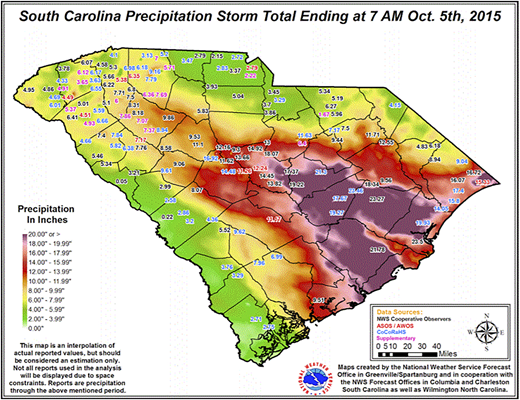
Historic 2015 South Carolina flooding map
Historic 2015 South Carolina flooding map
The Federal Emergency Management Agency (FEMA) opens DRCs in several SC counties to help SC flood survivors in case of flooding. We use the problem of locating DRCs in SC as our case study. Forty-six (46) counties are clustered based on proximity and populations into twenty counties. Then, one city from each clustered county based on a centroid approach is chosen. All population within the clustered county is assumed to exist in that city. The distance between these cities is considered to be the distance between counties. We assume that when a major disaster is declared, the DRC in that county cannot function due to the damaged facility and supply items and closed or unsafe roads and highways. The FEMA database provides a list of counties where a major disaster was declared. Based on the historical record and the assumption, the risk probability, pj, for each site is listed in Table 3. For the case study, some hypothetically pre-determined input parameters are listed in Table 4.
The date for the DRC location-allocation-routing design problem
| No | City | County | Population (K) | Risk probability | fj ($K) |
|---|---|---|---|---|---|
| 1 | Anderson | Anderson/Oconee/Pickens | 373 | 0.125 | 1,800 |
| 2 | Beaufort | Beaufort/Jasper | 187 | 0.063 | 2,000 |
| 3 | Bennettsville | Marlboro/Darlington/Chesterfield | 96 | 0.375 | 500 |
| 4 | Conway | Horry | 269 | 0.375 | 650 |
| 5 | Georgetown | Georgetown/Williamsburg | 93 | 0.438 | 550 |
| 6 | Greenwood | Greenwood/Abbeville | 92 | 0.125 | 1,600 |
| 7 | Hampton | Hampton/Allendale | 33 | 0.188 | 1,500 |
| 8 | Lexington | Lexington/Newberry/Saluda | 318 | 0.313 | 650 |
| 9 | McCormick | McCormick/Edgefield | 35 | 0.250 | 800 |
| 10 | Moncks Corner | Berkeley | 178 | 0.313 | 600 |
| 11 | Orangeburg | Orangeburg/Bamberg/Calhoun | 123 | 0.375 | 500 |
| 12 | Rock Hill | York/Chester/Lancaster | 321 | 0.313 | 600 |
| 13 | Spartanburg | Spartanburg/Cherokee/Union | 367 | 0.313 | 600 |
| 14 | Sumter | Sumter/Clarendon/Lee | 157 | 0.375 | 500 |
| 15 | Walterboro | Colleton/Dorchester | 135 | 0.250 | 700 |
| 16 | Aiken | Aiken/Barnwell | 184 | 0.313 | 500 |
| 17 | Charleston | Charleston | 350 | 0.250 | 1,200 |
| 18 | Columbia | Richland/Fairfield/Kershaw | 461 | 0.375 | 650 |
| 19 | Florence | Florence/Dillon/Marion | 203 | 0.438 | 450 |
| 20 | Greenville | Greenville/Laurens | 521 | 0.125 | 1,300 |
Input data used for the case study
| Symbol | Meaning | Value |
|---|---|---|
| A minimum number of sites that DRC j can cover | 2, | |
| A maximum number of sites that DRC j can cover | 7, | |
| Capacity for DRC j | 1,500, | |
| Maximum number of DRCs to be built | 4 | |
| c | Unit penalty cost for the demand uncovered/unsatisfied | $1.00 |
| Number of vehicles assigned to DRC j | 1, |
As procedure I proposes, we solve the GP model given in (12) through (21) for various values of α, where each weight changes between 0 and 1 with an increment of 0.2. There are 56 alternatives arising out of the combinations of the setting of α. These 56 alternatives are reduced into twenty-five (25) consolidated schemes, based on the values of the performance measures. Following Procedure II, three efficient DMUs (configurations) in Level 1, DMU #22, #25 and #37, and nine DMUs in Level 2 are identified by solving the multiplier DEA model given in (22)-(24). Then, we construct the super cross-evaluation matrix in Table 5 by solving (31)–(34). In Table 6, we report those 12 DMUs along with the values of four performance measures, ES in (22), two CESs, in (29) with peer-evaluation value only and in (30) with both self- and peer-evaluation values and two SCESs, in (35), with peer-evaluation only (β = 0) and with both self- and peer-evaluation (β = 1/12), respectively.
CEBSE score table for DMUs in Levels 1 and 2
| DMU | ||||||||||||
|---|---|---|---|---|---|---|---|---|---|---|---|---|
| Level 1 | Level 2 | |||||||||||
| DMU | 22 | 25 | 37 | 6 | 7 | 12 | 14 | 23 | 24 | 27 | 35 | 47 |
| 22 | 1.0075 | 1.0000 | 1.0000 | 0.8881 | 0.8183 | 0.7967 | 0.8187 | 0.9576 | 0.9661 | 0.8868 | 0.9204 | 0.9860 |
| 25 | 0.6177 | 1.1310 | 0.5788 | 1.0000 | 0.6359 | 0.7450 | 0.7450 | 0.7103 | 0.7028 | 0.5951 | 0.6657 | 0.5284 |
| 37 | 1.0000 | 1.0000 | 1.0018 | 0.8886 | 0.8500 | 0.8178 | 0.8399 | 0.9381 | 0.9394 | 0.9220 | 0.9388 | 0.9832 |
| 6 | 0.6557 | 1.0000 | 0.6631 | 0.8908 | 0.9129 | 0.9158 | 0.9158 | 0.6443 | 0.6132 | 0.8743 | 0.8184 | 0.6018 |
| 7 | 0.6557 | 1.0000 | 0.6631 | 0.8908 | 0.9129 | 0.9158 | 0.9158 | 0.6443 | 0.6132 | 0.8743 | 0.8184 | 0.6018 |
| 12 | 0.6557 | 1.0000 | 0.6631 | 0.8908 | 0.9129 | 0.9158 | 0.9158 | 0.6443 | 0.6132 | 0.8743 | 0.8184 | 0.6018 |
| 14 | 0.6557 | 1.0000 | 0.6631 | 0.8908 | 0.9129 | 0.9158 | 0.9158 | 0.6443 | 0.6132 | 0.8743 | 0.8184 | 0.6018 |
| 23 | 1.0000 | 1.0000 | 0.9915 | 0.8881 | 0.8150 | 0.7952 | 0.8169 | 0.9531 | 0.9613 | 0.8814 | 0.9158 | 0.9764 |
| 24 | 1.0000 | 1.0000 | 0.9915 | 0.8881 | 0.8150 | 0.7952 | 0.8169 | 0.9531 | 0.9613 | 0.8814 | 0.9158 | 0.9764 |
| 27 | 0.9982 | 1.0000 | 1.0000 | 0.8886 | 0.8502 | 0.8181 | 0.8401 | 0.9366 | 0.9376 | 0.9219 | 0.9383 | 0.9811 |
| 35 | 0.9982 | 1.0000 | 1.0000 | 0.8886 | 0.8502 | 0.8181 | 0.8401 | 0.9366 | 0.9376 | 0.9219 | 0.9383 | 0.9811 |
| 47 | 1.0000 | 0.9382 | 1.0000 | 0.8335 | 0.7911 | 0.7577 | 0.7804 | 0.9300 | 0.9401 | 0.8707 | 0.8963 | 0.9968 |
| CEBSES1 | 0.8397 | 0.9944** | 0.8376 | 0.8942* | 0.8331 | 0.8265 | 0.8405 | 0.8127 | 0.8034 | 0.8597 | 0.8604 | 0.8018 |
| CEBSES2 | 0.8537 | 1.0058** | 0.8513 | 0.8939* | 0.8398 | 0.8339 | 0.8468 | 0.8244 | 0.8166 | 0.8649 | 0.8669 | 0.8180 |
Note(s): CEBSES1: CEBSE score with peer-evaluation only. CEBSES2: CEBSE score with self- and peer-evaluation; **Ranked first; *Ranked second
Efficient DMUs, their performance metrics and efficiency scores
| DMU | EDC | TRC | TRD | LLD | ES | CES1 | CES2 | CEBSES1 | CEBSES2 |
|---|---|---|---|---|---|---|---|---|---|
| 22 | 4026.88 | $5369.12 | 1684.2 | 589.9 | 1.0000** | 0.8332 | 0.8471 | 0.8397 | 0.8537 |
| 25 | 3674.36 | $5221.64 | 1007.6 | 294.0 | 1.0000** | 0.9944** | 0.9949** | 0.9944** | 1.0058** |
| 37 | 4026.88 | $5369.12 | 1665.4 | 629.6 | 1.0000** | 0.8316 | 0.8456 | 0.8376 | 0.8513 |
| 6 | 3248.82 | $5197.19 | 1000.1 | 294.0 | 0.8908 | 0.8837* | 0.8843* | 0.8942* | 0.8939* |
| 7 | 3945.72 | $6650.28 | 1185.2 | 561.5 | 0.9129 | 0.8282 | 0.8352 | 0.8331 | 0.8398 |
| 12 | 3912.09 | $6883.91 | 1171.4 | 475.2 | 0.9158 | 0.8198 | 0.8278 | 0.8265 | 0.8339 |
| 14 | 3912.09 | $6683.91 | 1171.4 | 475.2 | 0.9158 | 0.8338 | 0.8407 | 0.8405 | 0.8468 |
| 23 | 3778.69 | $5417.31 | 1608.2 | 481.4 | 0.9531 | 0.8039 | 0.8163 | 0.8127 | 0.8244 |
| 24 | 3720.10 | $5275.90 | 1663.6 | 479.0 | 0.9613 | 0.7943 | 0.8082 | 0.8034 | 0.8166 |
| 27 | 3909.34 | $5986.66 | 1226.2 | 594.5 | 0.9218 | 0.8553 | 0.8608 | 0.8597 | 0.8649 |
| 35 | 3495.77 | $5200.23 | 1171.4 | 475.2 | 0.9383 | 0.8543 | 0.8613 | 0.8604 | 0.8669 |
| 47 | 3934.00 | $5262.00 | 1792.6 | 673.8 | 0.9968* | 0.7958 | 0.8125 | 0.8018 | 0.8180 |
Note(s): CES1: Cross efficiency score with peer-evaluation only. CES2: Cross efficiency score with self- and peer-evaluation; CEBSES1: CEBSE score with peer-evaluation only. CEBSES2: CEBSE score with self- and peer-evaluation. **Ranked first, *Ranked second
It is observed from Tables 5 and 6 that DMU #25 in Level 1 ranks first for all cases so that it would be the most efficient DRCLAR network scheme. The notable observations are that DMU #6 in Level 2 ranks second in terms of CESs and SCEs, while DMU #22 and #37 in Level 1 rank lower than some DMUs in Level 2. It would be a contradictory observation since DMUs in Level 1, which have a higher ES and SES, are considered to be more efficient than DMUs in the lower levels. To investigate further, we compute SCES for each DMU for various values of β and report them and the corresponding rankings in Table 7. From Table 7, we see that as the proportion of self-evaluation, β, increases, DMU #22 in Level 1 ranks second, while DMU #6 in Level 2 ranks second for the less value of β.
The effect of self-evaluation proportion on CEBSES
| DMU | ||||||||||||
|---|---|---|---|---|---|---|---|---|---|---|---|---|
| Level 1 | Level 2 | |||||||||||
| β | 22 | 25 | 37 | 6 | 7 | 12 | 14 | 23 | 24 | 27 | 35 | 47 |
| 1 | 1.0075* | 1.1310** | 1.0018 | 0.8908 | 0.9129 | 0.9158 | 0.9158 | 0.9531 | 0.9613 | 0.9219 | 0.9383 | 0.9968 |
| 0.9 | 0.9908* | 1.1173** | 0.9854 | 0.8912 | 0.9050 | 0.9069 | 0.9083 | 0.9391 | 0.9455 | 0.9156 | 0.9305 | 0.9773 |
| 0.8 | 0.9740* | 1.1037** | 0.9690 | 0.8915 | 0.8970 | 0.8979 | 0.9008 | 0.9250 | 0.9297 | 0.9094 | 0.9227 | 0.9578 |
| 0.7 | 0.9572* | 1.0900** | 0.9526 | 0.8918 | 0.8890 | 0.8890 | 0.8932 | 0.9110 | 0.9139 | 0.9032 | 0.9149 | 0.9383 |
| 0.6 | 0.9404* | 1.0763** | 0.9361 | 0.8922 | 0.8810 | 0.8801 | 0.8857 | 0.8969 | 0.8981 | 0.8970 | 0.9071 | 0.9188 |
| 0.5 | 0.9236* | 1.0627** | 0.9197 | 0.8925 | 0.8730 | 0.8711 | 0.8782 | 0.8829 | 0.8824 | 0.8908 | 0.8994 | 0.8993 |
| 0.4 | 0.9068* | 1.0490** | 0.9033 | 0.8928 | 0.8651 | 0.8622 | 0.8706 | 0.8689 | 0.8666 | 0.8845 | 0.8916 | 0.8798 |
| 0.3 | 0.8901 | 1.0354** | 0.8869 | 0.8932* | 0.8571 | 0.8533 | 0.8631 | 0.8548 | 0.8508 | 0.8783 | 0.8838 | 0.8603 |
| 0.2 | 0.8733 | 1.0217** | 0.8705 | 0.8935* | 0.8491 | 0.8443 | 0.8556 | 0.8408 | 0.8350 | 0.8721 | 0.8760 | 0.8408 |
| 0.1 | 0.8565 | 1.0080** | 0.8541 | 0.8938* | 0.8411 | 0.8354 | 0.8480 | 0.8267 | 0.8192 | 0.8659 | 0.8682 | 0.8213 |
| 0 | 0.8397 | 0.9944** | 0.8376 | 0.8942* | 0.8331 | 0.8265 | 0.8405 | 0.8127 | 0.8034 | 0.8597 | 0.8604 | 0.8018 |
Note(s): **Ranked first, *Ranked second
In Table 8, we report the location-allocation-routing for DRCs for the three efficient configurations in Level 1 and DMU #6 in Level 2 ranked second and depict these four configurations in Figure 4. As shown in Table 5 and Figure 4, DMU #25 and #6 hold relatively lower values of inputs, TRC, TRD and LLC, whereas DMU #22 and #37 yield the highest EDC as output and look inefficient in terms of TRD and LLD. As shown in Table 2, the three locations of DRCs in DMU #22 and #37, {Beaufort, Greenwood, Greenville}, have lower risk probabilities. Thus, locating DRCs in these cities, as the configurations of DMU #22 and #37 show, would yield higher EDC, but costs more and yield higher TRD and LLD that implies inefficient routing schemes.
Location-allocation-routing for four efficient schemes
| DMU | DRC | Site 1 | Site 2 | Site 3 | Site 4 | Site 5 | Site 6 |
|---|---|---|---|---|---|---|---|
| 25 | Beaufort | Hampton | Aiken | Lexington | Columbia | Orangeburg | Walterboro |
| Bennettsville | Rock Hill | Sumter | |||||
| Moncks Corner | Charleston | Georgetown | Conway | Florence | |||
| Greenville | Anderson | McCormick | Greenwood | Spartanburg | |||
| 22 | Beaufort | Orangeburg | Columbia | Rock Hill | Georgetown | Moncks Corner | Walterboro |
| Greenwood | McCormick | Aiken | Charleston | Conway | Florence | Spartanburg | |
| Greenville | Anderson | Lexington | Hampton | Sumter | Bennettsville | ||
| 37 | Beaufort | Hampton | Spartanburg | Sumter | Conway | Charleston | Walterboro |
| Greenwood | Anderson | McCormick | Orangeburg | Bennettsville | Columbia | Lexington | |
| Greenville | Rock Hill | Florence | Georgetown | Moncks Corner | Aiken | ||
| 6 | Orangeburg | Columbia | Lexington | Aiken | Hampton | Beaufort | Walterboro |
| Florence | Bennettsville | Rock Hill | |||||
| Charleston | Georgetown | Conway | Sumter | Moncks Corner | |||
| Anderson | Greenville | Spartanburg | Greenwood | McCormick |
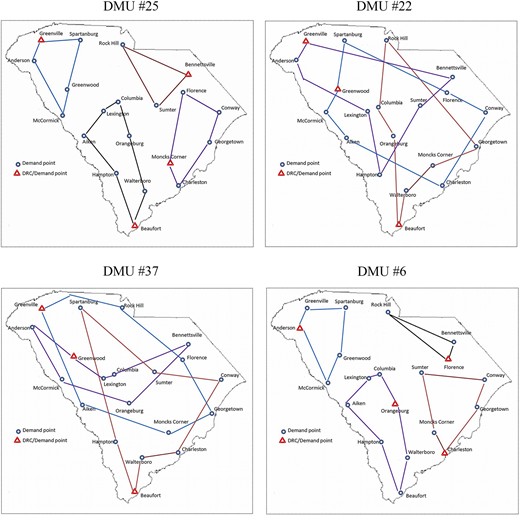
Efficient DRC location-allocation-routing network schemes
Efficient DRC location-allocation-routing network schemes
On the contrary, DMU #25 and #6 sacrifice EDC in exchange for efficient vehicle routing schemes with less total costs.
The C-DEA is expected to identify efficient DMUs with an efficiency score of 1, so that decision-makers would tend to consider these efficient DMUs only. In terms of disaster-related point of view, DMU#25 would also be the scheme for decision-makers to choose. The main reason is that DMU #22 and DMU #37, although these two schemes are identified as relatively efficient DMUs belonging in Level 1 group, are far from efficient in terms of routings. These two DMUs have the same locations of DRCs and very long routes, such as from CDC {Beaufort} to {Rock Hill} and from CDC {Greenwood} to {Charleston} in DMU #22. The delivery distance/time is another critical issue for efficient disaster relief activities. Thus, suppose the decision-makers do not accept the top-ranked DMU #25 due to some reasons. Although it is not relatively efficient, No. 2 ranked DMU #6 could be another candidate network scheme along with two efficient DMUs, DMU #22 and DMU #37.
6. Summary and conclusions
Disruptions caused by natural disasters and catastrophes such as climate/weather-related disasters, earthquakes, volcano eruptions, pandemics and human-made terrors, are usually unpredictable, infrequent and inevitable. A disaster recovery center location-allocation-routing (DRCLAR) network design problem is one of the most challenging tasks in DRLN design. This paper formulates the DRCLAR network design problem with the risk of facility disruptions through the two-step framework to identify efficient DRCLAR network schemes. Contrary to the single objective used in the most of the literature, four primary performance metrics featuring the DRCLAR network schemes are considered simultaneously: the expected demand covered/satisfied (EDC), the total relevant cost (TRC), the TRD and the LDD. In the first step, a GP model is formulated for the DRCLAR problem to find the optimal location of DRC, allocation and routing decisions. For a given weight assigned to each performance metric, solving the GP model generates an optimal DRCLAR network scheme. Consequently, solving the GP model for various values of the weights would provide many network alternatives. Treating each alternative as a DMU with EDC as output and TRC, TRD and LDD as three inputs, two DEA techniques, super efficiency and cross-efficiency methods, are combined and applied to find the efficient and the most efficient DRCLAR network schemes.
The contribution of this paper is to propose the framework for the DRCLAR network design problem. Each alternative generated by solving the GP model yields the optimal values of outputs and inputs, so that DEA methods can be applied to measure the relative efficiency of each network alternative and to identify the most efficient network scheme(s). The peer-evaluation based cross-efficiency DEA (CE-DEA) method was proposed to overcome the critical weakness of the C-DEA, which is based on the self-evaluation. As mentioned before, the critical weakness of the CE-DEA method is that the cross efficiency score (CES) generated by CE-DEA depends upon the kinds of optimization software. In addition, the effect of self-evaluation/peer-evaluation proportion on the CES has not been cleared. The super-efficiency DEA (SE-DEA), which does not have such an issue of inconsistent CES of CE-DEA, uses the two adjacent DMUs in terms of efficiency to generate an SE score. This study applies a CE based SE-DEA approach to identify the most efficient DRCLAR network scheme(s). At the same time, we consider the effect of self-evaluation/peer-evaluation proportion, which is the other weakness of CE-DEA, on the rankings of DMUs.
Using a case study, we observe that the proposed framework of combining the GP model and two DEA methods works very well, regarding identifying and ranking the efficient schemes. The proposed approach to the DRCLAR design problem would provide many insights to practitioners as well as researchers. As shown in the case study, DMU #6, which does not belong to the Level 1 group, can be considered the right candidate that can replace the most efficient scheme DMU #25 due to similar routes with different locations of DRCs.
Some goals can be transformed into the constraint, depending on the possible situation of disaster or the decision-maker's requirements on the performance measures. As mentioned before, it would be problematic to change DRC locations, but actual DRC allocation and routing schemes could be modified according to decision-maker's discretion. Besides, the proposed framework could be applied to design various supply chain network systems if their performance measures can be classified into inputs or outputs.
The limitation of this study comes from the assumption that if a DRC is disrupted, its allocated sites are not covered. For future research, it would enhance this research if the concept of backup facilities for the case of facility shutdown due to disruptions is considered. In other words, other non-disrupted DRCs, if the current capacity allows, would cover some sites allocated to the disrupted DRC. That is how to mitigate the impact of disruptions on the general supply chain network system. This study assumes that only DRCs are subject to disruptions. Thus, if some routes are disrupted, the emergency backup routing plan should be made. Besides, the maximum allowable delivery times from DRCs to any sites would be another critical factor for the disaster relief activities. It will surely enhance this research if the risk probabilities of routes and the constraint for the maximum delivery times are also considered.
This material is based upon work that is supported by the National Institute of Food and Agriculture, US Department of Agriculture, Evans–Allen project number SCX-313-04-18.
References
Further reading
Appendix
GP formulation for DRCLAR design problem:
Minimize in (12)
subject to
Constraints (A.1) make certain that each affected site is covered by a DRC. Constraints (A.2) define the maximum number of facilities to be built. Constraints (A.3) ensure that each site can only be covered by a selected DRC. Constraints (A.4) make sure that the facility j must cover at most and at least sites. Constraints (A.5) show the capacity of facility j. Constraints (A.6) make sure that a route should be formed at the location of facility j. Constraints (A.7) make sure that each site in a route starting from facility j should be accessible from two adjacent sites. Constraints (A.8) make sure that there should have edges active at the facility j. Constraints (A.9) are called the subtour elimination constraint, where S denotes a subtour, which is a route of a set of the affected sites and not visiting all sites that a vehicle is supposed to visit.

