


The impact of supply disruptions from unplanned events can cause goods shortage, limited responsiveness and high opportunity cost thus compromising development aid programmes' achievement targets. These situations force humanitarian aid agencies to develop new strategies for effectively managing their supplies. The purpose of this paper is to illustrate the foundation of humanitarian supply chain resilience through the development of an adapted Kraljic portfolio model.
Action research was used to adapt and validate the Kraljic portfolio model to the development aid context. The research team worked with a humanitarian aid agency in developing criterions and used Analytical Hierarchical Process (AHP) in weighting those key criterions.
The adapted portfolio model was able to evaluate purchases done by the aid agency by incorporating different perspectives related to the strategic importance of purchase and supply vulnerability. In particular, development aid programmes require large supplies annually. Better classification offers improved visualisation of purchases, leading to a more precise adoption of mitigation strategies and policies to minimise supply disruption risks.
Adapting the Kraljic portfolio model is a stepping-stone to building humanitarian supply chain resilience. The proposed humanitarian supply chain resilience framework is based on the foundation that current humanitarian supply chain needs to be re-engineered. In order to re-engineer, the supply base strategy must first be revisited.
Many aid agencies do not have a holistic view on their purchases and commonly apply a transactional classification of purchases that only considers the consumption values. Purchasing strategies mostly focus on cost minimisation, whereas risk mitigations have been disregarded. The proposed portfolio model overcomes these drawbacks. Societal impact may be limited but development aid agencies will be able to offer more reliable aid delivery as part of their mandate.
The proposed portfolio model is among the first tool to guide humanitarian aid agencies to develop procurement strategies to alleviate supply disruptions and increase development aid programmes resilience.
1. Introduction
Humanitarian supply chains not only have to deal with risks, uncertainties but also supply disruptions. Suppliers are often significant sources of disruptions due to their failures to fulfil orders, delayed delivery and an inability to meet surging demands. To cope with supply disruptions, humanitarian aid organisations are required to enhance their upstream resiliency and optimise their relationships with suppliers (Altay and Green, 2006).
In commercial supply chains, sourcing has been recognised as a strategy that helps reduce upstream vulnerabilities (Datta, 2017) and has been considered as the foundation in building supply chain resilience (Christopher and Peck, 2004). In humanitarian supply chains, sourcing and procurement help ensure that the aid organisation will have sufficient resources to meet its operational requirements (Blecken, 2010). Resilience, refers to the ability of the supply chain to spring back to its original state after being disturbed, is critical and should be one of the goals of long-term in development aid supply chains (Oloruntoba and Kovács, 2015; Singh et al., 2018).
Existing studies on resilient humanitarian supply chains have focused on emergency relief rather than on the development aid context (Venkatesh et al., 2014; Behl and Dutta, 2019; Sodhi and Knuckles, 2021). The literature on sourcing from the perspective of resilience for development aid programmes is scant (Van Kempen et al., 2017). Sourcing for development aid programme relies on long-term purpose. Its achievement is indicated by how much the programme's supply chain is resilient and how much it can help increase the target community sustainability (Beamon and Balcik, 2008; Falasca and Zobel, 2011). The management of supply risk in development aid programmes can mean the difference between success and failure of the operations (Shareef et al., 2020).
Recent impact related to the ongoing coronavirus pandemic on supply disruptions are good examples for humanitarian organisations who operate development aid programmes to rethink and incorporate other perspectives such as supply vulnerability when developing their purchase and supply base strategies. The immediate shutdown of manufacturing suppliers in China, for instance, has created a bottleneck to international health supply chain programmes, resulting in delayed procuring and delivery of health-related products and other essential medicines such as HIV and malaria programmes (Ravelo, 2020). A recent survey on the impacts of the coronavirus pandemic revealed that some aid organisations have faced challenges of up to 30-day delivery delays when sourcing and procuring from their suppliers, especially those involving international sources (HELP Logistics et al., 2020).
Through the years, aid organisations have recognised the importance of resilience in humanitarian supply chains as well as sourcing and procurement (Haavisto and Kovács, 2014). In the humanitarian supply chain literature, there are few studies on resilient humanitarian supply chains that integrate procurement, sourcing and purchasing (Behl and Dutta, 2019). However, a guideline for academia and practitioners on how to implement and create resilience in humanitarian supply chains is missing (Oloruntoba and Kovács, 2015). Although suggestions regarding sourcing and purchasing strategies to enable supply chain resilience are provided (Lamenza et al., 2019), they were not derived from the context of development aid purchases, where purposes and initiatives are different.
The aim of this paper is to propose a roadmap for building resilience in humanitarian supply chains from the perspectives of development aid context. The proposed roadmap is adapted from a well-known model taken from commercial supply chains and is empirically validated with a development aid case. Since the development aid and emergency relief contexts share some commonalities, the proposed roadmap can also be considered to build resilience from an emergency relief perspective.
The structure of this paper is as follows. Section 2 reviews the relevant literature related to resilience and sourcing in humanitarian supply chains. Section 3 explains the action research methodology and the context of the study. Section 4 reports the results from criterion classification, purchasing portfolio development and strategies. In Section 5, discussions related to lesson-learned from the case are provided as well as a roadmap for building resilience in humanitarian supply chains is proposed. Section 6 concludes the paper, highlights its contributions and notes limitations and future research.
2. Literature review
2.1 Emergency relief vs development aid programme
Humanitarian supply chains encompass operational activities in the areas of disaster relief and development aid programme (Haavisto and Kovács, 2014). While the goal of emergency operations aims to save lives and minimise immediate risks with speed, the goal of development aid programme is to increase community self-sufficiency and sustainability over a longer time period (Beamon and Balcik, 2008; Haavisto and Kovács, 2014). In contrast to humanitarian response operations with the purpose of short-term reliefs, the nature of development aid operations involves developing long-term solutions and assistance to cope with progressively negative consequences over time (Kunz and Gold, 2017). Development aid programmes are established and designed to respond to plagues, crises and other complex catastrophes to mitigate the suffering of health and livelihoods and build economic, social, environmental, political developments (Cozzolino, 2012).
The activities of development aid programme can include the establishment of permanent and reliable buildings, transport, healthcare and food security (Beamon and Balcik, 2008). Stakeholders of development aid programme are beneficiaries, development partners, donors, relevant government agencies and the private sector (Kretschmer et al., 2014). The essential enablers of such supply chain flows are resources and capabilities used for developmental activities and for helping beneficiaries. Donors play a central role in providing funds that are used to reduce constraints derived from lack of resources and capability, whereas private sectors act as suppliers producing products and services (hereafter commodities) used in a development programme (Sodhi and Knuckles, 2021). Commodities purchased can be construction materials, school kits, sanitation kits, medications, food, custom brokerage services and transport services, to name but a few (Moshtari et al., 2021). Such commodities or services are delivered following regular lead times, allowing for evaluations and bidding procedures to maximise available funds (Falasca and Zobel, 2011).
The purchasing function in development aid programmes is often conducted in a more complex condition than emergency relief operations. Development aid operations demand a large amount of supplies, which involve sourcing and purchasing activities that maintain the flow of distributed commodities to deliver assistance to beneficiaries in the programmes consistently (Van Wassenhove, 2006). Commodities are searched, sourced, selected and procured from different suppliers and markets at geographically dispersed locations annually. Similar to commercial supply chains, supply failure derived from poor procurement and distribution strategies will impact the operational performance of the development aid programme (Shareef et al., 2020).
2.2 Resilience in humanitarian supply chains
In commercial supply chains, resilience is the “ability of a system to return to its original state or move to a new more desirable state after being disturbed” (Christopher and Peck, 2004). In humanitarian supply chains, Dubey et al. (2014), Singh et al. (2018) proposed that resilience is the ability of the supply chain “with which original state can be regained quickly, and normalcy can be retained”. Resilient humanitarian supply chains can be designed to reduce risks and uncertainties (Stewart et al., 2009). Stewart et al. (2009) further suggested that, in practise, such design involves the attempts to reduce risks in the supply chain through strategies. Building resilience in humanitarian supply chains not only contributes to the supply chain itself but also increases a community's resilience to future disaster (Papadopoulos et al., 2017).
Research on humanitarian supply chain resilience covers various topics according to Behl and Dutta (2019) and Polater (2021). From the perspective of supply chain management, resilience can be built through many models such as agility (Balcik and Beamon, 2008; Dubey et al., 2014; Oloruntoba and Kovács, 2015), mitigation processes (Scholten et al., 2014), collaboration (Gabler et al., 2017; Papadopoulos et al., 2017) and supply chain design (Stewart et al., 2009). Singh et al. (2018) proposed a holistic view of developing resilience in humanitarian supply chains. The framework was developed for emergency relief operations and derived from the views of many stakeholders including government, private sectors, academia and aid agencies. Their findings indicated that government support and policy formulation are the main driving factors for developing resilience. However, it was observed that the framework is not fully applicable to the development aid context as some factors require re-definitions. Besides, it was found that often aid organisations cannot control their government in formulating procurement policy (Shareef et al., 2020). It is acknowledged that resilience should be pursued from a longer-term humanitarian aid supply chains perspective, but we still do not know yet how it should be implemented (Oloruntoba and Kovács, 2015).
2.3 Creating resilience from the perspective of commercial supply chains
In commercial supply chains, Christopher and Peck (2004) proposed that developing resilience can be done by the following four steps, as shown in Figure 1. The first step is supply chain (re)engineering which includes three stages: supply chain understanding, supply base strategy and design principles for supply chain resilience. Supply chain understanding emphasises the importance of identifying the network between the organisation and its suppliers (upstream) as well as customers (downstream). An analysis tool is required to reveal the many entities such as actors, critical nodes, risks and vulnerabilities, as well as problems that the supply chain is encountering. Supply base strategy involves the decision with regards to supply sourcing and supplier development. The organisation needs to decide on issues related to criteria for selecting suppliers, the number of suppliers, alternative supply sources and risk awareness of the supplier. Once the organisation understands its supply chain and supply base strategy, it can move towards the (re)engineering of its supply chain. This can be done by developing supply chain strategies that take into account many issues such as costs, lead time, opportunities and the impact of disruptions. The organisation can then re-examine the efficiency-redundancy trade-off. This paper focuses on the first step of Christopher and Peck (2004) 's framework and is focused on the supply side.
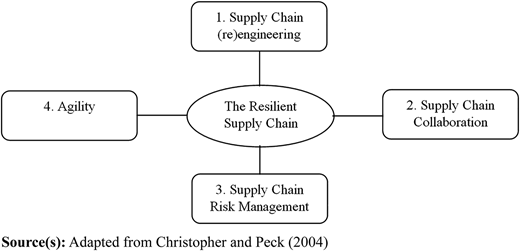
From the perspective of supplier management, sourcing is based on the identification of suppliers, consideration of negotiating terms, conditions and management of the supply base in order to create value by managing costs, supplies and reducing risks (Ketchen et al., 2014). Strategic sourcing involves complex decision-making related to supply management which includes supplier base selection, criteria for supplier selection and supplier relationships (Pereira et al., 2014). Strategic sourcing refers to “making supply management decisions with the intent to create distinctive value and to achieve a competitive advantage” (Ketchen et al., 2014, p. 165). Pereira et al. (2014) suggested that resilience in supply chains can be built through strategic sourcing (Pereira et al., 2014).
In the humanitarian supply chain literature, it is acknowledged that procurement and sourcing help ensure that the aid organisation will have sufficient resources to meet its operational requirements (Blecken, 2010). Many researchers have proposed several strategies. Falasca and Zobel (2011) presented a two-stage procurement model for emergency operations to better handle supply chain's uncertainties. Duran et al. (2013) suggested that the implementation of advanced purchasing and pre-positioning of relief items to solve supply disruptions during emergency reliefs. Iakovou et al. (2014) proposed a dual sourcing model when the humanitarian supply chain is being disrupted. Matopoulos et al. (2014) suggested the use of local suppliers and how to integrate them into the development aid operation's supply chain configuration. However, we know that there is no single perfect strategy for all purchased commodities. Commercial supply chain literature has suggested a model used for solving this issue, as presented hereunder.
2.4 The Kraljic portfolio model
Kraljic (1983) proposed a portfolio model for firms to develop their sourcing and purchasing strategies. Numerous portfolio models extended, built on or motivated by Kraljic portfolio model can comprehensively be found in the commercial supply chain literature (Olsen and Ellram, 1997; Ferreira et al., 2014; Medeiros and Ferreira, 2018). The model offers us a product portfolio that takes into account two dimensions: (1) the strategic importance of purchasing in terms of the value-added and the percentage of items and total spent and (2) the complexity of the supply market in terms of supply scarcity, market conditions, substitutions, entry barriers and logistics costs. Purchased items are classified based on a set of criteria and then positioned in a matrix with four quadrants: strategic, leverage, non-critical and bottleneck profiles. The outputs of the portfolio classification are strategies that can be used to optimise and manage buyer–supplier relationships (Olsen and Ellram, 1997).
The concept of the Kraljic portfolio model approach has recently been acknowledged as a foundation to classify suppliers and develop supply strategies to mitigate supply risks and increase resilience of commercial firms. A publication from Deloitte (2020) revealed that those companies who have diversified their sources apart from China-based suppliers or ones who considered inventory buffer against supply disruption could better respond to the coronavirus pandemic impacts. These adopted strategies apparently resulted from better supplier classification from a portfolio approach.
In the humanitarian supply chain literature, Lamenza et al. (2019) have provided a method for identifying criteria and for developing a purchasing portfolio model, but only for humanitarian emergency purchases. Their developed method is considered an extension of the Kraljic portfolio model. The criterions were identified from the literature and real world practice. The criterions were then sorted into two dimensions based on the Kraljic portfolio model: (1) the importance of purchasing in terms of “the degree of criticality of the purchase to provide humanitarian aid” and (2) the complexity of supply market in terms of “the supply risk of relief items considering the specific features of humanitarian operations” (Lamenza et al., 2019, p. 160). Next, the identified criteria were then assigned with weights and sorted into a matrix by using Analytical Hierarchy Process (AHP) technique. Finally, strategies were proposed for an emergency relief context with a focus on managing supplier relationships and sourcing burdens.
In summary, it is observed that the humanitarian supply chain literature lacks sourcing strategies for the development aid context. This paper aims to identify criteria and to develop a purchasing portfolio model for development aid programmes by adapting Lamenza et al. (2019)'s method. The purposes and initiatives of the portfolio model undertaken in this paper differ from Lamenza et al. (2019). It is expected that we will discover a set of criteria that should fully be applicable for the development aid context, which might be different from ones used in emergency relief context. Furthermore, there is a lack of model for building resilience in humanitarian supply chains. This paper also aims to provide a roadmap for creating such resilience. This paper focuses on the supply side by looking at developing sourcing and procurement strategies that incorporate different perspectives based on the strategic importance of purchase and supply vulnerability arising from the development aid context. An action research methodology is used to provide steps for building resilience.
3. Action research
The awareness has been raised for conducting action research in logistics and supply chain as they generally involve real-world problems (Näslund, 2002). The quality of research is determined by rigor and relevance. In terms of relevance, action research allows researchers to participate in the actual projects and investigate change processes, which are the main subjects of the research. Consequently, insights are gained, and solutions are generated from the reflections of practical problems. Thus, action research contributes to both science and practice (Näslund et al., 2010).
In the humanitarian supply chain literature, dominant methodologies are simulations, modelling and case studies, whereas only a few publications have focused on action research (Sabri et al., 2019). Kovács et al. (2019) have particularly called for action research. They have indicated that research works in the humanitarian supply chain literature have not sufficiently involved empirical evidence, which decreased the level of rigor and relevance. Furthermore, it has been observed by Sabri et al. (2019) that there was an insufficiency of action research work carried out in the context of procurement and in the development aid context.
In this paper, the action research undertaken involves the development of a procurement portfolio for a development aid programme. The steps for action research followed Susman and Evered (1978) protocols: (1) defining problems, (2) considering action plan, (3) implementation of the chosen alternative, (4) evaluating the consequence and (5) specifying learning. The action research steps are briefly summarised as follows.
3.1 The development aid programme context
The aid agency for this empirical study is active in Asia with a strong regionalisation focus. Different development aid programmes governed by country offices have been put in place in various countries to mitigate the suffering and improve the quality of lives in vulnerable communities. The countries have implemented both short- and long-term projects with aid from various sources. The role of the regional office is to fill gaps in the region by providing regular technical and capacity building supports while monitoring the supply chain performance of country offices.
Aid organisations are usually not required to follow the public procurement laws and regulations unless the organisation receives full or matching funds from the respective host governments. However, it is normal practise that policies and procedures related to purchasing of the aid organisations not be in conflict with the public procurement principles such as transparency, integrity, openness, fairness, accountability, etc. The aid organisations therefore observe the in-country government's laws and regulations while implementing the development aid programmes in the country but do not have to follow public procurement rules if there is no matching fund from the host country.
In this paper, the development of the portfolio model was built upon purchases for development aid programmes in one of the least developed countries (LDC) in South East Asia. It must be noted that the critical characteristics of the purchases remain the same in almost all countries in the region. The common purchased commodities of the country include construction materials, agricultural seeds, school kits, transportation services and so on. The purchasing strategies of the focused country also share some commonalities with other countries in the region. Such strategies are to choose one supplier (i.e. with the best value) through competitive bidding processes, where negotiation significantly takes part during the sourcing and supplier selection. Therefore, it requires staff to focus on communicating and engaging with suppliers. As a consequence of several negotiations and communication (which may not guarantee favourable results), the entire activity may take up to three months. On average, only one-year contracts are given to selected suppliers. The actions of supplier negotiation, selection and contracting are therefore repeated every year.
The nature of markets in the focused LDC country is either monopoly or oligopoly. This often creates a challenge to the aid agency to secure the commodities at reasonable prices. The current sourcing strategies can cause severe supply interruption or subject to the volatility of commodity prices, especially when unexpected events occur.
3.2 Steps for action research
Actors involved in this research project included a group of practitioners from supply chain department of the aid organisation, from both regional and country offices, and the research team. The project had been initiated with the aim of the research team to improve the strategic sourcing processes and supply performance of the aid organisation. Figure 2 illustrates the five-step action research undertaken in this project. The first step was carried out to define the existing problems and gaps of the sourcing processes that the aid organisation encountered. Numerous rounds of interviews and discussions via virtual meetings were undertaken with the experts from the aid organisation. The experts modelled the current procurement system with a set of questions corresponding to the nature, characteristics and goals of their development aid programmes as well as their current purchasing strategies and the supply market structure.
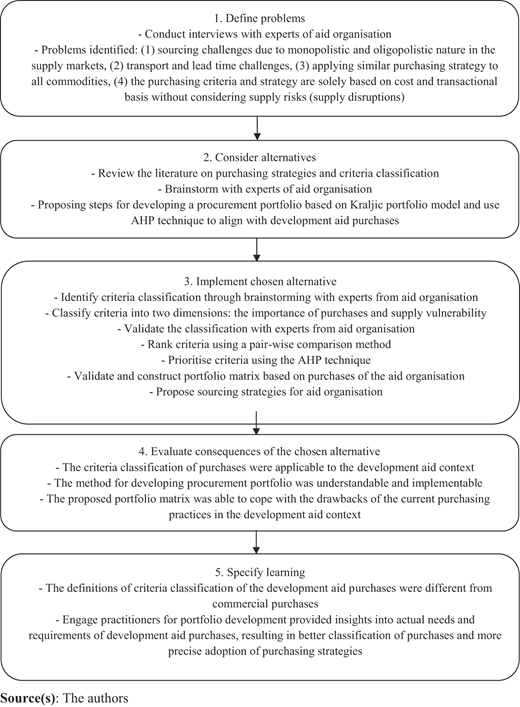
It was observed that the aid organisation did not have a comprehensive view on their purchased commodities, which impeded their supply performance. The traditional classification of the purchases, based on an activity-based costing (ABC) model that only considered the consumption values (or purchasing volumes), has been the common model used. Purchases have been segregated into three main groups according to overall spending or amount of purchases, and few purchasing strategies focusing on cost minimisation such as hard and soft negotiation strategies have been devised.
To a certain extent, the ABC analysis could manage and classify the purchases. However, the focus of classification was only from the perspective of financial performance for the organisation. Even though cost reduction could be achieved through negotiations with suppliers, it has not been practical when applying one strategy for all types of commodities. Furthermore, there are still high risks of supply disruptions as the perspective of supply vulnerability has not been taken into account.
Once the problems were identified, the research team explored for purchasing models in the literature and proposed them to the aid organisation. Brainstorming with the experts was undertaken to discuss how applicable the existing purchasing models were. One of the critical feedbacks received from the experts was that these purchasing models were not applicable in the development aid context.
In the original Kraljic portfolio model that has been designed for commercial purchases, commodities are analysed and classified according to dimensions that allow firms to achieve competitive advantages. Those dimensions consider the impact of commodity on profitability and business growth of the firm, value-added product as well as the complexity of supply market that influences the sourcing challenges. Since the purchases of the development aid programme serve different purposes and objectives from the original Kraljic portfolio model, it was then imperative to consider and develop a dedicated procurement portfolio with a set of criteria classification that were directly derived from the development aid context.
In the third step, the development of procurement portfolio model for the development aid programme was carried out. Adopting precise strategies and policies is based on the classification of purchased commodities in the portfolio model. Constructing appropriate classification relies heavily on defined factors (i.e. dimensions in the portfolio model) and their descriptors (i.e. criteria) (Ferreira et al., 2014; Padhi et al., 2012). One of the criticisms in developing a portfolio model is the difficulty of selecting appropriate dimensions that can fully reflect the organisation's goal (Nellore and Soderquist, 2000). To ensure that the dimensions and criteria classification are appropriately constructed, experts of the aid agency have extensively been engaged. An initial set of criteria classification was proposed by the research team. These initial criteria were translated from the goals of the development aid purchase and the problems that the aid organisation encountered. Eventually, the in-house experts played an essential role in validation of all criteria.
In the original Kraljic portfolio model, the 2 × 2 classification approach has been designed for commercial purposes. Therefore, purchased commodities and their respective suppliers are analysed and classified according to dimensions (or factors) that allow firms to achieve competitive advantages. This meant that commercial firms seek to minimise the sourcing challenge and ensure continuous availability of materials supplied so that firms can expect the least disruption in their operations. This refers to “the complexity of the supply market” dimension. On the other hand, firms also seek to achieve best purchase value from suppliers as this can directly impact firm profitability. This refers to the dimension of “the importance of purchase” (which mainly considers the profit impact).
Since the development aid organisation is a not-for-profit organisation, considering the influence of purchased commodities on the firm's profit impact is not appropriate. The first alteration of the Kraljic portfolio model was to redefine “the importance of purchasing” dimension. The authors proposed four criteria, which measured the degree of criticality of the purchased commodities in the development aid context.
Suppliers in development aid context are also operating in other markets. The resulting risks and vulnerabilities associated with purchases in the development aid context correspond to those proposed by the Kraljic portfolio model. In this paper, we elaborated on the risks and vulnerabilities associated in “the complexity of the supply market” dimension in such a way that they reflect not only sourcing challenges but supply disruption as well. This is the next alteration in the portfolio model to raise awareness on supply disruption which may take place because of risks and vulnerabilities associated with the purchases.
The last alteration in the model is related to the focused purchasing strategy. The Kraljic portfolio model usually recommends firms to use their purchasing power over the suppliers. If not possible, the Kraljic portfolio model suggests different strategies (e.g. diversification of sources) for firm to gain or leverage such power. In this research, the focused purchasing strategies are more to develop supply base strategies for aid organisation to mitigate supply disruptions risks.
A pair-wise comparison method was used to rank the criteria (Ferreira et al., 2014). The criterial prioritisation was concluded using the AHP technique. The numerical scales for pair-wise comparison and for the AHP are presented in Appendix 1. After achieving the ranked criteria, commodities were evaluated and scored against the ranked criteria. With defined dimensions of the “Importance of Purchasing” on Y-axis and “the “Supply Vulnerability,” on X-axis, commodities were positioned in one of the four quadrants of the matrix: strategic, leverage, non-critical and bottleneck profiles. Finally, the strategic sourcing strategies and purchasing focuses were devised based on the classification of purchased commodities in the portfolio matrix.
In the fourth step, evaluations of all findings were undertaken in terms of (1) the experts' perceptions on the criteria for the development aid context, (2) their perceptions of the potential use of the method and (3) their feedbacks on the proposed portfolio matrix and strategies. In the last step, lessons-learned were specified.
4. Findings
4.1 Proposed criteria
The first dimension of the portfolio model is the strategic importance of purchase. The definition of this dimension refers to the influence of the purchased commodities on the overall performances of the aid organisation in its development aid programmes, e.g. finance, effectiveness, responsiveness and reliability. Table 1 summarises the criteria associated with this dimension.
Selected criteria of strategic importance for purchase dimension
| Criteria | Description |
|---|---|
| A1: Impact on effectiveness | Influence of commodity on the aid organisation's effectiveness and programme milestone achievement |
| A2: Percentage of acquisition costs against total annual expenditure | Influence of commodity on the aid organisation spent and financial performance |
| A3: Variety of usage of commodity | Influence of commodity on the standardisation of purchase, which indirectly influences the financial performance and responsiveness |
| A4: Growth in consumption | Influence of the commodity on reliability to meet aid organisation's expectation when there is a growth in consumption |
Source(s): The authors
The first criteria considered the impact on effectiveness, similar to a criteria used in an alike project-driven industry, i.e. “the importance of the product in the project sequence” (Ferreira et al., 2014). As the development aid programmes are grant-based projects (e.g. the construction projects for houses, schools and community building), meeting the project milestones is a key performance achievement. An absence or insufficiency of relevant commodities may cause project delay or project disruption, directly affecting the organisation's effectiveness and donor relation, which may cause a decline in aid funding.
Despite being a not-for-profit organisation, the impact on financial performance was also an important criterion to the aid organisation (Haavisto and Kovács, 2014). Furthermore, donors have become more cost-conscious and may pull out the funds if the spending is not cost-efficient. Commodities with high annual acquisition costs are potentially the targets for cost saving through economies-of-scale purchases and bargaining power.
The variety of commodity usage was deemed important to the aid organisation (Lamenza et al., 2019) as more than 50% of the projects required similar commodities. This criteria also influences the organisation's financial performance. The standardisation of commodities was needed to further minimise operating costs, e.g. through purchasing leverage and reduction of overhead expenses. The standardisation of purchases can also enhance the agility and responsiveness of aid programmes.
Similar to commercial purchases (Kraljic, 1983), an increase in consumption of any commodity was defined critical to the aid organisation. It was found that the rise of natural and man-made failures (e.g. drought, famine and violence) scaled up the demands of the development aid programmes; meanwhile, the aid organisation had to ensure reliability of supply to meet the demand while utilising internal resources.
Table 2 summarises the supply risk criteria, which fall under three broad attributes. These risks may result not only in sourcing challenges but also in supply disruptions. Market risk was observed to be important to the development aid context, similar to emergency relief context (Lamenza et al., 2019). Some types of market such as monopoly and oligopoly could result in high supply dependency. Only a single or few suppliers were then observed in the market and were capable of providing the commodities. There were also barriers to new market entries in the monopoly and oligopoly conditions. The limited number of suppliers in the market implied the limited availability of commodities. Existing suppliers enjoyed better negotiating positions against the aid organisation, which added difficulty to the process of acquiring the commodities. In case of unexpected events taking place, there might be a severe impact of demand volatility. The few suppliers might also be disrupted, causing the reduction of their capacities. Few buyers with strong relationships with suppliers might have to accept premium prices for purchasing very limited amount of commodities. This creates high risk in supply disruptions to the buyer's organisation.
Supply vulnerability dimension criteria
| Criteria | Sub-criteria | Description |
|---|---|---|
| B1 Market risk |
|
|
| B2 Commodity risk |
|
|
| B3 Logistics risk |
|
|
Source(s): The authors
Next, some commodities required by the aid organisation were unique, for example, minerals and agricultural seeds, custom brokerage services and computers, which caused sourcing challenges to the aid organisation. In contrast, commodities with less complex and unique characteristics could be substituted with other competing commodities and lower the sourcing burdens. High possibility of substitution to the commodity increases the flexibility and agility of the development aid programme when there is supply disruption related to the concerned commodity.
Risks of lead time and other logistics complexity were the last attribute (Lamenza et al., 2019). The purchased commodities were mainly imported from overseas either directly or through local suppliers. Lack of proper logistics infrastructure, lack of skilled logistics personnel, long-distance transportation, limited number of vehicles, locations prone to disaster and locations not conveniently accessible are obstacles to the shipments of commodities resulting in variability of lead-time and logistics cost. Logistics infrastructure and transport capability in the country are insufficient, whereas the aid dependent locations were prone to disaster and often inaccessible.
4.2 Prioritisation of the proposed criteria
Table 3 summarises the weighted criteria of strategic importance to the purchase and supply vulnerability dimensions. As expected, the criteria of impact on effectiveness have the highest weight. The aid organisation defined effectiveness performance as the most important indicator of the success of its development aid programmes. The second and third highest weighted criteria are the percentage of acquisition costs against total annual expenditure and the variety of usage of commodity. These corresponded to increasing internal awareness of the impact of financial performance in the aid organisation as funding for development aid programmes had recently declined. Similar to others in the not-for-profit sector, more than half of the operational budgets are observed to be disbursed from procurement (Falasca and Zobel, 2011; Moshtari et al., 2021). The least weighted criterion is the growth in consumption criterion. This may be because only slight growth in consumption was expected by the aid organisation.
Weighted criteria of strategic importance to purchase and supply vulnerability dimensions
| Dimension | Criterion | Weight (%) | |
|---|---|---|---|
| Strategic importance of purchase dimension (consistency ratio = 0.04) | A1 | Impact on effectiveness | 45 |
| A2 | Percentage of acquisition costs against total annual expenditure | 34 | |
| A3 | Variety of usage of commodity | 15 | |
| A4 | Growth in consumption | 6 | |
| Supply vulnerability dimensions (consistency ratio = 0.03) | B1 | Market risk | 47 |
| B2 | Logistics risk | 40 | |
| B3 | Commodity risk | 13 | |
Source(s): The authors
In Table 3, it is observed that market risk criterion has the highest weight on the supply vulnerability dimension. This is in line with the most challenging problem in the sourcing process within the LDC amidst the ongoing pandemic, which is the issue of searching and discovering qualified sources of supply who are not only capable of ensuring the quality of deliveries but also comply with non-tolerant policies such as legal labour and transparency. Another recently highlighted issue is the execution of international and local shipments of commodities against travel and movement restriction. This brings logistics risk to the second-highest criterion. The least weighted criterion is commodity risk, as most existing commodities in the aid organisation had less complex characteristics and could be substituted.
4.3 A portfolio model and sourcing strategies
The aid organisation has purchased many goods and services due to the variety of its development aid programmes over the country. The strategic goals of the aid organisation are to enhance the quality of life of vulnerable communities in different pillars. The focused development programmes include ones that cope with malnutrition issues (e.g. food security programme, crop yield improvement, and clean water and sanitation system) and ones that improve the quality of education. It is important to note that majority of commodities purchased in the past have been imported from neighbouring countries. Table 4 shows a set of commodities and their percentage spending. These selected commodities are examples of the portfolio model developed for the aid organisation. Results of the AHP with regards to the selected commodities are presented in Appendix 2.
Selected commodities and their percentage spending
| Commodity | Type | Percentage of acquisition costs (%) |
|---|---|---|
| Construction materials | Item | 38 |
| Agriculture seeds | Item | 22 |
| School kits | Item | 11 |
| Custom broker services | Service | 8 |
| Fleet cards and fuels | Item | 7 |
| Hotels, accommodations, training venues | Service | 5 |
| Catering services | Service | 4 |
| Computers and IT equipment | Item | 2 |
| Ground transport services | Service | 2 |
| Office supplies and stationeries | Item | 1 |
Source(s): The authors
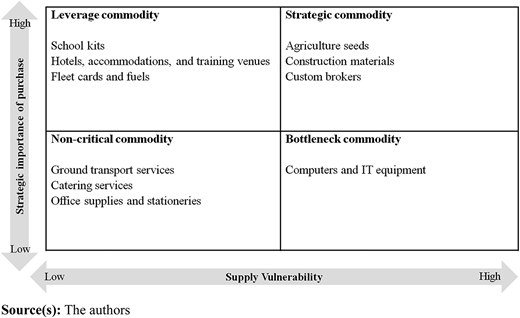
Figure 3 depicts the procurement portfolio model. According to the model, sourcing and purchasing strategies for the aid organisation were derived, as stated in Table 5. Non-critical commodities include ground transport services, catering services, office supplies and stationeries. These commodities were of low impacts to the programmes and aid organisational performances as well as were low on the supply burdens and vulnerabilities. Proposed strategies mostly involve cost reductions.
Strategies according to model's quadrants
| Commodity | Proposed strategies |
|---|---|
| Non- critical |
|
| Leverage |
|
| Strategic |
|
| Bottleneck |
|
Source(s): The authors
Leverage commodities, including school kits, hotels, accommodations, and training venues, fleet cards and fuels, were of high impacts to the aid organisation, but the associated sourcing complexities and supply vulnerabilities were low. Similar to the non-critical commodities, the aid organisation can avoid high resource allocation, but should leverage its buying power.
The strategic commodities include agriculture seeds, custom brokerage services and construction materials. These commodities impact the aid organisation and had high possibilities for supply disruption, which would deteriorate the aid organisational performances. It was, thus, advised to develop long-term relationships with such suppliers.
The bottleneck commodities, including computers and IT equipment, were those with low impacts to the aid organisation but being to acquire them was considerably challenging and vulnerable. Advised strategies are, for example, securing supplies through safety stock and searching for alternative suppliers.
4.4 Evaluating the proposed portfolio model and strategies
The aid organisation's experts agreed that the identified criteria classification of the purchases were applicable to their development aid programmes, which not only recommend ways to optimise their relationships with suppliers but also mitigate the risks of supply disruptions. The organisation's current practise focused on cost and transactional-basis, whereas the identified criteria have expanded their views on the purchased commodities with regards to supply risks and vulnerabilities.
The experts also agreed that the method for developing purchasing portfolio was understandable and implementable. The aid organisation has been aware of the original Kraljic portfolio model, but the challenges of applying and implementing the model in the development aid context have impeded the benefits gained from the model. Our step-by-step method provided a clear view of the portfolio implementation to local staff.
Lastly, it was found that the proposed portfolio model was able to cope with the drawbacks of the current purchasing practises in the development aid context. Although the experts agreed on its usefulness, the proposed portfolio and strategies had not been implemented because the aid organisation needed to consult with its regional office. This is not a surprise and often seen in commercial supply chains, where any proposed sourcing strategy must be aligned with the top-management-level strategies or top-down model (Carr and Smeltzer, 1997).
5. Discussions
5.1 Lessons-learned
In the lessons-learned from this action research, it was observed that a particular set of criteria was more appropriate for development aid context. The original Kraljic portfolio model is designed for commercial purchase and aims to increase the firm's competitive advantages. Thus, the dimensions consider profitability and business growth in terms of value-added and the complexity of supply market (Kraljic, 1983). Constructing appropriate classification relies heavily on the dimensions in the portfolio model and their criteria (Ferreira et al., 2014; Padhi et al., 2012). Since the purchases of the development aid programme serve different purposes, adaptations were required. A key difficulty is the selection of appropriate dimensions that can fully reflect the organisation's goal (Nellore and Soderquist, 2000). To ensure that the dimensions and criteria classification were appropriately constructed, experts of the aid agency had extensively been engaged from the beginning. Engaging practitioners for portfolio development provided insights into actual need and requirements of development aid purchases. As a result, we could obtain a better classification of purchases and more precise adoption of purchasing strategies that were suitable for the studied context.
5.2 A proposed roadmap for developing resilience in humanitarian supply chains
A proposed roadmap for developing the resilience in humanitarian supply chains is presented in Figure 4. Based on Christopher and Peck's (2004) framework, the paper proposes that the first step to build resilience in humanitarian supply chains is to understand its supply chain. This can be done by identifying actors and understanding risks and vulnerabilities as well as problems that the supply chain is encountering. The second step is to develop supply base strategy, which can be done by analysing and deriving supply sourcing strategies. The third step is to (re)design the aid supply chain. These three steps are the foundation for building resilience in the humanitarian supply chains.
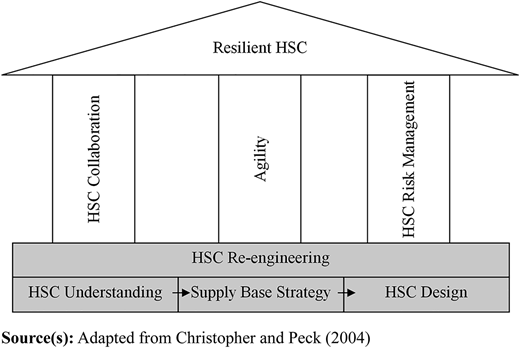
The action research presented in this paper provided the steps on how to understand potential supply risks and how to develop supply base strategies, from the perspective of a procurement portfolio. The first step is “defining problems of the aid organisation”. Practitioners need to be involved at the beginning and in all steps. The output of the method is sourcing and purchasing strategies that guide practitioners on several aspects: what the relationship between the aid organisation and suppliers should be (i.e. long-term or short-term), whether local or global sources are appropriate, how many suppliers the agency should have for certain commodity (i.e. multiple sourcing or single source) and what procurement models should be developed (i.e. bidding or buying with premium prices).
It needs to be noted that the Kraljic portfolio model does not focus on an integration of suppliers and inter-organisational relationships into the analysis (Wagner and Johnson, 2004). The Kraljic portfolio model allows practitioners to understand “its own supply weakness and treat it with a comprehensive strategy to manage supply” (Kraljic, 1983). In the commercial supply chain literature, it is acknowledged that firms should understand their own supply chains and core competency before integrating their systems to upstream and downstream activities through relationship management and information integration (Childerhouse et al., 2011). The Kraljic portfolio model should be a tool for the aid organisation to understand its own supply risks and should be the critical required step before the aid organisation initiates its own supply chain integration. Supply base strategies and purchasing strategies, which are derived from a portfolio model, may be then used to manage purchased commodities and suppliers through supply chain design, supply relationship management and collaboration. Decisions undertaken must be synchronised between the aid organisation and its suppliers, as they are the key to enable a supply chain to respond quickly to disruptions (Banomyong, 2018). Once the aid organisation has understood its own supply side, it can move towards the downstream side of supply chain and further complete the foundation part of humanitarian supply chain (re)engineering.
6. Conclusions
This paper proposed a roadmap for building resilience in humanitarian supply chains. The proposed roadmap was developed based on theory proposed in commercial supply chains literature. The focus of the paper was on the first step of building resilience, i.e. humanitarian supply chain (re)engineering. Action research was employed to demonstrate how researchers can work with practitioners in understanding supply risks, developing sourcing and purchasing strategies through an altered procurement portfolio model. Furthermore, this paper also provided the unique context of development aid programme, which have been rarely studied in the humanitarian literature.
The contribution of this paper is in proposing a roadmap that can serve as a guideline for humanitarian researchers and practitioners who are interested in creating resilience in humanitarian supply chains. The second contribution is that the paper explored the context of development aid programme where the literature is limited. Through the portfolio model, a set of purchasing criteria for the context of development aid programme were identified. It was found that these criteria were not similar to the criteria classification of purchases suggested in purchasing models in other domains. Lastly, the paper provided methodological contribution by illustrating how researchers can use action research in the procurement and sourcing context.
It is hoped that this portfolio model should assist humanitarian organisations in the classification of purchase strategies to mitigate their supply disruptions. This paper is among the first to develop a portfolio model in this extended domain to provide a comprehensive view of the purchases and also guide aid organisations to strategise purchases that will alleviate supply disruptions and help increase the resilience of their supply chain functions. The next step for the aid organisation participating in this research project is to implement and observe the impact of the proposed strategies. The aid organisation can then further propose such model to regional and other country offices. It would be useful in the validation of this portfolio model to explore other similar cases in other countries. Since the development aid and emergency relief contexts share some commonalities, with a minor adjustment the proposed roadmap should also be able to build resilience in the emergency relief context.
This paper has limitations. The foundation of the proposed roadmap, i.e. humanitarian supply chain (re)engineering was partially validated by using the case of a development aid organisation. The role of suppliers and supplier relationship management need to be integrated to complete the proposed roadmap's foundation. To complete the foundation, it is also imperative to expand our focus on downstream stakeholders, e.g. beneficiaries.
Future research may propose an extended Kraljic portfolio model that incorporates a method that takes into account joint and synchronised decisions between suppliers and the aid organisations. Another issue may be to consider the dynamic relationship between the aid organisation and its suppliers. Supplier development may be of interest, as it involves synchronised decisions with regard supply base strategy. Future study may provide a guideline on how to develop such synchronised decisions.
A numerical scale for pair-wise comparison
| Scale | Definition |
|---|---|
| 1 | Giving a scale of 1 implies that both criteria are equally important and contributed to the objective |
| 3 | Giving a scale of 3 to criterion “X” over “Y” implies that criterion “X” is more moderately important and favoured than criterion “Y” |
| 5 | Giving a scale of 5 to criterion “X” over “Y” implies that criterion “X” is more strongly important than criterion “Y” |
Source(s): Adapted from Ferreira et al. (2014)
Evaluating commodities against criteria of the strategic importance of purchase dimension and the supply vulnerability dimension
| Commodity | Type | Percentage of acquisition costs (%) | Strategic importance of purchase dimension | Supply vulnerability dimension | |||||||
|---|---|---|---|---|---|---|---|---|---|---|---|
| A1 | A2 | A3 | A4 | Score | B1 | B2 | B3 | Score | |||
| Construction materials | Item | 38 | 1 | 1 | 0.5 | 1 | 0.93 | 0.5 | 0.5 | 1 | 0.57 |
| Agriculture seeds | Item | 22 | 1 | 1 | 0 | 1 | 0.85 | 1 | 1 | 0.5 | 0.94 |
| School kits | Item | 11 | 0.5 | 1 | 0.5 | 0.5 | 0.67 | 0.5 | 0 | 0.5 | 0.30 |
| Custom broker services | Service | 8 | 0.5 | 1 | 1 | 0.5 | 0.75 | 1 | 1 | 0 | 0.87 |
| Fleet cards and fuels | Item | 7 | 0.5 | 0.5 | 1 | 0.5 | 0.58 | 0.5 | 0 | 0 | 0.24 |
| Hotels, accommodations, training venues | Service | 5 | 0.5 | 0.5 | 1 | 1 | 0.61 | 0 | 0.5 | 0 | 0.20 |
| Catering services | Service | 4 | 0 | 0.5 | 1 | 0 | 0.32 | 0 | 0 | 0 | 0 |
| Computers and IT equipment | Item | 2 | 0.5 | 0 | 0.5 | 0 | 0.30 | 1 | 1 | 1 | 1 |
| Ground transport services | Service | 2 | 0.5 | 0 | 1 | 0.5 | 0.41 | 1 | 0 | 0 | 0.47 |
| Office supplies and stationeries | Item | 1 | 0 | 0 | 1 | 0 | 0.15 | 0 | 0 | 0.5 | 0.07 |
Note(s): In the strategic importance of purchase dimension, for all criteria except A2, the experts rated score as follows: (1) a score greater than 0.5 was given to the commodity with high correspondence to the criterion; (2) a score of 0.5 (or lower) was given to the commodity with low (or least) correspondence to the criterion. A2 criterion was evaluated using the activity-based costing analysis with ratio of 80% (high value), 15% (low value), and 5% (least value). In terms of the supply vulnerability dimension, a score greater than 0.5 was given to the commodity with high complexity and vulnerability of the supply market, a score of 0.5 (or lower) was given to the commodity with low (or least) complexity and vulnerability of the supply market
Source(s): The authors
The research conducted in this manuscript has been supported by HELP Logistics of the Kuehne Foundation.

