


– The purpose of this paper is to describe and analyze a successful training exercise in detail, through both a practical and a theoretical lens, in order to identify critical aspects of its success and enable others to build upon it; and to capture insights and lessons learned in a framework that will facilitate the design of future trainings for a variety of goals and audiences.
– The authors document and analyze the case study of a successful humanitarian logistics training exercise: the World Food Programme’s Logistics Response Team (WFP’s LRT) training. The LRT is described in detail in order to capture the extensive knowledge and experience that went into developing the full-scale, immersive exercise.
– The authors evaluate the LRT training through a theoretical lens, considering how it teaches the diverse set of skills required and identifying reasons for its success. The authors contrast the LRT with a light version developed for classroom use, and capture insights in a framework that highlights critical aspects of training design.
– The requirements and design aspects highlighted in the framework are very high level, but they focus attention on key aspects that should be considered. Future research should develop more targeted metrics for evaluating what people learn from training exercises. More generally, a systematic approach to capturing knowledge and codifying good practices should be developed.
– The detailed case study and framework provide a basis for the design and improvement of simulated emergency training exercises, which are common in the humanitarian practice community.
– The case study of WFP’s LRT training formally documents valuable knowledge and experience that went into its development. The humanitarian community can use the proposed framework to more systematically evaluate, improve, and extend training exercises.
1. Introduction
Training humanitarian logisticians for emergency response is both important and challenging. It is challenging because each emergency is different, and as a result, very few tasks are routine. Training must therefore teach adaptive thinking skills in addition to logistics concepts and processes. Moreover, logisticians must work within a chaotic environment under enormous pressure, so training must prepare logisticians to work effectively in a high-stress environment. In addition, emergency logistics requires coordination and management, so training must enable logisticians to assume roles as leaders and organizers.
One of the most widely used methods for training this diverse set of skills is the simulated emergency response exercise. Many humanitarian organizations utilize exercises ranging from full-scale immersive simulated emergency exercises to hour-long tabletop scenarios. While they have met with general success, there has been little systematic effort to evaluate and improve these trainings. Indeed, in many cases, a couple of key experts develop and execute these trainings, but their knowledge has not been captured and recorded for others to learn from. At the same time, there is a growing demand to provide exercise trainings to a wider audience. Because of the lack of systematic recording and evaluation of exercises, it is unclear how to extend the success of flagship trainings to different settings.
This paper examines a resource intense emergency response exercise, conducted 13 times over seven years, to explain its success and to develop insights for designing new trainings or extending current trainings to new settings. First, we present a case study of the World Food Programme’s Logistics Response Team (WFP’s LRT) training, a full-scale, immersive, week-long emergency response exercise. It is described in detail in order to capture the extensive knowledge and experience that went into its development, in hopes that others can build upon it in designing future trainings. Second, we evaluate the LRT training through a theoretical lens, with reference to theories of learning from simulations, to consider how it teaches the diverse set of skills required and shed light on the reasons for the training’s success. Finally, we reflect on the lessons learned through this process with the aim of facilitating efforts to design different kinds of trainings that can reach wider audiences. As an example, we contrast the LRT with a simplified version developed for classroom use. We capture the lessons learned in a framework that highlights critical aspects of the design of trainings and matches them to requirements. The framework is intended to enable practitioners to easily utilize the insights from this paper.
Thus, this paper has two related goals: first, to describe and analyze a successful training exercise in detail, through both a practical and a theoretical lens, in order to identify critical aspects of its success and enable others to build upon it; and second, to capture insights and lessons learned in a framework that will facilitate the design of future trainings for a variety of goals and audiences.
2. Background
This section describes previous experiences in using simulated exercises for emergency response and logistics training and considers approaches for analyzing, evaluating, and improving existing exercises and designing new ones.
2.1. Humanitarian logistics
Recently, humanitarian logistics has received attention in the literature, as researchers, and practitioners seek ways to improve logistics processes and service delivery. Logistics is a critical component of disaster response. Researchers have argued that many aspects of humanitarian logistics, including processes, decision making, and collaboration and coordination, could benefit from lessons learned in commercial logistics (Kovács and Spens, 2007). This growing body of literature has identified critical aspects of humanitarian supply chains that shape their capabilities and constraints (Kovács and Spens, 2007; Van Wassenhove, 2005). A series of models have been developed to improve various aspects of humanitarian logistics, including inventory management and pre-positioning (Beamon and Kotleba, 2006; Duran et al., 2011), facility location (Balcik and Beamon, 2008), transportation and last-mile delivery (de la Torre et al., 2012), and other issues (Caunhye et al., 2012). Literature has also focussed on process improvement, including information flow (Day et al., 2009) and performance measurement (Beamon and Balcik, 2008). This body of literature provides insights that could be extremely useful to humanitarian logisticians in practice, yet the insights must be distilled and provided to practitioners in a manner that allows them to easily incorporate them into their jobs. One of the key ways to do this is through various types of training.
Training is important not only for disseminating new insights but also for developing the logistics skills of both new and experienced practitioners. There is a strong need for training, education, and other professionalization efforts in humanitarian logistics (Bolsche et al., 2013; Fritz, 2007). About a quarter of logisticians in one survey reported that they did not have access to training required to perform their jobs (Van Wassenhove and Allen, 2012). In response to this need, a variety of training programs have been developed, of various types ranging from online learning programs (WFP, 2014) to certification programs (HL Certification Program, 2014) and degree programs (University of Lugano, 2014; Bolsche et al., 2013). One key training method, particularly well suited for humanitarian logistics, is training through simulated exercises. The sections below explain why this is an important method for both emergency response and logistics training, respectively, and highlight some of the key skills that can be learned.
2.2. Emergency response training through simulation exercises
Emergency response training is difficult because each emergency is different, and as a result, very few tasks are routine. While logistics problems are common to most disasters, the specific supply chain configuration depends on the state of needs, infrastructure, and existing capacity in a given emergency. Logistics professionals require training beyond the concepts of logistics management (such as those described above). They must also learn skills that enable them to design new solutions in each emergency, and they must be trained in management and teamwork skills as well (Chaikin, 2003).
In emergency response, simulated response exercises are a common and essential training method because of the non-routine nature of emergencies. Emergency response training must impart skills with enough depth that they can be adapted to new scenarios and unexpected events. This “adaptive expertise,” in contrast to routine expertise, is an essential goal in training for changing tasks (Smith et al., 1997). Adaptive expertise is enhanced through training in active environments that resemble on-the-job tasks, in which trainees must discover or induce the tasks they must address, and in which they make mistakes and explore multiple strategies (Ford and Schmidt, 2000). Experts often make decisions based on recognition of a situation as similar to one previously experienced (Klein, 1998), so training should provide such experience. In addition, emergency response trainees need to build skills in sensemaking, or understanding an evolving situation and acting on it effectively (Weick, 1988). Simulated emergency exercises and games are a useful training technique because they address these issues: they require participants to make sense of scenarios, enable them to explore various options, and provide experience with a variety of challenging situations.
Training through simulated emergencies and tabletop exercises is widespread, and a variety of such exercises exist. They range from short, low-fidelity decision situations (e.g. Crichton and Flin, 2001) to in-depth, realistic field exercises like the one described in this paper. Computer simulations may supplement or replace live exercises, or enable better visualization and evaluation of the exercise (Campbell et al., 2008; Kincaid et al., 2003).
2.3. Logistics training through simulation exercises
Simulations and exercises are also a heavily used training tool in logistics education. One classic example is the “beer game,” a tabletop exercise in which students take roles in a simple multi-echelon supply chain and through their actions demonstrate the difficulties associated with the bullwhip effect (Sterman, 1989). The game has been widely utilized for logistics education from bachelors through executive levels. A number of other operations management simulation games have also been developed, on topics such as production process management (Johnson and Drougas, 2002), lean manufacturing (Wan et al., 2008), and production planning (Pasin and Giroux, 2011) (see Pasin and Giroux, 2011; for a further review).
Simulations and games are powerful tools for learning operations management because they enable a variety of critical types of learning. As summarized by Pasin and Giroux (2011), they enable skill development in problem solving and decision making (Salas et al., 2009), help students to connect concepts to their application in the real world (Faria and Dickinson, 1994), show the systemic effects of various dynamics and decisions (Machuca, 2000), and force students to make sense of complexities rather than simply applying theories (Zantow et al., 2005). Empirical measurements show that simulations are more effective than traditional methods in teaching students to deal with complex problems that arise in operations management (Pasin and Giroux, 2011). Thus, the motivation for using simulations to teach logistics is not dissimilar to the motivation for using simulations to teach emergency management: both areas require not only learning new concepts but also developing skills in applying those concepts in complex, dynamic real-world situations.
2.4. Developing and improving simulation exercises for humanitarian logistics
Simulated emergencies and exercises are utilized by many emergency response organizations, including the WFP, UNICEF, the International Red Cross Movement, the US Government, and many other organizations worldwide. Some of these trainings focus specifically on logistics, such as the one described in this paper, while others include logistics as a component of the larger response.
Despite the prevalence of simulated emergency exercises, there is a limited set of tools for analyzing and improving existing exercises and designing new ones.
One approach to improving exercises is to evaluate those in current use and draw lessons for their improvement. While some setups enable detailed after-action review (e.g. Kincaid et al., 2003), they are often geared toward reviewing the performance of teams within the exercise scenario, rather than drawing broader lessons for the improvement of exercises in general. As an example, the US Government’s Homeland Security Exercise and Evaluation Program has an exercise review framework that evaluates participants’ performance on specific core capabilities, but it does not capture lessons learned from the design of the exercise itself. As a result, it provides feedback for improving teams but not for improving exercises.
A somewhat more sophisticated approach is to understand the types of learning that should occur in simulation exercises, and evaluate exercises to determine whether they facilitate the critical types of learning. As described in the previous sections, researchers have identified a number of critical types of skill development facilitated by exercises, including adaptive expertise, making sense of complex situations, and problem solving (Ford and Schmidt, 2000). First, it is necessary to identify the types of learning that are most important for humanitarian logistics professionals, and design trainings accordingly. Ford and Schmidt (2000) consolidate theories on the types of learning that best prepare emergency response professionals for their jobs, offering a starting point for this endeavor. This type of analysis has received only limited attention in the broader literature: (Kebritchi and Hirumi, 2008) survey the literature on educational video games and conclude that few researchers are examining how learning strategies are applied in game design and how effective they have been. Mayer et al. (2014) suggest a comprehensive methodology for evaluating serious games, responding to a gap in the literature on how aspects of games contribute to learning outcomes.
We can draw additional insights from this wider literature on designing serious games, in which several papers have advanced guidelines for the design of games that are intended not only to entertain but also to enable learning. Duke (1980) provides a paradigm for game design, in the form of a series of steps that focus on putting together the game components; these steps do not focus on adapting the game to learning goals. Harteveld et al. (2010) describes a game design philosophy as a starting point for developing a design theory for serious games, asserting that there is little guidance for such efforts. Thus, while there is a need for game design guidelines, there is not yet a clear theory to guide design, particularly one that focusses on meeting particular types of learning goals.
2.5. Research gap
In humanitarian logistics, simulation training exercises are widely utilized. Many of them are regarded as successful within the humanitarian community, and there is a desire to extend them to reach more people and places (Bolsche et al., 2013). However, there have been few systematic attempts to describe, analyze, improve, and extend these trainings. This paper draws insights from theories of learning from simulations (in particular, from Ford and Schmidt, 2000) to analyze a simulation exercise that was successfully repeated numerous times and draw lessons useful to the refinement and development of future trainings. This is a first step toward the development of more systematic means for developing simulation exercises for humanitarian logistics. In addition, the detailed analysis of this case contributes to a gap in the broader literature by identifying the ways in which key elements of a successful exercise design contributes to the achievement of important learning goals.
3. Case study: the logistics response team training
The Logistics Response Team training is a week-long simulated emergency response exercise. Its purpose is to train humanitarian logisticians from multiple humanitarian agencies to deploy with an inter-agency logistics team responding to future emergencies.
The training is conducted by the United Nations WFP for the Logistics Cluster. WFP is one of the largest humanitarian organizations, a recognized leader in logistics, and the designated lead agency for the inter-agency Logistics Cluster (WFP, 2010a). The Logistics Cluster provides coordination, information management, and logistics services, such as transportation and warehousing, as needed in major crises (Logistics Cluster, 2013). To do so, the Cluster hosts coordination meetings with representatives from other aid agencies working in an emergency; solicits and shares critical information via meetings, its web site, e-mail lists, and other means; and manages shared resources such as warehouses and truck and helicopter fleets.
The Logistics Response Team training prepares logisticians to deploy immediately after an emergency, to activate and manage the Logistics Cluster. The trainees (referred to as “participants”) typically work for a variety of aid organizations, and have at least five years of field experience in logistics or a related sector (the Cluster draws personnel from multiple organizations, though it is managed by WFP). The training is therefore a refresher in emergency response logistics as well as an introduction to the mission and methods of the Logistics Cluster.
The primary goals of the LRT training are: first, to provide training in the processes to follow and skills required in a logistics response team; second, to provide an experience of “what it’s like” to respond to an emergency (in part so participants can evaluate their own suitability for the environment); third, to build participants’ expertise in coordination across various organizations and in the Logistics Cluster’s mission specifically; fourth, to build up a roster of well-trained logisticians who are deployable with the Cluster; and fifth, to create an inter-agency community of logisticians who understand and value coordination, through the shared LRT training experience (WFP, 2010a). The latter goal is particularly important, because in future emergencies, most of the LRT participants will be deployed not with the Cluster but with their own organizations. In their individual roles, they will attend Cluster meetings and utilize Cluster resources; their knowledge of and value for coordination thus enables the Cluster’s mission in future emergencies.
Each LRT training includes two teams of approximately ten participants, and each team responds independently to the same emergency. Participants are all experienced logistics managers in humanitarian organizations. Approximately 15 facilitators play the roles of representatives of various other aid organizations responding to the same emergency, and four representatives of WFP manage and run the simulation infrastructure (described in detail below). The training has been conducted once or twice per year since 2007, with 13 trainings conducted to date. In total, almost 300 aid workers from about 45 different organizations have been trained. More than 130 senior logisticians and humanitarian professionals facilitated the trainings.
3.1. Scenario and participant experience
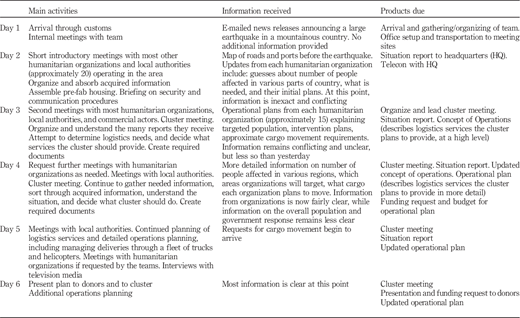
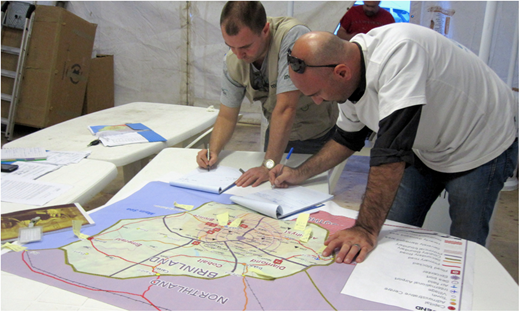
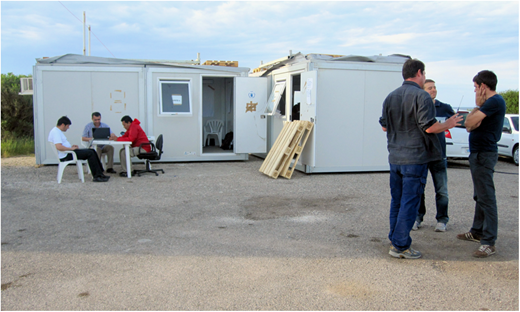
The LRT training is a week-long, 24-hour-a-day simulated emergency exercise. It closely replicates the conditions experienced by logistics response teams in real emergencies, including the stress, daily requirements, and working conditions. Plates 1 and 2, from past LRT trainings, provide a sense of the setup and working conditions (described in more detail below). Table I summarizes the key activities, information received, and products due over the course of the simulation. Details are provided in the following paragraphs.
Before their arrival, participants receive only e-mail news releases announcing that a large earthquake has hit a (fictional) developing country called “Brinland.” Their first two days are spent meeting with representatives of various aid organizations (played by facilitators), in which they begin to receive information about the crisis to which they must respond. For example, they learn how many people are affected, their approximate needs, the types of damage in each area, the available logistics resources and facilities, and the plans of other organizations. The information is generally incomplete and often conflicting, reflecting the usual reality of emergency response. Most of the information arrives through short meetings with facilitators playing the roles of various aid workers, or through e-mails in which they receive assessment reports or other documents from partner aid organizations. They receive information progressively and on a realistic schedule. For example, on the first day, participants learn very little (despite their many meetings) because their partner organizations have not gathered their own information nor decided how they plan to respond. On the second and third days, they begin receiving an avalanche of operational plans and situation reports from all these organizations. The information becomes more specific and less vague over time. The participants are responsible for sorting through this often-overwhelming set of documents to piece together the emerging picture of what is happening in the crisis. In total, they receive more than 170 documents (such as situation reports, maps, and operational plans), and many more e-mails.
In parallel with their information-gathering activities, they begin to develop the Cluster’s logistics strategy and manage daily operations. The daily rhythm and requirements mimic those of a real emergency. They must write a situation report or “sitrep” each day, hold teleconferences with headquarters, create key documents such as funding requests, and host Cluster meetings with their partner aid organizations. These meetings are a focal point of Cluster activities: through the nightly meetings, they share information with partner aid organizations and learn about others’ activities. Managing these meetings is one of the key skills taught through the LRT. The participants’ activities also evolve as the simulation proceeds, because they begin to develop and execute their logistics strategy. One important document they must produce, beginning on the second day and refined subsequently, is the logistics plan or “concept of operations” outlining how they will structure the logistics response. This “ConOps” outlines the main transportation corridors and hubs, the temporary warehousing and vehicles that must be brought into the country, and the services they plan to provide to the humanitarian community. On the fourth day, they begin to execute portions of this logistics plan, managing the use of a fleet of trucks and helicopters to deliver aid throughout the country. Finally, they present their plan and their accomplishments to both donors and the various humanitarian organizations to which they are providing service.
A key challenge throughout the exercise is that participants are forced to make decisions and write documents for which sufficient information is not available. For example, it is critical to know customs procedures in the first days of an emergency, but the Cluster cannot share that information when they have not received a clear set of procedures from the local authorities. The participants struggle constantly to respond to the demands of their partners and their headquarters when they do not know enough to do so knowledgeably.
Throughout the exercise, the teams experience realistic pressure to manage a chaotic and urgent situation, and as a result, are under a lot of stress. Each night, each team hosts a Cluster meeting, which requires them to share information and respond to the requests (often demands) of the representatives of all their partner organizations. The pressure is thus brought largely by the team of facilitators, who act their parts as busy (and sometimes unruly) logisticians who need useful and efficient service from the Cluster; often, they want information or services which are simply not available. Moreover, most facilitators are experienced logisticians who in reality work for the organizations they are playing. While there is no explicit evaluative component to the training, the participants’ performance in the exercise is clearly being witnessed by their peers and mentors, adding to the pressure they experience.
The participants have access to the same resources and operate under the same restrictions as in a real emergency. They live and work in the same housing and offices deployed by WFP to emergencies worldwide, and they must work with the same capabilities, including slow internet connections and limited computing and printing capabilities. Plentiful supplies of espresso, cigarettes, and pasta are available, but the food contains very little protein. Participants must drive their vehicles between their own offices and their meetings, and must receive clearance from security for any movement; they are chastised for violating driving, radio, and parking security guidelines. These restrictions and limitations add to the pressure and challenge of the training environment.
The LRT exercise is generally considered a realistic representation of the environment of an emergency response. The exercise is challenging in the same ways as a real emergency, due to the pressure of managing nightly Cluster meetings with demanding partners; the difficulty of assembling and interpreting sketchy and conflicting information; the requirement to make sensible logistics plans despite the lack of resources and information; and, not least, the total amount of work required in a short period of time, which results in very little sleep each night and a high level of stress.
This description of the exercise is relatively limited, because it would reduce the value of the training if participants could read this paper and learn about the specific emergency scenario to which they would be responding. However, we provide enough general details to enable readers to adapt the training concepts to their own emergency scenarios. A particularly challenging aspect of exercise design is setting the pacing of activities so that: information is provided in a realistic manner (including time of arrival and further clarification) and required products are challenging but not impossible to produce. The description provided herein should allow others to build on the successful pacing of this exercise.
3.2. Management, logistics, and facilitation
The management of the simulation is complex and requires the efforts of several organizers. A team of three to four organizers arrive on-site two days early, to execute two main tasks: preparing all the documents for the upcoming simulation (changing dates, names, and other details, and printing and organizing documents for all the facilitators and participants); and organizing the logistics of the simulation, including food deliveries, facilitator arrivals, meetings with local authorities, and other details. An additional team constructs the required office and living spaces and sets up internet connections and printers.
During the exercise, the participants live and work in temporary trailers; they have access to several laptop computers, a printer, standard stationary supplies, a landline phone, and a couple of cellular phones. They share an e-mail account. The facilitators live and work in similar conditions, spending most of their time in the “control room” when not otherwise employed. The participants’ and facilitators’ areas are separated and not visible to one another. Participants can phone and e-mail facilitators, as well as meet in person. The phones work as usual, but all e-mails are routed through a single e-mail address, then distributed to appropriate facilitators for response. At most times during the day, facilitators can observe participants by wearing a red ribbon to indicate they are invisible. This is somewhat disruptive to the participants at first, but they soon become so busy and so accustomed to the presence of observers that it has little effect on their work.
During the simulation, the experience of the training participants is controlled in various ways. One person is in charge of the entire scenario: he knows what is happening at all times, and ensures that the training proceeds appropriately. This person is informally referred to as the “maestro,” and we adopt the term here. The participants learn about the evolving scenario through e-mail, meetings with facilitators, and phone calls with facilitators. Regarding e-mails, one organizer is tasked full-time with sending e-mails to the participants. Many e-mails are scripted ahead of time, and updated as needed during the simulation. Other e-mails are new, and result from questions asked by the participants or clarifications required as the scenario proceeds; these are written by an appropriate facilitator. All non-scripted e-mails are checked by the maestro before being sent out. Regarding meetings with facilitators, each facilitator is provided with a folder containing instructions for each of her meetings, including what information should be given, any documents to be passed to the teams, and the general attitude that should be conveyed. Facilitators are also given group briefings before the large Cluster meetings, and are often debriefed by the maestro after important meetings with the teams. Regarding phone calls, the phones are answered in the main control room, so facilitators can be given instructions by the maestro in real time if necessary. As a result of these measures, all interactions with participants are governed by the pre-scripted scenario, and adapted by the facilitators in cooperation with the maestro as the scenario evolves. Each team’s experience is shaped by their own decisions and actions, but generally follows the outline of the scenario.
The materials for this in-depth scenario took a long time to build and refine. There are more than 200 “injections,” or e-mails and documents provided to the participants. These include injections from more than a dozen different aid organizations, each of which sends multiple e-mails and documents, including press releases, situation reports, load plans detailing incoming cargo, e-mails asking for specific information or notifying them about individual shipments, and operations plans describing their organization’s planned response to the emergency (none of which are in a common format). Each facilitator also receives documents describing his or her “role play”: the various meetings to hold with participants, what should be told and provided to them, and their general part in the response and in the training. At the first LRT, few of these documents were written, and the group of (very experienced) facilitators created them on-the-fly based on their own organizations’ ways of working. Over the years, the materials have been refined by succeeding facilitators. The mechanisms of injecting these documents also required consideration, including when and to whom to send injections and schedule meetings. Documents are provided on a realistic schedule, and the information becomes progressively more specific and useful, as mentioned earlier. Participants are able to schedule meetings with partners at certain times, but at other times they are “too busy” to meet with them or even to answer e-mails. All the injections are, by now, roughly pre-scheduled, but everything is adapted to the needs and decisions of each team in real time.
To ensure all facilitators are aware of the ongoing evolution of the scenario, the maestro conducts a meeting every morning to update and debrief everyone on past and upcoming events as well as the attitude and status of each team. Facilitators are also free to make suggestions and revise the scenario at any point in time; the maestro considers and approves or edits each such request.
3.3. Guiding participants and providing feedback
Feedback is provided to participants mainly through a nightly debrief. Each evening, the teams hold a Cluster meeting with most of the facilitators, and those not playing a role in the meeting attend as invisible observers. Following the evening meeting, the simulation is paused for a couple of hours. First, participants and facilitators eat dinner together, then a debriefing is conducted. The dinner hour is an important social outlet, and the debrief enables participants to reflect on the day’s activities and receive feedback and guidance from the facilitators. At all other times, participants and facilitators remain in character. Because most other interactions between participants and facilitators are stressful (pressure is constantly applied), this evening break is an important opportunity to remind participants that they are here to be trained and supported. A second feedback mechanism is a short debrief session after each hosted Cluster or donor meeting, lasting about 15 minutes. It is an opportunity to ask the teams, and later the facilitators, how they feel, what was good, and what they think should be improved.
One aspect of leadership that the LRT emphasizes is effective meeting management, and teaching this skill requires a particular type of feedback. During the short debrief following the nightly Logistics Cluster meeting, experienced facilitators reflect on the participants’ strategies for leading the meeting. Facilitators offer constructive feedback on strategies such as setting goals and priorities for the meeting, crafting the meeting agenda, communicating critical information, managing time, facilitating a single discussion with attendees who have a tendency for side conversations, encouraging information sharing from all attendees, and concluding the meeting with clear actions. The effectiveness of the Logistics Cluster in an actual emergency response is highly dependent on leaders from various organizations continuing to participate in the coordination meetings. People will continue to attend meetings that are effective in providing useful information and efficient in time commitment. Thus, refining this type of feedback is essential to the LRT’s success.
The delivery of the LRT requires precise planning and excellent organization. However, what is equally important is flexibility in reacting to the participants’ and teams’ individual experience with the exercise and guiding them appropriately. The maestro and several other experienced facilitators hold the main responsibility for “feeling out” the status of each team and adjusting the exercise appropriately. One of them visits the team at least once a day in their role within the simulation or as a red-ribboned observer. The maestro also debriefs facilitators after their own meetings to get their impressions of the teams, and asks individual participants for their thoughts outside the simulation. The maestro holds a specific session with each team the first night to discuss how they feel individually and how they are working as a team. They are warned that it is a difficult exercise, and they will succeed if the team is working together.
The dynamic of a team always varies in every training. The maestro must be able to identify when something is absolutely not working and action needs to be taken (this is rare), but at the same time, the teams must be left to figure out how to work together. It is critical to figure out when facilitators should be tough and push teams to work harder or better, and when to be supportive. If teams move at different speeds, the key is to evaluate whether the team is moving in the right direction. The most important thing is to look at the willingness of the people to deliver. If this spirit is there, facilitators can be less tough and more helpful to support their work. It is more important that they understand the importance of the documents they have to produce and the mechanism of getting there, rather than the quality of the documents. Most importantly, at the end of the week-long simulation, everyone should feel that they have succeeded in reaching their objectives, even under enormous pressure (in truth, everyone does indeed succeed, but they may not feel that way). An end-of-simulation celebratory barbeque reinforces the message that everyone has succeeded and, not least, allows everyone to blow off a little steam and enjoy each other’s company after a very stressful week.
The success of the LRT is built upon an enormously experienced maestro and set of facilitators, who orchestrate not only the evolving scenario but also the experiences of the facilitators and participants. They create realistic, stressful experiences, and ensure the teams are pushed just to their limits but not beyond, so that they come away with the experience of succeeding under stress. In future emergencies, that experience is critical in enabling them to do their job in a real crisis situation.
3.4. Participant and community feedback
Within the humanitarian logistics community, the LRT is viewed very positively. An evaluation of the overall Logistics Cluster noted that “training courses were widely appreciated for their high quality and inter-agency value” (WFP, 2012). Many participants continue to apply for the limited number of available spots in the training, and donors continue to fund it as an essential component of logistics capacity for emergency response.
Participants report that the LRT is an extremely valuable experience. Feedback is generally filled with comments such as, “I loved being here in spite of being deprived of comforts,” “best training experience I ever had,” and “Job well done! Very realistic scenario and situation.” Participants offer many suggestions for improvement as well, but the tone of the comments is overwhelmingly positive.
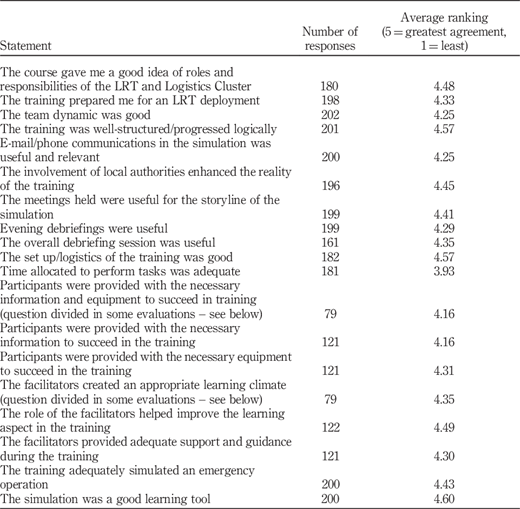
Quantitative feedback is available via evaluation survey data from 202 individuals collected immediately after ten of the exercises between 2007 and 2012. Participants were asked to respond to a series of statements about the exercise on a scale from 5 (indicating the greatest level of agreement) to 1 (the least agreement) and to provide an overall evaluation of the course from 5 (positive) to 1 (negative). The overall evaluation averaged 4.70, with over 70 percent ranking it as a 5 and only one individual ranking the exercise below 4. In addition, most participants agreed that the simulation was a good learning tool, with a score of 4.60. Thus, based on individual comments and on surveys, the LRT is very highly regarded by participants. Table II details the evaluation questions and average participant responses to each.
The surveys also give some insight into what is learned by participants in the LRT. The first two statements evaluate how well the exercise: teaches roles and responsibilities of the LRT and Logistics Cluster; and prepares them for an LRT deployment. For former objective, the ranking is higher at 4.48, with 96 percent answering 4 or 5; for the latter, 86 percent answered 4 or 5. Thus, participants largely indicated that the LRT was successful in one of its main goals: preparing participants for future deployment with the Cluster, and for working with the Cluster if deployed in other roles by their own organizations.
Beyond these two survey questions, the specific lessons learned by LRT participants have not been measured. However, we can speculate about further lessons learned based on: first, participants’ reporting in the survey that the training prepared them for an LRT deployment (which they now realize includes managing meetings, collating information, and setting operational plans); second, participants’ comments on free-form survey questions; and third, the authors’ extended experience with the training and their conversations with participants both immediately after the trainings and in succeeding years. Participants learn or practice several basic but important skills, including techniques for managing large meetings, and various skills in estimating needs, planning warehousing, and managing transportation fleets. They also learn broader lessons. One participant wrote, “The teams […] certainly came away with a greater understanding in respect of the needs of one another, our different agency expectations and how, with a little bit of teamwork, common sense, and a load of espresso, the seemingly impossible tasks are indeed possible” (WFP, 2010b). This participant’s comment points to two key lessons. First, participants learn about the needs and requirements of other aid organizations, and how to work together and coordinate around these needs. Second, participants learn the kinds of tasks they will need to accomplish, experience one way to accomplish them, and realize that it is possible to plan logistics even in the chaotic, pressurized, and limited-information environment of emergency response. This sense of accomplishment, even under significant stress, gives them confidence to manage the Logistics Cluster in future operations.
Recall the primary goals of the training laid out above. The survey mentioned above indicates that the LRT was successful in teaching skills required in a logistics response team, and preparing them for future deployment. It is more difficult to measure whether it taught coordination expertise and “what it’s like” to respond to an emergency, but participant comments certainly suggest that it did. The last goal, that of creating an inter-agency community who understand and value coordination, is extremely difficult to measure. The authors of this paper have worked with dozens of humanitarian logisticians from multiple agencies, and continually encounter people familiar with the LRT. Anecdotal evidence from many discussions on the topic suggests the LRT community is widespread and contributes to improved logistics response in emergencies worldwide. Perhaps the most important evaluation of the LRT training is whether the Logistics Cluster itself (which depends on the skills of its LRT-trained staff) has been successful. An overall evaluation of the Logistics Cluster found that Cluster “operations were relevant, effective, and provided value to participating organizations” (WFP, 2012).
4. Discussion: evaluating the learning outcomes of the LRT through a theoretical lens
While the LRT appears successful when evaluated in light of its effect on participants and its practice community, it has never been evaluated within a theoretical framework. Doing so would not only show whether the LRT has been successful against a different set of criteria, but more importantly, it could also shed light on why the LRT has been successful (or not). In this section, therefore, the LRT training is evaluated within an established theoretical framework. We later use this evaluation to prioritize efforts in designing lighter simulations that can reach larger audiences.
The main purpose of the LRT training is to enable logisticians to respond effectively to emergencies. Because emergencies are rare, urgent, and vary widely in character, training for them must be different than training for routine tasks. Ford and Schmidt (2000) synthesize the literature on strategies for emergency response training. Their synthesis provides a useful framework in which to evaluate the effectiveness of the LRT as training for emergency response.
Ford and Schmidt (2000) outline three key challenges that must be addressed. First, skills or expertise must be retained even though they are not utilized often. Second, learning must be generalizable in that skills can be adapted to unexpected scenarios. Third, responders require teamwork skills in addition to individual expertise. They next lay out training methods and strategies that address each of these three challenges. In the paragraphs below, we analyze whether and how the LRT incorporates each of these methods.
4.1. Retention
The first strategy supporting retention is training for mastery; in other words, emphasizing the goal of mastering of new skills rather than getting things right. A mastery orientation enables better learning strategies and results in more self-confidence and knowledge. In the LRT, participants’ performance is evaluated based on the documents they produce and the decisions they make, but the evaluation is conveyed in a constructive manner, emphasizing how to improve rather than whether it was right the first time. Documents and decisions, such as the Concept of Operations, are revisited so that participants can perceive the improvement as they master those skills. Thus, the LRT largely focusses on mastery rather than performance.
The second strategy is to enable learners to control their own learning, which can result in better retention, deeper understanding, and more personalized strategies. Control over learning generally means participants can select how and when they will be trained and what kind of feedback they will receive. In the LRT, participants have very little control over these factors. On the other hand, they have significant flexibility to choose which tasks each individual focusses on and how to tackle the tasks they perceive as necessary. The LRT enables control on some dimensions, while withholding control over others.
The third strategy is to include active learning, in which participants are trained on the job or through simulations of job-related situations. Active learning leads to feelings of accomplishment and to creative and innovative ideas. It rests on finding job situations that are challenging and, as a result, offer learning opportunities. Clearly, the LRT is designed around an active learning experience, in which the participants deal with an in-depth simulation of an extensive job-related situation. The survey result of 4.43 for the statement that “the training adequately simulated an emergency operation” indicates that participants experienced an effective active learning environment. Participants have reported significant feelings of accomplishment and confidence in new skills as a result of the training (WFP, 2010b).
4.2. Generalization
The first strategy supporting generalization is to enable learning through guided discovery. This strategy requires that tasks not be defined for participants, but that they figure out and define their own tasks. Guided discovery is beneficial because individuals are more motivated, use problem-solving strategies that require conscious attention, and enable experimentation among a range of possible strategies. The LRT is an exemplar of this learning technique. Participants must define most of their own tasks, to be corrected or guided by facilitators as they present their ongoing efforts during the course of the simulation. Early survey results indicate that facilitators created a good learning climate (4.35). Later surveys asked two questions about facilitators and show that they were slightly better at encouraging learning (4.49) than providing support and guidance (4.30). While still a strong outcome, future trainings could more strongly emphasize the guided discovery role with facilitators.
The second strategy is to enable error-based learning, in which participants are exposed not only to the correct way to do things but also to incorrect methods. By seeing errors, participants pay more attention, know what to avoid, and correct their own assumptions. The LRT, again, is an exemplar of error-based learning. Every team makes many errors, starts down many false paths, and has many discouraging experiences. Support and guidance from facilitators, and more importantly, the teams’ own ingenuity and persistence, enable them to overcome the errors. The practices of revisiting documents and decisions as well as breaking role for debriefing contribute to facilitator support and guidance.
The third strategy is to develop metacognitive skills, in which participants monitor and evaluate their own performance and learning. The LRT provides limited opportunities for metacognitive skill development. Through the nightly debriefs, participants are encouraged to reflect on what they have learned, but the emphasis is on better ways to complete the tasks. The post-training debrief emphasizes what participants have learned during the course of the training, but it is limited in time and scope.
4.3. Teamwork
The first strategy for enhancing teamwork is to build specific teamwork skills. While the LRT does not do so explicitly, the experience certainly provides opportunities to learn how to work together in a large and diverse team. When problems arise within teams, experienced facilitators often provide advice to individuals about how to overcome or manage the problems. However, there is no systematic teaching of or reflection on teamwork skills. Survey outcomes regarding teamwork were good (4.25 agreement with the statement: “The team dynamic was good”) but not as high as other aspects of the training. While all participants would probably claim they learned about teamwork, a more explicit focus on these skills may be beneficial.
The second strategy is to enable shared mental models, or common knowledge among team members that reflects understanding of the system with which they are working. The LRT appears to be exceptionally good at fostering this shared understanding among a very diverse community. Shared understanding may seem in short supply during the training, but each participant goes into the next emergency with a shared experience of the training scenario. In most major emergencies, many of the key logisticians are LRT graduates, and their shared experience in Brinland enables them to understand each others’ needs and work together more effectively.
The third strategy is to develop team leaders who play a role in enhancing team learning on the job. Two key strategies for doing so are pre-briefs and post-action reviews, conducted before and after an activity. The LRT does not teach specific team leadership skills, but they do address strategies in a very limited manner. The nightly debrief sessions take the form of post-action reviews, consolidating lessons learned through reflection on the day’s events. Participants are thus exposed to strategies, and probably perceive their usefulness, though they are not taught how and when to employ them.
4.4. Overall assessment
The LRT was designed by a small number of highly experienced emergency responders, based on their idea of what it takes to train logisticians and build expertise (which included very little exposure to theories of learning). As such, the training contains a remarkable number of proven strategies for effective training in emergency response, at least partially explaining its success. Participants are able to retain and generalize their knowledge for future emergencies because they learn it actively, through job-like situations, in which they are required to figure out their own tasks, make mistakes, improve their strategies, and reflect on their own successes and failures. They also pick up teamwork skills, and in particular take with them shared mental models of the emergency response system. On the other hand, analysis through Ford and Schmidt’s (2000) framework highlights potential areas for improvement. First, teamwork skills are essential but could be taught more explicitly by focussing on them in nightly debriefs. Second, leadership skills could be emphasized throughout the training. The remaining areas in which the LRT did not implement learning strategies completely, namely metacognitive skills and control over learning, would be much more difficult to incorporate into the training, and there are good reasons to avoid doing so. Enabling control over learning tasks would remove some of the pressure and chaos of the emergency environment, which is essential to effective training in this case. Metacognitive skills could be emphasized in the final debrief, but it would be disruptive to the simulated environment to further emphasize them during the training. Survey results provide some support for this, with the post-training briefing ranking slightly higher (4.35) than the evening briefings (4.29), which had 5.5 percent of participants ranking them below 3.
Evaluating the LRT from this theoretical lens has shed light on some of the reasons for the LRT’s success. In the next section, we use this knowledge to prioritize efforts in designing lighter simulations that can reach wider audiences, by retaining certain key elements that made the LRT successful. In particular, the above discussion highlights the importance of: first, requiring teamwork and developing shared mental models; second, requiring participants to explore problems, make mistakes, and define their own tasks; third, designing feedback to emphasize individual skill development; and fourth, building skills in adaptive thinking that enable knowledge transfer to new situations. In the following section, we integrate these four elements into a framework for evaluating and designing training exercises.
5. Capturing insights for training design
Given the success of the LRT’s training approach, there has been significant interest in making the training available to more people. However, the LRT is costly to execute, cannot be easily conducted in other locations, and is time-consuming for both participants and facilitators. Therefore, it cannot be rolled out on a much larger scale.
WFP and others would like to develop additional trainings based on their successful flagship programs (such as the LRT) that are less costly and more scalable. In this section, we describe an “ultralight” university classroom exercise developed by the authors, and discuss what students learned from it. We then capture the insights and lessons learned from the experiences of the LRT and this classroom version, along with the theories of learning discussed above, in a framework that enables us to consider extension to further settings.
5.1. Developing a classroom exercise: Mountainland
One challenge posed during the LRT was developed further into an active learning exercise for a graduate course at MIT on humanitarian logistics. The course focusses on adapting fundamental logistics concepts for application in distinct humanitarian contexts rather than on mastering logistics theory. It attracts graduate students from several schools across MIT and other universities such as Harvard and Tufts. The pedagogical approach leverages the students’ different disciplinary strengths (e.g. public health, nutrition, political science, urban planning, engineering, management) by having them work together in teams on exercises drawn from practical experiences. The same exercise has also been used in a professional master’s program for humanitarian logisticians; the experience suggests that this type of exercise would be effective in professional training programs.
The exercises follow an active learning approach in which students engage the material through tasks that require them to interact and reflect. The active learning exercise often poses a problem that the students must solve together, referencing readings from the syllabus. This is followed by a lecture to discuss the groups’ problem-solving approaches and contrast them with the theory and concepts from the reading material.
The active learning exercise drawn from the LRT focusses on transportation planning. The new scenario, located in the fictional country of Mountainland, simplifies a challenge from the Brinland context but retains important dimensions. The objective is to define an operational plan for five trucks and one helicopter to move 19 cargo loads from various organizations through a network of nine locations. The students are given a list of cargo movement requests, prioritization of commodity types, and details about vehicle costs, capacities and transit times (rounded off to half days to make calculations simpler). The authors adapted an Excel template that had been developed to support the LRT to facilitate the exercise. The template performs calculations of situational status and performance metrics based on their plan to date. Students are told to come up with a plan for the next four days.
Following a brief introduction, student teams are given approximately 60 minutes to produce a plan, with the remaining 15 minutes for plenary reflection. Teams never complete the plan in that time. They are often frustrated that they could not finish, and some teams finish the exercise outside of class even though it is not required. The authors were surprised that such a technical and complex exercise would be so compelling.
The exercise has been successful in developing intuition and skills in the following areas:
Forward planning: students quickly learn that they cannot move much cargo to its final destination without positioning the cargo and vehicles intelligently at earlier stages.
Assessing capacity and bottlenecks: certain asset types and locations in the network pose more challenges than others, and students learn that identifying and fully utilizing bottleneck locations/resources is critical in maximizing throughput.
Evaluating tradeoffs: beyond the fundamental challenges of moving as much cargo as possible, much of the team discussion focusses on which priorities to follow. They often identify the tradeoff that moving more cargo may come at the expense of some priority cargo.
Coordinating with various stakeholders: some groups consider the importance of moving cargo for each organization in order to provide equitable service. This is another tradeoff that they discuss in groups.
Decision-making approaches: students take different approaches to dividing and conquering the problem. They learn that different approaches or heuristics lead to different kinds of plans.
Decision support tools: many students reflect that they could not have been nearly as productive without the Excel tool to track their status and assess their performance.
In comparison to the LRT, the Mountainland exercise is very limited. Students spend only a couple of hours on it, and they are not under any particular stress nor required to define their own tasks amid a chaotic response. The lessons they learn are similarly limited but nevertheless valuable. The six elements discussed above constitute a small proportion of LRT lessons, emphasizing experience with difficult logistics tasks, but also touching on adaptive thinking skills. In the following section, we utilize the contrast between Mountainland and the LRT to illustrate a framework for designing various types of emergency training exercises on the wide spectrum from the “ultralight” Mountainland to the “heavyweight” LRT.
5.2. Lessons learned: framework and guidelines for designing emergency response simulation trainings
Designing and deploying simulation training can be labor and resource intense. One of the goals of this paper is to consider how successful trainings can be extended to new settings with fewer resources. To characterize these settings and the resulting exercises, we capture the lessons learned in this paper within a simple framework.
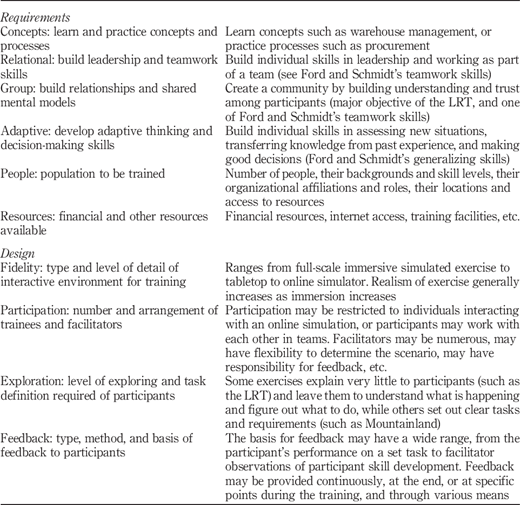
Our framework specifies the requirements of the training as a combination of the goals of the training and the constraints within which it must operate. It then describes various elements of the event design, in terms of four key dimensions that span many of the important aspects of the LRT and Mountainland exercises. The framework was developed to capture the lessons learned in this paper, including: the authors’ experience with the LRT simulated emergency exercise and the Mountainland classroom exercise, along with the theories of learning from response training exercises discussed earlier. Table III lays out the framework.
This framework enables us to map requirements to design elements, in order to determine appropriate designs for a given set of requirements. Based on the analysis in this paper, including experience with the LRT and Mountainland and the theories outlined in Ford and Schmidt (2000), we formulate the following guidelines for designs appropriate to each requirement:
Concepts can be learned and practiced in most types of training designs.
Relational skills require multiple participants interacting as a team. The fidelity should be realistic enough to create pressure and stress. Requiring teams to define their tasks will enable additional, valuable training in role definition. Training will be most effective if feedback is provided specifically on teamwork and leadership, which requires facilitators directly observing participants. Thus, training in relational skills requires a higher-fidelity simulation than concepts alone.
The objectives of the group goal can be met largely by creating shared experiences among a group of participants, which is much easier if multiple participants work as a team. The objective is further enhanced if there is some connection across multiple replications of a given training; for example, LRT participants often return as facilitators in later trainings. The level of exploration appears to be less critical, though the challenge of task definition might create stronger bonds. An immersive or otherwise intense experience (such as multi-day tabletop exercises with socializing in the evening) tends to create a stronger feeling of community; socializing or bonding under pressure may be essential to building trust.
Adaptive thinking skills are best learned when participants must explore the problem, define tasks, and make errors (see Ford and Schmidt, 2000). Therefore, the training should require significant exploration. Immersive environments are best, but tabletop or online exercises can require some amount of exploration if designed to do so. For example, in the Mountainland exercise, calculations in the Excel tool provide rapid feedback so that teams can more rapidly attempt and learn from various solution strategies. More opportunities for adaptive thinking are provided when there are multiple facilitators with some ability to reinvent the scenario as it unfolds. In training for adaptive thinking, opportunities for feedback are important. Success may not depend on the type of feedback actually provided to participants, but rather on creating a supportive environment for them to reflect.
Practical details of the training must revolve around the people to be trained, considering their background, skill sets, the nature and goals of their organization, their position or role in that organization, and their ability to travel or access the internet. Most importantly, the goals of the training should be designed to meet their needs.
The resources available will determine whether full-scale immersive exercises are feasible, whether participants can be brought together in person, or whether training must be conducted online. Resources may also include access to specialized training facilities, or online development capabilities. Full-scale immersive exercises (like the LRT) are typically very resource-intensive, requiring significant financial support, specialized training facilities, and a variety of personnel. Tabletop exercises require fewer resources and can therefore be conducted more frequently and in a variety of locations. Online simulations, especially if participation is individual, are very scalable and cost little each time they are executed, although they may be costly to develop.
All training designs should support retention of skills by incorporating job-related situations in the training and focussing on mastering new skills rather than performing well (Ford and Schmidt, 2000). This applies to any type of fidelity, participation, and level of exploration. The implications for feedback are important. Feedback should be provided not based on the result of executing a task but based on mastery of new skills. This may be particularly difficult in simulations without facilitators, such as individual online trainings, but it should be attempted nevertheless.
The framework and guidelines suggested here offer a path to define appropriate training exercises for various requirements. To further illustrate the proposed framework, we contrast the LRT and Mountainland exercises and consider future extensions.
The LRT goals are to teach logistics and Cluster concepts, create a cohesive group with shared understanding and trust, and enhance adaptive thinking skills, with the secondary goal of building relational skills. The resources are sufficient to bring the participants from their worldwide postings to a single training facility, to which WFP has access. The people to be trained have skilled backgrounds, so the training can push them to develop more complex skills. The design of the training is appropriate given the requirements. The fidelity is a full-scale immersive exercise, enabling skill development under realistic pressure and in a representative environment. Trainees participate in large teams, and an extensive set of facilitators has flexibility to adapt the scenario. The scenario both enables and requires significant exploration, enhancing the development of adaptive thinking skills along with group and relational capabilities. Finally, feedback is provided on a punctuated schedule, encouraging occasional reflection by the participants, and it focusses on skill development and teamwork rather than execution; moreover, it is provided to individuals based on careful observation by facilitators. Thus, the LRT is a high-fidelity training exercise designed to teach all the skills at the highest level; it is feasible because the constraints do not limit the design of the simulation.
In contrast, Mountainland is designed to teach people who are graduate students without extensive experience in humanitarian logistics. Very limited resources are available: students can access computers and the internet, can be co-located for a limited time based on the classroom period (typically 90-120 minutes), and no additional financial resources are available. The goals are mainly to teach logistics concepts and to develop adaptive decision-making skills. Although students work in teams, relational and group skills are a secondary consideration. The main reason for having students work in teams is to enable more rapid exploration and feedback in the limited time available. The design of the training is different from that of the LRT, in order to meet these requirements. The fidelity revolves around interaction with a computer-based decision support tool; this is sufficient for teaching concepts and decision-making skills, but does not contribute to development of leadership or trust-building. Participants enter with different types of skill sets and domain expertise, which enhances the variety of approaches in a small team. Only one facilitator is present, significantly reducing resource requirements. The exploration is relatively high given the short timeframe as students do make errors and try various strategies, enabling some adaptive skill development. Feedback is provided through calculations in the Excel tool, participants’ reflections on their own performance, limited guidance from the facilitator, and shared experiences in the plenary discussion. Thus, while the Mountainland exercise is less intense than the LRT, it still develops a limited set of key skills consistent with the requirements.
The Mountainland exercise is significantly less costly and more scalable than the LRT, but it develops a much smaller set of skills. Both teach logistics concepts and decision-making skills effectively, although with different levels of exploration and fidelity. For example, the adaptive thinking in Mountainland is limited to solution approaches in a static, well-defined context. The LRT develops deeper understanding of the logistics concepts, especially around fundamentals of the Logistics Cluster, and requires much broader adaptive thinking in a dynamic setting. The LRT also requires development of situational awareness and sensemaking skills in a high-fidelity setting, which are absent in the well-defined Mountainland exercise. Perhaps the biggest distinction is that the LRT requires participants to perform under realistic pressure and stress, interacting with multiple stakeholders over several days, which is very different from two hours with a small team of students in a classroom. Not only does this develop relationships and teamwork skills that are absent from the Mountainland exercise, but the LRT also requires participants to exercise their managerial and communication skills – within their team and with external parties – at a time when ideal approaches are difficult to apply given weariness and stress. This offers each individual a realistic assessment of how well they can apply their knowledge and skills when needed, and (for most) gives them the confidence to make tough decisions in similar environments in future emergencies. Mountainland teaches limited skills but does not provide the LRT’s depth of training and preparation for emergency response.
Mountainland and the LRT are examples of two extreme ends of the spectrum of emergency response training exercises, and there are many types of trainings that fall between them. The lessons captured in the framework and guidelines can be used to evaluate any of these trainings for the alignment between their requirements and their design. More importantly, the framework and guidelines support the design of new trainings that meet a given set of requirements. Clearly, the requirements and design elements highlighted in the framework are high level, but they focus attention on key aspects that should be considered. The framework and guidelines capture insights from this analysis of the LRT and Mountainland; further work could examine the generalizability of these lessons to other types of simulations and games.
6. Conclusions
This paper presents a case study of a successful humanitarian logistics simulation exercise and an experience in extending it to the classroom setting, in order to document valuable experiences and to outline a path for designing future training exercises. The case study of WFP’s LRT described some of the extensive knowledge and experience that went into its development. Analyzing this case study through a theoretical lens identified key elements that contributed to the LRT’s success. The lessons from this analysis were integrated into a framework for aligning training requirements with critical elements of training design. Using the framework to contrast the LRT and the Mountainland classroom exercise illustrated how it could be used to more systematically evaluate, improve, and develop humanitarian logistics simulation exercises.
The lessons learned in this analysis, captured in the suggested framework, are only a first step in improving exercise trainings. Future research should re-examine these lessons and this framework using other types of simulations and further develop them theoretically. In addition, researchers could develop more targeted metrics by which to judge what people learn from a training exercise, to facilitate targeted improvement. It would be useful to examine more closely some of the key aspects of this training, such as the impact of a stressful environment on learning. In addition, it is clear from the LRT case study that extensive knowledge is contained in the minds of the “maestros” who manage the trainings. There is no routine approach to documenting or sharing this knowledge, which may not be a sustainable approach in the long term. A more systematic approach to capturing knowledge and codifying good practices should be developed. Documenting and sharing experiences with specific trainings, as we have done in this paper, is a good first step toward developing a more systematic approach for improving emergency training throughout the humanitarian community.
References
About the authors
Dr Erica Gralla is an Assistant Professor in the Department of Engineering Management and Systems Engineering at the George Washington University. She completed her PhD Degree in the Engineering Systems Division at the Massachusetts Institute of Technology (MIT). Dr Gralla studies operations management in disaster response and other urgent, uncertain environments. Her research seeks to combine the strengths of human intuition and mathematical models to create better decision-making approaches. She has collaborated with the United Nations World Food Programme, Oxfam, International Rescue Committee, and other humanitarian organizations. Dr Erica Gralla is the corresponding author and can be contacted at: egralla@gwu.edu
Dr Jarrod Goentzel is the Research Director in the Center for Transportation and Logistics at the Massachusetts Institute of Technology and is a Founder of the MIT Humanitarian Response Lab, which addresses the practical challenges of meeting human needs in resource-constrained settings. His research focusses on supply chain management, information systems, and decision support technology; his teaching focusses on developing future leaders through active learning and simulation games. Dr Goentzel has worked with humanitarian organizations such as World Food Programme, UNICEF, Oxfam, International Rescue Committee, Partners in Health, and the International Federation of Red Cross and Red Crescent Societies. He received a PhD from the School of Industrial and Systems Engineering at the Georgia Institute of Technology.
Bernard Chomilier has directed humanitarian responses for most of the major crises around the world over the last 25 years as the Director for the Logistics Development Unit of the United Nations World Food Programme (WFP), Head of Logistics for the International Federation of Red Cross and Red Crescent Societies, and on the logistics team at the Medecins Sans Frontieres. In his role at the WFP, he was the “maestro” who organized and directed simulated emergency response trainings for the Logistics Cluster, WFP Logistics, UNICEF, and others.

