


The purpose of this paper is to develop a Humanitarian Purchasing Matrix to guide purchasing strategies for relief items in humanitarian operations.
The research synthesizes the structures of a Purchasing Portfolio Model and the characteristics of purchasing in humanitarian operations, validating them with academics and practitioners to develop a Humanitarian Purchasing Matrix. Then, based on the Analytic Hierarchy Process to classify the relief items in the matrix, an illustrative example is used as an empirical test for the proposed Humanitarian Purchasing Matrix.
The academic literature on purchasing in general and purchasing in humanitarian operations share some similarities in terms of “Importance of Purchasing” and “Complexity of Supply Market” dimensions. Moreover, the analysis of such criteria supports the definition of purchasing strategies for different relief items in humanitarian operations.
The Humanitarian Purchasing Matrix can be considered a tool/guide for professionals of humanitarian organizations in the adoption of purchasing strategies for the different relief items purchased for humanitarian operations.
Considering a scenario of a constant increase in the variety of relief items, the high purchasing volume and the pressure to more efficient relief operations, the research discusses the intersectionality of business purchasing models and the purchasing characteristics of humanitarian operations. Moreover, the research deliveries a tool/guide to the adoption of purchasing strategies that are composed of criteria observed in the literature and suggested by both humanitarian logistic academics and practitioners.
1. Introduction
Procurement is one of the most important activities in humanitarian operations, aiming to acquire relief items from suppliers to support the victims of disasters (Ertem and Buyurgan, 2013). It is estimated that 65 percent of relief operations costs are related to procurement, being the activity of humanitarian operations to which most monetary donations are applied (Schulz, 2009). In contrast, donors have become increasingly demanding of the efficient allocation of resources to ensure that their donations reach those in need (Aflaki and Pedraza-Martinez, 2016; Nunnenkamp and Ohler, 2012), thus reinforcing the importance of effective logistics practices, including procurement, to the survival of humanitarian organizations (Oloruntoba and Gray, 2009). Moreover, as humanitarian organizations have responded to a large variety of disasters, the portfolio of relief items purchased by them has become more diversified, ranging from simple items, such as food, to more complex items, such as debris-removing equipment (Taupiac, 2001).
Because donations are usually targeted toward the response stage, the procurement process in humanitarian operations tends to be reactive, focusing on the short term and being restricted to tactical and operational levels (Ertem and Buyurgan, 2013). Consequently, it results in problems such as the lack of supplies for immediate delivery, due to difficulty in forecasting demand and competition between humanitarian organizations, price increases with the sudden growth in demand and delays in deliveries because the entire process occurs after the disaster strikes (Wang et al., 2015). A trend that has been observed in this direction is the procurement of relief items in advance of disasters for pre-positioning or through long-term agreements with suppliers, thereby requiring humanitarian organizations to develop proactive procurement processes oriented toward the long term, i.e., on a strategic level (Duran et al., 2013). Fontainha et al. (2017) discussed the importance of such direct suppliers for disaster and humanitarian operations, indicating the need to integrate them with other stakeholders from public, private and people groups and that such integration of direct suppliers is observed essentially through procurement operations. In this sense, Fudalinski and Pawlak (2012) highlighted that the strategic procurement can offer two major advantages to humanitarian organizations: better capacity and efficiency in resource management, which are increasingly demanded by donors, and contributions to obtain competitive advantages by preparing unique possibilities of value for donors. Despite these changes, few studies have addressed the issue of defining purchasing strategies in humanitarian operations, with no specific models being observed in this field (Pazirandeh and Norrman, 2014).
While the Importance of Purchasing for relief items is recently acknowledged within humanitarian operations, purchasing strategies in business logistics have been recognized for their importance since the 1980s. They are well developed, with the Kraljic (1983) Purchasing Portfolio Model being the primary reference (Gelderman and Van Weele, 2005). The procurement portfolio models are systematics that enable the evaluation of the strategic importance of a purchase in many ways, as well as the difficulties in managing purchases. These portfolio models also enable managers to develop different strategies for each type of supplier market and each category of purchased item in order for the company to achieve gains in the supply management (Van Weele, 2002).
This bridge between managerial theories and the humanitarian context is also aligned with the perspective discussed by Behl and Dutta (2018) in a recent and extensive literature review regarding the Humanitarian Supply Chain Management (HSCM). The authors stressed that, despite the recent profusion of research in HSCM, there is a lack of research exploring the discussion of theories in the HSCM scope as well as the empirical testing of theories in the HSCM field. Thus, this paper aims to discuss the adaption of a methodology for the definition of purchasing strategies for relief items based on a Purchasing Portfolio Model, thus developing a strategic procurement process for humanitarian operations. To discuss the empirical test of the proposed methodology, an illustrative example was conducted based on São Paulo Civil Defense, Brazil (CEDEC-SP). CEDEC-SP is a governmental organization responsible for purchasing, storage and distribution of relief items to ensure the supply of relief items to the São Paulo population in case of disaster (Kawasaki, 2013). The relevance of CEDEC-SP is due to the high incidence of landslides and floods, which represents 88 percent of deaths and 59 percent of damage considering the disasters in the period between 2005 and 2013 in Brazil (Brito Junior et al., 2014; Roncancio and Nardocci, 2016).
Beyond the introduction, this paper is organized in five subsequent sections. Section 2 addresses topics relevant to procurement in general and in humanitarian operations. Section 3 presents the research methodology. Section 4 presents the proposed adaptation of a Purchasing Portfolio Model to a Humanitarian Purchasing Matrix. Section 5 presents the results obtained by the application of the Humanitarian Purchasing Matrix in the case of CEDEC-SP, and Section 6 presents the conclusions and suggestions for future research.
2. Theoretical background
Companies have received several benefits with strategic purchasing. Anderson and Katz (1998) pointed out that strategic purchasing is fundamental to increase the value added of the products and improvements in the financial result. According to the authors, leading companies in their markets exploit the opportunities offered by the strategic purchasing process, including the restructuring of the supplier base, due to the increasing importance that the purchasing area came to have in their performance. Moreover, the strategic purchasing process also provides beneficial results for the organizations, such as standardization of products and contracts; simplification in purchasing management; supplier relationship management, reduction of the supplier base, leverage in the volume of purchases allowing for scale gains in the negotiations; and costs and efforts of purchasing professionals (Ogden and Carter, 2008).
The research in strategic purchasing usually addresses Purchasing Portfolio Models, which emphasizes the definition of norm strategies to be applied to all sourcing categories in an organization (Hesping and Schiele, 2015). Using criteria such as volume purchased, percentage of the total purchase cost, availability and number of suppliers, the model proposed by Kraljic (1983) allows the decision maker to sort all the products purchased by the company according to its impact on profitability (Importance of Purchasing) and the supply risk (complexity of the supply market). Other approaches of procurement management models found in the literature (Hadeler and Evans, 1994; Olsen and Ellram, 1997; Bensaou, 1999) are still referenced on the Kraljic model to develop similar models, although there are more similarities than differences when compared to the original Kraljic matrix. There are several applications of the Kraljic model with changes, such as development of suppliers (Handfield et al., 2000), purchases on the internet of items for maintenance, repair, operations (Croom, 2000), process specification (Nellore and Soderquist, 2000), development of inter-organizational competence (Gelderman and Van Weele, 2002) and quantified approaches to locate the items in the Kraljic matrix (Montgomery et al., 2018).
2.1 Kraljic Purchasing Portfolio Model
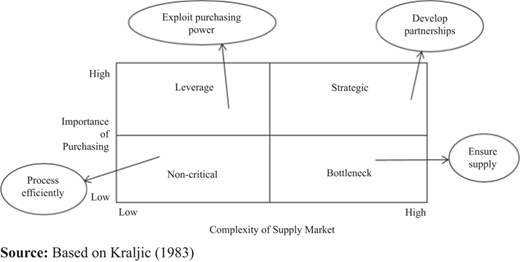
Kraljic (1983) proposed a model for the definition of purchasing strategies to minimize supply vulnerabilities and to maximize the company’s purchasing power. To this end, the company evaluates all of its products and services purchased in the past and likely to be purchased in the future, and it classifies them as high or low according to two dimensions:
the “Importance of Purchasing,” which can be defined according to the value added by the product line, the percentage of raw materials as a part of total costs and its impact on profitability; and
the “Complexity of the Supply Market,” which can be defined according to supply scarcity, the pace of technology and/or material substitution, entry barriers, logistics costs or complexity and monopoly or oligopoly conditions.
The result of this classification is the positioning of the purchased items in a matrix with four quadrants, as shown in Figure 1, in which each quadrant − identified as strategic, leverage, bottleneck and non-critical − represents a distinct category according to the results of the two dimensions, demanding specific purchasing strategies.
Kraljic Purchasing Portfolio Matrix
Kraljic Purchasing Portfolio Matrix
For leverage items, the strategy of which is to exploit the purchasing power, the goals consist of obtaining better short-term agreements and maximizing cost reductions. It is recommended that, to ensure that suppliers recognize a competitive scenario, similar items be grouped to obtain discounts in price, relatively short contracts (one to two years) be used, alternative suppliers and supplies be sought, value-added agreements be made and switching to the strategic quadrant be considered (Lysons and Farrington, 2006).
For strategic items, the strategy of which is to develop partnerships, the goals are to maximize cost savings, minimize risks and create competitive advantage and mutual commitments to long-term relationships. The main recommendations include accurate estimations of future needs, performance of risk analysis, the seeking of long-term (three to five years) relationships with suppliers incorporating agreements for continuous improvement and performance evaluations, consideration of joint ventures with suppliers for competitive advantage, the taking of prompt actions to correct performance failures and consideration of switching to the leverage quadrant, in cases of low trust (Lysons and Farrington, 2006).
For bottleneck items, the strategy of which is to ensure supply, the main goals are to reduce costs and to ensure short- and long-term contracts. It is recommend to estimate future needs accurately, consolidate purchases to ensure leverage, determine the company’s importance determined by suppliers, evaluate options for payroll or safety stocks, seek alternative suppliers and supplies and establish contracts to reduce risks (Lysons and Farrington, 2006).
For non-critical items, the strategy of which is to establish an efficient procurement process, the goals are to reduce managerial costs, eliminate complexity and improve operational efficiency. It is recommended that ordering, acquiring and paying be simplified and standardized when possible, that consolidating and purchasing be conducted through consortia, stimulating purchasing by the end-user and that switching to another quadrant be considered (Lysons and Farrington, 2006).
One of the criticisms on the model proposed by Kraljic is that by reducing the issues to two dimensions, the matrix representation does not capture relevant aspects of contemporary business transactions, such as business carried out through company networks (Dubois and Pedersen, 2002); the interdependence between products (Terpend et al., 2011); and the concept of competitive and sustainable advantage in inter-company relationships (Pagell and Wu, 2009). In addition, to classify purchases in the portfolio model, the company needs to assign weights to the criteria and factors based on the perception of managers and on the organization’s information (Olsen and Ellram, 1997; Gelderman and Van Weele, 2003). Nevertheless, Knight et al. (2014) and Montgomery et al. (2018) explained that the same research criticizing the Kraljic Purchasing Portfolio Matrix acknowledges that this tool is useful for describing and differentiating purchasing situations and developing appropriate sourcing strategies.
2.2 Procurement in humanitarian operations
According to Ertem et al. (2010), procurement is of fundamental importance in humanitarian relief operations because pre-positioned stocks and gifts-in-kind donations are typically not sufficient to meet all of the demand created by a disaster. To Ertem and Buyurgan (2013), procurement in humanitarian operations is extremely complex, with unique and distinct features of the logistics business, such as buyers, the procurement process, relief items purchased for preparedness and response to disasters, the sources of supplies and the procurement coordination mechanisms.
Buyers in humanitarian operations are international, national and non-governmental organizations (NGOs), United Nations (UN) agencies and, in some cases, by local governments (Balcik et al., 2010). According to Herlin and Pazirandeh (2012), there are two types of buyers in humanitarian operations: large buyers, such as international NGOs, UN agencies and governments of developed countries; and small buyers, such as local NGOs and governments of developing countries. Large buyers are characterized by high purchasing volume, operations in various disasters, global reputations, recognized brands and legitimacy, high purchasing power and developed relationships of interdependence with global suppliers. In contrast, small buyers usually address a limited number of suppliers in the local markets in which they operate, having strong dependence on these suppliers and, therefore, low purchasing power.
Ertem and Buyurgan (2013) stated that the procurement process in humanitarian operations could vary, depending on the occurrence of each disaster, the location of suppliers and the policies adopted by each organization. Therefore, there is not a unique procurement process in humanitarian operations described in the literature. Taupiac (2001) divided the procurement process in humanitarian operations into two categories: procurement for sudden-onset disasters, such as earthquakes and hurricanes; and procurement for slow onset disasters, such as famine and drought. In the case of sudden-onset disasters, the beginning of the process might occur in two ways: before or after the occurrence of a disaster, with the first occurring on the strategic level during the preparation stage and the second restricted to tactical and operational levels during the response phase (Ertem and Buyurgan, 2013; Whybark, 2007). When the process starts after a disaster, several problems arise for humanitarian organizations, such as the purchase of low-quality and high-cost items due to incomplete searches for suppliers and competition for similar items between organizations responding to the same disaster, the lack of supplies to meet demand, longer lead times and pressure for agility (Duran et al., 2013; Bagchi et al., 2011). Nevertheless, purchasing after a disaster is unavoidable in any relief operation, due to the difficulty of forecasting demand and the large volume of monetary donations received specifically for the response phase. This need might be minimized with the process being initiated in advance of disasters, which can occur through the pre-positioning of stock or long-term agreements with suppliers (Ertem and Buyurgan, 2013). Thus, when a disaster occurs, it only becomes necessary to transport the store items to the affected region or to send a purchase order to the supplier (Duran et al., 2013), thereby simplifying the process, ensuring availability, faster deliveries and lower costs for critical items (Balcik and Ak, 2014), and increasing the bargaining power, due to the higher volume of purchases involved (Duran et al., 2013). In the process for slow onset disasters, in contrast, there is no distinction between before and after the disaster because this threshold is not clearly defined. In these cases, because there is not pressure for agility in the process, relief items can be delivered following regular lead times, allowing for procedures for request proposals and supplier selection that resemble business logistics (Falasca and Zobel, 2011).
According to Duran et al. (2013), the management of relief items portfolios is a critical task because of the large quantities involved and their wide range, from first aid items to vehicles and construction equipment. Thus, the authors classified relief items into consumable, operational non-consumable and non-operational non-consumable items. Consumable relief items are those that satisfy the basic needs of the beneficiaries and therefore must be supplied continuously to the region affected by the disaster during the response phase, due to storage problems, high demand and the need for immediate consumption. Water, food, hygiene products, medicines, vaccines and sanitation kits are examples of consumable relief items. Non-consumable relief items are those that must be delivered to the regions affected only once, and these items can be divided into operational and non-operational items. Operational non-consumable items, such as radios, cell phones, computers, vehicles, building materials and logistics services, are used by the personnel involved in the response to the disaster to provide humanitarian aid. In contrast, non-operational non-consumable items, for example, tents, Mattresses and Blankets, are designated to beneficiaries so that, once they are received, they are used until the disaster response is over. Several humanitarian organizations regroup related relief items frequently used in responding to disasters into kits to facilitate their distribution, as in the case of medicines, hygiene products, products for families and products for food preparation. However, these kits might not be provided by a single supplier, thus requiring their assembly from items from multiple suppliers (Ertem and Buyurgan, 2013). Relief items involved in pre-positioning or long-term agreements with suppliers usually have standard specifications, providing lower costs, higher quality and faster deliveries, as well as facilitating coordination among humanitarian organizations (Muyser-Boucher, 2013). In addition, humanitarian organizations also standardize products purchased individually through electronic catalogs, for example, the International Federation of Red Cross and Red Crescent Societies have in its catalog more than 7,000 items (Gatignon et al., 2010).
The two main sources of supplies in humanitarian operations are gifts-in-kind donations made by third parties and purchases executed through local or global suppliers. Gifts-in-kind donations present management challenges due to mismatches between the amounts donated and demanded by beneficiaries, as well as delays in the purchasing step because donated items must have their quantities and qualities assessed before determining what will be purchased (Duran et al., 2013). Purchases are executed through local or global suppliers, with each option offering advantages and disadvantages, as shown in Table I.
Advantages and disadvantages of procuring locally or globally
| Advantages | Disadvantages |
|---|---|
| Local suppliers | |
| Stimulation of the economy | Low quality |
| Low transportation cost | Less availability |
| Faster response | Higher prices |
| Global suppliers | |
| Greater availability | Slower response |
| Higher quality | Higher transportation cost |
| Lower prices | |
Source: Duran et al. (2013)
According to Ertem and Buyurgan (2013), there is no distinction between local and global suppliers in the procurement process before disaster onset because the location of a disaster is unknown until it occurs. Regarding the procurement process after disaster onset, the authors stated that global suppliers are mostly used by large humanitarian organizations working in major disasters, during which the capacity of local suppliers is not sufficient to meet demand. In contrast, local suppliers are used to meet the immediate needs of the beneficiaries because they have sufficient stock that can be used. According to Taupiac (2001), global suppliers usually operate in other markets, and for the most part, they consist of multinational companies from developed countries that are capable of supplying large volumes of products required by humanitarian organizations, thus hampering the operation of local suppliers. Given this scenario, several humanitarian organizations have introduced practices into their procurement processes to encourage the participation of suppliers from developing countries, such as tolerance for higher prices, as well as the development of new suppliers. These processes include in particular the procurement process for slow onset disasters, which is more flexible to these practices relative to the procurement process for sudden-onset disasters.
Regarding the number of suppliers, Herlin and Pazirandeh (2012) noted that humanitarian organizations tend to diversify their supply bases, opting for a multi-supply strategy to avoid dependence on a single supplier and thereby to reduce risks and drastic price increases. Moreover, the humanitarian principles of competition, justice, transparency and integrity also influence the number of suppliers because humanitarian organizations must provide equal conditions for multiple suppliers to participate in competitive bidding processes (Taupiac, 2001).
Balcik et al. (2010) defined coordination in humanitarian operations as “the relationships and interactions between different actors in the humanitarian chain.” According to the authors, there are two types of coordination in humanitarian operations: vertical, which occurs between actors of different links in the chain; and horizontal, which occurs between actors belonging to the same link in the chain. The authors also stated that some humanitarian organizations currently adopt procurement coordination mechanisms, both vertical, through long-term agreements with suppliers, and horizontal, through purchasing consortia and the pre-positioning of stock.
In long-term agreements, suppliers reserve a part of their stock for the humanitarian organization, delivering relief items according to pre-established criteria, such as price, quality and lead time. After the occurrence of a disaster, the humanitarian organization decides whether to use some of these agreements and to place orders with the supplier, which, depending on the post-disaster conditions, makes the delivery to the disaster area or to logistical points nearby. Some benefits of long-term agreements can be observed in the case of the IFRC, which achieved a 28 percent increase in responsiveness, a decrease of 13 percent in delivery time and a reduction in costs of 14 percent (Balcik and Ak, 2014).
The main challenge in this type of agreement is the selection of suppliers, which might be reluctant to address the high risk and inventory costs involved due to the difficulty in forecasting demand in quantity and location of humanitarian relief operations. The potential for implementing this type of agreement is greater for large buyers because they operate in response to various disasters, presenting more stable demand, as well as the human and technological resources necessary to support information sharing, which reduces the risk for the supplier (Balcik et al., 2010).
Schotanus et al. (2008) defined purchasing consortia as “the sharing or consolidation of information, processes, resources and purchase volumes by two or more organizations, in order to increase their performance.” This practice has been used by humanitarian organizations to increase their bargaining power in negotiations with suppliers, to obtain lower prices, to increase synergy between parties, to minimize the risk of corruption, to reduce lead times and to share capabilities (Pazirandeh and Herlin, 2014). Schulz (2009) noted that this practice can also be advantageous for suppliers, which obtain continuous business, valuable market information and important guidelines regarding the quality of its products, as well as assistance in reducing their costs.
The purchasing consortia in humanitarian operations have various forms and can be established in a coordinated manner in response to a disaster, consolidating the purchases of various relief items through an umbrella organization (Balcik et al., 2010) or by a centralized organization with high purchasing power for a specific item, as with the United Nations Children’s Fund and the Pan American Health Organization in the purchase of vaccines for developing countries (Herlin and Pazirandeh, 2012).
In addition, another horizontal coordination mechanism involving purchasing consortia occurs through the pre-positioning of stock (Schulz, 2009), which consists of storing basic relief items at locations prone to disasters. Due to the large investment required, the unpredictability of demand and the most of the donations being directed toward the response phase, many humanitarian organizations do not have the ability to maintain their own structures for pre-positioning (Kunz et al., 2014). Thus, large humanitarian organizations, such as the United Nations Humanitarian Response Depot, offer low-cost storage space in their warehouses, thus facilitating the implementation of the pre-positioning of stock for humanitarian organizations with limited budgets (Duran et al., 2013).
Table II summarizes such complex characteristics of the procurement in humanitarian operations is extremely complex, which are related to the features of the logistics business, such as buyers, the procurement process, variety of the relief items, lead time, forecasting and operational challenges related to the supply chain structure.
Characteristics of humanitarian operations that affects the purchasing of relief items
| Characteristics of humanitarian operations affecting the purchasing of relief items | Criteria | Reference |
|---|---|---|
| The purpose of procurement in humanitarian operations is to ensure the supply of relief items needed to meet the demands of each disaster | No. 1. Impact of the lack of the item on providing humanitarian aid | Blecken (2010), Torabi et al. (2018) |
| Humanitarian organizations face intense competition for donations | No. 2. Attractiveness of the item to receive donations | Oloruntoba and Gray (2009) |
| Donors have become increasingly demanding of the efficient allocation of resources | No. 3. Purchase volume (in financial terms) | Van Wassenhove (2006) |
| The purpose of a humanitarian organization is to provide humanitarian aid to disaster victims | No. 4. Number of beneficiaries served by the item | Ertem et al. (2010), Torabi et al. (2018) |
| Humanitarian organizations usually operate in various disasters occurring in several different locations | No. 5. Number of locations served by the item | Taupiac (2001), Torabi et al. (2018) |
| Humanitarian organizations usually receive a high volume of gifts-in-kind donations, frequently used in disaster response | No. 6. Volume of gifts-in-kind donations received and used | Çelik et al. (2012), Piotrowicz (2018) |
| Humanitarian organizations tend to diversify their supply bases, promoting competitive bidding processes to avoid dependence on a single supplier | No. 7. Number of available suppliers in the market | Herlin and Pazirandeh (2012), Shokr and Torabi (2017), Torabi et al. (2018) |
| No. 8. Entry barriers to new suppliers in the market | ||
| Demand for relief items is sudden, with large quantities and short lead times for different items, and difficult to forecast | No. 9. Difficulty of forecasting demand for the item | Balcik and Beamon (2008), Torabi et al. (2018) |
| No. 10. Suppliers’ flexibility (in coping with variations in demand) | ||
| The lead time in humanitarian operations should be virtually 0 and can mean the difference between life and death | No. 11. Lead time | Balcik and Beamon (2008), Shokr and Torabi (2017) |
| Regions affected by disasters become remote, with limited transportation capacity and temporary installations along the chain | No. 12. Logistics complexity related to the item (storage and delivery conditions) | Thomas and Kopczak (2005); Balcik and Beamon (2008), Shokr and Torabi (2017), Piotrowicz (2018) |
3. Research methodology
The methodology applied in this research consists of defining a Humanitarian Purchasing Matrix, including criteria proposition and validation to define the “Importance of Purchasing” and “Complexity of Supply Market” dimensions in humanitarian operations. Then, the empirical test of the proposed model consists in an illustrative example on the definition of a purchasing strategy to the CEDEC-SP.
3.1 Methodology to develop the Humanitarian Purchasing Matrix
First, the paper presents a criteria set to compose the dimensions “Importance of Purchasing” and “Complexity of Supply Market” according to specific features of the humanitarian operations described in the literature as well as the general criteria defined by Kraljic (1983). Then, the criteria proposed are validated by 15 humanitarian logisticians, both professionals and academics of different profiles, as seen in Table III. The questionnaire developed to this purpose requested the opinions of respondents regarding the criteria proposed and allowed the inclusion of other criteria in addition to those already proposed. Such convergence between academic knowledge and practical experience is one of the main humanitarian operations needs indicated by Leiras et al. (2014).
Respondent profile
| Features | Categories | % respondents |
|---|---|---|
| Experience time | 0–5 years | 57 |
| 6–10 years | 14 | |
| 10+ years | 29 | |
| Stakeholder | Government | 27 |
| Academic | 40 | |
| NGO | 20 | |
| Military | 13 | |
| Position | Director | 20 |
| Manager | 20 | |
| Specialist | 20 | |
| Researcher | 33 | |
| Military | 7 |
After the validation of the proposed criteria set and the inclusion of other elements, the structure for the dimensions “Importance of Purchasing” and “Complexity of Supply Market” is defined, which leads to the development of the Humanitarian Purchasing Matrix. Last, the portfolio categories are discussed in strategic terms related to the high and low criticality of the items as well as complexity of the supply chain.
3.2 Methodology to develop an empirical test
The empirical test of the Humanitarian Purchasing Matrix considers the purchasing strategies for the top ten relief items demanded by CEDEC-SP. In order to classify these items according to the portfolio categories, the research applies the Analytic Hierarchy Process (AHP) technique. The applications of AHP in procurement observed in the literature are mostly related to the supplier selection problem. According to Bali and Amin (2017), the AHP is suitable for this type of problem because it considers the importance of the criteria, sorting alternative suppliers according to the scores obtained and quantifying qualitative criteria. In addition to the supplier selection problem, AHP is also applied for the development of the purchasing portfolio matrix, which is the focus of this paper and is used to weight the criteria raised for each dimension, to quantify the values for each item in each dimension and to position the items according to a measurement scale (Arantes et al., 2014).
The criteria weighting through AHP include filling in the comparisons matrix with the criteria of the same groups, according to the responses obtained through a questionnaire sent to CEDEC-SP buyers, and the use of the software Expert Choice for the weight definition. The respondents assigned for each item scores categorized into High, Medium or Low. For criteria with directly proportional impact, the values of 1 for High, 0.5 for Medium and 0 for Low were assigned, and for criteria with inversely proportional impacts, the values of 0 for High, 0.5 for Medium and 1 for Low were assigned. To position the relief items considered in the Humanitarian Purchasing Matrix, the weighted scoring method was applied, which consists of assigning scores of High, Medium and Low for each item according to the proportional impacts for each criterion and multiplying them by their respective weights (obtained in the previous step), using the resulting sum to determine the position obtained by the item in each dimension (Gelderman and Van Weele, 2003). In this illustrative example, the resulting sum indicated the final score of each item in each dimension (“Importance of Purchasing” and “Complexity of Supply Market”), allowing for their positioning in the Humanitarian Purchasing Matrix.
4. Humanitarian Purchasing Matrix
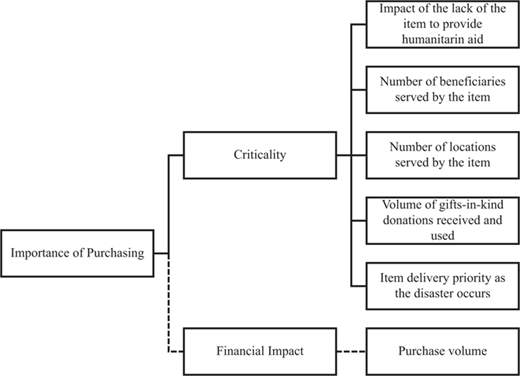
The purchasing strategies must support the organization’s goals (Nollet et al., 2005), a condition reflected in the “Importance of Purchasing” dimension because it is measured through the profit impact – which is related to the main goal of any company (Ertem et al., 2010). However, the goal of a humanitarian organization is to provide aid and help to disaster victims (Ertem et al., 2010). Thus, the criteria for defining the “Importance of Purchasing” were proposed to measure the degree of criticality of the purchase to provide humanitarian aid, considering the specific features of humanitarian operations described in the literature and presented in Section 2.2 (criteria from No. 1 to No. 6 presented in Table II).
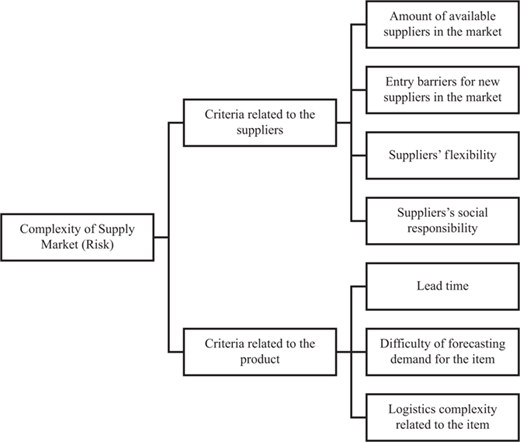
Considering that, as in business logistics, suppliers in humanitarian operations are companies that also operate in other markets (Taupiac, 2001), the “Complexity of Supply Market” dimension in humanitarian operations is associated to the same interpretation of the Kraljic (1983) model. Thus, the criteria for defining the “Complexity of Supply Market” dimension are proposed to measure the supply risk of relief items considering the specific features of humanitarian operations described in the literature and presented in Section 2.2 (criteria from No. 7 to No. 12 presented in Table II). Considering the purpose to validate the criteria presented in Table II (Section 2.2) by both academics and practitioners, the respondents achieved a high agreement rate regarding the proposed criteria to define the “Importance of Purchasing” and “Complexity of Supply Market” dimensions in humanitarian operations. Only the criteria No. 2 “Attractiveness of the item to receive donations” and No. 3 “Purchase volume (in financial terms)” received an agreement rate lower than 50 percent.
Despite the initial approach to discard the two criteria that received an agreement rate lower than 50 percent, the authors decided to maintain the No. 6 “Purchase volume (in financial terms)” as an independent criterion in the matrix to measure the financial impact of purchasing. This is justified by the perspective that such criterion was not accepted by respondents to measure the degree of criticality of purchase to providing humanitarian aid, despite its overall importance. The decision to keep this criterion is also justified by the financial impact importance in humanitarian operations because cost savings are well regarded by donors, which attracts more funding, as emphasized by Van Wassenhove (2006). Moreover, cost savings bring many other benefits, such as increased capacity for infrastructure investment, making the humanitarian organization better prepared to respond to disasters (Duran et al., 2013), although humanitarian organizations are not-for-profit organizations.
Besides the validation of the proposed criteria based on the academic literature, the respondents suggested the additional criteria presented in Table IV according to the frequency of citations and type of stakeholder. These additional criteria are numbered as a sequence continuation of the criteria gathered from the literature presented in Table II.
Additional criteria suggested by respondents
| Dimension | Criteria suggested | Frequency | Stakeholder |
|---|---|---|---|
| Importance of Purchasing | No. 13. Item delivery priority as the disaster occurs | 4 | Academic |
| No. 14. Supplier production capacity | 1 | Academic | |
| No. 15. Delivery frequency over the response to the disaster | 1 | Academic | |
| No. 16. The item availability at the time of order | 1 | Academic | |
| No. 17. Type and characterization of donations | 1 | Government | |
| No. 18. Availability of the item locally | 1 | NGO | |
| Complexity of Supply Market | No. 19. Suppliers’ social responsibility | 3 | Academic |
| No. 20. Variety of items provided by the supplier | 1 | Academic | |
| No. 21. The item availability at the time of order | 1 | Academic | |
| No. 22. Price formation conducive to market in the disaster region | 1 | Academic | |
| No. 23. Update time from supplier data | 1 | Academic | |
| No. 24. Negotiation type for price formation | 1 | Academic | |
| No. 25. Availability of suppliers locally | 1 | Academic | |
| No. 26. Availability of suppliers nearby storage points | 1 | Academic | |
| No. 27. Alternative supplies | 1 | NGO |
The results obtained in the validation as well as the additional criteria suggested and cited more than once by the respondents were consolidated and analyzed to define the Humanitarian Purchasing Matrix. While these criteria are only defined based on humanitarian operations context, there remains the need to discuss them according to the original criteria defined by Kraljic (1983).
Considering the “Importance of Purchasing” dimensions, in addition to “the purchase volume,” Kraljic (1983) proposed the criteria “value added by product line,” “impact on profitability” and “impact on business growth” to measure the financial impact of purchasing. However, they were not considered for the matrix because “value added by product line” can be interpreted as the “impact of the lack of the item on providing humanitarian aid,” which is already considered to measure the degree of criticality of the purchase to providing humanitarian aid. The “impact on profitability” and the “impact on business growth,” in contrast, do not fit because humanitarian organizations are not-for-profit organizations. Therefore, the criterion considered to measure the financial impact on the matrix was the “purchase volume.”
Thus, the criteria for the “Importance of Purchasing” dimension were defined according to the structure shown in Figure 2 to measure the degree of criticality of the purchase to providing humanitarian aid and its financial impact, considering that all of them have directly proportional impacts, except for “volume of gifts-in-kind donations received and used.” The dotted line indicates that the financial impact was analyzed independently of the degree of criticality.
Structure for the Importance of Purchasing
Structure for the Importance of Purchasing
Regarding the “Complexity of Supply Chain Market,” the criterion “suppliers’ social responsibility” was cited by three different respondents according to Table IV, which lead to the inclusion of this criterion in the matrix. Thus, the criteria for the “Complexity of Supply Market” dimension were defined according to the structure shown in Figure 3 to measure the supply risk, being grouped into two categories: criteria related to suppliers and criteria related to the product. All of them had a directly proportional impact, except for “number of available suppliers in the market,” “suppliers’ flexibility” and “suppliers’ social responsibility.”
Structure for the Complexity of Supply Market
Structure for the Complexity of Supply Market
Then, the Humanitarian Purchasing Matrix was defined as shown in Figure 4, keeping the same strategies recommended by Kraljic (1983) for each category and using the criteria seen in Figures 2 and 3 to define the dimension of “Importance of Purchasing” through the degree of criticality of the purchase to provide humanitarian aid and the financial impact, and the dimension “Complexity of Supply Market” through supply risk.
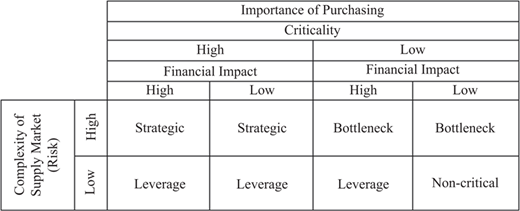
When the “Complexity of Supply Market” is high, the possible purchasing strategies are to develop a long-term partnership with the supplier, if the item is strategic, or to ensure the short-term supply through safety stock, aiming at cost reductions and to search for alternative products, if the item is subject to a bottleneck. Thus, the higher the criticality is of an item, the higher the reliability is of its supply, regardless of the financial impact. To this end, long-term partnerships can be developed with suppliers, so items with a high Complexity of Supply Market, high criticality and any financial impact are strategic, and the recommended strategy is to develop long-term partnerships with suppliers.
In contrast, the lower the criticality is of an item, the lower the reliability is of its supply, which can be secured in the short term by safety stock, cost reduction and substitute products. Therefore, items with a high Complexity of Supply Market, low criticality and any financial impact are subject to bottlenecks, and the recommended strategy is to ensure the short-term supply. When the Complexity of Supply Market is low, the possible purchasing strategies are to exploit the purchasing power, if the item is leveraged, or to establish an efficient process, if the item is non-critical.
In this case, the higher the criticality is of an item, the greater must be its availability, regardless of the financial impact. For this purpose, volume consolidation can be adopted through purchasing consortia and standardization, typical of the strategy for exploiting purchasing power. Therefore, items with a low Complexity of Supply Market, high criticality and any financial impact are leveraged, and the recommended strategy is to exploit the purchasing power.
The greater the financial impact is of an item, the higher the purchasing volume involved is, providing greater bargaining power with suppliers to negotiate agreements at lower prices, which is the main recommendation of the strategy exploiting purchasing power. Therefore, items with a low Complexity of Supply Market, low criticality and high financial impact are leveraged, and the recommended strategy is to exploit the purchasing power.
Finally, the lower the criticality and the financial impact of an item are, the lower are its required availability and its bargaining power with suppliers. Therefore, items with a low Complexity of Supply Market, low criticality and low financial impact are non-critical, suggesting the adoption of a strategy of establishing an efficient procurement process.
5. Illustrative example
The CEDEC-SP maintains four warehouses for the pre-positioning of relief items, and it currently purchases, keeps in stock and distributes ten relief items: Mattress, Blanket, Food Basket, Sheet, Hygiene Kit, Coat, Cleaning Kit, Glove, T-shirt and Raincoat. The purchasing strategy for relief items currently adopted by CEDEC-SP occurs through competitive bidding (Kawasaki, 2013), which is the formal and compulsory administrative procedure for public procurement in Brazil (1993), according to Law n. 8666. CEDEC-SP undertakes a competitive bidding process through the electronic trading mode, evaluating bids according to the lowest price, developing contracts of one year with the winners (Kawasaki, 2013).
The competitive bidding process includes several steps, and the expected time for its conclusion is 4.5 months, excluding setbacks and the step of evaluation of technical and budgetary viability is the longest one, estimated at 3.5 months. Due to the slow process, CEDEC-SP usually groups several items at the same Price Registration Act, which is usually prepared six months before the end of contract (Kawasaki, 2013). Once the supplier is selected, the purchase requisition process includes several steps, and depending on the occurrence of setbacks, it can last up to 11 days, from the request until the final receipt (Kawasaki, 2013).
5.1 Classification according to the Importance of Purchasing and Complexity of Supply Market
Based on the methodology presented in Section 4, classification according to the “Importance of Purchasing” and “Complexity of Supply Market” was divided into two parts: weighting of criteria through AHP and positioning of relief items in the Humanitarian Purchasing Matrix. First, the results related to the criteria weighting through AHP are shown in Table V.
Weighting results
| Dimension | Criteria | Weight | Total |
|---|---|---|---|
| Importance of Purchasing | No. 1. Impact of the lack of the item on providing humanitarian aid | 0.428 | 1.000 |
| No. 4. Number of beneficiaries served by the item | 0.143 | ||
| No. 5. Number of locations served by the item | 0.143 | ||
| No. 6. Volume of gifts-in-kind donations received and used | 0.143 | ||
| No. 13. Item delivery priority as the disaster occurs | 0.143 | ||
| Complexity of Supply Market | No. 7. Number of available suppliers in the market | 0.357 | 1.000 |
| No. 8. Entry barriers for new suppliers in the market | 0.178 | ||
| No. 10. Suppliers’ flexibility | 0.119 | ||
| No. 19. Suppliers’ social responsibility | 0.178 | ||
| No. 9. Difficulty of forecasting demand | 0.084 | ||
| No. 11. Lead time | 0.042 | ||
| No. 12. Logistics complexity related to the item | 0.042 |
For the positioning of relief items in the Humanitarian Purchasing Matrix, the weighted scoring method was applied. Tables VI and VII show the scores for each item considered in the dimensions of the “Importance of Purchasing” and the “Complexity of Supply Market,” respectively.
Scores for the Importance of Purchasing (criticality)
| Item | Impact of the lack of the item | Number of beneficiaries served | Number of locations served | Volume of gifts-in-kind donations | Delivery priority | Total |
|---|---|---|---|---|---|---|
| Mattress | 1 | 1 | 1 | 1 | 1 | 1.00 |
| Blanket | 0 | 0 | 0 | 0 | 0 | 0.00 |
| Food Basket | 1 | 1 | 1 | 0 | 1 | 0.86 |
| Sheet | 0 | 1 | 1 | 1 | 0 | 0.43 |
| Hygiene Kit | 1 | 1 | 1 | 0.5 | 1 | 0.93 |
| Coat | 0.5 | 0.5 | 0 | 0.5 | 0 | 0.36 |
| Cleaning Kit | 1 | 1 | 1 | 0.5 | 1 | 0.93 |
| Glove | 1 | 1 | 1 | 1 | 0 | 0.86 |
| T-shirt | 0 | 0 | 0 | 0.5 | 0 | 0.07 |
| Raincoat | 0 | 0 | 0 | 1 | 0 | 0.14 |
Scores for the Complexity of Supply Market
| Item | Number of suppliers | Entry barriers | Flexibility | Social responsibility | Lead time | Difficulty of forecasting demand | Logistics complexity | Total |
|---|---|---|---|---|---|---|---|---|
| Mattress | 0 | 0.5 | 0.5 | 0.5 | 1 | 0.5 | 1 | 0.36 |
| Blanket | 0 | 0.5 | 0.5 | 0.5 | 1 | 1 | 0.5 | 0.38 |
| Food Basket | 0 | 0 | 0 | 0.5 | 1 | 0.5 | 0 | 0.17 |
| Sheet | 0 | 0 | 0 | 0.5 | 1 | 0.5 | 0.5 | 0.19 |
| Hygiene Kit | 0.5 | 1 | 1 | 0.5 | 0 | 0.5 | 0.5 | 0.63 |
| Coat | 0.5 | 0 | 0.5 | 0.5 | 0.5 | 1 | 0.5 | 0.45 |
| Cleaning Kit | 0.5 | 1 | 1 | 0.5 | 0 | 0.5 | 0.5 | 0.63 |
| Glove | 0.5 | 0 | 0.5 | 0.5 | 0.5 | 0.5 | 0 | 0.39 |
| T-shirt | 0.5 | 0 | 0.5 | 0.5 | 0.5 | 0.5 | 0 | 0.39 |
| Raincoat | 1 | 0 | 0.5 | 0.5 | 0.5 | 0.5 | 0 | 0.57 |
For the “Importance of Purchasing,” items with scores greater than 0.5 correspond to high criticality, and items with scores less than 0.5 correspond to low criticality. For the Complexity of Supply Market, in turn, items with scores greater than 0.5 correspond to high complexity of the supply market, and items with scores less than 0.5 correspond to low complexity of the supply market.
Financial impact was classified considering a single criterion, which is the purchase volume. To this end, the ABC classification was used, considering that the items belonging to Class A (80 percent of the total value) have high financial impact, while other items belonging to Classes B and C (20 percent of the total value) have low financial impact. Table VIII shows the ABC classification of relief items purchased by CEDEC-SP (Brito Junior, 2014) and the results for the financial impact in the Humanitarian Purchasing Matrix.
5.2 Purchasing strategies definition
With the classification of relief items into the Importance of Purchasing and the Complexity of Supply Market, it was possible to position them in the Humanitarian Purchasing Matrix as shown in Figure 4 and to select the most appropriate purchasing strategy for each relief item, as indicated by the same.
As seen in Figure 5, the items Mattress, Food Basket, Glove and Blanket presented a low Complexity of Supply Market, high criticality or high financial impact. Thus, as defined in Humanitarian Purchasing Matrix, these items were classified as leveraged, and the recommended strategy for them is to exploit the purchasing power.
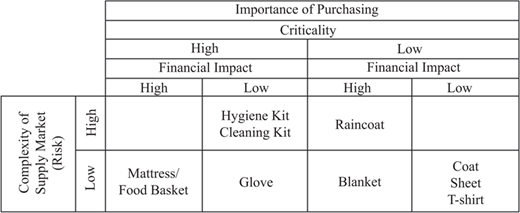
Positioning of relief items in the Humanitarian Purchasing Matrix
Positioning of relief items in the Humanitarian Purchasing Matrix
In turn, the items Coat, Sheet and T-shirt presented a low Complexity of Supply Market, low criticality and low financial impact. Therefore, according to the Humanitarian Purchasing Matrix, these items were classified as non-critical, and the recommended strategy for them is to establish an efficient procurement process.
The items Hygiene Kit and Cleaning Kit presented a high Complexity of Supply Market and high criticality. Thus, as defined in the Humanitarian Purchasing Matrix, these items were considered strategic, and the recommended strategy for them is to develop long-term partnerships with suppliers.
Finally, the item Raincoat presented a high Complexity of Supply Market and low criticality. Therefore, according to the Humanitarian Purchasing Matrix, this item was classified as bottlenecked, and the recommended strategy is to ensure the short-term supply.
5.3 Discussion
As stated before, CEDEC-SP currently adopts a unique purchasing strategy for its relief items, which is to explore the purchasing power through competitive bidding, using the criterion of lowest price, as established by the Brazilian legislation, and establishing contracts with the winners of each bid lasting one year, thus fixing the unit price of the item during this period. Thus, this purchasing strategy adopted by CEDEC-SP is suitable only for the items Mattress, Food Basket, Blanket and Glove, which recommends the exploration of purchasing power strategy according to the Humanitarian Purchasing Matrix, as already discussed by Lysons and Farrington (2006).
For the items Hygiene Kit and Cleaning Kit, the recommended strategy is to develop a long-term partnership with the supplier, ensuring greater reliability of supply (Lysons and Farrington, 2006). However, the maximum period established by the Brazilian legislation is one year (Brazil, 1993), thus limiting the long-term supply, as recommended for strategic items. In the strategy currently adopted by CEDEC-SP, with one-year contracts, supply is only guaranteed over the medium term, with the possibility of switching suppliers at the end of each period, which can result in less reliability for the supply than with the strategy indicated.
For the item Raincoat, the indicated strategy is to ensure the short-term supply, keeping safety stock and searching for alternative products (Lysons and Farrington, 2006). The strategy currently adopted by CEDEC-SP ensures supply in the medium term, making it difficult to exchange it for an alternative product in the short term, which should be implemented because the item has a high financial impact, and its supplier market is complex, although has a low criticality.
For the items Blanket, Sheet and T-shirt, the recommended strategy is to establish an efficient procurement process (Lysons and Farrington, 2006), which is not currently observed by CEDEC-SP, either in the bidding process, which lasts on average 4.5 months, or in the requesting process of suppliers, which can last up to 11 days until final delivery. Thus, CEDEC-SP should reduce the time spent engaging in bidding and request that its suppliers process and simplify, both through the stock management by the supplier, which would accomplish the resupply proactively, and through electronic catalogs for online requests.
6. Conclusion
Given the increasing strategic Importance of Purchasing and the lack of specific models for defining purchasing strategies in humanitarian operations, a Humanitarian Purchasing Matrix was proposed in this paper for defining purchasing strategies for relief items. The main reference for this tool is the Kraljic (1983) purchasing portfolio, developed considering the business logistics context, which is combined in the present research with characteristics of strategic procurement in humanitarian operations.
The empirical test for such methodology considered the case of CEDEC-SP, one of the leading humanitarian organizations in Brazil. Through the approach of weighting the criteria selected for the “Importance of Purchasing” and the “Complexity of Supply Market” dimensions, the purchase of relief items is positioned in the matrix. Finally, some suggestions are proposed to adapt the strategy used by CEDEC-SP to the recommendations established by the matrix, respecting the limitations imposed on CEDEC-SP by legislation for public procurement in Brazil.
Based on the findings discussed in this research, the use of the Humanitarian Purchasing Matrix could also be extended to other humanitarian organizations, especially those that conduct procurement in disaster preparation stages and that must develop their procurement processes at the strategic level. The managerial contribution of this paper is to explore the adherence of procedures for purchasing relief items according to the characteristics of the humanitarian operations, supporting the decision makers on how to structure the purchasing of each relief item properly. Thus, the Humanitarian Purchasing Matrix proposes the classification of relief items in one of the four categories: non-critical, leverage, strategic and bottleneck. The classification of such relief items relies on 13 criteria structured in three main criteria: the complexity of the supply market, the importance of the purchasing and the financial impact.
While the proposed Humanitarian Purchasing Matrix is generic in terms of disaster type, stakeholder and country perspectives, the specific location of the relief items in the matrix may vary according to such characteristics. For instance, one organization developing humanitarian operations in a region that faces climatological disasters associated to heavy rains and storms during the summer may locate the relief item “Blanket” in a low level of criticality (which is observed in the illustrative example in Section 5). However, another organization developing humanitarian operations in a region that faces sudden-onset disasters randomly along the year (e.g. earthquake) may locate the “Blanket” in a high level of criticality. Nevertheless, the strategies provided by the application of the Humanitarian Purchasing Matrix are still valid for both situations. Even in cases in which the organization faces specific limitations, such as the CEDEC-SP and its legislative bureaucracies, deploying a strategic orientation based on the Humanitarian Purchasing Matrix for purchasing of relief items is possible and valuable for the operations.
Despite the results achieved in this research, it is important to note that the criteria list is not exhaustive because the criteria were validated by a limited number of humanitarian logisticians. Therefore, future research could include new criteria to define even more precisely the dimensions of the “Importance of Purchasing” and the “Complexity of Supply Market” in humanitarian operations. Another point to note is that purchasing strategies have been proposed based on their objectives and on the expected results described in the literature, so it is recommended for future work to apply the methodology proposed to new cases and to analyze the main results obtained, assessing whether the goals and expected results for each purchasing strategy are achieved in practice. In addition, it is also important to note that the proposed methodology constitutes only one necessary step for the establishment of a strategic procurement process in humanitarian operations. Thus, future work could incorporate other steps, such as supplier selection, to define a strategic procurement process for humanitarian operations. Moreover, the present Humanitarian Purchasing Matrix and the four categories for classifying the relief items (i.e. non-critical, leverage, strategic and bottleneck) represent an essential characteristic to be considered in the research of stakeholder management and stakeholder collaboration in disaster and humanitarian operations.

