The purpose of this study was to apply the OH-SMART approach on dengue vector control and assess the influence on knowledge, attitude, practice (KAP) amongst elementary students in Majalengka as well as check the dengue serotypes distribution.
This study was designed by sequential exploration. An OH-SMART workshop involving local government institutions, schools, colleges and health professional organizations was conducted. A total of 334 elementary students, chosen by cluster sampling, participated including 171 in the intervention group and 163 in the control group. A self-administered questionnaire was used to assess the differences in the subject's KAP. Dengue serotypes were analyzed by reverse transcription–polymerase chain reaction (RT-PCR), and the distribution was measured by GPS. Descriptive statistics, paired t-test and the Wilcoxon rank test were used for data analysis.
There were eight gaps in Dengue vector control in Majalengka and three main recommendations after the OH-SMART workshop i.e. the formation of OH-teams, the preparation of module training, and training of vector control in the schools. After the program, there were statistically significant differences between the intervention and control groups (p = 0,001, CI 95%). All differences in the intervention group were higher than in the control. The most commonly found dengue serotype was DEN-1.
OH-SMART has never been applied in Indonesia, especially in a local government setting but is recognized as an effective approach in the prevention of vector-borne disease and zoonotic.
Introduction
Dengue hemorrhagic fever (DHF) is an infectious disease characterized by the sudden onset of fever, bleeding, shock and even death. DHF is caused by the dengue virus which belongs to the Flaviviridae family and is transmitted by Aedes aegypti mosquitoes. Dengue is classified as an arthropod-borne virus (arbovirosis) group b which has 4 serotypes, DEN-1, DEN-2, DEN-3 and DEN-4 [1]. One method of examining dengue serotypes is reverse transcription–polymerase chain reaction (RT–PCR).
The trend of DHF cases in Indonesia is evidenced by the incidence of cases in 2015 of 50.75/100,000 and a dramatic increase in 2016 to 78.85/100,000 [2]. West Java recorded the highest number of DHF cases in Indonesia. Majalengka, a district in West Java, recorded the highest case fatality rate (CFR) in 2012 in West Java at 5.2%. CFR from DHF in Majalengka increased in the period 2015–2017 and was equal to 0.65, 1.22 and 1.79 making the CFR of Majalengka higher than the national CFR set at <1%. The incidence rate of DHF in Majalengka in 2015 amounted to 25.9/100,000 and increased in 2016 by 28/100,000. Three sub-districts in Majalengka with the highest prevalence were Majalengka, Kadipaten, and Jatiwangi. School-age children (5–14 years) were the most vulnerable group of DHF cases in Majalengka with all cases of death caused by DHF also in this age group. In 2015 there were 193 cases of dengue in the 5–14 years (62.7%) category and 230 cases in 2016 (70.5%) [3–5].
Global health issues are influenced by various complex factors including high societal values and require holistic and transdisciplinary approaches. The One Health approach is based on the concept that health problems are interrelated and require treatment through collaboration and co-ordination of multiple sectors and disciplines [6, 7].
One tool used in the One Health approach is OH-SMART (One Health Systems Mapping and Analysis Resources Toolkit). The pilot project in Indonesia held by INDOHUN concluded that OH-SMART was adaptable and could be used to measure, identify and strengthen problem-solving with minimal resources [8].
Methodology
Study design
We used a mixed-method design i.e. sequential exploratory [9, 10] that combined the qualitative method in an OH-SMART workshop with a quantitative approach in comparison to pre–post analysis. The OH-SMART was used to determine the health promotion model in dengue vector control in elementary schools involving multisectoral collaboration, while knowledge, attitude and practice (KAP) measurements were used to test the intervention model trials that have been implemented.
Study procedure
This two-step study included the OH-SMART workshop and the comparison KAP and dengue distribution. Baseline data were used to see the influence of the intervention provided. The interventions given were the result of OH-SMART implementation. Participants in the OH-SMART workshop were stakeholders in Majalengka who were involved in vector control in Majalengka, guided by a purposeful theoretical sampling strategy. The location for serotypes and KAP measurement were taken by the cluster technique. Three sub-districts with the highest DHF prevalence, namely, Majalengka, Kadipaten and Jatiwangi were included in the intervention group and the lowest prevalence subdistrict, Sukahaji, as the control. The inclusion criteria were (1) elementary students in grade IV-VI who attended selected schools and (2) willingness to participate in the study confirmed by informed consent signed by the parents. Exclusion criteria were respondents who were absent on the day that participants were enrolled.
One Health SMART
The workshop on the OH-SMART program on vector control was held in a school in Majalengka from January 17, 2018 to January 18, 2018. Facilitators on the program were from OHCC (One Health Collaborating Centre) UGM and a senior technical officer Universitas Minnesota/INDOHUN) in cooperation with the School of Health YPIB Majalengka.
There were six steps to the One Health SMART program: (1) Identify the cross-sectoral network, (2) set the stage through “key-stakeholder” interviews, (3) define the system through process mapping, (4) analyze the system through a multi-agency workshop, (5) identify opportunities to strengthen system operations and (6) develop an implementation plan.
The OH-SMART workshop combined co-ordination and collaboration between institutions in Majalengka to determine gaps and provide recommendations on the dengue vector. The recommendation of OH-SMART was used as an intervention in this study.
Knowledge, attitude and practice (KAP) on dengue vector control
KAP on dengue vector control was measured from elementary students in eight schools in the Majalengka, Jatiwangi and Kadipaten subdistricts. Four schools were included in the intervention group and the rest in the control group. A standard questionnaire was developed from theory and previous studies [11–13].
The questionnaire contained characteristics of subjects, knowledge, attitudes and behavior in vector control. There were 15 (yes/no) questions about knowledge consisting of vector, DHF, prevention and vector control. Attitudes were assessed using 10 (true/false) statements about student perceptions in dengue vector control. Practices in vector control activities including participation in maintaining environmental health, vectors and periodic larval monitoring were assessed through 10 Likert scale–type questions. The four-point scale ranged from 1 meaning never to 4 = always.
Validity and reliability were assessed with 30 elementary students who had similar characteristics to the respondents in another subdistrict. The internal consistency reliability (Cronbach's α) was 0.655.
Viral identification and distribution
Identification and assessment of dengue serotypes began with making an ovitrap to catch mosquitos and larvas, and these were then distributed in the three randomly selected subdistricts Majalengka, Kadipaten and Jatiwangi. A total of 98 places could be analyzed. Viral identification was carried out before and after the intervention. An RT-PCR examination was carried out at the biotechnology laboratorium of Gadjah Mada University.
The identification consisted of three stages. The first stage was dengue virus RNA isolation from serum using an RNA isolation kit. The second was the dengue virus RNA amplification [14]. Copies of cDNA from capsid and prM were obtained by amplification using two consensuses primers (D1 and D2) and four specific primers (TS1, TS2, TS3, TS4). Two primary consensuses were attached to four specific primers for all four types of dengue serotypes. The third step was the amplification electrophoresis. The electrophoresis step used 1% agarose gel stained with ethidium bromide [15].
The interpretation of electrophoresis was DENV-1 if the DNA band length was 482 bp, DENV-2 119 bp, DENV-3 290 bp, and DENV-4 392 bp. The distribution of dengue serotypes was measured by GPS (Global Positioning System). Data were presented by descriptive statistics.
Ethics consideration
This study was approved by the Ethical Committee of Health Research Public Health Faculty of Diponegoro University (Approval Letter No. 008/EC/FKM/2018).
Results
OH-SMART
There were six steps to the One Health SMART approach: (1) Identify the cross-sectoral network, (2) set the stage through “key-stakeholder” interviews, (3) define the system through process mapping, (4) analyze the system through a multiagency workshop, (5) identify opportunities to strengthen system operations and (6) develop an implementation plan.
Step (1) identified the cross-sectoral network. There were nine institutions involved in this study including the health office of Majalengka, education office of Majalengka, religion office of Majalengka, primary health care, elementary schools, environmental control agency of Majalengka, nurse association branch Majalengka, midwife association of Majalengka and health school of Majalengka. Step 2 of the process set the stage through “key-stakeholder” interviews as described below (Table 1).
Steps 3 and 4 defined the system through process mapping and analyzed the system through a multiagency workshop. In step 3, each institution described gaps and mapped its decision-making system. All processes from the agencies were combined and accommodated on one map in step 4.
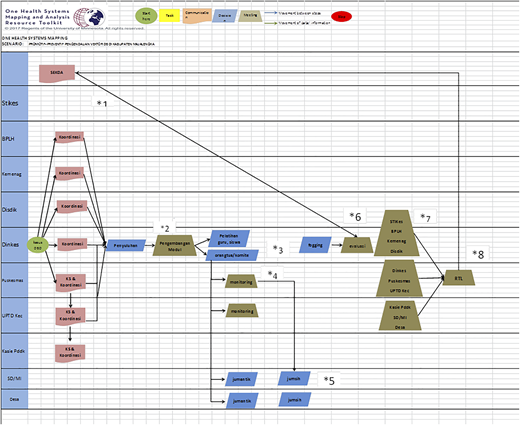
There were eight gaps in the discussion as follows: (1) lack of coordination, (2) lack of a training module about vector control for schools, (3) lack of training on vector control provided to the school committee, (4) no monitoring, (5) the ”Clean Friday” program was not running optimally, (6) multisectoral evaluation, (7) lack of university and professional association involvement and (8) a need for strengthening intersectoral coordination.
Lack of co-ordination between the health office and the environmental control agency, the education office, the religion office was identified as the main problem in DHF vector control. Besides, lack of coordination between the primary health care and the subdistrict officer, lack of health promotion (counseling) related to DHF in schools and communities and the absence of relevant training and learning modules were also considered influential in poor health promotion activities. Poor monitoring of existing activities/programs such as the Clean Friday program was also a gap in DHF vector control in Majalengka. The lack of advocacy relating to DHF problems in local governments thereby reduced government awareness. Poor coordination and no follow-up plans resulted in dengue cases continuing to appear in Majalengka (Figure 1)
Steps 5 and 6 identified opportunities to strengthen system operations and develop an implementation plan. The eight gaps were analyzed, and priority resolutions were selected (Tables 2 and 3).
Based on step 6, there were three programs conducted as follows: (1) the formation of an OH team in Majalengka, (2) a preparation module on vector control training and (3) training on vector control to elementary schools. The OH team was made up of nine institutions involved in the OH-SMART workshop and approved by the regent of Majalengka. The training module was prepared by the OH team and contained pictures and stories about environmental hygiene, mosquitoes, DHF and dengue vector control. The training was conducted in four schools. During training, students were also trained on how to monitor larve.
Knowledge, attitude and practice amongst elementary students
Four schools were chosen to participate in the intervention group and four schools in the control group. A total of 334 students were involved in this study including 171 students in the intervention group and 163 in the control group (Table 4).
Normality tests were conducted before analysis using the Shapiro Wilk test (p > α, α = 0.05). Knowledge (p = 0.99) and attitudes (p = 0.30) in the intervention group were normally distributed. The statistical test for normally distributed data used a paired t-test, while the rest was assessed by the Wilcoxon rank test (Table 5).
There was a difference between before and after intervention on knowledge, attitudes and participation of elementary school students in the intervention group (p < α, α = 0.05). In the control group, there was a difference in mean values on the knowledge variable (p = 0.001, p < α, α = 0.05) but no difference in the attitude variable (p = 0.489) and participation (p = 0.81).
After being given a test, the intervention group experienced an increase in their average knowledge by 3.48, an attitude of 1.37 and practice of 1.18, while the control group experienced an increase in average knowledge of 0.77, an increase in attitude by 0.09, and an increase in participation of 0.2. The differences in knowledge, attitudes and participation between the intervention and control groups are indicated by the value of p = 0.001 (p < α, α = 0.05).
Viral identification and distribution
Serotypes found in the three subdistricts in Majalengka were DEN1, DEN2 and DEN3. DEN4 serotypes were not found at the study site. The distribution of the dengue serotype data is presented in the following table (Table 6).
As many as 34 places were found positive for dengue from 98 places analyzed (34.7%) before the intervention. After the intervention, there was a decrease to 18 places (18.4%). DEN-1 was the most found serotype, which was 28 (40.9%) out of a total of 46 dengue serotypes analyzed, followed by DEN2 and DEN3. DEN3 was only found in Jatiwangi District. Nine places were positive for two serotypes, DEN1-DEN2 and DEN1-DEN3 in 3 places. All places in the Majalengka subdistrict showed negative results for mosquitos with Dengue. There were no places that showed up as positive for two serotypes at once after the programs.
Discussion
OH-SMART
This study provided the application of OH-SMART on dengue vector control in Majalengka. OH-SMART is one of the tools in the One Health approach to determine gaps and solutions to zoonotic problems based on cross-sectoral and cross-disciplinary collaboration and coordination [8]. DHF cases are commonly experienced by school-age children suggesting that schools could be a place for the transmission of DHF. Formal schools in Indonesia consist of two curricula, one under the supervision of the education office, and the rest under the religion department based on religious teaching. Improved co-ordination and collaboration among all institutions will improve awareness of DHF cases.
The OH-SMART advances the understanding of how to operationalize One Health from theory to action and make multisectoral coordination and planning less dependent on resources and time. The repetitive process used to develop this toolkit demonstrates how existing quality improvement methods can be modified and applied to improve multisector and complex One Health systems. The resulting OH-SMART has so far been used to strengthen One Health systems at various levels and has proven to be easy, robust and capable of boosting multisectoral collaboration on facilitating complex system-wide problem-solving [16].
The OH approach has been proven to be able to overcome various problems regarding zoonotic diseases around the world [17–20]. However, One Health as a strategy still faces obstacles. The main challenges of the One Health approach in South Asia include the lack of coordination in existing government structures, lack of legislation, attitudes and commitment of animal health and human health sector staff, donors, weak oversight mechanisms and short-term economic benefits of this approach in response zoonosis [21].
This current study could provide the necessary momentum on integrated vector control among institutions in Majalengka. The module in vector control training made by the OH team also contains religious teachings on cleanliness and local stories about mosquitoes. It is important to sustain momentum. Robust surveillance, evidence-based clinical management, sustainable vector control and effective communication with multisector partnerships are key strategies [22].
KAP in dengue vector control
The school was suspected as one of the dengue transmission sites. School-age children were the most affected group of DHF in Majalengka. Increased knowledge, attitudes and vector control practices are expected to reduce the incidence of DHF. Vector control training in schools includes teaching the module, screening of an animated film about DHF, role-playing about the transmission of DHF and larva monitoring practices. Finally, students were equipped with flashlights, stationery and larva monitoring forms. Questionnaires were given before training (pretest) and one month after training (post-test). While in the control group, students were given the larva monitoring equipment (flashlight, etc). The module was given after the post-test in the control group.
School-based education about dengue vector control has an impact not only on schools and the students but also vector control in households and communities. Good knowledge of dengue carrier vectors and symptoms of the diseases will increase student awareness, as stated in previous studies in Sri Lanka, India, Saudi Arabia and Malaysia [23–26].
This study started with co-ordination among institutions responsible for dengue vector control in schools. Previously, health problems had been the responsibility of health officers only. Schools and public sites were not active in dealing with DHF, even though proactive health education through appropriate awareness programs could strengthen and encourage community participation in vector control [27]. The twinning of social participation and environmental management improves the effectiveness of conventional dengue control programs and significantly reduces vector densities [28].
Viral identification and distribution
Serotypes detected in Majalengka are DEN-1, DEN-2 and DEN-3, and the most common are DEN-1. The results showed a decrease in the number of viral serotypes at coordinate points in three subdistricts namely Majalengka, Kadipaten, and Jatiwangi after the intervention. The most significant change was seen in Majalengka subdistrict after the intervention did not reveal positive mosquitoes carrying the dengue virus.
The most common serotype in Indonesia is DEN-3 [29, 30], although another study stated that the most reactive antibody was to DENV-2 [31]. Also, the presence of DEN-1 is riskier for the incidence of DB and DSS compared to DEN-2 [32]. This fact must be anticipated by local governments to prevent severe DHF and mortality caused by dengue.
The serotypes test in Majalengka showed several places containing more than one serotype. This fact presented more risk with the possibility of infection than only one serotype. In another study, Sasmono stated that more than half of Indonesian children were infected with more than one dengue serotypes which showed intense transmission that was often associated with more severe clinical episodes [31].
All dengue virus serotypes (DEN-1 to DEN-4) cause all spectrums of disease ranging from asymptomatic, mild dengue fever, DHF and even DSS [33]. Healsted states that the severity of dengue infection is associated with secondary infections of different types [34]. People who are infected with one of the dengue serotypes would form antibodies to the specific serotype but does not mean the person will not suffer dengue fever because it could be infected with other types of serotypes with no immunity to these serotypes. The previous study showed that as many as 50, or 9% of respondents, contained antibodies of several types of serotypes at the age of nine years and increased to 63.1% at the age of 15–18 years [31].
Conclusion
The OH-SMART was well-applied in Dengue vector control in Majalengka. The recommendations can be successfully implemented and improve knowledge, attitude and practice on the dengue vector control of the elementary students in Majalengka. This study found that the most Dengue serotypes in Majalengka were DEN-1. This information about serotypes distribution will improve the local government's awareness of Dengue vector control.
We acknowledge with gratitude the OHCC UGM, INDOHUN, School of Health YPIB Majalengka and the institutions that were involved in this study. Wawan Jurniawan: Acknowledgement to Ministry of Higher Education Research and Technology of Indonesia for financial support of this study through doctoral grant. Authors thank all investigators and participants from local government of Majalengka district, Indonesia Prof Agus Suwandono: Thank you to School of Postgraduate, University Diponegoro, Semarang, for encouragement and support to this research started from proposal development, implementation until this publication. My best appreciation to Journal of Health Research for publishing this article.Conflict of interest: There is no conflict of interest in this study.