The adoption of cryptocurrencies in tourism has been relatively slow despite the opportunities brought by this technology. Part of this can be explained by consumers' attitudes toward its acceptance. The research aims to analyze the determinants that influence attitudes and intentions to use cryptocurrencies as payment method for tourist services. We developed and tested an extended conceptual model based on the Technology Acceptance Model (TAM).
The proposed conceptual model was tested through the analysis of data collected through a survey conducted with cryptocurrency users. Two pre-tests of the survey instrument were conducted before the final data collection. The survey was carried out in all regions of Brazil, and 315 valid questionnaires were obtained. The data were analyzed using Structural Equation Modeling (SEM).
The intention to use cryptocurrencies to purchase tourist services was found to be affected by perceived security, perceived usefulness, social influence and attitude. Personal innovativeness and easiness play indirect roles in determining intentions. On the other hand, general political and legal interventions may discourage individuals from using cryptocurrencies. Users of this technology value disintermediation and decentralization; therefore, they may oppose regulations or alterations to the system's underlying structure.
Our work extends the TAM model, adding four new constructs, that is perceived security, regulatory support, personal innovativeness and social influence, to understand the behavior of cryptocurrency users regarding their monetary transactions in the travel context.
1. Introduction
Cryptocurrencies have strongly impacted various economic sectors, most notably the financial sector (Albayati et al., 2020; Jalal et al., 2021), and e-commerce (Cristofaro et al., 2023). The development of these digital currencies has also affected tourism in different ways (Wang and Chan, 2025; Lin et al., 2023). Cryptocurrencies benefit tourism by streamlining payments, simplifying cross-border transactions and reducing foreign-exchange costs (Balasubramanian et al., 2022; Treiblmaier et al., 2021).
Cryptocurrencies enable interoperable payments and settlements for tourists, addressing issues of money isolation and liquidity (Radic et al., 2022). These assets can reduce the risk of transactions between tourists and companies in the sector (Banerji et al., 2021). Therefore, cryptocurrencies impact the competitiveness of companies and tourist destinations as they constitute an additional and often advantageous way of consolidating transactions (Demirel et al., 2022; Kizildag et al., 2020; Maythu et al., 2024; Silva et al., 2022).
In addition to the characteristics of cryptocurrencies and the environment in which the use of this technology occurs, the adoption of this medium of exchange in tourism depends on individual elements of travelers. For example, Chang et al. (2022) showed that tourists' intention to use cryptocurrencies depends on performance expectancy, effort expectancy, social influence and facilitating conditions. Radic et al. (2022) examined how cryptocurrencies are being adopted within the tourism sector, emphasizing that tourists' perceptions – particularly regarding ease of use, usefulness and security – play a central role in shaping their willingness to use digital currencies.
However, empirical studies on the determinants of cryptocurrency and digital payments adoption by tourists are still in their infancy (Lee et al., 2025; Wang and Chan, 2025). The conceptual models adopted are varied and do not form a cohesive panel of explanations. Furthermore, the accumulation of empirical evidence is even small, and many findings seem to contradict others.
A systematic literature review was conducted on the factors influencing the adoption of cryptocurrencies as a form of payment for tourism services. The literature review contributed to the proposition of a theoretical model with constructs that involved technological issues and those related to the use of cryptocurrencies for service payments.
We then developed and tested an extended conceptual model based on the TAM (Davis, 1989). We augmented the original model based on theoretical insights from the extensive literature review. Four new variables were added to the model: regulatory support, perceived security, personal innovativeness and social influence. Hence this study aims to analyze the determinants that influence attitudes and the intention to use cryptocurrencies as a medium of exchange for tourist services.
2. Literature review and hypotheses
2.1 Technology acceptance model
The Technology Acceptance Model (TAM), proposed by Davis (1989), originally aimed at explaining computer usage behavior, but it has been adapted to a variety of contexts (Davis et al., 1989). TAM's notoriety is explained by its simplicity and validity in terms of theoretical attributes, empirical basis and general applicability to technology adoption issues in various domains (Nuryyev et al., 2020).
Although more comprehensive models such as the Unified Theory of Acceptance and Use of Technology (UTAUT) (Venkatesh et al., 2003), and its extension UTAUT2 (Venkatesh et al., 2012) have been used to analyze the acceptance of emerging technologies, these theories are more complex and often require contextual adaptations.
UTAUT was originally designed for organizational environments focused on productivity, while UTAUT2 introduced consumer-centric variables such as hedonic motivation, price value and habit. However, when examining the adoption of cryptocurrencies within the tourism sector, the structural multi-layered complexity and the extensive set of moderators inherent in UTAUT/UTAUT2 present significant empirical challenges that may obscure the core drivers of acceptance. For this reason, and to preserve parsimony, this study uses TAM (Davis, 1989).
This research highlights the need to expand the model to address specific contexts, whereas TAM, being a more concise and parsimonious theory, proves more suitable when the objective is to analyze technological acceptance in a robust and generalizable way, without the excessive inclusion of constructs that could compromise the simplicity and analytical clarity of the model.
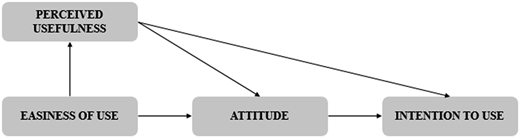
Individuals' resistance to new technologies is a widespread problem. Understanding why people accept or reject these technologies is essential for predicting behavior, explaining adoption and developing strategies to increase user acceptance (Davis et al., 1989). TAM postulates that two beliefs, regarding perceived ease of use and usefulness, explain the attitude towards the use of a particular technology, consequently causing the intention to use it (Davis, 1989; Davis et al., 1989), as illustrated in Figure 1.
Perceived usefulness is defined as the degree to which a person believes that using a particular system would affect his or her performance (Davis, 1989). Some of the attributes that attract users to cryptocurrency are investment opportunities, anonymity, privacy, acceptance by companies as a medium of exchange and fast fund transfers (Alzahrani and Daim, 2019). Cryptocurrencies simplify international transactions by overcoming the associated foreign currency exchange costs (Treiblmaier, 2021). Based on the original TAM model (Davis, 1989), the following hypotheses are established regarding the perceived usefulness of using cryptocurrencies:
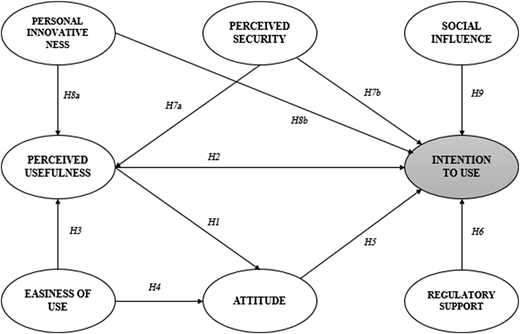
Perceived usefulness of cryptocurrencies has a positive effect on the attitude towards using this technology to pay for tourist services.
Perceived usefulness of cryptocurrencies has a positive effect on the intention to use this technology to pay for tourist services.
The perception of the effort or perceived ease of use determines the user's attitude toward the technology (Davis, 1989). It is important to recognize that cryptocurrencies require specific management knowledge, techniques and tools. It is not necessarily trivial to keep a virtual wallet safe (Yeong et al., 2019). The volatility of cryptocurrencies constitutes an additional problem, as the amount invested is constantly at financial risk. Perceived ease of use affects both the perceived usefulness of technology and the individual's attitude towards it. Then, two hypotheses are established based on TAM (Davis, 1989), regarding the perceived ease of use of cryptocurrencies:
Perceived ease of use of cryptocurrencies has a positive effect on the perceived usefulness of using this technology to pay for tourist services.
Perceived ease of use of cryptocurrencies has a positive effect on the attitude towards using this technology to pay for tourist services.
Attitude can be understood in this context as the user's assessment of the convenience of using cryptocurrencies to pay for tourist services (Ajzen, 1989). Intention to use, on the other hand, corresponds to the individual's willingness to use the technology. According to the TAM (Davis, 1989), favorable attitudes are positively associated with the intention to use cryptocurrencies:
A positive attitude towards using cryptocurrencies in general has a positive effect on the intention to use this technology to pay for tourist services.
2.2 Regulatory support
Although cryptocurrency regulation is still in its early stages, and these assets are not widely recognized as legal tender, government regulation plays an important role in their acceptance by individuals (Yeong et al., 2019). Government regulation can prevent price manipulation and fraud (Schaupp and Festa, 2018), boosting the market through greater solidity and reliability provided by the recognition of the technology, thus encouraging the adoption of new users (Reis and Coeli, 2019). Therefore, the following hypothesis can be established (Reis and Coeli, 2019):
Regulatory support for cryptocurrencies has a positive effect on the intention to use this technology to pay for tourist services.
2.3 Perceived security
The high or low level of security of an online system has a positive or negative impact on users, leading to the acceptance or rejection of that system (Nadeem et al., 2021). Perceived security is essential to the adoption of new technologies, including cryptocurrencies (Du et al., 2025). Palos-Sanchez et al. (2021) conceptualized perceived security as the security issues users believe they may face when using cryptocurrencies. The authors also showed that perceived security influences attitudes toward the use of cryptocurrencies. Therefore, the following hypotheses are established (Palos-Sanchez et al., 2021):
Perceived security of using cryptocurrencies has a positive effect on the perceived usefulness of using this technology to pay for tourist services.
Perceived security of using cryptocurrencies has a positive effect on the intention to use this technology to pay for tourist services.
2.4 Personal innovativeness
Personal innovativeness is described by Khazaei (2020) as individuals' willingness to evaluate, test or use any new technology or idea. Individuals with a high tendency for personal innovativeness are expected to develop more positive attitudes and be more likely to experiment with new technologies. Khazaei (2020) highlighted the influence of personal innovativeness on the intention to use blockchain technology among small and medium enterprises in Malaysia. Sohaib et al. (2019) also identified that personal innovativeness has a positive impact on the adoption of cryptocurrencies, as well as positively affecting the perceived usefulness of this technology. Then, the following hypotheses are generated (Sohaib et al., 2019):
Personal innovativeness has a positive effect on the perceived usefulness of using cryptocurrencies to pay for tourist services.
Personal innovativeness has a positive effect on the intention to use cryptocurrencies to pay for tourist services.
2.5 Social influence
Social influence is defined as the individual's perception of the opinions of other significant people about whether he or she should perform a certain behavior or use a particular system (Jankeeparsad and Tewari, 2018). Potential cryptocurrency users are more likely to adopt its use if those who are important to them (e.g. mentors, friends, family, etc.) are using or advocating for cryptocurrencies (Jankeeparsad and Tewari, 2018).
Arias-Oliva et al. (2021) support social influence on the intention to use cryptocurrencies when combined with other factors. According to the authors, social influence acts as an “enabling factor” for the rest of the explanatory variables and is positively linked to the intention to use cryptocurrencies. This study proposes the following hypothesis (Arias-Oliva et al., 2021):
Social influence has a positive effect on the intention to use cryptocurrencies to pay for tourist services.
In summary, the conceptual model proposed, and its hypotheses are presented in Figure 2.
3. Method
The proposed conceptual model was tested through the analysis of data collected through a survey conducted with cryptocurrency users. Only individuals who had used any type of cryptocurrency, whether for investment, payment, transfer of resources, reward in online games or other reasons, were allowed to participate in the survey.
Prior to final data collection, two pre-tests of the survey instrument were conducted. The first was conducted in person with twenty university professors from the fields of Tourism and Accounting. The purpose was to test the questionnaire's estimated response time and data collection, as well as to verify the clarity of the text used to measure the proposed variables.
The second pilot study was aimed at the actual target audience of this research: real cryptocurrency users. In this pilot test, the online questionnaire was distributed through the social network Instagram, making it available to users whose bios included information related to the use of these new virtual currencies. The link to the instrument was sent via direct message, accompanied by a brief explanatory text about the study and an invitation to participate.
Before completing the questionnaire, participants received a brief introduction to the study and responded to a consent question, in which they acknowledged understanding of the study's objectives and agreed to the dissemination of data in academic publications.
Information was collected exclusively for academic purposes, aiming to analyze the intention to adopt cryptocurrencies as form of payment for tourist services. No contact information or personally identifiable data were collected in the questionnaire, ensuring the anonymity of all participants. Also, no sensitive data were manipulated, no risk was posed to participants, and no personal identifiable information was collected during the research. According to Brazilian legislation in effect during the research period, opinion surveys do not require review by an Ethics Committee (Resolution CNS 510/2016). Thus, the research was exempt from formal approval, while fully respecting ethical principles, anonymity and informed consent. The study adhered to the ethical criteria applicable to research throughout all stages of its development, with particular attention to participant experience and careful handling of data.
The final questionnaire was divided into three parts (Appendix I). Initially, a filter question was inserted to find out whether participants had ever used cryptocurrencies for any purpose. If the answer was yes, they were then asked to describe the type of use, measuring the frequency of use of cryptocurrencies for the purposes using a metric scale based on the Likert model. The scoring options from 1 to 7 for each question referred to: (1) never; (2) very rarely; (3) rarely; (4) occasionally (neutral option); (5) frequently; (6) very frequently and (7) always.
The first stage of the questionnaire then began, including questions developed based on the proposed theories and theoretical concepts, to analyze the intention to use cryptocurrencies as a form of payment for tourism services. The second stage was intended to verify the level of knowledge about the five best-ranked cryptocurrencies on the CoinMarketCap platform (2022). The third stage was designed to capture information about the sociodemographic profile of the participants, as well as information related to the participants' reason for traveling.
A metric scale based on the seven-level Likert model was used in this phase to measure the degree of agreement or disagreement (in the first block) of the participants regarding each statement presented. The scoring options from 1 to 7 referred to: (1) I totally disagree; (2) I disagree; (3) I partially disagree; (4) I neither agree nor disagree (neutral option); (5) partially agree; (6) agree and (7) totally agree. In the block where the questions were related to the level of knowledge about the listed cryptocurrencies, the scoring options from 1 to 7 referred to: (1) totally unaware; (2) unaware; (3) partially unaware; (4) neither aware nor unaware (neutral option); (5) partially aware; (6) aware and (7) totally aware. Regarding travel motivation and frequency, the scoring options from 1 to 7 referred to: (1) never; (2) very rarely; (3) rarely; (4) occasionally (neutral option); (5) frequently; (6) very frequently and (7) always.
The dimensions used in the questionnaire were subdivided into Perceived usefulness (Davis et al., 1989; Mendoza-Tello et al., 2019), Perceived Ease of use (Davis et al., 1989), Attitude (Davis et al., 1989), Intention to use (Davis et al., 1989), Diversity of transaction resources (Walton and Johnston, 2018), Regulatory support (Albayati et al., 2020), Perceived security (Mendoza-Tello et al., 2019; Nadeem et al., 2021; Walton and Johnston, 2018; Arias-Oliva et al., 2021), Personal innovation (Nuryyev et al., 2020; Abbasi et al., 2021) and Social influence (Nuryyev et al., 2020; Arias-Oliva et al., 2021).
The final survey was applied through Google Forms distributed via direct messages on the social network Instagram. Respondents were asked to forward the questionnaire to colleagues and friends, who also fit the research sample profile. Furthermore, after contacting people who specifically provide online cryptocurrency consulting services via Instagram, they were asked to share it in social media groups, such as Telegram. The survey was carried out in all regions of Brazil.
Regarding the sample size calculation, the recommendation of Hair et al. (2009) was considered, which is based on multiplying the number of factors/constructs in the model by the number of indicators/dimensions of each construct. The result is then multiplied by 10. Therefore, since there are eight constructs and each has an average of three indicators, we obtain a total of 8 × 3 = 24, which multiplied by 10 gives a minimum sample size of 240 respondents for the research.
The non-probability sampling strategy was adopted due to the low incidence of cryptocurrency users in Brazil and the consequent difficulty in finding users of this type of medium of exchange. The method that appeared to be most appropriate for the investigation was convenience sampling. Similarly, snowball sampling was used, where an initial group of interviewees is chosen and after participating in the research, they are asked to identify others who belong to the target population of interest (Malhotra, 2004). In the end, 315 valid questionnaires were obtained.
The survey data were analyzed using SEM processed using IBM SPSS® - Statistical Package for Social Sciences, version 22.0 for Windows, along with the AMOS® package. Initially, descriptive statistics were calculated with the aim of understanding the data in its most basic aspects, such as frequency, percentage, mean, standard deviation, asymmetry and kurtosis.
To assess the potential presence of Common Method Bias (CMB), Harman's single-factor test was conducted using an unrotated principal component analysis including all measurement items (Podsakoff et al., 2003). The findings (Appendix II) suggest that CMB is unlikely to be a serious concern in this study.
It should be noted that the test is based on the factorial structure obtained through exploratory analysis and may be influenced by different methodological decisions, such as the number of items included, the sample size and the type of scale used. In this sense, the absence of a single dominant factor does not constitute conclusive evidence that CMB is absent. Therefore, although the results obtained – with the first factor explaining 44.57% of the total variance and the variance being distributed across multiple factors – suggest the absence of a dominant general factor, Harman's single-factor test should be understood only as an initial diagnostic procedure.
4. Results
The valid sample for the study was 315 users. Males predominated, accounting for 73% of all respondents, with females accounting for 25.7%, and 1.3% choosing not to respond. One reason for this predominance is that, according to a survey conducted at “Crypto World” events by the software company Bizzabo, 79% of participants were men, which reveals a greater interest in technology among men (Cointelegraph, 2019). Regarding age range, it is observed that there is a preponderance in three age groups: 24–34 years old (39%), 35–44 years old (26%) and 18–24 years old (21.3%), representing a total of 86.3% of respondents.
The data showed that the participants are young and adult, and predominantly male. Regarding the level of education, more than half of the sample has at least completed higher education. It is reported that 19.4% have completed higher education, 6% have incomplete postgraduate studies and 37.1% have completed postgraduate studies. It was observed that people from all regions of Brazil participated.
The proposed conceptual model showed a satisfactory fit to the data according to the Confirmatory Factor Analysis (CFA) model (CFI = 0.949, TLI = 0.938, RMSEA = 0.075), following the criteria established and recommended by Hair et al. (2009). The standardized factor loadings of each observable variable are presented in Table 1. A minimum value of 0.6 was adopted, with the following variables reaching this limit: INNO2 (0.664), SEC2 (0.672), SEC3 (0.617) and REG1 (0.622). All other variables met the limits set by Hair et al. (2009), loading between 0.714 and 0.942.
The reliability or precision of the constructs was assessed through the Average Variance Extracted (AVE) and Composite Reliability (CR) (Hair et al., 2009). The AVE of the constructs ranged from 0.444 to 0.846, while the estimated CR ranged from 0.748 to 0.944, as shown in Table 2. All values obtained fall within the acceptable range, with only the Regulatory Support construct having an AVE slightly below 0.5. Although this value is lower than the recommended threshold, the convergent validity of the construct can be considered acceptable, since the CR of the construct was 0.809, a value higher than 0.700, as discussed by Hair et al. (2009), who admit this flexibility in models with good CR indices.
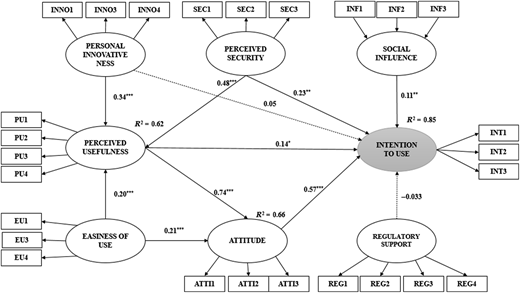
The final structural model explained a significant amount of the variance in the intention to use cryptocurrencies to pay for tourist services (R2 = 85%). The variance in perceived usefulness (R2 = 62%) and attitude (R2 = 66%) was also largely explained by the model according to the standards of Cohen et al. (2003). Consequently, the proposed model satisfactorily explains the attitudes and intentions to use cryptocurrencies to pay for tourist services. Figure 3 illustrates the final model, while Table 3 specifies its main results.
5. Discussion
This study aimed to analyze the determinants that influence the intention to use cryptocurrencies as payment for tourist services. Only two hypotheses were effectively rejected: H6 (regulatory support influences intention to use), and H8b (personal innovation influences intention to use).
The evidence suggests that regulatory support does not affect the intention to use cryptocurrencies to pay for tourist services (H6). Although some authors claim that regulatory support is a motivating factor for the adoption of cryptocurrencies (Yeong et al., 2019; Schaupp and Festa, 2018; Albayati et al., 2020; Reis and Coeli, 2019), our research is consistent with dissonant evidence such as those from Gonzálvez-Gallego and Pérez-Cárceles (2021), who claim that general political and legal interventions may discourage individuals from using cryptocurrencies. Users of this technology value disintermediation and decentralization; therefore, they may oppose regulations or alterations to the system's underlying structure.
The rejection of hypothesis H8b contradicts some previous research results (Khazaei, 2020; Abbasi et al., 2021). However, the relationship between personal innovativeness and perceived usefulness was significant, corroborating the results of Sohaib et al. (2019). Therefore, there is only an indirect effect of personal innovativeness on intention to use, which is mediated by perceived usefulness. When innovators perceive cryptocurrencies as useful, they tend to make greater use of these assets in tourism.
Regarding the hypothesis of the perceived usefulness effect on the attitude towards the use of cryptocurrencies in tourism (H1), our results revealed a highly significant relationship, corroborating several previous studies (Palos-Sanchez et al., 2021; Walton and Johnston, 2018; Albayati et al., 2020; Alaklabi and Kang, 2021). Users participating in this research attest to the perceived usefulness of cryptocurrencies when it comes to paying for tourist services.
The influence of perceived usefulness on the intention to use cryptocurrencies to pay for tourist services (H2) also proved to be supported (p < 0.05). The benefits of using cryptocurrencies as a means of payment are consistent with the findings of several authors, including Palos-Sanchez et al. (2021), Nuryyev et al. (2020), Mendoza-Tello et al. (2019), Nadeem et al. (2021), Khazaei (2020), Alaklabi and Kang (2021) and Abbasi et al. (2021).
Hypothesis H3, which tested the influence of perceived ease of use on perceived usefulness, was supported by evidence. This result is consistent with Palos-Sanchez et al. (2021), Mendoza-Tello et al. (2019), Nadeem et al. (2021), Albayati et al. (2020) and Abbasi et al. (2021). Due to the data collection of this study being carried out with cryptocurrency users, it is inferred that the participants are equipped with basic financial knowledge, as well as having the technical knowledge to make use of this technology. Thus, the perception of perceived ease of use has a positive influence on perceived usefulness because making payments with cryptocurrencies for any travel-related service requires specific skills, which consequently leads to the effect of perceived usefulness.
Hypothesis H4, which tested the effect of perceived ease of use on attitude, was also supported by the results, corroborating Palos-Sanchez et al. (2021), Walton and Johnston (2018) and Albayati et al. (2020). Prior knowledge about cryptocurrencies leads to a positive attitude towards using them as a means of payment for tourist services. To effectively facilitate the adoption of cryptocurrency payments, tour operators should promote cryptocurrency payments on their websites by providing tutorials, and promotional videos that emphasize the novelty and intuitive benefits of cryptocurrency payments (e.g. lower prices, rewards and user ease of use payment processes) (Moon et al., 2025).
Likewise, the effect of attitude on intention (H5) was highly significant, confirming that if an individual believes that making transactions in cryptocurrencies is a good idea, the intention to pay for tourist services will be higher (Schaupp and Festa, 2018). This claim is corroborated by several authors, such as Palos-Sanchez et al. (2021), Alaklabi and Kang (2021), Albayati et al. (2020), Schaupp and Festa (2018), Walton and Johnston (2018). Attitude proved to be one of the greatest influences of the intention to use cryptocurrencies in travel monetary transactions because individuals intend to use it only when they have a positive evaluation of this technology.
Hypotheses H7a (security influencing perceived usefulness) and H7b (security influencing intention to use) were tested, and both were supported by evidence, corroborating the findings of authors such as Mendoza-Tello et al. (2019), Jankeeparsad and Tewari (2018) and Khazaei (2020). Individuals who perform online transactions have specific security concerns (Balasubramanian et al., 2022), especially regarding leakages of confidential information and monetary losses (Zaghloul et al., 2020). Thus, the level of security of an online system leads to the acceptance or rejection of the system (Nadeem et al., 2021).
The relationship between security and perceived usefulness was stronger than the relationship between security and intention. When individuals believe that making payment transactions for tourist services with cryptocurrencies implies security and data privacy, they tend to perceive the technology as useful. Although the effect of perceived security was weaker on the intention to use than on the perceived usefulness, perceived security also affects users' intention to use, as they will feel more secure when using cryptocurrencies to pay for their tourist services. Thus, businesses that offer cryptocurrency payments and strong data security measures can attract travelers with this technological knowledge (Foroudi et al., 2026).
Finally, hypothesis H9 tested the effect of social influence on the intention to use cryptocurrencies to pay for tourist services. Social influence, in this study, refers to how much cryptocurrency users are more likely to adopt them as a means of payment for tourist services if significant people in their social circle are using or recommending it. The results showed that social influence positively affects the intention to use cryptocurrencies, which can be seen in previous studies (Nuryyev et al., 2020; Khazaei, 2020; Alaklabi and Kang, 2021). This finding suggests that users will conceive a favorable view, as those they trust use them for payments for tourist services.
The structural model yielded satisfactory fit indices, paths and R2 (variances). Regarding the R2 of each dependent variable, the R2 of perceived usefulness was 0.62, of attitude was 0.66 and of intention to use was 0.85. These results suggested that the proposed model is valid. The results show that the intention to use cryptocurrencies as a means of payment for tourist services is influenced by perceived ease of use, perceived usefulness, attitude, personal innovativeness, perceived security and social influence.
5.1 Theoretical contributions
This study provided insights into a large area that has been receiving considerable attention from researchers: tourism and new technologies, especially blockchain. In the context of this research, which deals with the adoption of cryptocurrencies in the tourism sector, it is worth noting that there was a deepening in the study of this specific innovation based on blockchain technology in tourism (Mountije et al., 2025; Suanpang et al., 2024).
The theoretical contributions of the research aimed to provide evidence of the determinants that affect the intention to use cryptocurrencies as a means of payment for tourist services. Our work extends the TAM model, adding four new constructs, that is perceived security, regulatory support, personal innovativeness and social influence, to understand the behavior of cryptocurrency users regarding their monetary transactions in the travel context.
Our literature review aimed to advance and broaden the TAM, a widely recognized framework utilized in research focused on understanding individuals' intentions to adopt new technologies. Thus, our main theoretical contribution concerns the variables added to the model, addressing the specificities of cryptocurrencies to broaden the list of determinants influencing the intention to use them as payment method for tourist services. The inclusion of additional dimensions within a comprehensive, integrated model has demonstrated a substantial improvement in explaining the intention to use cryptocurrencies in tourism.
5.2 Practical implications
The present research brings findings through the validated theoretical model that benefits various tourism activities, such as travel agencies, hotels, airline companies and tourists. These organizations can use the results of this study to improve their performance and capitalize on technology offerings in their ventures. They can provide the public with the necessary training before unexpected financial problems arise.
Given that ease of use affects both perceived usefulness and attitudes toward cryptocurrency adoption, tourism firms should actively reduce the technical barriers travelers face. Instead of requiring customers to develop complex cryptographic skills on their own, tourism managers should provide intuitive, low-friction interfaces at the point of sale. In practice, this means using payment infrastructure that hides the complexity of blockchain transactions from users. Tourism organizations should adopt plug-and-play crypto gateways with familiar checkout layouts, one-click mobile wallet integration and automatic QR code generation similar to standard digital payment apps. Additionally, travel agencies and hospitality providers should offer dedicated, 24/7 customer assistance specifically trained in crypto-transaction monitoring to handle payment verifications instantly.
Since perceived security influences the final purchase decision, tourism intermediaries and platforms should move beyond generic trust-building efforts and focus on implementing high-security payment systems. To give travelers full control and clear visibility over their payments, tourism firms should implement end-to-end cryptographic tracking systems in their user dashboards. This requires integrating real-time API webhooks connected directly to public blockchain explorers (such as Etherscan or Blockchain.com). The interface should present a real-time, easy-to-understand record of block confirmations, transaction hashes and network fees, helping reduce concerns about digital assets being lost during settlement.
Regarding the social influence construct, it is necessary to increase the visibility of cryptocurrencies through advertisements, to endorse the benefits of cryptocurrencies in the media. Also, travel platforms and hotel chains should integrate social proof mechanisms directly into their booking ecosystems, such as prominent “Crypto-Verified” badges on user reviews, dedicated sections highlighting testimonials from web3 travelers and user-generated content (UGC) loops that reward tourists with tokenized loyalty points when they share their crypto-funded travel experiences on social channels.
The implications of this study, while focused on the tourism context, also relate to other relevant actors, such as financial institutions and public policy makers, who can contribute to the safe dissemination of cryptocurrencies. For this technology to be perceived as ease to use and useful for tourists, it is necessary for users to possess basic technological knowledge and skills, which reinforces the importance of educational and guidance actions promoted by organizations in the sector.
Furthermore, consumer confidence is directly associated with the guarantee of confidentiality of personal data and the transparency of transactions, making it essential that cryptocurrency payment services be adapted to the national context and its cultural and regulatory specificities, in order to strengthen social influence and encourage its adoption in tourism activities.
Although cryptocurrencies are secure in themselves, managing these assets requires external security systems, such as for managing wallets and storing keys. In this sense, regularly ensuring the platform's security and disclosing the results of security audits can increase consumer confidence in the process (Lee, 2026).
5.3 Limitations and future research
A limitation of this research refers to the non-exploration of other dimensions as potential influencers of the intention to use cryptocurrencies as a means of payment for tourist services, such as experience, financial literacy, gender, age, which can be observed, culminating in significant advancements in understanding the adoption of cryptocurrencies.
In the assessment of the convergent validity of regulatory support, the AVE value below 0.50 was interpreted as evidence of a limitation in the measurement model of the construct, suggesting that the items used may not capture the intended theoretical dimension with sufficient consistency. This limitation was considered in the discussion of the results of hypothesis H6, serving as a complementary element for interpreting the structural relationship under analysis, but without replacing the appropriate statistical tests used to assess relationships among latent variables.
The study considered cryptocurrencies as a unique and homogeneous thing. Nevertheless, there are thousands of cryptocurrencies spread worldwide, which may have particularities that differentiate them. Taking the example of Bitcoin, the most popular, one of its attributes is scarcity, so users may not intend to use it as a means of payment for tourist services because it is mostly regarded as an investment. In this sense, the replication of this study focusing on a specific cryptocurrency may present different results and new approaches to the intention of use for tourist services.
Another relevant approach would be the use of other scientific methods to analyze the intention to use cryptocurrencies, being able to investigate the determinants that affect the intention to use cryptocurrencies as a means of payment for tourist services separated by distinctive groups. For example, by the frequency of use of cryptocurrencies, conducting a comparison of the results of the group of those who always use them with those who use them less frequently. Similarly, comparisons by groups with different travel motivations (leisure, business, cultural, events, etc.) can also corroborate with the refinement of new analyses.
A quantitative method was the main mechanism used in data analysis. It would be advisable to apply qualitative methods in future research to expand understanding and encourage new theoretical developments related to this area of investigation.
Finally, this study was cross-sectional in nature. It does not allow for strong casual inferences, even though the model structure may suggest casual relationships. Also, this study focused on current crypto users in Brazil. The findings may differ for non-users, and in other countries, for example. Furthermore, care should be taken with the generalizations of the conclusions, as they represent the crypto users analyzed in the present research using a non-probability (convenience and snowball) sampling.
An earlier version of this study was presented at the INC2024 (Tourism, Hospitality and Events INternational Conference) “Technology Enabled Competitiveness and Experiences in Tourism, Hospitality and Events” at the Hotelschool The Hague in Amsterdam, the Netherlands. Also, this paper is based on the first author’s doctoral dissertation defended in the Graduate Program in Tourism at Federal University of Rio Grande do Norte (UFRN), Natal, Brazil.
The supplementary material for this article can be found online.