The purpose of this study is to examine the trend toward purchasing locally grown food and evaluate if tourists visiting Hawai'i are willing to pay more for locally produced foods that are more ecologically sustainable.
A research questionnaire was developed in order to investigate the attitudes and behaviors of tourists from the continental United States visiting Hawai'i in purchasing locally grown food in Hawai'i. The final sample includes 454 valid survey responses collected via Momentive, a market research services company.
According to the findings of this study, there are economic prospects to expand the use of locally cultivated food into the tourists' experience, as well as a willingness for tourists to support these activities financially. The Contingent Valuation study revealed that tourists from the continental United States were ready to pay a higher price to purchase food that is locally grown, signifying that tourists to Hawai'i are willing to aid the local agriculture business by increasing their restaurant/hotel meal bill, which will help Hawai'i become a more sustainable tourist destination.
While tourists from the United States mainland, which is the “an islands” top tourist market, have agreed with paying extra or an additional fee for locally grown food products, this study might not accurately represent the attitudes and behaviors of international tourists visiting Hawai'i. Future research should focus on the international tourist markets which may have different social norms or cultural differences thus could provide a broader spectrum of the current study's findings.
The results of this study provided quantitative evidence that tourists from the United States are interested in purchasing locally grown food items in Hawaii in addition to their willingness to pay an additional fee for these locally grown food products at a restaurant or a hotel dining room, thus addressing a gap in the tourism research.
Introduction
For years, sustainable food consumption and production have been major elements of corporate social responsibility and have been at the center of many debates in academia and business. Previous studies and existing literature on the subject have addressed the sustainability of local food suppliers (Annunziata and Vecchio, 2011; Aschemann-Witzel and Hamm, 2010; Beardsworth et al., 2002; Brklacich et al., 1991; Bublitz et al., 2010; Carrigan et al., 2017; Devcich et al., 2007; Devlin et al., 2014; Falguera et al., 2012; Food and Agriculture Organization, 2019; Gupta, 2019; Hartmann and Siegrist, 2017; Hedin et al., 2019; Hoek et al., 2017; Leach et al., 2016; Miles et al., 2017; Reisch et al., 2013; Ross et al., 2015; Thornsbury and Martinez, 2012; Tobler et al., 2011; Topolska et al., 2021; Vermeir and Verbeke, 2006; Willett et al., 2019; Zaman et al., 2020). In the tourism sector, the interest in sustainable food consumption and production has manifested in recent years with greater urgency, especially from the moment it became globally essential for companies in the sector to start taking responsibility for their actions' effects and to understand the importance of their contributions to sustainable development (Andersson et al., 2017; Carrigan et al., 2017; Chambers et al., 2014; Fennell and Bowyer, 2020; Hall, 2019; Han, 2021; Hartmann and Siegrist, 2017; Hedin et al., 2019; Higgins-Desbiolles, 2018; Miles et al., 2017; Pan et al., 2018; Vågsholm et al., 2020; Willett et al., 2019; Zaman et al., 2020). Around the globe, there has been an increase in people's awareness of purchasing locally grown food products. The phrase “from local farm to table” has grown in popularity around the world (Brune et al., 2021). Hawai'i is no exception to this trend of purchasing food grown locally in the islands. Hawai'i's Tourism Authority has started a campaign titled the “Malama Initiative,” and one of the initiatives is titled “Sustainable Farming: Malama Hawai'i,” to support sustainable farming in Hawai'i (Hawaii Tourism Authority, 2022). With close to 90% of all the food in Hawai'i being imported and being the most isolated island chain in the world that has a population of over one million residents and over 10 million visitors, Hawai'i has begun growing more diversified crops to lower the amount of food that is imported to Hawai'i as well as lowering the carbon footprint caused by importing all the food to be more sustainable (Agrusa et al., 2021).
Sustainable food consumption and production are based on consumers' choices, attitudes and preferences, also referred to as “consumer behavior,” which refers to how individuals feel and think when purchasing a product or service (Hussain et al., 2022). Consumer behavior, according to Solomon, is the study of the processes that occur when people or groups choose, acquire, utilize, or dispose of products, services, ideas, or experiences to satisfy wants and desires (Solomon, 1992). According to Van Raaij (1986), consumer research on tourism should be a cornerstone of marketing strategy. “In fact, knowing consumer behavior is essential in order to conduct proper engagement research in touristic and recreational contexts and gives recommendations for future studies” (Van Raaij, 1986, p. 2). Several behavioral factors impact tourist consumption in travel, vacation and leisure. As a result, an accurate understanding of tourists' consumption behavior is critical for the hospitality and tourism industry, service providers and other stakeholders. In general, four factors are regarded as critical in consumers' decision-making processes: internal, external, situational and marketing mix (Dixit et al., 2019). The growing sophistication of hospitality and tourist services and experiences makes it difficult for businesses to sell them effectively. Consumer behavior research helps marketers understand what customers desire and why they choose some items over others. By revealing how customers react to goods and services, marketing allows marketers to examine their target audience's wants and expectations and work toward meeting them. On another note, making people's eating habits more ecologically friendly and environmentally sustainable is becoming increasingly crucial (Hartmann and Siegrist, 2017; Hedin et al., 2019; Springmann et al., 2016). Individuals' food consumption accounts for more than 60% of global greenhouse gas emissions and 50–80% of overall resource use (Ivanova et al., 2016).
According to Ares and Gámbaro (2007), sex and age might impact the purchase of socially responsible meals based on their functional enrichment. In general, younger customers tend to be more interested in purchasing sustainable foods with claims about health advantages rather than similar items with claims about illness prevention. For elderly customers, however, the reverse is true and has been at the center of many debates in academia and business. Numerous studies on the subject have contributed to increasing complexity by generating many notions and definitions (Abood et al., 2003; Aschemann-Witzel and Hamm, 2010; Beardsworth et al., 2002; Granqvist and Ritvala, 2016; Menrad, 2003; Qin and Brown, 2008; Roe et al., 1999; Topolska et al., 2021; Van Kleef et al., 2005). In the tourism sector, the interest in sustainable food consumption and production has manifested in recent years with greater urgency, especially from the moment it became globally essential for companies in the sector to start taking responsibility for their actions' effects and understanding the importance of their contributions to sustainable development.
The goal of the following research project is to link sustainable food consumption and production to the tourism industry, as well as to look into tourists' willingness to pay additional cost for sustainable food. We investigate if tourists to an island vacation are willing to pay a higher premium for locally grown food products. In order to be more sustainable, the study looked at how much tourists are ready to spend for locally grown food. This research will focus on tourists' impressions of locally grown food, the sustainability of Hawai'i tourism products and tourists' willingness to pay a premium for these locally grown food products from the continental United States. This research project surveyed tourists' perceptions of purchasing locally grown food during their stay in Hawai'i and identify potential economic opportunities to integrate locally grown foods further into the tourist's experience and their willingness to support these sustainable activities. The purpose of this study is to examine the present state of purchasing locally grown food and assess whether visitors visiting Hawai'i are prepared to pay extra for more environmentally friendly foods supplied locally. Specifically, this study's aim is to answer the following research questions, which underpin this exploratory study.
What are the current trends in purchasing locally grown food?
To what extent are tourists willing to pay more for locally sourced food that is more environmentally sustainable?
Considering the aforementioned increasing interest in sustainable food consumption and production, this study will make significant contributions to the literature regarding this topic. Moreover, this study presented theoretical and practical contributions to a wide range of stakeholders regarding current visitors' trends in purchasing locally grown food as well as examined tourists in Hawai'i and their commitment to pay an additional cost for locally sourced foods that are more ecologically sustainable.
Literature review
Shrinking tourists' carbon footprint is a major element in the evolution of a sustainable destination (McLoughlin et al., 2018). At secluded destinations, such as remote island resorts, the importation of food adds to tourists' carbon footprint, and with Hawai'i being the most secluded populated island chain in the world, this is a major concern (Connell, 2018). With the state of Hawai'i welcoming a record number of over 10 million tourists in 2019 and having over 90% of its food imported, to improve sustainability, such an isolated tourist destination will have to make major adjustments to its food supply (Hawai'i Tourism Authority, 2020). A repositioning of the islands' food supply should be considered an opportunity to shrink the carbon footprint and become a more sustainable destination.
Sustainable food production
The concepts of sustainable production and sustainability within the food and farming system can be interpreted and understood from different perspectives. Among the various views, the six that have been most successful over the years are: environmental accounting, sustained yield, carrying capacity, production unit viability, product supply, security and equity view (Brklacich et al., 1991; Helms, 2004; Kremen et al., 2012; Tamburini et al., 2020). Therefore, sustainable food production practices should attempt to respect the characteristics and resolve the critical issues of all these six aforementioned elements. Only in compliance with these characteristics, it is possible to state that “a sustainable food production system is defined as an agri-food sector that, over the long-term, can simultaneously: (1) maintain or enhance environmental quality, (2) provide adequate economic and social rewards to all individuals and firms in the production system, and (3) produce a sufficient and accessible food supply” (Brklacich et al., 1991, p. 10).
Therefore, the social responsibility of agri-food companies cannot remain relegated to a purely theoretical sphere but must be translated into concrete actions, investments and partnerships along the entire food supply chain (Ross et al., 2015; Zaman et al., 2020). The value and impacts generated by these actions must be measured, and over the years, this issue has generated discussions on the most appropriate evaluation methods for the sector. The ability to dictate long-term policies in food and agricultural production must necessarily be integrated with the monitoring of results since only by mapping the progress of policies it is possible to achieve the set objectives, both international and national (Food and Agriculture Organization, 2019). In the past, the most observed and evaluated dimension of food production was the economic one, making the results explicit in economic-financial indicators. Today, however, a more structured and holistic evaluation approach to food production is required, also incorporating the dimension of sustainability (Biggs et al., 2015; Devlin et al., 2014; Negri et al., 2021). Among the evaluation approaches that are most widespread for the environmental dimension of sustainability, there is the one based on footprints. Through this approach, agri-food entities have the flexibility to either adopt footprints or not, since their use is not mandatory. While not having a regulatory value, these indicators have the power to provide detailed information to stakeholders, making them more aware of the impacts deriving from goods or services purchased or from the operations of the manufacturing company (Brklacich et al., 1991; Khan et al., 2021; Ross et al., 2015).
Among the possible footprints, those whose attention by agri-food companies and the community has grown over time, are the ecological footprint (the total amount of resources to be used to produce goods and services or support a particular lifestyle, in relation to the biocapacity of the planet). The carbon footprint (the total of greenhouse gases emitted during the production, transformation, and distribution phases, measured in CO2 equivalent), and the water footprint (the volume of freshwater consumed directly or indirectly by the entire production chain of a good). The objectives of the footprints are to verify the impact in terms of the environment, water consumption and pollution (Chambers et al., 2014; Leach et al., 2016; Reisch et al., 2013; Vågsholm et al., 2020). Over the years, the footprint assessment has developed based on the life cycle assessment methodology, which, to date, is the most complete and used to identify the impacts detected along with the agri-food companies. This is a systematic methodology for quantifying and estimating the environmental impacts associated with a product, service or activity, considering both the flows of raw materials and energy necessary throughout its life cycle, therefore from the extraction of materials to the disposal of the product that has become waste (Jacquemin et al., 2012; Rugani et al., 2019).
Today, to have sustainable food, the first step is to incorporate sustainability and evaluate all the consequences of its production (Kremen and Miles, 2012; Ponisio et al., 2015; Reganold and Wachter, 2016; Tamburini et al., 2020). The concepts of good and clean food are also interdependent since a clean and sustainable production, which can be obtained with unpolluted and unstressed soil or with animals being raised in healthy environment, creates the conditions for a good food product. Finally, the third and final requirement is a “right” product (Gupta, 2019; Schneider, 2008). This term defines social justice, respect for workers, their skills, their wages and the recognition of the value of small farmers (Gottlieb and Joshi, 2010; Smaal et al., 2021). A sustainable global food system must identify what is right for everyone, in line with the needs of different social classes. Currently, one of the greatest global challenges is linked to achieving a sustainable food production system, ensuring food security for all, and reducing food waste (Garnett, 2014; Hall, 2019; Hoek et al., 2017; La Trobe and Acott, 2000; Miles et al., 2017; Schneider, 2008; Willett et al., 2019).
Not only producers and consumers are engaged in sustainable food practices, but companies and businesses that provide and prepare food for the consumers are engaged as well. Companies that choose to educate and sensitize consumers about environmental issues nowadays judge their success by the recipients' increasing competence, awareness and maturity. As a result, more thoughtful and responsible methods are required than in the past in terms of the nature and qualities of the information sent, both through the product and through marketing campaigns supporting sustainable habits (Confetto et al., 2018; Gordon and French, 2015). Businesses should follow sustainable food practices during the food production phase and have a sustainable orientation in terms of corporate communication aimed at sensitizing consumers on environmental issues. However, at present, businesses do not have specific sustainable food practices, standards, or procedures to follow, nor official rules or regulations exist to guide them exist either (Confetto et al., 2018; Porter, 1985). One of the biggest sectors involved with sustainable food practices in the restaurant industry. Sustainable restaurants aim at reducing negative impacts on the environment and increasing socio-economic benefits at the same time. This is the greatest challenge of sustainability: that is, to demonstrate the connection between good practices and the improvement of company's performance. In fact, being sustainable requires a different point of view, which translates into a responsible conversion of methods, systems and practices (Camilleri, 2021; Wang et al., 2013). The principles of the sustainable restaurateur are the same as those of citizens who want to protect their health and the environment: a careful choice of raw materials, with an eye also on the way in which food are produced and processed; respect for the agricultural production chain including favoring producers who are more attentive to the environmental impact; as well as a reduction in waste (Alsetoohy et al., 2021). As aforementioned, today, consumers have more information on production and distribution systems and control over what they purchase. Therefore, producers are directly responsible for producing and providing consumers with sustainable food options, which are consequently chosen and consumed by the customers, as the next section outlines (Brklacich et al., 1991; Carrigan et al., 2017; Food and Agriculture Organization, 2019; Garnett, 2014; Helms, 2004; Miles et al., 2017).
Sustainable food consumption
The protection of traditional knowledge, specifically in agriculture, which is emerging again as a global priority as its value is recognized as a tangible and intangible heritage of humanity, is key to all this sustainability change. Another fundamental point for sustainability is the changing habits, behavior and priorities of consumers and their demand for food to be produced in a more environmentally friendly way. Consequently, by providing the consumer with the information that will allow them to become more aware and capable of eco-sustainable decisions is the key to a shift in knowledge (Brklacich et al., 1991; Choi and Sirakaya, 2005; Food and Agriculture Organization, 2019; Helms, 2004; Higgins-Desbiolles, 2018; Reisch et al., 2013; Vågsholm et al., 2020). To achieve this, “green marketing” practices are necessary and addressed to people who have approached sustainability due to environmental concerns. Similarly, Grant (2008) has introduced the Five I's of Green Marketing. In fact, to be successful, green marketing must be: Intuitive (meaning that sustainable innovations should be ordinary and not distant); Integral (every area of the business must be part of the strategy); Innovative (must be able to produce new styles and products); Inviting, (must offer a positive and captivating choice); and finally, the consumers must be Informed (since the more a person has the knowledge, the more they act in the correct way).
Modern consumers no longer want to satisfy simple needs but place themselves on the market with a demand to satisfy growing desires. Consumers structure of preferences is increasingly complex, and for this reason companies that supply products are undergoing a profound transformation (Ahrholdt et al., 2017; Barnes et al., 2016; Shoemaker and Lewis, 1999; Torres and Ronzoni, 2018). Today, the consumer experience represents the essence of the relationship between supply and demand and the consumer's interaction with the external context. This new approach to marketing has, as its founding element, the management and design of a customer experience, that is, the set of interactions that occur between customer and company. A company capable of giving its consumers a memorable experience certainly acquires a competitive advantage even over its competitors (Chen and Chen, 2010; Gannon et al., 2021; Jin et al., 2015; Kandampully et al., 2018; Neal et al., 1999; Torres et al., 2020).
Generally speaking, consumers can either have a material purchase or an experiential purchase. A material purchase is one in which money is spent with the primary goal of acquiring a tangible object, whereas an experiential purchase is one in which money is spent with the goal of acquiring a life experience, which is an event or series of events that each person can personally experience (Andrade et al., 2021; Feng et al., 2021; Jin et al., 2015; Ronzoni et al., 2018; Schmitt, 1999; Tao, 2014; Van Boven and Gilovich, 2003; Voss, 2007). In the food industry field, experiential buying is manifested today in sharing space to realize the social and convivial dimension of eating, creating paths that can bring emotions to life, and where some important values can emerge. Food consumption choices are thus guided by the offer of experience (Brune et al., 2021; Henson and Jaffee, 2008; Hoek et al., 2017; Meo, 2019; Quan and Wang, 2004; Verbeke, 2006).
The consumption of sustainable foods, especially in the last decade and starting from some pioneering countries such as Japan, has progressively spread all over the world, favored by the growing importance of some values such as food safety, the correct lifestyle and a balanced diet have assumed among consumers (Badu-Baiden et al., 2022; Henson and Jaffee, 2008; Hussain et al., 2022; Martirosyan and Singh, 2015). The latter may be interested in buying functional foods because they recognize health properties such as, the prevention of some pathologies or curative effects for others not present in conventional foods (Annunziata and Vecchio, 2011; Kušar et al., 2021; Topolska et al., 2021). Previous studies on this topic have highlighted how consumers who attach great importance to the health aspects of food are more willing to consume functional foods (Boccaletti and Moro, 2000; Henson and Jaffee, 2008; Sharma et al., 2021; Vermeir and Verbeke, 2006), even to the detriment of other characteristics of the food, such as pleasant taste (Badu-Baiden et al., 2022; Florack et al., 2021; Verbeke, 2006). Additionally, certain foods are chosen for their healthiness and contribution to disease prevention (Ares and Gámbaro, 2007; Flaherty et al., 2018; Martirosyan and Singh, 2015; Tudoran et al., 2009; Weller et al., 2008; Willett et al., 2019). Various studies have shown that declarations on the label showing the functional or health properties of foods can be considered an effective means of communication regarding the physiological and nutritional properties of functional foods and the benefits for the health that these foods can bring (Aschemann-Witzel et al., 2013; Hoek et al., 2017; Florack et al., 2021; Galanakis et al., 2021; Tobler et al., 2011; Van Kleef et al., 2005; Willett et al., 2019). Finally, other important elements related to the consumption of sustainable foods are the price and the willingness to pay a premium price for such more expensive sustainable foods.
Willingness to pay
Several authors have observed that consumers' will pay an additional fee or higher cost for functional foods is generally significant when such claims are present on the products in question (Aschemann-Witzel et al., 2013; Chen, 2011a, b; Devcich et al., 2007; Falguera et al., 2012; Florack et al., 2021; Hailu et al., 2009; Larue et al., 2004; Siegrist et al., 2008; Thornsbury and Martinez, 2012; Van Kleef et al., 2005; Willett et al., 2019; Yormirzoev et al., 2021). Furthermore, the consumption of sustainable foods can depend on the socio-demographic characteristics of consumers. Previous studies have found that age has influence on the type of meals that consumers purchased (Ares and Gámbaro, 2007). It has been found in other studies that customers that are younger tend to be more interested in purchasing sustainable foods with claims about health advantages, while more senior or elderly customers select food items with claims about illness prevention (Coderoni and Perito, 2021; Gulseven and Wohlgenant, 2014; Linnes et al., 2022; Vassallo et al., 2009; Verbeke, 2006). Practicality and price are determining factors for young people to purchase food. At the same time, the origin of the raw materials from which sustainable foods are produced is an important factor for middle-aged people (Lillford and Hermansson, 2021; Wądołowska et al., 2009). Despite the intriguing findings in the available research, understanding the elements that might impact the consumption of sustainable foods beyond the traditional characteristics pertaining to healthiness does not appear to be a fully addressed subject. An aspect that deserves further study is the quantification in monetary terms of the value attributed by consumers to functional foods.
Tourism development in Hawai'i
Tourism to Hawai'i began to increase significantly when the islands became the 50th state of the United States and flights between Hawai'i and the mainland were introduced in 1959 (Agrusa, 1994; Mak, 2015). From that point forward, the state of Hawai'i began to select and implement various marketing and destination management strategies, with a primary focus on maximizing economic value and catering to guests' preferences rather than attempting to integrate tourism practices with local culture (Badu-Baiden et al., 2022; Santos et al., 2020). Hawaiian culture has been degraded, distorted and commodified as a result of actions that have reduced Hawaiian culture to tourism (Andrade et al., 2021; Agrusa et al., 2010; Williams and Gonzalez, 2017). A second renaissance of Hawaiian culture in the state of Hawai'i began following the civil rights movement. As a result, traditional Hawaiian culture and arts have been reexamined (Hawaiian Encyclopedia.com, 2021; Hawaiian Renaissance, 2009). The aforementioned social movements encouraged a closer look at Hawai'i's tourist-oriented growth and the role culture plays in the tourism industry. The state of Hawai'i's principal and leading economic industry is tourism. For the ninth year in a row, the tourist industry has been growing (excluding Covid-19 in 2020), with overall visitor expenditure and arrivals continuing to rise. In 2019, over 10.4 million tourists visited the country, up 5.4% over the previous year (Hawaii Tourism Authority, 2019). The tourism industry in Hawai'i generated approximately $17 billion in total tourist expenditure in 2019, resulting in state tax revenues of over $ 2 billion US dollars, highlighting tourisms economic position in the state.
Theoretical background
This study adopts the theory of planned behaviors (TPB) (Ajzen, 1991) as the theoretical foundation for the establishment of the framework proposed in this study. TPB has been adopted in several predictive studies on intention and behavior. This theory, initially born starting from Fishbein and Ajzen's (1977) expectation-value model of attitude, it was later renamed by Ajzen (1991) as the TPB. The only difference between the two is that TPB includes the perceived behavioral control as an additional determinant of intention and behavior. In fact, individual consumers have a desired control over the behavior of interest, and they realize that they are able to perform this behavior only if they want to. The TPB, on which this research lies its analysis, defines that human behavior is driven by three types of factors: the opinions on the results capable of generating certain attitudes toward behavior (that is, attitude toward the behavior); the opinions on the outcomes giving rise to what is defined as subjective norm (that is, subjective norms); and controlling opinions capable of obtaining a more or less strong perceived control over the situation (that is, perceived behavioral control) (Ajzen, 1991). The attitude toward a behavior (considering, for example, the willingness to pay extra to support Hawai'i's sustainable tourism experiences) is relevant for the purpose of determining the intention: in fact, based on opinions regarding future results, attitude affects the determination of the intention. Therefore, in decision-making contexts, behavior is mainly driven by intention and the variables of the TPB (Ajzen, 1985).
Additionally, in stable decision-making contexts, past behavior is able to directly influence the purchase intention: in the case of behaviors such as visits to tourist destinations, retail shops, shopping centers, it was found that the repetition of such behaviors leads to the development and consolidation of a sense of loyalty to the places visited (Alavi et al., 2016; Charng et al., 1988). This link with places has important repercussions on the intentions of individuals since it can induce them to repeat the same behavior almost unconsciously, that is, avoiding the possibility of going to other places to perform the same actions. From a territorial marketing perspective, this phenomenon translates into a relationship of loyalty to a tourist destination, which, in addition to inducing individuals to repeatedly use the same services, can activate particular forms of advertising such as positive word-of-mouth (Ajzen, 1985, 1991; Jang and Cho, 2022; Robinson and Leonhardt, 2018). In this sense, it is expected that tourists are wanting to encourage locally grown food products in Hawai'i and are prepared to pay extra for food farmed locally on the islands, in order to foster sustainable tourism experiences in Hawai'i and promote environmentally friendly tourism practices.
This study also adopts the contingent valuation model (CVM). This model is designed to calculate the economic worth of various products and services. The CVM is the most generally utilized approach for estimating non-use values, and it may be applied to estimate both use and non-use values. The contingent valuation model is known as an “expressed preference” method because it requires individuals to express their values explicitly rather than inferring them from choices, as revealed preference methods do. The contingency valuation model was applied in this study due to the relevance of sustainability, conservation and protecting the land (King and Mazzotta, 2000). As pointed out by Venkatachalam (2004), Ciriacy-Wantrup (1947) originally introduced the contingent valuation model because he believed that preventing soil erosion provides certain additional market advantages that are public goods in nature, and that one way to estimate these benefits is to use a survey method to elicit consumers' willingness to pay for these benefits (Portney, 1994; Hanemann, 1994). Davis (1963), in his dissertation, was one of the first to utilize the contingent valuation model empirically when he conducted a study of geese hunters to evaluate the advantages of goose hunting. In another study, Freeman et al. (2014) explained that people's willingness to pay for the preservation of a resource is simply because it exists. This is referred to as the existence value. The option value refers to people's desire to pay for the preservation of a resource-based for future use. After the two primary non-use values, existence and option values, this contingent valuation model gained prominence. Based on the above review of the literature, in order to answer the research questions stated in the introduction section, this study has formulated the following research hypotheses:
Tourists are willing to support locally grown food products.
The amount of money that visitors are willing to pay extra for locally grown food is positively related to the awareness of being sustainable toward Hawai'i.
Visitors are willing to pay extra to support Hawai'i's sustainable tourism experiences
Visitors feel it is critical for the tourism sector in Hawai'i to support environmentally friendly tourism practices.
Method
The purpose of this research was to investigate some of the attitudes and behaviors of tourists from the mainland United States to Hawai'i. Further, to evaluate the tourists views and commitment about buying locally grown food at a premium price while on vacation in Hawai'i. Crompton and McKay (1997) used a survey device that we modeled after, and it is recognized as an excellent analytical measurement tool. In order to ensure that the participants in this research project met the studies specifications – in this instance, people who are over the age of 18, are US citizens, and had visited Hawai'i in the last three years are the qualifying criteria that was used in this study.
The goal of this research was to look at visitor purchasing habits for locally grown food and evaluate if there is a tourist demand for it, as well as a willingness to pay a premium for it on their restaurant or hotel meal bill. Furthermore, the data gathered through the study's randomly selected sampling technique can better decide whether these activities are financially viable, as well as explore whether there are opportunities to better integrate sustainable food consumption and production into the tourist experience in the United States. Based on the literature research, this study used the contingent valuation method to elicit tourists' willingness to pay a higher price for locally grown food and to investigate “sustainable food consumption and production.” The term “contingent valuation” refers to a sort of stated preference (survey) in which participants indicate their preferences in hypothetical or contingent markets. This allows the researchers to evaluate and provide an estimation for the demand of goods and services that are not traded on the open market (Markandya and Ortiz, 2011).
Initially, we conducted a pilot test, and those who participated in the testing procedure were excluded from the final poll results. Before moving forward with the wider sampling, we evaluated the survey instrument in a pilot test with 40 US citizens who had visited Hawai'i to gain constructive input and make changes to the instrument to lessen the chances of bias in the responses. We ran a pre-test to rule out the potential that some of the survey questionnaire's questions would be difficult for respondents to understand. The pilot test confirmed that the survey questions chosen were relevant and easy to understand. According to Qualtrics (2020) sample-size calculator, at least 385 participants is the appropriate sample size for this study, based on the number of US citizens visiting Hawai'i (reflecting a 95% degree of confidence). The study's final sample consisted of 454 genuine survey responses obtained from Momentive, a market research firm.
Results
Over 63% of the survey respondents a total of 291 were first-time tourists in Hawai'i, and over 36% or 164 of the respondents were return tourists on the islands. Regarding the respondents' age, 27.6% were between the ages of 18 and 29, 27.2% were 30–44, 30.7% were 45–60 and 14.5% were above 60 years of age. Moreover, 59.4% of the participants were women, and 40.6% were men. The respondents in this study were from the entire United States, with 15.06% from the East North Central region, 4.72% from the East South-Central region, 13.03% from the Middle Atlantic region, 5.17% from the Mountain region, 4.27% from New England, 18.65% from the Pacific region, 19.78% from the South Atlantic region, 6.74% from the West North Central region and 12.58% from the West South-Central region. For this empirical study, factor analysis was applied as well as a chi-square test, and the t-test to classify participants as those who would prefer locally grown food and those who would be willing to pay for such products. The results of the analysis can provide a better understanding of tourists' desire for locally grown food in Hawai'i. The analysis of the surveys collected found no statistically significant differences in income or education level. Table 1 displays the respondents, socio-demographic characteristics.
H1: Tourists are willing to support locally grown food products
From the data, 356 (78.24%) of the respondents indicated they would be prepared to pay a premium to support locally farmed food and enhance the farming economy in Hawai'i. To compare genders, an independent sample t-test was conducted, which revealed a significant difference, p = 0.045 < 0.05. Both genders found this statement very important; however, male respondents showed an average willingness of 1.2663 to pay a higher price to support locally produced food (see Table 2).
H2: The amount of money that visitors are willing to pay extra for locally grown food is positively related to the awareness of being sustainable toward Hawai'i
In demonstrating assistance to Hawai'i's farming economy, over 78% of survey respondents stated they would be willing to pay a higher price for locally grown food. The majority of poll respondents indicated that they would be prepared to pay up to 5% more for locally grown food, and on average, respondents were willing to pay between 6 and 10% more. Several respondents claimed that they would be willing to pay an additional 11 to 50% more for locally produced meals in a restaurant or motel. Because the transportation route to Hawai'i is no less than 3,500 miles from the nearest landmass, purchasing locally grown food will result in a lesser carbon impact, making the islands more sustainable. The results provide quantifiable evidence that tourists in Hawai'i are prepared to pay an additional amount of money at restaurants and hotels to support the state's local farming business. Farmers, food and beverage producers, marketers, hotel and restaurant managers, tourist authorities, and politicians can utilize this study's findings to help them make sustainable decisions about locally grown food products. The responses to the open-ended questions confirm that tourists support locally grown food and are willing to pay an addition cost for such products (see Figure 1).
H3: Visitors are willing to pay extra to support Hawai'i's sustainable tourism experiences
The tourists' willingness to spend additional funds to support Hawai'i's long-term sustainable tourism validates the study's results. Compelling evidence shows that visitors are prepared to spend extra money to support Hawai'i's eco-friendly tourism. When asked if they would be willing to pay an additional charge to support long-term sustainable tourism in Hawai'i, more than 70% of survey respondents said “Yes.” Participants between 45 and 60 years of age showed the highest mean, 1.364 (SE = 0.041), and a one-way between-group ANOVA (p = 0.013) showed a significant difference. The age group between 30 and 44 years old scored the lowest on this question, followed by those over 60 years old. Between the ages of 45 and 60, both genders stated that they would be prepared to pay a higher price to promote long-term sustainable tourism, which bodes well for Hawai'i's future as a tourist destination (see Table 3).
H4: Visitors feel it is critical for the tourism sector in Hawai'i to support environmentally friendly tourism practices
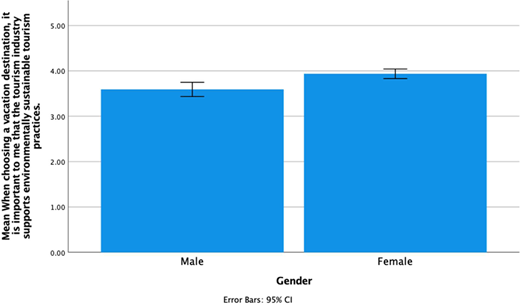
One of the primary questions and topics of interest is whether respondents thought it was vital for the tourism sector to encourage environmentally-friendly tourism practices in Hawai'i. The results indicated a mean of 3.927 out of 5 (SE = 0.053) on this Likert-scale question. An independent sample t-test showed a significant difference (p = 0.001). Both male and female respondents agreed that it was critical for the tourism industry to promote ecologically friendly tourism practices; however, female respondents gave this statement a higher rating. According to a chi-square analysis, these comparisons are statistically different (χ2(2) = 17.730, p < 0.05); however, Cramér's V = 0.198, indicating a moderate relationship among the variables. Error bars are a visual portrayal of the data's variability, used to highlight the error or uncertainty in a given measurement on a graph. They offer a rough indication of how exactly the measurement is or how far away the real (error-free) value is from the reported value (Hair et al., 2010). A short error bar indicates that values are concentrated, indicating that the plotted average value is more likely, whereas a long error bar indicates that values are more spread out and less dependable (The Data Visualization Catalogue, 2022). In this case, error bars can be used to compare the variables visually to determine whether there is a statistically significant difference. The display shows that the p-value is most likely less than the alpha (Hair et al., 2010) (see Figure 2).
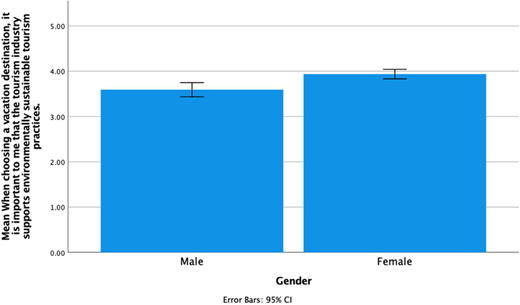
Another inquiry and point of interest were whether the respondents felt it was important for the tourism industry to support culturally respectful tourism practices. The participants' responses ranged from “disagree” (1) to “strongly agree” (5), indicating overall agreement with this assertion. The mean response was 4.170 (SE = 0.053). An independent sample t-test showed a significant difference (p = 0.049). Both genders found this statement important; however, female respondents rated this question higher. According to a chi-square analysis, these comparisons are statistically different (χ2(2) = 9.518, p < 0.05, Cramér's V = 0.145). When one of the categorical variables contains more than two categories, Cramér's V is employed as a measure of the strength of the connection between the two variables. It's a phi variant that is utilized when one or both categorical variables have more than two categories, and phi does not reach its minimum value of 0 (indicating no association). In this case, it indicated a moderate relationship (see Figure 3).
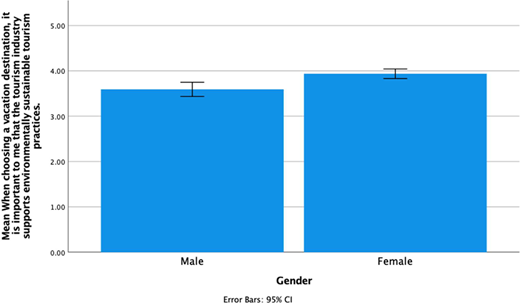
The next question asked whether the participants contemplate their actions' potential consequences when they plan many of their vacations. The mean response was 3.830 (SE = 0.051) on this Likert-scale question, with possible responses ranging from 1 to 5. An independent sample t-test showed a significant difference (p = 0.018). Respondents of both genders found this statement important; however, female respondents rated this statement higher. According to a chi-Square analysis, these comparisons are statistically different (χ2(2) = 11.971, p < 0.05), with Cramér's V = 0.162, indicating a moderate relationship. One might infer that the majority of respondents think about their behavior before deciding on a trip (see Figure 4).
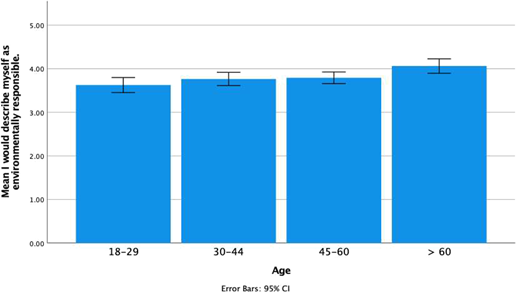
The following question asked whether the respondents would describe themselves as environmentally responsible. The respondents' mean response was 3.778 out of 5 (SE = 0.040). One-way between-group ANOVA indicated that these differences were significant (p = 0.011). All age groups found this statement important; however, those over 60 rated this statement higher (see Figure 5).
Thematic analysis
With the open-ended question “What are some of your primary concerns on your vacation to Hawai'i?” revealed that several of the respondent's primary concern was their vacation cost, of which food is a major component, while in Hawai'i. It is very easy for the tourists to compare the prices of food items on menus in the major chain restaurants here in Hawai'i and see that the prices on the menu are usually 10–15% higher than those of the same restaurant on the mainland due to importation/shipping costs. Most of the participants stated that traveling and vacationing in Hawai'i was expensive but that they would pay more for sustainable, locally grown food products because of the large carbon footprint of importing food to the islands. In addition, many of the respondents had a very favorable impression of Hawai'i as a tourist destination due too its wonderful food and the Hawaiian culture. Sustainability and Hawaiian culture went hand in hand and were at the center of the entire open-ended query. For over 1,000 years prior to Western influence, the residents of Hawai'i were able to survive on locally grown food through the sustainable food system of the Ahupua'a. To enhance Hawai'i's sustainability, it will be critical for Hawai'i to decrease tourism's carbon footprint by using more locally-grown food and to leverage its sustainable food consumption to attract higher-spending tourists who are prepared to pay higher prices for locally grown food products.
This study used thematic analysis to evaluate the open-ended questions. Thematic analysis is a method of evaluating information to gain a deeper insight into the participants' perspectives. Furthermore, thematic analysis exposes data patterns, helping the researcher fully comprehend the research findings (Altinay et al., 2016; Bryman and Bell, 2015; Creswell, 2013; Creswell and Plano, 2007; Field, 2009; Zikmund et al., 2013). The researchers categorized the open-ended questions as follows: (1) supporting locally grown food products, (2) environmentally friendly tourism practices and (3) sustainable tourism experiences. The open-ended replies were also connected to the study's questions to confirm that the responses matched the research questions. Respondents in the first category exhibited an interest in and knowledge of consuming locally grown food products, demonstrating that they recognized the value of local food products that visitors associate with Hawai'i. The tourists also associated certain seafood with Hawai'i. When purchasing locally grown shrimp or local seafood, the tourists help Hawai'i become more sustainable. In addition, the willingness to pay more for food that has a cultural component, such as the type of food served at a Hawaiian Luau, which consists of locally grown food products, also enhances sustainability in Hawai'i. These responses are consistent with research question 1, as they show that tourists are willing to incur an additional cost or fee to purchase locally grown food when visiting Hawai'i (see Table 4).
In the second category, the respondents were concerned with over-tourism that can negatively affect the Hawaiian Islands. They also indicated that the Hawaiian Islands need to be preserved for future generations and that the islands' natural beauty needs to remain intact. Being environmentally friendly means that they act in a way that has the least possible impact on the environment. These responses support research question 2.
Respondents in the third category demonstrated engagement and support in response to study question 2. The following examples demonstrate that the hospitality industry promotes sustainable practices. To create sustainable development, the tourist destination must work in three areas: climate and environment, economy, and social conditions (see Table 5).
The analysis demonstrated that tourists support environmentally and culturally sustainable tourism practices in Hawai'i. Preservation of the island is important to maintain a desirable tourism destination for years to come. This study's findings support the notion that tourists would be willing to pay higher prices for locally grown food, which is a major component of sustainable tourism in Hawai'i. According to the study's results, American visitors are prepared to pay a higher cost to support Hawai'i's sustainable food consumption and production. More than 78% of survey respondents stated they would be ready to pay more for locally grown food in support of Hawai'i's farming economy. In addition, more than 70% of survey respondents specified they would be willing to incur a higher price to bolster Hawai'i's long-term sustainable tourism. Tourists' efforts will result in a lesser carbon footprint, improved island preservation and increased sustainable food consumption in Hawai'i (see Table 6).
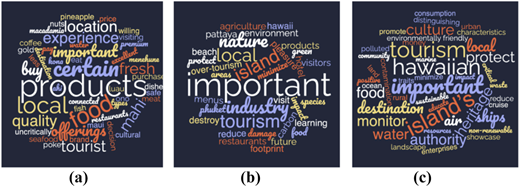
Further, Figure 6 displays three word-clouds that were generated from the respondents' answers to the open-ended questions. Diagram (a) presents the first word cloud, which focuses on tourists supporting and consuming locally grown food products while visiting Hawai'i. Visitors are more aware of and interested in purchasing locally grown food products where sustainability is important and are willing to pay more for locally grown items. Local brand-name products, such as Kona coffee, Mahi Mahi fish, Maui Gold Pineapple and Poke (raw fish that has been seasoned and a famous Hawaiian food), have gained status, and visitors want fresh local food products as well as to engage in a cultural food experience. These findings support H1 and H2. In diagram (b), environmentally friendly tourism practices bring up the issue of over-tourism. The respondents also pointed out other topics, such as agriculture, the environment, wanting to protect beaches and reducing the carbon footprint while on vacation. These findings support H3. In the last diagram (c), regarding industry supporting sustainable tourism practices, respondents addressed water conservation and consumption, educating the public, being environmentally friendly, and continuing to monitor and protect island resources. These findings support H4. With the thematic analysis, the researchers attempted to highlight what the respondents believe is important for Hawai'i, categorizing the responses and displaying the feedback in word clouds. The items presented in the word clouds and mind map are the most important items for the respondents.
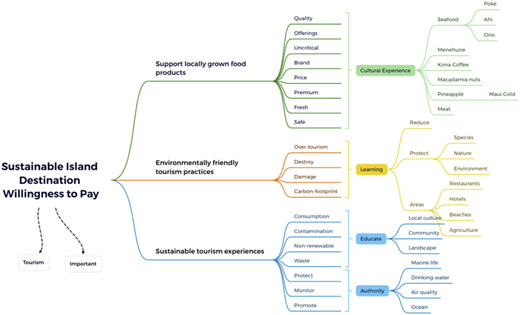
The mind map in Figure 7 demonstrates how items are interconnected. According to Bloom's taxonomy, the sequence of thinking skills is remembering, comprehending, applying, analyzing, evaluating and producing in that order (Phillips et al., 2013). In this case, one can clearly see that the items of importance are connected. Mind maps help improve decision-making processes and clarify topics of importance to visitors, locals and authorities. The major ideas are connected directly to the central topics, which are Hawai'i remaining a sustainable island destination and willingness to pay. To summarize, content analysis is a qualitative analytical approach that focuses on recorded human artifacts. It entails conceptual and relational analysis, which focuses on the links between ideas and how they're linked. When examining the questions from the research survey, the open-ended question responses are in line with the closed-ended responses from the survey.
Discussion and conclusion
We aimed to investigate the attitudes and behaviors of tourists from the continental United States concerning their willingness to pay a premium price to enjoy local food from sustainable sources in Hawai'i. Food habits are notoriously difficult to change since they are such an integral component of people's lives and social surroundings (Cairns, 2019; Flaherty et al., 2018; Sonestedt et al., 2005; Wright et al., 2001). Food choices are also influenced by food companies' marketing efforts, which have resulted in shifts in dietary requirements, eating and drinking category preferences (at the population level), and the cultural values that underlie food habits (Cairns, 2019). Because food-related decisions are so complicated, they are sensitive to a wide range of social, cognitive, emotional and environmental variables (Bublitz et al., 2010). Eating locally is an important principle of sustainable agriculture, which refers to agricultural techniques that show awareness and understanding of the consequences of and strive to minimize the effects of farming on the environment. Because all species are immediately affected by their environments, sustainable farming benefits all organisms, including humans. The study has answered the following research questions: (1) What are the current trends in purchasing locally grown food? (2) To what extent are tourists willing to pay more for locally sourced and more environmentally sustainable food?
Conclusions
The results of this analysis fill a gap in the tourism industry literature by giving quantitative confirmation of American tourists' desire to consume foods cultivated local and readiness to pay a premium for them in a restaurant or hotel. Furthermore, this study discovered quantifiable evidence that tourists from the United States are prepared to pay a higher price to help Hawai'i maintain its long-term tourism viability. In addition, the results of this research project suggest that there is considerable evidence that US tourists are prepared to pay a premium price on products in order to assist local farmers and Hawaii's sustainable tourism goods, with minimal difference between first-time visitors and return visitors to Hawai'i. To guarantee the tourism industry's long-term survival and competitiveness in Hawai'i, one needs always to optimize tourism's value creation in the local community, including what tourists take with them in terms of local values. Hawai'i has a rich culture in terms of local food, including taro, Hawaiian coffee, local pineapple and sugar. Many tourists are willing to learn and give back to the local community while on vacation. In addition, the island is sustainable regarding fish and shrimp with fish and shrimp farms throughout the islands. In many ways, Hawai'i is self-sustainable.
The findings indicate a favorable attitude from tourists toward purchasing locally grown food, and food is a prominent component of Hawaiian events. In addition, food and cultural festivals are held throughout the year, showcasing local food products. On the Big Island, the Kona region is well-known for its premium coffee production, and the annual Kona Coffee Cultural Festival commemorates the coffee bean's history in Hawai'i. This festival, which usually takes place in November, features coffee farm tours, coffee and tea pairing activities, and the Holualoa Village Coffee and Art Stroll, which brings tourists through Holualoa's art enclave (Marriott, 2022). The study clearly validates that visitors are willing to pay extra for quality, cultural or locally grown food products. Preserving and improving the local Hawaiian community's quality of life, including social structures, equitable access to resources, infrastructure, and public goods, as well as preventing social deterioration and exploitation, are necessary to succeed. Furthermore, engaging the local community and local stakeholders in planning, decision making, and the development of local tourism, will lead a more sustainable tourism destination.
Theoretical implications
The results of the current study have provided several important contributions to the literature focused on sustainable food consumption and production in a remote island setting. The scholarly literature includes several studies (Andersson et al., 2017; Carrigan et al., 2017; Chambers et al., 2014; Fennell and Bowyer, 2020; Hall, 2019; Han, 2021; Hartmann and Siegrist, 2017; Hedin et al., 2019; Higgins-Desbiolles, 2018; Miles et al., 2017; Pan et al., 2018; Vågsholm et al., 2020; Willett et al., 2019; Zaman et al., 2020) addressing sustainability in food consumption and production in the greater hospitality and tourism industry, but this might be the first study to examine this concept in a remote island setting. As previous studies have established, consumers are often willing to pay a premium to support causes in which they believe.
This study's results support other studies (Andrade et al., 2021; Ares and Gámbaro, 2007; Boccaletti and Moro, 2000; Chen, 2011a, b; Shepherd, 2009; Siegrist et al., 2008; Tobler et al., 2011; Verbeke, 2006) that demonstrate that consumers exhibit a willingness to pay premium prices to support socially responsible ideals and to advocate for environmentally friendly tourism practices. The study also extends the scope of the contingent valuation model to the context of locally farmed sustainable food in Hawai'i. The contingent valuation model is commonly used to estimate the value of non-market resources. This study provides evidence of this technique's usefulness in studying locally grown food products in Hawai'i and tourists' willingness to pay an additional cost to purchase this locally grown food. In addition, with a large amount of food being imported to Hawaii and the extremely far distance the food has to travel to arrive at the islands in the Pacific, purchasing locally grown food would decrease the carbon footprint significantly, thus bringing these purchases in line with sustainability.
Practical implications
This study provides practical implications to inform the government as well as food and beverage operators and suppliers about opportunities related to sustainable food consumption and production in the Hawaiian Islands. The climate and soil of the Hawaiian Islands are ideal for growing crops and raising livestock. Currently, Hawai'i imports approximately 90% of its food supply for residents and tourists. According to this study's findings, a sizable share of the US tourist market will respond to programs that support sustainability and purchase locally grown food in Hawai'i. Tourists are ready to pay a higher price for locally grown food and will pay to participate in sustainable tourism experiences while visiting Hawai'i. The study's findings provide the government and other stakeholders with the data supporting economic opportunities for providing for more locally grown food products to be available and provide marketers a better grasp of a destination's image and what tourists are prepared to pay for, enabling more targeted marketing efforts that satisfy tourists' demands and the destination's needs. These results inform government officials and agri-businesses concerning the feasibility of expanding local food production in Hawaii.
Furthermore, this study's findings demonstrate that tourists from the continental United States are eager to spend additional money in Hawai'i to support locally grown food and encourage sustainable tourism practices. Recently, changes have occurred in Hawai'i's tourist governance. The Hawai'i Tourism Authority's Malama Hawai'i campaign is one of the new ventures that has emerged as a result of these events to make Hawai'i more sustainable. This study has demonstrated that tourists in Hawai'i are ready to pay a higher price on their restaurant bill or hotel meal bill in order to support locally sourced food products and support local farming, resulting in a smaller carbon footprint by tourists visiting Hawai'i and ensuring that Hawai'i will be a more environmental friendly tourism destination. A great majority of those who took part in this research study were concerned about the environment.
This research has certain limitations. Its findings and conclusions are not applicable to other major tourism markets visiting Hawai'i, specifically the international tourism markets. Future research can also be expanded to investigate Hawaiian residents' opinions of purchasing more locally grown food products and to determine whether the price would be a major issue. For the foreseeable future, the COVID-19 epidemic will have a substantial impact on the worldwide tourist business, but Hawai'i has a once-in-a-lifetime opportunity to capitalize on its current reduced visitor numbers and develop its tourism offerings and procedures. This enhancement process will include a regenerated commitment to addressing and supporting the local farming community's needs in addition to determining tourists' willingness to spend additional money on purchasing locally grown food products. This study aimed to examine one fragment of the refinement process: the demands of tourists from the continental United States visiting Hawai'i and their willingness to pay a premium for locally sourced food products along with being more sustainable and supporting local farmers.
Limitations and future studies
Despite the fact that this study centered on the most recent tourism patterns of American visitors to Hawai'i, it has some limits. First, we collected data from tourists from the United States to Hawai'i, the United States' only island state with a unique native plant and natural environment and that is known for its strong cultural transitions and local foods. Although US visitors to Hawai'i are the island state's largest source of tourists, and the study's findings show that the respondents desire to be more ecologically conscious while on vacation and are ready to spend a higher price to do so for locally grown food products. This study only included domestic travelers, so the findings may not accurately reflect international tourists' behaviors when visiting Hawai'i. Future research should focus on overseas markets with a variety of cultural and ethnic differences in order to broaden the current study's findings. Additionally, because the current study reveals recent travelers' willingness to pay for locally grown food, tourists from other nations may have similar objectives while visiting the Hawaiian Islands. Future research might focus on overseas markets, particularly the Japanese market, which has been Hawai'i's largest and most important international tourist market for the past 40 years. The researchers urge that the survey instrument be translated into Japanese for the Japanese market to obtain the most accurate results (Agrusa and Kim, 2009). The Korean and Australian markets are two other overseas areas that researchers may possibly want to investigate. In addition, researchers may want to examine if the labeling of sustainable goods and services in greater detail and whether the labeling would increase the willingness to pay more for locally grown food in Hawai'i.
The researchers appreciate the research grant from Østfold University College, which has supported this research project. In memory of Jeff Weinland, Ph.D. The research team will miss him greatly.