


Drawing on the source attractiveness model and parasocial theory, this study investigated how influencer type (human vs. virtual) and message appeal (rational vs. emotional) influence festivalgoers' sustainable behaviors.
This study employed a two-stage experimental design with festivalgoers as participants. Stage 1 examined the direct effects of influencer type on sustainable behavioral intentions, as well as indirect effects through serial mediation by source attractiveness and social media engagement. Stage 2 incorporated message appeal, examining its interaction with influencer type and serial mediation through source attractiveness and parasocial relationships.
Virtual influencers drive strong pro-environmental intentions through a significant direct effect, despite a significant source attractiveness deficit compared to humans. While parasocial relationships and engagement typically mediate these outcomes, emotional appeals create a suppression effect, exacerbating the virtual influencer's deficit in perceived source attractiveness while simultaneously strengthening behavioral intentions.
The findings offer practical guidance for festival organizers and destination marketers on how to strategically align influencer type and message appeal with sustainability objectives. They can pair emotional appeals with virtual influencers to enhance pro-environmental behavioral impact, whereas human influencers or community representatives may be better suited to prosocial and relationship-oriented goals.
This study extends research on virtual influencers and sustainable tourism by showing how influencer type and message appeal jointly shape festivalgoers' pro-environmental intentions. It contributes theoretically by positioning source attractiveness as a relational mechanism distinct from source credibility and by identifying a boundary condition under which virtual influencers can motivate pro-environmental action despite lower perceived attractiveness and weakened parasocial pathways.
1. Introduction
Influencer marketing has emerged as a prominent strategy in the digital landscape, capitalizing on the visibility and popularity of individuals to promote products, services and ideas to their online audiences (Aw and Agnihotri, 2024; Kılıç and Gürlek, 2024). Owing to their perceived relatability and authenticity, influencers exert considerable influence on consumer attitudes toward brands, purchase intentions and broader social behaviors (Ye et al., 2021). This influence is of particular urgency in festival tourism, where large-scale events generate substantial environmental costs and reveal a persistent gap between organizers' sustainability goals and festivalgoers' actual behavior (Chi et al., 2022; Mair and Laing, 2013). Yet, effectively leveraging influencers to close this gap requires a more nuanced understanding of what drives their persuasiveness. Although the existing literature underscores the critical role of influencer credibility (Jhawar, 2024; Pop et al., 2022), emerging research suggests that credibility alone may not fully capture an influencer's effectiveness (Jang et al., 2021; Saleh, 2025). In tourism marketing in particular, factors such as charisma, emotionally resonant content, audience connection and perceived authenticity have gained increasing prominence (Saleh, 2025; Yılmaz et al., 2020).
As social media platforms evolve and artificial intelligence (AI) becomes more prevalent, a new phenomenon has emerged: virtual influencers (VIs), computer-generated characters that engage with audiences in ways similar to human influencers (Byun and Ahn, 2023). Due to advantages such as ease of control, timelessness and cost-effectiveness, VIs have been widely adopted in marketing (Vrontis et al., 2021). In the event industry, these artificial personalities engage with audiences on social media platforms and participate in various events, blurring the line between reality and digital simulation. For example, Lil Miquela and Shudu have appeared at music festivals, fashion shows and other high-profile events, interacting with attendees and promoting brands in ways similar to human influencers (Si, 2024). Advances in visual interface design and AI-driven behavioral realism have strengthened VIs' ability to shape consumer attitudes and behaviors (Kim et al., 2024). However, their artificial nature raises questions about authenticity and credibility, which may affect their long-term effectiveness (Sands et al., 2022; Xie-Carson et al., 2024). Research suggests that these challenges can be mitigated through parasocial relationships, one-sided, imagined bonds that audiences form with media personas, which can foster trust and engagement even in the absence of real interaction (Lim and Lee, 2023).
Beyond traditional product endorsements, both human and VIs are increasingly used to advocate for social and environmental causes (Gurrieri et al., 2023). Hoai Lan et al. (2025) found that VI advocacy can effectively promote environmental awareness and behavior. Yet, empirical evidence on the effectiveness of VIs in festival tourism remains limited and inconclusive. For example, Zhang et al. (2025) found contrasting results, indicating that VIs are often perceived as less knowledgeable about human culture and are less effective in endorsing cultural heritage destinations. These mixed findings open up a research avenue to examine which type of influencer, and which message framing, most effectively motivates sustainable behaviors among festivalgoers, a question with direct implications for how festival organizers can leverage influencer marketing to advance sustainability goals (Xie-Carson et al., 2023). Addressing these gaps, the present study proceeds in two analytical stages:
to examine how influencer type (human vs. virtual) shapes festivalgoers' sustainable behaviors, including pro-environmental and prosocial behavioral intentions (RQ1), and whether these effects occur through the serial mediation of source attractiveness and social media engagement (RQ2) and
drawing on the source attractiveness model (McGuire, 1985), to test the interaction effect between influencer type and message appeal (rational vs. emotional) on sustainable festival behaviors (RQ3), as well as a serial mediation pathway through source attractiveness and parasocial relationships linking this interaction to sustainable festival behaviors (RQ4).
This study contributes to the event-tourism and influencer marketing literature by examining how influencer type and message appeal jointly shape sustainable behaviors through the mechanisms of source attractiveness and social media engagement. While prior research has applied the source attractiveness model primarily to product endorsements (Filieri et al., 2023) and destination marketing (Jhawar, 2024; Liu et al., 2025; Zhang et al., 2025), this study extends its relevance to sustainability-oriented festival contexts, where persuasion must translate into environmentally and socially responsible action. Finally, by focusing on festival tourism, the study provides actionable guidance for festival organizers on leveraging strategic influencer partnerships to enhance event sustainability and drive meaningful behavioral change.
2. Literature review and research questions
2.1 Source attractiveness model
To understand influencer marketing, early research on celebrity endorsements provides a critical theoretical foundation. The source credibility model posits that persuasion depends on perceptions of an endorser's trustworthiness (e.g. honesty, integrity) and expertise (e.g. knowledge, experience, skill) (Hovland et al., 1953). However, this model does not fully account for situations in which attractive sources elicit more favorable attitudes and responses (Kelman, 1958). To address this gap, McGuire (1985) introduced the source attractiveness model, which argues that audiences are more likely to be persuaded by sources perceived as physically or socially attractive, such as shared beliefs, likable personality traits, interpersonal skills and lifestyle (Ohanian, 1990). Thus, in this study, source attractiveness is defined as the likability of influencers and their perceived ability to build relationships with followers (Kim and Park, 2023; Masuda et al., 2022).
Source attractiveness is particularly relevant in influencer marketing, where influencers are often viewed as more relatable than traditional celebrities because of their direct follower engagement and personal self-disclosure (Leite et al., 2024; Vrontis et al., 2021). Influencers who appear socially attractive and share similar beliefs or interests with their audiences are more likely to foster parasocial interactions – one-sided emotional connections – that enhance perceived persuasiveness (Sokolova and Kefi, 2020). Prior studies indicate that influencers' attractiveness shapes their perceived credibility and expertise, influencing audiences' initial judgments, engagement, message acceptance and marketing outcomes such as brand attachment and purchase intention (Masuda et al., 2022; Yoo et al., 2024). In the current study, the source attractiveness model serves as the theoretical foundation for examining how influencer types (human vs. virtual) and message appeals (emotional vs. rational) jointly shape festivalgoers' sustainable behaviors.
2.1.1 Influencer type (human and virtual influencers)
Influencer marketing leverages key individuals or opinion leaders to shape consumers' brand awareness and purchase decisions across social media platforms (Kim and Baek, 2022; Polat et al., 2024). Freberg et al. (2011) described social media influencers as independent third-party endorsers who shape audience attitudes through content shared on blogs, tweets and other social media. Their success typically depends on producing high-quality, consistent content within a defined area of expertise, which helps them build substantial followings that signal source attractiveness and perceived credibility (De Veirman et al., 2017; Kim et al., 2025).
Advancements in AI and virtual reality have given rise to VIs, defined as computer-generated characters orchestrated by humans and/or AI algorithms, whose personalities are presented through a first-person perspective (Xie-Carson et al., 2023). Despite being digital creations, VIs are often designed with attractive appearances, distinct personas and engaging storylines, comparable to human influencers (Deng and Jiang, 2023; Lee and Yuan, 2023). Unlike human influencers, whose self-presentation may be constrained by gender, appearance or socioeconomic status, VIs offer substantial customizability in visual appeal and narrative construction (Choudhry et al., 2022; Thomas and Fowler, 2021). By sharing stylized fictional lives and interacting with followers, VIs can cultivate perceived authenticity and intimacy (Thomas et al., 2025), thereby enhancing their source attractiveness, which may appeal to specific follower segments and tourism brands (Lee and Yuan, 2023; Lou et al., 2023). Thus, source attractiveness may be a particular strength of VIs in promoting events and tourism experiences. This study extends the source attractiveness model by examining how its mechanisms function differently between virtual and human influencers, offering new insights into influencer effectiveness in event marketing.
2.1.2 Message appeals (rationale and emotional appeal)
Message appeal is a critical determinant of how effectively information is communicated and how persuasively it influences consumer behavior (Djafarova and Trofimenko, 2019; Kotler and Keller, 2008; Wu and Wang, 2011). Kotler and Keller (2008) classified message appeals into two types:
rational appeal – emphasizes product attributes by highlighting audience benefits and
emotional appeal – aims to evoke positive or negative emotions to stimulate audience intentions.
Rational appeals, rooted in facts and logical reasoning, are especially influential when consumers require detailed information to make informed decisions. When audiences focus on product details such as functions, features and benefits, rational messages are particularly persuasive in shaping purchase intentions (Xiang et al., 2019), and they are also effective for credence services (e.g. medical or legal), where expertise and reliability are critical (Zhang et al., 2014). Emotional appeals, by contrast, are more effective for experience-based services (Noble et al., 2014). Emotional narratives that highlight urgency generate stronger social and environmental support than more detail-oriented rational messages (Choi and Choi, 2024). From the audience's perspective, influencers who share real-life experiences and emotions tend to be perceived as friendlier and more authentic (Chen et al., 2024), enhancing both source attractiveness and message persuasiveness (Aeron and Rahman, 2023; Ismagilova et al., 2020).
In influencer marketing, message appeal moderates how influencer type translates into user responses. Emotional appeals often align more naturally with human influencers, who are perceived as genuinely capable of expressing emotions, whereas VIs may face greater skepticism when using purely emotional appeals (Ozdemir et al., 2023). For example, VIs using rational appeals in tourism content have been found to generate higher engagement among Instagram users (Xie-Carson et al., 2024). Taken together, these findings suggest that emotional appeals may work better with human influencers under affect-driven processing, while rational appeals may be more effective for VIs under information-driven processing, a possibility that the present study empirically examines.
2.2 Social media influencers and sustainable behaviors in festivals
Festivals are themed public celebrations, typically of limited duration, organized around shared cultural, artistic or recreational themes (e.g. music, food, film and cultural events) that attract diverse audiences and generate significant social and environmental impacts on host communities (Getz and Page, 2016; Mair and Laing, 2013). While they provide fertile ground for fostering communitas and prosocial engagement, festivals are also associated with problematic behaviors such as mass waste generation, excessive resource consumption and/or disrespectful interactions (Alhajri et al., 2023). Regardless of their type or scale, festivals function as critical “living labs” for behavioral interventions. This study examines sustainable festival behaviors through both pro-environmental intentions (e.g. waste reduction, recycling and low-impact choices) and prosocial intentions (e.g. helping attendees and engaging with the community), two related yet distinct dimensions of sustainable participation (Chi et al., 2022; Mair and Laing, 2013). As temporary social microcosms, festivals offer a unique opportunity for behavioral modeling, allowing sustainable practices experienced on-site to spill over into everyday life (Tkaczynski et al., 2022).
Social media influencers can play a crucial role in driving these behavioral shifts (Ding et al., 2024; Kılıç and Gürlek, 2024). Studies suggest that VIs associated with nonprofit campaigns are viewed positively by audiences and are as effective as human influencers in delivering credible environmental and social advocacy messages (Choudhry et al., 2022; Kim and Wang, 2024). They are also recognized as credible endorsers of green products (Jiang et al., 2024), and can effectively encourage participation in climate change prevention (Gerrath et al., 2024), highlighting their growing potential to promote pro-environmental behaviors at festivals.
Prosocial behavior is defined as “voluntary action intended to aid or benefit another” (Labroo et al., 2023), such as offering support, assisting others or engaging in pro-environmental and citizenship behaviors (Li et al., 2024). In festival settings specifically, prosocial conduct, such as helping fellow attendees, respecting shared spaces and supporting host communities, is particularly salient, as individual actions directly shape the collective experience and long-term social sustainability of the event. Although prosocial behavior is a broader construct that includes pro-environmental behavior as a domain-specific expression, this study distinguishes prosocial behavioral intentions (e.g. helping others) from pro-environmental behavioral intentions (e.g. waste reduction and recycling) as two separate yet related aspects of sustainable festival behaviors. This separation enables a nuanced examination of their distinct predictors and pathways (Chi et al., 2022). Influencers have become crucial in shaping such behaviors in real life. Studies show that social media influencers significantly promote citizenship behaviors (Bu et al., 2022). Recent experiments further suggest that while human influencers are generally more persuasive in promoting prosocial behavior, VIs are effective when posts clearly demonstrate brand associations (Igarashi et al., 2024).
While these findings suggest that influencer-driven content can encourage prosocial behaviors, further research is needed on how social media influencers shape participants' prosocial behavior (Gao et al., 2025; Li et al., 2024), particularly in festival tourism contexts. Based on the arguments above, we propose the following two research questions:
Do festival-goers respond differently to influencer types (virtual vs. human) regarding their pro-environmental and prosocial behavioral intentions?
Does influencer type influence festival-goers’ pro-environmental and prosocial behaviors through the serial mediation of source attractiveness and social media engagement?
2.3 Source attractiveness and user engagement
As noted above, source attractiveness is the extent to which a person is perceived as likable or desirable as a social partner (Sokolova and Kefi, 2020). For social media influencers, particularly micro-celebrities, this dimension is crucial for effective message delivery and significantly influences audiences' engagement (AlFarraj et al., 2021; Choudhry et al., 2022; Djafarova and Trofimenko, 2019). This study conceptualizes engagement as a multidimensional construct encompassing cognitive, emotional and behavioral dimensions (Brodie et al., 2011; Lim et al., 2022), reflected in users' personal involvement, perceived relevance and satisfaction with social media content. When users feel emotionally connected or attracted to influencers, they tend to become more attentive to their content, perceive it as higher in quality and usefulness, and are more likely to follow their recommendations (Filieri et al., 2023; Saleem and Ellahi, 2017).
The source attractiveness of influencers can help build their perceived trustworthiness and expertise (Lou and Yuan, 2019; Masuda et al., 2022; Wang and Scheinbaum, 2018). These perceptions then increase audiences' affective evaluations of social media posts (Baker and Churchill, 1977). For VIs who are perceived as socially attractive, they may also alleviate audience anxiety and lower perceived social pressure (Deng and Jiang, 2023), facilitating engagement even in the absence of real human interaction (AlFarraj et al., 2021). Message appeal reinforces this process: emotional appeals, in particular, can foster affective attachment and perceptions of friendliness (Moreira et al., 2025), thereby increasing the perceived attractiveness of the message source (Zhan et al., 2024). Guided by these insights, this article proposes the following research question:
Will the use of different message appeal strategies (emotional vs. rational) significantly influence how influencer type (virtual vs. human) affects festival-goers’ pro-environmental and prosocial behavioral intentions?
2.4 Source attractiveness and parasocial relationship
Parasocial relationships, defined as “an illusionary experience, such that consumers interact with media figures, as if they are present and engaged in a reciprocal relationship” (Labrecque, 2014, p. 135), significantly shape how users respond to influencer content. Originally conceptualized by Horton and Wohl (1956), parasocial relationships refer to the enduring emotional and cognitive bonds that develop through repeated one-sided engagement with media figures. These bonds arise when media figures satisfy individuals' needs for emotional support and social connection by creating an illusion of mutual interaction and intimacy, even in the absence of actual reciprocal communication (Xu et al., 2024).
Recent studies indicate that parasocial interaction is cultivated not only in traditional mass media but also in digital environments, especially on social media, where human and VIs use socially attractive behaviors and personalized content to enhance perceived intimacy and authenticity (Stein et al., 2024). For VIs, presenting themselves as likable, friendly and emotionally expressive can foster parasocial bonds that promote more favorable attitudes and stronger behavioral intentions, such as sharing content or supporting campaigns (Ma and Li, 2024). For instance, Lil Miquela has shared personal stories, such as a breakup with her boyfriend; by disclosing emotional experiences, she increases her social attractiveness, which is central to establishing parasocial relationships (Dabiran et al., 2024; Lim and Lee, 2023).
When parasocial relationships are strong, followers may prioritize that psychological connection over the objective credibility of the content, engaging with posts based on trust and familiarity (Jin et al., 2019). Source attractiveness often initiates this process by drawing initial attention, with parasocial relationships forming sequentially to deepen engagement and persuasion. Consequently, parasocial relationships are likely to mediate the persuasive impact of influencers' messages – building on source attractiveness – and increase users' likelihood of sharing or acting on their recommendations. In the context of festivalgoers' sustainable behaviors, this study investigates the following research question:
Does the interactive effect of influencer type and message appeal influence festival-goers’ pro-environmental and prosocial behaviors through a serial mediation of source attractiveness and parasocial relationship?
3. Method
The current study examines VIs as an emerging influencer type that can shape festivalgoers' sustainable behaviors in festival contexts. Festivals were selected as behaviorally dynamic settings in which mass waste generation and one-time interactions among strangers make unsustainable behaviors salient, providing a suitable context for investigating influencer-driven behavioral change. This study employed a single between-subjects experiment analyzed across two analytical stages. Stage 1 tested the direct and indirect effects of influencer type (virtual vs. human) on sustainable festival behavior through the serial mediation of source attractiveness and social media engagement (RQ1, RQ2). Building on these findings, Stage 2 extended the analysis by incorporating message appeal (rational vs. emotional) as a moderator, examining its interaction with influencer type and the serial mediation pathway through source attractiveness and parasocial relationships (RQ3, RQ4). Both analytical stages draw from the same dataset collected through a single survey administration. A research model (see Figure 1) was developed to align with these research objectives.
 The diagram illustrates a conceptual model examining the influence of virtual versus human influencers and emotional versus rational message appeals on festivalgoers' sustainable behaviors. The model includes four research questions (RQ1, RQ2, RQ3, RQ4) that explore the direct and indirect effects of influencer type on sustainable festival behavior through the serial mediation of source attractiveness and social media engagement. It also examines the interaction of message appeal with influencer type and the serial mediation pathway through source attractiveness and parasocial relationships. The diagram shows influencer type and message appeal as the independent variables, source attractiveness and parasocial relationship as mediators, and engagement as an intermediary factor leading to pro-environmental and pro-social behavioral intentions.
Conceptual model. Source: Authors’ own work
The diagram illustrates a conceptual model examining the influence of virtual versus human influencers and emotional versus rational message appeals on festivalgoers' sustainable behaviors. The model includes four research questions (RQ1, RQ2, RQ3, RQ4) that explore the direct and indirect effects of influencer type on sustainable festival behavior through the serial mediation of source attractiveness and social media engagement. It also examines the interaction of message appeal with influencer type and the serial mediation pathway through source attractiveness and parasocial relationships. The diagram shows influencer type and message appeal as the independent variables, source attractiveness and parasocial relationship as mediators, and engagement as an intermediary factor leading to pro-environmental and pro-social behavioral intentions.Conceptual model. Source: Authors’ own work
3.1 Ethical approval
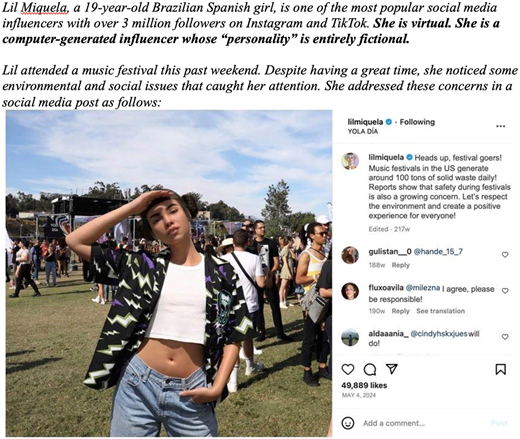
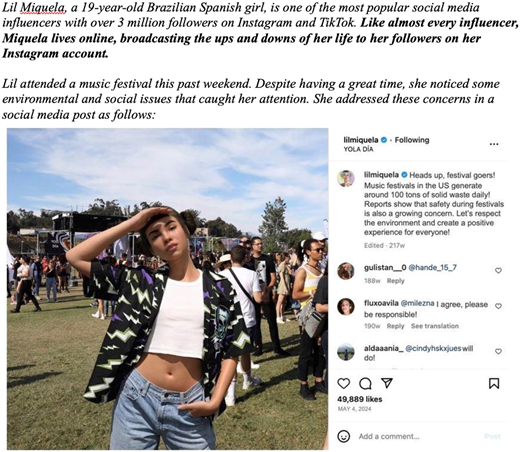
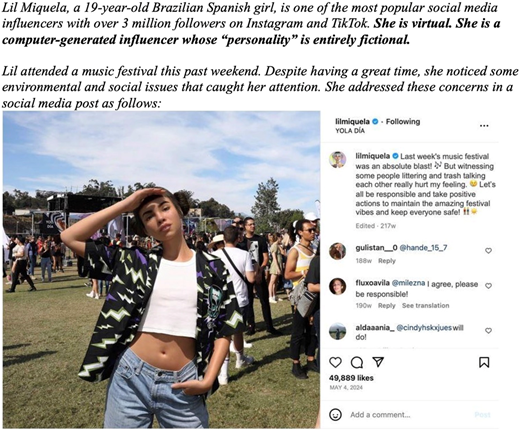
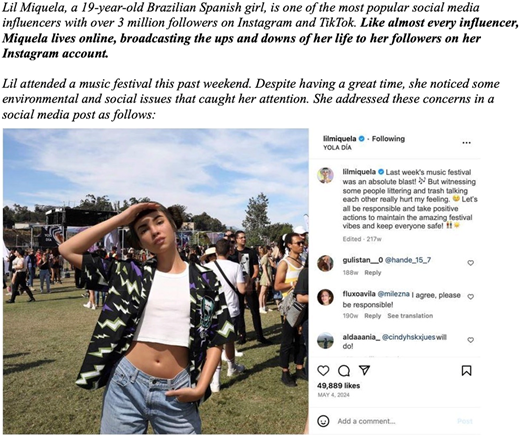
A 2 (influencer type: virtual vs. human) by 2 (message appeal: emotional vs. rational) between-subjects experimental design was employed. This study received institutional ethics approval and complied with relevant ethical guidelines. Informed consent was obtained from all participants. Participants had the right to withdraw at any time, and their anonymity and confidentiality were maintained throughout the study. The target sample comprised individuals aged 18 and older who had attended at least one festival in the past six months and had previously used social media platforms such as Instagram, TikTok or Facebook. Instagram, as a dominant platform for hospitality and tourism marketing (Carvalho, 2024; Egger and Yu, 2022), served as the study context for a fictional music festival post. Lil Miquela, a commercially successful VI with over 2.3 million followers and extensive brand collaborations, was selected as the focal influencer (Franke et al., 2023). To manipulate influencer type, the accompanying description explicitly identified her as either a virtual or a human influencer. Each scenario presented an Instagram post in which the influencer described her festival experience and delivered either a rational or an emotional appeal encouraging pro-environmental and prosocial behaviors. Participants were randomly assigned to one of the four conditions (see Appendix 1).
3.2 Sample and data collection
We recruited 188 eligible samples from Prolific (prolific.com), exceeding the minimum requirement of 30 respondents per experimental condition. The demographic composition of the sample comprised 56.9% females, with millennials representing 53.2% of participants, White or Caucasian accounting for 67.6% of respondents, about 58.5% attained a bachelor's degree or higher, and approximately 68.6% reported an annual household income of more than $50 K (see Table 1). In terms of event attendance, 36.7% of respondents participated in arts and entertainment events, followed by 20.2% who attended sports events.
Respondents' profile
| Characteristics | Frequency | Percentage | Characteristics | Frequency | Percentage |
|---|---|---|---|---|---|
| Age | Ethnicity | ||||
| Generation Z (1996–2012) | 31 | 16.5 | White/Caucasian | 127 | 67.6 |
| Millennials (1981–1996) | 100 | 53.2 | Asian | 21 | 11.2 |
| Generation X (1965–1980) | 45 | 23.9 | Black and/or African descent | 18 | 9.6 |
| Baby Boomer (1946–1964) | 12 | 6.4 | Hispanic/Latino | 17 | 9.0 |
| Total | 188 | 100% | Other | 5 | 2.6 |
| Gender | Total | 188 | 100% | ||
| Male | 74 | 39.4 | Kind of Event | ||
| Female | 107 | 56.9 | Cultural celebration | 36 | 19.1 |
| Other | 7 | 3.7 | Arts and Entertainment | 69 | 36.7 |
| Total | 188 | 100% | Sports | 38 | 20.2 |
| Education | Business and Trade | 20 | 10.6 | ||
| High school diploma/GED | 49 | 26.1 | Education and Scientific | 15 | 8.0 |
| Associate degree | 29 | 15.4 | Political and State | 9 | 4.8 |
| Bachelors' degree | 80 | 42.6 | Others | 1 | 0.5 |
| Masters' degree | 23 | 12.2 | Total | 188 | 100% |
| Doctorate or other professional terminal degree | 7 | 3.7 | |||
| Total | 188 | 100% |
3.3 Measures
After reading the Instagram post, participants completed a questionnaire measuring their perceptions and behavioral intentions. The constructs in the research model were operationalized using adapted validated measures from prior studies. Pro-environmental behavioral intentions were measured with three items (Venkatesh et al., 2012; Cronbach's a = 0.955), and prosocial behavioral intentions were measured with five items (Zhu et al., 2022; Cronbach's a = 0.886). In addition, perceived source attractiveness was measured with three items (Duran and Kelly, 1988; Cronbach's a = 0.877), social media engagement with four items (Baldus et al., 2015; Paruthi and Kaur, 2017; Cronbach's a = 0.826), and parasocial relationships with five items (Russell et al., 2006; Cronbach's a = 0.908). All constructs were assessed on a 5-point scale (1 = strongly disagree, 5 = strongly agree) (see Table A1 in Appendix 2).
3.4 Data analysis
Scenario realism was assessed using two items (“This scenario is realistic” and “I can imagine myself in the scenario”), and participants rated the scenarios as realistic and easy to imagine (Mrealisitic = 4.04, SD = 0.991; Mease of imagination = 3.76, SD = 1.114). To verify the manipulation of influencer type, participants were asked to identify the influencer category, and those who responded incorrectly were excluded from the analysis. Message appeal was validated by asking participants whether the post was rational/informative or emotional/sentimental, and an independent-samples t-test confirmed the effectiveness of this manipulation (Mrational = 4.08, Memotional = 2.32, t = 11.72, p = 0.003). Attention-check questions (e.g. “Please select strongly agree for this question.”) were included, and responses that failed these checks were removed from the data analysis.
4. Results
4.1 Stage 1 model testing
Stage 1 focuses on the effect of influencer type on sustainable behaviors (RQ1) and the mediating roles of source attractiveness and social media engagement (RQ2). Independent-samples t-tests showed that influencer type significantly affected pro-environmental intentions, with VIs eliciting higher intentions than human influencers (Mhuman = 3.47, Mvirtual = 3.81, t = −2.60, p = 0.033). However, influencer type did not significantly influence prosocial intentions (Mhuman = 4.37, Mvirtual = 4.42, t = −0.45, p = 0.469). These findings address RQ1 by demonstrating that festival-goers respond differently to virtual versus human influencers only in terms of their pro-environmental intentions, but not their prosocial intentions.
We then used the PROCESS macro model 6 to statistically test the serial mediation effects (Hayes, 2018). Influencer type served as the independent variable (X), sustainable behavioral intentions as the dependent variable (Y) and source attractiveness (M1) and social media engagement (M2) as mediators. For pro-environmental behavior, influencer type exhibited both significant direct and indirect effects through the serial pathway influencer type source attractiveness social media engagement pro-environmental behavioral intention (direct effect b = 0.499, SE = 0.136, 95% CI [0.231, 0.768], indirect effects b = −0.036, SE = 0.020, 95% CI [−0.080, −0.004]). For prosocial behavior, neither the direct effect (b = 0.013, SE = 0.115, 95% CI [−0.215, 0.240]) nor the indirect effect (b = −0.014, SE = 0.015, 95% CI [−0.048, 0.012]) was significant. These results address RQ2 by showing that source attractiveness and social media engagement jointly mediate the effect of influencer type on pro-environmental intentions, but not on prosocial intentions.
4.2 Stage 2 model testing
Building on Stage 1, Stage 2 examined how message appeal influences the relationship between influencer type and sustainable behaviors, as well as the mediating roles of source attractiveness and parasocial relationships (RQ3 and RQ4). A 2 (influencer type: virtual vs. human) × 2 (message appeal: emotional vs. rational) analysis of variance (ANOVA) was conducted on sustainable behavioral intentions. The analysis revealed a significant interaction between influencer type and message appeal strategy on pro-environmental intentions (F(1,184) = 5.197, p < 0.05), but not on prosocial intentions (F(1,184) = 0.005, p = 0.946). Simple main effects showed that under an emotional appeal, VIs (vs. human influencers) led to higher pro-environmental intentions (Mvirtual = 4.075 vs Mhuman = 3.505; F(1,184) = 9.846, p < 0.05) (see Figure 2). Conversely, under a rational message appeal, the effect of influencer type on pro-environmental intentions attenuated to nonsignificance (Mvirtual = 3.442 vs Mhuman = 3.447; F(1,184) = 0.001, p = 0.978). These patterns inform RQ3, suggesting that emotional messaging significantly shapes the effect of influencer type on pro-environmental intentions, whereas rational messaging does not.
 The bar graph compares pro-environmental behavior intentions based on influencer type and message appeal. It features two vertical bars for each category: rational and emotional message appeals. The influencer types are human and virtual, represented by dark blue and light gray bars respectively. The x-axis is labeled “Message Appeal” with categories “Rational” and “Emotional”. The y-axis is labeled “Proenvironmental behavior” with values ranging from 0 to 5. Under the emotional appeal, virtual influencers have a higher pro-environmental intention score (approximately 4.075) compared to human influencers (approximately 3.505). Under the rational appeal, both influencer types have similar scores (approximately 3.442 for virtual and 3.447 for human). A star annotation highlights the significant difference in the emotional appeal category. All values are approximated
Means plot of attendee's pro-environmental behavior intention. Source: Authors’ own work
The bar graph compares pro-environmental behavior intentions based on influencer type and message appeal. It features two vertical bars for each category: rational and emotional message appeals. The influencer types are human and virtual, represented by dark blue and light gray bars respectively. The x-axis is labeled “Message Appeal” with categories “Rational” and “Emotional”. The y-axis is labeled “Proenvironmental behavior” with values ranging from 0 to 5. Under the emotional appeal, virtual influencers have a higher pro-environmental intention score (approximately 4.075) compared to human influencers (approximately 3.505). Under the rational appeal, both influencer types have similar scores (approximately 3.442 for virtual and 3.447 for human). A star annotation highlights the significant difference in the emotional appeal category. All values are approximatedMeans plot of attendee's pro-environmental behavior intention. Source: Authors’ own work
PROCESS macro model 83 was selected because it estimates a moderated mediation model in which an interaction term predicts the outcome through two serially ordered mediators, with the moderator operating specifically at the first stage of the mediation chain (Hayes, 2018). The sequencing of the mediators was theoretically grounded: source attractiveness was positioned as the proximal mediator, representing audiences' initial relational evaluation of the influencer, which subsequently activates engagement and the formation of parasocial relationships as deeper affective bonds. This ordering is consistent with prior research establishing that perceived attractiveness precedes and enables the development of parasocial connections in influencer contexts (Lim and Lee, 2023; Sokolova and Kefi, 2020). Influencer type was the independent variable (X), sustainable behavioral intentions were the dependent variable (Y), message appeal was the moderator (W) and source attractiveness (M1) and parasocial relationships (M2) were the two serial mediators. The results showed a significant interaction between influencer type and message appeal on source attractiveness (b = −0.534, SE = 0.270, t = −2.05, p < 0.05). Source attractiveness subsequently predicted stronger parasocial relationships (b = 0.77, p < 0.001), which in turn positively influenced pro-environmental intentions (b = 0.31, p < 0.005). The serial indirect effect of influencer type on pro-environmental intentions through source attractiveness and parasocial relationships was significant (b = −0.133, boot SE = 0.08, 95%CI = [−0.329, −0.006]). This pattern did not emerge for prosocial intentions. These results informed RQ4 that message appeal interacts with influencer type to shape source attractiveness, and that source attractiveness and parasocial relationships subsequently mediate the effect of influencer type on pro-environmental behavior.
5. Discussion and conclusions
5.1 Conclusions
The present study contributes to the emerging literature on social media influencer marketing and event tourism management by examining the effects of influencer type (human vs. virtual) and message appeal (rational vs. emotional) on festivalgoers' sustainable behavioral outcomes. We further unpack the underlying mechanisms of these effects by examining serial mediation pathways through source attractiveness, social media engagement and parasocial relationships. Stage 1 findings reveal that VIs are highly effective in motivating pro-environmental intentions, exhibiting a strong, positive direct effect consistent with prior research highlighting their competitive advantage in green domains (Jiang et al., 2024). The direct effect is not significant for prosocial intentions, likely because these behaviors rely more on interpersonal drivers (e.g. empathy) and are less influenced by influencer messaging. However, the serial mediation analysis uncovers a critical distinction: while source attractiveness remains a key driver of behavioral outcomes for human influencers (Kim et al., 2025), VIs exhibit a relative deficit in perceived attractiveness. This suggests that VIs influence behavior through a significant direct pathway, rather than relying on traditional relational mechanisms such as likability or social rapport.
Stage 2 uncovers significant interactions between influencer type and message appeal. The virtual–emotional condition produces the highest pro-environmental intentions, suggesting that emotional appeals can enhance the persuasive impact of VIs. However, a complex “suppression effect” is revealed regarding the underlying mechanism: emotional appeals are associated with lower perceived source attractiveness for VIs relative to human influencers, while simultaneously strengthening behavioral intentions. This contrasts with prior research showing that emotional content typically enhances influencer credibility (Lim and Lee, 2023), and points to a divergent pattern wherein emotional framing appears to depress relational evaluations of the source while maintaining its influence on behavioral intentions. Drawing on the Source Attractiveness Model (McGuire, 1985), this may reflect how emotional appeals differentially activate relational versus message-level processing depending on whether the source is perceived as human or non-human. This pattern is consistent with emerging evidence that non-human characteristics do not necessarily hinder, and can even foster, positive consumer attitudes in specific contexts (Zheng et al., 2025).
Parasocial relationships serve as a key serial mediator connecting source attractiveness to intentions, consistent with research showing that these bonds can bridge authenticity gaps (Lim and Lee, 2023; Stein et al., 2024). However, our results indicate a selective mediation pattern that is specifically weakened for VIs under emotional appeals. This underscores that for VIs, the path to persuasion is not a universal compensatory mechanism rooted in social bonding. Rather, the effectiveness of VIs in sustainable festival tourism is driven by their direct influence and the specific interaction between influencer type and emotional appeal, which motivates action even when traditional source-driven attraction is diminished.
5.2 Theoretical implications
This study advances the source attractiveness model (McGuire, 1985) by demonstrating that its traditional role as a prerequisite for persuasion operates differently for non-human entities. While source attractiveness remains a core driver of engagement for human influencers (Kim et al., 2025), our findings reveal an unexpected pattern for VIs: they generate significant pro-environmental intentions despite a distinct deficit in perceived attractiveness. By identifying that emotional appeals actually intensify this attractiveness deficit, we extend foundational ideas on message framing as a moderator of source effects (Kelman, 1958), suggesting that in pro-environmental persuasion contexts, message-level effects may persist even when source-level evaluations are diminished, a boundary condition not previously documented in the influencer marketing literature (Yoo et al., 2024; Zheng et al., 2025).
The study also extends the parasocial relationship framework (Horton and Wohl, 1956) by uncovering the limits of digital bonding. While we establish parasocial relationships as a significant mediator that channels source attractiveness into intentions for human influencers, our findings reveal that this pathway is weakened for VIs when they use emotional appeals. This challenges the prevailing view that parasocial bonds serve as a universal compensatory mechanism for bridging credibility or authenticity gaps between different types of influencers (Jin et al., 2019; Lim and Lee, 2023). Instead, our research suggests that VIs create a boundary condition in which emotional appeals disrupt source attractiveness evaluations while still promoting behavioral intentions. In sustainable event-tourism contexts, this indicates that a strong parasocial bond with a non-human digital influencer is not necessarily required for behavioral change (Stein et al., 2024).
By distinguishing sustainable festival behaviors as pro-environmental and prosocial intentions, we also identify critical boundary conditions often overlooked in prior integrated models (e.g. Choudhry et al., 2022; Igarashi et al., 2024). Unlike pro-environmental behavior, prosocial behavior exhibits no significant direct or indirect relationships with antecedents or mediators. The absence of significant effects on prosocial intentions across both influencer type and message appeal conditions suggests that influencer-driven persuasion operates selectively across behavioral domains. Therefore, sustainable behavior should be examined through its distinct social and environmental components to more accurately delineate customers' intentions in sustainable behavior research.
5.3 Practical implications
For practitioners, these findings suggest that festival organizers and destination marketers should use VIs strategically when the goal is to prompt specific pro-environmental actions, such as recycling, waste reduction or low-impact choices. VIs may be especially useful for recurring festivals and large-scale sustainability campaigns because they allow consistent messaging, centralized creative control and scalable audience reach. However, organizers should pilot VI-led campaigns in real event settings before broad implementation to confirm audience response and behavioral impact.
The results underscore the importance of aligning influencer type with the targeted sustainable behavior. While VIs are effective in promoting pro-environmental intentions, they do not show the same influence on prosocial behaviors, such as helping other attendees or demonstrating community-minded conduct. Festival managers should therefore use a segmented strategy by deploying VIs for environmental sustainability messaging and human influencers, staff ambassadors or community representatives for prosocial and relationship-oriented goals. This messenger-to-task alignment is directly supported by the differential mediation patterns observed across behavioral dimensions in this study.
The trade-off between source attractiveness and behavioral outcomes for emotionally appealing VI content has direct implications for campaign design. When the goal is to drive immediate commitment to a sustainability cause, festival marketers should consider pairing emotional appeals with VIs to increase behavioral impact, even if this approach lowers perceived source attractiveness. When social rapport and long-term audience engagement are priorities, rational or informational appeals may be more appropriate for VI-led content. Balancing these elements can help festival organizers keep VIs engaging while directing festivalgoers toward recommended sustainable practices.
Finally, because parasocial relationships mediate the relationship between source attractiveness and pro-environmental intentions, practitioners should build sustained audience connections rather than relying on one-time posts. Festival organizers can engage influencers, whether human or virtual, across the event lifecycle, including pre-, during- and post-event communication. Repeated exposure to a consistent influencer persona across festival editions may reduce initial social distance and strengthen parasocial connections associated with stronger pro-environmental intentions among festivalgoers.
5.4 Limitations and future research
While this study provides valuable insights into the roles of human and VIs in promoting engagement and sustainable behaviors within festival contexts, several limitations warrant consideration and present opportunities for future research. First, reliance on self-reported data and a simulated festival scenario may limit ecological validity. To strengthen validity and generalizability, future research should employ longitudinal designs or field experiments during live events to capture real-time engagement and behavioral outcomes.
Second, the sample was predominantly composed of Millennials in the United States, which may constrain applicability across age groups, regions and cultural contexts. Because perceptions of source attractiveness and message appeal effectiveness can vary by culture and generation, future studies should adopt cross-cultural comparative approaches.
Third, this study focused exclusively on Instagram, which, although widely used, does not represent the full spectrum of influencer marketing strategies across today's diverse social media ecosystem. Platforms such as TikTok, YouTube and emerging metaverse environments offer distinct affordances and interaction modes that may influence engagement and effectiveness. Future research should explore multi-platform strategies to better understand how platform-specific features and audience expectations shape outcomes.
Finally, the mixed effectiveness of VIs highlights the need for a more granular investigation into the design elements and contextual factors influencing source attractiveness and impact. Future studies should consider examining how variations in human-likeness (e.g. appearance and emotional expression), brand congruence and influencer persona moderate engagement and sustainable behavioral intentions.
Appendix 1
Virtual influencer and rational condition
Human influencer and rational message
Virtual influencer and emotional message
Human influencer and emotional message
Appendix 2
Constructs, measurement items, and sources
| Variables and measurement items |
|---|
| Source Attractiveness (Duran and Kelly, 1988) |
| SA1: I want to have a friendly chat with this influencer |
| SA2: We could establish a personal friendship with each other |
| SA3: This influencer would be pleasant to be with |
| Parasocial relationship (Russell et al., 2006) |
| PS1: I would like to meet this influencer in person |
| PS2: If I came across a picture of this influencer, I would definitely watch it |
| PS3: If there were a story about the influencer in a newspaper or on the Internet I would read it |
| PS4: The influencer makes me feel comfortable as if I am with friends |
| PS5: When the influencer shows me how she feels about a green initiative, I follow her advice |
| Social media engagement (Baldus et al., 2015) |
| ENG1: Instagram is very relevant to my life |
| ENG2: I am satisfied with the features provided on Instagram |
| ENG3: Losing Instagram forever would upset me |
| ENG4: Watching Instagram videos is a good use of my time |
| Sustainable festival behaviors |
| Pro-environmental behavioral intentions (Venkatesh et al., 2012) |
| BEH1: I intend to use it to perform the suggested sustainable practices |
| BEH2: I predict I would perform the suggested sustainable practices |
| BEH3: I recommend that others perform the suggested sustainable practices |
| Prosocial behavioral intentions (Zhu et al., 2022) |
| SBEH1: I plan to be kind and respectful to other festivalgoers for my next festival |
| SBEH2: I will try to avoid disrespectful behaviors the next time I attend the festival |
| SBEH3: I plan to keep my socially responsible behavior at my next festival |
| SBEH4: I am willing to be considerate to others while enjoying my next festival |
| SBEH5: For my next festival, I plan to be respectful to other attendees and try not to disturb the surrounding community |

