Given the fast growth in automation technologies, it is crucial to understand the attributes influencing successful interactions between humans and robots. This study aims to explore service robotic technologies from a social actor’s perspective and examine the role of service robots in the service industry.
Applying stakeholder theory and Computers are Social Actors paradigm, this study conducted a systematic review of relationships between humans and robots in the hospitality and tourism field by reviewing and analyzing the extant research literature.
The findings indicate that robotic technologies play a variety of functions as social actors, not just as practical instruments in the hospitality and tourism industry. Moreover, robots present both benefits and challenges to organizations and their customers, which proposes the need for a wide range of research on the application of robotic technology.
This study provides valuable insights into human−robot interactions, facilitating a deeper understanding and enhancing the impact of collaboration on service delivery systems. In addition, the study offers a unique perspective on service robots as social players. It is suggested that this particular aspect be further discussed by academics in future studies.
1. Introduction
In the service encounter, successful service delivery depends on how service providers assure harmonious interactions with customers (Ho et al., 2020). With artificial intelligence (AI) technology accelerating faster than ever, service robots have begun to challenge the nature of customer service and reformulate the boundaries of service interactions beyond traditional human service (Rosete et al., 2020). In light of the rapid growth in automation technologies impacting numerous service sectors, it is essential to understand the attributes driving successful interactions between humans and robots in the hospitality and tourism industry. Therefore, this study is designed to investigate various social actors’ perspectives on robotic technology in the service environment and comprehend the role of service robots in service interaction. Previous research explored various robotic technologies and their applications in the hospitality and tourism literature (Fuentes-Moraleda et al., 2020; Lin and Mattila, 2021). The extant research shows the demand for understanding relationships between humans and robots as it enables practitioners to comprehend the characteristics of human−robot relationship formation and stimulate service management using robots.
The discussion of human−robot relationship has shifted to the human−robot interaction (HRI), a field of study that aims to comprehend, design and assess the whole robotic systems for use by or with humans (Goodrich and Schultz, 2008) as a subset of the study of human−machine interaction studies. From the social scientific perspective, HRI can be discussed by classifying an interdisciplinary dimension that incorporates sociology, communication, cognitive psychology and behavioral science (Carroll, 2006). As technology moves on, in the communication technology research field, interpersonal communication can be applied to human−technology interaction and contribute to understanding the way of evaluating robot interfaces and their optimization (Waddell et al., 2015). In this respect, robots have been embodied as psychologically based social actors rather than viewed as communication medium tools (Sundar, 2020).
Researchers have explored hospitality issues using the lens of stakeholder perspectives with respect to organizational management and business ethics. For instance, Canhoto and Wei (2021) investigated the development of recovery strategies for the COVID-19 pandemic using stakeholder theory. The analysis highlighted the interdependencies among stakeholders, including hotel owners, employees, customers, suppliers, communities and governments, both nationally and internationally, thereby strengthening the role of strategic partnerships. According to stakeholder theory, firms have an intention of generating diversified benefits for their stakeholders (Freeman, 1984; Mahajan et al., 2023). As robotic technologies continue to gain broad appeal in the hospitality industry, it is crucial to examine the relationships between robotic technology and stakeholders for successful business operations in the context of technological development. According to Song (2017), once individuals begin interacting with robots, their attitudes are shaped mainly by social factors, which promote people’s long-term acceptance of robots and influence their social and emotional responses to using them. Moreover, customers react differently to robots based on the degree to which they recognize anthropomorphized service robots as social actors (Fischer, 2016). HRI can be more pleasant, reflecting human-to-human relationships (Nass et al., 1994). Consequently, service robots, as social actors, may influence a better customer experience (Song et al., 2022), leading to positive evaluation and satisfaction (Qiu et al., 2020) from the perspective of service actors.
The current literature review papers on robotic technology have mainly focused on technology-mediated communication. For example, Li et al. (2021) explored the roles of AI technology in the relations among customers, employees and AI and demonstrated various AI modes regarding AI-based service encounters. Furthermore, recent research also examined AI as a tool for the sharing economy and its impacts on business. It divided the application of AI systems into AI, machine learning and deep learning in providing human functions (Chen et al., 2022). However, robots should be recognized as psychologically relevant social actors in the current hospitality and tourism field as they directly create beneficial values for customers through HRI (Ruiz-Equihua et al., 2022; Yang et al., 2024). In this respect, researchers have recently focused more on the social presence of service robots in the service market and explored stakeholders’ persuasion knowledge. Lee and Yi (2025) investigated the factors influencing the social presence of service employees, considering service employee type (human vs non-human) and anthropomorphic appearance, and found that a human-like service robot diminishes perceived service employee sincerity to customers.
Thus, this study aims to investigate service robot technologies from a social actor’s perspective and comprehend the role of service robots in affecting the cooperation between humans and robots in the hospitality and tourism industry. Specifically, applying stakeholder theory (Freeman, 1984) and a CASA paradigm, the study aimed to analyze the relevant topics using bibliometric analysis by creating a bibliometric network map of research on robotic technology, identify the current stage of robotic technology research from three different stakeholder perspectives using narrative synthesis, and suggest a future agenda for the study of robotic technology. A structured literature review of HRI would furnish valuable insights into HRI, facilitating a deeper understanding and expanding the influence of collaboration on service delivery systems. In addition, this study offers a unique perspective on service robots as social players. This aspect needs to be discussed by academics in future related studies.
2. Literature review
2.1 Robotic technology in hospitality and tourism
The current hospitality industry is highly integrated into society and the economy more than ever, involving a wide range of stakeholders (Mahajan et al., 2023). A stakeholder stands for any individual or group that has the power to influence or be influenced by the performance of the organization’s mission (i.e. accomplishment) (Freeman, 1984). Based on the definition of the term, the stakeholder theory is presented as an organization consisting of relationships among various entities that have an interest in the business (Jones, 1995). Since stakeholders can affect the success or collapse of a business in many ways, the theory highlights the importance of controlling assorted relationships for the business’s value-creation work and strategic decisions (Fassin, 2009; Freeman, 1984). Thus, containing a broad range of stakeholders’ perspectives in developing a service delivery system can enhance the understanding of the current situations in the service industry and provide a critical lens for active management strategies (Aladag et al., 2020). Extant research has applied the stakeholder theory to explore a variety of values and complex issues in hospitality. Canhoto and Wei (2021) developed a recovery strategy connected to the global pandemic and suggested effective collaboration approaches to organizations. By focusing on corporate social responsibility (CSR) and corporate financial performance from stakeholders’ perspectives, Franco et al. (2020) revealed the impacts of CSR and quality management on the financial performance of hospitality firms. As shown in previous research, stakeholder theory plays a vital role in understanding business ethics and organizational management, as it demonstrates the intention of organizations to create various benefits for each stakeholder (Freeman, 1984; Mahajan et al., 2023). Consequently, it is essential to comprehend the relationships between robotic technology and stakeholders from the extant literature, so that firms can operate their businesses successfully in conjunction with the development of robotic technology in the hospitality industry.
In addition, to explore the role of social actors in technology, the Computers are Social Actors (CASA) paradigm was applied in the current study. The CASA paradigm has been applied as one of the main theoretical frameworks to explain individuals’ social responses to a variety of technologies (Nass et al., 1994). While robotic technology is regarded as a machine when it performs a human role and interacts with people, a robot can be recognized it as a social creature to fulfill the role of a human, aligning with the CASA paradigm (Nass and Moon, 2000). According to Luckmann (1970), being a social actor does not require any form of humanity or the appearance of being human. Scholars have presented certain definitions of robots as social actors by highlighting different features. Bartneck and Forlizzi (2004) defined a social robot that can interact with human beings with four consecutive layers (i.e. physical, reactive, deliberative and social (communication) layers). In a similar vein, Fong et al. (2003) described “social robots are embodied agents that are part of a heterogeneous group: a society of robots or humans. They can recognize each other and engage in social interactions, they possess histories (perceive and interpret the world in terms of their own experience), and they explicitly communicate with and learn from each other” (p. 144) by expressing the specific capability of socially interactive aspect. On the other hand, Bartneck and Forlizzi (2004) demonstrated social robots with a design-centered approach. To comprehend social robots, Hegel et al. (2009) developed a social interface framework that includes three aspects: social form, social function and social context. They revealed that humans can attribute social identity to robotic technology and build it as a social interaction partner. More importantly, robots do not need to be social beings themselves. However, they should provide social cues so humans can perceive them as interaction partners. Consequently, social robot is defined as “a robot plus a social interface. A social interface is a metaphor which includes all social attributes by which an observer judges the robot as a social interaction partner” (Hegel et al., 2009, p. 174).
The fundamental concept of the CASA paradigm argues that individuals view technology as social actors similar to humans, establishing certain social norms based on social cues, such as emotions, language and interaction, and generating corresponding social responses (Moon, 2000). Moreover, the paradigm emphasizes mindlessness from a psychological perspective, claiming that it “fails to pinpoint precisely when and why mindless behavior will occur” (Nass and Moon, 2000, p. 96). In other words, it suggests that people tend to apply social norms or reactions to technology as they perceive mechanical technologies also behave like humans. According to Adolphs (2009), while the mindless approach underlines a more natural and quicker process, the mindful approach is weighted toward controlled and detailed progress. Consequently, the CASA paradigm emphasizes users’ experiences of social presence, particularly social cues and mindfulness, to examine interactions between humans and technology. It insists that users may still treat technology as social partners unintentionally, even when they recognize that it lacks genuine intentions or emotions. Therefore, grounded in the CASA paradigm, the current research conceptualizes the role of technology as a social factor in the hospitality industry from the perspectives of three main stakeholders.
Service robots received increasing attention from the hospitality industry to enhance hotel brand experiences and service delivery systems (Rosete et al., 2020). Autonomous robots earn autonomy from previous events and sensors acquired through the environment, and those inputs enable them to adapt their actions. (Simon et al., 2020). With the change in working environments, researchers and practitioners have paid attention to HRI and redefining service environments even though hospitality businesses are highly human-oriented (Bowen and Morosan, 2018). For example, De Kervenoael et al. (2020) examined the HRI on social robots providing hospitality services and emphasized the importance of robots’ cognitive and emotional aspects for perceived value. In other words, service robots can be involved in meaningful interactions with customers by acquiring intelligent and socio-emotional capabilities in their environment as one of the social actors (Song et al., 2022). From the customer perspective, some hotel guests prefer human interaction and service from the employees rather than service robots due to the physical service environment and interaction quality (Choi et al., 2020). In the restaurant industry, customers are reluctant to use robot services since they only provide certain services without interacting with the customers (Seyitoğlu and Ivanov, 2020b). Similarly, Hwang et al. (2023) explored the role of several information qualities (i.e. intrinsic, contextual, representational and accessibility) moderated by the employee type in the airline industry. The results showed that four information qualities positively impact overall service quality, with significant differences found between accessibility information quality and the type of employee. On the other hand, research focusing on the perceived robotic qualities of theme park visitors revealed that customers tend to prefer human-like robot servers over cartoon-like, anime-like and animal-like robot servers (Milman and Tasci, 2022). In summary, excellent service delivery using robots should be based on positive customer interactions. However, the extant literature review papers on robotic technology have largely concentrated on how robots are utilized and the intentions behind their adoption (e.g. Li et al., 2021).
The extant literature has also examined technology in terms of its social presence. For example, Sehgal et al. (2025) investigated the anthropomorphism of social robots in the lodging industry from employees’ perspectives. The findings revealed that social robots’ anthropomorphic features elicited warmth, thereby positively increasing hotel employees’ psychological ownership of their well-being. Interestingly, the research found that despite a lack of technological readiness, anthropomorphism in social robots enhances employees’ psychological well-being. From a management perspective, a recent study explored senior hotel managers’ viewpoints on smart technologies. The results showed that hotel managers perceive these technologies not merely as convenient tools but as employees with cognitive and emotional capabilities, especially in relation to attributes such as rapidity, memory of experience and harmony in service encounters. Additionally, hospitality scholars have researched social presence in technology in various ways, such as users’ mind perception of chatbots and their effects on social cues (i.e. paralinguistic cue and back channeling) (Lee et al., 2020), customers’ perception of front desk humanoid robots on automated social presence (Yoganathan et al., 2021) and the relationship between social cognition (e.g. attractiveness, receptiveness and warmth) and customer outcomes in frontline service settings (Van Doorn et al., 2017). Given the previous literature, this study investigates stakeholders’ perspectives on service robotic technologies to comprehend the role of service robots in the hospitality business. Drawing from the stakeholder theory and the CASA paradigm, researchers can gain a clear and comprehensive understanding of robotic technology and identify research gaps that lead to invaluable insights into service delivery systems.
3. Methodology
As for the data collection, the Scopus database was used to perform comprehensive literature research since Scopus covers an extensive range of studies (Martín-Martín et al., 2018) and is the largest global database in the research field (Zhao and Strotmann, 2015). The data retrieved only peer-reviewed journal articles written in English. This study focused on articles published in the top 10 Social Science Citation Index (SSCI) ranked journals in hospitality and tourism to guarantee well-established academic knowledge and comparability. This approach has been widely adopted in prior review studies in hospitality and tourism research (e.g. Han and Bai, 2022; Peng et al., 2025; Shin and Perdue, 2019; Sun et al., 2025). The sample articles contain International Journal of Contemporary Hospitality Management, International Journal of Hospitality Management, Journal of Hospitality Marketing and Management, Tourism Management, Annals of Tourism Research, Journal of Hospitality and Tourism Research, Cornell Hospitality Quarterly, Journal of Travel and Tourism Marketing, Journal of Travel Research and Journal of Sustainable Tourism. In addition, since the research concentrated on the technological context, the Journal of Hospitality and Tourism Technology and Information Technology and Tourism were also included. A total of 12 hospitality and tourism journals were reviewed for the data collection. Using the Boolean logic query, the sample articles that have relevant keywords, such as “artificial intelligence,” “service robots,” “robot,” “robotic technology” and “robotics” in the titles, author-identified keywords and abstracts were retrieved between 2012 and 2024 for the data collection.
Initially, 351 articles were collected. A detailed review by researchers ascertained the articles highly related to the topic. First, research that covers a wide range of hospitality technology, rather than focusing on robotics, was excluded from the sample data. In addition, studies on robotic technology that concentrate solely on technical performance, without involving any form of interaction with humans, were also eliminated. Each paper was carefully reviewed and classified by researchers according to whether it approached the robot from a social perspective or merely as a technical tool. The review process was made in alignment with the definition of social robots to maintain consistency with the research objective of exploring human−robot social interaction. Based on the classification, the final sample of 276 articles was selected for data analysis, as shown in Table 1.
The current study used bibliometric analysis with narrative synthesis. First, a bibliometric analysis was conducted using keyword co-occurrence and co-citation techniques to map the intellectual structure of the field. Subsequently, a narrative synthesis was performed on sample articles to identify significant research themes and trends from the perspectives of three key stakeholders (i.e. customers, employees and management).
4. Results
4.1 Research output and growth trend
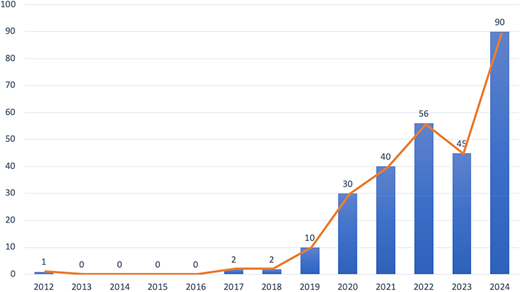
Descriptive results demonstrate the trends of prior research on robotic technology. Figure 1 illustrates the distribution of published articles in terms of the publication year. The interest in robotic technology research in hospitality and tourism has rapidly increased since 2019 and continues to rise. Although growth seemed to slow in 2023, it doubled the following year. Approximately 70% of the studies on applications of robotic technologies have been published in the last three years. As the sample articles were collected in August 2024, the total number of published articles in 2024 will be assumed to be much higher than the reported data.
4.2 Keyword analysis
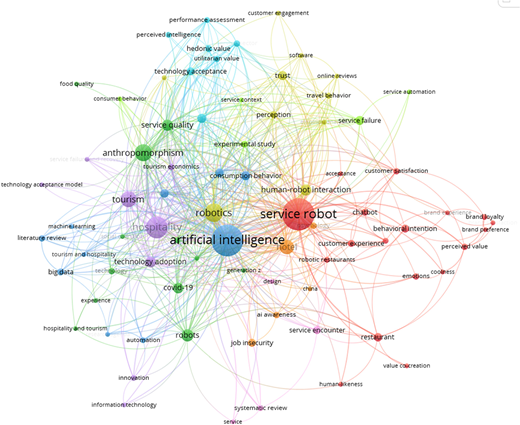
By applying the keyword co-occurrence analysis, this research explored the frequent themes of robotic technology in hospitality and tourism. A total of 585 keywords were generated from the 276 publications, and 79 keywords that appeared at least three times (Han and Bai, 2022) were selected for analysis. Before the analysis, the selected keywords were reviewed to unify the minor differences among keywords. For example, the keywords “robots” and “service robots” were modified as “robot” and “service robot” and “restaurants” was modified to “restaurant.” When the sample articles addressed the same topic using different keywords, the keywords that representing similar concepts were standardized for analysis. For instance, the keywords such as “hotel,” “hotels” and “hotel industry” were consolidated under “hotel,” while “hospitality” and “hospitality industry” were grouped under “hospitality” for consistency in the analysis. As shown in Table 2, the most frequent keywords were “service robot (90 occurrences),” “artificial intelligence,” “hospitality,” “robotics” and “anthropomorphism” appeared more than 25 times in the sample journals. The findings of keyword co-occurrence technique showed that the current stage of hospitality robotic technology research has paid attention to not only robot applications in service robots (e.g. front desk, cleaning, room service, restaurants or customer service) but also robot capabilities (e.g. learning, social and emotional intelligence). Particularly, the frequent mention of the keyword “anthropomorphism” indicated that hospitality scholars are highly interested in human-like qualities of robotic technology, such as social cues, appearance or attitude.
Based on the findings from the keyword co-occurrence analysis, a bibliometric network map was created in VOSviewer. Figure 2 displays the visualization of keywords and describes the strength of connections among each keyword of robotic technology research. Each line explains the relationships between two keywords. That is, two connected keywords are discussed together in the same manuscript (Knani et al., 2022). Bubbles with the same color were bound in one cluster, indicating that they are strongly related. The size of the bubbles represents the frequency of keywords (Knani et al., 2022). A total of 79 keywords generated nine different theme clusters, including “service robot” (red), “anthropomorphism” (green), “artificial intelligence” (blue), “robotics” (yellow), “hospitality” (purple), “tourist behavior (light blue), “hotel” (orange), “experimental study” (light green) and “service encounter” (pink). The red cluster demonstrates connections among “service robot,” “customer satisfaction,” “robotic restaurants,” “customer service,” “chatbot,” “perceived value” and “behavioral intention.” These relationships illustrate that extant service robot research has been studied and focused on the values of service robots from a customer perspective on applying automation service in the hospitality industry. The blue cluster highlights the relationships between “anthropomorphism,” “robots,” “service quality,” “COVID-19” and “technology readiness.” The purple cluster represents correlations among “hospitality,” “technology adoption,” “tourism economics” and “service failure and recovery.” As for the yellow cluster, the connections among “robotics,” “human−robot interaction,” “trust,” “travel behavior” and “perception” can be explained by the stream of robotic technology research on using robots as social actors offering service to customers.
4.3 Co-citation network
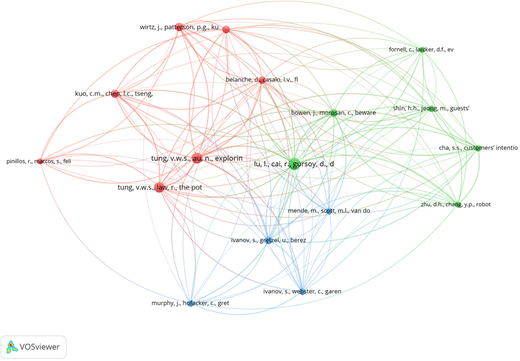
Co-citation analysis was applied using a VOS viewer to discover the theoretical foundation of extant robotic technology research. This research selected a reference set of 14 as the minimum number of citations for analysis, considering the number of sample articles in this study (Sullivan et al., 1977). A total of 17 citations from hospitality and tourism were extracted to create a co-citation network map. Figure 3 demonstrates the most essential cited references and the strength of the relationships among authors. Tung and Au (2018) had the highest co-citation total link strength of 121, followed by Lu et al. (2019) and Tung and Law (2017), with 115 and 97, respectively. The co-citation map identifies three well-defined clusters with different colors that are automatically generated by the software. The clusters provide closely associated citations based on theoretical support in the fields of hospitality and tourism. Three main topic clusters include service robot dimensions (Belanche et al., 2020; Huang and Rust, 2018; Kuo et al., 2017; Pinillos et al., 2016; Tung and Au, 2018; Tung and Law, 2017; Wirtz et al., 2018), user perceptions (Bowen and Morosan, 2018; Cha, 2020; Lu et al., 2019; Shin and Jeong, 2020; Zhu and Chang, 2020) and robot adoption (Ivanov et al., 2018, 2019; Mende et al., 2019; Murphy et al., 2017). Consequently, the results showed that the current trends in robotic technology research were concentrated on service robot dimensions, user perceptions and robot adoption in the hospitality and tourism sectors. Table 3 lists the representative citations regarding topic clusters.
4.4 Robotic technology research topics: stakeholder perspectives
This review paper analyzed the content of hospitality and tourism robotic technology research from three stakeholder perspectives: the customer, employee and management.
4.4.1 Customer perspective.
Extant service robot research in the hospitality and tourism industry has generally been studied by focusing on hotel guests and tourist perspectives. Previous research on robotic technology has examined customer−robot interactions to examine their relationships. Although, as seen in Table 2, the results showed only 14 occurrences of “human−robot interaction” as the most frequent keywords, many studies attempted to analyze the interaction between customers and robots and focus on the key antecedents influencing communication. Researchers tried to identify the attributes that influence user’s acceptance of service robots by applying various factors, such as functional and social aspects; emotional and instrumental interactions. Some research examined the relationships between customers and robots grounded understanding of customer experiences, such as sensory, cognitive, behavioral, escapism and facilitating experiences. Ma et al. (2023) explored the Generation Z customers’ attitude on using service robots in restaurants. The results showed that Generation Z has a favorable attitude toward using restaurant service robots and expresses an improvement in the appearance design, functionality and related human service, resulting in a better experience with service robots. Additionally, by applying the rapport-building factor to analyze the perspective of relationship building, Qiu et al. (2020) discovered significant relationships between service robot attributes and hospitality experience.
Specifically, researchers have attempted to compare different service actor types (e.g. robot vs kiosk vs human employee) (Choi et al., 2020) by applying distinct attributes affecting the impacts on customer behaviors, such as robot uniform styles and language styles. Some studies concentrated on the service quality gaps between customer expectations and actual performance based on customer experiences. One study comparing robot and human employees showed that the type of service actors plays a moderating role in the interaction between sensory and intellectual brand experiences and customer brand satisfaction (Hwang et al., 2021). Furthermore, Hou et al. (2021) found that tourists preferred robot-provided services rather than human staff in crowded environments related to over-tourism.
As hospitality and tourism are service-based businesses, some research has investigated robotic service quality positively related to customers’ attitudes and behavioral intentions toward interacting with robots. Prentice et al. (2020b) examined AI service quality by applying concierge robots, digital assistance, voice-activated services, travel experience enhancers and automatic data processing attributes. Similarly, Zhu (2022) investigated the service quality of robot restaurants related to perceptions of high-tech atmospheres. Based on customer online reviews, Luo et al. (2021) derived service quality elements of robots and by comparing four types of robotic servers (cartoon-like, animal-like, anime and human-like), Milman et al. (2020) explored robotic servers’ functions and service qualities.
In a different light of customer−robot interaction, some studies focused on robot service failure and recovery regarding various factors, such as humor appreciation, perceived insincerity, smartness failure; anthropomorphism, cuteness of AI assistant and perceived warmth and competence. Moreover, by comparing the level of recovery satisfaction between types of service delivery actors, some studies contributed to the implications of increasing customer service experiences and influencing service recovery positively using robotic technology (Ho et al., 2020; Hu et al., 2021). Zaki and Al-Romeedy (2024) investigated the relationship between chatbots’ symbolic recovery and customer forgiveness mediated by customer empathy. The findings revealed that the chatbot’s symbolic recovery has a significant impact on customer forgiveness, leading to positive customer reconciliation and sustained trust.
Besides the interaction between customers and service robots, robotic technology adoption has also been deliberated by scholars. Previous research examined the adoption of service robots by looking at robot services from various angles. For example, Chuah et al. (2022) studied usage intentions related to demographic, psychographic and situational factors and suggested the critical relationship between restaurant target customers and price fences. Robot adoption has been studied by applying different types of contexts, such as smart cruising, smart hotels and robotic restaurants. By applying various key antecedents to investigate robot adoption, researchers revealed the relationships between customer perceptions of using robotic technology, such as customer loyalty, willingness to pay and willingness to use. Recently, researchers have become more interested in main antecedents, such as co-creating value, anthropomorphism, gender differences, trust, rapport building and consumer innovativeness.
With the global pandemic, the hospitality industry was one of the most affected businesses. However, the pandemic has likely accelerated the adoption of robotic technologies, such as health concerns and social distance policy. Notably, as COVID-19 is subtle to frontline positions in the hospitality field, research has also concentrated on robot employment regarding robot epidemic prevention efficacy toward customer behavioral intentions (Romero and Lado, 2021). Researchers also discussed hotel marketing and management regarding hygiene, cleanliness, health care (Jiang and Wen, 2020) and perceived risk reduction using robot service (Wan et al., 2020). Since the pandemic generated particular attributes that may influence customer behaviors, researchers analyzed the structure of relevant factors in service robots, such as the impact of masks, vaccines and barista type (human vs robot) (Choi et al., 2023); mortality salience (Liu et al., 2022), perceived threat (Kim et al., 2021; Liu et al., 2022), sense of control (Xiong et al., 2021), pandemic risk (Kim et al., 2021; Xiong et al., 2021), contactless service (Li et al., 2022) and social distancing (Kim et al., 2021; Liu et al., 2023a, 2023b; Yu et al., 2023).
The results show that proactive interaction with technology serves as an important social cue for fostering positive customer–technology relationships within service encounters. According to the CASA paradigm, when technologies exhibit social presence, such as communicating with emotional expressions or behaving based on prior experience and memory, these features enhance customers’ perceived sense of social presence in hospitality settings. Moreover, a variety of social cues exhibited by emerging technologies, including appearance, language style, humor, sincerity, anthropomorphism, warmth and competence, also contribute to establishing social presence across different types of service actors. The findings revealed that, based on the perceived social presence, customers evaluate the service quality delivered by technology and regard these technologies as social actors in the service environment. Above all, extant research has shown that technology can participate in service recovery through symbolic recovery processes that elicit empathy from customers.
4.4.2 Employee perspective.
Compared to research topics related to customer perspective, there were fewer studies on employees’ attitudes toward robotic technology. From an employee perspective, several studies perceived robotic technology as a threat to intimidating human employee jobs, including job insecurity, job stress, career competency, burnout, turnover intention and resistance to service robot continuous usage. Parvez et al. (2022) discussed the employees’ perceptions associated with robot-induced unemployment issues of entry-level staff. However, Prentice et al. (2020a) demonstrated that AI has no direct effect on employee retention. Some studies focused on employee−robot collaboration by dealing with robots as partners. Qiu et al. (2022) researched AI service attributes mediated by reduced physical and mental fatigue and positive emotions toward their service hospitableness. They found that those factors lead to enhanced service hospitableness. In a similar vein, some research explored the level of AI capability and features by discussing customers’ and employees’ perceptions. Little research has concentrated on the double-edged sword effect of robotic technology, encompassing both its significant benefits (e.g. efficiency, accessibility) and potential risks (e.g. privacy concerns, job displacement) from the perspective of service employees.
Due to the limited research on the employee perspective regarding technology, especially in relation to social presence, it was somewhat challenging to identify the social-actor role of technology from employees’ views. Nevertheless, the findings indicate that employees also attend to their interaction with technology as a critical social cue. In particular, the usability and efficiency of technology have significant effects on hospitality employees, facilitating successful collaborative work between employees and technological systems.
4.4.3 Management perspective.
Although the limited study has discussed robotic technologies from management and decision-makers’ perspectives, the research findings include various contributions and implications for successful operations and future directions to practitioners. According to Ivanov et al. (2020), hotel management preferred to employ well-trained employees rather than service robots to provide quality service to customers and differentiated the appropriate tasks based on the service provider types. On the contrary, some studies examined the performance of AI adoption and AI-assisted experiences toward successful operations using robotic technology. Seyitoğlu and Ivanov (2020b) classified the service delivery system (i.e. robotic, human-based and mixed designs) and suggested applying each type of design by differentiating and positing them in business. With a similar perspective, Noone and Coulter (2012) revealed the benefits of robotics applications, in which robots influence reduced service time and food waste in quick-service restaurants. Management has also considered a redefined leadership system that integrates robots and employees with a focus on automation. From a management perspective, only one research discussed labor shortage solutions regarding digitization (Morosan and Bowen, 2022). In relation to the pandemic context, Lau (2020) tried to identify new hotel technologies to mitigate the pandemic impact by interviewing general managers and directors and proved the effects of service delivery systems using technologies, including robots, AI and facial recognition in view of managers.
Previous research has shown that hospitality management tends to be more receptive to technology’s social-actor role when it provides clear work efficiencies. When technology demonstrates rapidity and efficiency, managers perceive it as more reliable and are therefore more open to viewing it as capable of taking on roles traditionally performed by employees. Particularly, managers are more willing to regard technology as a substitute labor force in unexpected situations, such as labor shortages or crises like COVID-19.
5. Discussion
5.1 Conclusion
The various applications of robotic technology have made efficient service delivery possible in the hospitality field (Knani et al., 2022). As service robots play various roles and reflect new directions for the service, the development of robotic technology has a significant impact on both organizations and customers (Tussyadiah, 2020). This study reviewed service robotic technology research published in 12 leading hospitality and tourism journals between 2012 and 2024 to find major topics on robotic technology and identify the perspectives of different stakeholders. The results explained that interest in service robots is enlarging in the hospitality business. According to the analysis of the most frequent keywords, the keywords have primarily focused on the major terminology related to robotic technology, such as service robots, AI or robotics, rather than functions of robotic technologies. Moreover, the citation analysis results revealed that many sample articles focused on service robot dimensions, user perceptions and the adoption of robots in service encounters. Research from both employee and management perspectives received relatively lesser attention from scholars compared to studies on customer perspectives. However, there has been a growing interest in robotic technology studies from employees’ perspectives in the recent two years (i.e. 2023 and 2024). In addition, more diverse conversations have been discussed related to the role of service providers, such as human employee job positions, financial benefits using robots and redefined leadership systems. The findings of the narrative synthesis showed the main research categories from each stakeholder’s perspective. From a customer perspective, it contained six key categories: (1) HRI; (2) comparison of different service actor types (e.g. robot vs kiosk vs human employee; (3) robotic service quality; (4) robotic technology adoption; (5) robot service failure and recovery and (6) global pandemic. Compared to customer-focused research, fewer studies have explored the employee perspective. Employee perspective research addresses topics such as the perceived threats of robotic technologies, employee−robot collaboration, the level of AI capability and the double-edged sword effect of robotic technology. Finally, the research from the perspective of management focused on the performance of AI adoption, redefined leadership systems, labor shortage solutions and the impact of the global pandemic.
Overall, the results showed that one of the most important social cues was the ability of technology to interact with individuals regardless of different stakeholders’ perspectives. While extant research has explored the social presence of technology by applying a variety of social cues in the service context, these attributes have ultimately focused on aspects of efficient communication and collaborative work between humans and technology. On the other hand, there were some misalignments among these three perspectives. The findings revealed that both customers and management were more willing to embrace emerging technologies with a social-actor role positively in the service environment, rather than hospitality employees. While there were insufficient studies on employees’ perspectives on technology, some studies examined technology as a threat that negatively affects employees’ job-related psychological outcomes and job performance. However, since most research has explored the social-actor role of technology in general service encounters rather than in concrete service conditions, further investigation is needed to understand the role of technology as a social actor across various hospitality settings.
Consequently, the findings suggest that robotic technology is closely linked to the service industry, particularly in enhancing service quality, and that efforts have been made to expand its social role in business contexts. Thus, future studies can investigate various antecedents connected to more divers and in-depth social cues using robotic technology that may positively influence customer behavior. At the same time, the results have also demonstrated that robots present both benefits and challenges to organizations and their customers, which proposes the need for a wider range of research on the application of robotic technology in hospitality and tourism.
5.2 Theoretical implications
The findings of this study contribute to our understanding of service delivery systems using robotic technologies and provide several implications. This research extends Freeman’s (1984) stakeholder theory in the hospitality sector by applying a systematic literature review approach. While previous literature review studies have either focused on particular topics in hospitality or examined them from such a stakeholder perspective, the current research investigated robotic technologies and human−robot interactions from many different angles, enabling the comparison of values and issues. In addition, the analysis of theoretical foundations verified the diversified roles of robotic technologies as one of the social actors rather than the view of convenient tools in the service context. For example, given customer−robot interaction, previous research on the restaurant sector delved into robotic technologies used in various positions (e.g. robot chefs, baristas and servers). Within those diverse professions, researchers have analyzed robotic technologies in research contexts from cognitive psychology to behavioral science. Consistent with the results of Arora et al. (2024), the findings revealed that human-robot interaction has been discussed with a multidisciplinary approach in the hospitality sector.
5.3 Practical implications and future research agenda
By analyzing the existing research in the hospitality and tourism field, the findings provide practical implications and suggest a research agenda to scholars for future research. First, the content analysis of 276 sample articles found that most published articles discussed HRIs. Even though the keyword network map showed only 14 occurrences of the keyword “HRI,” most studies focused on the interaction. However, the research on HRI primarily concentrated on service experience and service failure settings. Thus, the current study can make practical contributions to the hospitality industry regarding service failure settings from each stakeholder’s perspective. For customers, robotic technology can improve service failures by offering an immediate apology and expressing empathy with polite language. In addition, acting friendly gestures or offering small rewards under certain circumstances can also sustain customers’ positive service experiences. From employees’ perspective, using robotic technology to handle service failure situations may help alleviate customers’ negative emotions, which may increase their psychological well-being and job performance. Also, for management, robotic technology can be used to analyze different types of service failure scenarios and predict customer reactions, thereby improving robotic operations by deploying them in appropriate roles.
Contrary to traditional service delivery, customer service using robotic technology is not limited to service actors; rather, the condition of interactions between robots and customers substantially influences the quality of service (Li et al., 2022). Based on the review findings, hospitality scholars may investigate distinct perceptions of HRIs by expanding the research angles related to service encounters so that practitioners can consider using robotic technology for successful management. Ruiz-Equihua et al. (2022) examined HRI in the restaurant context by employing psychological ownership theory with social cognition mechanisms on customer responses. The findings revealed that psychological ownership is highly associated with the relationship between social cognition and customers’ behavioral intentions (i.e. attitude and revisit intention) as a mediator, offering practical insights for enhancing customer service. Likewise, by examining the matching impact of brand image and service providers (AI vs human) on customers’ brand attitude, Liu et al. (2023a, 2023b) broadened the feasible domains of robotic technology application for brand management in the hospitality industry. In this manner, scholars should further explore the perceptions of HRI and enrich the extant literature. For example, researchers can intend to focus on the design of robotic technology (i.e. anthropomorphism and customization) and examine how its specific design can influence HRI and what factors will drive the enhancement of robotic technology in developing HRI. Anthropomorphic features encompass psychological human characteristics, such as personality traits and a humanlike mind, as well as physical characteristics, which refer to a humanoid face and body (Epley et al., 2007). Therefore, several types of anthropomorphizing should be explored from various angles, including human-like features, human-like minds and human-like traits, to enhance HRI design. In turn, the findings will reveal the key features in each angle that contribute to a successful partnership with stakeholders. In addition, future research should intend to focus on the underlying mechanisms and boundary conditions to better understand the effectiveness of robotic technology in service encounters. Prior studies have suggested that the impact of robots can be explained by psychological mechanisms, such as social cognition and emotional responses (Ruiz-Equihua et al., 2022; Yang et al., 2024). However, these effects are likely to vary depending on contextual factors, including service type, interaction intensity, task complexity and customer characteristics. Therefore, scholars should investigate these mechanisms and contextual conditions from various angles. In turn, the findings will help explain when and why robotic technology is effective, contributing to the theoretical development and practical applicability of HRI research. Therefore, the following future research questions (RQs) are proposed:
How do different types of service experience and service failure settings influence the relationships between robotic technology and customers, as well as robotic technology and service employees?
What specific social cues of robotic technology (e.g. voice tone, facial structure, body language) enhance customers’ adoption of robots?
How do contextual factors (e.g. task complexity and emotional intensity) and customer characteristics (e.g. technology anxiety and tech-readiness) moderate the effectiveness of robotic technology service in the hospitality industry?
Second, the analysis showed a significant relationship between robotic technology and service quality. Service quality has mainly been discussed as a significant factor that influences customer satisfaction and their behavioral intentions in the marketing field as well as the hospitality industry (Prentice et al., 2020b). According to research on technology-based service, the attributes related to service quality and atmosphere are considered crucial components affecting customers’ robot restaurant experience (Seyitoğlu and Ivanov, 2020b). The findings showed that service quality research on robotic technology in hospitality has paid attention to the general service quality factors, such as reliability, responsiveness, functionality and accessibility (Song et al., 2023; Yang et al., 2024; Zhang et al., 2022). Therefore, it can also provide relevant practical implications for quality of service in a hospitality setting. From a customer perspective, by applying customized social cues, such as adopting language in use and contacting the customers using their preferred title or name, hotels can provide a quality of service with robotic technology. In this way, customers can perceive them as friendly and helpful social actors by enhancing the social presence. For employees, hotel operators can deploy technologies to handle repetitive tasks and provide real-time information on customers, such as amenity requests, restaurant reservations and facilities utilization. By providing employees with helpful information and allowing them to focus on more in-depth communication with customers, it can improve employees’ perceptions of robotic technology, making them feel more supportive collaborators at work and positively affect customer satisfaction. For management, robotic technology can be used to monitor customers and collect customer feedback through its social attributes, such as visualization or notification alarms. It will allow management to improve service quality for customers by contributing to strategic decisions for business operations. With the recent emergence of personalization, personalized experiences, proactive support and empathetic interactions n hospitality literature, future studies can investigate more complex antecedents related to service quality, particularly focusing on how robotic technology can positively influence future customer behavior. Thus, the following future RQs are proposed:
To what extent does the integration of robotic technology impact the efficiency of customer service and its service quality in the hospitality and tourism industry?
How can personalized robotic technology service decrease the service quality gaps between customer expectations and its actual performance? And to what extent does the type of service actors mediate service quality differences?
What personalized experiences are needed to expand the adoption of social robots in diverse hospitality sectors (e.g. tourist attractions, airports and theme parks)?
What types of customer data are most effective in enabling robots to deliver customized hospitality services to offer proactive support for customers?
Third, more extensive robotic technology research should be conducted in hospitality, applying broad perspectives. The findings demonstrated that almost 80% of the sample articles described the usage of service robots from a customer perspective. They also showed that the studies on customer−robot interaction have been discussed with diverse topics, including the acceptance of service robots, understanding customer experiences, comparisons of service actor types, service failure and recovery, adoptions and the COVID-19 pandemic. On the other hand, employee- and management-focused robotic research accounted for only 14% and 6%, respectively. The research on employee−robot interaction has been explored only with two aspects, either threats or acceptance of robotic technology as well as collaboration, encompassing those two. While the hospitality business is a customer-oriented field and is substantially linked to customer behavior, it is also vital to observe the usage of robotic technology from an internal point of view in organizations and offer better strategies for employees using the technologies. The extant research discovered that organizational effectiveness is significantly associated with multiple criteria in the lodging industry, such as customer satisfaction influencing loyalty, effects of employee promotion and training and management’s satisfaction (Manoharan and Singal, 2019). Consequently, analyzing stakeholders’ perspectives in enlarging the scope contributes to improving the current service delivery system in hospitality (Aladag et al., 2020). Thus, future studies on robotic technology should adopt broader perspectives to examine the impact of robotic technology on hospitality businesses. The current research findings on employee perspective revealed that service employees have concerns about job instability. Nowadays, the adoption of robotic technology in business increases human employees’ anxiety related to job insecurity, career competency and burnout, eventually leading to a reluctance to collaborate with robotic technology. Thus, if organizations provide employee training that highlights the complementary roles of human employees and robots, it can help human employees understand the role of a robot as a supportive collaborator that can assist in their work, leading to promoting successful HRIs in the hospitality business. Thus, the following future RQs are proposed:
How can social robots and human employees partner to fulfill their assigned tasks by treating robots as partners and collaborate to meet customer expectations in the hospitality industry?
What is the best way to minimize the service human employees’ work-related threats (e.g. job insecurity, job stress, career competency, burnout, turnover intention and resistance to service robot continuous usage) caused by social robots?
How does the level of social robot capability and features either promote or diminish robotic technology adoption, reflecting the human employee’s intention to use?
Finally, robotic technology research needs to be more creative in its design in the hospitality context. Previous research has typically applied scenario-based experiments or online survey approaches to explore stakeholders’ perceptions of robotic technology. According to Bansal and Corley (2012), the qualitative design provides valuable results for the research’s novelty and the advent of the phenomenon under examination (i.e. new technology research), leading to robust findings. It is beneficial to investigate distinct stakeholders’ views on specific issues for more meaningful insights. For example, Mejia et al. (2024) interviewed 42 restaurant workers to examine dining employees’ perceptions of working with service robots. The results showed that the restaurant employees experienced challenges and issues connected to the robot’s reliability, and the experiences were highly related to the employee’s well-being. Additionally, Zhang et al. (2024) used an experiment with field data and found a relationship between promotion type (i.e. nonmonetary vs monetary) and promotion agent (human vs robot). Thus, researchers can consider applying qualitative or mixed methods in robotic technology research. More specifically, by incorporating the benefits of qualitative and quantitative research design, scholars can broaden the scope of HRI concepts and relevant features of users, including various stakeholders (e.g. customers, employees and management) in hospitality. The results may offer diversified outcomes, such as business- and organization-related outcomes of robotic technology. Thus, the following future RQs are proposed:
How do perceptions of social robots distinct among market-based major stakeholders (e.g. customers, owners, employees, suppliers) in the hospitality sector?
What conflict exists between stakeholders’ (e.g. travelers, airlines, tourism business, technology providers) expectations of social robots and their experiences in the hospitality and tourism industry?
What insights can be gained on interaction with social robots by conducting focus group interviews with different stakeholder groups?
5.4 Limitations
This review involves several potential research limitations. First, this research only used scholarly works in the Scopus database. Including data collected from other databases, such as Web of Science and Google Scholar, may help to build a more comprehensive picture of the study field. Second, the current study focused on top-ranked SSCI journals and did not cover all hospitality journals. While this approach ensured a high standard of academic quality, relying solely on SSCI indexing may have restricted the scope of the review and overlooked significant contributions from other reputable journals. Given the rapid growth of robotic technologies and their integration into the modern service delivery system, exploring a broader range of hospitality and tourism journals, considering diverse metrics such as impact factor or journal rankings, could present additional informative and comprehensive insights for the hospitality industry. Third, this study did not explicitly examine boundary conditions across different service contexts. Since the analysis focused on the social-actor role of technology in general service encounters rather than in specific service conditions, the findings were interpreted as overall trends rather than effects on particular service conditions. Therefore, future research should investigate how contextual factors, such as service type, service complexity or interaction level, influence the effectiveness of robotic technology in service encounters. Finally, although research findings showed a holistic view of the three stakeholders’ perspectives, they did not offer all the details according to each perspective. Researchers may deepen robotic technology research by using other approaches (e.g. meta-analysis) to synthesize existing knowledge and uncover novel insights.