This paper aims to analyse how the integrated value created by nonprofit entities (NPEs) promoting open innovation (OI) can be disclosed in the light of intellectual capital (IC) theory.
The research combines the literature on IC, OI, nonprofit reporting and integrated reporting (IR) with an interventionist case study of an Italian foundation operating as a promoter of OI, proposing three integrations to the International Integrated Reporting (<IR>) Framework.
Our findings show that the reporting logic of nonprofit promoters differs from that of conventional firms because a material part of value creation occurs outside organizational boundaries. The evidence supports separate disclosure of internal and external outcomes, cautious use of stakeholder-based transaction proxies for selected external IC-related outcomes and treatment of IC as the organizing capital connected with other capitals.
The quantification of the social value generated by nonprofit entities is characterized by inherent evaluative difficulties; consequently, the proposed monetization logic is partial and depends on explicit attribution and boundary assumptions. Besides, our study focuses on the specific sector of OI. Further research could usefully investigate the opportunity to disclose integrated value, particularly by applying the framework proposed here, within NPEs operating in other fields.
The paper offers a disclosure framework for nonprofit managers, standard setters and policymakers seeking disciplined reporting of mission-related value creation.
The results show that more disciplined disclosure of the value created by nonprofit promoters of OI can strengthen accountability, improve resource allocation and make visible the role of IC in innovation ecosystems.
The study offers a theory-generative extension of prior nonprofit IR research by showing how IC and OI jointly operate as a source of quantifiable added value in NPEs and by specifying the safeguards required for any monetary representation of external outcomes.
1. Introduction
This study examines the open innovation (OI) sector and its multiple implementation modes, highlighting how these modes enhance companies' intellectual capital (IC) and emphasizing the instrumental role of nonprofit entities (NPEs), particularly foundations, in promoting OI within the service sector (Benevene et al., 2017).
The emergence of OI has strategically changed how companies collaborate externally to harness diverse knowledge assets and enhance competitive advantage, calling for a renewed understanding of IC as a significant driver of value creation (Blankenburg, 2018a) in the light of IC theory.
The theoretical understanding of IC has evolved significantly from its early “first stage”, which focused primarily on reporting and the static measurement of intangible assets, to a “third stage” that emphasizes the performative nature of IC in managing value creation within organizations and their wider ecosystems (Dumay, 2016; Guthrie et al., 2012). This evolution aligns with the knowledge-based view (KBV) of the firm, which posits that knowledge is the most strategically significant resource for sustaining competitive advantage (Grant, 1996; Spender, 1996). According to the KBV, the firm's primary role is to integrate the specialized knowledge held by individuals. However, in an OI context, this integration extends beyond the firm's legal boundaries.
From a theoretical standpoint, IC is no longer viewed merely as a stock of assets (human, structural and relational) to be owned, but as a dynamic flow of knowledge resources that are mobilized through interactions (Kianto et al., 2014). The shift towards a network-based economy underscores the limitations of the traditional resource-based view (RBV) (Barney, 1991) if applied only to internal resources. In the OI paradigm, the “critical resource” is often the capability to access, absorb and leverage external knowledge, a process heavily dependent on relational capital (RC) (Cricelli et al., 2018). Therefore, IC theory provides the necessary lens to interpret how organizations do not just “possess” value but “co-create” it by bridging internal structural capital with external networks, thus transforming static intangible assets into dynamic capabilities (Teece, 2007). This perspective is crucial for understanding the role of intermediaries, which function as the nodal points that facilitate these knowledge flows, effectively reducing the transaction costs associated with searching for and transferring tacit knowledge across the market.
As organizations increasingly recognize that innovation is not confined within firm boundaries but is instead the product of continuous interaction with multiple actors in complex networks, the strategic importance of managing IC through inbound and outbound innovation processes becomes of primary importance (Kong and Prior, 2008). At the same time, the rapid expansion of the modern service sector and its knowledge-intensive character have amplified the need for sophisticated approaches to capturing and representing intangible value, especially among NPEs whose mission is to catalyze innovation and support companies in achieving sustainable growth (Benevene et al., 2017). Despite growing scholarly attention to OI and IC in commercial enterprises, the literature remains relatively silent on the specific contribution of NPEs in the OI domain and on how these institutions generate, manage and disclose integrated value (Blankenburg, 2018b). Addressing this gap, the present study proposes a set of disclosure criteria rooted in an adaptation of the International Integrated Reporting (<IR>) Framework to effectively capture the multifaceted contributions of NPEs operating in the OI sector (Sproviero et al., 2018).
In this context, the examination of the activities carried out by actors promoting OI highlights the significance of external consequences in terms of capital created for the benefit of a wide range of stakeholders. Consequently, it appears that the representation of such capital in the traditional accounting documents prepared by the beneficiary entities may constitute a valuable dataset that facilitates, according to quantitative criteria, the assessment of the value generated by organizations promoting OI, with IC at the core of this process. Considering that all these elements can significantly contribute to the identification and disclosure of the integrated value created by OI promoters, it is therefore argued that they may be effectively incorporated into a revised model of the International <IR> Framework.
The present study does not claim that this terrain is entirely unexplored. Prior studies have already adapted integrated reporting (IR) to nonprofit settings and to IC-oriented disclosure, showing that the International <IR> Framework can travel beyond the conventional for-profit corporation (Adams and Simnett, 2011; Girella and Dameri, 2019; Dameri and Ferrando, 2021, 2022). However, three issues remain underdeveloped. First, the joint role of IC and OI as a value-creation mechanism in nonprofit promoters has not been theorized in depth. Second, the nonprofit IR literature has primarily privileged qualitative or narrative disclosure, whereas the possibility of using bounded monetary proxies for selected external IC outcomes remains less specified. Third, the conditions required to avoid overstatement, impression management and false precision in such monetization exercises are still insufficiently articulated.
Accordingly, this paper offers three contributions. First, it conceptualizes nonprofit promoters of OI as organizations whose mission-related value creation occurs materially outside organizational boundaries and is therefore only partially visible in conventional performance measures. Second, it develops a bounded monetization logic that uses stakeholder-based transaction or accounting amounts as proxies for selected external outcomes linked to IC, while making explicit the assumptions that constrain attribution. Third, it derives normative disclosure proposals from case evidence, which gives the article a theory-generative orientation. The core novelty lies in treating IC and OI jointly as a source of quantifiable added value in NPEs, while maintaining a disciplined understanding of what the quantification does and does not cover.
Section 2 provides the literature review and theoretical background. Section 3 describes the research design and methodology. Section 4 presents and discusses the empirical results, distinguishing empirical observations from normative proposals. Section 5 draws conclusions and outlines research implications.
2. Literature review and theoretical background
2.1 Open innovation sector
To understand the analysed context, it is necessary to examine the OI sector and its implementation modes. OI is broadly defined as the purposeful collaboration across organizational boundaries to co-create knowledge and leverage external and internal intellectual resources for innovation, leading to synergistic outcomes that extend beyond the sum of individual contributions (Kong and Prior, 2008). In practice, organizations implement OI through various modes, including inbound OI, where firms actively acquire external ideas, technologies and knowledge to complement their internal R&D efforts and outbound OI, which involves disseminating internal ideas for external collaborative development or commercialization (Pirozzi and Ferulano, 2016; Ogink et al., 2023). A coupled or joint innovation mode further exemplifies OI by combining inbound and outbound approaches, enabling partners to collaboratively co-develop products, services or processes that drive transformative change (Benevene et al., 2017). The implementation of OI also entails the establishment of intermediary platforms or innovation ecosystems, where diverse stakeholders such as research institutions, start-ups, government bodies and nonprofit foundations converge to exchange knowledge and foster innovation in a structured yet flexible manner (Kong, 2007; Slitine et al., 2024). These intermediary roles serve to bridge disparate sources of knowledge and facilitate a more dynamic flow of intellectual resources across industry boundaries, thereby reinforcing the emergent paradigm of OI as a driver for economic and social progress (Blankenburg, 2018a; Zhang and Liu, 2024).
Conceptually, OI promotion by NPEs can be described through three interrelated functions (Pacheco et al., 2025). First, promoters perform an exploration and selection function by scanning technological landscapes and translating the innovation needs of established organizations into challenge definitions. Second, they perform a coordination and acceleration function by supporting experimentation, mentoring and the structuring of collaborative projects. Third, they perform an ecosystem governance function by shaping participation rules, fostering shared norms and aligning incentives across diverse stakeholders.
As a consequence, the value created by the promoter is often visible only when it materializes in the subsequent decisions and investments of other actors. In other words, the promoter's contribution is structurally externalized.
2.2 Intellectual capital for nonprofit entities promoting open innovation
The value generated through the paradigm inherent in OI is fundamentally rooted in the concept of IC, which, as is well known, encompasses human, structural and relational components and plays a fundamental role in sustaining competitive advantage in today's knowledge-driven economy, particularly when its management is aligned with OI practices (Benevene et al., 2017). Human capital refers to the collective skills, expertise and experiences of employees, which constitute the primary source of innovation when these attributes are actively nurtured and managed (Kong and Prior, 2008). Structural capital includes formalized systems, processes, databases, organizational culture and codified knowledge that enable the efficient transfer, retention and re-use of knowledge within an organization (Benevene et al., 2017). Relational capital, on the other hand, comprises external networks, stakeholder relationships, trust and reputation that facilitate the inflow and outflow of knowledge, making them critical for the effective implementation of OI practices (Pirozzi and Ferulano, 2016). The synergistic interaction among these components not only fosters innovation and strategic renewal but also reinforces a firm's capacity to generate new knowledge and creating long-term value (Blankenburg, 2018b).
The significance of these dynamics, in accordance with IC theory (Edvinsson and Malone, 1997; Stewart, 1997; Sveiby, 1997), is particularly pronounced in the service sector. This sector, recognized for its heavy reliance on intangible assets and knowledge-based activities, inherently operates under a Service-Dominant (S-D) Logic (Vargo and Lusch, 2004), where value is defined by the application of operant resources (knowledge and skills) rather than the mere exchange of goods. In this context, IC theory elucidates that value is co-created through the integration of resources in dynamic networks. The “connectivity” between the components of IC becomes the driver of performance: Human Capital provides the competence, Structural Capital provides the supportive infrastructure and Relational Capital provides access to the beneficiary (Meritum Project, 2002). Furthermore, recent theoretical advancements highlight that in knowledge-intensive service sectors, the boundary between the provider and the user blurs. The “relational” component of IC is not merely an external asset but becomes a structural part of the business model (Vitolla et al., 2019). This supports the notion that NPEs acting as intermediaries are not passive brokers, but active architects of “Structural Holes” (Burt, 1992; Laallam et al., 2020), filling gaps in the information flow between disconnected groups. By doing so, they generate social capital that facilitates the transfer of complex, sticky knowledge, which otherwise would remain siloed, effectively enabling the socialization, externalization, combination and internalization (Nonaka and Takeuchi, 1995) of expertise. Consequently, the sector has witnessed an increasing adoption of OI practices to sustain its competitive edge and respond to evolving demands of stakeholders (Benevene et al., 2017). Within this context, NPEs, such as foundations and similar organizations, have emerged as key facilitators of OI by acting as trusted third-party intermediaries that orchestrate the flow of knowledge among diverse actors, including private enterprises, government agencies and research institutions (Blankenburg, 2018a). NPEs leverage their inherent mission-driven focus and social capital to foster collaborative networks, stimulate the exchange of innovative ideas and build the necessary infrastructures for sustainable innovation ecosystems (Kong, 2007). These NPEs also contribute to enhancing companies' IC by providing specialized resources, mentorship and co-innovation opportunities that are particularly valuable in knowledge-intensive service environments (Benevene et al., 2017). The integration of NPEs into the OI landscape helps to overcome traditional barriers associated with external knowledge flows, promotes trust through well-established relational capital and ultimately leads to improved performance and increased resilience among participating companies (Blankenburg, 2018b).
Recent IC research reinforces this shift from stocks to mobilization and from isolated organizations to ecosystems. Studies on the relationship between IC and OI show that value creation depends on how knowledge assets are connected, recombined and translated into innovation processes rather than simply measured ex post (Matricano et al., 2022). Similarly, recent work on IC assessment stresses that measurement models must be explicit about conceptual boundaries, the object of valuation and the conditions under which indicators are valid (Cosa et al., 2024; Ahmad and Krishna, 2026). In nonprofit promoters, these concerns are amplified because the relevant outcomes often emerge in the activities, investments or accounts of external stakeholders rather than in the promoter's own balance sheet. For reporting purposes, this means that the IC generated by nonprofit promoters is at once central and elusive. It is central because the most significant outcomes concern knowledge assets, innovative firms, reputational effects and collaborative infrastructures. It is elusive because these outcomes are distributed, co-created and frequently realized beyond the focal organization's legal perimeter.
2.3 Disclosure of integrated value created by nonprofit entities promoting open innovation
A significant challenge, however, lies in the fact that traditional corporate reporting practices have historically fallen short of adequately capturing the full spectrum of value creation, particularly with regard to intangible and knowledge-based assets such as IC (Sproviero et al., 2018). Recognizing these shortcomings, the International <IR> Framework was developed to provide a holistic, principle-based approach to reporting that integrates financial and non-financial information into a unified narrative of value creation (Ahmed and Hassan, 2025; Zennaro et al., 2024; Permatasari and Tjahjadi, 2024; Fayad et al., 2024; Jayasiri, 2020). The Framework's six capitals model, which includes financial, manufactured, intellectual, human, social and relationship capitals, offers a comprehensive basis for communicating how organizations deploy and transform diverse resources to generate sustainable value (Kong and Prior, 2008). For organizations involved in OI, particularly for NPEs acting as innovation intermediaries, the Framework provides a promising and innovative platform for disclosing integrated value creation, as it acknowledges the critical importance of intangible assets and external relationships that are essential for fostering innovation (Pirozzi and Ferulano, 2016). In light of the evolving role of NPEs and the growing prominence of the service sector, there is a clear need to adapt and refine International <IR> Framework disclosure criteria to more explicitly capture the contributions of these entities to companies' IC and innovation outcomes (Jayasiri, 2020).
To address the complex challenges of representing the integrated value generated by NPEs in the OI sector, it is essential to develop a set of disclosure criteria that extend beyond traditional financial metrics and conventional performance indicators (Benevene et al., 2017).
First, such disclosure criteria should be grounded in the multidimensional nature of IC, explicitly accounting for human, structural and relational capital as core components of the innovation ecosystem (Kong and Prior, 2008). This entails providing qualitative and quantitative measures that capture the quality of mentorship, the robustness of knowledge management systems and the depth of collaborative networks established by NPEs (Pirozzi and Ferulano, 2016).
Second, the framework should acknowledge the specific roles played by NPEs as catalysts that not only facilitate OI within companies but also generate broader societal benefits by enhancing social capital and institutional legitimacy (Blankenburg, 2018a). In this regard, NPEs' performance reporting must include metrics related to stakeholder engagement, satisfaction and the long-term impact of collaborative innovation initiatives on community development (Benevene et al., 2017, 2019).
Third, the disclosure framework should be aligned with the International <IR>Framework's principle of “connectivity of information”, emphasizing the interplay between various capitals to provide a comprehensive picture of value creation and demonstrate how NPEs' activities translate into enhanced IC for partnering companies (Dumay et al., 2019).
For nonprofit promoters, this connectivity also requires explicit explanation of where value is generated, which outcomes remain internal to the organization and which emerge for external stakeholders. This distinction becomes central once monetization is attempted because the relevant observable amounts often belong to external actors rather than to the reporting organization itself (Blankenburg, 2018b; Bontis et al., 2018).
2.4 Integrated reporting quality and impression management
IR is not a neutral communication device; rather, it operates within a longstanding tradition of discretionary disclosure in which information provision coexists with impression management (Merkl-Davies and Brennan, 2007). Prior research shows that corporate narratives and, more specifically, integrated reports, may be shaped by strategic choices regarding tone, emphasis and textual balance, allowing preparers to highlight favourable outcomes, downplay ambiguity and present selective metrics that convey an appearance of rigour without equivalent substance (Melloni, 2015; Melloni et al., 2016). This risk is particularly salient when reporting on IC and business models, where narrative flexibility and limited standardization may enable rhetorical constructions to substitute for verifiable evidence. For NPEs seeking to monetize selected outcomes, the use of quantified indicators may further amplify these concerns by creating an unwarranted perception of precision.
These issues intersect with the broader debate on symbolic versus substantive adoption of IR. While some studies document that IR adoption can foster organizational change and integrated thinking, others highlight its ceremonial or legitimacy-seeking nature, with reporting practices only loosely coupled with internal decision-making processes (Stubbs and Higgins, 2014; van Bommel, 2014; Lai et al., 2016; Hsiao et al., 2022). More recent evidence suggests that adoption, disclosure and legitimacy are dynamically intertwined, and that organizations may strategically adapt reporting practices in response to stakeholder and media pressures (Gaia et al., 2025). From an institutional perspective, such dynamics are consistent with the notion that organizations may adopt formal structures symbolically to signal conformity and accountability, while underlying practices remain only partially implemented (Meyer and Rowan, 1977; Suchman, 1995). In the context of NPEs – where legitimacy claims are central and audiences are heterogeneous – this raises the possibility that IR frameworks and language may be adopted without embedding robust measurement and governance practices.
Concerns about impression management and symbolic adoption are closely linked to the problem of measurement validity. IC is widely recognized as a core driver of value creation, yet it is rarely observable or transacted in isolation. Empirical research emphasizes that valid IC measurement requires clear construct definitions, theoretically grounded indicator selection and explicit disclosure of what metrics capture and omit (Cosa et al., 2024; Tonelli et al., 2024; Carusone et al., 2025). In practice, especially in entrepreneurial and innovation contexts, observed outcomes typically reflect bundles of human, structural, relational and strategic resources rather than discrete capital categories (Matricano et al., 2022; Ahmad and Krishna, 2026). Consequently, the monetization of IC-related outcomes should be understood as a proxy for selected outcomes rather than as a direct measure of IC, provided that it remains conceptually aligned, empirically traceable and transparently bounded.
The literature on IR quality further reinforces these concerns. Evidence indicates that the quality of integrated reports is influenced by firm-level and institutional factors, yet existing measurement approaches often prioritize disclosure outputs over underlying processes, controls and governance mechanisms (Zennaro et al., 2024). Recent reviews call for stronger construct validity, greater attention to reporting processes and the introduction of control points capable of limiting opportunistic or symbolic adoption (Rauschenberger et al., 2025). Although assurance can enhance credibility, its effectiveness varies across institutional contexts and remains unevenly implemented (Kılıç et al., 2021; Caglio et al., 2020). For NPEs, these limitations are particularly consequential: in the absence of profit-based performance metrics, narrative disclosures become a primary vehicle for demonstrating mission achievement and resource efficiency, thereby increasing both the incentives and the risks associated with impression management.
Overall, the convergence of impression management incentives, the potential for symbolic adoption and persistent challenges in measurement validity suggests that IR, especially when extended to the monetization of IC-related outcomes, requires carefully designed safeguards. These should aim to constrain narrative discretion, strengthen the evidential basis of claims and enhance transparency regarding methodological assumptions and limitations, thereby supporting more credible and accountable reporting practices over time.
2.5 Monetization of social and intellectual capital
The monetization of social and IC has attracted significant scholarly debate. While assigning monetary values to social and intangible outcomes may enhance comparability, communication and accountability, a substantial body of research warns that translating heterogeneous forms of value into a single financial metric risks obscuring the plural, relational and context-dependent nature of value creation (Arvidson et al., 2013; Gibbon and Dey, 2011; Corvo et al., 2022). In the literature about social impact, approaches such as Social Return on Investment (SROI) have gained diffusion in practice, yet they remain contested due to concerns about attribution, commensuration and the reliance on debatable counterfactual assumptions (Nicholls, 2017; Vik, 2017). Besides, bibliometric evidence indicates that the SROI field is characterized by heterogeneous methods and continuing debates about credibility and comparability (Gutiérrez-Nieto et al., 2025).
These concerns are particularly relevant when the object of valuation is intangible. Research on IC and social impact measurement highlights that monetization can create an illusion of precision by translating complex, dynamic phenomena into apparently objective numbers (Roy and Teasdale, 2022; Vik, 2017). Key methodological choices, including proxy selection, attribution rules, discounting procedures, counterfactual reasoning and the demarcation of organizational boundaries, are constitutive elements of the valuation itself (Arvidson et al., 2013; Corvo et al., 2022). As a result, monetary representations may conceal substantial judgement while simultaneously shifting attention towards investor-oriented headline figures rather than towards the underlying processes through which value is generated.
Within the IC literature, similar critiques have been formulated. Scholars argue that monetizing IC risks producing category mistakes, over-precision and contested attributions, particularly when value is co-created across actors and unfolds over time (Dumay, 2016; Guthrie et al., 2012). IC is inherently relational and processual, and its value often depends on complementarities among human, organizational and relational resources; attempts to reduce these dynamics to static numerical indicators may therefore reify capabilities that are intrinsically evolving (Kianto et al., 2020). In addition, commonly used efficiency proxies in IC research have been criticized on theoretical and semantic grounds, reinforcing the need for transparent assumptions and methodological modesty when numerical representations are introduced (Marzo, 2022).
These challenges become even more evident in contexts where value creation occurs within multi-actor ecosystems, such as NPEs promoting OI. In such settings, outcomes are frequently systemic and indirect, involving capability development, learning processes and network formation that resist straightforward monetary commensuration. Because outcomes are often co-produced by multiple actors and shaped by contextual factors such as regulation, market dynamics and technological trajectories, causal attribution to a single organization becomes structurally problematic. Consequently, unqualified claims to monetize value-creation risk overstating organizational contributions and may undermine accountability rather than strengthen it. Also, critics warn that monetized metrics may facilitate impression management, invite gaming or obscure the interpretive choices embedded in valuation practices if they are not supported by transparent evidence and conservative methodological assumptions (Arvidson et al., 2013; Vik, 2017; Corvo et al., 2022).
2.6 Theoretical framework and research question
The comprehensive approach to innovation management described above, which emphasizes the interrelation between various forms of capital, enables organizations to achieve a more sustainable and resilient competitive advantage that is not solely reliant on financial metrics (Bontis et al., 2018). In turn, adopting IR frameworks that are customized to address the unique contributions of NPEs creates a more nuanced understanding of the value generated through OI, informing both managerial decision-making and stakeholder evaluations (Dumay et al., 2019).
Stakeholder theory offers the first pillar for interpreting these issues. Because nonprofit promoters exist to create value for multiple constituencies, their reporting cannot focus only on resources controlled internally. It must also make it visible how activities affect client firms, start-ups, researchers, investors, public actors and communities linked to the innovation ecosystem (Freeman, 1984; Donaldson and Preston, 1995; Dameri and Ferrando, 2022). In this study, stakeholder theory supports the analytical move from internal outputs to external outcomes and explains why mission fulfilment is often evidenced outside the promoter's legal and accounting perimeter.
Legitimacy theory provides a second pillar. Integrated reports do not simply transmit information; they contribute to the social construction of organizational legitimacy. In nonprofit settings, legitimacy depends not only on mission statements but also on credible demonstration that the organization's activities generate valued consequences for relevant constituencies (Suchman, 1995; Lai et al., 2016). This is why balanced reporting is critical. If monetized outcomes are presented without caveats, the report risks becoming a ceremonial artefact. If, by contrast, assumptions, exclusions and non-achieved outcomes are made explicit, reporting can enhance legitimacy through disciplined transparency rather than rhetorical amplification.
Institutional theory adds a third pillar. Reporting practices diffuse through fields under normative, mimetic and coercive pressures, but travel is never frictionless (DiMaggio and Powell, 1983). IR was designed in a field dominated by business corporations. When applied to nonprofit promoters, its categories require translation, not mechanical adoption. Institutional theory thus helps explain both the attraction of the Framework and the risk of decoupling if sector-specific value-creation mechanisms remain unrecognized. It also clarifies why incremental adaptations are methodologically preferable to claims of wholesale reinvention.
Taken together with IC theory, these three perspectives position the present study in a deliberately bounded way. Extending prior nonprofit IR research, the conceptual novelty of the paper lies in linking stakeholder-distributed value creation, legitimacy-sensitive disclosure and institutionally adapted reporting to the specific case of nonprofit promoters of OI, while showing that selected IC-related external outcomes may be disclosed through conservative monetary proxies. The study is incremental in relation to existing frameworks and conceptually distinctive in the way it theorizes when and how IC and OI can be reported as quantifiable added value in NPEs.
Therefore, given the limitations of traditional reporting mechanisms in capturing the complexity of value creation in OI ecosystems, the following research question is formulated:
How can the International <IR> Framework be adapted to disclose the value created by NPEs that promote OI, while preserving conceptual clarity about attribution, boundaries and the partial nature of monetary representation?
3. Research design and methodology
3.1 Development of the proposed integrations to the International <IR> framework
Taking into account the analysed scenario, this study aims to propose and verify how the tool of IR for NPEs operating in the field of OI can constitute a significant instrument to represent in the best possible way the types of value created not only for the organization itself but also and above all for a series of subjects and entities external to the organization (Adams and Simnett, 2011).
The study relies on the setting criteria and logical architecture of the International <IR> Framework (International Integrated Reporting Council, 2021), which is not abandoned but adapted in a bounded way to the realities under examination, through a conceptual integration of the Framework with IC theory and with stakeholder, legitimacy and institutional considerations previously discussed. The objective is not to redesign the Framework in its entirety. It is to refine it to the point where the reporting logic of nonprofit promoters diverges most clearly from that of conventional firms. It is believed in this regard that, although – as recognized by the Council itself – a model typically designed for for-profit companies and for the methods of creating and quantifying value usually attributable to these categories of enterprises, the aforementioned Framework leaves ample space for fruitful application within NPEs.
However, the contributions published on the applicability of IR to NPEs are very limited (Ficco et al., 2023; Vitolla et al., 2019) and, in any case, appear to be more focused on proposing qualitative data to include in reports rather than on attempting to economically value the capital created (Dameri and Ferrando, 2021, 2022; Girella and Dameri, 2019).
This study, therefore, highlights the opportunity to explore this scarcely investigated topic further, also with the aim of identifying possible criteria for NPEs' integrated reports that allow for the inclusion of economic valuations of the outcomes produced.
The development of the proposed integrations followed an abductive process moving iteratively between four elements: the content principles and capitals logic of the Framework; prior studies adapting IR to nonprofit and IC-oriented contexts (Dameri and Ferrando, 2021, 2022; Girella and Dameri, 2019); the critical literature on monetization and reporting quality; and the empirical material gathered through the case intervention. This process led to three bounded integrations. The first consists of disclosing internal and external outcomes separately. The second consists of monetizing selected external outcomes using stakeholder-based transaction or accounting proxies. The third consists of foregrounding the centrality of IC and its connectivity with other capitals, especially human, social and relationship, and natural capital.
The monetization logic is intentionally narrow. Only selected external outcomes are monetized, and only when the promoter's activity culminates in a completed transaction or an accounting recognition by an external stakeholder. In the present setting, these amounts may correspond to the acquisition value of an intangible asset, the consideration attached to the acquisition of a technology firm or innovative start-up, or the value of equity subscribed in a newly established venture supported by the OI promoter. The resulting amount is treated as a transaction-based proxy, not as the intrinsic value of the outcome and not as the total social value created. This distinction responds directly to critiques of financialization and proxy subjectivity in the social impact literature previously discussed (Arvidson et al., 2013; Roy and Teasdale, 2022; Vik, 2017).
Within this logic, conservative attribution means that the study attributes monetary relevance to the promoter only when documentary and process evidence show a material contribution by the promoter to the occurrence of the observed transaction or accounting recognition. Such contributions may consist of scouting, screening, due diligence, matching, mentoring, venture support or legitimacy-building. Yet, the approach does not attribute to the promoter the entire downstream performance of the acquired asset, the acquired company or the newly established venture. In this sense, conservative attribution operates as a lower-bound rule: it recognizes a material role without claiming exclusive causality. It restricts the valuation boundary to the immediate and observable event captured within the reporting period and supported by stakeholder documentation. Accordingly, the boundary excludes subsequent synergies, future profitability, reputational spillovers, wider ecosystem multipliers and outcomes for which documentary evidence is absent or too weak.
Overall, proxy selection is based on five criteria: material connection, that is, direct relevance to a mission-related external outcome; documentary traceability; boundary specification including temporal proximity to the reporting period; separability and non-duplication across reported outcomes; and conservatism, that is, preference for lower-bound rather than expansive estimates. These criteria are meant to strengthen measurement validity while preserving humility about what the disclosed number can and cannot represent. These criteria are summarized in Table 1, which also links each criterion to the reporting quality and impression management risks it addresses (Melloni et al., 2017; Rauschenberger et al., 2025).
A further implication of this methodological choice is that the model avoids aggregating of all selected proxy amounts into a synthetic total of value created. Aggregation would merge heterogeneous events characterized by different attribution strengths, different time horizons and different mixes of capitals. It would also reintroduce the commensuration problem highlighted in critiques of monetization. In the revised model, each proxy remains tied to a specific event category and is accompanied by a narrative explanation of the underlying IC mechanism, the stakeholders involved, and the exclusions applied. Monetization is therefore treated as a disclosure device nested within narrative explanation, not as a substitute for it.
3.2 Research approach and case study
To achieve the objective of the paper, which is to identify opportunities for adapting the International <IR> Framework to NPEs, the case study methodology was adopted, conducted through an interventionist approach.
The methodology of the case study is justified by several reasons. Case studies are the preferred strategy (Yin, 2003) when “how” questions are posed, as in our work, and when the focus is on a current phenomenon within a real-life context. Additionally, it is suitable as little data and theory exist in the investigated area, and there is a lack of strong empirical evidence on the research question (Huff, 2009; Yin, 2003). Finally, the case study method has already been applied precisely in order to understand the dynamics and peculiarities of NPEs, also with reference to the IR implemented by Italian entities (Dameri and Ferrando, 2021, 2022; Girella and Dameri, 2019).
To examine the modalities and effects of implementing an integrated report within a nonprofit organization, we chose to illustrate how this document can be concretely structured, considering the adjustments outlined above, by an Italian foundation (hereinafter: the Foundation) operating in the field of OI.
The decision to base the research on a single case study is justified by the fact that the researchers, as will be described below, have access in various capacities to a rich and distinctive collection of primary data and firsthand observations, which made it possible to conduct an in-depth analysis focused on the specific context and organizational processes of the entity under investigation (Yin, 2003). Furthermore, the choice of a single case study is consistent with the research methodologies adopted in prior studies describing the applicability of IR in other specific NPEs (Dameri and Ferrando, 2021, 2022; Girella and Dameri, 2019).
In particular, the selection of the Foundation made it possible to apply the case study methodology through an interventionist approach, thereby leveraging its significant benefits (Jönsson and Lukka, 2005; Dumay, 2011; Suomala et al., 2014), as we, the authors, were entrusted with preparing the guidelines for the development of the organization's first integrated report, in light of the needs expressed to us by the Foundation's representatives.
The distinctive feature of the interventionist approach lies in the researcher's direct involvement in the flow of events in real time rather than observing from a distance or working on ex post evidence (Kasanen et al., 1993; Labro and Tuomela, 2003; Lukka and Suomala, 2014). In this type of research, there is therefore both a need and an opportunity for the researcher to cross the boundary between the etic (outsider) and emic (insider) perspectives, moving back and forth between the two (Jönsson and Lukka, 2005; Dumay, 2011). These dynamic shifts between domains characterized by different logics create opportunities for new insights, as the researcher seeks to identify solutions that are effective within the operational context and to return with findings and conclusions of theoretical relevance (Suomala et al., 2014). Observation is essential and, more specifically, entails a certain degree of involvement in the process under investigation (Dumay and Rooney, 2018).
The main advantage of this approach – repeatedly applied also in research concerning, in particular, issues related to companies' IC (Dumay, 2011; Demartini et al., 2014; Giuliani et al., 2016; Francioli and Albanese, 2017; Dumay and Rooney, 2018) – is thus the possibility of collecting more many-sided, thorough, subtle and relevant empirical materials, enabling the researcher to participate in the change process and increasing the level of accuracy in reconstructing and documenting the research findings (Jönsson and Lukka, 2005; Suomala et al., 2014).
In our case, the interventionist approach helps us address the “how” question, namely, how IR can be effectively adapted for successful implementation within NPEs, by enabling the researcher to put academic theory into action through active participation in the change process under investigation and by contributing to the academic debate through the illustration of the related findings (Jönsson and Lukka, 2005; Girella and Dameri, 2019).
At the same time, the interventionist approach entails the risk that the research may not be sufficiently neutral (Jönsson and Lukka, 2005; Dameri and Ferrando, 2021). To mitigate this potential bias, the roles of the two authors were clearly differentiated (Sunding and Odenrick, 2010). One author can be described as the “interventionist researcher”, as he acted as a consultant to the Foundation, possessed direct, empirical knowledge of the specific case under study and was entrusted by the Foundation with identifying the appropriate framework for the preparation of the integrated report. The other author collaborated as an external observer and discussant. Through this form of collaboration – similar to that adopted in previous studies (Girella and Dameri, 2019; Dameri and Ferrando, 2021) – the researchers were able, on the one hand, to cross the boundary between the emic (internal) and etic (external) perspectives and, on the other hand, to overcome the potentially non-neutral nature of the interventionist approach. This dual-role arrangement is intended to balance access and practical relevance with reflexivity and analytical distance. Reflexivity was operationalized through explicit documentation of researcher roles, maintenance of an audit trail and iterative challenge of interpretations, thereby addressing concerns about bias and independence that can arise in engaged research settings.
The empirical material relied on multiple, appropriately triangulated sources, combining public documents describing the Foundation's mission, governance, stakeholder base and project portfolio; internal materials made available during the reporting design process, including draft reporting notes, project descriptions and documentary evidence relating to selected transactions; repeated working interactions with organizational representatives to clarify activities, stakeholder roles and reporting boundaries; and accounting or legal documentation used to substantiate the selected monetary proxies. The material was not treated as statistically representative evidence. It was used for analytic generalization and theory elaboration, which is consistent with case-based research aimed at developing concepts and propositions rather than population estimates (Eisenhardt, 1989).
To corroborate the validity and reliability of the research as well as the robustness of the adopted methodological strategy (McKinnon, 1988), a specific protocol was followed. This protocol is aligned with procedures outlined in previous studies on the interventionist approach and is structured into multiple steps, as follows (Jönsson and Lukka, 2005; Sunding and Odenrick, 2010).
A literature review on the topic under investigation, which highlighted, on the one hand, the scarcity of contributions specifically addressing the application of IR in NPEs and, on the other hand, identified particular opportunities to adapt the International <IR> Framework to NPEs operating in the field of OI;
Sharing the research design during meetings with members of the Foundation, fostering discussions aimed at reflecting on and identifying concrete courses of action;
Data collection within the organization through meetings and semi-structured interviews with Foundation members, ensuring appropriate triangulation through the combined use of different methods and sources, as well as through the distinct roles performed, respectively, by the first and the second researcher;
Joint mapping, with Foundation members, of all internal and external outcomes generated by the organization's activities;
Identification of recurring value-creation pathways and their grouping into specific activity areas;
For each activity area, examination of whether external outcomes could be linked to documentary evidence derived from stakeholder transactions or accounting recognitions;
Screening of candidate proxies using the five selection criteria described in Section 3.1, while explicitly recording alternative interpretations, non-achieved outcomes and cases lacking adequate documentary support, rather than forcing their monetization;
Progressive construction of the integrated framework, reflecting on emerging issues and sharing them with Foundation members;
Development of the final version of the framework, followed by its evaluation and approval by Foundation members.
Validity, reliability and robustness were addressed in four ways (Yin, 2003). Construct validity was strengthened through triangulation across documentary, interactional and accounting-related evidence. Internal validity was addressed through iterative comparison between theoretical expectations and empirical observations, including discussion of alternative interpretations. Reliability was supported through a written evidence matrix and explicit inclusion and exclusion rules for candidate proxies, so that another researcher could understand why some outcomes were monetized and others were not. Robustness was enhanced by applying the same decision rules across the three activity areas, by preferring lower-bound amounts and by retaining negative cases and non-monetized outcomes in the analysis. These procedures do not eliminate interpretive judgement, but they make that judgement explicit and reviewable.
4. Empirical results and discussion
4.1 Case context and open innovation promotion
The Foundation subject to the conducted case study is a nonprofit organization that, operating in Italy, addresses the OI demand of Large Enterprises, stimulating the response and integration of selected Start-ups, Spin-Offs and Innovative SMEs, which become part of a growth acceleration process. In this regard, the Foundation brings together the three key components of economic development, as it connects Large Enterprises, scientific institutions for research and higher education, as well as innovative financial institutions.
The Foundation thus represents an entity characterized by the ability to create a system while respecting the operational and organizational peculiarities of the individual components, aggregating those committed to promoting and supporting innovative actions in the field of technology transfer and OI for sustainable and lasting development. It emerges in this regard that accelerating technology transfer processes allows for innovation by stimulating the growth of the entrepreneurial system, responding efficiently and specifically to the demand for innovation and enabling the exploitation of significant market entry opportunities for technology-driven young companies, Spin-Offs and Innovative SMEs, which are more responsive to market needs. The Foundation also stands out for an active network of relationships continually expanding, having built a significant perimeter of collaborations with public and private subjects, with institutional and ordinary partners, who share its objectives and work together to develop specific activities.
In this setting, a traditional performance narrative centred on the Foundation's own revenues would capture only a limited fraction of the value created. The empirical material instead shows that mission fulfilment becomes visible mainly through consequences realized by external stakeholders. For this reason, the first reporting implication concerns the need to clearly distinguish between internal outputs, such as fees for services rendered, and external outcomes, such as the acquisition of intangible technologies, corporate transactions involving innovative firms and the establishment of new ventures. Table 2 synthesizes the revised architecture of the Foundation's first integrated report, preserving the main structure of the Framework while inserting a more explicit nonprofit logic in three locations.
Initially, the introduction explains the methodological note, the boundary of monetization and the distinction between internal and external outcomes. Subsequently, the strategies and stakeholders section recognizes that the Foundation's mission is inseparable from its external stakeholder network. Last, but definitely not least, the business model and results section becomes the core site for disclosing external outcomes, their possible monetary proxies, and the centrality and connectivity of IC.
4.2 Empirical observations on the three activity areas
Our analysis of the actual operations carried out by the Foundation made it possible to identify three specific areas of activity, each associated with the generation of IC, in relation to which the proposed integrations to the Framework can be applied.
The first area concerns the work performed by the Foundation, on behalf of certain companies, aimed at evaluating and selecting intangible assets and innovative technological projects developed by third parties, which are subsequently acquired or otherwise utilized by those companies within their business activities, in line with the logic of OI.
The second area relates to the identification, by the Foundation and taking into account the needs of its client companies, of technology firms and innovative start-ups – particularly those operating in the field of OI – which are subsequently acquired by the aforementioned client companies either through a business acquisition or through the purchase of an equity stake.
The third area refers to the consulting and support activities carried out by the Foundation in fostering the creation of new enterprises, particularly innovative start-ups or academic spin-offs, which also operate in the OI sector.
Across these three activity areas, one empirical regularity emerges. The Foundation's most significant mission-related consequences are external rather than internal. Internal outputs exist and remain reportable, but they are not sufficient to explain the Foundation's role in the innovation ecosystem. The recurrent pattern observed in the case is that the Foundation mobilizes human expertise, structural routines and relational credibility to make knowledge-based transactions and ventures possible for other actors. This empirical observation supports the first proposed integration, namely the separate disclosure of internal and external outcomes.
In the first activity area, the Foundation evaluates and selects intangible technologies or innovation projects for client firms. The empirical significance of this activity lies not merely in technical scouting. The Foundation also translates information between innovators and firms, reduces uncertainty and legitimizes the selected opportunity within the client's decision process. When this process culminates in the acquisition of an intangible asset by a stakeholder firm, the amount recognized in the stakeholder's financial or contractual documentation provides a transaction-based proxy for the external outcome. The proxy does not measure the future commercial success of the asset, nor the total value of the knowledge embedded in it. It captures only the externally validated economic commitment attached to that specific outcome.
In the second activity area, the Foundation identifies technology firms or innovative start-ups that may subsequently be acquired or financed by client companies. Here, the Foundation's promotional role operates through selection, matching, due diligence support and the activation of trusted relationships. The relevant external outcome is again centred on IC because the transaction concerns knowledge-based organizations, capabilities, intellectual property, teams and market opportunities that are difficult to evaluate without relational and structural support. The stakeholder-based proxy may take the form of acquisition consideration or recognized corporate elements, including goodwill, in the acquiring company's documentation. Once more, the proxy is partial. It does not equate to the full value created by the Foundation, and it does not collapse corporate premiums or expected synergies into a pure measure of IC.
In the third activity area, the Foundation supports the creation of new ventures, particularly innovative start-ups or academic spin-offs. The empirical material indicates that the Foundation's contribution here often combines mentoring, partner matching, project shaping and reputational support. When the process leads to the incorporation and initial capitalization of a new entity, the subscribed equity or initial shareholders' equity of that new venture offers an externally grounded proxy for the outcome. This proxy signals that external actors have committed resources to a venture whose emergence was materially supported by the Foundation. It does not, however, represent the future growth, survival probability or social spillovers of the new entity.
For the types of outcomes typically attributable to the work of NPEs, it is evident that there has traditionally been an emphasis on the inherent difficulty of assessing the related social impacts (Corvo et al., 2022; Gutiérrez-Nieto et al., 2025). This complexity is clearly due to the fact that, in general, the social benefit provided by a nonprofit entity lacks monetary value – that is, it does not constitute a tradable good and therefore does not possess an actual market price.
However, even within this context of evaluative difficulty, it appears concretely possible to associate with the IC outcomes linked to the three areas of activity previously identified within the Foundation an effective formation of corresponding market prices (specifically: the acquisition price of an intangible asset, the acquisition price of an innovative company or the subscription price of the share capital of a new technology start-up). Although these market prices arise from transactions that legally involve not the Foundation itself but rather its stakeholders, they nevertheless represent objective instruments for monetizing the value of the outcomes. Such instruments, it is argued, may be appropriately incorporated by the Foundation, whose activity proved decisive in the realization of these economic transactions, into the preparation of its integrated report.
Table 3 summarizes the most significant elements observed in the conducted case study, by virtue of the three integrations made to the general model provided by the Framework and makes two additional empirical points visible.
The monetized external outcomes across all three activity areas are closely related to IC, which supports the third integration focused on the centrality of IC. The same outcomes are connected to other capitals as well. Human capital is implicated because the transactions and ventures require teams and specialized competences. Social and relationship capital is implicated because the Foundation's credibility, networks and reputation help structure the process. Natural capital may also be implicated where supported technologies or firms are oriented towards environmental sustainability. The case therefore supports a view of IC not as an isolated category but as the organizing capital around which multiple forms of value creation are connected.
A cross-activity comparison clarifies the Foundation's contribution further. In technology selection, epistemic translation and technical due diligence are especially salient. In acquisitions and investments, matching, reputational assurance and process coordination become more prominent. In venture creation, mentoring, project shaping and legitimacy transfer are central. The specific mix changes across activities, yet the common mechanism remains stable: the Foundation converts dispersed knowledge into a decision-ready opportunity for external stakeholders. This recurring mechanism supports the analytical claim that the most relevant outcomes in the case are IC-intensive, stakeholder-distributed and only partially observable through the Foundation's own internal accounting measures.
A concise outline of the proposed Framework is presented in the Appendix.
4.3 From empirical observations to normative proposals
The empirical observations above should not be confused with a universal rule. They arise from a specific case and therefore require translation before they can inform broader reporting practice. For this reason, the study distinguishes carefully between empirical observation and normative proposal. Empirical observations concern what was found in the Foundation. Normative proposals concern the reporting design implications that can be derived from those findings through analytical generalization.
These proposals make the study theory-generative in a bounded and meaningful sense. The case does not merely illustrate a reporting template. It allows the derivation of a set of propositions about the relationship between nonprofit promotion, OI, IC and integrated value disclosure. The theoretical contribution lies precisely in articulating the conditions under which externally distributed, IC-related outcomes may enter IR without dissolving into either vague narratives or overconfident monetization.
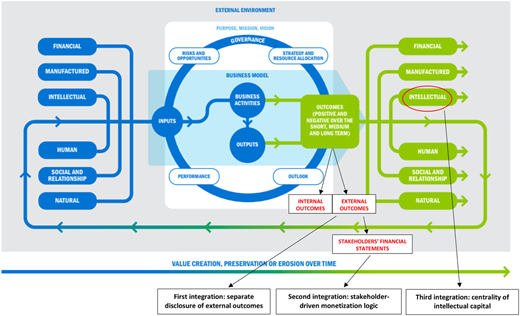
In Figure 1, building on the model presented by the International Integrated Reporting Council (2021), shows how the proposed integrations modify the original Integrated <IR> Framework, affecting the ways in which the process through which value is created, preserved or eroded is represented.
4.3.1 Normative proposal 1 – separate disclosure of internal and external outcomes
The first normative proposal is a dual outcome architecture for the integrated report. Internal outputs and external outcomes should be presented in distinct but connected layers. Internal outputs concern the Foundation's own operational activity, such as advisory services rendered, projects completed, events organized, training delivered or resources mobilized. External outcomes concern the mission-related consequences realized by stakeholders as a result of those activities, such as the acquisition of an intangible asset, the completion of an investment or acquisition involving an innovative firm or the establishment and initial capitalization of a new venture. The distinction is critical for accountability because it prevents the report from implying that the Foundation's own internal activity measures exhaust its value creation. It also prevents the opposite distortion, namely the presentation of external achievements without showing the operational processes through which they were enabled. In practical terms, the revised architecture treats internal outputs as evidence of organizational action and external outcomes as evidence of mission realization. The report should therefore disclose the two categories separately, explain their linkage narratively and avoid collapsing them into a single undifferentiated results section. This proposal follows from stakeholder theory (Freeman, 1984; Donaldson and Preston, 1995) because the value created by the promoter is distributed across multiple constituencies, and from reporting quality research (Permatasari and Tjahjadi, 2024; Zennaro et al., 2024; Ahmed and Hassan, 2025) because a clearer architecture reduces ambiguity in the location and interpretation of performance claims.
4.3.2 Normative proposal 2 – conservative monetization through stakeholder-based proxies
The second normative proposal concerns when and how selected external outcomes may be represented monetarily. The evidence supports a conservative, event-specific and document-based monetization logic. The unit of analysis is not the Foundation in the abstract nor the totality of social value produced during the year. The relevant unit is a selected external outcome that can be linked to the Foundation's promotional activity and supported by documentary evidence generated by an external stakeholder. A proxy may therefore be used when the outcome is mission-related, the promoter's contribution is materially evidenced, the amount falls within the reporting boundary, and the measure can be interpreted as a lower-bound representation. This requirement excludes speculative valuations, ex post estimates of ecosystem spillovers, later commercial performance and composite calculations that would conceal judgement inside a single headline number. The report should also avoid summing heterogeneous proxies into a total figure unless the events are analytically homogeneous and the basis for aggregation is explicitly justified. In the present study, the preferred design is separate disclosure by event category, accompanied by explicit statements on documentary source, attribution logic, temporal boundary, exclusions and limitations. Thus, the normative implication is not that NPEs should monetize all relevant outcomes. Instead, monetization can contribute to integrated value disclosure only when it remains traceable, lower-bound, conceptually aligned with the selected outcome and visibly subordinated to balanced narrative explanation (Arvidson et al., 2013; Corvo et al., 2022).
4.3.3 Normative proposal 3 – Intellectual capital as the organizing capital
The third normative proposal concerns the role of capitals in the report. In the case examined here, IC should be presented as the organizing capital around which the most material outcomes are structured, while its connectivity with other capitals must be made explicit. This does not imply reclassifying every effect as IC or denying the relevance of financial, human, social and relationship capital, as well as manufactured or natural capital. It implies recognizing that the Foundation's distinctive contribution is expressed primarily through knowledge selection, capability assessment, trust building, codification of routines, legitimacy transfer and orchestration of innovation relationships. Those mechanisms are intellectually grounded and then translated into external decisions by stakeholders. The report should therefore foreground IC in the business model and results sections, while explaining how human capital supports expertise and mentoring, how social and relationship capital supports trust and network access, how financial capital becomes visible in stakeholder commitments, and how natural capital may be implicated when the promoted innovations address environmental challenges. This proposal strengthens integrated thinking because it prevents the capitals framework from being applied as a flat taxonomy. Instead, the capitals are disclosed in a way that mirrors the actual hierarchy of value creation observed in the organizational setting (Tonelli et al., 2024; Dumay et al., 2019; Blankenburg, 2018b).
Taken together, these three normative proposals have a proposition-like character.
Proposition 1 is that nonprofit promoters operating in OI fields require a reporting architecture that distinguishes internal outputs from external outcomes whenever mission fulfilment is materially realized outside organizational boundaries;
Proposition 2 is that selected external IC-related outcomes may enter IR through conservative stakeholder-based proxies when documentary evidence, attribution logic and boundary assumptions are made explicit;
Proposition 3 is that, in knowledge-intensive promotional settings, IC should be treated as the organizing capital for disclosure purposes, with a transparent explanation of its connections to other capitals.
The propositions are grounded in one case and should therefore be read as analytical generalizations that invite further testing. Their value lies in making explicit a reporting logic that prior nonprofit IR studies had opened but had not developed in this specific direction.
These integrations are considered to be effectively applicable not only to nonprofit organizations operating in the OI sector but to a much broader category of entities, particularly those involved in intangible services. This is because they represent common traits for the majority of NPEs, as also emerging in this study, including the importance of external outcomes created for the benefit of the reference community, the centrality of intangible capital categories and the interconnections inevitably generated between these categories by virtue of the realization of the entities' social purpose. More specifically, transferability depends on whether the nonprofit entity operates as an ecosystem promoter whose mission is realized through external outcomes and whether a subset of those outcomes generates traceable accounting information in counterparties. In settings where outcomes are primarily non-transactional, the first and third integrations remain applicable, while the proxy logic may be less relevant. Conversely, in settings with frequent transactions but weak governance and documentation, proxy disclosure may be possible but risks over-claiming and should therefore be accompanied by stronger safeguards.
4.4 Reporting quality safeguards
The study highlights that the attribution of monetary values should remain partial when transactions are co-determined by multiple actors and contextual factors. In the present research, the relevant actors include the Foundation, client companies, inventors, start-ups, research institutions, investors, advisers and, in some situations, public bodies. Contextual factors include technology readiness, market timing, firms' absorptive capacity, the availability of finance, contractual negotiations and the broader institutional environment. For this reason, the reported amount is never presented as a value caused entirely by the Foundation. It is disclosed instead as a bounded proxy for an external outcome to which the Foundation materially contributed.
This is why the disclosure logic requires transparent statements regarding the role of the nonprofit promoter, the scope of the proxy and the relevant counterfactual assumptions. The counterfactual assumption is not that the transaction would certainly not have occurred without the Foundation. Rather, the assumption is that the timing, matching, configuration or probability of the observed outcome would have been materially different in the absence of the Foundation's promotional role.
To mitigate impression management risks (Merkl-Davies and Brennan, 2007; Melloni et al., 2017; Rauschenberger et al., 2025), the model also requires a balanced discussion of outcomes that were not achieved or could not be quantified. The Foundation carries out many activities whose effects remain important but non-monetizable within the logic adopted here. Examples include networking initiatives that did not culminate in a transaction within the reporting period, exploratory contacts without completed deals, mentoring relationships without immediate incorporation of a venture and broader reputational or learning effects for which documentary evidence is insufficient. These negative or incomplete cases are an essential part of a balanced integrated report because they reveal where the organization's influence remains significant but not monetizable.
Alternative interpretations must also be considered. Specifically, in the present research, the Foundation may primarily function as a certifier or legitimacy enhancer rather than as a creator of value. Moreover, the observed amounts may mainly reflect the capabilities and bargaining power of the stakeholder firms rather than the Foundation's role. A further alternative interpretation is that accounting recognitions and transaction prices may embed expectations, synergies or premiums that cannot be cleanly allocated to IC. The study does not dismiss these interpretations. Instead, it uses them to narrow the claim: the disclosed number should be read as an externally validated stakeholder commitment associated with a selected outcome, not as a full causal measure of value creation.
In this sense, the Foundation's case shows that monetization can be useful only when accompanied by methodological modesty. The practical consequence is straightforward. A nonprofit promoter should not attempt to monetize everything that matters. It should monetize only what can be defensibly proxied and then explain, with equal visibility, what remains outside the monetary frame. This balance between quantified and non-quantified outcomes is what allows the reporting model to be informative above all rather than merely persuasive (Rauschenberger et al., 2025; Zennaro et al., 2024).
5. Conclusions
The conducted analysis has shown that OI represents a powerful approach that leverages external knowledge flows, multiple collaboration modes and the integrated management of IC to drive sustained value creation in today's highly dynamic service sector (Blankenburg, 2018a; Barrena-Martínez et al., 2020). The involvement of NPEs, particularly foundations, as facilitators of OI is of strategic importance as these organizations help bridge knowledge gaps, foster stakeholder collaboration and enhance the overall IC of companies (Kong, 2007).
Due to the inherent complexity and intangibility associated with these processes, traditional reporting frameworks are inadequate in encapsulating the full range of value generated by such entities (Pirozzi and Ferulano, 2016). Consequently, our work has proposed, also with the support of a case study concerning the activity of a foundation operating in the field of OI, to use and adapt the International <IR> Framework to include specialized disclosure criteria that capture the nuanced contributions of NPEs to OI (Sproviero et al., 2018).
In nonprofit promoters of OI, the research shows that a material share of value creation occurs beyond organizational boundaries, is driven by IC and becomes visible when external stakeholders make investments, acquisitions or venture-creation decisions that can be documented.
The first contribution of the study is theoretical. By combining perspectives from IC theory, stakeholder theory, legitimacy theory and institutional theory, the study conceptualizes nonprofit promoters as organizations whose mission is realized through externally distributed outcomes. This moves the analysis beyond a descriptive statement that NPEs matter in innovation ecosystems. It clarifies why their reporting challenges differ structurally from those of conventional firms. It also explains why IC becomes the key form of capital in this setting. The central value created by the promoter concerns knowledge opportunities, relational trust, organizational routines and innovation pathways that culminate in decisions made by others.
The analysis underlines that enhancing companies' IC through OI requires both a rethinking of traditional knowledge management approaches and the implementation of robust, integrated disclosure frameworks that accurately represent the multifaceted contributions of NPEs (Dumay et al., 2019). By pursuing such an approach, the value generated by these NPEs can be transparently communicated to a broad spectrum of stakeholders, thereby fulfilling their institutional mission and reinforcing the essential role of the service sector in contemporary innovation ecosystems (Benevene et al., 2017).
The second contribution of the research concerns disclosure design. The study develops three normative proposals that remain closely aligned with the architecture of the Framework while improving its fit with the nonprofit sector. These proposals include separate disclosure of internal and external outcomes, the conservative monetization of selected external outcomes using stakeholder-based proxies, and the foregrounding of IC together with its interconnections with other capitals. The contribution is incremental in relation to prior nonprofit IR studies (Dameri and Ferrando, 2021, 2022; Girella and Dameri, 2019), but it is conceptually new in treating IC and OI jointly as a source of quantifiable added value in NPEs and in specifying the safeguards required for that quantification.
In this way, one of the main criticisms traditionally leveled against Integrated Reports, starting with those published by for-profit companies, namely the limited availability of metrics and quantitative data as a measure of the value created (Vitolla et al., 2019; Dumay et al., 2017; Permatasari and Tjahjadi, 2024; Ahmed and Hassan, 2025), can be overcome.
The practical implications for nonprofit managers follow directly. Managers of nonprofit promoters should map their mission-related activities not only to internal outputs but also to external outcomes realized by identifiable stakeholders. When using monetary proxies, managers should preserve an auditable trail linking the reported amount to documentary evidence, state the attribution logic explicitly and avoid reporting later synergies or wider spillovers as if they were directly attributable (Arvidson et al., 2013; Corvo et al., 2022). In operational terms, IR becomes a discipline of selective disclosure and methodological humility rather than a search for a single total value figure.
Boards should also be aware that selective monetization creates reputational benefits only when the associated limitations are disclosed with equal visibility. The study therefore supports a managerial view of IR as a discipline of evidence, boundary setting and interpretive restraint (Cosa et al., 2024; Carusone et al., 2025). These routines may also improve organizational learning because they force managers to identify where the NPE consistently adds value, where outcomes remain difficult to evidence and where apparent successes depend more heavily on contextual conditions than on replicable organizational capabilities.
The implications for policymakers are equally relevant. Public and quasi-public innovation policies increasingly rely on organizations that convene, screen and accelerate innovation ecosystems without necessarily owning the resulting assets. These organizations are often evaluated through narrow activity metrics or grant-compliance indicators. The present study suggests that policymakers should recognize nonprofit promoters as ecosystem infrastructure and should encourage reporting models that combine qualitative accountability with carefully bounded quantitative disclosure. Such models can improve the evaluation of policy-supported innovation ecosystems without forcing nonprofits into inappropriate corporate metrics or into totalizing monetization exercises (Gutiérrez-Nieto et al., 2025; Vik, 2017; Gibbon and Dey, 2011).
Standard setters may also draw useful lessons from the study. The findings suggest the value of sector-sensitive guidance notes or appendices that clarify how the capitals logic can be applied in mission-driven organizations whose most salient outcomes are external. They also indicate that any future guidance on quantitative disclosure should require explicit reporting of proxy selection criteria, attribution assumptions, counterfactual reasoning and non-quantified outcomes. In a reporting environment increasingly shaped by the interaction between IR and broader sustainability regulation (Raimo et al., 2025), such safeguards may help prevent the migration of ceremonial or weakly grounded metrics into nonprofit reporting practice.
A further implication for standard setters concerns assurance and comparability (Kılıç et al., 2021). The present study does not propose mandatory monetization requirements for NPEs. It suggests a narrower path: where organizations choose to monetize selected external outcomes, guidance should promote standardized disclosure of source documents, event categories, attribution notes and exclusions, thereby improving comparability without forcing uniform valuation formulas across heterogeneous missions. Such guidance would also help assurance providers, boards and audit committees evaluate whether a reported amount is anchored in a clearly defined construct or merely used rhetorically (Caglio et al., 2020). In this sense, the contribution is relevant for the design of soft-law guidance, sector protocols and internal governance mechanisms surrounding nonprofit reporting.
The paper also offers teaching and research implications. For teaching purposes, the case provides an instructive setting to discuss integrated thinking, IC, OI, measurement validity and the ethics of monetization (Tonelli et al., 2024). In particular, the study enables discussion of three recurring tensions in contemporary reporting research: the tension between accountability and advocacy, the tension between qualitative richness and quantitative comparability and the tension between sector-neutral frameworks and sector-specific value creation processes (Rauschenberger et al., 2025; Permatasari and Tjahjadi, 2024; Du Toit, 2024; Ficco et al., 2023; Vitolla et al., 2019). For research training, the case is equally useful because it illustrates how interventionist inquiry can contribute to both methodological rigour and practical problem-solving when reflexivity and explicit protocols are built into the design (Jönsson and Lukka, 2005; Sunding and Odenrick, 2010).
The study has limitations, but we believe that these limits define the scope of the contribution. The evidence comes from a single interventionist case in the OI field, and the proposed monetization logic is intentionally confined to selected external outcomes supported by documentary evidence. The paper does not attempt to address the impossible task of measuring total social value, total IC or all ecosystem effects generated by the NPE. Future research could therefore examine transferability across sectors, such as healthcare, education, culture or social services. Longitudinal studies could examine whether monetized disclosures affect resource allocation or stakeholder trust over time. Additional contributions could investigate how assurance practices might interact with this disclosure model and explore whether different stakeholder groups use narrative and monetary information differently. These avenues would extend the present work while, we hope, preserving the disciplined and bounded application of quantification developed here.
Appendix
Table A1 provides a condensed version of the reporting model derived from the case study.
It is intentionally shorter than the version developed in the main text and is designed to illustrate how the three proposed integrations can be incorporated into the main sections of an integrated report prepared by a nonprofit promoter of OI.