


The diffusion of electronic commerce has a notable impact on the economy's prosperity. This paper embraces complexity theory principles to examine the factors affecting Internet users' acceptance and use of electronic retailers. It is essential for the sustainability of electronic retailers to understand the motivations impacting online consumer behaviour. Symmetrical and asymmetrical methods are combined to examine the relationship between perceived ease of use, perceived enjoyment, web characteristics, online consumer reviews (OCRs) and online purchase intention. Further, symmetry and differences between males and females were examined.
Data collected from 425 online consumers using an online structured survey was analysed using structural equation modelling (SEM) and fuzzy set qualitative comparative analysis (fsQCA). The net effects and causal configurations of the four proposed variables and online purchase intention were examined.
The SEM findings confirmed the significance of perceived enjoyment, website characteristics and OCRs on online purchase intention. Perceived enjoyment mediated the relationship between perceived ease of use and online purchase intention. The multi-group analysis confirmed the difference in antecedent impacts between males and females. The fsQCA findings revealed that multiple recipes lead to the occurrence of online purchase intention; in addition, the recipes leading to its absence do not mirror the previous ones.
The present study embraces complexity theory concepts in understanding online purchase intention using fsQCA methodology; further, the role of gender in online consumer behaviour was highlighted in the result discussion.
1. Introduction
A turning point in human history was in 2020 due to the coronavirus epidemic, which fostered digital transformation and increased attention to sustainability, especially in developing countries (Amankwah-Amoah et al., 2021). The pandemic has greatly affected the retail sector, transferring transactions from offline to online businesses. With the mandatory closure of brick-and-mortar retailing and the fear of being infected, individuals turned to digital platforms to purchase goods. The patterns of consumer behaviour have changed due to the effect of the pandemic; across the world, consumers were encouraging online shopping at the expense of traditional retail (Lavuri, 2021). In 2021, global electronic commerce (e-commerce) sales exceeded 5.2 trillion US dollars, with the prediction to continue rising in the coming years (Statista, 2022a).
Electronic retailers (e-retailers) refer to retailers employing digital platforms to communicate with customers, promote brands, advertise products and provide support and after-sales services (Sullivan and Kim, 2018). They can be purely online, meaning that the digital platform represents their unique channel for communication, or they can support their existing physical presence with an online one. With over 5 billion global Internet users, the number of people making online transactions is growing. Many studies have shown that online shopping offers many benefits; customers benefit from the convenience of shopping at any time, saving time, comparing costs on different websites before making decisions, gathering information regarding the goods, reading the comments and reviews from previous users and obtaining the product delivered at home (Mainardes et al., 2020). On the other hand, e-commerce offers retailers a way to expand their reach globally, to promptly reply to customers’ inquires, and users' data analytics enable them to recommend the right products to the consumer; as a result, increasing customer satisfaction and loyalty.
The e-commerce in the Middle East and North Africa (MENA) region continues to evolve; the e-commerce sector in the region increased from $15 billion in 2019 to $22 billion in 2020. According to Research and Markets, the increase in electronic retailers in the MENA region will rise with a compound annual growth rate of 15.19% between 2022 and 2026. The value of e-commerce in the MENA region is estimated to reach $183.4 billion by the end of 2026. Saudi Arabia, the United Arab Emirates and Egypt are the key actors driving this development (Fakieh and Happonen, 2023). As a result of several factors, the digital transitions were accelerated in the region. One of these influencing factors is the spread of COVID-19 caused people to purchase online rather than physically visit stores. The worldwide reaction to the COVID-19 pandemic has expedited digital change in Egypt (Abdelsalam and Ahmad, 2023; Aref, n.d.). According to Statista (2022b), with 75.66 million Internet users by January 2022, Egypt ranked 12th globally, with an increase of 1.4 million users from the previous year. The increasing number of Internet users disrupts the power of prevailing brick-and-mortar retailers and accelerates the shift towards online shopping. While Egyptian people were hesitant to use digital channels for purchasing goods before COVID-19, prominent e-retailers like Souq, which relaunched as Amazon Egypt in 2021, Jumia and Noon reported a 940% rise in online sales in the first half of 2020. Also, the online retail site Mrsool, which provides 24/7 accessibility to customers to have their packages delivered at any time, became very popular during the pandemic. Their number of users quadrupled, and their revenues doubled during the pandemic (Mohamed, 2021). According to a Mastercard 2020 poll, over 75% of customers had increased online buying due to the pandemic (Augustine, 2022).
Egypt has a high Internet and mobile penetration; the median age of its population is 24.1, with many talented, well-educated and trainable youths. According to Statista estimates (2023), the e-commerce market revenue in Egypt is increasing with a compound average growth rate of 14.8% from 2023 to 2027. Although the effort of the government to boost digital transformation and the increasing number of Internet users and online retailers, the share of the online retail market represents 3% of the total market. It is critical for the prosperity of the e-commerce sector not only to improve the infrastructure and Internet speed but also, to increase the acceptance of online shopping among internet users and retain online customers. For Egypt to reap the economic benefits of e-commerce dissemination, it is necessary to promote the usage of e-commerce.
Gungor and Cardirci (2022) and Venkatesh et al. (2022) clarified the importance of understanding online customer behaviour for electronic markets to develop and expand. Consequently, there is a continuous need to identify the significant factors influencing online consumer behaviour, and the subject continues to be one of the essential research topics and grab the attention of researchers and practitioners. Researchers have developed many models to explore the adoption of different information systems in various contexts. One of the most applied models and empirically examined is the one proposed by Davis (1989), the technology acceptance model (TAM). The model has successfully explained the acceptance and use of novel technology in developed and developing countries (Rauniar et al., 2014; Mortenson and Verdgen, 2016). The TAM model, among other theories and methodologies, has been extensively applied in information technology and Internet-based services to explain the adaptation decision-making process (Ying et al., 2021).
According to the original model, adopting a new information system is impacted by how the users perceive the new system as valuable and effortless. The more the information system is easy and beneficial to the users, the more they will adopt it. Davis (1993) added perceived enjoyment and system characteristics to the model, revealing that the use of information systems will be affected by how they function in a manner that meets the expectation of users and amuse them. Viral marketing is one of the influential factors in the consumer decision-making process in the online context; hence, researchers extended the TAM to incorporate it (Zhao et al., 2020). Due to the significant impact of the previously mentioned factors, this paper examines the relationship between them and the intention to buy online in an emerging economy, Egypt.
Shopping has traditionally been stereotyped as a feminine activity. Males spend less time shopping and make shopping decisions faster than females. Due to the characteristics of the online context, including the absence of face-to-face interactions, the lack of social interaction, as well as the difficulty of evaluating the goods in detail using physical touches, and on the other hand, proving efficient ways for information searching and evaluation, the easiness of navigation; the dominance of females in shopping activities is questionable. Some findings insinuate that men can be the dominant gender in online shopping (Hasan, 2010). The growing population of Internet users, combined with the increasing number of e-retailers, can alternate the situation. As a result, this study examines gender differences towards online purchase intention.
Social science research witnessed an increase in research embracing qualitative comparative analysis (QCA) methodology due to the recognition that causality in complex systems needs to be addressed (Diwanji, 2022). QCA is a promising and powerful analytical technique balancing qualitative and quantitative methodologies and demonstrates the asymmetrical thinking of complexity theory (Kumar et al., 2022). The social scientist Charles Ragin introduced QCA to enable logical connections between an outcome and combinations of causal conditions by identifying rules summarizing sufficiency between potential combinations of conditions and the output (Ragin, 2008). Each one of these combinations represents a possible path to the outcome (Mendel and Korjani, 2013). As a result, Woodside (2017) called for researchers to re-examine previous research established using symmetrical methods by employing asymmetrical techniques.
Structural equation modelling (SEM) measures the average influence of every single exogenous construct on an endogenous variable. Numerous researchers have pointed out that such a mean-centred symmetric approach provides an incomplete view regarding the effects (Woodside, 2017). Using asymmetric methodologies can overcome this concern since they evaluate multiple groups of cases rather than the mean values of the variables. Fuzzy set qualitative comparative analysis (fsQCA) explores how antecedent conditions' combinations, rather than individual antecedents, influence the outcome. Many researchers emphasize the promise of combining asymmetric techniques with symmetrical ones (Rasoolimanesh et al., 2021). The extant literature drawing on methods techniques like fsQCA shows that causal relationships frequently occur in reality and that the antecedent factors that affect the outcome of interest do not act in isolation from other conditions (Gligor and Bozkurt, 2020; Chen et al., 2022). Unlike regression-based models, fsQCA can handle asymmetric effects and offers insights into causal interactions among conditions (Pappas and Woodside, 2021).
Given the continually expanding body of information on the intention towards online shopping, it would seem beneficial to use a variety of methodologies to get an in-depth understanding of the subject. Taking an asymmetric posture goes far beyond the research of interaction effects in that it provides a few different configurations that reliably predict the intention to shop online. Therefore, this study seeks to deepen the understanding of how website perceived ease of use, online shopping perceived enjoyment, website characteristics (WC) and online consumer reviews (OCRs) affect and lead to online purchase intention among Egyptian Internet users. In addition to examining the phenomena using SEM, fsQCA is conducted to deepen the understanding of how different combinations of the proposed factors lead to online purchase intention where each condition does not work in isolation from the others. The application of fsQCA allows the understanding that while an antecedent variable may be necessary for an outcome generation, a single antecedent variable is barely sufficient for its occurrence (Fainshmidt et al., 2020). While acknowledging the value of regression-based techniques, this research seeks to enhance their conclusions and deepen the understanding of online purchase intention beyond the net effects by uncovering possible causal combination patterns and offering set-theoretic insights into online purchase intention.
After the introductory section, this article is organized as follows. The concepts behind the fsQCA are presented in Section 2. Section 3 provides the proposed model and hypotheses. The SEM and fsQCA results are presented in Section 4, followed by a discussion of the main findings and how they theoretically and practically enlighten online purchase intention knowledge in Section 5. Limitations and an outlook on future research are presented in Section 6. The paper closes with the conclusion in Section 7.
2. Fuzzy set qualitative comparative analysis concepts and applications in the online context
2.1 Fuzzy set qualitative comparative analysis concepts
Ragin introduced QCA founded on sets theories and relations, a technique that examines set-subset relationships between all logically feasible arrangements of the presence or absence of antecedent conditions and the outcome presented in a binary form. According to Ragin (2008), the goal of QCA is to derive a logically simplified statement describing the different combinations of conditions linked to an outcome. Although QCA has conventionally been used for small or medium sample size, Emmenegger et al. (2014) argued that it is also applicable to survey data research.
FsQCA extends QCA by examining varying degrees of belongingness of cases to a particular set. Ragin (2008) declared fuzzy sets have many of the virtues of conventional interval- and ratio-scale variables, but at the same time they permit qualitative assessment. FsQCA bridges quantitative and qualitative methods. The process of assigning fuzzy membership scores to the values of a given variable is known as calibration. All original values for variables are calibrated into membership scores ranging from zero to one using a logarithmic function. For each variable, the researcher specifies the values for full membership based on the 95th or 90th percentile. Likewise, the 5th or 10th percentile represents the calibrated complete non-membership and the cross-over point for the median value (Fainshmidt et al., 2020).
Configurational modelling captures that a high score in an outcome condition is rarely resulting from a single condition; on the other hand, few recipes are required for the result to occur. FsQCA uses Boolean logic to determine necessary and sufficient configurations for the outcome (Ordanini et al., 2014). A condition is necessary if it appears in all causal combinations leading to the outcome; on the other hand, a condition or combination of conditions are considered sufficient, if the outcome emerges whenever the condition or combination of conditions are present. Several sufficient causes may exist.
Two key concepts are related to fsQCA: consistency and coverage (Dul, 2016). Consistency, like correlation, defines the degree to which observable configurations are consistently related to the output. Coverage, like R2 in regression, evaluates the empirical significance of a consistent subset (Ragin, 2008). Further, for each resulting combination raw coverage is computed, referring to the explanatory strength of this configuration to the output. Unlike consistency, limited configuration coverage does not indicate reduced relevance. In situations where a result happens through numerous causal configurations, a single configuration may have limited coverage yet still be valuable in explaining a set that produces the outcome (Emmenegger et al., 2014).
When the membership scores in a particular causal set (Xi, i = 1, 2, 3, …, n) are consistently smaller than or equal to the membership scores in the result set (Yi, i = 1, 2, 3, …, n), this is referred to as a consistent subset relation. Equation (1) is used to calculate consistency (Ordanini et al., 2014).
The consistency threshold distinguishes specific configurations of antecedents that are subsets leading to the result from those that are not. Perfect consistency is detected when the consistency index value is equal to one; however, Ragin (2008) recommended that for fsQCA analysis the consistency threshold should be ≥ 0.8.
Following that, fsQCA computes the coverage for the antecedents' final configurations. Coverage refers to the extent to which an antecedent configuration accounts for high scores in the result set. Coverage indices, like effect size in statistical hypothesis testing, vary from 0 to 1 and represent empirical relevance. Equation (2) is used to compute the coverage. A coverage value of 0.2 or higher confirms the sufficiency of a configuration; if both coverage and consistency are higher than 0.9, then this single condition or combination of conditions is considered necessary (Dul, 2016).
Truth tables are used to depict multiple causal relationships, as each row illustrates a mix of factors that lead to the outcome. The number of rows in the truth table is 2k, where k represents the number of conditions included in the study. Frequency threshold enables classifying combinations involved in the solution.
The next step in applying fsQCA is to define subset size and consistency thresholds. Based on the size of the sample, the subset size threshold is set. For a sample with more than 150 cases, the minimum threshold should be three or more (Fiss, 2011). The final stage in implementing fsQCA is the logical reduction of the sufficient antecedent. The fsQCA software provides three sets of solutions (complex, parsimonious and intermediate). Fiss (2011) clarified that the complex solution presents all the possible combinations of conditions when traditional logical operations are applied; parsimonious and intermediate solutions are simplified forms of the complex solution.
2.2 Fuzzy set qualitative comparative analysis embracing complexity theory principles
Adopting fsQCA embraces the core principles of the complexity theory (Woodside, 2013). The first core principle is that a single condition is rarely identified as a necessary or sufficient condition. However, a few combinations of the antecedent conditions are found to be necessary or sufficient for the outcome. The second one is the equifinality principle, implying more than one solution leads to the desired output. The findings of fsQCA could reveal that multiple combinations of antecedent conditions can generate the outcome. In other words, different paths can lead to output. Contrary to the dominant logic of regression-based estimation techniques such as SEM that relies on net effect assumptions. By excluding the impact of other antecedent circumstances from the equation, the net effects approach analyses the link between an antecedent condition and a result (Varnali, 2019); therefore, symmetrical techniques cannot be used for testing the concept of equifinality.
The third principle is the causal asymmetry principle, which indicates causal combinations explaining cases with low membership scores in an outcome condition are not mirror opposites of those associated with high membership scores. High levels of an antecedent condition could be associated with a high outcome condition and its negation, depending on what additional ingredients occur in specific recipes of antecedent conditions. And fourth, even a small subset could deepen the understanding of the relationships between independent and dependent variables, therefore, should be included in the analysis.
2.3 fsQCA applications in online context
Researchers have recently become interested in implementing fsQCA to complement and strengthen the results of traditional statistical techniques (Huarng, 2016). In the online environment, for instance, Ahmad (2017) alleged that studying only the net effect of determining the helpfulness of online reviews may lead to confusing results; the fsQCA findings revealed three paths leading to helpful online reviews. Moreover, Pekovic (2020) advanced customer experience research by empirically demonstrating how customer loyalty can result.
Further, Yang (2021) examined online purchase intention in social commerce. The net analysis affirmed the significant mediation role of trust and social interaction along with the fsQCA that confirmed that trust and social interaction are sufficient antecedents for online purchase intention in social media. While SEM results revealed an insignificant direct relationship between shared language and online purchase intention, the fsQCA findings revealed the recipe where shared language is necessary to reach online purchase intention. Likewise, the results of Aw et al. (2022) and Chen et al. (2022) revealed multiple configurations explaining social commerce purchase intention. Hence, the application of fsQCA, in dealing with causal complexity, has an advantage over the linear-based SEM by elucidating how antecedent factors interplay and combine in achieving the output.
3. Proposed model and hypotheses
Purchase intention is an essential component of the customer decision-making process. Kim et al. (2009) defined online purchase intention as the plan of a person to engage with websites, such as sharing information and conducting business transactions. Purchase intention from a particular website is used to predict the actual behaviour. The proposed model in this study is based on one of the most used models in information systems studies, the TAM. Based on the literature, the most significant factors are perceived ease of use, perceived usefulness, system characteristics and perceived enjoyment (Koul and Eydgahi, 2017). In addition, prior research on online consumer behaviour confirmed the positive relationship between viral marketing and the intention to shop online (Fard and Marvi, 2020). Therefore, the proposed model includes the four previously mentioned factors and examines the relationship between them and online purchase intention.
3.1 Perceived ease of use (PEOU) and perceived enjoyment (PE)
The presented model examines the relationship between online purchase intention and website perceived ease of use (PEOU) and perceived enjoyment (PE) from shopping through websites. PEOU refers to the degree to which consumers think that a website can support them in buying online with less effort; if users can easily handle the process of online shopping, they are more eager to purchase online. PE refers to the amount of delight that customers have when making an online transaction from a certain website. When users feel that online transactions are accessible, effortless and uncomplicated, this will increase their amusement. Hence, the following three hypotheses were examined.
There is a significant relationship between PEOU and OPI.
There is a significant relationship between PE and OPI.
There is a significant relationship between PEOU and PE.
3.2 Website characteristics (WC)
Chen and Teng (2013) clarified that a company website is a mirror for businesses' identities and affects how visitors perceive the company. The characteristics of the websites influence the perception of consumers regarding the product and services offered by e-retailers impacting their intention to buy from this website. Sharma and Lijuan (2015) confirmed that website design identifies a company's capacity to achieve online sales. In addition, the product description displayed on the site should be accurate and informative to the surfer. Not only the design of the website and the product information but also the quality of services, starting from how users can find products, track orders and receive replies to their inquiries.
Web designers are displaying items in ways that attract Internet surfers, aid them in evaluating the specs of products and persuade people to purchase online as web-based multimedia capabilities evolve. Ahmad (2017) advised that as web-based multimedia capabilities flourish, site designers should attractively display objects to attract Internet surfers, assist them in analysing product specifications and encourage customers to purchase online.
Websites should allow consumers to exchange information and evaluate products and services in an easy and interactive manner. In this study, the WC construct took into account both the usability, the interactivity of the site, the attractiveness of its product displays, the accuracy of the information it displays and the simplicity of its access and navigation. Tandon et al. (2018) confirmed that information usefulness and website qualities positively impact online purchase intention. Thus, this study included WCs as the third factor in the proposed model. Further, the author assumes that navigating a good website increases the surfer's enjoyment. So, the following hypotheses were examined.
There is a significant relationship between WC and OPI.
There is a significant relationship between WC and PE.
3.3 Online consumer reviews (OCRs)
The evolution of web technologies enabled customers to engage with one another conveniently and instantly, increasing information dependence. Before making a purchase decision, potential buyers access a tremendous quantity of consumer-generated information about the desired product. Approximately 97% of consumers read and are affected by consumer reviews (Ahmad, 2017). Viral marketing is changing the form product information is acquired and exchanged from marketers to consumer-generated content (Fard and Marvi, 2020).
OCRs are quickly becoming one of the most significant sources of information impacting customers' purchasing decisions, as they are less invasive and more effective than promotion messages (Hernández-Ortega, 2018; Pfeuffer and Phua, 2022). OCRs have undeniably become a potent marketing tool. They enable customers to exchange information and have remarkable scalability and speed of spread. According to previous research, customers trust the judgments of other consumers more than advertising or promotion information. Zhao et al. (2020) findings confirmed that reviews posted by different people about the benefits or drawbacks of a product on websites influence customer purchasing behaviour and guide product selection. Many scholars support that OCRs significantly impact online purchase intention (Andrian, 2022); hence the following hypothesis is examined.
There is a significant relationship between OCRs and OPI.
3.4 Gender
Researchers were interested in studying gender discrepancies towards new information systems adoption (Lin et al., 2019; Venkatesh et al., 2022). Cai et al. (2017) debated that computer anxiety is higher among females; males tend to be more informed and confident in their use of technology. Further, the association between site functionality and behavioural intention is higher among males than females (Danaher et al., 2006).
Wang et al. (2010) found that females are motivated by the fun of online shopping. Males, on the other hand, are known to prefer objective information that is concise and comparable. While spending limited time on a website, they desire efficiency and time-energy conservation in the buying process rather than a hedonic experience. Further, Hui and Wan (2007) and Sututemiz and Saygili's (2018) findings showed a significant difference between genders according to their responses to online hedonic shopping motivations; the mean scores of females' answers were higher than those of males. The current study investigates if males and females respond differently in the digital environment. Also, is perceived enjoyment having a higher impact on females and web characteristics having a higher effect on males? And what about OCRs?
4. Research methods and results
4.1 Measurement development
Data were collected using a structured online questionnaire survey. Google Forms was used for the questionnaire implementation. The link to the survey was posted via Facebook and WhatsApp. Although online surveys have some limitations, it has been widely used due to their practicality (Andrade, 2020). The survey included a brief introduction explaining the aim of the research and assuring the confidentiality of the collected data. All measurement items were drawn from the literature (Li, et al. 2013; Tandon et al., 2018; Aref, 2022). All items were translated into Arabic and carefully examined by the author. Five experts reviewed the survey tool and advised some minor wording changes. A total of 425 responses were collected. Two-thirds (64.7%) of the respondents had purchased online before; 68.5% of the respondents were females; 30.8% were less than the 20s, 48.5% were from the 20s to less than the 30s and the rest of the sample was more than 30.
4.2 Testing the measurement model
Exploratory factor analysis (EFA) was first carried out to determine the relationship between the measured variables. All manifest variables' outer loadings are sufficiently high, ranging above 0.5; hence, all items are kept for further analysis. The Kaiser–Meyer–Olkin measure of sampling adequacy is equal to 0.9, and Bartlett's test of sphericity was significant. The questionnaire items and their loadings are provided in Appendix 1. The dataset was checked for common method bias by drawing on Harman's single-factor test (Podsakof and Organ, 1986). The evaluation indicates that common method bias does not affect the study's analysis. The highest percentage explained by a factor was 24.63% of the variance, less than the threshold of 50%.
Next, confirmatory factor analysis (CFA) was conducted. The obtained values for Cronbach's alpha and construct reliability (CR) exceeded the recommended value of 0.7, indicating adequate internal consistency; the overall Cronbach’s alpha for the model, including a total of 24 items, was equal to 0.936. Additionally, the average variance extraction (AVE) values exceed the threshold of 0.5, indicating good convergent validity (Hair et al., 2019). The reliability and internal validity of measurements are presented in Table 1. Further, collinearity was examined. The VIF values of all constructs ranged between 1.5 and 2.5, indicating the absence of multicollinearity concern.
Summary of reliability and validity statistics
| Variable | # of items | Cronbach’s alpha | CR | AVE | Correlation | ||||
|---|---|---|---|---|---|---|---|---|---|
| OCRs | WC | PEOU | OPI | PE | |||||
| OCRs | 3 | 0.843 | 0.876 | 0.705 | 0.839 | ||||
| WC | 9 | 0.916 | 0.916 | 0.553 | 0.506 | 0.744 | |||
| PEOU | 4 | 0.832 | 0.830 | 0.555 | 0.567 | 0.582 | 0.842 | ||
| OPI | 4 | 0.902 | 0.906 | 0.709 | 0.483 | 0.634 | 0.606 | 0.745 | |
| PE | 4 | 0.832 | 0.838 | 0.569 | 0.384 | 0.548 | 0.694 | 0.632 | 0.754 |
Note(s): The square root of the AVE values are the diagonal elements written in italic
Source(s): Author's own work
4.3 Structural equation model results
The proposed model was found to be adequate according to Byrne (2006)'s recommended cut-off values. Goodness-of-fit indices like comparative fit index (CFI = 0.929) and incremental fit index (IFI = 0.930) had values greater than 0.9. The root mean-square-error of approximation (RMSEA = 0.068) was less than 0.07. Together, perceived ease of use, perceived enjoyment, OCRs and WCs accounted for 61% of the variance in online purchase intention. Further, web characteristics and perceived ease of use explained 43% of perceived enjoyment variation. The graphical presentation for SEM analysis results is presented in Figure 1.
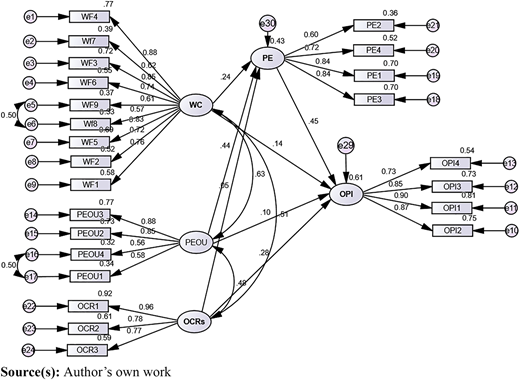
Five of the examined hypotheses were accepted. As hypothesized, perceived enjoyment was positively associated with OPI (β = 0.454, p < 0.001), OCRs were positively associated with OPI (β = 0.284, p < 0.001) and WCs were positively associated with OPI (β = 0.134, p = 0.014). Contrary to the proposed hypothesis, the direct relationship between perceived ease of use and OPI was not supported. On the other hand, WCs were positively associated with perceived enjoyment (β = 0.26, p < 0.001), and perceived ease of use was positively associated with perceived enjoyment (β = 0.459, p < 0.001).
The mediation of perceived enjoyment was examined through bootstrapping. The indirect effect of perceived ease of use on OPI was significant (β = 0.2, p = 0.001), the indirect effect of website characteristics on OPI was significant (β = 0.115, p = 0.001), confirming the mediation role of perceived enjoyment. Perceived enjoyment totally mediated the relationship between perceived ease of use and OPI; and partially mediated the relationship between website characteristics and OPI.
Multi-group analysis was performed to examine the role of gender. The results revealed that there is a significant difference between the original model and the constrained one p < 0.001 implying a significant difference in the variable effects based on gender. The direct and indirect results are presented in Table 2.
Structural equation modelling direct and indirect results
| Structural paths | Overall sample | Male | Female |
|---|---|---|---|
| Direct effects results | |||
| WC→PE | 0.243*** | 0.337** | 0.255*** |
| PEOU→PE | 0.443*** | 0.340** | 0.459*** |
| WC→OPI | 0.136** | 0.247** | 0.121 |
| PEOU→OPI | 0.097 | 0.198 | 0.023 |
| PE→OPI | 0.452*** | 0.338*** | 0.489*** |
| OCRs→OPI | 0.279*** | 0.233*** | 0.296*** |
| % of explanation R2 | |||
| OPI | 61% | 68% | 56% |
| PE | 43% | 40% | 41% |
| Indirect effect results | |||
| WC→PE→OPI | 0.2*** | 0.025*** | 0.186*** |
| PEOU→PE→OPI | 0.115*** | 0.106*** | 0.117*** |
Note(s): **p < 0.05, ***p < 0.001
Source(s): Author's own work
4.4 Fuzzy-set qualitative comparative analysis
Most research examines the impact of the different motivations towards online purchase intention using symmetric analysis. Such results may account for the contribution of a significant portion of the sample, but there is still a part of the sample that is not explained by the single best solution suggested by SEM since these methods assume that a predictor must be both a necessary and sufficient condition for the intended outcome. Pappas (2018) stated that focusing only on the net effects may be misleading since such analyses do not apply to all cases in the dataset. For example, perceived ease of use may be sufficient to explain high purchase intention, yet low perceived ease of use combined with other factors such as perceived enjoyment and web characteristics may still explain high purchase intention, implying that the presence of only one factor is not a necessary and sufficient condition. Therefore, in this study, the fsQCA methodology was implemented using fsQCA 3.0 software developed by Ragin and Davey (2014) to capture causal complexities and identify different combinations explaining online purchase intention.
The three percentiles (95, 50 and 5) were computed for the scales resulting from the factor analysis, and their values were used to calibrate the different conditions. After the calibration, necessity is assessed. Following Ragin's (2008) recommendation, the necessity threshold is set to 0.9. Each causal condition is independently tested towards the presence of OPI and its absence (∼OPI). The negation of online purchase intention is computed as (∼OPI = 1- OPI). The results are shown in Table 3. The highest consistency is 0.84, below the cut-off value of 0.90. Consequently, none of the conditions is considered a necessary condition. Further, the coverage value is computed for each condition independently; the coverage values ranged from 0.7 to 0.84, implying the empirical relevance of the relation between the conditions and the output.
Necessary condition assessment
| OPI | ∼OPI | |||
|---|---|---|---|---|
| Consistency | Coverage | Consistency | Coverage | |
| PE | 0.814 | 0.820 | 0.471 | 0.438 |
| ∼ PE | 0.442 | 0.476 | 0.807 | 0.800 |
| PEOU | 0.775 | 0.820 | 0.471 | 0.460 |
| ∼ PEOU | 0.490 | 0.501 | 0.816 | 0.770 |
| WC | 0.710 | 0.775 | 0.487 | 0.491 |
| ∼ WC | 0.534 | 0.530 | 0.777 | 0.712 |
| OCRs | 0.694 | 0.822 | 0.455 | 0.497 |
| ∼ OCRs | 0.575 | 0.533 | 0.837 | 0.716 |
Source(s): Author's own work
Since combinations leading to the occurrence of online purchase intention do not mirror those leading to its absence, Wageman and Schneider (2010) recommended the examination of causal combinations leading to the presence and the absence of the dependent variable. As a result, necessary and sufficient analyses were conducted for both OPI and ∼OPI. The resulting truth tables for OPI and ∼OPI are presented in Appendix 2.
Although the fsQCA provides three solutions, namely, complex, parsimonious and intermediate, this research followed Ragin’s (2008) recommendations, and the analysis continued using the intermediate solution. Consistency and coverage values are used to evaluate the solution. Regarding OPI, the consistency of the overall solution is 0.9, and the overall coverage is 0.68, indicating that the three configurations explained a considerable amount of the outcome; likewise, for ∼OPI, the overall solution consistency is 0.89, and coverage is 0.67. Three terms have derived the presence of OPI (1a through 1c), and two for its absence (2a and 2b). The five configurations and their consistency, raw and unique coverage are presented in Table 4.
Intermediate solutions from FsQCA analyses
| 1 OPI = f (OCRs, PE, PEOU, WC) | 2 ∼OPI = f (OCRs, PE, PEOU, WC) | ||||
|---|---|---|---|---|---|
| 1a | 1b | 1c | 2a | 2b | |
| PE | • | • | ⊗ | ⊗ | |
| PEOU | • | • | • | ⊗ | ⊗ |
| WC | • | • | • | ||
| OCRs | • | • | ⊗ | ||
| Consistency | 0.944 | 0.912 | 0.9 | 0.91 | 0.88 |
| Raw overage | 0.54 | 0.53 | 0.57 | 0.64 | 0.34 |
| Unique coverage | 0.06 | 0.05 | 0.09 | 0.34 | 0.33 |
| Overall solution consistency | 0.9 | 0.89 | |||
| Overall solution coverage | 0.68 | 0.67 | |||
Note(s): Black dot (•) indicates the presence of a condition, circle with x (⊗) indicates its negation, and the blank indicates “do not care”
Source(s): Author's own work
The consistency of the three proposed configurations (1a 1b and 1c) is higher than 0.9, implying that each of the causal combinations is considered a sufficient combination for the presence of OPI. Table 4 shows that the coverage of each combination exhibits a high degree of coverage ranging from 0.53 to 0.57.
Term 1a implies that the presence of PE, PEOU and OCRs is sufficient to reach high OPI; 1b indicates the presence of PEOU, WC and OCRs lead to OPI, and 1c comprises PE, PEOU and OCRs. Thus, the existence of any three conditions of the four proposed variables generates a high OPI. Regarding ∼OPI, Term 2a indicates that the absence of PE, PEOU and OCRs is sufficient to lead to the lack of OPI; and Term 2b implies that the absence of PE, PEOU, even with the presence of WC, leads to the absence of OPI.
Wageman and Schneider (2010) argued for a path's relative importance ranking based on raw and/or unique coverage. In this solution, regarding high scores for OPI, the third path (1c) has the highest raw coverage of 0.57 and unique coverage of 0.09, followed by the path (1a) with raw coverage of 0.54 and unique coverage of 0.06, and the last is (1b) with raw coverage 0.53 and unique coverage 0.05. Likewise, regarding ∼OPI, path (2a) with raw coverage of 0.64 followed by (2b) with raw coverage of 0.34.
Then the data is split into two parts based on gender, one including females and the second for males. The cut-off for the frequency threshold was set to 15 among the female group, and since the male group was smaller than the female group, the frequency threshold was set to 7. The fsQCA resulting causal configurations of males are presented in Table 5. The fsQCA analysis revealed three combinations for OPI among males and one combination leading to ∼OPI. The consistency of the overall solution is 0.95, and the overall coverage is 0.71, indicating that the three configurations explained a considerable amount of the OPI among males. Concerning the ∼OPI, the consistency of the overall solution is 0.87, and the overall coverage is 0.58. Similarly, the suggested configuration explained a considerable amount of the ∼OPI. Term M1a implies that the presence of PE, PEOU and OCRs is sufficient to reach high OPI among males; M1b indicates the presence of PEOU, WC and OCRs lead to OPI, and M1c comprises PE, PEOU and OCRs. Thus, the existence of any three conditions of the four proposed variables generates a high OPI among males. Regarding ∼OPI, Term M2 indicates that the absence of PE, PEOU, WC and OCRs is sufficient to lead to the lack of OPI.
Intermediate solutions from FsQCA analyses for males
| OPI = f (OCRs, PE, PEOU, WC) | ∼OPIc = f (OCRs, PE, PEOU, WC) | |||
|---|---|---|---|---|
| Males | M1a | M1b | M1c | M2 |
| PE | • | • | ⊗ | |
| PEOU | • | • | • | ⊗ |
| WC | • | • | ⊗ | |
| OCRs | • | • | ⊗ | |
| Consistency | 0.97 | 0.96 | 0.96 | |
| Raw overage | 0.54 | 0.55 | 0.61 | |
| Unique coverage | 0.05 | 0.053 | 0.11 | |
| Overall solution consistency | 0.95 | 0.87 | ||
| Overall solution coverage | 0.71 | 0.58 | ||
Source(s): Author's own work
Concerning females, the fsQCA analysis revealed two combinations for OPI and two combinations leading to ∼OPI with an overall solution consistency equal to 0.89, 0.89 and coverage of 0.58 and 0.67, respectively. Term F1a implies that the presence of PE, PEOU and OCRs is sufficient to reach high OPI among females; F1b indicates the presence of PEOU, WC and OCRs leads to OPI. Regarding ∼OPI, term F2a indicates the absence of PE, PEOU and OCRs is sufficient to lead to the lack of OPI; and Term F2b implies that the absence of PE, even with the presence of PEOU, WC and OCRs leads to the absence of OPI. Table 6 illustrates the combinations leading to OPI and ∼OPI for females.
Intermediate solutions from FsQCA for females
| OPI = f (OCRs, PE, PEOU, WC) | ∼OPI = f (OCRs, PE, PEOU, WC) | |||
|---|---|---|---|---|
| Females | F1a | F1b | F2a | F2b |
| PE | • | ⊗ | ⊗ | |
| PEOU | • | • | ⊗ | • |
| WC | • | • | ||
| OCRs | • | • | ⊗ | • |
| Consistency | 0.926 | 0.891 | 0.92 | 0.84 |
| Raw overage | 0.528 | 0.515 | 0.65 | 0.24 |
| Unique coverage | 0.064 | 0.051 | 0.45 | 0.044 |
| Overall solution consistency | 0.89 | 0.89 | ||
| Overall solution coverage | 0.58 | 0.69 | ||
Source(s): Author's own work
5. Results discussion and implications
This paper elucidates how the examined factors impact online purchase intention using two methodologies, SEM and fsQCA. The SEM's results affirmed the positive relationship between perceived ease of use, web characteristics and perceived enjoyment. Likewise, the positive relationship between perceived enjoyment, online consumer reviews and web characteristics with online purchase intention. Although the direct relationship between perceived ease of use and online purchase intention was not supported, the indirect effect was significant, confirming the mediation role of perceived enjoyment in line with the Chopdar and Balakrishnan's (2020) findings that the easiness and characteristics of the digital platform have a positive impact on perceived enjoyment. E-retailers must frequently capture their customer’s preferences and feelings; they should invest in processes that create happiness and increase perceived enjoyment.
The fsQCA results suggested three configurations for high online purchase intention and two for low online purchase intention. None of the proposed configurations included the four constructs. The presence of three of the four studied factors is sufficient for achieving online purchase intention. The absence of perceived enjoyment, perceived ease of use and online consumer reviews or the absence of perceived enjoyment, perceived ease of use and the presence of web characteristics, both lead to low online purchase intention, demonstrating equifinality and conjunctural principles. Three combinations of conditions lead to the occurrence of online purchase intention; and two causal configurations lead to its absence, which do not mirror those leading to its presence; in line with the results of previous research regarding online purchase intention (Pappas, 2018; Yang, 2021).
E-retailers may benefit from different analytics tools like mining customers' reviews to detect the patterns in their behaviour and identify the level of enjoyment and satisfaction. Business organizations aiming to increase the potential online shopping must commit to enhancing their websites. The findings are helpful to new e-retailers who have not yet established a well-known brand name, as they provide alternative solutions to improve or avoid decreasing purchase intention. The results emphasized the value of online consumer reviews, confirming the results of Andrian (2022). E-retailers should not only provide a place where customers can easily type their reviews and promote product ranking, but also should respond to customer complaints and requests quickly and efficiently.
Both SEM and FSQCA confirmed that males and females are motivated to purchase online in a different manner supporting the results of previous research (Kopplin and Rosch, 2021). Among females, the absence of perceived enjoyment leads to a lack of online purchase intention, while for males, it is required the absence of the four factors. Marketers should take into consideration different combinations among different genders. When targeting females, retailers should deploy every possible technique to increase perceived enjoyment. The gender-segmented solutions indicate the effectiveness of using different marketing strategies for males and females.
For the government to foster e-commerce, they should not only provide affordable and adequate access to the Internet, but also improve Internet quality and speed to small retailers. In addition to improving digital skills, this could be achieved by offering several initiatives like “Our Future is Digital” and increasing the university courses promoting digital literacy. Further, a reduced tax policy proportional to the digital transformation progress of small retailers could spur digital transformation. The government has to eliminate any technical or legal obstacles towards QR code usage to motivate small retailers to employ it and similar technologies. The availability of digital payments is considered a foundation pillar for e-commerce growth. Consequently, supporting Fintech companies and allowing the provision of different digital payment methods can significantly promote e-commerce in Egypt.
6. Limitations and further research
This research deepens the knowledge of online purchase intention; however, like other empirical studies has limitations. Firstly, the sampling methods employed to acquire respondents may limit the generalisation of the findings. Random sampling techniques may be used in future research with the contention of collecting data from the Internet and non-Internet users. Secondly, previous research confirmed that the use of artificial intelligence to recommend products or the personalization of products positively influences consumer loyalty and satisfaction. Therefore, potential research could extend the model to include factors like personalization, satisfaction and continuance intention.
Thirdly, this research examined the difference between gender in shaping the intention to purchase online. Other demographic factors could be used to group the users. For instance, grouping based on different age groups to answer, do still younger people dominate the online environment. What are the different combinations based on age groups? Additionally, clustering by previous online shopping experiences and examining the impact of good or bad experiences on factors' combination leading to shopping online; or based on residential areas, what are the resulting factors' assortment between urban and rural Internet users? Fourthly, even with high web characteristics, the absence of perceived enjoyment and perceived ease of use will delay online purchase intention. Some users will not shop from a website if they do not enjoy the process and find online transactions easy to conduct. Hence, increasing users' skills regarding online environments is essential for the growth of e-retailers. In addition, user Internet experience or Internet self-efficacy could be examined as moderator factors.
Fifthly, the findings of Shishah and Alhelaly (2021) confirmed the positive relationship between the acceptance and the use of contactless payment methods due to the pandemic in Saudi Arabia. Similarly, Egypt has witnessed the diffusion of electronic wallets (e-wallets), an application downloaded on a smartphone enabling basic banking operations such as payments and money transfers, supported by banks and mobile network operators. E-wallets are easy to obtain in an instant and secure manner, even for people who do not have a bank account. E-wallets are one of the steps enabling digital transformation in Egypt, reducing cash dependence and increasing digital payments. It is expected that the diffusion of e-wallets will positively impact the growth of e-commerce. Future studies are needed to examine this relationship. Sixthly, the world is witnessing the era of data protection, and Egypt has launched a Personal Data Protection law; there is a need to study the impact of this law on promoting e-commerce and increasing trust among users.
At last, the diffusion of social platforms enabled the evolution of social commerce; likewise, mobile commerce emerged due to the increase in the adoption of smartphones. Both models are forecasted to be the future of electronic commerce (Pappas et al., 2020; Wang et al., 2021). Smartphone technical advancements and social media attractiveness enable customers to easily and amusingly conduct online transactions. As a result, the antecedents of social commerce or mobile shopping need to be examined.
7. Conclusion
The study verified that combining symmetrical methodologies with asymmetrical ones enriches the analysis and deepens knowledge of the phenomena. This paper explored the relationship between perceived ease of use, perceived enjoyment, website characteristics, online consumer reviews and online purchase intention using SEM and fsQCA as complemented methodologies. The net effect methodology findings confirmed that perceived enjoyment, web characteristics and online consumer reviews have a key role in shaping online purchase intention. The findings of fsQCA revealed three different combinations leading to the occurrence of online purchase intention and two for its negation. Configuration analysis showed that although perceived enjoyment is a crucial factor, with the presence of the other three factors online purchase intention could be reached.
Consumers are expecting that digital platforms will provide them with speedy, convenient, and outstanding experiences. As a result, businesses are continually inventing techniques and relying on the most recent technology to meet customers' demands. Furthermore, increasing digital skills to improve how to deal with the online environment is revealed to be essential among Egyptian users.
Studying consumer behaviour is dynamic research since the behaviour and what motivates it changes over time. Therefore, there will be always a need to re-examine the factors that impact their behaviour, especially in developing countries where digital transformation is still evolving.
References
Appendix 1
The questionnaire items and their loadings
| Statements | Loadings | |||||
|---|---|---|---|---|---|---|
| Code | 1 | 2 | 3 | 4 | 5 | |
| Websites characteristics (WC) | ||||||
| While navigating a website, my willingness to shop is influenced by | ||||||
| The navigation | WF4 | 0.819 | ||||
| The design | WF3 | 0.798 | ||||
| The process of order tracking | WF6 | 0.773 | ||||
| The products display | Wf7 | 0.763 | ||||
| Download speed | WF9 | 0.726 | ||||
| The process of ordering | WF5 | 0.718 | ||||
| Communication through websites | Wf8 | 0.698 | ||||
| The site content (information, images, video, …) | WF2 | 0.696 | ||||
| The search engine | WF1 | 0.539 | ||||
| Online purchase intention (OPI) | ||||||
| I recommend online shopping to my friends | OPI2 | 0.955 | ||||
| I intend to shop shopping online | OPI1 | 0.899 | ||||
| I am considering online shopping as the best option | OPI3 | 0.811 | ||||
| I would seriously consider online shopping | OPI4 | 0.574 | ||||
| Perceived ease of use (PEOU) | ||||||
| It is easy to find products/services online | PEOU 3 | 0.909 | ||||
| Finding information about products/services is easier using websites | PEOU 2 | 0.857 | ||||
| Online shopping is easier than physical one | PEOU 4 | 0.597 | ||||
| I am familiar with online shopping | PEOU 1 | 0.548 | ||||
| Perceived enjoyment (PE) | ||||||
| I believe online shopping is interesting | PE3 | 0.862 | ||||
| I enjoy online shopping | PE1 | 0.731 | ||||
| I believe online shopping is fun | PE4 | 0.600 | ||||
| I enjoy surfing websites for products/services | PE2 | 0.581 | ||||
| Consumers online reviews (OCRs) | ||||||
| Consumers online reviews are trustworthy | OCRs 2 | 1.0 | ||||
| Consumers online reviews guide me to shop online | OCRs 3 | 0.720 | ||||
| Consumers online reviews help me in taking decisions | OCRs 1 | 0.647 | ||||
Source(s): Author's own work
Appendix 2
The truth tables for OPI and ∼OPI
| Truth table for OPI | |||||||
|---|---|---|---|---|---|---|---|
| PE | PEOU | OCRs | WC | Number | OPI | Raw consist | PRI consist |
| 1 | 1 | 1 | 1 | 97 | 1 | 0.953 | 0.916 |
| 1 | 1 | 1 | 0 | 22 | 1 | 0.953 | 0.874 |
| 1 | 1 | 0 | 1 | 24 | 1 | 0.918 | 0.806 |
| 0 | 1 | 1 | 1 | 25 | 1 | 0.901 | 0.673 |
| 0 | 0 | 0 | 1 | 19 | 0 | 0.772 | 0.280 |
| 0 | 0 | 0 | 0 | 99 | 0 | 0.495 | 0.120 |
| Truth table for ∼OPI | |||||||
|---|---|---|---|---|---|---|---|
| OCRs | PE | PEOU | WC | Number | ∼OPI | Raw consist. | PRI consist. |
| 0 | 0 | 0 | 0 | 99 | 1 | 0.919 | 0.858 |
| 0 | 0 | 0 | 1 | 19 | 1 | 0.911 | 0.717 |
| 1 | 0 | 0 | 1 | 15 | 1 | 0.873 | 0.512 |
| 1 | 0 | 1 | 1 | 25 | 0 | 0.792 | 0.313 |
| 1 | 1 | 1 | 0 | 22 | 0 | 0.672 | 0.125 |
| 0 | 1 | 1 | 1 | 24 | 0 | 0.643 | 0.160 |
| 1 | 1 | 1 | 1 | 97 | 0 | 0.472 | 0.063 |
Source(s): Author's own work

