This study aims to assess patients' experiences with a virtual clinic in Saudi Arabia and explore patient satisfaction levels with such a clinic.
This study opted for a descriptive cross-sectional study used a self-report questionnaire. A convenience sample of 375 patients who met the inclusion criteria participated in the study. The inclusion criteria were adult participants aged >18 years who had at least one experience of using virtual clinics.
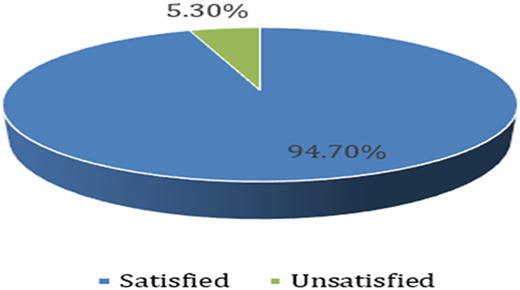
About 41.87% of patients reported that their experience with virtual clinics was excellent, 56.53% reported that it was somewhat good and only 1.6% reported that it was poor. Regarding patient satisfaction, the results found that 94.7% of patients were satisfied with the services provided by the virtual clinic. Virtual clinics are a convenient experience for most participants, who are mostly satisfied with such services. Only the educational level contributed significantly to the impact on satisfaction.
The online survey had limited accessibility as it needed Internet coverage and a social media account; additionally, patients with low literacy, who were unable to read and write, were excluded.
Findings had several implications for clinical practice in Saudi Arabia. The positive outcomes associated with telemedicine suggest that healthcare providers should consider integrating telemedicine options into disease management protocols. The potential of telemedicine to reduce routine in-person visits while facilitating earlier detection of complications suggests that a hybrid model of care, combining telemedicine with in-person visits, might be optimal for chronic disease management. Also, from a policy perspective, findings support the continued investment in telemedicine infrastructure and services in Saudi Arabia.
The Saudi Vision 2030 framework aims to accelerate technological innovation and the evolution of the health system; therefore, this research will be a distinctive addition to the existing research by illuminating patients' perspectives on virtual clinics in Saudi Arabia, which can guide the design and implementation of more efficient virtual care techniques. The results may also be helpful for healthcare professionals and policymakers with a stake in enhancing healthcare access and quality in Saudi Arabia.
Introduction
In recent years, healthcare systems have undergone rapid changes as healthcare providers seek methods to improve healthcare quality and accessibility, while lowering total costs. Electronic health (e-health) has become a popular solution for providing healthcare services to individuals who may have difficulty accessing traditional healthcare facilities (Al-Rayes et al., 2022). According to WHO (2022), E-health is defined as “the unified use of information technology and electronic communications in the health sector” (WHO, 2022).
In 2011, the Saudi Ministry of Health (MOH) announced the following e-health strategy to make real advancements in the field: A “safe, effective, standard-oriented, patient-centered and e-health supported health system” (Hmoud et al., 2023). One form of e-health that has gained popularity is the virtual clinic, according to Saudi MOH 2022, virtual clinic defined as a healthcare facility that offers medical services using advanced communication technologies such as video conferencing, instant messaging and online portals (MOH, 2022). These technologies make it possible for patients and healthcare professionals to connect remotely and receive or deliver medical care in a secure, cost-effective and convenient way (Al-Rayes et al., 2022).
Virtual clinics, which can be provided via phone, chat features, video or other technological means, are advantageous for all stakeholders, including healthcare practitioners, patients and the healthcare service (Abdulwahab and Zedan, 2021). A virtual clinic makes it easier to give information quickly, speed up the delivery of medicines, monitor patient samples with labs, perform radiology tests and carry out other everyday healthcare duties. A virtual clinic has enabled the monitoring of chronic conditions while reducing unnecessary hospital trips, particularly for children and vulnerable groups (Alahmari et al., 2022). Patients are receiving medical treatment in their homes, meeting their requirements. Patients can make web meetings and seek prescription refills, which lowers the possibility of no-shows or inconsistent drug use (Al-Rayes et al., 2022).
Implementing virtual clinics offers many benefits, however, some challenges must be overcome to adopt virtual clinics, including healthcare workers' technical knowledge and experience, patients' acceptance and willingness to use or engage with telemedicine platforms, issues with implementation, maintenance of telemedicine platforms by healthcare information technology experts and problems with security, privacy, dependability and supportability (Hmoud et al., 2023). Healthcare workers' technical knowledge and experience should be considered when developing strategies to adopt hospital information systems and patient access to high-quality healthcare increases by developing healthcare providers' capabilities and technical skills (Alahmari et al., 2022). With the understanding that healthcare providers increasingly favor flexible training and education opportunities through virtual webinars and video conferences, organizations must improve training programs for healthcare providers to implement telemedicine services efficiently (Abdulwahab and Zedan, 2021). Furthermore, there are cultural and social limitations that must be considered, such as compatibility with Islamic ethics, laws and Saudi social norms and traditions (Alwabili et al., 2021). Additionally, language barriers exist, as most patients in Saudi Arabia speak Arabic as it is their first language, while most telemedicine platforms were created in English (Crotty and Somai, 2022).
Various methods are used to offer virtual clinics in Saudi Arabia, first through medical appointments, where the doctor decides whether the patient needs a healthcare provider to be there in person or can receive the service online. Second, if the healthcare center offers the service, the patient can immediately schedule an appointment through the Sehhaty mobile application (Alahmari et al., 2022). With the opening of Seha Virtual Hospital (SVH), which is regarded as the first virtual hospital in the Middle East and the most prominent virtual hospital globally, virtual hospitals have grown since February 2022 and offers virtual specialty clinics like psychiatric, heart, endocrine and diabetes centers in addition to supporting a total of 130 hospitals across the nation (MOH, 2022).
Problem statement
Patients with various diseases require ongoing health assessments, timely follow-up with healthcare providers and proper self-care at home. This issue is intensified by the rising number of individuals with chronic illnesses in Saudi Arabia. Consequently, there is a need for strategies that improve access to health facilities to achieve better health outcomes.
Telemedicine is seen as a perfect answer for such difficulties. Telemedicine could thus be used to enhance healthcare services through remote care, enhancing clinical results, healthcare demands and patient satisfaction rates in patients with chronic diseases. However, much more research is needed to understand the satisfaction level among the Saudi Arabian population.
Significance of the study
The use of virtual clinics has grown significantly since the beginning of the COVID-19 pandemic in 2020, as a means to support public health control measures in lowering the risk of disease spread and limiting exposure to health facilities (Alharbi et al., 2021). A crucial aspect of achieving patient satisfaction is delivering high-quality healthcare services that satisfy patients' demands. Factors such as the simplicity of using the virtual clinic platform and communication quality with healthcare experts may impact patient satisfaction. Additional factors that affect patient satisfaction are the accuracy of diagnosis and treatment and the level of trust in the healthcare system (Loy et al., 2022). The success of telemedicine platforms and virtual care, in general, can be significantly affected by patients' impressions of their virtual clinic experiences. With an understanding of patient satisfaction, healthcare providers and policymakers may be able to identify areas that require improvement and strategies to provide high-quality virtual care services. This study aims to assess the patients' experiences and satisfaction level with the quality of care of the virtual clinic in Saudi Arabia.
Methods
Study design: A cross-sectional study design was used in this research to explore patient satisfaction and assess patients' experiences with a virtual clinic in Saudi Arabia.
Target population: The current study’s target population was the general adult population living in Saudi Arabia who fulfilled the following inclusion criteria: males and females above 18 years old with at least one experience using virtual clinics in healthcare services of Saudi Arabia’s five regions and being able to fill out the survey.
Sample size and technique: The required sample size was scientifically determined using G*Power 3.1 95% confidence level (Z = 1.96 for alpha 0.05), margin of error or precision (E = 0.05) and the proportion of telehealth use in Saudi Arabia (p = 56.2%), based on a recent study by (Alshahrani et al., 2024), while considering the sampling design effect (D = 2.5) for including five different Saudi Arabia’s regions. A convenience sample size of 375 participants met the study’s inclusion criteria and filled out the self-report questionnaire.
Data collection tools: The survey was adopted from the study done by Alharbi et al. (2021) in Saudi Arabia and obtained bioethics approval from the King Abdullah International Medical Research Center (KAIMRC). The validity and reliability of the Arabic survey were tested through a pilot study reliability value was Cα: 0.77 (Alharbi et al., 2021). The survey was prepared using Google Forms in Arabic and the link was shared online. The participants must approve the consent form before starting the survey; the participants could not continue the survey if they did not approve. The questionnaire includes three sections; the first section is concerned with the patient’s demographic data, such as age, gender, level of education and residency location. The second section was concerned with the patient’s experience using the virtual clinic, which included four items: the relevance of the virtual clinic experience, trustworthiness of the information provided by the healthcare provider via the virtual clinic, the most important advantage of the virtual clinic and the last one about the disadvantage of the virtual clinic. The third section assessed the patient’s satisfaction level using a five-item Likert scale ranging from strongly agree to strongly disagree.
Data collection process: The survey was prepared using Google Forms. Participants were recruited from five regions of Saudi Arabia by sharing an online link sent through multiple social media platforms (LinkedIn, WhatsApp and Twitter).
Data analysis: Data were analyzed using SPSS 22. For descriptive analysis, mean (M) and standard deviation (SD) are used, whereas for categorical and ordinal data, percentages (%) and frequencies are used. For inferential analysis chi-square test (χ2) was used. The significance of the results was not statistically significant when p > 0.05, while there was a statistically significant difference when p < 0.05.
Ethical considerations: Ethical approval was given by the Saudi Electronic University on 11/04/2023 with the number SEUREC-4451. An introduction about the nature of the study was given to the participants, also they were assured about the confidentiality of their responses, so an anonymous online self-report questionnaire was used.
Results
Table 1 shows the sociodemographic characteristics of patients; about 71.47% of them were females and 36% of their age was between 25 and 34 years. Regarding educational levels, 60.53% had a bachelor’s degree and most of the participants (87.73%) lived in the central region.
Table 2: Focuses on patients' experience with virtual clinics in Saudi Arabia, about 41.87% of patients reported that their experience with virtual clinics was excellent, 56.53% reported that it was somewhat good and only 1.6% reported that it was poor. For the trustworthiness of the information, 39.73% of patients were mostly trustworthy, while only 1.33% were not at all trustworthy of the information. Among the 375 patients included in the study, 261 (69.6%) mentioned that the most important advantage of the virtual clinic was quick access to the care that the patient needed, followed by that virtual clinic does not need transportation to go to the clinic, 58.40% see that avoiding crowding in waiting rooms is the most important advantage of the virtual clinic. For the most significant disadvantage of virtual clinics, 56% of participants reported nothing to be mentioned, while 49.07% worry about the privacy of their health information.
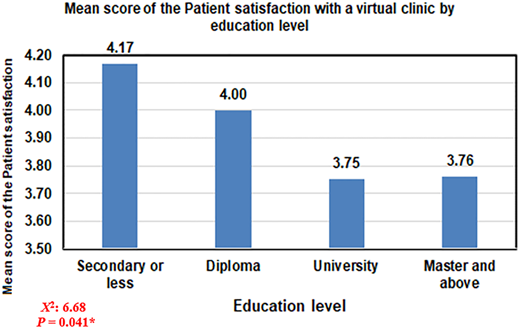
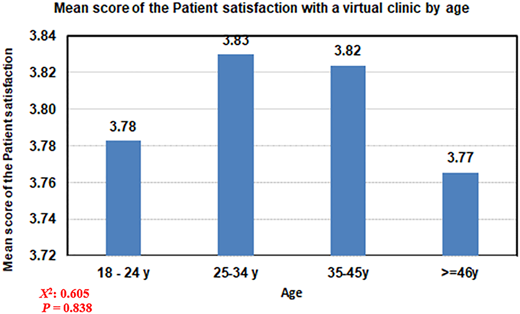
The results of patient satisfaction with a virtual clinic in Saudi Arabia are shown in Figures 1–3. Figure 1 shows that 94.7% of patients were satisfied with the services provided by the virtual clinic. The association between demographic variables and patients’ satisfaction is shown in Figures 2 and 3. In the present study, the educational level showed an association with the patients’ satisfaction (x2 = 6.68, p value = 0.041), while no association was shown with age (x2 = 0.605, p value = 0.838).
Discussion
The COVID-19 pandemic significantly accelerated the adoption of virtual clinics in Saudi Arabia, providing a crucial alternative for patients seeking healthcare while minimizing physical contact. We set out this cross-sectional study to assess patients' experiences and satisfaction with virtual clinics in Saudi Arabia. The results of the current study revealed that such clinics are convenient for most patients and showed a high level of satisfaction with the virtual clinics. Such findings are in line with a previous similar study conducted in the central region of Saudi Arabia (Alharbi et al., 2021) and the study done by Alwabili et al. (2021), which indicated that 92% of respondents were satisfied. The findings of this study are largely consistent with the global literature review done by Berlin et al. (2021) who found that the experience of the rapid adoption of telemedicine at the beginning of the COVID-19 pandemic.
A cross-sectional study conducted at King Faisal Specialist Hospital and Research Center revealed that 75.67% of patients were satisfied with their virtual appointments. Notably, younger patients (ages 18–30) reported higher satisfaction levels compared to older age groups (Aljaloud et al., 2023), while the current study showed no statistically significant differences between age groups; this may be due to the demographic characteristics of our participants, particularly the age distribution, which may have influenced the results. The majority of participants were younger, which could lead to different satisfaction levels compared to older populations typically studied in previous research. Additionally, cultural factors in Saudi Arabia, such as the increasing acceptance of technology among younger individuals, may play a significant role in shaping their satisfaction with the virtual clinic. The study done by Alahmari et al. (2022) indicated that satisfaction levels were significantly lower among patients over 70 years old and those who were not referred to virtual clinics upon their request. This suggests that age and the referral process are critical factors in patient satisfaction with virtual healthcare services. The discontinuation of telemedicine services and lower satisfaction recorded by some of the subpopulations in the study by Manary et al. (2021) are consistent with these concerns. This underscores the need for targeted interventions to ensure equitable access to telemedicine services across different demographic groups in Saudi Arabia.
Regarding educational level, the current study reported that the educational level showed a statistically significant association with the patients’ satisfaction. This result comes in the line with the previous study done by Alharbi et al. (2021) who found that the association was significantly correlated with age, in addition to the educational level and clinic type. Higher educational attainment often correlates with better health literacy, enabling patients to make more informed decisions about their healthcare. This can lead to higher satisfaction levels as patients feel more empowered in their healthcare choices. So it is important that policymakers consider implementing educational programs aimed at improving health literacy among less-educated populations to enhance their satisfaction with virtual healthcare services.
The results of the current study showed that virtual clinics offer advantages and benefits over conventional clinics, such as quick access to needed services, flexible appointment times, not having to worry about congested waiting rooms and the option to schedule an appointment without having to travel. These results are considered in line with the study done by Alahmari et al. (2022), who found that virtual clinics have enabled the management of chronic conditions while reducing unnecessary hospital trips, particularly for children and vulnerable groups (Alahmari et al., 2022). Also, the study done by Alsaif et al. (2024) indicates a high level of acceptance and satisfaction with virtual clinics across various demographics, including different age groups and genders. The convenience of accessing healthcare remotely has been a significant factor in this positive reception.
For the most significant disadvantage of virtual clinics, which may be making the patients avoid using the virtual clinic, the results of the current study mentioned that 49.07% worry about the privacy of their health information and 17.6% were worried about the quality of health care provided through this service. This result comes in contrast to the results mentioned in the study done by Juaristi et al. (2022), which found that the most significant disadvantage of virtual clinics, according to respondents, was their worry about the quality of virtual clinics.
Implications for practice
Findings had several implications for clinical practice in Saudi Arabia. The positive outcomes associated with telemedicine suggest that healthcare providers should consider integrating telemedicine options into disease management protocols. The potential of telemedicine to reduce routine in-person visits while facilitating earlier detection of complications suggests that a hybrid model of care, combining telemedicine with in-person visits, might be optimal for chronic disease management. Also, from a policy perspective, findings support the continued investment in telemedicine infrastructure and services in Saudi Arabia.
Limitations of the study
The inherent nature of cross-sectional studies limits the ability to draw causal inferences. The survey had limited accessibility as it needed Internet coverage and a social media account; several participants could not be included, especially in the rural areas. Additionally, patients with low literacy, who were unable, to read and write were excluded. Also, the reliance on online self-reported data introduces potential biases, such as memory inaccuracies and social desirability bias.
Conclusion
In conclusion, the results of this study indicated that about 41.87% of patients reported that their experience with virtual clinics was excellent, 56.53% reported that it was somewhat good and only 1.6% reported that it was poor. Regarding patient satisfaction, the results found that 94.7% of patients were satisfied with the services provided by the virtual clinic. Virtual clinics offer a viable and satisfactory healthcare option. However, it is important to note that factors influencing satisfaction may vary, with our study highlighting the significant role of educational level. This underscores the need for tailored strategies and educational initiatives to cater to diverse patient populations and ensure a positive telemedicine experience. Patients consistently reported that virtual clinics were convenient and trustworthy. The convenience of appointment booking and quick access to care, the ability to receive a diagnosis without waiting room exposure, were the primary reasons for choosing virtual clinics. Overall, most patients expressed satisfaction with virtual clinics. However, there is room for improvement in meeting the specific needs and expectations by addressing concerns about the privacy of patients' health information and the quality of health care provided through this service, by addressing these factors, virtual clinics can further enhance patient satisfaction and improve the overall quality of the care provided.
Recommendation
The current study recommends focusing on public educational campaigns on virtual clinics in Saudi Arabia using simple educational videos through local media. Increasing the sample size will give a good understanding of assessing patients' experiences and exploring patient satisfaction levels with a virtual clinic in Saudi Arabia. Furthermore, healthcare organizations must encourage healthcare providers to improve their interventions and reassure patients through the virtual sessions that they will have high-quality care that can help them trust the process. Further studies are needed to overcome the limitations, such as timing, participant numbers and geographic diversity. Also, we recommend further research to explore the long-term impacts of virtual clinics on patient outcomes and satisfaction across diverse demographics. Additionally, studies could investigate the barriers to accessing virtual healthcare services, particularly among the underserved populations.