This study examines the relationship between the three dimensions of the energy trilemma, including energy security, energy equity, and environmental sustainability, and their influence on economic growth in seven ASEAN countries from 2000 to 2022.
The analysis employs the Pooled Mean Group Autoregressive Distributed Lag (PMG-ARDL) model to capture both short term and long term effects.
In the short term, energy security and energy equity positively influence economic growth, while environmental sustainability has a negative effect. These findings reveal a trade-off between environmental protection and economic performance. Access to stable and affordable energy appears to be the most important factor driving short term growth, highlighting the need to prioritize energy security in national policies. However, in the long term, energy security shows a negative association with growth, suggesting potential structural or resource-related inefficiencies. This shift underscores the importance of adapting energy strategies to balance short term economic needs with long term sustainability goals.
The study provides new empirical evidence on the trade-offs inherent in the energy trilemma and offers important insights for ASEAN countries seeking to design energy policies that support both economic development and sustainable energy transitions.
1. Introduction
The energy trilemma, a term coined by the World Energy Council (2022), assesses the sustainability of countries’ energy systems based on three key factors: energy security, energy equity, and environmental sustainability. It addresses the crucial challenge of reducing global emissions while expanding electricity production in a responsible and sustainable manner. This challenge is particularly pressing for developing economies, which often struggle with affordability shortfalls.
Understanding the relationship between the energy trilemma and economic growth is crucial for formulating effective energy policies that support sustainable development. Many studies have explored the influence of the energy trilemma on economic growth from these three dimensions. Research focusing on energy security’s impact on economic growth includes works by Gasparatos and Gadda (2009), Prado et al. (2016), Le and Nguyen (2019), and Coester et al. (2020). Ensuring energy security is a priority in national energy policies, but recent decreases in investment in the energy sector have created significant pressure on the energy security of many countries. This underscores the importance of stable and low-cost energy sources as a cornerstone of economic development policy.
Esen and Bayrak (2017) highlight that the impact of energy use on economic growth may diminish as incomes rise, making efficient energy use just as crucial as energy consumption. Herring (2006) and Rajbhandari and Zhang (2017) state that expanding economic activity at the lowest cost requires efficient use of energy, which is a prerequisite for economic growth. Furthermore, researchers such as Abulfotuh (2007), Stern (2012), Bataille and Melton (2017), Khan et al. (2021a), and Andrew et al. (2023) argue that advanced production methods that save energy can boost economic activities without increasing energy consumption.
Additionally, previous studies have examined the broader nexus between environmental quality, sustainable development and economic performance, including Le and Nguyen (2019), Le et al. (2019), and Malik et al. (2020). These studies highlight that ineffective environmental and energy policies—rather than economic growth itself—are often the underlying drivers of rising greenhouse gas emissions and ecological degradation. Collectively, they argue that climate mitigation should not constrain economic expansion; instead, well-designed environmental and energy policies can support sustainable growth by encouraging cleaner technologies, green production practices and more efficient resource use.
According to the ASEAN Centre for Energy (ACE, 2020b), ASEAN’s energy demand is projected to increase significantly by 146% by 2040. Alongside energy security concerns, this surge in energy demand is expected to raise greenhouse gas emissions to potentially 4,171 million tonnes of CO2-equivalent by 2040. Consequently, the region must prioritize balancing the continued high energy demand with the adverse effects of climate change. ASEAN has outlined strategies to enable stakeholders to leverage innovation to achieve the region’s aspirational goals, including a 32% reduction in energy intensity and a 23% increase in the share of renewable energy in the energy mix by 2025. This energy trilemma-balancing economic growth, energy security, and environmental sustainability-has been explicitly recognized in regional policy frameworks, including the ASEAN Plan of Action for Energy Cooperation (APAEC) 2016–2025 Phase II: 2021–2025 (ACE, 2020a).
While the global literature provides valuable insights into how the three dimensions of the energy trilemma interact with economic growth, most empirical analyses are concentrated on OECD or cross-country contexts, leaving ASEAN largely underexplored. The structural and institutional heterogeneity across ASEAN, spanning from advanced economies like Singapore to energy import dependent emerging markets such as Vietnam and Indonesia, creates unique dynamics that existing global models cannot fully capture. Despite growing energy demand and ongoing policy initiatives under the ASEAN Plan of Action for Energy Cooperation, there remains limited empirical evidence explaining how the three pillars of the energy trilemma jointly affect economic growth within ASEAN economies. In particular, the short term benefits of energy security and affordability may come at the cost of long term environmental sustainability, yet this trade-off has not been rigorously tested.
To address this gap, this paper provides the first comprehensive empirical investigation of the relationship between the energy trilemma and economic growth across seven ASEAN countries from 2000 to 2022. By employing the Pooled Mean Group Autoregressive Distributed Lag (PMG ARDL) model, the study distinguishes between short run and long run dynamics, offering new insights into how policy priorities shift over time between energy security, equity, and sustainability. This approach allows for a more nuanced understanding of how ASEAN countries can achieve balanced energy transitions that sustain economic growth while advancing environmental goals.
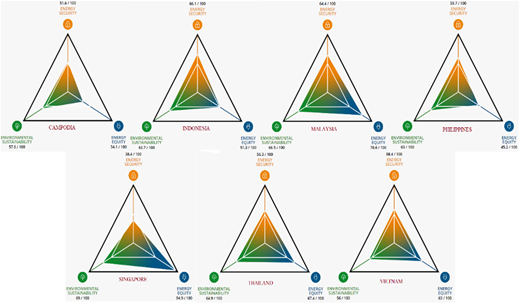
Figure 1 demonstrates the capacity of different ASEAN countries to balance their energy trilemma. Singapore, heavily dependent on energy imports, needs to significantly improve its energy security. To mitigate risks, it is essential for Singapore to diversify its energy import suppliers. On the other hand, Cambodia has a pressing need to enhance energy equity, particularly by increasing access to electricity and expanding coverage areas.
Singapore’s energy security trends have remained consistent over the past few years, with a heavy reliance on natural gas. The World Energy Trilemma Index 2022 report indicates that Singapore aims to achieve its energy target by 2030 and reach a reserve deployment target of 200 MW by 2025. Singapore boasts one of the world’s most reliable grids, as evidenced by the System Average Interruption Duration Index, and provides 100% of its population with access to electricity. The energy integration project between Laos, Thailand, Malaysia, and Singapore is being piloted to lay the groundwork for large-scale imports by 2035. Singapore has also announced plans to establish a long-term low-emissions development strategy, aiming for net-zero emissions by mid-century. Cambodia has a greenhouse gas mitigation strategy for the period 2020–2023, with a specific CO2 reduction target of 3,100 Gg. The fastest-growing energy sources in Cambodia are wind and solar energy, which have shown an average annual growth rate of 18% between 2018 and 2050. According to the Indonesia Energy Outlook (2022), the level of electricity grid coverage in Indonesia remains low, with approximately 55% of the population lacking access to electricity. To address energy equity, Indonesia has established a single fuel price program since 2017 and introduced various policies to reduce dependence on energy imports. These policies include the development of city gas networks, increasing the production capacity of new oil refineries, and the development of dimethyl ether. Thailand has set a plan to reduce energy intensity by 30% by 2036 and decrease greenhouse gas emissions by 20% from business-as-usual (BAU) levels by 2030.
Vietnam’s import dependency is expected to increase significantly over the next decade. According to the Viet Nam Energy Outlook Report 2021 (2022), the share of fuel imports could rise from 36% in 2020 to 60% in 2030 and 70% in 2050. Vietnam aims to achieve net-zero emissions by 2050, with the cost of transitioning to green energy systems projected to increase by 10% over the 2020–2050 period. Ensuring energy security in Vietnam poses numerous challenges. The energy industry’s infrastructure is under pressure due to the high growth rate of energy demand. High public debt and an unfavorable equitization process necessitate substantial investment capital. Additionally, the rapid increase in domestic energy demand exacerbates the environmental impact of energy supply activities. The limited supply of primary energy within the country leads to growing dependence on imported fuel, especially for power generation. As Vietnam becomes a net energy importer, the increasing share of imported energy in the total primary energy supply will significantly impact national energy security.
By exploring the diverse aspects of the energy trilemma, including energy security, energy equity, and environmental sustainability, this paper aims to fill theoretical gaps and provide a nuanced understanding of how energy policies can balance economic growth with sustainability goals. Specifically, it offers new ASEAN focused evidence that clarifies the dynamic interplay among these three dimensions and provides policy relevant insights into how the region can simultaneously pursue energy access, stability, and decarbonization.
2. Literature review
2.1 Global perspectives on the energy trilemma
The global energy trilemma, comprising energy security, energy equity, and environmental sustainability, provides a crucial analytical framework for understanding the interdependence between energy systems and macro-financial performance. Balancing these three dimensions has become increasingly complex as economies shift toward decentralized, digital, and low-carbon systems. Scholars generally agree that sustainable growth depends on energy systems that are reliable, affordable, and environmentally sound. However, evidence consistently shows that economic competitiveness often rises at the expense of environmental quality unless supported by institutional efficiency and technological innovation.
Empirical studies reveal both complementary and conflicting interactions among the trilemma’s components. Khan et al. (2022a) demonstrate that investments in non-financial assets and energy use enhance economic expansion but deteriorate environmental quality. Similarly, Liu et al. (2022) report that energy-driven growth in the world’s ten largest CO2-emitting economies aggravates ecological stress. In contrast, Khan et al. (2022b) find that coherent policy design and clean energy transitions can simultaneously improve economic and environmental outcomes when governance and energy intensity are properly aligned. Consistent with these findings, Khan et al. (2021b) identify a long-run positive association between balanced trilemma performance and growth among top performers in the World Energy Trilemma Index, underscoring the strategic value of integrated policy design.
2.2 Trade-offs and dynamic interactions
A second strand of literature emphasizes the temporal and structural trade-offs inherent in the energy trilemma. In the short term, economic growth is often anchored in energy security and affordability, whereas long-term sustainability requires decoupling output from carbon intensity. Chen et al. (2023) show that energy intensity, access, and security foster output growth but weaken environmental quality, exemplifying this tension. Chi et al. (2023) extend the analysis to North Africa and find that demographic and institutional conditions mediate the trilemma’s effects, reinforcing regional heterogeneity. Khan et al. (2021c) reveal that energy transitions influence both the level and volatility of growth in IEA economies, suggesting that sustainability considerations exert persistent feedback on macroeconomic outcomes.
Environmental sustainability remains the most contested dimension within this debate. Bekhet et al. (2017) and Zahoor et al. (2021) identify bidirectional causality between economic activity and environmental quality, implying that early industrial expansion often precedes ecological degradation. Arslan et al. (2022) observe that financial deepening and trade intensification can exacerbate emissions, while Yang and Khan (2021) confirm similar patterns in broader samples. Within advanced economies, Khan et al. (2021d) find that renewable energy transitions improve environmental quality but may constrain short-term output, consistent with the inverted U-shaped Environmental Kuznets Curve confirmed by Khan et al. (2021b) for APEC members. Conversely, Ibrahiem (2020) provides evidence from Egypt that innovation and alternative energy investment eventually offset the environmental costs of early growth, highlighting a dynamic adjustment path driven by technological progress.
2.3 Regional heterogeneity and the ASEAN context
Despite this expanding evidence base, regional asymmetries remain underexplored. Structural, institutional, and policy differences cause the trilemma’s effects to diverge across economies. Most cross-country studies focus on advanced or high-emitting nations and overlook the complex realities of emerging regions. In ASEAN, the challenge is intensified by rapid industrialization, population growth, and governance diversity. Energy demand in the region is projected to rise by approximately 4–5% annually, with more than 80% still supplied by fossil fuels (Safrina and Utama, 2023). This dependence reinforces the affordability–sustainability dilemma, as fossil fuel subsidies and financing constraints slow renewable energy adoption (Erdiwansyah et al., 2019; Nepal et al., 2021). The integration of variable renewables further strains grid reliability due to infrastructural and regulatory deficiencies (Huang et al., 2019). Institutional fragmentation compounds these challenges, as governance capacity, regulatory coherence, and investment climates differ significantly among member states (Phoumin et al., 2021; Vakulchuk et al., 2023). Achieving the collective renewable energy target of 23% by 2025 requires annual investment levels far beyond current fiscal and private sector capacity (Hossin et al., 2024). Without stronger coordination and innovative financial mechanisms, these disparities will persist and slow regional progress toward balanced and sustainable energy transitions.
2.4 Research gap
Although existing literature offers valuable comparative evidence, few studies have systematically examined how the three pillars of the energy trilemma jointly affect economic growth within ASEAN economies. The region’s structural features, including heavy energy dependence, manufacturing intensity, and heterogeneous regulatory frameworks, create distinctive trade-offs between short-term security and long-term sustainability. Whether the immediate growth benefits from energy security and equity outweigh the sustainability costs remains an unresolved empirical question. This gap underscores the importance of context-specific evidence that captures the multidimensional nature of the trilemma in emerging markets. From a finance-oriented perspective, energy policy choices directly influence capital allocation, investment risk, and macroeconomic stability. Early-stage growth based on fossil fuel reliance may yield short-term gains but often entails efficiency losses and environmental externalities. Over time, technological upgrading and institutional reform can realign incentives toward low-carbon productivity improvements. Hence, the interaction between the energy trilemma and economic growth should be understood as a dynamic equilibrium in which governance quality, innovation capacity, and financial structure jointly determine long-term sustainability outcomes. This study addresses this research gap by empirically investigating how energy security, equity, and sustainability interact to shape economic growth across seven ASEAN countries. In doing so, it contributes to the growing literature on energy and finance interlinkages, offering region-specific insights that connect short-term economic priorities with long-term sustainable growth trajectories.
3. Data, model, and methodology
3.1 Data
The study focuses on analyzing the impact of energy trilemma dimensions on economic growth in ASEAN countries from 2000 to 2022. ASEAN began implementing the Plan of Action for Energy Cooperation for the period 2000–2004 and beyond starting in 2000, which defined the objectives of energy security, sustainable energy development, and regional energy integration (ACE, 2022). This provides a clear basis for examining the evolution of the energy trilemma in ASEAN countries from this point onward. In addition, IEA (2022) reported that between 2000 and 2020, ASEAN’s total energy demand doubled, alongside a gradual shift from fossil fuels toward greater investment in renewable energy and electricity. Therefore, choosing 2000 as a baseline allows the study to capture the long-term transition and structural adjustment in the region’s energy systems. Due to data limitations and the need for consistency across indicators, the analysis covers seven ASEAN members-Cambodia, Indonesia, Malaysia, the Philippines, Singapore, Thailand, and Vietnam. The exclusion of Brunei Darussalam, Lao PDR, and Myanmar may reduce full regional coverage; however, their contribution to ASEAN’s aggregate economy and energy demand is relatively minor (ASEAN Secretariat, 2022), and their energy systems are often characterized by less diversification and more constrained infrastructures compared with the larger members (ACE, 2022; IEA, 2022, 2023). Accordingly, the selected sample is considered sufficiently representative while ensuring reliability and comparability of data for empirical analysis.
In this study, the three dimensions of the Energy Trilemma-Energy Security (ES), Energy Equity (EE), and Environmental Sustainability (ENS)-are measured following the definitions and data provided by the World Energy Council (WEC). These indices are chosen over alternative metrics for three main reasons. First, the WEC indicators have been widely adopted in prior research examining the nexus between energy and growth (e.g. Khan et al., 2021a, 2022a; Liu et al., 2022), ensuring comparability and continuity with the existing literature. Second, the WEC framework offers consistent and accessible data coverage across most ASEAN countries, whereas alternative measures (such as energy import dependency, electricity access rates, or standalone CO2 emissions) tend to be fragmented and lack the comprehensive scope necessary for cross-country analysis. Third, the ASEAN context is characterized by the simultaneous challenges of rapid economic growth, uneven energy access between urban and rural areas, and rising environmental and climate pressures (ACE, 2022; IEA, 2023). The WEC indices better capture this multidimensional balance, making them particularly well suited for analyzing the dynamics of energy development in the region (see more details in Supplementary Appendix A).
Economic growth (GDP) is measured as the annual percentage growth rate of GDP at market prices based on constant local currency, with aggregates expressed in constant 2015 U.S. dollars. This specification is consistent with prior studies on the energy–growth nexus (such as, Bekhet et al., 2017; Zahoor et al., 2021; Khan et al., 2021a; Khan et al., 2022a; Liu et al., 2022). Using annual GDP growth (%) as the dependent variable also aligns closely with the ARDL framework, which is designed to capture both short-run dynamics and long-run equilibrium relationships. In the short run, GDP growth is responsive to energy shocks, policy adjustments, and cyclical fluctuations-factors particularly salient for ASEAN economies that are frequently exposed to global energy price volatility and external shocks. In the long run, the ARDL specification enables the estimation of stable equilibrium relationships between economic growth and the dimensions of the energy trilemma. Accordingly, adopting GDP growth (%) as the dependent variable ensures methodological consistency, comparability with prior energy–growth studies, and direct policy relevance.
The control variable population growth (POP) is measured as the exponential rate of growth of the population from year t-1 to t. Trade openness (TRADE) is the sum of exports and imports of goods and services measured as a share of the gross domestic product. GDP, POP, and TRADE are compiled from World Development Indicators. ES, EE, and ENS are collected from World Energy Council.
Descriptive statistics in Table 1 highlight both commonalities and disparities among ASEAN countries. GDP growth averages 5.146% but shows wide variation, from −9.52% to 14.52%, reflecting both crises and high-growth episodes. Energy Security (mean = 53.650) and Energy Equity (mean = 56.139) indicate moderate levels overall, though EE displays the highest dispersion, underscoring significant inequality in energy access. Environmental Sustainability is more uniform (mean = 62.021, SD = 5.239), suggesting broadly similar environmental performance across countries. Population growth is stable at 1.343% per year, while Trade Openness varies drastically, from 32.972% to 437.327% of GDP, highlighting the structural diversity between highly trade-dependent and more inward-oriented economies. These initial patterns provide a useful context for assessing how the three dimensions of the energy trilemma jointly shape economic growth trajectories in ASEAN.
3.2 Model and methodology
This paper applies three individual dimensions of the energy trilemma to analyze the impact of each component on economic growth. Based on the studies of Khan et al. (2021a, 2022a), we analyze the impact of the energy trilemma on economic growth. The three dimensions of energy security, energy equity and environmental sustainability will be utilized for the period 2000–2022 according to the equation below:
Where: GDP is economic growth, ES is energy security, EE is energy equity, ENS is environmental sustainability, β0 is the intercept, β1, β2, β3 are the coefficients of three dimensions of the energy trilemma, β4 and β5 are the coefficients of control variables - POP & TRADE, respectively. ε is the error term.
To estimate a panel data model, one of the assumptions is that the data must be partially independent. Therefore, the results may be biased due to the failure to consider cross-dependence, leading to the possibility of incorrect results in the unit root test implementation. This study applies the cross-dependence test of Pesaran (2004) with CD statistics, Friedman’s test (1937) with Spearman’s rank correlation coefficient and the test of Frees (1995, 2004) with a statistic based on the sum of the squared rank correlation coefficients.
This paper applies the ARDL model with the Pooled Mean Group (PMG) estimator to analyze the impact of the energy trilemma on economic growth in both the short run and the long run. The PMG model of Pesaran et al. (1999) allows for short-run coefficients – including intercepts, rates of adjustment to long-run equilibrium values and heteroscedastic variances – to differ from country to country, while the long-run coefficient is uniformly restricted across countries. This feature is particularly useful when there are theoretical or policy reasons to expect a similar long-run equilibrium relationship among countries within a regional bloc.
Accordingly, the PMG-ARDL estimator (Pesaran et al., 1999) was employed because it accommodates country-specific short-run heterogeneity while imposing long-run homogeneity. This specification is appropriate for the ASEAN context, where economies differ in short-term dynamics but share increasingly convergent energy and development strategies (ACE, 2020a; ACE, 2022). The assumption of a common long-run relationship is also consistent with prior applications of PMG in cross-country energy–growth studies (Sadorsky, 2014; Le and Ozturk, 2020; Khan et al., 2021c).
While the PMG estimator provides efficient and consistent estimates for heterogeneous panels, one limitation is that the assumption of homogeneous long-run coefficients may obscure country-specific heterogeneity. Structural differences among ASEAN economies-such as resource endowments, institutional capacity, and policy implementation-can generate variation in long-run responses. Nevertheless, the assumption of long-run homogeneity remains defensible in this study, given that ASEAN members have progressively aligned their long-term energy strategies through regional frameworks such as the APAEC (ACE, 2020a) and the ASEAN Energy Outlook (ACE, 2022).
Then, the econometric equation for the impact of the energy trilemma on economic growth is as follows:
Where:
The parameter is the error correction rate, if , there is no evidence of a long-run relationship. This parameter is expected to be negative and statistically significant assuming the variables return to equilibrium in the long run.
Pesaran et al. (1999) suggest using the maximum likelihood to estimate the parameters in Equation (2) as follows:
Where: IT is the unit matrix of T
4. Results
The panel exhibits significant cross-sectional dependence, as the null hypothesis of cross-sectional independence is strongly rejected by Pesaran’s CD, Frees’s, and Friedman’s tests under both fixed-effects and random-effects specifications. This indicates that shocks occurring in one ASEAN country may be transmitted to others within the region. In light of this interdependence, second-generation panel unit root tests are employed instead of first-generation tests, and the Westerlund panel cointegration test is applied to ensure robustness in the presence of cross-sectional dependence (see Supplementary Table A1).
Using the CIPS approach proposed by Pesaran (2004), the unit root test results show that all variables are non-stationary in levels but become stationary in first differences, indicating that they are integrated of order one, I(1). This condition provides the necessary basis for examining long-run relationships among the variables. Accordingly, the Westerlund (2007) panel cointegration tests, which are robust to cross-sectional dependence and employ a bootstrap distribution, are applied (see Supplementary Table A2).
The results of the Westerlund (2007) panel cointegration tests indicate the existence of a long-run relationship among the variables in the presence of cross-sectional dependence (see Supplementary Table A3). Specifically, all four test statistics (Gt, Ga, Pt, and Pa) reject the null hypothesis of no cointegration when the bootstrap distribution is employed. This evidence confirms the presence of a stable long-run equilibrium relationship across the panel. Accordingly, the analysis proceeds to estimate both long-run and short-run dynamics using the PMG estimator.
The results in Table 2 show that both energy security and energy equity have a positive effect on economic growth, while environmental sustainability exhibits a negative relationship with economic growth in seven ASEAN countries. These findings highlight a trade-off inherent in the energy trilemma’s goals relative to economic growth. Specifically, access to stable and low-cost energy emerges as a key driver of economic expansion. Ensuring energy security should therefore be a central priority in national energy policies. Notably, a 1% increase in the energy security index leads to an average increase in GDP of 0.302%. This result is consistent with the findings of Sadorsky (2014) and Le and Ozturk (2020), who underscore the significance of energy supply stability in mitigating economic risks, supporting production activities and maintaining macroeconomic stability in developing countries. Energy security plays a crucial role during early stages of development, where economies are highly dependent on traditional energy inputs (IEA, 2023). A stable energy supply ensures uninterrupted functioning of production, transport and services by shielding them from energy shocks and unexpected price volatility. This is particularly relevant in ASEAN economies, where fluctuations in energy availability can significantly influence growth trajectories (Bilgili et al., 2016).
Similarly, energy equity – proxied by access to energy – also demonstrates a positive short-run impact, with an estimated coefficient of 0.065%. This can be attributed to the importance of reliable energy access in fostering industrial, commercial and residential activities, particularly in ASEAN nations that experience pronounced rural-urban disparities. This finding aligns with the conclusions of Bekhet and Othman (2017) and Khan et al. (2021c), who argue that improved energy access stimulates investment and productivity, thereby enhancing economic growth. The cumulative effect of energy equity suggests that as energy consumption rises, productivity gains increase, import dependence falls, and overall economic output improves.
Conversely, environmental sustainability is shown to have a short-run negative or unstable relationship with economic growth. Omri (2013) found that stringent environmental regulations can raise production costs, thereby constraining growth in its early phases. This reinforces the notion of a short-term trade-off between environmental protection and economic development. In the ASEAN context, the short-run growth drag from environmental sustainability reforms appears driven by transitional costs, technological gaps, and structural constraints. Imposing green regulations, carbon pricing, or cutting fossil-fuel subsidies can raise production and energy costs upfront, which tends to dampen output and consumption in the near term (IMF, 2021; IEA, 2022; ACE, 2022). These policy transition costs create a lag before efficiency gains and new green industries materialize. Technological readiness gaps further explain the trade-off: many ASEAN economies have low renewable energy adoption and insufficient clean technology infrastructure, while also struggling with institutional inertia, regulatory carryover from fossil fuel sectors, and high financing costs. These factors constrain the large-scale deployment of renewables and clean technologies, creating efficiency bottlenecks and supply constraints during the early stages of decarbonization (Nguyen and Kakinaka, 2019; Vakulchuk et al., 2023; Calcaterra et al., 2024). Structural and institutional factors unique to ASEAN also amplify the short-term costs. The region’s economies remain heavily reliant on carbon-intensive sectors, so aggressive sustainability measures can initially threaten energy security and affordability (ACE, 2022; IEA, 2022). Collectively, these factors help explain why bolstering environmental sustainability can impose a short-run growth penalty in ASEAN, even if such measures promise net gains for economic resilience and efficiency in the long run.
Over the long term, however, the findings indicate a reversal: energy security exerts a negative effect on economic growth in ASEAN countries. Omri (2013) explains that prolonged dependence on non-renewable energy sources increases pollution and adjustment costs, ultimately curbing long-term growth. The IEA (2023) warns Southeast Asian countries that failure to transition toward renewable energy sources exposes them to global energy price volatility, international decarbonisation obligations and rising policy adjustment burdens. For this reason, sustainable development must be integrated with environmental protection in long-term energy planning. According to the Southeast Asia Energy Outlook 2022, the region possesses abundant renewable energy potential. For instance, Indonesia and the Philippines have vast geothermal reserves; Indonesia, Malaysia and Thailand are rich in biomass; Cambodia and Vietnam have significant hydropower capacity; and solar energy potential is widespread across the region. Although Malaysia and Indonesia remain the only ASEAN nations self-sufficient in oil, their reserves are projected to be depleted within two decades. As oil resources diminish, natural gas production is also expected to decline, intensifying the urgency for renewable energy integration.
Beyond the resource and energy mix dimension, the long-run negative impact of ES may also stem from broader institutional and market inefficiencies that constrain the effective translation of energy availability into growth. In economies with weaker institutional quality, increased energy supply or access does not automatically generate productivity gains (Khan et al., 2021c). Funds directed toward energy security-such as subsidies or large infrastructure projects-may be subject to diminishing returns due to corruption, rent-seeking, or mismanagement, consistent with the idea that governance deficits can nullify the benefits of energy initiatives (Azimi et al., 2025). Moreover, rigid energy market structures-for instance, monopolistic utilities or price controls to ensure affordability-can lead to resource misallocation, whereby energy is over-used or directed to less productive sectors, ultimately dampening growth. This interpretation is consistent with Arslan et al. (2022), who report that heavy reliance on natural resource rents tends to hinder economic growth in the long run, highlighting the “resource curse” risk when institutional safeguards are weak. Similarly, Zahoor et al. (2021) demonstrate that although financial development and clean energy investments can stimulate growth, such gains are offset if accompanied by unsustainable practices-a scenario likely when institutional and policy frameworks are inadequate. In light of these perspectives, the negative coefficient on ES suggests that simply bolstering energy supply is not sufficient for sustainable growth in ASEAN. It must be complemented by improvements in institutional quality and market structure, so that energy resources are allocated efficiently and used to propel productive economic activity (Khan et al., 2021c; Zahoor et al., 2021; Arslan et al., 2022). This extended interpretation underscores the importance of structural reforms: strengthening governance, increasing market flexibility, and building institutional capacity can ensure that energy security enhancements translate into positive long-run growth outcomes.
Supplementary residual-based diagnostics, including histogram and Q–Q plot analyses for each ASEAN country, are provided in Supplementary Appendix B to validate the distributional assumptions underlying the PMG–ARDL results. Overall, these diagnostics indicate that the PMG–ARDL specification is reasonably stable and well-behaved, thereby supporting the reliability of the empirical findings on the effects of energy security, energy equity, and environmental sustainability on economic growth in ASEAN.
5. Conclusions
This study evaluates the status and trends of the energy trilemma in seven ASEAN countries and analyzes the impact of the energy trilemma dimensions on economic growth using the PMG-ARDL model for the period 2000–2022. The findings indicate that there is a trade-off between the energy trilemma and economic growth. Both energy security and energy equity positively affect economic growth, while environmental sustainability has a negative relationship with economic growth in the short run.
The findings from this research support existing empirical evidence that energy security has a positive short-term effect but a negative long-term effect. This is consistent with the theoretical arguments of endogenous growth theory (Romer, 1990) and ecological frontier theory (Daly, 1990), as well as the IEA’s (2023) warning that ASEAN countries will face significant adjustment costs and environmental risks if they continue to rely on fossil energy. According to Daly (1990), limited natural resources and environmental constraints place a cap on the potential for sustained economic growth. The continuous exploitation and consumption of fossil fuels not only accelerate resource depletion but also generate irreversible damage to the global environment and ecosystem.
In addition, this study highlights the significant contrast between the impacts of energy access and environmental sustainability in both the short and long term. These contrasting effects suggest that institutional quality and governance capacity in ASEAN countries may be insufficient to support long-term growth strategies. This observation aligns with the findings of Pachauri and Jiang (2008) on the importance of infrastructure, and with the IEA (2023), which identifies the regulatory and institutional obstacles impeding the implementation of green energy policies in the region.
Therefore, ASEAN countries must not only enhance energy efficiency and promote sustainable development at the national level, but also pursue a coherent regional approach. Strengthening intra-regional cooperation will be critical in shaping ASEAN’s long-term energy development strategy. Equally important is the mobilization of investment, technical support, and innovation capacity to accelerate the transition toward a low-carbon economy. Building a credible roadmap for green energy transition-minimizing reliance on fossil fuels and expanding modern energy infrastructure-is essential to secure sustainable growth for the region.
Although the PMG–ARDL model is estimated for the full ASEAN sample to capture a region-wide long-run relationship, policy implications cannot be applied uniformly across countries. In practice, the three pillars of the energy trilemma operate very differently across groups of ASEAN economies, consistent with recent assessments by the IEA (2023) and the ASEAN Centre for Energy (ACE, 2022). Resource-rich countries such as Indonesia and Malaysia benefit from higher energy self-sufficiency but face long-term risks arising from over-dependence on fossil fuels, implying the need for stronger diversification and a gradual shift toward cleaner sources. Import-dependent countries—including Singapore, the Philippines and Thailand—are more exposed to global supply and price volatility, and therefore must prioritise supply-chain resilience, regional grid interconnection and enhanced energy-efficiency policies. In contrast, economies with limited energy infrastructure such as Cambodia and Vietnam need to expand modern energy access, strengthen institutional capacity and mobilise investment to lay the foundation for a sustainable transition.
Given these structural differences, ASEAN policymakers must adopt policy directions that balance economic growth with energy security and environmental objectives while reflecting the characteristics of each country group. Resource-rich economies should reduce reliance on fossil fuels and accelerate diversification (IEA, 2022); import-dependent economies need to strengthen resilience and deepen regional electricity trade (IEA, 2023); and countries with underdeveloped infrastructure must prioritise energy access and institutional reforms (ACE, 2022). Across all groups, solar photovoltaics offer a cost-competitive pathway, supported by declining technology costs and favourable climatic conditions (IEA, 2022, 2023). A group-based approach therefore provides a more realistic and effective foundation for policy design, ensuring that the region’s long-term energy transition aligns with each group’s resource endowments, vulnerabilities and institutional readiness.
At the regional level, stronger collaboration remains essential. Gradually phasing out fossil-fuel subsidies can help correct market distortions, curb wasteful consumption, and create fiscal space for clean-energy investment (IEA, 2023). Advancing the ASEAN Power Grid and expanding cross-border interconnection projects will further enhance energy security and optimise generation portfolios across member states (IEA, 2022). Mobilising sustainable finance is equally critical: the ASEAN Taxonomy for Sustainable Finance provides a regional framework for guiding and attracting green investment, while alignment with international climate-finance mechanisms can reinforce national transition efforts (ASEAN Taxonomy Board, 2021; IEA, 2022). Finally, deeper cooperation through the ASEAN Centre for Energy can strengthen innovation, harmonise standards and reinforce institutional capacity for implementing the region’s energy transition (ACE, 2022).
Overall, the study shows that ASEAN’s sustainable energy future depends on harmonising region-wide objectives with policy pathways tailored to the distinct characteristics of different country groups, ensuring that the energy trilemma is addressed in a pragmatic and context-sensitive manner. Future research could further investigate sector-specific dynamics and institutional heterogeneity, thereby offering deeper insights into how ASEAN economies may translate the energy trilemma into sustained long-term growth.
The supplementary material for this article can be found online.