Tourist deviance, including littering and vandalism, can undermine destination sustainability, yet effective ways to curb such behavior remain underexplored. Drawing on nudge theory and prospect theory, this study examines how supervisory guidance from tour guides and host communities shapes tourists' attitudes and intentions toward deviant behavior.
Survey data were collected from 283 domestic tourists visiting a remote destination in Vietnam. Partial least squares structural equation modeling (PLS-SEM) was used to test the proposed relationships and the moderating role of convenience orientation.
Supervisory guidance reduces both favorable attitudes toward deviance and intentions to engage in deviant behavior. Convenience orientation weakens the effect of supervisory guidance on attitudes but not on behavioral intentions, suggesting that convenience-oriented tourists may retain favorable views of deviance while still responding to direct supervision. Tour guides have a stronger influence on behavioral intentions, whereas host communities are more effective in reshaping attitudes.
This study distinguishes the effects of two sources of supervisory guidance and clarifies how convenience orientation shapes tourists' responses to behavioral interventions. The findings extend the application of nudge theory and prospect theory to tourist deviance and identify complementary roles for guides and residents. Destination managers should combine visible supervision with convenience-oriented choice architecture, using tour guides to deter misconduct and host communities to reshape tourists' evaluations of deviant behavior.
1. Introduction
Tourism is particularly important to Vietnam's economy, contributing VND 771 trillion or over 7% of national GDP and supporting nearly six million jobs in 2024 (WTTC, 2024). Yet, its benefits can be undermined by tourists' deviant behaviors (Mason, 2020; Roxas et al., 2020). In July 2026, tourists at Hon Chong in Nha Trang broke off more than 10 kg of protected Acropora coral as souvenirs, upsetting the public and causing irreparable damage to the destination. Managing such behaviors is therefore essential (Li and Chen, 2017). However, research on its psychological and contextual antecedents remains limited (Li et al., 2022b; Roxas et al., 2020) and deviant behavior remains a persistent challenge (Ahmadi Alvar et al., 2023; Kaplan, 1982). Traditional models such as the Theory of Planned Behavior rely on the assumption of rationality (e.g. Ulker-Demirel and Ciftci, 2020), but tourists' behaviors are not purely rational and are often driven by hedonic motives and disinhibition (Dai et al., 2022; Eiser and Ford, 1995; Jung and Kim, 2016). Behavioral economics therefore provides a complementary and more realistic lens for understanding tourists' deviant behaviors.
Current tourism literature remains limited in explaining how to curb tourist deviance. Supervisory guidance from tour guides and host communities may promote appropriate behavior through persuasion and social pressure (Pu et al., 2023; Wang et al., 2018; Weiler and Black, 2015), but its effect may depend on tourists' preference for convenience, such as minimizing time, effort and cognitive demands (Candel, 2001; Wong and Zhao, 2016). Although widely examined in consumer behavior, its role in tourist deviance remains underexplored. Such interactions also involve power asymmetries and unfamiliar local norms, especially in culturally diverse domestic destinations such as Vietnam (Burt, 1992; Sharpley, 2014). Yet, how these forces interact remains unclear. Moreover, prior studies have examined guides, providers, or tourism nudges separately (Iloranta and Komppula, 2022; Souza-Neto et al., 2023; Zatori et al., 2018), leaving it unclear how supervisory guidance and convenience orientation jointly shape tourists' attitudes and intentions toward deviant behavior. This study addresses these gaps by examining how supervisory guidance and convenience orientation together influence tourists' attitudes and intentions toward deviant behaviors, drawing on behavioral economic perspectives of nudges and prospect. The remainder of this study is organized as follows. Section 2 reviews tourist deviance, nudge theory, prospect theory, supervisory guidance and convenience orientation. Section 3 develops the hypotheses. Sections 4 and 5 describe the method and results. Sections 6 and 7 discuss implications and conclusions.
2. Literature review
2.1 Deviant behaviors in tourism
Deviant tourist behavior refers to conduct in a tourism setting that departs from acceptable social or ethical norms (Lugosi, 2019; Uriely et al., 2011). It encompasses both illegal acts such as vandalism, and socially inappropriate behaviors such as littering and noise-making. These acts pose persistent challenges to sustainability (Li and Chen, 2017; Lugosi, 2019; Uriely et al., 2011) by damaging natural resources and host communities (Bramwell et al., 1996; Mason, 2020; Roxas et al., 2020). Recent studies show that tourist deviance is strongly shaped by social and situational conditions. A state of deprivation can encourage socially inappropriate behaviors as self-protection and self-compensation motives become more salient (Pan et al., 2024). Observing deviant behaviors of other tourists increases one's own deviant intentions through moral disengagement (Su et al., 2022), while staying in a crowd promotes deviant acts through deindividuation (Jo et al., 2024). Other studies show that tourists also respond to features of the surrounding environment. Positive moral cues can discourage deviant behavior by strengthening tourists' moral motivation (Li et al., 2025). In contrast, unattractive or disorderly environments can increase deviant intentions by generating negative emotional responses (Lan et al., 2026). These findings suggest that tourists' deviant behaviors reflect an interaction between individual motives and contextual cues.
Accordingly, recent research has increasingly explored interventions meant to regulate tourists' behaviors. For example, anthropomorphized messages improves civilized behavioral intentions (Liu et al., 2024), while simply adding a watching eye into the signage increases self-awareness and eventually reduces deviant behaviors (Yan et al., 2025). Zhang et al. (2026) further show that supervisory agents, including intelligent robots, can deter tourist misconduct through face-related mechanisms. Together, these studies highlight the importance of guidance and social monitoring, while also suggesting that their effectiveness may depend on tourists' characteristics and motives. Such contingencies are especially relevant in a culturally diverse destination like Vietnam. Vietnam is generally characterized by relatively high power distance and collectivist orientations, which place greater emphasis on hierarchy, interpersonal relationships and conformity to group expectations (Hofstede, 2001), yet power-distance orientation shapes deviant intentions and interacts with social context (Jeong et al., 2026). These cultural tendencies may heighten tourists' sensitivity to social approval and authority, as evidence from remote Vietnamese communities shows that convenience seeking and feelings of superiority can also contribute to inappropriate behavior and complicate the regulatory role of guides and local residents (Vu et al., 2024).
2.2 Nudge theory and prospect theory
Nudge theory, introduced by Thaler and Sunstein (2008), explains how people's choices can be influenced by the way a decision environment is designed. The theory pioneers the concept of “nudge”, which is a change in the choice environment that encourages a particular behavior without restricting freedom of choice or substantially changing economic incentives (Thaler and Sunstein, 2008). For example, defaults, reminders, social norm messages, or information about behavioral consequences can make a desirable choice more noticeable or easier to consider. Nudges are often discussed in relation to two types of thinking. System 1 is fast and automatic, while System 2 is slower and more reflective (Kahneman, 2011). Accordingly, Type 1 nudges, such as defaults and framing, mainly influence automatic responses. Type 2 nudges, such as reminders, information and social cues, encourage people to think more carefully before acting (Bonell et al., 2011; Lin et al., 2017).
Prospect Theory, developed by Kahneman and Tversky (1979), helps explain why such nudges may influence behavior. According to Kahneman and Tversky (1979), people evaluate outcomes as gains or losses relative to a reference point and usually react more strongly to losses than to equivalent gains. nudge can therefore influence behavior by making certain costs or losses more noticeable. This is particularly relevant to tourist deviance because tourists respond to anticipated social consequences. For example, perceived disapproval from others can reduce intentions to misbehave (Wan et al., 2021), while concerns about face and social image can discourage deviant tourist behavior (Wang et al., 2018). Prospect Theory thus complements Nudge Theory by explaining how changes in the decision environment can alter the way tourists perceive the costs and benefits of their actions (Lin et al., 2024).
Both approaches have been applied in tourism. A meta-analysis of 118 interventions found that choice architecture can influence sustainable tourist behavior (Greene et al., 2024), and visible pro-environmental behavior by residents can encourage similar tourist behavior. Work on “Nudge Plus” also shows how nudges and reflection can support deliberate decisions (Yachin et al., 2024). However, tourism research still focuses mainly on pro-environmental behavior, messages and observable social cues, while interpersonal supervisory guidance and the conditions shaping its effectiveness remain less developed (Souza-Neto et al., 2023).
2.3 Supervisory guidance in tourism
Constructive and supportive instructions by supervisors are referred to as supervisory guidance, which was conceptualized by Dineen and colleagues as “the extent to which supervisors instruct their employees regarding the enactment of positive behaviors and avoidance of negative behaviors” (Dineen et al., 2006, p. 623). This approach focuses on promoting the desired outcomes and limiting the undesired behaviors, which seems appropriate for the application in tourism. Supervisory guidance influences economic behavior by reshaping the payoff structure individuals assess: beyond private benefits and intrinsic costs, it highlights potential social costs such as reputational loss, embarrassment, or disapproval, making them salient and thereby adding a negatively weighted term to decision utility while amplifying loss-sensitive responses (Dineen et al., 2006; Kahneman and Tversky, 1979).
Few tourism studies examine supervisory guidance explicitly, but related work shows that tour guides choreograph tourist actions, encounters and emotions (Weiler and Black, 2015). Service providers in guided and luxury tourism also steer tourists' attention, participation and behavior through interaction, empathy and responsiveness (Iloranta and Komppula, 2022; Zatori et al., 2018). In tourism, therefore, supervisory guidance may operate outside a formal manager-employee hierarchy through the influence of guides and host communities. Guides act as experience brokers, while host communities influence behavior through social interaction (Pu et al., 2023; Wang et al., 2018). Vu et al. (2024) suggest that such guidance affects tourist deviance, but empirical confirmation is still needed.
2.4 Convenience orientation
Convenience or more specifically, convenience orientation, was conceptualized by Candel (2001) as “the degree to which a consumer is inclined to save time and energy,” with the emphasis that energy saving may relate to both physical and mental energy saving. People with a strong convenience orientation therefore tend to prefer options that require less time, effort, planning, or discomfort (Candel, 2001; Gottschalk, 2020a). Convenience orientation has been shown to influence consumer choices across different settings, including geographic access, transactions and perceived benefits (Wong and Zhao, 2016). In hospitality, convenience orientation has also been used to explain consumers' acceptance of technologies that simplify service interactions (Morosan and Gunden Sorathia, 2024).
Because convenience orientation varies across individuals and situations, it may affect responses to behavioral guidance. People who strongly value convenience may give greater weight to immediate ease than to future consequences, especially in unfamiliar settings or when attention is limited (Gamache and McNamara, 2019; Goodwin et al., 2018). In tourism, this may matter when appropriate behavior requires extra effort. Tourists may be less willing to follow rules or local expectations when compliance seems inconvenient, so convenience orientation may shape how they respond to supervisory guidance. This relationship remains underexplored.
2.5 Research gap
Despite the advances in our understanding of how to reduce deviant tourist behaviors, important gaps remain. Tourism studies increasingly recognize that tourists do not always make fully rational decisions, yet behavioral mechanisms such as bounded rationality and short-term thinking remain underused in explaining deviance. Nudge research has also focused mainly on impersonal interventions such as defaults, framing and messages (Souza-Neto et al., 2023; Thaler and Sunstein, 2008; Wang et al., 2018; Weiler and Black, 2015), while less attention has been given to interpersonal guidance from tour guides and local residents. Evidence from Vietnam suggests that guides and host communities can help regulate tourist behavior, but their effects are not always consistent (Vu et al., 2024). Individual differences are also less understood. In particular, convenience orientation may make tourists more likely to choose easier, short-term options, even when these conflict with social expectations (Candel, 2001; Gottschalk, 2020b). However, its role in shaping the effectiveness of supervisory guidance has received little empirical attention. This study therefore focuses on the joint influence of supervisory guidance and convenience orientation on deviant tourist behavior.
3. Hypotheses development
3.1 Attitude and intention to engage in deviant behaviors
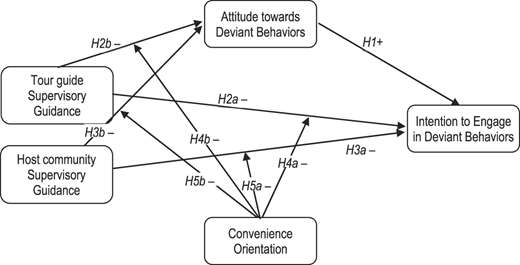
The extant literature provides a multitude of empirical evidence to support the influence of attitude on behavioral intention (e.g. Hu et al., 2018; Nguyen and Nguyen, 2017). For instance, Chinese tourists' attitude is found to significantly influence their intentions to collect self-generated litter (Hu et al., 2018). Attitude also has a positive impact on the intention to purchase counterfeit goods (Nguyen and Nguyen, 2017). In the context of tourists' deviant behaviors, we expect that attitude towards deviant behaviors has a similar effect on intention. Based on the above discussion, it can be hypothezised that:
Attitude has a positive impact on tourists' intention to engage in deviant behaviors.
3.2 Supervisory guidance nudge and tourists' intention to engage in deviant behaviors
Tour guides help tourists understand a destination and expected conduct (Cunningham, 2004). Such interactions may occur through briefings, tour-program content, or the overall visitor experience (Lin et al., 2022; Meschini et al., 2021; Wang et al., 2018). From a behavioral economics perspective, persuasion and social pressure can shape decisions under uncertainty (Li et al., 2022a). In this study, these pressures come from tour guides and host communities. Framed as Type 2 nudges, supervisory guidance should increase the salience of social costs and reduce deviant behavior (Souza-Neto et al., 2023; Thaler and Sunstein, 2008). Therefore:
Tour guide supervisory guidance is negatively related to tourists' intention to engage in deviant behaviors.
Tour guide supervisory guidance is negatively related to tourists' attitude towards deviant behaviors.
The host community also shapes tourist behavior. Wang et al. (2018) found that Chinese B&B hosts used social interaction and signage to limit undesirable guest behavior, while host-guest interaction can be mediated by tour guides in sustainable tourism practices (Pu et al., 2023). In addition, interaction between tourists and residents had an impact on tourists' experience and behavior (Su and Wall, 2010) and even on general tourists' sustainable behavior (Wang et al., 2018). In this sense, we would argue that the host community engages in the same supervisory behaviors towards tourists with the same communication framing and social modeling as that of the tour guide. Vietnam's remote area provides an interesting research context where the lack of established service brings the local closer to the guests, thus highlighting the role of these stakeholders in shaping behaviors. Therefore:
Host community supervisory guidance is negatively related to tourists' intention to engage in deviant behaviors.
Host community supervisory guidance is negatively related to tourists' attitude toward deviant behaviors.
3.3 Convenience orientation and tourists' intention to engage in deviant behaviors
Since convenience orientation has been recognized as a driver of consumer behavior (Candel, 2001; Wong and Zhao, 2016) it may encourage tourists' deviant acts when rules are perceived as inconvenient. The desire for pleasurable, low-cost experiences can attenuate concern for future or collective harms and increase the likelihood of deviant behaviors that deliver immediate gratification (Fodness, 1994; Li and Chen, 2017; Uriely et al., 2011). Viewing from prospect theory in travel contexts, comfort and convenience often serve as key reference points, shaped by tourists' expectations and situational factors. When rules or norms are perceived as undermining these reference points, tourists are more likely to disregard them, leading to deviant behaviors (Park and Yi, 2025).
From a behavioral economics perspective, convenience orientation is not a nudge itself. Instead, it is a personal tendency to prefer options that save time, effort, or discomfort. This can make easier but less compliant choices more attractive, especially when breaking a rule requires less effort than following it (Gottschalk, 2020a; Wisdom et al., 2010). Convenience orientation may therefore shape how people respond to external nudges. It does not change the choice environment in the sense proposed by Thaler and Sunstein (2008), but it can change how attractive compliant and non-compliant options appear to the individual (Candel, 2001). In this way, convenience orientation may weaken the effect of external guidance when following the desired behavior requires more time, effort, or inconvenience.
Supervisory guidance from tour guides is intended to encourage appropriate behavior by telling tourists what they should and should not do (Dineen et al., 2006). However, such guidance may sometimes conflict with tourists' desire for ease, pleasure and relaxation during a trip (Fodness, 1994). Because highly convenience-oriented tourists place greater weight on immediate, low-effort payoffs, they are more likely to preserve the utility of opportunistic or noncompliant actions even after receiving supervisory cues. Consequently, convenience orientation attenuates the translation of guidance into changed attitudes and, especially, into behavioral intentions (Candel, 2001; Gottschalk, 2020a). Convenience orientation should therefore weaken the effect of supervisory guidance on both attitudes and behavioral intentions. This reasoning may also apply to guidance from host communities, as local reminders may be less effective among tourists who strongly prefer ease and convenience (Vu et al., 2024; Wang et al., 2018). Accordingly, we propose:
Convenience orientation negatively moderates the impact of supervisory guidance by tour guides on tourists' intention to engage in deviant behaviors.
Convenience orientation negatively moderates the impact of supervisory guidance by tour guides on tourists' attitude towards deviant behaviors.
The host community likewise plays an active supervisory role in shaping tourists' behaviors through direct interaction, social modeling and locally delivered reminders, which are forms of external social nudges analogous to tour guide guidance (Vu et al., 2024; Wang et al., 2018). These cues make local expectations and the social consequences of misconduct more visible. Prior research shows that anticipated disapproval, face and social image can reduce deviant tourist behavior (Wan et al., 2021; Wang et al., 2018). However, this effect may be weaker among tourists with a strong convenience orientation. If following local expectations requires extra effort, changing plans, or giving up an easier option, highly convenience-oriented tourists may be less responsive to host community guidance (Candel, 2001; Gottschalk, 2020a). Accordingly, we propose:
Convenience orientation negatively moderates the impact of supervisory guidance by the host community toward tourists' intention to engage in deviant behaviors.
Convenience orientation negatively moderates the impact of supervisory guidance by the host community on tourists' attitude towards deviant behaviors.
The theoretical framework and the hypothesized relationships are presented in Figure 1.
4. Research methodology
We measured perceived supervisory guidance and convenience orientation using validated self-report scales, which are appropriate to measure subjective psychological constructs such as tourists' perceptions, attitudes and intentions (Ajzen, 1991). Self-report measures also allow us to capture how tourists perceive social guidance and convenience in the tourism setting, which are central to understanding how behavioral interventions may influence decision-making (Dineen et al., 2006; Weiler and Black, 2015). Data were collected on site from tourists who had recently interacted with tour guides and local residents. This allowed respondents to report on real experiences rather than imagined situations, improving the ecological validity of the study compared with hypothetical laboratory scenarios (Shadish et al., 2002). Because all variables were collected through self-report questionnaires, common method bias was a potential concern. To reduce this risk, we used validated measures, separated items where possible and conducted post-hoc tests for common method variance following the recommendations of Podsakoff et al. (2003).
4.1 Research site
The context of this study is based in It Thai village in Khau Pha valley, a remote mountainous area of northeastern Vietnam. Tourism has recently developed around its natural attractions. Although isolation and a small population create resource scarcity and dependence on external supplies (Andriotis, 2005), these conditions also preserve the landscape and local culture sought by tourists (Canavan, 2014). As a new destination, Khau Pha has strong information asymmetries: tourists may feel superior to local providers while lacking local knowledge. Its fragile ecosystem and sociocultural conditions make it suitable for examining this paradox (Geneletti and Dawa, 2009). Small-scale tourism can strengthen host–tourist ties (Jensen, 2010), but tourist misconduct may disrupt local identity, lifestyles and values (Hall and Lew, 2009).
4.2 Sampling and data collection
We employed convenience sampling because It Thai village is a relatively remote destination with a relatively small tourist flow and no official statistics. To maximize participation and enhance the diversity of our sample, data were collected during specific time slots when tourists typically returned to the village from trips to nearby attractions. These periods were 11:00–12:00, 15:00–16:00 and 16:00–18:30. More than 300 self-administered questionnaires were delivered to participating tourists. The data were collected between Spring and Summer of 2022. The final sample included 283 domestic tourists. The sample had slightly more males (54.4%) and was mostly young. Specifically, 48.8% of our respondents were younger than 25 years old, 25.1% were from 25 to 40 and 26.1% were older than 40 years old. Concerning education level, our sample included nearly 79% of college/university and above. Our sample covered a wide range of occupations, including students (35.6%), office staff (21.9%), businesspeople (27.6%) and others (14.9%).
4.3 Measures and questionnaire design
Attitude and intention were measured with adapted three-item scales from Ajzen (1991), including items on whether behaviors such as making noise, ignoring local rules and dressing improperly for the host culture are acceptable or normal. Convenience orientation was adapted from Candel (2001), with four items focused on time and energy savings. Tour-guide and host-community supervisory guidance were measured with adapted four-item scales from Dineen et al. (2006), using statements about whether guides or local people advise tourists against inappropriate behaviors. All items used a five-point Likert-type format from strongly disagree (1) to strongly agree (5). Detailed questionnaire items are available in supplementary material.
In our research, the questionnaire includes all the scales measuring five latent constructs in the conceptual model plus some demographic questions such as gender, age, education level and occupations at the end of the questionnaire. Since all scale items originally were in English, we followed the back-and-forth translation process (see: Nguyen et al., 2019). Specifically, the scale items were first translated from English into Vietnamese by a bilingual academic and then were translated back into English by another one. The translated version and the original one in English were carefully checked by an English-fluent scholar. A small sample of 30 tourists at It Thai village, Khau Pha was employed to test the questionnaire. Based on the comments, necessary changes regarding the content understanding and the format were made to the final questionnaire.
5. Research results
The current study followed a two-stage assessment approach to interpret the PLS-SEM results. Stage 1 assessed the measurement model by examining the convergent and discriminant validity. After validating Stage 1, Stage 2 assessed the structural model by examining the inner VIF values and path coefficients in the bootstrapping results.
5.1 Measurement model assessment
We looked at the PLS algorithm outputs to determine the internal consistency of the constructs. First, outer loading values of the observed variables were examined to ensure they converged in their respective constructs. Four items were removed due to low loading (under 0.7). The PLS algorithm was then restarted. As illustrated in Table 1, the composite reliability (CR), Cronbach's Alpha and Average Variance Extracted (AVE) were greater than the threshold values of 0.7, 0.7 and 0.5, respectively (Hair et al., 2013). To assess the discriminant validity of the constructs, we evaluated the Heterotrait-Monotrait ratio (HTMT) in Table 2. All HTMT values were lower than the conservative threshold level of 0.85 (Hair et al., 2019), indicating no issue with discriminant validity. Thus, the measurement model was deemed fit for structural assessment.
5.2 Structural model assessment
We first assessed the possibility of collinearity by examining the inner VIF values. As illustrated in Table 3, the inner VIF values were below 3.3, indicating no potential collinearity issues between the constructs.
Path coefficients were assessed through non-parametric bootstrapping with 5,000 sub-samples. Table 4 presents bootstrapping outputs and f2 values. Most hypotheses were supported. Attitude positively affected intention (H1, p = 0.000), showing that favorable attitudes toward deviant behavior increased intention. Supervisory guidance from tour guides and host communities also had significant negative effects on intention and attitude (H2a, H2b, H3a, H3b), suggesting that corrective intervention from both sources can discourage deviant intentions. Table 5 reports R2 and Q2 values for explanatory power and predictive relevance. R2 for Attitude was modest at 0.179, while Stone-Geisser Q2 values were 0.139 for Attitude and 0.250 for Intention, indicating predictive relevance.
Bootstrapping results confirm that attitude significantly mediates the effects of both tour-guide and host-community supervisory guidance on behavioral intention. The indirect effect of tour-guide guidance through attitude was significant (β = −0.075, p = 0.032), as was the indirect effect of host-community guidance (β = −0.103, p = 0.002). At the same time, the direct effects of tour guide guidance (β = −0.253, p < 0.001) and host community guidance (β = −0.182, p = 0.007) remained significant. The VAF (Variance Accounted For) values were 22.9% for tour guide guidance and 36.1% for host community guidance, indicating partial mediation in both cases. Because the direct and indirect effects have the same negative direction, both relationships represent complementary partial mediation, with the mediating role of attitude stronger for host-community guidance.
Regarding the moderating role of convenience orientation, the findings suggest that convenience orientation only moderated the relationship between supervisory guidance from the tour guide and attitude (p-values = 0.037), not intention (p-values = 0.580). In other words, highly convenience-oriented tourists appear to respond more strongly to supervisory guidance from the tour guide in terms of their attitudes, although with a small effect size (f2 = 0.027). Therefore, the results rejected H4a and supported H4b. Moreover, convenience orientation did not moderate the relationship between supervisory guidance from the host community and attitude (p-values = 0.577). Convenience orientation for showed a significant moderation effect for the relationship between supervisory guidance from the host community and intention (p-values = 0.007), but the effect size was negligible. H5a was therefore rejected and H5b was accepted with caution.
6. Discussion
6.1 Discussion of results
Our findings suggest that supervisory guidance can reduce tourists' acceptance of deviant behavior and their intention to engage in it. Attitude also remains an important predictor of behavioral intention, consistent with previous research (Han and Stoel, 2017). However, our results show that these attitudes are shaped not only by tourists' own preferences but also by social guidance from tour guides and the host community. The results strongly support the deterrent effect of supervisory guidance from both tour guides (H2a, H2b) and host communities (H3a, H3b). From a Prospect Theory perspective, these nudges function by making social costs or inappropriate behavior more salient. When a guide or a local resident provides guidance, tourists' choice architecture shifts. Their behaviors are no longer determined solely by personal benefits but also by the possibility of being socially disapproved, as reflected in Attitude. This suggests that human-initiated interventions can act as potent Type 2 nudges, forcing tourists to move from intuitive, hedonic processing (System 1) to more deliberative, normative evaluation (System 2).
The two guidance sources show different patterns. Host-community guidance has a stronger relationship with attitudes toward deviant behavior (β = −0.242) than tour-guide guidance (β = −0.176), while tour-guide guidance has a stronger relationship with behavioral intentions (β = −0.253) than host-community guidance (β = −0.182). Attitude partially mediates both relationships, with a stronger indirect effect for local guidance (β = −0.103, VAF = 36.1%) than tour-guide guidance (β = −0.075, VAF = 22.9%). Host communities may therefore influence intention by shaping evaluations of deviance, whereas tour guides may more directly affect intended action. One explanation is that residents are insiders with knowledge of local customs (Wang et al., 2018). while tour guides hold more formal authority during the trip. Social inequalities between tourists and ethnic minority residents may also play a role, as previous research in mountainous Vietnam has shown that local ethnic communities are sometimes positioned more as part of the tourism experience than as stakeholders with formal authority (Michaud and Turner, 2006; Sharpley, 2014). However, because perceived authority, credibility and authenticity were not directly measured in this study, future research should test these mechanisms more explicitly.
Another important finding is that convenience orientation moderates the effect of supervisory guidance on attitude (H4b, H5b), but not on intentions (H4a, H5a). This suggests that convenience orientation may matter more when tourists evaluate deviant behavior than when they decide whether they intend to engage in it. Interestingly, tourists with stronger convenience orientation appear to respond more strongly to supervisory guidance in their attitudes toward deviant behavior. One possible explanation is that highly convenience-oriented tourists become more sensitive to guidance when it makes the possible social costs or inconvenience of deviant behavior more visible. However, convenience orientation does not significantly change the effect of supervisory guidance on behavioral intentions. This suggests that its role may be limited mainly to attitudinal evaluation rather than intended behavior. These findings should be interpreted cautiously because the moderating effects are small, particularly for host-community guidance and other explanations are possible.
Overall, the findings suggest that supervisory guidance can help discourage deviant tourist behavior, but its effects depend partly on the source of guidance and, to a lesser extent, tourists' convenience orientation. Supervisory guidance from host communities appears to have a stronger influence on attitudes toward deviant behavior, whereas supervisory guidance from tour guides has a stronger influence on intentions. Although it is tempting to assume the existence of different cognitive processes behind the formation of attitude and intention, these differences should not be taken as evidence of distinct psychological mechanisms without further testing.
6.2 Implications
The current study has several important implications. Theoretically, our findings support framing supervisory guidance as a deliberative, System-2 nudge that increases the salience of social costs and invites reflective deliberation rather than automatic, hedonic responses (Dineen et al., 2006; Kahneman and Tversky, 1979; Thaler and Sunstein, 2008). Our research extends existing tourism literature by examining interpersonal guidance from tour guides and the host community. Previous studies show that nudges can influence tourist behavior through choice architecture, social norms, information and reflection (Greene et al., 2024; Souza-Neto et al., 2023; Yachin et al., 2024). Our findings add that interpersonal guidance may also discourage deviant behavior by making social expectations and possible social costs more visible. This is consistent with evidence that anticipated disapproval from others can reduce tourist misbehavior (Wan et al., 2021) and that face and social image can discourage deviant behavior in Asian tourism settings (Wang et al., 2018).
We also contribute to the literature by distinguishing the effectiveness of different sources of guidance. Guidance coming from the host community has a stronger influence tourists' attitudes toward deviant behaviors than that from tour guides, whereas tour guides exert a stronger influence on tourists' behavioral intentions toward deviant behaviors. Previous research shows that hosts can shape tourist behavior through interpersonal interaction, social approval and local norms (Wang et al., 2018), while tour guides can influence pro-environmental behavior through their communication with tourists (Lin et al., 2022). These findings suggest that residents and guides may play complementary roles rather than only having isolated effects.
Practically, these findings also provide more specific guidance for destination managers. Effective strategies to curb deviant behaviors should involve various stakeholders combined with multiple changes to choice architecture. Tour guides should provide short and clear instructions at points where inappropriate behavior is most likely to occur. Practical measures include short briefings and frequent reminders, which have been shown to improve tourists' environmental knowledge, attitudes and awareness (Meschini et al., 2021), while guide communication can influence tourists' pro-environmental responses (Lin et al., 2022). For example, before entering culturally or environmentally sensitive areas, guides can clearly explain restricted behaviors, why the restrictions matter and what visitors should do instead. Because guides show a stronger relationship with behavioral intentions in our study, these messages may be most useful when delivered close to the point of decision.
Host communities can play a complementary role through everyday interaction, social approval, community-led interpretation, locally designed messages and welcome activities (Vu et al., 2024; Wang et al., 2018). Destination managers should elevate this role early in a destination's life cycle, when visitors have limited prior knowledge and may be more open to resident guidance. Meeting tourists' cultural, historical and climatic expectations can strengthen community-based tourism choices in Vietnam (Duong and Pham, 2024). Institutionalizing community participation in supervisory roles thus strengthens compliance while maintaining residents as active tourism stakeholders rather than treating them mainly as cultural attractions (Jensen, 2010; Michaud and Turner, 2006).
For destination managers and policymakers, the implications are clear: responsible behavior should be made easy. Trust and perceived usefulness can shape Vietnamese tourists' attitudes toward ecotourism (Nguyen et al., 2021). Sustainable tourism requires not only persuasive communication and visible oversight but also structural changes that reshape the convenience calculus of tourists (Berry et al., 2002; Seiders et al., 2005). Designing environments where responsible actions are effortless and deviant behaviors are costly can foster voluntary compliance without diminishing the leisure experience (Vu et al., 2024; Weiler and Black, 2015). Moreover, the principle of diminishing sensitivity as seen from Prospect Theory indicates that moderate sanctions combined with consistent supervision and reminders may be more effective than relying solely on severe punishments (Park and Yi, 2025).
7. Conclusions
The current study applied Nudge Theory to examine tourists' intentions to engage in deviant behaviors, focusing on supervisory guidance from tour guides and host communities and convenience orientation as a moderator from a behavioral economics perspective. The findings show that guidance from both sources is associated with less favorable attitudes toward deviant behavior and lower behavioral intentions. One possible explanation is that such guidance makes the social costs of inappropriate behavior, such as disapproval, embarrassment, or reputational loss, more visible (Dineen et al., 2006; Kahneman and Tversky, 1979; Lin et al., 2024). At the same time, convenience orientation emerges as a critical moderating factor as it weakens the effect of supervisory guidance on attitudes, suggesting that tourists who strongly value ease and low effort may be less responsive to guidance when judging whether deviant behavior is acceptable (Candel, 2001; Gottschalk, 2020a).
This study has limitations. First, the sample consists mainly of young, well-educated domestic tourists visiting a remote Vietnamese destination, so the findings should be tested with more diverse samples and destinations. Second, the study relies on self-reported attitudes and intentions, which may be affected by social desirability and other response biases. Future research should use laboratory or field experiments that manipulate supervisory guidance and the convenience of compliant versus non-compliant choices, and should observe actual tourist behavior where possible. Third, the moderating effects of convenience orientation are small and significant mainly for attitudes, so they should be treated as limited evidence rather than a general moderation effect. Finally, future studies should examine why tour guides and host communities differ in their effects by measuring perceived authority, credibility, authenticity, social closeness and trust.
Acknowledgment of generative AI use
ChatGPT5.6 was employed in searching for materials and proofreading the manuscript.
The supplementary material for this article can be found online.