This study aims to investigate the effect of utilizing artificial intelligence (AI) in social commerce on increasing consumer engagement, specifically in terms of engagement and conversion rates. It also examines the role of flow experience in strengthening this relationship.
This study collected data from 354 Indonesian social commerce shoppers. Covariance based Structural Equation Modeling was employed to analyze the data following the two-stage procedure. First, the measurement model was assessed for validity and reliability. Second, the structural hypothesis model was evaluated to test the proposed hypotheses.
The utilization of AI significantly influences social commerce visitor interactions in terms of engagement and conversion. Both variables can enhance customer satisfaction, thereby impacting repurchase intention. Flow experience also strengthens the relationship between engagement and satisfaction, offering practical guidance for creating immersive and enjoyable user experiences.
This study extends the existing social commerce and AI literature by positioning flow experience as a moderator, explaining how and when engagement and conversion translate into satisfaction. Unlike previous models that primarily focus on direct effects, this research introduces psychological mechanisms that capture the conditional and experiential nature of AI-driven interactions, thereby offering a more comprehensive understanding of consumer behavior in social commerce.
1. Introduction
The number of social media users worldwide is projected to reach 5.6 billion by 2026, or 68.6% of the global population (We Are Social, 2026). This increase has fueled the emergence of social commerce (s-commerce), where businesses leverage social media platforms to support their commercial activities (Qu et al., 2023). The synergy between social media and e-commerce has attracted marketers' attention due to its potential to enhance consumer purchasing experiences through social interactions (Rosário and Raimundo, 2021). This is particularly true in developing countries in Asia, particularly Indonesia, which has 180 million users and is predicted to continue growing (We Are Social, 2026). Algharabat and Rana (2021) confirm that social commerce strategies in developing and developed countries will certainly differ. S-commerce is the integration of e-commerce and socialization activities, using technology that facilitates purchasing decisions on social media (Abed, 2020). Unlike traditional e-commerce, which generally relies on one-way communication between sellers and buyers, s-commerce emphasizes two-way communication and leverages the influence and social relationships between users (Hajli et al., 2017). Consumers can engage in various activities through s-commerce, such as providing reviews, sharing experiences, and interacting directly with brand accounts across multiple platforms. Furthermore, the widespread adoption of artificial intelligence (AI) in the retail industry is transforming the way social commerce users interact, using chatbots, AI-based user experiences, personalized product suggestions, and intelligent algorithms that adapt content in real time (Sadiq et al., 2025). Recent advances in generative AI are transforming social commerce interactions by enabling more natural, conversational, and personalized user experiences that go beyond traditional AI applications such as recommendation systems (Xie, 2026).
However, the use of AI technology in s-commerce presents several challenges. This is because technology owners have access to and control over user data, such as demographic characteristics, geographic location, and activity (Soliman et al., 2023). Therefore, previous research has focused on issues related to attitudes and ethics, such as data privacy and service quality (Febrian et al., 2025). AI can enhance personalization, raising concerns about data privacy, ethical use, and algorithmic bias that can impact user trust (Aydin, 2026). Although these studies have addressed privacy issues, they generally only partially explain the factors influencing user behavior and do not fully capture the psychological dimensions of experience that arise during digital interactions. These interactions can be studied using the concepts of customer engagement and the Commitment-Trust Theory of Relationship Marketing (Morgan and Hunt, 1994). Therefore, the impact of AI utilization can be seen in the level of user engagement and conversion (Bag et al., 2022).
The concept of flow experience is relevant for further exploration. Flow experience is characterized by a state of full engagement, high concentration, and a feeling of enjoyment when using a digital platform, which plays a crucial role in encouraging more intensive and sustained user engagement, making it highly relevant to understanding the concept of consumer interaction with AI (Nguyen et al., 2022). When consumers experience flow while using AI services, they tend to perceive the service as enjoyable, engaging, and valuable. This positive flow experience can increase satisfaction, trust, and loyalty toward AI systems (Guerra-Tamez et al., 2024). For example, the success of chatbot utilization requires more than just interactivity; it depends on how the service influences the customer's virtual flow experience. Previous research has used the Technology Acceptance Model (TAM) and Expectancy Confirmation Theory (ECT) to explain the use of this technology (Intra et al., 2024). However, these models primarily emphasize cognitive evaluations and utilitarian benefits, assuming that users are rational and goal-oriented. This perspective creates a theoretical gap, as AI-driven social commerce interactions are inherently dynamic, real-time, and socially embedded, where user decisions are not solely driven by rational evaluation but also by immersive and affective experiences (Zhang et al., 2026). Consequently, TAM and ECT are insufficient to fully capture the experiential and psychological mechanisms underlying user behavior in this context. Therefore, a more comprehensive approach is needed to better explain user behavior in AI-based social commerce by integrating affective and experiential dimensions. The novelty of this research lies in the effort to integrate the flow experience dimension as a psychological variable that moderates the relationship between social commerce user interaction and user satisfaction.
Previous studies have also addressed AI and consumer responses from various perspectives, including perceived value and social presence (Febrian, 2026), privacy and intrusion concerns, and consumer reactions to influencer marketing. However, these studies did not explain how AI-powered social commerce interactions translate into engagement, conversion, and satisfaction under varying levels of immersive experiences. Therefore, this study extends previous research by examining user engagement and conversion as a result of AI utilization and positioning the flow experience as a moderator of their relationship with customer satisfaction.
Previous research has examined AI and customer responses from various perspectives, including concerns regarding privacy and intrusion (Shoukat et al., 2025) and consumer reactions to influencer marketing (Ma et al., 2026). Specifically, previous research analyzed AI usage in social commerce from a value-based perspective, focusing on how utilitarian and hedonic values influence customer satisfaction, and examining the moderating role of social presence (Febrian, 2026). However, that value-based perspective only explained the value customers derive from AI and how AI-driven interactions engage them. This study addresses that limitation by analyzing AI-driven user engagement and conversion as interaction mechanisms connecting AI-based customer interactions. While the previous study positioned social presence as a moderator within the social context, this study introduces the flow experience as an experiential and psychological boundary condition to explain when and how AI-driven interactions are more likely to generate positive customer responses. Thus, this study extends prior research by shifting the focus from AI-generated value and social presence to AI-driven interaction mechanisms and user experience conditions, thereby providing a complementary explanation of customer responses in social commerce.
Thus, this article aims to empirically examine how AI-based customer interactions influence positive user attitudes in social commerce and how flow experience moderates this relationship. Specifically, this study proposes to answer the following questions: (1) How can AI influence user engagement and conversion? (2) How do user engagement and conversion influence customer satisfaction, which has implications for repurchase intention? (3) What is the moderating role of flow experience in the relationship between user interaction and user satisfaction?
The remainder of this article is organized as follows. After outlining the problem statement, Section 2 presents the literature review and the development of research hypotheses. Section 3 details the research methodology, including the research design, measurement instruments, sampling procedures, and data analysis. Section 4 presents the empirical results, discussing the research findings in terms of their theoretical and practical implications. Finally, we conclude the study by outlining the key contributions, limitations, and directions for future research.
2. Literature review and hypotheses development
AI is a technology designed to mimic human thinking and learning through data (Ozay et al., 2024). Huang and Rust (2018) suggest three types of AI: (1) mechanical AI, which carries out routine or repetitive tasks; (2) cognitive AI, which is capable of learning from data to make decisions; and (3) emotional AI, which is designed to exhibit empathy and understand human emotions. This study focuses on emotional AI. AI use in social commerce includes chatbots, recommendation systems, and live-streaming algorithms. By automating customer analysis, AI enhances the efficiency of community management and unlocks opportunities for more targeted engagement, fostering shared value creation (Nguyen et al., 2021). User engagement is considered a key metric for assessing consumer psychology or behavior in digital marketing (Brodie et al., 2011). This attitude is an interactive concept centered on consumer interactions with a specific brand or object, stimulated by AI (Hollebeek et al., 2024). This perceived human presence can strengthen emotional connections, leading users to engage more actively with the platform. AI functions not only as a technological tool but also as a social actor that stimulates deeper user engagement (Zhan et al., 2024). Social media platforms like TikTok and Instagram use AI-based algorithms to personalize product exposure through short video content, live broadcasts, and influencer-based recommendations. This allows users to engage with sellers in real time, unlike traditional e-commerce (e.g. Amazon), which focuses on transactions and limited social interaction (Herzallah et al., 2025). Therefore, the following hypothesis is suggested:
AI has a significant positive effect on user engagement.
AI ability to enhance personalized shopping experiences can not only increase customer engagement but also increase customer conversion (Arya et al., 2025). Conversion indicates how well a service turns visitors into actual consumers by completing transactions (Madanchian, 2024). This is a fundamental difference from engagement, which only indicates a consumer's active attitude. AI algorithms can analyze browsing behavior and interactions to predict consumer preferences and recommend products or services tailored to individual interests. This personalization can drive reasonable conversion rates (Iyelolu et al., 2024). However, each social media marketing strategy may have different conversion rates, making it a practical evaluation of online marketing activities (Ilieva et al., 2024). AI-powered social media marketing can strengthen community relationships and increase conversion rates (Allagui and Breslow, 2016). AI-based recommendation systems reduce decision-making fatigue by simplifying product choices and filtering relevant information (Zhang and Xiong, 2024). This approach allows users to make faster purchasing decisions and increases the likelihood of conversion. Therefore, the following hypothesis is suggested:
AI has a significant positive effect on conversion.
Satisfaction also describes the overall perception of the extent to which there is a match or discrepancy between customer expectations and the reality they receive from the product provider (Hansemark and Albinsson, 2004). Satisfaction is a crucial aspect that can determine whether customers will repurchase on a s-commerce (Attar et al., 2021). Drawing on Expectation Confirmation Theory, conversion (i.e. completing a purchase) can be interpreted as evidence that the AI-driven interaction has met or exceeded users' expectations during the information search and decision-making process. This confirmation of expectations subsequently leads to greater satisfaction. This satisfaction can be influenced by various factors that trigger the success of an e-commerce system (Wang et al., 2016). For example, customer engagement and conversion are positive attitudes that enable marketers to obtain consumer feedback and help companies determine customer satisfaction levels Click or tap here to enter text. The direction of the relationship between engagement and satisfaction can be explained by the Self-Perception Theory (Bem, 1972). Users who frequently interact with AI-based platforms by browsing or engaging with content are more likely to interpret their engagement levels as indicative of positive experiences, thereby increasing their perceived satisfaction. Companies continually strive to engage customers in their digital experiences by meeting their needs and desires, thereby achieving expectations such as commenting on their shopping experiences and assessing overall satisfaction (Marolt et al., 2022). Therefore, the following hypotheses are developed:
User engagement has a significant positive effect on satisfaction.
Conversion has a significant positive effect on satisfaction.
The concept of flow describes an optimal mental state when a person is highly focused, fully engaged, and enjoying the activity they are doing (Sajno and Riva, 2022). Recent studies have extended this concept to social commerce and online interaction environments by explaining its role in enhancing user immersion and engagement (Wang et al., 2026). In social media, consumers experiencing flow tend to exhibit brand engagement behaviors beyond purchasing due to the engaging, memorable, and enjoyable experience (Febrian, 2026). Particularly in s-commerce, flow experience may enhance users' immersive experiences and strengthen their engagement with AI-based interactions. Previous research has demonstrated a positive relationship between flow experience and customer engagement. Flow experience may lead to deep positive engagement in the context of social media (Triantafillidou and Siomkos, 2018). This feeling encourages individuals to increase their involvement in the community, based on the value of enjoyment, utility, and the behavioral value of sharing ideas with others. Consumers experiencing flow will try to re-engage and revisit the activities that provided the flow experience (Hsu et al., 2012). Therefore, when online consumers enjoy their online shopping experience, they are more likely to explore further within the web store (Koufaris, 2002). One way is through interactivity, which creates a flow experience that elicits affective responses and consumer behavioral intentions. Arghashi and Yuksel (2022) show that the motivational power of engagement is derived from the user's flow experience in a digital context. Gao and Bai (2014) demonstrate that the flow experience significantly increases online product purchases, which is related to consumer satisfaction. In some cases, engagement and conversion can directly influence satisfaction (Busalim and Asadi, 2025). This relationship is not always equally strong across different user experiences. For example, social commerce users who engage only functionally, such as searching for information or comparing products, may not experience high levels of satisfaction because they lack a deep psychological experience (Hosen et al., 2026). Experience quality, such as flow, is an important differentiating factor. Contingency theory can explain the moderating role of flow experience by emphasizing that the direction of the relationship between variables depends on contextual or situational factors (Pyper et al., 2022). Previous studies often conceptualize flow as an antecedent or mediator (Lin, 2023). This study adopts a contingency perspective by positioning flow as a moderating variable. As a temporary psychological state, flow does not necessarily function as a causal mechanism linking variables; rather, it influences the strength of the relationships among engagement, conversion, and satisfaction, depending on the user's level of immersion. User engagement and conversion do not always lead to the same level of satisfaction. Instead, their effects vary depending on the user's psychological state during the interaction. Flow experience, as a state of deep immersion and enjoyment, acts as a contingent condition that can strengthen or weaken the impact of engagement and conversion on satisfaction (Cha et al., 2024). Therefore, the following hypotheses are developed:
Flow experience moderates by strengthening the relationship between user engagement and satisfaction.
Flow experience moderates by strengthening the relationship between conversion and satisfaction.
Repurchase intention is defined as a customer's tendency to continue purchasing products from the same provider, influenced by previous positive experiences (Qin et al., 2025). Repurchase intention is crucial for the long-term success of online shopping, as it can boost profitability and reduce costs (Febrian and Mero, 2026). This behavior can be explained by the Theory of Planned Behavior (TPB) (Ajzen and Driver, 1992). TPB is based on the idea that decision-making is carried out rationally and systematically using the information available (Yi et al., 2024). This study also draws on the Consumer Behavior Theory perspective, which emphasizes the role of satisfaction and perceived value in driving repurchase intention, especially in interactive environments (Zhao et al., 2023). A higher level of satisfaction indicates a more positive attitude, thereby increasing the likelihood of repurchase intentions. Several studies have found that high customer satisfaction encourages repeat purchases, as customers feel secure, satisfied, and derive value from previous interactions (Olfat and Kirkham, 2024). Therefore, the following hypothesis is suggested:
Satisfaction has a positive and significant effect on repurchase intention.
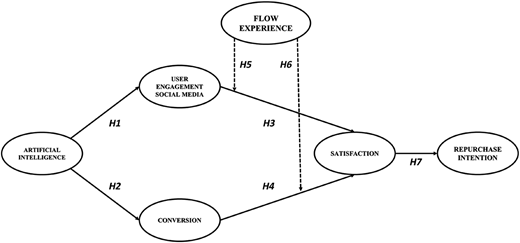
This study proposes a research model, as shown in Figure 1, that examines the role of AI in social commerce. AI is conceptualized as a higher-order construct formed by four dimensions: perceived usefulness, perceived ease of use, social presence, and perceived convenience. These dimensions already capture the functional, cognitive, and social aspects of AI. The model hypothesizes that AI influences user engagement and conversion, ultimately enhancing customer satisfaction and leading to repurchase intentions. The moderating role of flow experience is also examined to assess whether it strengthens the effects of engagement and conversion on satisfaction.
3. Method
3.1 Sample and data collection
A quantitative method was used to collect primary data from consumers with experience using AI-enabled social commerce in Indonesia. Most respondents used popular social commerce platforms such as TikTok, Instagram, and Facebook, which are widely used in Indonesia for AI-driven interactions (We Are Social, 2026). While this study did not focus on a single platform, these platforms share similar AI-driven features that facilitate user interaction and immersive experiences. Respondents were selected using purposive sampling based on predefined criteria (Etikan et al., 2016). Specifically, respondents were required to have visited and engaged in social commerce activities on at least one of these platforms, either occasionally or frequently. Respondents were recruited online, and the questionnaire link was distributed through social media channels. Before accessing the main questionnaire, respondents were screened to confirm their experience with social commerce activities, such as searching for products, viewing product recommendations or advertisements, interacting with sellers, or purchasing products. Only respondents who met the screening criteria were included in the study. Although this purposive and voluntary online recruitment approach ensured that participants had relevant social commerce experience, it may limit the sample's representativeness. Therefore, the findings should be interpreted as reflecting the experiences of the participating social commerce users rather than all social commerce users in Indonesia. The questionnaire was administered using Google Forms. This research followed relevant national and international ethical guidelines for research involving human participants.
Before testing the measurement model, 362 respondents were recruited to check for data normality and ensure there were no missing values or outliers. Multivariate normality was assessed by examining skewness and kurtosis values. All constructs showed skewness and kurtosis values within the acceptable range of ±2, indicating that the assumption of normality was satisfied for CB-SEM analysis. Eight respondents were excluded for not meeting the established criteria, as determined by a z-score of ±3 (Andrade, 2021). After the data met the normality criteria, the measurement model was then tested using AMOS. The final dataset comprised data from 354 respondents, as presented in Supplementary Table A1.
To minimize common method bias (CMB), several procedural measures were implemented during survey design, including ensuring respondent anonymity, reducing evaluation anxiety, and using clear, concise questionnaire items. The Directly Measured Latent Variable (DMLV) technique was also applied, as it is considered robust for detecting method bias (Castillo et al., 2026). Social desirability was included as a directly measured latent variable to capture respondents' tendency to provide socially desirable evaluations of AI-based interactions, engagement, and satisfaction. Structural Equation Modeling (SEM) was conducted using AMOS to estimate two competing models: a baseline model without DMLV and an extended model including social desirability as a method factor. The comparison showed that including DMLV did not substantially change the structural relationships or model fit indices, indicating that CMB had a minimal impact on the findings. The results of Harman's single-factor test also indicated that the first factor accounted for less than 50% of the total variance, further suggesting that CMB was not a serious concern.
3.2 Measure
This study adopted a questionnaire from previous research. The AI construct was operationalized through four latent dimensions: Perceived Usefulness (PU) (Shoukat et al., 2024), Perceived Ease of Use (PEU) (Venkatesh et al., 2003), Social Presence (Toader et al., 2020), Perceived Convenience (Akdim and Casaló, 2023). In addition, the research model included five other latent constructs: User Engagement on Social Media (UESM) Click or tap here to enter text., Conversion Click or tap here to enter text., Flow Experience (FE) (Guerra-Tamez et al., 2024), Satisfaction (SAT) (Sheikh et al., 2019), Repurchase Intention (Shang and Bao, 2020). All items were measured using a five-point Likert scale ranging from 1 (strongly disagree) to 5 (strongly agree).
4. Results
4.1 Measurement model analysis
The study ensured that the data were normally distributed by checking the z-score values in SPSS, which were ±3.0 (Andrade, 2021), and confirmed that all data met the requirements. Confirmatory Factor Analysis (CFA) was conducted using AMOS 24 with maximum likelihood estimation to assess convergent and discriminant validity. Convergent validity was evaluated based on factor loadings and Average Variance Extracted (AVE). Factor loadings above 0.50 were considered acceptable (Steenkamp and Geyskens, 2006), while loadings below 0.40 were recommended for removal (Hair et al., 2010). Items with loadings between 0.40 and 0.70 were considered for removal when their exclusion improved AVE or overall model fit. Accordingly, several items with low loadings were removed, while conceptually relevant items were retained where necessary to preserve content validity. The AVE values for all eight constructs exceeded 0.50, confirming convergent validity (Supplementary Table A2). Reliability was assessed using Cronbach's alpha and Composite Reliability (CR). All constructs achieved values above 0.70, indicating satisfactory internal consistency and construct reliability (Jöreskog, 1971; Smith, 1974). The means and standard deviations of all measurement items are presented in Supplementary Table A3. Fornell-Larcker criterion and the Heterotrait-Monotrait (HTMT) ratio were used to assess the discriminant validity. Discriminant validity was confirmed, as the square root of AVE for each construct was greater than its correlations with other constructs, and all HTMT values were below the recommended threshold of 0.85 (Henseler and Sarstedt, 2013). Common method bias and linearity assumptions were also satisfied. Mean scores for all constructs exceeded 3.5, indicating moderate to high agreement among respondents.
4.2 Structural model analysis
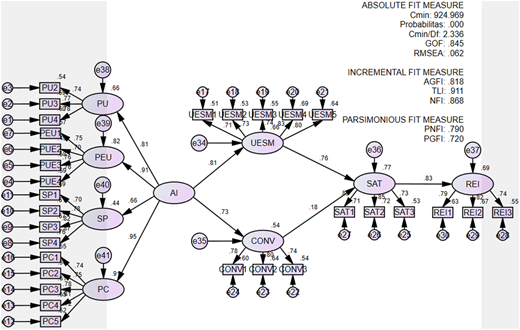
In the conceptual research model, causal relationships were tested using goodness-of-fit and the significance of path coefficients. Overall, the data indicated good model fit, as evidenced by the estimation of several model fit test statistics. The model fit was assessed using three categories of fit indices: absolute, incremental, and parsimonious (Hair Jr and Sarstedt, 2019). Supplementary Table A4 shows that the absolute fit measures category tended to have a high fit, followed by the incremental fit indices category, and the parsimonious fit indices category tended to have a strong model fit (>0.78 -> 0.90). Although the GFI (0.84), AGFI (0.81), and NFI (0.86) values indicated marginal model fit based on commonly reported recommended thresholds, the overall model fit was considered acceptable because the remaining fit indices met the recommended criteria. Modification indices were also reviewed to identify potential sources of model misfit. However, no model modification was made because changes were not supported by sufficient theoretical justification. Therefore, the original theoretically specified model was retained, and model fit was evaluated based on the overall combination of absolute, incremental, and parsimonious fit indices. SEM evaluation should not rely on a single index, but rather on a combination of several fit criteria (Hair et al., 2010; Iacobucci, 2010). In this study, several key indices indicated good model fit, including a CMIN/df value of 2.33, an RMSEA of 0.05, and a TLI of 0.91. The parsimonious fit indices (PNFI = 0.79; PGFI = 0.72) indicated an adequate balance between model fit and model parsimony. Therefore, based on the combination of absolute, incremental, and parsimonious fit indices, the model demonstrated acceptable overall fit and is suitable for further hypothesis testing. Supplementary Table A4 presents the research model fit statistics along with recommended values or cut-off points. Based on the recommended criteria, the fit indices indicate that the model has a good fit to the data; thus, the model is considered suitable for hypothesis testing (Seyal et al., 2002).
To examine the relationship between variables in the model and test the hypotheses, three criteria were used: the regression coefficient and the significance level (p-value <0.05). Based on these criteria, the hypotheses were accepted or rejected. The results of the hypothesis testing are presented in Figure 2 and Table 1. H1 is supported, with a significant positive effect of AI on social media user engagement (β = 0.81, p < 0.01). H2 is supported, with a significant positive effect of AI on conversion (β = 0.73, p < 0.01). H3 is supported, with a significant positive effect of social media user engagement on satisfaction (β = 0.76, p < 0.01). H4 is supported, with a significant positive effect of conversion on satisfaction (β = 0.18, p < 0.01). H7 is supported, with a significant positive effect of satisfaction on repurchase intention (β = 0.83, p < 0.01). Supplementary Figures A1 and A2 and Supplementary Table A4 present the results of the moderating effect of flow experience on the relationships between engagement and satisfaction and between conversion and satisfaction. The findings indicate that H5 is supported (β = 0.01; p < 0.01). The interaction curve in Supplementary Figure A1 indicates that flow experience moderates the relationship between engagement and satisfaction.
Furthermore, testing the moderating effect of flow experience on the relationship between conversion and satisfaction shows a significant interaction effect (β = 0.64; p < 0.01). However, the interaction curve in Supplementary Figure A2 shows a buffering pattern, whereby the effect of conversion on satisfaction is stronger under low-flow conditions than under high-flow conditions. To further examine this moderating effect, a simple slope analysis was conducted by comparing the relationship between conversion and satisfaction at low (−1 SD) and high (+1 SD) levels of flow experience. The results reveal that the effect of conversion on satisfaction is stronger under low-flow conditions (β = 0.78; p < 0.001) than under high-flow conditions (β = 0.43; p < 0.05). This finding indicates a buffering effect of flow experience, whereby the positive relationship between conversion and satisfaction becomes weaker as flow experience increases. One possible explanation is that conversion-related outcomes become more salient when users experience lower levels of flow, making successful transaction outcomes more important in their evaluation of satisfaction. In contrast, under high-flow conditions, users may derive greater satisfaction from engaging with the social commerce environment itself, reducing the relative contribution of conversion to overall satisfaction. Thus, flow experience appears to function as a buffering condition rather than an enhancing condition in the conversion satisfaction relationship.
5. Discussion
5.1 Theoretical contributions
This study contributes to the digital marketing literature by providing a holistic framework that examines the impact of AI on consumer interactions with social commerce service providers, particularly in terms of engagement and conversion. This study focuses on social commerce because previous research has shown that incorporating social elements into e-commerce has created new opportunities and challenges for businesses and consumers (Azhar et al., 2023). Naturally, the business models of e-commerce and s-commerce differ. E-commerce relies on direct interactions between sellers and buyers, while s-commerce involves user interaction through self-generated content and participation in virtual communities (Febrian, 2023). Therefore, this study is crucial for investigating the effects of AI on social commerce. A key finding of this study is that flow experience moderates the effects of user engagement and conversion on customer satisfaction.
This study makes two main contributions to the literature. First, given the growing trend of integrating social media and e-commerce platforms, this study responds to the importance of understanding customer engagement in social commerce. Previous research has found that AI effectively increases customer engagement and conversion through e-commerce Click or tap here to enter text. This study builds on this context by developing a more comprehensive understanding of how customer engagement contributes to customer satisfaction, with implications for repurchase intention. Second, the current study also contributes to the literature on engagement relationships by examining the moderating effect of flow experience, which can strengthen user engagement by creating an immersive, enjoyable, and sustainable experience during activities on s-commerce platforms.
The overall results support the model proposed in this study. The direct effects of AI and customer engagement were both found to be significantly positive. This study suggests that the social, emotional, and functional components of AI are essential indicators for developing practical AI features. These results align with a study (Cheng, 2025) that states that the effectiveness of AI in s-commerce depends heavily on its ability to balance functional and emotional intelligence in addressing user needs. This study also identified and considered the moderating effect of flow experience interactions in influencing the relationship between engagement and satisfaction. The findings revealed that flow experience can strengthen this relationship. Flow experience, which reflects a state in which users feel immersed, focused, and thoroughly enjoy an activity, can act as a factor that strengthens the influence of engagement and conversion on satisfaction. When users experience a high level of flow while interacting on an s-commerce platform, this experience can enhance their engagement and satisfaction. Similarly, conversion processes that happen when users are in a state of flow tend to result in a higher level of satisfaction than when they are not. More specifically, these findings suggest that flow experience can serve as a psychological amplifier, enhancing the quality of the user experience and thereby encouraging deeper satisfaction, even when the level of engagement or conversion remains relatively the same. Thus, flow experience is not merely a complement to user interactions, but rather a key element that significantly determines the success of a digital platform in creating a satisfying and memorable experience for its users. For example, in live shopping activities on social media, a user might actively comment, “like,” and listen to product descriptions from sellers, reflecting engagement. However, user satisfaction will not be optimal if the interaction feels boring, uneven, or uninteresting. Conversely, when users truly enjoy the process due to the presentation of engaging content, interactive communication, and a pleasant atmosphere, a flow experience is created. It strengthens the impact of engagement on satisfaction. Therefore, flow experience is a crucial element that should not be overlooked. S-commerce platforms need to design user experiences that not only encourage engagement and purchases but also create attention-grabbing, enjoyable interactions and build emotional bonds. This strategy will ensure that customer satisfaction is achieved not only from a functional perspective but also from a meaningful psychological experience.
Ultimately, this study confirmed that increased consumer satisfaction is associated with higher repurchase intentions. However, repurchase intentions do not always translate into actual behavior. External factors, such as situational constraints, changing preferences, or financial constraints, can prevent users from acting on their intentions. These findings align with (Shang and Bao, 2020; Meilatinova, 2021). These findings expand theoretical understanding in the field of s-commerce by confirming that consumer satisfaction plays a crucial role in driving repurchase intentions. These results reinforce the Expectation Confirmation Theory (ECT) framework, which has consistently demonstrated strong predictive power in determining user satisfaction and their intention to utilize interactive digital systems (Mehrabioun, 2024). In s-commerce, social interactions and user recommendations create unique experiences that can significantly enhance consumer satisfaction. Therefore, this study contributes theoretically by demonstrating that satisfaction formed through digital social dynamics is not only affective but also functional in shaping loyalty and repeat purchasing behavior on s-commerce.
5.2 Practical implications
This research emphasizes the importance of strategically utilizing AI features in s-commerce. Given that engagement has a stronger impact on satisfaction than conversion, managers should prioritize AI features that enhance interactive engagement (e.g. live chat, personalized content) rather than focusing solely on transactional efficiency. However, for SMEs with limited resources, implementing advanced emotional AI may not be feasible. Therefore, businesses can adopt more affordable alternatives, such as rule-based chatbots, personalized message templates, and interactive social media content, to simulate emotional engagement at a lower cost. AI that responds empathetically or adapts to the user's language style will create a more natural and enjoyable experience. Therefore, developers and digital businesses should consider integrating AI that enhances customers' emotional experience to increase user engagement and achieve higher conversion rates. The results confirm that the flow experience plays a crucial role in strengthening the influence of engagement and conversion on customer satisfaction. Furthermore, the findings reveal a nuanced moderation effect. When flow experience is low, customers rely more on functional outcomes, such as successful transactions, to evaluate satisfaction. Therefore, in low-immersion environments, managers should prioritize transactional reliability, promotional incentives, and ease of checkout processes. Conversely, when flow experience is high, satisfaction is more influenced by immersive and enjoyable interactions, suggesting that experiential design should be emphasized. Consequently, s-commerce platforms need to design interfaces and interactive features that create immersive, enjoyable, and naturally flowing experiences. For example, live shopping, gamification, or interactive content should be designed to capture users' attention and make them feel fully engaged in the platform's activities. This will not only increase satisfaction but also increase the likelihood of users returning and making repeat purchases. One of the unique features of s-commerce compared to conventional e-commerce is the high level of user social involvement in the interaction and transaction process. Therefore, businesses need to build active digital communities by utilizing user-generated content, review systems, and community features such as discussion groups or responsive comment sections. This finding is particularly important because consumer opinions can significantly influence purchasing decisions. Previous research reported that 97% of customers consider consumer opinions when making purchase decisions (Ahmad and Laroche, 2017).
This strategy also supports expectation confirmation when users feel that their experience meets or exceeds initial expectations. This research emphasizes the importance of developing structured customer engagement that aligns with the customer journey. Businesses must monitor and manage every stage of customer engagement, from attraction and interaction to conversion and retention. Keeping customers active is not enough; engagement should also create a pleasant and meaningful experience. Thus, engagement is not merely a fleeting activity; it creates deep satisfaction that leads to loyalty and repurchase intention. Another practical implication is the importance of an Expectation Confirmation Theory-based approach in developing customer experience strategies. S-commerce can use ECT as a framework to evaluate whether the system and experience provided meet users' initial expectations. This evaluation can be conducted through post-transaction surveys, satisfaction measurements, and tracking user return rates.
6. Conclusion and limitations
This research makes a significant contribution to the digital marketing literature, particularly in the context of s-commerce, by proposing a holistic framework that explains the role of AI, engagement, and flow experience in driving customer satisfaction and repurchase intentions. This study confirms that AI plays not only a functional role but also an emotional one, fostering personalized and immersive interactions with users. The combination of AI and user engagement has been shown to positively influence conversion and customer satisfaction, especially when enhanced by an immersive and enjoyable flow experience during interactions on s-commerce. Another important finding is the identification of the moderating role of flow experience, which significantly strengthens the relationships between engagement, conversion, and satisfaction. When users experience a state of flow, feeling focused, comfortable, and immersed in a digital activity, this experience enhances the psychological quality of the interaction, ultimately leading to higher satisfaction and continued loyalty. This study also confirms that customer satisfaction is a key determinant in forming repurchase intentions, in line with the Expectation Confirmation Theory (ECT) framework. The social dynamics offered by s-commerce, such as user-to-user interactions, user-generated content, and community features, strengthen perceptions of service quality and the overall customer experience.
Despite providing essential findings, this study has several limitations. First, the study focused on data from a single geographic or demographic context, thereby limiting its generalizability to other markets or cultures. Specifically, the findings may be context-specific to Indonesia, where a collectivist culture and high social media usage strongly influence social commerce adoption and digital behavior. Therefore, caution should be exercised when generalizing these results to other countries with different cultural characteristics and digital infrastructure. Second, the study uses a quantitative approach, which may not capture the potentially more complex emotional and behavioral nuances of users. Third, this study only considered flow experience as a moderating variable; other factors, such as trust, social norms, or content quality, may also play a significant role in shaping user satisfaction and loyalty. Therefore, future research should adopt a mixed-methods approach.
The author gratefully acknowledge Universitas Lampung for its support in conducting this research.
The supplementary material for this article can be found online.