This study investigates the reciprocal mediation effects between infrastructure (INF) and green logistics performance index (GLPI) on the balance of trade (BOT) in Asian countries from 2013 to 2023. It aims to determine whether infrastructure or green logistics plays the leading role in enhancing trade outcomes under the lens of sustainable development.
The study develops a reciprocal mediation model using a dynamic panel dataset comprising 308 observations from 44 Asian countries. A two-step System Generalized Method of Moments estimator is applied to control for endogeneity, serial correlation and heteroskedasticity. The model evaluates both mediation directions: INF → GLPI → BOT and GLPI → INF → BOT.
The results reveal that GLPI has a more substantial direct impact on trade balance than INF. Moreover, INF exhibits a more significant mediating role in the GLPI–BOT relationship, accounting for 65.66% of the total effect. In contrast, GLPI mediates only 25.44% of the INF–BOT relationship. The impact of GLPI on INF is also found to be stronger than the reverse. These findings underscore GLPI as the key driver in promoting green infrastructure and enhancing sustainable trade outcomes in Asia.
A potential measurement overlap exists between GLPI and INF, despite diagnostic tests confirming no severe multicollinearity. The study also faced data constraints, including missing and biennial data reporting, which were addressed through interpolation and PCA adjustments. Further research using Structural Equation Modeling is recommended to capture latent constructs and complex interactions better.
To the best of the authors’ knowledge, this is one of the first empirical studies to apply a reciprocal mediation framework to simultaneously examine how infrastructure and green logistics influence trade performance in Asia. It offers novel policy insights by highlighting GLPI as both a trade enhancer and an infrastructure catalyst, guiding resource allocation in sustainable trade development.
1. Introduction
Balance of trade is a widely used term in economics, especially in the context of international trade. It constitutes the most significant component of the current account in a country's balance of payments, reflecting the difference in value between exports and imports at a given time (Harahap et al., 2023). Amid growing challenges in global commerce, the WTO (2024) reported a 1.2% decline in global merchandise trade volume in 2023, with a modest recovery projected at 2.6% in 2024. UNCTAD warns that global growth is expected to slow to 2.3% in 2025, driven by policy shocks, financial volatility and intensifying trade tensions. Recent tariff measures have disrupted supply chains and reduced predictability, thereby negatively impacting global trade (UNCTAD, 2025). In this uncertain environment, Asia stands out as a bright spot. According to ESCAP (2024), Asia's exports and imports grew by 3.4% and 3.6%, respectively, in 2024, surpassing the global averages of 1.8% and 2.2%. The region accounted for 38.9% of global export value and 36.7% of global import value. The Regional Comprehensive Economic Partnership, effective since 2020 and encompassing 15 Asia–Pacific economies, has formed the world's largest free trade area, representing roughly 30% of global trade (Erokhin, 2020; Vu and Nguyen, 2020). In its first 2.5 years, intra-RCEP trade rose by nearly 8%. Similarly, between 2018 and 2021, intra-CPTPP trade grew by 5.5%, with a notable 13.2% increase among members without prior bilateral Free Trade Agreements (FTAs) (Saori, 2025). South-South trade, much of it within Asia and accounting for one-third of global trade, has been pivotal for regional economic growth (UNCTAD, 2025). As Asia's economic integration deepens, international trade has become a key driver of regional growth and development. Trade in goods and services represents a significant share of GDP in many Asian economies. Zaman (2023) highlights how export-led strategies elevated countries like South Korea and Japan to high-income status. Chen et al. (2025) emphasize that trade expansion can enhance economic growth, social equity and environmental sustainability. Thus, trade is increasingly interlinked with sustainable development goals, requiring policies that balance trade liberalization with environmental and social considerations.
Given Asia's rising role in global trade, in-depth studies focusing on its trade dynamics are essential. Alongside expanding trade flows, infrastructure and green logistics have emerged as integral components of modern commerce. The importance of infrastructure investment has grown, notably as Asia's liberalization efforts have significantly reduced tariffs (Ismail and Mohd, 2015). Transport and information and communication technology (ICT) infrastructure directly influence international trade efficiency. Rahman et al. (2021) found that road, rail, seaport and digital infrastructure (electricity, Internet and mobile networks) significantly facilitate trade across Asian economies. Concurrently, “green logistics”, logistics systems designed to reduce carbon emissions, has gained traction as a critical approach for harmonizing economic growth with environmental protection. Khan et al. (2019) argue that green logistics contributes to environmental protection, social progress and economic development. Enhancing green logistics performance helps overcome environmental barriers in trade, promoting sustainable trade growth (Ren and Huang, 2015). Suki et al. (2021) also demonstrate that traditional Logistics Performance Index (LPI) indicators contribute to economic growth and emission reduction, encouraging infrastructure upgrades toward environmental sustainability. Numerous studies have separately examined the direct effects of infrastructure and green logistics on trade, confirming that both play a critical role in enhancing market connectivity and promoting sustainable trade growth. However, the notion of a reciprocal mediating mechanism, where either infrastructure or green logistics acts as an intermediary that amplifies the effect of the other, has rarely been empirically tested. In the context of ongoing global supply chain disruptions and the urgent push for green energy transitions, the need for environmentally sustainable infrastructure and green logistics systems has become increasingly critical. For instance, UNCTAD (2022) highlighted that recent supply chain crises have compelled countries to upgrade multimodal infrastructure and decarbonize transport systems to improve resilience. Likewise, at the 2024 Global Supply Chain Forum, experts stressed the urgency of transforming freight transport to meet global climate goals, reflecting the growing significance of green logistics and sustainable infrastructure in the current landscape of trade competitiveness. Therefore, investigating the simultaneous interaction of these two crucial factors within a reciprocal mediating mechanism and a unified model for international trade in Asia is both timely and essential. This study addresses this gap by investigating the reciprocal mediation effect between Green Logistics Performance Index (GLPI) and Infrastructure (INF) in shaping the Balance of Trade (BOT) of Asian countries during 2013–2023. Moreover, it advances the theoretical framework of Porter (1990) by examining whether infrastructure serves as a foundational enabler of green logistics, or conversely, if improvements in green logistics act as a catalyst for developing environmentally friendly infrastructure. This inquiry informs whether limited national resources should prioritize green logistics efficiency or infrastructure investment to optimize multilateral trade outcomes.
The study is grounded in two core theoretical frameworks: Porter's (1990) diamond model of national competitiveness and Tinbergen (1962) gravity model of trade. It develops a reciprocal mediation model following Cole and Maxwell (2003) and Maxwell et al. (2011), employing a two-step System GMM approach to address endogeneity. The findings confirm the significance of both mediation pathways. Infrastructure exerts a stronger indirect effect in the pathway from GLPI to BOT, while GLPI shows a dominant direct effect on BOT, as well as a stronger influence on INF than the reverse. Distinct from prior studies that mainly focus on the direct effects of infrastructure or logistics on trade, this paper is among the first to empirically validate the reciprocal mediation effects between INF and the GLPI in shaping the trade balance of Asian economies. The findings highlight GLPI not only as a key driver of sustainable trade but also as a motivator for upgrading digitalized and adaptive infrastructure, a dimension that remains underexplored in the existing literature. Based on these findings, the study proposes policy recommendations tailored to national capacities and emphasizes GLPI as a strategic priority in enhancing trade sustainability. Limitations and future research directions are also discussed.
2. Literature review
2.1 Literature review
2.1.1 Infrastructure and Balance of Trade
The quality of transport infrastructure is a key determinant of international competitiveness (Lakshmanan, 2011; Wilson, 2015). Numerous empirical studies have shown that well-developed infrastructure helps reduce transport costs, optimize production efficiency and increase export volumes (Schwab, 2018; Won et al., 2014; Bruinsma, 1995). Recent evidence from South Asia (Rehman et al., 2020) and Spain (Bensassi et al., 2015) reinforces the conclusion that transport infrastructure, including roads, railways, airports and seaports, is essential in improving trade balance and enhancing regional economic integration. Sénquiz-Díaz (2021) demonstrated that the quality of roads and ports significantly boosts exports, as they facilitate cross-border movement of goods. Similarly, Wang et al. (2020) found that the development of inland port systems positively impacts bilateral trade between China and South Korea. High-quality logistics and transport infrastructure also provide comparative advantages for countries, especially in logistics-intensive sectors (Park, 2020; Ismail and Mohd, 2015). Khalaf et al. (2024) argue that an infrastructure system does not only consist of physical elements but also requires a reliable information infrastructure. In addition, ICT infrastructure, such as broadband networks, has a significant positive impact on export performance (Zhou et al., 2022). According to Francois and Manchin (2013), access to modern transport and communication infrastructure is vital for countries' participation in global trade, particularly in improving export performance.
2.1.2 Logistics Performance Index (LPI) and Balance of Trade
Logistics is increasingly recognized as a key driver of global trade, foreign trade and economic growth (Salawu et al., 2022). Several empirical studies have confirmed that improving logistics performance yields substantial benefits for international trade, particularly in developing economies, through better customs procedures, infrastructure quality and logistics capabilities (Martí et al., 2014; Wang and Choi, 2018; Tang and Abosedra, 2019; Puertas et al., 2013). For instance, Ma et al. (2021) found that provincial-level logistics development in China significantly contributed to bilateral trade expansion along the Belt and Road Initiative, suggesting the need for targeted logistics investment to reduce regional disparities. Türkcan and Majune (2021), using EU-28 data, showed that importer-side “hard” logistics is more influential in sustaining exports, while exporter-side “soft” logistics plays a critical role. Other studies have shown that high logistics performance is positively correlated with FDI inflows, reinforcing logistics as a key factor in boosting trade and attracting investment (Chen and Hasan, 2020; Luttermann et al., 2020). Zaninović et al. (2020) emphasize that LPI scores significantly affect bilateral trade, especially for small open economies. Song and Lee (2022) further noted that each component of LPI transport services, tracking and timeliness has varying impacts on trade by product type and trade direction, implying that improving logistics quality is essential for optimizing trade efficiency.
In the context of sustainable development, the conventional LPI may not fully capture a country's environmental logistics performance, necessitating the creation of new indicators (Cheng et al., 2024; Lu et al., 2019; Starostka-Patyk et al., 2024). Green logistics, which integrates sustainability goals into logistics activities such as inventory, distribution and freight transportation, aims to harmonize efficiency with environmental conservation. It has become a key factor in enhancing trade competitiveness by reducing carbon emissions (Ahmadi and Taghizadeh, 2019; Tang and Wang, 2020). Conversely, Mai (2025) developed a GLPI, which was found to impact imports but reduce exports positively. Hausman et al. (2013) and D'Aleo and Sergi (2017) stressed that logistics development, combined with trade liberalization, supports trade growth, production scale, distribution capacity and economic performance. Enhancing logistics through sustainable or green logistics is thus crucial for the economic competitiveness of all nations, particularly in Asia. In line with the environmental focus of GLPI, Mansour et al. (2025) investigate board governance in ASEAN-5 countries and show that higher board effectiveness significantly enhances carbon emission disclosure, underlining the role of governance mechanisms in promoting environmental transparency.
2.1.3 Infrastructure and Logistics Performance Index
Modern transport, port and ICT infrastructure help reduce costs, shorten delivery times and improve logistics service quality, thereby promoting trade and economic development. Munim and Schramm (2018) emphasized that port infrastructure quality directly improves logistics performance and maritime trade, especially in developing countries. Wong and Tang (2018) pointed out that countries with strong resources in infrastructure, labor and education can enhance logistics efficiency. Institutional factors, including corruption and political stability, also significantly influence global logistics performance. Road infrastructure investment is vital for supply chain connectivity, cost reduction and improved national logistics (Bayoumi et al., 2021). In a sustainable development context, Yingfei et al. (2022) highlighted that infrastructure plays a critical role in boosting green logistics performance, which in turn enhances service trade and environmental protection. Well-designed infrastructure optimized in terms of location, scale and allocation can promote sustainable logistics by increasing efficiency and minimizing environmental impact (Perschke et al., 2023). ICT integration is also crucial for information sharing and logistics optimization, which supports green logistics (Frehe and Teuteberg, 2014, 2017). Within the Vietnamese context, Do et al. (2024) confirmed that infrastructure development fosters green logistics through improved efficiency, cost savings and enabling green technology adoption, thereby reducing greenhouse gas emissions and enhancing supply chain sustainability.
Existing studies have focused mainly on the direct effects of infrastructure and logistics (including green logistics) on trade balance in Asian countries. Although a few studies, such as Yeo and Deng (2020), have explored the mediating role of conventional logistics performance, there is a lack of research examining the reciprocal mediation between infrastructure and green logistics. No prior study has systematically investigated the dual mediating role: whether green logistics performance mediates the effect of infrastructure on trade balance, and conversely, whether infrastructure mediates the effect of green logistics on trade. This study aims to fill that gap and address the key question: Is infrastructure the foundational enabler for improving green logistics to achieve sustainable trade, or is green logistics the driving force that fosters environmentally friendly infrastructure to enhance trade balance?
2.2 Theoretical framework
2.2.1 Porter's theory of national competitive advantage
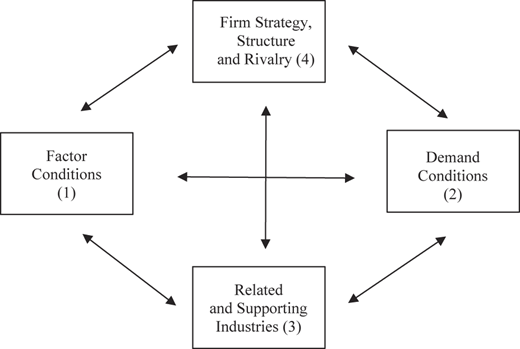
Among modern trade theories, Porter (1990) theory of national competitive advantage, commonly known as the Diamond Model explains a nation's competitiveness through the interaction of four key determinants: (1) Factor conditions, such as human resources, infrastructure and technological capabilities; (2) Demand conditions, referring to the scale and sophistication of domestic market demand; (3) Related and supporting industries, including high-quality suppliers and strong inter-industry linkages; and (4) Firm strategy, structure and rivalry, which drive innovation and efficiency through domestic competition. Porter argues that these four determinants are mutually reinforcing and are influenced by two external factors: chance events and government actions. The effective interplay of these elements enables countries to build and sustain a competitive advantage in global markets. In the context of this study, Porter's framework is used to conceptualize the research model wherein infrastructure represents a core input condition (1), and green logistics performance reflects the role of related and supporting industries (3). These two components are not only interdependent but also jointly contribute to enhancing a nation's global competitiveness through international trade. While Porter emphasized that factor conditions and related supporting industries are mutually reinforcing, most prior studies have modeled this relationship as unidirectional (Sénquiz-Díaz, 2021; Zhou et al., 2022; Zaninović et al., 2020; Tang and Wang, 2020). This study extends and empirically tests the Diamond framework by demonstrating a reciprocal mechanism, in which infrastructure and green logistics alternately serve as mediators in the relationship of the other factor with the national trade balance (INF → GLPI → BOT and GLPI → INF → BOT). The determinants of national competitiveness are presented in Figure 1.
2.2.2 Gravity theory of trade
The gravity theory of trade (Tinbergen, 1962) explains bilateral trade flows based on economic size, typically measured by GDP and geographic distance. Tinbergen posited that larger and geographically closer economies are more likely to engage in strong trade relationships due to reduced transportation and transaction costs. The model has since been extended (e.g. Helpman et al., 2008) to incorporate institutional factors and multilateral trade barriers. In the context of international trade, the concept of “distance” extends beyond physical distance to include transaction costs, non-tariff barriers and the efficiency of customs procedures. According to this theory, trade flows primarily depend on economic size and trade costs, particularly transport costs. In this study, infrastructure reduces trade costs by improving connectivity and transportation, while green logistics mitigates barriers related to environmental and carbon factors. In addition, control variables such as gross domestic product (GDP) and trade facilitation (TF) are also well explained by this theory, providing significant contributions to the research model. By integrating these aspects, our model extends the gravity framework to account for both physical and environmental efficiency as determinants of the trade balance. Therefore, this theory is highly appropriate for explaining the issue under investigation. Accordingly, the gravity model provides a relevant and robust theoretical foundation for this study.
2.2.3 Reciprocal–influence mediation framework
The reciprocal-influence mediation model is an extension of traditional mediation analysis in which the mediator and the independent or dependent variable can exert reciprocal effects (i.e. reciprocal causation). Developed by Cole and Maxwell (2003) using autoregressive cross-lagged panel modeling, this framework enables simultaneous estimation of direct, indirect and feedback (reciprocal) effects among variables over time. Maxwell et al. (2011) emphasized the limitations of using cross-sectional data in mediation analysis, as it often leads to biased causal inference. Their work strengthened the call for longitudinal designs that incorporate temporal dynamics. Statistically, the bootstrapping technique proposed by Hayes (2015) has enhanced the reliability of indirect effect estimations. This is grounded in the foundational framework by Baron and Kenny (1986), later expanded by Fairchild and MacKinnon (2008). One of the seminal empirical applications of this model was conducted by Sinclair and Stuart (2007), who clarified the reciprocal relationship between mediators and independent or dependent variables. Rather than viewing mediation as a one-directional causal chain, this framework treats relationships as part of a continuous causal feedback network. Recent studies have continued to validate this reciprocal mechanism. For example, Nawrocka et al. (2021) demonstrated that both quantitative and qualitative job insecurity acted as both independent variables and mediators in explaining work engagement. Additional empirical evidence supporting reciprocal mediation has been presented by Exelmans and Van den Bulck (2017), Bakker et al. (2004) and Vander Elst et al. (2014).
2.3 Research hypotheses
Infrastructure can be classified into physical infrastructure and ICT infrastructure relevant to trade. These components facilitate the efficient flow of goods, services and information across borders (Felipe and Kumar, 2012; Wong and Tang, 2018). Physical infrastructure includes air freight, container port traffic, cargo railway volume and paved road networks. ICT infrastructure is represented by five key indicators: Internet users, secure Internet servers, fixed broadband subscriptions, fixed telephone subscriptions and mobile cellular subscriptions (Ismail and Mohd, 2015). These are essential elements of modern trade systems, and their advancement has consistently propelled waves of globalization (UNESCAP, 2017). In this context, trade-related infrastructure is considered the backbone of economic connectivity.
According to Tinbergen (1962) gravity theory, any factor that reduces transaction costs and increases connectivity will promote international trade flows. Similarly, Porter's (1990) diamond model emphasizes infrastructure as a foundational input for national competitive advantage. Thus, well-developed infrastructure not only enhances production and export capacity but also reduces import costs, contributing to trade balance improvement. Empirical research supports this relationship, showing that investments in both physical and ICT infrastructure positively influence bilateral trade in Asia (Ismail and Mohd, 2015; Rahman et al., 2021). Improving infrastructure and logistics performance is seen as one of the most effective strategies for capturing trade gains and increasing economic efficiency (Yeo et al., 2020; Felipe and Kumar, 2012; Park, 2020).
INF has a positive impact on the BOT of Asian countries.
Logistics performance is commonly assessed using the LPI developed by the World Bank in 2007. The LPI is based on standardized survey responses and statistical methods to evaluate logistics efficiency and cross-country comparisons (Arvis et al., 2018). Building on the six sub-indicators of the LPI, Fan et al. (2022) introduced the GLPI by integrating entropy-weighted environmental factors such as greenhouse gas emission intensity (CO2, CH4, N2O and F-gas) and fossil fuel consumption.
As logistics plays a crucial role in national economic development, green logistics becomes essential in aligning trade competitiveness with environmental sustainability (Bensassi et al., 2015). Its core objective is to minimize the environmental externalities of logistics operations, including emissions, noise and waste, while balancing economic, social and environmental goals. Using gravity models, Wang et al. (2018) analyzed the effect of GLPI on international trade in 113 countries and found a strong positive relationship with export volume and trade balance. Similarly, Le et al. (2022) found that GLPI significantly enhanced export volumes within APEC countries.
GLPI has a positive impact on the BOT of Asian countries.
Wong and Tang (2018) emphasized that infrastructure not only supports physical transportation but also facilitates timely information exchange across the supply chain. High-quality logistics infrastructure (such as seaports, roadways, warehouses and telecom systems) is crucial for building an efficient and flexible global supply chain. According to Mangan et al. (2021), strong infrastructure enables effective logistics, improves international trade capabilities and enhances national trade balance. Haj et al. (2023) also showed a positive relationship between port infrastructure and LPI scores in Tunisia and Morocco, affirming that logistics development enhances port competitiveness and maritime trade. These findings suggest a reciprocal relationship between logistics performance and infrastructure. On the one hand, improved infrastructure fosters efficient logistics; on the other hand, rising logistics demands drive further investment in infrastructure (Chen and Hasan, 2023; Yeo et al., 2020). From Porter's perspective, infrastructure represents factor conditions, while green logistics represents related and supporting industries. Two key elements of the diamond model jointly contribute to national competitiveness.
INF has a positive impact on GLPI.
GLPI has a positive impact on INF
Porter (1990) emphasized that competitive advantage is shaped by the combination of production factors (e.g. infrastructure and technology) and supporting industries (e.g. logistics services). These components interact dynamically; robust infrastructure enables green logistics efficiency, while green logistics stimulates investment in infrastructure. Leading to long-term competitive advantage (Düerkop and Huth, 2016; Ye et al., 2025). Modern infrastructure (transportation and ICT) reduces trade costs and supports eco-friendly logistics solutions (Munim and Schramm, 2018; Do et al., 2024). Improved GLPI enables firms to comply with green standards, expand exports and limit unnecessary imports, thereby improving the trade balance (Wang et al., 2018; Le et al., 2022). In turn, enhanced GLPI motivates public and private investment in roads, ports, warehouses and ICT to sustain logistics capacity (Yeo et al., 2020; Haj et al., 2023), ultimately reducing logistics costs and improving trade outcomes (Ismail and Mohd, 2015; Park, 2020).
Furthermore, several studies have demonstrated mediating roles of logistics and infrastructure in similar frameworks. For example, Alam et al. (2014) found that IT integration only improves supply chain performance when supported by logistics capacity. Hamid et al. (2024) also concluded that information-sharing technology indirectly affects performance through logistics capabilities. Yeo and Deng (2020) showed that logistics performance mediates the relationship between trade facilitation and international trade, while Chen and Hasan (2023) confirmed that port quality mediates the link between maritime connectivity and logistics effectiveness.
Building on Porter's theory and the reciprocal mediation framework by Cole and Maxwell (2003), this study investigates the dual mediation effects between infrastructure, green logistics and trade balance, using panel data with a reciprocal causation design (Maxwell et al., 2011). Accordingly, the following hypotheses are proposed:
GLPI mediates the relationship between INF and BOT.
INF mediates the relationship between GLPI and BOT.
3. Methodology
3.1 Research model
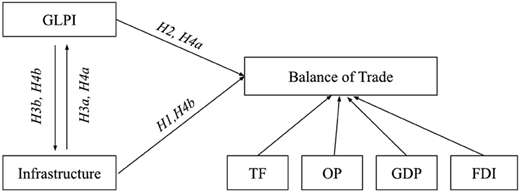
Building on the theoretical foundations of Porter's (1990) national competitive advantage, Tinbergen (1962) gravity model of trade and supported by prior empirical studies such as Wong and Tang (2018), Chen and Hasan (2023), Yeo et al. (2020), Fan et al. (2022) and Sinclair and Stuart (2007), this study investigates the reciprocal mediation effects between GLPI and INF on the BOT of Asian countries during the period 2013–2023. To fulfill this objective, the research first tests the mediating role of green logistics performance in the relationship between infrastructure and trade balance, as proposed in Hypothesis H4a. Subsequently, it evaluates the mediating role of infrastructure in the relationship between green logistics performance and balance of trade, as stated in Hypothesis H4b. To further clarify this reciprocal mediation mechanism and enhance the robustness of the analysis in the presence of macroeconomic influences, the study incorporates a set of control variables, including trade facilitation (TF), West Texas Intermediate crude oil price (OP), GDP and foreign direct investment (FDI). The proposed research model is presented in Figure 2.
The study first explores the mediating role of GLPI in the relationship between INF and BOT, as specified in Hypothesis H4a. Following the three-step procedure of Baron and Kenny (1986), Fairchild and MacKinnon (2008) and Hayes (2015), the authors construct three general equations, referred to as Equations (1), (2) and (5), to test the mediation effect. Accordingly, the total effect of the independent variable (INF) on the dependent variable (BOT) is captured by the following general form of Equation (1):
To examine the mediating role of the GLPI, the authors conduct a mediation analysis and formulate Equation (2) as follows:
To verify the reciprocal mediation effect specified in Hypothesis H4b, the authors formulate a set of general equations to examine the indirect effect of INF in the relationship between GLPI and BOT. Specifically, the total effect of GLPI on BOT among Asian countries, along with the mediating role of INF, is represented by Equations (3) and (4) as follows:
Finally, the direct effects of both INF and GLPI in the two reciprocal mediation pathways (H4a and H4b) are formally tested and validated through Equation (5):
In these equations, i denotes the country and j represents the year. The dependent variable, ln(X/M), is defined as the natural logarithm of the trade balance. β0, β1, … are the estimated coefficients for the independent variables. The error term ε reflects the deviation between the actual observed values and the predicted values from the regression model. To validate the mediating role of GLPI (Hypothesis H4a), INF must show a statistically significant effect on the dependent variable in both Equation (1) and Equation (2). Furthermore, when INF is controlled for in Equation (5), the mediator GLPI must also exhibit statistical significance. If INF remains significant in Equation (5), this indicates that GLPI acts as a partial mediator. Conversely, if INF becomes statistically insignificant after the inclusion of GLPI, it implies that GLPI functions as a full mediator (Baron and Kenny, 1986). Similarly, to assess the mediating role of INF (Hypothesis H4b), GLPI must demonstrate significance in the relevant equations. The mediating effect of INF is then determined based on whether GLPI maintains statistical significance in Equation (5).
3.2 Data
This study collected a dataset on the balance of trade of 44 countries and regions in Asia from 2013 to 2023, which includes Afghanistan, Saudi Arabia, Armenia, Azerbaijan, Bahrain, Bangladesh, Bhutan, Brunei, Cambodia, United Arab Emirates (UAE), Cyprus, Timor-Leste, Georgia, South Korea, India, Indonesia, Iran, Iraq, Jordan, Kazakhstan, Kuwait, Kyrgyzstan, Laos, Lebanon, Maldives, Mongolia, Malaysia, Japan, Nepal, Oman, Pakistan, China, Philippines, Qatar, Singapore, Sri Lanka, Syria, Tajikistan, Thailand, Turkey (Asian part), Turkmenistan, Uzbekistan, Vietnam and Yemen. After processing the data according to the procedure, excluding outliers and observations with missing data, the dataset contains 308 observations from 44 Asian countries and regions. The sources of the variables are summarized in Table 1.
3.3 Measurement method
3.3.1 Measurement of Balance of Trade
According to the World Trade Organization (WTO), the trade balance is defined as the difference between the value of a country's exports and imports of goods over a specific period. It is calculated by subtracting the total value of imports from the total value of exports.
Here, X denotes the total value of exports, and M represents the total value of imports. To reduce data distribution skewness, improve linearity and stabilize variance in the model, the authors apply a natural logarithmic transformation as follows:
3.3.2 Measurement of Green Logistics Performance Index (GLPI)
Following the methodology of Fan et al. (2022), the authors calculate GLPI based on the six sub-indicators of the LPI. For years with missing data, the LPI values are estimated using the average of adjacent years. In addition, the study focuses on the role of the green level score, which incorporates two key components: (1) greenhouse gas emission (CO2, N2O, CH4 and F-gases) and (2) a fossil fuel consumption index, to construct a comprehensive GLPI. The sub-indicators of the GLPI and their respective data sources are summarized in Table 2.
The study begins by collecting data on the emission intensities of CO2, N2O, CH4, F-gases and fossil fuel consumption for Asian countries and territories. The green level score (GLS) is then calculated using the entropy weighting method, initially developed by Shannon (1948) and further formalized by Starr and Zeleny (1977) and Mi et al. (2006). Subsequently, the normalized values of the traditional LPI and the GLS (standardized using the min–max method) are processed again using a second round of entropy weighting. This procedure generates the final GLPI, which reflects the positive direction of environmental performance objectives for Asian countries and territories during the period 2013–2023.
3.3.3 Measurement of Infrastructure
Building on previous studies on physical and ICT infrastructure (Felipe and Kumar, 2012; Wong and Tang, 2018), the research measures infrastructure using eight indicators: three for physical infrastructure and five for ICT infrastructure, following the approach of Ismail and Mohd (2015). The Principal Component Analysis (PCA) method is applied to construct a composite infrastructure index from these multiple indicators (Jolliffe and Cadima, 2016). For observations with missing data by year or country, the relevant indicators are estimated using the average of adjacent years. PCA is then conducted using Stata 14 to extract the main components. The list of infrastructure sub-indicators and their data sources is provided in Table 3.
PCA is conducted on the standardized dataset to ensure that differences in measurement units do not distort the component indicators. The selection criteria for the principal component are based on the highest eigenvalue and a cumulative variance contribution of at least 70%, thereby ensuring that the composite index captures the majority of the original information (Jolliffe and Cadima, 2016). The procedure consists of three steps: (1) data standardization; (2) implementation of PCA using Stata 14; and (3) selection of the first principal component if the above criteria are met. The PCA results in this study confirm that the first principal component satisfies the requirements and is thus adopted as the composite infrastructure index.
3.4 Estimation method
To analyze the reciprocal mediation effects between INF and GLPI on the BOT of Asian countries, the authors employ a set of panel data regression methods. The estimation begins with the Pooled Ordinary Least Squares model, followed by the Random Effects Model and the Fixed Effects Model. To address issues such as heteroskedasticity and autocorrelation, the Feasible Generalized Least Squares method is then applied. However, these conventional estimators may yield biased results due to the presence of endogeneity among variables, a common issue arising from the economic nature of the constructs in the model. To overcome this challenge, the study employs the Two-Step System Generalized Method of Moments (SGMM) estimator to test and control for endogeneity. In the SGMM framework, the authors use lagged variables and population size as instrumental variables. The lagged variables help control for time-series dependence across previous periods, while population, with an F-statistic of 47.49 (>10), is identified as a strong instrument, enhancing the model's validity. Following the SGMM estimation, the study performs Arellano–Bond tests to check for second-order autocorrelation and the Hansen test to assess the validity of instruments. These diagnostics confirm that issues of autocorrelation and heteroskedasticity have been effectively addressed. The two-step SGMM method thus improves estimation accuracy compared to traditional panel regressions, particularly in dealing with endogeneity and serial correlation, making it a robust choice for dynamic panel analysis.
4. Results and discussion
4.1 Result
Table 4 reports the descriptive statistics. The variation in the number of observations across variables mainly results from the characteristics of secondary data and the preprocessing phase prior to analysis; some indicators are only updated biennially or are not fully reported across all countries and years, leading to missing data. Additionally, the logarithmic transformation of economic variables excludes original values that are less than or equal to zero, thereby reducing the number of valid observations. Meanwhile, the regression model retains only complete cases across all variables; nevertheless, the sample size remains adequate and the regression results are highly reliable, as evidenced by strong statistical indicators. Specifically, the coefficient of determination (R2) is very close to 1, and the F-test demonstrates strong statistical significance (p-value <0.01).
Table 5 presents the correlation matrix, which shows that the pairwise correlations among variables in the model are relatively low (below 0.8). Therefore, the model does not suffer from multicollinearity. Moreover, Table 6 reports the Variance Inflation Factors (VIF), all of which are below 10 for the coefficients. Hence, the authors retain the original model specification for subsequent model selection and estimation procedures.
The results of the analysis on the impact of INF on BOT and the mediating role of GLPI are presented in Table 7, specifically in Columns (1), (2) and (5) using the two-step SGMM, the model sequentially reports the total estimated effect of INF on BOT, the effect of INF on GLPI, and the direct effect of INF on BOT. In the reverse mediation pathway involving INF, Columns (3), (4) and (5), respectively, show the total estimated effect of GLPI on BOT, the effect of GLPI on INF and the direct effect of GLPI on BOT. The indirect effects of GLPI (1) and INF (2) are computed by subtracting the respective coefficients of INF (1) and GLPI (2) in Model (5) from their corresponding coefficients in Model (1) and Model (3). The direct effects are captured by the coefficients of INF and GLPI in Model (5), while the total effects of INF and GLPI are reflected in their coefficients in Model (1) and Model (3), respectively.
4.2 Discussion
The findings indicate that INF exerts a positive and statistically significant effect on the BOT of Asian countries. Specifically, in regression model (5), a one-unit increase in infrastructure development is associated with an improvement of approximately 1.7% in a country's trade balance, holding all other factors constant. Although this figure may appear modest, in the context of international trade, where competitive advantages are often determined by slight differences in cost, time and operational efficiency, such an impact is substantial and noteworthy. In this study, infrastructure is not confined to its traditional components, such as roads, ports or warehousing but also reflects technological readiness and information connectivity critical to trade facilitation. This integration of physical and digital infrastructure contributes to enhanced supply chain performance, reduced transport delays and greater precision in trade processing. These improvements, whether technical or operational, accumulate into significant advantages in expanding export markets, managing imports efficiently and optimizing trade balance. The result is entirely consistent with previous studies such as Wong and Tang (2018), Yeo et al. (2020) and Chen and Hasan (2023), all of which underscore the central role of infrastructure in driving international trade and strengthening national economic competitiveness. The quantitative validation of Hypothesis H1 in this research further confirms that infrastructure is not merely a supporting factor but rather a strategic pillar in shaping the trade success of economies across the region.
In addition, the GLPI plays a critical and significantly positive role in influencing the BOT of Asian countries, with a statistical significance level of 1% (H2). Specifically, a one-unit improvement in a country's green logistics performance is associated with a 14.8% increase in its trade balance. This is a remarkable figure, highlighting the importance of green logistics development in promoting international trade, particularly in the context of Asia's ongoing commitment to sustainable development strategies, as reflected in the Regional Comprehensive Economic Partnership 2020 and the Comprehensive and Progressive Agreement for Trans-Pacific Partnership 2018. This finding is consistent with previous studies by Wang et al. (2018) and Le et al. (2022), reinforcing the empirical evidence on the positive relationship between green logistics and trade performance. It underscores that green logistics contributes not only to improved transport efficiency and supply chain effectiveness but also acts as a key driver of sustainable trade growth. Moreover, enhancing green logistics can strengthen national competitiveness, attract foreign direct investment and expand market access, particularly in economies with high environmental and transportation standards.
From the perspective of the empirical findings, INF is shown to have a positive and statistically significant effect on GLPI in Model (2), with a regression coefficient of 0.0129 at the 1% significance level. Conversely, GLPI also exhibits a positive effect on INF, with a much stronger estimated coefficient of 0.22, also significant at the 1% level. These results support the authors' initial assumptions, confirming Hypotheses H3a and H3b. Furthermore, they reinforce Porter's diamond model, which emphasizes the complementary relationship between factor conditions (infrastructure) and related and supporting industries (green logistics) in shaping national competitive advantage through sustainable trade. The higher coefficient from GLPI to INF suggests that improvements in green logistics are playing a driving role, encouraging investment in adaptive infrastructure. This finding aligns with the observations of Chen and Hasan (2023), who noted that emerging green operational standards and digital transformation are increasingly guiding infrastructure upgrading strategies. In the reverse direction, although the coefficient from INF to GLPI is smaller, it remains statistically significant, indicating that infrastructure improvements, particularly in transport networks and ICT systems, continue to facilitate sustainable supply chain optimization and emissions reduction. This observation supports the argument by Wong and Tang (2018) regarding the foundational role of infrastructure in enabling both the flow of information and physical goods. The reciprocal relationship between green logistics and infrastructure further highlights the importance of a coordinated investment strategy, as proposed by Yeo et al. (2020), to maximize long-term economic and trade efficiency.
Furthermore, the findings reveal that INF not only has a direct impact on the BOT but also an indirect impact through GLPI. Specifically, INF is statistically significant in all three Models (1), (2) and (5). At the same time, GLPI is significant at the 1% level in Model (5), indicating that GLPI functions as a partial mediator in the relationship between INF and BOT. Similarly, INF also serves as a partial mediator in the relationship between GLPI and BOT. Based on the estimation results, the direct effects of both GLPI and INF are found to be smaller than their total effects, which aligns with the argument by Muller et al. (2005). According to their logic, the regression coefficient of an independent variable in a model that includes a mediator (Model 5) should be lower than in models without the mediator (Models 1 and 3) since the mediator absorbs a substantial portion of the explanatory power. These results confirm Hypotheses H4a and H4b and empirically demonstrate the existence of a reciprocal mediation effect between green logistics performance and infrastructure in influencing the trade balance of Asian countries over the period 2013–2023.
The empirical findings contribute to clarifying the core research question regarding the reciprocal relationship between GLPI and INF in enhancing the BOT, while also validating the propositions embedded within Porter's (1990) theory of national competitive advantage. Notably, the direct coefficient from GLPI to BOT is significantly larger than that from INF in Model (5), indicating that GLPI currently serves as a stronger driver in improving national trade performance. However, when examining indirect effects, GLPI transmits only about 25% of INF's impact on BOT, suggesting that the diffusion effect via green logistics remains limited in scope and intensity. In contrast, when INF serves as a mediator, it accounts for more than 65% of the effect from GLPI to BOT, implying that the benefits of green logistics are more effectively realized when accompanied by complementary infrastructure investment. This finding aligns with Wong and Tang (2018), who emphasized the importance of combining logistics development with physical infrastructure upgrades. Moreover, the magnitude of the estimated coefficient from GLPI to INF far exceeds the reverse direction, as confirmed by Hypotheses H3a and H3b, supporting the notion that optimizing green supply chains has become a critical prerequisite that triggers infrastructure investment and upgrades to meet sustainable trade standards. Taken together, the results reaffirm that GLPI is a key driver in promoting environmentally friendly infrastructure development, thereby improving trade performance. Accordingly, in the context of resource-constrained nations, particularly developing countries, prioritizing green logistics efficiency, once basic infrastructure conditions are met, can be a strategic starting point. Subsequently, a sustainable trade strategy should be implemented that simultaneously advances both pillars: enhancing green logistics capabilities and investing in adaptive infrastructure, thereby creating a positive feedback loop to maximize long-term trade competitiveness.
The findings show a clear alignment with Porter's Diamond Model by confirming that factor conditions (infrastructure) and related and supporting industries (green logistics) have a mutually reinforcing relationship in enhancing national competitiveness through trade. At the same time, this study extends the testing of the theoretical framework by empirically demonstrating a reciprocal mediation mechanism, indicating that the interaction between INF and GLPI is co-evolutionary rather than unidirectional as assumed in most prior studies. In addition, the results also reinforce and extend the Gravity Theory of Trade by showing that environmental efficiency from green logistics contributes to reducing trade costs and green costs, complementing traditional factors such as transport costs and economic distance. Thus, the findings not only align with existing theories but also broaden them in ways that are consistent with the context of sustainable trade. From a practical perspective, the findings provide important evidence for policymaking and practice in international trade. The co-evolutionary relationship between infrastructure and green logistics highlights the need for an integrated approach that simultaneously upgrades infrastructure and promotes sustainable green logistics, thereby strengthening national trade competitiveness. In particular, meeting the requirements of green logistics appears to be a top priority, driving the development of appropriate digital infrastructure, which in turn leads to more effective improvements in the trade balance. In addition, this study contributes to filling gaps in the existing literature. Specifically, most previous research has only examined the one-way impact of infrastructure or logistics on trade. In contrast, this study provides empirical evidence of a reciprocal mediation mechanism and the parallel development between INF and GLPI. Moreover, the integration of sustainability and environmental efficiency not only enriches the theoretical foundation but also broadens the explanatory scope for determinants of the trade balance in the context of green globalization.
5. Conclusions
This study investigates the reciprocal mediating effects of IFN and GLPI on national trade balance within the context of sustainable development. Based on a panel dataset of 308 observations from 44 Asian countries over the period 2013–2023, the SGMM estimation results reveal that green logistics performance has a superior impact compared to infrastructure in enhancing trade balance. Furthermore, the study confirms the “pulling” role of green logistics in stimulating the demand for adaptive infrastructure investment. These findings unveil a positive feedback mechanism between the two factors, wherein green logistics not only directly promotes sustainable trade but also places pressure on infrastructure upgrades to meet green and digitalized operational standards. The results answer the research question by showing that green logistics effectiveness serves as the driving force behind the development of environmentally friendly infrastructure aimed at improving trade balance. The research objective is addressed by recognizing the significance of both mediating pathways, with infrastructure playing a more prominent mediating role (65.66%) than GLPI (25.44%).
As a theoretical contribution, this study contributes to the theory of national competitive advantages and the gravity model of trade by exploring the reciprocal mediating effects between green logistics and infrastructure, thus offering a comprehensive view of their multidimensional impact on trade balance. This study first provides important empirical evidence to verify and clarify Porter's Diamond Model of national competitive advantage (1990). The findings indicate that modern infrastructure (including ICT infrastructure …), categorized as a “factor condition (1),” and the GLPI, classified as a “related and supporting industry (3),” both exert direct and significant effects on the trade balance. Moreover, the study extends and reinforces Porter's proposition regarding the interaction among the four key determinants in the Diamond Model by empirically testing the reciprocal mediation effects between INF and GLPI. This evidence demonstrates that the two factors not only influence each other but also complement one another, thereby strengthening and enhancing national competitiveness through international trade, an empirical contribution that has not been explicitly addressed in prior studies. Second, the study contributes to the enrichment of the Gravity Theory of Trade (Tinbergen, 1962) by incorporating the sustainability perspective. Specifically, the results show that INF and GLPI can effectively reduce “transaction distance” through lowering green costs, decreasing reliance on fossil fuels and ultimately improving trade efficiency. The study further reinforces this theory as both GDP and TF variables exhibit significant and statistically meaningful effects. Third, the study advances and broadens conventional unidirectional mediation theory by proposing and empirically validating a reciprocal-influence mediation framework. In this framework, INF and GLPI do not merely act alternately as independent or mediating variables in linear relationships but also interact within a dynamic feedback loop.
Beyond the academic implications, the findings underscore the greater importance of prioritizing the development of green logistics performance to meet international sustainability standards in the short term. In the long term, countries should implement a dual-policy approach, simultaneously promoting sustainable logistics and developing national infrastructure in support of the sector. The study also suggests future pathways, such as shifting focus to the strategy of “building right and operating green,” emphasizing investment in supply chain digitalization, low-emission transport methods and CO2 standards. These insights provide actionable directions for different stakeholders. For policymakers, the evidence highlights the urgency of designing regulatory frameworks that incentivize green investments, such as tax credits for renewable-powered logistics operations or subsidies for low-emission fleets. For industry practitioners and logistics firms, the findings serve as a roadmap to strengthen competitiveness by adopting digital solutions, complying with international carbon standards and promoting public–private partnership models, which are necessary for developing smart ports, multimodal logistics corridors and renewable energy-powered warehousing systems to ensure infrastructure alignment with GLPI standards. For trade negotiators and regional organizations, integrating green logistics benchmarks into FTAs not only harmonizes standards but also creates new avenues for carbon-efficient supply chains, which can be a decisive factor in export competitiveness. Taken together, these implications underline that advancing green logistics is not merely a compliance exercise, but a strategic lever for sustainable economic growth and long-term industry resilience.
5.1 Recommendations and policy implications
The findings show a significant relationship between GLPI, INF and BOT, in which GLPI not only directly improves trade efficiency but also acts as a key driver for infrastructure enhancement. This implies a new policy approach: rather than continuing to place physical infrastructure at the center of trade strategies, countries should restructure their investment direction toward green logistics foundations and digital technologies. These findings provide multi-layered implications for different stakeholders.
First, GLPI should be established as a pillar in national trade strategies. Investment in green logistics not only directly impacts trade balance but also guides the strategic development of physical and informational infrastructure. Thus, governments should allocate resources to areas such as supply chain automation, digital transformation of logistics operations, customs digitalization and support for environmentally friendly transport and storage technologies. For policymakers, the findings underscore the necessity of redesigning trade strategies and infrastructure development in alignment with the GLPI. Specifically, this involves introducing fiscal incentives such as tax reductions or green credits to encourage enterprises to invest in sustainable logistics, while simultaneously establishing a clear regulatory framework on carbon standards and supply chain digitalization. In parallel, the implementation of targeted public investment programs and policies that support innovation in logistics, such as process digitalization, the application of real-time data and the promotion of clean transport modes, will accelerate the transition toward green logistics and strengthen long-term competitiveness in international trade.
Additionally, infrastructure remains essential but should be designed to align with green standards and global supply chain digitization trends. Rather than expanding broadly, infrastructure development programs should focus on integration, interoperability and direct support for green logistics systems, including information infrastructure such as cargo flow management platforms, real-time data and cross-border electronic monitoring systems. In addition, the government may prioritize investment in and the integrated development of a green and innovative transport infrastructure system. For road transport, this entails expanding high-quality expressways, promoting the use of electric vehicles and establishing charging stations along major routes. In the railway sector, efforts should focus on developing environmentally friendly networks such as subways, high-speed trains and metro systems, while applying intelligent management technologies to optimize operations. In aviation, airports should be upgraded to modern and professionally operated hubs, incorporating renewable energy, digitalized air traffic management systems and optimized flight routes to reduce emissions. For waterways, investment in smart green ports, the adoption of electronic customs clearance, automation of cargo handling and the promotion of cleaner fuels such as LNG or hybrid alternatives can reduce dependence on polluting fossil fuels.
Another critical requirement is establishing a tight coordination mechanism among relevant ministries and sectors to ensure interconnection in infrastructure planning, trade and environmental policies. Creating an integrated institutional framework, where green logistics is not merely a technical indicator but a central orientation of national development strategy, would facilitate public investment synchronization and broader private sector participation. For industry practitioners, especially logistics providers and exporters, the results indicate that upgrading operations toward digitalized and low-emission models is not only environmentally beneficial but also a source of long-term competitiveness in international markets.
Finally, GLPI should be incorporated into national-level policy assessment and planning frameworks as a tool to monitor the quality of sustainable trade development. Countries that successfully place green logistics at the core, not just as an outcome but as a reform driver, are likely to create a dual leverage effect: enhancing trade performance while restructuring infrastructure to be more innovative, more flexible and more responsive to global shifts. For trade negotiators and regional organizations, incorporating GLPI benchmarks into trade agreements can harmonize carbon-related rules, reduce transaction frictions and open new market opportunities. Taken together, the policy insights show that green logistics is not simply a supportive element of trade but a strategic driver that redefines how infrastructure, trade balance and sustainability can be pursued in parallel.
5.2 Limitations and future research directions
Despite offering valuable theoretical and practical insights, this study has some limitations that should be acknowledged for comprehensiveness and analytical integrity. First, the GLPI may partially overlap with physical infrastructure components, which are also the core of the INF variable. This raises the possibility of measurement overlap and may affect the independence between variables. However, VIF tests did not indicate serious multicollinearity, and the study clearly distinguishes INF in both physical and informational dimensions, while GLPI reflects operational capacity and environmental friendliness. Nevertheless, the conceptual interaction between the two variables should be further clarified in future micro-level studies, especially when exploring mediating or moderating relationships. Structural equation modeling (SEM) appears to be more appropriate for analyzing and controlling latent constructs and indirect measurements.
A second limitation arises from the quality and availability of data. Inconsistent data disclosure across countries, especially for indicators updated biannually, required the research team to handle missing data by reapplying PCA with a reduced index set. While this approach ensures technical consistency, it reduces conceptual coverage and may overlook important information.
Additionally, the research period of 2013–2023 coincides with a phase in which many Asian countries had already reached basic infrastructure thresholds, rendering some traditional indicators (e.g. roads) less relevant. As a result, the study focused on indicators reflecting connectivity, logistics and digitalization capacities, which are more aligned with current practical development contexts. However, they may not fully capture all infrastructure dimensions.
Given these limitations, future research could explore deeper directions. First, applying SEM could better manage variable overlap and more effectively measure latent structures, particularly when assessing the mediating or moderating roles of factors like green logistics or institutional quality. Furthermore, an important but underexplored aspect in this study is energy and financial infrastructure. Two components are increasingly strategic for international trade. Incorporating indicators reflecting the quality and accessibility of these two types of infrastructure would expand the analytical dimension of trade efficiency. Lastly, while this study focuses on trade balance as a dependent variable representing trade performance, future research could broaden the analytical framework to include national economic growth indicators, thereby clarifying the interlinkages between infrastructure, trade and long-term development in the context of globalization and green transition.
The author would like to express sincere gratitude to Ms. Truong Bich Phuong and Mr. Huynh Nguyen Vinh, both from Foreign Trade University, Ho Chi Minh City Campus, for their valuable guidance and foundational knowledge on scientific research, which greatly contributed to the completion of this study.