The true (full) cost of a utility strike incident is rarely known. Generally, only the direct costs are used to measure the impact of utility strikes; the wider indirect and social costs are rarely quantified in monetary terms. Moreover, no established methodology exists to address this gap in knowledge, while access to fully documented records often presents the greatest challenge. This paper presents research that for the first time has been given access to 16 fully detailed utility strike case studies in UK urban areas. The research has identified and assessed the impacts of these utility strikes and provided an objective estimation of their associated (total) costs. These costs consist of those paid directly by the utility owner (direct costs), those borne by third parties in the contractual agreement (indirect costs) and those borne by other parties not engaged in the contractual agreement (social costs). Although the richness lies in the detailed case studies, the aggregated findings from all 16 utility strike case studies indicate that the total cost ratio – the ratio of indirect and social costs to the direct cost of repair – is 29:1. Thus there is a very substantial impact, which to date has been largely neglected.
Notation
Introduction
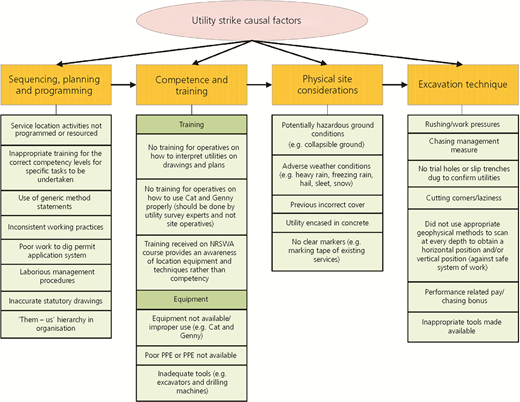
A wide range of equipment and operational procedures are utilised in street works to repair, replace and maintain buried infrastructure, including pipes and cables, chosen to satisfy project costs first and maximise profits, in addition to meeting operational time constraints (Rogers et al., 2012). More often than not, access to buried pipes and cables is achieved through excavation from the surface using open trenches (ASCE, 2002; Metje et al., 2007), and as such a utility strike is a constant risk due to the techniques employed – for example, use of mechanical excavators. A utility strike occurs when any element of the utility network infrastructure is hit, leading to damage, during excavation (Usag, 2016), and can be caused by a whole host of reasons, as illustrated in Figure 1.
A review of the literature (Hunt et al., 2014; Jung and Sinha, 2007; McMahon et al., 2005; Moran et al., 2017; Ormsby, 2009; Woodroffe and Ariaratnam, 2008) shows that a variety of terms have been used to define the different costs related to buried asset infrastructure, and rather confusingly, several studies have used identical terms to define different types of costs. For clarity, it is therefore necessary to define clearly the terminology prior to examining the costs themselves. For the purposes of this study, the costs of buried asset infrastructure will be cost estimated under the following three categories: direct costs (DCs), indirect costs (ICs) and social costs (SCs).
When a utility strike incident happens, the utility owner often incurs the direct construction costs of the strike incident – that is, planning, supervision, material, design and labour costs (Goodrum et al., 2008; Metje et al., 2015). However, there are ICs, additional costs associated with the contracts incurred by the utility company and third parties due to, for example, loss of business income (Bernold, 2003; Gilchrist and Allouche, 2005). SCs are those which are a result of the street works, but which are borne by society and the environment instead of the utility companies and include costs to other businesses, increased levels of air pollution as well as noise, damage to the environment and traffic delays experienced by road users due to the additional works, which are paid for by society (McMahon et al., 2005). When combined, these DCs, ICs and SCs are the ‘true costs’ linked to utility strike incidents.
Moreover, when taking account of works undertaken on or beneath the highway, the division should be made between street works (which are undertaken by statutory undertakers, e.g. water companies) and highway works (which are maintenance works undertaken by the highway authorities). Predictably, costs will arise with all such works, but the focus of this study is the costs connected with buried asset infrastructure and so will of necessity give attention to street works. In point of fact, most of the literature on the disruptive consequences of road works tends to concentrate on the effects of street works (Hunt et al., 2014; Jung and Sinha, 2007; Matthews et al., 2015; McMahon et al., 2005; Woodroffe and Ariaratnam, 2008).
More than 4 million holes are excavated in UK roads each year (McMahon et al., 2005), with approximately 60 000 utility strikes occurring annually in the UK alone (ICE, 2017), contrasted with 500 000 in the USA (Talmaki and Kamat, 2012), and with increasing debates over traffic congestion and its impacts on public and private transport service disruption (Litman, 2017), local authority austerity and the need to maintain services (Pike et al., 2017) and the imperatives of urban sustainability and resilience (Hunt et al., 2016; Makana et al., 2016a), research is needed whose implications, and direction towards far more effective street works, are potentially transformative (Clarke et al., 2017; Hojjati et al., 2017; Makana et al., 2017; Rogers et al., 2017).
The study herein presented is therefore the first attempt on both the national and international levels to put forward explicitly a methodology for cost estimating through case studies the full economic impact of utility strikes – that is, the sum of DCs, ICs (if any) and SCs (if any) that are a by-product of a utility strike incident. This paper presents research that for the first time has been given access to 16 fully detailed utility strike case studies in a UK urban area. The research has identified and assessed the impacts of these utility strikes and provided an estimation of their associated costs. Perhaps more important still is the fact that the evidence base presented in this paper, until now, has been non-existent, with this paper filling the long-awaited evidence gap that permits asset owners and other urban professionals to demand changes towards safer and more sustainable, resilient and liveable city practices (Rogers, 2018).
Literature review: cost estimation of utility strikes
The debate in the infrastructure sector around the costs that arise through utility strikes has been ongoing for a long time (Sanghvi, 1982), with little or no evidence to substantiate any estimates conclusively until recently (Metje et al., 2015). Construction industry contracts often do not account for the wider economic losses resulting from utility strikes, which are experienced by parties not involved in the contractual agreement (Broome and Perry, 2002). This typically occurs because contractors and utility owners seldom have to substantiate their selection of construction methods and procedural routines based on any cost estimation methodology that takes into account the costs borne by society (Gilchrist and Allouche, 2005). ICs and SCs resulting from a utility strike incident are generally not recorded, and the current data collection and information management systems used in industry do not capture the information that can estimate the total costs of utility strikes in a systematic fashion (CGA, 2015; Metje et al., 2015; Usag, 2016), hence the key impact of this research. In infrastructure planning literature, there are currently attempts to explicitly estimate the cost of the wider impact (DCs, ICs and SCs combined) of utility strikes and straddle the interface between the utilities project, the economic system and the socio-ecological system in which the strike incident has occurred.
Within these limitations, Metje et al. (2015) presented the first attempt to compile a compendium of utility strike costs (3348 provided by four contractors, two clients and two utility companies across the UK), centred specifically on the DCs incurred. However, even here the ICs and SCs of each strike incident were not taken into account and the need for an approach allowing a wider range of costs was highlighted. Goodrum et al. (2008) provided a similar attempt to estimate the impact of utility conflicts (disruptions when utility installations are encountered unexpectedly during construction) during construction projects through statistical analysis of surveys from 45 different US states, with the study focusing on detailing their frequency and severity, in addition to four separate case studies, nested in the overall study, in which utility strike incidents (or hits) were experienced, and the resulting direct and ICs they brought about provided by the utility company in question. However, the cost estimation methodology behind each of these strike costs was not explained, as these costs were provided by individual case study companies and no SCs were accounted for. Moreover, several studies in the USA have attempted to cost estimate (based on a cost–benefit analysis) potential utility management savings through a number of approaches – for example, using subsurface utility engineering – but no methodology for explicitly estimating the cost of the wider impact of utility strikes was presented in any way (Bell et al., 2014; Bernold, 2003; Goodrum et al., 2006; Jung and Sinha, 2007; Kraus et al., 2012; Lew, 2000; Osman and El-Diraby, 2005; Sinha et al., 2007; Woodroffe and Ariaratnam, 2008). Other relevant studies have attempted to assess how to cost estimate utility strike incidents, but none have provided a methodology to do so or estimated the total cost of any incident cases (Brady et al., 2001; Çelik et al., 2017; CGA, 2015; Gilchrist and Allouche, 2005; Hojjati et al., 2018; Hunt et al., 2014; Matthews et al., 2015; McMahon et al., 2005; Moran et al., 2017; Najafi and Kim, 2004; Ormsby, 2009; Wang et al., 2008).
Methodological approach
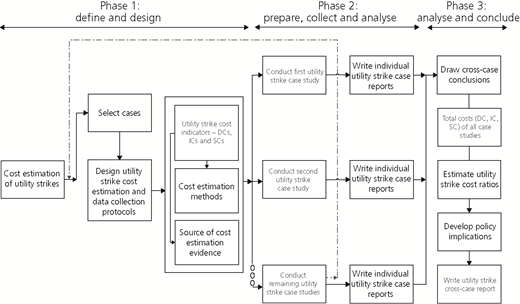
The methodology used to estimate the cost of utility strikes is illustrated in Figure 2, and more details are provided by Makana et al. (2016b). Figure 2 shows the case study approach used that focuses on each case study individually and then draws cross-cutting conclusions, using utility strike cost indicators detailed in Table 1 as the unit of analysis, drawing from the work of Yin (2013), who sets out the general principles to be observed in case study research design and methods. As a result, no clear rationale distinction is drawn in the present study between the commonly understood classic single-case study and multiple-case studies. The three different phases of the ‘new approach’ utility strike cost estimation methodology as shown in Figure 2 are summarised the sections headed ‘Phase 1: define and design’, ‘Phase 2: prepare, collect and analyse’ and ‘Phase 3: analyse and conclude’.
Phase 1: define and design
For the define and design phase, the selection of utility strike case studies is made and the focus in the selection process should be, if possible, the selection of individual projects which include a mix of utilities and a mix of projects ranging from simple to complex. A key criterion (where possible) for the selection of cases is still the use of interviews of key actors – for example, contractors – thus providing important context as to why the utility strike incident happened and the conditions around the incident on the day. Moreover, interviews provide key information where a paper record of the utility strike incident is not available.
The next important step requires the definition of cost estimation measures for each utility strike case study. These measures are shown in the study utility strike cost indicators, drawn from Table 1, and have been grouped into DC, IC and SC indicators. A utility strike cost indicator is defined here as a ‘measurable cost which in monetary terms can be quantified and is a consequence of one or more utility strike-related negative impacts on the environments surrounding a utilities project’ and affords the opportunity for extensive analysis into a single case. A total of 22 representative cost indicators were carefully chosen from appropriate published engineering literature (Bernold, 2003; Goodrum et al., 2008; Jung and Sinha, 2007; Lew, 2000; McMahon et al., 2005; Metje et al., 2015; Najafi and Gokhale, 2005; Osman and El-Diraby, 2005). The following criteria were used to select cost indicators in this study.
Relevance: There is a clear relationship between utility strike cost estimation and the indicator.
Usefulness: The indicator will point to areas of improvement and helps capture information to facilitate moving utility strike avoidance strategies, priorities or programming forward.
Feasibility: Cost estimation data for the indicator can be obtained with reasonable and affordable effort.
Validity: To the extent possible, the indicator has been field tested and used in practice for cost estimation exercises previously.
Distinctiveness: The indicator lacks redundancy and does not duplicate measures captured by other indicators.
Table 1 shows the relationship between the utility strike cost indicators, the cost estimation methods (direct and indirect) that could be used to estimate the strike cost indicator and the multiple sources of evidence that are available to establish a chain of evidence during data collection. The cost estimation methods presented in Table 1 are by no means exhaustive, but are presented to show a range of ways in which cost estimation can be approached. The most appropriate cost estimation method is dependent on the nature of the utility strike cost indicator being estimated. The cost estimation methods in the literature can be grouped into two main classes, direct and indirect methods, where DC estimation techniques are the most extensively utilised methods since they are centred on market and measurable indicator costs (e.g. cost of labour and cost of repair). As stated by Gilchrist and Allouche (2005) in addition to Tsunokawa and Hoban (1997), commonly used DC estimation techniques comprise but are not limited to (a) loss of productivity, (b) human capital, (c) replacement cost, (d) lane closure cost and (e) Spon’s price book (or similar country equivalent). Conversely, IC estimation techniques are used in situations where the cost indicator does not have a market or measurable value in monetary terms (e.g. damage to brand image and traffic delay cost) and use of which allocates known market values to the indicator in question to arrive at an approximate cost. As stated by Gilchrist and Allouche (2005) in addition to Tsunokawa and Hoban (1997), commonly used IC estimation techniques comprise but are not limited to (a) hedonic pricing, (b) user delay cost and (c) Contingent valuation technique. However, as illustrated in the second column of Table 1, there will be instances when cost estimating one or more utility strike cost indicators will not be necessary based on other possible sources of cost estimation. This is because a source of cost estimation evidence will already be available and as such provides the DC estimation data sought for a specific utility strike cost indicator, as the availability or otherwise of cost estimation evidence is dependent on an existing paper trail.
Phase 2: prepare, collect and analyse
Here each individual utility strike case study comprises a ‘full’ study, in which convergence of cost estimation and multiple information sources is sought with respect to the evidence and deductions for the case.
A key feature of Figure 2 is the feedback loop (dashed line). These loops characterise a typical scenario, where important findings were discovered while analysing one of the individual case studies. Such a finding could necessitate re-examination of one or more of the study’s initial cost estimation (utility strike cost indicators) and data collection protocols. At this stage, ‘case design restructuring’ ought to take place prior to moving forward with the study. This redesign could include modifications in the cost estimation and data collection protocols. Following this approach, the risk of distortions within the study is avoided, whereby ‘external validity’ is achieved through consistent replication of case design rules, ‘reliability’ is achieved through use of this consistent case study protocol and ‘construct validity’ is achieved through execution of the study on this basis, while collating multiple sources of evidence, which by consequence establish a robust chain of proof for resultant cost estimates.
Phase 3: analyse and conclude
The final phase involves cross-case synthesis of multiple cases. Aggregation of all the case study findings will result in totals for all cost estimates, for DC, IC and SC estimates.
These totals allow ratio analysis to be utilised with respect to IC/DC, SC/DC and IC + SC/DC ratios and act as an effective tool for identifying indicators of positive and negative utility strike cost trends. More importantly, this allows policymakers to gain insight into the differences over the supposed impact of utility strike incidents and their true impact to both the industry and society. The information that cost ratio trend analysis provides can be accumulated over time as with other initiatives currently ongoing in industry (e.g. CGA (2015) and Usag (2015, 2016)). The ratio analysis additionally affords (a) the ability to judge the efficiency of a company in a specific context concerning utility strikes; (b) the ability to locate weakness of a company’s operations concerning utility strikes; (c) the ability to help formulate plans based on the understanding of past performance concerning utility strikes; and (d) the ability to compare performance over different years and compared with other companies within the same industry.
Characteristics of the selected utility strike case studies
This study focused on 16 case studies collected over 6 months (October 2014 to March 2015), where utility strikes were experienced and in which a mix of utility types and size of the associated projects were involved. Appendix 1 provides a detailed context on the 16 case studies. Several site visits where undertaken for data capture and application of the new approach methodology (see Figure 2 and the section headed ‘Results and discussion’).
Table 2 shows a breakdown of the different types of utility damaged in the 16 case studies, with electricity cables and gas pipelines being most represented. More information on the breakdown of utility strikes in the UK by type can be found in the paper by Metje et al. (2015) and the report by Usag (2016). Table 2 correspondingly shows the different types of excavation tools being used when a strike incident occurred. From Table 2 it is clear that mini diggers cause by far the highest number of utility strike incidents in the 16 case studies, which is in contrast to the findings by Metje et al. (2015), who found that hand tools were the most common, but the low number of cases presented herein may explain the differences. All but one (94%) of the case studies reviewed had statutory drawings available before excavation, which were of variable quality, mostly presented in black and white, and often hard to read. These limitations were considered to be a significant contributory factor as to why the strike incidents occurred in the case studies. Of the statutory drawings available, six (37%) accurately showed the location of utility services and seven (44%) did not accurately show their location, while the accuracy of the remainder (three; 19%) was not recorded.
Table 2 further shows whether the utilities were encased in concrete or directly buried in the ground. Services encased in concrete considerably increased the likelihood of a utility strike incident, as did cases in which services were not at the specified depth. Most companies in this study employ a safe dig best practice – that is, an exclusion zone for untraceable utility services. Where services cannot be detected by the use of a cable avoidance tool (Cat) scanner (e.g. polyethylene (PE) gas and water pipes, pot-ended electricity cables), where no as-built information was available and where there was no visible indication of the presence of buried services from the surface (i.e. valves or chambers), an automatic 600 mm red exclusion zone is used when excavating either side of the expected service location regardless of depth. The methodological approach described in the section headed ‘Methodological approach’ is applied in the section headed ‘Results and discussion’ to the 16 utility strike case study incidents.
Results and discussion
Utility strike incidents are unique with respect to the wider adverse impacts that each one causes – that is, their true cost. Table 3 provides a summary of all the case study findings (presented in Table 2) and is intended to give broad indications or estimations of the costs of utility strikes. It therefore provides a baseline for estimating potential costs and brings to focus the true cost of strike incidents. However, details of both the works carried out to rectify the situation once the strike has occurred and the context – the surrounding urban fabric and activities and the nature of the disruption to them – are necessary to understand the cost calculations and how they might be translated to other sites where utility strikes have occurred.
Accordingly, Appendix 1 (Table 4) provides the essential details for the case studies, although even with this detail, extrapolation and translation will remain at best approximate because every incident and subsequent activities and impacts will be to some degree unique. This is where the difficulty arises in making a case for changes in practice and governance – individual cases provide an insufficiently strong evidence base for far-reaching change. The current paper has measured factual impacts and aims to provide the missing robustness to this evidence base, being founded on a relatively large number of cases. Importantly the strength of this approach makes a compelling case for accurate detection of buried utilities in addition to the development of safe digging practices and the use of alternative working practices.
Nevertheless, engineering judgement is required to diagnose the full impacts and take into account fully the context in which the disruption has occurred and hence enable the findings to be translated to other situations. In this respect, the apparently highly approximate accounting of additional impacts (i.e. those due the adverse impacts of queuing traffic, such as noise pollution, air pollution, loss of business and health and safety issues) is helpful, since adjustment of the evidence base can be made on the basis of the contextual information provided and equally allowance can be made in determining costs for any other particular case under consideration. The use of engineering judgement is to be encouraged, therefore, but on the understanding that the assumptions used in arriving at this judgement are made explicit and therefore the evidence on which the judgement is made is wholly transparent.
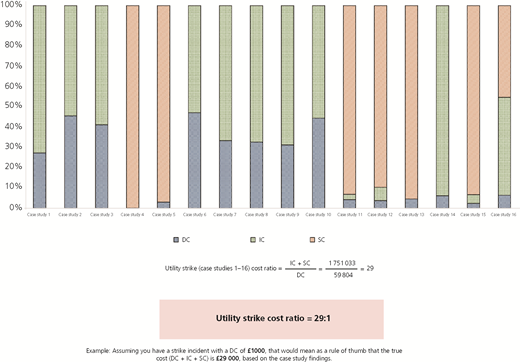
The 100% stacked column graph in Figure 3 compares the percentage that each cost category (direct, indirect and social) contributes to the total true cost to emphasise the different proportions. The ratio expresses the mathematical relationship between IC, SC and DC as expressed in the equation
It can be seen that the DC of the remedial works does not account for half the total cost in any of the case studies. It should be noted that by normalising the costs for each case study with respect to the total cost (see Figure 3), information on the size of the costs is lost. Based on the costs derived from each case study, it is possible to determine the ratio of indirect and socials cost to the DCs incurred
Thus, indirect and SCs are on average 29 times larger than the DC of repair incurred to resolve the strike. It could be argued that the robustness of this ratio could be improved with the addition of more case studies, yet the ratios are almost universally likely to prove underestimates of the full impacts of the works.
The more immediate observation from Figure 3 is that the quantified true costs of utility strikes in the UK is far more than what was previously thought on the basis of industry calculations; see the paper of Metje et al. (2015). As Figure 3 shows, the DC of remedial works, which is consistently at present the only recorded cost for strike incidents, is often a small proportion of the true cost and is sometimes almost negligible in comparison (e.g. case studies 4, 5 and 11–16). In practice, if the proposed methodology was applied and the utility strike cost ratio (29:1) was extrapolated to all utility strikes in the UK, the case for far greater emphasis on preventative measures would be so overwhelming, leading to changes in both governance and industry practices (with 60 000 incidents occurring annually in the UK (ICE, 2017), and a conservative estimate of £500 of direct repair costs (Metje et al., 2015) would result in a total cost of £870 million).
It is clear from the case study findings that road traffic congestion is the main contributor to several of the SCs identified in this study – in particular road user delay, delay to train commute times and the costs to businesses from lost productivity and business income (see Table 3 and the report of Makana et al. (2016b) for more details). Yet to emphasise the point made earlier, while the specific impact of utility strikes on road user delay costs has been investigated in some detail, a deeper understanding of other congestion-related costs would strengthen the evidence base and the case for change in favour of minimising disruption to citizens. An obvious counter argument for change is that the cost of street works might rise, and this cost would be passed onto the customers, yet this misses the essential point made by Hayes et al. (2012) that there is ‘one customer’ in all this – the ICs and SCs are ultimately paid by the same citizens who receive a marginal saving by avoiding the costs of the ‘externalities’ (i.e. the ICs and SCs) of remedial street works on their utility bills. The logical conclusion of this line of thinking, therefore, is that citizens would almost certainly welcome a small extra cost invested to reduce greatly the likelihood of utility strikes rather than paying the far larger ICs and SCs of the consequences of not doing so. Moreover, this would lead to hidden, or uncosted, benefits such as a general enhancement of citizen well-being (Leach et al., 2016).
A different approach is needed to move thinking away from the traditional views of utility strike impacts centred on the DC of repair and more importantly make the business case for the upfront investment required by PAS 128:2014 surveys (BSI, 2014). The new approach methodology developed herein helps to bridge this ‘gap in knowledge’ by taking a view beyond the direct construction works (and costs) to include impacts on the three pillars of sustainability: the economy, the environment and society. Although some social and even some environmental costs (in spite of the recent work on natural capital impacts (Natural England, 2016)) are difficult to monetise, such a shift in thinking relies on attempts to cost estimate in monetary terms the true cost – that is, make explicit the full impact of a utility strike incident using a common baseline.
Conclusions
This paper describes the development of the new approach methodology – a novel multi-case study approach to cost estimation of the true cost of utility strike incidents. The methodology was applied as a proof of concept to 16 utility strike case study incidents in dense urban environments, this representing an unprecedented evidence base in the published literature and one that therefore has the potential for a profound impact on policy and governance.
The overall true cost ratio, determined by summing the primary ICs and SCs deriving from remedial works following a utility strike and comparing them to the DCs of the remedial works, when averaged out over all the 16 case studies, amounted to 29:1. This finding highlights the very considerable cost of utility strikes beyond DCs. However, it should be noted that since the case studies all occurred in dense urban areas, it is likely that this cost ratio is an underestimate, since additional adverse effects that utility strikes can have on the environment, citizens’ quality of life, the operation of businesses and so on will not have been adequately included.
The size of the discrepancy between the DCs of remedial works, which are typically the only costs recorded by the utilities industry, and the ‘total costs’ has been emphasised by normalising the different costs on a 100% stacked column graph for each case study with respect to the total cost. The DC accounts for less than 50% of the total cost in all the case studies, and in half of the cases, it forms an almost negligible proportion (6% or less). Lack of knowledge of where utilities were buried and utilities being encased in concrete contributed to 75% of the 16 strike case study incidents, implying that improved survey practices could have helped to avoid the strikes occurring. Moreover, the separate indirect to direct, and social to direct, cost ratios provide important evidence on which to base improved site practices.
The successful application of the methodology on the 16 utility strike case studies demonstrates that it is a suitable tool for facilitating improved decision-making based on an economic imperative for utilities management and planning. The evidence base that this research has created, and in particular the underpinning details of the strike incidents, remedial works and urban context in which they were carried out, provides an invaluable resource against which to make engineering judgements for the assessment and cost estimation of the true cost of utility strike incidents for any particular case or site elsewhere. It also enables refinement, again using engineering judgement, of the calculations, which have deliberately used a simple and transparent methodology in each case. More importantly, it provides the basis for political interventions and a change in the governance of street works to bring about a better, and cheaper, outcome for the citizens who benefit from the utility services and an undisrupted transport and urban environment.
Acknowledgements
The authors gratefully acknowledge the funding provided by the UK Engineering and Physical Sciences Research Council (EPSRC) and the Economic and Social Sciences Research Council for Infrastructure BUsiness Models, Valuation and Innovation for Local Delivery (iBuilD) (Grant Reference EP/K012398/1) and by EPSRC for Assessing the Underworld (Grant Reference EP/K021699/1).
Appendix 1
Appendix 2
Detailed traffic delay calculations
Step 1: Determine which traffic control plan replicates the traffic disruptions for the case study area under examination (see the paper of Tighe et al. (1999) for examples), and the underlying assumptions associated with it (e.g. lane width, length of detour, partial/full closure of one lane, use of flag person, use of signalised zone and delays associated only with a speed reduction).
Step 2: Determine the total time duration caused by the traffic disruptions for the case study under examination.
Step 3: Determine the average annual daily traffic (AADT) for the case study area under examination. Ordinarily, the transport authority in the country in question retains AADT data. In the UK, AADT for any given road can be determined through the Department for Transport’s traffic count online database (Leduc, 2008). The AADT on a road segment can alternatively be estimated by using Equation 3 where no official traffic count data exists.
where is the 24 h traffic flow on segment s at day j.
Step 4: Based on the traffic control plan (1, 2 or 3, chosen after Tighe et al. (1999); see below) and total duration time of traffic disruptions experienced as a result of the utility strike incident (equations are provided for 40, 50, 80, 100, 160 and 200 h by Tighe et al., 1999; the values calculated by the equations can be summed, and thus a combination of the equations can be used), the appropriate equation(s) can now be selected to determine the cost associated with traffic disruptions. The equations in Tables 5–7 are for a total disruption time of 80 h using different traffic control plans.
Traffic control plan 1 refers to full closure of one lane and the use of a flag person or signalised zone to allow traffic alternately to bypass the roadworks and the assumption that the associated delay will be a queuing delay. Traffic control plan 2 refers to traffic diverting over a shoulder or being funnelled into a narrower lane to bypass the roadworks, so the traffic is still able to proceed and delays would be associated with speed reductions and queuing in times of high flow. Traffic control plan 3 refers to full closure of the road and implementation of a traffic diversion.
Step 5: Having calculated the delay time in step 4, it is proposed to increase the delay by 40% using a ‘rule of thumb’ approximation for utility strikes in urban areas with a high population density to account for the adverse impacts of queuing traffic related to noise pollution, air pollution, loss of business and health issues (Goodwin, 2005; Lee et al., 2005; Weisbrod et al., 2003). This rule of thumb should be used where the corresponding data for quantifying these separate additional costs as a result of the strike incident cannot be accessed (see the publication of McMahon et al. (2005) for additional ICs and SCs that may arise as a result of street works). However, this is where engineering judgement can be brought into consideration to take account of the context: roadworks that have to be extended in an urban street adjacent to a school playground and close to a school entrance with a heavy pedestrian footfall would attract, for example, a greater multiplier for the additional impacts.
Step 6: It should be noted that the equations quoted by Tighe et al. (1999) are computed in US dollars. If these equations are utilised in other jurisdictions, the calculated cost value for traffic disruption should be subject to an appropriate currency conversion.
Example illustrative calculations
For the new approach, utility strike cost estimation methodology, traffic delay quantification will be illustrated in a concise manner herein through case study 11.
Step 1: Traffic control plan 3 (after Tighe et al. (1999)) was implemented as a result of the utility strike incident.
Step 2: The traffic delay impact was 3 weeks in total as a result of the utility strike incident. Assuming that Sunday trading laws in the UK make Sunday a half day based on a 10 h working day, the traffic delay impact is for 6·5 d/week.
Step 3: AADT for the case study area under examination = 8000
Step 4: Traffic control plan 3 with a total time duration of ∼200 h for a road with a lane width of 3·75 m results in the following equation
Step 5: To account for additional impacts of queuing traffic in a dense built-up area for which no data were available, the rule of thumb of 40% of the total traffic delay time cost is applied
Traffic control plan 3 with a total time duration of 80 h results in the following equation
Step 6: Convert to pounds given that the case study under examination is UK centric (£1 = $1·55 – (conversion rate taken in April 2015, at the time of this study))