


This study aims to elucidate how actors from communities that differ in their epistemic culture, i.e., specific aspects related to knowledge or its validation that make up how we know what we know, negotiate and translate process improvement knowledge through deliberate attempts to promote collaboration between them.
Using a longitudinal case study, a practice-based qualitative approach is deployed by using “practices” as the unit of analysis with sustained data collection over a 12-month period. Ethnographic methods were used to generate data from observations of the interactions between operations improvement advisors and target clinicians (nurses and doctors) at workshops, off-line interviews with the workshop participants before, between and after the workshops and background discussions with officials at the Department of Health responsible for the intervention.
If different epistemic cultures are brought together, “problems of proximity” emerge that highlight epistemic divides between the policymakers, operations managers (knowledge “advisors”) and clinician-manager (knowledge ‘targets). Humans, as epistemic cultures, are autopoietic systems. To continuously recreate, they need to remain closed and only selected channels allow for signals that need to be translated by the receiver. The findings support this argument that knowledge mobilization should be perceived as an act of translation rather than transfer, revealing an ongoing “collective conversation” between actors characterized by tensions as different epistemic cultures negotiate and translate process improvement knowledge in different ways.
The authors show that mobilizing knowledge across disciplinary boundaries in complex multi-stakeholder contexts involves translation across epistemic cultures. Neglecting this aspect may explain the failure of many lean health-care implementations. This moves research beyond rational, objectivist models of knowledge mobilization dominant in the operations management literature that assume the unproblematic transfer of knowledge.
Introduction
Effectively mobilizing knowledge across boundaries is critical for organizations to improve their operations, particularly in health care (Harrison et al., 2016; Swan et al., 2016a; Dreyfus et al., 2020). Knowledge needs to be mobilized from its domain of origin to new target domains, and for this to occur, collaboration among actors within and between organizations is necessary (Kislov et al., 2018; Papa et al., 2020). How operations management (OM) practitioners can most effectively mobilize knowledge to improve operations has been a longstanding question (see, Hwang and Krackhardt, 2020). Knowledge mobilization (KM) is typically described in terms of the “transfer” of a given body of “knowledge” from one place or mind to another (Swan et al., 2016a). It involves the ability of an individual possessing the knowledge to effectively and successfully delivering it to the intended recipient (Sun et al., 2025; Del Giudice et al., 2023) thereby promoting teaching and learning (Lee et al., 2024). This overall transfer of knowledge is considered to be critical for organizational success (Gaur et al., 2019; Zhang et al., 2025). While useful, this perspective has resulted in only limited attention to the processes through which collaboration takes place (Venkitachalam and Bosua, 2014; Powell et al., 2018) and to explaining how and why knowledge is mobilized in different contexts and circumstances (Haynes et al., 2020). “Transfer” studies have limited our perspective to the outcomes of collaborative KM initiatives and to whether knowledge gets “transferred” (Rani et al., 2025).
Collaboration can improve performance but we argue that this is dependent on KM (Anzola-Román et al., 2019). This is most salient when attempts are made to mobilize knowledge across substantially different domains, e.g. from manufacturing to service environments, being challenges associated with achieving collaboration in a multi-stakeholder environment where knowledge is already implicated in disciplinary and organizational boundaries, hierarchies and power relations well-documented (Pentland et al., 2011; Powell et al., 2018). These challenges are exemplified in longstanding attempts to mobilize improvement ideas and practices that were pioneered in manufacturing into health-care service operations (Hopp and Spearman, 2021). For example, issues often arise between lower-ranked OM practitioners, who promote improvement and higher-ranked clinical professionals, who are the targets for these ideas (Waring and Bishop, 2010). Indeed, mobilizing improvement knowledge that is “non-native” to professionals in the field has revealed itself to be a troublesome endeavor (Harrison et al., 2016). Consequently, gaps between the intended benefits of process improvement and the actual outcomes are common (Radnor et al., 2012). We argue that these features make health care an ideal context in which to explore the generic question about how knowledge mobilizes through collaboration across different domains, particularly where the targets work in knowledge-based organizations or are higher-ranked professionals. This will provide new insights on how to make such collaborations more effective (Swan et al., 2016a) not just to health care but extending to other disciplines and practices (Golhasany and Harvey, 2023).
In this study, we offer an alternative approach to the “transfer” model. Drawing on the notion that humans are autopoietic systems (Maturana and Varela, 1980), we develop an understanding of KM as active “translation”. Autopoiesis is a key concept in cybernetics perceiving living systems as continuously self-reproducing. This implies that they need to remain closed as otherwise they would dissolve in the environment. The question arises how a closed system can communicate with the environment. Biological systems use restricted channels of communication and do not transfer but perceive and translate signals. In the context of humans, there are five main senses. Autopoiesis also found wide application for social systems, where it is argued that social constructs emerge when individuals share similar channels and signals and that they necessarily need to continuously self-reproduce by sharing these signals (Luhmann, 2012) to persist. They are consequently closed systems, epistemic communities, with their own epistemic culture that is continuously reproduced. There is no direct transfer of knowledge possible since this would open and destroy these social systems in its current form. Limited channels that allow for signaling and translation can be created to overcome this problem. Knowledge is consequently transferred as messages that need to be interpreted by the receiver (Bhatt, 2001). There is no direct transfer, the message is necessarily limited by the channels available, such as language, the visible spectrum etc. and the knowledge transferred is necessarily receiver dependent.
To further assist in understanding how and why non-native knowledge becomes contested as it crosses boundaries of various types, we deploy Knorr Cetina’s concept of “epistemic cultures” (Knorr Cetina, 1999), which relates to “creating and warranting knowledge” (p. 1). The epistemic cultures perspective draws particular attention to the politics of participation when certain types of knowledge (e.g., “non-native” process improvement knowledge) and certain types of actors (e.g., high status-doctors) are the targets of such initiatives. This conceptual lens helps to make visible the epistemic and political nature of collective learning, and offers a way to consider status and power relations as they connect to different epistemic communities and their attendant epistemic identities. This enables us to see how different actors negotiate and translate knowledge from within a set of pre-existing assumptions and viewpoints (Fischer et al., 2016). These perspectives together with Lave and Wenger’s concept of communities of practice (CoP) create an initial sensitizing model of collaborative knowledge mobilization which guides the analysis. Newcomers to a practice learn through “legitimate peripheral participation” which is not merely about acquiring knowledge from more experienced practitioners, but about participating in a sociocultural practice and becoming a member of a community of practitioners (Lave and Wenger, 1991, p. 29) with particular economies of meaning (Wenger, 1998).
Although, qualitative studies in health-care operations literature have been gaining attention (see, Stevens and van Schaik (2020)), detailed and rigorous case-studies on KM in health care are somewhat limited. Consequently, our current understanding of knowledge transfer offers little practical insight to practitioners engaging in collaborative initiatives for KM about how they might make these more effective (Pentland et al., 2011). We therefore ask: How do key actors from different epistemic communities (improvement advisors, policymakers and clinician-manager “targets” of improvement knowledge) negotiate and translate knowledge within collaborative networks?
We demonstrate through an empirical example how interventions that seek to support collaboration to mobilize improvement knowledge need to take account of different epistemic cultures, and this can be critical in determining how far non-native knowledge is successfully translated into a new domain in practice (Dobbins et al., 2019). To demonstrate the process of translation, we focus on a collaborative intervention established to address issues of scaling and spreading of non-native improvement knowledge in an Australian jurisdiction’s hospital, and to address a perceived problem of engagement on the part of the clinical professionals. A key objective of the intervention was to improve collaboration between OM practitioners, called process improvement “advisors”, and clinician-manager “targets” of the improvement. Like other governments around the world, the jurisdiction was increasingly struggling to address growing cost and demand pressures. Hence, policymakers had embarked on a series of improvement programs that were largely developed around process improvement knowledge, predominantly with “non-native” roots in the Lean methodology. The decade-long program had, however, seen mixed results and reactions from various health-care actors. To “reinvigorate” the original improvement program, the policymakers set up a collaborative intervention which they hoped would be more successful in mobilizing process improvement knowledge, ideas and expertise across health services. Given the complexity of collaborative interventions, a doctoral project (involving the first author) was conducted alongside the program. The policymakers felt this could bring the necessary theoretical knowledge to inform the collaboration, as well as help them objectively evaluate the program to garner continued support from those “pulling the purse-strings”.
Taking part in the 12-month long collaborative exercise provided the first author with direct access to actors from different epistemic communities who would undertake different practices and experience different demands during the early stages of a collaborative initiative that aimed to mobilize “non-native” process improvement knowledge. This overcomes quantitative biases often encountered in OM, where scholars focus on what is readily measured (e.g., quantifiable operational improvements and performance outcomes). Findings contribute to the literature in two important ways. First, by questioning the “transfer” approach usually taken in the OM literature, instead taking a “translation” perspective, we are able to examine processes that research on both process improvement and KM has tended to neglect. The health-care setting exemplifies the challenges associated with collaboration and offers useful insights on KM for management in general. Second, using Knorr Cetina’s (1999) epistemic cultures concept enables us to elucidate how actors from different epistemic cultures negotiate and translate knowledge targeted for mobilization. We suggest that this often-neglected aspect of organizational life must be attended to if the intended outcomes of KM through collaboration are to be achieved (Pyrko et al., 2017). The constructive potential of carefully facilitating epistemic conflict across epistemic cultures to overcome problems of proximity and create shared goals should not be overlooked. Findings are not restricted to health care but also apply to the general management literature and different contexts.
The remainder of our paper proceeds as follows. We first relate our study to existing research on KM and further develop our “translation” perspective to provide the backdrop to our study. Next, we outline the intervention and describe our qualitative approach. We then present our findings identifying two key tensions followed by a theoretically-informed discussion. Conclusions and implications for practitioners and researchers are then discussed.
Theoretical background
Health care is a sector that experiences high levels of uncertainty along with varying and different types of patients and symptoms (Ponsignon et al., 2015). This implies that they must see themselves as learning and knowledge organizations and be continuously willing to make and respond to changes to enhance customer experience (Shukla and Sushil, 2020). It is this kind of market-focused service flexibility that is highly valued by patients (Kumar, 2024). It should be understood as a dynamic capability that is shaped by learning/knowledge integration, and that triggers learning/knowledge integration. Health-care organizations should be willing to acquire and absorb any new knowledge to stay ahead of the competition and remain successful (Kumar, 2024). But there has been a general reticence within the OM literature to move beyond the linear, rational, objectivist models of KM (Nordin et al., 2020).
The limited OM literature on KM borrows from the concept of diffusion and social network theory (Burt, 1992). The Diffusion of Innovations Theory (Rogers, 1995) is a well-known example where boundaries are assumed to be relatively unproblematic because stable conditions of understanding between “sender” and “receiver” are taken for granted (Carlile, 2004). Knowledge is implicitly assumed to be “thing-like” and to flow more or less passively, linearly and without significant alteration from one rational actor to another, because rational actors are assumed to be motivated to take up “beneficial” knowledge (Ferlie, 2016). This is reflected in the heavy emphasis on “transfer”, “acquisition” and the “structural anatomy” of networks (Park et al., 2018). Much literature implicitly assumes that learning across disciplinary and organizational boundaries is a simple matter of increasing the proximity of actors and the communication between them so that new knowledge can “diffuse” among them (Glegg et al., 2019). It is assumed that concerted collaboration and deliberate knowledge sharing activities will “naturally” result in improved KM which will then underpin operational outcomes (Sun et al., 2025). This assumption effectively “black-boxes” the process of KM and has resulted in research that tends to focus on outcomes and the enablers and barriers to achieving these (e.g., Leite et al., 2020). Most importantly, it overlooks that individuals and social systems to which they belong may have different and often contradictory objectives with different definitions of “beneficial” and that “diffusion” implies the collapse of individual systems. To understand how and why knowledge mobilizes among different organizational or occupational groups, a different perspective is required. This may then provide an explanation why many initiatives attempting to improve processes and standardize practice have failed (Lindsay et al., 2020), especially in health care.
Translation perspectives on KM
Some scholars argue that knowledge “flow” is a radically inappropriate image to describe what are erratic, circular, or abrupt processes […]”(Ferlie et al., 2005, p. 123) and that more detailed examination of practices and processes involved in the mobilization of operations knowledge is needed if OM practice is to be improved. In search of an alternative paradigm that can produce more nuanced insights about KM, scholars within the social sciences and organization studies have conceptualized KM in more dynamic “translational” terms. We follow Swan et al. (2016b, p. 2), who understands KM to be both a practical objective and also “a proactive process that involves efforts to transform practice through the circulation of knowledge within and across practice domains”. Using an autopoietic perspective, this can be further extended by the notion that this circulation creates the social construct. This is further extended by Actor Network Theory (e.g., Latour, 1986) that includes all physical processes into this constructive cycle of reproducing systems, for example, the communication between a robot, AI-based task assignment, a doctor, a nurse and the patient creating a socio-technical system for a specific patient treatment task.
Underpinning the “translational” approach to KM is the notion that human beings are essentially autopoietic systems. This leads to three consequences. First, knowledge is not a separable “thing”. Instead, “what is known, the one who knows it, and the context of action are bound together" (Tooman et al., 2016, p. 19). Second, whenever knowledge is mobilized, it is always also translated. Translation studies such as those drawing from Actor Network Theory and the Sociology of Translation (Callon, 1986) highlight that ideas are modified by agentic actors in relation to the specific social realities within which they are situated (Czarniawska and Joerges, 1996). Actors are therefore “translators” with diverse interests who actively make meaning of, negotiate, and modify knowledge, shaping it “according to their different projects” (Latour, 1986, p. 268). Third, in contrast to the passive, rational characterization of actors in “transfer” models, actors are seen as active meaning negotiators, embedded in broader societal contexts which implies that they have varied and conflicting interests within their diverse economies of meaning (Wenger, 1998). They interpret the “benefits” of KM and even what constitutes knowledge itself differently (Heusinkveld et al., 2011). Tensions, conflicts and negotiations are inevitable and the knowledge targeted for mobilization will be subject to ongoing translation and change “through the flow of practices rather than as a result of deliberate implementation efforts” (Hultin et al., 2021, p. 2). Differences between knowledge mobilization in transfer and translation perspective are summarized in Table 1.
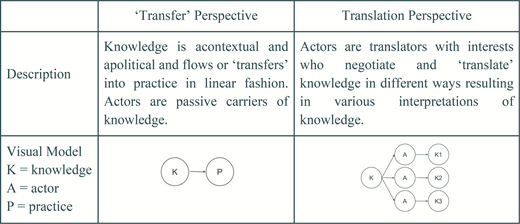
Epistemic cultures and knowledge translation
Where “transfer” perspectives only report on whetherKM has or has not occurred, and might associate this outcome with characteristics of the context or actors, “translation” perspectives invite the exploration of how and why knowledge mobilizes (Fischer et al., 2016). To further enhance our “translational” perspective, we deploy Knorr Cetina’s (1999) concept of epistemic cultures. According to Knorr Cetina (1999, p. 1), epistemic cultures are “amalgams of arrangements and mechanisms—bonded through affinity, necessity, and historical coincidence—which, in a given field, make up how we know what we know. Epistemic cultures are cultures that create and warrant knowledge […]”. The concept helps to foreground differences between groups, and particularly the strategies and politics of knowing that inform experts’ practices. This allows us to sharpen our focus on how and why knowledge is negotiated, translated, and mobilized in different ways by actors from different organizational and occupational communities. Specifically, it provides a way to consider status and power relations when certain knowledge (e.g., process improvement knowledge which is “non-native” to health care) and certain actors (e.g., higher-ranked medical-managers) are brought together.
The concept of epistemic practices describes the specific ways in which knowledge is approached, developed and shared within a given epistemic culture (Jensen et al., 2015). In the context of multi-disciplinary and multi-organizational KM initiatives, such concrete practices are likely to shed light on real-world “epistemic clashes” and on relations of power and negotiability between epistemic communities (McGivern and Dopson, 2010). Combining the “translational” perspective to KM and the epistemic cultures concept helps us to unravel what really goes on around the dynamics of collaborations intended to assist in promoting new improvement knowledge to targets across organizational and disciplinary boundaries without falling into the trap of assuming unproblematic “transfer”, or sidelining conflictual aspects (Contu and Willmott, 2003; Gherardi, 2009).
Method
We deploy a practice-based qualitative approach that moves from data collection to theme development, coding and analysis. In our study, “practices are understood to be the primary building blocks of social reality” (Feldman and Orlikowski, 2011, p. 3). Our unit of analysis is the practices, the “doings and sayings” (Nicolini and Monteiro, 2017, p. 110) of participants, which we understand to make up a collectively constructed, processual reality (Langley et al., 2018). Through this approach, we contribute to a small but growing subset of the OM field using such methods (Dreyfus et al., 2020) following persistent calls for this type of research to enrich the field (DeHoratius and Rabinovich, 2011; Marshall et al., 2016). We apply this practice-based approach to the case of a multidisciplinary and multi-organizational intervention (henceforth, “The Collaborative”) created following the aforementioned decade-long attempt to “transfer” improvement knowledge into the public hospital system of an Australian state jurisdiction. One outcome of this had been the formation of a team of OM practitioners (called “improvement advisors”) who were rooted in hospitals and given responsibility of brokering improvement knowledge to clinician-manager “targets” who would then lead operational improvement projects and initiatives. In spite of the efforts in creating this significant capability, problems of engaging target clinicians (especially medical) had restricted the effects of the intervention. “The Collaborative” was designed by the state health department to address this issue of spreading improvement knowledge across the health-care system, as well as the problem of engaging clinicians.
Data collection
Our empirical focus is provided by the first four workshops of “The Collaborative” which brought together the advisors and clinician-managers to share learning and expertise. These workshops were funded by the jurisdiction to encourage the collaboration which they imagined would then become self-sufficing. The lead author (who held considerable experience in health care as a health professional, health-care consumer advocate, and health-care management researcher) was requested by the constituents involved in “The Collaborative” to undertake the qualitative longitudinal case study (as part of their doctoral study) with sustained data collection over a 12-month period (May 2018-May 2019). Ethnographic methods were used to generate data from observations of the interactions between OM improvement advisors and target clinicians (nurses and doctors) at the workshops, off-line interviews with the workshop participants before, between and after the workshops, and background discussions with officials at the Department of Health responsible for the intervention. This provided real-time, time-series observational data, enabling exploration of how OM improvement advisors and clinician-manager targets negotiated the process of mobilizing improvement knowledge.
Upon approval of an ethics clearance from the researchers’ university, detailed field notes were taken at each workshop focusing on participants’ “front stage” practices—their “doings and sayings” (Nicolini and Monteiro, 2017, p. 110), with a total of 89 h spent in the field. The lead author also conducted 31 in-depth semi-structured interviews with participants of “The Collaborative” in English which varied between 30 min to two hours. These provided a “backstage” view of epistemic struggles. All interviews were recorded, transcribed and checked. The lead author also engaged as a participant-observer in meetings with the policymakers responsible for “The Collaborative”, gaining insight into the policy context. This technique of front stage and backstage data collection enabled KM to be investigated via visible behavior and interactions in the workshops, as well as otherwise hidden reflections of participants. The longitudinal, layered qualitative case study design facilitated processual investigation of “The Collaborative”, as well as “zooming in and out” (Nicolini, 2009) on the progress of KM, and on the micro-practices of actors and groups of actors within their real-life context.
We employed an abductive approach to guide us with the data collection and simultaneous iterative analytical processes. This involved constantly iterating back and forth between data generated about actors’ everyday practices and interpretations of their own experience, and the extant literature and conceptual lenses (Nicolini and Monteiro, 2017). This analytic strategy enabled us to systematically develop an understanding of what the data was telling us, and to verify this understanding through coding and categorization to saturation, through the steps detailed in the data analysis section, below. The interviews were designed to build an understanding of participants’ experience of collaboratively mobilizing improvement knowledge during “The Collaborative”. We probed the improvement advisors and clinician-manager targets about their experiences of participating in “The Collaborative” and engaging with improvement knowledge, as well as collaborating with other disciplines. We sought to understand how these informed their “front stage” and “backstage” practices in relation to “The Collaborative”.
In direct contrast to the “transfer” approaches common in OM which seek to erase subjectivity and generate statistical generalizability through “large n” studies, we wanted to generate rich, contextualized and detailed narratives. It was precisely this “small n” approach to achieving conceptual clarity (Tsoukas, 2019) and our emphasis on situational details unfolding over time that allowed us to uncover, describe, and explain many of the practices involved in concerted efforts to promote collaborative KM (Langley and Abdallah, 2011). While considered problematic from the epistemological perspectives of much OM research, we are unselfconscious in taking this small n approach and value the importance of adhering to a rigorous methodological process. We achieved detailed understandings of micro-level practices of collaborative KM through ongoing deep engagement and reflexivity (Guba and Lincoln, 1994). We used member checking as part of the iterative process of explanation building and triangulation to verify and assess our qualitative results (Carlson, 2012). This enabled us to explore rival explanations, achieve analytical rigor, and enhance the trustworthiness of the findings (Gehman et al., 2018). In addition, regular research team meetings provided opportunities to review emergent codes, categories and interpretations of the data. The mix of data generation tools outlined above allowed us to triangulate sources (e.g., different actors, groups of actors, organizations, events) and methods for the purposes of validation and generalization, and extending knowledge (Flick, 2018). Collectively, these strategies and processes serve to enhance the validity, reliability, credibility, and explanatory power of our findings (Strauss and Corbin, 1998).
Data analysis
Sensitized by our conceptualization of KM as translation and by theory about epistemic cultures, we approached our abductive analytical process by applying a grounded, open-coding procedure to the interview transcripts in NVivo, recognizing that data that we consider to be “raw” has always already been transformed in some way through the data collection process, and already analyzed according to some framework as it is generated (Czarniawska, 2004). We used NVivo software to make the large amounts of textual data easier to handle, with all analytical decisions made by the research team. Our abductive data analysis process progressed in three main phases – from explicit and descriptive, through an analytic phase, and finally to explanation building. While portrayed below as distinct phases, in a practical sense, these involved constant iterations between interesting empirical data about actors’ everyday practices or interpretations, and the literature and conceptual lenses (Nicolini and Monteiro, 2017). The three stages of our data analysis strategy are depicted in Figure 1.
 The diagram illustrates a three-phase coding process leading to explanation building. Phase one, descriptive coding, starts with an initial sensitising template and inductive coding that combine to form emic and etic codes. In phase two, inferential and pattern coding, these codes are grouped into multiple subcategories that merge into broader categories. These categories are coded for similarity, difference, frequency, sequence, correspondence or relations, and causation. Phase three, explanation building, synthesises these categories into explanatory accounts
Visual representation of data analysis strategy
Source: Authors’ own work
The diagram illustrates a three-phase coding process leading to explanation building. Phase one, descriptive coding, starts with an initial sensitising template and inductive coding that combine to form emic and etic codes. In phase two, inferential and pattern coding, these codes are grouped into multiple subcategories that merge into broader categories. These categories are coded for similarity, difference, frequency, sequence, correspondence or relations, and causation. Phase three, explanation building, synthesises these categories into explanatory accountsVisual representation of data analysis strategy
Source: Authors’ own work
In the first phase, descriptive codes were derived from both the participants’ (emic) viewpoint and sensitized by our initial model and the (etic) constructs we brought to the data from the literature and context. Relevant aspects of the data were labelled by either creating a new code or assigning an existing code from the growing codebook. The coding process revealed that the advisors and clinician-managers appeared to be conceptualizing (and doing) a shared ultimate goal of improved service delivery differently (e.g., improvement as efficiency vs improvement as clinical quality). This suggested they may be interpreting the value of improvement knowledge in different ways. Table 2 demonstrates examples of codes from the early codebook and the definitions given by the research team.
Example codes, code definitions and data fragments from early codebook
| Code | No. of appearances in the data | Kinds of statements or actions assigned to code | Example data fragment |
|---|---|---|---|
| Clinical concerns | 24 | Clinician concerns about improvement knowledge e.g. impact on professional practice or impact on patient outcomes | “We need to think about what it means when… we’re just looking at time as a surrogate for quality” (Dr Jason) |
| Clinician engagement | 214 | How clinicians engage with improvement knowledge, problems relating to clinician engagement, techniques used to engage clinicians | “I’m not a processing factory, I’m dealing with patients, so don’t tell me about how to optimize [processes].” (Dr Jason) |
| Epistemic identity | 223 | Expressions of epistemological stances | Improvement advisors were observed often to value and engage with aggregated comparative performance data |
| Measuring and evaluating | 22 | Understandings of the value of different types of measures of performance | “From a values point of view… clinicians engage with… things that relate to quality and safety. Not… efficiency.” (medical manager) |
| Pinning down the data | 38 | Usefulness of data – e.g. for improving practice at individual and organizational levels | “Please find below where you’re sitting compared to other staff. The KPI is this.” (improvement advisor) |
| Tension between disciplines | 198 | Differing understandings of the meaning or value of improvement / issues of trust or understanding between disciplines, interdisciplinary conflict | “I still have this debate with [improvement advisor] to say, “We did this without any lean.” and he goes, “Well, you did [Lean].” (Dr Jason) |
In the second stage, coding moved from descriptive to inferential (Miles and Huberman, 1994). Here, we progressively collapsed codes from the first phase into higher order categories as patterns emerged (Patton, 2015). These categories pointed to tensions between disciplines and troubles around engaging clinicians with improvement knowledge. Because the epistemological stances that people hold are often implicit and taken for granted, they are not likely to be explicitly spoken about. The effects of epistemic cultures are more likely to be revealed through practices of KM or knowledge construction, in which “clashes” can emerge and bring otherwise hidden ways of knowing to light. As such, we recognized that our observational data was more likely to reveal these tensions in action and returned to our data to seek out “clashes” and practices that may have been used by participants to overcome these tensions. At the same time, we returned to the literature on epistemic cultures to help us make sense of what we found in our data. We further collapsed codes in our process of categorization (Miles and Huberman, 1994) and the process led us to two key categories or themes, of tensions that we called “Performance vs Practice”, and “Efficiency vs Quality”, and a category that seemed to be about resolving these tensions, which we called “Merging: Efficiency & Quality”. See Table 3 for examples of data fragments in each of these key categories.
Problems of proximity as central epistemic fault line between performance measures and clinical practice: Supporting data
| Problems of proximity: an epistemic faultline between performance measures and clinical practice | |
|---|---|
| Category/theme | Data |
| Performance vs practice policymakers and improvement advisors use aggregated ‘practice-distant’ performance measures to direct clinicians’ practice. Efforts to exert control over clinical practice are resisted, and the validity of data produced through process improvement methods is contested on epistemic grounds | It might be very black and white that [a clinician] needs to change… And you can provide to them all the data and all the feedback in the world… [but] as frustrating as it is [they have] to make that decision [to change]. (participant 12, improvement advisor) |
| I observed the policymakers puzzling over why ‘mental health’ had been highly prioritized as a topic of interest in the ECoP co-design workshop. They thought it was “too clinical” an issue, unrelated to access or flow. It was, however, revealed both front and back stage to be a significant, under-resourced problem for ED performance: | |
| Mental health was always, will always, always be a problem for [patient flow in] any ED… [but] I’ve been here 12 years and I’ve never had a [mental health] budget… (participant 16, hybrid nurse) | |
| Efficiency vs. quality hybrid clinicians overtly prioritize qualitative understandings of improvements in quality—the ‘right’ kind of improvement—over quantifications of efficiency improvements prioritized by policymakers and improvement advisors | If I can’t see that there’s any benefit to the patient or to myself… I’m just not going to do it. And because I’m a senior person it’s very hard to make me. (participant 15, hybrid doctor) |
| … [we need to be] demonstrating to [clinicians] what benefits this could potentially deliver for our patients, for our communities, as opposed to using… you know, the board up there around the key performance indicators *indicates electronic dashboard*. I don’t think that’s what really drives them… [it’s] patient outcomes and improving the quality and safety for their patients. (participant 13, improvement advisor) | |
| Merging: Efficiency and quality attempts made to reframe process improvement and the role of improvement advisors in terms that more explicitly prioritize quality. Such attempts are relegated to the ‘backstage’ due to tight circumscription by policymakers of advisors’ official roles and identifications as experts in ‘pure’ (non-clinical) process improvement | … it’s difficult to engage senior clinicians in this. I don’t think it’s impossible but… they need to be exposed from all different angles… how does it benefit the patient, how does it benefit the hospital and other people who are also managing the patient… (participant 31, hybrid doctor) |
| … [we need to] show more clinicians how these methods can improve quality, and their outcomes. Not just improve productivity and flow and wait times. (participant 21, improvement advisor) | |
Cast of key characters in the collaborative
| Pseudonym | Profile | Category | Organization |
|---|---|---|---|
| Colin | Host of second workshop at big metro. New to the jurisdiction but with significant expertise in improvement gained in the manufacturing sector | Improvement advisor | Big metro: large prestigious metropolitan hospital |
| Non-clinical background | |||
| Malcolm | Host of first workshop at Edgeside | Improvement advisor | Edgeside: rapidly growing outer-suburbs hospital |
| New to the jurisdiction but with management education and overseas experience in health sector. Non-clinical background | |||
| Dr Jason | Director of ED at Edgeside | Medical-manager | Edgeside: rapidly growing outer-suburbs hospital |
Third, we sought to understand the relationships between these categories. This third phase aimed to build and test our explanations of these relationships by drawing on both theory about epistemic cultures as well as our data (Patton, 2015; Yin, 2014). We explored the tensions surrounding “Performance vs Practice” and “Efficiency vs Quality”, and one account of a potential resolution (Merging: Efficiency & Quality). We developed explanations of these problems and potential solutions through narrative accounts, by weaving moments from our observational “front stage” data that exemplified epistemic practices of the advisors and clinician-managers together with “backstage” reflections that involved either direct discussion of these incidents in interviews, or more generalized reflections that helped to explain them.
Following a small body of literature that has used narrative approaches to represent and understand change in health care (Currie et al., 2009), this “weaving together” allowed us to generate thematic narratives for each of our three key findings, giving both coherence and depth to our findings and their presentation. It was through this process that we came to determine that the key tensions emerging through the participants’ knowledge translation practices related to their relative proximity or distance to the practice of improvement itself – to “problems of proximity.”
In our final stage of analysis, we drew together our thematic narratives to articulate a model of collaborative KM which highlights how the micro-level domain of actors’ negotiation and translation practices in relation to knowledge is entwined with, and shapes, the evolution of the “knowledge” that is eventually mobilized – emphasizing both that knowledge is embedded in practice and that knowledge practices are recursive (Langley and Abdallah, 2011).
Table 4 summarizes the key characters and organizations who appear in our thematic narratives. When presenting our findings, we draw on quotes and observations from a range of participants, but name and predominantly focus on a narrow cast of characters for two reasons. First, making some characters familiar helps bring coherence to a narrative disjointed by necessary reduction, and second, the characters we chose to name offered particularly salient or powerful “proof” quotes (Pratt, 2008).
Findings
During the workshops, tensions emerged which reflected the role played by differences in epistemic culture. These “problems of proximity” that emerge when different epistemic cultures are brought together includes two key problems (“Performance vs Practice”, and “Efficiency vs Quality”), which highlight the significant epistemic divide between the improvement advisors and clinician-managers, as well as a potential solution, entitled (“Merging: Efficiency and Quality”), which highlights the epistemic negotiations that occurred not only between the two parties but also with the policymakers themselves. We begin each narrative thread with a fragment of observational data, building on this with participants’ responses to the front stage incident, related observational data, and more general backstage participant reflections.
Problems of proximity
Our field notes from the first Collaborative workshop at Edgeside reveal undercurrents of epistemic troubles that improvement advisors and clinician-managers faced in the mobilization of improvement knowledge. Malcolm was an enthusiastic improvement advisor, new to the jurisdiction’s health sector. Malcolm had postgraduate business qualifications and process improvement experience, and aspirations of becoming a hospital executive in the future. In a seminar presentation, Malcolm explained how he had applied the “Project Assessment Tool” (the policymakers sought to promote this to the participants) to retrospectively score four of Edgeside’s recent patient flow initiatives. His presentation displayed the results of his self-titled survey creation: “A Very Scientific Survey of Perceived Project Success (n = 5 respondents)”. Two projects were “Huge Hits” on his tongue-in-cheek success spectrum; two scored closer to “Total Flop”. Aware of the need to include “science speak” when talking to doctors, Malcolm proudly reported:
I found a perfect correlation between the Project Assessment Tool scores and n = 5 peoples’ perceptions of the success of each of the initiatives! So, the analysis, with an R2 of 0.9964, kind of validates the assessment tool.
Following his performance, the two medical-managers representing Edgeside at the workshop felt compelled to make their point. Dr Jason, the Ed. medical director, despite his own improvement initiative scoring as a “Huge Hit!”, and despite its substantial impact on Edgeside’s performance and emergency department access targets, publicly critiqued Malcolm’s quantification. Moreover, he called into question its relevance, since Malcolm’s scale measured the “wrong” thing—‘performance’ against managerial and policy measures rather than clinical quality.
Performance vs. Practice.
Medical and nurse-managers were seen by the policymakers as the key “targets” of improvement knowledge in “The Collaborative”. They were believed to be best positioned to spread improvement among the clinical rank and file. However, the epistemic “problem of proximity” between clinical and improvement communities emerged as a faultline between actual clinical practice and (necessarily) aggregated, abstracted, and practice-distant performance measures and management rhetoric. Backstage of the Collaborative, Dr Jason referred to the front stage negotiation above, saying: “I still have this debate with Malcolm to say, “We did this without any Lean.” And he goes, “Well, you did [Lean].” And I go, “No, we didn’t.” Dr Jason had no interest in how well his project conformed to management change models, and never mentioned the extraordinary improvement on the emergency access targets that his “Huge Hit” project had precipitated. Dr Jason described clinicians’ experiences of the performance/practice tension, referencing the internal struggles that clinicians faced when asked to engage with improvement focused on efficiency, as well as performance measures. While he was highly engaged in improvement work in his Ed. and a regular Collaborative attendee, he said: “I think clinical communities, clinicians […] there’s always this inherent debate that [clinicians] have about, you know, “I’m not a processing factory, I’m dealing with patients, so don’t tell me about waste, don’t tell me about how to optimize [processes].” Further, he explained the widespread perception among doctors that it was up to the improvement advisors and administrators of hospitals — “to fix X, Y and Z [so] I can do my job”. This indicated a perceived separation between autonomous professionals and the system, and the ideal that “the system” should act as a supportive but unobtrusive backdrop to their more important work.
When Dr Jason presented the details of his Huge Hit model of care six months later in the final Collaborative workshop, his emphasis was on the organic nature of the change and on how he had given his medical staff the autonomy to iterate and make changes: “They did all this themselves because we gave them the freedom.” Dr Jason made plain that medical clinicians did not accept authoritarian mandates for change, especially when they came from those who were not professionally proximal to the practice of delivering health care.
A further contributor to the performance/practice problem was that clinicians were wary of the aggregated performance data (e.g., Ed. wait times, average lengths of stay) that were the primary tool at the disposal of the improvement advisors’ epistemic community. These data were important in terms of evidencing advisors’ own performance to policymakers and their organizations, for learning from their peers, and (they believed) for trying to engage clinicians. The advisors highly valued curated comparative performance data (e.g., the “racetrack diagram” – a chart comparing hospitals in terms of emergency department performance). Not only did it help them to position themselves in their field, but this kind of objectified evidence of performance variation made it possible to “sleuth out” who they could learn from.
Abstracted, quantified performance data was also used to lead them closer to the actual practices behind good performance. This desire for data appeared to stem from a belief that transparent, public representations of individual clinicians’ practice—represented as abstracted performance data—had the potential to change practice and behavior, particularly that of the hard-to-engage frontline senior clinicians. However, sleuthing the practices behind the quantified performance measures always meant crossing into the territory of frontline clinicians. One improvement advisor reported enjoying some success with this approach, having managed to implement comparative data for both nurses and doctors in the Ed. (albeit, through a hardline approach). This had reportedly led to their Ed. transitioning “from the worst performing Ed. to the best performing” in the jurisdiction in terms of their emergency access targets. However, the granular transparency at the practitioner level had not been without issue:
Improvement advisor: [I would] send it out [in an email] […] “Please find below where you’re sitting compared to other staff. The KPI is this. Some staff find it helpful in their practice, please feel free to come and speak to me.”
Interviewer: And did they come and speak to you?
Improvement advisor: No, they improved their performance. They said, “Holy sh*t I'm there, look where everyone else is.” […] obviously some natural attrition occurred […]
This improvement advisor had not been concerned by the “natural attrition”. If clinicians left, they were not the right fit for the improvement culture that organizations ought to be striving to create. She believed that organizations needed to set clear performance expectations of their doctors and that “there needs to be a tighter rein put on that [senior medical] group […] [tell them] “This is where you should be sitting [in terms of performance] […] This is your length of stay vs when [another] person is doing the same operation and they’re much shorter”” An improvement advisor from another hospital also reflected on the problem of “medical accountability”, saying “that’s not something I’m shy in discussing […] data and holding people to account”. She also, however, had reservations about the finger-pointing approach: “Do we have to get to that? […] Name and shame people […]? Not sure.”
These kinds of discussions, which tended to occur backstage as people reflected to us in interviews, suggested that one pathway to improvement was to influence clinician behavior by translating more of their practices into more granular data—data that could get those charged with leading improvement (but who were experience-distant from the frontline) closer to the actual practices of individual (experience-near) clinicians. Yet, even while the improvement advisors and nurse unit managers advocated for greater use of comparative data, they realized that data alone were not sufficient. They also realized that success in engaging clinicians involved much more than providing “hard” data and logical reasoning and expecting rational behavior changes in response. Most who advocated for more data also recognized the tension that abstracting practice upwards into performance measures produced; translating performance back down in a way that motivated concrete practice changes at the frontline was not so simple.
Efficiency vs. Quality.
At the final workshop, Dr Jason brought the efficiency vs quality issue (that he had pointed to in Malcolm’s “Very Scientific” presentation) squarely back onto the front stage. The policymakers’ “co-design” session at this last workshop aimed to gather feedback on how the participants wanted “The Collaborative” to continue the following year. During this session, Dr Jason reiterated that the use of proxy measurements focused on efficiency and time was a serious problem in the policymakers’ and improvement advisors’ approach to improvement:
We need to bring quality into this […] how do we know that our surrogate measures about time are working? When we’re looking at the timing of care for [hip fractures] or getting analgesia in time, or time to antibiotics […] We need to think about what it means when […] we’re just looking at time as a surrogate for quality.
In interviews with medical-managers, not a single individual mentioned the need for more performance data. Instead, they all prioritized an explicit rhetorical commitment to quality. Dr Jason’s front stage claim in the final workshop suggested to the policymakers that the time for such a limited view of process improvement (as merely efficiency improvement) had passed. Talking about Dr Jason’s statement a few weeks later, another Ed. director corroborated the view, that efficiency-based performance measures were too narrow and reductive, and that it was time to move on to more nuanced measures that could tell them about clinical care quality:
I think that access performance is […] it was a hot topic two or three years ago […] access is sort of a good proportion of quality and safety for patients, but really spreading that scope and saying […] “What else can we do to really proactively solve quality issues?” I think that’s going to be the future […]
Albeit, late in the game for “The Collaborative”, Dr Jason’s front stage proposal to reframe matters of measurement was suggestive of new ways for the policymakers and improvement advisors to approach improvement in the jurisdiction. This was particularly the case if they wanted to achieve their aim of more widespread clinical especially medical engagement. As a medical-manager from a large suburban hospital summarized: “From a values point of view, the one thing that clinicians engage with tends to be things that relate to quality and safety. Not necessarily efficiency.” (medical-manager)
In advocating for quality to be privileged over efficiency, the medical-managers also argued that oversight ought to be maintained not by practice-distant non-clinical managers, but by people with “at least some clinical background [who understand] the health or the biological ramifications of what we’re doing and what the results of delays or time changes can have for a patient. That’s really important.” Ideally, as the Ed. director below said, this would be medical oversight:
I think it’s very easy for people to sit in an office and say “everything’s fine” [but] […] it needs to be focused around the quality of care […] and sometimes that can be very difficult for a manager to detect. Does it need to be a specialist emergency doctor? Ideally, because this is what we specialise in and this is what we understand and we get the nuances of it. (medical-manager)
Medical-managers claimed epistemic jurisdiction over the detection and judgement of quality, justifying this by their proximity to the actual practice and the all-important recipient of care – the patient.
Merging: efficiency and quality.
The improvement advisors (many with clinical backgrounds themselves) were not averse to discussions of quality. However, the notion was difficult to account for within their abstract OM language, and difficult to measure with their tools of the trade which centered around the measurement of pace, flow and access to care. Recognizing the tension between quality and efficiency, they were caught in the middle. Clinicians on one side and on the other policy pressures related to time-based measures of access and patient flow. Bubbling away in the background, however, were glimpses of improvement advisors grappling with this issue and attempting to reframe the quality/efficiency divide as a false dichotomy to merge the perspectives, achieve broader clinician engagement, and, as Malcolm from Edgeside suggested, “start to try and speak the same language.” Backstage of The Collaborative, Malcolm was searching for something to bridge the faultline between efficiency and quality. Despite having taken Edgeside’s horrible performance on over-24-hour Ed. wait time “breaches” from over 300 per month two years ago to zero today using process improvement, Malcolm reflected that he had been unable to persuade clinicians that “these methods can improve quality and their outcomes, not just productivity and flow and wait times […]” He was certain that “these tools absolutely can help improve quality and outcomes, we just haven’t got enough runs on the board yet to convince clinicians that that’s the case.”
Malcolm and others recognized the epistemic boundary at play and the differences in ways of thinking between the different actors and surmised that overcoming it would involve changing how they marketed this “non-native” improvement knowledge. Colin, the improvement advisor from Big Metro, also came to this understanding during one of our interviews with him. As he reflected on the challenges of engaging clinicians with improvement, he landed on the problem that while the link between efficiency and quality outcomes was crystal clear to him, advisors and policymakers may never have made the connection for clinicians that the government’s emergency access KPI was actually “a clinical measure”, saying, “They don’t understand that 81% was because that’s where standardized mortality bottoms out […] I don’t think we’ve done a good job of [explaining] it. I don’t think the Department [of Health] has done a good job of it […]”
Similarly, Malcolm recognized that part of the reason Edgeside’s great leaps in performance on the government’s mandated KPIs were of little “advertising” value to clinicians was that “[that’s] a process thing, that’s an access thing and I don’t think clinicians deep down care as much about access as they do reducing infections and falls and things like that. I don’t think we have yet, in the medical literature, published successful safety improvement initiatives using the language of improvement science.”
The solution, then, was to begin to apply improvement tools in ways that evidenced how they could be used to advance clinical quality outcomes. Malcolm was an early mover in this regard: “We’re starting to do that [at Edgeside], with the [Value Based Healthcare project] looking at hospital-acquired complications. That’s the first real foray into quality improvement using this lens.” Value based health care (VBHC) was coined by Harvard Business School management Professor Michael Porter around 2005. It appeared to be of growing interest but was not yet a priority for policymakers. From a VBHC perspective, care costs are calculated at a granular level to disincentivize poor-quality care (such as that which results in hospital acquired complications), and incentivize high-quality care. Malcolm’s focus on reducing hospital-acquired complications was, in Lean parlance, still about reducing waste in the system, but it focused on reducing harm first and foremost, rather than on increasing pace and using efficiency as a proxy for quality. Malcolm could therefore still improve efficiency (having always been “sort of limited to my job description, which was patient flow stuff”), but via the route of improving care quality, which would hopefully engage clinicians. Going outside of his role scope was, as he said, “kind of sneaky”, and he had craftily “used the excuse of, “Complications increase length of stay. Let’s try and reduce complications to reduce length of stay.””
VBHC, while never mentioned on the front stage in “The Collaborative” workshops, appeared to spread organically “backstage” in the jurisdiction. At the final workshop, Malcolm spoke to one of The Agency’s Lean consultants about VBHC. At the end of the year, The Department announced that some key policymakers would be heading to Harvard Business School to be trained in VBHC, to bring the knowledge back to the jurisdiction. VBHC was politically palatable as it produced economic performance measures. Twelve months after the final Collaborative workshop, The Department released a jurisdiction-wide strategy for VBHC. Their website stated that the approach would “reframe” their focus on better outcomes for patients, not just cost reductions. For advisors and policymakers, VBHC appeared to have the potential to bridge the quality/efficiency divide, and to expose the false dichotomy inherent in the apparently “opposing” perspectives of improvement advisors and clinical care communities. The spread of the concept demonstrates a growing realization that merely hammering high-level performance data without translating it in a way that clearly linked it to quality of care was not an effective way of mobilizing improvement knowledge across the epistemic boundary with senior doctors.
Discussion
Our study was conducted in the health-care sector. This setting is characterized by high uncertainty and variability, which makes them specifically suited to study KM. Health-care organizations should be ready to acquire and absorb any new knowledge to stay competitive (Kumar, 2024). But our findings are also of relevance to other contexts where different epistemic cultures need to come together to realize customer service. This includes the classical production-sales divide, and new challenges caused by new technologies, such as big data and artificial intelligence (AI). As AI is transforming the health-care sector, supporting resources need to be developed to facilitate its implementation (Kumar, 2025). For this, different epistemic cultures, for example, programmer, operations manager and lawyers, need to come together to create new solutions. Figure 2 provides a conceptual model of our findings to support the KM process in these contexts, before the main themes from our findings will be discussed.
 The diagram depicts a two-way translation process. On the left side, epistemic cultures, practices, and identities represent the origin of knowledge. On the right, knowledge targeted for mobilisation signifies the application or use of that knowledge. A double-headed arrow labelled translating connects the two ends. Beneath the arrow, negotiation and translation of knowledge, economies of meaning, and power dynamics are listed, showing that these interactions mediate how knowledge is interpreted, adapted, and mobilised between contexts.
Conceptual model of the translation process
Source: Authors’ own work
The diagram depicts a two-way translation process. On the left side, epistemic cultures, practices, and identities represent the origin of knowledge. On the right, knowledge targeted for mobilisation signifies the application or use of that knowledge. A double-headed arrow labelled translating connects the two ends. Beneath the arrow, negotiation and translation of knowledge, economies of meaning, and power dynamics are listed, showing that these interactions mediate how knowledge is interpreted, adapted, and mobilised between contexts.Conceptual model of the translation process
Source: Authors’ own work
Problems of proximity
Much has been written on the practice research divide in lean (Hopp and Spearman, 2021), but this research largely focused on the actual practice of lean and other improvement affords, asking whether improving something brings forward a theory and thus can be regarded a science. Both research and practice typically focus on outcomes, showing that improvement works, and both often measure outcomes as efficiency rather than effectiveness, since it is easier to show that something is done right than that one is doing the right thing. In fact, we believe that many OM scholars can reflect themselves in the role of the advisors in this study, partly sharing the same epistemic culture. At the same time, it is commonly accepted that efficiency and effectiveness have to come together to truly improve operations. Our study contributes by showing how translation can help to realize this by mobilizing knowledge from one domain, in our case the efficiency domain, to another domain, which focusses on effectiveness. Knowledge is native to an epistemic culture, and humans (can) belong to different epistemic cultures playing different roles. In fact, the solution to KM appears to be to adapt the role of the other and the associated epistemic culture to create an appropriate “receiver” and “sender”. This may be a mixing, but can also remain as paradox adopting the same person contradictory epistemic cultures. This is what happens through negotiation and translation. Dreyfus et al. (2020) showed that intense communication among team members helps resolve boundary-spanning failures. We show that it is not the intensity alone. Only when communication results in shared epistemic cultures can improvement be realized. In fact, we would assume that a functional team will reduce communication intensity over time since things are simply understood. In this sense, tenure/experience matters since the process of creating a shared epistemic culture is closely linked to it. Our findings also inform literature on organizational culture, for example Hardcopf et al. (2021), who highlight that organizational culture is important if lean is to improve performance but that there are different cultures which have positive and negative effects. Our study goes one level deeper providing an explanation for this effect.
Perceiving social systems as autopoietic, they exist because they communicate using similar channels and signals. Clinicians talk to other clinicians in “their language” about “their topics/values” that differentiate this social group of clinicians from other groups. They justify their disengagement with “process improvement as efficiency” by arguing that this clashed with their professional duty, and the professional stance ingrained in them through their professional training: to prioritize the quality of care for individual patients over populations of patients. If communication stops this epistemic culture will disappear and the social construct will dissolve; continuous reconstruction of this culture is necessary, which also allows for adaptation. This learning perspective to social systems is reflected in Wenger’s (1998) work on situated learning and communities of practice. Since there is a self-interest in maintaining this distinct social group, often associated with the self-image of participants or the “power” over certain resources (Weber, 2019), they resist if other groups threaten the established ways of communication/self-reconstruction, leading to problems of proximity. These need to be resolved by managing the communication, how signals are sent and translated, between different social constructs that allow for each group staying a closed system while realizing concerted actions in a higher-level social construct, such as the Collaborative. This perspective can be extended to socio-technical context through Actor-Network-Theory.
The role of social and power relations
The epistemic cultures (Knorr Cetina, 1999) lens also allowed us to address the limited attention paid to broader social and power relations within the operations and health-care management literatures that are a result of overly simplistic accounts of rational actors, and idealized interpretations of “collaboration” (Gherardi, 2009). Consistent with the findings of previous studies, medical-managers in The Collaborative disputed the validity of data produced by improvement tools (McLoughlin et al., 2019). The epistemic cultures lens further reveals an epistemic faultline between those epistemic communities whose practices and tools prioritize abstract “experience-distant” (Geertz, 1974) measures of health-care performance (policymakers, improvement advisors, and some nurse-managers) and those which prioritize concrete “experience-near” practice (especially doctors). The data produced by the lower status epistemic machinery and practices of the improvement advisors were argued to be of questionable validity because they could not stand up to the epistemic machinery of “science”, with which doctors identify, and which helps them legitimize their work (Sanders and Harrison, 2008).
Doctors involved in “The Collaborative” contested not only the validity of performance data—the key “tool of the epistemic trade” of improvement—but also resisted the “tighter rein” that these represented (Alvesson and Willmott, 2002). Although the doctors in “The Collaborative” may be described as “willing” hybrid medical-managers (McGivern et al., 2015), the imposition of this foreign knowledge by those from the OM epistemic community implied managerial regulation. This helps to explain the problems which have previously been found to be associated with overly top-down approaches to improvement in health care. Perceptions of managerial regulation triggered ingrained skepticism on the part of medical-managers, both of “non-native” process improvement knowledge and of the “non-native” actors who attempted to use it to expose their practices at increasingly granular levels (Alvesson and Willmott, 2002). While scholars have documented resistance to increased transparency over clinical work and the circumscription of doctors’ valued professional autonomy (Bejerot and Hasselbladh, 2011), our findings highlight how the mobilization of particular epistemic practices may further embed tensions between OM practitioners and doctors. In principle, the medical-managers in “The Collaborative” supported improvement but, as previous scholars found, they resisted dominant top-down interpretations which they perceived prioritized efficiency over care quality (Fischer et al., 2013).
Resolving problems of proximity: an autopoietic perspective
If there exist communication channels between two different epistemic cultures, then tensions resulting from problems of proximity may lead to constructive effects for KM. In our study we observed two effects. First, epistemic and political conflicts led to private reflective processes as well as public statements of the kinds of values that improvement should prioritize. This highlighted the negotiability of what Chenhall et al. (2017) refer to as the expressive role of measurement systems. These tensions were critical aspects of the negotiation of the knowledge targeted for mobilization in “The Collaborative” (Wenger, 1998; Contu and Willmott, 2003). They contributed to the process of KM and, importantly, were valued by participants. Second, these kinds of conflictual relations inspired innovative endeavors to translate improvement knowledge in ways that had the potential to address some of the issues underpinning the epistemic and political “problems of proximity”. As Kislov (2014) suggested, our study supports the idea that while conflict may be avoided by keeping epistemic communities apart, such approaches also eliminate opportunities to negotiate epistemic conflicts and develop shared boundaries.
In “The Collaborative”, improvement advisors sought to address the challenges associated with engaging doctors in improvement. They did so by attempting to find innovative ways of merging efficiency and care quality. Our findings add to previous research, which has found that such knowledge brokers recognize their lower position and lack of legitimacy (McLoughlin et al., 2019) by showing how they try to overcome these issues. In “The Collaborative”, these OM practitioners attempted to interweave epistemes (Renedo et al., 2018). They did this, for instance, by reframing improvement in terms that more explicitly prioritized quality. This adds to our understanding of the political work of incumbents of low-ranked knowledge-brokering roles. Policy and organizational circumscriptions of the advisors’ official role identities as experts in “pure” (non-clinical) process improvement constrained their epistemic practices (Alvesson and Willmott, 2002), but through “sneaky” endeavors, bold advisors acknowledged the performative role of improvement (Chenhall et al., 2017). They began to search for different concepts, such as VBHC, which had the potential to better “convince clinicians” through normative claims about the benefits to patients of their engagement with improvement. This was partly facilitated by VHBC being a “new” concept that did not belong to an existing epistemic culture. There was no contested ground. Communicating about it enabled the creation of a new higher-level social construct where goals and means could be freely negotiated and appropriate translations found. Tensions and paradoxes were resolved by moving to a higher order construct.
Our findings show that the advisors saw these kinds of “merging” epistemic cultures as politically valuable in terms of “proving their worth” in the context of their precarious roles and well-documented hegemonic efficiency narratives within the policy context (Ferlie, 2017). This lends support to previous arguments which suggest that to be effective in their roles, knowledge brokers need to become more political and look beyond the 'evidence’ to the micropolitics of improvement (Kislov et al., 2017). It was ultimately the political palatability of VBHC in terms of its translatability into economic performance measures that led the policymakers to mobilize it more widely across the sector. This highlights the two-way nature of the translational process, the performative dialectic that alters both the knowledge and the dynamics of status in collaborative environments, as participants from different epistemic cultures negotiate what the knowledge targeted for mobilization ought to be. Collaboration focused on “what” and “when” of KM stalls because it does not take account of different epistemic cultures and the role they can play in defining the “why” and “how” of KM. This is especially important where higher-ranked targets have virtual monopoly on the ought.
Implications and conclusion
From the “transfer” perspective dominant in the OM field, the enablers and barriers to problems of mobilizing knowledge tends to be framed as one of finding more and “better” evidence to persuade people of its benefits (outcomes). Given this, people should “naturally” take up “beneficial” knowledge and put it into practice. Our findings clearly show, however, that this is not effective if the epistemic practices sitting behind the evidence differ from the practices of the parties who are expected to “take up” the knowledge targeted for mobilization. In our study, no amount of convincing enabled doctors to admit the validity or relevance of the measures that OM practitioners produced through the use of their epistemic practices and managerial tools. Instead, significant private and public negotiation and translation of the improvement knowledge was inevitable, and necessary, for the knowledge to be “successfully” mobilized.
Theoretical contributions
Our study contributes twofold to the existing literature. First, by problematizing the “transfer” approach and instead taking a “translation” perspective, we were able to examine processes that OM research on process improvement and KM has tended to neglect. By extending the “translation” approach to KM through Wenger’s (1998) concept of Communities of Practice (CoP) enabled us to actively explore and understand how collaborative learning took place across boundaries. Second, using the concept of epistemic cultures we were able to elucidate how actors from different epistemic communities negotiate and translate knowledge targeted for mobilization. This allows us to make an important contribution to the management literature where the processes by which OM knowledge (e.g., improvement knowledge) circulates, is taken up, and changes in organizations, remains under-theorized. Methodologically, we offer a way to make legible practices and processes which often remain invisible. Our longitudinal case study design and ethnographic methods enabled us to observe activities and incidents in real-time, and critically over time, on the “front stage” of The Collaborative. This allowed us to compare these with the reflections of participants “backstage” in informal conversations and interviews which enabled us to study the practices involved in KM from multiple perspectives, and to weave these into insightful narratives.
Implications for managers and policymakers
Our study has several practical implications for managers and policymakers. First, we highlight that through the establishment of clear communication channels a shared epistemic culture can be created which can reduce power tensions within the operations and health-care management and support mobilization of the non-native improvement knowledge among diverse epistemic communities to facilitate “translation”. This is translation is further facilitated by using new channels and topics/values since it avoids contested grounds. Tensions are resolved by creating new epistemic cultures that allow the existing cultures to persist. This is a useful lens for policymakers, medical managers and participants attempting to mobilize knowledge through collaboration as it describes how negotiation and translation of knowledge occurs through an ongoing dialogue between different epistemic communities and their practices, and the knowledge targeted for mobilization, within particular contexts. Second, to enhance KM, the policy makers should design interventions (such as training and reward systems) that are responsive to the epistemic culture and flexible enough to be adjusted according to the specific epistemic community (Papa et al., 2020). Specifically, the training for the medical-managers could be about how to embrace processes improvement in facilitating clinical care which eventually can incentivize the diverse communities in creating a shared epistemic culture. Finally, our study has implications for public-private collaborations where greater learning about communities of practice and initiatives involved would help to overcome epistemic boundaries, increasing the probability of success. A summary of suggested and discouraged practices for managers is presented in Table 5.
Suggested and discouraged practices for managers
| Aim | Practices that foster negotiation | Unhelpful practices |
|---|---|---|
| Resolving problems of epistemic divisions through epistemic negotiations | Accepting that people simultaneously play different roles within different and sometimes contradictory epistemic cultures | Not considering the challenges faced by those who straddle various epistemic cultures with differing epistemic machineries within organizational contexts |
| Creating early opportunities for ‘intense’ communication, including the generation of informal, personal connections | Overly formalizing opportunities for communication that don’t make space for open dialogue about participants’ differing epistemic practices, cultures and status | |
| Paying attention to ever-present relations of status and power between disciplines and how they are affecting the mobilization of knowledge. Consider the relation of different epistemic ‘machineries’ to status and power | Using top-down managerial measures to expose or regulate the practices and/or performance of individual high-status actors | |
| Creating opportunities to openly negotiate the types of data used during, for example, improvement efforts, as well as the way the data is generated and analyzed | Making top-down decisions about the kinds of epistemic practices and artefacts to be used in improvement efforts, particularly where these are managerial practices that attempt to control and command particular ways of doing improvement | |
| Creating space for tensions and conflict; allow people to examine and negotiate epistemic conflicts, and work to develop shared boundaries | Overly ‘sanitizing’ relations between participants, for example through overly prescribed ways of relating |
In general, mobilization of knowledge can improve productivity, innovation and performance in current market driven health systems. We therefore recommend health-care management and OM professionals from the health-care sector to consider the “how” and “why” features of KM. This is not a prescription for action, but, rather, a way to see social, epistemic, and political issues and activities that would normally remain hidden. It suggests that the “success” of collaborative KM initiatives needs to be redefined to include not only the intended outcomes of instrumental knowledge “transfer”, but also the effectiveness of “translational” processes including epistemic negotiations.
Limitations and future research
We recognize the limitations of our qualitative research approach, calling for more quantitative research providing inductive support to our abductive claims. Future researchers could also focus on how different epistemic cultures negotiate and translate knowledge in organizational settings with differing characteristics (e.g., different industries, complexity or professional communities) and in other cultural contexts. We argue, for example, that many of our findings are applicable to global health-care settings, since all health-care settings share some similarities in terms of their epistemic complexity and status differentials. But more work is needed to contextualize our findings, identifying potential contingency factors. Our work could, for example, be extended to global and cross-sectoral contexts. Such type of work could also be valuable in further identifying the nuances of knowledge translation and improving our understanding on interactions between epistemic cultures. This might include the identification of the most effective approaches to promote constructive “collective conversation” among epistemic communities.

