The purpose of this paper is to examine what behaviors are core to effective followership in the workplace and the facilitators and inhibitors of those behaviors.
A qualitative research method has been adopted by conducting 63 in-depth, semi-structured interviews.
The findings of this study revealed that followership behaviors can be categorized as core and that non-core behaviors contribute to followership when core behaviors are present. The study also identified what followers and leaders can do to facilitate and inhibit core followership behaviors in the workplace.
The research is based on interviews with public sector followers and leaders. In order to develop the research further, other sectors and research methods (such as observational studies) would be helpful. The identification of core followership behaviors and the exploration of their facilitators and inhibitors provide valuable insights. These findings can help organizations better understand and develop effective followership, which is an area that has not been extensively covered in previous research.
The paper contributes to the field of followership by identifying core followership behaviors and distinguishing these from related constructs and by clarifying the distinction between implicit followership theories (IFTs) and followership orientations. This differentiation is crucial as it moves the understanding of followership beyond traditional subordinate roles and highlights the dynamic, co-constructed nature of leader–follower relationships in modern organizations. The paper provides further theoretical and practical value by identifying what facilitates and inhibits core followership behaviors.
Effective leadership contributes to achieving organizational outcomes (for example Lord et al., 2017; Yukl, 2012). Leadership does not occur without followership (Carsten and Uhl-Bien, 2012; Oc and Bashshur, 2013), and leading and following behaviors can be understood as co-creating leadership (Dulebohn et al., 2012; Larsson and Neilsen, 2021). Followership is distinct from “general employee behavior” (Uhl-Bieb et al., 2014, p. 96). However, unlike for leadership (Yukl, 2012), there is no taxonomy of followership behaviors, as distinct from typologies of follower types or characteristics. The emphasis on behaviors is important given that behaviors generate outcomes and (rather than traits or intentions) are the focus when performance is assessed (Carpini et al., 2017). Following behaviors are believed to be underpinned by deference (Uhl-Bien and Pillai, 2007), and previous research suggests that some followership behaviors are enacted in direct relationship with leaders while others are less directly leader-focused (Benson et al., 2016; Carsten et al., 2010; Carsten, 2017; Carsten and Uhl-Bien, 2012).
In the workplace we have expectations of others’ behaviors and about how and why those behaviors will be enacted. Expectations about followers and their behaviors are found in the implicit followership theory (IFTs) and followership orientation literature (Carsten et al., 2018; Sy, 2010; Velez and Neves, 2022). IFTs overwhelmingly reflect leaders’ ideal representation and understanding of followers’ behaviors (Epitropaki et al., 2013). In contrast, followership orientation research has explored followers’ understanding of the followership role (Carsten et al., 2018; Carsten and Uhl-Bien, 2012; Carsten et al., 2010; Velez and Neves, 2022) with a focus on whether followers tend toward a proactive or more passive enactment of followership.
This study defined followership as the active contribution by followers to the leadership relationship and the leadership process. Followers are therefore individuals who engage in followership as a partner in the leadership relationship and process and followership behaviors are actions that contribute to followership.
Description or categorization of followers and identification of followers’ behaviors have not yet adequately distinguished between behaviors unique to followership and related constructs. This study elicited followers’ and leaders’ expectations of followers and descriptions of follower behaviors through interviews. It explored whether followership behaviors can be categorized as core (or unique to followership) and non-core (more general behaviors that contribute to followership) behaviors. It further explored what facilitates, or inhibits, the enactment of effective followership behaviors. Approval for the interviews was granted by the UniSA Business Negligible Risk Committee.
Literature review
The construct of followership includes the understanding that followers and leaders are roles, followers and leaders are in a relationship with each other, they share a common purpose, and followers are active participants engaging in followership behaviors (Baker, 2007; Uhl-Bien et al., 2014). Two main streams of followership research have developed in the management literature over the past two decades. One of these has a primary focus on organizational structure. This associates followership in organizations with formal, hierarchical (subordinate) job roles while recognizing that followers influence leaders’ attitudes, behaviors and outcomes (Uhl-Bien et al., 2014). By contrast in the second stream of followership research followership and leadership can be understood as being co-constructed in social and relational interactions between people (e.g. Shamir, 2007; Uhl-Bien et al., 2014). This study contributes to the strand of followership research which has moved away from equating followership with subordinate roles in an organizational hierarchy. The relationship between leaders and followers in modern organizations is mutually influential (Oc and Bashshur, 2013). Both partners may engage in both leadership and followership (Acton et al., 2019; Sims and Weinberg, 2024). This approach has a primary focus on relationships between individuals and on behaviors rather than on formal organizational status.
Typologies or taxonomies of follower types or characteristics have been proposed since the 1960s (Crossman and Crossman, 2011). However, these have blurred behaviors and attitudes or traits when followership behaviors are described. For example, Kelley’s (1988) classification, which remains influential, highlights the qualities of effective followers: commitment, competence and focus, courage, honesty and credibility, and self-management. Coyle et al. (2023) have recently developed a typology of followers drawing on published research. Despite bringing efforts to identify a followership typology up to date, Coyle and colleagues focus on both characteristics and behaviors which are identified only by leaders (not followers). Their typology is also based on a role and rank understanding of followership rather than a co-constructed approach. Bastardoz and Adriaensen (2023) reiterate that the major taxonomies of followership behaviors (or styles) proposed by Kelly, Kelleman and Chaleff, are role-based. They also suggest that these taxonomies are oversimplifications because they sort individuals into a small number of categories disregarding other influences and suggest caution in referring to existing taxonomies. Overall identification of follower styles and categories provides valuable insights but they are not yet sufficiently informed by followership behaviors and reflect only a role-based understanding of followership.
Moving from taxonomies, followers’ behaviors have been proposed and, in a small number of studies, empirically identified. Table 1 collates follower behaviors that have been identified in the followership literature. The behaviors are grouped as to whether they are personal, leader-focused or organization-focused. This summary shows that some follower behaviors are understood as being enacted in a direct relationship with leaders while others are less directly leader-focused. There is some blurring of behaviors, attitudes and traits in the followership literature. Despite Uhl-Bien and colleagues’ important distinction between follower and employee and assertion that followership is “not general employee behavior” (2014, p. 96) there is no clear distinction made between behaviors that might be unique to followership and more general employee behaviors. The more general followership behaviors described in the literature have some overlap with other constructs including aspects of work performance. Understanding of individual work performance has developed beyond task proficiency to include other valuable workplace behaviors. Previously identified followership behaviors include those that enact organizational citizenship behavior (OCB), voice and proactivity.
OCB (Organ, 1997) forms an element of work performance (Podsakoff et al., 2009; Rotundo and Sackett, 2002). In the followership literature, OCB is reflected in behaviors such as assume new or additional responsibilities to unburden the leader (Chaleff, 2009) and showing a concern for performance as well as a supportive friendly atmosphere (Howell and Mendez, 2008). It should be noted that OCB tends to be identified and rewarded by leaders. Some follower OCBs, such as helping, make leaders’ jobs easier (Podsakoff et al., 2009). Leaders may equate these helpful behaviors with effective followership but they may not necessarily reflect followers’ understanding of followership behaviors.
Voice is intended to influence workplace policies, practices, procedures, work methods and goals (Chamberlin et al., 2017). It may be related to proactivity if it challenges the status quo. Voice is explicitly identified as a follower behavior (Carsten et al., 2018; Carsten and Uhl-Bien, 2012; Uhl-Bien et al., 2014).
Proactivity involves challenging the status quo (Crant, 2000) and is assumed to be very important in the work environment (e.g. Belschak and Den Hartog, 2010; Parker and Collins, 2010). Proactivity is reflected in the follower behaviors challenge assumptions and challenge or offer alternative strategies when solicited (Chaleff, 2009; Carsten et al., 2010; Benson et al., 2016).
In-role, extra-role, task performance and citizenship behaviors can all be carried out in a more active or a more passive way (Parker and Collins, 2010). The possibility that followership behaviors might be enacted more, or less, actively is consistent with this. Indeed Kilburn’s (2010) review of follower typologies finds that level of activity is a common criterion for identifying followers. Similarly, Carsten et al. (2018) followership orientations comprise beliefs about behaviors that effectively fulfill the role of the follower (Carsten et al., 2018) as well as beliefs about responsibilities inherent in the follower role and how the follower role is executed categorize followership orientations as passive, active and proactive. However level of activity is not itself a behavior. Activity or passivity describes how followership behaviors are being enacted rather than what those behaviors are.
Followership orientation is understood by some to be a proxy for IFTs (Epitropaki et al., 2013). There are consistencies between proactive followership orientation and prototypical IFTs demonstrated through followers being hardworking, productive, going above and beyond, excited, outgoing, happy, loyal, reliable and a team player (Sy, 2010). However, anti-prototypical IFTs of conformity, insubordination and incompetence (Sy, 2010) and passive followership which reflects followers’ relative lack of accountability and responsibility compared with a leader (Carsten et al., 2018; Carsten and Uhl-Bien, 2012) do not align with each other. This indicates that IFTs and orientation are different lenses for viewing followership and accentuates the need for more clarity about followership behaviors.
Method
Two interview protocols were developed, one for followers and one for leaders. The protocols were based on constructs identified through a review of previous research (Kvale, 2007). Interviews were held with 63 employees from 9 state government agencies. I ascertained whether the interviewee had supervisory experience in conversation before the more formal information and consent process and invited 32 participants to respond as followers and 31 as leaders. Some interviewees who responded as followers had supervisory experience but I did not ask anyone to respond as a leader if they did not have any experience in a formal leadership or supervisory role. I ensured equal representation of follower and leader respondents as the interviews progressed. Interviews were held over a 9-month period between November 2018 and July 2019. The gender and age of the total sample of interviews reflected the 2017–18 public sector workforce demographics (Government of South Australia, 2018).
The core followership behaviors initially emerged from the in vivo coding of the first 15 interviews. Behaviors that mapped to existing constructs such as OCB were coded as non-core followership behaviors. The initial core followership behavior themes were: communication, compliance, deliver, do their job, initiative, listen, loyalty, mak contribution (adding, not doing the minimum), professional and personal development, question, relationship, respect, seek information and support, speak up, support leader, team player, understand context and work–life balance. Next, the themes and subthemes were refined (Miles et al., 2014) across the first 44 interviews to code for behaviors that aligned with core followership. I identified and grouped 135 codes using constant comparison (Boeije, 2002). Two overarching themes emerged: deferring to the leader and supporting the leader. Each overarching theme had four subthemes. A second coder reviewed and sorted the interview extracts over two rounds. There was 97% agreement between myself and the second coder as to the interview extracts’ themes and subthemes at the end of the sorting process.
Analysis for facilitators and inhibitors of effective followership was more exploratory (Hsieh and Shannon, 2005). Facilitators and inhibitors were discussed across interviews, largely in response to my invitation for participants to tell instances when a follower was successful and unsuccessful. Table 2 shows the final consolidated first and second-round facilitator themes and specifies whether they are follower or leader-driven.
I followed the same process for inhibitors extracting interview extracts coded “inhibitor leader,” “inhibitor follower” and “other.” This resulted in 186 coded extracts from 58 interviews. I then subcoded these extracts: collaborative communication, follower communication, leader communication, follower behavior, leader behavior, follower attitude, leader attitude and organization inhibitor. My analysis focused on followership behaviors and facilitators and inhibitors of those behaviors at individual and dyad levels. Table 3 shows the first and second-round themes for inhibitors of core followership behaviors.
My logic, coding and findings were discussed iteratively with two experienced researchers. The involvement of a second coder and experienced researchers provides reassurance as to the process and findings of my analysis (O’Connor and Joffe, 2020).
Results
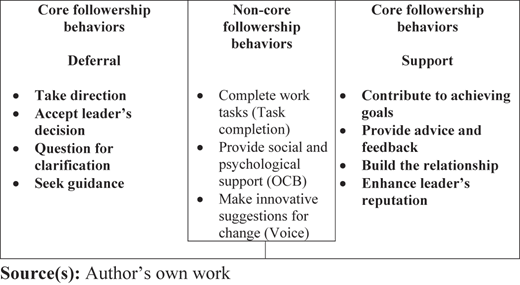
I will summarize my findings in relation to followership behaviors before presenting my results in more detail (Figure 1). I identified that core followership behaviors comprise deferring to the leader or stepping back in order to let the leader lead, and supporting the leader or stepping up to help the leader achieve outcomes. Without these core behaviors, followership is not occurring. I also identified non-core followership behaviors which are understood as contributing to followership when the core followership behaviors are present. These non-core behaviors are not unique to followership and overlap with OCB (Organ, 1997), voice (Chamberlin et al., 2017), and proactivity (Campbell and Wiernik, 2015). I briefly consider these non-core followership behaviors first.
Three key behaviors engaged in by followers align with task completion,
I think followers are usually, or they can be, in my experience, quite hardworking, so they tend to do a lot of grunt work or foundation work in an organisation that doesn’t necessarily get a lot of glory but is very necessary in order for a project to get completed or for you to run your core business functions. (Interview 11, Leader)
OCB
I’d say it’s cliché, but you’ve got an individual contribution, but far and away the strongest is if you can help each other to contribute. So some of that will be flexing strengths that others are not so good. Some is about a right workload and timing. Emotional and consideration for various events in individuals’ lives, both in a personal sense, and a workplace sense. (Interview 17, Follower)
and voice.
… providing feedback. I think that’s a really important thing, being able to say what’s working, and what’s not working, and what needs to be changed. (Interview 7, Follower)
Also emerging from the interview data were descriptions of behaviors unique to followership. Provided these core followership behaviors are present, non-core behaviors: are understood by interviewees as contributing to followership.
Core followership behaviors comprise deferring to the leader or “stepping back” in order to let the leader lead, and supporting the leader or “stepping up” to help the leader achieve outcomes. Table 4, at the end of the article, shows the core followership behavior themes, subthemes and indicative interview extracts.
Core followership behaviors
Followers will take direction and do what the leader asks without following blindly.
I suppose you get given a direction and the expectation is that you follow that direction, and you deliver what you need to deliver. From my point of view, I get given deliverables that I then deliver by a certain date and up to a certain quality. I go about doing that in the best way that I can, trying to manage expectations of stakeholders as I go. (Interview 44, Follower)
They will accept and abide by the leader’s decision even though it might not be the decision the follower would make. This might come after discussion or negotiation with the leader but in the end, the leader’s decision will be followed. The discussion or negotiation and resulting acceptance distinguishes accepting the leader’s decision from taking direction which is done without negotiation.
If you’ve had the opportunity to express a view and have your opinion heard, then me as a follower, and then as a follower, once I’ve done that, it’s then up to the decision maker to make the decision, and I accept the decision that’s made. (Interview 34, Leader)
Followers will ask questions to make sure that they understand what the leader is asking them to do. This clarifies what the follower will do.
… making sure that they … know the expectations, and asking questions if they don’t know. Just winging it doesn’t work. (Interview 3, Follower)
Followers will also request advice, guidance, or reassurance from the leader to ensure that what they are doing is correct. Whereas questioning clarifies what the follower will do, seeking guidance allows the leader to reassure the follower that they are doing the right things or doing things in the right way.
… seek guidance for what they should do and how they should do it and whether it’s the right thing. (Interview 13, Follower)
The core followership behavior of support or “stepping up” also has four subdimensions. Firstly, followers work with leaders, contributing to the achievement of the workgroup or broader organization’s outcomes.
If I put myself as a follower all I’m trying to think is if I can understand what my leader is wanting to achieve and how I could assist that, as long as it’s aligned with my values as well. (Interview 10, Leader)
Followers give leaders advice on what to do and feedback on what has been done to support the leader’s decision-making.
But the decisions can’t be made without the other people that below kind of providing guidance and advice and things like that. (Interview 32, Follower)
Providing feedback to support the leader’s decision-making is different from seeking advice which is focused on the follower’s behavior and checking that what is being done is consistent with what the leader wants.
The two further subdimensions were usually identified by followers; both relate to their relationship with the leader. Followers build the relationship they have with their leader.
Building relationships. I’ve worked in a couple of areas where the relationship with the leader wasn’t a good one, and it’s not helpful for anybody in that situation, including the leader. (Interview 28, Follower)
Beyond that relationship they enhance, or do not detract from, the leader’s reputation to others.
I wanted to make her look good to the next level above. (Interview 3, Follower)
Deferral and support, if considered in isolation from each other, could be seen as contradictory. However effective followership behavior is nuanced. Findings in relation to facilitators and inhibitors of followership show that followers draw on their understanding of context and on their relationship with the leader to step up and support or step back and defer as they consider appropriate to achieve organizational aims. Thus, stepping up, which is often understood as a leadership behavior, is done as an act of followership; not to usurp but to take on shared responsibility in the leadership relationship and process.
I am good at following. So, I am active. I will push my leaders. I will open up and tell them if I got a different point of view. (Interview 16, Follower)
Followership facilitators and inhibitors
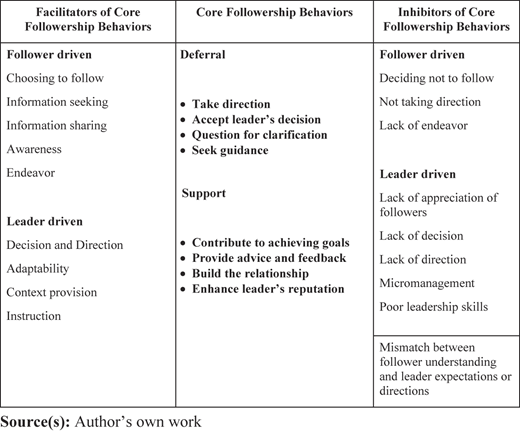
To extend our understanding of followership it is helpful to explore what enables and inhibits core followership behaviors. Again I summarize my findings before detailing my results. Facilitators and inhibitors may be follower-driven (what followers think, believe and do) or leader-driven. They provide a context within which core followership behaviors are more (or less) likely to be enacted. Figure 2 summarizes the core followership behaviors and their facilitators and inhibitors.
A number of followers identified making a choice to follow as being a facilitator of effective followership
I guess that’s part of the follower’s responsibility to take part. So it’s not something really a leader can force you to do it. It does come down to the person themselves. (Interview 51, Follower)
Without choosing to follow, individuals are not engaged in followership. Having made that choice followers seek and share information, knowledge and expertise in order to follow effectively.
And if there’s any delays, updating communication well with your leaders, that’s always a good [thing] Those communications are something that followers can do. (Interview 10, Leader)
The facilitator information seeking results in a follower having an understanding of the context within which they work which informs their followership behaviors. Follower communication which is confident and timely was described as facilitative, ensuring effective information sharing and information seeking. Sharing of information is connected with leaders’ adaptability; followers will share with leaders who are receptive.
I have had a [senior leader] who said, “I’m very open.” Very clear what their role is, and what their position is, and who has potentially the last say, because that’s how it is. But not threatened by challenge, not threatened by an alternative view, not threatened by someone who has more knowledge on that particular topic than themselves (Interview 59, Leader)
Followers describe awareness as an emergent understanding of smaller tasks building to group and ultimately organizational outcomes. Followers’ awareness therefore relates to knowing their job role and the tasks and responsibilities that entail, as well as connections between their job, others’ jobs, and links to organizational goals. Awareness means that effective followership entails doing the right things as well as doing things correctly.
Definitely one thing they can do to be successful is to make sure they understand what’s being asked of them and what’s required. And as much as possible, where it fits into the big picture. (Interview 5, Leader)
Endeavor is a purposeful undertaking that requires effort. Most often identified by leaders, this might be for followers to do tasks well, beyond the minimum required, to participate in the leadership process, and to understand the leader’s expectations of them. Followers making an effort to understand and learn, to communicate and to do more than the minimum necessary for task completion are all aspects of endeavor.
… you can see very quickly those who are doing it because they understand the purpose and the end goal and those who are just going through the motions essentially. (Interview 40, Leader)
Follower-driven facilitators of followership behaviors highlight follower agency in the leadership process. Notwithstanding this, some facilitators originate with leaders. Leader decision and direction are leadership behaviors that facilitate followership. The value of leaders communicating clear direction (prior to follower action) and feedback (on completed actions) was highlighted by followers.
She does give quite clear communication and feedback, so you don’t just plod along thinking, “Am I doing this the right way?” She’s actually quite explicit in the feedback that she gives, and she does it quite regularly. (Interview 13, Follower)
Leader adaptability was demonstrated through receptiveness to followers’ sharing of ideas or information and the leader’s resulting change of mind. Some leaders highlighted willingness to engage with followers who initiate communication about work progress and followers described leaders’ supportive enabling of effective followership.
Oh, she is a manager. But to me, managing sometimes is a bit like pushing down “This is what you’ve got to do. These are your tasks”. Where she’s very much about lifting us up. More of a supporting role. She knows what we’ve got on our plate and wants to know how she can support us. And she really does encourage us to think for ourselves, put forward recommendations. (Interview 55, Follower)
Leaders’ provision of context is facilitative when it is communicated in ways that help followers develop their own awareness and to do work that contributes to organizational outcomes. Line of sight communicated by leaders is therefore linked to follower awareness.
In the business unit now, our general manager has monthly briefing sessions where the business unit as a whole comes together and he briefs us on the bigger picture where the organisation is heading and how our team fits in… I think this setup works because you have that line of sight down from your leaders at a team level and at a team member or follower level, what’s expected of you and how your day-to-day work and the behaviors that are expected from you fits into where the organisation is heading. (Interview 48, Follower)
Because leaders’ context provision is communicated in order to facilitate effective followership behaviors that support the leadership process and relationship it is linked to instruction. Instruction comprises the training, teaching and developing of followers. Leaders instruct followers directly, by providing training
… he would sit down and say, “all right, have I shown you how to cost up […]?” “Oh no, I haven’t learnt … “ then he’s like, “all right, well this is how we approach it. This is how we …” and he’d step through processes. (Interview 52, Follower)
Role modeling or providing opportunities for followers to learn from examples was also identified by leaders and followers as facilitating followership. Developing followers seems to occur over longer time periods in the context of an ongoing leadership relationship and is related to the development of followers’ awareness as well as their skills.
But then obviously he’s got a lot more experience than I do too. So I try and learn a lot from what he does and how he deals with situations. (Interview 51, Follower)
Consideration of how facilitators interact with each other highlights that communication is not done for its own sake. Followers communicate to share information to support the leader by providing feedback, knowledge and expertise. They provide updates on task progress or difficulties in meeting expectations and seek clarification, direction and information. Leaders communicate to support and teach or develop followers by communicating the leader’s understanding and providing a line of sight through direction (before follower action) and feedback (after follower action). Facilitators of effective followership also include the effort that followers put into understanding and into communication as well as into tasks. A leader’s facilitation of effective followership is described as displayed through flexibility and support. Underpinning all these, followership is enabled by followers choosing to follow. Without that choice, followership does not occur.
People would also make a choice, will I either agree or disagree, and if I agree I stay and am part of that work, or if I disagree and I can’t align myself with where we’re going, then that’s a choice I need to make about not being led by them. (Interview 6, Follower)
There are also actions and attitudes which inhibit followership. Followers deciding not to follow, and thereby not taking direction, are fundamental inhibitors of effective followership.
A member of our team who couldn’t follow just to save their life. … It was almost sabotage, but she didn’t mean it to be. She just couldn’t take instruction from anyone else and had to question things to the nth degree, even when they weren’t that important. Like, you know? Sometimes you’ve just got to get a job done. Sometimes you’ve got a deadline and you know what you have to do. (Interview 55, Follower)
Interviewees linked the decision not to follow with not making an effort highlighting again that followership is not merely task completion.
She’s quite set that this is her job description, this is what she does, and if you say can you do something that’s a little bit out of that scope, it’s just, “No, I will not do that. Nope, it’s not my job. Nope.”[ …] And she’s good at what she … Like, what she does is done perfectly, but it’s just she’s not willing to take on any additional stuff. (Interview 28, Follower)
Followers’ lack of endeavor was often mentioned as a response to a leader’s lack of appreciation where their work or their potential was unappreciated.
You only feel like you want to put in the bare minimum to get through, that you don’t want to put in the extra effort to spend time and additional effort … So there’s less motivation to do that for someone who doesn’t conduct themselves in a way that you aspire to be like or that you feel that you’re not appreciated or recognized. (Interview 13, Follower)
Given that followership is, by definition, deferral to and support of leaders, a leader’s lack of decision or direction makes followership impossible.
There’s a lot of good people here in the followership who are just waiting and screaming and asking for, give us some direction and empower us and support us. People don’t sign up for the public service just to not deliver things. (Interview 19, Follower)
While a lack of clear leadership direction is an inhibitor so too is micromanagement or unnecessary direction.
If you’re a leader and you don’t trust your follower, like you’re micromanaging them or you’re working extra hard checking all their work or redoing all their work or something, then that’s not a sustainable way really. It’s not productive in any way. (Interview 53, Follower)
Indeed, more general lack of leadership skills or ability, which might include a lack of leader adaptability, also inhibits effective followership.
I sometimes find it, as a follower, challenging when I’m expected to follow people that should have the knowledge and the skills, and they don’t, but they won’t work with other people to better their … Or they’re a little bit stubborn in regards to thinking that they know the right way when perhaps they don’t. I find that extremely challenging as a follower. (Interview 1, Follower)
The final inhibitor was a mismatch between follower understanding and leader expectations or directions. Interviewees who responded as followers were invited to consider whether they believed there was a match or mismatch between their own expectations of followers and their leaders’ expectations and how this made them feel. Positive feelings were expressed in relation to a matching of the interviewee and their leader’s followership expectations. These included generally feeling good or happy as well as confident, effective, engaged and motivated and supported.
Probably supported. I think if someone’s got a high expectation of you and you agree with that high expectation, it kind of helps you to make sure things are done and definitely feel supported with everybody around. (Interview 28, Follower)
Mismatches between followers’ and leaders’ expectations provoked negative feelings, some of which were very strongly expressed. Interviewees described feeling frustrated, a lack of satisfaction, and distrust. They felt less able to use their skills to their full ability. A number indicated that they were considering leaving their role.
Really frustrated, and there’s been times where I’ve been wanting to leave because if things don’t align with me ethically, or if it’s things like people aren’t going to let me do the job that I think I should be doing, then I’m very much driven by need to kind of have an impact but also do the best job that I can do and the job that I believe that I was hired for and not someone else’s expectations of my role. (Interview 1, Follower)
Discussion
In this study, I distinguished core from non-core followership behaviors. This clarifies distinctions both between followership and employee behaviors and between followership behaviors and followership traits or attitudes. My research makes two significant contributions that extend our understanding of followership behaviors. First, although followership differs from general employee behavior (Uhl-Bien et al., 2014), effective followership is more than effective task completion (Junker and van Dick, 2014; Junker et al., 2016; van Gils et al., 2010), as shown in Table 1, the current literature does not make a clear distinction between behaviors unique to followership and more general employee behavior constructs.
Non-core behaviors, previously suggested as follower behavior, overlap with established constructs of work performance (Campbell and Wiernik, 2015), OCB (LePine et al., 2002; Organ, 1997; Podsakoff et al., 2009; Rotundo and Sackett, 2002), proactivity (Crant, 2000) and voice (Chamberlin et al., 2017). These non-core behaviors are useful in organizations. However, they are general employee behaviors that I found contribute to followership when core followership behaviors are present.
I found that core followership behaviors comprise deferral to and support of a leader. The core followership behaviors identified and classified as such for the first time in this study are consistent with some previous findings. Aspects of core followership behaviors have been previously identified in the followership literature. Deferral appears somewhat consistent with asking for clarification (Tepper et al., 2001), feedback seeking (Benson et al., 2016; Chaleff, 2009; Uhl-Bien et al., 2014), obedience and doing things the leader’s way (Carsten et al., 2010; Uhl-Bien et al., 2014). Support is reflected through challenging assumptions (Benson et al., 2016; Carsten et al., 2010; Carsten and Uhl-Bien, 2012; Chaleff, 2009) providing input, feedback and advice (Benson et al., 2016; Carsten et al., 2010; Uhl-Bien et al., 2014), and loyalty (Carsten et al., 2010; Chaleff, 2009; Howell and Mendez, 2008).
The previous recognition of aspects of followership but not the identification of what constitutes core followership behaviors and the inclusion of other, already established, constructs as followership raises conceptual and measurement issues that this study moves toward clarifying. If researchers use measures that only partially address followership behavior or that measure constructs that are not followership our quantitative understanding of followership behaviors is built on a shaky foundation. There is not yet an agreed, well-validated, measure of followership behaviors. This study provides guidance as to what such a measure should include.
Second, the importance of leaders’ influence on followers underpins the leadership literature (Lord et al., 2017). My findings about how leader behavior facilitates or inhibits core followership are consistent with leadership studies that found that leaders’ behavior influences follower outcomes (e.g. DeRue et al., 2011). A group of leader-driven behaviors facilitates effective followership, similarly a group of leader-driven behaviors is inhibitive. My study extends the emphasis in the leadership literature to highlight the importance of follower agency in facilitating or inhibiting core followership behaviors. Followers choosing to follow is the fundamental precursor to followership. Having made this choice, followers fulfill more than the minimum job requirements, seeking and sharing information. The additional effort or follower endeavor may be directed toward understanding their job role, the leader/follower relationship or the broader context in which they work. The emphasis on follower agency drawn from the perspectives of both followers and leaders is a useful, nuanced, and inclusive contribution to the understanding of leadership.
The contribution of followership and recognizing the influence that leadership behaviors have on followership has practical implications. This research can be used to improve team dynamics and leadership strategies within organizations. Understanding the facilitators and inhibitors of followership behaviors can help leaders and followers, create and sustain environments that encourage effective followership. This has economic and commercial impacts. Organizations with effective followership are likely to experience better performance and higher employee engagement as leaders and followers work together to achieve shared goals. Within a work team that takes followership as well as leadership seriously team members will respect every participant’s contribution. They will take responsibility for their part in the endeavor. They will communicate well: seeking and sharing information and direction aware of the broader group, organizational and external contexts. Leadership and followership in this team will not be constrained by organizational structures but will be fluid with team members taking on and granting leadership and followership as appropriate to the work being done (Sims and Weinberg, 2024).
There are also implications for organization’s human resource practices. At each stage of an employee’s hierarchical relationship with the organization. Professional development of both followers and leaders to include followership would support the practice of effective follower behaviors and link these behaviors with individual performance and organizational outcomes. There have been calls for leadership development to incorporate followership (Carsten, 2017; Collinson and Tourish, 2015) and to recognize that in hierarchical organizational structures leaders also follow (Carsten, 2017; Jaser, 2021). My identification of core followership behaviors and of follower-driven facilitators and inhibitors of those behaviors suggest specific areas of focus for professional skills development. Followership development would be applicable to every member of an organization including the most hierarchically junior or recently appointed who would benefit from skilling in the core followership behaviors of deferral and support.
The development of leaders to facilitate followership would be especially useful at points in an individual’s career when they take on additional people management responsibilities. Promotion to a role as a new manager would be a particularly opportune time for followership as well as leadership development to extend their own and their appreciation of others’ contributions in the workplace. The identification of leader-driven facilitators and inhibitors of core followership behaviors gives focus to the suggestion arising from a review of Leader Member Exchange (LMX) research that leaders be equipped to engage in leader behaviors that support effective follower performance (Martin et al., 2016). Leader decision and direction, provision of context and instruction and adaptability are aspects of leadership development that would facilitate effective followership. These areas for development also pertain to more senior managers.
Calls for followership development have not yet been extended to other aspects of human resources practice (Kulik and Perry, 2023). The recruitment and selection of employees who follow well and the reward and recognition of effective followership are further practical implications of my research. Recruitment for behaviors which are facilitative of followership in leaders and in followers could include development of tools to identify managers’ and staff members’ followership expectations and to test candidates’ understanding and implementation of followership as well as their ability to adapt to each other’s needs. While it is unlikely an effective follower will not also be an effective employee, if followership is useful to organizations it would be sensible to recognize and reward effective followership and facilitators of effective followership in addition to recognizing and rewarding work performance. Many organizations gather stakeholder feedback, including staff members who report to a manager as part of that manager’s performance evaluation (Kulik and Perry, 2023). Followers’ feedback on leader’s facilitation or inhibition of effective followership would be useful.
Limitations and future research
Although the study collected interview data from a total of 63 followers and leaders across a range of workplaces, the sample was drawn from a single sector. A more diverse sample involving participants from a wider range of industries and organizational contexts could enhance the generalizability of the findings or provide helpful contextual or boundary conditions. Conducting a longitudinal study could provide insights into how followership behaviors evolve over time. For example, providing context about the organizational environments and specific situations in which followership behaviors are enacted (e.g. Larsson and Neilsen, 2021) would help in furthering understanding of the conditions that facilitate or inhibit these behaviors. Research that employs multiple data sources, such as observations and archival data would be helpful extensions. Future research incorporating well-designed followership behavior measures is likely to provide additional information. Indeed future mixed methods approaches would provide a more complete understanding than taking a qualitative or quantitative approach alone (Creswell, 2014).
Conclusion
If leadership emerges from leadership and followership behavioral interactions, followership behavior must be important. This study contributes to knowledge about how followership is understood in the workplace by exploring leaders’ and followers’ identification of effective follower behaviors, and facilitators and inhibitors of those behaviors. Identification of core followership contributes to distinguishing between followership and general employee behavior. It therefore provides a good foundation for further research to support the creation of a comprehensive taxonomy. The findings in relation to facilitators and inhibitors of effective followership illuminate the nuanced and interrelated nature of followership and leadership and suggest how and why followership behaviors are enacted. A better understanding of followership and followership behaviors clarifies the contribution that followership makes in organizations.
Ruth Sims’ PhD research was supported by an Australian Government Research Training Program Scholarship.