


The purpose of this study is to understand the types of philosophy programmes that are taught to managers and management students around the world.
A thematic analysis was conducted based on semi-structured interviews with 62 professors and trainers who teach philosophy for management in 22 different countries.
The results reveal that there are at least 24 types of philosophy for management programmes, which fall into two broad categories: (1) traditional management courses that are based on philosophy (MP4M) and (2) philosophy programmes designed for management (PP4M). Interestingly, many of these are taught in an “undercover” manner, which opens a discussion on the use of hidden curricula in philosophy for management.
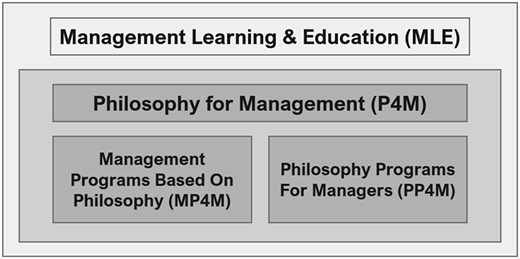
This study contributes to demystifying the field of philosophy for management (P4M) as a subset of management learning and education (MLE). It is the first paper to coin the term “philosophy for management” and to provide a typology of philosophy programmes in business based on empirical data from various geographies. Through mapping out the types of programmes within the discipline, researchers and practitioners can reflect on how to approach business education from a philosophical angle. Ultimately, this study illustrates the diversity of ways that make it possible to integrate philosophy into management education.
Introduction
Historically, philosophy influenced the development of a multitude of disciplines, such as law, politics, mathematics and literature (Small, 2004). Management is no exception – countless philosophers have directly influenced the theories that are taught in today’s business programmes (Fontrodona and Melé, 2002; Joullié and Spillane, 2015; Beltramini, 2018). For this reason, some would say that managers study aspects of philosophy through studying business, but, in truth – in the majority of cases – the roots of business have long been forsaken (Hühn, 2015; Jasinska, 2024). As business schools started adopting a scientific paradigm based on empiricism or pragmatism (Woiceshyn, 1992), it became rare for management learning and education (MLE) to refer back to the disciplines that shaped management into what it is today. Now – though it is still rare to incorporate philosophy into MLE – this practice is becoming more popular (Claes et al., 2009).
Despite the great differences between philosophy and management, there are many similarities that unite the two disciplines, and management literature often discusses philosophy (Small, 2004; Ledoux, 2012). For example, some papers investigate the ideas of specific philosophers and their input on management theory (Blok, 2021; Joullié and Spillane, 2015). Other papers discuss philosophical services targeted at business people, such as philosophical consulting, mediation and counselling (Ledoux, 2012; Hategan, 2019). There is also a stream of literature that discusses philosophy in MLE where authors refer to several types of philosophy: logic, communities of inquiry, Socratic dialogue, epistemology and esthetics as examples (Woiceshyn, 1992; Bolten, 2001; Small, 2004; De Monthoux, 2015; Tsahuridu, 2022). Yet, most frequently, MLE research discusses business ethics, which is a well-established – if not mainstream – form of philosophy in management education (Small, 2004).
The word “philosophy” is commonly used in the management field, but there is a lot of variability in how it is employed. Though often equated to business ethics, it is a much broader concept that can be defined etymologically as “the love and pursuit of wisdom” (Small, 2004) or as an “activity of questioning assumptions” (Segal, 2005, p. 21). Windsor (2015) says that “philosophy is inquiry into knowledge, truth, meaning, right, and good as a basis for wisdom in practical judgment and action” (p. 18). When defining the concept, others still look at its function; Ledoux (2012) describes philosophy as “an attempt to clarify our relation to the world and how to live accordingly, through a discursive and rational thought practice producing concepts” (p. 8). Despite many efforts to provide definitions, there remains a lot of confusion around the word “philosophy” in relation to management. Case et al. (2011) complain that, due to vernacular language, “the classical meaning of philosophy has been diluted significantly, becoming little more than a synonym for ‘personal attitude’ or ‘preferred approach’” (p. 4). In fact, philosophy is most commonly used alongside the word “management” to refer to a specific worldview or approach towards doing business. “Management philosophy” and “business philosophy” – synonymous with “philosophy of managers” – designate the values, principles and beliefs that guide a manager’s or leader’s actions (Collins and Latemore, 2002).
The term “philosophy” changes meanings across contexts or when paired with other nouns or prepositions; whether philosophy is of, for or in management completely transforms what is being discussed. For example, “the expression ‘philosophy of’ (for example) management suggests inquiry into the philosophical foundations of a discipline” (Windsor, 2015, p. 17) – and “philosophy of management” is in fact a sub-discipline of management that explores managerial concepts through a philosophical lens (Blok, 2021). However, “philosophy of management” is not to be confounded with the “philosophy of managers”, which, as noted above, is another way of saying “management philosophy”.
Another concept – which is key for this paper – is “philosophy for managers” (P4M). It is rarely used and can only be spotted in a handful of papers (e.g. Saarinen, 2008; Koslowski, 2010; Ledoux, 2012; Windsor, 2015). Generally, there have been few attempts to define what it means; Saarinen (2008) says it is applied philosophy, but Windsor (2015) has a slightly different approach that attributes a prescriptive dimension; he says “philosophy for managers” instructs on “how to do business”. These definitions do not fully capture the meaning I attribute to P4M in this paper. Here, “philosophy for managers” will be interchanged with “philosophy for management”; it means that the academic discipline of philosophy – or elements of it – is addressed and instructed to businesspeople. In other words, when managers or management students are intentionally exposed to philosophy – and philosophy is tailored for them – I call this “philosophy for management”. It is a term I specifically propose for the field of MLE. I also employ the expression “philosophy in management education” as a synonym for P4M.
Since years, many scholars have advocated for philosophy in management education (e.g. Small, 2004), but literature does not reflect developments in this area. The entire field of P4M is under-researched and poorly understood – even when it comes to basics such as understanding the existing types of P4M programmes. There are discussions about programmes based on philosophy of science (Zald, 1996; Lamy et al., 2014), philosophy of management (Goldman, 2009), critical reflexivity (Cunliffe, 2009) or Socratic Dialogue (Bolten, 2001; Tsahuridu, 2022), but only a small number of authors explain how P4M is taught. The majority of literature is prescriptive rather than representative of what current programmes indeed contain. All this leads many to pose the following research question: what types of philosophy programmes are taught to managers and management students? In this paper, I seek to attain more clarity about P4M in MLE.
Method
Sample and procedures
There were 62 pedagogues included in this study who deliver P4M programmes in 22 different countries. A few of them also offer online or “blended” programmes that alternate between online and in-person sessions (Matheos et al., 2005). The sample consisted of 54 men and eight women; 53 who were actively working and nine who were retired or semi-retired at the time of the interview. 51 out of 62 respondents are from university settings, whereas 11 come from the private sector.
To identify potential interviewees, I scanned the editors of the Philosophy of Management journal and used the keywords “philosophy” and “management” on Google Search (a search engine) to identify potential educators of P4M (Philosophy of Management, 2024). This process resulted in a list of 201 names of people who fit the study. Secondly, 163 people were selected from the list based on their adherence to the following criteria: they were alive at the time of the study, appeared to teach P4M, and had contact details available. Thirdly, individual customized e-mails were progressively sent out inviting them to participate in this study. I only retained the names of interviewees who self-identified as delivering P4M programmes and who were available to provide an interview.
Data collection
Ultimately, I conducted 62 semi-structured, in-depth interviews with open-ended questions (Edwards and Skinner, 2009). Interviews were conducted between June 2022 and March 2023 and lasted between 30 and 120 min. I continued doing interviews until saturation was reached. With the help of Microsoft Teams’ video-conferencing software, 51 discussions were conducted online, the rest were conducted in person. Microsoft Teams’ automatic transcription function was used, and I took notes in case of technological issues.
Data analysis
Data was analysed via a thematic analysis, which is a method of interpreting data by identifying recurrent patterns. The thematic analysis was conducted manually and in an inductive manner, permitting exploration and the extraction of themes directly from data. The process consisted of six phases: data familiarization, initial codes, theme identification, thematic review, theme naming and definition and report production (Braun and Clarke, 2006). Data familiarization consisted of reading interviews and verifying the validity of the transcripts. Then, initial codes were attributed line-by-line, and themes were identified after coding transcripts. These themes were refined in a recursive process before names and definitions were attributed. Finally, the section below reports on themes that were identified.
Results
Types of philosophy for management programmes
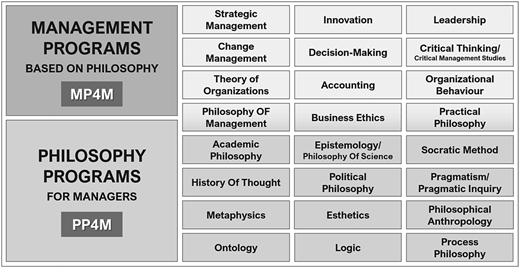
Generally, two overarching themes emerged from the analysis: (1) management programmes based on philosophy (MP4M) and (2) philosophy programmes designed for managers or management students (PP4M). Figure 1 maps the educational landscape of philosophy for management, while Figure 2 plots a programme typology outlining different categories of programmes that were identified through this study.
Management programs based on philosophy (MP4M)
Firstly, this study revealed that many teach philosophy within the context of regular management courses. They teach typical business classes – such as accounting, change management or leadership – but base them on philosophy. One professor stated: “I’m teaching them management […] and I make that quite clear to them. But philosophy is clearly embedded” (MU05). Another commented that their own background and affinity towards the subject resulted in making philosophy the basis of anything they taught: “even in those mainstream courses, because I’ve been teaching them, they always had a philosophical approach” (MU55).
Within this broader category of “management programs”, several types of courses were identified as being based on philosophy: (1) strategic management, (2) change management, (3) theory of organizations, (4) innovation, (5) decision-making, (6) accounting, (7) leadership, (8) critical thinking, (9) organizational behaviour, (10) philosophy of management, (11) business ethics and (12) practical philosophy. It is important to note, however, that the former three (philosophy of management, business ethics and practical philosophy) intersect with the second broader category called “philosophy courses for management”, which will be described afterwards.
Strikingly, a great variety of business courses have a philosophical core. Some are typical business school courses; others are less commonly seen in management curricula. One of the respondents explained: “there is another class that I’ve taught to managers […] called ‘Creative Thinking’, and that was definitely strongly philosophical” (MU02). Someone else shared: “I’m also teaching “Leadership and Change’, so that is again a mainstream course where I still bring in some philosophical elements” (MU55). Some courses maintain a traditional structure but integrate content that goes above and beyond business: “it’s a leadership course, but where I speak on slightly more philosophical questions” (MU29). This is even the case for courses that are not associated with the humanities: “in the accounting courses […] I brought in some sort of basic critical thinking” (MU57). Another teacher shared: “I tried to introduce it into the regular Management Accounting course” (MU34). No matter how their class was called, these teachers described how it was based on philosophy: “as soon as I touch into general questions of innovation strategy, I tried to bring in over Heidegger and some more recent works” (MU20). There are all kinds of atypical course names in this field: “Business, Politics and Culture” (MU08), “Principles of Business Administration” (MU39), “Humanity and Management” (MU06), “Organizational Change” (MU50), “Organizational Theory” (MU04), “Decision-Making” (MU02), “Foundations of Management Thought” (MU54) and “Cultural Management Control” (MU34). There was a lot of variety in the responses, but all the courses fell into the subcategories listed previously. Among all these categories, the most common types of MP4M were in leadership, critical thinking, philosophy of management and business ethics.
Amid the commonly taught management courses based on philosophy, business ethics takes the centre stage; it is most often listed as part of a repertoire of courses taught by P4M pedagogues: “when I teach ethics, I do philosophy there too” (MU05). Some shared how they incorporate philosophy: “we have a Levinassian approach to business ethics” (FU01). Many insisted that ethics must strictly be taught from a philosophical angle; “it would make little sense to have a course on business ethics without philosophy” (MU08). Someone else commented: “in ethics it’s easy – philosophy is integrated from the beginning to end” (MU04). This is especially the case for those who have an educational background in philosophy: “I know it’s called ‘Business Ethics’ class but I’m a philosopher” (MU59). Interviews revealed that when teachers have the intellectual toolkit to treat business ethics as a philosophical subject matter, then it becomes the only acceptable approach towards teaching.
Philosophy courses for management (PP4M)
Secondly, another category of P4M is called “Philosophy Programs for Management” (PP4M). These courses are primarily philosophical but altered to fit a management audience; “there’s a difference between being a philosopher or even a business ethicist versus being a manager who needs to understand what those philosophical ideas are and then apply them” (FU61). This type of course focuses on what the business world can learn from the philosophy world since philosophy is difficult to access without guidance.
Some dissect the brains of great thinkers: “what interests us is what happens in the philosophers’ heads and what we can transmit directly to the manager” (MI36). Another echoed: “there is a bit about talking about how philosophers thought about the world, but the real thing was: okay, having talked about that, how does that allow us to think?” (MU15). Philosophical thinking seems to be of interest to pedagogues: “our goal is actually the inculcation of a of a critical mindset […] you need to understand how the basic thought pattern of philosophy works” (MU21). Others still are about “taking concepts and making them applicable” (MI56).
Within the PP4M category, interviews revealed multiple sub-groups: (1) academic philosophy, (2) the history of thought, (3) metaphysics, (4) ontology, (5) epistemology and the philosophy of science, (6) political philosophy, (7) esthetics, (8) logic, (9) the Socratic method, (10) philosophical anthropology and (11) process philosophy. One professor stated: “I did applied process thought. I took process philosophy and I applied it in a very technical sense to topics in management” (MU15). Another shared: “[I teach] social anthropology from a very philosophical anthropological perspective” (MU41). Other philosophy courses for managers branched out to other areas still: esthetics (e.g. MU24), political philosophy (e.g. MU34), logic (e.g. MI36) and social ontology (e.g. MU60).
Among these categories, programmes about the history of thought, the Socratic method and epistemology were the most commonly cited in interviews. The latter seems to be especially popular for those teaching master’s or doctorate-level courses in university settings: “I used to offer PhD courses that got a lot into epistemology. So there I really involved a lot of philosophy” (MU20). On the other hand, the Socratic method is a popular educational approach in business: “maieutics applied to management aims to be the best technique” (MI36). Another commented, “typically I use a Socratic method in my teaching” (MU09). This approach seems to be especially popular in non-university settings but remains prevalent across contexts. Moreover, the history of thought is commonly taught: “the course looks at history and at how management has been looked at over time” (FU03) and “you take advantage of the great thinkers, and the history of philosophical thought” (MU37). Some clarified which philosophical schools of thought were instructed: “stoicism in general is really a philosophy that is very suitable or very related to management” (MU29). Although some forms were discussed more than others, results reveal the great range of P4M programmes through the typology.
Undercover philosophy
In this study, a unique phenomenon was observed pertaining to the instruction of P4M. It appears that, in a large number of cases, philosophy is taught without being named or its pervasiveness is purposely understated. When this occurs, I call it “undercover philosophy”, which is the act of masking P4M as a different or secondary subject. Respondents discussed this on numerous occasions: “I do not tell students they are learning philosophy” (MU05). Someone else explained, “it doesn’t have the word philosophy in it, but clearly is” (MU02). Multiple interviewees deemed it unnecessary to reveal what their programme was truly about: “not all of them have to have black and white written in the curriculum the part where it says ‘we’re teaching philosophy’” (MU39). Apparently, in many cases, philosophy seems to be delivered in an “undercover” manner. However, this phenomenon was mainly observed in the MP4M category, with few occurrences in PP4M.
Discussion
In response to the initially posed research question – surrounding the types of philosophy programmes found in MLE – I was able to map a programme typology with 24 categories that paint a portrait of the P4M field. I also differentiated between MP4M and PP4M courses and identified a unique phenomenon called “undercover philosophy”. The great number of categories identified in this study was unexpected since literature does not describe so many forms of P4M. It was particularly surprising to uncover the great number of traditional business courses that pose as management classes but instruct P4M. I could not have predicted that “accounting” or “organizational behaviour” courses would appear in the typology due to lacking literature about the integration of philosophy in such areas. I have now come to understand that many MP4M programmes have flown under the radar until now due to the practice of undercover philosophy. Though “Organizational Theory” and “Leadership” courses have also often gone undetected as P4M, these were more likely to contain philosophical elements since the philosophical roots of leadership and management are often discussed in literature (e.g. Fontrodona and Melé, 2002; Joullié and Spillane, 2015), and there are examples in literature of such programmes being taught philosophically (e.g. Cunliffe, 2009). Thus, classifying such programmes as themes in the programme typology was less surprising than inserting a category for “accounting”; still, the prominence of such programmes was unexpected.
Moreover, it was interesting to discover a whole set of courses that are not entitled “philosophy” per se, but that classify as such. This discovery connects with a well-studied phenomenon called the “hidden curriculum” (HC) – also called “implicit education”. In contrast to an “official curriculum”, the HC assumes that there are formal and informal learnings and considers the tacit learning that takes place in education. Concretely, the HC accepts that there are explicit and implicit objectives in education and the implicit ones are referred to as “hidden”. They can be intentionally or unintentionally omitted; HCs simply look at all that is informally taught in addition to what is said to be taught (Bergenhenegouwen, 1987; Blasco, 2012; Orón Semper and Blasco, 2018).
In this case, is it not clear if philosophical teaching is hidden on purpose; what is merely observed is that business is announced on the menu, but instructors intend to teach philosophy. Additionally, programmes are not necessarily focused on teaching management concepts; they may teach how to reason, how to question or how to make decisions. Though the precise learning objectives of P4M were not examined in this study – nor did I analyse the reasons why some opt for implicit versus explicit approaches towards teaching philosophy – this study uncovers the frequent use of HCs in P4M; especially in MP4M. Some PP4M programmes include them too, but differently; they teach philosophy explicitly but may include implicit elements. This aligns with Blasco (2012): “various dimensions of the formal curriculum convey implicit signals about what really matters at business schools” (p. 374).
HCs have been previously reported in MLE in the context of responsible management education; otherwise, few have discussed them in MLE (Blasco, 2012; Høgdal, Rasche, Schoeneborn and Scotti, 2019). According to Blasco (2012), HCs send messages allowing educators to signal appropriate conduct; if I consider Mintzberg’s (2004) view that management is a practice, HCs can serve MLE through instructing certain behaviours.
Moreover, literature contains some delicate traces of this “undercover” teaching approach. For example, to overcome students’ impatience with philosophical questions, Nigel Laurie used a stoic approach to pose questions in a seemingly unphilosophical manner: “framing the matter in this broader context resonates with people as persons, leads to more fruitful conversations and takes people to different places” (Tsahuridu, 2022, p. 475). Other than this testimony, research does not contain much evidence of HC in P4M – making this finding quite unique.
On another note, looking at the programme typology, despite the clear categorization that was developed, programmes are not so simple to categorize and can fall under multiple categories. For example, a leadership class could instruct on the philosophy of management, whereas another might teach critical management. Alternatively, a decision-making class can make use of Socratic Dialogue, logic or business ethics. This programme typology is not intended to fix labels onto programmes but rather to indicate the range of P4M programmes that exist in MLE.
Furthermore, three of the categories – philosophy of management, business ethics and practical philosophy – are on the intersection of both PP4M and MP4M and, therefore, cannot be clearly classified under either one of the general categories. Beltramini (2018) believes philosophy of management is a subfield of management, but he also says that it “borrows” from philosophy. The same applies to business ethics; scholars attribute both philosophical and managerial roots to this field (Hühn, 2015; Jasinska, 2024). Thus, whether these types of programmes are considered as management or philosophy is a complicated debate – dependent also on the method of instruction – explaining why they are categorized as being on the intersection of both aforementioned fields. What is vital is to remember is that the category does not matter so much – the typology points to the existence of certain forms of philosophy in MLE.
Results did not identify programmes that integrated both MP4M and PP4M, but literature contains one example of a mixed approach. The Philosophy and Business Administration (FLØK) at Denmark’s Copenhagen Business School is “one of only a few examples in higher education worldwide of academic programmes that not only integrate elements of philosophy in teaching traditional business disciplines but also teach philosophy as an academic discipline in a business school setting” (Johnsen, Thaning and Pederson, 2016, p. 375). The reason why this programme is able to make such a claim is because it contains a multitude of different courses within the programme. Thus, the word “program” is perhaps too broadly used in this study, but what is recommended is to investigate individual courses within the study programme to understand how each module incorporates P4M.
This paper contributes to MLE in several ways: (1) it defines P4M as a subset of MLE, (2) it differentiates MP4M from PP4M, (3) it provides a typology containing 24 categories of P4M programmes and (4) it recognizes the practice of “undercover philosophy”, indicating the use of hidden curricula. These findings shed light on the many philosophical approaches towards teaching business and give insight on how philosophy can be embedded into MLE. Through mapping out P4M programmes, business schools, professors and trainers can reflect on how to incorporate philosophy into their practice.
Limitations
One of the limitations of this study concerns the sample. Some geographies are not part of the analysis (Asia and Latin America); from the few programmes that were identified, potential interviewees were not available to participate in this study. Their exclusion from this research could have prevented the identification of further P4M categories. Moreover, the manner in which P4M educators were identified could have impacted the results; pedagogues self-identified as teaching P4M, but the extent to which this holds true cannot be verified except through participating in their courses. Lastly, identifying P4M is particularly challenging due to the prevalence of undercover philosophy. There might have been more relevant programmes that were undetected due to a keyword search methodology that failed to consider hidden curricula. Still, the results unveil categories that have never been identified before and can serve as a skeleton for other scholars to build on with future studies.
Another limitation is the scope of this study. In this paper, I focused on demystifying “what types of philosophy programs are taught to managers and management students?”, but many other questions remain: what are the learning objectives of P4M programmes? How are they taught? Who teaches such programmes? Several questions also emerged from the results: why is MP4M instructed in an undercover manner? What are the most prevalent P4M programmes in each geographic region? Why is P4M under-represented in some regions? The scope of this paper was too limited to explore these interrogations, but more research can be conducted in the future.
Lastly, it is to be noted that this study focused on P4M in MLE, but there is an ecosystem of P4M touchpoints that extend beyond education. Philosophical consulting services, journals and corporate speakers (Hategan, 2019; Tsahuridu, 2022) are examples of P4M that could be considered in future typologies.
Conclusion
This paper maps out the field of philosophy for management as a subsection of MLE. Following a qualitative study based on semi-structured interviews with professors and trainers, I was able to outline 24 types of P4M programmes that exist around the globe. The programme typology presented in Figure 2 aims to demystify the different ways of embedding philosophy into MLE and showcases the diversity of ways of incorporating P4M into curricula. In 2004, Small called to “widen the scope and range of the philosophy being studied” (p. 195) to extend beyond ethics and logic. About 20 years later, this appears to be the case. Though P4M is in no way a mainstream approach towards MLE, it reflects what is possible – especially for those looking to innovate.
Lots of research – supportive of P4M – has given management teachers the idea and appetite for teaching philosophy, yet literature fails to indicate how this can be achieved. Thanks to this study, there is a better understanding of how philosophy is integrated into business programmes and how pedagogues could integrate it into their own practice. It is a contribution to the MLE field and a step towards demystifying P4M education.

