


This study reviews recent publications on the informal, experience-based transfer of tacit knowledge within onboarding processes, focusing on the mechanisms, conditions, and barriers influencing this process. It also aims to identify research gaps that require further investigation.
A systematic literature review (SLR) was conducted using the PRISMA method. A total of 865 publications identified in Scopus and Web of Science were filtered to English-language journal articles published between 2016 and 2025. After screening titles and abstracts, 53 articles were reviewed in detail, of which 46 were found relevant.
The reviewed studies emphasise that tacit knowledge transfer enhances individual and organizational performance, supports commitment, and reduces knowledge loss and turnover. While many papers discuss tacit knowledge transfer in various industries and contexts, only a limited number directly address onboarding among knowledge workers.
The study does not distinguish between organizational size, sector, or job function, despite potential contextual differences in tacit knowledge transfer. Moreover, while the search used major international databases, the limited number of relevant studies indicates the value of extending future searches to additional sources.
This study highlights tacit knowledge as a key factor in individual and organizational performance and points to onboarding as a critical yet underexplored setting for its transfer. By synthesising recent findings, it underscores the need for further research on onboarding-related tacit knowledge transfer.
1. Introduction
The global economy is currently facing several challenges that affect the field of human resource management. These include low productivity growth, skill shortages, labour market inequalities, as well as structural transformations caused by technological advancements and the green transition. Another challenge lies within globalized organizations, where knowledge transfer requires intercultural competence, a common language, and shared interpretive frameworks (WESO, 2025). Therefore, the onboarding process can become a tool to address the aforementioned challenges, as a well-structured training process aimed at the transfer of explicit and implicit knowledge can facilitate faster productivity achievement. In the year 2025, HR professionals in Hungary consider the modernization of HR processes to be the most important topic in order to confront these global challenges. One critical point in this regard is improving onboarding processes, or, in many cases, establishing structured training and integration processes and placing greater emphasis on education and training programs (Randstad, HR Trends Survey, 2025). Large companies do not always emphasize the transfer of explicit and tacit knowledge; often, a well-planned, documented induction plan, mentoring program, and mentoring initiatives are lacking (Süveges and Kurucz, 2024). According to a 2023 Ipsos survey, only 40% of Hungarian employees participated in a structured onboarding process. The research further highlighted that “in Hungary, the employee training and integration program does not enhance the sense of loyalty developed during the job interview and onboarding process. Onboarding would be an excellent opportunity to lay the foundation for a long-term, successful collaboration [ …]” (Ihász-Novák, 2023).
Another issue is quiet quitting and employee turnover, as well as knowledge loss due to an aging workforce in certain companies or professional fields. Effective onboarding includes structured training programs and personal mentoring, which enhances new employees’ organizational loyalty and commitment, reducing turnover and fostering engagement, ultimately addressing issues like quiet quitting (Süveges and Kurucz, 2024; Haider and de Pablos-Heredero, 2024; Qi, 2023). The transfer of tacit knowledge alongside explicit knowledge during the initial period employees spend at the company, specifically during the training process, contributes to avoiding the loss of professional and organizational knowledge caused by employee departures. It is important to make this accessible to new employees so that valuable knowledge can be transferred effectively as soon as possible (Krumsiek, 2023).
It should also be noted that remote and hybrid work have gained increasing prominence in recent times, representing a “new normal” in work practices after the 2019 coronavirus (COVID-19) pandemic. Following the widespread adoption of remote work during the pandemic, the new normal refers to a hybrid workplace where part of the work continues to take place outside the office (Bula et al., 2024). Most companies continue to operate in a hybrid manner, with the classic full-time office paradigm being rare, and are even planning to join the metaverse. The metaverse, as a future virtual world, is not a digital revolution but an evolution, and joining it raises questions about its validity (Mehta et al., 2023). It also raises questions about the transfer of tacit knowledge. How challenging is the transfer of tacit knowledge in this new hybrid model?
The transfer of tacit knowledge during onboarding processes can be particularly critical in knowledge-intensive industrial environments such as manufacturing, engineering, accounting, or logistics. In these roles, everyday decisions, productivity, and efficiency are often based on undocumented, experience-driven know-how. However, despite their practical significance, the current academic literature offers only limited research on the transfer of such context-specific tacit knowledge during the onboarding phase. This highlights the need for a more thorough examination of onboarding as a potential tool to mitigate knowledge loss in these sectors and to emphasize its importance.
From a sustainable HRM perspective, onboarding represents a critical early-stage intervention through which organizations can support long-term workforce stability, knowledge continuity, and employee integration. The transfer of tacit knowledge during onboarding contributes to social sustainability by facilitating inclusion and shared understanding, and to economic sustainability by reducing early turnover and knowledge loss. This review therefore approaches onboarding-related tacit knowledge transfer as a micro-level mechanism of sustainable HRM rather than as an isolated training activity.
The paper goal is to explore how tacit, experiential knowledge is transferred in industrial organizations, focusing on the initial phase of knowledge workers’ employment. More specifically, the study aims to identify the mechanisms, conditions, and obstacles that influence the transfer of tacit knowledge in practice. The study also aims to understand the role of formal onboarding structures and informal interactions, such as mentoring, peer support, as well as cultural cues and behaviours in facilitating this transfer. In relation to this topic, the following research questions for the systematic literature review:
How does the effective transfer of tacit knowledge impact the performance and integration of new employees?
How does the transfer of tacit knowledge affect corporate performance?
What role does the tacit knowledge transferred during onboarding play in the issue of knowledge loss and turnover?
The present systematic literature review aims to address these questions by synthesizing existing scholarly evidence. Relevant publications were identified using the PRISMA (Preferred Reporting Items for Systematic Reviews and Meta-Analyses) method (Beller et al., 2013).
2. Literature review
2.1 Tacit and explicit knowledge: conceptual distinctions
In the 21st century, knowledge has become a sustainable competitive advantage for organizations (Sólyom and Fenyves, 2021). Knowledge, as Polányi distinguishes, can be explicit, meaning it is describable, communicable, and directly transferable knowledge, or it can be tacit, meaning it is person-bound and not easily transferable. It is a form of underlying knowledge that we may not even be aware of. “We may know more than we can tell” (Polanyi, 1966). This tacit knowledge is personal in origin and, while difficult to codify and communicate and less documented, is highly functional in the mind of its possessor (Polanyi, 1973). Tacit knowledge has been a foundational idea in knowledge management and related fields, such as psychology and sociology, and it has essentially evolved from sociology (Polanyi, 1966). Polányi also notes that the explicit part of our knowledge does not replace tacit knowledge, as a driver’s skill cannot be substituted by thorough theoretical instruction on vehicle operation. Furthering this idea, it is natural that the transfer of knowledge that cannot be conveyed merely at a theoretical level becomes important within organizations. Distinguishing between explicit and tacit knowledge is fundamentally important for understanding the knowledge assets of organizations (Kucharska and Erickson, 2023).
In companies, for newly arrived employees, explicit knowledge consists of regulations, which also include the formal onboarding process, as well as various training materials and job descriptions. However, these only represent one part of the knowledge to be acquired. The other part is tacit knowledge, which is often activated in specific situations—such as decision-making routines or a sequence of physical actions. Tacit knowledge cannot be generalized to all situations; it is rather dependent on context, environment, and interpersonal relationships, and it is acquired primarily through practice. Moreover, a portion of tacit knowledge is tied to collective interactions, meaning that an individual can only acquire it as a member of a community (Collins, 2013). The two forms of knowledge are therefore fundamentally different in nature—they do not substitute but rather complement each other, as mastering a rule in theory is not equivalent to the practical application of that rule.
Organizations tend to overemphasize explicit knowledge at the expense of tacit knowledge, despite the latter’s strategic importance. Underestimating tacit knowledge can lead to declines in organizational performance, diminished innovation, and the loss of competitive advantage. It also hinders knowledge sharing, negatively impacts corporate culture, and impedes effective learning and collaboration among employees (Lartey et al., 2022).
2.2 Knowledge conversion models
In recent years, with the advancement of globalization, the role of national culture in knowledge transfer has become increasingly prominent. Today, cultural and social factors are significant not only for multinational companies but also for firms employing workers from third countries. Beliefs and norms significantly influence knowledge transfer by shaping communication styles, levels of trust, and collaboration practices. Understanding these dimensions is crucial for effective knowledge sharing across cultures within organizations (Li et al., 2014).
Knowledge sharing mechanisms in organizational environments are diverse and can be categorized based on their characteristics and effectiveness in knowledge transfer. These mechanisms are essential for enhancing collaboration, innovation, and performance within organizations. Common knowledge-sharing mechanisms include mentoring, observation, working together, conversations, and informal exchanges of experience. In organizational settings, mechanisms also include face-to-face meetings, the employment of a knowledge manager, the implementation of technology that supports knowledge sharing, and collaboration through weblogs (Sensuse et al., 2021). However, knowledge sharing often faces several barriers, such as a lack of willingness to share knowledge, lack of motivation (Basit-Memon et al., 2018), or time constraints. Factors such as work culture, trust, and lack of managerial support also play a significant role. Trust is a prerequisite for effective knowledge sharing and cooperation (Bencsik et al., 2025).
While these barriers present significant challenges, organizations can adopt strategies to foster knowledge sharing—such as promoting a collaborative culture, providing training, improving technological infrastructure, and enhancing internal communication to support and facilitate knowledge exchange.
2.3 Onboarding as a channel for organizational learning
The first and most important stage of knowledge transfer within the employee life cycle is the process that lasts from the hiring of the employee until the point when the employee is fully trained and can perform their tasks independently, responsibly, and effectively. The onboarding process plays a key role in ensuring that the new employee becomes an efficient, creative, quick problem-solver, and committed member of the company as soon as possible. It is also a key process for the new colleague to contribute to the retention of organizational knowledge. Among human resource management processes, onboarding is the first pillar in retaining employees, reducing turnover, and increasing productivity and efficiency (Stein and Christiansen, 2010).
Onboarding programs, as defined by Talya Bauer (2010), include the following:
Training sessions and roundtable discussions.
Meetings with key internal stakeholders.
Learning on the job with the support of direct supervisors.
Individual mentoring and HR support.
Practical and product experiences, such as site visits and shadowing programs, where the new colleague follows an experienced colleague and observes their daily work live, facilitating the transfer of tacit knowledge.
Overall, it can be stated that onboarding is not merely an administrative process but a strategic tool for retaining employees, increasing their satisfaction, and strengthening organizational culture. Well-designed and executed training and integration programs contribute to the long-term success of the organization. While the literature extensively discusses tacit knowledge and knowledge sharing in organizational contexts, fewer studies explicitly connect these processes to sustainable HRM outcomes. In particular, onboarding has rarely been theorized as a sustainability-relevant phase of the employee lifecycle, despite its potential contribution to long-term retention, organizational learning, and the reproduction of experiential knowledge. This gap provides a theoretical rationale for examining tacit knowledge transfer during onboarding through a sustainable HRM lens.
3. Methodology
The research is based on a systematic literature review focusing on the transfer of tacit knowledge within corporate integration processes. Data collection was conducted using the Scopus and Web of Science (WoS) databases, where filtering articles published in scientific journals over the past ten years. This approach aimed to ensure access to scientifically reliable and relevant sources. The search strategy was based on a combination of keywords related to tacit knowledge, onboarding, and knowledge transfer.
For additional methodological clarity, the search strategy and inclusion criteria can be interpreted through a PEO (Population–Exposure–Outcome) framework. In this review, the Population refers to employees undergoing organizational onboarding (with particular relevance to knowledge workers), the Exposure captures tacit knowledge transfer processes and mechanisms (such as mentoring, peer learning, shadowing, and informal interaction), and the Outcomes relate to onboarding effectiveness and integration outcomes (including adaptation, learning speed, performance, commitment, and turnover-related aspects).
The relationships between the keywords were defined using Boolean operators, which helped refine the results. (AND = signifies exact match, OR = provides options between synonyms, “ ” = searches for specific phrases, * or % = replaces an arbitrary number of characters, () = indicates logical relationships and search order.) In both databases, the search was conducted in terms of title, abstract, and keywords, denoted by the TITLE-ABS-KEY and TS tags. The Boolean search expression was as follows:
For the Scopus database – TITLE-ABS-KEY ((onboarding OR orientation OR socialization OR “employee% integration” OR newcomer%) AND (“tacit knowledge” OR “implicit knowledge” OR “experiential knowledge” OR “know-how”) AND (transfer OR sharing OR learning)) – which resulted in 486 publications.
For the WoS database – TS= ((onboarding OR orientation OR socialization OR “employee% integration” OR newcomer%) AND (“tacit knowledge” OR “implicit knowledge” OR “experiential knowledge” OR “know-how”) AND (transfer OR sharing OR learning)) – which yielded 380 publication hits. The search was conducted on April 20, 2025, and does not include articles published after this date. To narrow and organize the search results, the PRISMA (Preferred Reporting Items for Systematic Reviews and Meta-Analyses) method was applied, which provides a transparent procedure for selecting relevant articles (Page et al., 2021). Following a preliminary screening based on titles, abstracts, and keywords, duplicates—amounting to 15 publications—were first removed, and then the scope was narrowed to relevant scientific fields (Business, Management and Accounting, Engineering, Social Science, Psychology). The results were limited to English-language journal articles published between 2016 and 2025, ultimately excluding 700 publications. For the 150 articles remaining for review, those that did not examine the transfer of tacit, implicit knowledge or that were conducted in educational settings rather than in a corporate environment were excluded. Finally, by reading the full texts of the publications deemed relevant to the research, the final sample of 53 high-quality articles was identified (see Figure 1).
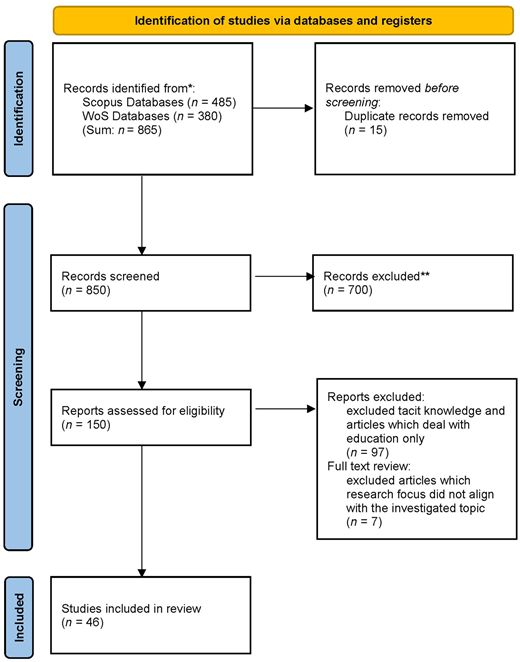
PRISMA flow diagram of the literature selection process. Source: Authors’ own compilation based on the PRISMA framework
PRISMA flow diagram of the literature selection process. Source: Authors’ own compilation based on the PRISMA framework
During the full review of the 53 articles, an additional 7 articles were excluded. For these articles, it became apparent during the full-text analysis that their research focus did not align with the investigated topic. Specifically, it was unclear from the abstract whether the study analysed the transfer of tacit knowledge within the context of education, which was deemed irrelevant to the current research. The remaining 46 articles were analysed based on various criteria. The analysed articles were organized into thematic categories, considering the methods, challenges, and contextual factors related to tacit knowledge transfer. A summary table of the 46 studies reviewed is provided in Appendix. The aim of the study is to provide a comprehensive overview of existing academic findings, while also identifying research gaps and suggesting possible directions for future studies (Table A1).
4. Results
4.1 Quality of the studies
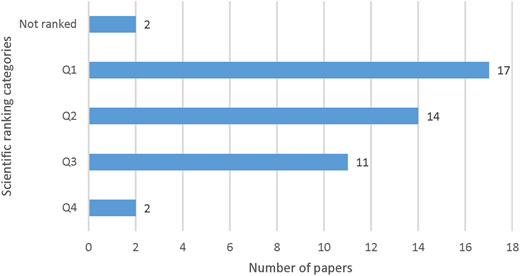
The first and most important piece of information concerns the academic value of the reviewed articles, which form the basis of the research. A key indicator of this is the ranking of the journal in which the publication appeared. The Scimago Journal and Country Rank (SJR) is a publicly accessible portal where the scientific rankings of journals can be tracked. Four main categories are used in the international ranking to assess journals: Q1, Q2, Q3, and Q4. The following chart clearly shows that 67.39% (31 articles) of the 46 reviewed articles represent high academic value, having been published in Q1 or Q2 ranked journals. Only two articles were published in journals that had not yet been ranked at the time of publication (see Figure 2). The dominance of Q1 and Q2 publications in the reviewed literature confirms that the issue of tacit knowledge transfer during onboarding is at the forefront of the international scientific community.
4.2 Trends in research output and source databases
Next, the distribution of the analysed articles between the two databases was examined, along with the research trends emerging based on the publication years (see Figure 3).
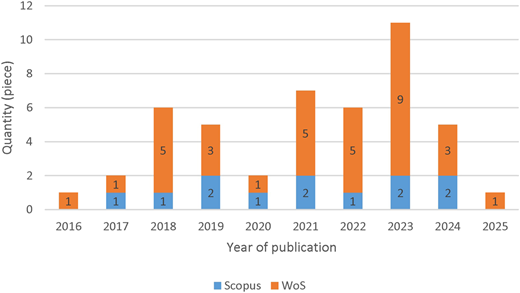
Number of articles published per year (Scopus and WoS). Source: Authors’ own compilation
Number of articles published per year (Scopus and WoS). Source: Authors’ own compilation
Overall, it is clearly visible that significantly more articles were published in the Web of Science (WoS) database than in Scopus. It can be stated that in the second five-year period of the examined timeframe, the number of studies and publications in the topic doubled. The year 2023 stands out, with 11 articles published on the investigated topic. However, it is also evident that in the following year, 2024, the number of publications dropped to less than half, with only 5 articles released.
The temporal distribution of publications suggests that scientific interest in tacit knowledge transfer will increase after 2020, which is a direct response to the sudden shift to working from home caused by the pandemic. However, this increase is not accompanied by a proportional diversification of research contexts. One reason for this is the focus of the research: the literature has so far primarily examined immediate micro-level effects, stress, and individual performance, while secondary, long-term structural consequences—such as intergenerational knowledge loss or limitations on socialization—remain understudied. On the other hand, a significant part of knowledge management research comes from traditional sectors such as construction and manufacturing, where physical presence is essential and tacit knowledge is still treated as a location-dependent, observation-based process.
4.3 Geographical distribution of publications
Finally, a brief overview aims to illustrate the geographical distribution of the publications and highlight that the area under investigation—and the publications appearing within it—is not only under-researched in Hungary, but also across Europe (see Figure 4).
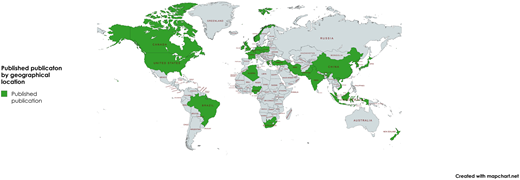
Published articles by geographical location. Source: Created by authors with MapChart.net
Out of the 46 articles reviewed, 3 lack a clear geographical context, as they either present conceptual frameworks, report global literature reviews, or provide theoretical–typological overviews. Examining the geographical distribution of the remaining studies, 18 were conducted in Asian countries, 11 in Europe, 6 in the Americas, 5 in Africa, and 1 in Australia/Oceania. In addition, two studies approached the topic from a global perspective without focusing on a specific country. It is noteworthy that none of the analysed articles reported research conducted in Hungary. Only 27% of the geographically identifiable studies were carried out in a European context. The high proportion of studies conducted in Asian contexts are culturally embedded to some extent in their interpretation and examination of tacit knowledge transfer. The role of informal learning, mentoring and social networks may appear differently in European or Central and Eastern European contexts. Therefore, the generalizability of the results cannot be stated due to the geographical distribution.
5. Discussion
Although tacit knowledge transfer is a widely discussed topic in knowledge management literature, its examination during onboarding remains limited. This may suggest that onboarding is treated more as an administrative HR process than as a critical learning and knowledge reproduction phase.
Out of the 46 publications examined on the topic, 28 used questionnaires as part of their research method, with two of these also combining them with interviews. In 13 cases, the research was conducted solely through interviews, 4 studies were literature reviews, and in one case, the study was based on a case study. The authors examined the transfer of tacit knowledge based on various factors, which were classified into eight distinct groups. Figure 5 summarises the main factor groups examined in the reviewed studies, showing that several papers link tacit knowledge transfer to onboarding/training practices and to outcomes such as integration, learning, and performance.
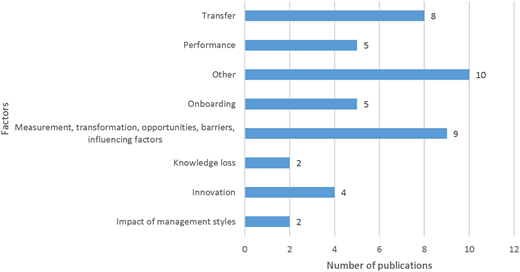
Among the 46 analyzed articles, the majority focused on the measurement, transformation, and transfer of tacit knowledge, as well as its limitations and influencing factors (n = 9).
Five articles explored the relationship between tacit knowledge transfer and performance. Each study emphasized that the transfer of tacit knowledge plays a crucial role in improving performance (Ibidunni et al., 2023; Ha, 2021; Ferdinand and Wahyuningsih, 2018; Ismail et al., 2023a; Suresh et al., 2017). The development and innovativeness of individuals lead to enhanced performance (Ferdinand and Wahyuningsih, 2018), and may also offer a solution to a broader global issue—namely, the skills gap. Ferdinand and Wahyuningsih also highlight that tacit knowledge transfer is a strategic tool for strengthening innovation capabilities. However, transferring explicit knowledge alone is not sufficient to improve operational performance. In fact, the lack of tacit knowledge transfer can even diminish the impact of explicit knowledge.
Therefore, it is essential for companies to develop an organizational culture and incentive system that supports the transfer of both types of knowledge (Ha, 2021). The research by Ibidunni et al. (2023) pointed out that even in less technologically developed environments—such as Nigeria—tacit knowledge and openness to learning jointly contribute to organizational effectiveness.
The presence of a learning orientation has a positive effect on company performance and indirectly supports the utilization of tacit knowledge. Furthermore, learning-oriented cultures provide a competitive advantage (Ismail et al., 2023a, b). The study by Suresh et al. (2017) investigated the relationship between tacit knowledge transfer and performance improvements through reduced costs associated with quality defects. Based on interviews with managers having years of experience in the construction industry, the research emphasized that forms of tacit knowledge transfer—such as mentoring and vocational training (e.g. the dual education system present in Hungary, or professional internships and university collaborations in the case of knowledge work)—play a key role in reducing costs caused by quality issues. The study also highlighted that explicit knowledge transfer methods, such as documentation or memorization, are less effective in this context. Thus, the importance of training is already being emphasized in relation to performance improvement and reducing error-related costs.
The following section analyses studies that focus on the transfer of tacit knowledge during the integration of new employees. Table 1 presents the methods used in the five publications that examined the relationship between tacit knowledge and onboarding. It is evident that, in this category, interviews and focus group discussions were more commonly used (n = 3), while only two studies applied a questionnaire-based research method.
Onboarding factor articles research method
| Author | Factor | Method |
|---|---|---|
| Dostál (2022) | Onboarding | Expert interview, focus group discussion |
| Yiu et al. (2023) | Onboarding | Interview |
| Işık et al. (2021) | Onboarding | Interview |
| Enwereuzor et al. (2023) | Onboarding | Questionnaire |
| Shariq et al. (2019) | Onboarding | Questionnaire |
The knowledge transferred during the onboarding process—including not only explicit but also tacit knowledge—may offer a solution to the current issue of high employee turnover. In his 2022 study, Dostal proposes a new onboarding framework model in which the identification and transfer of tacit knowledge is facilitated through eye-tracking technology for newly hired IT service desk employees. This innovative technology not only enables more effective knowledge transfer from experienced employees to newcomers, but it may also indirectly reduce turnover. The transfer of tacit knowledge to new hires is also highlighted as a facilitator of smoother adaptation and integration (Enwereuzor et al., 2023; Işık et al., 2021). In their research, Işık et al. (2021) emphasize the importance of recording tacit knowledge from experienced employees in the organizational memory, so that it can be retained even if those employees leave the company. This, too, can be addressed through the transfer of tacit knowledge during onboarding.
Furthermore, a study by Yiu et al. (2023), conducted among new employees in the healthcare sector—specifically among doctors—highlights that mentoring and open communication can help make tacit norms visible, thereby reducing stress arising from conflict situations. They highlighted in their research that professional identity formation among newcomers is strongly shaped by influences from communities of practice. These influences, messages and values are often tacit and acquired through an unconscious process. Since newcomers feel a certain pressure to conform to tacit group norms, this process can also generate stress.
The sharing of tacit knowledge within teams requires a high level of social interaction and trust, and tacit knowledge transfer further impacts innovative work behaviour (Işık et al., 2021). In addition, the intra-group transfer of tacit knowledge has significant effects on organizational performance (Ibidunni et al., 2023). However, when there is no balance between explicit and tacit knowledge, teams and communities may struggle to adequately accomplish socio-technical tasks, which in turn undermines their overall performance. The significance of socio-technical tasks lies in the fact that in such situations—such as collective decision-making or problem-solving—technical expertise alone is not sufficient; effective communication and collaboration among colleagues are equally important. For example, in joint problem solving or collective decision-making, technical skills alone are insufficient; alignment among colleagues, effective communication, and rapid information flow are also necessary. These socio-technical tasks heavily depend on the flow of tacit knowledge, which in turn requires trust, mutual understanding and informal interaction among team members (Mtsweni and Gorejena, 2023). This underlines that the transfer of tacit, not only explicit knowledge, is crucial and should begin as early as the onboarding process.
In terms of remote work and hybrid work, it is important to note that this type of work organization makes it difficult to satisfy the need for social interaction, and the lack of such interaction can negatively affect employee performance and motivation (Audrin et al., 2025). Since interpersonal relationships form the basis for the transfer of tacit knowledge, their absence hinders this form of knowledge sharing. This is also highlighted by the work of Ton et al. (2022), in which they emphasize the role of trust: its persistent absence can significantly hinder the exchange of critical information, thereby undermining the effectiveness of team collaboration. Law and Koh (2023) explain in their study that tacit knowledge elements are lost during remote work, which means that in professional fields, employees will know what to do based on the explicit information available to them, but the answers to the questions of how and why are lost, which can lead to a lack of skills and talent. However, it is important to emphasize that tacit knowledge transfer during onboarding in hybrid or remote work environments appears only to a very limited extent in the articles examined. The only study dealing with this issue suggests that the challenges in such environments are not purely technological, but stem primarily from the limited opportunities for informal interaction, observation, and internalization of tacit norms. The available results therefore suggest that such environments primarily hinder the transfer of tacit knowledge through a reduction in opportunities for informal interaction and observation, which reinforces the importance of onboarding as a critical intervention point in sustainable HRM.
Although the last study mentioned in the table (Shariq et al., 2019) does not directly address the transfer of tacit knowledge during onboarding, it underscores its importance. The study notes that involving new employees in knowledge sharing—especially through challenging tasks—helps surface and apply tacit knowledge. This can also be seen as evidence supporting the relevance of tacit knowledge transfer during onboarding.
The results of the present systematic literature review provide a comprehensive overview of current research on the transfer of tacit knowledge during the onboarding process. The analysis confirms that tacit knowledge plays a key role in enhancing both individual and organizational performance, as well as supporting the integration of new employees. At the same time, the reviewed studies reveal significant unexplored areas. From a geographical perspective, the research has primarily focused on the Asian context (18 studies), with fewer studies conducted in Europe (11 studies), where European investigations account for only 27% of the geographically identifiable publications. We did not identify any study specifically examining the transfer of tacit knowledge during onboarding in the Hungarian context, indicating a clear national-level research gap. This geographical bias suggests that in certain regions—particularly Central and Eastern Europe—cultural, institutional, and organizational factors influencing tacit knowledge transfer remain insufficiently explored.
Compared to prior literature, these findings align with works emphasizing the strategic role of tacit knowledge in maintaining competitive advantage (Polanyi, 1966; Kucharska and Erickson, 2023). However, while earlier research typically investigated tacit knowledge in the context of general knowledge management or innovation, this review highlights the limited number of studies explicitly focusing on onboarding. This gap is significant, as onboarding represents a critical period for introducing new employees to organizational norms, processes, and experiential knowledge. Furthermore, few studies link tacit knowledge transfer during onboarding with long-term outcomes such as retention, turnover reduction, or mitigation of knowledge loss.
From a practical standpoint, the results underscore the importance of incorporating both formal and informal mechanisms of tacit knowledge transfer within onboarding programs. Several studies have found mentoring, peer learning, shadowing, and collaborative problem-solving to be effective; however, their application and success are context-dependent. Practical applications should focus primarily on micro-level mechanisms that help new employees integrate, rather than solely on more distant organizational outcomes. (Halvari et al., 2021; Kiessling et al., 2023) Mentoring programs are most effective when they are organically integrated into everyday work, for example in the form of job shadowing, guided observation, and informal interactions between colleagues during the initial phase of employment. (Suresh et al., 2017; Bolduan et al., 2024; Işık et al., 2021) The transfer of tacit knowledge is smoother when mentors are selected based on task similarity and experiential expertise rather than solely on their hierarchical position. (Suresh et al., 2017; Işık et al., 2021; Correa et al., 2022) It is recommended to supplement traditional onboarding methods with eye tracking and narrated screen recording. These tools allow new employees to see where experienced experts focus when solving complex problems, capturing the tacit “tricks of the trade” that would be difficult to express verbally. (Dostál, 2022) Periodic role rotation dramatically improves tacit knowledge transfer and trust, as it takes employees out of their comfort zone and helps them understand the connections between different departments. (Arnett et al., 2021; Olaisen and Revang, 2018) It is essential to maintain formal and informal learning spaces—such as “learning cafés” or knowledge communities—where new employees and senior staff can engage in spontaneous dialogue. (Lau et al., 2019; Phaladi and Ngulube, 2024) This helps to avoid isolation and failed socialization, which often leads to turnover in hybrid environments. (Kiessling et al., 2023; Law and Koh, 2023) Furthermore, HRM strategies should create an atmosphere of trust where experienced professionals are motivated to share their knowledge and do not feel threatened in their own positions. (Arnett et al., 2021; Jiang and Chen, 2021; Bolduan et al., 2024; Enwereuzor et al., 2023; Law and Koh, 2023)
The geographical concentration of research also raises questions about generalizability, further reinforcing the need for region-specific investigations.
The methodological diversity of the reviewed studies is noteworthy but also reveals certain limitations. Most empirical research relies on cross-sectional designs, which limit the ability to assess causal relationships between tacit knowledge transfer and performance outcomes. A considerable number of studies use self-reported data, which may be subject to bias, particularly in measuring tacit knowledge that is inherently difficult to articulate. Additionally, quantitative survey-based approaches dominate, whereas mixed-method and longitudinal studies—which could capture the dynamic and evolving nature of onboarding—are underrepresented. Finally, industry-specific research remains scarce, and few studies explicitly address the differences in tacit knowledge transfer mechanisms across sectors such as manufacturing, engineering, or financial services.
Based on the results of the review, the social consequences are directly related to the preservation of organizational knowledge and ensuring intergenerational knowledge transfer. Rather than a general shortage of skilled labor, the evidence points to a more specific threat: due to a lack of socialization during integration, critical tacit knowledge is not being transferred to the new generation, causing a systemic loss of efficiency in the industry. This means that labor market strategies must focus not only on recruitment, but also on knowledge-preserving HRM practices such as structured mentoring and the promotion of socialization platforms. In social terms, the lack of tacit knowledge transfer increases the isolation and turnover of new employees, which jeopardizes the social sustainability goals of HRM.
The answers to the three research questions posed in this study are summarised in Table 2 together with the most relevant supporting literature.
Research questions and answers from the literature reviewed
| Research question | Answer summary | Key references |
|---|---|---|
| Q1: How does the effective transfer of tacit knowledge impact the performance and integration of new employees? | The transfer of tacit knowledge during onboarding improves employees’ adaptation, accelerates learning curves, enhances job performance, and fosters a stronger sense of belonging. Informal mechanisms (mentoring, peer learning) and structured integration programs support faster assimilation | Dostál (2022), Yiu et al. (2023), Enwereuzor et al. (2023), Işık et al. (2021), Shariq et al. (2019), Pu et al. (2022a, b), Halvari et al. (2021), Sial et al. (2023) |
| Q2: How does the transfer of tacit knowledge affect corporate performance? | Tacit knowledge transfer contributes to innovation, operational excellence, and improved team collaboration. It enhances problem-solving capacity and supports dynamic capabilities. The presence of a learning-oriented culture further amplifies these effects | Ferdinand and Wahyuningsih (2018), Ha (2021), Ibidunni et al. (2023), Ismail et al. (2023a, b), Hung et al. (2024), Arnett et al. (2021), Suresh et al. (2017), Kucharska and Erickson (2023), Lamperti et al. (2023) |
| Q3: What role does the tacit knowledge transferred during onboarding play in the issue of knowledge loss and turnover? | Tacit knowledge sharing helps mitigate knowledge loss—especially due to retirements or turnover—and supports organizational memory retention. Onboarding is a key opportunity for capturing and embedding this knowledge early in the employee lifecycle | Dostál (2022), Işık et al. (2021), Yiu et al. (2023), Enwereuzor et al. (2023), Correa et al. (2022), Phaladi and Ngulube (2024), Zhou et al. (2025) |
6. Conclusions
This study highlights that tacit knowledge transfer is a key factor in the initial period of a new employee’s tenure at a company. Within the framework of sustainable HRM, tacit knowledge transfer during onboarding acts as critical micro-level mechanism that, through socialization and mentoring, directly supports workforce retention and knowledge continuity. By facilitating early integration, reducing the isolation of newcomers, the process makes a substantial contribution to the social and human sustainability dimension of HRM, ultimately enhancing the organization’s long-term resilience and innovation capability. The systematic literature review conducted using the PRISMA method confirms that the performance and integration of new employees are influenced not only by explicit knowledge, which is easily documented and shared, but also by tacit knowledge, which is difficult to articulate and transfer. (Q1) The analysis of the articles also confirms that the lack of tacit knowledge transfer weakens the effectiveness of explicit knowledge transfer. This affects not only individual development and success but also the overall performance of companies. (Q2) Several studies mentioned that knowledge transfer plays a central role in addressing the challenges of retirement and employee turnover. (Q3) The transfer of tacit knowledge during onboarding provides a means to prevent knowledge loss.
The study also points out that only a limited number of studies deal specifically with the transfer of tacit knowledge to new employees. Therefore, future research is needed to map the mechanisms and barriers involved in the transfer of tacit knowledge among knowledge workers during onboarding. It would also be necessary to examine how knowledge transfer, especially tacit knowledge transfer, takes place during onboarding processes in the “new normal” hybrid work environment. Such studies would fill a gap in the literature and offer guidance and insights into addressing current global challenges. Future research should address the industry-specific nature of tacit knowledge transfer during onboarding, especially in knowledge-intensive environments such as engineering or financial services. Tailored onboarding strategies may differ significantly across sectors in terms of knowledge complexity, formality, and transferability.
Based on the results, it is also important to identify future research directions that can further deepen our understanding of the transfer of tacit knowledge during the onboarding process.
7. Future research directions
Although this study provides a comprehensive overview of the transfer of tacit knowledge during the onboarding process, highlighting its significant role, it also highlights a number of research gaps that would be worth investigating in the future. Based on the analysis, three main research directions can be identified: content gaps, methodological challenges, and practical implications.
7.1 Content gaps
Future research should focus on the mechanisms of tacit knowledge transfer during the onboarding process, with particular attention to hybrid and remote work environments. The “new normal” of work increasingly relies on digital collaboration, which reduces opportunities for informal face-to-face interactions and may hinder the flow of tacit knowledge. (1) It would be important to explore how organizations can compensate for these limitations and what new forms of interaction emerge—for example, online mentoring, virtual shadowing, or virtual professional communities. (2) How does the development and maintenance of trust change in hybrid environments, and does this change influence tacit knowledge transfer? (3) Further investigations are needed for industry-specific comparisons, since the flow of tacit knowledge and onboarding practices may differ across knowledge-intensive sectors, particularly within hybrid work environments.
In addition, a geographical bias can be observed in the literature: most studies have been conducted in Asian contexts, far fewer in Europe, and only a negligible number in Central and Eastern Europe. This suggests that examining cultural and institutional factors in this region offers significant opportunities for future research.
7.2 Methodological challenges
Most existing research is based on cross-sectional, questionnaire-based approaches, which have limited ability to capture the dynamic, time-varying nature of onboarding and tacit knowledge transfer. More broadly, systematic reviews in this domain can be complemented with science-mapping techniques—such as co-word analysis and citation-based main path analysis—to trace thematic evolution and knowledge-flow patterns over time (Rejeb et al., 2025). Empirical designs (e.g. surveys and interviews) remain essential to explain the mechanisms behind these patterns at the organizational level. Conceptually, onboarding and tacit knowledge transfer can be understood as “flow” phenomena rather than static “stock” snapshots, which further supports the need for longitudinal research designs. (Süle, 2013) In the future, there will be a need for longitudinal studies that track processes over a longer period of time, as well as mixed-method studies that combine quantitative surveys with qualitative techniques such as interviews. Experimental research examining the effectiveness of specific onboarding practices in facilitating tacit knowledge transfer could also make a significant contribution.
7.3 Practical implications
Future research should explore how HR practices and organizational strategies can more effectively support the sharing of tacit knowledge during onboarding. Because onboarding design involves multiple (often competing) sustainability-related criteria (e.g. integration speed, wellbeing, retention, knowledge preservation, and cost), multi-criteria decision-making (MCDM) can provide a structured logic to prioritize onboarding interventions (Hódosi et al., 2023) It is worth examining the role of digital tools—such as collaboration platforms, artificial intelligence-based analytics, or eye-tracking technologies—in capturing and transferring tacit knowledge in hybrid environments. In addition, attention should be paid to industry-specific onboarding strategies, as the processes of transferring tacit knowledge can vary greatly based on the complexity, formality, and transferability of the knowledge. Such research would not only contribute to academic discourse, but also provide practical guidance for companies seeking to retain employees, reduce turnover, and strengthen their competitive advantage through more effective knowledge management.
Appendix
Summary table of the studies examined
| Author(s) | Year | Title | Journal | Method | Factor(s) | Main findings |
|---|---|---|---|---|---|---|
| Arnett, D. B. et al. | 2021 | A process model of tacit knowledge transfer between sales and marketing | Industrial Marketing Management | Quantitative (215 individuals) | Mutual understanding, quality of communication | Trust and the quality of communication support tacit transfer through mutual understanding |
| Avdimiotis, S | 2019 | Emotional intelligence and tacit knowledge management in hospitality | Journal of Tourism, Heritage and Services Marketing | Quantitative (128 individuals) | Emotional intelligence (EI), SECI model | EI and tacit knowledge are closely related; EI is one of the structural elements of tacit knowledge |
| Azzam, A. et al. | 2020 | The role of knowledge creation modes in architectural innovation | Strategic Change – Wiley | SEM (196 individuals) | SECI modes, architectural innovation | Socialization and internalization are the most important ways to achieve architectural innovation |
| Bolduan, R. et al. | 2024 | Psychometric analysis of the scale of barriers to sharing knowledge in the Kaizen of a company | Gestao and Prducao | Qualitative (212 individuals), EFA | Kaizen, meritocracy, Ba context | The lack of performance-based rewards and limited management support are the main barriers to knowledge sharing |
| Bouncken, R., and Aslam, M. M | 2019 | Understanding knowledge exchange processes among diverse users of coworking-spaces | Journal of Knowledge Management | Qualitative (26 individuals), Grounded Theory | Coworking spaces, physical proximity | Physical proximity provides opportunities for socialization, which leads to tacit knowledge exchange |
| Castaneda, D. I., and Toulson, P | 2021 | Is it possible to share tacit knowledge using information and communication technology tools? | Global Knowledge, Memory and Communication | Quantitative (217 individuals) | ICT tools, dialogue capacity | Tacit knowledge can only be shared using ICT tools that enable dialogue |
| Celestine, N. A. and Perryer, C | 2016 | The Impact of National Cultural Values on Intrinsic Motivation to Transfer Tacit Knowledge | International Journal of Knowledge Management | PLS (128 individuals) | Long-term orientation, collectivism | Cultural values significantly influence the internal motivation for tacit transfer |
| Chatterjee, A. et al. | 2018 | Learning transfer system inventory (LTSI) and knowledge creation in organizations | The Learning Organization | Conceptual | LTSI constructions, SECI model | LTSI factors measure an organization’s willingness to create and transfer knowledge |
| Chen, Z. J. et al. | 2018 | When and how authoritarian leadership and leader renqing orientation influence tacit knowledge sharing intentions | Information and Management | Regression (309 individuals), Bootstrapping | Authoritarian leadership, Renqing (emotion) | Renqing orientation (empathy) mitigates the negative effects of authoritarian leadership on division |
| Correa, R. D. et al. | 2022 | Mechanisms for capturing and transferring tacit knowledge between projects | International Journal of Knowledge Management Studies | Systematic Literature Review | Barriers, informal spaces | Informal spaces and socialization are essential for tacit transfer between projects |
| Dahou, K. et al. | 2019 | Knowledge management as a critical success factor in developing international companies’ organizational learning capability | Journal of Workplace Learning | Quantitative (47 expatriates) | KCP (knowledge conversion), OLC | Socialization and internalization are the most decisive factors in the development of learning abilities |
| Dogra, P., and Sparkling, A. E | 2020 | Supervisors’ Reliance on Tacit Knowledge and Barriers to Knowledge Sharing in the Electrical Contracting Industry | Journal of Construction Engineering and Management | Mixed methodology | Experiential knowledge, formal processes | There is a strong link between experience and tacit knowledge; the main obstacle is lack of time |
| Dostál, M | 2022 | Service Desk Onboarding Training Environment | Acta Informatica Pragensia | Design Science | Eye tracking, simulation | Technology-assisted onboarding (eye tracking) helps to capture tacit knowledge |
| Edgar, G. et al. | 2024 | Effect of knowledge resources on innovation and the mediating role of dynamic capabilities: case of medical tourism sector in Iran | European Journal of Innovation Management | Quantitative (102 individuals), SEM | Dynamic abilities (learning, perception) | The ability to learn is key to transforming knowledge resources into innovation |
| Enwereuzor, I. K. et al. | 2023 | Unlocking the mask: how respectful engagement enhances tacit knowledge sharing among organizational members | International Journal of Manpower | SEM (593 individuals) | Respectful commitment, friendship | Respectful interactions through workplace friendships facilitate the sharing of tacit knowledge |
| Ferdinand, A. T., and Wahyuningsih, W | 2018 | Salespeople’s innovativeness: a driver of sales performance | Management and Marketing | Quantitative (229 individuals), SEM | Tacit knowledge exchange, value-based selling | The exchange of tacit knowledge within the team increases salespeople’s innovativeness and sales performance |
| Ha, M. T | 2021 | Social capital and firm operational performance: The mediating roles of knowledge sharing | Cogent Business and Management | SEM (346 SME) | Social capital (SSC, RSC, CSC) | Cognitive social capital (shared vision) directly improves operational performance |
| Halvari, A. E. M. et al. | 2021 | A prospective study of knowledge sharing at work based on self-determination theory | Scandinavian Journal of Work and Organizational Psychology | Latent profile analysis (299 individuals) | Self-determination theory (SDT), managerial control | People in an environment that supports autonomy share more knowledge |
| Hung, S. Y. et al. | 2024 | Tacit knowledge sharing in information systems development projects: social interdependence and regulatory focus perspectives | Information Technology and People | PLS-SEM (198 individuals) | Social interdependence, focus | Cooperative interdependence and prevention focus support tacit exchange |
| Ibidunni, A. S. et al. | 2023 | Interacting Effects of Tacit Knowledge and Learning Orientation in Improving Firm Performance | Journal of the Knowledge Economy | Quantitative (231 individuals), SEM | Individual and group tacit knowledge | Learning orientation strengthens the link between tacit knowledge and corporate performance |
| Işık, C. et al. | 2021 | The Nexus between Team Culture Innovative Work Behaviour and Tacit Knowledge Sharing: Theory and Evidence | Sustainability | Quantitative (360 individuals), Smart PLS | Team culture, innovative work behaviour | Tacit knowledge sharing (SECI) mediates the relationship between team culture and innovation |
| Ismail, M. B. et al. | 2023 | Learning Orientation as Mediator between International Entrepreneurial Orientation and International Firm Performance in Global Halal Industry | Global Journal Al-Thaqafah | Quantitative (136 individuals), PLS-SEM | International entrepreneurial orientation | Learning orientation fully mediates the relationship between entrepreneurial spirit and performance |
| Ismail, M. et al. | 2023 | Managerial capabilities learning orientation and performance of international halal industry using upper echelon theory | International Journal of Business and Society | Quantitative (136 individuals), PLS-SEM | Senior management skills, UET theory | International experience has a direct impact on success, while market knowledge has an impact through learning orientation |
| Jiang, D., and Chen, Z | 2021 | Innovative Enterprises Development and Employees’ Knowledge Sharing Behaviour in China: The Role of Leadership Style | Indian Institute of Technology | Quantitative (791 individuals) | Transformational and authoritarian leadership | The type of leadership has a different impact on explicit and tacit knowledge sharing |
| Kiessling, T. et al. | 2023 | Managing global knowledge transfer: Inpatriate manager embeddedness and firm innovation | International Business Review | Theoretical overview | Embeddedness of inpatriates | Inpatriates are key to reversing the transfer of tacit knowledge back to headquarters |
| Kucharska, W., and Erickson, G. S | 2023 | Tacit knowledge acquisition and sharing and its influence on innovations: A Polish/US cross-country study | International Journal of Information Management | Quantitative (729 individuals), SEM | Learning through action/interaction | Awareness and sharing are key to transforming tacit knowledge into innovation |
| Lamperti, S. et al. | 2023 | From incubator’s knowledge transfer to sustainability start-ups’ impact: a case study in a French support program | Journal of Knowledge Management | Qualitative case study | SI knowledge (sustainability impact), incubator | Knowledge transfer consists of three phases: awareness, identification, and evaluation |
| Lau, K. W. et al. | 2019 | A collective organizational learning model for organizational development | Leadership and Organization Development Journal | Typological overview | 3P concept (principles, purposes, processes) | A new collective model for an algorithm-based and tacit knowledge-based society |
| Law, K. K., and Koh, Y | 2023 | What Is Next? The Longer-Term Managerial Challenges following COVID-19 | Sustainability | Qualitative (13 interviews) | WFH (Work From Home), talent shortage | The lack of socialization during WFH leads to a long-term professional knowledge gap |
| Mtsweni, E. S., and Gorejena, K | 2023 | Team Barriers to Tacit Knowledge Sharing in Software Development Project Teams | Electronic Journal of Knowledge Management | Qualitative (28 interviews) | Team culture, cohesion, trust | Seven team-oriented barriers were identified that inhibit the flow of tacit knowledge |
| Muniz Jr, J. et al. | 2024 | Worker knowledge sharing in the Brazilian glass sector | Knowledge Management Research and Practice | qualitative case study | Informal knowledge sharing in industrial work | Tacit knowledge sharing is embedded in everyday work and is primarily based on informal interactions and experiential learning |
| O’Connor, C., and Kelly, S | 2017 | Facilitating knowledge management through filtered big data: SME competitiveness in an agri-food sector | Journal of Knowledge Management | Longitudinal case study (7 companies) | Filtered big data, competitiveness of SMEs | Access to filtered big data improves SMEs’ tacit and explicit knowledge, increasing their competitiveness |
| Olaisen, J., and Revang, O | 2018 | Exploring the performance of tacit knowledge: How to make ordinary people deliver extraordinary results in teams | International Journal of Information Management | Longitudinal (30 months) | Role rotation, socialization | Rotating roles within the team transforms tacit knowledge into explicit, actionable knowledge |
| Phaladi, M.P., and Ngulube, P | 2024 | Understanding tacit knowledge loss in public enterprises of South Africa | SA Journal of Human Resource Management | Mixed methodology (20 interviews, 145 questionnaires) | Fluctuation, lack of retention strategies, aging workforce, organizational culture, and knowledge loss risks | Tacit knowledge loss is caused by turnover and a lack of retention strategies, which undermines the company’s knowledge base, absorption capacity, and defense capabilities. The key to knowledge retention is recognizing knowledge as a strategic resource |
| Pu, B. et al. | 2022 | The Effect of Entrepreneurial Leadership on Employees’ Tacit Knowledge Sharing in Start-Ups: A Moderated Mediation Model | Psychology Research and Behaviour Management | Quantitative (485 individuals) | Entrepreneurial leadership, affective commitment | Affective commitment and career opportunities reinforce tacit knowledge sharing |
| Pu, B. et al. | 2022 | Entrepreneurial Leadership and Entrepreneurial Performance in Start-Ups: A Moderated Serial Mediation Model | Frontier in Psychology | Quantitative (376 individuals) | Entrepreneurial leadership, embeddedness | Entrepreneurial leadership improves performance through tacit knowledge sharing |
| Rezende da Costa, P.et al. | 2018 | Relational capability and strategic alliance portfolio configuration: A study of Brazilian technology firms | International Journal of Emerging Markets | Quantitative research with online questionnaires | Relational capacity (access to resources, asset creation, governance, knowledge exchange) and federal portfolio configuration (diversification) | Competence-oriented alliances are based on tacit knowledge exchange and close trust |
| Shariq, S. M. et al. | 2019 | Mediating and moderating impact of goal orientation and emotional intelligence on the relationship of knowledge oriented leadership and knowledge sharing | Journal of Knowledge Management | Quantitative (223 individuals) SEM | KOL (knowledge-oriented leadership), EI | Learning orientation mediates the relationship between leadership and knowledge sharing |
| Sial, M. A. et al. | 2023 | Does mobile technology shape employee socialization and enable tacit knowledge sharing in public sector organizations | Journal of Open Innovation: Technology, Market, and Complexity | Qualitative (18 interviews) | Mobile technology, socialization | Mobile technology facilitates virtual socialization and tacit knowledge transfer |
| Singh, P.K. and RaoM.K. | 2018 | Knowledge transfer and innovation in multinationals: a review of the literature using SCM-TBFO framework | International Journal of Knowledge Management Studies | Quantitative (550 individuals), SEM | Tacit and explicit strategy (balanced view) | The balance between tacit and explicit strategies is critical to organizational excellence |
| Suresh, S. et al. | 2017 | Impact of knowledge management on construction projects | Proceedings of Institution of Civil Engineers: Management, Procurement and Law | Mixed methodology (25 interviews, 114 questionnaires) | Mentoring, internship program, COPQ | KM (mentoring, shadowing) significantly reduces costs arising from poor quality |
| Trim, P. R. J., and Lee, Y. I | 2021 | How B2B marketers interact with customers and develop knowledge to produce a co-owned marketing strategy | Journal of Business and Industrial Marketing | Qualitative (15 individuals) | Interactive communication, trust | Emotional attachment and socialization help transform tacit knowledge into explicit knowledge |
| Wuytens, N. et al. | 2022 | Entrepreneurs Can Know More Than They Can Tell: Conceptualizing and Measuring Tacit Entrepreneurial Knowledge | Frontiers in Psychology | Situational Judgment Test (SJT) | Tacit Entrepreneurial Knowledge (TEK) | The TEK measuring device was developed based on the lessons learned by experienced entrepreneurs |
| Xie, Y. et al. | 2022 | Multinational Enterprises’ Knowledge Transfer Received Dimensions and Subsidiary Innovation Performance: The Impact of Human Resource Management Practices and Training and Development Types | Frontier in Psychology | HLM – Hierarchical Linear Modeling (314 subsidiaries) | HRM practices, training (on/off-the-job) | HRM practices reinforce the impact of tacit knowledge on innovation performance |
| Yiu, S.et al. | 2023 | Stress and conflict from tacit culture forges professional identity in newly graduated independent physicians | Advances in Health Sciences Education | Qualitative (23 individuals) Grounded Theory | Tacit culture, stress, conflict | New doctors’ professional identity is shaped by their compliance with tacit group norms |
| Zhou, Q. et al. | 2025 | Knowledge governance and innovation ambidexterity in the platform context: exploring the role of knowledge transformation | Journal of Knowledge Management | CB-SEM (375 individuals) | Contractual and relationship governance | Relational governance better supports tacit socialization and breakthrough innovation |

