When the management of an information technology (IT) manufacturing firm perceives a need for innovation due to any threat in the external environment, it will be prompted to use organizational resources to support innovation and improve organizational performance through the implementation of the innovation. The purpose of this paper is to explore whether an IT manufacturing firm’s budget slack, information quality of information system (IS), process innovation and product innovation would interact to collectively form an innovation capacity, which is termed “innovation capability configuration (ICC)”, and whether ICC mediates the relationship between perceived innovation requirement and organizational performance.
To answer these questions, a structural equation model was built and a questionnaire survey was conducted to collect data from research and development and production managers of IT manufacturing companies listed on the Taiwan Stock Exchange and Over-The-Counter markets.
The results showed that budget slack, IS information quality, process innovation and product innovation are all significantly related to ICC, in which high-quality information and low level of budget slack are the key factors that underpin the innovation capacity. In addition, ICC has a full mediation effect, that is, perceived innovation requirement positively influences ICC, which, in turn, improves organizational performance.
Because all items in a questionnaire were answered by a manager, the common method variance might exist in this study. In addition, the effective recovery rate of the questionnaire was not high due to which the non-response bias might occur. Following the research limitations, several future research recommendations are proposed.
This study offers managerial implications for the development of an IT manufacturing firm’s innovation strategy and structure to smooth the implementation of innovation in the severe environment.
The study is the first attempt to integrate the four elements clearly illustrating the ICC, which is a more complete innovation strategy, thus contributing to improve the past fragmental studies and clarify some controversial points existing in the extant innovation research.
1. Introduction
Recently, the operational environment of information technology (IT) manufacturing industry has undergone significant changes mainly due to technological shifts and product competition (Jayaram et al., 2014). The fluctuating environment is always accompanied by changes in consumer preference and hobby. In order to cater to consumers’ preferences, businesses are accelerating their research and development (R&D) to innovate products that bring market opportunities (Subramanian and Nilakanta, 1996; Rachelle, 2007; Slepniov et al., 2014). When a manufacturing firm’s management perceives a need for innovation, it will develop innovative strategies to guide innovation (Jayaram et al., 2014; Steenhuis and Pretorius, 2017). An important strategy is to configure critical factors of organizational resources to promote innovation (Slepniov et al., 2014; Wang and Hu, 2017; Wang and Dass, 2017). Studies have pointed out that budget slack (Nohria and Gulati, 1997; Van der Stede, 2000), quality of information provided by information systems (IS) (Gul and Chia, 1994; Indjejikian and Matejka, 2009), process innovation and product innovation (Deshpande et al., 1993; Subramanian and Nilakanta, 1996; Bisbe and Otley, 2004; Kafetzopoulos and Psomas, 2015) are indispensable factors of product and service innovation. Indjejikian and Matejka (2009) stressed that management information and budget resources should be evaluated as a package. According to Yang et al. (2009), to promote innovative performance, organizations should have tightly interdependent and mutually supportive budget slack, IS information quality, process innovation and product innovation. Cheng et al. (2013) contended that budget slack, innovation and IS information quality are complementary and should be researched using a holistic approach. In other words, a proper configuration of these organizational resources can lead to higher innovation potential. Although the integration of resources is an important point of view in innovation research (Kafetzopoulos and Psomas, 2015; Wallin et al., 2015), there is no study addressing how to configure these elements for a higher innovative capacity. Due to such deficiency, from the resource-based view, the first purpose of this study is to propose a concept of innovation resource integration and then test a model named “innovation capability configuration (ICC)” consisting of budget slack, IS information quality, process innovation and product innovation. Given the innovation strategy and structure, it is vital to understand why an IT manufacturing firm needs such innovative capabilities. Previous research on the antecedents and consequences of innovation has pointed out that environmental factors such as technological dynamism and competitive intensity are antecedents to a firm’s innovation (Jayaram et al., 2014). Therefore, the second purpose of this study is to examine the influence of perceived innovation requirement which is associated with environmental competition and technological dynamism on ICC.
In ICC, budget slack refers to providing excess budget resources that can later be exploited for innovation activities (Nohria and Gulati, 1997; Peneder, 2008). Quality of IS information relates to the accuracy, timeliness, completeness, reliability and relevance of information (Gul and Chia, 1994; Wang and Strong, 1996). Prior research on innovation and IS emphasized the importance of information in innovation because high-quality information provides information and knowledge needed to coordinate and control innovation (Davila, 2000; Bisbe and Otley, 2004; Wang and Wang, 2012). Therefore, appropriate budget combined with high quality of IS information can enhance innovation performance (Dunk, 2007; Yang et al., 2009). Process innovation refers to the use of advanced technologies and new skills in the production process for the purpose of increasing the production speed, accuracy and efficiency. Product innovation involves the use of new materials and new designs in improving the features of a product, such as quality, appearance, price and service. Both process innovation and product innovation are intended to create a higher product performance (Mansury and Love, 2008; Yang et al., 2009; Jayaram et al., 2014; Kafetzopoulos and Psomas, 2015). The final objective of this study is to investigate the impact of ICC on organizational performance. The result can help clarify the unclear relationship between innovation and organizational performance in prior studies (Damanpour et al., 1989; Damanpour and Evan, 1990; Subramanian and Nilakanta, 1996; Kafouros et al., 2008; Kafetzopoulos and Psomas, 2015). The remainder of paper is structured as follows. The next section comprises literature review and development of research hypotheses, followed by research methodology and results. The discussion section contains the interpretation of the findings, comparison of the findings with related literature and research contributions. The conclusions section includes a summary of findings and the advantages of the study. The last two parts of this section are managerial implications and limitations and future research recommendations.
2. Literature review and hypothesis development
2.1 Budget slack, IS information quality, innovations and ICC
Among the four factors of ICC, budget slack is the most controversial in prior studies. Proponents of budget slack claimed that slack resources resolve goal conflicts between subgroups in an organization (Cyert and March, 1963; Bourgeois and Singh, 1983), create buffers to reduce information processing costs across subunits (Galbraith, 1973) and allow managerial attention to be focused on long-term performance (Van der Stede, 2000). As far as innovation is concerned, budget slack enables firms to experiment the innovative projects with uncertain success (Nelson and Winter, 1982), provides financial support for innovation investment (Peneder, 2008) and promotes the adoption of technical innovations (Subramanian and Nilakanta, 1996). Opponents countered that, from the perspective of organizational finance and the principal-agent relationship, budget slack only causes waste and lax discipline and would be detrimental to innovation (Williamson, 1964; Leibenstein, 1969; Jensen, 1986; Nohria and Gulati, 1997; Dunk, 2007; Yang et al., 2009). This study argued that the true role of budget slack is to support innovation through its reaction to other factors that make up ICC.
The quality of IS information[1] is a vital element to motivate innovation. High-quality information facilitates market research, fosters development of new ideas and encourages experimentation for new initiatives through a process of knowledge generation (Simons, 1995, 2000; Bisbe and Otley, 2004; Todtling et al., 2009). It can be inferred that IS information quality affects a manager’s decision to engage in product innovation. In addition, high-quality information reduces information asymmetry and agent problems. It can prevent managers from having complacency and undisciplined behaviors and also motivate them to focus on looking for new ideas and developing new products (Yang et al., 2009). The other two factors of ICC are process innovation and product innovation, which are major areas of innovation and have been commonly adopted in previous empirical studies (Deshpande et al., 1993; Avlonitis et al., 1994; Bisbe and Otley, 2004; Yang et al., 2009; Kafetzopoulos and Psomas, 2015). Process innovation refers to the innovation of product manufacturing methods and processes. It is the extent to which the latest technology is used in production processes and the frequency of change in processes, technology and techniques. Therefore, process innovation involves the ability to innovate production processes. Product innovation is about introducing innovative ideas or elements in the design or creation of products. Product innovation can take place when updating an existing product or releasing a new one and thus can be viewed as an ability to innovate products (Tidd et al., 1997; Zhuang et al., 1999; Prajogo and Ahmed, 2006).
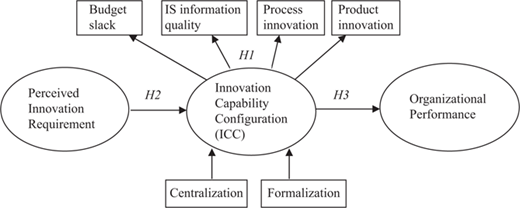
When given a high level of budget slack, managers may ignore the importance of IS and the quality of information. Such ignorance is detrimental to process and product innovations. A low level of budget slack would encourage them to focus on the effective use of IS information, which is critical to process control and product design (Nohria and Gulati, 1997; Yang et al., 2009). Previous information system research has suggested that a system has better stability and accuracy when the budget is constrained (Wang and Hu, 2010; Ahmadizar and Soltanpanah, 2011). Thus, this study contended that the four factors of ICC constitute an IT manufacturing firm’s innovation capability, and the ICC will demonstrate a greater capacity when the level of budget slack is lower and the degrees of IS information quality, process innovation and product innovation are all higher. Accordingly, the first hypothesis was proposed:
Budget slack, IS information quality, process innovation and product innovation are all positively related to ICC.
2.2 Perceived innovation requirement and ICC
When management of an IT manufacturing company faces technological dynamism and product competition, they would recognize the needs for innovation (Subramanian and Nilakanta, 1996; Nohria and Gulati, 1997; Yang et al., 2009; Jayaram et al., 2014). In the dynamic technological environment, new technologies shorten the life cycle of products. This implies that more product innovation is needed to meet the changing demand of consumers (Nohria and Gulati, 1997; Jayaram et al., 2014). Another environmental condition is competition, which has been seen as a key driver of innovation (Majumdar and Venkataraman, 1993). In a highly competitive environment, the market is fragmented and the profit from a new product will shrink. In such an adverse environment, businesses need to maintain their market share through price competition. They will be driven to engage in process innovation to reduce production costs and create a competitive advantage (Covin et al., 1999; Lumpkin and Dess, 2001; Jayaram et al., 2014). In addition, appropriate budget slack provides financial resources needed for innovative experimentation in a contingent environment (Nohria and Gulati, 1997), and high-quality information can help enhance a firm’s competitive position by providing market and production relevant information (Davila, 2000; Bisbe and Otley, 2004; Yang et al., 2009). Therefore, this study deemed that perceived innovation requirement which is associated with technological dynamism and environmental competition promotes the formation of the innovation capability constituted by the four factors. The second hypothesis was proposed:
Perceived innovation requirement is positively related to ICC.
2.3 Organizational performance and ICC
Organizational performance is the result of business operation, and normally, is comprised of financial indicators such as return on assets (ROA) and return on equity (ROE), and non-financial indicators such as market share and sales growth (Subramanian and Nilakanta, 1996; Jayaram et al., 2014). With regard to the relationship between innovation and organizational performance, previous studies have mixed findings, not always confirming the positive proposition (Damanpour et al., 1989; Damanpour and Evan, 1990; Subramanian and Nilakanta, 1996; Kafouros et al., 2008; Kafetzopoulos and Psomas, 2015). For instance, Damanpour and Evan (1990) found no difference in organizational performance among firms with different levels of innovations. Kafetzopoulos and Psomas (2015) pointed out that the relationship between innovation and firm performance is only partially established. A plausible explanation is that these studies simply focused on the impact of product innovation and process innovation on organizational performance. Product innovation can generate revenue and a higher market share, while process innovation can reduce production costs. However, if the four factors of innovation capability are considered, the impact of innovation on performance is not just a result of product and process innovations. Jayaram et al. (2014) argued that inadequate financial resources inhibit innovation and subsequently reduce the performance of an organization in the aspects of return on investment and ROA. Therefore, a sufficient budget is an indispensable factor for improving an organization’s innovation performance. However, too much innovation budget would be harmful to the performance (Nohria and Gulati, 1997; Dunk, 2007). In addition, the high quality of IS information ensures that relevant production information is provided (Bisbe and Otley, 2004; Todtling et al., 2009). It can help improve product quality, attract more consumers and generate more revenue. This study argued that ICC formed by the four factors has a positive impact on organizational performance and thus proposed the third hypothesis:
ICC is positively related to organizational performance.
3. Research methodology
Figure 1 is the conceptual model of this study, which depicts the relationships among research variables and shows the related hypotheses. To validate the research hypotheses, a structural equation model (SEM) was constructed and a cross-sectional questionnaire survey was employed in this study. The survey period was from March 2016 to June 2016. The items of measuring variables in the questionnaire were adopted from past studies, thus the questionnaire has content validity. In addition, the draft of questionnaire has been reviewed by three professors and two industry managers before completing. Therefore, the questionnaire also has expert validity. The content of the questionnaire is divided into three parts. The first part is the cover letter, which informs research subjects the research purpose, the protection and confidentiality practice and researchers’ gratitude. The second part is the main body of the questionnaire, which contains the rules for answer and measurement items. The third part is individual information of the subjects, including working department, age and service years. The questionnaire was sent to a company’s personnel department by post mail enclosed in a package containing a self-addressed stamped envelope. A phone call was followed up to track receipt and distribution of the questionnaire. Once the subjects completed the questionnaire mailing it directly back to the researcher.
3.1 Population and samples
The population of this research is companies in IT manufacturing industry including semiconductor, computer and peripheral equipment and optoelectronic. These companies are all listed on the Taiwan Stock Exchange or Over-The-Counter markets. The population number was 379 covering all companies in the three IT manufacturing industries. This study randomly selected 300 companies from the population as samples, accounting for about 80 percent of the population. The research subjects were the managers of production department and R&D department of the companies. Only production and R&D managers were investigated because their jobs are closely related to innovation activities. The questionnaire was issued to 830 managers in total and 226 responses were received. Later, seven invalid responses were excluded due to incomplete answers. Therefore, 219 responses were available for data analysis, yielding an effective recovery rate of 26.39 percent. The average age of the respondents was 38.72 years old and the average service duration in their current position was 5.61 years. They all worked for either production department (57.32 percent) or R&D department (42.68 present). Table I presents the detailed information of the population and samples.
3.2 Measurement
All items used to measure the research variables were rated on a seven-point Likert scale[2] as in prior studies such as Slepniov et al. (2014) and Kafetzopoulos and Psomas (2015). These items are presented in Table II. The measurement of research variable is explained as follows.
ICC
Budget slack is operationally defined in this study as the resources in excess of the necessary to produce a given level of organizational output. Following Yang et al. (2009), budget slack was measured using two questions adapted from Nohria and Gulati (1997). The two questions are as follows: assume that due to some sudden development, 10 percent of the time of all the people working in your department has to be spent on work totally unconnected with the task and responsibilities of your department. How seriously will your output be affected over the next year? Assume that due to a similar development, your department’s annual operation budget is reduced by 10 percent. How significantly will your work be affected over the next year? The score for each of these questions ranges from 1 (output will not be affected) indicating the level of budget slack is the highest, to 7 (output will fall by 20 percent or more) indicating the level of budget slack is the lowest, while the median value 4 represents that output will fall by about 10 percent, which is the same as the reduction in resources. The final degree of budget slack is determined by the average score for the two questions, and a higher score indicates smaller slack.
Quality of IS information is operationally defined as the accuracy, timeliness, reliability, completeness and relevancy of information provided by the IS. The quality of IS information was measured using five items developed by Teng et al. (1995). Subjects were asked to rate the IS information quality along the above five criteria on a scale, where 1 denotes very low and 7 denotes very high. The average score for the five items indicates the level of IS information quality. A higher score indicates higher quality.
Process innovation is defined as the extent to which the latest technology is used and the speed of technological change in the production process. Product innovation is related to the novelty of products, the speed of product development, the number of new products that have been introduced into the market and the number of new products being first to market. Based on the above definitions, the four items and five items were used to measure process innovation and product innovation, respectively, as in previous studies (Deshpande et al., 1993; Avlonitis et al., 1994; Bisbe and Otley, 2004; Yang et al., 2009). The average score for these items is used to represent the degree of innovation in the respondent’s company. A higher score indicates a higher degree of innovation.
Perceived innovation requirement
Several studies have pointed out that environmental conditions, including competition and technological dynamism, drive innovation (Nohria and Gulati, 1997; Yang et al., 2009; Jayaram et al., 2014). From this viewpoint, this study suggested that environmental competition and technological dynamism are elements that directly affect the management’s perception of the innovation requirement for the company. In terms of measurement, the same instrument as in Nohria and Gulati (1997) and Yang et al. (2009) was used. Subjects were asked to answer two questions about environmental competition and technological dynamism on a scale ranging from 1 (very low) to 7 (very high). The higher the average score, the greater the perceived innovation requirement.
Organizational performance
Organizational performance was measured using both financial and non-financial indicators (Subramanian and Nilakanta, 1996; Jayaram et al., 2014). Subjects were asked to evaluate their firm’s performance relative to the industry’s average on financial indices, including ROA and ROE, and non-financial indices, including market share and sales growth on a scale from 1 (well below) to 7 (well above). The higher the average score, the higher the organizational performance.
Control variables – centralization and formalization
Since centralization and formalization are the internal control mechanisms that may significantly affect R&D expenditures and allocation of resources for innovation (Subramanian and Nilakanta, 1996; Yang et al., 2009), this study thus adopted these two internal control systems as control variables. Centralization refers to the extent to which the power for decision making concentrates in particular persons in an organized hierarchical structure. Formalization is the degree to which the company strictly follows a set of formal procedures, rules and manuals as guidelines for work and decision making (Subramanian and Nilakanta, 1996; Yang et al., 2009). The measures of centralization and formalization in this study were the same as in Yang et al. (2009). To measure centralization, subjects were asked to assess their power for making five types of decisions on a scale from 1 (very low) to 7 (very high). The average score indicates the degree of centralization in the company, and a higher score indicates a lower level of centralization. As for formalization, subjects were asked to assess the extent to which they agree with five questions about the implementation of task rules, policies, manuals and job descriptions on a scale from 1 (very disagree) to 7 (very agree). The average score indicates the degree of formalization in the company. A higher score indicates a higher level of formalization.
3.3 Analysis method
This study used a series of statistical tools and techniques to effectively analyze research data. SPSS was employed to analyze for normality, descriptive statistics and reliability of research data, and also for correlation analysis among research variables. In order to further test the convergent validity and discriminant validity of the measurement, and judging the unidimensionality of research variables, this study used LISREL statistical software to perform confirmatory factor analysis (CFA). In addition, LISREL was also used to estimate the path coefficients of the structural model and thus to verify the research hypotheses. Assessment of the overall goodness of fit for the measurement analysis model and SEM is based on a combination of goodness-of-fit indices (GFIs), namely χ2 value , GFI, adjusted goodness-of-fit index (AGFI), non-normed fit index (NNFI), comparative fit index (CFI) and root-mean-square error of approximation (RMSEA). For a good model fit, the χ2 value should be insignificant (Carmines and McIver, 1981), and the values of GFI, AGFI and NNFI are all recommended to reach above 0.9 (Hu and Bentler, 1999; Bentler and Bonett, 1980), CFI is above 0.95 (Bentler, 1990) and RMSEA is less than 0.08 (McDonald and Ho, 2002).
4. Results
4.1 Descriptive statistics and correlation analysis
Before analyzing the various statistical parameters, the assumption that the research data are normally distributed was tested. The results of the normality test of data in the dependent variable indicated that the Kolmogorov–Smirnor statistic was not significant (p=0.241), thus, the assumption that the data are normally distributed was not rejected. In order to understand the characteristics of the research data, the descriptive statistical analysis and correlation analysis were implemented. Table III shows the descriptive statistics including number of items, theoretical range of scores, minimum, maximum, mean values and standard deviation for each variable. From the values of maximum, minimum and mean, it is worth to note that the firm’s budget slack tends to be low and the degree of centralization is not high, which indicate that budget resources are subject to a certain degree of control and the situation of centralized power is not obvious. However, the IS information quality, process innovation, product innovation, perceived innovation requirement and organizational performance all have a high tendency, indicating that these variables are important and valued by companies. For correlation analysis, since the Pearson correlation analysis is applicable to continuity variables (Chen and Popovich, 2002), such as variables in this study, it is thus appropriate to compute Pearson correlation coefficient between research variables. The correlation coefficients are presented in Table IV. There is no significant correlation between budget slack and IS information quality, but both of them are correlated with process innovation and product innovation, and the two innovations are closely correlated, thus implying that budget slack and quality of IS information are necessary for supporting process and product innovations. Furthermore, in addition to a significant positive correlation between perceived innovation requirement and organizational performance, both of them have a significant correlation with the four factors of ICC, suggesting that there are certain relationships among the three latent variables. Centralization has a positive correlation with process innovation, suggesting centralization would hinder process innovation. There is a positive correlation between formalization and IS information quality, implying that formalization is conducive to the improvement of information quality.
4.2 Validity and reliability of measurement
Because all variables’ measurement of this study comes from previous related studies, the CFA was performed to further check the validity of the measurement. In the analysis, convergent validity was judged by whether the factor loading of variable’s items is greater than 0.5 (Hoskisson et al., 1993), and discriminant validity was determined by whether the square root of a variable’s average variance extracted (AVE) is greater than the correlation coefficients between the variable and other variables (Bagozzi et al., 1991). In addition, Cronbach’s α coefficients were used to assess the reliability of the scales. The results of CFA and Cronbach’s α are presented in Table II. The factor loadings of items are all greater than 0.5 and the measurement model fit results are good (χ2=891.80, df =464, GFI =0.91, AGFI =0.90, NNFI =0.94, CFI =0.96, RMSEA =0.06), which demonstrate that the measurement has convergent validity. As in Table IV, the square root of AVE in each variable is greater than its correlation coefficients, so the measurement meets the criterion for discriminant validity. The results in Table II also show that all Cronbach’s α values are greater than the accepted threshold of 0.7 (Nunnally, 1978). Hence, the unidimensionality of all variables is confirmed.
4.3 Structural model estimation and hypotheses testing
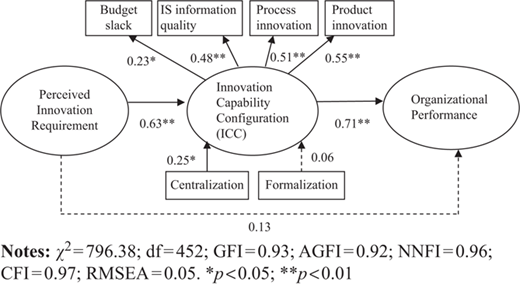
The goodness of fit and estimations of the structural model are presented in Figure 2. The fit indices indicate an acceptable structural model, which can be used to appropriately explain the meaning of the data. The χ2=796.38 (df =452, p=0.31), GFI =0.93, AGFI =0.92, NNFI =0.96, CFI =0.97 and RMSEA =0.05. The path coefficients from ICC to budget slack, IS information quality, process innovation and produce innovation are all positive and significant (0.23, 0.48, 0.51 and 0.55, respectively). This result supports H1. Namely, a firm with a low level of budget slack combined with a high level of information quality, a high degree of process innovation and product innovation is able to exert a higher innovation capability. The path between perceived innovation requirement and ICC is significantly positive (0.63, p<0.01), so H2 is supported. In addition, the path between ICC and organizational performance is also significant (0.71, p<0.01), offering support for H3. However, the relationship between perceived innovation requirement and organizational performance is not significant, indicating that ICC has a full mediation effect in the relationship between the two latent variables. In terms of two control variables, centralization has a positive effect on ICC (0.25, p<0.05). This implies that decentralization would promote the formation of innovation capacity. However, the path coefficient between formalization, another control variable and ICC is not significant (0.06, p>0.1), meaning that a firm’s formalization does not obviously influence its innovation capability.
5. Discussion
Based on the resource-based view and theories of innovation, this study proposed a model of ICC, which consists of budget slack, IS information quality, process innovation and product innovation. It contributes to the existing innovation research by integrating the four factors that can create innovation. Most of the existing studies focused on product innovation and/or process innovations such as Bisbe and Otley (2004) and Yang et al. (2009). The construct of ICC proposed in this study captures the main elements of a firm’s innovative facets and provides a more complete assessment model for a firm’s innovative capability.
From the findings of the present study, there are some interpretations on the hypothesized model and its empirical evidence from IT manufacturing companies. The first point, the proposed model is built on the prior studies in terms of the relationships that exist among various innovation resources (Nelson and Winter, 1982; Subramanian and Nilakanta, 1996; Bisbe and Otley, 2004; Peneder, 2008; Todtling et al., 2009; Yang et al., 2009; Kafetzopoulos and Psomas, 2015), between innovation and a firm’s external environment (Subramanian and Nilakanta, 1996; Nohria and Gulati, 1997; Yang et al., 2009; Jayaram et al., 2014) and between innovation and the resulting performance (Damanpour et al., 1989; Damanpour and Evan, 1990; Subramanian and Nilakanta, 1996; Kafouros et al., 2008; Kafetzopoulos and Psomas, 2015). This study further explores the issues missing from these studies. More specifically, this study introduces a second-order variable “ICC” that can be directly assessed by its first-order factors (i.e. budget slack, IS information quality, process innovation and product innovation). As far as we know, this is the first attempt to establish and confirm the path between the ICC and the four factors. The results confirmed that the four factors are positively associated with ICC. Among them, the positive relation of budget slack to ICC is in line with the argument of opponents of budget slack that high budget slack impedes innovation (Williamson, 1964; Leibenstein, 1969; Jensen, 1986; Nohria and Gulati, 1997; Dunk, 2007; Yang et al., 2009), and does not support the benefits claimed by the proponents. The reason is that budget slack and other ICC factors interact with each other. In terms of the quality of IS information, since high-quality information reduces information asymmetry, it can decrease self-interest behavior of managers and increase the efficiency of using budget resources. On the other hand, under budget constraints, managers will be more devoted to improving the IS information quality, including high accuracy, reliability and relevance, which in turn improve process innovation and product innovation. These interpretations are consistent with the arguments of previous studies such as Nohria and Gulati (1997), Dunk (2007), Wang and Hu (2010) and Ahmadizar and Soltanpanah (2011). The positive link between IS information quality and ICC is in line with the view of Todtling et al. (2009) who believed that good information quality facilitates innovation. As to the positive links between process innovation and ICC, and between product innovation and ICC, these results confirmed the claim of prior studies, such as Yang et al. (2009) and Kafetzopoulos and Psomas (2015), which found that process innovation and/or product innovation are indispensable innovation capability of a company.
The next point in which this study contributes to the body of knowledge is that the conceptual model also examines the relationships between ICC and its antecedent and consequence. The perceived innovation requirement, which is the ICC’s antecedent variable, is aroused by a firm’s external environmental conditions including technological dynamism and product competition. The empirical results demonstrated a positive relationship between perceived innovation requirement and ICC. The finding is the same as the argument of Nohria and Gulati (1997) and Jayaram et al. (2014) which found that the perceived innovation requirement of management stirred by technological dynamism and environmental competition is a key driver of innovation. Another important finding of this study is the significantly positive relationship between ICC and organizational performance. From the viewpoint of innovation capacity, this result clarifies the argument in previous studies that innovation does not necessarily lead to higher organizational performance (Damanpour and Evan, 1990; Kafetzopoulos and Psomas, 2015). Moreover, in the perspective of the relationship between budget slack and organizational performance, Van der Stede (2000) claimed that low-level budget slack caused by rigid budget control will encourage managers to engage in opportunistic earnings manipulation, which is detrimental to the long-term performance of an organization. However, this study found that the integration of low budget slack with high information quality, process innovation and product innovation is conducive to improving organizational performance. In addition, from the whole picture, this study further found that there is no direct relationship between perceived innovation requirement and organizational performance, but that the ICC plays a complete intermediary role between the two. It demonstrates that when firm management recognizes the need for innovation, the firm must produce high innovation capabilities in order to improve organizational performance.
Finally, in this study, the important internal control mechanisms of centralization and formalization were considered being control variables in the model because they may affect the formation of a firm’s innovation capability (Subramanian and Nilakanta, 1996; Yang et al., 2009). The study found that centralization has an adverse effect on innovation capability. However, formalization would not hinder innovation since some policies and rules are still needed for resources allocation and job guidance. These results are consistent with the findings of Subramanian and Nilakanta (1996) and Yang et al. (2009).
6. Conclusions
This study employed a questionnaire survey and collected data from managers of production and R&D departments of IT manufacturing companies listed on the Taiwan Stock Exchange and Over-The-Counter markets. The collected data were carefully analyzed by statistical techniques, such as normality test, reliability analysis, CFA and path estimation of SEM. The results supported all of the proposed hypotheses. The important findings and advantages of this study are stated as follows. First, the two organizational resource of budget slack and IS information quality, and two distinct innovation dimensions of process innovation and product innovation clearly illustrated the construct of ICC, which is a much richer and more complex innovation strategy. The study is the first attempt to integrate these four elements with the expression of a second-order factor, thus improving the past fragmental studies related to these elements in innovation literature. This approach successfully established an innovation capability assessment model for IT manufacturing companies, and contributed to bridge the gap between theory and practice. Second, an evidence provided in this study is that the ICC is impacted by perceived innovation requirements of management. This shows that when IT manufacturing companies are in a highly competitive environment and thus recognize the needs to innovate, they should tactically shape a resource configuration which generates innovation capabilities in response to external environmental shocks. And when the environment becomes more severe, companies will form more solid ICC. Third, an important finding regarding ICC and organizational performance is that the organizational performance is enhanced by a strong ICC. This finding stressed out the suggestion that a company with a high ICC will be rewarded by high organizational performance. Fourth, in the research model, two organizational control systems of centralization and formalization were considered as control variables. The study found that centralization hinders the formation of innovation capabilities. However, formalization does not necessarily impede innovation. At last, from the perspective of the relationships among three latent variables, ICC has a perfect mediation effect between perceived innovation requirement and organizational performance, playing an important pivotal role. This finding reminds and encourages IT manufacturing companies to emphasize the development of innovation capabilities. This is a major strategy for effectively improving organizational performance in an era of innovation.
6.1 Managerial implications
The findings of this study offer important managerial implications with regard to an IT manufacturing firm’s innovation strategy and organizational structure. When a firm’s management perceives a need for innovation due to environmental competition and technological dynamism, it should consider innovation capability in order to sustain competitive advantages and improve overall firm performance. In development of an innovation strategy, a firm is advised to have a low level of budget slack and high-quality information and engage in process and product innovations, which will combine to form a high innovation capacity that can help the firm to cope with challenges in the external environment. This is good news for modern IT manufacturing companies with increasingly tight budget, because the companies do not need to invest a lot of financial resources to produce an innovation capability. In turn, the management can make a more favorable allocation of firm resources. As to organizational structure, in order to reduce obstacles and smooth implementation of innovation, the structure should be appropriately adjusted. This study found that excessive concentration of power can hinder the formation of innovation capabilities. Therefore, the firm should give managers appropriate decision-making authority and discretion for dealing with uncertainties arising from innovation activities. In addition, moderate formalization is feasible for innovation, so it is the responsibility of the management to formulate work rules to guide innovation.
6.2 Limitations and future research recommendations
This study is subject to the following limitations and therefore proposes relevant future research opportunities. First, because all the measurement items of research variables were answered by a manager’s subjective judgment, the common method variance (CMV) might exist in this study (Podsakoff et al., 2003). To check CMV, the Harman’s single-factor test was applied as suggested by Podsakoff and Organ (1986). The result indicated a poor fit (χ2/df=6.52; RMSEA=0.33), and many items had a factor loading lower than 0.5. Hence, CMV would not be a serious problem in this study. Although the result of the test may reduce such a doubt, it is suggested that future studies consider different source of subjects such as managers and their superiors to survey the research. Second, because the response rate of the questionnaire was not high, non-response bias was likely to occur. In order to test the bias, the first 30 responses were compared with the last 30 ones based on the assumption that late respondents represent non-respondents (Armstrong and Overton, 1977). The statistical result of t-test showed no significant difference between the two groups (t=1.07), indicating that non-respondents did not influence the results. To improve this limitation, it is suggested that future studies can include qualitative data such as interviewing firm managers and compare with this study to enrich the content of the research, or to perform a longitudinal study to better understand the causal relationships among the research variables. Finally, the empirical companies of this study are IT manufacturing industry, so it should be cautious to apply the research results to other industries. The twenty-first century is an innovative century. Any industry needs innovation in essence, so the model of this study can be applied to other industries by future research proposals.
Notes
Information processed by information systems can be classified into non-managerial and managerial information. Non-managerial information belongs to an operation-level system and is less relevant to managerial decisions, while managerial information pertains to a type of strategic-level systems including management information and decision-support systems (Anthony, 1965). Since innovation activities are related to subjective judgment, originality and management discretion, this study places an emphasis on managerial information.
Preston and Colman (2000) explored the optimal number of response categories in rating scales from aspects of reliability, validity, discriminating power and respondent preferences. They found that the seven-point scale is superior to the five-point scale in most of these aspects.