This study investigates how digital technologies support the development of resilience capabilities across the agri-food supply chain (AFSC). While prior research has identified multiple resilience capabilities, limited attention has been given to how these capabilities function as a structured system or how digitalisation enables capability development across different AFSC actors. The study addresses this gap by examining how foundational, operational and transformational capabilities emerge and interact in digitally enabled AFSCs.
The research applies a qualitative, planned pragmatic multiple-case study design across six AFSC sub-sectors, including raw material producers, processors, manufacturers and retailers. Combining deductive grounding in resilience and the dynamic capabilities theory with inductive cross-case pattern identification, the study draws on 22 semi-structured interviews and supplementary field materials. The analysis followed an iterative abductive logic, integrating theoretical propositions with emergent insights on capability development and the role of digital technologies.
The study confirms that AFSC actors rely on a shared set of ten core resilience capabilities organised into a hierarchical structure. Foundational capabilities support readiness and rapid response, operational capabilities enable recovery and stabilisation, while transformational capabilities facilitate long-term adaptation and strategic renewal. Digital technologies act as cross-cutting enablers: cloud systems and IoT strengthen foundational visibility, automation and predictive maintenance reinforce operational recovery and advanced analytics and AI support transformational adaptation. The findings validate all three propositions and demonstrate that the relevance of each capability shifts systematically across the resilience cycle.
The study advances the resilience theory by conceptualising resilience as a multi-level capability architecture rather than a flat set of practices. It introduces the Digital Resilience Capability Architecture, which explains how digitalisation enables progression across capability layers. Methodologically, the research demonstrates the value of a planned pragmatic case design for studying complex socio-technical phenomena such as digital resilience in AFSCs.
Quick value overview
Interesting because – The study approaches the challenges of resilience caused by global disruptions affecting key players in AFSCs, namely manufacturing companies, from a new perspective. It highlights the fact that the literature has typically treated resilience as a unified capability, while its levels, maturity and internal hierarchy may vary. The research addresses this gap by presenting an integrated, hierarchical model that shows how digital capabilities support different levels of resilience.
Theoretical value – The study provides a novel interpretative framework for examining SC resilience by conceptualising it not as a set of isolated practices but as a multi-level capability architecture. The developed Digital Resilience Capability Architecture (DRCA) framework uncovers how digitalisation facilitates development across different capability levels. With this approach, the research further develops the theory of DCs, highlighting how resilience becomes a continuously evolving, network-embedded capability system.
Practical value – The research delivers a clear message to practitioners: resilience is not the result of rapid digital investments but a consciously constructed, context-dependent strategic process. Focus is on conscious steps instead of digital leaps. The proposed step-by-step framework helps managers align technology decisions with organisational maturity and resilience goals, avoiding fragmented development.
1. Introduction
In recent years, agri-food supply chains (AFSCs) have been confronted with multiple, overlapping disruptions – such as the Covid-19 pandemic, energy crises across Europe, the Russia–Ukraine war and the changing consumer needs regarding healthy and quality food – that have exposed deep vulnerabilities in globalised, efficiency-driven systems (Farghali et al., 2023; Hobbs, 2021; Matos et al., 2022; Zhang et al., 2023). These disruptions are complex in both scope and consequence: they simultaneously affect input availability, production planning, energy costs, logistics and consumer demand. In the agri-food sector – where perishable goods, regulatory compliance and traceability requirements all increase complexity – these disruptions mean a systemic pressure, which challenge firms’ capacity not only to maintain operations but also to adapt dynamically across all supply chain tiers. Resilience, defined as the ability to absorb, recover and adapt from shocks (Ponomarov and Holcomb, 2009), has thus become a central strategic priority.
While prior research has extensively examined resilience in AFSCs, most studies treat resilience capabilities as a homogeneous set of organisational skills, without distinguishing their scope, maturity or hierarchical interaction (Kamalahmadi and Parast, 2016; Hohenstein et al., 2015; Yadav et al., 2023). Existing approaches (Chen, 2019; Rojo et al., 2018; Jia et al., 2020; Hobbs, 2021) therefore overlook how capabilities evolve and interlink across different levels of resilience building – from maintaining basic operational stability to enabling proactive transformation. The increasing digitalisation of agri-food systems has introduced technological capabilities also, that reshape how firms sense, respond to and recover from disruptions (Birkel and Hartmann, 2020; Finger, 2023; Tortorella et al., 2024). Yet, current literature lacks an integrated framework that explains how digital capabilities support different tiers of resilience capability development. This study addresses this gap by proposing a hierarchical model that distinguishes between the levels of resilience capabilities. Accordingly, the research explores how digital capabilities enable multi-level resilience building in the AFSC.
This study addresses these gaps by investigating how various digital technologies support the multiple levels of resilience capabilities in the entire AFSC. The main research question is, how do different digital technologies enable multi-level resilience building in the AFSC? Based on the dynamic capabilities’ framework (Teece et al., 1997) and the resilience cycle model (Stone and Rahimifard, 2018; Adobor, 2020), the research explores how digital tools enable supply chain actors to prepare for, absorb, recover from and adapt to disruptions. To investigate this question, we employ a qualitative multiple-case study following a pragmatic, iterative analytical logic through 22 semi-structured interviews. This design is well suited to examining complex, context-dependent capability-development processes and enables us to compare how different food supply chain actors (with special emphasis on manufacturing) leverage digital technologies.
The study contributes to the theoretical discourse by introducing a hierarchical framework of resilience capabilities that links digitalisation to multi-level capability development across the AFSC. While prior research often treats resilience capabilities as a uniform construct, this study distinguishes the different levels of capabilities supporting resilience. By empirically demonstrating how digital solutions – such as IoT, ERP, predictive analytics and automation – reinforce these distinct capabilities, the paper explains how resilience evolves from operational stability to dynamic transformation. This multi-level conceptualisation contributes to resilience and dynamic capability theory by clarifying the pathways through which digitalisation shapes organisational adaptability across supply chain tiers. The findings emphasise that digitalisation should be treated not merely as a driver of efficiency but as a strategic enabler of hierarchical resilience, fostering both short-term responsiveness and long-term adaptability.
The paper begins with a literature review of AFSC challenges, dynamic capabilities and digitalisation concluding in the resilience capabilities framework in the agri-food context. Based on the research question and the literature, three research propositions are formulated. This is followed by a description of the qualitative pragmatic case study research design and findings from both within-case and cross-case analyses. The final section concludes with a discussion of key insights, managerial implications, limitations and future research directions.
2. Literature review
In this paper, we examine how digital technologies enhance resilience in AFSCs, with a particular focus on the manufacturing segment, by analysing the interaction between digitalisation and dynamic capabilities across multiple actors. To reach the proper research questions, the literature on the challenges of AFSCs, resilience capabilities and digitalisation is reviewed.
2.1 Influential corporate capabilities contributing to the resilience of the AFSC
As the introduction pointed out, AFSCs need to adapt to multiple kinds of challenges. According to Ivanov (2022), resilience is the capacity to appropriately respond to disruptions and subsequently return to the original state following a disturbance. Resilience can also be characterised by the speed with which a system returns to equilibrium in response to a disturbance, but it is not certain that it will return to the original state (Stone and Rahimifard, 2018). Yao and Meurier (2012) state that resilience is a set of capabilities that enables an organisation or a SC to reach balance again after a crisis situation and respond the changes in the environment (Adobor, 2020; Al Naimi et al., 2022; Pellegrino and Gaudenzi, 2025; Spieske and Birkel, 2021). Resilience can be observed through the adaptive cycle which consists of four stages: readiness, response, recovery and growth/adaptation (Stone and Rahimifard, 2018; Adobor, 2020).
Resilience and its cyclical behaviour describes how companies react to unexpected disruptions, recover and adapt (Christopher and Peck, 2004; Hohenstein et al., 2015; Kamalahmadi and Parast, 2016; Jain et al., 2017; Ponomarov, 2012; Michel-Villareal et al., 2021). Resilience appears as a fundamental management task in dealing with supply chain disruptions (Alhawari et al., 2021), with the aim of restoring operations to either their original or an improved state.
In the readiness phase companies need capabilities to identify and predict environmental risks, use predictive and analytical methods, as well as to strengthen organisational openness to change (Ponomarov and Holcomb, 2009; Teece et al., 1997; Lin et al., 2016; Adobor, 2020; Al Naimi et al., 2022; Spieske and Birkel, 2021). In the response phase, building on previous phase, the activation of business continuity plans, the capability to integrate existing and new knowledge and rapid operational interventions ensure an effective response (Stone and Rahimifard, 2018; Lin et al., 2016; Adobor, 2020; Al Naimi et al., 2022; Spieske and Birkel, 2021; Gaudenzi et al., 2023). The key issue in the recovery phase is building on the implementation of strategies, the development of competencies (Cohen and Levinthal, 1990; Eisenhardt and Martin, 2000; Adobor, 2020; Gaudenzi et al., 2023; Pellegrino and Gaudenzi, 2025; Ali and Mahfouz, 2025). During the growth or adaptation phase, organisations need the capabilities to incorporate lessons learned into their future strategies, respond to market changes and strengthen future resilience through innovation (Teece et al., 1997; Adobor, 2020; Ali and Mahfouz, 2025; Pellegrino and Gaudenzi, 2025; Gaudenzi et al., 2023).
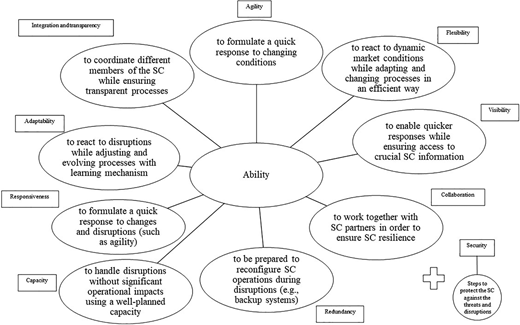
Most studies analysing capabilities necessary to reach resilience are conducted at the corporate or sectoral level (Finger, 2023; Galaz et al., 2021; Ibrahim, 2023), but these form the basis for SC-level resilience. In this paper the theory of dynamic capabilities is applied (Teece et al., 1997) to examine organizational capabilities on SC actor level, which explains how SCs can adapt to a rapidly changing environment (see Figure 1). According to Kochan and Nowicki (2018) and Pettit et al. (2010), the only requirement is security, which is more of a collection of practices designed to protect SCs, but these practices together form the basic structure of dynamic capabilities in SCs.
Classifying capabilities has long been recognised as essential for understanding how firms build, deploy and renew their resource bases under changing environmental conditions. Capability taxonomies help scholars distinguish between routine-based competencies and higher-order mechanisms that enable learning, coordination and strategic renewal (Korhonen and Niemelä, 2005; Denford, 2013). Across the literature, several dominant classification logics can be identified. Many studies differentiate capabilities according to their function within the firm, such as knowledge acquisition, integration and reconfiguration (Denford, 2013; Van Looy et al., 2014). Others propose hierarchical or layered structures, distinguishing basic operational capabilities from more advanced dynamic or strategic capabilities that allow firms to modify existing routines and create new ones (Zhong et al., 2023; Pohjola and Stenholm, 2012). These classifications converge on the idea that capabilities differ in complexity, timescale and organisational embeddedness and that higher-order capabilities build upon and orchestrate more basic ones.
2.2 Digitalisation supporting AFSC resilience
The range of digital technologies used in the SC is very diverse, and so is their impact. In general, Tseng et al. (2021) have shown that the sustainability of SC operations is facilitated by the use of diverse digital platforms, the extent of digital communication and the digital support of labour and manufacturing processes. This suggests that digitalisation may simultaneously contribute to both resilience and sustainability, challenging the notion that these goals are distinct in terms of their temporal focus within SCs (Saravanan et al., 2022).
The use of digital technologies in the SC helps to increase the efficiency of information sharing, communication and collaboration, and the widespread use of platforms increases reliability, agility and efficiency while managing risks (Tseng et al., 2021). IoT increases data exchange, agility and visibility, and hence transparency (Birkel and Hartmann, 2020; Yadav et al., 2023). RFID as an IoT tool can be effective in communicating disruptions with SC partners in case of an unexpected event (Ivanov et al., 2019). Blockchain increases traceability in the SC which, in turn, improves synchronised transactions, reliability, security and cost-effectiveness (Park and Li, 2021). Artificial intelligence (AI) supports SC resilience by ensuring business continuity and can help minimise the impact of disruptive events. AI can increase SC resilience through the development of agent-based systems, generic algorithms and expert systems for prediction and decision making, assuring flexibility, automation and strategic planning (Ghaffarian et al., 2022; Modgil et al., 2022). However, Galaz et al. (2021) emphasise that AI and a high level of automation can lead to trade-offs between resilience and efficiency when the latter is prioritised. Decision making supported by digitalisation might lead to situations where standardisation increases the exposure to hazards (e.g. in the case of decreasing biodiversity) (Nyström et al., 2019). Ivanov et al. (2019) highlight additive manufacturing as a means to achieve a faster, more efficient and resilient SC. Integrating these digital technologies not only strengthens resilience but also enhances traceability which is crucial for ensuring food safety. Improved traceability through technologies such as blockchain allows for meticulous tracking of food products, thus supporting higher standards of food safety and regulatory compliance (Freund, 2023).
While the literature recognises a wide range of digital technologies that can enhance SC resilience, existing studies tend to examine their individual benefits or sector-specific applications. There is limited empirical evidence on how these diverse technologies interact in practice to build resilience across multiple actors in the AFSC.
2.3 Research gap and research propositions
Although digitalisation has become a central theme in the AFSC literature, existing research remains fragmented, with most studies examining isolated technological solutions, individual sectors or specific products rather than the supply chain as an interconnected system. Prior work has demonstrated, for example, that IoT and sensor technologies improve firm-level operational performance and visibility (Yadav et al., 2023), that digital platforms and agricultural social networks strengthen downstream coordination (Tombe and Smuts, 2023) and that machine learning and digital climate services support risk prediction and adaptive responses (Ghaffarian et al., 2022; Simelton and McCampbell, 2021). Yet these contributions largely operate within siloed contexts, focusing on individual actors or isolated disruptions. They do not consider how digital technologies collectively strengthen resilience across multiple SC actors, nor how digitalisation interacts with organisational capabilities along the full resilience cycle.
A further limitation lies in how resilience capabilities are conceptualised. Although capabilities such as agility, flexibility, collaboration and visibility are widely acknowledged, existing studies typically treat them as a homogeneous set and seldom examine how their role, weight and impact differ across the resilience cycle. The literature does not consider that some capabilities may serve as basic prerequisites for disruption absorption, while others become critical during recovery or adaptation. Similarly, prior work does not explain how digitalisation supports the development of capabilities that vary in importance and operate at different levels – from foundational operational capabilities to more strategic, transformative ones. This narrow view prevents a deeper understanding of how resilience is built cumulatively across time and across actors.
For AFSCs – characterised by perishability, strict quality requirements, interdependencies and cumulative risks – this lack of a whole-chain, multi-level perspective represents a critical gap. Addressing disruptions requires considering how capabilities emerge, combine and evolve across readiness, response, recovery and adaptation phases and how digital technologies support this development at different levels of organisational maturity. Therefore, an integrated framework is needed that connects digitalisation, differentiated capability roles and resilience phases within a full supply chain perspective. Responding to this need, the present study investigates: How do digital technologies enable the development of multi-level resilience capabilities across the agri-food supply chain?
To address this question, we formulate three research propositions:
Although AFSC actors face diverse disruptions and resource constraints, their resilience practices rely on a common foundation of key capabilities (Figure 1).
The integration of diverse digital technologies across multiple AFSC actors strengthens these capabilities, enabling organisations to progress from basic operational continuity toward more advanced adaptive and transformative resilience at the supply chain level.
Although a common set of key resilience capabilities can be identified across AFSC actors, these capabilities do not hold equal importance throughout the resilience cycle; rather, their influence varies by phase, supporting resilience at different levels, from foundational readiness and rapid response to operational recovery and longer-term strategic adaptation.
3. Research context
Notably, the global Covid-19 pandemic and climate change have had widespread impacts on all AFSC participants, including consumers, who face price increase, production delays or shortages (Alhawari et al., 2021; Amentae and Gebresenbet, 2021; Blažková et al., 2023; Brouziyne, 2021; Hobbs, 2021; Sekabira et al., 2023; Sridhar et al., 2023). These events have exposed the structural vulnerabilities of AFSCs and their dependence on globalised production and distribution systems. Similar to other complex supply chains, AFSCs operate within tightly coupled systems where disruptions propagate rapidly, often resulting in cascading effects across nodes and tiers (Ivanov, 2020; Müller et al., 2023). The pandemic in particular has served as a natural stress test, revealing the limited adaptive capacity of both upstream producers and downstream distributors to manage sudden shocks. The simultaneous impact of labour shortages, logistic constraints and demand fluctuations contributed to both operational inefficiencies and loss of resilience (Hobbs, 2021). Such disruptions often trigger a bullwhip effect (Lee et al., 1997), magnifying uncertainty and inventory imbalances throughout the chain, placing heavy burdens on manufacturers and retailers alike. Crisis situations typically impact both the upstream and downstream sides of the AFSC, particularly through material shortages and delivery delays, though consumers are generally less affected (Finger, 2023; Kowalska et al., 2023). Moreover, climate-induced shocks – such as droughts, floods or heat waves – further exacerbate production volatility and food insecurity (Fanzo et al., 2025; Yamanoshita, 2022). While consumers may experience short-term disruptions, producers and intermediaries often bear the greatest long-term risks to sustainability and profitability. The growing digitalisation of AFSCs has introduced new layers of interdependence and risk exposure. As digital platforms, IoT systems and blockchain technologies become integral to AFSCs, cyber risks and data vulnerabilities are increasingly recognised as systemic threats (Kuntke et al., 2022). These developments underline the importance of building resilience, agility and integrated risk management frameworks that combine technological innovation with socio-economic adaptability (Christopher and Peck, 2004; Ivanov, 2022).
4. Research methodology
This study applies a qualitative, multiple-case study approach to investigate how digitalisation contributes to the development of resilience capabilities within the Hungarian agri-food industry. Given the complex and context-dependent nature of these processes, a qualitative, case-based design enables an in-depth exploration of the mechanisms and patterns that underpin capability development. The overall research design follows a pragmatic orientation, emphasising practical relevance and iterative learning from empirical data. This comprehensive, planned pragmatic approach, which is unique compared to previous research (Yadav et al., 2023; Tombe and Smuts, 2023; Ghaffarian et al., 2022; Simelton and McCampbell, 2021), enables us to analyse the entire value creation process with a special focus on manufacturers who play a central role in orchestrating value creation and ensuring supply chain resilience. The following sections describe the philosophical foundation, case selection, data collection and analysis procedures in detail. Given the complexity and context dependence of resilience capability development, a qualitative multiple-case study approach is appropriate for capturing real-world dynamics across different AFSC actors (Yin, 2009).
4.1 Research philosophy and design
This study adopts a planned pragmatic multiple-case study design (Eisenhardt, 1989; Steenhuis, 2015) to explore how digitalisation reconfigures resilience capabilities within the Hungarian agri-food sector. Pragmatism provides the overarching philosophical foundation, acknowledging that meaningful knowledge arises from the interaction between theoretical reasoning and empirical experience (Morgan, 2014).
Following this stance, the research integrates theory-informed sensitivity with inductive, theory-building logic. Rather than testing predefined hypotheses, we drew on conceptual insights from the dynamic capabilities and supply-chain-resilience literature as sensitising concepts to guide data collection and early coding. These propositions were iteratively refined as empirical evidence accumulated and cross-case patterns emerged.
The planned pragmatic approach combines the structured, replicative logic of Eisenhardt’s (1989) multiple-case design with the iterative learning orientation highlighted by Steenhuis (2015). This balance between planning and adaptability aligns with the study’s aim to build an empirically grounded yet theoretically meaningful framework of DRCA.
4.2 Research context, case selection and data collection
The European food industry provides a compelling empirical setting for studying resilience under systemic pressure. The sector has faced multiple, overlapping disruptions in recent years – including pandemic-related shocks, energy-market volatility and rapid shifts in consumer demand. These factors make it a natural laboratory for investigating how digitalisation enables and transforms organisational resilience.
The study follows the logic of theoretical sampling (Eisenhardt and Graebner, 2007) to ensure diversity across agri-food industry. Each case represents a distinctive supply-chain configuration within the agri-food industry, allowing both replication and contrastive analysis across varying contexts. The units of analysis are the actors and through them, the entire supply chains. This sampling strategy follows established guidelines for rigorous case study design in operations and supply chain research, which emphasise theoretical diversity, replication logic and cross-case learning (Voss, 2009).
Data was collected through a literature review, semi-structured interviews, direct observations and the analysis of secondary data such as balance sheets and annual reports. These methods reduce potential biases and enhance the reliability of findings. Direct observations at company premises provided further insights into the application of digital technologies, while public documents and open databases offered additional resources. Consistent with the pragmatic stance, the data-collection process was iterative and adaptive: as initial insights emerged, interview questions and focal themes were refined to explore emerging patterns in greater depth (Corbin and Strauss, 2014).
In total, 22 semi-structured interviews were conducted: 20 interviews with AFSC actors including experienced executives and plant managers (for further details on interviewees see Table 1) and further two with trade association leaders. Interviews lasted 1–1.5 hours and were supplemented with follow-up phone calls for clarification. Data collection took place between May 2023 and May 2024.
The interviews were conducted either in person (at the interviewees’ offices) or online (via Microsoft Teams), according to the preferences of the interviewees, with the researchers present in pairs. All participants consented to audio recording. During and after the interviews, both interviewers took separate notes and memos, and the interview transcripts were subsequently transcribed and coded. The audio and written materials from the interviews were stored in a secure location.
4.3 Data analysis
Data analysis followed an iterative comparative process, combining within-case interpretation with cross-case synthesis (Eisenhardt, 1989; Gioia et al., 2013). The procedure unfolded in three stages:
Within-case analysis: Each case was examined individually to identify key events, digitalisation initiatives and resilience-related responses. Open coding captured first-order concepts closely aligned with the language of participants.
Cross-case pattern identification: Codes were compared across SCs to detect recurring structures, interactions and contrasts in capability configurations.
Iterative model refinement: Emerging categories were clustered into higher-order themes representing different capability levels. These relationships were gradually consolidated into a conceptual model of DRCA.
Throughout the process, theoretical constructs from the literature (e.g. dynamic capabilities, resilience capabilities) served as sensitising devices, shaping but not constraining interpretation. This ensured analytical rigour while preserving openness to emergent insights – a hallmark of the planned pragmatic approach.
4.4 Validity and reliability
Multiple strategies were employed to enhance research credibility and robustness:
Construct validity was supported through triangulation across data sources (interviews, internal documents, secondary materials).
Internal validity was strengthened through pattern matching and replication logic across cases.
External validity was addressed via theoretical sampling, ensuring diversity in firm characteristics and supply-chain configurations.
Reliability was achieved by maintaining detailed case protocols, coding memos and an audit trail documenting analytical decisions.
Additionally, preliminary findings were discussed with company representatives for member validation, ensuring that interpretations remained consistent with practitioners’ perspectives.
4.5 Summary of methodological positioning
The study is inductive in its analytical logic yet pragmatic in its philosophical orientation and design. It does not test predetermined hypotheses but builds conceptual understanding through iterative engagement with empirical data, guided by theoretical sensitivity.
The planned pragmatic multiple-case design thus bridges the often-perceived divide between deductive and inductive reasoning. It allows for both disciplined comparison and flexible theory generation – ensuring coherence between research aims, empirical process and the emergent conceptual model of digital resilience capabilities in AFSCs.
5. Findings
The cross-case analysis demonstrates that AFSC actors did not develop resilience through isolated actions but through hierarchically structured bundles of capabilities, shaped by their digital maturity, supply chain position and exposure to disruptions. The emerging hierarchical model provides deeper explanatory power by revealing how these practices collectively form a coherent resilience architecture across the AFSC. Operating in an environment characterised by global shocks, climate volatility, shifting consumer demands and geopolitical tensions, AFSCs – particularly manufacturers – were compelled to mobilise capabilities rapidly to stabilise operations and redesign processes. Based on the literature and the case findings, we propose a three-level capability hierarchy of foundational, operational and transformational capabilities. Foundational capabilities are essential for all SC actors to cope with disruptions and handle readiness and response phases. On the operational level, capabilities help restore routines, recovery and adaptation to some extent, but rather enables a return to something close to the original state. Transformational level resilience capabilities complete adaptation to new circumstances, whether it help establishing completely new corporate routines or redesigning operations. Such distinctions are particularly relevant in contexts characterised by turbulence and discontinuity, where firms must not only maintain functioning operations but also respond to disruptions and develop new patterns of action and routines over time. This provides a strong rationale for examining how resilience-related capabilities may also be structured into coherent levels that reflect their role in stabilising, restoring and renewing organisational processes.
5.1 Foundational capabilities
Foundational capabilities constitute the basic resilience infrastructure required for AFSC actors to anticipate risks, detect early signals of disruption and maintain continuity during the initial shock. These capabilities function primarily in the readiness and response phases, ensuring that systems remain transparent, connected and protected. Collaboration forms the cornerstone of this layer, reflected in strong supplier–buyer coordination, transparent communication channels and cross-departmental cooperation. Such collaboration enables rapid information flow about shortages, quality problems or logistical constraints, allowing actors to mobilise resources swiftly. Visibility, supported by digital tools such as ERP systems, IoT sensors, traceability platforms and cloud-based dashboards, enhances real-time monitoring of inventories, production conditions or animal welfare. This visibility reduces uncertainty, improves situational awareness and supports more informed decision-making. Integration and transparency – often strengthened through vertical integration, shared planning systems or data interfaces like EDI – secure the continuity of material and information flows across organisational boundaries. Finally, security capabilities (e.g. safety stocks, continuity plans, remote work systems, protected digital infrastructures) ensure operational stability when disruptions occur. Collectively, foundational capabilities represent the essential prerequisites for any meaningful resilience response: without them, higher-level adaptive actions cannot be initiated.
5.2 Operational capabilities
Operational capabilities form the second capability layer and are crucial during the recovery phase, when organisations must stabilise operations, restore routines and rebalance supply–demand conditions. These capabilities rely heavily on the presence of foundational elements but extend them toward restoring operational performance. Agility enables rapid adjustment of production schedules, product mixes or sales channels in response to shifting markets. Flexibility reflects the ability to reconfigure processes, labour deployment or equipment utilisation, often supported by automation, cobots, modular machinery or predictive maintenance. Capacity management – through additional warehouse automation, dynamic workforce allocation or robotic handling systems – allows firms to cope with sudden demand spikes or labour shortages. Responsiveness ensures that organisations can quickly implement corrective actions based on real-time data, whether through fine-tuning automated lines, reallocating resources or revising procurement decisions. Digitalisation plays an enabling role here by providing the data, automation and predictive insights needed to maintain flow efficiency. Operational capabilities therefore support a return to near-normal functioning and ensure that firms can re-establish performance after an initial shock. While these capabilities facilitate stabilisation, they do not fundamentally change organisational routines; rather, they focus on effective and efficient restoration.
5.3 Transformational capabilities
Transformational capabilities represent the highest level of resilience development, becoming essential in the adaptation phase, where organisations rebuild routines, redesign processes and create new equilibrium states. These capabilities enable long-term strategic change rather than short-term operational fixes. Adaptability is central here, encompassing a firm’s ability to re-evaluate its organisational model, redesign production systems, adopt new technologies, diversify markets or shift toward climate-resilient production practices. Examples include wine producers investing in climate-adaptive machinery, dairy processors integrating advanced diagnostics and digital platforms or fruit and vegetable processors upgrading entire production lines for automation and traceability. At this level, digitalisation supports not only the continuation of existing workflows but also the reconfiguration of business models, enabling remote-controlled operations, integrated data ecosystems and sophisticated decision-support systems. Redundancy at the transformational level extends beyond safety stocks to encompass structural diversification (e.g. supplier diversification, market expansion, product portfolio changes) and organisational redundancy, such as the ability to draw on wider networks, substitute processes or scale across multiple facilities. These capabilities allow firms not merely to bounce back but to bounce forward, emerging stronger or more competitive after disruptions. Transformational capabilities therefore underpin resilience as a strategic asset and enable long-term renewal across the AFSC.
6. Emergent model: the DRCA
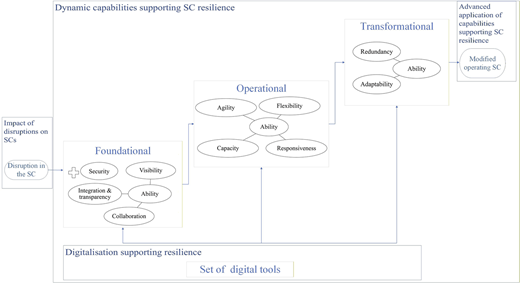
Figure 2 presents the DRCA, derived from the literature and our findings, which conceptualises resilience in AFSCs as a hierarchically structured capability system and supported by digitalisation. The model differentiates three capability layers. Foundational capabilities – collaboration, visibility, security and integration and transparency – ensure transparent information flow and coordinated action, supporting readiness and immediate response (Christopher and Peck, 2004; Pettit et al., 2010). Operational capabilities – agility, flexibility, responsiveness and capacity – enable firms to restore processes and stabilise operations during recovery (Kamalahmadi and Parast, 2016; Rojo et al., 2018). Transformational capabilities – adaptability and redundancy – facilitate long-term renewal, strategic reconfiguration and the establishment of new routines (Teece et al., 1997). Digitalisation functions as a cross-cutting enabler across all three layers, enhancing sensing, data integration, predictive decision-making and process reconfiguration (Ivanov et al., 2019; Modgil et al., 2022).
The model developed has a complexity which consists of complementary conceptions. The hierarchy of capability layers (foundational–operational–transformational) represents a structural layering of organisational capabilities. The layers are concurrent rather than strictly sequential meaning that higher-order abilities presuppose the lower layers but do not replace them, and “leaps” without a solid foundation generally underperform. This is complemented with the resilience cycle (readiness–response–recovery–adaptation) theory which reflects a temporal process, phases recruit capabilities from multiple layers and in varying combinations Thus, the two logics complement each other rather than being identical in structure, since there is no one-to-one correspondence between each phase and each layer but rather numerous interactions, which Figure 2 illustrates.
The DRCA synthesises the dynamic capabilities theory (Teece et al., 1997) and supply chain resilience research (Hohenstein et al., 2015; Stone and Rahimifard, 2018) into a multi-level capability hierarchy, demonstrating that resilience is not a singular ability but a layered architecture that evolves over time. While existing studies recognise various resilience capabilities, they typically treat them as a uniform set (Kamalahmadi and Parast, 2016; Kochan and Nowicki, 2018) or examine them in isolated organisational contexts. The DRCA advances this literature by showing how capabilities differ in their complexity, temporal role and strategic importance, an aspect largely missing from current AFSC scholarship.
Furthermore, the model is valuable because it clarifies the distinct roles of digital technologies at each capability level. Prior work on digitalisation in AFSCs focuses on isolated tools (e.g. IoT, AI, blockchain) or single-sector applications (Yadav et al., 2023; Simelton and McCampbell, 2021). In contrast, the DRCA demonstrates how digitalisation enables capability development at multiple organisational levels – from basic visibility and integration, through agile operational adjustment, to transformational renewal. This integrated perspective helps explain how digital resilience emerges systemically, not merely within individual firms.
Finally, the DRCA is worth developing because it adopts a whole-supply-chain perspective, showing how resilience capabilities mature differently across producers, processors, manufacturers and retailers. This responds to a major gap in resilience literature, which often overlooks the interdependence of actors in AFSCs (Finger, 2023; Ivanov, 2022). By capturing cross-actor patterns, the DRCA provides researchers and practitioners with a comprehensive roadmap for diagnosing capability gaps, designing digital interventions and guiding long-term resilience strategies across the entire AFSC.
Table 2 presents the ten resilience capabilities observed in the cases, along with illustrative quotes and the digital technologies associated with their development. This mapping clearly shows that digitalisation contributes to resilience in differentiated ways, reinforcing the hierarchical capability structure (foundational–operational–transformational) identified in this study.
7. Discussion
7.1 Theoretical contributions
This study contributes to supply chain resilience theory by demonstrating that resilience capabilities in the AFSC form a structured, hierarchical architecture rather than a flat set of equally weighted practices. Although prior research has identified individual capabilities such as agility, flexibility, redundancy or visibility (Pettit et al., 2010; Kamalahmadi and Parast, 2016; Hohenstein et al., 2015), these studies have mostly treated capabilities as parallel constructs. By analysing multiple AFSC sub-sectors and actor types, our findings show that capabilities operate at three distinct levels of resilience maturity – foundational, operational and transformational – consistent with the dynamic capabilities perspective (Teece et al., 1997) and the staged logic of the resilience cycle (Stone and Rahimifard, 2018; Adobor, 2020).
Foundational capabilities (collaboration, visibility, security, integration and transparency) act as basic, routinised enablers of preparedness and rapid response, resembling the simple, experiential dynamic capabilities described by Eisenhardt and Martin (2000). Operational capabilities (agility, flexibility, capacity and responsiveness) help stabilise operations and restore continuity, reflecting the capability configuration mechanisms highlighted by Carvalho et al. (2012) and Jain et al. (2017). Transformational capabilities (adaptability and redundancy) support the redesign of routines and long-term adaptation, consistent with advanced dynamic capabilities that enable strategic renewal (Ponomarov and Holcomb, 2009; Eisenhardt and Martin, 2000).
The DRCA integrates this hierarchy with the resilience cycle and clarifies the differentiated role of digitalisation. Earlier studies highlight digitalisation as an enabler of resilience (Ivanov et al., 2019; Spieske and Birkel, 2021; Yadav et al., 2023), but typically consider its effects in general terms. Our findings show that specific digital tools strengthen distinct capability layers: basic data systems (ERP, IoT, cloud-based traceability) underpin foundational capabilities; automation and predictive technologies support operational capabilities and advanced analytics and integrative platforms foster transformational capabilities. This explains why digitalisation yields different strategic effects depending on capability maturity.
The results support RP1 and RP3 by showing that resilience practices consistently rely on the same foundational capabilities across actors (Christopher and Peck, 2004; Scholten and Schilder, 2015), and that these capabilities contribute unevenly across the resilience cycle. The hierarchy thus offers an integrated theoretical structure for understanding resilience as a multi-level capability system distributed across the AFSC (Ivanov, 2022; Negri et al., 2021; Gaudenzi et al., 2023).
7.2 Methodological contributions
The study also contributes methodologically by applying and refining a planned pragmatic case study design, consistent with iterative, abductive reasoning emphasised in Steenhuis (2015), Eisenhardt (1989) and Gioia et al. (2013). Unlike traditional designs that rely solely on inductive exploration or deductive testing, our approach combines deductive framing (based on capability and resilience theory) with inductive pattern identification across six AFSC sub-sectors.
This approach strengthened the examination of RP2, enabling us to trace how digital technologies support the progression from basic robustness to adaptive and transformative resilience. The planned pragmatic design – structured yet flexible – made it possible to identify how digital tools (ERP, IoT, automation, AI-enabled planning) consistently reinforced foundational capabilities, supported operational improvements and, in some cases, triggered transformational change. This matches the replication logic of case-based theory building emphasised by Eisenhardt and Graebner (2007).
The research process combined theoretical sampling (Glaser and Strauss, 2017), cross-case comparison (Eisenhardt and Graebner, 2007) and abductive refinement (Dubois and Gadde, 2014), allowing iterative movement between data and theory. This approach was particularly well-suited to AFSC research due to the sector’s heterogeneity in technological maturity, product characteristics and regulatory environments. It also allowed the layered capability model and the DRCA framework to emerge organically – structures that would not likely appear through a purely deductive design.
Following Yin (2009) and Voss (2009), the study also demonstrates that multi-actor, multi-sector case designs provide rich contextual depth while still supporting analytically generalisable insights. Thus, the methodological contribution lies in showing how structured pragmatism (Steenhuis, 2015) can generate theory in complex socio-technical systems such as AFSCs.
7.3 Practical contributions
The findings offer actionable guidance for AFSC managers and policymakers by linking digitalisation decisions to a clear capability maturity pathway. Rather than treating digital investments as isolated choices, the DRCA highlights the need to align technological decisions with the three capability layers.
At the foundational level, firms should prioritise digital tools that strengthen visibility, transparency and security – such as ERP systems, IoT-based monitoring, shared databases and sensor-driven quality control. These tools stabilise operations by improving information quality and early disruption detection (Birkel and Hartmann, 2020; Finger, 2023; Ghaffarian et al., 2022; Simelton and McCampbell, 2021).
At the operational level, automation, predictive maintenance, cloud platforms and advanced planning systems enhance agility, flexibility and responsiveness, supporting efficient recovery during shocks (Hobbs, 2021; Finger, 2023).
At the transformational level, technologies such as machine learning, remote diagnostics and integrated SC platforms enable long-term adaptation, business model renewal and strategic repositioning (Matos et al., 2022; Yamanoshita, 2022).
RP1 highlights the universal importance of foundational capabilities; RP2 shows digitalisation as a driver of capability upgrading and RP3 identifies the shifting importance of capabilities across resilience phases. Together, these insights provide a sequenced digitalisation roadmap that aligns technological maturity with resilience objectives. Policymakers can use the findings to direct investments toward digital infrastructure, workforce skills and interoperable data platforms across the AFSC.
The DRCA thus offers a practical diagnostic tool for firms aiming to identify capability gaps, plan digital transitions and coordinate with supply chain partners to enhance resilience system-wide.
8. Conclusion
This study examined how digital technologies enable the development of resilience capabilities across the AFSC. Drawing on a multi-sector, multi-actor qualitative design, the findings confirm that AFSC resilience is driven by a shared set of capabilities, that digitalisation strengthens these capabilities and that their relevance varies across resilience phases. By analysing the full breadth of the AFSC rather than a single node, the study provides a cross-actor perspective on how resilience is constructed in systems exposed to heterogeneous risks and constraints.
The key theoretical contribution lies in demonstrating that resilience capabilities form a hierarchical capability architecture rather than a set of isolated practices. Foundational capabilities enable readiness and rapid response, operational capabilities support recovery and stabilisation and transformational capabilities enable long-term adaptation. Digitalisation acts as a differentiated enabler across these layers: basic data and traceability systems reinforce foundational visibility and integration; automation, predictive tools and cloud-based monitoring strengthen operational flexibility and responsiveness and advanced analytics and integrative platforms support transformational renewal. This layered conceptualisation extends the dynamic capabilities view by showing how digitalisation reshapes resilience as an evolving, multi-level capability system embedded in interdependent supply chain actors.
Practically, the findings show that resilience building is a strategic, context-dependent process. Rather than adopting digital tools piecemeal, AFSC firms should prioritise investments according to their capability maturity: first establishing foundational visibility and collaboration, then enhancing operational agility and flexibility and finally developing transformational capabilities that enable strategic renewal. This sequenced pathway offers managers a structured guide for aligning technological choices with resilience objectives and sectoral characteristics, while also informing policymakers seeking to strengthen AFSC-wide digital infrastructure and coordination.
This research has limitations that open promising avenues for future work. As a qualitative case study, the findings are not statistically generalisable and the cross-sectional nature of the data limits the ability to trace how capabilities evolve over time. Moreover, the heterogeneity of AFSC sub-sectors means that digital maturity, technological constraints and regulatory conditions differ substantially across actors, which may influence how specific digital tools contribute to capability development. The planned pragmatic case design, while well suited for building and refining theoretical propositions, is not designed to test causal relationships or quantify performance effects.
Future research could therefore build on this study in several ways. Longitudinal or mixed-method research could examine how foundational, operational and transformational capabilities develop over time and how digital investments accelerate (or slow) these trajectories. Quantitative or configurational approaches could assess the relative performance effects of different capability combinations and validate the hierarchical capability structure at scale. Actor-level studies could further explore how manufacturers, processors, retailers and primary producers differ in their digital resilience pathways, while ecosystem-level work could investigate the role of regulatory bodies, shared data platforms and collaborative infrastructures in enabling system-wide resilience.
Overall, the study positions resilience as a dynamic, digitally enabled capability architecture that develops across foundational, operational and transformational layers. By clarifying how digital technologies activate and reinforce these layers, the study offers both theoretical insights and practical guidance for designing more robust, adaptive and future-oriented AFSCs.
The authors are truly thankful to the Editor and the anonymous Reviewers for their whole support, precise and persistent work which helped us in improving the paper.