The purpose of this study is to understand how family and ethnic social ties, both as distinct and interrelated forms, support immigrant entrepreneurs in developing their businesses in their host country. This is identified through the following research question: How do family and ethnic social ties support immigrant entrepreneurs in developing their businesses in their host country?
This study draws on the study of three immigrant entrepreneurs from Sweden, who run their businesses in different industries. The study used interviews and complementary data sources such as annual reports and press clips.
The results reveal three concepts of immigrant entrepreneur social ties: (1) the control-based social ties of the immigrant entrepreneur, (2) the responsibility-based social ties of the immigrant entrepreneur, and (3) the inclusive and ethnic urgency-based social ties of the immigrant entrepreneur.
This paper develops three ideas on immigrant entrepreneurs' use of social ties in Sweden. The paper particularly focuses on the central roles of family ties for entrepreneurship in combination with ethnic social ties.
Introduction
The topic of immigrant entrepreneurship and family businesses has gained much interest recently (e.g. Evansluong et al., 2023; Evansluong et al., 2024a; Evansluong et al., 2024b; Malki, 2024). Moreover, immigration has been a topic in many European countries since the 1970s, e.g. in the Netherlands (Rusinovic, 2008) and Sweden (Yazdanfar et al., 2015). Whereas some immigrants entered the labour market as employees, others started their own businesses. Moreover, many of these businesses can be classified as family businesses because family members work together (Selcuk and Suwala, 2020).
The phenomenon of immigrant entrepreneurship has gained growing economic significance in many economies (e.g. Kazlou and Klinthall, 2019; Ramos-Escobar et al., 2022). Immigrant entrepreneurs are recognised as important contributors to economic growth in host countries (Fatoki and Oni, 2014), and with proper planning and support, their impact could be further enhanced (Malki et al., 2022). They are embedded in multiple contexts (Kloosterman, 2010; Kloosterman et al., 1999), meaning that entrepreneurship is substantially shaped by individual traits, host-country business environments, and home-country socio-economic characteristics (Brzozowski, 2017). This understanding of embeddedness has its theoretical roots in Granovetter's seminal argument that economic action is inherently embedded in ongoing social relations (Granovetter, 1985). Consequently, immigrant entrepreneurship is influenced by ethnic communities, family ties across borders (Ljungkvist et al., 2023b), and cultural factors (Selcuk and Suwala, 2020). Social ties between immigrant entrepreneurs and their communities are crucial for facilitating resource exchange and business guidance (Malki et al., 2022), while sustaining supplier and customer relationships essential to entrepreneurial strategies (Tavassoli and Trippl, 2019). Given the significance of these connections, the purpose of this study is to understand how family and ethnic social ties, both as distinct and interrelated forms, support immigrant entrepreneurs in developing their businesses in their host country.
Some research shows that the country of origin matters for immigrant entrepreneurs, for instance, immigrants from OECD countries tend to exhibit higher growth rates (Efendic et al., 2016). Accordingly, we included entrepreneurs from various home countries. Prior studies also demonstrate that family resources influence immigrant entrepreneurial behaviour, while social embeddedness shapes entrepreneurial outcomes (Bagwell, 2018; Selcuk and Suwala, 2020). However, local embeddedness becomes a challenge when the local context fails to provide migrant entrepreneurs with the same conditions as domestic ones. In diverse contexts, it is easier for immigrant entrepreneurs to leverage social ties (Sanders et al., 2002), particularly those rooted in family and ethnic networks (Dana et al., 2020). Previous research highlights the need for further studies examining the nuances and significance of immigrant entrepreneurs' reciprocal social ties, which serve as a means to access essential resources, such as information, funding, and capabilities, which are essential for successfully developing entrepreneurial ventures (Dana et al., 2020; Ramos-Escobar et al., 2022; Yang and Girotto, 2024). In this study, we explore the manifestations of resources available to immigrant entrepreneurs, focusing on the social ties within their family and ethnic community, which leads to the following research question:
How do family and ethnic social ties support immigrant entrepreneurs in developing their businesses in their host country?
In a recent study investigating the literature on migration and family business, Hadri et al. (2023) identified that family plays a central role in immigrant entrepreneurship, although they only identified three studies addressing this topic. Overall, research on ethnic and family involvement in entrepreneurship remains scarce (Kazlou and Klinthall, 2019; Ramos-Escobar et al., 2022), as reflected in the call for this special issue. Studies on social ties are also limited, particularly in the context of immigrant entrepreneurship (Dana et al., 2020; Wigren-Kristoferson et al., 2022). Earlier research showed that immigrants often depend on social ties and close contacts when seeking employment in host countries (e.g. Sanders et al., 2002). However, such reliance presupposes the presence of an ethnic community, as more diverse communities facilitate access to ethnic social ties.
We offer a perspective from Sweden, particularly the story of immigrant entrepreneurs developing businesses in various industries. Illustrations from three cases of immigrant entrepreneurship in Sweden extend the ongoing debate. Sweden has experienced substantial migration inflows in recent decades (Backman et al., 2021), contributing to a rise in entrepreneurship (Heyman et al., 2019). This context makes Sweden a compelling setting for examining how social networks shape immigrant entrepreneurship. Research further highlights that social ties are vital for both integration into Swedish society and entrepreneurial success (Tavassoli and Trippl, 2019). Building on this, we develop a theoretical framework, outline our research method, present empirical findings, and conclude with a discussion of the results.
Literature review
We review the literature on family and ethnic ties and their embeddedness within immigrant entrepreneurship and family firms. The review first outlines the importance of social ties, followed by a joint discussion of immigrant family and ethnic ties, treated here as two forms of social ties (Ramos-Escobar et al., 2022). As both are situated within socially embedded contexts, they are subsequently discussed separately from an embeddedness perspective in the next sections.
Social ties
Immigrant family firms often maintain long-term relationships with stakeholders (Ramos-Escobar et al., 2022), grounded in social ties between family entrepreneurs and their surrounding communities. Some firms even leverage their family image to create a competitive advantage (Arregle et al., 2015), based on the owning family's social embeddedness. Similarly, non-family immigrant entrepreneurs rely on social ties within their ethnic communities (Kloosterman, 2010; Kloosterman et al., 1999), which are often more accessible than non-ethnic or domestic networks. These ties form the basis for broader ethnic networks that shape entrepreneurial activities and business success (Yang and Girotto, 2024), further developed in the next section.
Family and ethnic ties
Immigrant entrepreneurs' family and ethnic ties are often discussed in overlapping terms, lacking clear conceptual distinctions (e.g. Ramos-Escobar et al., 2022; Yang and Girotto, 2024). Li and Johansen (2023) define immigrant family ties as relationships among family members characterised by solidarity, patience, and mutual trust, while Chung et al. (2020) describe ethnic ties as managerial connections with individuals sharing the same country of origin or ethnicity. Although related, the two concepts differ in focus. Family ties are rooted in blood relations, marriage, or close kinship (Arregle et al., 2015; Chrystome, 2010; Dana et al., 2020; Kloosterman, 2010), whereas ethnic ties extend beyond the family to encompass shared culture, language, ethnicity, and beliefs (Dana et al., 2020; Kerr and Kerr, 2020; Kerr and Mandorff, 2023).
Family ties are crucial in determining the success of immigrant entrepreneurs in host countries and are significant for entrepreneurs in general (Arregle et al., 2015). The degree of family involvement in entrepreneurial ventures varies depending on the venture's stage (Klyver, 2007), yet the family remains a key context for entrepreneurial development (Aldrich and Cliff, 2003). Moreover, family ties influence whether immigrant entrepreneurs remain in business and continue their entrepreneurial activities (Bird and Wennberg, 2016). Yet, as Arregle et al. (2015) note, familiness can generate both resource advantages and structural rigidities. Building on this, the present study considers how immigrant entrepreneurs balance the benefits of familiness against the risks of over-embeddedness in kinship-based networks.
With regard to immigrant ethnic ties, a recent literature review identifies both positive and negative implications for immigrant entrepreneurship (Yang and Girotto, 2024). Yang and Girotto (2024) refer to these as dual characteristics, highlighting drawbacks such as confinement to a single ethnic group and the potential exploitation of co-ethnic employees. Moreover, reliance on ethnic ties can reflect a resource constraint. In contrast, access to a broader, multi-ethnic network provides greater diversity and resource richness.
In relation to social ties, immigrant entrepreneurs' resources comprise socially embedded material and immaterial assets, notably family- and ethnically based networks, legitimacy, labour, and financial support (Malki, 2024). Moreover, culture and traditional values shape access to such resources within family and ethnic networks, which serve as key support structures providing capital, labour, and market access (Dana et al., 2020). However, Dana et al. (2020) primarily conceptualise social capital as supportive and cohesive, offering limited attention to its constraining or exclusionary aspects. This study extends that perspective by showing how family and ethnic ties may also impose boundaries and obligations that affect entrepreneurial autonomy.
According to an Italian study by Brzozowski and Cucculelli (2020), immigrant entrepreneurs often maintain ties to their home countries, with entrepreneurial experience and education level influencing the extent of these transnational family ties. The study also shows that strong ties to the same ethnic community in the host country may weaken growth prospects. This tension reflects broader debates in transnational entrepreneurship, where maintaining home-country linkages can both sustain and limit host-country adaptation (Ljungkvist et al., 2023b). Our findings illustrate this ambivalence by showing how entrepreneurs mobilise transnational ties selectively rather than continuously. However, emotional and financial support provided by the ethnic group and family is essential for immigrant entrepreneurs in managing critical uncertainties (Chrysostome, 2010; Chung et al., 2020; Malki et al., 2022; Yang and Girotto, 2024). Accordingly, general business ties to domestic host country entrepreneurs seem to foster more successful immigrant entrepreneurs in terms of growth.
However, ethnic and family ties can be a double-edged sword, providing both support and constraints. Yang and Girotto (2024) show that immigrant entrepreneurs' autonomy is reflected in their need for control and independence in business activities. To preserve this autonomy, they may sometimes refrain from involving family or ethnic contacts (Dana et al., 2020). Nonetheless, family and ethnic involvement can also help leverage networks to address resource constraints (Kerr and Kerr, 2020; Li and Johansen, 2023; Yang and Girotto, 2024), which is often associated with firm growth (Pruthi and Tasavori, 2022). To understand family ties, it is essential to analyse the heterogeneity of families in general and particularly among immigrant entrepreneurs. Families perform various important functions for entrepreneurial ventures (Zellweger et al., 2012) and, for immigrant entrepreneurs, serve multiple roles across home and host countries (Evansluong et al., 2024a, b). Moreover, both ethnic and family-based ties are crucial for accessing networks, shared beliefs, funding, and skills necessary to operate a business (Dana et al., 2020; Ramos-Escobar et al., 2022).
Immigrant entrepreneurship and family embeddedness
The family embeddedness perspective builds on Granovetter's original formulation of embeddedness as the entwinement of economic action within ongoing social relations (Granovetter, 1985). Aldrich and Cliff (2003, p. 577) define embeddedness as “that people are not atomised decision-makers, but rather, are implicated in networks of social relations,” implying that immigrant entrepreneurs' social relationships shape their entrepreneurial activities. Recent research criticises the dichotomous view of embeddedness, either embedded or not (Wigren-Kristoferson et al., 2022; Yetkin and Tunçalp, 2023). Instead, Yetkin and Tunçalp (2023) propose understanding embeddedness as a gradual rather than a binary concept.
Business activities within immigrant entrepreneurship are often organised as family firms (Ljungkvist et al., 2023b). This has been recognised as an emerging research stream, highlighting the decisive influence of family in migrant-run ventures (Hadri et al., 2023). Their study emphasises the importance of family capital in shaping immigrant entrepreneurship. Families affect businesses in various ways: supporting entrepreneurial orientation, shaping socio-cultural contexts, governance, and gender roles, illustrating the embeddedness of entrepreneurial activity within familial and social structures (Hadri et al., 2023). Immigrant entrepreneurs also draw on family ties and experiences from their home countries, often involving family members to compensate for resource constraints (Li and Johansen, 2023). Consequently, most newly established immigrant businesses can be regarded as family firms (Evansluong and Ramírez Pasillas, 2019; Kerr and Kerr, 2020; Li and Johansen, 2023), sometimes across generations. Embedded family relationships also create opportunities, such as enabling women's participation in business—opportunities less common in patriarchal societies (Vershinina et al., 2019). Moreover, through these close and enduring ties, business knowledge, values, and strategies are transferred via informal socialisation (Ramos-Escobar et al., 2022). The family dimension remains an understudied aspect of migrant entrepreneurship (Selcuk and Suwala, 2020) but has recently gained increasing scholarly attention (Evansluong and Ramírez Pasillas, 2019; Evansluong et al., 2023; Ljungkvist et al., 2023b).
However, the phenomenon is heterogeneous (Evansluong et al., 2024a, b), both within the family (Chua et al., 2012) and across home and host countries (Ljungkvist et al., 2023b). Although immigrant businesses are often embedded within the family (Vershinina et al., 2019), relationships among immigrant entrepreneurs are dynamic, evolving over time as social ties are shaped by sociocultural conditions (Rodgers et al., 2019). To fully understand family firms in immigrant entrepreneurship, it is crucial to consider embeddedness, the extent to which entrepreneurs are integrated into social and economic structures (Wigren-Kristoferson et al., 2022).
Immigrant entrepreneurship and ethnic embeddedness
It has long been recognised that immigrant entrepreneurs often operate within ethnically embedded contexts (Kloosterman, 2010; Kloosterman and Rath, 2001; Kloosterman et al., 1999). Being embedded offers access to networks and ties, allowing for ethnic collaboration on entrepreneurial activities (Chung et al., 2020). While much of the immigrant network literature highlights these collaborations, earlier work (e.g. Light and Gold, 2000; Portes, 1998) has been criticised for overlooking how ethnic networks can reinforce dependency and limit outward linkages. This study therefore treats ethnic embeddedness as both an opportunity and a constraint. The trust, solidarity, and social responsibility within ethnic groups form the foundation of ethnic capital, defined by Maani et al. (2015, p. 5) as “an immigrant network that includes markets, resources, and information shared by the group, based on the country of origin, average skill level, group language proficiency, social network, geographical concentration, shared beliefs, and other resources typical of an ethnic group.” Through these networks, immigrant entrepreneurs develop sector-specific expertise (Kerr and Mansdorff, 2023), build trust, and access new markets (Kerr and Kerr, 2020), enhancing legitimacy within both ethnic and broader societal contexts (Ramos-Escobar et al., 2022). Building on this, classic ethnic enclave and ethnic economy research (Light and Gold, 2000; Portes, 1998) shows that co-ethnic networks provide trust, lower transaction costs, and facilitate access to labour, information, and markets. These mechanisms suggest why ethnic embeddedness can both enable and constrain immigrant entrepreneurship. Compared to family ties, ethnic ties are more instrumental, context-dependent, and far-reaching (Dana et al., 2020), providing entrepreneurial embeddedness and fostering resource-based ethnic clans (Tavassoli and Trippl, 2019). However, the most common form of embeddedness arises from family (Aldrich and Cliff, 2003). Within this context, entrepreneurs draw on familial ties but likewise often benefit from ethnically based networks (Dana et al., 2020). Belonging to an entrepreneurial family or ethnic group enhances access to valuable network ties (Ramos-Escobar et al., 2022). Moreover, immigrant entrepreneurs are embedded not only in family and ethnic networks but also across home and host countries, where family connections may differ (Ljungkvist et al., 2023b).
In this paper, we argue that immigrant entrepreneurs are embedded in specific contexts that both support and constrain their entrepreneurial endeavours. In immigrant family firms, the family itself forms a key context. Immigrant families are typically embedded in multiple settings, such as home- and host-country families (e.g. Evansluong et al., 2023; Ljungkvist et al., 2023b). Moreover, immigrant entrepreneurs are often embedded among ethnically like-minded individuals, forming entrepreneurially oriented ethnic clans (Dana et al., 2020).
Method: a case study approach
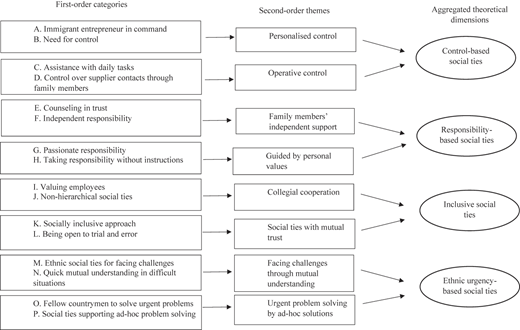
Due to the limited research on immigrant entrepreneurs' social ties, and since these processes are shaped by family dynamics and the entrepreneurial context, which involve advanced social complexity (Selcuk and Suwala, 2020), a case study approach is well justified (Eisenhardt and Graebner, 2007). To conceptualise these social ties and understand the underlying family and ethnic mechanisms, a theoretical framework is required, further supporting the use of an inductive case study design (Corley and Gioia, 2004; Eisenhardt and Graebner, 2007). This approach enables researchers to build on participants' experiences and interpretations, ensuring that theory is grounded in empirical reality (Gioia et al., 2013). To support analytical transparency, Table 1 provides a consolidated overview of case characteristics and data sources, while Figure 1 presents a complete depiction of the analytical flow from raw data to the four aggregate dimensions. Together, these elements document the methodological procedures and illustrate how the empirical material was systematically transformed into the study's conceptual insights. Employing multiple cases allows for comparison and identification of relationships between constructs, facilitating emerging theory development and providing a stronger basis for theory building than a single case study (Yin, 1994; Eisenhardt and Graebner, 2007).
Case selection
In this study, three immigrant entrepreneurs operating in different industries were compared. Two of them managed family businesses, while the third was a co-owner and CEO in a non-family firm. The inclusion of this latter case, the non-family immigrant entrepreneur, served to contrast the two family-based cases. This comparative design enabled an examination of how family-based and non-family (ethnic-based) social ties differ and complement each other in supporting immigrant entrepreneurs. The chosen approach facilitated an understanding of how such family and ethnic social ties assist immigrant entrepreneurs in developing their businesses in the host country. Moreover, it provided deeper insights by comparing the family-based social ties of immigrant entrepreneurs with those underpinning ethnically based entrepreneurship (Eisenhardt and Graebner, 2007).
This study employs theoretical sampling (Eisenhardt et al., 2016), selecting cases that enhance understanding of relationships between conceptualisations and contribute to developing theoretical categories and illustrating constructs (Eisenhardt, 1989). In doing so, the selected cases deepen comprehension and facilitate the identification of diverse immigrant entrepreneurs' social ties and their underlying mechanisms related to firm, family, and ethnicity.
By selecting two immigrant family businesses in different industries (restaurant and imports), this study examines how family social ties support entrepreneurship across contexts, enabling the identification of common patterns. A third case, a non-family IT business, provides contrast and explores how ethnic social ties support immigrant entrepreneurship. In other words, the underlying logic was to reveal both ethnic and family ties in the studied companies. The immigrant family businesses expose both ties explicitly, whereas the IT company illustrates clear ethnic ties. Moreover, the businesses are of different size, allowing to further contextualising the relevance of the ethnic and family ties. Furthermore, IT is a knowledge-intensive industry relying more on professional than family ties, making it particularly interesting to compare with the other two cases. These three firms were chosen from the university's collaboration network, enabling extensive data collection. To ensure diversity, entrepreneurs with Turkish, Chinese, and Icelandic backgrounds were selected.
Finally, the selection of immigrant entrepreneur cases is guided by the following criteria: (1) The entrepreneur should have an immigrant background, (2) the immigrant entrepreneur should hold a key leadership position within either a family or non-family firm, specifically as an owner and/or CEO, and (3) The immigrant entrepreneur should have a central operational role in the daily business activities, in which social ties play an important role. Table 1 below, gives a more detailed overview of the selected cases.
Taken together, the rationale for including both family and non-family immigrant entrepreneurs was directly guided by the study's purpose: To understand how family and ethnic social ties, as distinct yet interrelated forms, support immigrant entrepreneurs in developing their businesses in the host country. This selection reflects the logic of theoretical sampling (Eisenhardt et al., 2016), ensuring analytical depth and alignment with the research question. The cases were deliberately chosen to capture variation across both industry and type of social embeddedness, thereby enabling theoretical as well as empirical contrast. By including two family-based businesses in traditional, low-entry industries (restaurant and import) and one non-family, knowledge-intensive business in the IT sector, the study allows for a systematic comparison of how family and ethnic social ties function under different contextual and structural conditions. From a theoretical standpoint, this variation illustrates different manifestations of social embeddedness among immigrant entrepreneurs, ranging from close kin-based support and control to broader, ethnically grounded collaboration and opportunity development. Such diversity enhances the analytical leverage of the study and enables us to theorise immigrant entrepreneurs' social ties as a dynamic continuum rather than fixed categories of family versus ethnic relations.
Data collection
The data collection strategy was designed to capture multiple dimensions of the social ties outlined in the research question. Interviews and archival data were selected to provide complementary perspectives on how family and ethnic ties manifest in practice. This alignment between case selection and data collection ensured that the empirical material directly addressed the study's aim of understanding how social ties support entrepreneurial development in different organisational contexts.
Data were collected through interviews with entrepreneurs and secondary sources such as annual reports, press clippings, and related documents. A qualitative interview approach was chosen for its suitability in exploring socially complex phenomena requiring contextual interpretation (Qu and Dumay, 2011). This approach is particularly relevant to immigrant entrepreneurship, which often depends on familial and social networks within ethnic communities (Dana et al., 2020). Through qualitative interviews, the researchers examined and interpreted entrepreneurs' and other actors' perceptions of how social ties support entrepreneurial activities (Ramos-Escobar et al., 2022). All interviews were conducted jointly by the authors at the respondents' workplaces in southwestern Sweden, facilitated by the university's collaboration network. In total, 11 on-site interviews were recorded, two in Case 1, three in Case 2, and six in Case 3. The uneven distribution reflects the smaller scale of the immigrant family businesses (Cases 1 and 2), where key themes emerged with fewer interviews due to the entrepreneurs' concentrated social ties. In contrast, the non-family business (Case 3), with a larger and more diverse workforce, required more interviews to capture variations in the immigrant entrepreneur's social ties with both co-ethnic and non-ethnic employees.
All participants and companies were anonymised using pseudonyms. Each interview lasted 45–60 min, providing interviewees with freedom to discuss the company's business concept, operations, and the role of social ties in immigrant entrepreneurship. To explore the impact of immigrant entrepreneurs' social ties (Arregle et al., 2015; Brzozowski and Cucculelli, 2020; Kloosterman and Rath, 2001), questions addressed key areas such as how family ties contributed to strategic and operational advice, access to skills and resources such as labour and capital, commitment and task responsibility, company control, cohesion, emotional support, and the identification of business opportunities and firm development.
The interviews were complemented by archival data, including 33 press clippings from local newspapers and 12 annual reports (Table 1). The press clippings offered insights into specific business events revealing implications for social ties in the entrepreneurial process, such as the restaurant's reopening or the owner-manager receiving an entrepreneurial award. The annual reports provided an overview of company development, including turnover and employee changes, indirectly influencing social ties. Particular attention was paid to the section “Significant events during the financial year,” which offered insights into strategic decisions or key events affecting the entrepreneur's social ties.
To minimise potential bias in understanding immigrant entrepreneurship and associated social ties, interview findings were cross-checked and triangulated with statements made by the entrepreneurs in archival sources (Golden, 1992). For example, the Icelandic entrepreneur's account of key events in the company's development that influenced social ties could be triangulated with both press clippings and annual reports.
Context
This study reports findings on immigrant entrepreneurs across various industries in Sweden. Sweden represents a suitable context for such research due to its long immigration history, dating back to the 1930s, and consistently high immigration levels (SCB, 2025). About 10% of the Swedish workforce is self-employed (Wagman, 2025), and as in most OECD countries, immigrant self-employment exceeds that of native-born entrepreneurs (Tavassoli and Trippl, 2019). Recent restrictive migration policies have reduced asylum immigration, shifting focus toward labour migrants to strengthen competitiveness (Government Offices of Sweden, 2025). Stricter regulations may also foster entrepreneurship as a pathway to economic stability and integration outside traditional labour market structures (Fairlie and Lofstrom, 2015).
As shown in Table 1, the interviewees originate from different countries and operate across various industries, reflecting the multiplicity of immigrant entrepreneurship. Prior research highlights the importance of country of origin (Efendic et al., 2016), showing that it influences firm size and growth rate. Efendic et al. (2016) found that second-generation immigrant firms from OECD countries exhibited higher growth rates than native Swedish firms, while non-OECD immigrant-run businesses demonstrated lower growth rates than domestically run ones.
Background information on the studied case companies
Case 1 is a restaurant owned by a second-generation entrepreneur (Table 2). Founded by immigrant parents initially recruited as factory workers, the restaurant was later taken over by their son, who professionalised and further developed the business.
The entrepreneur in Case 2, originally from China, has operated an import–export business in Sweden for over a decade. The limited company imports tools, machinery, and porcelain for Swedish customers. After briefly employing staff, she chose to work alone due to pressure, relying instead on occasional support from her partner and daughter, who contribute labour and advice (Table 2). Case 3, a university spin-off developing software for financial industry clients, has demonstrated substantial growth in turnover and employee numbers in recent years (Table 2).
As summarised in Table 2, the three cases were selected to capture variation in both social embeddedness and industry context, enhancing theoretical contrast. Case 1, a second-generation family restaurant, exemplifies intergenerational responsibility and control within the family. Case 2, a first-generation import–export entrepreneur, shows how transnational and informal family support can replace formal organisational resources. Case 3, a non-family immigrant entrepreneur in a knowledge-intensive IT firm, illustrates how ethnic rather than familial ties underpin trust, collaboration, and opportunity recognition. Together, these cases reveal distinct constellations of family and ethnic social ties across traditional and knowledge-based industries.
Data analysis
The analytical procedure was guided by the study's aim and research question, focusing on how family and ethnic social ties support immigrant entrepreneurs in developing their businesses in the host country. Accordingly, the data analysis was designed to identify both similarities and differences between family-based and non-family (ethnic-based) cases, thereby linking the comparative case selection to the study's theoretical purpose. This ensured that the analysis remained closely aligned with the overall research aim and contributed to a coherent understanding of how different forms of social ties shape immigrant entrepreneurship. The chosen approach enabled the exploration of nuanced differences in social ties between the three immigrant entrepreneurs, while also allowing for a contrast between family-based and ethnically-based social ties. As a result, a foundational analysis of the distinctions between immigrant entrepreneur family social ties and non-family immigrant entrepreneur social ties could be conducted. The study employed a thorough multistage data analysis approach, a method frequently used in qualitative research (Eisenhardt, 1989).
The data analysis followed a systematic and iterative process inspired by established qualitative research approaches (Eisenhardt, 1989; Gioia et al., 2013). Both authors were actively involved throughout all stages, working collaboratively to interpret and refine the analysis until consensus was reached. The process consisted of four main steps. First, guided by previous conceptualisations of immigrant entrepreneurs' social ties (Arregle et al., 2015; Dana et al., 2020), the authors jointly reviewed the interview transcripts and archival material to identify all excerpts referring to relationships, networks, or social support, which were coded as instances of either family or ethnic social ties. Second, quotations with similar meanings were compared and grouped into first-order categories that captured the respondents' own language and perspectives, see Figure 1.
Third, these first-order categories were examined for underlying meanings and relationships, leading to the development of broader second-order themes that reflected the mechanisms behind the social ties (e.g. personalised control, mutual responsibility). Finally, the second-order themes were aggregated into four overarching theoretical dimensions—control-based, responsibility-based, inclusive, and ethnic urgency-based social ties—that synthesise how different forms of social ties support immigrant entrepreneurs in developing their businesses in the host country. Throughout this iterative process, both authors coded independently, compared interpretations, discussed differences, and refined the categories until theoretical saturation was reached, ensuring analytical rigour and credibility. To ensure analytical rigor, data saturation was considered during the iterative coding process; no new themes emerged as additional data were analysed. Potential researcher bias was mitigated through ongoing reflexive dialogue between the authors, comparing interpretations and discussing alternative categorisations until full agreement was reached.
To enhance analytical transparency, Figure 1 illustrates the progression from raw data to theoretical abstraction. The first-order categories capture participants' language and lived experiences, which were iteratively clustered into second-order themes reflecting underlying relational mechanisms. These themes were then synthesised into four aggregate dimensions, control-based, responsibility-based, inclusive, and ethnic urgency-based social ties, representing the theoretical core of our findings. This progression was continuously refined to ensure conceptual clarity and coherence between the data structure, table, and figure.
Empirical findings
This section presents the findings of the collected empirical material regarding the three immigrant entrepreneurs, illustrating the complexity and relevance of social ties (Ramos-Escobar et al., 2022).
Family and ethnic ties
In the cases studied, entrepreneurs report varying family and ethnic ties (Table 3). In all three cases, the nuclear family resides in Sweden, while the extended family remains abroad, reflecting diverse transnational family structures among the entrepreneurs.
In the following section, we first present key quotations that illustrate how social ties support immigrant entrepreneurs in their entrepreneurial activities (Table 4), forming the basis for the first-order categories (Corley and Gioia, 2004). These categories, in turn, underpin the development of the explanatory aggregate concepts of control-based social ties, responsibility-based social ties, inclusive social ties, and ethnic urgency-based social ties (Figure 1), which are later addressed in the discussion section, where three concluding propositions are formulated. These three forms of social ties represent distinct yet complementary ways through which family and ethnic relationships support immigrant entrepreneurs in developing and sustaining their businesses in the host country. This is followed by a presentation of the entrepreneurial narrative for each case. Hence, a comparative analysis was conducted to identify shared and contrasting patterns in how these ties support business development. Control-based and responsibility-based ties appeared mainly in family contexts, while urgency-based ties were most evident in the ethnic case, illustrating their distinct but interrelated relational mechanisms in practice.
Case 1
The restaurant is a second-generation family business. The business founders came to Sweden as labour migrants from Turkey to work in a factory in the automobile industry. The current owner took over the business from his parents and renovated it completely.
“When I took over, I invested substantially. The restaurant became much bigger. We have 114 places inside and the same number outside on the terrace.” He also states, “In 2008, I bought all the shares in this company.”
When asked about his background, the restaurant owner replies: “I was born here [place in Sweden]. I am Syrian. Christian-orthodox. My parents come from South-East Turkey. They have lived in Sweden since 1974. We are a working-class family.” The respondent, a second-generation entrepreneur under 35, took over the restaurant at a young age, financed by his father and brother-in-law. With limited prior experience, only the brother-in-law had worked in restaurants, the family gradually learned the business. Besides the owner, one brother and one sister are employed at the restaurant, though the owner stresses: “They are employees!” Both, however, work independently, i.e. without instructions, and take full responsibility, treating the business as their own. The owner describes his sister as self-driven and deeply committed, assuming responsibility autonomously and reducing the need for oversight or direction. Furthermore, the respondent also noted that moments of acute workload or staff absence triggered immediate and informal responses among family members. These short-term mobilisations illustrate a comparable urgency logic within family-based ties, where trust and shared understanding enable swift coordination.
Although no longer the official owner, the father of the second-generation restaurateur still plays a central role. The son frequently consults him on major decisions, reflecting strong values of loyalty and responsibility in their social bond (Li and Johansen, 2023), as illustrated in the following quote: “I paid almost nothing [to my father for the restaurant] … he saw that I had accomplished quite a lot of good things and said – congratulations, keep working and take care of this.”
The son summarises his relationship with his dad as, “He is my head. What he says, I do.” But he has stopped asking how the restaurant is doing every day.
In addition to the family members meeting daily at the restaurant, where they also sometimes hold family meetings: “We meet almost daily, and sometimes we have family meetings” [at the restaurant] (second generation business owner), the Syriac Orthodox Church serves as an important gathering place, where staff are occasionally recruited. Interestingly, the restaurant owner reports having around 500 relatives in the city, reflecting the size of the family clan within the Syriac Orthodox Church, which functions as an extended family (Zellweger et al., 2012). He states, “It's a large network, you could say (through the Syriac Orthodox congregation).” This means the congregation members are also a key customer base.
Case 2
During a meeting, the entrepreneur proudly presented a rating confirming her company's solvency and absence of negative credit history. The business focuses on importing goods from China for Swedish customers, with orders largely driven by demand. Although she frequently travels to China, she relies on her family there, mainly her sister, for handling transactions (cf. Bagwell, 2018). The entrepreneur says: “About once a month, I get a container delivered to my warehouse with all the ordered items” (Chinese entrepreneur), which her sister helps her with. This was very important during the Pandemic, when journeys to China were practically impossible. Moreover, in urgent situations, such as disrupted deliveries or unexpected customer demands, her sister is quickly activated to solve problems. This reflects an urgency-oriented response similar in nature to the ethnic-based mobilisation identified in Case 3, though enacted through transnational family ties.
An interesting observation relates to the fact that the entrepreneur communicates with her Swedish customers in English, even though she understands and speaks Swedish. She explains: “You don't have to adjust to the local language in every situation, and it works efficiently for me […]”. One reason is that she did not speak fluent Swedish when starting the company. Using English, a second language for both parties, may create more equal terms and give her greater control over customer relationships.
The entrepreneur lives with her Swedish husband, who assists with practical tasks. Consistent with family firm entrepreneurs' need for control (Ljungkvist et al., 2023a), she remains highly determined and retains full authority over business operations. Her husband confirms: “… she takes all the decisions.” However, he emphasises his willingness to help when possible, noting that shared efforts free time for enjoyable activities and that her success benefits them both, reinforcing mutual support within their relationship. Her husband further explains, “We talk a lot about the business. But we also try to separate work and spare time. Sometimes, it is a lot even on the weekend. But we try to keep it separate. This is spare time, this is work.”
Besides her husband, the entrepreneur has a daughter from a previous relationship. After completing secondary school in Sweden, the daughter studied law in England. Although not involved in the business, she assisted with a legal dispute by drafting a customer letter, helping resolve the issue. The entrepreneur expressed pride in her daughter's skills despite her lack of formal legal training.
Case 3
The business began at a science park close to a university in Sweden. The CEO worked at the university before starting the business with companions at the science park. But this period was quite stressful and he felt burnt out. “I started talking to my childhood friend, who had set up an IT company. He is from the same village in Iceland as me. My friend started the company together with a Swede. They had four or five employees,” His friend said to him, “Come over to us. You can start working as a project leader.”
So, he left his university position to join a start-up, where he is now CEO and co-owner. The immigrant entrepreneur expressed relief upon leaving the pressures of academia: “I don't feel safe if I can't take risks.” Rather than maintaining the organised and predictable life of a university employee, he values his role as CEO. Since risk tolerance varies across ethnic groups (Dana et al., 2020), he links his risk-taking behaviour to Icelandic culture. This attitude also shapes customer relations and social ties. The company's CFO, also of Icelandic background, states: “It's about daring to challenge the customers and their needs”, which is supported by the CEO'sperception. “Starting a new customer relationship is always a bit risk-taking. Our customers are big financial service providers. They are not the easiest or nicest to deal with. It is quite common that they want to squeeze the prices a little further. Then, you have to resist. It is a little like gambling.”
Furthermore, he emphasises how important investing in new products is: “You have to take risks […] if you just live on the existing systems and services, you can milk them for a couple of years, but then we have nothing. Therefore, developing new products and services is essential but also taking a huge risk.” Regarding social ties and risk-taking, the immigrant entrepreneur emphasises that in urgent or critical situations, he prefers collaborating with fellow countrymen rather than Swedes. Drawing on the concept of ethnic capital (Maani et al., 2015), both staff and the entrepreneur noted that Icelandic employees were perceived as more action-oriented. This reliance on shared social ties reflects common values and norms that foster speed and decisiveness in managing critical situations.
According to the respondents, staff with an Icelandic background play a significant role, though the immigrant entrepreneur views Icelandic–Swedish social ties as mutually beneficial. He and the CFO argue that Icelanders' ad-hoc approach complements Swedish problem-solving (cf. Kerr and Mansdorff, 2023), while acknowledging communication differences—Swedes’ conflict avoidance versus Icelanders' directness. Nonetheless, their complementarity becomes evident when the CEO describes the company's purpose:
Build and grow. Create a good return on investment for the shareholders. We are four shareholders [Swedes and Icelanders]. But of course, provide good working environments for fantastic employees. Without them, it doesn’t work. It is not just the entrepreneurs who create output.
The respondents emphasised the importance of a workforce with diverse national backgrounds and genders. The immigrant entrepreneur stated, “I believe that's important. So Swedish men are a minority in this company.” This suggests that, except in urgent or critical situations, immigrant entrepreneurs may adopt a more open approach to diversity, fostering a wider range of social ties. However, the entrepreneur also stressed the need for cultural cohesion: “If anyone threatens the culture we have here, the one we have built together … then there is only one thing to do, and that is to fire that person. They are out.” This illustrates the entrepreneur's strong need for control over the workplace and its social ties.
Overall, although urgency-based ties were most clearly observed in Case 3, traces of similar rapid, trust-based coordination were also evident in the other cases during moments of operational stress. We therefore interpret urgency-based ties as a context-dependent mechanism that can manifest across different industries when immigrant entrepreneurs face high uncertainty and time pressure.
Discussions
This section discusses the significance of autonomy and the role of family and ethnic social ties in immigrant entrepreneurship. The identified forms of social ties (control based, responsibility based and ethnic urgency based) function as mechanisms through which different forms of embeddedness support business development in the host-country context. In this way, the typology translates the broader aim of the study into a set of empirically grounded relational mechanisms that explain how family and ethnic social ties contribute to entrepreneurial development. By comparing patterns across cases, the analysis shows how our mechanism-based view complements existing constructs on immigrant embeddedness and familiness (Arregle et al., 2015; Dana et al., 2020) and responds to calls for more nuanced, context-sensitive explanations (Yang and Girotto, 2024).
There is some evidence that immigration has positive effects on the Swedish labour market in that entrepreneurs benefited from prior reforms (Kazlou and Klinthall, 2019). Nonetheless, such quantitative studies are not able to provide information about the individual immigrants' perspective, which still faces reservations from other participants in the labour market or society at large.
The industrial context
This paper presents findings from three different industries, with all interviewed entrepreneurs having an immigrant background. Each contributes to Swedish society by creating jobs and paying taxes. A common theme is the value placed on autonomy (Yang and Girotto, 2024). They enjoy making independent decisions and resist external control, an essential criterion in entrepreneurship research (Ivanycheva et al., 2024).
Family and ethnic involvement
The cases display different levels of family involvement. It varies between the family as backup and informal extra-resources (Boers and Henschel, 2022b), formally employed family members, and family members as sounding boards (Ljungkvist, 2017). In part, the family is seen and functions as a pool of resources, which immigrant entrepreneurs can access more easily than other resources. Family ties appear strong in Cases 1 and 2, where the entrepreneurs operate in traditional low-entry sectors. Nevertheless, all three entrepreneurs are opportunity-driven rather than necessity-driven (Dheer, 2018), including the Case 3 entrepreneur, who could have pursued an academic career. Whereas control- and responsibility-based ties primarily foster stability, trust, and accountability within family-embedded ventures, ethnic urgency-based social ties provide flexibility, responsiveness, and access to new opportunities beyond the family. Together, these relational logics illustrate how different forms of embeddedness jointly support immigrant entrepreneurs' business development in the host country. Family involvement contributes to familiness, e.g. the creation of unique resources and developing the business (Habbershon et al., 2003). However, the sole involvement of family members in immigrant entrepreneurial businesses is often not sufficient (Li and Johansen, 2023), other non-family resources are crucial, such as venture capital and the ethnic community (Malki et al., 2022; Yang and Girotto's, 2024).
Taken together, the findings indicate that family and ethnic social ties are not separate or mutually exclusive categories but rather interrelated forms of social embeddedness. In the family-based cases (Cases 1 and 2), ethnic affiliation reinforces and extends family ties through shared norms, religious networks, and transnational linkages. Conversely, in the non-family case (Case 3), ethnic ties operate as functional equivalents to family ties by providing trust, loyalty, and problem-solving capabilities in critical situations. This suggests that immigrant entrepreneurs draw upon a dynamic continuum of social ties that shift between family-based and ethnic-based relationships depending on context and need. Family members can help compensate for resource constraints among immigrant entrepreneurs (Li and Johansen, 2023), a feature also seen in non-immigrant small family firms (Boers and Henschel, 2022a). What differs, however, is the family constellation, often spanning both home and host countries, where parts of the entrepreneurial family reside (Evansluong and Ramírez Pasillas, 2019; Ljungkvist et al., 2023b). Consequently, the family and ethnic community's roles as resource providers and sounding boards extend across borders, as reflected in in the immigrant entrepreneur's social ties in the present empirical findings.
Beyond their economic relevance, immigrant entrepreneurs contribute to social cohesion and local development by mobilising family and ethnic social ties. These ties support job creation, cultural integration, and the revitalisation of local economies, particularly in smaller or less diverse regions. Policymakers should therefore view immigrant entrepreneurship not only as an economic activity but also as a means of fostering social integration. The study's conceptual distinctions reveal different pathways of impact: control- and responsibility-based ties enhance business stability, legitimacy, and continuity, while inclusive and ethnic urgency-based ties stimulate problem-solving efficiency, opportunity recognition, and collaboration. Recognising these mechanisms can guide policy and support initiatives that leverage immigrant entrepreneurs' diverse social logics to promote both sustainable economic growth and societal inclusion.
The control-based social ties of the immigrant entrepreneur
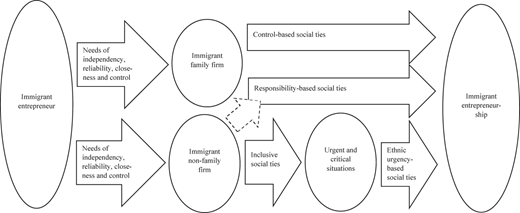
Cases 1 and 2 exhibit a high degree of control of the immigrant entrepreneurs over their businesses. This is not uncommon even for non-immigrant entrepreneurs (e.g. Miller and LeBreton Miller, 2014). However, in the context of immigrant entrepreneurship, it has different connotations. It is not only about possession (this is mine) but also about legitimacy. Being a business owner can give a feeling of psychological ownership (Ljungkvist and Boers, 2020). Nevertheless, Ljungkvist and Boers (2020) mainly examine psychological ownership within stable, domestic family firms. By contrast, this study explores how such ownership feelings interact with migration-related uncertainty, thereby extending the understanding of psychological ownership beyond its original institutional setting. However, immigrant entrepreneurs, particularly founders, typically act as owner-managers and exercise firm control over their businesses. However, legal ownership and psychological ownership are not synonymous. Some legal owners may lack feelings of psychological ownership (Brundin et al., 2023), whereas others may experience such feelings without formal ownership (Ljungkvist and Boers, 2020). Psychological ownership should therefore be regarded as dynamic rather than static (Brundin et al., 2023). The literature emphasises autonomy as an important entrepreneurial motive (Dana et al., 2020; van Gelderen and Jansen, 2006). Van Gelderen and Jansen identified two dimensions of autonomy: decisional freedom, referring to the ability to make one's own choices, and instrumental freedom, referring to the ability to avoid restrictions imposed by others. Both forms of autonomy influence the immigrant entrepreneur's social ties (Dana et al., 2020). In Case 3, the entrepreneur expressed only a limited need for personal control and autonomy. This can partly be explained by the fact that it was not a family business and partly by the complexity of the IT company, which required a more decentralised leadership style (Andersén and Ljungkvist, 2021). Nevertheless, operating in a country other than one's homeland can create a sense of uncertainty. This uncertainty is likely compensated for by a greater need for control and autonomy (De Vries, 2003; Yang and Girotto, 2024), as illustrated in Figure 2. As a mechanism, control-based social ties not only help immigrant entrepreneurs navigate host-country uncertainty but also strengthens their autonomy and perceived legitimacy, which are central drivers of sustained firm performance in foreign environments. By securing a trusted relational base, these ties enable more decisive opportunity pursuit and lower coordination costs, thereby enhancing business development in the host country. This leads to the following proposal:
The immigrant entrepreneurs' need for autonomy and control leads their entrepreneurial endeavours to rely more heavily on close social ties with individuals they know well, i.e. relationships characterised by kinship and common ethnical backgrounds, fostering a sense of control, which can be labelled as control-based social ties.
The responsibility-based social ties of the immigrant entrepreneur
Previous research demonstrates that immigrants' social ties with their home country and compatriots are vital for their entrepreneurial activities (Brzozowski and Cucculelli, 2020). As shown in the empirical cases, these relationships are characterised by responsibility, often of an unpaid nature. In Case 1, the Turkish restaurant entrepreneur receives key entrepreneurial advice from his father, while in Case 2, the Chinese import entrepreneur benefits from her daughter's support, underscoring the importance of deeply embedded family relationships (Li and Johansen, 2023). In Case 3, embedded relationships became significant primarily in solving urgent and complex problems, where shared ethnicity rather than family bonds played a central role. Another notable observation in Case 1 is that the entrepreneur's siblings, though not co-owners, take full responsibility for the restaurant's operations without guidance. The immigrant entrepreneurs' families constitute a context where ties are embedded (Ramos-Escobar et al., 2022), serving as a resource base that partly compensates for other limitations such as financial constraints (Li and Johansen, 2023; Boers and Henschel, 2022b). Responsibility-based social ties are illustrated in Figure 2 as one of two distinct forms of social ties within immigrant family businesses. As a mechanism, responsibility-based social ties create a stable and reliable internal structure that supports continuity and operational efficiency, conditions that are essential for sustaining firm performance and resilience in the host-country context. Through embedded norms of duty and reliability, these ties strengthen the entrepreneur's capacity to sustain daily operations and maintain long-term business viability.
The immigrant entrepreneurs' family members carry out their tasks at the company without instructions or verbal work orders, i.e. the social ties are characterised by a high degree of independence and a high degree of responsibility and reliability.
The inclusive and ethnic urgency-based social ties of the immigrant entrepreneur
Previous research highlights the central role of ethnic social ties in immigrant entrepreneurship, including their importance in handling critical situations (Chrysostome, 2010; Chung et al., 2020). Case 3 offers an interesting example of how a company responds when faced with urgent and challenging circumstances. Although the immigrant entrepreneur viewed Swedes and Icelanders as complementary in entrepreneurial skills and competencies, he chose to manage crises exclusively with employees who shared his own ethnicity. This behaviour may reasonably be explained by his trust in their effective problem-solving abilities, which he attributed to shared values and norms within the immigrant group. However, the company's overall workforce was highly diverse, including various nationalities and genders, with Swedish men in the minority. This apparent paradox (Smith and Lewis, 2011) suggests that diversity provided a wide range of competencies and social ties for everyday operations, while shared ethnicity and communicative efficiency were drawn upon to address urgent issues. Although this pattern was not explicitly evident in Cases 1 and 2, it may also apply there, as family ties can facilitate strong communication and cohesion. These mechanisms of inclusive and urgency-based ethnic ties contribute to the entrepreneur's dynamic capabilities by uniting diversity-driven opportunity recognition with culturally grounded rapid problem-solving. This dual mechanism enhances the firm's capacity to adapt, compete, and sustain growth in the host-country market, particularly under conditions of high uncertainty. Overall, this dynamic can be linked to the organisation's dynamic capabilities, arising from the entrepreneur's ability to reconfigure and maintain a flexible workforce (Helfat and Peteraf, 2015), leading to the following proposal:
The immigrant entrepreneurs tend to be more inclusive in terms of gender and ethnicity in their workforce compared to native entrepreneurs, but ethnically exclusive when it comes to resolving urgent and critical problems, resulting in inclusive and ethnic urgency-based social ties.
Derived from the presented proposals, Figure 2 provides a summary of how the immigrant entrepreneur's social ties support them in their entrepreneurship: The immigrant entrepreneur's need for independence, reliability, closeness, and control influences the social ties in both family businesses and non-family businesses (Figure 2). In family firms, these needs mainly manifest as control- and responsibility-based social ties that support immigrant entrepreneurship (Arregle et al., 2015). In contrast, control-based ties play a smaller role in non-family firms due to the absence of family as a control mechanism (Ljungkvist et al., 2023a). In Case 3, a high-tech company, this pattern is further explained by the firm's complexity, which requires decentralisation and inclusive social ties. However, in critical situations, “ethnic urgency-based social ties” become crucial, as they are grounded in ethnic norms of responsibility and reliability. This also includes “responsibility-based ties” (Figure 2). Yet, the social ties illustrated in Figure 2 are not static, since their emphasis may shift with changing roles and circumstances. Hence, our results indicate that co-ethnic ties are not a general-purpose substitute for organisational coordination. Rather, they are selectively mobilised under urgency, when shared language and codes compress search and negotiation time. In routine operations, entrepreneurs favour inclusive ties to widen skill diversity and legitimacy.
Theoretical contribution
In response to Yang and Girotto's (2024) recent call for more nuanced research on how ethnic and family ties support immigrant entrepreneurs in their host-country endeavours, this study advances the literature by introducing three distinct yet interrelated mechanisms of social ties: control-based, responsibility-based, and urgency-based. These mechanisms explain how immigrant entrepreneurs mobilise social relations under contextual uncertainty. Control-based ties ensure autonomy and trust, responsibility-based ties support task delegation through shared moral duty, and urgency-based ties are activated in acute situations where shared language and cultural codes enable rapid coordination and decision-making. In routine operations, by contrast, entrepreneurs rely more on inclusive and diverse ties to broaden legitimacy and skill variety. By conceptualising social ties as relational mechanisms rather than fixed categories, the study contributes a processual understanding of immigrant entrepreneurs' embeddedness. It clarifies the shifting roles of family and co-ethnic relations in balancing control, responsibility, and urgency, thereby extending prior work on family embeddedness and ethnic network ties (Arregle et al., 2015; Dana et al., 2020; Ramos-Escobar et al., 2022) and answering calls for mechanism-based theorising in immigrant entrepreneurship (Yang and Girotto, 2024). Overall, the framework deepens understanding of how immigrant entrepreneurs orchestrate their family and ethnic relations to navigate uncertainty, coordinate action, and sustain business development across varying contexts.
Managerial implications
Practically, the study raises awareness among immigrant entrepreneurs about different forms of social ties. This understanding helps them interpret why relationships with staff and family members take their specific forms and what drives them. The findings may provide a reflective framework to make the entrepreneurs' social ties more flexible. For example, Proposition 2 may offer immigrant entrepreneurs insights into the paradoxical tension between autonomy and control (Smith and Lewis, 2011), which could explain why they may hold on to relatives with whom they have close social ties for too long. Another example is that Proposition 3 may illuminate the tendency of immigrant entrepreneurs to resolve urgent and critical business problems with employees of their own ethnicity. Such insights could encourage entrepreneurs to seek solutions from other groups within the company, thereby increasing team and organisational flexibility.
Contributions for future research
We suggest the following areas for further investigation. First, we draw on three cases of immigrant entrepreneurs from Sweden. How relevant these cases are empirically for other contexts should be studied further. It is also advisable to use other means of investigation, such as surveys. Nevertheless, we also have to advise that access is an important criterion in order to understand immigrant entrepreneurs. Therefore, interview-based and observation-based studies are a useful method for studying immigrant entrepreneurship. Moreover, other migrants with different ethnic backgrounds could be studied in Sweden. Finally, while this study does not explicitly examine the temporal evolution of family and ethnic social ties, it recognises that these relationships are inherently dynamic. Future research could therefore explore how the roles and interplay of family and ethnic social ties evolve over time and across generations of immigrant entrepreneurs.
Study limitations
This study contains several limitations. First, since the study focuses on three cases situated in Sweden, the reported experiences and findings cannot be generalised; however, they inductively suggest theoretical generalisation (Neubaum and Micelotta, 2021). Second, Sweden has a unique culture (Heinze et al., 2022), which may influence the social networks of immigrant entrepreneurs, i.e. they are embedded to varying degrees in the Swedish context (Yetkin and Tunçalp, 2023). This, in turn, affects the study's comparability with immigrant entrepreneurs operating in other countries. Third, the comparability between the cases was also affected by the immigrant entrepreneurs' differing cultural backgrounds (Hofstede, 1980). Since values and norms influence one's social ties, the immigrant entrepreneurs likely had different perspectives on their social ties, which in turn influenced how these were formed.
Conclusions
As the call for this special issue shows, there are plenty of opportunities to further the understanding of immigrant entrepreneurship. This study aimed to understand how family and ethnic social ties support immigrant entrepreneurs in developing their businesses in their host country. By comparing patterns across the three cases, the study identified how distinct, yet interrelated mechanisms shape these ties in practice. The three empirically derived proposals demonstrate how family and ethnic social ties shape the development of immigrant-owned businesses. Control-based social ties show how kinship and shared ethnicity enable entrepreneurs to exert control over business activities. Responsibility-based social ties highlight how family norms of responsibility and reliability support entrepreneurial efforts. Finally, inclusive and ethnic urgency-based social ties reveal how diversified skills enhance daily operations, while ethnically grounded ties are mobilised to manage urgent or critical situations.