This article explores how relational job crafting unfolded amid the organisational flux of the COVID-19 pandemic. It examines software test engineers (STEs) in a major Irish bank undergoing digital transformation as their work shifted to remote settings. Using a practice theory lens, it examines how relational job crafting enabled individuals and teams to sustain meaning, collaboration, and community through changing work practices, highlighting how STEs co-created belonging and purpose in hybrid environments.
The study adopts an insider ethnographic approach. Data were collected through participant observation, autoethnography, reflexive journalling, field notes and 25 semi-structured interviews with internal and external technology professionals.
Relational job crafting enabled STEs to reshape roles and relationships while working remotely. Through reflexive practices, communication and informal support, technical work was increasingly enacted through ongoing interactions and collaboration, fostering a sense of belonging and collective identity. The findings show how workers generate meaning and contribute strategically amid organisational change and physical distance.
While insider research allow unprecedented access, challenges persist with being faithful and respectful to my colleagues while presenting robust findings. We have obtained ethical approval from both the university and the organisation under study.
Nonetheless, this study carries limitations. As an insider autoethnographic account, the findings are shaped by the lead author's relationships, role and organisational history within the Bank. While this embeddedness afforded depth unavailable to an external researcher, it also introduced risks of over-identification and familiarity. Reflexive techniques, co-author dialogue and the combination of interviews with observational data mitigated, but cannot eliminate, these risks. The focus on a single technology team within one financial institution in a specific national context constrains broad generalisation. However, the contextual specificity that limits generalisability is also a strength of the ethnographic approach, generating situated theoretical insight that invites examination across other organisational settings.
This study provides an insider view of relational job crafting, showing how it supports meaning and connection in remote, technology-mediated contexts. The pandemic created a unique setting to observe the organisational conditions that allow job crafting to emerge. Combining practice theory and autoethnography, the article highlights the overlooked contributions of technical teams in banking and advances understanding of how digital change can foster belonging, identity and strategic relevance at the organisational periphery.
Introduction
The digital transformation of work accelerated as organisations responded to the unprecedented challenges of the COVID-19 pandemic. Across sectors, the pandemic response led to rapid embedding of digital technologies, reshaping how work routines were coordinated and experienced (Carroll and Conboy, 2020; Hodder, 2020; McGuire and Germain, 2023; Cañibano et al., 2026). Workers faced a sudden reconfiguration of not only where work happened but how it happened, prompting re-evaluation of meaning, boundaries and identity (Waizenegger et al., 2020; Kniffin et al., 2021; Aleksić et al., 2024). We draw on practice theory and its focus on the dynamic and relational aspects of everyday work as a valuable lens for understanding how pandemic-driven disruption materialised across everyday routines and socially situated practices in a banking organisation (Tsoukas and Chia, 2002; Baptista et al., 2020).
The study is situated within a major Irish financial institution (the Bank), where the lead author works as a Software Test Engineer (STE). It draws on his autoethnographic experiences as an “insider” or “at home” researcher (Coghlan and Holian, 2007) to explore how the team engaged in relational job crafting during the COVID-19 pandemic once remote working was mandated by the Bank. Job crafting refers to the bottom-up adjustments employees make to align their work with personal values, interests and capabilities (Wrzesniewski and Dutton, 2001; Buonocore et al., 2020). The research was originally conceived as a study of digital transformation in banking, regarding it as a field in flux as traditional banks undergo accelerated digital transformation in response to advanced digital-first FinTech challengers. As the ongoing transformation of work routines (the pandemic-led “new normal”) unfolded during field work, the research evolved and embraced the afforded opportunity to examine how STEs adapted their roles, relationships and sense of belonging through digital collaboration in a remote work environment. The pandemic created an unusually condensed temporal space to surface the meshing of digital transformation at both the organisational level and in everyday practices of relational job crafting.
Digital transformation in banking remains a critical backdrop to this inquiry. This form of organisational change is described as an ongoing organisational process through which disruptive technologies are adopted to enhance productivity, efficiency and value creation (Ebert and Duarte, 2018). Within organisations, information and communication technologies have long served as tools for restructuring control and coordination, enabling new forms of flexibility and efficiency (Orlikowski, 1992, 2007) but also constraining expert autonomy (Schou and Nesheim, 2024). In doing so, they create new opportunities for collaboration, participation and meaning-making at work (Trittin-Ulbrich et al., 2021).
The adoption of digital technologies by banking organisations is not new and has progressed in the last century alongside industry developments, from ATMs in the 1980s to online banking in the late 1990s, reflecting a gradual but significant digital shift (Regini et al., 1999). Since the turn of the century, the rise of the digital economy has intensified these pressures, with new technologies and FinTech competitors challenging traditional banks to innovate and adapt (Friend, 2021; Carney, 2019). New digital challenger banks in the market required incumbent banks to respond by advancing their digital programmes. As digital transformation reshapes work routines (Zuboff, 2019), new roles and tasks emerge. In banking, this brings technology-focused workers into core roles, often requiring career pathways and work routines that differ from core finance staff (Armstrong and West, 2001).
One of these new digital roles in the Bank was that of STE. A role designed with responsibility for assuring that software enabling public “digital first” activities worked as expected. Before the COVID-19 pandemic, the daily routine work of STEs was conducted within the Bank's offices. While the pandemic was not the primary cause of increased digital-first work, it acted as a catalyst, accelerating the pace of adoption, creating a schism with the past and placing STEs in a state of flux and liminality (Turner, 1969; Szakolczai, 2000). Breaking from their normal routines allowed space and conditions to challenge boundaries (Garsten, 1999) and to rebuild and craft their work practices. The ongoing process of re-establishing workplace norms evolved dynamically during the data collection phase of the study. Adopting a practice theory perspective allowed the lead author to use a flexible approach to selecting methods that could elicit meaningful data from the field. Furthermore, it opens the possibility of surfacing the meanings attached to workplaces and routines through the practices associated with relational job crafting.
Integrating practice theory, job crafting and insider ethnography, this article advances understanding of how workers relationally reconstitute work under conditions of rapid digital and organisational transformation. First, it offers situated empirical insight into how STEs sustained collaboration, belonging and continuity through relational job crafting during pandemic-driven remote work. Second, it extends job crafting scholarship by reframing crafting, not solely as an individual or cognitive adjustment, but as a relational practice embedded in shared routines and digitally mediated coordination. Third, it contributes to practice theory by foregrounding how workers actively and reflexively reshape relational engagements in moments of disruption, demonstrating how large-scale processes of digital transformation become lived, negotiated and socially sustained within remote and hybrid work environments.
The article proceeds by first situating job crafting and introducing practice theory, before outlining the methodology, research setting and ethnographic practices. It then presents findings organised around the motivations, techniques and outcomes of relational job crafting, followed by a discussion of their theoretical implications.
Situating job crafting
Job crafting theory offers a human-centred perspective through which to understand the processes used by workers to actively shape and reconfigure the contours of their daily work. Wrzesniewski and Dutton (2001, p. 179) define job crafting as “the physical and cognitive changes individuals make in the task or relational boundaries of their work”. This perspective foregrounds the everyday socio-material practices through which a job is constituted and experienced.
To situate this ethnographic inquiry, it is helpful to return to foundational ideas about the nature of jobs and the agency of workers. Berg et al. (2007, p. 1) defines a job as “a collection of tasks and interpersonal relationships assigned to one person in an organization”. Traditional job design theory conceptualises this process as a top-down endeavour, whereby managers define, prescribe and monitor the scope of employees' roles. Job crafting in contrast reflects a bottom-up approach to job design, one in which employees proactively alter elements of their work to better align with their values, interests and capabilities (Buonocore et al., 2020). Job crafting has evolved from its origins in the work of Wrzesniewski and Dutton (2001) into a broader framework for understanding how individuals seek meaning, identity and agency within their work (Zhang and Parker, 2019). While the theory has been applied in a range of empirical contexts, much of the existing research remains focused on generalisable models (Tims and Bakker, 2010) or survey-based designs (Zhang and Parker, 2019). In this article, we draw on Wrzesniewski and Dutton's original formulation, which is less embedded in managerialist paradigms and more open to interpretive and ethnographic enquiry.
Berg et al. (2007) identify three key phases in the job crafting process: the motivations to craft, the techniques used and the outcomes experienced. Motivations can include a desire for more meaningful social interaction, a need to better manage adversity or a quest for professional growth. Techniques of crafting can involve changing relational dynamics, altering task sequences or reframing the cognitive meaning of work. Outcomes, in turn, may include greater job satisfaction, resilience and the reconfiguration of one's work identity. Job crafting, as a practice, is not a singular event but an ongoing recursive process embedded in day-to-day organisational life that affects shared meanings of identity, culture and performativity (Demir and Knights, 2021). Taking this onboard, Wrzesniewski and Dutton (2001) categorise three forms of job crafting; task, cognitive and relational. Task crafting involves changing the nature, scope, or sequence of work tasks. These changes are often shaped by available job resources and constraints (Tims and Bakker, 2010). Cognitive crafting entails reframing of how individuals understand work infusing it with personal meaning connected to broader organisational or societal goals (Buonocore et al., 2020). Relational crafting involves altering the nature and intensity of one's social interactions at work. This may involve building new relationships, reconfiguring existing ones or redefining the social environment in which work occurs (Wrzesniewski and Dutton, 2001).
Of the three forms of job crafting identified by Wrzesniewski and Dutton (2001), relational crafting is the primary focus of this article. Task and cognitive job crafting are introduced here to situate the broader framework. Relational crafting, unlike its cognitive and task counterparts, is inherently social and collective in character, requiring its outcomes to be co-produced with others. This collective quality makes it particularly amenable to analysis through practice theories and methods. In the context of remote and hybrid work, relational job crafting is especially significant as it shapes not only how tasks are completed but also how identity and community are maintained across dispersed and virtual teams.
Practice theory and organisational transformation
Practice theory provides a relational ontology for understanding workplace routines as constituted through activities that integrate meaning, competence and material arrangements (Shove et al., 2012). Practices, in this sense, are not static learned activities but actions that are continually reconstituted through interaction, adaptation and disruption. Practice theory advances understanding of job tasks as stable routines by emphasising emergent and relational qualities. Additionally, and significantly, it extends job crafting theory from observing individual pursuits to collective actions. From this perspective, individuals are not autonomous designers of work but “carriers of practices”, which are transformed and reproduced by practitioners in situated actions (Reckwitz, 2002; Shove et al., 2012). This does not mean that agency disappears, but rather that it is reconceived. Individuals are part of a process of building links between “proto practices” and enacting, reproducing and reconfiguring them over time (Shove et al., 2012).
This framing is particularly relevant in contexts of rapid organisational transformation where established routines become unsettled and new forms of coordination, identity and meaning-making emerge. Within organisation studies, second-wave practice theorists emphasise emergence, relationality and the ongoing reconstitution of routines through interaction and disruption (Schatzki, 1996; Feldman and Orlikowski, 2011; Ploder and Hamann, 2021). The dynamic nature of practices related to job tasks and work routines benefits studies of practices “in the making” along with methodological openness and sensitivity to change as it unfolds (Katja Schönian, 2026). Practice theory is therefore not simply a theoretical adjunct to job crafting in this article, but a method to better understand how relational connections can be built and sustained by workers in digitised and remote work environments. Without a practice lens, analysis of how workers adapted their relational routines during the pandemic would risk reducing a collective and materially situated accomplishment to a series of individual cognitive re-framings. A practice lens surfaces how workers embody and transfer relational practices as they craft and negotiate new shared ways of working.
Methodology
This study adopts an insider ethnographic approach, informed by practice theory, to examine how relational job crafting unfolds in the context of digital transformation and remote work. The methodology was designed to capture the situated, relational and evolving nature of everyday work practices during a period of organisational disruption.
Research setting: the bank
The empirical setting for this study is a large financial institution, referred to throughout as the Bank. Although banking organisations have expanded in scope and complexity, they are still commonly understood through their traditional financial and economic functions (Longman, 2000; Chambers, 1998), suggesting that their core business remains shaped by enduring historical narratives. Yet banks are distinctive institutions (Fama, 1985), combining economic centrality with deep social and community roles. A number of rich ethnographic and narrative studies illuminate these organisational worlds (including: Heathcote-Márcz, 2019; Ho, 2009; Weeks, 2004; Luyendijk, 2015; Silva and Navarro, 2012). Understanding the Bank solely through its formalised structures risks obscuring the everyday adaptability of workers when pandemic disruption meant established routines could no longer hold. It is precisely this adaptability that the methodology used here was designed to capture.
Employing an insider and autoethnographic approach (Armstrong and West, 2001), the lead author makes use of his embeddedness in the Bank and the STE team to explore the unfolding practices of relational job crafting. Ethnographic research seeks to illuminate the shared values, beliefs and relational practices that define a cultural group, enabling both insiders and outsiders to better understand the social world under study (Ellis et al., 2011). During the active phases of the research, we adopted the view that ethnography is not reducible to a fixed or prescriptive design, but rather “a practice that evolves in design as the study progresses” (O'Reilly, 2012, p. 3). Avoiding highly structured and “methodified” (Ploder and Hamann, 2021) approaches allowed the ethnography to become embedded within the process, remaining responsive to the complexity of organisational life, where practices are often messy, multi-layered and dynamic (Schmid, 2020; Shove et al., 2012; Schatzki, 1996). This stance rejects the tendency to treat organisations as cohesive or unified entities (Gabriel, 1999) and instead acknowledges the diversity of meanings, values and behaviours that constitute everyday work.
Recognising the importance of practice design as being contingent on the researcher's reflexivity to dynamic contexts and situations (Schmid, 2020), the remaining parts of this article are presented in the voice of the lead author as he navigates through the field. Thus, this article presents the lead author's embedded reflections, tracing his shift from office-based work to full-time remote and now hybrid working at the Bank. This account is enriched by interviews, informal conversations and close observation of work practices.
Research approach: insider ethnography
I entered the field, and became an object of the research, aware of the challenges and opportunities of researching within my own organisation (Gottwald et al., 2018). Guided by Ploder and Hamann's (2021) view of ethnography as a weaving of interconnected practices (seeing, listening, documenting and interpreting), I approached the study with openness and reflexivity. Aware of my situated position, I employed several concrete practices to encourage reflexivity: I maintained a research journal to document emerging interpretations and emotional responses to fieldwork; I regularly discussed my positionality with my co-authors to surface assumptions shaped by my insider role; and deliberately paused at moments of familiarity to question if I might be taking any aspect for granted. Schmid's (2020) notion of “extra-methodological dispositions” informed my sensitivity to both my own and my colleagues' experiences. Participant observation (Geertz, 1973) formed the core of my approach, combining immersion in everyday work with reflexive documentation of interactions and positionality.
Conducting research alongside my STE role (Robson, 2002; Coghlan and Holian, 2007) provided access and trust in a commercially sensitive environment (Mercer, 2007; Wainwright and Sambrook, 2010) and deep contextual insight into organisational systems and culture (Coghlan and Brannick, 2005). Familiarity with routines and organisational norms supported ethically attuned engagement (Roth et al., 2007), allowing me to recognise when colleagues felt uncomfortable with questioning and identifying commercially sensitive content of conversations. To ensure transparency, I adopted reflexive and autoethnographic techniques to surface assumptions and avoid reproducing dominant narratives (Alvesson, 2003; Clifford and Marcus, 1986; Gilmore and Kenny, 2015).
Data generation and analysis
Formal ethnographic observational data collection began following ethical approval from my university and consultation with my direct manager in the Bank. At the outset of the research, a key challenge was clarifying to colleagues when I was acting as a researcher or as a co-worker. To address this, the semi-structured interviews allowed interlocutors (all of which have been assigned pseudonyms in this article) to engage with me as a researcher and raise questions or concerns. Each interlocutor received an information sheet and signed an informed consent form. In total, 25 interviews were conducted with technology professionals, including internal employees of the Bank and external subcontractors based overseas (see Table 1).
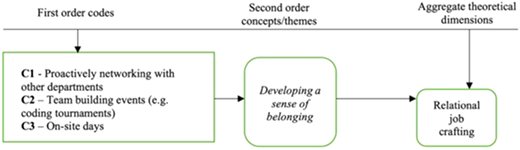
Following an initial period of participant observation and interviews, I began to consider how my colleagues and I negotiated new ways of working during the pandemic. Figure 1 is based on the emergent first-order codes derived from the rigorous data analysis of interviews and ethnographic observations, which include (1) proactively networking with other departments, (2) team-building events (e.g. coding tournaments) and (3) on-site days. At a higher level of abstraction, these codes formed a second-order concept/theme of the desire to develop a sense of belonging within the organisation, which ultimately formed the aggregate theoretical dimension of their respective relational job crafting processes.
Findings: relational job crafting in the STE team
To analyse the importance of relational job crafting, the following sections draw on motivations, techniques and outcomes of relational job crafting observed among members of the STE team during the research period (Berg et al., 2007). The accounts are presented through the lens of “jointly told tales” and impressionist storytelling (Van Maanen, 1988), capturing the complex negotiations of identity, trust and professional legitimacy. Interpreted through the relational job crafting frame with a practice theory lens, they are not solely my experiences but reflect the co-produced patterns identified across interlocutor interviews, informal conversations and ethnographic observations.
As a pre-cursor to the early part of my work, I visited the full-time office environment; my reflexive diary gives an indication of the environment. What had once been a thriving open-plan office was empty on the day.
I walked throughout the Group Website (GWS) space, it was empty and quiet. The building is a large, modern structure consisting of six floors … This 12,000 sqm building accommodates 1,500 staff in a mostly open plan offices.
The layout of each of the six office floors is nearly identical. Each floor has at least two coffee/kitchen areas … These kitchen areas (while small in size) are of great significance to the study. They provide an environment for people from various roles/levels to interact on an equal footing; they break down manager/subordinate hierarchies where casual conversations often happen. In the coffee docks social barriers are removed, making it much easier to forge meaningful professional relationships and “shoot the breeze”.
Motivation for relational job crafting: shared purpose and belonging
When discussing the general work of STEs within the broader technological eco-system of the Bank, a common theme among the interlocutors was a sense of belonging. While collaboration is a common feature of software development and agile work, these discussions had a deeper meaning than just completing the work to a high standard. They tended to focus on intrinsic reactions to being part of something meaningful. A comment made in an interview with Jack brought home to me how important community is in the workplace and how it shapes our decisions and commitment: “until you feel like you belong to an organisation, you might behave differently, depending on the situation”.
Similarly, in underpinning a sense of belonging to the organisation, Jane stated “we felt proud when delivering something” referring to the completion of a significant milestone project, and another stating “as [Bank] employees, we feel invested in the strategic direction of the bank, because we are part of it, and in it for the long-run”. The use of “we” highlighting the importance of communal work in achieving success and being part of both the organisation and the team.
This collective identity and sense of belonging, formed around our roles within the Bank, is additionally influenced by our impact on the social and economic benefit of successful digital customer experiences. Despite our work being removed from the customer, Jerry articulated how they came to understand their role as embedded within the wider customer experience, in this case, when designing mortgage application forms.
As a tester I am committed to always keep the end users' interest in mind and act as a gatekeeper to minimise any fracture or inconvenience during any interaction with the product. I believe that if we work with care and attentiveness, it shines through in the services and user experience.
Throughout our conversations interlocutors regularly highlighted the importance of testing to the Bank's success, especially as it moves towards becoming a “digital relationship bank” (Jane). They were acutely aware of the negative effects, for both the customers and the perception of their abilities if testing is not conducted effectively and failures occur. This sense of shared purpose I highlight as a key motivator to engage in relational job crafting during the sudden change to remote working.
Techniques for relational job crafting: providing online solutions to vulnerable customers
In response to the enormous financial pressure faced by business owners during the pandemic, the Bank sanctioned the commission of Payment Break forms, which were designed to enable customers to suspend loan payments. This critical work was conducted entirely remotely by STEs and developer teams.
Being directly involved in the commissioning of these digital forms and their maintenance, I experienced how proactive networking and shared purpose enhanced collaboration while working entirely remotely. I noted in my diary a deep sense of meaning towards the difference they would make in difficult times. The emotions and uncertainty that surrounded pandemic lockdowns encouraged purposeful action to maintain meaningful relationships with team members, while also necessitating new forms of proactive networking to build relationships with other departments. Knowing that my collaborative work on these forms helped ease customers' anxiety, in turn, alleviated some of my own deeper concerns about the societal effects of the pandemic. This sentiment was shared in an informal conversation with one of the testers, who commented that in a way we are doing our part to help them.
Like for many others, the upheaval in “normal” working life was unprecedented and required us to alter our roles and build new relationships whilst working remotely. As technical staff contributed to alleviating customers' financial distress, I reflected that our roles became vehicles for social contribution during the pandemic.
Techniques for relational job crafting: responding to the digital form outage
A further example of relational job crafting emerging through autonomous but communal practices arose during a digital forms outage in 2024. Upon detection, testers and developers rapidly mobilised, drawing on digital communication tools to coordinate their response.
Although I was focused on the immediate work involved in providing a solution to this problem, I reminded myself to also observe how the teams worked together. It was the first real “crisis” we had faced when working remotely. I noticed how the STEs and other technology teams communicated effectively, utilising the online tools that we had become so familiar with during the pandemic lockdowns. While we discussed the incident, little formal instruction was needed to initiate a series of technical actions carried out entirely remotely across multiple teams. By way of example, I traced how one team promptly executed automated regression test scripts as a contingency measure while my team focused on verifying these actions, thus enabling the software developers to implement a comprehensive solution to the issue.
Upon reflection, and through subsequent discussions within the STE team, we recognised that our coordinated effort was instrumental in resolving the problem swiftly. From both the post-event interviews and my own observations, it became evident that the STEs perceive their organisational identities as dynamic and adaptive, grounded in strong professional relationships (Reflexive diary). Guided by personal relational job crafting processes, they continually cultivate meaningful and fulfilling professional connections that enhance both individual and collective performance (Field notes).
This event led me to reflect on my own personal relational job crafting processes. I often provide informal technical advice, drawing from my background as an e-commerce and analytics specialist. While outside the traditional remit of a tester, this practice builds trust and strengthens collaboration. I noted in my reflexive diary that I make a conscious effort to “offer suggestions in a friendly manner rather than issuing directives”. I do this to share my knowledge to build collegial relations with colleagues. Through my autoethnographic reflections, I feel these relational job crafting practices enhance effectiveness and provide a solid foundation for addressing a crisis event that emerged at a time when remote working was slowly becoming our “new normal.”
Outcomes of relational job crafting: present-day hybrid working
In line with recent international trends, and particularly evident in the latter half of 2025 among Irish banking institutions, employees have increasingly been required to “return-to-the-office.” The Bank has mandated two in-person days weekly, a policy implemented widely across the Irish banking sector despite notable resistance from staff (The Irish Times, 2025). Aligned to this are discussions around the effectiveness of remote and hybrid work, particularly in relation to collegiality and collaboration. A note from my own reflexive journal captures the ambivalence this produced:
From my own observations and discussions with colleagues, the transition back to office-based work has at times proven challenging, particularly after becoming accustomed to full-time remote work. However, I feel on a positive note that increased face-to-face interaction can create opportunities to enhance the progress made with relational job crafting. Management may get a better idea of the dynamics we have developed to achieve our responsibilities over the past years.
The tension between the relational job crafting practices cultivated during remote working and the institutional pull back towards embodied presence frames the outcomes explored in this section. In considering this new organisational mandate, I reflect on how relational job crafting had reshaped what we understood as “normal” work practice, but equally the compromises made to create these new work routines. In doing so, I acknowledge that while I believe the workplace environment individually and collectively created during the pandemic had successful outcomes, it was not always a smooth pathway to achieve this. Ignoring challenges and compromises risks smoothing over a complex and emotional period.
The most telling evidence of compromise and a sense of loss came from Jane, who had been among the most articulate voices on the relational achievements of the pandemic period. Reflecting on the subsequent merger of three teams and the disruption this had brought to the relational fabric the STE team had worked hard to build, they offered this account:
It’s very hard to explain — I think of it like a family before. Now … it’s not really what it used to be. People are a little deflated. It’s probably just natural — but the merge between the three teams made roles and relationships clouded.
Jane is not simply reporting a change in working arrangements; they are describing the partial dissolution of a practice community whose shared meanings, competences and material arrangements had been painstakingly constructed before the pandemic. Relational job crafting practices were built out of existing practices and foundations, and in this period of flux, many hidden values became visible.
Trust and respect are values that are often declared but can be difficult to understand outside of concrete actions. In this context, for the STEs they emerge not from formal protocols or managerial instruction but from the accumulated experience of working across boundaries, which were heightened as a result of pandemic-mandated remote work. What became apparent across interviews and observations was that trust, as an outcome of relational job crafting, was inseparable from the material conditions of digitally mediated work (Shove et al., 2012). In an interview, Joe articulated this most clearly when reflecting on the reciprocal dynamics that had developed between the STE team and their development colleagues:
They have an idea of how they want it to look, but they do know we’re the experts and they will take our advice, they’re very good like that … and they trust us as well. We help them as best we can, because we want to help them carry out what they need … It’s respect back and forth, that’s it.
The phrase “respect back and forth” captures something important about the relational nature of building trust, that it is not deference to hierarchy but negotiated recognition of competence surfaced through embodied practices (Shove et al., 2012). From a practice theory perspective, this represents recognition of skills and knowledge not through job titles but through performing work. While trust and respect made relational crafting feel personally meaningful, collaboration was the outcome that made it organisationally visible.
The shift to remote working did not just disrupt existing collaborative routines; it revealed the importance of informal interactions and the materiality of shared physical space. When the material infrastructure disappeared, taken for granted in-person communication practices required realignment into new shared realities. Jane gave direct expression to this:
We definitely were more collaborative before … It used to be that you could just turn around and ask a question.
This sentiment indicates that what had previously been taken for granted became visible in its absence. Jane goes on to detail the actions taken to overcome this challenge by integrating the Quality Assurance (QA) team into daily work routines. When this was done, it built mutual understanding and created a new form of collaborative work.
I think when we brought the QAs in to the daily sync-up calls … made us understand better what and how the QAs are doing … it’s better for a QA to be part of a team and understand the sprint goals and not jump from task to task … they say like this.
This deliberate act of relational job crafting produced a new collaborative routine that did not just mirror the “on site” routines but became a digitally mediated practice in its own right.
The initial response to the uncertainty of the COVID-19 pandemic and the altered work routines that followed necessitated the STEs developing new practices of collaboration and communication within their own team and externally with additional expert teams. By quickly adopting digital technologies, they built collective work practices that were not just technical but relational. The pandemic had a catalysing effect on an already emerging programme of digital transformation, providing a glimpse into the actions and compromises that workers used to shape and craft their new roles.
Discussion of findings
Guided by a practice-theoretical lens, this study views job crafting as an ongoing, situated process through which individuals and groups reproduce, adapt and re-imagine their work in response to shifting organisational realities. The disruptions caused by the pandemic revealed how relational work became essential to sustaining productivity and well-being in digital environments. In this context, relational job crafting emerged not as an optional supplement to technical work but as the very practice that allowed work to continue meaningfully under uncertain conditions through the collective mobilisation of relational knowledge. The actions taken to reconstitute relational practices were not abstract tendencies or attitudinal orientations. They are identifiable, recurrent and socially shared forms of activity derived through relational job crafting as enacted and embodied practices meshed with meaning, competence and material arrangements. Each of which sustained organisational continuity under conditions of radical disruption.
Naming these practices specifically matters because it addresses a gap in the existing job crafting literature. Much of that literature, including the influential models of Tims and Bakker (2010), identifies job crafting at the level of individual behaviour and attitudinal change. From that vantage point, what the STEs in this study did might be described as expanding their relational resources, seeking feedback or increasing social job demands. A practice theory reading, by contrast, locates the analytical centre of gravity not in the individual worker but in the shared activity itself. As such, it makes visible dimensions of relational job crafting that survey-based and individually focused approaches are structurally unable to see. Communally, the workers observed in this study developed confidence and competence to develop shared approaches to utilising digital methods for communicating, building trust and carrying out integrated work tasks.
Interlocutors' motivations to engage in relational job crafting were tied to their need for connection and purpose during the pandemic's enforced isolation. Aligned with Wrzesniewski and Dutton's (2001) view of relational job crafting as a proactive process through which individuals shape work to reflect their identities and values, the interlocutors described how belonging and professional identity depended on regular, authentic interaction with colleagues. This reflection of how the relational dimension of job crafting sustains meaningful connections questions the position of job crafting as an autonomous and individual pursuit (Berg et al., 2013). The abrupt shift to remote work highlighted how relational job crafting became a collective endeavour of enacted practices through which the various individuals and teams adapted together (Grant, 2007; Leana et al., 2009). From a practice theory perspective, such motivation arises through participation in shared actions that sustain social order and identity (Schatzki, 2002; Gherardi, 2012). For STEs accustomed to structured in-person collaboration, virtual work initially felt depersonalised. Yet, the drive to preserve collegiality and competence-in-practice (Nicolini, 2012) inspired creative relational practices and cross-team collaborations that transcended physical boundaries.
The second stage of job crafting centred on organisational moments intensified by the challenges customers faced during the pandemic. Episodes such as the development of the “Payment Break” forms and digital form outage revealed how relationships served as an invisible infrastructure of resilience. When systems failed or urgent tasks arose, success relied less on formal hierarchies and more on relational networks cultivated through months of remote collaboration. These moments illustrated how employees engaged in job crafting techniques by redefining boundaries, seeking feedback, offering help and initiating informal communication channels. Serving to maintain both task efficacy and social connection in uncertain conditions (Wrzesniewski and Dutton, 2001; Tims and Bakker, 2010), these practices represent the everyday “doing” of organisational life, where knowing and relating are reproduced through situated performances (Schatzki, 2002; Gherardi, 2012; Nicolini, 2012). Remote work required a deliberate reinvention of proximity to sustain trust, care and interdependence across digital boundaries.
Over time, these crafted relationships evolved into what Orlikowski (2000) terms “enacted structures,” routines of communication and mutual reliance that became foundational to organisational resilience. Rather than being peripheral or compensatory, relational job crafting emerged as a central practice of organising. Employees were enabled to mobilise collective competence, share knowledge and sustain belonging during a liminal period of flux. In this way, the relational techniques of job crafting not only mitigated disruption but also constituted the social foundation supported through digital and technological advancements. Through shared practices, workers enacted new forms of identity and competence-in-practice, reflecting Gherardi's (2012) view of identity as a situated, relational accomplishment. However, tensions emerged as the Bank reintroduced mandatory office days. While remote work had fostered collaboration and technical focus, organisational legitimacy appears to be moving back towards being tied to embodied presence and hierarchical visibility (Orlikowski, 2007). Thus, although relational job crafting reconstituted belonging and efficacy, these gains have proved fragile in the current push to return to past organisational arrangements. Therefore, they require continual attention and negotiation against enduring norms of physical presence, control and organisational politics.
Ultimately, these findings suggest that relational job crafting is neither solely an individual accomplishment nor a permanent one. It is a collective, materially situated practice that must be continually reproduced through the integration of shared meaning, competence and material arrangements. For the STEs in this study, the pandemic created the conditions under which new relational practices could be forged. But the subsequent merger and return-to-office mandate revealed the limits of what workers can craft within structures they do not control. Practice theory, in this reading, does not simply extend job crafting theory; it exposes the structural conditions that enable or foreclose it. This is perhaps the most significant contribution of an ethnographic and practice-theoretic approach to job crafting research: it makes visible not only what workers do, but what they are up against.
Conclusion
Recent advances in practice theory have revitalised interest in organisational ethnography, yet understanding such dynamics requires embedded engagement within organisational life (Järventie-Thesleff et al., 2016). The flexibility afforded by practice theory and ethnographic methods during a period of rapid transformation enabled the collection of data as the site of study changed when the STE team transitioned to fully remote work. This methodological positioning supports one contribution of the article: demonstrating how practice theory can be operationalised through insider ethnography to capture relational job crafting as it unfolds in situ.
The turn to relational job crafting highlights how workers exercised agency to create meaning in their work (Demerouti, 2014; Wrzesniewski and Dutton, 2001). However, rather than treating job crafting primarily as an individual or cognitive adjustment, this study shows how meaning emerged through shared routines, digitally mediated coordination and the maintenance of relationships under disruption. In doing so, the article extends job crafting scholarship by reframing relational job crafting as a situated and collective accomplishment embedded in practice. At the same time, it contributes to practice theory by foregrounding how workers reflexively reshape relational engagements in moments of organisational flux, making visible lived and socially sustained dimensions of digital transformation.
Nonetheless, this study carries limitations. As an insider autoethnographic account, the findings are shaped by the lead author's relationships, role and organisational history within the Bank. While this embeddedness afforded depth unavailable to an external researcher, it also introduced risks of over-identification and familiarity. Reflexive techniques, co-author dialogue and the combination of interviews with observational data mitigated, but cannot eliminate, these risks. The focus on a single technology team within one financial institution in a specific national context constrains broad generalisation. However, the contextual specificity that limits generalisability is also a strength of the ethnographic approach, generating situated empirical insight that invites examination across other organisational settings.
The findings show how the STE team shaped tasks and their organisational environment through shared purpose and relational practice. Proactive communication, informal support and contextual interpretation transformed technical roles into relationally meaningful ones, generating belonging, professional pride and collective identity. These insights are particularly relevant as remote and hybrid arrangements become normalised, requiring new forms of connection across physical distance.
Ultimately, remote work and disrupted routines are not solely destabilising forces but conditions under which new forms of relational engagement emerge. By integrating practice theory and relational job crafting, this article reveals how workers collectively sustain meaning, coordination and continuity amid digital transformation. It offers a pathway for future research examining how relational job crafting, understood as an embodied and socially embedded practice, can support meaningful work as organisational boundaries continue to shift.
This paper forms part of a special section “Organizational Ethnography and Practice Theories in the Digital Transformation of Work”, guest edited by Katja Schönian and Diana Ayeh.