


Artificial intelligence (AI) in accounting information systems (AIS) may reshape how public sector accounting information is prepared and audited. Its impact, however, depends on whether accounting and audit professionals are willing to adopt it. This study analyses and compares AI acceptance among public sector accountants and auditors, focussing on the factors that shape differences in intention to use.
Using survey data from 386 public sector professionals, the study combines contrast tests, PLS-SEM with multigroup analysis and cluster analysis to examine both common and divergent adoption mechanisms.
The results show that public professionals prioritise service quality, while professional experience is associated with resistance to technological change. Nevertheless, clear divergent adoption patterns emerge. Public sector accountants display more favourable attitudes toward AI, driven by perceived usefulness and job relevance, whereas public auditors exhibit greater caution, shaped primarily by social influence and the need for institutional legitimacy. Cluster analysis further reveals two distinct adoption profiles, revealing latent heterogeneity within the public sector.
This study provides a comparative analysis of AI adoption across two key roles in the public sector accounting cycle, integrating accountants and auditors within a single framework. By combining multiple methods, it offers novel evidence on professional heterogeneity and differentiated adoption mechanisms in highly institutionalised public sector contexts.
Introduction
Public administrations face growing pressure to strengthen accountability to citizens and other stakeholders, which requires Accounting Information Systems (AIS) capable of producing timely and decision-useful information (Brusca et al., 2018). In local governments, accountability demands are especially salient because citizens directly experience the consequences of public financial management (David et al., 2025). At the same time, Supreme Audit Institutions (SAIs) are expected to deliver high-quality and impactful audits and are increasingly viewed as key actors in promoting good governance (Otia and Bracci, 2022). Against this backdrop, the diffusion of artificial intelligence (AI)—including tools such as machine learning and natural language processing—may reshape how public accounts are prepared and audited, with implications for transparency, control, and trust (Bracci et al., 2025; Mansour et al., 2025).
For public sector accountants, AI can support routine task automation, error reduction, and more efficient report preparation (Al Wael et al., 2023). For auditors, it can enhance the ability to process large datasets, enable continuous monitoring, and generate anomaly alerts that inform audit planning and execution (Mansour et al., 2025). At the same time, adoption in public organisations is not frictionless. AI introduces implementation challenges linked to specialised skills, workflow redesign, explainability, and the need to preserve traceable and defensible outputs in accountability-critical processes (Al Wael et al., 2023; Mansour et al., 2025; Bracci et al., 2025). Ultimately, the public value potential of AI in AIS depends not only on the availability of tools, but on whether the professionals responsible for producing and verifying public accounts are willing to use them.
Recent research has therefore examined AI acceptance in accounting and auditing using technology-acceptance models (e.g. TAM and UTAUT), typically focussing on determinants of intention such as perceived performance, perceived effort, and social influence (Venkatesh et al., 2003). Empirical evidence in public accounting and public auditing contexts suggests these mechanisms are relevant, but findings are not fully consistent across professions and settings. For example, studies centred on public auditors highlight the importance of usefulness considerations (with ease of use being less decisive), while other work points to the salience of social influence and professional environment when adopting emerging technologies (Bracci et al., 2025; Majeed and Taha, 2024; Mansour et al., 2025). In public accounting settings, studies often report stronger and more systematic effects of core acceptance beliefs on adoption intentions (Al Wael et al., 2023; Abdallah et al., 2025; Alquhaif and Al-Mamary, 2025).
Complementing this acceptance-oriented evidence, resistance-focused studies highlight profession-specific mechanisms. Among accountants, Schmidt et al. (2020) find that switching costs directly increase resistance but do not significantly affect perceived technology value, while perceived ability and social norms may reduce resistance. By contrast, among auditors, Fotoh and Mugwira (2025) suggest that procedural switching costs both heighten resistance and shape perceived value, reinforcing status quo preferences, whereas higher self-efficacy does not significantly reduce resistance.
These studies show that adoption and resistance mechanisms are not uniform across accounting-related professions. These divergent findings may arise from several sources. Prior studies examine different technologies, such as AI or blockchain, and are conducted across different countries and institutional environments. Differences in adoption drivers may therefore reflect the technology analysed, regulatory settings, and organisational conditions. They may also reflect the distinct professional logics and role-based expectations through which accountants and auditors evaluate emerging technologies (Leca and Laguecir, 2023; Al Wael et al., 2023; Bracci et al., 2025). Consequently, comparing results across separate studies makes it difficult to determine whether divergences reflect professional role differences or variations in technology, country, or context.
This gap matters because accountants and auditors occupy sequential and interdependent roles within the same public sector accounting cycle. AI adoption by accountants can alter the nature of evidence, internal controls, and audit trails that auditors must subsequently evaluate; conversely, auditors’ acceptance (or scepticism) can enable (or constrain) whether AI-enabled outputs are used in a defensible way in reporting and decision-making (Gold et al., 2020; Boer et al., 2023). Any misalignment along this accountability chain can weaken the effectiveness of democratic accountability arrangements (Santiso, 2015). However, the two professions face distinct institutional demands, which may translate into different adoption drivers (Otia and Bracci, 2022; Bracci et al., 2025; Abdallah et al., 2025).
Accordingly, this study analyses and compares AI acceptance among public sector accountants and external auditors in Spain, examining whether common technology-acceptance mechanisms operate similarly across both professions and where they diverge within the same institutional context, period, and technology environment. The study’s contribution is primarily comparative and explanatory: it offers within-context evidence on how acceptance drivers may differ across two interdependent roles in the public sector accounting cycle, thereby clarifying boundary conditions that remain hard to infer from prior fragmented, single-profession studies. Practically, the comparison is intended to inform more realistic implementation strategies across the accountability chain, helping public organisations anticipate where adoption may face greater friction and tailor training, governance protocols, and documentation expectations to the needs of accountants and auditors.
The remainder of the paper is organised as follows. The next section develops a public sector theoretical framework that situates AI adoption in broader accountability and institutional contexts. We then develop hypotheses based on the technology-acceptance backbone and contextual extensions. The methodology section describes the sample, measures, and analytical strategy. We subsequently present the results, followed by a discussion that interprets them through the theoretical framing. Finally, the conclusion summarises key takeaways, implications, limitations, and directions for future research.
Theoretical framework
The diffusion of AI in public sector AIS unfolds against the broader transition towards digital-era governance, which emphasises the integration of information systems, data-driven decision-making and the automation of administrative processes to enable more agile public organisations that can respond speedily and flexibly to societal change (Dunleavy et al., 2006; Park et al., 2025; Muttaqin, 2026). In Spain, this transition is reinforced by recent policy initiatives that explicitly position AI as a lever for modernising public administration and improving service quality, with local governments and Supreme Audit Institutions playing a central role in shaping implementation and oversight (Government of Spain, 2024; Bracci et al., 2025; David et al., 2025).
Understanding whether this transformation materialises in public sector AIS requires attention to the professionals who prepare and audit public accounting information. Technology acceptance models such as UTAUT provide a parsimonious explanation of how individual beliefs shape behavioural intention (Venkatesh et al., 2003). However, AI adoption in the public sector is rarely a purely individual decision. It is embedded in institutional arrangements that prioritise legality, accountability, and legitimacy, which can redefine what counts as a benefit, a cost, or an acceptable way of working with technology (Bracci et al., 2025; Muttaqin, 2026; Martins et al., 2026). These constraints are particularly salient when AI affects core accountability processes such as public financial reporting and auditing, where decisions have implications for transparency, control, and trust (Brusca et al., 2018; Cordery and Hay, 2022; Abdallah et al., 2025).
This institutional perspective addresses a limitation of intention-based acceptance models: although they are useful for explaining individual adoption beliefs, they may under represent the institutional complexity of public organisations (Abdallah et al., 2025). Accordingly, this study treats UTAUT as a behavioural backbone and complements it with public administration and institutional perspectives that clarify why the same UTAUT mechanisms may operate differently across institutional roles.
A useful bridge between individual acceptance and institutional context is the institutional logics perspective. Institutional logics refer to overarching sets of values, norms, and taken-for-granted assumptions that define what constitutes appropriate and legitimate behaviour for specific professional roles within a shared organisational field (Leca and Laguecir, 2023; Martins et al., 2026). Applied to the public sector accounting cycle, this perspective suggests that accountants and external auditors are not merely users of AIS. Rather, they are organisational actors embedded in distinct professional logics within the same public accounting field (Leca and Laguecir, 2023; Martins et al., 2026).
These distinct logics are enacted through different forms of bureaucratic professionalism. Both groups operate in rule-dense bureaucracies, but the way professional discretion is exercised—and constrained—differs in meaningful ways (Al Wael et al., 2023; Bracci et al., 2025; Abdallah et al., 2025). Accountants face dense procedural requirements but enjoy greater discretion to reorganise workflows and exploit technological tools to cope with increasing informational demands (Zemánková, 2019; Alquhaif and Al-Mamary, 2025; Abdallah et al., 2025; Muttaqin, 2026).
By contrast, external public auditors work in highly standardised environments, where their professional judgement is tightly framed by detailed auditing standards, formalised methodologies and institutional expectations of caution, independence and professional scepticism (Otia and Bracci, 2022; Bracci et al., 2025). This makes auditors particularly sensitive to the risks of delegating critical aspects of evidence evaluation to algorithmic systems, especially under political and reputational pressures surrounding public audits (Cordery and Hay, 2022; Otia and Bracci, 2022; Álvarez-Domínguez et al., 2026). As a result, audit institutions often rely on validated and widely adopted practices to reduce uncertainty when introducing innovations (Cordery and Hay, 2022).
From an institutional theory perspective, these different logics shape how professionals interpret new technologies and which mechanisms they rely on when forming their intention to use them, so that the same UTAUT determinants are filtered through divergent expectations of what constitutes appropriate and legitimate behaviour. Accordingly, it is pertinent to explore these potential divergences, which leads to the following research question:
How do public sector accountants and auditors differ in their acceptance of artificial intelligence and their intention to use it?
Hypotheses development
Several theoretical frameworks have been used to explain technology acceptance and adoption, including the Technology Acceptance Model (TAM), the Theory of Planned Behaviour (TPB), and Diffusion of Innovations Theory (IDT). UTAUT is particularly suitable for this study because it consolidates eight prominent acceptance models, including those mentioned above, into a unified and parsimonious framework with strong explanatory power for behavioural intention (Venkatesh et al., 2003).
Resistance-focused theories, such as Status Quo Bias Theory, explain why professionals may prefer existing routines over technological change (Schmidt et al., 2020; Fotoh and Mugwira, 2025). However, such frameworks are less aligned with the purpose of this study for two reasons. First, this study does not model resistance as a distinct behavioural outcome, but examines variation in public sector professionals’ intention to use AI and in the acceptance-related beliefs that shape such intention. Second, Status Quo Bias Theory typically explains resistance by comparing the perceived value and costs of a new system with those of an existing alternative, whereas this study focuses on professionals’ perceptions of AI itself rather than on a comparison with a specific incumbent technology. Accordingly, UTAUT is used as the main behavioural framework, while recognising that lower intention, professional caution and reluctance may still be interpreted in light of resistance-oriented perspectives.
Building on this framework, we examine AI adoption intention as an individual-level behavioural outcome, while recognising that acceptance-related beliefs are shaped by institutional roles and professional norms. UTAUT identifies performance expectancy (PE), effort expectancy (EE), and social influence (SI) as central drivers of intention to use (IU) (Venkatesh et al., 2003). In this tradition, individuals are more likely to intend to use a system when they expect performance gains, perceive use as relatively easy, and receive support from relevant social or organisational actors.
Recent studies on AI and emerging technologies in accounting and auditing confirm the relevance of these mechanisms. Perceived usefulness is central to adoption decisions, and perceived benefits may also reduce resistance to technological change (Schmidt et al., 2020; Alquhaif and Al-Mamary, 2025; Mansour et al., 2025; Hamadeh et al., 2025; Abdallah et al., 2025; Fotoh and Mugwira, 2025). In public sector accounting and auditing, expected performance gains are not limited to individual productivity benefits; they are also connected to broader accountability, service quality, and oversight objectives (Al Wael et al., 2023; Bracci et al., 2025; Abdallah et al., 2025).
Prior evidence also shows that perceived ease of use influences adoption, while switching costs can increase resistance to technological change (Schmidt et al., 2020; Majeed and Taha, 2024; Alquhaif and Al-Mamary, 2025; Mansour et al., 2025; Fotoh and Mugwira, 2025). This is especially relevant in public organisations because AI adoption often faces challenges related to adaptation to formalised procedures, limited digital capabilities, and resource constraints (Al Wael et al., 2023; Abdallah et al., 2025).
Finally, social and organisational environments can shape adoption intentions, particularly when technologies are novel or institutionally sensitive (Ferri et al., 2021; Afifa et al., 2022; Majeed and Taha, 2024). Similarly, resistance-focused studies show that positive opinions and support from the professional environment may reduce resistance to technological change (Schmidt et al., 2020; Fotoh and Mugwira, 2025). In public sector accounting and auditing, social influence may also signal whether AI use is viewed as legitimate, professionally acceptable, and defensible (Otia and Bracci, 2022; Bracci et al., 2025).
Based on these arguments, the following hypothesis is proposed:
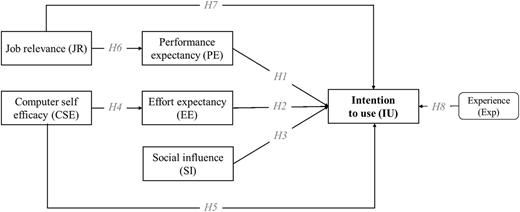
PE, EE, and SI are positively associated with the intention to use AI among public sector accountants and auditors.
Although PE, EE, and SI represent the core UTAUT determinants, prior work emphasises that UTAUT often benefits from context-specific adaptations (Afifa et al., 2022; Majeed and Taha, 2024). Prior accounting and auditing research has shown that PE and EE may also be shaped by computer self-efficacy (CSE) and job relevance (JR) (Ferri et al., 2021; Afifa et al., 2022; Majeed and Taha, 2024; Bracci et al., 2025).
Computer self-efficacy is theoretically related to, but distinct from, effort expectancy. Whereas effort expectancy captures perceived ease of use, computer self-efficacy captures professionals’ perceived capability to use AI under enabling conditions such as guidance, training, or technical support (Venkatesh and Bala, 2008). Empirical studies using extended acceptance models have shown that self-efficacy is associated with effort-related beliefs and, directly or indirectly, with behavioural intention (Afifa et al., 2022; Olomiyete, 2024; Hamadeh et al., 2025; Bracci et al., 2025). In public sector accounting and auditing, this mechanism is especially relevant because AI tools may require new digital skills, while prior literature highlights the limited availability of advanced digital competencies in public sector settings (Al Wael et al., 2023). Therefore, we hypothesise:
CSE is positively associated with effort expectancy and the intention to use AI among public sector accountants and auditors.
Job relevance is also related to, but distinct from, performance expectancy. Whereas performance expectancy captures expected benefits, job relevance captures whether professionals perceive AI as applicable and important to the future of their own accounting or audit activities (Venkatesh and Bala, 2008). Prior accounting and auditing studies suggest that task relevance strengthens usefulness perceptions and adoption intentions because professionals value technologies that address concrete work demands (Ferri et al., 2021; Hamadeh et al., 2025). In the public sector, job relevance is particularly important because AI adoption must be justified through its contribution to formal responsibilities, service quality, auditability, and accountability (Otia and Bracci, 2022; Bracci et al., 2025). Accordingly, we propose:
JR is positively associated with performance expectancy and the intention to use AI among public sector accountants and auditors.
Finally, in acceptance models experience is often treated as a relevant user characteristic that may condition how individuals evaluate new technologies (Venkatesh et al., 2003). However, prior literature reports heterogeneous findings regarding the effect of professional experience on technology adoption. Some studies suggest that greater experience may be associated with resistance to change, whereas others indicate that experience may facilitate adoption by improving professionals’ ability to recognise and integrate technological benefits (Ferri et al., 2021; Afifa et al., 2022). In AI settings, emerging evidence shows that work experience can meaningfully differentiate adoption mechanisms (Kim et al., 2024).
More experienced accountants and auditors may be more risk-averse due to greater exposure to established routines, norms, and professional expectations (Ismail et al., 2021). At the same time, AI raises concerns related to accountability, explainability and ethical risk, which may amplify cautious adoption among professionals with greater responsibility and reputational exposure (Munoko et al., 2020; Cordery and Hay, 2022). Conversely, experience may facilitate adoption if it helps professionals better recognise AI’s benefits and integrate it into work practices (Kim et al., 2024). This suggests that its effect is not necessarily linear or uniform. Therefore, we propose:
Professional experience exhibits a non-monotonic association with intention to use AI across career stages among public sector accountants and auditors.
The final proposed hypotheses are presented in Figure 1.
Methodology
Sample
To capture perceptions of AI across two key professions in the public sector accounting cycle in Spain, we administered a questionnaire to public sector accountants working in local authorities and public sector auditors working at the Court of Auditors and regional audit institutions.
For accountants, the target sample comprised professionals working in municipalities with more than 20,000 inhabitants and in provincial councils. This threshold is justified because larger municipalities assume broader responsibilities, including e-government services, while provincial councils coordinate and support smaller municipalities (Law 7/1985). The target population comprised 465 local authorities, and the questionnaire was distributed by email, yielding 223 valid responses and a response rate of 47.95%.
For auditors, the questionnaire was distributed through institutional contacts and professional networks using non-probabilistic convenience sampling. Given the institutional dispersion of this group and the absence of an observable sampling frame, a response rate could not be computed. A total of 163 valid auditor responses were obtained, although findings for this group should be interpreted as evidence from the achieved convenience sample rather than as statistically representative of the full population.
The online questionnaire required completion of all items before submission; therefore, no missing data were observed and only fully completed responses entered the final dataset (N = 386). The study complied with the ethical principles of the General Data Protection Regulation (EU) 2016/679. Participation was voluntary and anonymous, no personally identifiable information was collected, and informed consent was obtained from all participants prior to their participation in the survey.
The descriptive characteristics of the public sector professionals surveyed are presented in Table 1. The gender distribution is relatively balanced, with a slight predominance of women among both accountants and auditors. In both groups, there is a high proportion of older professionals, although the most frequent age group among accountants is 46–55 years, whereas among auditors the predominant group is over 55 years. In terms of professional experience, there is a clear predominance of public sector professionals with more than 20 years of professional experience, reflecting a high level of seniority in the analysed sample.
Demographic characteristics of the respondents
| Cases | |||
|---|---|---|---|
| Accountants | Auditors | Total | |
| Gender | |||
| Male | 98 | 68 | 166 |
| Female | 123 | 93 | 216 |
| Other | 2 | 2 | 4 |
| Age | |||
| Under 35 | 13 | 10 | 23 |
| Between 36–45 | 42 | 33 | 75 |
| Between 46–55 | 95 | 47 | 142 |
| Over 55 | 73 | 73 | 146 |
| Experience | |||
| Less than 3 years | 21 | 13 | 34 |
| 3–10 years | 42 | 37 | 79 |
| 11–20 years | 45 | 26 | 71 |
| More than 20 years | 115 | 87 | 202 |
Given the voluntary nature of the survey, we assessed potential non-response bias following the early–late respondent approach proposed by Armstrong and Overton (1977), where late respondents are used as a proxy for non-respondents. The results showed no statistically significant differences for gender (t = −1.343, p = 0.183), age (t = −1.721, p = 0.089), or professional experience (t = −0.301, p = 0.764). These findings suggest that non-response bias is unlikely to materially affect the results.
Measurement scale
Measurement items were drawn from prior accounting and auditing literature using UTAUT and extended technology acceptance frameworks (Ferri et al., 2021; Afifa et al., 2022; Majeed and Taha, 2024). These studies informed the measurement of the core UTAUT constructs, as well as the computer self-efficacy and job relevance constructs. Accordingly, CSE and JR were not incorporated as isolated additional items, but as theoretically grounded constructs previously used in accounting and auditing research.
Rather than developing new items, we adapted previously used measures to the context of AI in public sector accounting and auditing (Table A1, Appendix). This adaptation involved replacing the original technology examined in prior studies with AI and tailoring the wording to the respondent’s role: accountants received items referring to public accounting activities, whereas auditors received equivalent items referring to public audit activities. The wording was otherwise kept as close as possible to the original scales to preserve content validity.
The final instrument includes 21 statements measured on a 5-point Likert scale (“Strongly disagree” = 1 to “Strongly agree” = 5) and five demographic questions. The constructs were modelled as reflective, with each construct measured by four items, except for IU, which is measured using a single item, following recent studies on AI adoption (Jackson and Allen, 2024; Park et al., 2025).
Single-item measures are considered appropriate when the target is concrete, singular, and unambiguous for respondents (Loo, 2002; Bergkvist and Rossiter, 2007). Behavioural intention is a relatively straightforward construct that can be captured with one well-specified question, while multiple intention items may provide limited incremental information or even introduce construct contamination (Courneya, 1994; Bergkvist and Rossiter, 2007). Empirically, single-item measures of behavioural intention have shown good predictive performance in applied settings (Kavanaugh and Schwarz, 2009; Sim et al., 2025). In our study, IU refers to a specific behavioural disposition—public sector professionals’ intention to use AI-enabled tools in their work—making the construct concrete and readily interpretable.
To further ensure clarity and minimise ambiguity, we piloted the questionnaire with 30 accounting and auditing professionals prior to field administration, confirming item comprehensibility and wording adequacy. Finally, PLS-SEM can accommodate single-item constructs without identification problems, which supports the feasibility of modelling IU in this way within our analytical approach (Hair et al., 2021).
Data analysis
To address the study objective, the analysis followed three complementary steps, each linked to a specific empirical purpose. First, we compared accountants and auditors at the item level using STATA 19 to identify whether both professional groups differed in their AI-related perceptions. Independent-samples t-tests are reported as the primary mean-comparison approach, and the Wilcoxon (Mann–Whitney) rank-sum test is reported as a sensitivity check to ensure that conclusions are not driven by distributional assumptions (Field, 2013).
Second, we estimated the structural relationships between constructs using PLS-SEM in SmartPLS 4, given its suitability for variance-explanation and models with multiple relationships (Hair et al., 2021). Statistical significance was assessed using bias-corrected and accelerated (BCa) bootstrapping with 10,000 subsamples to improve the stability of standard errors and confidence intervals (Hair et al., 2021). Differences between accountants and auditors were assessed using PLS-MGA.
Third, we identified respondent profiles using hierarchical agglomerative clustering (Ward’s method) in STATA 19 to examine whether distinct AI adoption profiles existed within the sample (Ward, 1963). Items within each construct were averaged to form composite scores prior to clustering. The Calinski–Harabasz index was used to select the number of clusters, supporting a two-cluster solution with an index of 256.68 (Caliński and Harabasz, 1974). We then estimated a logistic regression model to examine which constructs predict profile membership and assessed the stability of the segmentation using Linear Discriminant Analysis (LDA) based on a random 70% training/30% test split (Fisher, 1936).
Given the self-reported survey design, we assessed common method variance using Harman’s single-factor test (unrotated PCA). The first factor accounted for 49.43% of the variance, below levels typically associated with severe CMV (50%), suggesting CMV is unlikely to drive the main results (Cooper et al., 2020).
In addition, we assessed the reflective measurement model following standard PLS-SEM criteria (Hair et al., 2021). We first examined indicator reliability (outer loadings), using 0.708 as the benchmark. As shown in Table 2, all indicators meet this criterion except CSE4 (0.668); given that loadings between 0.40 and 0.708 may be retained when internal consistency and convergent validity are adequate, this item was kept (Hair et al., 2021). Table 2 also reports internal consistency (Cronbach’s alpha and composite reliability) and convergent validity (AVE). All constructs meet the recommended thresholds (CA and CR > 0.70; AVE >0.50), supporting the reliability and convergent validity of the measures (Hair et al., 2021).
Measurement model: indicator loadings, reliability and convergent validity
| Variables | Items | Outer loading | CA > 0.7 | CR > 0.7 | AVE >0.5 |
|---|---|---|---|---|---|
| Effort expectancy | EE1 | 0.824 | 0.857 | 0.903 | 0.701 |
| EE2 | 0.877 | ||||
| EE3 | 0.867 | ||||
| EE4 | 0.777 | ||||
| Social influence | SI1 | 0.913 | 0.909 | 0.936 | 0.786 |
| SI2 | 0.909 | ||||
| SI3 | 0.841 | ||||
| SI4 | 0.881 | ||||
| Performance expectancy | PE1 | 0.954 | 0.969 | 0.977 | 0.915 |
| PE2 | 0.963 | ||||
| PE3 | 0.964 | ||||
| PE4 | 0.945 | ||||
| Job relevance | JR1 | 0.885 | 0.906 | 0.934 | 0.780 |
| JR2 | 0.872 | ||||
| JR3 | 0.915 | ||||
| JR4 | 0.860 | ||||
| Computer self-efficacy | CSE1 | 0.867 | 0.866 | 0.909 | 0.717 |
| CSE2 | 0.911 | ||||
| CSE3 | 0.917 | ||||
| CSE4 | 0.668 |
Note(s): CA = Cronbach’s alpha; CR = composite reliability; AVE = average variance extracted
Discriminant validity was assessed using the heterotrait–monotrait ratio (HTMT). The HTMT matrix is reported in Table 3, showing that all values fall within recommended cut-offs (<0.90 for conceptually similar constructs and <0.85 for more distinct constructs) (Henseler et al., 2015).
Discriminant validity assessment: HTMT ratios
| Computer self-efficacy | Effort expectancy | Intention to use | Job relevance | Performance expectancy | |
|---|---|---|---|---|---|
| Effort expectancy | 0.499 | ||||
| Intention to use | 0.412 | 0.543 | |||
| Job relevance | 0.549 | 0.644 | 0.667 | ||
| Performance expectancy | 0.556 | 0.678 | 0.669 | 0.834 | |
| Social influence | 0.378 | 0.449 | 0.529 | 0.618 | 0.538 |
Collinearity among predictor constructs was assessed via VIF; Table 4 reports VIF values, all below 5, indicating no problematic collinearity (Hair et al., 2011).
Collinearity assessment: inner VIF values
| Effort expectancy | Intention to use | Performance expectancy | |
|---|---|---|---|
| Computer self-efficacy | 1 | 1.459 | |
| Effort expectancy | 1.743 | ||
| Job relevance | 2.969 | 1 | |
| Performance expectancy | 3.065 | ||
| Social influence | 1.506 |
Finally, we assessed measurement invariance as a prerequisite for meaningful multigroup comparisons. Using the MICOM procedure, all p-values exceed 0.05 (Table 5), indicating compositional invariance and supporting comparisons between accountants and auditors in the PLS-MGA (Henseler et al., 2016).
Measurement invariance assessment using MICOM
| Original correlation | Correlation permutation mean | 5.00% | Permutation p value | |
|---|---|---|---|---|
| Computer self-efficacy | 0.998 | 0.997 | 0.992 | 0.350 |
| Effort expectancy | 1 | 0.999 | 0.997 | 0.931 |
| Intention to use | 1 | 1 | 1 | 0.425 |
| Job relevance | 1 | 1 | 1 | 0.205 |
| Performance expectancy | 1 | 1 | 1 | 0.993 |
| Social influence | 0.999 | 0.999 | 0.998 | 0.266 |
Results
The results are presented in the same sequence as the analytical strategy. We first report item-level differences between accountants and auditors, then present the PLS-SEM and multigroup results, and finally examine the adoption profiles identified through the cluster analysis and their determinants.
The results show differences between public sector accountants and auditors across individual AI-related perception items. As reported in Table 6, accountants score higher on nearly all items of CSE, JR, EE, PE, and IU. Within EE, the only non-significant item is the statement referring to public sector professionals’ ability to learn how to use AI. For SI, differences are more limited and concentrated in SI1 and SI2.
Item-level comparison between public sector accountants and auditors
| Item | Total (n = 386) | Accountants (n = 223) | Auditors (n = 163) | t | z | |||
|---|---|---|---|---|---|---|---|---|
| Mean | Dev | Mean | Dev | Mean | Dev | |||
| CSE1 | 3.98 | 0.88 | 4.16 | 0.89 | 3.74 | 0.81 | 4.6894*** | 5.150*** |
| CSE2 | 3.92 | 0.89 | 4.11 | 0.93 | 3.67 | 0.78 | 4.8394*** | 5.271*** |
| CSE3 | 4.05 | 0.92 | 4.28 | 0.90 | 3.74 | 0.84 | 5.9215*** | 6.520*** |
| CSE4 | 3.56 | 1.11 | 3.79 | 1.13 | 3.23 | 1.00 | 5.0497*** | 5.397*** |
| JR1 | 3.38 | 1.05 | 3.59 | 1.10 | 3.09 | 0.89 | 4.7877*** | 4.820*** |
| JR2 | 3.30 | 1.04 | 3.39 | 1.11 | 3.17 | 0.93 | 2.0815* | 1.989* |
| JR3 | 3.63 | 1.01 | 3.76 | 1.06 | 3.44 | 0.91 | 3.1088** | 3.436*** |
| JR4 | 3.35 | 1.07 | 3.65 | 1.07 | 2.94 | 0.93 | 6.8792*** | 6.711*** |
| EE1 | 3.16 | 0.91 | 3.26 | 1.01 | 3.01 | 0.73 | 2.7190** | 2.710** |
| EE2 | 3.37 | 0.86 | 3.44 | 0.96 | 3.27 | 0.71 | 1.9594 | 1.932 |
| EE3 | 3.38 | 0.86 | 3.55 | 0.93 | 3.15 | 0.69 | 4.6825*** | 4.819*** |
| EE4 | 3.38 | 1.05 | 3.51 | 1.17 | 3.21 | 0.84 | 2.7250** | 3.125** |
| PE1 | 3.65 | 0.97 | 3.87 | 1.04 | 3.36 | 0.76 | 5.2924*** | 5.623*** |
| PE2 | 3.65 | 0.96 | 3.87 | 1.01 | 3.34 | 0.80 | 5.5806*** | 5.838*** |
| PE3 | 3.71 | 0.97 | 3.96 | 1.02 | 3.36 | 0.78 | 6.3960*** | 6.739*** |
| PE4 | 3.77 | 0.98 | 4.04 | 1.03 | 3.40 | 0.77 | 6.6128*** | 7.133*** |
| SI1 | 2.70 | 1.06 | 2.79 | 1.12 | 2.58 | 0.97 | 1.9942* | 1.672 |
| SI2 | 2.80 | 1.11 | 2.95 | 1.13 | 2.60 | 1.03 | 3.1175** | 2.733** |
| SI3 | 2.72 | 1.24 | 2.77 | 1.33 | 2.64 | 1.11 | 0.9947 | 0.635 |
| SI4 | 2.77 | 1.10 | 2.82 | 1.16 | 2.70 | 1.01 | 1.0333 | 0.660 |
| IU1 | 3.23 | 1.27 | 3.61 | 1.25 | 2.70 | 1.11 | 7.4141*** | 7.019*** |
Note(s): *p < 0.05, **p < 0.01, ***p < 0.001; IU = intention to use; PE = performance expectancy; EE = effort expectancy; SI = social influence; JR = job relevance; CSE = computer self-efficacy
PLS-SEM estimates for the full sample and multigroup comparisons between accountants and auditors are reported in Table 7. In the full sample, PE, EE, and SI are positively associated with IU, supporting H1. CSE is positively associated with EE, whereas its direct association with IU is not statistically significant. Since H2 comprises two expected relationships—a positive association between CSE and EE and a direct positive association between CSE and IU—the hypothesis is partially supported. JR is positively associated with IU and with PE, supporting H3. Professional experience exhibits a non-monotonic association with IU, captured through significant linear and quadratic terms, supporting H4. The multigroup analysis shows that the PE → IU and JR → IU paths are stronger among accountants, whereas the SI → IU path is stronger among auditors.
PLS-SEM path coefficients and multigroup differences
| Total effects | Auditors | Accountants | Difference | |
|---|---|---|---|---|
| CSE → EE | 0.444*** | 0.37*** | 0.446*** | −0.075 |
| CSE → IU | 0.05 | −0.055 | 0.036 | −0.091 |
| EE → IU | 0.097* | 0.134 | 0.107* | 0.027 |
| Exp → IU | −0.108* | −0.184** | −0.045 | −0.139 |
| JR → IU | 0.474*** | 0.303*** | 0.517*** | −0.213* |
| JR → PE | 0.782*** | 0.722*** | 0.791*** | −0.069 |
| PE → IU | 0.350*** | 0.033 | 0.438*** | −0.405*** |
| QE (Exp) → IU | −0.076* | −0.106 | −0.061 | −0.045 |
| SI → IU | 0.172*** | 0.387*** | 0.111* | 0.275** |
Note(s): *p < 0.05, **p < 0.01, ***p < 0.001; IU = intention to use; PE = performance expectancy; EE = effort expectancy; SI = social influence; JR = job relevance; CSE = computer self-efficacy; QE = quadratic effect
In addition to professional experience, age and gender were considered as potential controls. Age was not retained because it was closely related to professional experience, which was more aligned with the study’s focus on professional routines, standards, and accountability expectations. Gender was also excluded because it was not significantly associated with IU and did not materially affect the remaining structural relationships. Thus, to preserve model parsimony, the final model retained professional experience as the relevant career-stage control and substantive predictor.
From another perspective, the cluster analysis identified two clearly differentiated psychological profiles among professionals. Figure 2 plots the mean construct scores for each profile. The “Favourable Users” profile displays markedly higher scores across all analysed constructs, particularly in IU and PE, reflecting a proactive attitude toward AI adoption. By contrast, the “Reluctant Users” profile exhibits consistently lower values, indicating greater caution and resistance to the incorporation of these technologies.
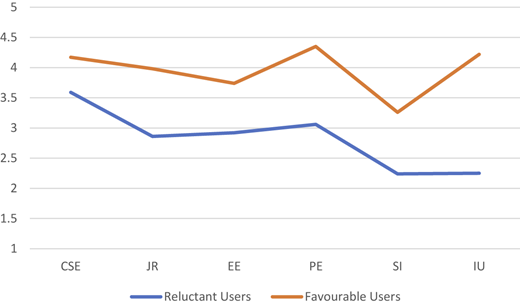
Construct mean scores by adoption profile. Note: IU = intention to use; PE = performance expectancy; EE = effort expectancy; SI = social influence; JR = job relevance; CSE = computer self-efficacy
Construct mean scores by adoption profile. Note: IU = intention to use; PE = performance expectancy; EE = effort expectancy; SI = social influence; JR = job relevance; CSE = computer self-efficacy
To assess the robustness of the two-profile solution, we conducted an out-of-sample validation using a train/test split. Table 8 reports the resulting classification accuracy and confirms that the two-profile solution is highly robust. Classification accuracy reaches 96.6%, with high sensitivity for both “Reluctant Users” (96.8%) and “Favourable Users” (96.4%). Cohen’s kappa (0.93) further indicates near-perfect agreement beyond chance, supporting the stability and separability of the profiles.
Out-of-sample classification accuracy
| Original cluster | Predicted cluster 1 | Predicted cluster 2 | Total |
|---|---|---|---|
| Reluctant Users | 60 | 2 | 62 |
| Favourable Users | 2 | 53 | 55 |
| Total | 62 | 55 | 117 |
| Metrics summary | |||
| Overall accuracy | 96.60% | ||
| Recall/Sensitivity (Reluctant Users) | 96.80% | ||
| Recall/Sensitivity (Favourable Users) | 96.40% | ||
| Cohen’s kappa | 93.00% | ||
The distribution of profiles by profession strongly reinforces the comparative focus of the study. Table 9 reports profile membership by profession. Public sector accountants are predominantly concentrated in the favourable profile (65% of the total), whereas public sector auditors are mostly grouped within the reluctant profile (71%). This statistically significant difference indicates that profession is associated with distinct psychological profiles, beyond item-level differences or structural path differences.
Distribution of profiles by professional group
| Profile | Accountants | Auditors | Total |
|---|---|---|---|
| Reluctant users | 79 | 116 | 195 |
| Favourable users | 144 | 47 | 191 |
| Total | 223 | 163 | 386 |
| Pearson χ2 = 48.12, p < 0.000 | |||
Finally, Table 10 reports the logistic regression explaining membership in the favourable profile. The model exhibits excellent explanatory power (pseudo R2 = 0.9265). Intention to use AI is the most influential predictor, followed by performance expectancy. A particularly relevant and counterintuitive result is that lower computer self-efficacy is associated with a higher probability of belonging to the favourable profile.
Discussion
The results indicate that public sector accountants hold more favourable perceptions of AI and a stronger intention to use it than public sector auditors. This is consistent with the institutional framing developed above: accountants and auditors are not simply users of the same technology, but professionals embedded in different role-based expectations within the public sector accounting cycle.
Accountants tend to be open to technological innovation as a way to cope with increasing informational demands, whereas public auditing is often characterised by a more conservative orientation (Zemánková, 2019; Otia and Bracci, 2022; Alquhaif and Al-Mamary, 2025). A substantial part of auditing also relies on professional judgement exercised under scepticism and within formal standards—an aspect that AI systems may not easily replicate—thereby constraining the perceived scope of AI applications (Zemánková, 2019; Otia and Bracci, 2022). Consistent with this, auditors perceive a higher implementation burden, even though both groups report broadly similar perceived learnability.
At the same time, differences between professions are not uniform across all dimensions of social influence. Accountants report stronger influence from personally important individuals, whereas both groups show similar perceptions of influence from coworkers and hierarchical superiors. This partial convergence may reflect the role of professional and inter-organisational networks in public audit settings. Supreme Audit Institutions frequently seek guidance in uncertain environments through inter-organisational cooperation (conferences, professional networks, and systematic exchanges of experiences) potentially creating shared normative reference points about acceptable practice (Cordery and Hay, 2022).
Accountants’ higher intention to use AI is particularly consequential because accountants and auditors occupy sequential and interdependent roles in the public sector accounting cycle. When accountants adopt AI in preparing public accounts, this can alter the evidence, controls, and audit trails that auditors must subsequently evaluate (Boer et al., 2023). If auditors remain reluctant to rely on—or cannot effectively audit—AI-enabled outputs, implementation may face friction at the verification stage. In this sense, misalignment along the accountability chain can weaken the effectiveness of democratic accountability arrangements (Santiso, 2015).
From a technology acceptance perspective, the aggregate results are consistent with the core UTAUT logic, showing positive associations between intention to use AI and performance expectancy, effort expectancy, and social influence (Venkatesh et al., 2003). This supports H1 and confirms that standard acceptance mechanisms remain relevant in public sector AIS. The finding also aligns with empirical research in accounting and auditing, which highlights the explanatory power of UTAUT in shaping technology acceptance (Ferri et al., 2021; Afifa et al., 2022; Majeed and Taha, 2024; Alquhaif and Al-Mamary, 2025; Mansour et al., 2025). Complementary resistance-focused studies reach a similar conclusion from the opposite angle, showing that perceived benefits, switching costs, and social norms shape resistance to technological change (Schmidt et al., 2020; Fotoh and Mugwira, 2025).
However, in public sector settings, these constructs take on governance-relevant meaning because adoption is embedded in institutional arrangements where legality, accountability, and legitimacy reshape what counts as benefit, cost, and acceptable technological practice (Bracci et al., 2025; Muttaqin, 2026; Martins et al., 2026). This differs from typical private sector adoption dynamics, where performance expectancy is often associated with productivity, cost reduction, profitability, or competitive advantage (Park et al., 2025; Abdallah et al., 2025). In public sector accounting and auditing, performance expectancy is also linked to accountability, transparency, service quality, and the reliability of accounting outputs (Abdallah et al., 2025; Muttaqin, 2026).
Similarly, effort expectancy extends beyond ease of use or training costs, as AI must fit formal procedures, documentation requirements, audit trails, existing workflows, and resource constraints (Otia and Bracci, 2022; Al Wael et al., 2023; Bracci et al., 2025). Social influence also takes on a distinctive meaning, signalling whether AI use is professionally legitimate, institutionally endorsed, and defensible to oversight bodies and external stakeholders (Otia and Bracci, 2022; Park et al., 2025). Thus, AI acceptance should be interpreted through public sector governance conditions rather than private sector adoption logics.
The extended constructs further refine this explanation. Regarding H2, computer self-efficacy shows the expected association with effort expectancy, consistent with research suggesting that perceived capability reduces perceived effort (Afifa et al., 2022; Olomiyete, 2024; Hamadeh et al., 2025; Bracci et al., 2025). However, the lack of a direct association with intention may reflect that, in accountability-oriented public sector roles, professionals are willing to invest learning effort when they perceive clear performance benefits, prioritising service quality (Abdallah et al., 2025).
Consistent with H3 and prior technology acceptance studies in accounting and auditing, job relevance operates as a bridge between task applicability and intention: professionals are more willing to use AI when they see it as directly relevant to their day-to-day tasks, which also strengthens expected performance gains (Ferri et al., 2021; Hamadeh et al., 2025). This is particularly salient in the public sector, where resource constraints and procedural requirements can dampen perceived usefulness unless the technology clearly supports core priorities and a broad set of tasks (Al Wael et al., 2023; Abdallah et al., 2025; Alquhaif and Al-Mamary, 2025).
The comparative evidence further shows that UTAUT mechanisms are filtered through distinct institutional roles. Among accountants, intention appears more closely anchored in performance-oriented reasoning and task applicability, consistent with the idea that they operate under heavy informational demands and may view AI primarily as a tool for efficiency and service-quality improvements in routine, high-volume processes (Alquhaif and Al-Mamary, 2025; Abdallah et al., 2025; Muttaqin, 2026).
Among external auditors, by contrast, social influence becomes more salient. Audit institutions typically operate under highly standardised procedures, where judgement is framed by formal methodologies, independence expectations, and professional scepticism (Otia and Bracci, 2022; Bracci et al., 2025). In such settings, adoption becomes closely tied to legitimacy and risk management: relying on institutionally endorsed or widely adopted practices helps reduce uncertainty when introducing innovations (Cordery and Hay, 2022; Álvarez-Domínguez et al., 2026).
Professional experience further contributes to this interpretation. The negative association between experience and intention to use AI, with stronger effects at higher levels, is consistent with H4 and with prior evidence that more experienced professionals may exhibit greater resistance to technological change (Ferri et al., 2021). Greater seniority may imply deeper exposure to established routines, norms, and professional expectations, increasing risk aversion and preference for familiar methods (Ismail et al., 2021). Moreover, AI raises concerns related to accountability, explainability, and ethical risk that may amplify caution among professionals with greater responsibility and reputational exposure (Munoko et al., 2020; Cordery and Hay, 2022). In this sense, experienced professionals may develop inertia toward traditional approaches even when alternatives promise efficiency gains (Bracci et al., 2025).
Finally, the profile analysis adds value by revealing latent heterogeneity that is not fully captured by mean differences or structural relationships. In a digital-era governance context, implementation of AI in public sector AIS rarely progresses uniformly; rather, it tends to unfold through uneven organisational readiness and role-dependent interpretations of what constitutes “appropriate” use (Otia and Bracci, 2022; Al Wael et al., 2023; Park et al., 2025). The “Favourable Users” profile appears anchored in stronger intention and performance-related beliefs, which is consistent with a public sector logic oriented toward public value creation through service improvement and stronger accountability (Park et al., 2025; Muttaqin, 2026).
At the same time, the association between higher computer self-efficacy and a lower likelihood of belonging to this profile should be interpreted cautiously. It does not imply that low skills cause favourable attitudes; rather, it may reflect alternative mechanisms (e.g. some public sector professionals perceiving AI as enabling or compensatory), which would require further investigation. Prior evidence suggests that higher technological competence can be associated with more critical evaluation of usefulness cues, potentially weakening acceptance behaviour in certain contexts (Olomiyete, 2024), but this should be presented as a compatible interpretation rather than a logical inversion of the observed pattern. This counterintuitive association may also reflect sample-specific characteristics, such as the high proportion of experienced professionals, and warrants replication before stronger inferences are drawn.
Finally, the uneven distribution of profiles across accountants and auditors reinforces the institutional framing developed above: readiness to adopt AI is not only an individual preference but is patterned by role-based accountability expectations within the same public accounting field (Leca and Laguecir, 2023; Martins et al., 2026). In other words, the profile solution illustrates how different institutional roles can cluster into distinct readiness configurations.
Conclusion
This study analysed and compared AI acceptance among public sector accountants and external auditors in Spain, examining whether common technology-acceptance mechanisms operate similarly across both professions within the same institutional context, period, and technology environment. Overall, the evidence shows a consistent comparative pattern: accountants display more favourable perceptions of AI and a stronger intention to use it than auditors.
The results show that intention to use AI is shaped by core acceptance beliefs, although their relative salience differs across professional roles. Accountants’ adoption appears more closely associated with performance oriented and task fit considerations, whereas auditors’ adoption is more strongly conditioned by social validation and the defensibility of AI use within the professional environment. Professional experience also appears relevant, suggesting that implementation strategies should account for career stage differences and accumulated exposure to established routines. The profile analysis further shows that favourable and reluctant readiness profiles coexist within the public sector, highlighting heterogeneity that is not captured by average differences alone.
From a practical perspective, these findings suggest that AI implementation in public sector AIS should be approached as an end-to-end accountability-chain initiative rather than as two separate professional transformations. For accountants, implementation strategies should prioritise use cases with clear operational fit, measurable improvements in reporting reliability and timeliness, and sufficient traceability. For auditors, adoption should be supported by institutional and professional legitimacy, including alignment with auditing standards, clear guidance, shared protocols, and documentation requirements. More broadly, if accounting workflows become AI-enabled, auditors must be able to evaluate AI-generated outputs in a defensible way. At the policy level, this suggests the need for coordinated AI governance arrangements across the accounting and audit chain to reduce friction and strengthen the public accountability benefits of AI adoption.
Beyond practice, the study also offers research-relevant contributions. Empirically, it provides a within-context comparative test of AI acceptance mechanisms across two interdependent professions operating within the same public sector accountability chain, helping distinguish profession-related differences from patterns that may otherwise reflect differences in research design or contextual variation. Conceptually, the study positions technology-acceptance models as a parsimonious behavioural backbone while showing that acceptance mechanisms are not institutionally neutral: AI readiness and adoption drivers are shaped by role-based accountability expectations. Methodologically, it combines mean comparisons, multigroup path analysis, and a profile-based approach to capture both between-profession differences and within-sector heterogeneity in public sector AI readiness.
The study also has limitations that should be acknowledged. Contextually, it is situated in Spain, where AI adoption in public sector AIS is shaped by the national digital modernisation agenda, evolving AI governance expectations, and the decentralised structure of public administration. Therefore, the findings may not transfer directly to countries with different regulatory regimes or institutional arrangements. Methodologically, the analysis uses non-probabilistic sampling for the auditor group, which may limit generalisability. In addition, its cross-sectional, self-reported design does not allow causal inference or capture how attitudes may evolve as AI tools and governance frameworks develop, and the single-item measure for intention to use may involve greater random measurement error than multi-item constructs.
These limitations suggest several avenues for future research. Longitudinal studies could examine how adoption drivers evolve as AI tools mature and governance frameworks stabilise, while mixed-method research could unpack how professional judgement, evidential expectations, and accountability concerns shape day-to-day AI use. Experimental or quasi-experimental designs could test whether interventions such as explainability tools, audit-trail standards, targeted training, or formal governance protocols affect accountants and auditors differently. Future research could also broaden the accountability-chain perspective by incorporating internal auditors, controllers, IT and data governance staff, and policy designers, and by combining intention measures with behavioural indicators of actual use.
Ultimately, the governance value of AI in public sector AIS depends not only on whether accountants adopt these tools, but also on whether auditors can verify AI-enabled outputs in a credible, explainable, and institutionally defensible way. If adoption advances faster in preparation than in verification, AI may create new accountability gaps rather than closing existing ones. Coordinated, role-sensitive implementation across the accounting and audit chain is therefore essential if AI is to strengthen, rather than complicate, public accountability.
Appendix
Survey questions and items for each construct
| Item | Statement |
|---|---|
| Intention to use | |
| IU1 | I have the intention to use AI for accounting/audit activities |
| Performance expectancy | |
| PE1 | Using AI would allow me/allows me to improve public accounting/audit activities |
| PE2 | The use of AI would facilitate/facilitates the provision of public accounting/audit services |
| PE3 | Using AI would improve/improves my effectiveness in public accounting/audit activities |
| PE4 | Using AI would improve/improves the efficiency of my work |
| Effort expectancy | |
| EE1 | I would find/find it easy to use AI for public accounting/audit activities |
| EE2 | Learning to use AI would be/is easy for me |
| EE3 | It would be/is easy for me to become proficient in using AI |
| EE4 | Using AI for public accounting/audit activities does not cause me stress |
| Social influence | |
| SI1 | People who influence my behaviour would think/think that I should use AI |
| SI2 | People who are important to me would think/think that I should use AI in public accounting/audit activities |
| SI3 | My boss believes that I should learn to use AI for public accounting/audit activities |
| SI4 | People who work with me would think/think that I should use AI in public accounting/audit activities |
| Job relevance | |
| JR1 | AI can be used extensively in public accounting/audit activities |
| JR2 | In public accounting/audit, the use of AI is relevant |
| JR3 | AI is relevant to the future of public accounting/audit services |
| JR4 | The future of public accounting/audit activities is AI |
| Computer self-efficacy | |
| CSE1 | I could use AI if someone showed me how to do it first |
| CSE2 | I could use AI in public accounting/audit activities if it had a built-in help function for assistance |
| CSE3 | I believe I can use AI for accounting/audit activities if my entity organises good training |
| CSE4 | I could use AI if I had used a similar application before this one |

