The purpose of this paper is to investigate a form of indirect comparative advertising in which an advertiser makes it clear which specific brand is being referenced without explicitly naming it (implicit referencing). This extends existing theories and adds a conceptual facet to frameworks of comparative advertising.
Following calls for comparative advertising research beyond US contexts, this paper uses an interpretive approach, namely, textual analysis as established by Barbara Stern, to analyze two Swiss cases of implicit referencing.
This paper finds that implicit references are constructed using verbal and visual references. Verbal referencing refers to references that build on verbal cues to elicit associations with a specific brand (e.g. slogans, taglines and expressions). Visual referencing refers to references that build on visual cues to elicit associations with a specific brand (e.g. colors, labels and shapes). The authors also identify construction patterns for implicit referencing: Implicitly referencing ads establish a favorable basis for comparison, incorporate redundant cues and guide consumers in interpreting the comparison.
This paper offers valuable insights for practitioners on crafting effective implicit references. As indirect comparative ads have been shown to be more effective when they elicit specific brand associations, the authors provide strategic tools to enhance their impact.
While prior research acknowledges the existence of implicit referencing, to the best of the authors’ knowledge, this is the first paper to examine its underlying mechanisms. The theoretical contribution of this paper lies in refining comparative advertising theories and expanding their scope to include cross-category comparisons.
Introduction
Comparative strategies in advertising are widely used by brand managers to position their brands against other brands, with the goal of achieving a competitive advantage (Keller et al., 2002). Research distinguishes between two primary forms of comparative advertising: direct comparative (DC) advertising and indirect comparative (IC) advertising. DC advertising explicitly names another brand to make a direct comparison, while IC advertising does not identify a specific brand but instead refers to a generic “Brand X” or all competitors collectively (Beard, 2016; Jackson et al., 1979; Miniard et al., 2006; Wilkie and Farris, 1975). Both forms of comparative advertising have been extensively studied, particularly in US contexts (del Barrio-García et al., 2020).
However, existing research has not examined the underlying mechanisms of a specific yet common form of IC advertising. We refer to it as implicit referencing. In this form, advertisers make it unmistakably clear which brand is being referenced without explicitly naming it. While past research acknowledges its existence (Beard, 2016; Brown and Jackson, 1977; Jackson et al., 1979), it does not explore its underlying mechanisms.
Implicit referencing allows advertisers to draw direct comparisons while mitigating legal and reputational risks associated with DC advertising. Notable real-world examples include Burger King’s billboards that visually reference McDonald’s without explicitly naming it (www.creativebloq.com/creative-inspiration/advertising/burger-king-ads) and Dollar Shave Club’s ad verbally referencing Gillette without naming the brand (www.youtube.com/watch?v=ZUG9qYTJMsI). As these examples illustrate, implicit referencing is used as an advertising strategy in practice. However, academic research has not fully explored how brands construct implicit references in IC advertising and the implications of this approach.
To add to existing frameworks of comparative advertising, this paper investigates two Swiss cases of IC advertising that reference specific brands without explicitly naming them. Our research question is:
How do brands implicitly reference specific brands in indirect comparative advertising?
By answering this question, we add two facets to existing knowledge. First, we extend the theoretical understanding of IC advertising by identifying and analyzing the mechanisms of implicit referencing. Prior studies have primarily examined how IC advertising positions a brand against an undefined “Brand X” or all competitors (del Barrio-García et al., 2020; Kalro et al., 2013). Our research further shows through which mechanisms IC advertising can implicitly reference a specific brand.
Second, we refine current conceptualizations of comparative advertising. Existing literature typically views comparative advertising as a tool for within-category comparisons, assuming that comparative ads target direct competitors. However, we find empirical examples where comparative advertising operates across categories (i.e. between brands that are not direct competitors). One of our analyzed cases illustrates this phenomenon. Thus, we extend the conceptualization of comparative advertising by illustrating that it can work across categories as well as within categories.
Additionally, by examining Swiss cases, we respond to calls for more research outside the US context (del Barrio-García et al., 2020), providing a broader perspective of IC advertising in a non-US market.
In terms of a practical contribution, this study offers insights for marketing practitioners. Research shows that IC advertising is more effective when consumers naturally associate the message with a specific brand (Miniard et al., 2006). Our findings offer strategies for advertisers to design IC ads that subtly evoke associations with a specific brand in consumers’ minds, helping them leverage comparative advertising while mitigating legal risks. Compared to DC advertising, IC advertising often faces fewer legal restrictions (e.g. DC ads are prohibited in some countries, while IC ads remain legal; Hançar, 2023). Given this advantage, understanding how to craft effective implicit references in IC advertising is highly relevant.
This paper is structured as follows. First, we review existing literature on comparative advertising and highlight how our research question fits with existing knowledge. Next, we outline our methodology and research context. Then, we present our findings. Finally, we conclude with a discussion of our contributions, practical implications and directions for future research.
Theoretical background: comparative advertising
Comparative advertising has a long history, especially in the USA (del Barrio-García et al., 2020). It refers to ads that either make a direct comparison between the advertiser and another brand or reference a fictional brand or other brands in the category using terms like “brand X”, “other brands” or similar expressions (Beard, 2013, 2015, 2016; Brown and Jackson, 1977; del Barrio-García and Luque-Martínez, 2003; Jackson et al., 1979). As such, comparative advertising can be divided into DC advertising, where the referenced brand is explicitly named, and IC advertising, which does not explicitly name a specific brand in the comparison. Importantly, research into IC advertising thus far has focused on cases where ads reference all other brands in a category (“compared to other brands”) or reference a fictional or unidentified brand (“compared to the market leader”) (del Barrio-García et al., 2020). This means that implicit referencing is mentioned by previous research as a form of IC advertising (Beard, 2016; Brown and Jackson, 1977; Jackson et al., 1979), but its mechanisms and construction remain underexplored.
Effectiveness of direct comparative advertising vs indirect comparative advertising
Researchers have sought to determine whether DC or IC advertising is more effective. However, broad conclusions remain elusive because of the influence of various moderating variables. For instance, research demonstrates that the effectiveness of DC and IC ads depends on consumers’ information processing modes: DC ads are more effective when consumers apply analytical processing, while IC ads are superior when consumers use imagery processing (Kalro et al., 2013). Additionally, gender also plays a role in DC vs IC ad effectiveness (Petrovici et al., 2019), and age may also moderate DC ad effectiveness (Beard, 2015). Thus, no definite conclusion can be drawn on whether DC or IC ads are inherently more effective.
Pechmann and Ratneshwar (1991) investigated whether DC or IC advertising is more successful in positioning a brand against another brand and found that DC ads are more effective. In contrast, Miniard et al. (2006) showed that IC advertising is superior to DC advertising in positioning a brand against an entire market. They also found that IC ads can outperform DC ads in positioning against a specific brand if the ad spontaneously activates a specific brand in consumers’ minds. As specific brand activation enhances IC ad effectiveness, it is crucial to examine how brands can implicitly reference other brands to trigger this response – an issue this paper addresses.
How implicit brand references work
Associative network theory explains how implicit brand references activate consumers’ associations with a specific brand. According to this theory, the brain stores information as interconnected nodes representing specific concepts, brands and attributes (Anderson, 1983; Teichert and Schöntag, 2010). Links between nodes are strengthened through experience, repetition and meaningful connections. When consumers encounter an implicit reference containing a cue (such as a distinctive color, wording or attribute), the relevant node is activated, triggering associated concepts (Anderson, 1983; Collins and Lofthus, 1975).
More specifically, the mechanism at play is called “spreading activation” (Anderson, 1983; Collins and Lofthus, 1975). An implicit reference to another brand acts as a cue (Anderson, 1983; Collins and Lofthus, 1975) activating working memory to retrieve associated concepts from long-term memory, which results in a complete mental construct (Bower, 1981; Oakenfull and McCarthy, 2010). This activation cascades across the network of nodes and more intensely affects stronger associations than weaker ones (Anderson, 1983; Collins and Lofthus, 1975). Thus, an implicit brand reference’s effectiveness depends both on consumers’ prior exposure to the brands and the strength of their associative links. Also, an implicit reference’s success hinges on the effective use of cues that trigger consumers’ intended associations. Therefore, understanding how to craft effective implicit references is essential.
Conceptualizing cross-category implicit references as indirect comparative advertising
Research states that comparative ads typically compare brands within the same category based on specific products or services (Wilkie and Farris, 1975). However, empirical examples show that comparative advertising need not include two brands from the same category. Instead, brands can be compared based on a particular product, service or consumer benefit. For instance, Vitamin Water launched an ad comparing its drinks to flu shots (www.youtube.com/watch?v=R2HhSdzlL8I). This example illustrates that comparative advertising can extend beyond direct competitors, focusing instead on a characteristic that brands share (e.g. the consumer benefit of immunity in this example).
However, current theories on comparative advertising do not account for cross-category comparisons. To address this gap in theory, this paper examines a case of cross-category IC advertising.
In sum, the literature establishes several crucial points regarding IC advertising that require further investigation. First, IC advertising is more effective when it activates consumers’ associations with a specific brand (Miniard et al., 2006). Thus, advertisers need to understand how to intentionally evoke these associations.
Second, whether such associations are triggered depends on the presence of effective cues as explained by associative network theory. Therefore, research should examine how these cues are integrated into IC ads.
Third, the literature review reveals a blind spot in the theorization of comparative advertising. While comparative advertising is typically conceptualized as occurring within the same category, empirical examples indicate a broader scope. To extend theory to these real-world occurrences, this paper includes one case of cross-category IC advertising in its analysis, allowing us to conceptualize implicit referencing as functioning both within and across categories.
To achieve these research goals, this paper poses the research question: How do brands implicitly reference specific brands in IC advertising?
Methodology
To answer our research question, we examine two cases of implicit brand referencing. Specifically, we use textual analysis to understand the underlying mechanism of implicit referencing. Textual analysis (Stern, 1988, 1996a) is an interpretive approach that analyzes “the ad-as-text” (Stern, 1988, p. 3). Text is defined broadly as “any media artifact designed to persuade consumers, and generated, composed, recorded, and analyzed by sponsorial agents and/or researchers” (Stern, 1996a, p. 62). Thus, in this sense, “text” encompasses not only written language but also visuals and other promotional materials. As Barbara Stern pioneered textual analysis in advertising and branding research and the method remains relatively underdeveloped by others (Fowler et al., 2022), our methodology primarily relies on her work. For an overview of her work, see Fowler et al. (2022).
Textual analysis consists of several steps, which we followed in our analysis and outline below. Both authors engaged in separate and joint analysis. Textual analysis begins with a close reading of the text (Stern, 1988, 1996a) based on a “line-by-line or episode-by-episode commentary on what is going on in a text” (Barnet and Cain, 2014, p. 37). As Boulton (2013, p. 6) notes, “the reason for this is the crudely practical one that, though we can perceive several things at once, we cannot describe the several things that we perceive at once, all at the same time; we cannot think two complete sentences simultaneously.” Close readings examine “implications of words, the function of rhymes, the shifts in point of view, the development of contrasts and any other contributions to the meaning” (Stern, 1988, p. 4) individually to ascertain their meaning. Figures of speech are also closely analyzed (Stern, 1988). For a detailed guide on close reading, see Stern (1988, 1996a; 1996b).
The second step is the “construction of meaning” (Stern, 1996a, p. 67). In this step, individual meanings are synthesized into an interpretation of the text that considers all the meanings and adds them up to “a holistic ‘meaning’ greater than the sum of their parts” (Stern, 1988, p. 4). Rooted in structuralism, “[t]his approach posits reconciliation as an outcome of the processes of transformation (each binary moves toward its opposite) and of mediation (the opposites are incorporated into a gestalt entity)” (Stern, 1996b, p. 137). For further examples and a detailed explanation, see Stern (1988, 1996a).
The final step, “deconstruction of meanings” (Stern, 1996a, p. 67), adopts a deconstructive approach. This stage revisits and questions the monolithic meaning established in step 2 in favor of “infinitely open meanings brought about by the play of language itself” (Stern, 1996a, p. 63). Close attention is paid to what is said in the text to identify what is absent, addressing “the contradictory meanings inherent in language by disassembling the cultural assumptions that a text simultaneously reveals and conceals” (Stern, 1996a, p. 64): By signifying one concept, words inherently suppress their binary opposites by not naming them (Stern, 1996a). This step highlights the tensions between presences and absences in a text, revealing their significance regarding the underlying hegemonic cultural assumptions (Stern, 1996a). For a detailed explanation of this step, see Stern (1996b).
Notably, textual analysis includes visual analysis, as visuals are also understood as a form of text in a wider sense (Scott, 2006; Stern, 1996a). Visual analysis begins with a close reading of the visual text, identifying key elements such as “form, subject matter, genre, medium, color, light, line, and size” (Schroeder, 2006, p. 304). For examples, see Hirschman (1988), Hirschman and Stern (2000) and Holbrook and Grayson (1986). Using these observations and contextual details, an interpretation of the visual text in question is developed (Schroeder, 2006), enabling a critical interpretation of visual texts. As visual analysis is widely considered part of textual analysis (Stern, 1996a), we henceforth use “textual analysis” to refer to both language-based texts and other media artifacts, including visuals.
Textual analysis aligns with our research interests, as it closely examines the intricacies and construction of an ad (Stern, 1988) and “provides a tool to examine how brands create narratives” (Fowler et al., 2022, p. 347). This makes it particularly useful for uncovering how brands implicitly reference other brands in IC ads. Given the usefulness of this method, scholars have called for its broader application (Fowler et al., 2022), a call we answer in this paper. Past research demonstrates that textual analysis as a stand-alone method yields valuable insights into the workings of ads and promotional activities (Hirschman, 1988; Holbrook and Grayson, 1986; Stern, 1988). To maintain a clear research focus, we apply solely textual analysis without integrating other methods.
Context
This section provides background information on the brands in our IC advertising cases. In both cases, the ads implicitly reference the retailer Migros. In one case, the advertiser is FREITAG, in the other Aldi. Below, we detail each brand.
Migros
Founded in 1925 (https://history.migros.ch/de/timeline.html), Migros is a Swiss retailer with a particularly loyal customer base: Migros has given rise to a phenomenon known as “Migros children.” Consumers call themselves “Migros children” (Migros Kinder in German) to express that they are loyal customers of Migros and that other family members, especially their parents, are also loyal to Migros. Migros supermarkets offer a wide range of products, including typical grocery items as well as clothes, accessories, cosmetics, household goods, cleaning products and pet food. A key feature of Migros’ product portfolio is its extensive private label selection. Since its inception, Migros has replicated higher-priced branded products, offering private-label alternatives at lower prices. Migros roughly divides its private label portfolio into three price ranges: M-Budget (the most affordable), M-Classic and Migros Sélection (the premium line). The M-Budget product line is particularly diverse, covering fresh produce, dairy, meat, pet food, personal hygiene products and cleaning supplies. Beyond retail, Migros operates a foundation, donating 1% of their proceeds to support culture, society, education and sports (https://engagement.migros.ch/de/kulturprozent).
FREITAG
FREITAG is a Swiss brand specializing in bags, backpacks and accessories crafted from recycled materials like old truck tarps, seatbelts and bike tubes. Founded in Zurich in 1993 (www.freitag.ch/de/donnerstagag), FREITAG has deep roots in urban cycle culture, as its first bags were designed as bags for bike messengers and cycling commuters (www.freitag.ch/de/circular-tarp). The brand is also known for its innovative design, and since 2003, one of its models has been featured in the Museum of Modern Art in New York (www.freitag.ch/de/donnerstag).
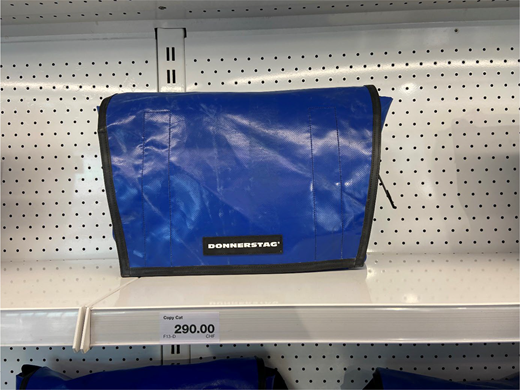
FREITAG has a history with Migros: In 1997, Migros copied one of FREITAG’s bags and called it “Donnerstag” – a play on words as “Freitag” means “Friday” in German and “Donnerstag” means “Thursday.” FREITAG objected to the copy because it was made from cheaper, non-recycled materials, resulting in a short-lived product that contradicted FREITAG’s sustainability principles (www.freitag.ch/de/donnerstag). Because of negative consumer reactions, which were widely reported in the media, Migros soon discontinued the copycat bag (www.freitag.ch/de/donnerstag). In 2023, to mark its 30th anniversary – and in reference to the copycat incident – FREITAG temporarily turned their flagship store in Zurich into a Migros supermarket. They recreated the look using Migros-style furnishings, logos, signs and other paraphernalia without ever naming the brand explicitly (for images, see Appendix).
Aldi
Aldi is a German supermarket brand that entered the Swiss market in 2005 (www.aldi-suisse.ch/de/unternehmen/ueber-uns.html). As in the USA and UK, Aldi in Switzerland positions itself as a low-price supermarket. In Switzerland, Aldi furthermore highlights its extensive selection of fresh, often organic and locally sourced produce. When Aldi entered the Swiss market, they were looking for a way to appeal to Swiss consumers. To establish a frame of reference (Keller et al., 2002) that would help the Swiss consumers make sense of the then-new brand, Aldi compared itself to a well-known Swiss retailer: Migros. They did so in a TV spot we analyze. As with the FREITAG case, Migros was never explicitly named.
Findings
We find that brands implicitly reference specific brands in IC advertising using two types of referencing: verbal referencing and visual referencing. Drawing on two empirical cases, we demonstrate how verbal and visual referencing combine to create associations with a specific but unnamed (i.e. implicitly referenced) brand. We detail both types of referencing below.
Verbal referencing
Verbal referencing refers to references that build on verbal cues to elicit associations with a specific brand. These could, for example, include slogans, taglines or expressions linked to the referenced brand.
FREITAG
In its marketing stunt, FREITAG made several verbal references to establish cues to Migros. They stated that the stunt was in response to “a large Swiss retailer” (www.freitag.ch/de/donnerstag) copying their bag 30 years ago. With this statement, FREITAG achieves two things: First, they cue consumers to the fact that the referenced brand is Migros – one of Switzerland’s two major retailers and the only one known for copying branded products and launching them as private labels. Second, they establish a basis on which consumers can compare the two brands: Migros used to sell a bag and FREITAG produces bags, allowing consumers to make a comparison of the two brands based on their bags.
FREITAG also verbally references Migros by adapting its slogan. Migros’ original slogan reads “ein M besser” (one M better – the M referencing Migros’ initial letter). FREITAG modified this to “ein F originaler” (one F more original), replacing “M” with “F” to reference its own name. By adapting Migros’ slogan, FREITAG constructed a further cue to verbally reference Migros without mentioning the brand explicitly. This adaptation also suggests that the original is superior to the copy, implying FREITAG’s superiority over Migros where bags are concerned by suggesting that the original is better than the copy. Thus, this serves both as a reference to Migros and a cue guiding consumers how to interpret the comparison of the bags (i.e. in favor of FREITAG).
FREITAG also reinterpreted a Migros sustainability campaign. Migros promotes its sustainability efforts through the “Generation M” campaign, in which it pledges to become more sustainable for “Generation M.” “Generation M” refers to tomorrow’s Migros’ consumers, that is, today’s children. FREITAG transformed this into “Generation F.” This intertextual reference both represents a cue to Migros and highlights FREITAG’s commitment to sustainability through its recycled-material products. The comparison between Migros and FREITAG suggests that the latter is more sustainable than the former because, unlike Migros, it exclusively sells eco-friendly products. Thus, this reference also guides consumers how to interpret the general comparison between Migros and FREITAG.
FREITAG also verbally references another defining trait of Migros. FREITAG announced that 99% of the proceeds of their Donnerstag bags would be donated to “the charity of a prominent retailer” (www.freitag.ch/de/donnerstag). As Migros is the only retailer with such a charity, the reference is unmistakable. The choice of 99% is also symbolic: Migros donates 1% of its proceeds to this charity, so inverting this figure (1% vs 99%) further positions FREITAG as superior by emphasizing its larger charitable donation.
In sum, FREITAG uses multiple verbal references to clarify its implicit references refer to Migros. FREITAG incorporates both obvious brand markers (e.g. referring to Migros’ size and adapting its slogan) and subtler references (e.g. the charity), which require consumers to have more in-depth knowledge of Migros for them to successfully decode the cue. Through these references, FREITAG establishes the bags as the basis for comparison on which consumers can compare the two brands. FREITAG also constructs the comparison in such a way that it emerges as superior to Migros. To achieve this, some cues serve a dual function: They reference Migros while simultaneously signaling FREITAG’s superiority.
Aldi
Aldi implicitly referenced Migros in a TV spot in which they built on the concept of the “Migros child” (for the full spot, see www.youtube.com/watch?v=LSj7y5UaZrs).
ORIGINAL AND TRANSLATED TEXT OF ALDI AD
(INCLUDING ANNOTATION OF STRESSES FOR THE ORIGINAL TEXT)
Die Schwéiz hat ein néues Kínd. Das Áldi-Kínd.
Switzerland has a new child. The Aldi-child.
Und plóetzlich séhen ándere Kínder ált aus.
And suddenly, other children seem pale in comparison.
Áldi-Kínder máchen vórwärts.
Aldi-children drive progress.
Áldi-Kínder káufen schláu und wóllen éinfach núr das Béste.
Aldi-children are smart buyers and only want the best.
Býe-bye ánderes Kínd. Hier kómmen die Áldi-Kínder.
Bye-bye other child. Here come the Aldi-children.
In this spot, Aldi leverages a phrase strongly linked to Migros to construct the implicit reference. Consumers loyal to Migros refer to themselves as “Migros children,” a term unique to Migros. Consumers loyal to other supermarkets do not call themselves children of this supermarket. By introducing the “Aldi-child,” Aldi creates a clear implicit reference to Migros without explicitly naming it. Additionally, Aldi ensures a favorable comparison through the “Aldi-child”: In the final line, Aldi suggests that all other children (i.e. Migros consumers) will go extinct (“Bye-bye other child”), as Aldi children will replace them. This implies that Migros children will switch to being Aldi children believing it to be the superior choice (i.e. compared to Migros, Aldi is much better). Similarly, the ad claims that, in comparison to Aldi-children, “other children [i.e. Migros children and by extension Migros] seem pale.” This further reinforces the message that Aldi is superior to Migros.
Aldi further reinforces the implicit reference to Migros through additional cues. It uses a Migros product line to construct a basis for comparison from which to establish a favorable comparison. The ad states that Aldi consumers and, by extension, Aldi, are as “smart” and quality conscious (“they only want the best”). Being “smart” about grocery shopping alludes to Migros’ M-Budget product line. M-Budget is Migros’ low-price line, marketed as an affordable yet high-quality alternative to name brands. Migros presents M-Budget as the smart choice for price-conscious consumers who prioritize quality. The emphasis on being smart and quality-conscious, thus, serves as a reference to M-Budget and, by extension, Migros. By highlighting that Aldi children are smart and quality-conscious, Aldi presents itself as the superior alternative to Migros.
In sum, Aldi leverages a phrase uniquely associated with Migros to create an implicit reference without naming the other brand. Additionally, Aldi subtly references a specific Migros product line, establishing it as a basis for comparison. Crucially, Aldi constructs the comparison such that it is favorable to Aldi. As Aldi offers lower prices than Migros (Blick, 2024), emphasizing price benefits is advantageous to Aldi. It simultaneously deflects from other areas, for example regional sourcing, where Aldi might perform worse than Migros.
Visual referencing
Visual referencing refers to references that build on visual cues to elicit associations with a specific brand. These could for example include colors, labels or characteristic shapes.
FREITAG
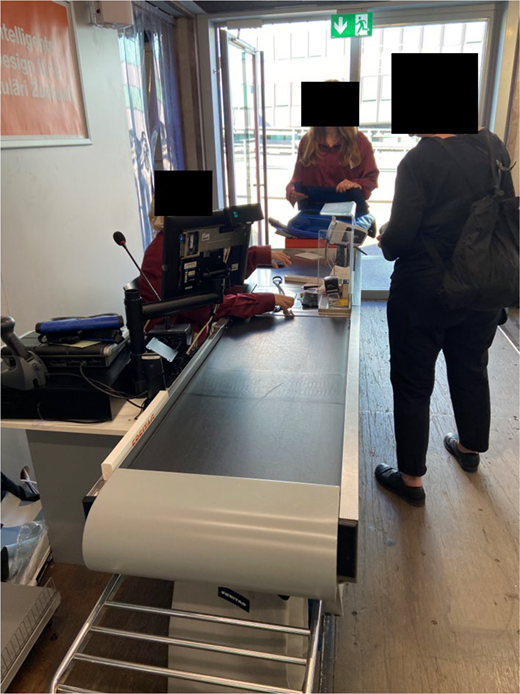
FREITAG used an abundance of visual references in dressing up their flagship store as a Migros supermarket (see images in Appendix). They furnished the store with Migros-style elements, including shelves, a checkout counter with a conveyor belt, shopping baskets, signs, labels and other supermarket fixtures. Crucially, they removed the Migros brand name from all materials, keeping the references implicit.
One of FREITAG’s visual references was an adapted Migros logo. At the store entrance, the name “FREITAG” appeared in bold orange letters. The font and the color were the same as in the Migros logo, therefore presenting a strong association with Migros. They also reinterpreted a Migros label indicating local product origins (e.g. vegetables from local farms). FREITAG retained the color scheme and style but inverted the imagery: The original label depicts a sunny sky and rural landscape, while FREITAG’s version featured a starry night sky and city skyline. Despite these changes, the identical style and color scheme ensure that the label is recognizable as an adaptation of Migros’ label. Thus, it can clearly be decoded as an implicit reference to Migros.
Finally, the entire flagship store served as a strong visual cue to Migros. The setup closely resembled a Migros supermarket, with all brand names removed. The shopping baskets matched Migros’ signature orange color, the crates in the shelves were the same shade of green as Migros’, and the furniture was identical. FREITAG even replicated Migros’ recycling station, which because of its design, was a clear implicit reference to Migros. However, instead of collecting PET-bottles, plastic bottles and batteries (like the original Migros recycling stations), FREITAG’s version featured sections for ski boots, old car seatbelts and used bicycle tires. These are the materials FREITAG uses to produce their bags, so this recycling station is a nod toward the fact that FREITAG uses more sustainable materials to produce its bags than Migros used when they copied its bags. Thus, this is also a cue guiding consumers to interpret the comparison favorably for FREITAG.
In sum, FREITAG used a variety of visual cues to reference Migros. Some were overt, like the adapted logo and label, while others, like the recycling station, require greater familiarity with Migros to understand. FREITAG provided fewer visual cues (compared to its use of verbal cues) guiding consumers in interpreting the comparison “correctly” (i.e. in favor of FREITAG). The only one we identified was the recycling station, a reminder that Migros did not use sustainable materials in their bags, making them inferior to FREITAG’s.
Aldi
Aldi’s ad includes subtle visual references to Migros. It features fast-cut images and video clips. As the word “Aldi-child” first appears on the screen, the background shifts to a vivid orange, evoking Migros’ signature color (orange). This color reappears throughout the ad, contrasted with Aldi’s signature dark blue. By juxtaposing these colors, the ad creates an implicit visual reference to Migros and invites a comparison with Aldi.
The ad also uses more visual cues to reinforce a comparison that is favorable to Aldi. As discussed above, Aldi verbally references a Migros product line, presenting itself as superior. During these verbal references, the video shows snippets in black and white that reinforce Aldi’s superiority over Migros. For instance, as the ad states that “other children pale in comparison,” a man leaning back in a chair falls over. Likewise, as the ad declares “bye-bye other child,” a black-and-white clip shows one boxer knocking out another. These visuals reinforce the message that Aldi is superior to Migros. By using black-and-white video clips, the ad visually relegates Migros to the past (just like black-and-white TV is a thing of the past). In contrast, the rest of the ad is very colorful, thus portraying Aldi as the vibrant future, encouraging a favorable comparison to Migros.
In sum, Aldi uses subtle cues (color) to implicitly reference Migros without naming it. The visuals primarily reinforce the favorable comparison established through verbal references.
Discussion
This paper set out to explore how brands implicitly reference specific brands in IC advertising. Through textual analysis of two Swiss cases, we have found that brands use verbal and visual references to implicitly reference specific brands in IC advertising. Verbal references can include adapted slogans, taglines and brand-specific expressions. Visual cues can include brand-related colors, logos and furnishings. Table 1 summarizes our findings, situates them within existing research and compares implicit referencing to other forms of advertising.
Comparison of noncomparative advertising, direct comparative advertising and indirect comparative advertising
| Dimensions of comparison | Noncomparative advertising | Direct comparative advertising | Indirect comparative advertising | ||
|---|---|---|---|---|---|
| Refers to | Ads in which “the brand’s performance along salient attributes is discussed without reference to the competition” (Miniard et al., 2006, p. 53) | “[A]dvertising that makes explicit reference to one or more named competitors” (del Barrio-García et al., 2020, p. 74) | Ads implicitly referencing a multitude of other brands (del Barrio-García et al., 2020) | Ads implicitly referencing a fictitious/anonymous brand that cannot be identified (del Barrio-García et al., 2020) | Ads implicitly referencing a specific identifiable brand without naming it |
| Illustrative examples | Apple’s “Privacy. That’s iPhone” campaign (https://d2oto3d7z6t29c.cloudfront.net/entries/transformed/d1/5f/702529_ffb09daeb1d14f7a8c8e84bad0310343.jpeg) | Verizon vs. AT&T on 3G coverage (www.youtube.com/watch?v=klFbchu1nYI) Apple’s 2002 switch campaign (www.youtube.com/watch?v=hj7lLt9Ztic) | Lay’s chips: “40% less fat than regular chips” (www.lays.com/sites/lays.com/files/2022-08/1%20Lays%20Kettle%20Cooked%20Fat%20Reduced%20%281%29.png) Apple’s 2018 switch campaign (www.youtube.com/watch?v=MjyzXVDJZ-g) | Dove campaign “Doesn’t your skin deserve better care?” (www.nytimes.com/2013/06/25/business/media/in-criticizing-rival-products-a-dove-campaign-is-called-unfair.html) | Burger King’s campaign comparing the Whopper burger to McDonald’s Big Mac Burger (e.g. https://socialbee.com/wp-content/uploads/2021/09/burger-ad.png) Dollar Shave Club comparing itself to Gillette (www.youtube.com/watch?v=ZUG9qYTJMsI) |
| Comparison in the ad | None | With a specific named brand that is referenced explicitly | With all competitors (other brands) | With a fictitious/anonymous brand (brand X) | With a specific brand that is implicitly referenced (not named) |
| Goal | Highlighting merits of advertised brand in competitive void (Miniard et al., 2006) | Differentiating the advertised brand relative to a specific brand (Pechmann and Ratneshwar, 1991) | Differentiating the brand relative to all competitors or to a specific brand coincidentally activated in consumers’ minds (Miniard et al., 2006) | Differentiating the brand relative to a specific brand purposely activated in consumers’ minds | |
| Mechanism | Mentioning salient attributes, strengths and performance of advertised brand (Miniard et al., 2006) | Specifically naming a brand and favorably comparing the advertised brand to it based on all attributes or specific products/attributes (Wilkie and Farris, 1975) | Using terms like “ordinary brands”, “other brands” (Beard, 2013, 2015, 2016; Brown and Jackson, 1977; del Barrio-García and Luque-Martínez, 2003; Jackson et al., 1979) | Using terms like “brand x”, “the market leader” (Miniard et al., 2006) | Visual referencing (based on brand elements such as logos, colors, labels etc.) Verbal referencing (based on phrases or slogans associated with the other brand) |
| Advantages relative to other advertising types | Avoids accidentally advertising competitor brands Avoids accidentally associating the two brands rather than differentiating them | Clearly names a specific competitor, thus potentially increasing the effect of the ad (Beard, 2015; Pechmann and Ratneshwar, 1991) | Avoids appearing as too aggressive or unfair (Beard, 2013, 2016) Avoids potential legal issues associated with DC ads (Hançar, 2023) | Increases effectiveness of ad by evoking a specific competitor (Miniard et al., 2006) while avoiding appearing as too aggressive or unfair (Beard, 2013, 2016) and avoiding potential legal issues associated with DC ads (Hançar, 2023) | |
Source(s): Authors’ own work
Our cases reveal a pattern in the construction of implicit brand references. First, the initiating brand clearly defines a basis for comparison to the referenced brand. This allows consumers to compare the brands on a specific aspect, aligning implicit referencing with definitions of direct and indirect comparative advertising, which emphasize comparative ads must provide a basis for comparison (Wilkie and Farris, 1975). Our analysis highlights the importance of selecting the right basis for comparison. In our cases, comparisons were strategically designed to favor the initiating brand. It makes sense that brands would base comparisons on products, services or benefits where they hold a clear advantage. Otherwise, the ad risks unintentionally benefiting the referenced brand if the comparison favors it instead.
To ensure a favorable comparison, indirect references not only include cues to the referenced brand and establish an advantageous basis for comparison but also build on cues that guide the interpretation of the comparison. In our cases, the initiating brands subtly asserted their superiority through visuals, adapted slogans or altered furniture.
Second, our cases follow the principle of redundancy: Instead of relying on a single cue, both cases use multiple verbal and visual cues to reinforce the implicit reference. This increases the likelihood that consumers will successfully decode the reference, making the ad more effective (Miniard et al., 2006). Because consumers may overlook subtle cues or those requiring detailed brand knowledge, using multiple cues provides more “chances” to consumers to decode the implicit reference. Research on DC advertising supports this supposition, showing that DC ads both verbally and visually naming a competitor lead to greater recall (Kangun et al., 1984).
Third, implicit references rely on brand elements that are already strong signifiers, cultivated through deliberate branding efforts (e.g. slogans, logos, expressions and colors). Thus, implicit references capitalize on the referenced brand’s efforts to build a strong identity (Aaker, 1996). This suggests that indirect references are most effective when referencing well-known brands with widely recognized elements. In turn, this again would seem to increase the likelihood that the indirect reference is decoded correctly.
Fourth, our analysis reveals that verbal and visual references work together to create an implicitly referencing ad. As demonstrated, visual and verbal references reinforce each other by conveying the same message on different levels. Additionally, they complement each other, as seen in the Aldi case, where visual references underline verbal ones.
On a methodological level, this paper shows that using interpretive approaches – specifically textual analysis – yields detailed insights into the intricacies of branding. Focusing on the details of advertising, textual analysis provides a perspective that produces a rich understanding of IC advertising and especially implicit referencing. Thus, it is ideally positioned to complement previous literature examining the phenomenon on a meso- or macrolevel, such as on a consumer level or in comparison to all other types of advertising. We join Fowler et al. (2022) in calling for a wider application of this methodology to other fields and research questions.
Theoretical contribution
This paper makes two theoretical contributions. First, we expand existing knowledge about comparative advertising by exploring the underlying mechanisms of implicit referencing. While previous research acknowledged the existence of this type of comparative advertising (Beard, 2016; Brown and Jackson, 1977; Jackson et al., 1979), it did not reveal insights into the underlying mechanisms. Thus, this paper enhances our understanding of implicit referencing. This contribution is depicted in Table 1 in the bold column.
Second, we expand the conceptualization of comparative advertising by showing that it can work across categories and between non-competing brands. This is an addition to previous conceptualizations as existing literature focused on cases where the involved brands were direct competitors within the same category (del Barrio-García et al., 2020; Wilkie and Farris, 1975), even though cross-category comparative advertising occurs in practice. Thus, our paper contributes a more complete theoretical picture that better represents empirical cases.
Practical contribution
Our research offers several important implications for practitioners. We examine how to craft indirect references to specific but unnamed brands. Our findings offer strategies for designing better IC ads, as triggering a specific brand association has been shown to make them more effective (Miniard et al., 2006). Specifically, we identify the types of cues that serve to construct implicit references, highlight the importance of establishing a basis for comparison – even across categories – and emphasize the value of redundant cues to ensure the ad is decoded correctly.
Understanding how to craft implicit references is important, as this type of IC advertising offers a key advantage over DC advertising. Unlike DC advertising, which may face legal restrictions, IC advertising in general and implicit references in particular may be subject to looser regulation (Hançar, 2023). Thus, IC ads referencing specific brands enable marketers to leverage comparative advertising while mitigating legal risks.
Limitations and future research
Our research is limited to two Swiss cases. While this aligns with calls for more research into comparative advertising beyond US contexts (del Barrio-García et al., 2020), we acknowledge the focus on a single market as a limitation. Future research should investigate the issues we raise in other contexts to further enrich our understanding of the phenomenon. Particularly, future research should examine additional cases of implicit referencing in different context to establish whether the patterns we identify in our research hold across other contexts as well.
Furthermore, while the methodology of textual analysis effectively provides insights into the mechanisms and constructions of implicit references in IC advertising, it does not illustrate how consumers interpret these ads. Thus, future research should build on our findings by using consumer insights to understand interpretive processes.
While our research advances understanding of implicit referencing, several questions remain for future study. Although we identify cues used to construct implicit references, our study does not assess their relative effectiveness. It might be that verbal references generally are more effective than visual references or vice versa. Or it is possible that certain cues (e.g. using a logo vs using a color) vary in effectiveness. Future research should investigate these issues.
Furthermore, we propose a hypothesis for future research to test. We suppose that redundant cues in IC ads enhance consumers’ ability to decode the implicit reference. Future research should test this supposition. Additionally, research should examine the optimal combination of cues. Which cues are essential for decoding? Is there a threshold beyond which additional cues no longer improve decoding accuracy? These questions provide valuable directions for future research.
References
Appendix
 The photograph shows a freestanding metal framed pavement sign placed on a sidewalk. The poster headline reads Donnerstag Wochen with the dates 19.9.2023 to 30.9.2023. A product image of a DONNERSTAG Messenger Bag P 13 Copy Cat is displayed with the price 290.00. A label reads Neu beside the bag. Additional offers are shown below, including apples labelled Hit, a large number 30 with 30 percent and price 6.99, another item with 50 percent and price 5.99, and flowers with 99 percent. The word FREITAG appears at the bottom of the poster.
board in front of FREITAG store advertising the copycat bag
Source: Authors’ own image
The photograph shows a freestanding metal framed pavement sign placed on a sidewalk. The poster headline reads Donnerstag Wochen with the dates 19.9.2023 to 30.9.2023. A product image of a DONNERSTAG Messenger Bag P 13 Copy Cat is displayed with the price 290.00. A label reads Neu beside the bag. Additional offers are shown below, including apples labelled Hit, a large number 30 with 30 percent and price 6.99, another item with 50 percent and price 5.99, and flowers with 99 percent. The word FREITAG appears at the bottom of the poster.board in front of FREITAG store advertising the copycat bag
Source: Authors’ own image
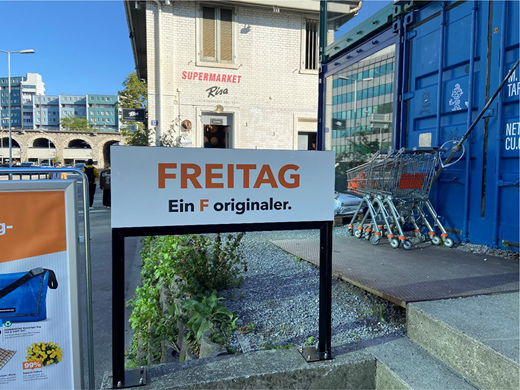

Store display in FREITAG store referencing Migros
Source: Authors’ own image
Store display in FREITAG store referencing Migros
Source: Authors’ own image
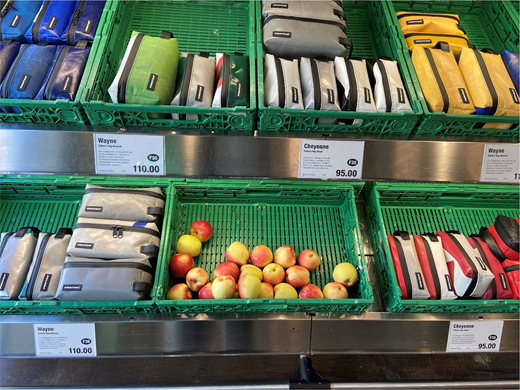
Details of FREITAG store display referencing Migros
Source: Authors’ own image
Details of FREITAG store display referencing Migros
Source: Authors’ own image
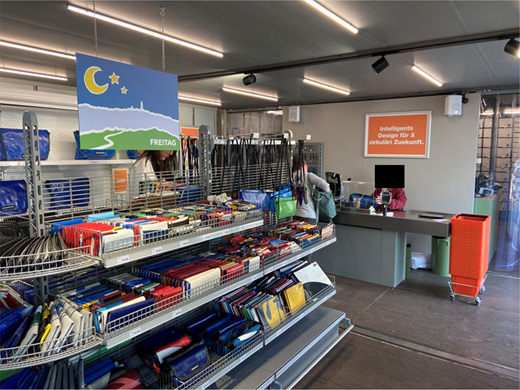
FREITAG store display and till referencing Migros
Source: Authors’ own image
FREITAG store display and till referencing Migros
Source: Authors’ own image
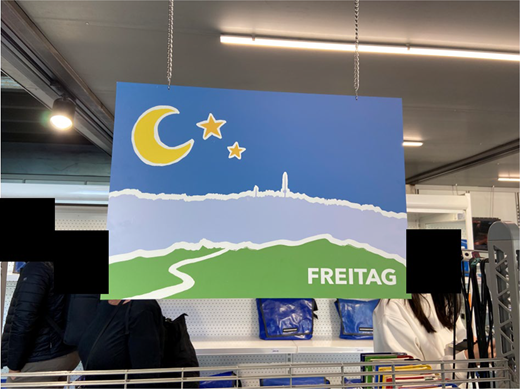
FREITAG’s adapted Migros label of regional origin
Source: Authors’ own image
FREITAG’s adapted Migros label of regional origin
Source: Authors’ own image