This study aims to examines how consumer advocates of the cause respond to value-aligned brand activism by drawing on identity fusion and consumer–brand relationship norms.
Four online experiments tested these dynamics. Study 1 assessed whether induced advocacy fusion increases support for aligned activism. Study 2 examined whether fusion moderates the effect of relationship norms on positive WOM and whether perceived authenticity mediates this effect. Study 3 replicated these effects using trait fusion. Study 4 investigated how fusion and relationship norms drive negative reactions to inconsistent activism via perceived hypocrisy.
Studies 1 and 2 found that induced advocacy fusion increased positive WOM intentions. Across Studies 2–3, fusion weakened the advantage of exchange norms over communal norms, with authenticity mediating effects. Study 4 showed that high fusion amplified negative responses to inconsistent activism, particularly in communal relationships, through heightened perceptions of hypocrisy.
This study extends the brand activism literature by identifying identity fusion as a primary driver of cause advocates’ responses. It conceptualizes relationship norms as an underlying relational contract and shows that identity fusion can both amplify and attenuate these norms, offering a framework for authentic sociopolitical engagement.
Introduction
In moments of social upheaval, consumers often experience a profound sense of “oneness” with those who share their sociopolitical views. The aftermath of George Floyd’s killing prompted powerful displays of solidarity with the Black community (Jan et al., 2021). The #MeToo movement ignited widespread support, particularly among those standing with victims of sexual harassment and assault (Gracia, 2017). Recognizing how deeply individuals connect to sociopolitical causes, brands increasingly take public stands, positioning brand activism as a salient signal of commitment to social change (Moorman, 2020).
Market responses to brand activism exhibit significant complexity than a simple demand for advocacy. While recent reports indicate that a majority of Americans prefer companies to remain neutral on political and social issues (Ipsos, 2025), certain demographic segments show the opposite trend. 63% of Gen Z respondents reported a higher likelihood of purchasing from brands that take a stand, and support among Black and Asian consumers is nearly double the 35% reported by White consumers (Sprout Social, 2025). When political conflict intensifies, engaged stakeholders often push for clearer brand positioning and substantive action (Tsougkou et al., 2025).
Among these engaged stakeholders, cause advocates represent a particularly critical audience. They are not only the most likely to demand brand activism but also the quickest to challenge it when perceived as opportunistic or inconsistent (Caruelle, 2025; Francioni et al., 2025; Walter et al., 2024). When Target announced in early 2025 that it would scale back its diversity, equity and inclusion initiatives, cause advocates and civil-rights leaders mobilized the public, leading a boycott against what they perceived as a capitulation to political pressure (Karnowski, 2025). Despite their influence, little is known about the psychological processes that shape cause advocates’ responses to brand activism, making this an essential area for investigation.
Identity fusion theory (Swann et al., 2012) posits that when a social identity becomes intertwined with the personal self, it motivates pro-group behaviors, such as loyalty to the fused group or cause. Drawing on this perspective, cause advocates may vary in the extent to which their cause-related identity is fused with the self, a state referred to here as advocacy fusion. Identity fusion often emerges from shared, particularly dysphoric, experiences that trigger self-reflection and integrate personal and group identities (Reese and Whitehouse, 2021). In today’s digital environment, frequent exposure to such events can foster solidarity and strengthen advocates’ ties to the movement (Kumar et al., 2025). Importantly, identity fusion predicts intense pro-group behavior more strongly than traditional social identity frameworks (Swann et al., 2024), offering a mechanism for why cause advocates exhibit both strong support for authentic brand activism and harsh backlash when it appears insincere.
Consumer responses are further shaped by relational expectations that influence how the authenticity of brand activism is judged. Relationship norms are implicit rules that govern brand–consumer interactions and guide consumer reactions to both brand social initiatives (Lim and Hong, 2023; Tao and Song, 2020) and their failures, such as brand transgressions (Motsi, 2024; Rodrigues et al., 2021; Saeed et al., 2024; Yang and Mundel, 2022). Understanding how these norms operate can help brands navigate advocacy efforts more effectively by aligning their actions with consumer expectations.
Four online experiments investigate how advocacy fusion and consumer–brand relationship norms shape responses to brand activism. Study 1 tests whether dysphoric injustice events related to sociopolitical issues elicit advocacy fusion and increase support for brand activism, including intentions to spread positive word-of-mouth (WOM). Study 2 tests the interaction between advocacy fusion and relationship norms on positive WOM, with perceived authenticity as a mediating mechanism. Study 3 replicates these effects by measuring trait-level advocacy fusion among cause advocates. Study 4 analyzes how advocacy fusion and relationship norms jointly drive brand avoidance and negative WOM in response to inauthentic activism, with perceived hypocrisy acting as the mediator.
This research advances brand activism scholarship by uncovering the psychological drivers of how cause advocates respond to brand activism, demonstrating how identity-based processes and relational expectations amplify support for authentic activism and intensify backlash against perceived “woke-washing.” The findings offer a theoretical framework for understanding these mechanisms and provide actionable guidance for brands navigating sociopolitical engagement.
Theoretical background
Brand activism and cause advocate responses
Brand activism is a strategic approach in which companies take public positions on contentious sociopolitical issues (Moorman, 2020). Unlike corporate social responsibility (CSR) initiatives, brand activism represents a values-driven effort that addresses controversial topics through explicit communication (Lou et al., 2024; Vredenburg et al., 2020). While CSR has long served as a driver of positive social and environmental change, it typically concentrates on broadly accepted prosocial issues, such as combating hunger or promoting education for children in developing countries (Mukherjee and Althuizen, 2020). In contrast, brand activism involves corporate stances on politically charged issues such as abortion rights, health care, gun control and LGBTQ+ rights. These topics are inherently divisive and often elicit strong reactions from stakeholders (Zhao et al., 2024; Zhao et al., 2025). They carry reputational risks, as brands may alienate consumers or stakeholders who oppose their positions (Haupt et al., 2023; Vredenburg et al., 2020).
Brand activism is regarded as promising because cause advocates who support the focal cause are likely to reward these brands for their stances (Vredenburg et al., 2020). Studies have shown that when a brand publicly endorses sociopolitical issues consistent with consumers’ views, it elicits more positive responses (Wannow et al., 2024; Zhao et al., 2024). Activist consumers may be more likely to discount negative information about product failures from activist brands than from nonactivist brands (Francioni et al., 2025).
Cause advocates may, however, exhibit more intense responses when brand activism signals failure or inconsistency (Caruelle, 2025; Francioni et al., 2025; Milfeld et al., 2025; Walter et al., 2024). They responded more harshly to failures involving value-related issues (Francioni et al., 2025) and perceived the brand as hypocritical (Milfeld et al., 2025) and supporters of social justice causes report sharp declines in trust, attitudes and brand credibility when value-aligned brand activism is perceived as “woke-washing” (Caruelle, 2025; Walter et al., 2024).
Cause advocates represent a critical consumer segment that is more likely to translate authentic activism into durable brand equity (Vredenburg et al., 2020), yet similarly predisposes them to stronger backlash when efforts appear opportunistic (Caruelle, 2025; Walter et al., 2024). Prior research has focused on general consumer responses through framework, such as consumer-brand values alignment (Zhao et al., 2024), consumer–brand identification (Haupt et al., 2023; Wannow et al., 2024) and cause involvement (Caruelle, 2025; Francioni et al., 2025; Walter et al., 2024). However, findings remain mixed regarding whether these approaches reliably predict brand outcomes (Francioni et al., 2025; Haupt et al., 2023; Wannow et al., 2024; Zhao et al., 2024). This study addresses this gap by applying identity fusion theory to explain both positive and negative reactions to value-aligned brand activism.
Advocacy identity fusion and consumer response to brand activism
Consumers form deep connections with advocacy and with others who share their sociopolitical views, strengthening their commitment to both the cause and fellow supporters. This heightened sense of unity amplifies their “oneness” with the group, motivating pro-group behaviors (Gómez et al., 2011). This psychological state, known as identity fusion, arises when the boundary between an individual’s personal and social identity blurs, resulting in their seamless integration (Gómez et al., 2011).
Unlike social identity, which emphasizes categorization within a collective and often shifts attention away from the personal self, identity fusion preserves the individual self-concept while integrating it with the group identity (Swann et al., 2024). This integration produces intense emotional ties and a sense of personal responsibility toward the group, making fused individuals more willing to act in its best interests as they would for themselves, even to the extent of fighting and dying for ingroup members (Gómez et al., 2011; Swann et al., 2014). Previous studies have extended identity fusion to additional targets, such as ideologies and brands (Hawkins, 2019; Lin and Sung, 2014; Swann et al., 2012). This research proposes that consumers can develop identity fusion with advocacy, a phenomenon referred to as advocacy fusion.
Identity fusion develops through shared experiences, particularly dysphoric or painful ones, which foster self-reflection and merge personal and group identities (Reese and Whitehouse, 2021). Research indicates that individuals affected by natural disasters or social injustices may form a strong, shared identity, even if they were previously unconnected (Whitehouse et al., 2017). Such emotionally charged experiences generate empathy, solidarity and stronger commitments to collective action, thereby inducing identity fusion (White et al., 2024).
Collective injustice-related events can forge a deep, unified bond around social justice issues, fostering a fusion of advocacy through shared emotional pain. Exposure to widely shared dysphoric events – such as the killing of George Floyd, including the widely circulated phrase “I can’t breathe” – may amplify collective emotional responses and increase motivation for collective action. Building on this logic, the present research proposes that shared moments of injustice can foster advocacy fusion, characterized by a visceral sense of oneness with the cause:
Participants exposed to an injustice event will exhibit higher advocacy fusion than those in the control condition.
Many studies have documented that identity fusion is a stronger predictor of pro-group behaviors (e.g. Swann et al., 2024). It develops through strong relational bonds with ingroup members, which reinforce each other and lead individuals to view themselves as integral parts of the group (Reese and Whitehouse, 2021; Swann et al., 2012). This psychological state creates a sense of self-equivalence with the group or cause, motivating individuals to act on its behalf (Swann et al., 2014). Empirical evidence demonstrates that strong fusion with political causes such as gun control or abortion rights increases individuals’ willingness to self-sacrifice to support the cause (Buhrmester et al., 2015; Martel et al., 2021). By contrast, individuals who strongly identify with a group but lack strong fusion tend to show less extreme support (Buhrmester et al., 2015; Martel et al., 2021; Swann et al., 2012). Thus, consumers with strong advocacy fusion are more likely to support brands that take positions aligned with their fused identity compared to those who are weakly fused:
Strongly fused participants will exhibit a higher intention to share positive word of mouth than weakly fused participants.
Response to value-aligned brand activism by the consumer-brand relationship norm type
Consumers form relationships with brands in ways like their relationships with other people, governed by two types of norms: communal and exchange (Aggarwal and Larrick, 2012; Aggarwal and Law, 2005; Alvarez et al., 2023). Exchange relationships involve providing benefits with the expectation of receiving equivalent returns, akin to business partnerships that value proportional benefits (Aggarwal and Law, 2005). In contrast, communal relationships reflect a genuine concern for the well-being of others and a commitment to meeting their needs, resembling friendships and family bonds in which individuals prioritize the other person’s needs over their own self-interest (Aggarwal and Larrick, 2012). Expectations formed within these relationships shape how consumers evaluate the brand, its products and messages (Alvarez et al., 2023; Motsi, 2024; Yang and Aggarwal, 2019).
When brand behavior deviates from these relational expectations, the discrepancy triggers cognitive responses that influence evaluations of both the behavior and the brand (Burgoon, 2015). Such discrepancies can produce positive responses when behavior exceeds expectations and negative reactions when it falls short. CSR initiatives generate favorable responses when consumers primarily associate the brand with competence, as such actions positively violated exchange-focused relationship norms (Lim and Hong, 2023; Tao and Song, 2020). In brand activism, value-aligned advocacy can also be perceived positively when it defies prior expectations (Zhang and Zhou, 2025). Conversely, violations of trust-based norms lead to negative reactions, as demonstrated in consumer responses to brand transgressions (Rodrigues et al., 2021; Motsi, 2024; Saeed et al., 2024). These insights provide a theoretical foundation for understanding consumer responses to value-aligned brand activism.
The moderating role of identity fusion on consumer-brand relationship norms in brand activism responses
Consumer responses to brand activism depend on the type of consumer–brand relationship and the level of advocacy fusion. For weakly fused consumers, relationship norms may shape expectations and subsequent responses. In communal relationships, consumers expect brands to prioritize their well-being and respond positively to their concerns (Aggarwal and Larrick, 2012), often anticipating that brands to will take a stand on meaningful sociopolitical issues (Zhang and Zhou, 2025). By contrast, exchange relationships are defined by expectations of balanced value exchange (Aggarwal, 2014), with little anticipation that brands will engage in sociopolitical advocacy. When an exchange-oriented brand adopts a stance on an issue supported by its customers, the action may positively exceed expectations and generate favorable responses.
For highly fused cause advocates, however, advocacy fusion supersedes relationship norms. This identity fusion creates visceral, family-like bonds, leading consumers to perceive activist brands as ingroup members and diminishing the effect of any prior relational history (Swann et al., 2014; Whitehouse et al., 2017). Advocacy fusion, therefore, becomes the primary driver of supportive responses to brand activism, overriding relational expectations. The following hypothesis is proposed:
The interaction between consumer–brand relationship norms and advocacy fusion influences positive WOM. Specifically, participants in exchange relationships, compared with those in communal relationships, are more likely to exhibit stronger intentions to share positive WOM when they are weakly fused rather than strongly fused.
The mediating role of perceived authenticity
Perceived authenticity may function as a key mediator driving positive response among cause advocates. Perceived authenticity is defined as the extent to which a brand’s motives and actions are seen as genuine (Moulard et al., 2016). Because consumers often exhibit skepticism toward the motivations of brands engaging with societal issues (Mirzaei et al., 2022), addressing such doubts requires ensuring that the activism is perceived as authentic (Schmidt et al., 2021; Vredenburg et al., 2020). Consumers who are more involved in the cause are more likely to assess authenticity of the brand activism (Walter et al., 2024).
The literature highlights that perceived authenticity plays a pivotal role in generating positive consumer outcomes (Alhouti et al., 2016; Beermann and Hallmann, 2025; Mirzaei et al., 2022). Studies have shown enhanced perceived authenticity increases brand attitudes (Beermann and Hallmann, 2025) brand loyalty and purchase intention (Alhouti et al., 2016). When activism is perceived as authentic, it is likely to strengthen identity alignment, positioning the brand as a vehicle for self-expression that enhances the self (Wallace et al., 2014) and thereby increasing willingness to share positive WOM (Markovic et al., 2022). As a result, perceived authenticity is expected to mediate the interaction effect of advocacy fusion and relationship norms on positive WOM:
The interaction between advocacy fusion and relationship norm type on positive WOM toward brand activism aligned with participants’ sociopolitical advocacy is mediated by perceived authenticity.
Consumer backlash to inconsistent brand activism
Brand activism requires consistent alignment between a company’s core values, its marketing messages on social issues and its operational practices (Ahmad et al., 2024; Mirzaei et al., 2022; Lou et al., 2024; Vredenburg et al., 2020). Consumers scrutinize the motives behind brand activism and any inconsistency they perceive can lead to accusations of opportunistic, profit-driven behavior, often labeled “woke-washing” (Ahmad et al., 2024; Mirzaei et al., 2022; Vredenburg et al., 2020). When a brand’s practices contradict its stated commitments, such discrepancies foster skepticism and make activism appear deceptive (Vredenburg et al., 2020), decreasing perceived authenticity (Ahmad et al., 2024; Allen and Wanjugu, 2025), reducing meaningful social impact (Schmidt et al., 2021) and diminishing brand credibility (Walter et al., 2024).
Brands may be judged as hypocritical when they take stances on unrelated issues (Kim et al., 2025), offer selective support (Malik et al., 2025) or later retract their original positions (Milfeld et al., 2025). Such contradictions can be interpreted as violations of a brand’s professed values, leading to amplified punishment for activist brands following moral transgressions (Mahmud and Guzmán, 2025). Inauthentic brand activism damages perceptions of ethics and integrity (Vredenburg et al., 2020), prompting negative behaviors such as boycotts (Grégoire et al., 2009), ceasing patronage (Youn, 2022) and spreading negative WOM (Grappi et al., 2024; Jung et al., 2020).
Highly fused advocates may respond more punitively when a brand signals inconsistent or exploitative commitment to a shared cause. Among fused advocates, a brand’s inconsistent stance in the case is more likely to register as an identity threat because the cause is intertwined with their core identity (Swann et al., 2012). Identity fusion research suggests that threat-related arousal can heighten pro-group orientation and identity-protective responding (Gómez et al., 2011; Swann et al., 2009). In marketplace contexts, identity-relevant disruptions have been associated with punitive behaviors such as negative WOM, boycott and avoidance, particularly among highly fused consumers (Hawkins, 2019).
Inconsistent brand positions further heighten perceptions of immorality when they violate communal relationship expectations rooted in fairness and mutual trust (Aggarwal and Larrick, 2012). Because communal ties carry stronger expectations of moral obligation and care, violations are more likely to be interpreted as betrayal and elicit stronger outrage than breaches of transactional norms (Aggarwal and Larrick, 2012; Grégoire et al., 2009). These reactions can increase punitive responses (Grappi et al., 2024; Jung et al., 2020). For strongly fused advocates, communal betrayal is experienced as more severe because it threatens a core identity, amplifying punitive responses. This logic leads to the following prediction:
Participants in communal relationships are more likely to engage in (a) brand avoidance and (b) negative WOM than those in the exchange relationship norm, as the advocacy fusion increases.
Perceived hypocrisy as a psychological mechanism
Perceived hypocrisy may act as a key mechanism driving negative consumer behavior. It refers to the perception that an individual or organization presents itself as something it is not (Wagner et al., 2020). It generally arises from a brand’s perceived unethical behavior, particularly when initial statements or actions establish a code of conduct that later conflicts with the brand’s practices (Barden et al., 2005; Wagner et al., 2009). Such contradictions create impressions of unreliability or failures to adhere to core values, thereby violating fundamental social norms of honesty and integrity (Wagner et al., 2020).
Consumers denounce hypocrisy not only because it signals moral weakness but also because it conveys a deceptive moral message intended to mislead others (Baghi and Antonetti, 2021; Barden et al., 2005; Jordan et al., 2017). Consequently, heightened perceptions of hypocrisy lead consumers to distance themselves from unethical brands and reject those associated with undesirable self-images or negative affiliations (Baghi and Antonetti, 2021), decreasing consumer attitudes and purchase intentions (Malik et al., 2025). In practice, consumers may deliberately avoid such brands, sever ties with entities linked to moral dissonance (Youn, 2022) and disseminate negative information to dissociate from ethical violations (Grappi et al., 2024; Jung et al., 2020). Based on these insights, the following hypothesis is proposed:
The interaction between advocacy identity fusion and the consumer-brand relationship type on intention to engage in (a) negative WOM and (b) brand avoidance toward disingenuous brand activism is mediated by perceived hypocrisy.
Study 1
Study 1 method
Research design
Study 1 investigates whether a dysphoric injustice event increases advocacy fusion and enhances positive WOM in response to brand activism aligned with the fused identity (H1 and H2). The study used a single-factor between-subjects experimental design (advocacy-related injustice event: absent vs present). It manipulated the presence of the injustice event and measured advocacy fusion and perceived authenticity.
Stimuli development and measurements
The sociopolitical issue selected for the study was the Black Lives Matter (BLM) movement. BLM’s prominence in debates over policing, use of force, racial inequality and systemic racism makes it a particularly relevant sociopolitical issue (Collins, 2020). To minimize the influence of prior brand attitudes, a relatively unknown brand (Café 99) was introduced, accompanied by a brief description and a mock Instagram post. The post included a symbolic BLM image with a caption affirming the brand’s support for equality (e.g. #BlackLivesMatter). Posts were formatted to replicate Instagram’s layout for realism.
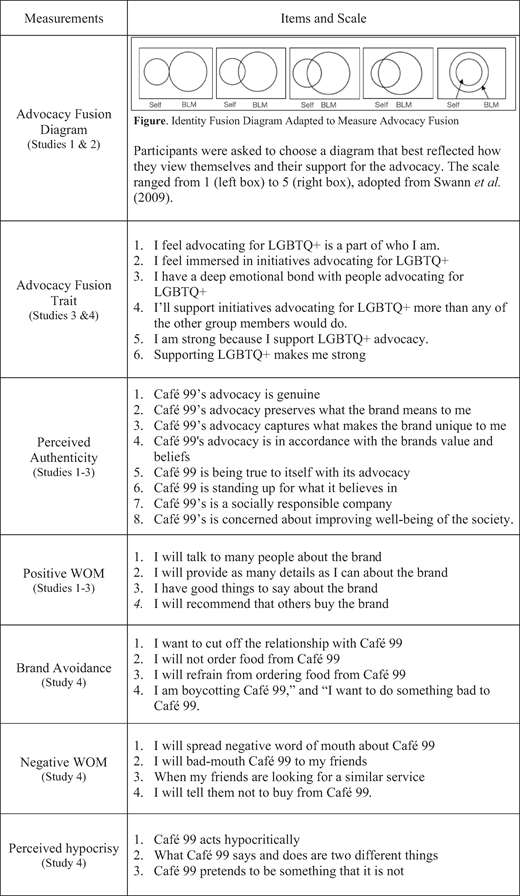
Two news articles were developed to manipulate the presence of a dysphoric injustice event. One article described a neutral community gathering, while the other depicted the fatal shooting of an unarmed Black teenager following a false allegation. Identity fusion was assessed using a pictorial scale developed by Swann et al. (2009). Participants rated their fusion on a five-point scale represented by images: 1 indicated complete separation between self and advocacy (no fusion), whereas 5 represented full integration of advocacy support into the self-concept (highest fusion). The detailed diagram of the scale is provided in Appendix.
Positive WOM (Cheema and Kaikati, 2010) was measured using four items on a seven-point Likert scale (1 = strongly disagree, 7 = strongly agree), such as “I have good things to say about the brand” (α = 0.73).
Sampling and procedure
A total of 130 US participants were recruited through Amazon Mechanical Turk (MTurk), a widely used platform for social science research (Berry and Burton, 2024). After providing informed consent, participants were asked whether they supported the BLM movement; those who did not were automatically exited from the survey. Eligibility was restricted to US-based workers with a HIT approval rate of 99% or higher. CAPTCHA verification prevented automated responses, while attention checks and open-ended questions ensured the quality of the data. Participants who failed screening or attention checks, or who provided irrelevant responses or atypical completion times, were excluded in accordance with best practices (Aguinis et al., 2021). Qualtrics flagged potential bots, straight-line responses and ambiguous answers, which were then manually reviewed for accuracy. Full details of the data collection procedures are provided in the online supplementary materials. The final data set consisted of 109 valid cases (30.3% female, n = 33; Mage= 34.08, SDage = 4.63, range: 26–53). Participants self-identified as 2.8% American Indian or Alaska Native (n = 3), 16.5% Asian (n = 18), 10.1% Hispanic or Latino (n = 11) and 70.6% White (n = 77).
Participants were randomly assigned to read either a general community event article (n = 52) or an injustice event article related to the Black community (n = 57). They then indicated their level of fusion with BLM advocacy, were introduced to a local café and its social media post supporting BLM, and evaluated the brand’s activism, including perceived authenticity and willingness to engage in positive WOM. The survey concluded with demographic questions, after which participants were debriefed and thanked.
Study 1 results
Manipulation check
The advocacy fusion manipulation was successful. In the advocacy fusion treatment group, 77.2% (n = 44) identified the article as “a tragic injustice event,” while 80.8% (n = 42) of the base group selected “community event” (χ2 = 36.55, p < 0.001).
Hypothesis testing
A series of independent sample t-tests was conducted to test H1 and H2. For advocacy fusion, participants who read about the negative injustice event in the community reported significantly higher identity fusion on the pictorial diagram (M = 3.55, SD = 0.95) than those in the baseline condition [M = 3.15, SD = 0.80; t(105.03)=2.35, p = 0.020, d = 0.45, 95%CI = [0.069, 0.834]]. For positive WOM, participants in the treatment condition (strongly fused; M = 6.22, SD = 0.48) reported a higher intention to share positive WOM than those in the control condition [weakly fused; M = 5.68, SD = 0.95; t(73.95)=3.71, p < 0.001, d = 0.73, 95%CI = [0.341, 1.118]]. These results support both H1 and H2.
Study 1 discussion
Study 1 demonstrated that participants exposed to a dysphoric injustice event exhibited significantly higher advocacy fusion than the control group. These findings extend identity fusion theory (Gómez et al., 2011; Swann et al., 2012) by suggesting that emotionally charged experiences can strengthen a sense of “oneness” with abstract causes (White et al., 2024; Whitehouse et al., 2017). This heightened fusion, in turn, drives stronger intentions to share positive WOM when brand activism aligns with advocates’ values, supporting H1 and H2.
Study 2
Study 2 method
Research design
Study 2 investigates whether advocacy fusion moderates the effect of consumer–brand relationship norms on positive WOM for value-aligned brand activism (H3) and examines whether perceived authenticity mediates this interaction effect on positive WOM (H4). A 2 (relationship norms: exchange vs communal) × 2 (advocacy-related injustice event: no vs yes) factor between-subjects experiment design was used. Relationship norms and advocacy-related injustice events were manipulated, while perceived authenticity and positive WOM were measured.
Stimuli development and measurements.
The same brand and news articles from Study 1 were used. Following prior research, two vignettes were developed to induce relationship norms. The exchange conditions emphasized transactional benefits, such as service quality and promotions. In contrast, the communal condition emphasized a friend-like bond by incorporating language of family, kindness and warmth (Aggarwal and Larrick, 2012; see online supplementary materials).
The perceived authenticity (Bruhn et al., 2012) was assessed on eight items, such as “Café 99’s advocacy is genuine” (α = 0.79). The identical scale from Study 1 was adopted to measure positive WOM (α = 0.73). All items were measured on a seven-point Likert scale (1 = strongly disagree, 7 = strongly agree). See Appendix for measurements.
Sampling and procedure
A total of 180 US-based MTurk participants were recruited. Only those who supported BLM and met strict quality criteria were retained. Applying the same data-quality procedures described in Study 1 yielded 143 valid cases (35.5% female, n = 56; Mage=34.43, SDage = 5.05, range: 27–53). Participants identified as 2.1% American Indian or Alaska Native (n = 3), 2.8% Asian (n = 4), 0.7% African American (n = 1), 8.4% Hispanic or Latino (n = 12), 85.3% White (n = 122) and 0.7% Other (n = 1).
After providing informed consent, participants indicated whether they supported BLM advocacy; those who did not were automatically exited from the survey. Eligible participants were randomly assigned to one of four conditions: exchange/control (n = 39), exchange/advocacy fusion treatment (n = 33), communal/base (n = 30) and communal/advocacy fusion treatment (n = 41; χ2 = 2.03, p > 0.05). They were then exposed to a social media post highlighting the brand’s commitment to BLM advocacy, followed by questions assessing perceptions of the brand and its activism. The survey concluded with demographic items, after which participants were debriefed and thanked.
Study 2 results
Manipulation check
All conditions were successfully manipulated. The manipulation of injustice events related to advocacy was confirmed by the treatment group (78.85%, n = 82) identifying the article as highlighting “a tragic injustice event,” while the control group (81.93%, n = 68) categorized it as “a community event” (χ2 = 68.29, p < 0.001). Relationship norm manipulations were assessed by asking participants to rate the brand on a seven-point scale (1 = friend; 7 = businessperson). Independent sample t-test results showed that participants in the exchange condition perceived the brand more as a businessperson (M = 4.90, SD = 2.24) than those in the communal condition [M = 3.97, SD = 2.43; t(139.85) = 2.38, p = 0.019, d = 0.40, 95%CI = [0.07, 0.73]].
Hypothesis testing
An independent sample t-test was conducted to determine whether the treatment elicited stronger advocacy fusion, using the same identity fusion diagram as in Study 1. Consistent with Study 1, participants who viewed the injustice event (M = 3.59, SD = 1.01) displayed higher advocacy fusion than those in the control condition [M = 3.19, SD = 1.12; t(139) = 2.21, p < 0.05, d = 0.37, 95%CI = [04, 0.71]].
A two-way multivariate analysis of variance was conducted to minimize Type I error by simultaneously testing the dependent variables (Warne, 2014). Levene’s test indicated no significant variance differences across groups (p s > 0.05), confirming the assumption of homogeneity. Multivariate tests using Wilks’ showed no main effect of brand relationship type [λ = 0.993, F(2,138) = 0.48, p = 0.618, ηp2 = 0.007], a significant main effect of advocacy fusion [λ = 0.930, F(2,138) = 5.16, p = 0.007, ηp2 = 0.070] and a nonsignificant interaction [λ = 0.966, F(2,138) = 2.43, p = 0.092, ηp2 = 0.034]. Univariate follow-ups indicated no main effect of relationship norm was found on perceived authenticity [F(1,139) = 0.60, p = 0.439, ηp2 = 0.004] or positive WOM [F(1,139) = 0.97, p = 0.327, ηp2 = 0.007]. In contrast, a significant main effect of advocacy fusion was found on perceived authenticity [F(1,139) = 8.36, p = 0.004, ηp2 = 0.057] and positive WOM [F(1,139) =10.18, p = 0.002, ηp2 = 0.068]. Specifically, participants in the advocacy fusion treatment group presented higher perceived authenticity (Mstrong = 6.15, SDstrong = 0.57 vs Mweak = 5.86, SDweak = 0.67) and positive WOM (Mstrong = 6.20, SDstrong = 0.55 vs Mweak = 5.92, SDweak = 0.53) than the control group.
The results indicated a significant interaction between relationship norms and advocacy fusion on brand authenticity [F(1,139) = 4.73, p = 0.031, ηp2 = 0.033] and positive WOM [F(1,139) = 4.10, p = 0.045, ηp2 = 0.029]. Planned contrasts, conducted with Bonferroni-adjusted comparisons, revealed a significant difference between relationship norms when participants were weakly fused for perceived authenticity [F(1,139) = 4.19, p = 0.042, ηp2 = 0.029] and positive WOM [F(1,139) = 4.36, p = 0.039, ηp2 = 0.030]. Specifically, participants in the exchange condition showed higher perceived authenticity (Mexchange = 5.99, SEexchange = 0.10 vs Mcommunal = 5.69, SEcommunal = 0.11) and positive WOM (Mexchange = 6.04, SEexchange = 0.09 vs Mcommunal = 5.77, SEcommunal = 0.10) than those in the communal condition. No significant differences were found when participants were strongly fused for perceived authenticity [F(1,139) = 1.02, p = 0.315, ηp2 = 0.007] and positive WOM [F(1,139) = 0.56, p = 0.455, ηp2 = 0.007].
To examine whether perceived authenticity mediated the interaction effect of relationship norms and advocacy fusion on positive WOM, PROCESS Model 8 with 5,000 bootstrap samples was used (Hayes, 2017). The interaction significantly predicted perceived authenticity [ = 0.45, SE = 0.21, 95%CI [0.041, 0.862]; R2 = 0.09, MSE = 0.38, F(3,139) = 4.34, p = 0.006]. Perceived authenticity was positively associated with positive WOM [ = 0.72, SE = 0.04, 95%CI = [0.634, 0.800]; R2 = 0.71, MSE = 0.09, F(4,138) = 83.90, p < 0.001]. The index of moderated mediation was significant (Index = 0.32, SE = 0.15, 95%CI = [0.030, 0.621]) and the direct effect was nonsignificant across levels of the moderator (p s > 0.05), indicating indirect-only mediation (Zhao et al., 2010). Neither conditional indirect effect was individually significant across levels of advocacy fusion (bootstrap CIs included zero). H3 and H4 are supported.
Study 2 discussion
Study 2 replicated Study 1 by showing that participants in the advocacy fusion condition reported higher advocacy fusion, perceived authenticity and positive WOM intentions than controls. The results revealed an interaction between relationship norms and fusion. Among weakly fused participants, an exchange relationship prime produced higher authenticity perception and positive WOM than a communal prime, consistent with expectancy-based accounts that relational expectations shape evaluations of brand initiatives (Burgoon, 2015; Lim and Hong, 2023; Tao and Song, 2020). In contrast, under strong fusion, responses did not differ by relationship type, indicating that fused identity can override relational expectations. Perceived authenticity mediated this interaction, reinforcing authenticity as a key driver of supportive responses to brand activism (Beermann and Hallmann, 2025; Schmidt et al., 2021; Vredenburg et al., 2020) and supporting H1 through H4.
Study 3
Study 3 method
Research design
Study 3 aims to replicate the findings of Studies 1 and 2 by examining a different sociopolitical domain and assessing trait advocacy fusion. A single-factor (i.e. the relationship norm type: exchange vs communal) between-subjects experiment design was used. While relationship types were manipulated, the trait advocacy fusion levels, perceived authenticity and positive WOM intentions were measured.
Stimuli development and measurements
The brand from previous studies was reused, with a focus on LGBTQ+ advocacy, a topic often polarized across political ideologies (USC Media Relations, 2022). A mock Instagram post was created featuring a rainbow flag in a café window. The caption affirmed the brand’s support for LGBTQ inclusion, referencing its nondiscrimination policy, staff training and community events. Hashtags (e.g. #LGBTQfriendly, #supportLGBTQ) were included to enhance realism. The vignettes used in Study 1 were reused in Study 2, and two vignettes were developed to prime exchange versus communal relationship norms (see online supplementary materials).
Participants’ trait advocacy fusion was measured by adopting the identity fusion scale (Gómez et al., 2011) for six items, such as “advocating for LGBTQ+ is a fundamental part of my identity, and I feel deeply involved in LGBTQ+ advocacy” (α = 0.85). See Appendix for measurements. The identical scales from previous studies were adopted for perceived authenticity (α = 0.77) and positive WOM (α = 0.74). All variables were assessed on a seven-point Likert scale (1 = strongly disagree to 7 = strongly agree).
Sampling and procedure
A total of 140 US-based participants were recruited via MTurk. Only those supporting LGBTQ+ advocacy were included. After applying the same data-quality procedures as in prior studies, 117 participants remained in the final data set (36.0% female, n = 42; Mage = 34.14, SDage = 8.46, range: 25–67). Participants identified as 4.3% American Indian or Alaska Native (n = 5), 3.4% Asian (n = 4), 6.8% African American (n = 8), 0.9% Hispanic or Latino (n = 1), 83.8% White (n = 98) and 0.9% Other (n = 1).
After providing informed consent, participants were asked whether they supported LGBTQ+ advocacy. Following this, they were asked to rate their thoughts about the cause on the identity fusion scale. Then, participants were randomly assigned to one of two relationship norm conditions: exchange (n = 62) versus communal (n = 55). After reading a vignette about their relationship with the brand, participants were exposed to a social media post demonstrating the brand’s commitment to LGBTQ+ advocacy. Then, they answered questions about the brand and their activism. In the end, participants completed demographic questions and were debriefed and thanked.
Study 3 results
Manipulation check
To verify the manipulation of relationship norms, participants rated Café 99 on a seven-point Likert scale (Aggarwal and Law, 2005). Communal perception was measured by agreement with “helps in times of need,” and exchange perception by “provides service worth your money.” A repeated-measures analysis confirmed successful manipulation [F(1,115) = 10.36, p = 0.001, ηp2 = 0.08]. Participants in the exchange condition rated the brand as more transactional (M = 5.82, SD = 0.92) than those in the communal condition (M = 5.51, SD = 1.05), while communal perceptions were stronger in the communal condition (M = 5.85, SD = 1.01) than in the exchange condition (M = 5.42, SD = 1.16).
Hypothesis testing
A moderated regression using PROCESS Model 1 (Hayes, 2017) with 5,000 bootstrap samples tested relationship norm (1 = exchange, 2 = communal) as the independent variable, advocacy fusion as the moderator and positive WOM as the dependent variable. The results indicated significant interaction effects of advocacy fusion and relationship norms on positive WOM [ = 0.28, SE = 0.13, 95%CI = [0.015, 0.545]; R2 = 0.43, MSE = 0.33, F(3,113) = 28.01, p < 0.001]. Significant differences between exchange and communal relationship norms were weakened for positive WOM as advocacy fusion increased [Effectweak = –0.35, SEweak = 0.14, 95%CI = [–0.625, –0.067] vs Effectstrong = 0.07, SEstrong = 0.15, 95%CI = [–0.230, 0.376]]. Specifically, weakly fused participants tended to show higher positive WOM intentions in the exchange condition (Mexchange = 5.43) compared to the communal condition [M = 5.09communal; t(113) = −2.46, p = 0.015], consistent with Study 2’s findings. Figure 1 illustrates this relationship.
 The vertical axis is labelled positive word of mouth and ranges from five point zero to six point two. The horizontal axis is labelled advocacy fusion score and ranges from minus one to plus one. Two lines are plotted and identified in a legend titled relationship norms. One line represents an exchange. One line represents communal. Both lines increase from left to right across the advocacy fusion score range. The exchange line starts slightly above five point two at minus one and reaches slightly above six point two at plus one. The communal line starts slightly below five point zero at minus one and reaches slightly above six point two at plus one.
Advocacy fusion moderating the effect of consumer-brand relationship type on positive WOM
Note(s): Advocacy fusion is mean-centered and plotted at −1 SD and +1 SD from its mean
Source: Author’s own illustration
The vertical axis is labelled positive word of mouth and ranges from five point zero to six point two. The horizontal axis is labelled advocacy fusion score and ranges from minus one to plus one. Two lines are plotted and identified in a legend titled relationship norms. One line represents an exchange. One line represents communal. Both lines increase from left to right across the advocacy fusion score range. The exchange line starts slightly above five point two at minus one and reaches slightly above six point two at plus one. The communal line starts slightly below five point zero at minus one and reaches slightly above six point two at plus one.Advocacy fusion moderating the effect of consumer-brand relationship type on positive WOM
Note(s): Advocacy fusion is mean-centered and plotted at −1 SD and +1 SD from its mean
Source: Author’s own illustration
A moderated mediation analysis was conducted using Hayes’s PROCESS Model 8 (Hayes, 2017) with 5,000 bootstrap samples. The interaction between advocacy fusion and relationship norms significantly predicted perceived authenticity [=0.59, SE = 0.17, 95%CI = [0.247, 0.924]; R2 = 0.29, MSE = 0.54, F(3,113) = 15.03, p = 0.001]. In turn, perceived authenticity was positively associated with positive WOM [ = 0.34, SE = 0.07, 95%CI [0.210, 0.474]; R2 = 0.54, MSE = 0.27, F(4,112) = 32.91, p < 0.001]. The index of moderated mediation was significant [Index = 0.20, SE = 0.07, 95%CI = [0.073, 0.361]], while the direct effect was nonsignificant across levels of the moderator (p s > 0.05), indicating indirect-only mediation (Zhao et al., 2010).
Study 3 discussion
Consistent with Studies 1 and 2, Study 3 revealed that intentions to share positive WOM increased as cause advocates indicated higher trait advocacy fusion, providing evidence that fusion predicts supportive responses to value-aligned brand activism. These findings align with identity fusion theory, supporting that a visceral sense of “oneness” exhibit a heightened willingness to engage in pro-cause behaviors (Gómez et al., 2011; Swann et al., 2012). Study 3 replicated the interaction dynamic where the exchange relationship advantage diminished as fusion increased, suggesting that identity-based motivations override relational expectations. This interaction was mediated by perceived authenticity, supporting H2–H4.
Study 4
Study 4 method
Research design
Study 4 examines how advocacy fusion and relationship norms influence negative consumer responses when brand activism fails to align with its stated stance and actions (H5 to H6). A single-factor (i.e. relationship norms: exchange vs communal) between-subjects experimental design was used. Levels of advocacy fusion were measured; perceived hypocrisy was assessed as a mediator and brand avoidance and negative WOM intentions were measured as dependent variables.
Stimuli development and measurement
The identical stimuli from Study 3 were used to manipulate relationship norms. To manipulate a woke washing, a fictitious news article that states the brand’s donation to a cause that opposes LGBTQ+ advocacy is shown after the brand’s social media post advocating for the LGBTQ+ issue.
The same scale from Study 3 was adopted to measure participants’ levels of advocacy fusion (α = 0.86). Perceived hypocrisy was measured with three items, such as “Café 99 acts hypocritically” (α = 0.88). Negative WOM was assessed using a five-item (Hegner et al., 2017), such as “I will bad-mouth Café 99 to my friends” (α = 0.91). Brand avoidance (Grégoire et al., 2009) was gauged with five items, such as “I want to cut off the relationship with Café 99” (α = 0.94). All variables were measured on a seven-point Likert scale (strongly disagree = 1 to strongly agree = 7). See Appendix.
Sampling and procedure
A total of 150 US participants were recruited via MTurk. Participants who did not support LGBTQ+ advocacy were screened out, and prior participants were excluded by collecting MTurk IDs. Applying the same data-quality procedures as in earlier studies yielded a final sample of 127 participants (40.2% female, n = 51; age: M = 34.28, SD = 8.95, range: 25–67 years). Participants identified as 3.1% American Indian or Alaska Native (n = 4), 2.4% Asian (n = 3), 6.3% African American (n = 8), 0.8% Hispanic or Latino (n = 1), 86.6% White (n = 110) and 0.8% Other (n = 1).
After consenting to participate, participants indicated their levels of alignment with LGBTQ+ advocacy. They were randomly assigned to either the exchange (n = 61) or communal (n = 66) relationship norm condition. They then viewed a social media post about the brand’s LGBTQ+ advocacy followed by a post signaling support for the opposing cause, after which they answered questions about the brand’s misaligned actions. The survey concluded with demographic items, and participants were debriefed and thanked.
Study 4 results
Manipulation check
A series of independent sample t-tests confirmed successful manipulation. Participants in the exchange condition (M = 5.87, SD = 0.83) scored higher than those in the communal condition [M = 5.53, SD = 1.07; t(125) = –2.07, p = 0.041, d = 0.35, 95%CI = [−0.72, −0.02]] on the exchange relationship scale. Conversely, participants in the communal condition (M = 5.76, SD = 1.04) exhibited higher scores compared to those in the exchange condition [M = 5.36, SD = 1.13; t(125) = 1.98, p = 0.049, d = 0.37, 95%CI = [0.001, 0.703]] on the communal relationship scale.
Hypothesis testing
A series of moderated regression analyses was performed using SPSS Process Model 1 (Hayes, 2017) with 5,000 bootstrapping samples. The results indicated significant interaction effects of advocacy fusion and relationship norms on brand avoidance and negative WOM. Table 1 presents path coefficients and the model summary.
Study 4 results of the moderated regression analyses (Hayes process Model 1 with 5,000 bootstrapping samples)
| Antecedent | Dependent variables | |||||||
|---|---|---|---|---|---|---|---|---|
| Brand avoidance | Negative WOM | |||||||
| Coeff | SE | t | CI 95% | Coeff | SE | t | CI 95% | |
| Constant | 4.72 | 0.13 | 37.27*** | 4.474, 4.970 | 4.50 | 0.14 | 33.25*** | 4.228, 4.764 |
| Relationship norm (X) | 0.58 | 0.25 | 2.32* | 0.085, 1.076 | 0.70 | 0.27 | 2.58* | 0.162, 1.234 |
| Advocacy fusion (W) | 0.30 | 0.15 | 2.08* | 0.015, 0.594 | 0.35 | 0.16 | 2.20* | 0.035, 0.660 |
| X × W | 0.80 | 0.29 | 2.71* | 0.214, 1.379 | 0.78 | 0.32 | 2.45* | 0.148, 1.407 |
| Model summary | R2 = 0.13, MSE = 1.99, F(3,123) = 6.34*** | R2 = 0.14, MSE = 2.32, F(3,123) = 6.40*** | ||||||
*= p < 0.05; **= p < 0.01; ***= p < 0.001
Significant differences between exchange and communal relationship norms were strengthened for brand avoidance [Effectweak = 0.12, SEweak = 0.31, 95%CI = [–0.478, 0.724] vs Effectstrong = 1.18, SEstrong = 0.33, 95%CI = [0.523, 1.846]] and negative WOM [Effectweak = 0.25, SEweak = 0.33, 95%CI = [–0.398, 0.900] vs Effectstrong = 1.29, SEstrong = 0.36, 95%CI = [0.574, 2.002]] as advocacy fusion increased. Specifically, strongly fused participants exhibited higher scores for brand avoidance [Mexchange = 4.34 vs Mcommunal = 5.52; t(123) = 3.55, p = 0.001] and negative WOM [Mexchange = 4.09 vs Mcomnunal = 5.38; t(123) = 3.57, p = 0.001] in the communal condition compared to the exchange condition.
A series of moderated mediation analyses were performed (Hayes Process Model 8, based on 5,000 bootstrapping samples). The results exhibited that perceived hypocrisy functioned as a significant mediator of the moderated effects on both brand avoidance (Index = 0.76, SE = 0.29, 95%CI = [0.223, 1.359]) and negative WOM (Index = 0.87, SE = 0.32, 95%CI = [0.290, 1.534]). Specifically, higher levels of perceived hypocrisy significantly increased both brand avoidance and negative WOM. As the direct effects were nonsignificant, these patterns reflect indirect-only moderated mediation. Path coefficients and the model summary are reported in Figure 2. Therefore, H5 and H6 are supported.
 At the top left is W colon advocacy fusion. At the bottom left is X colon relationship norm. In the centre right is M colon perceived hypocrisy. On the far right is a combined box listing Y one colon brand avoidance and Y two colon negative word of mouth. Arrows connect X to M, W to M, and the interaction X W to M. Text beside these paths lists coefficients as X to M b equals point three six with standard error point two three and C I nine five per cent from minus point one zero zero to point eight one nine, W to M b equals point one eight with standard error point one four and C I nine five per cent from minus point zero nine three to point four four three, and X W to M b equals point nine one with standard error point two seven and C I nine five per cent from point three six eight to one point four four seven, marked with two asterisks. An arrow connects M to Y one and Y two. The text states M to Y one b equals point eight four with standard error point zero six and C I nine five per cent from point seven two one to point nine six three, marked with three asterisks, and M to Y two b equals point nine six with standard error point zero six and C I nine five per cent from point eight three six to one point zero seven five, marked with three asterisks. An arrow connects W directly to Y one and Y two with text stating W to Y one b equals point one six with standard error point zero nine and C I nine five per cent from minus point zero two six to point three four zero, and W to Y two b equals point one eight with standard error point zero nine and C I nine five per cent from minus point zero zero one to point three six two. A horizontal arrow connects X to Y one and Y two. The text lists X to Y one b equals point two eight with standard error point one six and C I nine five per cent from minus point zero three seven to point five nine two, and X to Y two b equals point three five with standard error point one six and C I nine five per cent from point zero four two to point six six six. Additional interaction paths are listed as X W to Y one b equals point zero three with standard error point one nine and C I nine five per cent from minus point three five one to point four one four, and X W to Y two b equals minus point zero nine with standard error point one nine and C I nine five per cent from minus point four six nine to point two eight nine. At the bottom left is a model summary table. It lists outcome perceived hypocrisy with R-squared equals point one two, mean squared error equals one point seven zero, F three comma one two three equals five point six two with two asterisks. It lists outcome brand avoidance with R squared equals point six six, mean squared error equals point seven nine, F four comma one two two equals five nine point three zero with three asterisks. It lists outcome negative word of mouth with R squared equals point seven two, mean squared error equals point seven seven, and F four comma one two two equals seven six point five nine with three asterisks.
Moderated mediation coefficient path values and model summary (Process Model 8)
Note(s): * = p < 0.05; ** = p < 0.01; *** = p <0.001
Source: Author’s own illustration
At the top left is W colon advocacy fusion. At the bottom left is X colon relationship norm. In the centre right is M colon perceived hypocrisy. On the far right is a combined box listing Y one colon brand avoidance and Y two colon negative word of mouth. Arrows connect X to M, W to M, and the interaction X W to M. Text beside these paths lists coefficients as X to M b equals point three six with standard error point two three and C I nine five per cent from minus point one zero zero to point eight one nine, W to M b equals point one eight with standard error point one four and C I nine five per cent from minus point zero nine three to point four four three, and X W to M b equals point nine one with standard error point two seven and C I nine five per cent from point three six eight to one point four four seven, marked with two asterisks. An arrow connects M to Y one and Y two. The text states M to Y one b equals point eight four with standard error point zero six and C I nine five per cent from point seven two one to point nine six three, marked with three asterisks, and M to Y two b equals point nine six with standard error point zero six and C I nine five per cent from point eight three six to one point zero seven five, marked with three asterisks. An arrow connects W directly to Y one and Y two with text stating W to Y one b equals point one six with standard error point zero nine and C I nine five per cent from minus point zero two six to point three four zero, and W to Y two b equals point one eight with standard error point zero nine and C I nine five per cent from minus point zero zero one to point three six two. A horizontal arrow connects X to Y one and Y two. The text lists X to Y one b equals point two eight with standard error point one six and C I nine five per cent from minus point zero three seven to point five nine two, and X to Y two b equals point three five with standard error point one six and C I nine five per cent from point zero four two to point six six six. Additional interaction paths are listed as X W to Y one b equals point zero three with standard error point one nine and C I nine five per cent from minus point three five one to point four one four, and X W to Y two b equals minus point zero nine with standard error point one nine and C I nine five per cent from minus point four six nine to point two eight nine. At the bottom left is a model summary table. It lists outcome perceived hypocrisy with R-squared equals point one two, mean squared error equals one point seven zero, F three comma one two three equals five point six two with two asterisks. It lists outcome brand avoidance with R squared equals point six six, mean squared error equals point seven nine, F four comma one two two equals five nine point three zero with three asterisks. It lists outcome negative word of mouth with R squared equals point seven two, mean squared error equals point seven seven, and F four comma one two two equals seven six point five nine with three asterisks.Moderated mediation coefficient path values and model summary (Process Model 8)
Note(s): * = p < 0.05; ** = p < 0.01; *** = p <0.001
Source: Author’s own illustration
Study 4 discussion
Study 4 demonstrated that highly fused advocates engage in brand avoidance and negative WOM when activism is perceived as inauthentic. Because the cause is intrinsically tied to the self, the brand’s inauthenticity is construed as a personal value deviation, motivating punitive distancing (Swann et al., 2012). These effects are amplified in communal relationships, where trust-based violations elicit stronger outrage than breaches of exchange-based ties (Aggarwal and Larrick, 2012; Grégoire et al., 2009). Perceived hypocrisy mediated the interaction effects, indicating that perceived contradictions signal unreliability and value violations that breach norms of honesty and integrity (Wagner et al., 2020), supporting H5 and H6.
Theoretical and practical implications
Theoretical implications
The interplay between advocacy fusion and relationship norms elucidates the intensity of cause advocate support for – and backlash against – brand activism. Identity-based commitment, a durable predictor of consumer behavior (Hawkins, 2019; Lin and Sung, 2014), emerges as a key driver that exerts a stronger influence than broad value alignment or cause involvement. This perspective helps reconcile mixed evidence on whether consumer–brand alignment improves brand activism outcomes (e.g. Haupt et al., 2023; Zhao et al., 2024; Wannow et al., 2024) by specifying the psychological conditions under which alignment translates into market outcomes.
Advocacy fusion operates both as an induced state and as a stable trait, each driving positive responses to brand activism that aligns with shared values. Studies 1 and 2 provide empirical evidence that exposure to sociopolitical injustices serves as a catalyst for state-based advocacy fusion, increasing supportive intentions through a heightened sense of collective identity. This pattern extends identity fusion theory by demonstrating that witnessing or participating in collective dysphoric experiences fosters a visceral, synergistic sense of “oneness” with an abstract cause (Buhrmester et al., 2015; Reese and Whitehouse, 2021; Swann et al., 2014; Whitehouse et al., 2017). Study 3 reveals that trait advocacy fusion predicts cause advocates support for value-aligned brand activism, highlighting identity fusion as an enduring motivational force.
Advocacy fusion further emerges as a double-edged mechanism among cause advocates. It not only intensifies supportive responses when activism is perceived as authentic, but also amplifies backlash (e.g. negative WOM and avoidance) when activism is perceived as inauthentic. This pattern extends identity fusion theory to marketplace settings by showing that the pro-group energy associated with advocacy-fused identities can be redirected toward punitive, identity-protective responses when a brand is construed as violating core cause values (Hawkins, 2019). Consistent with prior work on compensatory reactions under identity threat (Hawkins, 2019; Swann et al., 2012; Swann et al., 2014), inauthentic activism functions as a value violation that renders the brand misaligned with the fused self, thereby motivating strong negative responses.
Consumer–brand relationship types act as distinct expectancy mechanisms through which value-aligned activism is interpreted. While relationship norms broadly shape consumer expectations for brand messaging (Aggarwal and Larrick, 2012; Burgoon, 2015; Lim and Hong, 2023; Tao and Song, 2020), the current evidence suggests a critical distinction in how cause advocates process these signals. Value-aligned activism is perceived as normative in communal relationships but functions as a favorable surprise in exchange contexts.
The influence of these norms shifts when advocacy is closely tied to identity, establishing a boundary condition for relationship norm theory. Under authentic activism, advocacy fusion attenuates the influence of relationship norms, whereas perceived inauthenticity amplifies the consequences of violated expectations. This amplification is most evident in communal relationships, where trust-based violations elicit stronger outrage, downstream avoidance and negative WOM (Aggarwal and Larrick, 2012; Grégoire et al., 2009). Incorporating identity fusion into the relationship norm framework therefore provides a more comprehensive account of cause advocate responses by specifying when identity-based motivations bypass or intensify relational expectations.
Two psychological mechanisms account for supportive versus punitive responses to value-aligned brand activism. Studies 2 and 3 corroborate authenticity as a key driver of supportive reactions (Ahmad et al., 2024; Lou et al., 2024; Mirzaei et al., 2022; Vredenburg et al., 2020). Under perceived inauthenticity, Study 4 identifies perceived hypocrisy as a primary driver of negative responses. When brand actions diverge from activist claims, the inconsistency is interpreted as opportunistic or immoral, increasing avoidance and negative WOM. This mechanism reinforces the notion that perceived immorality in activism erodes trust and damages brand reputation (Baghi and Antonetti, 2021; Barden et al., 2005; Grappi et al., 2024; Jordan et al., 2017; Jung et al., 2020; Wagner et al., 2009, 2020).
Practical implications
Brand activism works best when it is guided by how key audience segments respond, not by overall public preferences for corporate neutrality (Ipsos, 2025). Cause advocates with strong identity-based attachment to an issue respond intensely to brand stances, translating perceived authenticity into support while penalizing activism perceived as inconsistent or performative. In digital environments, high visibility speeds up collective sensemaking and mobilization, allowing these responses to spread quickly. Practitioners should therefore treat value-aligned activism as a long-term commitment and prioritize clear, credible authenticity signals over broad-market appeal.
Executing a public stand requires a preliminary credibility audit to ensure the position aligns with the brand’s historical record, operational practices and prior issue commitments. Managers should avoid mixed or hedged positioning aimed at appeasing divergent stakeholders, as cause advocates whose advocacy is intertwined with identity are likely to interpret such signals as hypocrisy and may rapidly shift from support to vocal criticism.
The success of these initiatives depends on preexisting brand–consumer relationship dynamics. Brands positioned as business partners can earn support from cause advocates whose advocacy is intertwined with identity by taking a value-resonant stand. When a friend-like bond exists, the strategic bar is higher because advocacy is treated as part of the relational contract, and missteps are interpreted less as ordinary messaging errors and more as breaches of trust. Communal brands should therefore approach activism as a long-term commitment rather than a campaign tactic, ensuring message–action consistency and sustained follow-through to protect relational equity.
Limitations and suggestions for future research
While this research demonstrates that advocacy fusion and relationship norms shape cause advocates’ responses to brand activism, several limitations warrant attention and suggest directions for future research. To minimize the influence of prior knowledge, experiences and brand identity fusion, the studies used a small, little-known brand, given that consumers often form deep connections to familiar brands that shape behavior (Lin and Sung, 2014). Future research should test well-known brands to enhance ecological validity. It may also be valuable to examine brand identity fusion – distinct from advocacy fusion – to clarify how brand–consumer bonds shape responses to activism. Because screening required participants to indicate support for the focal social justice issue and advocacy fusion was measured at the start of the survey in Studies 3 and 4 to capture trait fusion, this design reduced the risk that experimental exposure would contaminate fusion scores. At the same time, it may have introduced priming or demand effects. Future studies could mitigate this concern by inserting unrelated filler items between key measures, randomizing item order or counterbalancing the timing of fusion measurement to directly test for such effects.
Across studies, the gender composition showed a modest male skew. Prior research indicates that women tend to express stronger support for social justice causes such as LGBTQ+ rights and greater engagement in e-WOM (Sherman, 2024). Future research should recruit more gender-balanced samples and test whether gender moderates the effects of advocacy fusion, particularly given widening gender divides in political attitudes among Gen Z. This research focused on left-leaning causes, including BLM and LGBTQ+ advocacy. Future work should extend this inquiry to right-leaning issues (e.g. gun rights, immigration restrictions) to assess whether the dynamics of advocacy fusion generalize across the ideological spectrum or vary by issue orientation.
Ethics statement
The authors affirm that approval was obtained through an expedited review process by the Institutional Review Board (IRB) at [OSU; IRB-23-215]. This approval was granted based on the current study’s presentation of no more than minimal risk to human subjects, in compliance with federal regulations [45 CFR 46.101(b)].
Funding
The author declares that no funding was received for this study.
References
Supplementary material
The supplementary material for this article can be found online.