This study analyses the potential and emerging risks of blockchain technology in several financial and non-financial industries. The ability of blockchain technology to comply with the Corporate Sustainability Reporting Directive is also analysed.
A systematic bibliometric analysis was carried out based on the PRISMA 2020 methodology, reviewing 43 articles, all peer-reviewed and indexed in the Web of Science database. Subsequently, a meta-analysis was conducted to assess how blockchain technology can provide advances and improvements.
Seven research questions were answered to highlight the ability of blockchain technology to automate data verification, data immutability and align corporate reporting with International Financial Reporting Standards. Blockchain technology has the potential to enhance corporate risk management strategies and promote cross-industry collaboration.
We found that technology can act as an enabler for achieving sustainability goals and more effective corporate governance in increasingly changing environments.
In addition to the ability to automate traceability and strengthen regulatory compliance in sectors such as finance, tourism and agribusiness. Blockchain technology has the potential to improve environmental, social and governance auditing and facilitate verification processes. The findings focus on its role in enhancing transparency, risk management and cross-industry collaboration, leading to more reliable and sustainable corporate reporting.
A combined approach is offered by bibliometric analysis and meta-analysis to assess the role of blockchain technology in Corporate Sustainability Reporting Directive compliance. Theoretical frameworks such as institutional, stakeholder and corporate governance theories are integrated from a sustainable and technological perspective.
1. Introduction
Blockchain has gained significant academic and practical attention since its introduction (Prados-Castillo et al., 2023). This technological paradigm, initially linked to the rise of “cryptoeconomics” (Beck et al., 2018), integrates cryptographic mechanisms and distributed consensus to enable secure, transparent and tamper-proof transactions across decentralised networks. By replacing reliance on third-party intermediaries with algorithmic trust, blockchain establishes a reliable and auditable digital infrastructure for recording and verifying economic exchanges (Prados-Castillo et al., 2022). Beyond cryptocurrency applications, blockchain underpins diverse processes, such as smart contracts, supply chain traceability and sustainability reporting, providing a foundation for automation, accountability and data integrity within corporate governance frameworks.
Szabo (1995) defines smart contracts as “computerised transaction protocols that execute the terms of a contract”. In other words, they can automatically execute a set of instructions when the specified assigned conditions are met. Smart contracts have applicability in the management of multi-signature electronic portfolios, insurance and inheritance, among many other applications. One of the developments in smart contracts has been the emergence of decentralised autonomous organisations (DAOs) (Ding et al., 2022). DAOs are collective entities governed by smart contracts that allow decisions and operations to be executed automatically without traditional hierarchical management. These organisations operate as individual self-managed systems or platforms under specific protocols based on blockchain technology. Their applications range from fund management by non-profit organisations, the management and traceability of subsidies, the management of software subscriptions and the transparency and legitimation of properties in metaverse platforms, such as the example of Decentraland (Al-Jaroodi and Mohamed, 2019).
Blockchain technology has revolutionised various industries by offering benefits such as greater transparency, security and efficiency (Juneja, 2024) in business operations. The relevant areas of application are finance, healthcare management, supply chain management and traceability of products and services. This technology allows for transparent transactions, secure management of personal data and automation of processes through the aforementioned smart contracts. Blockchain technology also presents risks and challenges in its implementation in areas such as scalability, security and regulation. The adoption of blockchain is still in a very early phase in most economic sectors, and existing implementations still lack systems for evaluating effectiveness. This does not mean that there are no more applications that imply its wider adoption (Morar and Popescu, 2024). Blockchain technology offers benefits in improving corporate governance, risk management and sustainability in various business sectors (Yermack, 2016) through its ability to carry out secure, transparent and efficient transactions. This technology has the potential to revolutionise traditional business processes (Park and Li, 2021). This technology can eliminate or considerably reduce the possibility of fraud through the transparency and disclosure of information shared by company boards of directors (Mehta et al., 2023).
In addition, blockchain adoption is expanding in sectors such as healthcare and energy. In the healthcare sector, blockchain-based solutions have been deployed to secure patient records, improve data interoperability and strengthen traceability in pharmaceutical and medical device supply chains, thereby enhancing overall compliance with data protection regulations. In the energy sector, blockchain enables decentralised energy trading, facilitates peer-to-peer transaction transparency and supports traceable carbon accounting in emerging renewable ecosystems. These examples highlight the adaptability of blockchain across industries (Al-Jaroodi and Mohamed, 2019; Lee and Khan, 2022).
For supply chain management, blockchain brings transparency, reliability, traceability and efficiency to environmental protection, social equity and governance (Munir et al., 2022). The application of blockchain technology extends beyond corporate governance and supply chain management. In the manufacturing industry, this can lead to real-time transparency and cost savings, thereby improving profitability and competitiveness (Ko et al., 2018). Finally, the financial sector can benefit from blockchain's ability to track assets, reduce reliance on credit rating agencies and increase investor confidence (Cohen et al., 2017). However, the implementation of blockchain technology presents challenges, including technological, organisational, adoption, operational and environmental barriers (Saberi et al., 2018). Similar analyses have been conducted in the context of the supply chain. Younis et al. (2024) offer a critical meta-analysis that synthesises the enabling and limiting factors affecting the adoption of blockchain. It identifies technological readiness, regulatory harmonisation and organisational learning as relevant elements in the long-term success of its implementation.
Blockchain technology offers a solution for improving corporate governance, risk management and sustainability across various sectors. Its potential to create transparency, reduce fraud and enhance efficiency can lead to significant improvements in business practices and sustainability (Kewell et al., 2017; Ronaghi and Mosakhani, 2021). As technology continues to evolve, addressing adoption barriers and tailoring governance models to specific organisational needs will be crucial to realising its full potential in transforming business operations and contributing to sustainable development goals (Trump et al., 2018).
This solution can enhance transparency, efficiency and security in estate management (Jebril et al., 2024, p. 202) and improve data integrity in sustainable development initiatives (Senturk and Baghırov, 2023). For small and medium enterprises (SMEs), blockchain-based corporate governance innovations can reduce credit risk (Mutamimah et al., 2022). Nonetheless, adopting blockchain in sustainable supply chain management also presents risks such as increased training costs and resource wastage (Zhang and Song, 2022). Singh et al. (2023) propose a strategic roadmap to overcome adoption challenges in sustainable construction by combining structural equation models and artificial neural networks to prioritise mitigation strategies. This approach is potentially transferable to blockchain projects focused on environmental, social and governance (ESG) standards (Dasilas and Karanović, 2025). In the financial context, blockchain can transform corporate governance by improving record-keeping and ownership transparency (Yusuf et al., 2023). Although promising, there are still obstacles to overcome, such as ensuring network security, addressing data privacy issues and establishing effective governance frameworks (Drljevic et al., 2020).
This study analyses the potential of blockchain technology as a tool capable of improving value creation in companies and promoting sustainable innovation processes (López Vázquez et al., 2024). It analyses how the characteristics of blockchain technology (based on security and transparency) can improve the behaviour and decision-making of companies in areas such as risk management, sustainability and regulatory compliance, as stated in the Corporate Sustainability Reporting Directive (CSRD) (European Commission, 2025; Li et al., 2025). The CSRD significantly broadens the scope and depth of sustainability disclosures, making non-financial reporting mandatory for a wide range of companies, and is therefore central to ongoing debates on governance and transparency. The aim is to analyse the benefits and challenges associated with the adoption of this technology and its impact on the transformation of corporate governance and the efficiency of companies. Seven research questions were developed for this purpose.
How can blockchain technology facilitate compliance with the non-financial disclosure directive, promoting transparency and alignment with ESG standards?
What are the main benefits and risks associated with blockchain implementation for corporate sustainability and financial and operational risk management?
To what extent can blockchain transform corporate governance, strengthen trust, reduce information asymmetry and optimise ESG decision-making?
How can blockchain technology improve sustainability and resilience in supply chains, thus fostering responsible practices and cross-sector collaboration?
What technological, regulatory and organisational factors determine the successful adoption of blockchain in the context of ESG and corporate sustainability?
How do blockchain-based solutions compare with other emerging technologies in terms of sustainability and compliance impact?
How does the adoption of blockchain vary in different regulatory contexts and what lessons can be learned to promote its implementation globally?
2. Methodology
In the initial stage of this systematic analysis, the Web of Science (WoS) database was chosen as the main resource. This indexing platform is recognised as the most extensive repository of scholarly publications worldwide (Zhu and Liu, 2020) and is considered the most authoritative academic source (Elvik, 1998). Peer-reviewed articles were analysed up to 31 December 2024 considering that this is the last year of consolidated research. A Boolean methodology was employed, utilising the keywords “blockchain risk sustainability”, “blockchain risk corporate governance” and “blockchain risk institution”. The selection of titles, abstracts and keywords is justified by the need for specificity in the subject matter under analysis, necessitating a precise approach to the breadth of the keywords utilised. In accordance with the Prisma Statement methodology (Page et al., 2021) and the recommendations of prominent experts in bibliometric analyses and literature reviews (Kraus et al., 2022), data were gathered from WoS sources up to a designated date. The focus was solely on articles published in English, including those available in early access, which are related to the fields of Business and Management. The dataset derived from the WoS comprised 55 documents after applying the specified exclusions. The analysis was conducted using the Biblioshiny software tool (Aria and Cuccurullo, 2017). Thresholds for citation counts and keyword occurrences were calibrated according to the scale and maturity of the research domain to ensure that the most influential contributions were captured while avoiding the overrepresentation of peripheral terms. This calibration enhances the reliability of bibliometric mapping by balancing coverage and precision. The exclusive use of the WoS database was motivated by its standardised indexing procedures, peer-reviewed quality control and consistency with the PRISMA 2020 reporting guidelines. To assess potential selection bias, manual cross-validation was performed with Scopus-indexed records using the same Boolean search terms. The comparison confirmed that the core set of high-impact publications was identical across the databases, supporting the reliability of WoS coverage for the studied period. Nonetheless, future research may integrate Scopus and Google Scholar sources to expand longitudinal and regional representations as the field continues to evolve. This indexing source constitutes the most extensive and academically recognised collection of peer-reviewed research journals worldwide (Zhu and Liu, 2020). WoS provides reliable citation metadata and ensures replicability in bibliometric analyses by minimising data duplication and inconsistencies across indexing platforms. While complementary databases such as Scopus and Google Scholar could expand the corpus in future research, the focus on WoS guarantees a high level of methodological rigor and transparency suitable for the objectives of this study.
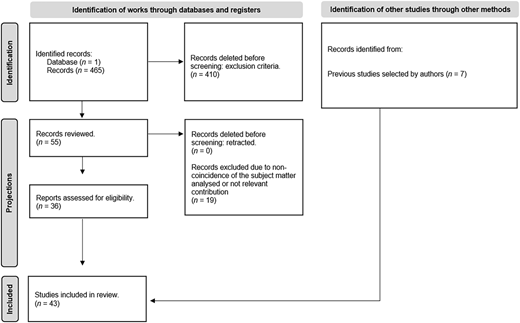
Nineteen documents were excluded, as they did not align with the research topic, while four documents were incorporated because of their relevance to the objectives of the study, having not been previously included in the analysis. The methodology employed in this study, illustrated in Figure 1, is supported by numerous scientific investigations. An initial evaluation of the bibliographic data was conducted on the first set of 36 documents, which were deemed appropriate for description and visualisation through bibliometric techniques. In addition to the 36 documents incorporated for analysis, seven additional documents were incorporated for discussion and conclusions, including the most relevant documents published until the end of 2024. Based on this, a total of 43 documents were analysed (see Table S1 in Supplementary Material). The subsequent sections present an analysis of the bibliometric results, followed by a discussion and meta-analysis of the acquired data in response to the proposed research questions. Specifically, the meta-analysis conducted in this study was mainly qualitative. As mentioned above, the PRISMA 2020 guidelines were followed, selecting documents based on their relevance to blockchain compliance and ESG/CSRD criteria. Coding was carried out by theme, grouping the results into categories such as governance, supply chain, risk management and technology adoption. This ensured consistency in the extraction of information and facilitated synthesis between different studies.
Nevertheless, preliminary descriptive quantification was performed to complement the qualitative synthesis. This included computing the frequency distributions of publication years, research domains and average citation rates per thematic cluster, offering a numerical overview of the research landscape. While these indicators do not constitute formal effect sizes, they provide valuable contextual evidence that strengthens the interpretative validity of qualitative meta-synthesis. Future research, once a more homogeneous body of empirical studies becomes available, could develop a hybrid meta-analytic approach that combines quantitative aggregation and qualitative synthesis to enhance inferential robustness.
3. Results of the descriptive analysis
3.1 Overview and production trends
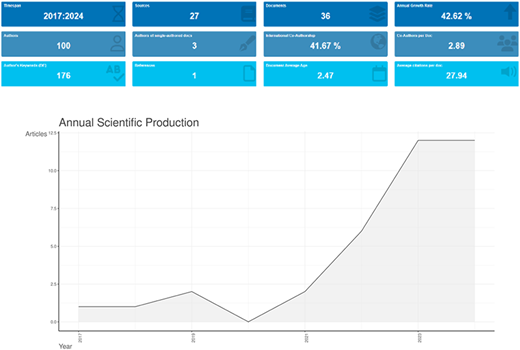
An analysis of 36 documents published between 2017 and 2024 revealed a rapidly expanding research field, with an average annual growth of over 40% and increasing international collaboration. On average, each paper received nearly 28 citations, underscoring the field's growing academic impact and relevance. As shown in Figure 2, citation patterns fluctuate across years but remain indicative of sustained scholarly attention. While early publications (2017–2019) achieved higher citation averages, subsequent years showed broader participation and diversification of topics, reflecting the maturation of blockchain–CSRD research.
3.2 Trend of the annual citations
As shown in Table 1, the annual citations per article fluctuated over the years. In 2017, with only one document, the average number of citations per article was 71.00, demonstrating a significant initial impact. In 2018, the average dropped to 34.00, but increased dramatically to 237.50 in 2019, despite only two documents being published that year. From 2020 onwards, the average number of citations per article per year has gradually decreased, with values of 35.00 in 2021, 27.17 in 2022, 11.33 in 2023 and 4.75 in 2024. These fluctuations suggest variations in the focus and reach of the research output during this period. Despite this, consistent publication activities and the number of citable years have highlighted the growing influence of the field.
3.3 Most influential documents
As indicated in Table 2, the three most frequently cited papers within this dataset had a substantial impact on the research domain. Notably, the work by Min (2019), entitled “Blockchain Technology for Enhancing Supply Chain Resilience” is distinguished by a total of 433 citations and an impressive annual citation rate of 61.86, underscoring its ongoing significance. The second most cited paper (Swan, 2017) is “Anticipating the Economic Benefits of Blockchain” which accumulated 71 citations at an annual rate of 7.89. The third significant contribution is the work titled “Digital technologies as enablers of supply chain sustainability in an emerging economy” (Akbari and Hopkins, 2022), which garnered 64 citations and maintained an annual citation rate of 16.00.
3.4 The most influential countries
Table 3 highlights the countries that have the greatest impact on this field of research, as determined by the volume of articles and the average number of citations each article receives, highlighting their role in advancing knowledge. The United States is at the forefront, with five articles and an average of 117.40 citations per article, underscoring its pre-eminence in research impact. India follows with eight articles and an average of 19.38 citations per article, reflecting a significant contribution to the field. Other influential countries included the United Kingdom (three articles, 22.00 average citations), Australia (one article, 64.00 average citations) and China (six articles, 10.33 average citations). These countries have demonstrated diverse but impactful participation in the advancement of blockchain research.
3.5 Thematic convergence between technology, sustainability and management
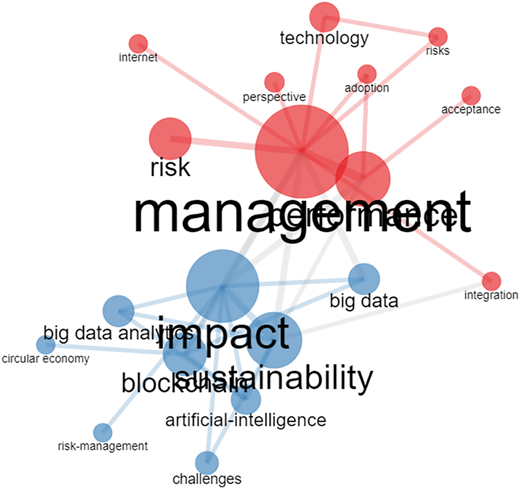
Figure 3 shows the analysis of the co-occurrence of key terms in the literature analysed. Two main clusters were detected. The first, in red, linked to “management”, “risk”, “technology” and “adoption”, groups together topics focused on risk management and technology incorporation. The blue one highlights terms such as “impact”, “sustainability”, “blockchain” and “artificial intelligence (AI)”. This is associated with topics related to sustainable innovation, data analytics and the circular economy. This data support the hypothesis that blockchain technology acts as a connector between sustainability, operational efficiency and compliance approaches.
3.6 Thematic map analysis
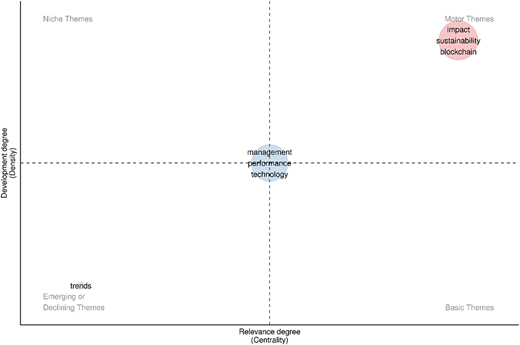
As illustrated in Figure 4, thematic analysis of the documents identified several significant themes and areas of interest within the field. The “impact” cluster, identified as a motor theme, is characterised by its high centrality (Callon Centrality = 3.41) and density (Callon Density = 85.19), reflecting its pivotal role in the development of the research field. This cluster includes key terms such as “impact”, “sustainability” and “blockchain”, emphasising the transformative potential of these technologies.
The “management” cluster, situated in the basic themes quadrant, highlights foundational topics such as “management”, “performance” and “technology.” This cluster, with a Callon Centrality of 1.67 and a density of 74.11, underscores its significance in establishing the groundwork for research in this area.
Conversely, the “trends” cluster, positioned in the emerging or declining themes quadrant with a Callon Centrality of 0 and a density of 50, reflects less developed yet exploratory topics that could shape future research directions. These findings suggest a dynamic research landscape, where established themes continue to grow, while emerging areas hold the potential for innovative advancements.
The most significant articles contributing to these themes include “Digital technologies as enablers of supply chain sustainability in an emerging economy” by Akbari and Hopkins (2022). “Why, where and how are organisations using blockchain in their supply chains?”, by Ahmed et al. (2022), and “Critical success factors of blockchain technology adoption for sustainable and resilient operations in the banking industry” by Mishra et al. (2023). These articles emphasise the diverse uses of blockchain in sustainability, organisational efficiency and resilience, further solidifying the relevance of the “impact” cluster in thematic map analysis.
3.7 Thematic map evolution
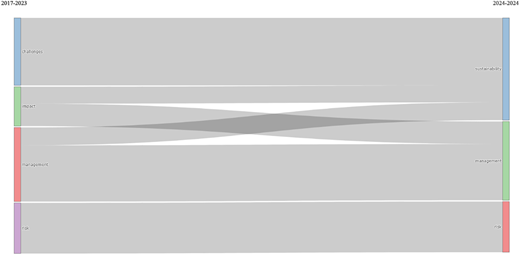
As shown in Figure 5, the documents examined indicate a notable change in research emphasis over time. Prior to 2023, the primary focus areas encompassed themes such as challenges, impacts, management and risks. However, by 2024, attention had shifted towards more specific subjects, including sustainability and performance. The concept of “challenges” evolved into “sustainability” (weighted inclusion index = 0.67), reflecting an increased emphasis on environmental concerns and long-term strategies. Similarly, “management” retained its relevance (weighted inclusion index = 0.56) but also expanded to include elements of performance (weighted inclusion index = 0.18), indicating a focus on efficiency and effectiveness. Additionally, “risk” remained stable but continues to underscore concerns regarding uncertainties in blockchain applications (weighted inclusion index = 0.50). These findings illustrate the dynamic nature of thematic evolution within the field, displaying a progression towards addressing complex and impactful issues in blockchain research.
The thematic evolution observed across the analysed period reflects a gradual transition from exploratory discussions on blockchain's risks and operational challenges to more outcome-oriented research agendas. Earlier studies (2017–2020) predominantly focused on feasibility, adoption barriers and governance issues, whereas more recent contributions (2021–2024) increasingly examined sustainability performance, policy alignment and cross-technology integration. This progression illustrates the maturation of the field from conceptual debates to empirical validation and strategic implementation, where blockchain is positioned as a key enabler of transparency and compliance in ESG reporting.
3.8 Bibliographical coupling
Two clusters were identified, although only one was relevant. A wide variety of relevant topics emerged from the analysis of this cluster (blue), as shown in Table 4, which can be used in future research.
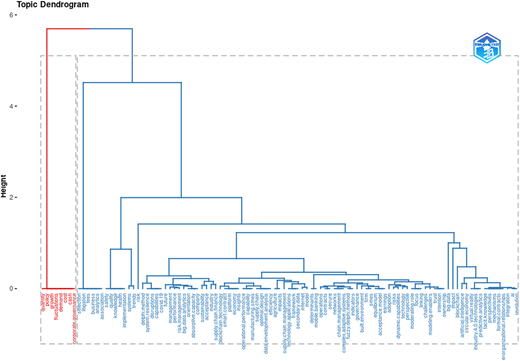
The dendrogram in Figure 6 provides a detailed visual representation of the thematic connections derived from the bibliometric coupling analysis. This hierarchical clustering highlights the relationships between key topics, revealing two main clusters, of which only one was identified as relevant for this study. Relevant clusters offer valuable insights into interconnected research themes and their potential for guiding future research.
The first notable aspect of the dendrogram is the strong connectivity between foundational topics, such as blockchain, sustainability and digitisation. These keywords form the backbone of relevant clusters and underscore the central role of blockchain technology in addressing multidisciplinary challenges. The presence of these core terms suggests that blockchain is a key enabler for various innovations, particularly in tourism and energy industries.
On the other hand, words such as traceability, transparency and smart contracts point to the potential of blockchain technology to create sustainable corporate solutions, including supply chain management and traceability of distribution processes, providing features to improve inefficiencies and promote environmental and ethical practices. However, an approach to this technology in the field of cultural preservation and heritage has been identified. Terms such as heritage, cultural sustainability and digitisation highlight the need to take advantage of this technology to protect and promote cultural assets, something that has already been analysed in previous studies (Kashem et al., 2022). Specifically, it highlights how this technology can be used in combination with other digital tools to promote the preservation of historical records, improve tourist experiences and maintain cultural integrity, thus improving the impact of tourist activities on these assets. The thematic areas identified in the figure (adoption of technology in tourism, blockchain for sustainability, improvement of the user experience and cultural preservation) offer interesting avenues to explore in future research.
3.9 Co-authorship network analysis
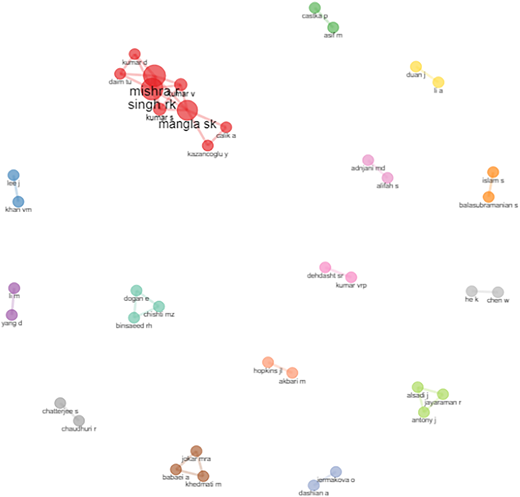
A co-authorship network analysis was conducted to identify the collaboration structure among the authors of the selected corpus of 43 articles. The resulting network (Figure 7) reveals a main group (Group 1) that includes authors such as Mangla S.K., Mishra R., and Singh R.K., who have the highest intermediary centrality (12, 5, and 5, respectively) and proximity centrality (0.1 each). These values indicate their role as a bridge between the different subgroups of the research community analysed. The PageRank values also highlight their influence (0.0358–0.0381) within the analysed network.
On the other hand, cluster 1 includes authors such as Calik A., Daim T.U., Kazancoglu Y., Kumar D., Kumar S. and Kumar V., whose proximity and PageRank measures suggest a more localised but still relevant contribution to the cohesion of the cluster. Cluster 2 is represented solely by Khan V.M., with a strong link to Lee J., but with very limited integration into the main collaboration structure analysed.
In short, although a core group of authors collaborates intensively within a cohesive community, several peripheral pairs remain disconnected from the main knowledge core. This behaviour suggests opportunities to strengthen collaboration between clusters and improve knowledge exchange between isolated research pairs and the dominant core of the network. Table 5 presents the centrality measures for the most relevant authors in the network.
Authors such as Mangla, Mishra, and Singh, who exhibit the highest betweenness and PageRank values, occupy bridging positions that connect otherwise fragmented subgroups. These scholars function as intellectual brokers who facilitate cross-disciplinary knowledge transfer in sustainability, operations management and blockchain adoption studies. The high closeness and proximity values observed for secondary contributors (e.g. Calik, Daim, and Kazancoglu) indicate their role in reinforcing thematic cohesion within specific subdomains. Overall, the network structure reveals a combination of core influencers and peripheral contributors, whose collaborations collectively define the field's knowledge architecture.
3.10 Theoretical framework's contributions
The reviewed articles highlight the importance of blockchain technology across diverse sectors and its transformative potential. One significant contribution is summarised in “A conceptual framework for blockchain-based sustainable supply chain” (Mangla et al., 2022), which integrates blockchain technology to improve sustainability in the tea supply chain. This study utilises a Spherical Fuzzy Analytic Hierarchy Process to identify barriers and prioritise actions, creating a framework applicable across agricultural sectors. Caldarelli et al. (2021), in their work on the sustainable fashion supply chain, demonstrate how a pragmatic approach to overcoming organisational and cultural resistance can accelerate the adoption of blockchain, highlighting the importance of stakeholder participation and gradual integration.
Another remarkable framework is presented in the document “A novel algorithm for evaluating omni-channel distribution networks” (Babaei et al., 2023). By leveraging blockchain technology for transparency and consensus formation, this study suggests a fuzzy goal programming model to optimise performance evaluation in the retail sector. The document “Blockchain and energy commodity markets” (Lee and Khan, 2022) searches for the legal implications and sustainability impacts of blockchain in crude oil trading. This agenda links blockchain architecture with the United Nations Sustainable Development Goals by offering practical visions for responsible sourcing and information symmetry. Pandey et al. (2024) contribute identifying 21 key factors influencing supply chain sustainability. By employing the Grey-DEMATEL method, this framework highlights the importance of core integration and standardised data management. Singh et al. (2019) employ the technology acceptance model (TAM) to assess stakeholder acceptance of blockchain, demonstrating how blockchain enhances transparency and accountability, adopting long-standing challenges in financial record-keeping. All of these illustrate the versatility of blockchain and its ability to address complex building problems.
4. Intellectual structure
RQ1: How can blockchain technology facilitate compliance with the Non-Financial Disclosure Directive, promoting transparency and alignment with ESG standards?
Blockchain technology can ensure compliance with CSRD regulations and the preparation of associated reports by providing reliable infrastructure based on the collection, verification and auditing of ESG data. By recording every relevant transaction or data in a shared and decentralised digital ledger, blockchain technology enhances the verifiability and traceability of ESG indicators along supply chains and held within organisations (Senturk and Baghırov, 2023). Additionally, this technology can be integrated with Smart Contracts (Szabo, 1995), allowing the automation of sustainability-related reporting and enabling the proactive detection of non-compliance and facilitating audit work. This enhances the confidence of the stakeholders involved.
RQ2: What are the main benefits and risks associated with blockchain implementation for corporate sustainability and financial and operational risk management?
We can highlight the improvement in transparency processes, the ability to reduce fraud, and the improvement in automation and traceability processes in critical supply chain operations. In turn, the most relevant ability is to facilitate ESG compliance or so-called internal governance (Senturk and Baghırov, 2023). Although technology strengthens operational efficiency and enables a more robust approach to corporate risk management, associated risks should not be ignored. The high costs of adoption, the need for human resources training, the lack of technical standards, the lack of global regulation and the correct management of data (Mishra et al., 2023) are challenges to be solved in the coming years. Another relevant challenge is the energy consumption of certain blockchain networks, although steps have already been taken to incorporate solutions, such as changes to consensus mechanisms (Ethereum.org, 2025), the use of renewable energy and the use of more efficient blockchain networks (Lightning Network, 2025). Although blockchain enhances transparency and trust, its environmental footprint remains a concern. Energy-intensive consensus mechanisms can offset sustainability gains; however, recent shifts towards proof-of-stake systems and renewable-powered infrastructure are reducing these impacts and aligning blockchain with low-carbon objectives.
RQ3: To what extent can blockchain transform corporate governance, strengthen trust, reduce information asymmetry and optimise ESG decision-making?
Blockchain technology has the potential to transform corporate governance of firms by empowering digitisation, decentralisation and automation of corporate oversight and decision-making mechanisms. The ability to record all relevant transactions and decisions in a transparent and immutable way provides the ability to significantly reduce information asymmetry between managers, shareholders and other stakeholders (Singh et al., 2019).
From the perspective of business decision-making derived from the ESG framework, blockchain technology allows the integration of real-time data from different internal and external data sources. This guarantees the authenticity of the data, facilitates decision-making and promotes the transparency of the analysed data. Specifically, it facilitates the use of digital governance information platforms with the capacity to develop secure voting systems in shareholder meetings and to control staff and management incentives in an ethical and transparent manner by considering governance criteria (Yusuf et al., 2023).
RQ4: How can blockchain technology improve sustainability and resilience in supply chains, thus fostering responsible practices and cross-sector collaboration?
The application of blockchain technology in supply chains enables granular traceability of both products and services. This means that every step can be recorded in an immutable digital record (blockchain network) from the origin of the raw materials to their purchase by the end consumer. This functionality strengthens responsible practices, enabling the verification of certifications such as fair trade (FairTrade International, 2025), carbon footprint (Carbon Trust, 2025) and labour compliance, acting as a deterrent to unethical and opaque practices (Pandey et al., 2024). Furthermore, the interoperability of blockchain technology with other technologies, such as the internet of Things (IoT) sensors, can enhance the agile response to corporate crises and more global crises, such as natural disasters, improving operational resilience.
RQ5: What technological, regulatory and organisational factors determine the successful adoption of blockchain in the context of ESG and corporate sustainability?
From the technological point of view, the functionalities associated with scalability, interoperability between platforms, energy efficiency and the availability of specialised human resources (mentioned above) are key factors in the adoption of blockchain technology in the field analysed (Mishra et al., 2023). From a regulatory point of view, there is a need for regulatory clarity that is currently lacking, especially considering the different regulations by country and geographical area. From an organisational point of view, the leadership factor is key. To implement the aforementioned functionalities effectively, it is necessary to foster a culture of innovation in the company and the dedication of sustainable financial resources over time (Zhang and Song, 2022).
RQ6: How do blockchain-based solutions compare with other emerging technologies in terms of sustainability and compliance impact?
What differentiates blockchain technology from other emerging technologies is its ability to ensure data integrity, transparency management and tamper-resistance (Asif et al., 2023). This is key in the context of sustainability and regulatory compliance. However, its risks must also be considered, some of which have been discussed, such as its considerable energy cost. This makes it a technology with high potential, but in a process of technological maturity.
RQ7: How does the adoption of blockchain vary in different regulatory contexts and what lessons can be learned to promote its implementation globally?
From a regulatory point of view, there are countries with regulatory frameworks already defined in terms of access to digital infrastructure and with public policies geared towards innovation. Thus, in these regions, the implementation of blockchain technology in areas related to corporate sustainability has advanced enormously, as in the cases of countries such as Estonia and Singapore. In contrast, there are other regions with high legal uncertainties derived from the lack of technological standardisation and low levels of business and population digitisation, where the implementation barriers are significant (Drljevic et al., 2020). Against this backdrop, it is necessary to develop policies and regulations to define clear international technical and regulatory standards, foster public–private collaboration, and adapt the development of blockchain solutions to the context of the geographical region, for example, by developing pilot projects that have measurable initial results.
Table 6 offers a comprehensive response to the research questions by drawing on the findings from the reviewed literature. This table enhances transparency and augments the theoretical contributions of this study.
5. Contribution to theoretical frameworks
This research contributes to the advancement of blockchain technology adoption in the field of corporate sustainability by analysing the existing literature up to 2024. It integrates different streams of literature on the aspects of corporate governance, risk management and sustainability. From a theoretical point of view, the contributions enrich the TAM (Davis, 1989) and the Diffusion of Innovations Theory (DOI) (Rogers, 1962), providing the unique attributes of the blockchain (immutability, decentralisation and real-time auditability) as key determinants of institutional trust and symmetry of financial and non-financial information. Additionally, the paper aligns with Stakeholder Theory (Freeman and McVea, 2001) by suggesting that blockchain technology has the ability to facilitate transparent communication between stakeholders by providing clearly verifiable ESG data. The meta-analysis also validates the relevance of Institutional Theory (DiMaggio and Powell, 1983; Meyer and Rowan, 1977) by explaining the disparate manner in which the technology under analysis is adopted in different regulatory environments. This theory highlights the influence of institutional pressure and the need for regulatory maturity when deploying any technology that is key to the adoption of blockchain technology.
These existing theoretical frameworks seek to reinforce the potential of technology as a facilitator in improving governance mechanisms and supporting legislative directives, such as the CSRD (European Commission, 2023) and Corporate Governance Theory (Eccles et al., 2014), which is linked to Sustainability Theory (Krüger, 2015). Blockchain technology has the power to improve areas related to transparency, traceability and regulatory compliance in ESG reporting, considering CSRD directives (European Parliament, 2022). The integration of the functionalities of smart contracts and DAOs provides a new framework that can support future business decision-making processes. However, it is necessary to develop theoretical frameworks that delve deeper into the new dynamics of corporate governance based on decentralised consensus.
This study advances the academic debate on blockchain and sustainability by integrating bibliometric, meta-analysis and social network analyses. It aims to provide transparency on how blockchain can contribute to ESG information and governance using a multi-method approach that expands on previous reviews on the topic.
Beyond the institutional and stakeholder lenses, this research incorporates insights from Sustainability Transitions Theory to capture the multi-level dynamics of technological and organisational change. This perspective emphasises how blockchain adoption in ESG reporting represents technological innovation and a socio-technical transition that depends on regime-level coordination, niche experimentation and policy alignment from a multilevel perspective. Foundational work on transitions highlights how changes unfold across niches, regimes and landscapes, providing a lens to situate blockchain-enabled transparency within broader decarbonisation pathways (Geels, 2002; Markard et al., 2012). Recent reviews on blockchain and sustainability further indicate that diffusion accelerates when on-chain data architectures align with supportive policy and governance arrangements, reinforcing the value of a transition lens for ESG reporting (Thanasi-Boçe and Hoxha, 2025).
From an organisational theory perspective, the adoption of blockchain can be interpreted as an interplay between dynamic capabilities and their micro-foundations. Dynamic capabilities reflect a firm's ability to integrate, build and reconfigure resources in response to environmental and regulatory changes, whereas microfoundations focus on the individual routines, learning processes and managerial decisions that enable such adaptability (Felin et al., 2012; Teece, 2010). This dual lens highlights how blockchain implementation depends not only on strategic reconfiguration at the organisational level but also on the behavioural and cognitive mechanisms that drive acceptance and sustained use within firms. The bibliometric clusters identified (impact, management and sustainability) closely correspond to the qualitative themes derived from the meta-synthesis. This convergence reinforces the robustness of the findings and demonstrates the alignment between quantitative mapping and qualitative interpretation.
6. Conclusions
This research provides an extensive overview of how blockchain technology can be useful and relevant for compliance with the CSRD. This establishes that blockchain can promote and strengthen corporate governance, sustainability and risk management practices by improving transparency, traceability and trust in ESG reporting. A bibliometric and meta-analytical synthesis of 43 academic articles confirms that this is a rapidly growing field of research that is increasingly focused on the potential of technology to enhance corporate accountability and stakeholder confidence.
In particular, blockchain's application in supply chains, financial services and stakeholder governance can help companies meet their compliance, efficiency and social responsibility requirements. However, its implementation still faces several technical, organisational and regulatory challenges that require coordinated responses. Therefore, this study emphasises the importance of developing sector-specific strategies based on international cooperation to ensure the widespread and responsible adoption of blockchain technology.
Beyond the European framework, the results highlight the necessity of transnational regulatory coordination of blockchain adoption for sustainability. Differences between regions such as North America, Asia and Latin America illustrate the need for harmonised standards and collaborative governance to maximise blockchain's potential for ESG reporting. By combining bibliometric evidence, meta-analysis and social network analysis, this study offers a comprehensive perspective on the field and serves as a foundation for future international comparative research.
Blockchain is emerging as a relevant enabler of sustainable governance and corporate reputation, with implications that transcend national borders and require global cooperation among companies, regulators and stakeholders. Future research could further validate and extend these findings by examining how blockchain interacts with emerging technologies such as AI and the Internet of Things (IoT), and by analysing its implications for sustainable reporting and regulatory innovation.
7. Limitations and future research
This study has several limitations that should be considered in future work. First, the methodology relies exclusively on the Web of Science (WoS) database, which ensures data quality and replicability, but may overlook relevant contributions from other sources such as Scopus. Additionally, for the purposes of this analysis, some disciplinary categories – particularly engineering and environmental sciences – were excluded to maintain a focus on business and management. Although this approach provides clear managerial implications, it limits cross-disciplinary perspectives.
From a methodological viewpoint, future studies should expand the database scope and adopt empirical validation techniques, such as case studies and surveys, to measure the impact of blockchain on CSRD compliance, audit efficiency and stakeholder trust. Empirical research is particularly relevant for sectors with segmented value chains, such as agriculture, tourism and retail distribution, in which blockchain traceability and data integration capabilities can be tested in real operational contexts.
There are also opportunities for comparative studies between blockchain and other digital technologies, including AI and IoT, to assess potential synergies in improving ESG reporting and corporate sustainability performance. Moreover, longitudinal research designs are needed to examine adoption patterns over time and identify learning dynamics within organisations and institutions.
Furthermore, while the present study prioritises methodological rigor and replicability through a WoS-only dataset and qualitative meta-synthesis, future analyses could adopt a hybrid meta-analytic approach that combines quantitative aggregation with cross-database validation to deepen inferential robustness.
Finally, cross-regional comparative analyses should be conducted to evaluate how cultural, institutional and regulatory factors influence blockchain adoption in diverse economic environments. While the debate has been primarily European, future studies should broaden the analysis to other regions, such as North America, Asia and Latin America, to capture differences in policy maturity and innovation ecosystems. These approaches will enrich the understanding of blockchain's temporal and contextual dimensions and help address the scope limitations of the present study.
8. Practical, social and policy implications
From a practical perspective, this study provides several pertinent guidelines for corporations, public regulators and researchers. The themes delineated in Table 7 encompass six distinct areas of application, elucidating their implications from the governance and sustainability standpoints, alongside examples of prospective applications derived from the findings of this study. These themes encompass the analysis of operational validation, real-time management of environmental compliance, and traceability of products and services within key sectors.
Recent technological developments have demonstrated how blockchain operates synergistically with AI and the IoT to strengthen ESG data reliability. For example, AI-driven analytics can automatically detect inconsistencies in sustainability disclosures recorded on blockchain ledgers, thereby improving the accuracy of environmental reporting. Similarly, IoT sensors embedded in production and logistics networks can transmit real-time data on emissions, energy consumption and resource use directly to blockchain systems, thereby ensuring traceability and verifiable compliance. These integrated applications highlight the complementary role of blockchain within a broader digital ecosystem for sustainable governance and performance management.
For managers and professionals, the results of this study highlight the potential of blockchain to improve transparency, traceability and CSRD compliance. Companies can apply this knowledge to strengthen their risk management and improve supply chain sustainability. Various obstacles are also identified, such as scalability and organisational readiness, and guidance is provided for implementation strategies. Beyond the business sphere, blockchain adoption has broader social and regulatory implications. For example, by emphasising transnational perspectives, this research highlights the importance of international cooperation in sustainability reporting. Regulators and policymakers in North America, Asia and Latin America can benefit from lessons learned in the EU, facilitating the harmonisation of disclosure standards and promoting corporate responsibility globally.
Effective policy harmonisation requires alignment with existing international standards and regulatory initiatives. Relevant examples include the International Organisation for Standardisation's (ISO, 2021) framework, which guides greenhouse gas management and investment decision-making, and the IFRS Foundation's International Sustainability Standards Board (ISSB), which promotes uniform sustainability disclosure practices across jurisdictions. Coordinating blockchain-enabled ESG reporting with these standards can facilitate global comparability, reduce regulatory fragmentation and strengthen the credibility of corporate sustainability disclosures.
To overcome these barriers, a structured roadmap is proposed to guide organisations and policymakers towards effective blockchain integration. (1) Regulatory harmonisation: establish interoperable standards and cross-border alignment of ESG disclosure requirements. (2) Technical standardisation: develop open-source protocols that ensure interoperability between blockchain platforms and existing reporting systems. (3) Capacity building: provide targeted training for managers, auditors and IT professionals to reduce implementation uncertainty and foster organisational readiness. (4) Pilot implementation: initiate small-scale pilot projects in high-impact sectors, such as finance, supply chain and energy, to generate evidence of cost-efficiency and scalability. This phased approach facilitates gradual adoption while minimising financial and operational risks.
Based on the above, to translate these recommendations into practice, a concise Blockchain ESG Readiness Checklist is proposed. This tool helps organisations evaluate their preparedness for blockchain adoption in ESG reporting and sustainability management.
Blockchain ESG Readiness Checklist.
Data governance maturity: Does the organisation maintain reliable, digitised and auditable ESG data sources?
Technical infrastructure: Are IT systems interoperable and capable of integration with blockchain platforms?
Regulatory compliance: Has the organisation aligned its reporting framework with existing standards, such as CSRD or ISO 14097?
Energy efficiency: Are blockchain solutions evaluated in terms of sustainability and low-energy consensus mechanism?
Human capital and training: Do managers, auditors and IT personnel receive adequate training on decentralised reporting tools?
Cross-functional governance: Is there coordination between sustainability, IT and compliance departments for blockchain deployment?
Applying this checklist enables decision-makers to identify organisational gaps and prioritise actions required for effective blockchain integration into ESG reporting systems. Finally, Table 8 summarises the main practical, social and policy implications of this study. It integrates the blockchain's contributions to ESG data governance, the four-step roadmap for adoption, the ESG readiness checklist and policy alignment with international standards, thereby providing an executive summary for practitioners and regulators.
Declaration
We, the authors, hereby declare that the work submitted does not contain any third-party material that requires permission beyond standard academic fair use. In the case that third-party content has been included, we confirm that.
Therefore, no legal or copyright restrictions apply to the material used in this work.
The supplementary material for this article can be found online.