This study aimed to improve the critical thinking skills of teacher–trainees through a strength-based program rooted in positive psychology.
A mixed-methods experimental design was employed. Quantitatively, a single-group pre-test post-test design with time-series analysis was conducted using the Cornell Critical Thinking Test – Level Z. Statistical analysis included normality testing, paired t-tests, repeated measures ANOVA and interrupted time series regression using SPSS 29. Qualitative data, collected via daily feedback and a post-intervention survey, were analyzed using thematic analysis. To ensure the reliability of the results, triangulation was conducted through theory and data triangulation.
The program demonstrated significant improvement in critical thinking, as evidenced by both quantitative (p = 0.001) and qualitative analyses.
The research contributes to Sustainable Development Goal 4 by promoting quality education through improved teacher training. As teacher–trainees transition to professional teaching roles, they will apply the critical thinking strategies learned, directly impacting the learning outcomes of their students. Over time, this creates a ripple effect. The improved pedagogical skills of teacher–trainees are passed on to successive generations of learners, fostering a culture of critical thinking and lifelong learning. This approach not only benefits individual classrooms but also strengthens education systems more broadly.
This research pioneers the application of strength-based programs for developing critical thinking in teacher–trainees, addressing an overlooked gap in educational research. It stands out as a groundbreaking initiative nationally and globally, introducing an innovative approach to teacher education.
1. Introduction
In an era defined by rapid change and interconnected global challenges, the importance of critical thinking skills has been emphasized in prominent educational policies worldwide. India’s National Education Policy (NEP) 2020 highlights critical thinking as an essential component of a holistic, future-ready education system (Mhavan et al., 2022; Rathod and Shrivastava, 2021). Similarly, UNESCO’s initiative, “Education for Sustainable Development,” emphasizes the integration of critical thinking into education systems (González-Salamanca et al., 2020; Taimur and Sattar, 2020). The Organization for Economic Co-operation and Development’s Programme for International Student Assessment (PISA) also evaluates students not only on academic knowledge but on their ability to apply that knowledge in real-world scenarios (Hanushek et al., 2008; Bybee and McCrae, 2011).
Critical thinking skills are crucial for equipping students to face modern challenges, enabling them to analyze information critically, engage in deeper inquiry, and generate effective solutions to complex problems. Beyond academic success, these skills empower individuals to navigate diverse challenges, such as evaluating media messages and making informed life decisions (Akpur, 2020; Alsaleh, 2020; Lu et al., 2021).
Although various strategies, such as problem-solving, collaborative learning, and flipped classrooms, have been employed to foster critical thinking (Chen and Chuang, 2021; O’Reilly et al., 2022; Warsah et al., 2021), most efforts have focused on instructional methods rather than leveraging individual strengths. Positive psychology, with its focus on strengths, offers a promising yet underexplored approach for enhancing critical thinking. While it has demonstrated significant contributions in areas like stress management, student well-being, and academic success (Hammill et al., 2022; Kotera and Ting, 2021; Nair, 2023), its potential for fostering critical thinking remains largely unexamined.
The present study addresses this gap by implementing a strength-based program to enhance the critical thinking skills of teacher-trainees. As future educators, teacher-trainees play a pivotal role in shaping the quality of education delivered to the next generation. Equipping them with robust critical thinking skills not only supports their professional growth but also ensures they are prepared to meet the evolving needs of their students. By focusing on this group, the study contributes to developing a cadre of educators capable of fostering critical inquiry in their classrooms and promoting quality education aligned with global educational goals.
2. Literature review
2.1 Foundations of critical thinking
Critical thinking is widely regarded as a cornerstone of education, with roots in both philosophical and psychological traditions. Philosophically, it originates from the Socratic method and pragmatism, emphasizing inquiry, reasoning, and reflection (Meyer, 2018; Vaidya, 2017). Scholars like Ennis and Halpern conceptualized critical thinking as reflective, goal-oriented thought used for decision-making and problem-solving (Safari et al., 2021; Tunjungsari and Takwin, 2021). The Delphi Report further consolidated these definitions by identifying core attributes agreed upon by experts in the field.
From a psychological perspective, critical thinking involves key cognitive processes such as analysis, evaluation, and inference. Piaget’s developmental theory highlights the importance of active exploration in logical reasoning, while Vygotsky’s sociocultural theory underscores the role of social interactions and cultural context in shaping cognitive abilities (Islami and Gustiana, 2021; Kilag et al., 2024).
2.2 Approaches to developing critical thinking
A wide range of methods has been implemented within education to enhance critical thinking skills, targeting learners from early schooling to advanced professional programs (Fadhlullah and Ahmad, 2017; Oliveira et al., 2016; Umar Alwehaibi, 2012; Jamil et al., 2021). These strategies cater to both subject-specific and overarching critical thinking abilities.
Popular techniques include engaging learners in collaborative and cooperative activities, problem-solving tasks, flipped classroom practices, digital storytelling, and case study analysis (Zabit, 2010; Kek and Huijser, 2011; Yang and Wu, 2012; Asyari et al., 2016; Dehghanzadeh and Jafaraghaee, 2018; Saputra et al., 2019; Aufa et al., 2021). While these methods are widely studied and applied, much of the existing research is primarily centered on evaluating the outcomes of individual teaching techniques rather than adopting a more comprehensive approach to nurturing critical thinking across diverse educational settings.
Research indicates that many teacher preparation programs fail to develop critical thinking skills in future educators. These programs often emphasize subject knowledge and pedagogy over structured interventions that enhance higher-order cognition (Darling-Hammond, 2012; Zohar, 2013; Bailin and Battersby, 2016; Abrami et al., 2008). A key gap is the absence of metacognitive training, essential for critical thinking (Magno, 2010). Traditional teacher training tends to prioritize procedural knowledge and standardized testing over inquiry-based and reflective learning, which are vital for analytical reasoning (Choy and Cheah, 2009; Davies and Barnett, 2015).
Pre-service teachers recognize the importance of critical thinking but struggle to apply it in classrooms, particularly in complex decision-making and problem-solving (Kurfiss, 1988; Miri et al., 2007; Abrami et al., 2015). Cross-cultural research reveals significant differences in how educational systems foster critical thinking. In some regions, rote learning prevails, limiting inquiry-based and reflective pedagogies (Choy and Cheah, 2009; Davies and Barnett, 2015). Western teacher preparation programs often integrate critical thinking through Socratic dialogue, case-based teaching, and problem-solving exercises (Brookfield, 2011). In contrast, many Asian and African contexts prioritize memorization and transmission-based learning, restricting analytical skill development (Lui and Bonner, 2016; Altinyelken, 2021). Cultural expectations and institutional structures shape how critical thinking is embedded in teacher training (Ronderos et al., 2024). These variations highlight the need for structured, research-based interventions to enhance critical thinking in teacher education (Ronderos et al., 2024).
2.3 Positive psychology and strength-based approaches
Positive psychology, a key applied branch of psychology, emphasizes character strengths as fundamental. Strength is defined as the capacity to think, feel, and act in ways that drive excellence (Wood et al., 2011), with critical thinking recognized as an essential skill. Positive psychology has contributed to education by enhancing stress management, student well-being, attention, emotional intelligence (Bar-On Reuven, 2010; Waters, 2011), academic performance, and mental health (Rawana et al., 2011; Soria-Reyes et al., 2023; Sutipan et al., 2017).
However, research on how strength-based approaches enhance critical thinking remains limited. Addressing this gap, Nair and Bhandare (2024) introduced an innovative strength-based program to develop critical thinking in teacher-trainees. Their study, published under the CC BY 4.0 license, marks a breakthrough in educational research as the first to apply this approach to critical thinking development.
2.4 Unique contribution of this study
Building on the foundational work of Nair and Bhandare (2024), the present study represents a logical progression and substantial advancement in the exploration of strength-based programs for enhancing critical thinking skills among teacher-trainees. While the earlier pilot study employed a single-group pretest-posttest design, which is often limited by potential threats to internal validity, the current research adopts a more robust methodological framework.
This study utilizes a mixed-methods design that incorporates a time-series component within the quantitative phase, complemented by qualitative methods and a triangulation approach. This comprehensive design addresses the limitations of the previous study by enabling a deeper and more detailed understanding of the intervention’s impact. The inclusion of multiple data collection points over time enhances the reliability of the quantitative findings, while the qualitative insights provide valuable contextual understanding. Triangulating these methods ensures that the conclusions drawn are both valid and well-supported.
By adopting this rigorous approach, the current research not only builds upon but also significantly extends the scope and depth of the earlier pilot study, offering a more thorough evaluation of the strength-based program’s effectiveness in fostering critical thinking skills among teacher-trainees.
3. Research questions
What are the signature character strengths of teacher-trainees as assessed by the Value in Action (VIA) Inventory?
Does the implementation of the strength-based program lead to an improvement in the critical thinking skills of teacher-trainees?
4. Research design
The present study adopted a mixed-methods experimental design to explore the effectiveness of a strength-based program in enhancing critical thinking skills among teacher-trainees. Mixed methods research is an investigative approach that entails the collection of both quantitative and qualitative data, followed by the integration of these two forms of data. The “mixed-methods experimental (or intervention) design” involves the comprehensive collection and analysis of both quantitative and qualitative data, integrating this information within an experimental or intervention trial. In this design, qualitative data collection is incorporated into an experiment or intervention to capture the individual experiences of participants. Qualitative data functions as a secondary source embedded within the experimental pre-test and post-test data collection. Researchers have flexibility in incorporating qualitative data into the experiment, whether before, during, or after its execution. The approach includes embedding the “core exploratory sequential design” for exploration before the experiment, incorporating a “convergent core design” during the experiment to assess participants’ experiences, or adding an “explanatory sequential design” after the study to follow up on experimental outcomes. The points at which qualitative data collection and findings intersect with the experiment represent the integration in the mixed methods study. Depending on available resources, qualitative data collection can occur at a single point or multiple points in time (Creswell and Creswell, 2018).
The quantitative aspect of the research employed a single-group pretest–posttest design with a time series component, chosen to measure changes within the same group over time while addressing the inherent limitations of the single-group design, such as threats to internal and external validity.
The Interrupted Time Series (ITS) design used in this study allowed for systematic data collection at multiple time points. During the baseline phase, pretests were conducted over four consecutive days to establish the participants’ initial critical thinking levels. This was followed by a 15-day intervention period where the strength-based program was implemented. Finally, the posttest phase extended over four days, capturing the outcomes of the intervention.
Qualitative data were collected through daily participant feedback during the intervention and a post-implementation survey. The study employed theory and data triangulation to enhance the reliability and validity of its findings. Theory triangulation involved analyzing the results through multiple theoretical perspectives, while data triangulation integrated quantitative data from pretest and posttest analyses with qualitative insights gathered through daily feedback during the intervention and a post-implementation survey. This combined approach ensured a comprehensive evaluation of the strength-based program’s impact on critical thinking skills.
4.1 Participants
This study, part of the researcher’s PhD work, involved 50 second-year B.Ed. teacher-trainees from Adarsha Comprehensive College of Education and Research, affiliated with Pune University, during the 2023–2024 academic year. Purposive sampling was used. Adarsha Comprehensive College was chosen based on its strong reputation and 23-year history in teacher education. A total of 50 participants were included in the study. The sample size is justified based on the central limit theorem, which posits that with a sufficiently large sample (generally considered 30 or more), the sampling distribution of the mean approaches normality, regardless of the population’s underlying distribution (Kwak and Kim, 2017). Therefore, the sample of 50 participants is considered adequate for statistical analysis and representative of the broader population of B.Ed. students.
4.2 Materials and instruments
4.2.1 The VIA Survey of Character Strengths
The Values in Action (VIA) Survey of Character Strengths measures 24 strengths through 240 self-report items on a 5-point Likert scale. It is specifically adapted for adults, making it suitable for this study. It demonstrates strong psychometric properties, with Cronbach’s alpha ranging from 0.63 to 0.86 and an overall reliability of 0.97.
Regarding the psychometric validation, detailed Cronbach’s alpha information for the English version is presented in Table 1, illustrating its strong psychometric properties. This reliability ensures the survey’s capacity to provide accurate and consistent measurements of character strengths across diverse populations.
4.2.2 The Cornell Critical Thinking Test-Level Z (CCTT-Z)
The Cornell Critical Thinking Test-Level Z (CCTT-Z) is a reliable tool for assessing critical thinking in adults, including university students. It has an overall reliability estimate of 0.76, with section-wise estimates ranging from 0.60 to 0.76 (Ennis et al., 2005). The test consists of 52 multiple-choice questions evaluating deduction, induction, observation, credibility, and assumptions, requiring about 50 min to complete. While its content is proprietary, it features practical, globally relevant scenarios (Iwaoka et al., 2010). Updated in 2005, the test maintains strong psychometric properties and compares well with other standardized assessments (Bataineh and Zghoul, 2006). Its multiple-choice format and real-world focus make it widely applicable in educational and professional settings.
5. Data collection and analysis
This study employed a mixed-method experimental design. Quantitative data was collected within the experimental setup, which involved a single-group pretest-posttest time series design using the Cornell Critical Thinking Test-Level Z (CCTT-Z). Qualitative data was gathered through daily written feedback and a post-implementation survey. During the intervention stage, the Values in Action Inventory (VIA) was used to identify the signature character strengths of the teacher-trainees. Details of the strength-based program are presented in Table 2. Following the implementation of the program, post-testing was carried out.
Quantitative analysis of pretest and post-test scores was performed using IBM SPSS Statistics software version 29. Normality testing was conducted using the Shapiro-Wilk test. Paired t-tests were performed for each sub-component of critical thinking as well as for composite critical thinking scores. Additionally, Cohen’s d, repeated measures ANOVA, and interrupted time series regression analysis were employed. This was followed by thematic analysis and theory triangulation and data triangulation techniques.
6. Results
6.1 Shapiro-Wilk test
The results of the Shapiro–Wilk normality test indicated that the data adhered to a normal distribution. This conclusion was based on the p-value obtained (S-W = 0.983; df = 50; p = 0.705), which was greater than the threshold of 0.05 (Table 3).
6.2 Strength identification [VIA Inventory]
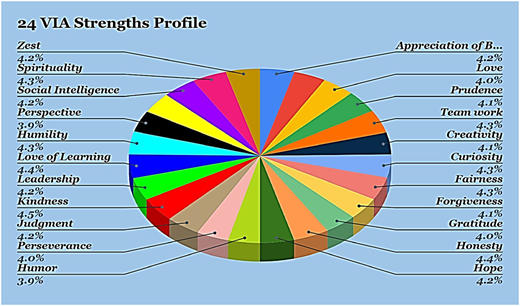
The signature character strengths of the class were identified using the VIA Inventory of Character Strengths. Individual scores for each of the 24 strengths were aggregated to generate a total score for each strength. These totals were then converted into percentages, providing a clear and interpretable class profile of strengths.
Figure 1 illustrates the results of this analysis, revealing a balanced distribution across the 24-character strengths. Among these, humor and perspective were identified as the least represented strengths, each comprising 3.9% of the total distribution. In contrast, honesty emerged as the highest strength, accounting for 4.4%. The remaining strengths displayed a relatively narrow range, varying between 4.2 and 4.3%.
This even distribution of character strengths stresses a diverse and well-rounded class profile, indicating that the teacher-trainees exhibited a broad spectrum of strengths.
6.3 Paired t-test
To examine the influence of the strength-based intervention on the various dimensions of critical thinking, as assessed by the Cornell Critical Thinking Test – Level Z, a paired t-test was employed. An improvement was consistently observed across all critical thinking components: deduction (t = 13.31, p < 0.001), meaning (t = 15.39, p < 0.001), observation and credibility (t = 26.00, p < 0.001), induction (t = 45.00, p < 0.001), and assumption (t = 21.02, p < 0.001) (Table 4).
Additionally, an analysis of the composite critical thinking scores via the paired t-test stressed the program’s effectiveness in enhancing critical thinking skills among teacher-trainees. This was evidenced by a notable increase in critical thinking scores between the pre-test and post-test assessments (t = 38.82, p < 0.001) (Table 5).
6.4 Effect size
Table 6 presents the details of the effect size analysis for this study. Cohen’s d was utilized to determine the effect size, yielding a point estimate of 5.491. The obtained value of 5.491 significantly exceeds the threshold for a large effect size, indicating a substantial and meaningful difference between the pre-test and post-test scores. To account for potential bias in the relatively small sample size, Hedges’ correction was applied. This adjustment resulted in a corrected value of 5.407. The minimal difference between the uncorrected (d = 5.491) and corrected values (d = 5.407) suggests that the adjustment had little impact on the overall result. The findings confirm that the intervention led to a significant improvement in critical thinking skills, as evidenced by the substantial effect size.
6.5 Repeated measures ANOVA
In this study, data for critical thinking was collected at more than two time points. This increases the risk of Type I error. To address this concern, a Repeated Measures ANOVA was conducted (Table 7). This method allows for the simultaneous comparison of means across multiple time points, providing a robust framework to confirm whether the observed effects are genuine. The results of the Repeated Measures ANOVA indicated a significant difference between pre-test and post-test scores. The F value was 1507.707, representing a substantial ratio of variances, and strongly rejecting the null hypothesis that no difference exists between the scores. The p-value was less than 0.001, suggesting that the probability of these results occurring by chance is exceedingly low. Partial Eta Square, a measure of effect size in ANOVA, was calculated as 0.969, meaning that approximately 96.9% of the variance in critical thinking scores can be attributed to the strength-based program. This is an exceptionally large effect size. Additionally, the noncentral parameter (1507.707) further underscores the strength of the observed effect. The observed power of 1.000 indicates a very high likelihood of detecting a true effect, affirming the reliability of the analysis. These results conclusively suggest that the observed differences in critical thinking scores across time points are a direct result of the intervention, validating the program’s effectiveness.
6.6 Interrupted time series regression analysis
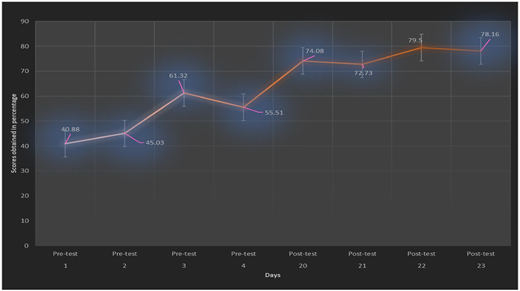
Pre-test scores were collected over four days, followed by the implementation of the strength-based program. Post-test scores were collected over the last four days. The study utilized Interrupted Time Series (ITS) Regression Analysis as the appropriate method, given its capacity to analyze measurements collected over time with an intervention implemented between the pre-test and post-test phases. Data visualization through time series graphs provided a clear representation of the trends, with raw scores converted into percentages to ensure accuracy. Figure 2 depicts a distinct upward trend in scores during the post-test phase compared to the pre-test phase, emphasizing the program’s impact.
Table 8 details the results of the Model Summary from the Interrupted Time Series Regression Analysis. The high correlation coefficient (R = 0.955) revealed a strong linear relationship between the day variable, the intervention phase, and the test scores, indicating that the model accounted for a significant portion of the variance in the outcome variable. Furthermore, the “Sig. F Change” value of 0.002 demonstrated that incorporating the intervention phase as a predictor significantly enhanced the model’s fit.
The Durbin-Watson statistic, used to assess autocorrelation in the residuals of the regression model, was calculated as 2.424. A value near 2 indicates no significant autocorrelation, which is desirable for the reliability of regression results. In this study, the absence of significant autocorrelation in the residuals strengthened the validity of the findings, confirming that the observations were independent over time.
The ANOVA Time Series table (Table 9) provided an overall measure of the regression model’s statistical significance, with a p-value of 0.002. This low p-value indicated that the combination of time-based variables and the strength-based program intervention phase significantly explained the variability in test scores.
The results of the Interrupted Time Series Regression Analysis strongly supported the conclusion that the strength-based program had a statistically significant impact on test scores over time. The high correlation and model fit statistics highlighted the program’s effectiveness in improving test scores, while the absence of significant autocorrelation further validated the independence of observations.
6.7 Qualitative analysis
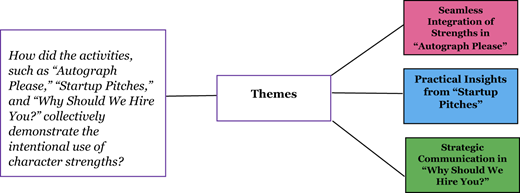
Qualitative data was collected through daily written feedback and a post-intervention survey, both designed by the researcher. The feedback and survey responses were subjected to thematic analysis to extract meaningful patterns and insights. Thematic analysis, as articulated by Braun and Clarke (2006), served as the guiding theoretical framework for analyzing the qualitative data in this study. The analysis followed a six-phase process: familiarization with data, generation of initial codes, searching for themes, reviewing themes, defining and naming themes, and producing the final report. The approach enabled the researcher to systematically explore participants’ experiences during the intervention, making it especially appropriate within the embedded qualitative component of this mixed-methods experimental design. For each question, thematic maps were generated to visually represent the progression from raw data to refined themes. A sample thematic map for one question is presented in Figure 3, providing an example of the process.
7. Discussion
7.1 RQ1: what are the signature character strengths of teacher-trainees as assessed by the Value in Action (VIA) inventory?
The analysis of the Value in Action (VIA) Inventory highlights a balanced distribution across the 24 signature character strengths among the teacher-trainees. This well-rounded class profile indicates diverse individual strengths, creating a group dynamic that is conducive to multifaceted and personalized activities. The strength-based program, which focused on developing critical thinking skills as measured by the Cornell Critical Thinking Test – Level Z (CCTT-Z), benefited from this diverse profile. A well-rounded distribution allows for the integration of a variety of approaches and activities, enhancing engagement and facilitating a more tailored learning experience.
Table 3 and Figure 1 show an even distribution, with honesty as the most prominent strength (4.4%) and humor and perspective the least (3.9%). This suggests some strengths are naturally dominant, while others need reinforcement. The presence of a well-balanced strengths profile allowed the researcher to employ diversified instructional strategies, leveraging individual strengths effectively. Additionally, this distribution facilitated collaborative learning, as peer interactions drew upon complementary strengths to enhance critical thinking engagement.
7.2 RQ2: does the implementation of the strength-based program lead to an improvement in the critical thinking skills of teacher-trainees?
The findings from both quantitative and qualitative analyses provide compelling evidence for the effectiveness of the strength-based program in enhancing critical thinking skills among teacher-trainees.
From a quantitative perspective, significant improvements were observed across all subcomponents of critical thinking as measured by the Cornell Critical Thinking Test – Level Z (CCTT-Z). The paired t-tests revealed a statistically significant rise in the subcomponents of deduction, meaning, observation and credibility, induction, and assumption, as well as composite critical thinking scores.
Tables 4 and 5 show significant improvements in critical thinking, with paired t-tests yielding highly significant results (p < 0.001). Effect size analysis supports this, with Cohen’s d = 5.491 and Hedges’ corrected value = 5.407, confirming a substantial intervention effect and its practical significance in enhancing critical thinking.
As seen in Table 7, Repeated Measures ANOVA results show a highly significant effect (F = 1507.707, p < 0.001), with a Partial Eta Squared value of 0.969. This indicates that approximately 96.9% of the variance in critical thinking scores can be attributed to the strength-based program, demonstrating its strong influence on learning outcomes. Additionally, the observed power of 1.000 suggests that the likelihood of detecting a true effect is extremely high, reinforcing the robustness of the results.
The results of the Interrupted Time Series Regression Analysis (Table 8) further validate these findings, with a high correlation coefficient (R = 0.955) suggesting a strong relationship between the intervention and improved scores. The significant F Change (p = 0.002) indicates that incorporating the intervention phase as a predictor significantly enhanced the model’s fit. Figure 2 visually supports this trend, showing a clear upward trajectory in post-test scores compared to the pre-test phase. The Durbin-Watson statistic (2.424) confirms the absence of significant autocorrelation, ensuring that the observed improvements are not due to random fluctuations but are a direct result of the intervention.
The qualitative analysis provided additional depth to these findings. Tables 10 and 11 outline the key qualitative themes derived from thematic analysis. Thematic analysis of daily feedback and post-intervention surveys revealed themes emphasizing enhanced analytical skills, better problem-solving approaches, and improved logical reasoning among participants. Participants consistently noted how program activities encouraged active engagement and reflection, contributing to their critical thinking growth. The thematic map and analysis showed that the strength-based approach resonated well with the teacher-trainees, fostering both cognitive and emotional engagement throughout the intervention.
The data triangulation, depicted in Table 12, indicated a successful convergence of findings across quantitative and qualitative data, strengthening the reliability and validity of the results. The theoretical underpinnings elaborated in Table 13 further support the observed outcomes, providing a framework to understand the mechanisms through which the strength-based program improved critical thinking skills.
8. Practical implementation
The research aligns with NEP 2020, PISA, and global initiatives by fostering critical thinking in teacher trainees. It introduces positive psychology to address gaps in traditional methods, promoting innovative, strength-based, and student-centered learning. This supports prior research showing strengths-based interventions boost motivation, self-efficacy, and academic performance (Seligman et al., 2009; Niemiec, 2018). Emphasizing character strengths enhances cognitive engagement, as reflected in this study’s significant critical thinking improvements (Tables 4, 5 and 7).
The development of a strength-based program for teacher trainees supports the goal of Sustainable Development Goal 4 (Quality Education) by promoting quality education practices through improved teacher training. It aligns with the Skill India initiative by equipping teachers with critical skills useful for teaching and other professions. Existing literature emphasizes the importance of teacher training programs that integrate socio-emotional learning and cognitive skill development (OECD, 2018). By focusing on character strengths, this study contributes to bridging the gap between theoretical knowledge and practical application, reinforcing prior findings that well-trained educators play a crucial role in fostering 21st-century competencies in students (Darling-Hammond and Darling-Hammond, 2022).
By using a strength-based program, it adds a new approach to teacher education, equipping teacher trainees with skills they can pass on to their future students. The intervention’s effectiveness, as demonstrated by the high effect sizes (Cohen’s d = 5.491, Partial Eta Squared = 0.969), suggests that character strengths-based training can serve as a powerful tool in teacher education. Peterson and Seligman (2004) found that teachers who develop their strengths foster resilience and engagement in students, a claim supported by this study’s results.
This research helps the teacher trainees recognize and build on their signature strengths, equipping them with innovative teaching strategies that are more effective and student-centered. These strategies can lead to more dynamic, engaging classrooms, benefiting future students. Research on strengths-based pedagogy (Harzer and Ruch, 2015) suggests that teachers using this approach experience greater job satisfaction and effectiveness. This study reinforces that perspective, showing that a well-structured strengths-based program enhances critical thinking and equips educators with tools for transformative teaching. The ripple effect of these strategies likely benefits students, aligning with Quinlan et al. (2015), who highlight strengths-based education’s role in fostering a growth mindset and engagement. Future research could explore its long-term impact, particularly in real classroom settings beyond teacher training.
9. Suggestions for future study
A critical avenue for future investigation involves integrating usability testing methodologies for the strengths-based program by employing iterative testing cycles to refine instructional design and delivery. Since the researcher both designed and implemented the program, future replication may require a clear understanding of the underlying pedagogical rationale to ensure fidelity. Efforts can persist in developing a strength-based program tailored for various age groups and exploring different skill sets that have not been extensively examined. Specifically, future studies can investigate how strength-based pedagogies enhance critical thinking across different educational levels, including primary, secondary, and higher education settings. These skill sets may not be limited to cognitive dimensions and can extend to encompass the affective and psychomotor domains. A longitudinal study can be conducted to assess the long-term impact of the strength-based program on teacher trainees who have transitioned into teaching roles by tracking their instructional strategies, student engagement, and learning outcomes over multiple years. A similar strength-based program can be tailored to enhance domain-specific critical thinking, such as in STEM education, language acquisition, or social sciences, thereby contributing to a more subject-relevant pedagogical approach. The potential of the strength-based program can be explored to support inclusive education practices. It can be adapted to meet the diverse needs of differently abled students by investigating its effectiveness in fostering differentiated instruction and personalized learning pathways. Additionally, studies can explore how character strengths can support neurodivergent learners, including students with ADHD, autism spectrum disorder, or learning disabilities, in developing cognitive flexibility and metacognitive skills. The feasibility and effectiveness of integrating the strengths-based program into ongoing professional development trainings for both in-service school teachers and higher education professors can be investigated through large-scale intervention studies measuring instructional efficacy and teacher self-efficacy. Furthermore, research can examine the adaptability of the program across diverse educational settings, including rural and urban schools, to ensure equitable access to strength-based pedagogies. The role of parental involvement and support in reinforcing the strength-based program’s impact can be investigated by exploring how parent’s awareness of character strengths enhances student learning outcomes and self-efficacy. Future studies can also analyze the impact of parental training programs in complementing classroom-based strength interventions, fostering a holistic learning environment that extends beyond school settings.
10. Conclusion
In conclusion, this study demonstrates that a strength-based program effectively enhances the critical thinking skills of teacher-trainees. The results indicate a clear improvement in critical thinking abilities, as reflected in assessments conducted before and after the program.