This study investigates the effect of waste management practices and institutional pressures on environmental sustainability performance at the household level in Ghana, specifically within the Cape Coast metropolis.
The study employed an explanatory and quantitative research design to analyze data collected from 339 sampled households, of which 242 responses were deemed valid for analysis. Data were processed using SPSS for descriptive statistical analysis and Smart-PLS 4 for structural equation modeling to examine relationships among the study variables.
Results demonstrate that waste management practices significantly enhance environmental sustainability performance. Institutional pressures positively influence waste management practices and environmental sustainability performance. Interestingly, institutional pressure negatively moderates the relationship between waste management practices and environmental sustainability performance.
Enhanced understanding of these dynamics can aid policymakers and waste management institutions in crafting targeted interventions that foster more effective waste management practices at the household level.
By improving waste management practices and responding effectively to institutional pressures, households can significantly contribute to broader environmental sustainability goals, thus supporting sustainable urban development and responsible consumption patterns as outlined in the Sustainable Development Goals (SDGs).
This research contributes uniquely by articulating the moderating role of institutional pressures in the context of household waste management, a relatively underexplored area within environmental management research.
1. Introduction
Environmental sustainability has become a critical focus for practitioners and academics, given its importance in ensuring quality of life and sustainable business operations (Hamdoun, 2020; Zhang et al., 2022a, 2022b). Environmental sustainability performance refers to the measurable outcomes of actions and practices to minimize negative environmental impacts, conserve natural resources, and promote ecological balance (Singh et al., 2020). Households are fundamental units of consumption and waste generation, and their role in achieving sustainability targets cannot be overlooked. However, significant gaps remain in the literature, particularly regarding waste management practices at the household level in developing countries. Households in these regions generate approximately 1.3 billion tons of solid waste annually, projected to rise to 3.8 billion tons by 2050 (Sharma and Jain, 2020; Roy et al., 2022; World Bank, 2019). Alarmingly, over 90% of household waste in Africa is improperly disposed of through open dumping, burning, and burying, leading to severe environmental repercussions such as air, surface, and groundwater pollution from hazardous substances leaching, as well as land and marine contamination (Mintz et al., 2019; Bundhoo, 2018).These unsustainable disposal practices highlight the urgent need for effective waste management strategies that directly engage households in mitigating environmental harm.
In response to waste management challenges, governments have implemented various capacity-building programs, seminars, and workshops aimed at equipping industries with relevant knowledge (Anku-Tsede and Deffor, 2014; Jalil et al., 2016). However, these initiatives have predominantly focused on sectors such as manufacturing, transport (Khor et al., 2016; Baah et al., 2020), construction (Maslesa, Jensen, and Birkved, 2018), and electronics (Huang et al., 2018), with little attention given to the critical role of households. As first-tier suppliers in the waste management supply chain, households play a pivotal role in waste collection, sorting, decontamination, and return (Bing et al., 2014, 2016; Halldórsson et al., 2019). Yet, their contribution to environmental sustainability remains underexplored, creating a significant gap in understanding how household-level practices influence broader sustainability performance. This oversight undermines the effectiveness of waste management systems and limits the potential for meaningful environmental protection.
Furthermore, studies reveal that households in many developing countries lack awareness of their role in proper waste management practices, such as collection, sorting, decontamination, and return (Muhammad et al., 2020; Twumasi, 2017; Douti et al., 2017; Guarnieri et al., 2020). This lack of awareness contributes to improper waste disposal, which significantly harms the environment. The absence of education and engagement at the household level not only impedes the reengineering of waste management systems but also weakens the decision-making and actions of waste management institutions (Halldórsson et al., 2019). Addressing this knowledge gap is essential to fostering sustainable waste management practices and enhancing environmental sustainability. Without targeted efforts to educate and empower households, the potential for achieving meaningful progress in waste management and environmental protection remains limited.
Waste management issues are particularly acute in developing countries like Ghana, where rapid urbanization and population growth have exacerbated waste management challenges. For instance, the Government of Ghana allocated approximately GH₵ 5.2 million in 2020 and GH₵ 5.3 million in 2021 to waste collection and transportation, with annual disposal costs estimated at $290m, equivalent to 1.6% of the country’s GDP (Lissah et al., 2021). Despite these investments, improper waste disposal practices persist, particularly in urban areas such as Cape Coast, which faces unique challenges due to its status as a major tourist and educational hub. The city’s growing population and economic activities have led to increased waste generation, yet households remain largely unaware of their role in proper waste management practices such as collection, sorting, decontamination, and return (Muhammad et al., 2020; Twumasi, 2017; Douti et al., 2017; Guarnieri et al., 2020). This lack of awareness undermines the effectiveness of waste management institutions and impedes the reengineering of systems necessary for environmental protection (Halldórsson et al., 2019). This challenge requires a deeper understanding of the external forces that can influence household behavior and shape waste management practices.
DiMaggio and Powell (1983) argued that external forces can shape individual behaviors through regulatory, normative, and cognitive mechanisms. The tenets of the institutional theory suggest that organizations and individuals conform to societal expectations and norms to gain legitimacy, resources, and survival advantages (Scott, 1995). In the context of waste management, institutional pressure can compel households to adopt sustainable practices such as proper waste collection, sorting, decontamination, and return by enforcing regulations, promoting societal norms, and enhancing awareness (Bing et al., 2016; Halldórsson et al., 2019). For instance, regulatory pressure through policies and penalties can incentivize compliance, while normative pressure from community expectations and educational campaigns can foster a culture of environmental responsibility (Guarnieri et al., 2020). Cognitive pressure, driven by shared knowledge and awareness, can further influence households to align their behaviors with sustainable practices (Muhammad et al., 2020). Without such pressure, households in Ghana often lack the motivation or knowledge to engage in effective waste management, leading to improper disposal and significant environmental harm (Twumasi, 2017; Douti et al., 2017). Despite the importance of institutional pressure in waste management (Bing et al., 2014, 2016; Halldórsson et al., 2019), it role in waste management practices and environemental sustainability performance remain unexplored in the Ghanaian context. Understanding how institutional pressure can enhance or hinder the effectiveness of household waste management practices is crucial for developing comprehensive waste management strategies.
On the other hand, Studies by Liao and Li (2019) and Cheng and Osman (2019) suggest that socio-demographic factors can affect people’s perception and understanding of the environment. As a result, this study will control for some demographic factors. By accounting for these variables, the study can eliminate confounding effects, enhance the accuracy of its findings, and ensure that the results are generalizable across diverse household groups. This approach enables policymakers to design targeted interventions that cater to specific demographic needs, improving compliance and participation in sustainable waste practices. Additionally, understanding demographic variations provides valuable behavioral insights, aiding in the development of tailored educational campaigns and awareness programs, ultimately contributing to the achievement of Sustainable Development Goals related to sustainable cities, responsible consumption, and climate action (Guarnieri et al., 2020; Halldórsson et al., 2019).
Several gaps in the literature emphasised the need for this study. First, while existing research has extensively explored waste management in industrial sectors, the role of households as key stakeholders in the waste management supply chain has been overlooked. Second, the impact of institutional pressure on household waste management practices and environmental sustainability performance remains underexplored. Institutional pressure, which includes regulatory, normative, and cognitive forces, can significantly influence household behaviors, yet its moderating effect on the relationship between waste management practices and environmental performance has not been thoroughly investigated. Third, the contextual factors influencing waste management in developing countries, particularly in urban areas like Cape Coast, Ghana, have not been adequately addressed. Socio-demographic factors such as education, income, and cultural practices can shape household perceptions and behaviors, yet these variables are often excluded from analyses, limiting the generalizability of findings (Liao and Li, 2019; Cheng and Osman, 2019).
To address these gaps, this study seeks to achieve the following objectives:
Examine the effect of household waste management practices on environmental sustainability performance.
Assess the influence of institutional pressure on household waste management practices and environmental sustainability performance.
Investigate the moderating role of institutional pressure in the relationship between household waste management practices and environmental sustainability performance.
This research contributes to the waste management and sustainability literature by highlighting the critical role of households in addressing environmental challenges in developing economies. By focusing on Cape Coast, Ghana, the study provides contextual insights that can inform the design of resilient waste management systems tailored to the needs of urban areas in developing countries. The findings will guide policymakers and waste management institutions in developing targeted interventions to improve household participation in sustainable waste practices, enhancing environmental sustainability performance. Furthermore, the study aligns with the United Nations Sustainable Development Goals (SDGs), particularly SDG 11 (Sustainable Cities and Communities), SDG 12 (Responsible Consumption and Production), and SDG 13 (Climate Action). By promoting better waste management practices at the household level, this research supports efforts to reduce greenhouse gas emissions, mitigate climate change impacts, and foster sustainable urban development.
The remainder of this study is organized as follows: Section 2 provides the theoretical background, hypothesis development, and literature review underpinning the conceptual framework. Section 3 outlines the research methodology, including the research design, data collection instruments, population, sampling techniques, and data analysis strategy. Section 4 presents the data analysis, results, and discussion. Finally, Section 5 concludes the study with managerial, policy, and theoretical implications, limitations, and suggestions for future research.
2.0 Theoretical perspective of the study
2.1 Institutional theory
Institutional theory emphasizes that external forces shape organizational and societal decisions, with institutions playing a critical role in improving decision-making through norms, rules, and social structures (DiMaggio and Powell, 1983; Bruton et al., 2013; Kauppi, 2022). These external forces, known as institutional pressures, manifest in three forms: coercive, mimetic, and normative (DiMaggio and Powell, 1983; Sherer et al., 2016). Coercive pressures arise from regulatory requirements and legal obligations, compelling compliance to avoid penalties. Mimetic pressures drive the imitation of successful practices, particularly in uncertain situations, while normative pressures stem from societal expectations, professional standards, and cultural values, encouraging conformity to accepted behaviors (Aerts et al., 2006; Scott, 1995). These pressures are particularly relevant in environmental management, where they influence the adoption of sustainable practices by firms and households (Delmas and Toffel, 2010; Hoffman and Jennings, 2015).
In waste management, institutional pressures are pivotal in shaping strategies and behaviors. Coercive pressures, such as waste disposal regulations, enforce proper waste management practices, while mimetic pressures encourage households to adopt proven waste reduction strategies observed in other communities. Normative pressures, driven by educational campaigns and community norms, foster a sense of environmental responsibility, motivating organisations and individuals to engage in sustainable practices like waste collection, sorting, decontamination, and return (Guarnieri et al., 2020; Muhammad et al., 2020). Studies by Zhu and Sarkis (2007) and Zhu, Sarkis, and Lai (2013) have demonstrated how these pressures promote green practices in supply chains, highlighting their applicability to household waste management. By leveraging institutional theory, this study aims to elucidate how institutional pressure influences household waste management practices and enhances environmental sustainability performance, providing insights for designing effective strategies to achieve sustainability goals (Zhang et al., 2022a, 2022b; Hamdoun, 2020).
2.2 Theory of planned behaviour
The Theory of Planned Behavior (TPB), developed by Ajzen (1991), extends the Theory of Reasoned Action (TRA) by incorporating the concept of perceived behavioral control, which acknowledges that individuals may not always have complete voluntary control over their actions. TPB provides a robust theoretical framework for understanding the relationship between waste management practices and environmental sustainability performance. According to TPB, individual behavior is influenced by three key factors: attitudes (positive or negative evaluations of the behavior), subjective norms (perceived social pressure to perform the behavior), and perceived behavioral control (the perceived ease or difficulty of performing the behavior). These factors collectively shape an individual’s intention to engage in a specific behavior, predicting actual behavior (Ajzen, 1991). In the context of waste management, TPB explains how households’ attitudes toward recycling, waste segregation, and other sustainable practices, combined with social norms and their perceived ability to perform these actions, influence their participation in waste management activities (Jalil et al., 2015). Studies have demonstrated that TPB effectively explains environmental management practices, such as waste separation and recycling, by highlighting the importance of attitudes, social norms, and control beliefs in driving sustainable behaviors (Ramayah et al., 2012; Chan and Bishop, 2013). This study argues that households with favorable attitudes, strong social norms, and high perceived control are likelier to adopt effective waste management practices, thereby enhancing environmental sustainability performance.
2.3 Hypothesis development
2.3.1 Waste management practices and environmental performance.
Environmental performance, a cornerstone of sustainability, is a critical global concern as it addresses the ecological impacts of organizational and societal actions (Sachs, 2012; Claver et al., 2007). The literature on environmental sustainability performance highlights the importance of indicators and metrics for measuring progress. Globally, metrics such as carbon footprint, waste diversion rates, and resource efficiency are commonly used to assess environmental performance (Singh et al., 2020). Organizations and societies can enhance their environmental performance by integrating recycled materials into production processes, adopting clean production methods, and implementing sustainable administrative practices. These measures reduce waste generation and pollutant emissions, contributing to environmental preservation (Wang and Wang, 2016; Noudeng et al., 2024). While industrial sectors have made significant strides in adopting sustainable resource management practices (Roos and O’Connor, 2015; Phonthanukitithaworn et al., 2024), the role of households in environmental sustainability remains underexplored, particularly in developing countries like Ghana. Research has demonstrated that organizational practices, such as minimizing effluent discharge, solid waste, and hazardous material usage, effectively reduce environmental impacts (Dumont et al., 2017; Masri and Jaaron, 2017). Extending this logic, household waste management practices, such as proper collection, sorting, decontamination, and recycling can similarly mitigate environmental harm. Empirical studies have consistently shown that sustainability practices positively influence environmental performance at the organizational level (Cantele and Zardini, 2020; Jansson et al., 2017; Halldórsson et al., 2019; Ayantoyinbo and Adepoju, 2018; Noudeng et al., 2024), suggesting that similar practices at the household level could yield comparable benefits.
Theoretically, the theory of planned behavior (TPR) can be leveraged to drive household waste management practices. TPB posits that individual behavior is influenced by three key factors: attitudes (positive or negative evaluations of the behavior), subjective norms (perceived social pressure to perform the behavior), and perceived behavioral control (the perceived ease or difficulty of performing the behavior) (Ajzen, 1991). Attitudes toward sustainable practices, such as recycling or waste sorting, play a critical role in shaping intentions to adopt these behaviors. For instance, households with positive attitudes toward environmental conservation are likelier to engage in waste management practices. Similarly, subjective norms, such as community expectations or peer influence, reinforce these behaviors by creating a sense of social responsibility (Jalil et al., 2015). Additionally, perceived behavioral control, which includes access to waste management infrastructure and knowledge, determines the likelihood of households successfully implementing these practices (Chan and Bishop, 2013). This study argues that households with favorable attitudes, strong subjective norms, and high perceived behavioral control are more likely to adopt effective waste management practices, thereby enhancing environmental performance. The study hypothesises that waste management practices improve environmental performance (H1).
2.3.2 Institutional pressure and waste management practices.
The growing emphasis on sustainability awareness has become a pivotal concept, driving individuals, societies, and firms to realign their practices to protect the environment (Dzhengiz and Niesten, 2020). This shift is evident in the increasing integration of environmentally friendly practices into supply chains, a response to global pressures to mitigate environmental degradation (Jazairy and von Haartman, 2020). Institutional theory provides a robust framework for understanding how organizations respond to external pressures and seek legitimacy by adopting sustainable practices (Brammer, Jackson, and Matten, 2012). According to this theory, institutional pressures (coercive, mimetic, and normative) shape organizational behavior by enforcing compliance, encouraging imitation of best practices, and aligning actions with societal expectations (DiMaggio and Powell, 1983). These pressures are influenced by stakeholders’ perceptions of environmental issues and their expectations regarding the responsibility to minimize harmful environmental impacts (López-Gamero and Molina-Azorín, 2016). However, the intensity of these pressures varies across nations, industries, and even firms due to differing market dynamics and organizational attributes (Rowley and Berman, 2000; Cadez et al., 2019).
Empirical studies have consistently demonstrated that institutional pressures significantly influence environmental management practices. For instance, Herold and Lee (2019) found that internal and external pressures drive carbon management practices in the logistics industry, while Jazairy and von Haartman (2020) highlighted the critical role of institutional pressures in promoting green supply chain practices among shippers. Building on these insights, this study argues that institutional pressures can similarly shape household waste management practices. Coercive pressures, such as government regulations and penalties, can enforce compliance with waste management protocols. Mimetic pressures, driven by imitating successful waste management practices in other communities, can encourage households to adopt similar behaviors. Normative pressures, stemming from societal expectations and educational campaigns, can foster a culture of environmental responsibility. Drawing on institutional theory, this study hypothesizes that institutional pressures positively influence household waste management practices (H2).
2.3.3 Institutional pressure and environmental performance.
Institutional theory posits that the performance of firms both environmental and economic is heavily influenced by the quality of institutions (Kong et al., 2022;Charnor and Quartey, 2024). Institutional pressures, including coercive, mimetic, and normative forces, shape organizational strategies and influence human behavior (DiMaggio and Powell, 1983). These pressures manifest through regulations, societal expectations, and industry standards, motivating firms and societies to adopt environmentally friendly practices (Agan et al., 2013). Policymakers and institutions are critical in creating a conducive environment that fosters productivity and sustainability (Bhaumik et al., 2018; Ojeka et al., 2019). For instance, studies have shown that increased regulatory pressure significantly enhances environmental performance among small and medium-sized enterprises (SMEs) (Graafland and Smid, 2017) and contributes to broader economic performance (Zhu and Sarkis, 2007; Nicoletti and Scarpetta, 2003). Furthermore, empirical evidence across various countries and sectors demonstrates that institutional pressure positively impacts performance, including environmental sustainability (Nyamah et al., 2022; Vanacker et al., 2021; Ahmed et al., 2020; Singh and Pradhan, 2020). This study argues that institutional pressures can similarly influence household waste management practices, enhancing environmental sustainability performance. Drawing on institutional theory, this study hypothesizes that institutional pressures positively influence household waste management practices (H3).
2.3.4 Moderating effect of institutional pressure.
Institutional theory highlights the pivotal role institutions play in shaping societal norms, behaviors, and practices, often described as the “rules of the game in a society” (North, 1990). Institutions exert significant influence through coercive, mimetic, and normative pressures, which drive organizations and individuals to align their actions with societal expectations and regulatory requirements (DiMaggio and Powell, 1983). These pressures are particularly relevant in the context of environmental sustainability, where institutions shape environmental responses and the pursuit of legitimacy (Shubham and Murty, 2018). For instance, Molina‐Azorín and López‐Gamero (2016) highlight that the extent to which organizations prioritize reducing environmental impacts is largely determined by stakeholder pressures. Coercive pressures, such as government regulations and penalties, compel compliance with environmental standards. Mimetic pressures encourage the adoption of best practices observed in other organizations or communities, while normative pressures, rooted in societal values and expectations, foster a culture of environmental responsibility. Sáez-Martínez et al. (2016) further emphasize that regulatory factors are a primary driver for firms and individuals to mitigate adverse environmental effects. Without institutional support, including policies, resources, and monitoring mechanisms, achieving meaningful environmental performance remains challenging (Awasthi et al., 2018).
In waste management, institutional pressure is critical in bridging the gap between household practices and environmental performance. While waste management practices such as collection, sorting, decontamination, and recycling are essential, they alone are insufficient to achieve optimal environmental outcomes without the backing of institutional frameworks (Zorpas, 2020; Pluskal et al., 2021). Governments and institutions provide the necessary resources, competencies, and regulatory oversight to ensure effective implementation of these practices. For example, training programs, monitoring systems, and well-defined waste management policies can significantly influence household behaviors, encouraging active participation in sustainable practices (Li et al., 2018). Empirical studies, such as those by Zorpas (2020) and Li et al. (2018), have demonstrated that environmental strategies and green practices, supported by institutional monitoring, enhance environmental performance. However, limited research has explicitly examined the moderating role of institutional pressure on the relationship between waste management practices and environmental performance. This study addresses this gap by hypothesizing that institutional pressure strengthens the positive impact of household waste management practices on environmental performance (H4).
2.4 Control variables
Socio-demographic factors, such as education, income, and household size, play a significant role in shaping environmental perceptions and behaviors, making them critical variables to consider in studies on sustainability and waste management (Liao and Li, 2019; Cheng and Osman, 2019; Abegaz, Molla, and Ali, 2021). Education, in particular, has been consistently linked to positive environmental responsibility, as higher levels of education often correlate with greater awareness of environmental issues and a stronger inclination to adopt sustainable practices (Otto and Pensini, 2017; Triguero et al., 2016; Soomro et al., 2021). For instance, Wang et al. (2021) found that education levels moderate attitudes toward waste segregation, highlighting the importance of educational background in influencing waste management behaviors. On the other hand, the relationship between income and environmental behavior remains debated. While some studies suggest that higher income levels enable individuals to invest in sustainable practices, others argue that income alone does not necessarily translate into pro-environmental actions (Sarbassov et al., 2019). Household size also plays a role, as larger households may generate more waste, but their ability to manage it effectively depends on access to resources and awareness of sustainable practices.
Given the inconclusive nature of existing literature and the influence of geographical and cultural contexts on environmental behaviors, this study controls for educational level, income status, and household size to ensure the accuracy and reliability of its findings. By accounting for these variables, the study aims to isolate the specific effects of waste management practices and institutional pressures on environmental performance, minimizing the potential confounding effects of socio-demographic factors. This approach enhances the robustness of the research and provides a better understanding of how different demographic groups engage with waste management practices. Furthermore, controlling for these variables allows policymakers to design targeted interventions that address diverse household groups’ unique needs and challenges, ultimately improving compliance and participation in sustainable waste management initiatives. This study contributes to the broader goal of achieving environmental sustainability by ensuring its findings are generalizable and actionable across varying socio-demographic contexts.
2.5 Conceptual framework
A conceptual framework was developed to establish the relationship between the key variables examined in this study. Four variables were proposed: an independent variable, a moderating variable, a controlling variable, and a dependent variable. Solid waste management practices were identified as the independent variable, while environmental sustainability performance was designated as the dependent variable. Institutional pressure was a moderating variable, influencing the relationship between waste management practices and environmental performance. Income level, education, and custom-made waste services were also introduced as control variables to account for their potential effects. The theory of planned behaviour provided the foundation for understanding the relationship between waste management practices and environmental performance. Furthermore, institutional theory explains the influence of institutional pressure on waste management practices and its moderating role in the relationship between waste management practices and environmental sustainability. The relationships between the variables are depicted in Figure 1.

3.0 Research method
The study employed an explanatory research design and a quantitative research approach to understand and explain the effects of solid waste management practices, institutional pressure, and environmental performance. The explanatory approach was appropriate as it facilitated an in-depth analysis of how institutional pressure influences waste management practices and, consequently, environmental sustainability. On the other hand, The study relied on the quantitative research approach to explain the phenomenon by collecting numerical data and analysing the data using statistical procedures (Alase, 2017). A quantitative research approach was adopted to ensure objectivity, enhance reliability, and enable statistical analysis of numerical data for generalizability.
The study was conducted in the Cape Coast in the central region of Ghana. Cape Coast represents one of the most prominent destinations for tourists and educational hub in the country, which represents an international eye for the country. Hence, waste management activities represent a relevant issue for the city. The researchers focused on households in the municipality. The metropolis comprises 58,832 households, specifically Cape Coast South and North, with a population of 36,424 and 22,408, respectively (GSS, 2021). The study sampled 397 (246 and 151 for Cape Coast South and North, respectively) households using Yamane’s formula () with confidence level of 95% (z = 1.96). The study applied the cluster and purposive sampling techniques to select the respondents. The cluster was applied to group the households into two metropolises. This was followed by randomly selecting from each cluster, which was used to produce the final sample. The researcher finally applied purposive sampling to select the individuals in the household who are knowledgeable about waste issues and are willing to participate in the study. The method was deemed appropriate because it helped the researcher gather relevant information from the respondents directly involved in solid waste management in the various households in the Cape Coast Metropolis.Additionally, bootstrapping in Structural Equation Modelling (SEM) enhanced statistical accuracy by generating robust standard errors and confidence intervals. This approach mitigated potential biases from non-random sampling, ensuring the reliability and validity of the findings.
To enhance face and content validity, the questionnaire was reviewed by waste management experts, lecturers, and peers to ensure clarity, relevance, and alignment with the study’s objectives. This process ensured that the questionnaire effectively captured the intended variables before administration. A closed-ended questionnaire was administered to the 397 households after the households approved informed consent. The questionnaire was organized into four sections: Section A described the demographic characteristics of the respondents; sections B, C, and D described waste management practices, environmental sustainability performance, and institutional pressure, respectively. A total of 283 responses were retrieved after the data collection exercise.
Out of the 283 questionnaires, 41 were unusable and excluded, leaving 242 valid responses for analysis. The 242 valid responses represent 60.95% of the calculated sample size of 397, which is considered appropriate for behavioural science research given the propositions of Af-Whlberg and Poom (2015). The 242 valid responses were coded in SPSS V25 and analysed via PLS-SEM 4. The PLS-SEM was selected for this study due to its appropriateness for exploratory research and smaller sample sizes, which align with our research context. PLS-SEM is advantageous for complex models with both formative and reflective indicators, where data may not necessarily follow a normal distribution (Hair et al., 2017). Unlike Covariance-Based SEM (CB-SEM), PLS-SEM can efficiently handle models with many constructs and indicators without the stringent requirements for sample size and distributional assumptions (Ringle et al., 2015). The researchers ensured that confidentiality and anonymity were ensured.
3.1 Measures
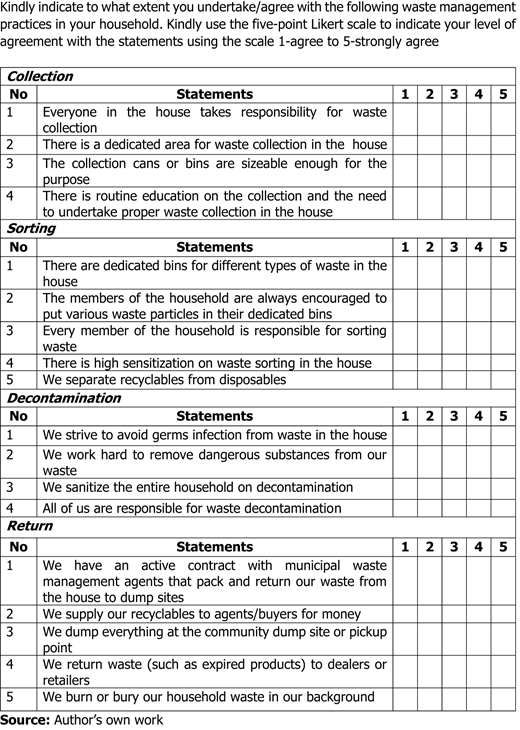
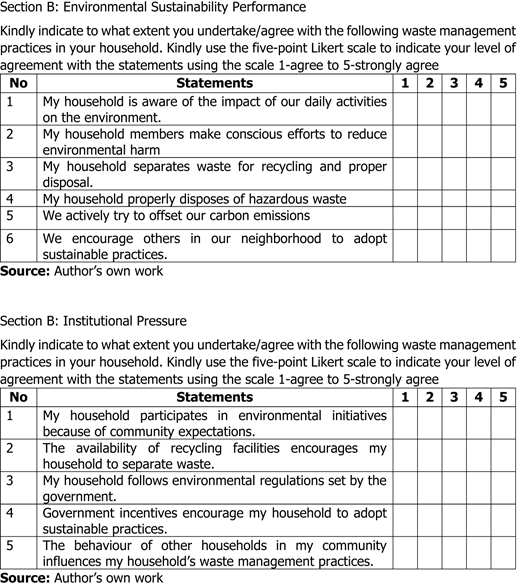
The measures for the study were critically adapted from the literature (see Appendix). The study used a 5-likert scale agreement ranging from 1(agree) to 5(strongly agree). Waste management practices were measured with four variables (thus collecting, sorting, decontaminating and returning). 4 Items for the collection were adapted from Aleluia and Ferrão (2016), five items for sorting were adapted from Chan and Bishop (2013), four items for decontamination was adapted from Aleluia and Ferrão (2016) and three items for return was adapted from Xie and Breen (2014). Institutional pressure and environmental performance were measured using five items and six items, respectively, from Zhu and Sarkis (2007) and Agyapong et al. (2023). Also, the study controlled for income, education, and household size. The adapted questionnaire items are presented in the Appendix section.
3.2 Common method bias (CMB)
To address CMB, which occurs when responses are influenced by the research instrument rather than respondents’ dispositions (MacKenzie and Podsakoff, 2012), the study followed Tehseen et al. (2017) by introducing unrelated items into the questionnaire to ensure respondents’ attention. After removing responses to unrelated questions, the valid data was analysed. The study applied Harman’s single-factor test and variance inflation factor (VIF) to assess CMB. The total variance extracted was 34.39% (less than 50%), and all VIF values were below 3.3, indicating no CMB issues affecting the relationship between the variables (Kock, 2017).
4.0 Results and discussion
4.1 Respondent information
The various demographic characteristics, such as education level, household size, household income, and residence type, were analysed and presented in Table 1.
Demographic characteristics
| Variables | Frequency | % |
|---|---|---|
| Level of formal education | ||
| Basic | 46 | 19.0 |
| Secondary/High | 55 | 22.7 |
| Tertiary/professional | 141 | 58.3 |
| Household size (persons) | ||
| 1 | 13 | 5.4 |
| 2 | 15 | 6.2 |
| 3 | 53 | 21.9 |
| 4 | 70 | 28.9 |
| 5 or more | 91 | 37.6 |
| Household’s monthly income | ||
| Below GH₵1000.00 | 38 | 15.7 |
| GH₵1000.00–2000.00 | 32 | 13.2 |
| GH₵2001.00–3000.00 | 70 | 28.9 |
| GH₵3001.00–4000.00 | 53 | 21.9 |
| GH₵4001.00–5000.00 | 21 | 8.7 |
| Above GH₵5000.00 | 28 | 11.6 |
| Type of residence | ||
| Family house | 74 | 30.6 |
| Personally owned | 74 | 30.6 |
| Rented/mortgage | 87 | 36.0 |
| Others | 7 | 2.9 |
| Total | 242 | 100 |
Source(s): Authors’ own work
Table 1 shows that most respondents have a tertiary or professional qualification (58.3%), followed by secondary education (22.7%), with the rest having basic education, indicating a literate population suitable for questionnaire use. Most households have more than five residents (37.6%), followed by four residents (28.9%), with the least being one resident (5.4%), indicating larger household sizes in the Cape Coast metropolis. Regarding income, most earn between GH₵2001.00–3000.00 monthly (28.9%), with fewer earning GH₵4001.00–5000.00 (8.7%). Most respondents live in rented/mortgaged houses (36.0%), followed by those in family houses or personally owned homes (30.6% each). The result aligns with the demographic and economic trends of Cape Coast North and South, as reported by the Ghana Statistical Service (GSS, 2021). The population is highly educated, with a significant number holding tertiary or professional qualifications, reflecting the region’s strong educational infrastructure. Also, large households are common, indicative of the cultural norm of extended family living. Most residents fall within the middle-income bracket, aligning with the economic stability seen in the Cape Coast metropolis. Additionally, housing trends show a preference for rented or mortgaged accommodations, consistent across the Cape Coast area, highlighting the region’s uniform urban housing market dynamics.
4.2 Confirmatory factor analysis
This study used the repeated indicator approach in SartPLS 4 to conduct confirmatory factor analysis for waste management practices, considering its multiple dimensions as depicted in Figure 2 and Figure 3 (Hair et al., 2019). According to Hair et al. (2019), reflective constructs should have factor loadings of at least 0.7 and t-values of at least 1.96 for validity. The results highlighted in Figures 2 and 3 show that most factor loadings met the 0.7 threshold, but items below 0.6 were dropped. Specifically, 2 items for collection and 1 item for return were removed due to t-values below 1.96. One item under institutional pressure with loading below 0.7 was retained because its t-values exceeded 1.96 (see Figure 3), supporting the overall validity of the indicators.


The study established construct validity and reliability, discriminant validity, and collinearity statistics to assess the model’s fitness. Table 2 shows that the average variance extracted (AVE) values are above 0.5, and composite reliability (CR) statistics are above 0.7, confirming construct validity and reliability (Hair et al., 2019). All Rho_A values exceeded 0.70, indicating no reliability issues. Table 3’s heterotrait-monotrait ratio (HTMT) demonstrates that no pairwise correlations exceed 0.90, establishing discriminant validity (Hair et al., 2019). Finally, Table 4’s variance inflationary factors (VIFs) are all below 3.3, indicating no multicollinearity or common method bias (Kock, 2017)
Construct validity and reliability
| Constructs | Cronbach’s alpha | Rho_A | Composite reliability | AVE |
|---|---|---|---|---|
| Collection | 0.724 | 0.774 | 0.876 | 0.780 |
| Decontaminate | 0.851 | 0.867 | 0.899 | 0.691 |
| Environmental performance | 0.905 | 0.905 | 0.926 | 0.677 |
| Institutional pressure | 0.846 | 0.848 | 0.892 | 0.626 |
| Return | 0.770 | 0.778 | 0.867 | 0.686 |
| Sorting | 0.891 | 0.900 | 0.920 | 0.697 |
Source(s): Authors’ own work
Discriminant validity (HTMT)
| Constructs | 1 | 2 | 3 | 4 | 5 | 6 | 7 |
|---|---|---|---|---|---|---|---|
| Collection | |||||||
| Decontaminate | 0.716 | ||||||
| Environmental performance | 0.429 | 0.555 | |||||
| Institutional pressure | 0.653 | 0.691 | 0.709 | ||||
| Return | 0.611 | 0.608 | 0.606 | 0.741 | |||
| Sorting | 0.667 | 0.548 | 0.567 | 0.572 | 0.614 | ||
| Institutional pressure x waste management practices | 0.528 | 0.586 | 0.513 | 0.595 | 0.490 | 0.439 |
Source(s): Authors’ own work
4.3 Results and discussion
The study evaluated the structural model using R-square, Adjusted R-square, and Q-square prediction statistics. Table 5 and Figure 4 show that institutional pressure explains 46.6% of the variance in waste management practices. Waste management practices and institutional pressure also explain 49.5% of the variance in environmental performance. While these values are below 50%, they still represent a substantial explanatory power in social science research, where environmental and behavioural phenomena are often influenced by multiple interacting factors.The Q2_predict statistics confirm the model’s significance and show that the independent variable has a non-zero effect on the dependent variable. The model demonstrates good predictive relevance for the endogenous variable, as the Q2_predict statistics are greater than zero (Wong, 2016).
Direct effect, R2, Q2 and effect size
| Hypothesis | Original sample (O) | t-statistics | Effect size | p-values | 2.5% | 97.5% |
|---|---|---|---|---|---|---|
| IP → EP | 0.280 | 3.921 | 0.069 | 0.000 | 0.137 | 0.419 |
| IP → WMP | 0.682 | 17.949 | 0.871 | 0.000 | 0.603 | 0.752 |
| WMP → EP | 0.247 | 2.950 | 0.039 | 0.003 | 0.086 | 0.410 |
| IP x WMP → EP | −0.098 | 2.406 | 0.020 | 0.016 | −0.178 | −0.017 |
| R-square | R-square adjusted | |||||
| EP | 0.495 | 0.482 | ||||
| WMP | 0.466 | 0.463 | ||||
| Q2predict | RMSE | MAE | ||||
| EP | 0.423 | 0.763 | 0.589 | |||
| WMP | 0.459 | 0.738 | 0.586 | |||
Note(s): IP = institutional pressure, EP = environmental performance, WMP = waste management practices
Source(s): Authors’ own work

The study tested four hypotheses, control variables and total indirect effect. The result shown in Table 5 and Figure 4 proved that waste management practices positively affect environmental performance with β = 0.247, p = 0.003, and F2 = 0.039. The result probed further to analyse the total indirect effect of the various waste management practices and their effect on environmental performance. The result presented in Table 6 indicates that all the practices (thus collection, decontaminate, return and sort) have a positive and significant effect on environmental performance with (β = 0.029, p = 0.000), (β = 0.103, p = 0.000), (β = 0.098, p = 0.000) and (β = 0.154, p = 0.000) respectively. The result from the confidence interval proved that zero was not present between the lower and higher limits (0.086 → 0.410). The results indicate that waste management practices such as collection, decontamination, return, and sorting positively enhance environmental sustainability performance and emphasize the critical role of comprehensive waste management practices in achieving sustainability goals. These practices work together to reduce environmental pollution, conserve natural resources, and mitigate the harmful effects of waste. This implies that improving household waste management practices will boost environmental performance in the Cape Coast Metropolis. This highlights the importance of implementing robust waste management practices to minimize ecological impact and promote long-term environmental health. The results align with prior studies that emphasize the impact of effective waste management on logistical performance and energy efficiency (Salisu et al., 2022; Fereja and Chemeda, 2022; Seshie et al., 2020; Ayantoyinbo and Adepoju, 2018). Specifically, Ayantoyinbo and Adepoju (2018) that proper waste collection and sorting enhance waste management efficiency by streamlining logistics and optimizing resource utilization. Similarly, Salisu et al. (2022) and Seshie et al. (2020) argue that sustainable waste practices reduce carbon footprints and improve circular economy initiatives.
Total indirect effect and control variables
| Hypothesis | Original sample (O) | t-statistics | p-values | 2.5% | 97.5% |
|---|---|---|---|---|---|
| COL → EP | 0.029 | 3.712 | 0.000 | 0.015 | 0.045 |
| DECO → EP | 0.103 | 3.953 | 0.000 | 0.053 | 0.154 |
| RET → EP | 0.098 | 3.840 | 0.000 | 0.049 | 0.150 |
| SORT → EP | 0.154 | 3.996 | 0.000 | 0.080 | 0.231 |
| Control variables | |||||
| Education → EP | 0.092 | 2.067 | 0.039 | 0.003 | 0.178 |
| Income → EP | 0.154 | 2.797 | 0.005 | 0.049 | 0.265 |
| Size → EP | 0.038 | 0.599 | 0.549 | −0.085 | 0.167 |
Note(s): COL = collection, EP = environmental performance, DECO = decontaminate, RET = return and SORT = sorting
Also, the result in Table 5 proved that institutional pressure has a positive and significant effect on waste management practices with β = 0.682, p = 0.000, and F2 = 0.871. This conclusion was drawn because the T-value of 17.949 exceeds the recommended threshold of 1.96, and the corresponding p-value = 0.000. The result from the confidence interval proved that zero was not present between the lower and higher limits (0.603 → 0.752). The result of the study suggests that implementing carefully crafted policies and regulations can significantly impact shaping and guiding the practices related to household waste management. Strategic implementation of effective policies, incentives, and regulatory frameworks by institutions can foster improved waste management practices among households, significantly enhancing environmental preservation. Establishing robust waste infrastructure is crucial for encouraging sustainable household waste practices. The study supports institutional theory, highlighting the role of institutions in shaping societal behaviors through these measures. The study aligns with the principles of institutional theory, which suggest that institutions play a crucial role in shaping societal behaviours by implementing policies, providing incentives, and enforcing regulations. The findings of this study align with previous research, demonstrating that institutional pressures significantly influence waste management practices (Nassani et al., 2023; Sharma et al., 2023; Hasan and Taha Islam, 2023; Zhang et al., 2022a, 2022b; Qian et al., 2018). These studies collectively highlight the role of regulatory frameworks, social norms, and economic incentives in shaping household waste management behaviours. For instance, Qian et al. (2018) emphasize that government policies and enforcement mechanisms drive compliance with sustainable waste disposal practices, while Sharma et al. (2023) argue that financial incentives and public awareness campaigns enhance household participation in waste management initiatives. Similarly, Hasan and Taha Islam (2023) found that institutional support structures, such as waste collection services and recycling facilities, improve adherence to sustainable practices.
Table 5 shows that institutional pressure positively and significantly affects environmental performance with β = 0.280, p = 0.000, and f2 = 0.069. The result from the confidence interval (0.137–0.419) firmly excludes zero, reinforcing the argument that institutional pressures are a significant driver for environmental performance. The study’s findings align with the tenets of institutional theory, which indicate that institutions play a crucial role in shaping the practices and performance of societies. The relationship between institutional pressure and environmental performance highlights the pivotal role of regulatory bodies and other institutional factors in driving the advancement of environmental sustainability in the household. Empirically, these findings are consistent with previous studies, such as Agan et al. (2013), Graafland and Smid (2017), Thomas and Bhaumik (2023), and Ojeka et al. (2019), which established that institutional pressures enhance environmental responsibility and sustainability performance. For instance, Agan et al. (2013) found that regulatory compliance and market-based institutional pressure encourage organisations to adopt environmentally friendly practices. Similarly, Graafland and Smid (2017) argue that institutional pressures, particularly in government regulations and industry standards, are critical in shaping sustainability initiatives. Beyond environmental management, studies such as Nyamah et al. (2022), Charnor and Quartey (2024), Vanacker et al. (2021), and Ahmed et al. (2020) indicate that institutional pressures enhance institutional efficiency and compliance across various sectors. This suggests that while institutional pressures can drive environmental performance at the household level, their effectiveness depends on enforcement mechanisms, public awareness, and the availability of infrastructure to support sustainable waste management. Therefore, a proactive approach integrating regulatory compliance with household engagement and access to waste management services is essential to achieving broader sustainability objectives.
Table 5 shows that institutional pressure significantly and negatively moderates waste management practices and environmental performance nexus (β = 0.-0.098, p = 0.016, F2 = 0.020). The result from the confidence interval proved that zero was not present between the lower and higher limits (−0.178 → −0.017). The research findings indicate that institutional pressure plays a role in shaping direct relationships. However, it is important to note that the complex processes and potential inconvenience associated with environmental regulations or guidelines can substantially deter households, impacting their willingness to comply with such measures. Individuals’ natural psychological resistance nature can explain the findings. Psychological resistance may arise when households encounter institutional pressures necessitating changes in their lifestyle or habits. Households frequently resist altering their routines, particularly when the proposed changes require reduced convenience or additional work. The negative moderating effect observed in this study aligns with arguments from other scholars who suggest that excessive institutional pressure can sometimes lead to compliance fatigue or resistance (Gonzalez-Perez et al., 2020; Zhang et al., 2022a, 2022b). Gonzalez-Perez et al. (2020) argue that regulatory overreach may impose additional costs and complexities, leading to resistance rather than compliance. Zhang et al. (2022a, 2022b) further highlight that when environmental policies are perceived as overly rigid or impractical, they can create psychological barriers that hinder individuals from adopting sustainable practices.
On the other hand, some findings contrast with prior studies, such as Nazir et al. (2024) Li et al. (2016), and Saeed et al. (2018), which established that institutional pressure positively moderates the relationship between green practices and performance. For instance, Nazir et al. (2024) found that regulatory and market-driven pressures enhance organisations’ commitment to green supply chain practices. Similarly, Li et al. (2016) emphasized that institutional monitoring mechanisms positively influence firms’ environmental performance by ensuring compliance with sustainability policies. These contrasting perspectives suggest that the effectiveness of institutional pressure in enhancing environmental performance is contingent upon how regulations are designed and enforced. While regulations are essential in promoting sustainable waste management, they must be balanced with education, incentives, and infrastructure support to encourage voluntary compliance.
4.4 Control variables
The study analysed education, income, and household size as control variables. The results presented in Figure 4 and Table 5 show that education and income of the household have a positive and significant effect on environmental performance (β = 0.092, p = 0.039) and (β = 0.154, p = 0.005), respectively. However, household size showed an insignificant effect on environmental performance (β = 0.038, p = 0.549).
4.5 Robustness
The research examined the impact of waste management practices on environmental performance and the role of institutional pressure, using Importance-Performance Map Analysis (IPMA) for additional insights. Results in Figure 5 indicate that waste management practices enhance environmental performance by 67.28%, while institutional pressure contributes 65.83%. Among control variables, household size had the highest impact on environmental performance (72.831%), followed by income (60.537%) and education (22.521%). These findings suggest that improvements in waste management, institutional pressure, and household characteristics can significantly boost environmental performance from a household perspective.

5. Conclusion
The study investigated the effect of waste management practices on environmental performance and the role of institutional pressure. The findings of this study emphasized the critical role of effective waste management practices and institutional pressure in enhancing environmental performance. While institutional regulations and external pressures encourage households to adopt sustainable waste practices, the negative moderating effect suggests that rigid or complex institutional frameworks may inadvertently hinder compliance. This highlights the need for a balanced approach that combines enforcement with behavioral change strategies, education, and infrastructural support to facilitate waste management at the household level. Additionally, socio-economic factors such as education and income significantly influence environmental performance, reinforcing the argument that policies should focus on regulatory enforcement, capacity building, and economic incentives to promote sustainable waste practices. To achieve long-term environmental sustainability, policymakers must implement integrated strategies that align institutional frameworks with accessible waste management infrastructure, awareness campaigns, and community engagement initiatives. The findings conclude that effective waste household practices (thus collection, sorting, decontaminating, and return) are required to enhance Cape Coast’s environmental performance. Moreover, implementing proper waste management policies and providing waste infrastructure will positively affect households’ waste practices and improve environmental performance in the metropolis of Cape Coast.
5.1 Managerial implication and theoretical contribution
Municipality and waste management institutions must extend sustainable waste management practices to households and ensure effective monitoring along their value chains. This can be done by intensifying the awareness of waste management practices. Awareness can be in the form of periodic training, mass information, and seminars to educate households on the need to play a role in waste management. However, it will be beneficial to the municipality and the government to proactively involve themselves in facilitating awareness programs by identifying the shortfalls in the household’s current waste management practices, helping to enhance best practices, and achieving higher engagement of the households. Also, the government must aid in providing the facilities and equipment that will help promote sustainable development. Hence, providing adequate facilities and equipment will enable the households to play their roles well, increase the sustainability of the waste management systems, and positively impact the environment.
This study makes a significant theoretical contribution by reinforcing and extending the applicability of institutional theory and the theory of planned behaviour in the context of waste management and environmental sustainability. The findings confirm that institutional pressure moderates the relationship between waste management practices and environmental performance, highlighting the role of regulatory frameworks, social norms, and policy enforcement in shaping sustainable waste behaviours. This aligns with institutional theory, which posits that institutions influence societal and organisational practices, driving compliance with environmental standards. Additionally, the study supports the theory of planned behaviour by demonstrating that household waste management practices are influenced not only by individual intentions but also by external structural and social pressures. The significant positive relationship between waste management practices and environmental performance underscores the multifaceted nature of pro-environmental behaviour, reinforcing the idea that individuals are more likely to engage in sustainable waste practices when institutional support, education, and perceived behavioural control mechanisms are in place. These findings advance theoretical discourse by demonstrating that effective environmental sustainability requires an integration of institutional influence and behavioural motivation, suggesting that policies should combine regulatory enforcement with behavioural change strategies to drive long-term environmental performance.
5.2 Limitations and suggestions for future research
The study contributes to the waste and sustainability literature by investigating the effect of waste management practice, environmental performance, and institutional pressure’s role. However, the study was limited to the Cape Coast metropolis in Ghana. Hence, other studies can replicate the same in other parts of the country and other sectors to test whether the sectors hold different perspectives on waste management in the supply chain. Also, the study was limited to three variables (thus waste management practices, institutional pressure and environmental performance). Hence, other studies can introduce other moderating or mediating variables to extend the boundaries of knowledge of waste management practices.
References
Further reading
Appendix: Instrument
SECTION A - Background characteristics
This section takes data on your background characteristics. Select the most appropriate answer applicable to you.
Kindly indicate your level of formal education:
Basic or less
Secondary
Tertiary/Professional
What is your household size?
1
2
3
4
5+
Kindly indicate your household’s monthly income:
Below GH₵1000.00
GH₵1000.00 - GH₵2000.00
GH₵2001.00 - GH₵3000.00
GH₵3001.00 - GH₵4000.00
GH₵4001.00 - GH₵5000.00
Above GH₵5000.00
Residence type:
Family house
Personally owned
Rented
Other
SECTION B – Household Waste Reverse Logistics Practices