This study aims to investigate how mindfulness-based facilitation can serve as an empowering process within community-based tourism. Drawing on the mindfulness-to-meaning theory, it explores how mindfulness-oriented activities cultivate awareness, agency and shared responsibility among destination residents. The research highlights how mindful co-creation generates eudaimonic experiences that strengthen residents' intrinsic motivation to act responsibly and collaboratively within their communities.
Participatory action research was conducted in Atayal Indigenous communities in Taiwan. Mindfulness-based workshops, reflective dialogues and field observations traced transformations across the mindfulness-to-meaning stages – decentring, attentional broadening, reappraisal and savouring. Thematic analysis revealed how residents reinterpreted guiding and collaboration as mindful co-creation, strengthening empowerment and local agency in responsible tourism.
Mindfulness-based training reshaped residents' interpretations of travelling and breathing mindfully in Atayal Forests. Four representations of mindfulness-to-meaning processes emerged: cultivating place reflexivity, fostering dialogue with nature, reappraising guiding as cultural custodianship and nurturing a long-term communal vision. These processes generated eudaimonic meanings that affirmed identity, reinforced empowerment and guided community tourism toward responsible engagement.
This paper offers the first empirical application of the mindfulness-to-meaning theory to responsible tourism. It develops a process–outcome framework linking mindfulness, meaning-making and empowerment, extending mindfulness-to-meaning theory beyond individual psychology to collective transformation. Conceptually, it introduces mindful facilitation as a mechanism for host empowerment. Practically, it demonstrates how mindfulness-based co-creation fosters awareness and responsibility from within communities, enabling authentic, value-based forms of responsible tourism.
Introduction
Humans naturally pursue meaningful experiences that enrich life. There has been growing scholarly interest in understanding how to enhance meaning in life (Richards et al., 2005). Mindfulness – a psychological construct associated with present-moment, non-judgemental awareness – has been recognised as a path to cultivating positive mental health (Chen et al., 2017; Kabat-Zinn, 2003) and enabling individuals to enact wisdom situationally (Štante, 2016) in ways that foster eudaimonia – encompassing meaning, growth, authenticity and excellence (Huta and Waterman, 2014). This orientation, akin to flourishing, reflects a deeper sense that life is meaningful and worthwhile, beyond fleeting pleasure and grounded in personal growth and virtue (Garland et al., 2015b; Huta and Waterman, 2014).
Building on these qualities, mindfulness-based practices have been increasingly recognised as effective approaches for fostering awareness, self-regulation and meaning across diverse domains, including Buddhism (Thích, 1988; Wallace, 2003), clinical psychology (Creswell, 2017; Kabat-Zinn, 2003; Kang and Whittingham, 2010), leisure (Carruthers and Hood, 2011), education (Weare, 2014) and work (Reb et al., 2013). While these interventions have mainly centred on individual benefits, there is a growing recognition of the need to explore how mindfulness cultivation may also foster collective awareness (Deja and Wójcik, 2021) and shared meaning in group or community contexts (Creswell, 2017).
Collective empowerment refers to processes through which groups strengthen their shared capacity to act, decide and influence outcomes that improve quality of life (Perkins and Zimmerman, 1995). Within meditative mindfulness, such empowerment can be fostered through structured programmes that cultivate sensory awareness and embodied presence, enabling participants to internalise values that support communal flourishing (Deja and Wójcik, 2021; Hanley et al., 2015; Kabat-Zinn, 2003). This perspective shifts attention from individual transformation to group-level awareness and relational meaning. However, within tourism and community development research, applications of mindfulness-based facilitation that nurture collective awareness – particularly toward constructing shared eudaimonic consciousness – remain insufficiently examined. As Kaya et al. (2024) highlight, further inquiry into collective tourism practices is needed.
In community-based tourism, empowerment initiatives have often relied on a one-way transfer of technical skills or external expertise from academics and practitioners to local actors (Mtapuri et al., 2021; Sriyani, 2022). Similarly, in nature-based tourism – such as forest bathing and therapy – operational guidelines often privilege standardised protocols, which risk eroding locally distinctive meanings and cultural attributes (Gobster et al., 2023; Shin et al., 2010). While these approaches may promote efficiency, they can simultaneously limit opportunities for destination residents to interpret and express place-based values on their own terms. This opens up possibilities for mindfulness-based facilitation that foregrounds sensory awareness and embodied presence, enabling communities to articulate place-based understandings of beauty and meaning as a foundation for more responsible tourism development. Nonetheless, practical applications in tourism remain limited, and greater clarity is required on how academia and local communities can collaborate in such empowerment processes. In this study, the term “residents” refers specifically to Atayal community members, who are simultaneously the host population and custodians of the destinations under investigation.
Accordingly, the purpose of this study is to investigate how mindfulness-based facilitation can serve as an empowering process within community-based tourism. Specifically, the study aims to examine how destination residents interpret eudaimonic meanings associated with their place through participatory, mindfulness-oriented activities. In addition, it seeks to clarify the respective roles of outsiders (external experts) and insiders (destination residents) in this empowerment process, underscoring the importance of co-creating tourism knowledge rather than relying on one-way transfers. This study is expected to generate theoretical implications by extending the mindfulness-to-meaning framework from the individual to the collective and practical implications by illuminating how communities' mindful awakening might intrinsically nurture responsible tourism.
Literature review
Responsible tourism centres on demonstrable positive impacts while minimising negative effects to maximise community benefits and protect cultural and environmental resources (Goodwin, 2024). However, limited research has examined the psychological and experiential processes that facilitate responsibility in practice. Mindfulness has been shown to foster environmentally and socially sustainable attitudes among residents (Yılmaz and Anasori, 2022). This study addresses this gap by linking responsible tourism with the psychological domain of mindfulness and its application through empowerment, providing the awareness, meaning-making and agency that underpin the conceptual framework of this study.
Mindfulness practices
Mindfulness, rooted in Buddhist contemplative traditions (Thích, 1988), has been secularised and integrated into multidisciplinary programmes that cultivate non-judgemental awareness of the present moment (Chen et al., 2017; Kabat-Zinn, 2003). Clinically, interventions such as mindfulness-based stress reduction and mindfulness-based cognitive therapy demonstrate efficacy for attentional regulation, mental health and psychological well-being (Kabat-Zinn, 2003; Kang and Whittingham, 2010). Other variants, including mindfulness-based art therapy, combine contemplative techniques with creative expression, thereby fostering emotional regulation and resilience (Newland and Bettencourt, 2020). These protocols commonly employ focused breathing, body scanning and reflective dialogue, which directly counter “autopilot” behaviour (Rill, 2016) and have been shown to improve cognitive and affective functioning, interpersonal outcomes and overall quality of life (Creswell, 2017; Newland and Bettencourt, 2020).
Beyond clinical contexts, mindfulness has been applied in leisure and tourism to deepen sensory engagement and enhance experiential quality (Chen, 2022). Examples include forest bathing (Farkic et al., 2021), Zen retreats (Wang et al., 2021), programmes in mountain retreats (Chen, 2022), and hospitality workplaces (Bagaria and Nirmala, 2023). These practices embed mindful awareness in ordinary actions by consciously activating perception – sight, sound, smell, taste and touch – to cultivate embodied presence (Carruthers and Hood, 2011; Chen and Scott, 2024; Chen et al., 2017; Hanley et al., 2015). Beyond sensory awareness, mindfulness practice has been differentiated in the literature into formal and informal modes. Mindfulness is cultivated through formal modes, typically involving dedicated meditation sessions and informal modes, which integrate awareness into everyday routines such as walking, eating, being in nature, storytelling, and group sharing. Both forms are increasingly recognised as indispensable for sustaining mindful states in daily life and educational settings (Birtwell et al., 2019; Chen, 2022; Hanley et al., 2015; Lee et al., 2025). Though seemingly mundane, informal approaches can heighten self-awareness and relational attunement; when curated by destination management organisations with local communities, they may evoke genuineness and emotional resonance and foster meaningful interactions around shared interests (Lee et al., 2025). Recent studies also show that mindfulness supports residents' sustainable attitudes (Yılmaz and Anasori, 2022) and enhances environmental awareness that can foster more positive attitudes and responsible orientations toward green tourism (Hadi and Johan, 2023).
While mindfulness training programmes were originally designed for individual mind–body regulation, they are now increasingly recognised for their collective potential, particularly as a foundation for humanistic approaches to management and community development (Gaan and Shin, 2024; Holm and Islam, 2024). At this level, such practices have been linked to the creation of supportive environments and to empowerment processes that extend from individuals to groups (Gaan and Shin, 2024; Holm and Islam, 2024). Nevertheless, systematic attention to this collective dimension within tourism remains underexplored (Wu and Chen, 2019). Interdisciplinary studies suggest that group-based mindfulness can nurture relational awareness and shared meaning (Deja and Wójcik, 2021), yet tourism scholarship has seldom examined how these practices might move beyond individual well-being to enable collective empowerment and community meaning-making.
To address this gap, the present study positions informal mindfulness-based activities as methodological foundations (Hanley et al., 2015) for community-based training – guided, organic practices that invite residents to reflect on self and place, foster community consciousness and cultivate context-sensitive empowerment. For destination hosts, such mindful attending moves them beyond “autopilot” routines, sharpening awareness of environmental impacts. This heightened awareness represents a crucial psychological condition for assuming responsibility, resonating with responsible tourism's call to minimise harm and enhance community benefits (Goodwin, 2024; Yılmaz and Anasori, 2022). This perspective informs the design elements underpinning the study's empirical application.
Mindfulness-to-meaning theory
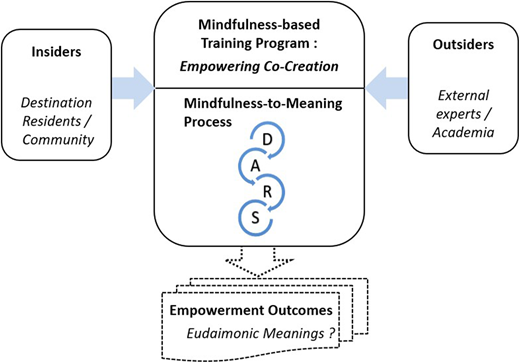
While prior scholarship has documented the beneficial outcomes of mindfulness, the mindfulness-to-meaning theory (MMT) advances this understanding by explicating its underlying mechanisms (Garland et al., 2015a, b; Garland and Fredrickson, 2019). The theory posits that mindfulness initiates a recursive sequence of cognitive-affective processes that spiral upward toward enhanced meaning and well-being (Garland and Fredrickson, 2019). In MMT, mindfulness unfolds as decentring → attentional broadening → reappraisal → savouring (DARS), translating mindful awareness into eudaimonic meaning (Garland et al., 2015a; Garland and Fredrickson, 2019). Decentring marks a shift from immersion in mental contents to awareness of consciousness – becoming aware, dis-identifying from thoughts and emotions and recognising that thoughts are not facts – creating reflective distance and de-automatising appraisals (Garland et al., 2015a, b). On that basis, attentional broadening widens sampling to previously unattended interoceptive and exteroceptive cues, furnishing a
more balanced situational representation (Garland and Fredrickson, 2019). With a richer informational base, reappraisal re-construed experience in value-consistent, growth-oriented terms (Hanley et al., 2015). Savouring then mindfully elaborates valued moments and their effect, consolidating rewards and higher-order meanings – an iterative orientation toward eudaimonia (Garland and Fredrickson, 2019; see Table 1).
Conceptually, DARS specifies distinct yet complementary processes: decentring opens the system; attentional broadening supplies raw material for reinterpretation; reappraisal transforms narrative and affective trajectories and savouring stabilises gains. Metacognitive awareness underpins the entire sequence – permeating DARS by guiding attentional selection, scaffolding reappraisal and framing the meta-aware elaboration involved in savouring (Garland et al., 2015b; Hanley et al., 2021). Specifically, eudaimonic meaning is generated across the sequence in a dynamic, iterative manner – principally constructed during reappraisal and subsequently consolidated and amplified through savouring, with successive cycles deepening the meaning–well-being linkage (Garland et al., 2015a, b; Garland and Fredrickson, 2019; Hanley et al., 2021). Accordingly, MMT functions as a process model that offers a causal account of how mindfulness fosters meaning via identifiable cognitive-affective mechanisms, yielding eudaimonic rather than merely hedonic outcomes (Garland and Fredrickson, 2019).
Although MMT has been developed mainly in psychology and health, where it provides a process account of how mindfulness fosters meaning-making and eudaimonic enhancement (Allen et al., 2021), its theoretical application in tourism remains underexplored. Recent work applies MMT to tourist experiences by linking mindfulness with perceived place authenticity, engagement and storytelling (Lee et al., 2025), but this evidence is predominantly tourist-centred. Supply-side perspectives – particularly those of community guides – are scarcely examined. Links between MMT and responsible tourism remain underexplored.
In light of this gap, this study employs MMT as a mechanism-level framework to interpret how a mindfulness-based empowerment programme in community-based tourism may support place-based meaning-making and the development of reflexive guide identity, thereby contributing to eudaimonic meaning. While previous research has largely examined mindfulness-to-meaning processes at the individual level, this study investigates how such processes are represented in a community-based tourism setting and how they may be further conceptualised as meaningful constructs of collective empowerment and sustainability. This study seeks to explore whether hosts' mindful experiences may generate intrinsic motivation through the MMT process and how such processes might foster reappraisal, a values-driven sense of purpose and potential commitment to responsible initiatives.
Empowerment training in tourism
Empowerment is broadly understood as strengthening the capacity of individuals, organisations and communities to exercise agency and influence over matters affecting their lives (Timothy, 2006; Zimmerman, 2000). It is conceptualised as a dynamic, multi-level process that links individual efficacy, critical awareness and collective participation (Joo et al., 2020; Zimmerman, 1995). Within this perspective, training can be regarded as one pathway to empowerment, as it provides structured opportunities to build capabilities, confidence and shared agency (Scheyvens and van der Watt, 2021; Wallerstein, 1992). In tourism research, empowerment training has been increasingly recognised as essential for advancing responsible and sustainable development (Scheyvens, 1999; Scheyvens and van der Watt, 2021), particularly in community-based contexts where residents or local actors must develop not only technical skills but also reflexivity to articulate place meanings (Boley and McGehee, 2014; Joo et al., 2020). In addition, stewardship roles are critical for ensuring that empowerment contributes to long-term sustainability (Joo et al., 2020; Scheyvens, 1999; Scheyvens and van der Watt, 2021). Such empowerment aligns closely with the principles of responsible tourism, where local agency and stewardship are recognised as critical for minimising harm and maximising community benefits (Goodwin, 2024; Scheyvens and van der Watt, 2021).
In practice, empowerment in tourism has been pursued through both bottom-up and top-down approaches. Bottom-up empowerment emphasises conscientisation, local reflexivity and agency, enabling residents to develop an awakened sense of agency that drives change and allows them to articulate community concerns (Joo et al., 2020; Mohan and Stokke, 2000). This reflects a form of “power from within”, cultivating confidence and identity that can drive collective transformation (Scheyvens and van der Watt, 2021). Conversely, top-down approaches rely on external actors such as governments, NGOs, academics or outside expertise to provide resources, training opportunities and legitimacy (Mohan and Stokke, 2000; Scheyvens and van der Watt, 2021; Timothy, 2006). Such approaches create a consultative process that can assist communities by offering knowledge, technical support and opportunities for learning and decision-making (Zimmerman, 2000).
While both mechanisms can be valuable, each carries limitations: bottom-up processes often lack resources and enabling factors, constraining residents' ability to sustain long-term initiatives (Mohan and Stokke, 2000; Scheyvens, 1999; Wallerstein, 1992; Zimmerman, 1995), whereas top-down interventions may foster dependence on external professionals (Wallerstein, 1992; Zimmerman, 2000) or risk tokenistic participation (Boley and McGehee, 2014), thereby weakening reflexivity and local voice and ultimately reinforcing powerlessness (Mtapuri et al., 2021). Moreover, research has shown that empowerment training combined with genuine community participation is crucial for enabling tourism residents to adopt responsible practices in the sustainable use of land and resources (Wondirad and Ewnetu, 2019; Yılmaz and Anasori, 2022). Taken together, these observations suggest that empowerment in tourism is a dynamic process in which single-directional approaches remain partial, and the question of how they might be integrated requires further exploration.
In light of these limitations, recent scholarship has increasingly discussed co-creation as a potential integrative mechanism (Richards, 2020), emphasising interactive processes in which local non-academic actors and external experts jointly contribute to empowerment outcomes (Soulard et al., 2021). Co-creation foregrounds dialogue between equal partners so that knowledge is generated with, rather than delivered to, communities (Binkhorst and Den Dekker, 2009). From this perspective, empowerment is reframed not as a unilateral transfer but as a relational process through which diverse actors collaboratively develop more context-sensitive and resilient practices (Richards, 2020). Rill's (2016) notion of resonant co-creation positions mindfulness as a precondition for authentic co-creative engagement, through which participants are empowered via worldview transformation that can foster strategic innovation. However, this perspective, while clarifying the psychological basis of co-creation, remains theoretical with limited empirical support in applied community or tourism contexts.
In this sense, mindfulness-based empowerment can be viewed as not only fostering agency but also enabling communities to enact the responsibilities central to sustainable tourism development. In sum, mindfulness-based training can be understood as an empowering approach that embeds interactive processes between insiders and outsiders in community-based tourism. Such processes can be further interpreted through the lens of the MMT, offering a conceptual foundation for examining how empowerment may unfold in context-sensitive and relational ways. These discussions inform the formulation of the mindfulness–empowerment co-creation framework in community-based tourism, which is illustrated in Figure 1 and serves as a basis for the empirical design that follows.
Methodology
Research design
This study adopted a qualitative research design that combined participatory action research (Goebel et al., 2019), sensory ethnography (Pink, 2009a, b) and open-ended questioning (Soulard et al., 2021) with critical dialogues involving destination residents in order to investigate mindfulness-based empowerment in community-based tourism. Such a design was chosen because it foregrounds participants' lived experiences and contextual reflexivity while enabling local knowledge to be co-created through collaborative processes rather than imposed as externally defined categories (Goebel et al., 2019; Pink, 2009a, b).
Participatory action research offered a means of engaging destination residents and external experts in joint reflection and action, while sensory ethnography extended this engagement by capturing the embodied, multi-sensory dimensions of participants' encounters with place –
sight, sound, smell, touch and movement – that are often overlooked in conventional research (Pink, 2009a, b). Open-ended prompts were also incorporated to stimulate dialogue, encouraging participants to articulate self-reflections and cultural meanings in their own words (Soulard et al., 2021).
Central to this research design was the insider–outsider dynamic. Outsiders, represented by the academic facilitation team, were not positioned as detached evaluators but as collaborators in knowledge co-creation. The researcher assumed the role of “researcher-facilitator”, enabling communicative spaces where residents could articulate agency and reinterpret local meanings through reflexive dialogue (Goebel et al., 2019; Richards, 2020). Reflexivity was embedded to minimise epistemic dominance (Farkic et al., 2021) and to sustain a dialogical mode of empowerment (Goebel et al., 2019).
Fieldwork context and participants
The fieldwork was situated in three Atayal Indigenous communities (Yingshi, Leshui and Lunpi tribes) in Datong Township, northeastern Taiwan, where residents showed willingness to explore sustainable eco-tourism development. Located in a forested mountainous region rich in ecological and cultural resources, these communities nonetheless faced pressures from increasingly homogeneous Indigenous eco-tourism initiatives, which undermined local distinctiveness. Yingshi community, in particular, had not yet initiated tourism development; while endowed with favourable natural and cultural assets, residents lacked clear strategies to transform these into distinctive and sustainable tourism practices. In this study, Atayal community members were positioned as insiders, contributing local knowledge and values.
To address these challenges, the Yilan Branch of the Forestry and Nature Conservation Agency, Taiwan, commissioned an academic facilitation team to collaborate with the communities for one year. Representing the outsiders, the team was not tasked with prescribing solutions but with fostering responsible and sustainable pathways of tourism development through collaborative empowerment. In total, 41 participants joined this participatory action research, comprising 31 Indigenous residents and 10 external facilitators. The residents included elders, community leaders, accommodation hosts and local tour guides and operators, while the external facilitators consisted of one mindfulness academic, seven mindfulness-based training facilitators and two environmental theatre specialists, who co-designed and led seven training modules, as shown in Table 2, engaging both groups in joint participation through which subsequent meanings could be generated. Engagement unfolded through workshops and meetings, adopting a reflexive ethnographic stance (Pink, 2009a) that built trust and produced rich field data for co-created empowerment activities.
Mindfulness-based training programme: empowering co-creation
The mindfulness-based training programme, hereafter referred to as the empowerment programme, was intentionally designed to integrate informal mindfulness activities into a structured curriculum. Drawing on sensory ethnography (Pink, 2009a, b), the training programme ranged from simple indoor practices to more complex reflective exercises and extended to outdoor mindful encounters with the environment (see Table 2). Each session functioned as a gateway for embodied engagement with sight, sound, smell, taste and physical movement. The design encouraged participants to experience ordinary activities in a non-evaluative manner and to sustain attention with openness and acceptance (Kabat-Zinn, 2003). The sessions were designed to encompass a range of practices, from basic self-awareness (e.g. body scan) to collective reflection (e.g. reflecting on our journey) and ritualised appreciation (e.g. mindful tea-drinking practice).
The principles of the MMT were embedded into the programme's structure. For instance, Appreciate what you have already guided participants to decentre from habitual patterns of negative thinking (D: decentring), broaden awareness to community resilience (A: attentional broadening), reframe hardships as opportunities for growth (R: reappraisal) and affirm gratitude for existing resources and relationships (S: savouring). Similar dynamics were intentionally incorporated across all seven sessions, ensuring that each activity functioned as a gateway for the full D–A–R–S cycle. This design distinguished the programme from conventional training models that prioritise technical knowledge transfer over reflexive engagement. This approach allows capturing residents' lived expressions as representations of mindfulness-to-meaning processes, which may later inform conceptual development in the discussion and conclusion.
Open-ended questions and dialogues
Based on the approach of the MMT, open-ended questions were developed and employed before and after the training programme to explore participants' meta-awareness and interpretations regarding co-creation outcomes. These prompts were not intended to test knowledge but to facilitate self-reflection, stimulate dialogue and elicit narratives about residents' identities, roles and visions for future community tourism (see Table 3). While all questions implicitly engaged the recursive cycle of D→A→R→S, particular emphases were designed to foreground specific stages.
For example, the question “How would you reflect on and identify yourself, and why does this matter to you?” encouraged participants to decentre (D) from habitual self-views and broaden attention (A) to new aspects of identity. Similarly, “What role should a local tourism guide or operator play in leading community tourism, and what qualities are most important?” prompted reappraisal (R) of guiding as a responsibility tied to empowerment and community values. Future-oriented prompts such as “How can a local tourism guide or operator support others, also empowering themselves for the future?” encouraged savouring (S), affirming collective aspirations and long-term commitments to sustainable and responsible tourism.
Data handling and trustworthiness
Data included transcripts of reflective dialogues, meeting notes, observational records and responses to open-ended prompts, with interaction lengths ranging from a few minutes to several hours. These materials were thematically coded, guided by the constructs of the MMT (Garland et al., 2015a, b). Analysis combined manual coding, informed by the researcher's intensive engagement with the communities and the principles of participatory action research, with the use of NVivo software to support data management and cross-check coding consistency. The ethnographically informed stance enhanced sensitivity to local meanings (Pink, 2009a), while the analysis traced how participants' narratives reflected the D→A→R→S processes and their links to empowerment and meaning-making. The present analysis focuses on the narratives of Indigenous residents as hosts; interview data from facilitators were collected as well and will be addressed in a separate study, given the scope.
To ensure trustworthiness, triangulation was applied across data sources (Lincoln and Guba, 1985). Reflexive memoing was maintained to minimise researcher bias. Credibility was reinforced through prolonged engagement, peer debriefing within the facilitation team and transparent documentation of analytic decisions (Lincoln and Guba, 1985; Tracy, 2010).
Results
The findings show how mindfulness-based training reshaped residents' interpretations of travelling and breathing mindfully in Atayal Forests. Four representations of mindfulness-to-meaning processes emerged – cultivating place reflexivity, fostering dialogue with nature, reappraising guiding as cultural custodianship and nurturing a long-term communal vision – culminating in eudaimonic meanings oriented toward sustained well-being. The following sub-sections illustrate these transformations by comparing residents' reflections before and after the training.
Decentring: cultivating place reflexivity
Findings show that decentring was evident in residents' responses to the question of what “travelling and breathing mindfully in Atayal Forests” meant to them (Table 3, Q1). Decentring here refers to stepping back from automatic or habitual meanings of travel and re-examining its significance in relation to place. Through this process, participants shifted from externalised interpretations of mindful travel toward reflexive awareness of the forest as a foundation of cultural and community identity.
Before the training, participants described mindful travel in predominantly functional or hedonic terms. One explained: travel is to experience the beauty of the forest. [R13], while another emphasised “relaxation”: walking into the forest helps me relax and breathe in fresh air [R04]. Others highlighted external knowledge, noting that mindful travel was […] to learn Atayal traditional knowledge, to understand forest resources and to breathe in phytoncides of the forest mindfully [R04]. These statements reveal that the meaning of mindful travel was largely externalised – centred on scenery, health, or outside expertise – rather than on reflexive engagement with place. A longer account illustrates this orientation:
For me, mindful travel meant following what outsiders teach about the forest— how to see resources, how to breathe in the fresh air, and how to learn new knowledge. I thought of it mainly as an activity of looking and receiving. [R04]
This reflection underscores how meanings of travel were initially framed as objectifying the forest and dependent on external validation, with little consideration of its cultural embeddedness.
After the training, participants described letting go of these habitual associations and recognising deeper connections with place. One remarked, “To let go, to empty myself, to cultivate empathy and to remain calm and stable” [R03]. Another explained, “Placing my heart in the present, emptying myself, learning to be quiet, realising the relationship between human and nature – this has always been our authentic way of living” [R01]. These reflections highlight decentring as a shift from externally imposed meanings to inner quietude and relational awareness. A more extended reflection shows how this process fostered place reflexivity:
When I became silent and stayed with the forest, I began to see our lives differently. The forest is no longer just scenery—it is where our culture takes root. By slowing down and reflecting on our way of living here, I could see more clearly how the forest and community are inseparable. [R09]
Here, decentring enabled a re-examination of travel not as consuming scenery but as engaging in cultural grounding and relational belonging.
In sum, decentring helped residents step back from utilitarian or externalised views of mindful travel and reframe it as a practice of place reflexivity. By recognising the forest as integral to community identity and cultural continuity, residents cultivated a perspective that supports responsible community-based tourism, where travel is not only about personal benefit but also about sustaining the socio-ecological roots of the destination.
Attentional broadening: fostering dialogue with nature
Dialogue with nature, as applied in this study, is understood not only as communication with the forest but as engagement with the socio-ecological whole of the destination. Nature here encompasses land, community, culture and environment. In reflecting on their identities (Table 3, Q2), participant accounts demonstrated how attention shifted from narrowly defined self-concerns to an expanded awareness of relational belonging.
Before the training, self-descriptions often emphasised inadequacy or personal strain. One
participant admitted, “I am an ignorant person with little education. I need outsiders to help me learn tour guiding skills” [R23]. Another reflected, “I have a passion for caring for others and creating changes for my community. However, it makes me too serious, and I often feel stressed” [R16]. These statements located identity in individual traits and burdens rather than in wider socio-ecological relationships.
A more extended account further illustrates this inward orientation:
When asked to reflect on myself, I mostly thought of my shortcomings—my lack of knowledge, my inability to speak well, and the pressure I feel. I seldom considered how I am. [R23]
Such reflections show that identity was initially confined to self-referential limits, disconnected from the community and environment.
After the training, residents described a broadened attentiveness in which self-reflection was situated within relations to nature and community. One explained, “Slowing down, now I can hear subtle and beautiful sounds that I normally would not notice” [R06]. Another shared, “While listening carefully and paying attention, I suddenly felt the destination forest whispering to me” [R05]. These accounts suggest that attention extended outward, allowing participants to engage with their surroundings in dialogical ways.
One participant elaborated more poetically:
It feels as though the community forest is calling me to be still and remain quietly
in her presence. [R14]
This description portrays the destination not as static scenery but as a living presence to be engaged with in reciprocity.
During the Love for the Land training activity, another resident further expanded on this awareness:
Listening to nature, it’s like merging with the land, recognising myself, learning from nature, taking wisdom from the forest—our relationship with the forest is one of integration, and this is the valuable essence of my everyday life. [R27]
Here, self-reflection is no longer limited to personal traits but embedded in a socio-ecological system that binds individuals, community and environment.
In sum, attentional broadening enabled residents to shift from self-contained identity reflections to dialogical awareness of interdependence with nature and community. This broadened identity, infused with affective attachment and responsibility, provides a foundation for responsible community-based tourism, where individual self-recognition is transformed into collective stewardship of place.
Reappraisal: from guiding to cultural custodianship
Evidence suggests that reappraisal emerged in residents' responses to the question of “what role a local tourism guide or operator should play in community tourism, and what qualities matter most” (Table 3, Q3). Reappraisal here refers to reframing the meaning of guiding – from a narrow focus on task performance and individual shortcomings to a broader understanding of guiding as a role of cultural custodianship. Through this process, participants began to see guiding not only as managing tourists but as embodying care, respect and responsibility for sustaining their community and culture.
Before the training, participants often expressed anxiety or self-doubt when reflecting on the guiding role. One explained, “I do not know how to explain things well to outsiders; I lack the right words” [R18]. Another admitted, “[…] Being a guide feels stressful, because I have little training and I worry about doing it wrong” [R22]. These accounts illustrate how guiding was initially seen as a technical duty or source of personal pressure, defined more by what participants lacked than by its potential cultural meaning. A more extended statement highlights this constrained view:
To me, being a guide simply meant showing visitors around, but it felt like a responsibility I was not ready for. I mainly thought about my lack of skills and how difficult it would be to meet outsiders' expectations. [R22]
This response portrays guiding as a burdensome obligation, framed in terms of deficits rather than community value.
After the training, participants reappraised guiding as a position of responsibility rooted in community and culture. One stated, “[…] As a mindful host, I must first respect our land and culture, and only then can I share this with visitors.” [R10] Another reflected, “Guiding is not just about explanation—it is about showing our way of life and teaching visitors to value it” [R07]. These shifts show how guiding was reframed as a practice of transmitting values rather than merely providing information. One participant elaborated on this reframing:
I realised guiding is not about skills, but about standing with my community and protecting our culture by telling our stories in our own way. [R12]
This reappraisal shifts the guide from service provider to custodian of cultural meaning. Another resident echoed this, extending custodianship to community tourism:
Hosting visitors is helping them see our traditions as living culture, not entertainment. Guiding reminds us we are caretakers of this place—and I will keep that in mind. [R19]
Here, reappraisal turns guiding into an act of stewardship, embedding individual roles within collective responsibility.
In sum, reappraisal enabled residents to transform guiding from a stressful duty into a meaningful role as cultural custodians. By reframing the role and qualities of local guides, participants aligned their self-perception with the values of respect, stewardship and responsibility. This reappraisal strengthens the foundation of responsible community-based tourism, where guiding is no longer only about leading outsiders but also about sustaining the cultural and environmental integrity of the destination.
Savouring: nurturing a long-term communal vision
Savouring, in the mindfulness-to-meaning process, refers to the prolongation and deepening of positive mindful experiences so that they yield enduring meaning. In this study, savouring was expressed in residents' reflections on how local guides and operators could support others and empower themselves for the future (Table 3, Q4). Participant accounts revealed how mindful hosting was reinterpreted not only as an individual task but also as a way of affirming collective empowerment and sustaining a shared vision for community-based tourism.
Before the training, residents often described aspirations in short-term or individual terms. One explained, “I hope more tourists will come so we can have more income” [R20], while another said, “Learning guiding skills will help me improve myself and maybe get more opportunities” [R17]. These reflections emphasise short-term benefits and personal advancement rather than enduring empowerment of the community as a whole. For example:
For me, tourism meant a chance to earn and to show our place to outsiders. I mostly thought about what it could bring us now, not about what it might mean for the future of our culture. [R20]
Here, tourism was seen largely as an economic activity, with limited awareness of its potential to affirm cultural identity or nurture community responsibility.
After the training, residents described sustaining empowerment by linking mindful guiding to intergenerational continuity and collective well-being. One resident reflected, “Tourism must be done step by step, not too fast, so that we can protect our culture while developing” [R11]. Another added, “What matters is that our children and grandchildren will still have this forest and these traditions” [R08]. These reflections illustrate how participants began to extend the meaning of tourism beyond the present toward a shared responsibility for long-term commitments. One participant's elaboration also sheds light on this shift:
I thought tourism was just showing things, but now I see it’s about keeping our culture alive. We must grow carefully, so the next generation inherits something authentic. [R15]
This reappraisal demonstrates savouring by prolonging the meaning of mindful experiences and deepening them into a vision of cultural continuity. Another participant connected this stance more explicitly to collective empowerment:
Running tourism is about caring for today and tomorrow. It means deciding together to protect our forest and culture, so community tourism not only lasts but grows stronger over time [R21]
This reflection exemplifies savouring by extending mindful hosting into a shared, long-term vision. The emphasis on “making decisions together” shows how positive experiences were transformed into collective responsibility, affirming empowerment at the community level.
In addition, the training units further reinforced this transformation by encouraging creative expression and collective reflection. In the mindful Earth dreamcatcher activity, residents engaged in improvisational performances, weaving dreamcatchers by the riverside and sharing personal dreams with the community. One participant explained:
Happiness lies in my forestry community, and I wish to welcome every guest to experience our land. My dream is to live step by step, to grow as a cultural worker in the village, to connect with partners, and to let this dream rise like a tree, reaching higher together. [R18]
These symbolic stories connected personal aspirations with place, cultivating a collective vision of sustainability and cultural continuity.
Another noteworthy finding was that participants described the programme as fresh and organic, guiding them to pause, notice, and savour ordinary life in novel ways. One resident reflected on the mindful tea-drinking practice, “Drinking tea together with my community felt like a simple ritual. In that slow pace and with focused actions, I felt grateful for the moment” [R22].
Even though the training was intensive – 16 hours across two days – participants found it deeply nourishing and unlike any previous programme. As one elder recalled, “These two days were full of laughter and sharing that brought us closer together. I feel this training is like a seed planted in my heart – I want it to grow, to push me into real action, and to help create the future world I dream of” [R19].
In sum, savouring allowed residents to transform short-term aspirations into a sustained ethic of communal empowerment. By prolonging the meaning of mindful hosting and embedding it in intergenerational and collective responsibility, participants nurtured a long-term communal vision. This orientation provides the affective and ethical foundation for responsible community-based tourism, ensuring that empowerment endures not only for individual hosts but also for the community and destination as a whole.
Emergent eudaimonic meanings: toward sustained well-being
Findings indicate that across the mindfulness-to-meaning processes, residents articulated emergent eudaimonic meanings that redefined travelling and breathing mindfully in Atayal Forests. These meanings extended beyond individual relaxation to encompass communal consensus, dialogue with nature, cultural custodianship and intergenerational stewardship, thereby pointing toward a shared vision of responsible and sustainable community-based tourism.
At the psychological level, residents described how mindful practices enabled them to let go of self-doubt, cultivate stillness and rediscover their cultural roots. As one participant admitted, “I used to think I had little to offer, but now I realise our stories and culture are treasures worth sharing” [R16]. Another reflected, “Even without high education, I can speak about our forest with pride, because it is who we are” [R23]. Such accounts reveal how decentring and savouring acted as an organic process, planting seeds of confidence and fostering an awareness of the community as a living organism.
Toward collective transformation, residents extended their reflections from personal insight to communal empowerment and future-oriented responsibility. Several emphasised that mindful tourism should not only serve visitors but also reinforce solidarity within the community. One community leader expressed:
Many thanks to the special mindful training and project team for such a unique experience. We feel more connected. Collaboration and sharing are the essence of Atayal, and we will act together for the next milestone in community tourism—with compassion, responsibility, and care. Dear teachers and friends, please come again next year to see our achievements. [R11]
This testimony shows how participants redefined the meaning of guiding as a collective endeavour rooted in solidarity and responsibility. In sum, these reflections consolidate emergent eudaimonic meanings – affirming identity, renewing bonds to place and orienting community tourism toward responsible practice and sustained well-being for residents and their socio-ecological environment.
Discussion
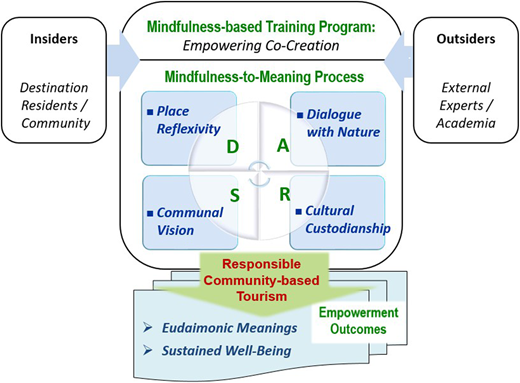
From a host-empowerment perspective, mindfulness-based training functioned not as technical instruction but as inner cultivation, fostering a collective responsible mindset within the community. Extending these findings, this study interprets this process as enabling residents to reassess place, reorient ecological relations, affirm cultural responsibilities and envision communal futures. Collectively, these transformations coalesced in eudaimonic meanings and sustained well-being outcomes, demonstrating how mindfulness-based facilitation provides both a conceptual and practical basis for responsible community-based tourism. Although government-commissioned, strong community engagement enhances the transferability of the findings to broader contexts of host empowerment. As shown in Figure 2, the following sub-sections elaborate on each dimension and its contribution to the responsible mindset and outcomes.
Decentring and place reflexivity
Decentring empowered residents to detach from habitual perceptions and reinterpret socio-ecological associations of their destination. Rather than treating place as scenery or accepting externally imposed roles, residents engaged in reflexive awareness grounded in place identity (Boley and McGehee, 2014; Iwasaki, 2017). Place reflexivity captures the capacity to critically re-examine taken-for-granted relations with one's environment (Massey, 2013; Richards, 2020; Rose, 1997), producing a mindscape infused with cultural and intangible values.
Such awareness fosters local agency and a responsible mindset by affirming belonging and encouraging respectful visitor engagement. In this sense, decentring shows that host empowerment arises not from top-down transfer but from internal processes that embed responsibility as an enduring orientation for tourism development (Goodwin, 2024; Saarinen, 2019).
Attentional broadening and dialogue with nature
Attentional broadening shifted residents' awareness from self-concerns toward an expanded sense of relational belonging with nature, including the living environment. Dialogue with nature infused encounters with affective meanings that could deepen into eudaimonic significance. This shift moved beyond surface perceptions of external objects and reflected contemplative and mindfulness perspectives that emphasise interdependence and deeper awareness of lived reality (Wallace, 2003). Such attentional shifts fostered ecological sensitivity and affective attachment, transforming bare observation into meaningful engagement.
This process resonates with Ingold's (2021) dwelling perspective, which views landscapes as relational and co-constitutive of human life, and with Tuan's (1977) notion of emotional attachment to place. Yet here the affective bond was explicitly cultivated through mindfulness training that foregrounds attunement and mindful listening. In doing so, attentional broadening nurtures a responsible mindset aligned with responsible tourism principles of conserving natural and cultural resources (Goodwin, 2024; Scheyvens, 1999) and sustaining the well-being of communities and ecosystems (Saarinen, 2019).
Reappraisal and cultural custodianship
Reappraisal enabled residents to reinterpret guiding not as a commodified service but as the embodiment of a living culture. Cultural custodianship foregrounded the value of tacit knowledge (Nonaka and von Krogh, 2009) and relational knowledge (Salazar, 2012) rooted in everyday life, transmitted through community storytelling (Ryan and Higgins, 2006; Salazar, 2012) rather than codified disciplinary knowledge (Nonaka and von Krogh, 2009). This shift encouraged residents to build pride and confidence in local resources, authentic traditions and cultural identity within community-based tourism, highlighting mindfulness as a catalyst for cultural sustainability.
This process aligns with responsible tourism principles that emphasise respect for local culture and empowerment of host communities to define tourism on their own terms (Goodwin, 2024; Scheyvens, 1999). By reappraising guiding as cultural custodianship, residents assumed responsibility for presenting cultural narratives with authenticity. In doing so, they enacted a responsible mindset that fosters community pride, thereby sustaining community well-being (Saarinen, 2019).
Savouring and communal vision
Savouring enabled residents to transform momentary experiences into enduring commitments for the community's future. Through this process, individual reflections on shared positive lived experiences converged into a communal vision that generated higher-order eudaimonic meanings (Bryant and Veroff, 2007; Garland et al., 2015a, b), fostering hope and an empowered orientation toward life (Iwasaki, 2017).
Such a process nurtures meaning and responsibility as conscious and relational beings (Higgins-Desbiolles, 2018). In this manner, savouring and the resulting communal vision created a consensus of responsibility for eco-friendly engagement with the living environment, both for the present and for future generations. It consolidates collective well-being, understood as finding happiness through mutual concern (Iwasaki, 2017), and transforms fleeting moments into long-term commitments that lay a foundation for responsible tourism (Goodwin, 2024).
Eudaimonic meanings and sustained well-being
Eudaimonic meanings emerged as outcomes of the mindfulness-to-meaning processes through mindfulness-based empowerment, encompassing identity affirmation, cultural rootedness and intergenerational continuity. Sustained well-being was understood not as temporary relief but as confidence, belonging and a future-oriented vision of community flourishing. Residents described guiding as community storytelling, the forest as a dialogue partner and tourism not as a short-term activity but as a pathway for intergenerational continuity, showing how mindfulness-based empowerment cultivated outcomes extending beyond functional roles (Garland et al., 2015a; Pattiyagedara, 2024).
Such outcomes represent more than individual gain; they constitute a collective responsibility for community-based tourism. By grounding empowerment in residents' own meaning-making, the processes of decentring, attentional broadening, reappraisal and savouring translated mindfulness into practices of responsibility – ensuring that tourism development remains culturally sensitive, socially inclusive and future-oriented (Goodwin, 2024; Higgins-Desbiolles, 2018; Scheyvens, 1999). Taken together, eudaimonic meanings and sustained well-being embody the ultimate outcomes of responsible tourism, where inner transformation is inseparable from collective sustainability (Saarinen, 2019).
Conclusions and implications
This study contributes to the actionable dimensions of responsible tourism by showing how an internal, mindfulness-based process can drive meaningful and long-term change within a host community. The findings make three contributions to advancing the understanding of mindfulness in tourism. First, they demonstrate that the MMT (Garland et al., 2015a, b), originally conceived as an individual psychological process, can also be enacted collectively within community-based tourism. This extends the theory beyond intrapersonal well-being, showing how place reflexivity, dialogue with nature, cultural custodianship and communal vision can function as socio-cultural constructs of mindful meaning-making. Second, the study highlights that empowerment in tourism is not merely a matter of capacity building but involves cultivating reflexive and relational engagements that sustain cultural continuity. Third, it reframes guiding from a functional role into a eudaimonic practice of stewardship, linking mindfulness directly to discourses of responsibility and sustainability in tourism (Goodwin, 2024; Pattiyagedara, 2024).
The results also emphasise the importance of co-creation between outsiders and insiders. For external experts, the findings underline the need to move beyond one-way knowledge transfer and instead design participatory frameworks where communities co-define tourism meanings and practices. This aligns with the core tenet of responsible tourism, which emphasises that all stakeholders must take responsibility and action. For local residents, the study shows that mindfulness-based facilitation can enhance agency and cultural pride, offering a pathway for intergenerational transmission and long-term custodianship. Such co-created processes contribute to responsible tourism, where local voices are respected, knowledge systems are valued and development outcomes are aligned with community aspirations rather than external prescriptions.
Several limitations of this study open up directions for future research. The analysis focused on residents' perspectives and did not examine whether DARS processes unfold sequentially as theorised. Moreover, it did not test the effectiveness of mindfulness-based products from the visitors' perspective. Future studies could investigate these dimensions through experimental or longitudinal designs, thereby consolidating the theoretical extension of mindfulness-to-meaning processes into socio-cultural contexts while providing evidence-based guidance for responsible tourism practices.
The author sincerely thanks the Atayal communities of Yingshi, Leshui and Lunpi in Datong Township for their generous participation and collaboration throughout this project. The author is also grateful to the mindfulness-based training facilitators and environmental theatre specialists who contributed to the co-creation workshops.
Ethical statement
The research involved human participants as part of community-based action research conducted under a government-commissioned project funded by the Yilan Branch of the Forestry and Nature Conservation Agency, Taiwan (No. 106–737–01–01). Ethical clearance was not required because the study was conducted within a government-authorised project framework with community consent, and all participants were represented by codes with no identifiable personal information disclosed.