Incorporating recycled waste materials, such as eco-aggregates, in sustainable construction practices reduces landfill waste and environmental impact. However, these materials are typically combustible and could pose fire concerns, necessitating research into their fire properties. This study examines the fire safety implications of incorporating crumb rubber (CR) and plastic eco-aggregates (RESIN8) for the production of sustainable concrete bricks (SCB) at replacement ratios of 5%–50%.
A series of fire behaviour and resistance tests, including cone calorimeter at various irradiances, elevated temperature material at ambient and post-fire conditions and fire-resistance furnace tests at International Organization for Standardization 834 fire exposure, were conducted.
SCBs with 50% CR showed ignition at irradiance levels of 35 kW m−2 and 50 kW m−2, while with 40% CR ignited only at 50 kW m−2. Conversely, RESIN8-incorporated SCB ignited solely at the 50% replacement ratio. No other samples ignited. Post-fire SCBs exhibited strength reductions of up to 75% at high replacement levels. Residual strengths decreased by up to 82% after heating samples to constant temperatures of 200 °C–600 °C. Non-load-bearing masonry walls achieved a 2 h fire-resistance rating, with no cracks or holes formed and effective insulation properties with potential smoke production at medium to higher replacement ratios.
Incorporating 20%–30% eco-aggregate replacement in SCB can offer an optimal balance of sustainability and minimised fire risk.
This study provides critical data for performance-based fire design, which has been lacking for sustainable masonry systems based on uniquely quantified ignition properties, fire performance and post-fire structural integrity.
1. Introduction
In recent years, the construction industry has been witnessing a paradigm shift towards sustainable and eco-friendly construction materials in response to the rising concerns surrounding environmental degradation and resource depletion. Sustainable construction materials are becoming increasingly popular due to their eco-friendliness and cost-effectiveness. Sustainable construction involves repurposing and recycling waste materials for use in construction processes, leading to a reduction in waste, the development of environmentally friendly materials, and a minimisation of environmental impact (Zamora-Castro et al., 2021). One promising approach involves replacing conventional aggregates with eco-friendly recycled materials, also referred to as eco-aggregates. These eco-aggregates are waste materials that would otherwise end up in landfills, and their incorporation into concrete bricks can help reduce the carbon footprint of the construction industry (Athithan and Natarajan, 2023; Zamora-Castro et al., 2021). This recycling approach results in the production of sustainable concrete bricks (SCB).
SCB can be produced using various eco-aggregates (Al-Fakih et al., 2019) such as plastics (Aneke and Shabangu, 2021; Arun Solomon et al., 2023; Botha et al., 2023; Chauhan et al., 2021; Muthupriya et al., 2023) and crumb rubber (CR) (Faizah et al., 2018; Fraile-Garcia et al., 2018; Gheni et al., 2017; Mohammed et al., 2018; Pereira et al., 2021; Praburanganathan et al., 2022; Sodupe-Ortega et al., 2016; Thakur et al., 2022; Turgut and Yesilata, 2008), which will be the focus of this paper, although other materials could be used. SCB production involves partial replacement of fine aggregates (sand) with various percentages of these eco-aggregates. These percentages range from 5% to 50% (Aneke and Shabangu, 2021; Botha et al., 2023; Muthupriya et al., 2023; Praburanganathan et al., 2022) depending on the purpose and strength requirements.
While sustainable construction practices such as incorporating eco-aggregates offer environmental benefits, their impact on the fire performance of concrete remains a crucial question for their safe and widespread adoption, and it introduces unique challenges related to fire safety. The combustible and flammable recycled synthetic materials, coupled with their high fuel loads, pose a potential risk to fire safety (McNamee and Meacham, 2023). Plastic and rubber have calorific values in the range of 30 kJ g−1 to 45 kJ g−1, which is approximately the same as hydrocarbons, which are in the range of 40 kJ g−1 to 50 kJ g−1 (Drysdale, 2016; Panda et al., 2010). Furthermore, significant quantities of smoke can be released when these materials smoulder or burn. Significant research has been conducted to quantify such materials in their virgin form (Ibrahim et al., 2015; Tewarson, 1982). However, within a brick, a cementitious matrix will reduce heat transfer and oxygen flow to these combustible materials, significantly limiting the rate of combustion. At low percentage replacement values, the eco-aggregates will be encapsulated and protected, having limited influence on risk.
Plastic and rubber exhibit low thermal conductivity, ranging from approximately 0.17 W m−1 K−1 to 0.43 W m−1 K−1 and 0.13 W m−1 K−1, respectively, compared to normal concrete’s thermal conductivity of 1.0 W m−1 K−1 (Khan et al., 2016). These characteristics result in reduced heat transfer within the concrete matrix to unexposed surfaces and provide good insulation properties. At high replacement values, the eco-aggregates could potentially form a highly porous concrete network, allowing for much of the aggregate to pyrolyze when exposed to heat, leading to increased smoke production and heat release rates|heat release rate (HRR). Hence, important questions to be considered include: What is the influence of eco-aggregates on fire risk? How does the replacement proportion influence behaviour? How is load capacity affected (pre- and post-exposure) by the inclusion of such low-strength materials?
Various testing approaches, ranging from bench-scale to large-scale tests, are available to evaluate the fire performance of both sustainable construction systems and building elements. Bench-scale tests provide detail on reaction-to-fire properties of building materials and include setups such as the cone calorimeter test (Janssens, 2016; Whitehead et al., 2022). The cone calorimeter test provides information on ignitability, flammability, HRR, peak heat release rate (pHRR), time to ignition (TTI), and mass loss (Janssens, 2016). In addition, it provides valuable data on the material’s initial response to fire and its potential contribution to flame spread and flashover. Elevated temperature (up to 1,000 °C) material tests allow one to determine the residual strength of building materials and simulate their potential real-world fire exposure (Hernández-Olivares and Barluenga, 2004). Numerous studies have been conducted to assess the effect of elevated temperature on building materials (Ahmed et al., 2022; Fernandes et al., 2021; Hawileh et al., 2023; Hernández-Olivares and Barluenga, 2004; Mathews et al., 2020; Mohammadhosseini et al., 2019; Sundin et al., 2023). These studies have shown that elevated temperatures negatively impact concrete by causing weight loss approximately proportional to strength loss. Heated concrete specimens show a substantial drop in strength, with the duration of heating significantly influencing concrete strength and stiffness due to the formation of thermal cracks (i.e. micro or macro) (Fernandes et al., 2021; Mathews et al., 2020).
The fire performance of building configurations or elements can also be assessed using a fire-resistance furnace test (Chaturvedi et al., 2023; Gnanachelvam et al., 2019). The time-temperature curves specified in European Norm (EN) 1363-1 (EN 1363-1, 2020), American Society for Testing and Materials (ASTM) E119 (ASTM, 2007) and International Organization for Standardization (ISO) 834 (ISO 834-1, 1999) are widely employed as typical furnace exposures in fire-resistance testing (Lattimer, 2016). Walls require (1) integrity (preventing the passage of hot flames and gases) and (2) insulation (limiting the unexposed face temperature to 140 °C above ambient temperature, or a maximum of 180 °C at any point) resistance during a fire, with (3) load-bearing walls also requiring structural resistance ratings (Franssen and Iwankiw, 2016). The fire-resistance test of walls includes exposing the wall to a standard temperature-time curve on one side (exposed side), while simultaneously monitoring the conditions on the unexposed side (Franssen and Iwankiw, 2016).
The data related to sustainable construction practices, the production process of construction materials incorporating eco-aggregates, and the study of their mechanical properties are widely available (Athithan and Natarajan, 2023; Fraile-Garcia et al., 2018; McNamee and Meacham, 2023; Sodupe-Ortega et al., 2016). However, only a handful of investigations have presented insights into the effect of elevated temperature on post-fire exposure of concrete construction materials (Marques et al., 2013; Netinger et al., 2011). This indicates that there is limited knowledge associated with the performance of sustainable construction practices, especially on a large scale, in fire. To address this gap, it is essential to conduct a comprehensive fire testing regime aimed at quantifying fire parameters and evaluating the fire-resistance capabilities of building systems, including various building elements and walls. Such an approach is vital not only for identifying fire safety concerns associated with sustainable construction but also for developing a holistic understanding of the overall fire safety landscape.
While the use of SCBs in construction systems is well documented, limited research exists on their performance under fire conditions. This study addresses this gap by investigating the influence of incorporating eco-aggregates, specifically CR and RESIN8 (R8), into SCB and characterising the fire behaviour and fire-resistance rating (FRR) of building elements and walls. These eco-aggregates were selected as a partial replacement in the production of SCB for reasons such as large volumes being sent as solid waste to landfills, current usage in recycled construction materials, as well as the fire behaviour and fire ratings of building elements (bricks and walls) containing these eco-aggregates, have not been characterised, although some preliminary work has been conducted (Botha et al., 2023). An optimised mix design has been formulated, and SCBs were cast incorporating eco-aggregate replacement proportions of up to 50%, and their mechanical properties were assessed. In practice, the replacement proportion for such eco-aggregates is typically limited to 5%–10%, but in this work, the replacement proportion has been significantly increased to understand the fire performance across a broad range, and potentially identify limitations on replacement values that should be considered. This research fills gaps in understanding the holistic fire behaviour of concrete bricks incorporating recycled CR and plastics using a series of fire tests ranging from cone calorimeter to fire-resistance tests, and post-fire strength assessments, as available literature mainly focused on strength loss at elevated temperatures.
2. Materials and methods
2.1 Materials
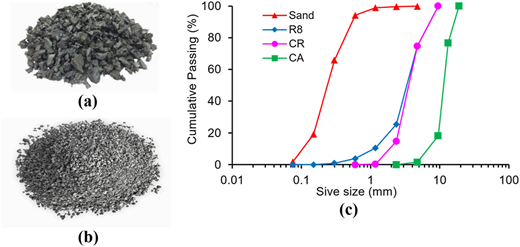
Two recycled wastes (eco-aggregates) were considered to produce SCB. These eco-aggregates were granulated CR and RESIN8 (R8) supplied by the Mathe Group (Mathe Group, n.d.) and CRDC Global (CRDC Global, n.d.) respectively. As per the suppliers, CR was recycled from waste tyres, and RESIN8 was recycled from a blend of all types of plastic waste, about 80% with about 20% addition of mineral ingredients (mainly calcium hydroxide and pozzolans) (Babafemi et al., 2022). Figures 1a and 1b show the CR and RESIN8 materials.
A CR having a specific gravity of 1.15 and R8, with a specific gravity of 0.97, were used as fine aggregate (sand) partial replacement in proportions ranging from 5% to 50% by volume. This replacement of the fine aggregate was chosen because the size distribution of these materials more closely matches that of sand. The detailed thermal decomposition properties of raw CR and R8 are well-documented and can be found in the published literature (Shewalul et al., 2024a). Pozzolan Portland cement (CEM II/B-M(L-S) 42.5 N) with a specific gravity of 3.15 was used as a binder. Malmesbury River sand with a specific gravity of 2.70 and local crushed coarse aggregate, greywacke stone, with a specific gravity of 2.24 and a nominal dimension of 13 mm, were used. The aggregate gradation complies with SANS 1215 (SANS 1215, 2008), consisting of a blend of fine sand with particles smaller than 1 mm, and coarse aggregate (stone) with a nominal maximum size of 13 mm. The particle size distribution curves obtained from the sieve analysis of CR, R8, sand, and CA are presented in Figure 1c.
2.2 Mix design and casting of SCB
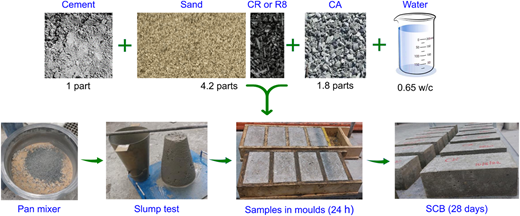
A suitable mass ratio of cement to total aggregate of 1:6 was selected based on previous studies (Cement and Concrete Institute, 2011; Frasson et al., 2012; Thakur et al., 2020). The proportions of sand and coarse aggregates (CA) to the total aggregates in the mixture were fixed at 70% and 30%, respectively. This resulted in a mass ratio of 1:4.2:1.8 for cement, sand, and CA, respectively. The sand proportion was then replaced with eco-aggregates ranging from 5% to 50% by volume. A water-to-cement ratio of 0.65 was selected for all mixes. Unlike conventional concrete, where mix proportions are often optimised to meet a particular strength requirement, this mix design prioritised factors such as workability and strength relevant to brick applications. The chosen water-to-cement ratio was based on the guidelines provided by Frasson et al. (2012), which suggests ratios appropriate for concrete masonry units. The mix design proportions were established by evaluating the surface texture and cohesion of the concrete during the trial mixing. This evaluation involved varying the particle size, type, and proportion of aggregates as well as adjusting the cement content and water-to-cement ratio. The resulting mix design met both the cohesion and texture requirements, while also containing the appropriate amount of coarse aggregate.
It was observed that the workability of the fresh aggregate increased slightly with an increasing replacement percentage of CR. This was because the CR absorption capacity was lower than that of the aggregates. Hence, a slight adjustment was made to the 50% CR replacement mix. Consequently, CR replaced 40% of the sand and 10% of the coarse aggregate. A total of seven batches were mixed and cast using each eco-aggregate, which resulted in 14 total batches. Table 1 summarises the brick mix design. Note that optimised mixes could potentially be developed at each specific replacement value, but the number of variables has been limited to identify the influence of replacement proportion alone more clearly.
SCBs (solid units) were cast using wooden moulds, as shown in Figure 2. Wooden moulds were assembled for casting standard-sized (imperial) concrete bricks with dimensions of 222 × 106 × 73 mm. These moulds were treated with a waterproof sealant and de-bonding oil before being filled with fresh concrete to facilitate brick demoulding.
The ingredients were mixed in a mechanical pan mixer (all dry ingredients (cement, aggregates, and recycled materials) were first mixed for 2 min to ensure uniform distribution), and water was gradually added and mixed for an additional 3 min. The mixture was then allowed to rest for 2 min, followed by a final mixing phase of 2 min to ensure homogeneity. The workability of freshly prepared concrete was examined by measuring the slump. Fresh concrete was then poured into wooden moulds on a vibrating table to ensure even distribution. The vibration time was adjusted to prevent bleeding and to ensure optimal compaction. A trowel levelled the top surface to maintain specified brick dimensions. Moulds were kept in a climate-controlled chamber (27 ± 2 °C, 50% relative humidity), demoulded after 24 h, and cured in a water tank (27 ± 2 °C) for 28 days. This procedure was applied to all mix designs to produce sufficient SCB samples for the study. Figure 2 illustrates the manufacturing process, which includes the mixing of materials, the concrete wooden moulds used for casting, and the final SCB product, suitable for constructing concrete masonry walls.
Substantial amounts of waste can be effectively recycled and integrated into SCB, offering an environmentally friendly approach to construction, which has been quantified as shown in Table 2. To illustrate, when using 30% SCB in the construction of a single skin 5 m wide by 3 m high wall, it is possible to utilise around 220 kg of CR. Similarly, one can utilise up to 190 kg of RESIN8 for the same wall (at the same replacement proportion). These quantities represent a potential contribution to sustainable construction practices. As expected, the density of units decreases as the replacement value increases. However, it is acknowledged that significant debate exists regarding whether incorporating waste materials can be considered eco-friendly, as the recycled materials will still need to be dealt with at the end of the service life of the SCBs in which they are used. Furthermore, the cost-effectiveness will vary widely depending on the cost of processing and incorporating the waste materials. Nevertheless, companies are already using these materials in private and public buildings, so their impact on fire safety needs to be assessed.
2.3 Compressive strength test
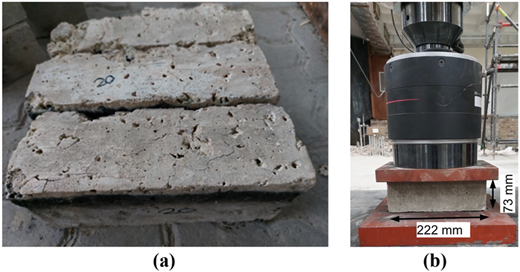
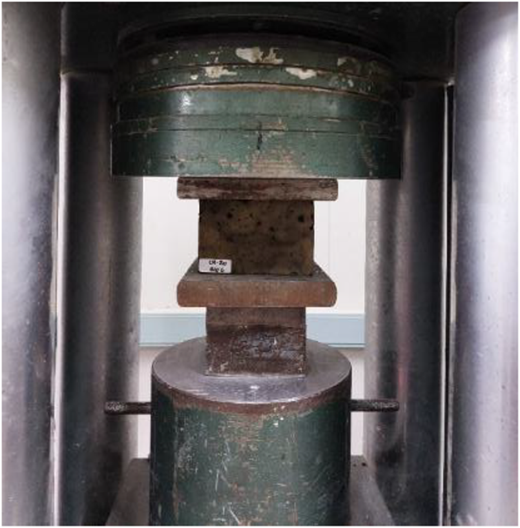
The failure load versus deformation curves of the samples at ambient temperatures and samples collected from post-fire tests (fire-resistance furnace tests) were obtained. The compressive strength tests were conducted using a 2 MN Instron actuator machine, as shown in Figure 3. The SCBs were tested with the load being applied to the face of 222 mm × 106 mm using a deformation-controlled loading rate of 1 mm min−1. The compressive tests were conducted following the standard testing procedure for concrete masonry units (bricks) discussed in ASTM C140 (ASTM C140, 2013) and SANS 1215 (SANS 1215, 2008). At least three samples were tested in each batch. These tests indicate the influence of increasing CR and R8 on SCB capacity. Neither CR nor R8 is a structural material and has a negligible load capacity, in relation to concrete, so it will inherently reduce strength.
2.4 Cone calorimeter test
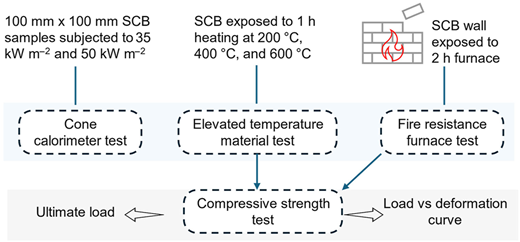
A series of fire behaviour and resistance tests, including cone calorimeter, elevated temperature material, and fire-resistance furnace tests, were conducted as shown in Figure 4. A cone calorimeter test was conducted to assess the ignitability, flammability, and other fire parameters such as HRR curves, time-to-ignition (TTI), and peak HRR (pHRR) of the SCB samples and compared with raw CR and RESIN8 samples. The SCB samples with dimensions of 100 × 100 × 50 mm were cast incorporating CR and RESIN8 as discussed in Section 2.2. The samples were allowed to cure in a water tank for 28 days and then oven-dried at 110 °C prior to the cone calorimeter test. The tests were conducted following ISO 5660-1 (ISO 5660-1:2015, 2015) under irradiance levels of 35 kW m−2 and 50 kW m−2 using a cone-shaped heater. The test was run for at least 30 min, during which time various data were recorded, including visual observations. Each test was repeated at least three times on each sample.
Past testing of CR and R8 has indicated that the critical heat flux of the materials is 10 kW m−2 and 7.5 kW m−2, respectively (Shewalul et al., 2024a), but with brick samples not igniting at irradiances of around 30 kW m−2. Hence, an irradiance level of 20 kW m−2 was not considered as it would not have caused ignition. The focus of this work was to answer questions such as: could SCBs containing such eco-aggregates ignite, especially at higher replacement values? What would be the contribution to HRR if they ignite?
2.5 Elevated temperature material test
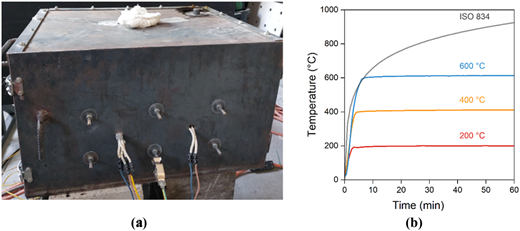
Elevated temperature material tests were conducted to estimate the mass loss and residual strength of SCB samples at temperatures of 200 °C, 400 °C, and 600 °C after a 1 h heating duration, with similar testing approaches being presented in the literature (Marques et al., 2013; Netinger et al., 2011). A small furnace/hotbox was used to heat the samples to a specified temperature, as shown in Figure 5. For the small-scale furnace utilised, and subsequent mechanical testing to failure, it was not possible to install thermocouples within the samples. Hence, smaller samples were used and exposed to uniform temperatures for an hour. The SCBs were cut in half using a saw, resulting in samples measuring 111 mm in length, 106 mm in width, and 73 mm in height. These smaller samples ensured a more even temperature distribution. Small internal temperature gradients may still have resulted within the specimens.
The samples were heated to the desired temperature in a computerised hotbox equipped with six electrical radiant panels (Botha et al., 2023) and connected to a control unit. The control unit effectively regulated the hotbox temperature based on the data from three K-type thermocouples placed at various positions inside the box. A vent of the hotbox prevented pressure buildup within the system. The experimental gas temperature versus time curves of the hotbox and the ISO 834 standard curve are shown in Figure 5. The heating conditions curves applied were closely aligned with the standard temperature curve in the initial phase. The mass of the samples was measured both before and after being heated for 1 h using a scale with a precision of 0.1 g. After heating, the samples were allowed to cool to the ambient temperature.
A compression test was performed using a ConTest Compression Machine to determine the post-fire residual strength of the samples, as shown in Figure 6. This was then compared with the strength of the samples at ambient temperature. A minimum of three samples for each material were subjected to the specified heating curves. Tests were discontinued for samples with a 50% CR and 50% R8 at a temperature of 600 °C because of unmanageable smoke and flames that were emitted, which also caused the explosive spalling of the samples during the heating process. Hence, the data below is based on only a single data point. This behaviour is important for considering the risk associated with high replacement levels, but has resulted in a limited data set.
2.6 Fire-resistance furnace test
Fire-resistance furnace tests were conducted to obtain FRR in terms of integrity and insulation requirements. Post-fire testings of exposed bricks were conducted to give an indication of residual strength and structural resistance. Ignis Testing (Cape Town, South Africa) facilitated the test according to SANS 10177-2 (SANS 10177-2, 2005), which uses the ISO 834 time-temperature curve. Two sets of furnace tests, each with seven walls on reduced-scale dimensions, were tested for 2 h. The first test involved walls constructed with CR bricks, whereas the second test used RESIN8 bricks.
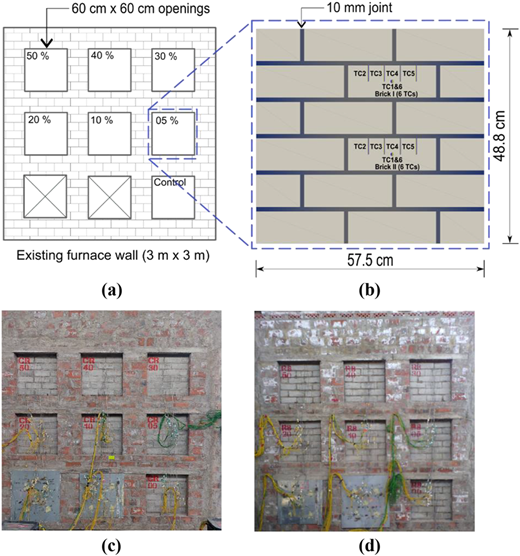
The walls (57.5 cm wide and 48.8 cm high) were built from concrete bricks using a 10 mm vermiculite mortar joint. This mortar was prepared by combining cement, vermiculite, and water in a volume ratio of 1:4:2. Vermiculite mortar was utilised for its rapid drying properties, to prevent any joint failure concerns, given its effectiveness in fire-resistant properties, and also its low strength, allowing walls to be dismantled more readily. The walls were constructed within the openings of an existing furnace wall (3 m × 3 m), which contained a total of nine openings (60 cm × 60 cm). The walls were left unplastered. Of the nine available openings in the furnace setup, only seven were utilised; the remaining two (on the bottom left) were sealed using ceramic wool and calcium silicate boards, with a steel plate on the unexposed surface, as shown in Figure 7a. The tests were conducted after allowing the walls to dry for five days.
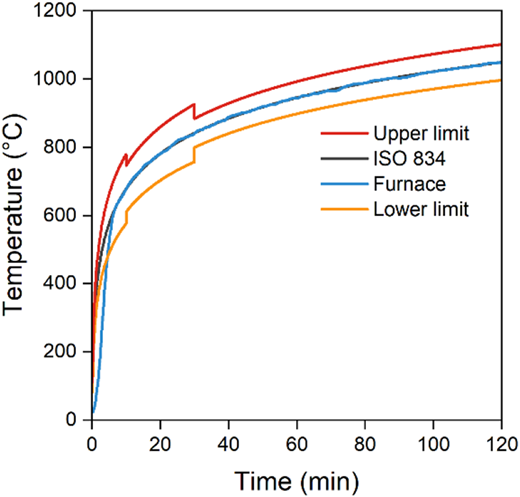
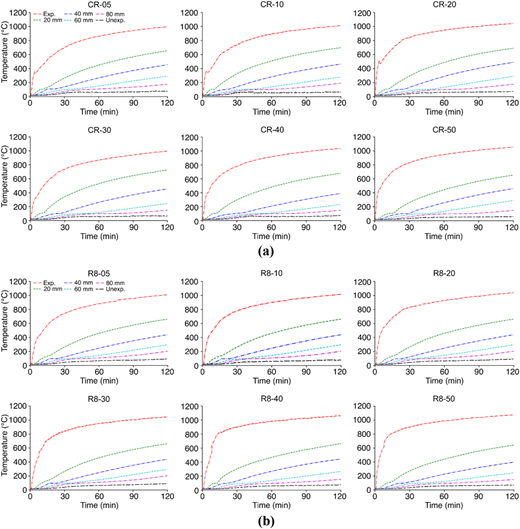
Temperature measurements were obtained from two bricks on each wall using K-type thermocouples. Prior to the construction of the walls, the selected bricks were drilled, and thermocouples were inserted at various locations. Thermocouples (TC) were placed at six depths per brick, with TC1 placed at the exposed surface (0 mm), TC2 at 20 mm, TC3 at 40 mm, TC4 at 60 mm, TC5 at 80 mm from the exposed surface, and TC6 at the unexposed surface (106 mm). Thermocouples TC2 to TC5 were inserted in drilled holes halfway into the thickness of the bricks. In each furnace test, 84 (12 TCs per wall) thermocouple readings were recorded. Figure 7 shows the wall layout and schematic diagram of the thermocouple locations. Figure 8 illustrates the recorded temperatures of the furnace throughout the test, conforming to the upper and lower tolerances specified in accordance with SANS 10177-2. A thermal imager (U5857 A series TrueIR) captured the temperature distribution of the wall surfaces every 10 s.
After completion of the test, the walls were allowed to cool for 24 h before they were carefully dismantled. During the process, three brick samples were safely removed from each wall to evaluate their residual compressive strengths further. This approach was selected since there is limited guidance documented to assess the residual strength of a brick specimen after a fire-resistance test (Chaturvedi et al., 2023). According to SANS 10177-2 (SANS 10177-2, 2005) a hose stream test is not required for assessing samples, however, it should be considered in the future when testing large-scale samples. This will provide insight regarding the residual capacity of samples and whether they may collapse during firefighting operations. Nevertheless, visual operations and activities during sample disassembly indicated that the bricks and mortar remained intact limited capacity was lost due to the samples being thermally thick, having a significant area with limited capacity loss.
3. Results and discussion
3.1 Load vs deformation curve of pre-and post-fire exposure of SCB
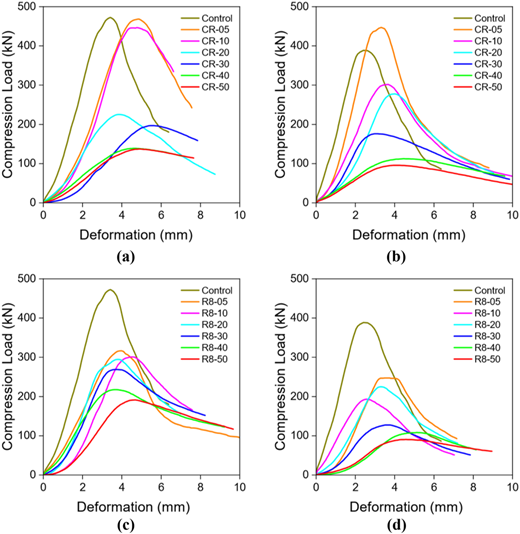
Load vs deformation curves were obtained from the compressive strength test. The load vs deformation curve presented in Figure 9 illustrates the comparison between SCB under ambient conditions and SCB obtained from dismantled walls following a 2 h fire-resistance test. This curve serves as a visual representation of the SCB behaviour, highlighting any changes in its mechanical response due to exposure to elevated temperatures. Table 3 provides a summary of the average peak compressive strength results of SCBs at ambient conditions and after 2 h of standard fire exposure.
At ambient conditions (Table 3 and Figure 9a), the compressive strength of SCB incorporating 5% and 10% replacement of CR eco-aggregates was approximately 20 ± 0.5 MPa, demonstrating a level of strength comparable to that of the control bricks. The concrete bricks can achieve a compressive strength of up to 32 MPa (Domone and Illston, 2018). Nevertheless, a notable decline in compressive strength was observed when CR eco-aggregates were utilised as replacements in the range of 20%–50%, in comparison to the control bricks. Specifically, at 40% and 50% replacement percentages of CR eco-aggregates, the compressive strength recorded was approximately 5 MPa, indicating a significant reduction of approximately 75%. On the other hand, SCB incorporating R8 at lower replacements (5%, 10%, and 20%) exhibited considerably reduced compressive strength, measuring approximately 13 ± 0.5 MPa compared to the control bricks (i.e. 33% reduction), as shown in Figure 9c. However, at higher replacement levels (40% and 50%), the compressive strength of SCB incorporating R8 was approximately 9 ± 0.5 MPa (i.e. 51% reduction). This value was found to be higher than the compressive strengths of SCB with CR at equivalent replacement levels. The observed phenomenon can be attributed to the low density and specific material characteristics of CR and R8 eco-aggregates. It is worth highlighting that even with this reduction, the compressive strength of these SCBs remains above the required 3.5 MPa threshold specified by national standards such as ASTM C129 (ASTM C129, 2017) and SANS 1215 (SANS 1215, 1984) for non-load-bearing masonry units.
Compared to the results obtained under ambient conditions, the compressive strength of the SCB with CR eco-aggregates exhibited a decrease when subjected to a 2 h furnace test, as illustrated in Figure 9b. A similar trend was observed for SCB with R8 eco-aggregates, as shown in Figure 9d. However, there were no changes, or only a slight decrease was observed, with a 5% replacement. This could be attributed to inconsistent mixing. Despite a reduction in compressive strength following a 2 h furnace test, the SCB incorporating CR and R8 eco-aggregates at 40% and 50% replacements still exhibited compressive strengths greater than 3.5 MPa, reaching approximately 4 MPa. This suggests that these SCBs could potentially be suitable for non-load-bearing walls even at high replacement values.
3.2 Cone calorimeter results
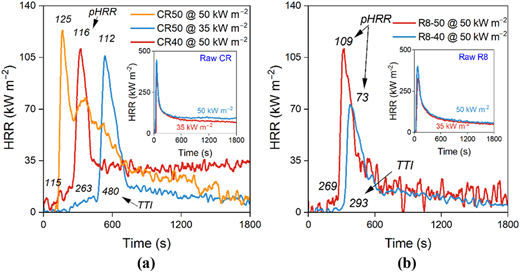
In the cone calorimeter tests, both the CR and R8-based SCB, with replacement proportions of 40% and 50%, exhibited ignition at an irradiance level of 50 kW m−2. However, only the SCB with a 50% CR replacement ignited at 35 kW m−2. No other samples ignited, which is an important finding, but also, HRR results should be interpreted accordingly.
The pHRR of the SCB with a 50% CR replacement was 112 kW m−2 and 125 kW m−2 at irradiance levels of 35 kW m−2 and 50 kW m−2, respectively. These values are considerably lower than the pHRR of the raw CR samples, which were 387 kW m−2 and 444 kW m−2, as illustrated in Figure 10. Similarly, the pHRR of the SCB with a 50% R8 replacement was 73 kW m−2 at 35 kW m−2 irradiance and 109 kW m−2 at 50 kW m−2 irradiance. These values are smaller than the pHRR of the raw RESIN8, which measured 324 kW m−2 and 404 kW m−2 at the respective irradiance levels. The SCB with a higher replacement (50%) of these eco-aggregates showed a pHRR that was roughly equivalent to that of timber, such as basswood at 108 kW m−2, red oak at 113 kW m−2, and southern pine at 115 kW m−2, all measured at an irradiance level of around 50 kW m−2 (Tran and White, 1992). The average HRR values of all the ignited samples are below 35 kW m−2.
The TTI of the samples was influenced by the irradiance levels. Specifically, the TTI of SCB with a 50% CR replacement was approximately 1.9 min, which was lower than the 4.5 min observed for SCB with a 50% R8 replacement at an irradiance level of 50 kW m−2. Similarly, at this irradiance level, the TTI for SCB with a 40% CR replacement was approximately 4.4 min, slightly less than the 4.9 min observed for SCB with a 40% R8 replacement. For both SCB samples, the TTI was significantly shorter compared to that of the raw CR and R8 eco-aggregates, approximately at 0.2 min. The prolonged TTI occurred due to the concrete matrix surrounding the eco-aggregates hindering (delaying) the generation of flammable volatile gases (pyrolysis) from the surfaces of the eco-aggregates.
Based on these findings, it is evident that incorporating eco-aggregates, even in substantial amounts (50% replacement), in concrete bricks still results in a much lower potential fire hazard compared to raw eco-aggregates. However, challenges associated with the inclusion of these eco-aggregates, in terms of fire, include a reduction in brick strength, leading to possible collapse and a noteworthy increase in smoke production. Very high replacement levels are required before individual walls may become the first item ignited. However, it does not mean that the non-ignited samples identified above would have no contribution to fire behaviour. In a post-flashover fire, the heat fluxes will be far higher (>100 kW m−2), and the pyrolysis gases liberated, as quantified by mass losses in all experiments, will result in increased HRRs within compartments. Further research is required to quantify this and whether enclosure fire dynamics would be influenced by large areas of exposed SCB. Additionally, smoke emissions and toxicity are significant concerns for these recycled materials, and they need to be quantified and addressed in future research.
3.3 Residual strength and mass loss
3.3.1 Visual observations of samples during and after elevated temperature tests
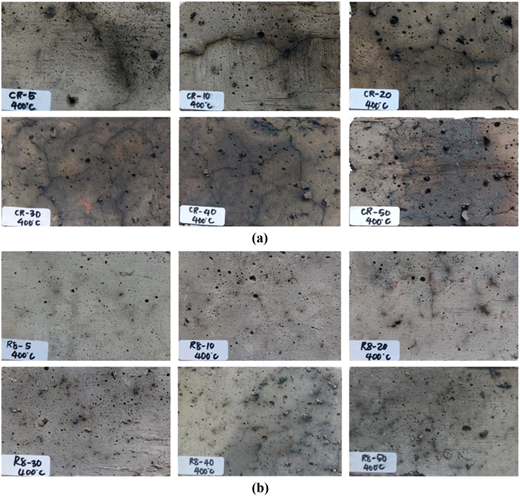
Visual observations were made on all samples after exposure to elevated temperatures to assess the formation of surface cracks or damage. Inspections of the samples were performed immediately after their removal from the hotbox to determine whether the surfaces exhibited any cracking, damage, or colour changes. The surface cracks and colour changes on SCB samples after exposure to a temperature of 400 °C are illustrated in Figure 11 as an example. At temperatures of 400 °C, the samples exhibited significant surface cracks and colour changes. These effects were more noticeable with an increase in the replacement percentage for both materials. Comparable, or potentially more severe, surface cracks were noted at a heating temperature of 600 °C. The SCBs, which were composed of a 50% replacement for both materials, experienced extensive explosive spalling when subjected to heating at 600 °C. This phenomenon was attributed to the thermal expansion and elevated pressure generated by the combustion of the smoke and flame mixture in the hotbox. It is interesting to note that this phenomenon did not occur in the furnace tests. This is presumably due to flaming conditions within the furnace, which may have caused a more rapid increase in porosity, allowing for the escape of gases, thereby reducing pressure buildup.
However, it was observed that the exposed samples at 200 °C did not show noticeable surface cracks or colour changes for 5%–30% replacement, but small cracks and slight colour changes were observed for 40% and 50% replacement for both materials.
3.3.2 Comparison of strength and mass loss pre-and post-heating
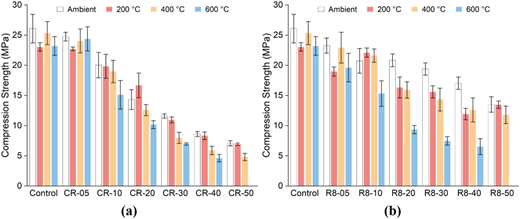
The results of pre-and post-heating load capacity for CR and R8-based SCB exposed to temperatures of 200 °C, 400 °C, and 600 °C for 1 h are presented in Figure 12. The overall trend of the graphs illustrates a reduction in compressive strength with an increase in both temperature and the percentage of replacement. The residual strength results exhibited some inconsistency, potentially because a 1 h heating duration did not result in uniform temperatures internally. This could be addressed in future work by allowing the samples to heat for extended periods of heating time, such as 2–4 h. The error bars indicate the range in results of the 3 samples tested. Due to the explosive spalling of the 50% samples and associated smoke production, no post-fire data is available at 600 °C.
Compared to the control, the percentage decrease in the strength was: (a) at ambient, 5%–73%, (b) at 200 °C, 13%–73%, (c) at 400 °C, 8%–82%, for SCB with CR 5% to CR 50%, and (d) at 600 °C, 7%–82% for SCB with CR 5% to CR 40% respectively. Likewise, for R8-based SCBs, the percentage decrease in the strength was: (e) at ambient, 11%–48%, (f) at 200 °C, 15%–49%, (g) at 400 °C, 12%–55% for SCB with R8 5% to R8 50%, and (h) at 600 °C, 25%–75% for SCB with R8 5% to R8 40%, respectively.
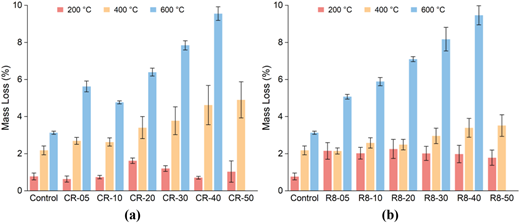
The observed mass loss of the SCB samples upon exposure to elevated temperatures exhibited a positive correlation with higher replacement percentages (Figure 13) at temperatures of 400 °C and 600 °C. This phenomenon was expected, given that the combustible eco-aggregates in the SCB samples undergo pyrolysis and release volatile components. Nevertheless, an applied heating temperature of 200 °C did not cause a notable mass loss in the SCB samples. While the bricks containing R8 eco-aggregates demonstrated a consistent trend, those with CR eco-aggregates exhibited inconsistency at a 5% replacement. Notably, the values at this replacement were marginally higher than those at a 10% replacement, suggesting that the observed inconsistency could be attributed to variations in the mixing process. As noted above, the mass loss will result in increased fire intensity due to the contribution of pyrolysis gases, which need to be quantified in future work.
3.4 Fire resistance of the SCB walls
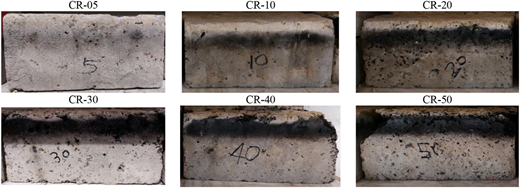
The visual appearance of fire-damaged SCB incorporating CR eco-aggregates is shown in Figure 14. This illustration shows the degree and extent of the fire damage, as well as the degree of deterioration on the exposed surface of the bricks. A significant portion of the SCB was damaged and deteriorated when higher replacement percentages were used. The damage was moderate for replacement percentages of 10% and 20%, while minimal damage occurred at a 5% replacement percentage.
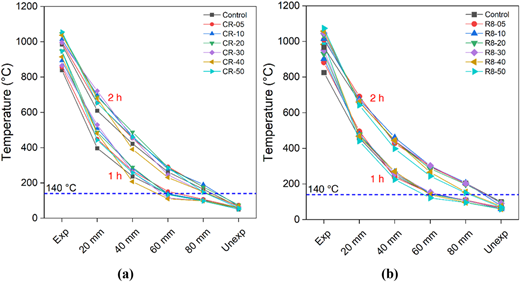
Figure 15 presents the temperature readings acquired during the 2 h fire-resistance test. The data illustrates consistent temperature patterns based on the thermocouples’ respective locations. In all walls tested on reduced-scale dimensions with no load applied, a 2 h FRR was achieved, meaning that no cracks or holes were observed in the walls, and the temperature on the unexposed surface of the walls did not exceed 140 °C (Figure 16) throughout the testing period. The maximum exposed face temperature at 2 h was 1,055 °C for walls with CR-based SCBs and 1,074 °C for walls with R8-based SCBs, whilst the maximum unexposed face temperatures were 77 °C and 94 °C for CR-based and R8-based SCB walls, respectively. This performance signifies the wall’s ability to effectively ensure integrity and insulation requirements. If tests were conducted under load, it is possible that additional cracking and deformation may occur. This should be investigated in future research. In contrast, behaviour may vary within block walls with internal hollows. In such systems, smoke and pyrolysis gases may be emitted into such voids, which could impact smoke and heat transfer. This should be considered in future work, especially where internal ‘chimneys’ are formed through continuous void spaces. However, block systems are often more economical than solid bricks and can potentially provide increased FRRs.
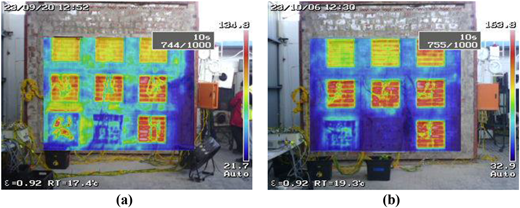
The thermal imager captured the temperature distribution on the exposed surfaces of the walls at the conclusion of the test, as illustrated in Figure 17. Notably, variations in temperature distributions were observed among the walls. In the cases of both CR and R8 walls, the temperature distribution exhibited higher temperatures for control walls, progressively decreasing as the replacement percentage increased. This observation aligns with the temperature values presented in Figure 16, indicating that walls built using SCB with higher replacement percentages offer enhanced insulation performance. This is attributable to the lower thermal conductivity of plastic and rubber materials relative to concrete. Also, the conductivity of units will further decrease as these materials decompose and voids form within the concrete matrix. Entrapped air has a very low thermal conductivity of around 0.02 W m−1 K−1 (Fraile-Garcia et al., 2018; Kadoya et al., 1985), although internal convection and radiation may influence heat transfer.
A detailed finite element analysis on the thermal behaviour and determination of material properties has been presented in an associated paper (Shewalul and Walls, 2025). Furthermore, a comprehensive characterisation of the R8 and CR materials in isolation (including cone calorimetry and thermogravimetric analysis) has been conducted and presented in (Shewalul et al., 2024a), along with the PhD thesis associated with this work (Shewalul et al., 2024b).
4. Conclusion
Emphasising fire safety within sustainable construction practices enables the integration of eco-friendly aggregates and recycled materials. This study addressed concerns associated with fire safety, especially when integrating recycled materials into sustainable construction practices.
Summary of key fire performance findings
Extensive testing was carried out to evaluate the fire resistance of SCB and walls, specifically focusing on CR and RESIN8 (recycled plastic) brick walls. SCB samples with higher eco-aggregate content (40–50%) ignited (i.e. no other samples ignited due to insufficient pyrolysis gas generated for ignition to occur) at higher irradiance levels (50 kW m−2), produced significant smoke, and contributed to the HRR. These raise concerns about fire spread and flashover. Although SCB walls maintained structural integrity and insulation properties during 2 h fire tests, issues like smoke production, explosive spalling, and strength loss at high temperatures suggest their use should be limited in fire-prone areas, especially for compartmentation without further protective measures.
Smoke production, HRR, and practical limitations
At higher replacement levels (40–50%) and under increased irradiance, the SCB samples ignite and contribute to HRR and produce significant smoke during the cone calorimeter tests, which could influence flashover. Even at lower replacement levels (5–10%), the samples exhibit smouldering and melting. During the fire-resistance furnace test, flaming ignition on the surface of the walls and smoke were observed. This may limit the use of these materials/systems at higher replacements unless adequate fire protection is provided. The work contributes to understanding the impact of these systems on fire dynamics. However, it has not classified them in typical combustible/non-combustible systems, such as per ISO 1182.
Structural integrity and mechanical implications
Considerable strength reduction was observed in SCB samples subjected to 1 h heating in the hotbox and those collected from post-furnace tests. Despite the decrease in strength, the SCB still met the prescribed strength limit specified by standards. The SCB walls demonstrated enhanced insulation resistance due to decreased conductivity and also exhibited no issues related to structural integrity for a duration of a 2 h fire-resistance test on reduced-scale dimensions. While SCB-based walls have attained a 2 h FRR in terms of integrity and insulation, it is important to note that simply labelling them as “2 h FRR walls” may be insufficient. This is due to significant smoke production and the potential increase in mass loss, which can contribute to a higher HRR, potentially impacting flashover conditions. SCBs are suitable for partition walls. However, their use in compartmentation is limited due to increased smoke production, particularly at higher replacement levels during fully developed fires. While proper plastering may mitigate some of these concerns, further study is essential to confirm their suitability. Hence, it is crucial to consider these factors alongside the FRR. To ensure a comprehensive assessment, future studies should validate the overall FRR in terms of structural stability, integrity, and insulation with full-scale dimensions. The smaller-scale tests conducted may not identify phenomena such as wall movement/deformations or cracking of samples due to size effects. Through assessing a range of mixes, the work allows trends in behaviour to be more clearly identified (e.g. increasing smoke emissions), which would not be possible for testing of a smaller number of large-scale samples. Additionally, smoke emissions and the toxicity of these materials need to be investigated in future research.
Structural resistance was considered through testing samples after they had experienced furnace tests and indicated a maximum strength reduction of around 75% and 63% for SCB with 50% CR and 50% R8 replacements, respectively. The findings from the tests could serve as a foundation for indicating the extent to which these systems comply with the relevant national fire safety guidelines. Mass loss of SCB samples increased with higher replacement levels, reaching 10% at 600 °C and around 5% at 400 °C, correlating with greater pyrolysis and fire intensity, while remaining below 2% at 200 °C.
Of concern was the explosive spalling of samples heated to 600 °C at 50% replacement levels, along with the associated smoke production and flaming. This indicates that such samples could potentially influence fire dynamics and hazards within buildings. In environments where smoke production could influence evacuation, this may limit their application. For replacement proportions of 5%–10%, as currently used in practice, it appears that smoke production would have a limited contribution to building risk.
Environmental and end-of-life considerations
The SCBs contribute to waste reduction by utilising recycled materials, offering environmental benefits. However, the end-of-life management of these materials remains uncertain and requires further investigation. The incorporation of 20%–30% eco-aggregates in the production of SCB offers advantages in terms of both environmental sustainability and fire resistance.
Recommendations for future work
The present study did not consider the plastering of brick walls, a factor that could enhance their fire resistance. Therefore, further research is essential to investigate this aspect. Additionally, there is a need for subsequent studies to evaluate the fire behaviour of brick walls incorporating various recycled materials, particularly focusing on combustible wastes. The results presented above may potentially be applicable to systems incorporating biomass aggregates, although the HRR contribution and smoke production will typically be significantly lower.
The tests in this research were conducted with the assistance of Ignis Testing. The authors gratefully acknowledge the SFPE Foundation for funding this research.