Fire safety requirements involve complex spatial and semantic conditions that go beyond simple attribute checks. This review consolidates approaches for automated code compliance checking (ACCC) for fire safety, classifies them by applied technologies, methods, complexity levels and data formats, and assesses their suitability for building permit processes.
A PRISMA-compliant systematic literature review across major databases, augmented by backward and forward snowballing, yielded 16 papers. The included studies were mapped descriptively and analyzed thematically using concept matrices according to Webster and Watson, covering methods, technologies, rule complexity, data formats, and reported opportunities and challenges.
Existing methods effectively support rule checks of lower complexity, but tasks involving spatial reasoning and interdependent safety conditions, such as multi-story compartmentation, remain difficult to automate. Compared to black box systems, white box methods are preferred for their transparency and auditability, with visual programming noted as particularly user-friendly. Despite the many advantages of ACCC, organizational, technical, and regulatory requirements constrain deployment in the permit process.
The use of ACCC in the building permit process is a promising opportunity to achieve long-term efficiency gains, reduce errors and lighten the workload in building authorities, provided that the current challenges are addressed appropriately through a coherent implementation strategy. As research activities have accelerated significantly since 2023, the topic is becoming increasingly important, while several challenges remain unresolved. This research identifies further gaps, such as limited support for complex spatial–topological reasoning or insufficient IFC expressiveness for fire-safety properties.
Plain language summary
Fire safety rules often involve complex spatial relationships that cannot be checked through simple attribute comparisons. This paper reviews current approaches for automated code compliance checking (ACCC) in fire safety and evaluates how well they can support building permit processes. Based on a systematic literature review of 16 studies, the findings show that existing methods work well for simple rule checks, but more complex situations, such as evaluating fire compartments across multiple stories, remain difficult to automate. Approaches that make the checking logic visible and understandable (white box methods), such as visual programming, are generally preferred over systems where the internal logic is hidden (black box methods). However, ACCC is not widely used in real permit procedures yet, because workflows, data, and legal rules are not fully aligned with it. To make ACCC effective, digital models must provide complete and consistent fire-safety information, checking tools need to handle more complex situations, and build expertise among employees in the building authorities.
1. Introduction
Building codes are fundamental to ensuring safe building design and operation (Porter, 2016). Compliance checking of these regulations has traditionally been a manual, paper-based process (Shahi et al., 2019), which is time-consuming, costly, and prone to human error (Wu et al., 2023). For example, Zhang and El-Gohary (2017) indicate that in the United States, building compliance reviews often extend over several weeks and may involve multiple cycles as designs evolve, resulting in municipalities spending millions of dollars annually on manual review processes at the city level. Delayed or inconsistent compliance checks can also affect safety management processes, since detected non-conformities often have to be communicated, documented, and resolved across several stakeholders in the construction industry. This is particularly relevant for health-and-safety teams, safety officers, designers, and regulatory reviewers, while the consequences of unresolved safety-related deviations ultimately concern future building occupants. Previous research on model-based safety checking has shown that rule-based model analysis can support the early identification of unsafe design conditions and improve the use of safety information during planning (Hongling et al., 2016; Zhang et al., 2013).
Automated Code Compliance Checking (ACCC), a rule-based verification of regulations against a digital model, is intended to provide a solution to these challenges within the building permit process (Ataide et al., 2023; Noardo et al., 2022). This is accomplished by translating the regulatory provisions written in natural language into machine-interpretable rules, which are then systematically validated against a digital, semantically enriched 3D model (Mendonça and Ferreira, 2024). The reliability of such checking procedures depends on whether the information required by the applicable rules is available in the model, semantically interpretable, and unambiguously mapped to the corresponding objects, attributes, geometries, and spatial relationships. Missing, inconsistent, or insufficiently structured model information may therefore lead to incomplete or unreliable compliance results.
With the Architecture, Engineering, Construction and Operation (AECO) industry undergoing rapid digitalization, there is a growing push to automate rule checking by leveraging Building Information Modeling (BIM) and rule-based model checking (Doukari et al., 2022). Automated rule checking is not limited to compliance with building regulations, but covers a wide range of other use cases, such as checking customer design requirements, logistics planning for the construction site, providing the completeness of BIM data for facility management, and ensuring occupational safety (Eastman et al., 2009; Solihin and Eastman, 2015). Within this broader field, ACCC is particularly relevant for regulatory approval processes, because it aims to verify whether digital building information complies with applicable legal and technical requirements. Yamusa et al. (2024) describe that ACCC can reduce processing time, but also improve the accuracy and consistency of reviews. Furthermore, streamlining the permit process through digital workflows enables seamless integration of submission, review, and approval with minimal data hand-offs, thereby reducing media breaks between stakeholders (Urban et al., 2024). To further distinguish the computational complexity of different rules in ACCC, Solihin and Eastman (2015) proposed a four-level classification system that differentiates rules according to the amount of data, logic, and modeling requirements involved. Table 1 summarizes the four classes of rules defined in their framework.
Over the past two decades, international research and pilot projects have emerged across the globe, reflecting a broad consensus that ACCC can transform building compliance processes (Zou et al., 2023). Early pioneering systems in the early 2000s demonstrated the feasibility of automated code checking in practice: for instance, Singapore's CORENET e-PlanCheck was one of the first government-driven efforts to automatically check building plans for code compliance (Preidel, 2020). In addition to Singapore, Finland, Estonia, and South Korea are also described as pioneers in the BIM-based building permit process and rule-based model checking: Finland was among the early adopters of BIM-based e-permitting. Following the successful KIRA-digi pilot program, the City of Vantaa's building control department began accepting BIM models in Industry Foundation Classes (IFC) format and using Solibri Model Checker for automated rule-checking to verify code compliance (Ullah et al., 2022). A national pilot project completed in 2018 demonstrated that all information needed for a building permit could be extracted directly from a BIM model, leading over 60% of Finnish municipalities to join the digital permit platform Lupapiste for BIM-based submissions (Terzić et al., 2024). The authors also describe Estonia as pioneer, which country has similarly launched a nationwide BIM-based building permit system in collaboration with its government, using a digital model of the to automatically check zoning, noise barriers, and other regulatory constraints. Kim et al. (2020) describe South Korea's pioneering efforts toward digitizing its building permit process through the SEUMTER e-submission platform, first launched in 2009, and expanded nationwide by 2011 to enable e-submissions. Building upon this foundation, Lee et al. (2023) and Jeongmin and Sangyun (2024) report that Korea has advanced from early e-submission systems toward IFC-based ACCC for building permit reviews. In addition to the countries mentioned, other countries, such as Norway and the Netherlands, have also introduced BIM-based building permits, based on pilot projects supported by public authorities (Terzić et al., 2024; Ullah et al., 2022).
These international initiatives show that BIM-based permitting and ACCC are no longer isolated technical experiments, but are increasingly being considered within broader public-sector digitalization strategies. However, the practical use of ACCC in building permit workflows is still limited by the way regulatory rules are implemented. Existing code-checking solutions have often been criticized for relying on hard-coded or “black box” implementations, in which the checking logic is difficult for users to inspect, verify, or adapt (Preidel, 2020). In response to this limitation, more transparent and extensible “white box” approaches have gained attention because they make the encoded rules more accessible to stakeholders (Ismail et al., 2023). For example, South Korea's KBimCode project illustrates this development by translating Korean building regulations into explicit computer-readable rule structures and representing them through a visual language to support automated permit checking. Despite these considerable efforts worldwide, truly comprehensive and widely adopted ACCC solutions are still rare in practice (Amor and Dimyadi, 2021; Fuchs et al., 2025). Overall, the state of the art suggests that automated compliance checking is technically achievable but largely remains at the pilot or prototype stage, with limited integration into routine regulatory approval processes. This research–practice gap is motivating studies in several countries to learn from international successes and challenges. In Germany, for instance, there is growing interest in leveraging BIM-based ACCC to streamline the building permit process (Hartmann et al., 2024b; Fauth and Soibelman, 2022; Tulke et al., 2021). This challenge is also reflected in a German pilot project on BIM-based building permit submission. While several code requirements could be checked on the basis of a BIM model, fire-safety-related requirements such as escape routes and necessary corridors were considered but not prototypically implemented (Tulke et al., 2021). The report also shows that automated checking requires both semantic and geometric model requirements, which helps explain why fire safety regulations are more difficult to translate into directly checkable model parameters.
Li et al. (2025) conducted a systematic literature review (SLR), examining 145 papers from 2008 to 2024 in order to reveal the state of the art and knowledge gaps in the field of BIM-based model checking (BMC). The evaluation shows a steady increase in publications with peaks in 2016 and 2022, a thematic shift toward Artificial Intelligence (AI)-supported approaches (Natural Language Processing (NLP), deep learning), and three central deficits: a lack of uniform rule classification, a lack of representation methods, and inconsistent quality metrics for BIM models. The authors derive priority research areas, such as internationally coordinated standards and platforms, higher data interoperability, and the deeper use of intelligent technologies to reliably embed BMC in regulatory approval and industrial process chains.
In the context of fire safety applications, where regulatory supervision acts as the primary means of protecting human life, Kodur et al. (2020) underline the heightened need for efficient and reliable compliance verification. Especially in facilities with high fire safety requirements such as hospitals, which have extensive and, in Germany for example, project-specific requirements, the challenges of automation are even greater due to the lack of general standards, but the need for improved compliance with safety regulations and automation is particularly high (Hartmann et al., 2024a). Automating fire safety compliance, however, presents several challenges in terms of implementation. Fire protection requirements often involve complex spatial and semantic conditions that go beyond simple attribute checks. For example, codes must ensure adequate escape routes, proper placement of fire exits, fire-resistant compartmentation of spaces, limits on travel distance, occupant load calculations, and so on – all of which require understanding the building's geometry and topology within a BIM model (Hartmann et al., 2025). In fact, model checking software programs such as Solibri Model Checker already contain predefined rules for evaluating escape capacity, accessibility, and space utilization based on regulations, which highlight the potential benefits of ACCC fire safety, such as the rapid detection of non-compliant fire resistance classes. However, Hartmann et al. (2025) also criticize the possible adaptation of these rule sets and highlight the need to take into account the complex semantics and 3D logic of fire safety regulations, such as the verification of fire compartments, which cannot yet be checked across multiple stories. Parsing these spatial geometric relationships (e.g. distances between exits, adjacency of rooms to fire barriers) in an automated way remains difficult, and few existing tools address it comprehensively (Santiago and Cuperschmid, 2023). At the same time, fire safety rules are written in natural language with domain-specific terminology (Fuchs et al., 2023), e.g. what constitutes a “fire compartment” or a “protected corridor”), which means formalizing the expert knowledge and intent behind these rules is non-trivial.
The absence of a well-structured representation of fire safety codes has been identified as a barrier to full automation, which is driving research on ACCC forward, particularly in the area of fire safety. Although BIM technology provides a rich data source for checking fire safety regulations through digital building models containing physical and spatial data, solutions are needed for the correct interpretation of regulations and the review process. This research need is not only technical, but also regulatory and organizational. For policymakers and regulators, ACCC raises the question of how fire safety requirements can be transformed into machine-interpretable, transparent, and auditable checking procedures without shifting final decision-making responsibility away from qualified human reviewers. For building authorities, such procedures may reduce repetitive checking tasks and improve the consistency and traceability of compliance assessments. For designers, fire safety engineers, contractors, health-and-safety teams, safety officers, and future building occupants, earlier identification of non-conformities can improve coordination and reduce the risk that safety-relevant deviations are carried forward into approval, construction, or operation.
This paper systematically reviews peer-reviewed, indexed literature on ACCC in the field of fire safety engineering (FSE), with a particular focus on BIM-based building permit processes. This deliberately narrow focus is necessary because fire safety compliance is a particularly demanding domain for automated checking. It requires the interpretation of legally binding regulations, the evaluation of life-safety-critical design decisions, the integration of spatial and semantic model information, and coordination across architectural, structural, technical, and operational building information. These characteristics require transparent and auditable checking procedures for regulatory decision support. At the same time, fire safety can serve as a challenging test case for ACCC, since methodological insights from this domain may also inform other regulatory areas that depend on rule interpretation, model-based information checking, and traceable decision support.
The study follows the PRISMA 2020 protocol according to Page et al. (2021), which recommends structuring the research question according to PICO (Population, Intervention, Comparator, Outcome). Although the PICO framework is primarily used in clinical research, Nishikawa-Pacher (2022) demonstrates its applicability to broader fields by structuring the research question with reference to the problem of the research project, the intervention with the theory or method, the comparison, and the outcome. Therefore, the PICO structure is also used in the present study, and the research questions are as follows:
What ACCC methods and technologies (I) are used in BIM-based building permit processes (P), compared to conventional permit checking (C), to ensure compliance with fire safety regulations (O)?
What advantages and disadvantages (O) result from applying ACCC (I) in a BIM-based building permit process (P) compared with the conventional permit process (C)?
Due to the specificity of the topic the review combines a PRISMA database search (DB) with a hybrid snowballing approach, as recommended by Mourão et al. (2020), to minimize the risk of missing key studies. While backward snowballing (BS) improves recall, forward snowballing (FS) increases precision, resulting in a combined application that enhances search efficiency. The remainder of the paper is organized as follows. Section 2 details the systematic review protocol, specifying inclusion and exclusion criteria, search strings, databases queried, and screening procedures. Section 3 presents the findings in three parts — DB, BS, and FS — each analyzed against the overarching research question. Section 4 discusses these results in depth, relates them explicitly to the research question, and derives actionable recommendations for practitioners and regulators; it also sets out a roadmap for a pilot implementation to test and refine the identified approaches within Germany's BIM-based permitting process. Section 5 concludes the paper by synthesizing the study's key insights and outlining their broader implications.
2. Search methodology
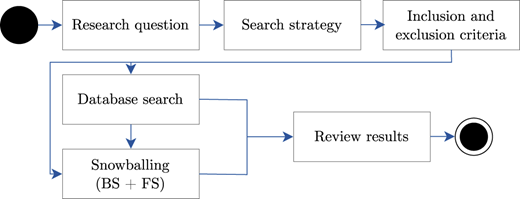
The concept and execution of the SLR are presented in this chapter, with the methodology summarized in Figure 1. The review follows the PRISMA 2020 guidelines and combines a systematic database search with a hybrid snowballing approach based on Mourão et al. (2020). The process comprises six sequential steps: (1) formulating the research questions, (2) developing the search strategy by defining keywords and search strings, (3) defining inclusion and exclusion criteria, (4) conducting the database search and screening, (5) extending the results through backward snowballing (BS) and forward snowballing (FS), and (6) synthesizing and evaluating the final set of included studies.
After formulating the research questions, the search strategy was developed by identifying suitable keywords and combining them into database-specific search strings. While the research questions define the conceptual scope of the review, the search strategy operationalizes this scope into searchable terms, Boolean operators, and database-specific queries. To retrieve indexed peer-reviewed literature, four databases are selected, specifically, Scopus, ScienceDirect, Web of Science, and IEEE Xplore. To identify relevant search terms, a preliminary exploratory search was conducted in Google Scholar. This step was not used for study selection, but only to identify terminology commonly used in the fields of BIM-based model checking, automated compliance checking, and fire safety regulation checking. Based on this exploratory step, the keywords in English and German were defined and organized into three categories (Table 2) to address the research questions. The first category includes general search terms that cover the BIM methodology, the second category comprises search terms relevant to ACCC, and the third category refers to the field of fire protection.
The search terms within the same category are combined using the Boolean operator “OR”, and the search terms from different categories are connected using the Boolean operator “AND”. To optimize the search, truncations of the search terms are applied, resulting in the following search string:
(“BIM” OR “Building Information Model*” OR “digital twin”) AND (“ACCC” OR “compliance check*” OR “code check*” OR “rule check*” OR “automat*” OR “*prüfung”) AND (“fire safety” OR “fire protection” OR “Brandschutz*” OR “fire code*” OR “fire regulation*” OR “FSE”)
Since there's no truncation feature and the number of characters for the search string in the ScienceDirect database is limited, an alternative search string is used for the review in this database:
(“BIM” OR “Building Information Model” OR “digital twin”) AND (“ACCC” OR “compliance check” OR “code check” OR “rule check”) AND (“fire safety”)
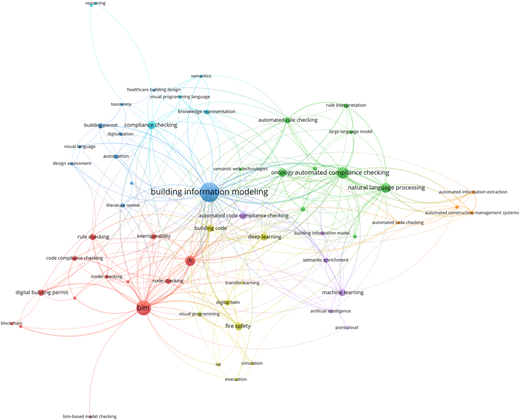
To methodically validate the search string, a keyword co-occurrence analysis was conducted in VOSviewer prior to the actual screening. The aim of this step was to examine whether the terms included in the search string cover the thematic scope of automated, rule-based checking in the BIM-based building permit process and whether related research streams are captured as well. The analysis was used to support the plausibility of the search string and to identify related terminology, not as a standalone bibliometric result. In the VOSviewer network, each node represents a keyword, and the node size indicates the frequency of occurrence within the analyzed records. Links between nodes represent keyword co-occurrences, while link strength reflects how often two terms occur together. The spatial distance between nodes indicates relative relatedness according to the VOSviewer layout algorithm; shorter distances generally indicate stronger association, but should not be interpreted as exact metric distances. Colors indicate clusters of terms that are more strongly connected within the network. For the analysis, the settings full counting and a minimum number of occurrences of 3 were applied. To avoid counting orthographic variants (e.g. building information modeling/building information modelling) and singular/plural forms (e.g. ontology/ontologies) separately, a thesaurus was created and applied to the analysis (see Table A1 in the Appendix).
The resulting keyword network (Figure 2) shows several thematic concentrations, for example related to ontologies, visual programming, and AI techniques. However, these terms are not organized in clearly separated clusters but are dispersed across the network and highly interlinked. This indicates that the methods and technologies for ACCC described in the literature are often used in combination and therefore cannot be assigned to strictly disjoint research strands. At the same time, several semantically equivalent designations for ACCC appeared, such as automated compliance checking, automated rule checking, or code checking, which supports the broader conceptualization chosen in the search string. The nodes “building information modeling”, “bim” and “automated compliance checking” were particularly central, whereas the fire-safety-related term “fire safety” appeared more peripherally and less frequently, suggesting that this is a comparatively specialized subdomain that is nevertheless explicitly covered through its inclusion in the search string. Accordingly, the co-occurrence analysis confirms the above-formulated search string for the database search.
In step iii, the inclusion and exclusion criteria are defined to ensure only relevant studies regarding the topic are selected. Table 3 provides an overview of the inclusion and exclusion criteria established for the SLR. The selected period from 2015 to 2025 ensures that the review captures the most recent decade of research and includes the publication peaks reported by Li et al. (2025) in 2016 and 2022, as described in the introduction.
3. Search process and results
3.1 Database search
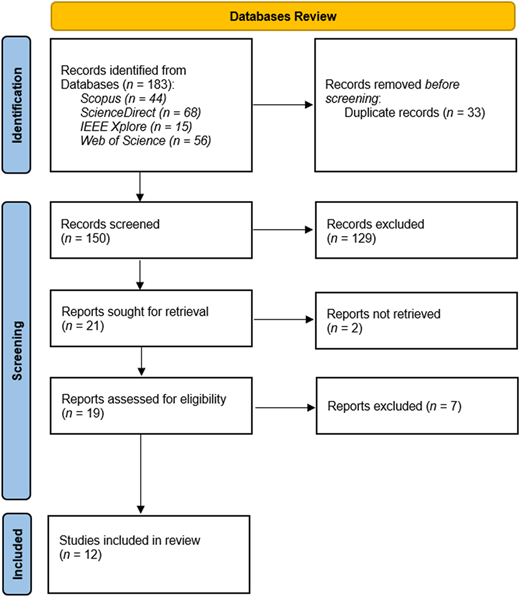
In the fourth step, the search of databases is carried out using the criteria defined in the previous steps, as well as the PRISMA guidelines for filtering and screening. The filters relating to the publication year and language were set directly in the databases during the search query. The search and export of results from the databases took place on June 5, 2025. The export files and the complete screening documentation are provided in the Supplementary Material, including duplicate removal, availability checks, title and abstract screening, eligibility assessment, and the final inclusion status of each record. As a result, a total number of articles n = 183 are found in the chosen scientific databases, specifically, Scopus (n = 44), ScienceDirect [1] (n = 68), IEEE Xplore (n = 15), and Web of Science (n = 56).
After excluding duplicate records, records with unsuitable titles and abstracts, and studies that did not meet the inclusion criteria, a total of n = 12 articles remained from the database search for full-text analysis. Figure 3 presents an overview of the database search and screening process based on the PRISMA guidelines.
Malsane et al. (2015) describe the transformation of free-text fire safety clauses from the Building Regulations (England & Wales) into an IFC-compatible, semantically enriched object model. By filtering declarative and informative clauses and extracting entities, attributes, and value lists, a domain-specific model with over 350 semantic units is created. The largely consistent terminology of the regulations facilitates semantic modeling and provides the basis for later rule execution in model checkers, although rule checking itself is not part of this study.
Preidel and Borrmann (2015) highlight that existing ACCC tools such as CORENET, Solibri, and BERA perform partial geometry-based checks but often lack transparency or completeness. They propose the visual code checking language (VCCL), a visual programming approach that modularly translates regulations into nodes and provides transparent, detailed results. Implemented in a CodeBuilder plugin for the BIM platform bim+, VCCL extracts component data, compares it to regulatory limits, and marks deviations automatically. The concept was tested with the German fire safety standard DIN 18232-2:2007-11 on smoke extraction, demonstrating functional rule checking but without quantified efficiency analysis.
Hayan Kim et al. (2019) present the Korean BIM Visual Language (KBVL), a visual approach that semantically transforms fire safety clauses from the Korea Building Act into graphical rules for automated BIM compliance checking. Logical operators (IF, THEN, ELSE) are used to generate consistent, rule-based modules. Regulatory clauses are structured in the KBim metadata database, decomposed into KBVL nodes (objects, methods, conditions), and automatically translated from visual into script-based code. Key challenges concern metadata maintenance and model completeness. Owing to its intuitive visualization, the approach is considered user-friendly for non-programmers. Validation was limited to a nested rule of lower complexity; higher-level rules were not addressed explicitly.
Kincelova et al. (2020) develop a BIM-based fire safety checking approach for mass timber buildings by converting regulatory clauses from the Canadian building code into verifiable Dynamo scripts. Derived fire safety concepts, including fire resistance, flame spread, and compartment continuity, enable automated assessment of both geometric and non-geometric rules. The method was validated on an eight-story timber building in Montreal, where additional BIM parameters (e.g. FireRating) were introduced. The study reports challenges with inconsistent modeling, ambiguous rule texts, and limited visualization, as Dynamo outputs only tabular data. Complex geometries such as vertical fire compartments remain unresolved, and no quantitative performance evaluation is included.
Zheng et al. (2022) develop an ontology-based ACCC method integrating NLP and semantic modeling to automate fire safety rule interpretation from the Chinese code GB 50016–2014. The “Fire Protection for Building Ontology” (FPBO) defines fire safety entities, attributes, and relations, while entity-role tagging and CFG parsing enable automatic rule translation into SPARQL queries. Twelve rules were fully generated, three of which were tested on an industrial IFC model with 90% mapping accuracy and equivalent error detection to manual checks, requiring only one-fifth of expert time. Complex spatial–topological rules could not yet be formalized or validated.
Ismail et al. (2023) develop a semi-automated approach that formalizes 256 Malaysian fire safety clauses using RASE semantic markup and logic-based classification for Revit-based compliance checking. RASE divides each clause into Requirements (R), Applicability (A), Selection (S), and Exceptions (E), allowing transparent and automatable logic. BIM parameters are extracted directly from Revit and analyzed through Dynamo scripts. Main challenges concern ambiguity in regulations, reliance on expert interpretation, and maintaining the rule base. Expert evaluations confirmed its practicality, although no quantitative efficiency metrics were reported. The system supports, but does not replace, manual judgment in complex or qualitative assessments.
Wang et al. (2023) present an approach to automate spatial–geometric checks in IFC models by converting them into triangular meshes and formalizing over 4,000 clauses of the Chinese fire code into logical rules via NLP. BIM data are parsed in Java, and NLP-based rule translation is performed in Python. Tested on ten BIM models, the method achieved 77–97% precision and 91–100% recall, with simpler models performing best. While no quantitative time data are given, the approach demonstrably accelerates checking. It supports reliable semantic validation and simple geometric analysis, but more advanced routines are still needed to cover complex fire safety rules.
Zhang and El-Gohary (2023) introduce a transformer-based method for semantic alignment between IFC schema concepts and regulatory terms from IBC, IECC, and ADA Standards to support ACCC. The ALBERT (A Lite BERT) base language model, fine-tuned through deep learning, classifies IFC–regulation pairs as semantically related, achieving 84% accuracy and 83% recall on 42,180 test pairs. The approach performs well for concise clauses but struggles with complex or syntactically inconsistent definitions, highlighting the need for improved handling of multi-layered rule semantics.
Fitkau and Hartmann (2024) introduce the Fire Safety Ontology (FiSa), designed to automate fire safety checking based on the German Model Building Code (MBO). By formalizing regulatory and expert knowledge, the ontology enables semantic verification of building class, fire resistance, and material requirements. Built on the Building Topology Ontology, it allows IFC integration but does not yet support complex checks such as escape routes or multi-story compartments. A prototype in Revit successfully automated several floor-level and wall-related fire safety checks, though validation in real projects is still outstanding.
Chen and Jiang (2024) propose Fire-GeoBERT, a BERT-based model that automatically translates Chinese fire safety regulations (GB 50016-2014) into BIM-checkable rules. The system extracts entities and spatial relations from regulatory text, converts them into ontology triples, and formalizes them through deontic logic, achieving 96% accuracy. XML rule sets are generated for execution in the Revit Model Checker. In a small-scale test of five distance-based rules, three were verified successfully, while two failed due to mapping errors. The approach shows promise for basic geometric checks but requires further validation and extension to handle complex 3D fire safety logic.
Besiroglu and Serteser (2025) assess BIM-based fire safety tools for compliance with Turkish standards (BYKHY, EN 12845, NFPA 13) and usability. A Revit model of a five-story office building was checked with CYPEFIRE Design (passive safety) and FINEFIRE (active safety) across 25 criteria. CYPEFIRE Design verified 13 items, FINEFIRE 10. In qualitative usability testing, CYPEFIRE Design excelled in efficiency and error prevention, while FINEFIRE proved easier to learn and remember. The study concludes that both systems complement each other and enhance digital fire safety assessments in distinct areas.
Bigdeli et al. (2025) develop a machine-learning method to automate evacuation route modeling in BIM for Belgian high-rise buildings. Doors are automatically labeled as “exits,” enabling calculation of travel distances that are compared directly with regulatory thresholds (30 m/60 m). The approach, implemented in the EvacRouteChecker Revit plugin, reduces labeling time by 90% and overall checking time by two-thirds while maintaining ≈90% classification accuracy. Remaining challenges involve limited dataset diversity, country-specific code variations, and incomplete ML coverage of edge cases.
3.2 Snowballing
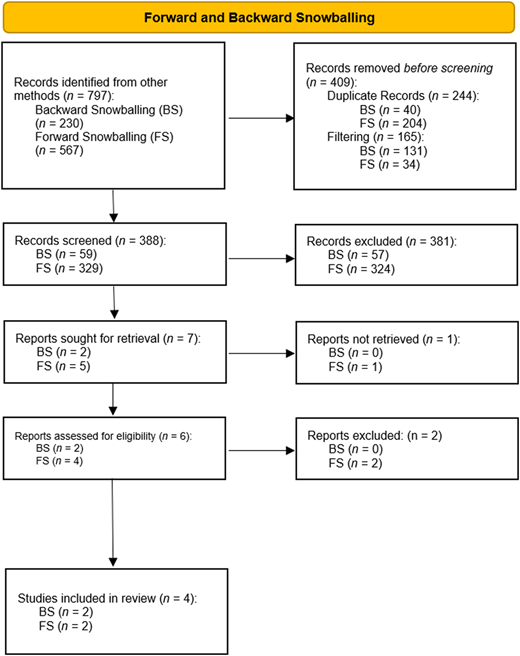
Backward and forward snowballing were applied to complement the database search and to reduce the risk of missing relevant studies that may not have been retrieved by the search string or database indexing. Backward snowballing was used to identify relevant earlier studies cited by the database-search papers, whereas forward snowballing was used to identify later studies citing these papers. Both procedures followed the same inclusion and exclusion criteria as the database screening. Following the database search, both backward and forward snowballing were conducted based on the 12 studies included from the initial database screening.
In the BS step, all references listed in the bibliographies of these 12 papers were examined according to the predefined inclusion and exclusion criteria and subsequently underwent the same screening process. The bibliographic data are exported using the Citavi Picker function, which allows the extraction of all cited references directly into the reference management software Citavi. For FS, all articles citing the 12 included studies were identified using Google Scholar via the “Cited by” function. The export dates of the respective FS lists are provided in the Supplementary Material (“FS – all records”, column L). The complete BS and FS export lists, including duplicate removal, filtering, availability checks, title and abstract screening, eligibility assessment, and final inclusion status, are documented in the Supplementary Material. Unlike in the database search, temporal and language filters had to be applied manually during snowballing. Duplicate records, both within the snowballing results and between the snowballing and database searches, are removed. In total, 797 additional records were identified through the snowballing process: 230 from BS and 567 from FS (Table 4). As expected, the number of records retrieved by FS decreases with publication year, since more recent papers have had less time to be cited. After applying the inclusion and exclusion criteria, four additional articles, two from BS and two from FS, were selected for inclusion in the review, thereby complementing the results of the database search. Although the final number of included studies is limited, it results from the deliberately narrow focus on the intersection of ACCC, fire safety engineering, and BIM-based building permit processes, combined with the systematic application of the predefined inclusion and exclusion criteria. The final set of studies therefore reflects the combined outcome of the database search and the supplementary snowballing procedure. The scope was not broadened to general BIM-based code checking, construction safety checking, or digital permitting studies unless they explicitly addressed fire-safety-related ACCC in the defined context, because this would have reduced the thematic specificity of the review and weakened its alignment with the research questions. The overall snowballing process is illustrated in Figure 4. The final included papers are described below in relation to the research questions.
3.2.1 Results identified by BS
The authors of Dimyadi et al. (2016) examine two approaches for representing and utilizing regulatory knowledge to support automated compliance checking, based on the C/VM2 document of the New Zealand Building Code (NZBC), which specifies fire safety requirements in Clauses C1–C6. The study investigates how regulatory knowledge can be translated into formal, machine-readable formats using the XML-based LegalRuleML (Legal Rule Markup Language) and semantic web languages. To enable querying of both the building model and the encoded rules, the authors introduce the domain-specific Regulatory Knowledge Query Language (RKQL), whose syntax is inspired by Structured Query Language (SQL). Alternatively, SPARQL is used when querying semantically modeled knowledge. These logic-based approaches facilitate automated checking of explicit regulatory requirements (e.g. IF–THEN rule structures). However, the authors note that no user interface is provided for acquiring additional user input, such as implicit design knowledge or design assumptions. No information is provided about which rules are being checked and which complexity class they belong to. However, these approaches are unsuitable for complex checks such as escape route simulations, as technical-analytical or simulation-based methods cannot be fully mapped, so a possible rule check up to class 2 according to Solihin is assumed.
The study by Peng and Liu (2023) focuses on using knowledge graphs to transform regulations into computer-readable language for more efficient and accurate design checks based on a BIM model. Chinese building and fire safety regulations are broken down into individual clauses and converted into terms, attributes, and relationships in an ontology. Using NLP and machine learning algorithms, triples are created and stored as nodes and edges in a graph database. The model is created in Revit, and data are exported in IFC format. The IFC file is converted into an IFCOWL file using an IFC-to-RDF converter. SPARQL queries then link building objects to corresponding regulation entities. Automated compliance checking is demonstrated on four example models, completed in less than 10 s with a component recognition accuracy of 96.81–98.17%. The result is described by experts as promising and efficient, however, a quantitative time comparison to manual checking is not available. An accuracy rate of 96% (ratio of correctly identified components to all identified components in the test) demonstrates a high precision in information extraction for the subsequent checking.
3.2.2 Results identified by FS
Fitkau et al. (2024) investigate the potential for reusing existing ontologies in the context of building permits. The focus is on aligning domain-specific ontologies, such as the Ontology for Building Permit Authorities (OBPA), the Interconnected Data Dictionary Ontology (IDDO), and the Fire Safety Ontology (FiSa), which was previously described by Fitkau and Hartmann (2024), using the Simple Knowledge Organization System (SKOS). The study explores use cases for integrating FiSa into the building permit process and using it for content analysis. However, he use cases in the study are considered for illustrative purposes only, and further research and validation are needed for the future use of the system. The two papers differ in both scope and approach: Fitkau et al. (2024), “Ontology Reuse in Building Permitting,” focuses on reusing and aligning existing ontologies through SKOS mappings to enhance interoperability within the building permitting process, offering conceptual integration examples rather than a new system. In contrast, Fitkau and Hartmann (2024), “An ontology-based approach of automatic compliance checking for structural fire safety requirements,” develops the Fire Safety Ontology (FiSa) from the ground up using OWL, SWRL, and SPARQL to formalize German fire safety regulations and demonstrate automated compliance checking. Thus, the first delivers a technical framework for automated fire safety compliance, while the second emphasizes ontology reuse for permitting workflows.
The article by Iraci Sareri et al. (2024) addresses digital model checking in the context of fire safety, analyzing the fire behavior of building elements and developing an algorithm to automate compliance checks with Italian fire safety regulations using a simplified Revit-based building model. A Python script was used to check the IFC model's compliance with national standards. The results demonstrate that the IFC data model is promising for digitizing fire safety regulations, but additional parameters need to be defined by buildingSMART to cover standards from other countries. The application was tested on a prototype nursing home model. The algorithm outputs an Excel sheet indicating which requirements were met or not, revealing, for example, that the wallpaper did not meet the required fire safety standards. The checks conducted in this study suggest that only rules of complexity class 1 were addressed.
4. Evaluation of results and discussion
The combined search approach, utilizing database querying followed by forward and backward snowballing, proved successful in this study. Due to the specifics of the research topic, the initial PRISMA database search yielded only 12 articles for inclusion. This core set was subsequently augmented by four additional papers through the snowballing process. The identified papers are presented in Table 5, indicating the search methodology used, and will be subjected to both bibliometric and thematic analyses in the following sections.
4.1 Descriptive overview of the included studies
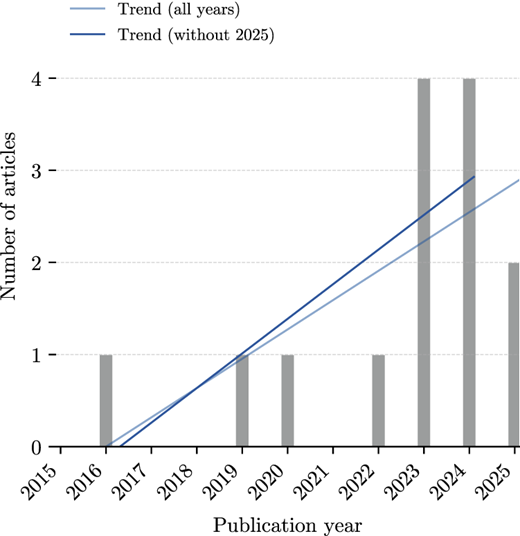
This section provides a descriptive overview of the 16 studies included in the review. Because the final sample is limited, the publication years are not interpreted as a robust bibliometric trend, but as a descriptive indication of how research activity in this specific field has developed over time. Figure 5 shows that only isolated studies were identified between 2015 and 2022, whereas most of the included studies were published from 2023 onwards. The data presented for 2025 only include publications available up to the database search conducted on June 5, 2025.
For this reason, no regression slope or bibliometric trend coefficient is calculated. Instead, the publication-year distribution is used only to contextualize the maturity of the research field. The low number of studies before 2023 suggests that the intersection of fire safety, BIM-based model checking, and ACCC in building permit processes has received limited scientific attention until recently. The higher number of recent publications indicates growing interest, but this observation should be interpreted cautiously due to the small sample size and the incomplete publication year 2025.
Because the final sample is small, no further bibliometric network analysis was conducted. Instead, the included studies are analyzed through thematic categories that are directly linked to the research questions.
4.2 Thematic analysis
In the thematic analysis, the identified articles are evaluated and compared qualitatively according to thematic clusters, methods, technologies, as well as opportunities and challenges. This involves several concept matrices, following Webster and Watson (2002), to establish a thematic categorization and cross-study comparisons. The concept matrices shown below were developed to synthesize the included studies according to criteria directly derived from the research questions, including application context, model format, rule complexity, rule interpretation, advantages, disadvantages, and implications for building permit processes.
Before applying these categories, it is important to note that the reviewed literature uses several closely related terms for automated and rule-based checking procedures, including automated code compliance checking, automated compliance checking, automated code checking, and automated rule checking. In some cases, the application domain is specified more explicitly, for example through the term automated fire code compliance checking (Wang et al., 2023). This terminological overlap supports the use of thematic categories rather than a separate keyword-network analysis based on the small final sample.
When considering application-specific features (Table 6), the geographical scope of the underlying fire safety regulations is distinguished according to German, European, and non-European regulatory contexts. A further criterion concerns the data format used, differentiating between the vendor-neutral IFC format and native formats (e.g. rvt from the authoring software Revit). In addition, the complexity of the checking rules is assessed on the basis of the taxonomy proposed by Solihin and Eastman (2015) in order to infer the scope and technical depth of the respective compliance-checking applications. With regard to rule interpretation, it is analyzed whether the rules are implemented as a black box (hard-coded representations in the form of predefined and parameterized rule templates, e.g. in Solibri) or as a white box (logical representations using script-based or visual programming). Moreover, it is examined to what extent AI methods are employed in the rule-authoring process. To ensure transparency, the detailed explanations for each classification decision are provided in the Supplementary Material, in the worksheet “Thematic Analysis”.
Within the limited sample of 16 studies, the majority of the examined studies address non-European regulatory frameworks (≈63%), while smaller shares address European (≈19%) or specifically German fire protection requirements (≈19%). This distribution mainly reflects the geographic location of the research institutions. Despite structural and linguistic differences between the respective legal frameworks, the results indicate that a transfer between regulatory contexts is generally possible, as long as there is careful semantic adaptation to national regulations. Regarding the model format used, the majority of the studies rely on the vendor-neutral IFC format (50%). This highlights the increasing establishment of IFC in compliance-relevant processes. At the same time, several articles point to practical challenges in using IFC, which are addressed in the subsequent concept matrices on ACCC characteristics and building-permit-related opportunities and challenges. The analysis of rule complexity shows that most approaches address checks of complexity class 1 (75%). Checks of complexity class 2 are also widespread (≈69%), while complexity class 3, which involves the automated evaluation of complex spatial and topological relationships, is addressed only in isolated cases (≈19%). It can be assumed that solutions implementing rules of complexity class 3 are also able to check classes 1 and 2, even if this is not explicitly stated, as illustrated in Table 6. At the same time, the implementation of individual rules of a class does not imply that all requirements of that complexity level can be checked. For example, Kincelova et al. (2020) describe the possibility of automated verification of fire compartments, but verification of cross-story fire compartments was not possible. The FiSa ontology also enables the verification of fire compartments (Fitkau and Hartmann, 2024). Due to the ontology's story-based structure and the checking approach presented, it can be assumed that the verification of fire compartments is only possible at the story level, even if not explicitly mentioned. In the paper by Besiroglu and Serteser (2025), rules of complexity class 3 are also applied, but the verification of fire compartments is not addressed. This finding highlights the challenge of cross-story fire compartment verification mentioned in the introduction. Complexity class 4 is not addressed in any of the 16 papers. This suggests that corresponding simulation-based evaluation methods currently only play a secondary role and have not yet been routinely used in the building permit process. Regarding the methods of rule interpretation, White Box approaches dominate. Hard-coded or black box methods occur only in isolated cases (≈13%). The majority of studies instead rely on Visual Programming (25%) or script-based queries (50%), including ontology-based approaches using SPARQL. Notably, in the few studies that address complexity class 3, different methodological technologies were successfully applied. This indicates that the decisive factor is not primarily the choice of technical tool, but rather precise rule formalization as well as consistent modeling and attribute definition of the digital building model. In addition, it is evident that AI is already applied in some of the studies (≈31%), particularly for rule interpretation using NLP. However, these works address only complexity classes 1 and 2. This indicates that the automated derivation and formulation of higher-complexity rules is currently not reliably feasible, meaning that domain-specific expertise and manual rule interpretation work remain essential for such tasks.
Overall, the thematic mapping shows that the reviewed studies do not form strictly separated methodological groups, but rather overlapping research strategies. Visual programming approaches mainly address transparency and usability in rule formalization, script-based approaches provide flexibility in executing explicit checking routines, ontology- and semantic-web-based approaches support the structured representation of regulatory knowledge and model semantics, and AI-supported approaches are mainly used for rule interpretation, semantic alignment, or model enrichment. Across these strategies, the main unresolved challenge is the reliable automation of complex spatial and topological fire-safety requirements, particularly where regulatory interpretation, model semantics, geometry, and traceable checking logic must be combined.
In addition to the application-specific characteristics summarized above, the included studies were analyzed with regard to the advantages and disadvantages attributed to ACCC. This second concept matrix distinguishes between benefits that arise directly from the use of automated checking, such as faster and more consistent rule evaluation, and challenges that concern model requirements, information availability, transparency, interoperability, and changes in working practices. The opportunities and challenges described in the literature can be assigned to two levels: (1) the direct advantages and disadvantages resulting from the use of ACCC, and (2) the implications for the building permit process as an organizational and regulatory framework. This categorization is presented in Tables 7–8 and is supported by textual evidence in the Supplementary Material in the worksheet Opportunities and Challenges.
At the level of direct characteristics of ACCC (1), the most frequently mentioned benefit is the increase in efficiency achieved through rule-based checking. Notably, none of the included studies provides quantitative evidence (e.g. time or cost savings) to substantiate efficiency gains. Several studies emphasize that automated validation procedures can accelerate routine and repetitive checks while reducing potential sources of error. In addition, increased transparency and traceability of validation results, improved collaboration, and the possibility of conducting plausibility checks in early planning phases are regarded as positive effects. The integration of issue management workflows, for example through the export of identified issues, is also described as supportive for iterative coordination throughout the planning process.
However, a number of disadvantages are reported more frequently than the advantages. Most prominently, the need for detailed and consistent information requirements is highlighted. These are necessary to achieve the required level of detail that automated rule checking depends on. Consequently, the depth of modeling required is often perceived as a barrier and is closely linked to broader adjustments in established work processes.
Furthermore, the limited integrability of data and information is identified as a challenge. This particularly concerns the representation of references, such as those found in graphical fire protection plans (Zheng et al., 2022). Although the IFC format is used in the majority of studies and is considered an interoperable standard, several works point to shortcomings in its ability to represent fire safety–relevant properties and classifications. Iraci Sareri et al. (2024) demonstrate that fire protection–related classes and attributes in IFC are only partially and insufficiently defined. They additionally criticize the inherent complexity of the EXPRESS data modeling language underlying IFC, which complicates the implementation and maintenance of domain-specific properties. In response to such limitations, Wang et al. (2023) added further parameters within the native authoring environment to provide the necessary information for compliance checking.
Further drawbacks relate to the transparency of validation processes. Black box approaches are critically discussed in the literature, as they impede the verification and validation of rule interpretations. Accordingly, the need for machine-readable yet human-interpretable rules, particularly with regard to their applicability in the building permit process (Table 8), is emphasized. This requires both the translation of regulatory requirements into formalized structures and transparent documentation of the applied checking logic (Preidel and Borrmann, 2015). A significant obstacle to applying rule-based validation in the building permit process is the currently insufficient availability of organizational and technical prerequisites. Personnel resources, limited experience with BIM and ACCC, and a generally low level of innovation in the construction sector are likewise described as constraining factors. In addition, regulatory frameworks in several jurisdictions currently prohibit the delegation of formal decision-making authority to automated systems, as is the case in the German building regulations (Preidel and Borrmann, 2015). Decisions therefore remain legally tied to human responsibility, meaning that ACCC can function as an assistive tool, but not as a full replacement. Moreover, certain regulatory requirements - particularly implicit or interpretive provisions - continue to require professional judgment.
At the same time, several of these challenges may be understood as opportunities for improvement. Reducing manual sources of error, standardizing information requirements, and enabling structured, digitally supported information exchange have the potential to relieve building authorities. This is particularly relevant against the backdrop of increasing procedural workloads and personnel shortages. In conclusion, it should be noted that the opportunities and challenges described are primarily conceptual. None of the reviewed studies validate ACCC within a fully executed, legally binding building permit procedure. Although some studies use real project data, the practical effectiveness of ACCC in operative permitting contexts therefore remains to be demonstrated.
4.3 Critical synthesis and implications for BIM-based fire safety checking
The thematic analysis shows that the reviewed studies should not be interpreted as isolated technical solutions, but as overlapping research strategies for translating fire safety requirements into model-based checking procedures. Five main strategies can be distinguished across the included studies. First, visual programming approaches focus on making checking logic understandable and modifiable for users with limited programming expertise. These approaches are particularly relevant for building permit workflows because they support transparency and traceability. However, they are often limited by the quality and completeness of the underlying BIM data and by the difficulty of representing complex spatial relationships.
Second, script-based checking approaches provide flexibility for implementing explicit rule logic and extracting model information. They can support efficient and repeatable checking procedures, especially for rules that can be expressed through attributes, predefined parameters, or clearly defined geometric operations. At the same time, script-based approaches require technical expertise and may be less accessible to regulatory reviewers or other stakeholders if the checking logic is not documented transparently.
Third, ontology- and semantic-web-based approaches address one of the central challenges of fire-safety-related ACCC: the structured representation of regulatory concepts, building objects, attributes, and relationships. These approaches are promising because they can improve semantic interoperability and make regulatory knowledge more reusable. However, they also require considerable effort for ontology development, maintenance, rule formalization, and alignment with BIM data structures. Their practical applicability therefore depends not only on technical feasibility, but also on whether the required semantic information is consistently available in the model.
Fourth, NLP- and AI-supported approaches mainly contribute to the interpretation of regulatory text and the semantic alignment between regulations and model information. These approaches can reduce manual effort in rule extraction and support the identification of relevant regulatory entities, attributes, and relationships. Nevertheless, the reviewed studies indicate that such methods are still mainly applied to rules of lower or medium complexity. Ambiguous legal language, exceptions, context-dependent requirements, and complex spatial-topological conditions continue to require domain expertise and manual validation.
Fifth, model-enrichment and machine-learning-based preparation approaches support the creation or completion of model information required for subsequent checking tasks. They are particularly useful where relevant information is not explicitly available in the BIM model, such as the classification of exits, evacuation routes, or other fire-safety-related elements. However, these approaches do not replace rule checking itself. Instead, they should be understood as enabling steps that improve model readiness for automated checking.
Across these strategies, the main limitation is not the absence of individual checking tools, but the difficulty of integrating rule interpretation, model semantics, geometric reasoning, and transparent decision support into a consistent workflow. Fire safety compliance is particularly demanding in this respect because it often requires the combination of legal interpretation, life-safety-critical decisions, spatial relationships, and information from different building elements and disciplines. The reviewed studies show that lower-complexity checks based on explicit attributes or simple derived values are already technically feasible, whereas complex spatial and topological requirements, such as multi-story fire compartmentation or advanced escape route analysis, remain only partially addressed.
For BIM-based building permit processes, this finding has important implications. ACCC should not be understood as a replacement for qualified human review, but as a decision-support mechanism that can improve consistency, traceability, and early detection of non-conformities. Transparent white-box approaches, including visual programming and well-documented script- or ontology-based checking procedures, appear particularly suitable for regulatory contexts because they allow reviewers and stakeholders to understand how checking results were produced. In contrast, hard-coded or black-box systems may be efficient for predefined rule sets, but provide limited support for regulatory transparency, auditability, and adaptation to local fire safety requirements.
4.4 Limitations
This review has several limitations. First, the final sample consists of 16 studies. Although the search strategy combined a PRISMA-based database search with backward and forward snowballing, the number of eligible studies remained limited. This reflects the deliberately narrow scope of the review, which focuses on the intersection of ACCC, fire safety engineering, and BIM-based building permit processes. Broader studies on general BIM-based code checking, occupational safety checking, digital permitting, or digital twins were not included unless they explicitly addressed fire-safety-related ACCC within the defined context.
Second, the inclusion and exclusion criteria may have affected the final sample. The review was limited to peer-reviewed, open-access publications in English or German published between 2015 and 2025. As a result, relevant studies published in other languages, outside the selected time frame, or without open full-text availability may not have been included. The search was conducted on June 5, 2025; therefore, the publication year 2025 is incomplete and should not be interpreted as representing a full annual publication output.
Third, the classification of the included studies involved interpretative decisions. The assignment of studies to rule complexity classes, rule interpretation approaches, advantages, disadvantages, and building-permit-related opportunities and challenges was based on the information reported in the publications. In some cases, the studies did not explicitly state all relevant details, such as the exact complexity class of implemented rules or the full extent of validation. To increase transparency, the detailed explanations for the classification decisions are provided in the Supplementary Material.
Fourth, the comparability of the reviewed studies is limited. The studies differ in regulatory context, model format, software environment, validation case, performance metrics, and level of implementation maturity. Some studies present conceptual frameworks, while others implement prototypes or evaluate specific software tools. Consequently, the results should be interpreted as a focused synthesis of existing research strategies and challenges rather than as a quantitative comparison of performance across studies.
Finally, the review focuses on ACCC in the design and building permit phase. Operational fire safety management, sensor-based digital twins, real-time monitoring, and post-occupancy compliance checking were therefore outside the scope of the present review. These areas may become relevant for future extensions of model-based compliance checking, but they require separate investigation because they involve different data sources, lifecycle stages, responsibilities, and validation requirements.
5. Conclusion
This review synthesized 16 studies on ACCC for fire safety with a particular focus on BIM-based building permit processes. The findings show that ACCC is technically promising, especially for lower-complexity checks based on explicit attributes, predefined parameters, or simple derived values. However, the review also shows that the automation of fire safety compliance remains limited where requirements depend on complex spatial relationships, semantic interpretation, or context-specific regulatory judgment.
The reviewed studies demonstrate several overlapping research strategies, including visual programming, script-based checking, ontology- and semantic-web-based approaches, NLP-/AI-supported rule interpretation, and model-enrichment methods. These strategies contribute to different parts of the ACCC workflow, but none of them currently provides a comprehensive solution for fire-safety-related compliance checking in legally binding permit procedures. The central challenge is therefore not only the formalization of individual rules, but the integration of regulatory interpretation, reliable model information, geometric reasoning, and transparent checking logic into a consistent and auditable workflow.
For BIM-based building permit processes, the results suggest that ACCC should be understood primarily as a decision-support mechanism rather than as a replacement for qualified human review. Transparent white-box approaches appear particularly relevant in regulatory contexts because they make checking logic more understandable, adaptable, and auditable. At the same time, the effective use of ACCC requires clearly defined information requirements, consistent modelling conventions, suitable data exchange formats, and organizational and legal conditions that support the use of automated checking results in the approval process.
Future research should therefore move beyond isolated prototypes and evaluate ACCC in realistic or pilot-based building permit workflows. Particular attention should be given to complex fire safety requirements, such as escape routes, spatial dependencies, and multi-story fire compartmentation, as well as to the development of standardized information requirements for fire-safety-relevant BIM data. Further work is also needed to assess how transparent rule representation, semantic modelling, and model validation can be combined to support reliable, traceable, and practically applicable ACCC workflows for fire safety.
Appendix
Note
A Python script was developed to convert the citation data from .RIS to .CSV format, as the ScienceDirect platform lacked a direct Excel export function: Link to the website
The supplementary material for this article can be found online.