This study aims to investigate how small agricultural enterprises translate generative artificial intelligence (GenAI) functionality into social impact. It examines the iterative improvement loop (IIL) as the relational mechanism that activates the required dynamic capabilities (DC).
The research uses a qualitative, longitudinal multicase study design, analyzing four small farms in Western Europe. Data collection spanned eight months in 2025, using interviews, follow-ups and on-site observations.
Findings reveal that GenAI social impact creation depends on the depth and continuity of the IIL. The study identifies three depths of improvement, demonstrating that sustained feedback cycles between farmers and providers are essential to mature DC from sensing to reconfiguring.
This paper introduces iterative improvement as a necessary underlying process of DC for social impact. It extends DC theory by showing that capability evolution unfolds relationally.
1. Introduction
Generative artificial intelligence (GenAI) is rapidly reshaping how small businesses access knowledge, support decision-making and develop innovative organizational practices. Increasingly accessible technologies such as ChatGPT, Gemini and Copilot offer small businesses opportunities to improve operational efficiency, innovation and communication formerly only available to multinational enterprises (Rajaram and Tinguely, 2024). Existing research highlights the potential of GenAI to support customer relationship management, automate administrative activities, generate marketing content and enhance strategic decision-making processes in SMEs (Abrokwah-Larbi and Awuku-Larbi, 2024; Drydakis, 2022). Beyond economic performance, GenAI is increasingly linked to broader social impact outcomes, defined as the intentional improvement of economic, human and environmental conditions over time (Russell-Bennett and Reid, 2026). These outcomes include improved access to expertise, greater organizational resilience, sustainability-oriented decision-making and more inclusive digital capabilities for smaller firms (Kumar and Ratten, 2025).
Unlike conventional enterprise technologies such as enterprise resource planning (ERP) systems, which primarily standardize organizational data, automate predefined workflows and integrate internal business processes through rule-based logic (Davenport, 1998), GenAI systems produce adaptive, probabilistic and context-dependent outputs that require ongoing interpretation, evaluation and recalibration (Gama and Magistretti, 2025). Consequently, the success of GenAI in organizations depends not only on technological implementation itself, but also on the organization’s ability to continuously interpret, validate, refine and integrate AI-generated outputs into operational routines and decision-making processes over time, capabilities closely aligned with dynamic capabilities (DC) theory (Teece, 2007). Moreover, because GenAI outputs remain adaptive and context dependent, organizations must iteratively refine and contextualize AI-generated insights over time (Dwivedi et al., 2021; Dellermann et al., 2021). This study therefore conceptualizes the iterative improvement loop (IIL) between users and providers as the recursive mechanism through which AI-generated insights are continuously interpreted and refined. When output remains generic, inconsistent, insufficiently contextualized or partially hallucinated, organizational trust in AI-generated recommendations may decline and implementation efforts frequently stagnate. This distinguishes GenAI implementation from more rule-based digital technologies, where functionality is predefined and operational outcomes are comparatively predictable.
These dynamics are particularly important in the context of small businesses. Small businesses account for the majority of firms worldwide and play a central role in employment creation, regional development and local sustainability transitions (OECD, 2023). At the same time, they frequently operate under conditions of limited financial resources, constrained digital expertise, low digital maturity and restricted access to specialized knowledge networks (Bakhtiari et al., 2020; Cenamor et al., 2019). Such conditions can complicate the implementation of rapidly evolving digital technologies. However, small businesses may also possess important advantages for GenAI implementation due to flatter organizational structures, shorter decision-making processes and greater operational flexibility (OECD, 2023). These characteristics can enable faster experimentation, closer interaction between users and technology providers and more rapid adaptation of organizational routines. At the same time, they make GenAI implementation highly dependent on continuous organizational learning and contextual adaptation, particularly when AI-generated outputs must be aligned with highly localized operational realities.
Despite growing interest in GenAI, existing literature provides limited understanding of the recursive organizational processes through which small businesses progressively contextualize AI-generated outputs and translate them into sustained social impact outcomes over time. Existing studies predominantly focus on adoption drivers, technological functionality, implementation barriers or operational efficiency outcomes (Rajaram and Tinguely, 2024), while providing less attention to the iterative improvement, provider-user interaction and capability activation processes required for GenAI integration with social impact outcomes. AppendixTable A1 illustrates that current research frequently conceptualizes GenAI implementation as a technological adoption challenge rather than as an ongoing process of organizational adaptation and iterative improvement. Consequently, less is understood about how small businesses progressively embed AI-generated insights into organizational routines capable of generating sustained organizational and societal value.
Small agricultural businesses provide a particularly relevant context for examining these dynamics because they operate under conditions of high environmental uncertainty, localized knowledge requirements and increasing sustainability pressures. Family-run and individually managed farms account for more than 80% of global food production and are central to sustainable food systems and rural development (FAO and IFAD, 2019). At the same time, these businesses face growing challenges related to climate volatility, labor shortages, sustainability regulations and animal welfare requirements (Rattan et al., 2024). Many continue to rely on advisory services and agronomists, agricultural specialists who provide expertise on soil management, crop production and sustainable farming practices, for specialized support. However, continuous access to such expertise is often constrained by financial and geographic limitations (Fabregas et al., 2019). GenAI therefore appears particularly promising because it can generate real-time recommendations, interpret sensor data and provide individualized operational guidance (Li et al., 2025; Sai et al., 2025). However, inaccurate or insufficiently contextualized outputs may also create significant operational, environmental and societal risks. The agricultural context therefore provides a useful setting for examining how small businesses progressively contextualize and operationalize AI-generated outputs under conditions of high local variability and uncertainty.
Building on the recursive dynamics outlined above, this study draws on DC theory to explain how organizations transform GenAI functionality into social impact over time. DC theory conceptualizes organizational adaptation as the ability to purposefully activate organizational resources in response to changing environments (Helfat et al., 2007; Teece, 2007). However, less is understood about how such capabilities are progressively activated in contexts characterized by adaptive and probabilistic GenAI systems whose outputs continuously evolve through recursive interaction and contextual recalibration. To address this gap, we use iterative improvement research (McCarthy et al., 2006; Salo and Abrahamsson, 2007) and DC theory as combined lenses to address the following research question:
How do iterative improvement loops between small agricultural businesses and technology providers activate the dynamic capabilities required to transform GenAI functionality into social impact?
2. Methodology
This study uses a longitudinal qualitative multiple-case study design to examine how small businesses iteratively translate GenAI functionality into social impact over time. Qualitative case study research is particularly appropriate for investigating complex organizational processes within their real-world contexts, especially when the boundaries between technological implementation, organizational adaptation and social impact creation remain fluid and evolving (Yin, 1994). The approach further enables a process-oriented understanding of how recursive interactions between organizations and technology providers shape the activation of DC over time (Lindgreen et al., 2021a, 2021b).
A longitudinal design was particularly important because the study focuses on iterative improvement as an evolving organizational process rather than a one-time implementation event. Data collection therefore spanned from March to October 2025, enabling observation of how GenAI-supported practices, provider-user interactions and organizational routines developed across multiple stages of implementation. This temporal perspective made it possible to capture how organizations progressively contextualized AI-generated outputs, recalibrated system use and integrated digital insights into operational decision-making processes over time. Data were analyzed through sequential within-case and cross-case analysis. First, interviews and observational data were organized chronologically to trace implementation trajectories. Second, empirical evidence was coded according to IIL depth and associated sensing, seizing and reconfiguring capabilities (see supplementary materials 7). Finally, cross-case comparison identified recurring implementation patterns.
Research rigor was ensured through triangulation across interviews, observations, documentary evidence and longitudinal follow-up. Construct validity was strengthened through multiple-case comparison and transparent coding, while reliability was supported through standardized interview guides, consistent data collection procedures and a structured case study database. Analytical generalization was pursued through purposeful case selection and replication logic (Eisenhardt, 1989; Yin, 1994).
2.1 Case selection and context
The empirical setting comprises four small agricultural enterprises in Germany and Switzerland that had recently begun implementing GenAI in their operations. These farms constitute the cases in this study, as the research examines how small agricultural businesses experiment with and integrate GenAI into everyday practice. Cases were purposefully selected using two criteria:
fewer than 15 employees; and
recent implementation of GenAI.
Early-stage implementation enabled observation of how GenAI became embedded in organizational routines over time. To support theoretical replication, the sample included two livestock and two crop farms using different GenAI applications while maintaining a consistent small-business context. An overview of the cases is presented in Table 1.
3. Findings
Our empirical analysis reveals that GenAI alone does not automatically generate social impact for small farms. Instead, social impact emerged through differing depths of IILs between farmers and technology providers. Across the cases, recursive feedback, contextual recalibration and provider-user interaction progressively activated the underlying mechanisms of DC, sensing, seizing and reconfiguring capabilities (Teece, 2007), enabling organizations to increasingly embed AI-generated insights into operational routines and decision-making processes over time.
The findings summarized in Table 2 demonstrate that social impact creation depended not primarily on the initial sophistication of GenAI systems, but on the depth of recursive iterative improvement through which organizations progressively contextualized AI-generated outputs. Shallow IIL trajectories remained characterized by fragmented feedback, weak contextual adaptation and limited organizational embedding of AI-supported insights. Under these conditions, sensing capabilities remained weakly activated, operational experimentation did not progress toward coordinated seizing activities and organizational routines were not reconfigured around AI-supported processes. In contrast, deeper IIL trajectories enabled sustained provider-user recalibration, increasing interpretive reliability and progressively activating sensing, seizing and reconfiguring capabilities. As recursive interaction intensified over time, AI-generated outputs became increasingly trusted, operationally actionable and institutionally embedded within organizational planning and management routines.
Case C illustrates this mechanism particularly clearly. Although the farm initially invested considerable effort into implementing a technically sophisticated GenAI chatbot, the iterative improvement process remained shallow because recursive recalibration between provider and user did not mature. Consequently, AI-generated output remained insufficiently contextualized to local soil and weather conditions, weakening trust in the recommendations over time. This shallow IIL trajectory prevented the activation of deeper sensing capabilities because the organization failed to develop reliable interpretive alignment around AI-generated insights. Similarly, seizing capabilities remained immature because AI-supported recommendations were not operationalized into coordinated decision-making routines, while reconfiguring capabilities failed to emerge because existing organizational practices remained largely unchanged. As a result, the GenAI system was ultimately discontinued. A deeper iterative improvement trajectory would likely have required sustained provider-user feedback, localized retraining of the model and recursive contextual recalibration capable of progressively embedding AI-supported insights into operational routines.
3.1 Shallow and moderate iterative improvement: activating sensing capabilities
At shallow and moderate levels of iterative improvement, recursive provider-user recalibration primarily activated sensing capabilities, an organization’s ability to identify emerging signals and risks in its environment (Teece, 2007), by progressively improving the interpretability and contextual reliability of AI-generated outputs. Rather than emerging automatically from the availability of GenAI-generated insights, sensing capabilities were activated through repeated cycles of feedback, interpretation and contextual refinement in which organizations increasingly aligned AI-generated outputs with localized operational realities. As IILs deepened, employees progressively learned which outputs were operationally meaningful, how system recommendations should be interpreted, and when AI-generated alerts required additional attention or intervention.
In Cases A and B, repeated interaction between users and providers transformed initially generic or unreliable outputs into increasingly contextualized and operationally relevant insights. During the early implementation stages, farmers reported unclear alerts, insufficiently precise interpretations and difficulties relating system outputs to local animal conditions. At this stage, iterative improvement remained relatively shallow and AI-generated outputs were only partially trusted and weakly embedded within everyday decision-making routines. However, recursive feedback exchanges progressively deepened the iterative improvement process. The farmers repeatedly communicated tacit operational knowledge, questioned ambiguous recommendations and provided corrective feedback regarding inaccurate alerts. In response, the providers recalibrated thresholds, refined explanatory models and incorporated localized contextual information into subsequent system iterations.
Over time, these recursive recalibration processes progressively activated stronger sensing capabilities by improving the interpretability, credibility and operational relevance of AI-generated outputs. In Case A, alerts that had initially indicated only a generic “movement anomaly” later evolved into more detailed explanations of asymmetry and possible early fatigue patterns. As the owner explained, “in two cases we prevented injuries because the system generated warnings before symptoms appeared.” Similarly, in Case B, employees increasingly relied on AI-generated lameness and body-condition scores to identify emerging animal welfare risks earlier and prioritize targeted inspections more effectively. GenAI outputs progressively evolved from isolated informational signals into trusted interpretive mechanisms supporting continuous operational awareness and earlier risk recognition.
Case C illustrates the consequences of a too shallow IIL. Limited provider-user recalibration prevented the chatbot from adapting to local soil and weather conditions, weakening trust in AI-generated recommendations. As sensing, seizing and reconfiguring capabilities failed to mature, the system was ultimately discontinued.
3.2 Deepening iterative improvement: activating seizing capabilities
As IILs moved from shallow to moderate beyond initial interpretive alignment, organizations increasingly activated seizing capabilities through the operational coordination of GenAI-supported insights. While sensing capabilities enabled organizations to recognize emerging signals and risks, seizing capabilities became activated when recursive recalibration processes progressively transformed AI-generated outputs into trusted and operationally actionable coordination mechanisms embedded within everyday workflows. Rather than relying solely on individual experience or fragmented experimentation, organizations increasingly coordinated interventions, monitoring routines and resource allocation decisions around shared AI-generated interpretations.
Case B illustrates this transition particularly clearly. The camera-based monitoring system generated lameness and body-condition scores accompanied by AI-generated explanations of potential health risks. Initially, however, employees struggled to interpret the large volume of reports and remained uncertain which alerts required immediate intervention. At this stage, iterative improvement remained relatively shallow because outputs were only partially contextualized, and employees continued relying primarily on existing experiential judgment. Consequently, AI-generated insights remained weakly integrated into coordinated operational routines. As recursive provider-user interaction intensified, the iterative improvement process progressively deepened and stronger seizing capabilities began to emerge. Repeated discussions between employees and the provider focused on how scores were calculated, how recommendations should be interpreted, and which alerts were operationally most relevant. Through these recursive recalibration processes, the provider progressively refined alert thresholds, adjusted explanatory categories and simplified the operational presentation of AI-generated outputs. For example, the system was adapted so that only highly relevant alerts were displayed in the most frequented stable areas, reducing interpretive overload and enabling employees to integrate AI-supported recommendations more effectively into everyday workflows.
Over time, these moderate iterative improvement trajectories progressively activated seizing capabilities by enabling employees to operationalize AI-generated insights into coordinated organizational action. Rather than treating AI-generated outputs as isolated informational signals, employees increasingly synchronized inspections, intervention timing and monitoring priorities around shared AI-supported interpretations. For example, when a cow’s lameness score exceeded a threshold, targeted inspections and interventions followed immediately. Similarly, the integration of AI-supported calving interpretations reduced the need for continuous nightshift monitoring because employees increasingly trusted the operational reliability of the recommendations. As the owner explained, “healthy cows produce more milk and require fewer treatments.”
Overall, moderate iterative improvement enabled organizations to translate AI-generated insights into coordinated monitoring and intervention routines. This strengthened operational alignment, improved animal welfare and working conditions and increased productivity, whereas shallow trajectories failed to progress beyond isolated experimentation.
3.3 Sustained iterative improvement: activating reconfiguring capabilities
When IILs became sustained and deeply embedded, recursive recalibration progressively activated the most advanced DC mechanism, reconfiguring (Teece, 2007), through the institutionalization of AI-supported decision-making routines. At this stage, organizations no longer used GenAI outputs merely to support isolated operational decisions, but increasingly reorganized planning structures, resource allocation processes and management routines around AI-generated insights. Reconfiguring capabilities therefore emerged when sustained provider-user interaction enabled organizations to progressively embed AI-supported recommendations into broader organizational infrastructures and long-term operational practices.
Case D illustrates this transformation particularly clearly. The grain farm implemented GenAI-enabled precision agriculture machinery that integrated lidar, radar and soil sensors with a GenAI-powered digital agronomist to optimize seeding, fertilization and pesticide application. During the initial implementation stage, the farmer primarily relied on default system parameters and used AI-generated outputs cautiously alongside existing operational routines. At this stage, iterative improvement remained relatively moderate because AI-supported recommendations had not yet become deeply integrated into organizational planning and management processes. As recursive recalibration processes intensified over time, the iterative improvement trajectory progressively deepened and stronger reconfiguring capabilities emerged. Through repeated provider-user interaction, operational data was continuously reviewed, and system parameters were recalibrated to reflect terrain variation, soil moisture differences, crop conditions and field-specific operational requirements. Unlike earlier iterative improvement stages primarily associated with interpretive alignment or coordinated intervention, these deeper recursive interactions progressively reshaped how organizational planning itself was conducted. AI-generated recommendations increasingly informed fertilization strategies, pesticide allocation, cultivation timing and long-term resource management decisions.
Over time, these sustained iterative improvement processes progressively activated reconfiguring capabilities by embedding AI-supported insights into the farm’s broader organizational infrastructure. Employees increasingly consulted the dashboard before scheduling field activities and adjusted operational decisions according to AI-generated recommendations. Importantly, the system also became institutionalized within sustainability reporting and certification activities. Automated reports documenting fertilizer and pesticide use supported subsidy applications and sustainability compliance processes, linking environmental performance directly to economic planning and governance structures.
These findings show that sustained iterative improvement enabled organizations to embed GenAI into planning, reporting and resource management. As a result, AI-supported routines generated broader environmental, operational and economic benefits than the shallower implementation trajectories.
3.4 When iterative improvement breaks down
The importance of sustained IILs becomes particularly visible when these processes fail to deepen beyond shallow interactions. Case C illustrates this breakdown clearly. The crop farm implemented a conversational GenAI system that generated agronomic recommendations. Initially, the farmer perceived the system as a potentially valuable knowledge resource capable of supporting crop management decisions. However, the output soon proved insufficiently adapted to the farm’s highly localized conditions. Fields with different soil compositions, moisture levels and environmental characteristics frequently received nearly identical recommendations, indicating that the system failed to adequately capture local variability. As a result, the recommendations were increasingly perceived as overly generic, operationally irrelevant and unreliable in everyday decision-making.
Although the GenAI system itself was technically sophisticated, the IIL remained shallow because recursive provider-user recalibration processes failed to emerge. Unlike the more successful cases, feedback exchanges with the provider remained limited and did not evolve into sustained co-learning processes through which localized operational knowledge could progressively shape GenAI outputs. Consequently, trust in the recommendations weakened over time, and employees increasingly reverted to existing experiential routines rather than integrating AI-generated insights into operational decisions. The GenAI system therefore failed to evolve from a generic informational tool into a contextualized interpretive layer.
This case demonstrates that the existence of GenAI functionality alone does not generate DC activation or social impact outcomes. Rather, the findings suggest that such outcomes depend on the extent to which IILs evolve beyond shallow trajectories.
3.5 Across-case pattern: iterative improvement loop depth and dynamic capabilities activation
Taken together, the cases prove that the relationship between GenAI functionality and social impact unfolds through iterative organizational improvement processes rather than emerging automatically from the initial sophistication of the technology itself. The findings indicate that organizations generated social impact only when IILs progressively transformed initially generic AI-generated outputs into trusted, contextualized and operationally embedded decision-making mechanisms. This transformation occurred through repeated cycles of provider-user interaction in which organizations communicated localized operational knowledge, questioned ambiguous outputs, recalibrated recommendations and gradually aligned AI-generated interpretations with everyday work practices.
The findings further suggest that the depth of IILs shaped both the activation of DC and the resulting social impact trajectories. At shallow levels of iterative improvement, provider-user interaction remained limited and GenAI outputs stayed weakly contextualized to local operational realities. Under these conditions, organizations struggled to trust or operationalize AI-generated insights and largely continued relying on existing experiential routines. As illustrated in Case C, shallow trajectories were characterized by fragmented experimentation, generic recommendations and weak organizational embedding. Because recursive recalibration processes did not deepen over time, the GenAI system failed to evolve into a meaningful interpretive layer capable of supporting organizational learning or coordinated decision-making. Consequently, sensing, seizing and reconfiguring capabilities remained immature and no sustained social impact outcomes emerged.
As IILs became more sustained and recursive, organizations progressively moved toward moderate trajectories associated with sensing and seizing capabilities. In these cases, repeated interaction between users and providers progressively aligned GenAI outputs with localized operational conditions and everyday workflows. This recursive recalibration process increased the interpretability, credibility and operational relevance of AI-generated outputs, enabling organizations to incorporate them into monitoring routines, intervention timing and resource allocation decisions. Cases A and B demonstrate that social impact emerged when employees no longer treated GenAI outputs as isolated informational signals, but increasingly coordinated responses around shared AI-generated interpretations. Through this process, organizations were able to identify health risks earlier, prioritize inspections more effectively, reduce unnecessary manual monitoring and support less experienced employees through shared interpretive infrastructures. As summarized in Table 2, these more moderate trajectories contributed to improved animal welfare (SDG 15), better working conditions (SDG 8) and increased productivity and food production efficiency (SDG 2).
The deepest IILs were associated with reconfiguring capabilities. In these deeper trajectories, recursive learning and recalibration processes no longer supported isolated operational decisions alone, but progressively reshaped organizational planning structures, reporting routines and management practices. Case D illustrates how sustained provider-user interaction enabled AI-generated insights to become embedded within operational planning, sustainability reporting and long-term resource management processes. Over time, the organization increasingly reorganized decision-making activities around AI-generated recommendations rather than treating them as supplementary informational support. In this way, GenAI functionality became institutionalized within the farm’s broader management infrastructure. As summarized in Table 2, these deeper trajectories generated more social impact outcomes including reduced fertilizer use and improved environmental sustainability (SDG 12), alongside strengthened economic resilience and operational efficiency (SDG 8) and increased productivity and food production efficiency (SDG 2).
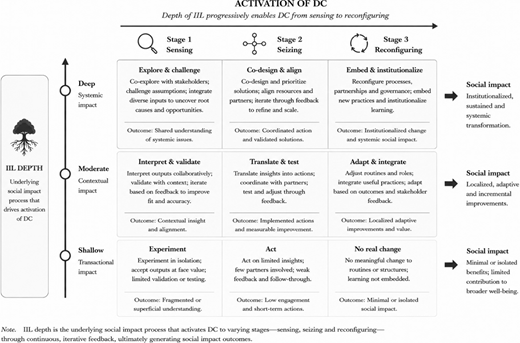
Figure 1 synthesizes these findings by illustrating how differing depths of iterative improvement correspond to progressively deeper forms of contextual recalibration, trust development, organizational embedding and DC activation across the cases. The social impact matrix should therefore not be interpreted as representing fixed organizational categories, but rather as illustrating evolving iterative improvement trajectories through which organizations progressively contextualized GenAI outputs, embedded AI-generated insights into organizational routines, and generated increasingly sustained social impact outcomes over time.
4. Discussion and implications
This study examined how IILs between small agricultural businesses and technology providers activate the DC required to transform GenAI functionality into social impact. Specifically, the study addressed the following research question: How do iterative improvement loops between small agricultural businesses and technology providers activate the dynamic capabilities required to transform GenAI functionality into social impact? The findings show that social impact does not emerge from GenAI implementation alone, but from sustained recursive feedback processes that progressively activate DC which enable small businesses to contextualize AI outputs and embed them into organizational routines.
The findings show that successful GenAI implementation depends not simply on technology adoption, but on sustained iterative improvement between users and providers. Through these recursive interactions, organizations progressively contextualize AI-generated outputs, activate DC and embed GenAI into organizational routines that generate social impact.
4.1 Theoretical contributions
This study contributes to emerging research on the social impact of GenAI in small businesses by explaining how organizations progressively translate GenAI functionality into social impact outcomes over time. Existing research on GenAI in small businesses frequently emphasizes the transformative potential of AI for improving efficiency, innovation, competitiveness and decision-making capabilities (Rajaram and Tinguely, 2024). Similarly, prior studies highlight the capacity of GenAI to support customer engagement, automate administrative activities, enhance knowledge accessibility and strengthen organizational resilience in SME contexts (Abrokwah-Larbi and Awuku-Larbi, 2024; Drydakis, 2022; Kumar and Ratten, 2025). However, current literature provides more limited understanding of the recursive organizational processes through which small businesses progressively contextualize adaptive AI-generated outputs and translate them into meaningful organizational and societal value over time. Our findings show that social impact does not emerge from GenAI implementation alone, but from sustained IILs through which organizations progressively activate DC which enable them to align AI-generated outputs with contextual realities, operational routines and localized knowledge. The study therefore extends emerging GenAI and social impact literature by conceptualizing implementation as a recursive process of contextualization, organizational learning and capability activation rather than a linear technology adoption process.
The study further contributes to DC research by identifying IIL as the relational and temporal mechanism through which sensing, seizing and reconfiguring capabilities are progressively activated in GenAI-enabled environments. Existing DC research conceptualizes sensing, seizing and reconfiguring as essential organizational responses to uncertainty and environmental change (Teece, 2007). However, less is understood about how such capabilities are activated in contexts characterized by adaptive and probabilistic GenAI systems whose outputs continuously evolve. Our findings demonstrate that capability activation depends not only on internal organizational resources, but also on sustained recursive interaction between small businesses and technology providers. Through repeated feedback, interpretation, recalibration and organizational learning, organizations progressively increase the contextual reliability of AI-generated outputs and embed them into organizational decision-making processes. The study therefore extends DC theory by conceptualizing iterative improvement as a recursive capability activation mechanism through which organizations progressively operationalize GenAI functionality in practice.
The findings additionally contribute to research distinguishing GenAI from more conventional digital technologies in small-business contexts. Existing digital transformation research frequently conceptualizes implementation as the integration of relatively stable and predefined technological systems designed to automate standardized organizational processes (Davenport, 1998; Verhoef et al., 2021). In contrast, our findings show that GenAI implementation is characterized by ongoing uncertainty because AI-generated outputs remain adaptive, context-dependent and potentially inconsistent over time. Consequently, successful implementation depends less on technology acquisition itself than on the organization’s ability to continuously contextualize, evaluate and recalibrate generated outputs through recursive learning processes. This distinction is particularly important in small-business environments characterized by limited resources, informal organizational structures and high contextual variability. Across the cases, organizations characterized by shallow iterative improvement experienced fragmented experimentation, low trust in AI-generated recommendations, and limited organizational transformation. In contrast, deeper iterative improvement enabled stronger provider-user collaboration, greater contextualization of outputs and the gradual embedding of AI-generated insights into organizational routines associated with sustained social impact outcomes. The study therefore contributes to emerging GenAI literature by explaining why similar GenAI technologies may produce substantially different organizational and societal outcomes depending on the depth of iterative improvement and capability activation processes.
Finally, the social impact matrix developed in this study contributes a process-oriented framework for understanding how differing combinations of IIL depth and DC activation shape social impact outcomes in small businesses implementing GenAI. Existing literature frequently discusses the potential societal benefits of AI adoption but provides more limited understanding of how social impact progressively emerges through organizational processes over time (Russell-Bennett and Reid, 2026). The matrix introduced in this study demonstrates that social impact should not be understood as a direct consequence of GenAI adoption alone, but as the outcome of recursive organizational learning processes that progressively activate sensing, seizing and reconfiguring capabilities. By linking differing levels of IIL depth to specific forms of DC activation and organizational transformation, the framework provides a foundation for future research examining how small businesses operationalize GenAI for organizational and societal value creation across different contexts beyond agriculture.
4.2 Practical implications
The findings generate several practical implications for small businesses seeking to implement GenAI for social impact creation. Unlike conventional digital systems that primarily automate predefined workflows, GenAI produces adaptive, probabilistic and context-dependent outputs that require continuous interpretation, recalibration and organizational learning. The findings therefore suggest that small businesses should approach GenAI implementation not as a one-time technology acquisition project, but as an iterative improvement process requiring sustained interaction between users and providers. Across the cases, successful GenAI integration depended less on initial system functionality than on the organization’s ability to progressively contextualize AI-generated outputs and embed them into operational routines over time.
The cases further demonstrate that small businesses should evaluate GenAI systems not only based on efficiency gains or automation potential, but also on the provider’s willingness and capability to support continuous contextual adaptation. In the unsuccessful trajectory observed in Case C, AI-generated recommendations remained overly generic and insufficiently adapted to local operational conditions. Because provider-user interaction remained limited and iterative recalibration did not occur, trust in the system gradually declined and employees increasingly ignored or manually overrode AI-generated outputs. The findings therefore suggest that when GenAI outputs repeatedly appear generic, contradictory, poorly contextualized or partially hallucinated, organizations should avoid fully relying on AI-supported recommendations and instead intensify feedback exchanges with providers to improve contextual relevance and interpretive accuracy.
The findings additionally show that successful IILs are characterized by progressively stronger alignment between AI-generated outputs, local operational knowledge and organizational routines. In the more successful cases, organizations continuously documented inaccurate recommendations, compared AI-generated insights against contextual conditions, and communicated recurring inconsistencies back to providers. Over time, these recursive feedback exchanges improved the contextual reliability of the systems and strengthened organizational trust in AI-supported recommendations. As iterative improvement deepened, AI-generated insights increasingly influenced operational coordination, resource allocation, monitoring routines and sustainability-related decision-making processes. In contrast, shallow IIL trajectories remained characterized by fragmented experimentation, sporadic use of AI outputs, limited employee trust and the persistence of manual routines.
The findings further indicate that small businesses should seek provider support not only during initial implementation, but throughout the ongoing use of GenAI systems. Provider interaction became particularly important when organizations encountered recurring contextual inaccuracies, inconsistent recommendations across operational conditions, or employee uncertainty regarding how AI-generated outputs should be interpreted. In the successful trajectories, providers actively participated in recalibrating thresholds, refining recommendations, incorporating localized operational data and supporting employee interpretation of AI-generated insights. This sustained provider-user interaction enabled organizations to move beyond shallow sensing activities toward stronger seizing and reconfiguring capabilities associated with sustained social impact outcomes. Table 3 summarizes the practical implications associated with differing combinations of iterative improvement depth and DC activation.
4.3 Limitations and future research
As with any qualitative case study, this research provides analytical rather than statistical generalization. The study focuses on four small farms in Germany and Switzerland, enabling an in-depth exploration. Future research could extend these insights by examining whether similar patterns emerge across larger samples, different industries and varying organizational contexts. Another promising avenue is to examine how iterative improvement unfolds across broader ecosystems. This study focuses mainly on the relationship between farms and technology providers. However, innovation systems also involve actors such as advisory services, cooperatives, certification bodies and regulatory institutions. Investigating how these actors shape iterative improvement could provide a more comprehensive understanding of how digital technologies generate social impact in agriculture. Finally, future research could investigate how iterative improvement and DC activation evolve beyond early implementation stages. In particular, future studies could examine how sustained GenAI integration reshapes organizational structures, decision-making routines, governance mechanisms and human-AI collaboration over time, as well as how organizations manage emerging challenges related to contextual drift, overreliance on AI-generated recommendations and the long-term maintenance of interpretive accuracy.
References
Supplementary material
The supplementary material for this article can be found online.