This paper aims to introduce the Mission-Aligned Research Framework, a practical, staged process designed to align faculty research with institutional mission and social purpose. The framework is intended to support mission-driven institutions seeking to integrate scholarly rigor with sustained community and regional relevance.
The framework emerged from a three-year analytic autoethnographic inquiry conducted during the author’s tenure as dean of a mission-driven business school in Appalachia.
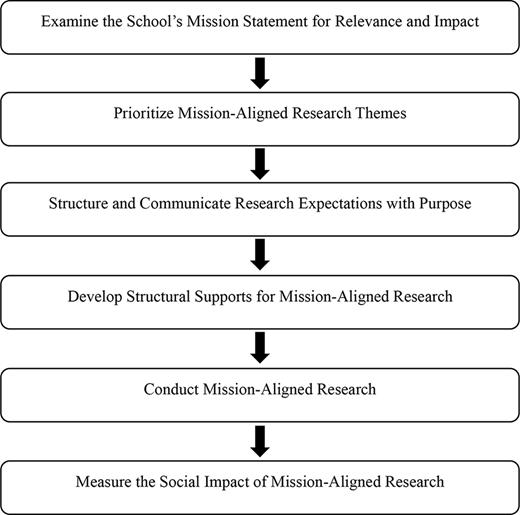
The Mission-Aligned Research Framework consists of six sequential components, including examining the school’s mission for relevance and impact, prioritizing mission-aligned research themes, structuring and communicating research expectations with purpose, developing structural supports for mission-aligned research, conducting mission-aligned research and measuring the social impact of mission-aligned research.
The framework provides higher education leaders with a structured approach for aligning faculty research with institutional mission while preserving scholarly autonomy. It is intended to support administrators in intentionally leveraging faculty scholarship as a mechanism for advancing institutional mission, strengthening community and regional engagement and reinforcing the social purpose of academic research.
To the best of the author’s knowledge, this study is among the first to introduce a structured framework that operationalizes mission-aligned faculty research as a mechanism for accomplishing institutional social purpose.
Introduction
Institutions of higher education increasingly recognize the importance of aligning their activities with broader social purpose. This awareness reflects a growing consensus that colleges and universities must extend their roles beyond instruction and isolated knowledge production to act as agents of social good (Compagnucci and Spigarelli, 2020; Guerrero and Menter, 2024; Trencher et al., 2014; Zomer and Benneworth, 2011). This responsibility is particularly significant in underserved rural regions, where institutions often serve as anchor organizations whose resources make them key drivers of community stability and growth (Orphan and McClure, 2019; Salomaa, 2019; Schafft, 2016). Consequently, the missions of institutions operating in such environments frequently emphasize socially oriented goals, such as expanding educational access, reducing disparities and fostering long-term community well-being (Orphan and McClure, 2019; Schafft, 2016).
The extent to which these missions are realized depends heavily on faculty, whose professional responsibilities routinely reflect institutional commitments. Across standard faculty roles, teaching and service are commonly recognized as expressions of mission (Boyer, 1990; Bruns et al., 2002). Research, however, is more frequently shaped by disciplinary norms and external academic incentives than by institutional mission or place-based need (Beltran et al., 2024; Penfield et al., 2014; Spaapen and Van Drooge, 2011). Nevertheless, when designed with mission attainment and social impact in mind, faculty research becomes an accessible, locally relevant resource that can inform decision-making, address community-specific needs and reinforce institutional relevance for regional stakeholders (Ehlenz, 2018; Fullerton, 2015; Orphan and McClure, 2019; Salomaa, 2019).
Within the context of business schools, specifically, scholars increasingly call for research that is practical, actionable and responsive to real-world problems (Liu and McKinnon, 2019; Lockett, 2024; Palmer et al., 2009; Redgrave et al., 2023). For mission-oriented business schools, this expectation represents an opportunity to leverage faculty expertise in support of local entrepreneurship, workforce development, economic resilience and more. Despite this promise, formal strategies for aligning faculty research with institutional-level mission remain limited.
In response to this gap, this paper introduces a Mission-Aligned Research Framework to guide faculty scholarship toward institutional mission and community impact. The framework is grounded in a three-year analytic autoethnographic inquiry conducted during my tenure as dean of a mission-driven business school in Appalachia. Guided by the question:
How can faculty research be intentionally aligned with institutional mission while also supporting individual scholarly interests?
I explored how research agendas could be shaped to reflect a university’s commitment to regional prosperity. Theoretical perspectives from Social Anchor Theory and the Third Mission of Higher Education reinforce the relevance of this work.
Methodology
This study adopted an analytic autoethnographic methodology to examine the internal processes, contextual influences and professional insights that shaped the development of the Mission-Aligned Research Framework. The following sections define the analytic autoethnographic tradition, explain my positional stance and describe the reflective process that supported the research and resulting output.
Analytic autoethnography
Historically, autoethnography is a research method that uses personal experience to understand cultural phenomena and societal issues. It involves the researcher describing their own lived experiences to gain insight into broader contexts and shared realities (Butz and Besio, 2009; Denzin and Lincoln, 1994; Ellis, 2004; Ellis et al., 2011; Wall, 2006). As an extension of autoethnography, analytic autoethnography emphasizes systematic analysis, theoretical engagement and transparency in the research process (Anderson, 2006). Rather than solely evoking emotion or recounting lived experiences, analytic autoethnographers use their position as insiders to critically examine the relationship between self and society through an academic lens (Anderson, 2006). By positioning the researcher as both participant and analyst, this approach enables the production of knowledge that is simultaneously personal and scholarly.
In applying analytic autoethnography, I engaged in sustained self-reflection, theoretical integration and critical examination of practice, grounded in my role as an administrator at a rural-serving, mission-driven business school. This approach was appropriate given the exploratory nature of the inquiry and the absence of prescriptive guidelines to support the development of mission-driven, socially engaged research in higher education (Emerald Publishing, 2025a; Lockett, 2024).
Researcher positionality
Because analytic autoethnography requires explicit reflection on the researcher’s positionality, it is essential to recognize how my professional experiences shaped this inquiry. As the dean of a mission-driven business school, I occupy an insider position that provides access to faculty viewpoints, institutional processes and strategic priorities at the school and university levels. From this vantage point, I engaged in an extended process of institutional immersion and critical self-reflection guided by the following question: How can faculty research be intentionally aligned with institutional mission while also supporting individual scholarly interests?
Although this insider standpoint offered rich contextual access and a deep understanding of institutional practices and culture, it also introduced potential challenges related to bias, selective interpretation and power dynamics. To address these concerns, I used several reflexive strategies, including maintaining notes of relevant experiences and observations, revisiting interpretations over time and seeking peer debriefing from colleagues outside of the business school. These practices helped to ensure that insights emerged through critical distance rather than confirmation of prior assumptions (Anderson, 2006).
Data sources and analysis
The data for this study were drawn primarily from sustained reflection over a three-year period. Sources included recollections of significant professional experiences and informal notes recorded during that time. To contextualize these reflections and confirm the sequencing of key events, I also reviewed department-level meeting minutes and internal planning documents that related to my own administrative actions and decisions. Experiences, notes and documents were considered significant when they informed key decisions or reflected meaningful shifts in perspective or practice. The resulting analysis followed iterative cycles of self-examination, critical questioning and peer debriefing through which I identified insights related to aligning faculty research with the missions of the school and larger university. Because the study focused on my own experiences, ethical considerations centered on maintaining reflexivity regarding potential bias.
Contextual foundations.
Because this inquiry is deeply embedded in institutional practice and surrounding social realities, it is necessary to first outline the broader context in which these reflections and activities occurred.
Institutional and regional context
The university where I serve operates within the Appalachian region, a setting which has long been shaped by geographic isolation, economic hardship and cultural resilience (Denham, 2016). Founded in the late 19th century with the mission of expanding educational access in this underserved region, the institution has consistently emphasized regional development and service to humanity. Over time, it has grown to include a broad range of professional programs in fields such as health, law and business, thus reflecting a sustained commitment to addressing the economic and educational disparities that continue to characterize the region. This institutional context has shaped my understanding of purpose-driven scholarship and continues to inform how I approach the relationship between higher education, place and social impact.
The broader regional environment provides critical insight into why this mission remains both urgent and challenging. Appalachia’s mountainous terrain and geographic isolation have historically limited economic development and access to broader markets (Eller, 2008). With fewer opportunities to diversify, many communities became heavily dependent on extractive industries such as coal mining and timber, which led to recurring cycles of growth and prolonged decline (Black et al., 2005). Despite modern improvement efforts, 39% of counties in the Appalachian region remain designated as “economically distressed” or “at-risk of becoming economically distressed” by the Appalachian Regional Commission (Appalachian Regional Commission, 2025a).
These structural hardships have also shaped educational outcomes within the area. Postsecondary attainment across Appalachia continues to lag behind national averages because of barriers such as financial limitations, restricted access and generational detachment from higher education (Friesen and Purc-Stephenson, 2016; Gibbons et al., 2020). Currently, 27.3% of adults in the region hold a bachelor’s degree compared to the national average of 35% (Appalachian Regional Commission, 2025 b). In Central Appalachia, specifically, the rate declines further to just 17.0% (Appalachian Regional Commission, 2025 b). Such disparities underscore the need for Appalachian colleges and universities to pursue strategies that confront systemic challenges while honoring the traditions, relationships and cultural strengths of local communities.
The university as a social anchor and agent of mission
Given the significance of the structural and educational challenges outlined above, it is important to consider the theoretical perspectives that underpin higher education’s capacity to support regional development and societal outcomes. One such perspective is the concept of anchor organizations, which recognizes place-based institutions for their capacity to promote community well-being through economic impact and civic engagement (Harkavy and Zuckerman, 1999; Harkavy et al., 2009; Hodges and Dubb, 2012). By mobilizing employment opportunities, infrastructure investment and sustained community partnerships, anchor organizations retain the capacity to function as stabilizing actors within regional systems. This effect is particularly consequential within historically underserved or economically distressed areas, including the focal context examined here (Dubb and Howard, 2012; Ehlenz, 2018).
Building on the importance of the anchor institution role, Clopton and Finch (2011) conceptualize Social Anchor Theory, which emphasizes the relational and social capital dimensions through which anchor organizations support community well-being. Rather than focusing primarily on institutional scale or economic activity, this perspective highlights how locally rooted organizations foster social connectedness, trust and integration within the communities they serve (Clopton and Finch, 2011). In this way, Social Anchor Theory extends anchor institution scholarship by clarifying the social processes through which institutional presence translates to sustained community benefit.
Higher education’s evolving third mission offers a complementary yet distinct perspective on how universities contribute to societal well-being. While anchor institution and social anchor perspectives emphasize physical presence and relational embeddedness, the third mission foregrounds knowledge transfer as the primary pathway through which universities enact positive social change (Compagnucci and Spigarelli, 2020; Guerrero and Menter, 2024; Pinheiro et al., 2015; Salomaa, 2019; Trencher et al., 2014; Zomer and Benneworth, 2011). By centering universities’ societal contributions on the application and diffusion of knowledge beyond academia, this orientation has fueled calls for business schools to pursue economic objectives alongside a more socially oriented role that addresses pressing real-world challenges (Lockett, 2024; Redgrave et al., 2023).
The evolving global focus on mission-aligned research.
As the third mission has become central to how universities define their societal role, research has emerged as a practical mechanism for advancing institutional commitments while extending higher education’s influence outside the academy (Ehlenz, 2018; Fullerton, 2015; Grunwell and Ha, 2014). Across national systems, universities are increasingly expected to demonstrate the societal value of scholarly activity by way of contributions to public benefit, policy, practice and the resolution of complex social challenges (Aguinis et al., 2014; Hoffman, 2021). This expanding discourse positions research impact as a natural extension of third-mission priorities and reinforces the expectation that academic inquiry should produce value beyond disciplinary advancement.
National policy frameworks.
National research evaluation systems illustrate how expectations for societal impact have been formalized within higher education policy. In the UK, the Research Excellence Framework represents one of the most prominent efforts to assess research impact outside of the traditional academic domain and defines impact in terms of demonstrable benefits to the economy, society, public policy, the environment or quality of life (UK Research and Innovation, 2025). Central to this approach are impact case studies, which assess societal benefit by documenting the influence of research on these defined focal areas.
Comparable approaches have emerged across other national contexts as well. The Strategy Evaluation Protocol in The Netherlands evaluates research units according to quality, societal relevance and long-term viability (Research on Research Institute, 2025). In Australia, the Engagement and Impact initiative focused on researcher engagement with end users and the translation of research beyond academia (Australian Research Council, 2025a). More recent Australian reforms reflect a shift toward integrated, data-driven approaches to assessing research performance and influence across the sector (Australian Research Council, 2025b; Australian Research Council, 2025c). Collectively, these frameworks reflect a shared international movement toward evaluating research not only by scholarly merit but also by its broader societal contributions.
Conceptual models for understanding social impact.
Developments in research evaluation have also introduced conceptual models that guide the measurement of research impact. Originally developed within the context of health care, the Payback Framework provides a broad, multidimensional approach for assessing the effects of research by tracing how influence emerges and accumulates over time (Donovan and Hanney, 2011). Rather than serving as a quantitative measurement tool, the model provides an evaluative logic pathway that spans project specification, inputs, research processes, primary outputs and dissemination pathways that link research findings to broader audiences (Donovan and Hanney, 2011). These dissemination pathways also give rise to secondary outputs, such as contributions to policymaking or product development, which can culminate in longer-term societal, economic and system-level outcomes (Hanney et al., 2004).
The Social Impact Assessment Methods for research and funding instruments through the study of Productive Interactions (SIAMPI) framework also advances process-oriented approaches to research evaluation by emphasizing productive interactions between researchers and stakeholders as the mechanism through which social impact becomes visible and assessable (Spaapen and Van Drooge, 2011). By focusing on how knowledge is communicated and applied through sustained engagement, SIAMPI shifts attention from end results to the interactional processes that enable research to be adopted in practice. It also captures the early and processual dimensions of impact, which unfold on a shorter time horizon than the longer-term societal changes typically assessed through models such as the Payback framework.
Shifts within academic publishing.
The global movement concerning the promotion and assessment of socially impactful research is further visible within the academic publishing landscape. Journals and publishers now more explicitly encourage scholarship that demonstrates societal relevance alongside academic rigor. The United Nations Sustainable Development Goals (SDGs) have become a central reference point in this regard and have shaped expectations for socially responsible research across disciplines (United Nations, 2025). Emerald Publishing’s Responsible Management Initiative exemplifies this trend by promoting research that advances the SDGs and contributes to ethical, sustainable and socially responsible organizational practices (Emerald Publishing, 2025b).
A framework for developing and sustaining mission-aligned research
In recognizing the university’s role as a social anchor, alongside the aims of higher education’s third mission and the growing global emphasis on social impact, I began to consider how faculty research might be more intentionally aligned with socially driven institutional commitments. Through extended self-reflection, dialogue with colleagues, examination of institutional practices and ongoing analysis of these experiences, I identified a multi-component strategy intended to more effectively cultivate faculty research that contributes to mission-aligned social impact. From this process, a sequential framework emerged that serves as a practical guide for fostering and sustaining mission-centered scholarship. Importantly, this framework articulates a foundational logic that serves as a precursor for the types of scholarly activities that existing global policy and evaluation frameworks assess for societal benefit.
While created within the specified context, the framework’s components are flexible and conceivably applicable across a range of institutional settings. The framework includes six sequential elements, including examining the school’s mission for relevance and impact, prioritizing mission-aligned research themes, structuring and communicating research expectations with purpose, developing structural supports, conducting mission-aligned research and measuring the social impact of mission-aligned research over time (Figure 1). To further operationalize the framework, a logic model grounded in Weiss’s (1995) Theory of Change is presented in Table 1 to outline the goals, inputs, activities, outputs and related short- and long-term outcomes identified through the analysis. The subsections that follow trace the development of each component of the framework through an analytic autoethnographic lens and detail the reflective insights and professional experiences that contributed to its formation.
Examine the school’s mission for relevance and impact
Early in my tenure as dean, my administrative leadership team and I began examining how the business school could more intentionally serve the region in alignment with the university and its broader mission. Drawing on the theoretical perspectives previously outlined, we recognized faculty research as a viable vehicle for community and regional advancement. Accordingly, the following question became the basis of this inquiry: How can faculty research be intentionally aligned with institutional mission while also supporting individual scholarly interests?
In considering this question, it became clear that meaningful alignment required clarification of the school’s mission. Because the university’s mission and institutional heritage reflect a longstanding commitment to service and regional impact within Appalachia, it was evident that the business school’s mission needed to extend these commitments rather than operate independently. A review of the existing mission statement revealed language that functioned more as broad platitudes than as a clear articulation of purpose. Recognizing McKeown’s (2012) assertion that mission statements fail when they are overly broad, we initiated a school-wide effort to redefine the mission in a way that would genuinely guide our work. This effort engaged faculty and staff across multiple forums and encouraged reflection on how the school’s identity as a business institution could more intentionally support the university’s mission while responding to the economic development and business capacity needs of the Appalachian region.
Through this process, I came to understand that clarifying the school’s mission is not merely an administrative exercise, but a necessary foundation for guiding purposeful, locally relevant work. In our case, this work culminated in the adoption of a revised mission statement: Through teaching, research and service, we develop business leaders who contribute to the economic and social prosperity of the Appalachian region and beyond.
Prioritize mission-aligned research themes
Following the adoption of the revised mission statement, attention returned to how faculty research could serve as a strategic avenue for mission fulfillment. We recognized the potential for faculty to demonstrate thought leadership by producing and sharing knowledge that advanced academic discourse while simultaneously informing practice, shaping policy and fostering innovation within the Appalachian region (AACSB International, 2020).
Given the school’s small faculty size and diverse academic credentials, traditional models of thought leadership rooted in deep disciplinary specialization within large departments were not well suited to our context. Instead, we explored how thought leadership could emerge through collaboration, interdisciplinarity and a shared commitment to regional relevance. This approach aligns with broader perspectives on leadership in higher education, which emphasize collaborative sensemaking as a mechanism for aligning institutional mission with academic practice (Kezar and Eckel, 2002).
Resulting discussions focused on how expertise across business fields, such as finance, economics, marketing, management and accounting, could be integrated to address the interconnected social and economic challenges facing Appalachian communities. These discussions informed the development of a research focus statement that explicitly defines thematic research areas intended to guide faculty research and support interdisciplinary contributions. Consistent with the school’s mission, the defined themes emphasize regional and community development alongside the advancement of business education pedagogy. In this way, research is positioned as both a source of scholarly knowledge and a vehicle for generating tangible benefits for students, practitioners and communities.
Structure and communicate research expectations with purpose
Following the articulation of research themes, it became necessary to establish expectations that would connect those themes to faculty work in consistent and purposeful ways. As Votruba (1992) observed, while colleges and universities often profess commitments to social purposes, these priorities frequently remain peripheral in practice. To overcome this common pitfall and more fully enact the school’s mission through faculty research, we focused on translating shared priorities into clear, actionable expectations that could guide faculty research agendas. This effort resulted in the development of formal guidelines, including the expectation that a portion of faculty scholarship in each review period aligned with the school’s research focus statement. To institutionalize these expectations, the following language was incorporated into the School’s Scholarly Activity Policy:
At least 50% of each faculty member’s total intellectual contributions as required by this policy must be aligned with the discipline of their terminal degree. Additionally, at least 50% of total intellectual contributions must align with the school’s Research Focus Statement. Intellectual contributions may fulfill both criteria simultaneously when applicable (i.e., a single contribution may count toward both discipline alignment and Research Focus Statement alignment). Because contributions may count toward both alignment requirements simultaneously, up to 50% of total contributions may consist of works not aligned with either the discipline of terminal degree or the Research Focus Statement […].
While formalizing these expectations, we remained attentive to the importance of faculty autonomy in sustaining an engaged and innovative scholarly community (Leisyte and Dee, 2012). Some faculty expressed concern that emphasizing mission alignment might constrain their ability to pursue topics of personal or disciplinary interest. In response, we emphasized that the policy preserved flexibility by allowing faculty to balance mission-focused work with independent lines of inquiry. Importantly, mission-aligned scholarship is recognized and valued within the university’s promotion process, thereby reinforcing its legitimacy alongside traditional academic contributions.
To support consistent interpretation of the stated policy and assist faculty in making informed decisions about their scholarly work, we also developed a mission fit rubric to evaluate individual projects. The rubric, presented in Table 2, outlines criteria for determining high, moderate or low alignment with the school’s mission and related priorities. Within this context, both high and moderate ratings are considered mission-aligned, as moderate-fit projects maintain a meaningful connection to the mission and retain potential for application within regional or community settings.
These activities also prompted deeper reflection on how academic leaders effectively communicate the value of mission-aligned research expectations themselves. As noted in a contemporaneous reflection: Viewing research as a perfunctory requirement overlooks its authentic purpose. In a service-oriented institution, research should not be perceived as a procedural obligation but embraced as an inherent responsibility to advance the surrounding community. This perspective stands in contrast to prevailing academic narratives that often reduce research to mechanistic productivity metrics, primarily measured through publication counts and curriculum vitae accumulation (Lockett, 2024). Such framing narrows the value of scholarship to quantifiable outputs and obscures its capacity to inform practice, address pressing challenges and contribute to societal well-being. For mission-driven universities, particularly those embedded in underserved regions, recognizing and reclaiming research as an authentic responsibility requires shifting the conversation from quantity to impact and from individual advancement to collective contribution.
Develop structural supports for mission-aligned research
Beyond policy formation and ongoing discussion, creating structural supports was essential to embedding mission-aligned research into the everyday work of faculty. We recognized that clear expectations alone were insufficient without practical mechanisms to enable and sustain scholarly activity. To that end, my administrative team and I established internal structures designed to promote collaboration, provide peer feedback and connect individual projects to the school’s mission priorities. Central to this effort was the formation of a school-level Scholarly Activities Committee, which served as a forum for faculty to share ideas, receive constructive input and identify opportunities to align emerging projects with broader mission themes.
Recognizing that faculty are the institution’s most critical resource (Bowen and Schuster, 1986), we also increased budgetary support for research-related activities, including conference travel, data collection, publication costs and faculty development. Rather than implementing a formal application process, requests for monetary support are made directly to the dean, which allows for responsive, low-barrier access to funding. These requests are evaluated based on mission alignment and feasibility to ensure that resources support both faculty development and the advancement of the school’s scholarly priorities.
To further advance mission-aligned research, we launched a school-sponsored academic conference intentionally designed around the school’s research focus areas. The conference now provides an ongoing venue for collaboration, dissemination of research and engagement with regional stakeholders, while reinforcing the connection between faculty scholarship, regional development and business education pedagogy. Further, we expanded partnerships with area organizations, community stakeholders and our business advisory board to create pathways for engaged research that addresses local economic and social challenges. These collaborations have enabled faculty to pursue projects with immediate, tangible impact while also enriching teaching through applied learning experiences.
Conduct mission-aligned research
With structural supports in place, faculty translated these resources into action by pursuing research projects that reflected both their disciplinary expertise and the school’s mission. Several initiatives focused on regional economic development and workforce challenges, including studies designed to support local businesses, expand workforce capacity and address persistent skill gaps within the Appalachian economy.
One illustrative project examined small business employees’ perceptions and adoption of artificial intelligence (AI) tools across the Appalachian region. The study identified a sizable adoption gap, with only 10% of Appalachian small business employees reporting AI use compared to approximately 40% of small businesses nationally. Results were shared with employer partners, who emphasized the need for practical, workforce-level AI education tailored to the constraints facing small rural businesses. In response, the school expanded applied AI learning opportunities through curricular enhancements and the development of professional workshops designed to support the adoption of low-cost, operationally relevant AI tools.
Additional faculty-led research projects examined the ethical adoption of emerging technologies within regional organizations and explored responsible approaches to integrating analytics and AI in business practice. Faculty also partnered with a local nonprofit health-care organization to address operational and strategic challenges. At the same time, they advanced innovations in business pedagogy through applied case studies, experiential learning projects and the integration of virtual reality as a tool for immersive instruction.
Measure the social impact of mission-aligned research
The successful launch of mission-aligned faculty projects necessitated moving beyond the production of scholarship to its evaluation. To capture the significance of this work, it became necessary to distinguish between academic impact and social impact. Academic impact reflects influence within scholarly communities through contributions to disciplinary knowledge and methodological advancement (Penfield et al., 2014). Social impact refers to the ways in which research informs policy, guides practice and contributes to public understanding beyond academia (Aguinis and Gibson, 2025; Alkire et al., 2025; Beltran et al., 2024; Spaapen and Van Drooge, 2011). While both forms of impact hold value, the school’s mission-driven identity led us to prioritize the long-term social contributions of scholarship over traditional measures of academic prestige. This perspective was articulated during a summer strategic planning retreat, in which it was noted that: Our foremost goal is not publication in top-tier academic outlets but rather engaging in research as an ongoing developmental process that positively affects both the faculty member and the communities they serve.
As a result, within the Mission-Aligned Research Framework, the social impact of scholarly work is measured through the sustained production of academically rigorous research that is socially relevant and responsive to community and regional needs. Because the framework is intended for schools, colleges and universities that are in the early stages of pursuing mission-aligned and socially-oriented research, such production serves as a practical proxy for social impact, given that the downstream effects of related scholarship often take time to materialize. In practice, this involves assessing the collective body of faculty research to ensure it meets established academic standards while also confirming that a meaningful portion aligns with the institution’s mission and prioritized research themes. This approach encourages a steady flow of scholarship that can, over time, influence policy, shape practice and respond to public needs. In this way, the emphasis on sustained, mission-aligned scholarly production is consistent with Parkinson and Naidu’s (2024) definition of social impact as “the result of intentional activities aimed at effecting significant or positive change to solve or mitigate pressing societal challenges and create value for the beneficiaries of these activities” (p. 114).
As research contributions mature, assessment practices may transition from a production-based proxy toward more direct indicators of social impact that capture longer-term outcomes. At this stage, evaluative approaches such as SIAMPI and the Payback framework may provide useful lenses by emphasizing stakeholder engagement, productive interactions and the pathways through which research is adopted and applied in practice (Donovan and Hanney, 2011; Hanney et al., 2004; Spaapen and Van Drooge, 2011).
Implementation and leadership reflections
This inquiry began with a focus on aligning faculty research with institutional mission while simultaneously supporting individual scholarly interests. Addressing this question required a deeper examination of the school’s mission, identity and purpose. What followed was a multi-year process that delineated our collective direction, strengthened faculty commitment and expanded our capacity to generate meaningful social impact as a mission-driven institution. While formal structures and strategic decisions helped establish direction, the most consequential progress emerged through sustained dialogue, moments of uncertainty and shared aspirations that reshaped how we understood the role of research within our school.
One of the most challenging aspects of this process involved balancing the desire to demonstrate progress with the patience required to build genuine consensus. I often navigated the tension between leading decisively and creating space for faculty voices to shape our path forward, particularly when concerns emerged about preserving academic autonomy. These moments prompted deeper reflection on the role of leadership within higher education, where advancing institutional priorities must be carefully balanced with faculty agency. At the same time, I was encouraged by colleagues’ willingness to engage openly, share uncertainties and collaboratively define priorities that felt authentic to our context. This commitment to trust and transparency fostered stronger collaboration and a shared sense of purpose across the faculty and larger department.
As these efforts unfolded, the six-phase Mission-Aligned Research Framework emerged organically through collaborative dialogue, iterative learning and reflective practice. Although the initial aim was to support mission-aligned scholarship structurally, the process ultimately redefined how research was valued and enacted within the school. Evidence of this change appears in faculty scholarly output. In the most recent academic year, 47% of faculty scholarship was classified as mission-aligned, which represents a substantial increase from 16% in 2022–2023 to 40% in 2023–2024.
This progression signifies a broader cultural realignment consistent with Schein and Schein’s (2017) three-level framework of organizational culture. Change became visible through artifacts such as a revised school-level mission statement and a formalized research focus statement, reinforced through espoused values reflected in research expectations and structural supports and, ultimately, embedded in underlying assumptions concerning the purpose of scholarship. Over time, faculty engagement shifted from initial compliance with articulated expectations toward the internalization of mission-aligned values and the normalization of scholarship as an expression of collective purpose. As one faculty member reflected:
I think the renewed focus and clarification of the mission driven components of the School of Business and their mapping to the institutional mission were game changers for the business faculty. Having a better idea of what we are collectively trying to accomplish has given our folks a renewed vigor and interest in research. Not only can we start planning for more involved projects, we can forecast intended results and support in the community.
When considered together, the Mission-Aligned Research Framework and Schein and Schein’s (2017) model illustrate a reinforcing progression from explicit structures to shared values and, ultimately, to deeply held assumptions that make mission-aligned scholarship feel natural and self-sustaining. In this way, the Mission-Aligned Research Framework captures not only a set of practices for aligning research with mission but also a pathway for cultivating a scholarly culture in which social purpose becomes inseparable from faculty identity and institutional life.
Conclusion
Reflecting on this three-year analytic autoethnographic process, it is clear that aligning research with institutional mission is not a finite task but an ongoing practice that requires sustained attention, adaptability and reflective learning. What began as a shared desire to more intentionally support an institution founded on advancing regional well-being evolved into a deeper examination of identity, purpose and responsibility. Clarifying mission and aligning research became a collective effort to understand not only what we do as an institution, but why it matters and how scholarly work can contribute meaningfully to the public good. This experience reinforced that leadership in higher education involves cultivating purpose, building trust and helping faculty situate their work within a broader institutional mission.
This collective commitment fostered a cultural shift toward scholarship that is purposeful and responsive to community needs and ultimately led to the development of the Mission-Aligned Research Framework. Rather than relying solely on conventional academic metrics, the framework emphasizes contributions that intentionally align with institutional mission and generate tangible social value. Within this approach, impact is not merely defined by scholarly recognition but by the accessibility, relevance and sustained value of research for regional stakeholders. In this sense, the framework functions as an enabling structure that supports the conditions under which meaningful social impact can develop over time.
Although the framework emerged within a rural-serving business school in Appalachia, its components are intentionally adaptable across a wide range of mission-driven institutions. By centering research on institutional purpose and community relevance, colleges and universities can reimagine scholarship as both academically rigorous and socially impactful. In doing so, mission-aligned research becomes a catalyst for institutional transformation and community prosperity, while offering higher education a practical pathway to deepen its role in advancing the public good.