This study investigates how citizens perceive and respond to the increasing consolidation of pharmacies into holding companies. It examines purchasing behaviours, consumer preferences and the social value attributed to these organisational models. The primary objective is to assess whether such aggregations can foster sustainable business ecosystems embedded in local communities – especially in the healthcare sector and in support of biodiversity – moving beyond a focus on economic efficiency alone.
The research adopts a quantitative approach through an online survey completed by a sample of 405 residents in Italy. The questionnaire explored perceptions of pharmaceutical holding companies, consumer purchasing habits, and expectations regarding product availability, pricing and service delivery. The analysis is framed within the broader context of entrepreneurship and sustainability, with particular attention to ecosystem dynamics.
The results indicate that consumers primarily value product availability and affordability, while also recognising the social function of pharmacies. Holding companies are generally perceived as capable of reducing costs and expanding business potential. Consumers show a willingness to switch pharmacies if product availability is ensured, and express appreciation for home delivery services – provided they are accompanied by discounts in aggregated models. These findings provide actionable insights for managers of pharmacy holdings, who can leverage customer expectations on price, product availability and service innovation to design more effective operational strategies and sustainable service models towards SDG 3.
This study provides an original perspective on pharmacy management by linking it to sustainable entrepreneurship and the promotion of biodiversity. It offers valuable insights into how aggregated organisational models can contribute to the development of local ecosystems focused on shared value and collective well-being. Beyond describing consumer attitudes, the survey also provides managerial insights, highlighting how pharmacy holdings can balance efficiency with customer trust and translate consumer expectations into operational strategies. By aligning consumer expectations with ecological and social goals, the research enriches the discourse on strategic innovation in sustainable pharmaceutical retail.
1. Introduction
The topic of sustainable development goals (SDGs) has taken centre stage in everyday life, promoting alignment towards common goals even in a context of diverse objectives (Liu et al., 2025a; Ordonez-Ponce, 2023; Velte, 2024). The research highlights the importance of leveraging synergies between goals and strengthening international cooperation (Pham-Truffert et al., 2020; Rajan and Sushil, 2022), as it is precisely the synergistic effects of the SDGs that are the most influential component of their overall impact (Kuc-Czarnecka et al., 2023; Moallemi et al., 2022). In this context, the emergence of biodiversity entrepreneurship ecosystems plays a crucial role by fostering innovation, local engagement and market-based solutions that support biodiversity conservation while contributing to multiple SDGs (Feger and Mermet, 2020; Krasnokutska et al., 2024; Oliveira et al., 2025). These challenges inevitably extend to the digital realm (Troise et al., 2022). These ecosystems not only enhance environmental outcomes but also create inclusive economic opportunities, thereby reinforcing the interconnected nature of sustainable development (Filippelli et al., 2025; Troise et al., 2024). The underlying goal is to pursue global sustainability with the contribution of all stakeholders (D’Adamo, 2025).
Strategic renewal mediates the link between innovation capability, strategic orientation and competitive advantage (Larabi, 2025). Current research highlights the role of education and smart technologies in creating inclusive and environmentally responsible learning ecosystems amid urban transformation (Azar et al., 2025). Additionally, acknowledging cross-cultural differences in knowledge management can enhance the integration of social, economic, and environmental dimensions within urban ecosystems (Chen et al., 2024), while human-centred approaches and technological innovation are increasingly crucial for effective decision-making (Del Giudice et al., 2023).
1.1 Governance, biodiversity and innovation: managing strategies for sustainable ecosystems
Recent literature shows that sustainability must be addressed in a systemic manner, combining governance and biodiversity strategies (Khatib and Sulimany, 2025) with a critical re-evaluation of the growth paradigm (Bansal et al., 2025) and the integration of ecosystem service assessment into decision-making processes for the construction of sustainable ecosystems (Jiang and Ding, 2025). In this context, biodiversity management strategies emerge as key levers for improving business performance and strengthening sustainable competitiveness (Singh et al., 2025). At the same time, innovation and digital entrepreneurship practices – supported by artificial intelligence and dynamic capabilities (Cimino et al., 2025; Del Giudice, 2025) – are intertwined with regulatory pressures that transform constraints into strategic opportunities (Liu et al., 2025b). The combination of digitalisation and sustainability strengthens organisational resilience and flexibility within industrial districts (Fernández-Miguel et al., 2024a, b), without neglecting human well-being (Panagiotopoulos et al., 2024), the role of local authorities in urban transitions (Vardopoulos et al., 2023) and the value of knowledge and education as levers for social change (Basilico et al., 2025), together with technological innovation as a driver of strategic flexibility (Larabi, 2025).
1.2 Evolving pharmacies: sustainability, innovation and expanded services
The healthcare sector is evolving rapidly, and pharmacies are facing new challenges that are disrupting the traditional dispensing model. In response, pharmacies are expanding their services, creating new revenue opportunities and patient support (Anjeza Fero RPh, 2025). The services provided by pharmacies require attention to waste management (A. Singleton et al., 2014), and medicines nearing the end of their life cycle should not remain in pharmacies until their expiry date but should be donated to people in need (Khan and Ali, 2022). Some authors focus on the technological dimension of the supply chain (Ravaglia et al., 2024).
However, the growing focus on sustainability, understood not only as environmental management of the supply chain but also as organisational and labour sustainability, is imposing new standards in human resource management and service delivery, requiring a broader and more integrated view of corporate objectives (Crespo-Gonzalez et al., 2020). Pharmacies are thus evolving into health management centres, offering personalised services in addition to simply dispensing medicines (Raza et al., 2022). Technological innovations have encouraged the adoption of intelligent management systems in pharmacies, automating key functions such as inventory, prescriptions and billing (Nishane and Ajankar, 2025).
The emerging concept of “sustainable pharmacy” therefore presents itself as an evolutionary framework capable of combining therapeutic efficacy, continuity of care and social responsibility. In this perspective, sustainability is no longer a property of individual products, but a systemic and dynamic characteristic that requires ethical reflection, transparent governance and truly transformative actions (Khan et al., 2023; Witte and Müller, 2025). Pharmacies are being called upon to rethink their social and professional role, contributing to building communities focused on collective well-being. Defining a new professional identity for pharmacists, centred on the customer and sustainability, is a priority challenge (Hohmeier et al., 2024; Kellar et al., 2021). The creation of pharmacy networks requires communication synergies and greater trust on the part of customers (Chu et al., 2021).
1.3 Consumer perception between service quality and trust in pharmacies
The quality of service offered by pharmacies plays a decisive role in determining the value perceived by customers and their loyalty. Some studies highlight how personal interaction with the pharmacist is the most influential factor on user satisfaction and loyalty, surpassing the impact of the physical appearance of the store or price competitiveness (Carter et al., 2023; Guhl et al., 2019). To accurately measure service quality, validated tools have been developed, such as multidimensional questionnaires that assess, among other things, advice, relationships, environment and health outcomes (Grew et al., 2019; Mirzaei et al., 2019).
However, service perception is also influenced by critical factors such as privacy, which is often inadequate and discourages patients from sharing sensitive information (Alrasheed et al., 2024). The choice of pharmacy is mainly driven by proximity and trust in staff, but critical issues related to poor confidentiality and mistrust persist in some contexts (Jarab et al., 2024; Nazaryan et al., 2024). In rural areas, the expansion of services – such as screening and counselling – is particularly appreciated by consumers and strengthens the healthcare role of pharmacies (Taylor et al., 2025). Communication tools such as promotional videos also help to improve the perception of the service and trust in pharmacists (Rangi et al., 2023).
Finally, online pharmacies are attracting growing interest, although their adoption is limited by concerns about privacy, trust and regulation (Bahamdan and Almanasef, 2024; Sampene et al., 2024). Sociodemographic factors, such as age, economic status and residence, influence trust in pharmacists, with a preference for traditional pharmacies in rural settings (Wrześniewska-Wal et al., 2025). Finally, online reviews are a valuable indicator of perceived quality, demonstrating a strong correlation between positive ratings and service availability (Laghbi and Al Dhoayan, 2024). Convenience and competitive prices are decisive factors in the decision to buy online (Limbu and Huhmann, 2024).
Recent analyses highlight the growing need for pharmaceutical holding companies in response to market, regulatory and management complexities. Strategic analyses identify commercial opportunities, lifestyle improvements and working conditions as key factors for joining a holding company aiming to support SDGs 3 and 8 (D’Adamo et al., 2025).
1.4 Research objective
The context of the analysis is to evaluate the new challenges facing the Italian pharmaceutical industry, in which individual pharmacy owners are increasingly considering the advantages of joining a holding company. The gap in the analysis that emerged previously is to evaluate consumer perceptions of the pharmacy sector, which influences the daily lives of citizens. This article proposes a social analysis that aims to understand people’s feelings towards holding companies, their habits and what benefits they might expect from aggregation, in order to determine the critical success factors. The idea is to analyse whether the strategic prerequisites are in place to create long-term value, preserving the ethical values of the role of the pharmacist and putting people and their health at the centre. In this perspective, it is also essential to consider the development of an entrepreneurship ecosystem capable of supporting innovation, collaboration and sustainable business models within the pharmaceutical sector.
Following this introduction, the article presents a literature review (Section 2) and then the methodological framework used (Section 3). Section 4 illustrates the results obtained from the online questionnaire. The article concludes with a discussion of the results obtained (Section 5) and conclusions (Section 6).
2. Methodology
The social analysis aimed to study the effect of the creation of the holding company on the population. It was structured through an online survey, which adopted a behavioural approach based on transdisciplinary taxonomy (Sovacool et al., 2018), combining different techniques from the fields of economics and psychology. The online survey approach is widely recognised in the literature, as it allows for different strategies for participant recruitment, data collection and the use of various measurement tools, while facilitating in-depth analysis and understanding of consumer behaviour (Ananno et al., 2021; Wang et al., 2024). Consumer behaviour is essential for studying decision-making processes using augmented reality technologies in order to promote a customer-centric approach in these operations (Pandey and Pandey, 2025). The literature on consumer behaviour and sustainability highlights how analyses are very prevalent in the United States, China and Italy (Hael et al., 2025). A key role played by Italy that is confirmed in another study concerning environmental, social and governance literature (Jain and Tripathi, 2023).
Online surveys have also been widely adopted in recent studies aimed at building a strategic analysis of consumer decisions, market perception and consumption habits, such as in the context of sustainable fashion (D’Adamo et al., 2024) or waste management in the food sector (D’Adamo et al., 2023) in Italy. Other surveys tend to focus on multiple products/services (Miotto et al., 2024). Although these approaches have limitations related to sample selection and lower reliability of the judgements that may be accepted, they nevertheless represent a starting point for obtaining data and subsequent reflections. This approach also allows for assessments to be made for investors and businesses, as it makes it possible to identify consumer types. In this regard, the impact of corporate social responsibility and corporate image on consumer decisions is assessed (Rodrigues and Borges, 2015; Streimikiene et al., 2024), as is the approach that digital solutions can have in terms of sustainability (Stankeviciute and Hoffmann, 2020; Wolny et al., 2025).
In this study, a structured questionnaire was designed and administered to a significant sample of Italian consumers using the Google Forms platform. To limit potential biases associated with online questionnaires and ensure adequate sample representativeness, a multi-channel distribution strategy was employed, using different social media with the aim of involving an optimal number of participants. This approach sought to overcome the critical issues of online surveys (Menegaki et al., 2016) by exploiting the different levels of user engagement on different social media (Albert and Smilek, 2023). The questionnaire consisted of 13 questions, pre-validated by experts through a pilot study and was divided into three sections. The experts involved in the pre-validation phase are academics with proven experience in questionnaire design and in the analysis of firms’ competitive advantages, a field in which they have conducted extensive research and published scientific contributions. The first section collects sociodemographic data and allows us to explore any differences in perception related to the individual characteristics of the respondents, helping to define a more accurate profile of the sample. The second section focuses on consumers’ opinions and perceptions regarding the decision to join the pharmacy holding company. The questions investigated aspects such as improved customer service, reduced costs (purchasing and administrative), staff efficiency, the possibility of developing new businesses, brand consolidation and personal lifestyle choices. Finally, the third section dealt with the holding company’s current and future services, looking at the actual interests of the market and how to create added value for them, with the aim of understanding the actual interests of the market and identifying strategies to generate added value. The questions ranged from reasons for visiting the pharmacy to the importance of product availability and the propensity to order online or from other pharmacies in case of unavailability. In addition, willingness to pay for home delivery and the inclination to purchase from a group of pharmacies were explored, measuring the perception of benefits. The complete questionnaire is included in Appendix. During the data collection period (March–April 2025), a total of 405 valid responses were obtained. The purpose of the study was clearly described at the beginning of the questionnaire and the anonymity of the participants was guaranteed. The questionnaire questions included both multiple-choice answers and answers based on a Likert scale from 1 to 10 (which was chosen over the 1–5 scheme in order to provide respondents with a greater number of choices (Basilico et al., 2025)). The latter, having a greater number of options, allows for finer nuances in respondents’ opinions to be captured and is appropriate when differences between closely related responses are important for the research (de Rezende and de Medeiros, 2022). The relationships between variables were examined using descriptive statistics and various analysis techniques, including Mann–Whitney, Kruskal–Wallis, t-test and ANOVA. Participation in the survey was entirely anonymous and GDPR-compliant, and respondents gave their informed consent before taking part.
3. Results
To investigate consumers’ preferences and views on the topic of pharmacy holding, an online questionnaire was conducted and completed by 405 individuals. The age of the respondents, ranging from 19 to 75 years with an average age of 31 years, was then divided into three bands in order to analyse the responses in relation to age: 18–24 years (48.6%), 25–40 (31.9%) and over 40 (19.5%). The sample consisted of 44.8% women and 55.2% men. Regarding declared annual income, 55.3% were in the range up to 20,000€, 23.5% between 20,001€ and 40,000€, 10.9% between 40,001€ and 60,000€, and the remaining 10.4% were over 60,000€. The sample data tends to be similar in composition to that proposed in another study (Basilico et al., 2025), while the number of responses is similar to other studies (D’Adamo et al., 2024; Miotto et al., 2024).
After the demographic questions, the second section collected the strategic questions.
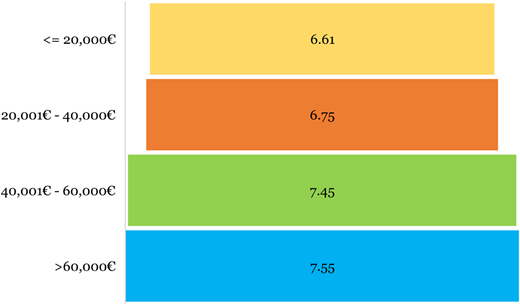
The first question in this section investigated how respondents perceived the effect of aggregations among pharmacies on the well-being of the community (Figure 1). The overall mean score was 6.83 out of 10, indicating a moderately positive assessment. Based on income, there is a clear trend: those who earn more express higher evaluations, with the average rising from 6.61 in the 0–20 k€ range to 7.55 over 60 k€. The differences between the lowest and highest income brackets are found to be statistically significant (Kruskal–Wallis test, p = 0.0017). Higher income brackets may show greater familiarity with collective welfare and corporate welfare initiatives, as well as greater reliance on more structured business models such as holding companies: often those with greater economic resources tend to take a more strategic and long-term oriented view (de Bruijn and Antonides, 2022).
The main question in this section aimed to assess the importance attached by consumers to the motivations for a partner to join a pharmacy holding. Participants expressed generally high scores on all seven proposed motivations, with averages above 7, indicating a positive and knowledgeable perception of the strategic reasons behind the project (Tables 1 and 2). Among the motivations, reducing the cost of purchasing merchandise scored the highest (8.34), followed by new business opportunities (7.96) and reducing administrative costs (7.78), underscoring the importance accorded to economic and growth aspects. Motivations such as staff efficiency (7.25) and lifestyle choice (7.51) were considered relevant but less central than economic performance.
From a sociodemographic perspective, there is an increase in the valuation of these motivations with increasing age and income. In particular, those over 40 and those with incomes above 60,000€ tend to give higher scores, especially on cost reduction and new business. Statistical differences (Kruskal–Wallis test) confirm different perceptions, especially in evaluations related to lifestyle choice and cost reduction, with younger and lower-income clusters showing a more limited understanding of organisational dynamics, perceiving business aggregation as more impersonal and focused solely on business. From a graphical point of view, yellow indicates the results with the highest values, while blue indicates those with low values. Green indicates where statistically significant differences have been found.
The questionnaire investigated the main motivations for people to go to the pharmacy, asking them to rate the importance of various services offered. The results, shown in Tables 3 and 4, show that the purchase of drugs – prescription and non-prescription – is by far the predominant motivation. At the tail end of the ranking are consultation services (either through machines or with health care personnel) and booking visits through centralised booking system (CUP), indicated as less-frequent motivations.
Analysis by gender shows significant differences on two dimensions. Women place significantly more importance on the purchase of personal care products, as confirmed by the Mann–Whitney test, than men, for whom the figure is nonetheless increasing. A second significant divergence is recorded for the purchase of veterinary products, where ratings differ between the two genders in a stable manner.
Lower-income clusters maintain a consumption profile in line with the overall average, but place greater importance on counselling services (both automated and human). The higher income clusters, on the other hand, show a strong preference for personal care and veterinary products, suggesting a different orientation in consumption, more focused on quality and discretionary spending.
The survey investigated how important it was to the consumer that the desired product be immediately available (Table 5). The responses collected clearly show how crucial this factor is considered by a large part of the population, regardless of demographic or socioeconomic profile. Regarding the income bracket, the difference is significant (Kruskal–Wallis, p-value = 0.0419). The highest income cluster is the least willing to accept the unavailability of a product, followed by the lowest income cluster. In contrast, the middle cluster (40–60 k€) is more tolerant. In the case of the low end, less patience could be related to a combination of factors, including a younger average age (and thus a habit of faster consumption patterns) and greater attention to time management, often influenced by work or family constraints. In the case of the high end, the importance attached to availability probably reflects higher expectations about service, linked to a greater shopping experience in settings with higher performance standards.
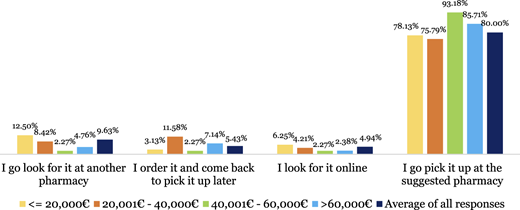
The next question asked what the consumer would do if he or she did not find the desired product available, followed by a second question introducing the certainty of product availability in another pharmacy in the same municipality/neighbourhood. In the first case, the options proposed were: (1) look for the product in another pharmacy, (2) order it and return to pick it up and (3) search for it online. The second question kept the same choices, but added another choice: (4) go directly to the reported pharmacy equipped with the product (Figure 2).
In terms of gender, a consistency emerges with what has already been shown in the previous responses: men are more inclined to search for an alternative immediately, while women are more inclined to choose ordering with later pickup, preferring a safe and planned solution. Finally, with regard to income, interesting dynamics emerge. Consumers with incomes between 40 and 60 k€ turn out to be the most willing to look for the product in another pharmacy from the first application, while those in the 20–40 k€ range prefer to order it, probably as a matter of convenience and time management. When the information on certain availability is introduced, all income clusters lean strongly towards this option, but with different intensities. The intermediate clusters (40–60 k€) show the greatest enthusiasm towards the efficiency of the service, while the lower income groups seem less likely to change habits based on new information.
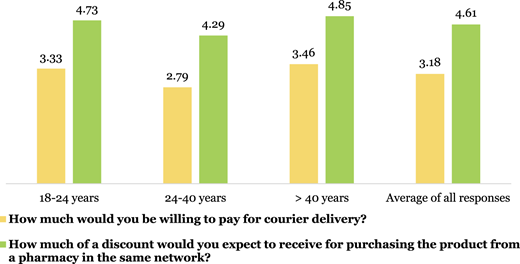
The survey analysed economic aspects investigating the consumer’s willingness to pay (WTP) in two different but complementary contexts (Figure 3): the first one concerns the maximum amount one would be willing to spend for home delivery on an expense of up to 50€, while the second one concerns the discount value required to go to another pharmacy in the same network if the product was not available in the one initially visited.
In all clusters analysed, a marked difference emerges between the two responses, with the payment threshold for delivery systematically lower than the discount requested, confirming that the incentive required to physically move is perceived as more onerous than payment for a service that avoids inconvenience.
The average value that consumers would be willing to pay for home delivery stands at 3.18€. The 25–40 year-old cluster appears to be the least willing to pay for this service (2.79€), perhaps due to a greater propensity for mobility or autonomy in purchasing. As for the minimum discount required to move to another pharmacy in the cluster, the average value is 4.61€, with the absolute maximum reached by the intermediate-income cluster (40-60 k€), which requires an average of 5.50€, or about 10% on a 50€ expenditure, while the minimum is again detected among the 25–40 year-olds (4.29€), consistently less demanding on this front as well. This result suggests relevant managerial implications. The fact that the WTP for the delivery service is lower than the discount required to switch pharmacies indicates that such a service could be employed as a strategic lever. The collected data, in fact, provide the basis for hypothesising shipping pricing policies in the event of an expansion into the online market. Moreover, operational management could be supported by loyalty mechanism, such as awarding additional points for in-store pickup or offering a compensatory discount when a product is temporarily unavailable, with the aim of partially sacrificing the unit margin while minimising the cost associated with stockouts.
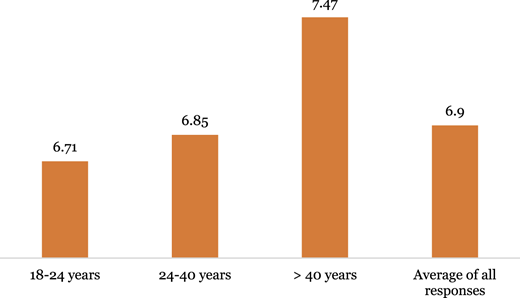
The questionnaire asked how much the consumer felt more inclined to buy from a group of pharmacies, i.e. a holding company, to investigate the perceived potential impact of creating a structured network on purchasing behaviour. The overall average rating was positive at 6.9 out of 10 (Figure 4).
From an age perspective, all clusters show a positive tendency towards buying from a holding company, but it is the oldest cluster that shows the most pronounced inclination.
This could be explained by the fact that older consumers tend to value solidity and continuity of service more, perceiving the cluster as a guarantee of reliability and competence, elements that are particularly sought after when it comes to health care.
Finally, the questionnaire investigated what benefits consumers perceive in buying from a pharmacy belonging to a group (Tables 6 and 7). Analysing the responses by age group, a clear trend emerges: as age increases, so does appreciation for the benefits associated with a group pharmacy, particularly with regard to loyalty and price reductions, which are most highly recognised in the over-40 cluster. In contrast, younger people show a more superficial involvement and weaker perception of the benefits associated with holding, consistent with their lower propensity for structured purchasing observed in other questions.
On the income side, there are marked differences. Those with higher incomes (over 60 k) show themselves to be very sensitive to product availability and price reduction, but less interested in consultation services, probably because they already turn to private facilities for these needs. In contrast, those who belong to the lowest cluster (0–20 k) show a more balanced attitude, attaching importance to both convenience and services, while the middle cluster (40–60 k) turns out to express the absolute maximum value on price reduction, suggesting that even in the mid-to high-end, economic leverage remains crucial. The Kruskal–Wallis test reported statistically significant differences in precisely two areas: loyalty, between the lowest and highest income clusters, and price reduction, between the lowest and highest income clusters.
4. Discussion
The analysis conducted highlights how the aggregation of pharmacies into a holding company, while offering concrete and perceived advantages in terms of management efficiency, cost reduction and development opportunities, is met with mixed reactions among consumers.
It is clear that the strategic effectiveness of the holding company is more evident in the physical context than in the digital one. This is confirmed by user behaviour when a product is unavailable: the majority choose the option that guarantees availability at another physical pharmacy rather than purchasing online. Customers, therefore, seem to value the speed and security of local services over the flexibility of the digital channel. As a result, the physical network remains the main channel on which a holding company should build its identity and differentiation.
The need to create an online sales model, which arose in the post-pandemic period, has translated into opportunities (Ying et al., 2021), as it improves the accessibility and efficiency of healthcare (Fan and Ukaegbu, 2024). The market share using it is no longer negligible (Jairoun et al., 2021) and is constantly growing, especially in markets such as cosmetics (Almeman, 2024).
The bond of trust between customers and pharmacists becomes a very difficult issue to manage online (Ersöz et al., 2023), where there is no direct interaction, but it remains a market with very high potential. Although online pharmacies were not the topic of the study, it is worth mentioning them and commenting that the sample considered in the questions did not show a tendency to follow European and global trends in online sales.
Expanding into the online channel could offer the holding the opportunity to further increase the reach of its services, strengthen brand positioning and enhance customer loyalty through digital tools. However, fully seizing these opportunities will require significant investments in digital infrastructure and staff training, in order to bridge existing technological and skills gaps within the organisation. Another critical issue concerns the management of the trust-based relationship between pharmacists and customers, which may weaken in the transition to digital, as well as the need to ensure high standards of security and privacy protection, particularly regarding sensitive health data.
Furthermore, it appears that shifting customers towards remote purchasing would lead to a loss of the holding company’s territorial coverage advantages on the local market, as well as giving rise to new issues relating to privacy management (Sampene et al., 2024). For our sample, the issue of trust and personal interaction is still too important for a complete clinical picture to be understood.
Another strategic finding concerns the discrepancy between corporate motivations and consumer perception. The criteria most appreciated by the public are tangible ones – price, availability and distribution – while aspects such as the “lifestyle choice of the pharmacist”, staff efficiency and service improvement, although fundamental in terms of sustainability and internal motivation, are secondary in external perception. This gap suggests the need for greater transparent communication focused on the qualitative value of the work carried out within the aggregated pharmacies, in order to strengthen the link between the company and the customer on the basis of values and not just economic considerations.
The link between the company and its customers is represented by the pharmacist, and this aggregation can lead to services that are more tailored to customer needs, thereby increasing the level of personalisation of the service (Fares et al., 2025). The distinctive skills of a company are intrinsic to the service offered by pharmacists (Deloitte, 2020), and they fill the perceived gaps in the national healthcare system (Schommer et al., 2018). In the IASO model, pharmacists become managers, a role that is unusual for people with this qualification but which provides perspectives geared towards patient well-being (Mayimele et al., 2023).
Pharmacists can be used by the company as a means of gaining a pragmatic view of the needs of those requesting the service, on which to base a strategy that truly puts customers at the centre.
Community-led initiatives contribute to the achievement of the SDGs (Henfrey et al., 2023), and sustainable communities overcome individualism by basing themselves on a collective mission: maintaining a balance between respect for past generations and trust in the potential of new ones. At the heart of this is a conception of sustainability as an altruistic philosophy that goes beyond rhetoric and greenwashing to translate into concrete actions, actively involving stakeholders (D’Adamo, 2025).
The issue of sustainability is impacting the healthcare supply chain. Pharmaceutical companies should cultivate a customer-centric culture that prioritises understanding and satisfying customer needs by adopting green innovation strategies (Chen et al., 2024). Community pharmacists play a key role in promoting public health thanks to their frequent interaction with patients (Al-Kubaisi et al., 2025). It is therefore clear that a sustainable vision is not just about adopting environmentally friendly sourcing practices in pharmacies, but also about strengthening commitment to the local community (Derqui et al., 2021).
This study also aims to fill a gap that seems to be emerging: a focus on strategies and management in the pharmaceutical sector (Srivastava, 2012; Vlados, 2019), which is characterised by significant profits, but less attention to pharmacies, which are only part of this supply chain. The context of sustainable development highlights the need to assess the biodiversity perspective, which can link health services to local resources, traditional knowledge and environmental sustainability.
In a context of globalisation, where large organisations could compromise the survival of smaller groups, it is essential that they reorganise themselves while maintaining their identity. This emerging strategy is based on skills, with pharmacists returning to focus on technical skills and leaving management tasks to more specialised figures, resulting in a social benefit as new employment opportunities are created. A potential environmental advantage could be to move forward only with the certainty of having a product. Future developments could include an app used mainly by young people that indicates which pharmacies in the holding company to go to. IT support would have costs, but would be part of the long-term strategy.
In a broader view, the evolution of the pharmaceutical sector should also be analysed from the perspective of a biodiversity-based entrepreneurial ecosystem capable of promoting innovation, local participation and sustainable development. This approach highlights the importance of creating a favourable environment in which pharmacies – especially those deeply integrated into the local community – can grow not only economically, but also socially and environmentally.
From this perspective, the aggregation of pharmacies can also be interpreted as contributing to the creation of sustainable ecosystems, in which healthcare, social cohesion and environmental responsibility are interdependent. By strengthening the role of local pharmacies within the community, the holding structure promotes resilience and equitable access to healthcare services, reducing inequalities and supporting well-being at the local level. Furthermore, the integration of digital and physical channels, if guided by sustainable principles, can generate synergies that strengthen both the economic profitability and long-term sustainability of healthcare ecosystems.
5. Conclusions
5.1 Consumer behaviour in pharmacy chains: a data-driven perspective
The numerical results show that the opinion that pharmacy chains support collective well-being (6.8 on a scale of 1–10) is moderately important, particularly for those aged over 40 and with high incomes, on a par with buying from a group of pharmacies (6.9), thus demonstrating an openness without ideological barriers. Citizens state that if a product is not available in two-thirds of pharmacies, they go to another pharmacy (62.5%), but almost all of them are willing to go to the pharmacy indicated if they are assured that the product is available (80%). An economic dimension also emerges, which clearly tends to motivate various choices proposed in the questionnaire. Consumers believe that the main advantages for pharmacists in joining a holding company are economic: lower purchase costs (8.3) and business opportunities (8.0). Although they do not tend to buy online, if the product is delivered to their home, they would be willing to pay 3.20 € for delivery, which is less than the 4.60 € discount they would expect if they went to the designated pharmacy. Women tend to ask for a bigger discount, while the 25–40 age group asks for lower discounts for both economic questions. The other key parameter is product availability (9.1). This figure is linked to the previous one, as the reasons why citizens would go to the pharmacy indicated are product availability (8.3) and lower prices (8.1), both of which are more pronounced in the >40 age group and in terms of price reduction with higher incomes. The reasons why citizens go to pharmacies are to purchase prescription and non-prescription medicines (8.7), and the other item that exceeds a rating of 6 is parapharmaceuticals. However, there are some special cases: women, those aged over 40 and those with high incomes also pay attention to personal care, and those with high incomes also pay attention to veterinary products.
These differentiated behaviours confirm that pharmacies, especially when organised in holdings, can act as nodes of a broader sustainable ecosystem, fostering inclusive access to healthcare while adapting services to diverse community needs.
5.2 Entrepreneurship ecosystem
These findings highlight the potential to develop a pharmaceutical entrepreneurship ecosystem rooted in biodiversity – a network of pharmacies, professionals and stakeholders capable of responding to local health needs, economic drivers, and consumer preferences through innovation, cooperation and territorial integration.
A biodiversity-oriented entrepreneurial ecosystem promotes the integration of traditional knowledge, personalised care and ecosystem services into pharmaceutical practices, thereby contributing to the improvement of public health and the preservation of natural capital. In this direction, pharmacies can become true strategic players, not only within the healthcare system, but also in the broader ecological and social context of the communities in which they operate. Such an ecosystem can foster synergies between stakeholders, enhance the value of aggregation and promote a human-centred approach aligned with evolving social and health needs. In this perspective, ecosystems oriented towards sustainable development can be seen as “communities-as-a-service,” capable of engaging and aggregating diverse interests to generate shared value and long-term resilience.
5.3 Policy implications
Holding company pharmacies represent a significant evolution in the healthcare system, introducing greater efficiency and wider availability of products. Citizens view this model with interest, but some critical issues remain that require attention. Political support is therefore needed to guide the change, avoiding new inequalities and preserving the proximity function of pharmacies. Aggregated models should be supported above all where they can improve access to services, particularly in peripheral or underserved areas. However, it is essential that they remain accessible to the most vulnerable sections of the population. Public communication also needs to be strengthened: many citizens are unaware of the organisational benefits of these groups and their potential contribution to the healthcare system. This unawareness also highlights the need to frame holdings as part of a sustainable healthcare ecosystem, where efficiency and social equity are pursued together. Finally, it is crucial to enhance the role of pharmacists by investing in training and local roots. It is therefore necessary that policy, in facilitating private investment, preserves the ethical and healthcare and educational purpose of pharmacies (understood as healthcare facilities and not as businesses), involving pharmacists more closely in order to understand whether holding companies are pursuing social welfare.
5.4 Managerial implications
Pharmacy holding companies are creating new management challenges. Citizens appreciate a more efficient organisation, but continue to expect a human, personalised and local service. For managers, this means investing in staff training, focusing on the customer experience and striking a balance between standardisation and customisation. Effective communication of the advantages of the aggregate model can also strengthen trust and promote customer loyalty. Finally, the process of centralising holding companies must remain partial, encompassing the know-how and relationships established in the local area by each individual pharmacy, because organisational innovation can only succeed if it stems from a solid and ongoing relationship with the local community. In this perspective, the managerial challenge is not limited to efficiency, but extends to the design of service models that actively contribute to sustainable healthcare ecosystems, integrating economic, social and territorial dimensions.
5.5 Limitations and future directions of research
Although it offers useful insights, the analysis has some limitations. The first is that the observations obtained in this study depend on the sample interviewed. The second concerns the data collection method, which could involve live experiments. Furthermore, the economic data should be investigated, as it is clear that citizens have a positive perception of going to the indicated pharmacy; however, the economic discount requested could generate a wait that is not considered appropriate by the pharmacists belonging to the holding company, thus generating an effect opposite to customer loyalty. Future research could include a systematic comparison of different organisational models (e.g. independent pharmacies vs. pharmacy holding companies) and define how these new organisational forms can support the creation of sustainable communities by balancing the interests of various stakeholders. Overall, these findings offer practical guidance for managers and policymakers, helping to balance efficiency with citizens’ trust and social sustainability. Furthermore, the strategic value of customer loyalty emerges strongly in the more mature and affluent clusters, signalling an opportunity to invest in personalised and long-lasting loyalty programmes. The analysis contributes to the achievement of SDG 3, promoting more efficient, widespread and inclusive access to healthcare services through the holding pharmacy model.
Appendix
Section 1 – Sociodemographic data
Age: ________
Gender:
☐ Male ☐ Female ☐ Prefer not to answer
Gross annual income:
☐ 0–20.000€
☐ 20.001–40.000€
☐ 40.001–60.000€
☐ >60.000€
Section 2 – Entrepreneurs’ Perspective
How important do you think it is for groups of multiple pharmacies to support collective welfare?
(Scale from 1 = not at all important to 10 = very important)
How important were the following motivations for getting a member to join IASO?
(Scale from 1 = not at all important to 10 = very important)
☐ Improved customer service
☐ Reduction in purchasing costs
☐ Reduction in administrative costs
☐ Staff efficiency
☐ Opportunity for new business
☐ Brand development
☐ Lifestyle choice
Section 3 – Customer Perspective
For what reason do you go to the pharmacy? (Scale of 1–10)
☐ Purchasing prescription/without prescription drugs
☐ Purchasing parapharmacy products
☐ Booking CUP visits
☐ Personal care
☐ Foods for intolerances/allergies
☐ Veterinary products
☐ Consultation by machine
☐ Human consultation (e.g. nutritionist, dermatologist)
How important is it for you to find the product right away?
(Scale of 1–10)
If the product was not available, what would you do?
☐ I would order it and return
☐ I look for it at another pharmacy
☐ I look for it online
If you were told it was available at another pharmacy in the municipality/neighbourhood, what would you do?
☐ I order it and return
☐ I pick it up at the indicated pharmacy
☐ I look for it at the nearest one
☐ I would look it up online
How much would you be willing to pay for home delivery on an expense of up to 50€?
______ €
How inclined are you to purchase from a group of pharmacies?
(Scale from 1 = not at all to 10 = always)
What benefits do you perceive in buying from a pharmacy in a group?
(Scale of 1–10)
☐ Increased product availability
☐ Loyalty
☐ More human services (e.g. consultations)
☐ More instrumental services (e.g. measurements)
☐ Reduced prices on some products
☐ Greater outreach throughout the territory
How much discount should be applied to persuade you to buy from another network pharmacy?
______ %