

This study aims to investigate which factors are associated with the willingness of employers to hire people with disability from the perspective of disability employment service providers. We also identify social marketing approaches that disability employment service providers consider to be most effective in increasing employer willingness to hire people with disability.
Using the framework of the theory of planned behavior, this study examines the association of attitude, subjective norms and perceived behavioral control with employer willingness to hire people with disability. The authors do this from the perspective of disability employment service providers, who are responsible for matching people with disability with suitable employment opportunities. The authors used a qualitative approach to data collection and conducted 30 in-depth interviews. Data analysis included deductive and inductive coding to develop the themes and subthemes.
Attitude, subjective norms and perceived behavioral control were all perceived to influence employers’ willingness to hire people with disability. However, the importance of each construct was perceived to differ by location and organization type. Three key social marketing approaches were perceived to be most effective in increasing employer willingness to hire people with disability: educational, relational and interactive. The educational intervention attempts to increase employers’ knowledge about disability, the relational approach aims to develop relationships within the community to strengthen relationships with employers and the interactive approach involves direct contact between employers and people with disability.
Theoretically, this study reveals perceived heterogeneity in terms of the theoretical constructs that are employer hiring decisions. Practically, results help disability employment service providers design social marketing strategies that are effective in reducing barriers and increasing employment for people with disability. Methodologically, this study adds a new perspective on employer willingness to hire people with disability – that of disability employment service providers – which avoids the social desirability bias found in many self-reported studies of employer attitudes and behavior.
Introduction
More than one billion people across the globe have disability (United Nations Department of Economic and Social Affairs, 2021). People with disability represent 14%–20% of the population of developed countries (Organisation for Economic Co-operation and Development, 2003). People with disability are twice as likely to be unemployed than people without disability (The United Nations Department of Economics and Social Affairs, 2018), putting them at a higher risk of living in poverty or lacking access to adequate health care (Pinilla-Roncancio and Alkire, 2020).
The inclusion of people with disability in the labor market provides benefits not only for the person with disability but also for employers and the economy (Australian Human Rights Commission, 2021). The benefits for individuals with disability include achieving economic sufficiency, a strong sense of identity and better quality of life (Livermore and Honeycutt, 2015; Sundar et al., 2018). Benefits for employers include having access to a diverse talent pool and increasing workplace diversity and productivity (Ameri et al., 2017; Graffam et al., 2002; Lindsay et al., 2018). Economic benefits include increased labor force participation and reduced government welfare expenditure (Goodman and Stapleton, 2007; Roeske, 2002).
Social marketing uses marketing techniques to achieve desirable social change (Donovan, 2010), such as greater inclusion of people with disability in society. Social marketing campaigns which have aimed for greater inclusion of people with disability include the “Time to Change” campaign in the UK (Henderson and Thornicroft, 2013) and the “Like Minds, Like Mine” campaign in New Zealand (Vaughan, 2004). Evaluations of these campaigns reported that people with disability experience a significant reduction in discrimination (Randle and Reis, 2016).
The challenge of increasing employment for people with disability can be considered a social marketing challenge because it relies on changing the attitudes and behaviors of individuals to be more inclusive of people with disabilities in the workplace. This is increasingly being recognized and new programs are emerging that take a social marketing approach to develop strategies to achieve this (Cruz-Morato and Dueñas-Zambrana, 2021; Gil Guzman et al., 2021). Examples include “Don’t be my limit!” and “Working is a story” campaigns to promote the employment of people with disability in Spain (Cruz-Morato and Dueñas-Zambrana, 2021). Both campaigns reported a positive shift in employers’ willingness to hire people with disability (Cruz-Morato and Dueñas-Zambrana, 2021). Employer attitudes have been a major focus of social marketing campaigns which aim to increase labor market participation for people with disability (The European Commission, 2021). This is because employers’ unfavorable attitudes are often reported to be a major barrier to the inclusion of people with disability in the labor market. Therefore, changing attitudes is considered imperative to ultimately changing hiring behaviors (Idle et al., 2022).
The extant literature on the employment of people with disability largely focuses on either the perspective of employers (Chan et al., 2010; Irvine, 2008; Rimmerman et al., 2013) or the perspective of people with disability (Baker et al., 2018; Castillo and Larson, 2020). Few studies have considered both perspectives, or the potential discrepancy between studies that report employers’ views, which typically report positive employer attitudes, and studies that report the perspectives of people with disability, which typically report negative employer attitudes. In addition, limited studies have empirically examined the effectiveness of job placement strategies used by disability employment service providers, although they often play a central role in achieving successful employment matches (Simonsen et al., 2011). The present study contributes to knowledge of employer willingness to hire people with disability by examining the perspective of disability employment service providers. Insights can be used to inform the development of evidence-based social marketing approaches that improve employers’ willingness to hire people with disability.
Literature review
The perspective of employers
The literature on disability employment reports various barriers to hiring people with disability. Studies of employers identify attitudinal, socio-ecological and organization structural factors that influence employers’ willingness to hire people with disability (Bonaccio et al., 2020; Burke et al., 2013; Houtenville and Valentini, 2014). Attitudinal factors can be seen in cases of employers who have had meaningful contact with someone with disability, such as a positive prior hiring experience, and report being more likely to hire someone with disability in future. They also report more favorable attitudes toward people with disability, especially in terms of their perceived work ethic (Ju et al., 2013). Employer attitudes towards the nature and severity of disability can also influence their willingness to hire a person. Employers report a greater willingness to hire someone with a physical disability than someone with an intellectual disability because of negative stereotypes such as people with intellectual disability being unpredictable (Bricout and Bentley, 2000).
Organization structural factors include organizational characteristics such as size and financial resources which can influence employers’ perceptions of their ability to hire people with disability (Chan et al., 2021). Employers in small organizations report lower willingness to hire people with disability because of the perceived financial costs associated with any workplace modifications that may be required to accommodate them (Murfitt et al., 2018). Socio-ecological factors include contextual social norms which influence hiring decisions, such as workplace cultural norms and broader community attitudes and expectations regarding the inclusion of people with disability within society. For example, employers report being influenced by the attitude of their staff toward coworkers with disability because they fear potential disruption to established workplace dynamics (Bonaccio et al., 2020). Most research considers employers as a homogenous group with little attention paid to heterogeneity among employers in terms of differences in their willingness to hire people with disability (Randle and Reis, 2016).
Employers’ self-reported attitudes toward hiring people with disability are often relatively positive (Copeland et al., 2010; Hartnett et al., 2011; Jasper and Waldhart, 2013; Nota et al., 2014). Yet, empirical studies of employer behavior reveal that employers are less likely to hire someone if they disclose disability in their job application (Ameri et al., 2017; Hernandez et al., 2000). It has therefore been concluded that employers’ self-reported acceptance and willingness to hire people with disability may be an artifact of social desirability bias (Araten-Bergman, 2016).
The perspective of people with disability
Compared to studies of employers, people with disability are more likely to report negative employer attitudes as a long-standing barrier to workforce inclusion (Ameri et al., 2017; Hernandez et al., 2007; Sundar et al., 2018). Unfavorable employer attitudes are commonly informed by misconceptions about the ability of people with disability (Kaye et al., 2011; Sundar et al., 2018). They also stem from a lack of knowledge about disability-related matters, including how to best support different types of disability in the workplace (Darcy et al., 2016; Hogan et al., 2012). As a result, people with disability report feeling discouraged from seeking and maintaining employment because they feel undervalued and disrespected (Hernandez et al., 2007).
The perspective of disability employment service providers
The perspective of disability employment service providers features strongly in the area of workplace accommodations (Dong et al., 2013; Gold et al., 2012) and improving employment support services (Alberto et al., 2018; Butterworth et al., 2012; King and Waghorn, 2018). Yet, there is a lack of research on the actual practices used by disability employment providers to increase employer willingness to hire people with disability (Simonsen et al., 2011).
Approaches to achieving effective matches between employees with disability and employers have been described as “a combination of sticks and carrots” (Luecking et al., 2006,p. 3). For example, disability employment service providers may approach employers using employment subsidies (a “carrot”) or discrimination consequences for discrimination (a “stick”) (Gilbride and Stensrud, 1999; Nützi et al., 2020).
Theoretical framework
The theory of planned behavior postulates that any given behavior is influenced by three key constructs: attitude, subjective norms and perceived behavioral control (Ajzen, 1991). Attitude refers to beliefs about the outcomes of performing the behavior and the evaluation of these outcomes (Ajzen, 1991). Subjective norms refer to the perceived views of important others in relation to performing the behavior, and the individual’s motivation to comply with these important others. Perceived behavioral control refers to the perceived factors that facilitate or hinder the performance of the behavior, and the perceived strength of their impact on them personally (Ajzen, 1991).
The theory of planned behavior has been used to gain insight into behavior (Armitage and Conner, 2001) across a range of different contexts, including recycling behavior (Haj-Salem and Al-Hawari, 2021), organ and blood donation (Holdershaw et al., 2011), the use of bioplastic (Gutiérrez Taño et al., 2021) and vaccination (Twum et al., 2021). It has also proven useful in the context of investigating the employment of people with disability, including by the original theorist (Ang et al., 2015; Fraser et al., 2010). Using the theory of planned behavior, the present study investigates the perspective of disability employment service providers to answer the following research questions:
What are the perceived attitudes employers hold towards hiring people with disability, and what perceived factors are associated with these attitudes?
What are the perceived subjective norms that are associated with employers’ willingness to hire people with disability and what perceived factors are associated with these norms?
What are the perceived barriers and facilitators to employers being willing to hire people with disability, and what are the perceived factors associated with these barriers and facilitators?
What types of social marketing approaches are perceived to be most effective in increasing employer willingness to hire people with disability?
Materials and methodology
Research context
Following the international movement for disability rights, disability is no longer typically viewed as a medical abnormality. Rather, it is viewed in terms of the social and environmental barriers that hinder the daily lives of people with impairments (Oliver, 2013). Australia has taken formal steps to support the inclusion of people with disability, including the introduction of the National Disability Insurance Scheme (Australian Government, 2013). This scheme supports people with disability to live an ordinary life by giving them more autonomy and building their skills to participate in society, including employment (Macdonald and Charlesworth, 2016).
In 2016, a national inquiry sought to understand the barriers to employment for people with disability. The inquiry found that “employment discrimination against people with disability is ongoing and systemic”, and that this discrimination is “underpinned by negative assumptions and attitudes that are held by many employers and throughout the community” (Australian Human Rights Commission, 2016). As a result, Australia’s disability strategy 2021–2031 considered the increase in employment of people with disability as the first policy priority (Australian Government, 2021).
In Australia, a federally funded disability employment service program provides support to match people with disability with suitable employment opportunities. Under this program, not-for-profit and for-profit organizations provide support services to potential employees with disability (Carroll and Steane, 2005). Disability employment service providers are funded based on their success in matching people with disability with suitable employment. As such, providers are under competitive pressure to effectively market the employability of individuals with disability to employers and achieve successful job matches (Thornton and Marston, 2009). A star rating system measures the performance of individual disability employment service providers, with each rated from 1 star (poorest performance) to 5 stars (highest performance) (Australian Government, 2018). In addition, vocational support for people with disability is also provided by professional groups such as rehabilitation consultants. This group has specialist clinical expertise regarding the needs of people with specific disability types in a vocational context.
Sampling and recruitment
The population comprised 2,200 disability employment service providers in New South Wales, Australia (Department of Social Services, 2021). We used stratified random sampling to select a representative sample. Geographic location and star rating were used as stratification variables creating a sampling framework comprising 25 strata. Geographical location was classified based on the primary address of the disability employment service provider using the Modified Monash Model. The model is a geographical classification system based on population data that categorizes metropolitan, regional, rural and remote locations into seven levels according to geographical remoteness and town size (Australian Government, 2019)
Disability employment service providers were then randomly selected from each stratum. We contacted participants and invited them to nominate a professional in a role that involves matching people with disability to employment opportunities. In addition, we purposively included a small number of rehabilitation consultants to ensure that the specialist clinical expertise of this group was captured. For this group, professionals known to the researchers were invited to participate. As the participants’ roles are practically similar, we refer to the sample as a whole as “disability employment service providers.” The University’s Human Research Ethics Committee (approval 2018/332) provided approval for this research.
Data collection and measures
Data collection occurred between March and September 2021. The study adopted a qualitative approach using in-depth interviews because they involve interpersonal interaction that typically results in a greater expression of participants’ attitudes and beliefs (Gubrium et al., 2012). The interview guide included questions informed by the theory of planned behavior constructs (attitude, subjective norms and perceived behavioral control). We measured attitudes by asking about the kind of responses participants commonly received when suggesting to employers hiring a person with disability, and why employer attitudes were typically positive or negative. We measured subjective norms by asking participants about important others that employers consider when hiring someone with disability, what those important others typically thought and why. We measured perceived behavioral control by asking about the factors that participants perceive to make it easier or harder for employers to hire a person with disability. Finally, we asked participants about the types of approaches they found most effective in increasing employer willingness to hire people with disability.
Data analysis
We recorded the interviewees and transcribed the audio files. We used a deductive approach by predetermining primary-level themes using the constructs in the theory of planned behavior and the extant literature on social marketing approaches (Krippendorff, 2018). Then, we used inductive coding to derive subthemes (Chandra and Shang, 2019). Themes emerged by grouping similar responses on factors participants perceived to be associated with employer willingness to hire people with disability and techniques they used to increase employer willingness to hire (Chandra and Shang, 2019). Throughout the analysis process, we adopted a comparative thematic approach to ensure subthemes were repeatedly reviewed and validated (Miles et al., 2018).
Results
Sample description
In total, 30 individuals participated in the study. Participants represented organizations from metropolitan, regional and rural locations, and providers across each of the five-star ratings. Table 1 provides detailed sample characteristics description.
Sample description of the interviewed disability employment service providers
| Characteristics | N (%) |
|---|---|
| Organization characteristics | |
| Organization type | |
| Disability employment service provider | 25 (83) |
| Nondisability employment service provider | 5 (17) |
| Location | |
| Metropolitan | 11 (37) |
| Regional | 10 (33) |
| Rural | 9 (30) |
| Star rating* | |
| One | 2 (8) |
| Two | 5 (20) |
| Three | 7 (28) |
| Four | 6 (24) |
| Five | 5 (20) |
| Participant characteristics | |
| Gender | |
| Female | 17 (57) |
| Male | 13 (43) |
| Years of experience | |
| 0–5 | 14 (47) |
| 6–10 | 4 (13) |
| 11–20 | 3 (10) |
| 21+ | 9 (30) |
Note:
*Applies only to disability employment service providers
In this section, using the framework of the theory of planned behavior (attitude, subjective norms and perceived behavioral control), we first outline the perceptions of disability employment service providers regarding factors they perceive to be associated with employer willingness to hire people with disability. We then identify the social marketing approaches disability employment service providers have found most effective in increasing employer willingness to hire. It should be noted that while rehabilitation consultants’ perceptions focused more on the employment of people with disability as part of their rehabilitation process, the research team did not consider their overall perceptions of employers to be significantly different from those of disability employment service providers. For this reason, the findings reported in the following sections represent the perceptions of the entire sample of participants, although participant job functions are included at the end of each quote to provide context for the particular participant perspective being illuminated. Figure 1 is a graphical summary of the perceptions captured from disability employment services providers.
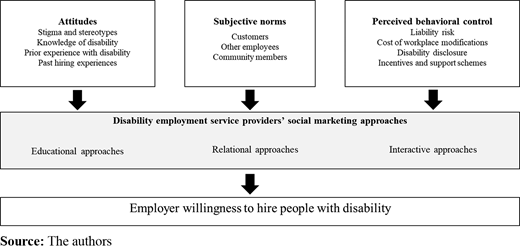
Graphical summary of findings of the disability employment service providers perceptions
Graphical summary of findings of the disability employment service providers perceptions
Employer attitudes
Disability employment service providers reported that employers are most concerned with finding the right person for the job. It is common for them to hold unfavorable attitudes toward using someone with disability in the first instance. The exception is when employers have a prior positive experience with a person with disability, in which case they are more likely to hold positive attitudes.
Negative attitudes.
Negative employer attitudes are typically related to stigma and stereotypes, or past negative experiences of people with disability. Stigma involves linking disability as an attribute to undesirable characteristics (stereotypes), such as not being able to perform job tasks. Participants reported having to deal with stigmatizing views of employers: “The word ‘disability’ gives people an instant, personal reflection on what they think that means, and it isn’t necessarily true to who we might be trying to market” [Employment consultant, disability employment service (DES) provider]. This perception suggests that employers’ interpretations of disability are strongly associated with attitudes toward hiring individuals with disability.
While stigma and stereotypes against all people with disability exist, they may differ based on the nature of the disability. Participants perceived that employers are often more favorable toward people with physical disability compared to mental illness or psychological disability. One participant explained that employers often express fear when asked to consider hiring a person with mental illness: “What happens if this person has a meltdown? What do you do?” (Employment consultant, DES provider). Participants reported that employers perceive that people with mental illnesses will be unpredictable in their behavior and work performance.
Participants believed that stigma is a result of a general lack of knowledge on disability: “lack of knowledge creates fear [.] and is probably the biggest hinder to employment” (Employment consultant, DES provider). Disability employment service providers try to address this knowledge gap by communicating to employers: “The benefits and abilities of people with disability rather than what they can’t do” (Area manager, DES provider). As long as employers lack knowledge of the benefits of hiring people with disability, it is likely that disability stigma and stereotypes will prevail and contribute to sustaining negative attitudes.
Participants reported that employers can develop negative attitudes toward hiring people with disability because of negative past hiring experiences. As a result, employers refrain from hiring applicants with disability again: “That one bad experience stands out more than 10 good experiences” (Manager, DES provider). The supportive role of disability employment service providers is perceived to be a key factor in providing positive (or negative) hiring experiences for employers: “what happened was the [disability employment service] provider opened the door, [.] then they didn’t know how to support that employer.” (Rehabilitation consultant).
Positive attitudes.
Participants reported that employers who expressed more positive attitudes toward hiring someone with disability typically had prior personal experience with people with disability. As one participant explained:
[…] [employers] feel that they’ve been well supported previously, and so they want to give back, or sometimes the opposite that they’ve really struggled, that friend, or contact and so they wanted to make a difference. (Rehabilitation consultant)
As a result, some employers are proactive in hiring people with disability:
[…] [one employer] saw our ad and thought that this was an opportunity where he could help someone because he knew another family friend had a young fellow with an intellectual disability. (Area manager, DES provider)
Subjective norms
Participants reported that employers hiring decisions are influenced by groups that participants perceived to be important to employers. The groups identified by participants are customers, other employees and the wider community.
Customers.
In customer service-based industries such as hospitality, employers are more likely to be concerned about customer reactions to employees with disability. When asked why employers feel this way, one participant stated: “I think because they worry about perception and how business is going to be perceived” (Chief operation officer, DES provider). Participants described the negative and positive influences of customer attitudes toward disability on hiring decisions. One participant described a job placement that was unsuccessful because of customers’ negative response to an employer’s hiring decision: “[one employer] said ‘our customers do not want people serving them and putting their groceries in the bags if they’re disabled’” (Employment consultant, DES provider). Conversely, another participant described a positive experience of customers supporting a local café that predominantly hired people with disability. As a result, other employers in that area became more proactive in hiring people with disability: “we actually saw a big increase in [employers] contacting us” (Regional manager, DES provider).
Other employees.
Organizational culture, particularly dynamics among employees, is perceived as a key priority for employers. Hiring people with disability can be viewed as a potential threat to workplace culture. This can involve other employees being uncomfortable around people with disability: “employers can be anxious about the other staff, and not sure how to treat another person with disability as a staff member” (Employment consultant, DES). It can also cause tension among employees if some employees perceive the productivity of the person with the disability to be lower than theirs: “sometimes the staff that is there will see that they’re getting paid the same amount as the person with disability, and yet they’re having to do more tasks” (Employment consultant, DES provider).
Community.
Participants explained that employers generally want to comply with community expectations. For example, employers in smaller communities are more willing to hire someone with disability because they like the community to view them as being supportive, especially where everyone knows everyone else: “there is probably more of a tendency to be supportive because small communities know a lot of people in their community” (Rehabilitation consultant). Participants perceive employers based in small communities to be more influenced by community attitudes, because of the desire to be perceived as “a good community citizen [.] followed by that sense of altruism or social justice or being a good employer” (Area manager, DES provider).
Perceived behavioral control
Factors perceived to prevent employers from hiring people with disability include the risk of liability and the cost of workplace modifications and reasonable adjustments. Factors perceived to support employers hiring people with disability include disability disclosure and incentives and support schemes.
Barriers.
Participants reported that a key concern for employers is the liability risk associated with a person with disability being injured at work. This is particularly the case for people who acquired their disability due to a workplace injury because employers fear that people with workplace acquired disability: “won’t be able to do the job, they will potentially injure themselves again, and then they could potentially have a workers’ insurance claim” (Rehabilitation consultant).
The potential cost of the workplace modifications required to accommodate an employee with disability is also perceived as a barrier for some employers. Costs may relate to the modification of physical premises or purchasing of customized equipment. Participants explained that employers commonly expressed concerns such as: “my place isn’t set up for this. I don’t have the facilities here. What things are they going to need? Any modifications? I think it’s going to cost me money” (Employment consultant, DES provider). There is a perceived lack of knowledge among employers regarding the schemes available to financially support workplaces that need modifications to make them accessible to people with disability, as explained by one participant: “most employers, unless they’ve been through the experience, don’t know those things exist until we talk about them” (Business development officer, DES provider).
Reasonable adjustments are another type of workplace modification whereby job tasks are modified for people with disability so they can perform job tasks. For example, employers can adjust working hours for someone with disability depending on their work capacity assessment. Participants noted that employers are often reluctant to implement reasonable adjustments, particularly if they involve reducing working hours or allocating time to train and support someone with disability:
[…] [employers] want somebody who can be seen as being able to do the role themselves independently and every single part of that role, rather than maybe just certain parts of it due to their disability (Workplace support consultant, DES provider).
Yet, participants reported that employers do express a willingness to negotiate reasonable adjustments if they believe that the employee shows a high motivation and willingness to work: “the employer said: “well if she’s excited. I’m excited’” (Area manager, DES provider).
Facilitators
People with disability who are referred to disability employment service providers are not obliged to disclose their disability to a potential employer. However, participants explained that when this happens it often results in unsuccessful job placement: “hand on heart, I tell you every nondisclosure [.] never works” (Regional manager, DES provider). Disclosing disability is more likely to lead to a successful job placement because it allows employers to understand an individual’s abilities and capacity to perform the role effectively, and therefore make an informed hiring decision: “they know exactly what that person will need, how they’ll need to be managed and what capacity they can work” (Employment consultant, DES provider). Participants perceived that encouraging potential employees to disclose their disability to employers is critical in alleviating employer concerns and enabling people with disability to “give advice to the manager on what they need to do and what kind of support they would appreciate in achieving best outcomes in the workplace” (Area manager, DES provider).
Participants reported that accessing incentives and support schemes such as wage subsidies can be a strong motivation for employers to hire someone with disability. This is because “the employer can see that there’s a benefit to them investing because it usually does take more time to establish an employment opportunity for someone with disability” (Rehabilitation consultant). In Australia, wage subsidies are often offered to employers for the first six months of the hiring period, and they help to hire people with disability. Yet, they do not necessarily guarantee job sustainability. Participants reported that some employers are only interested in the financial incentives:
At end of six months […] [employers] give us the excuse that the person wasn’t good at their job [.] or the job is no longer available. […] Then they approach a different provider and do the same thing.
This can have a significant negative impact on the employee, because “they sometimes think that they’ve been used” (Support worker, DES provider).
Social marketing approaches
The most common approaches used to increase employer willingness to hire people with disability can be grouped into three types: educational, interactive and relational.
Educational approaches.
Educational approaches refer to attempts to increase employers’ knowledge about disability: “we help them understand more about that disability and more about how employing that person could be of benefit to their business” (Rehabilitation consultant). Another way of addressing the knowledge gap is communicating messages using social media and televised advertisements, which often involve public figures and celebrities:
People like Dylan Alcott [a well-known Australian Paralympian athlete]. He has been quite outspoken about people with disability getting a job [.] A couple of years ago I would have said it was much harder to approach employers that didn’t know about that. (Employment consultant, DES provider)
Participants noted the need for messages to address common employer concerns: “there is not enough information out there for employers, regarding the disability schemes [.] I think that’s where more information needs to be put out there” (Employment consultant, DES provider). Message design should also account for the different types of disability to prevent reinforcing stereotypes and were critical of those they perceived as lacking in this respect: “it’s not giving the whole picture, it is just saying, ‘everyone that’s under disability employment agency must be exactly like that’” (Employment consultant, DES provider).
Interactive approaches.
Interactive approaches involve direct contact between employers and people with disability. For example, in-person interviews and work-based opportunities enable the person with disability to gain or demonstrate work skills. Such approaches are effective because they allow employers to directly observe people with disability in the work environment:
On a work trial they can get to see the person and get to know them and what they’re capable of, and then hopefully offer them a job if things are well.
This approach also helps applicants with disability to “gain skills or relevant skills. It can be an opportunity to help improve their work capacity” (Rehabilitation counsellor, non-DES provider).
Participants noted the effectiveness of the interactive approach with the hiring decision-maker in the business: “it can often be the gatekeepers that are the ones preventing the employers from even giving someone a chance” (Area manager, DES provider). This indicates that the successful placement of employees with disability can be influenced by which professional is contacted within the organization.
Relational approaches.
Relational approaches aim to develop relationships within the community to strengthen relationships with employers. This may include, for example, joining community-based networks to raise their profile and building rapport with employers. Highly recognized disability employment service providers in the communities are likely to have greater access to employment opportunities because they “understand what the opportunities are because [they] understand the community [.] use networks to try and identify opportunities” (Area manager, DES provider).
Relational approaches are used more in nonmetropolitan areas where there is greater reliance on word-of-mouth to assess the credibility of disability employment service providers. Building rapport with employers is critical in establishing professional networks, and if they failed to do so “it’s going to be a lot more negative reaction to when we contact them. So that’s why we really aim for that” (Employment consultant, DES provider).
Relational approaches often involve sustained contact between disability employment service providers and employers to advocate for hiring people with disability. One example is initiatives that involve employers with positive hiring experiences sharing their stories:
[…] some of them are really raw and they say, I was really nervous, I was scared, I didn’t know what this person, what impact they were going to have, [.] they share their experiences with others, and we believe that’s the best way. (Regional manager, DES provider)
This suggests that strong relationships with credible employers with positive hiring experiences can be highly effective in increasing willingness to hire people with disability.
Discussion and conclusion
The current study responds to recent calls for additional social marketing research in the area of disability (Gil Guzman et al., 2021). The key insights gained from this study are threefold. First, generally speaking, disability employment service providers report employer attitudes toward hiring people with disability as negative. This supports research which takes the perspective of people with disability and reports stigmatizing attitudes among employers (Ameri et al., 2017; Hernandez et al., 2007; Sundar et al., 2018), and contradicts findings of research which takes the perspective of employers who self-report positive attitudes (Copeland et al., 2010; Hartnett et al., 2011; Jasper and Waldhart, 2013; Nota et al., 2014). Second, sources of heterogeneity were identified which are perceived to influence employer willingness to hire people with disability, including organizational size and location. This is in contrast to much of the extant literature which only considers employers as a homogenous group (Randle and Reis, 2016). Third, disability employment service providers use a range of social marketing approaches to job-match people with disability with suitable employers. The selection of social marketing approaches changes, depending on factors such as employer size and location.
Theoretical implications
The present study uses the theory of planned behavior as a framework to examine the perspective of disability employment service providers on employer willingness to hire people with disability. Examining each theoretical construct separately revealed participant perceptions of attitude, subjective norms and perceived behavioral control all perceived to play an important part in employer willingness to hire. However, the constructs in the framework, are considered to have different levels of associations depending on the location and type of organization the employer is from. For example, disability employment service providers perceive subjective norms tend to have a greater influence on employer willingness to hire in regional and rural areas because the smaller communities are very positive about employers who are inclusive in supporting community members. In contrast, providers in larger cities are perceived to have weaker connections with their immediate community and are less concerned about the potential for negative word of mouth that might result from them being less inclusive. Differences were also perceived in relation to perceived behavioral control, with participants observing greater barriers to hiring for employers from smaller organizations. Such barriers include the cost of workplace modifications and liability risks which could be very costly for smaller organizations with fewer resources at their disposal. In contrast, participants perceived that larger organizations tend to have greater resources and are driven by more formalized diversity and inclusion policies.
The existing literature on employer willingness to hire people with disability typically considered employers as one homogeneous group. The present study suggests that the influence of attitude, subjective norms and perceived behavioral control may differ according to the characteristics of the employer’s organization and that in this respect we have identified heterogeneity among employers in the factors that may influence their willingness to hire people with disability.
Practical implications
Disability employment service providers perceive that most employers are not actively seeking to hire people with disability. Therefore, their role is essential to target employers, address their concerns and promote the abilities of people with disability using social marketing approaches. This could involve downstream social marketing approaches to address the specific barriers faced by an individual employer. For example, knowing that the perceived cost of workplace modifications is a concern of many employers, disability employment service consultants are in an ideal position to educate employers about the range of government financial support available to organizations to assist with the costs of any required modifications. They can also provide potential employers with examples of similar local organizations that were concerned about employee performance, but that have hired people with disability and experienced outcomes that exceeded their original expectations. This could include providing the contact details of managers within these organizations who can attest to their success in this regard. Failing to do so, employment rates of people with disability will remain unacceptably low. The skills and training of disability employment service providers in using effective social marketing approaches are key to positively influencing employers’ hiring decisions. This is supported by literature that suggests that transforming social marketing approaches to the disability sector, by trained disability employment consultants, is likely to increase the inclusion of people with disability in the labor market (Gil Guzman et al., 2021).
Midstream social marketing approaches (Russell-Bennett et al., 2013) could also be used, for example, by involving communities and business leaders with positive hiring experiences of people with disability to promote hiring people with disability. For example, creating community-based initiatives whereby communities are aware of, and have avenues to support, businesses that demonstrate socially responsible actions such as hiring people with disability. This could include listing supportive employers on publicly available websites and providing links to social media sites where members of the community can follow, like and share information about the organization within their own social networks. These types of approach support literature that highlights the positive effect of community-based approaches and citizen engagement in social marketing strategies (Lefebvre, 2013; The European Commission, 2021).
Disability employment service providers are not responsible for advocacy at the policy level, and therefore they do not tend to use upstream social marketing approaches. While financial support schemes are available to employers, disability employment service providers report that employers are often unaware of them or how to access them. This suggests that any upstream efforts should encourage the government to increase communications of such support schemes to ensure they reach and motivate employers.
Educational, relational and interactive approaches are the key social marketing approaches that disability employment service providers use to promote the potential of people with disability to employers. These types of approaches should inform the methods mix, which is an important part of any social marketing strategy and a key element of the social marketing benchmark criteria (The European Commission, 2021). The identified social marketing approaches are often not evidence-informed but rather guided by the practical experience of each disability employment service provider. In considering the most appropriate approach type, disability employment service providers should consider the characteristics of the labor market in their location. For example, providers in smaller nonmetropolitan areas may focus on using relational and interactive approaches targeting employers through community networks. These approaches can strengthen employers’ trust in disability employment service providers and challenge their stereotypes of disability. Providers in larger metropolitan areas may choose to use educational approaches which dispel myths and concerns employers may have when considering hiring people with disability.
Methodological implications
Disability employment service providers perceive that employers typically hold unfavorable attitudes toward hiring people with disability in the first instance, largely based on a lack of knowledge of disability and negative stereotypes. In a limited number of cases, employers do have a positive attitude right from the outset, but this is usually when employers have prior personal experience with people with disability. These findings provide some clarity regarding the conflicting findings of studies that report the views of employers, which typically report positive employer attitudes, and studies that report the perspectives of people with disability, which typically report negative employer attitudes (Bredgaard and Salado-Rasmussen, 2021; Gilbride et al., 2000; Hernandez et al., 2007; Hernandez et al., 2000; Ju et al., 2013; Smith et al., 2004). This disparity is likely due to social desirability bias on the part of employers who want to appear inclusive to people with disability. This finding suggests that some of the studies which include self-reported attitudes of employers may be questionable in terms of their validity and mask the true extent of discrimination faced by people with disability who want to work.
The contribution of the present study is providing the perspective of disability employment service providers on employers’ hiring practices and the challenges that need to be overcome to increase the inclusion of people with disability in workplaces. This perspective is widely missed in the literature on employers’ hiring practices of people with disability. Therefore, the study provides an alternative perspective that can be considered with other perspectives included in the literature.
Limitations and future research
The present study was conducted within one specific context of disability employment support in Australia. Despite the geographical limitation, findings can potentially be generalized in other countries with similar models of disability employment services and similar sociocultural and political characteristics, such as the Ticket to Work program in the USA (Social Security Department, 2022).
In addition, our study used an exploratory qualitative design. Further quantitative studies with larger samples of employers could quantify the number of employers who hold the different views identified in our study, although careful consideration should be given to managing the potential social desirability bias. Future research should also consider testing different social marketing messages with employers to identify which are most effective in increasing willingness to hire people with disability.
This research is supported by the Australian Research Council through the linkage projects scheme (LP 170100690).

