Structural Concrete 2009, 10, No. 3, 139–152.
Discussion
Matti Pajari, VTT Expert Services, Finland
Based on analytical, numerical and experimental work carried out in Europe it has been concluded that for slabs with flat webs, equation 6.4 of EN 1992-1-1 (Eurocode 2) considerably overestimates the resistance against web shear failure. More recently, similar experiences with the ACI code have also been reported (Hawkins and Ghosh, 2006). Now the authors have carefully analysed a great number of shear tests and it seems that they have observed the same phenomenon. Nevertheless, they conclude that there is no safety problem when using Eurocode 2. How is this possible?
The answer is simple: equation 6.2.a of Eurocode 2, which tries to simulate the bending shear failure, is over-conservative for short shear spans, at least when applied to vertical or almost vertical cracks as the authors seem to have done. This can be seen as follows. The authors' conclusion (c) states that ‘The failure mechanism predicted for the great majority of the specimens using “mean” values is failure at cracking bending moment (MRC).’ This means that when a flexural crack appears below the line load, Bertagnoli and Mancini consider the cracking load Fcrk,m equivalent to the failure load because the load corresponding to the predicted bending shear failure is still lower. This is illustrated in Figure 8 for specimen no. 15. Figure 5 shows that for the great majority of specimens, the predicted failure load Fvc,m has been lower than the experimental failure load Fu,exp. Since the real failure mode has been web shear failure (see the next paragraph) the failure load Fvc,exp corresponding to the bending shear failure modelled by equation 6.2.a must have been higher than Fu,exp. Using the notation of Bertagnoli and Mancini, it is possible to write Fvc,m < Fcrk,m < Fu,exp < Fvc,exp for the great majority of specimens, which means that equation 6.2.a is over-conservative.
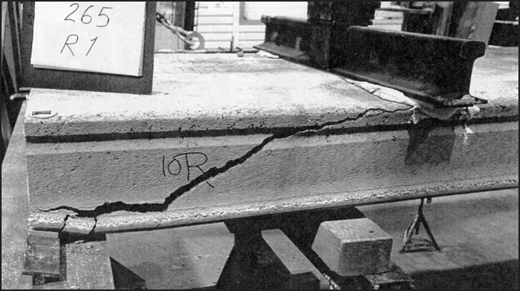
In the great majority of the specimens (maybe in all), the actual failure took place in the web close to the support, not below the line load as predicted by Bertagnoli and Mancini. Contrary to their claim, it is easy to distinguish between web shear failure and bending shear failure. Both are loud and dusty, but the latter type never happens without preceding wide cracks, which never close after the failure; also it seldom (never?) takes place in short shear spans of heavily prestressed slabs. The flexural cracking failure is also easily identified. Therefore, it is not justified to assume as Bertagnoli and Mancini have done that the reported web shear failures have been something else. This is the case at least for the 46 VTT slabs analysed by Bertagnoli and Mancini.
Bertagnoli and Mancini's multicriteria approach, as they call it, is not acceptable because it includes two poor criteria which hide the real failure mode and predict a failure mechanism and position of failure having nothing to do with the actual failure. Such design rules cannot be regarded as transparent, and it can only be imagined what their outcome will be in the education of the new professionals, in product development etc. To summarise, the study of Bertagnoli and Mancini makes the reader convinced that the shear design rules of Eurocode 2 need urgent updating. This need is confirmed by the fact that equation 6.2.a of Eurocode 2 is strongly non-conservative for long shear spans of heavily prestressed hollow core slabs.
Authors' reply
Gabriele Bertagnoli and Giuseppe Mancini, Politecnico di Torino, Italy
The authors of the paper under discussion have found many recent reports concerning experimental testing of hollow-core slabs in shear, but the conclusion that equation 6.4 of EN 1992-1-1 (Eurocode 2) considerably overestimates the resistance of hollow core slabs is not widely accepted as Pajari claims.
A more refined method to calculate uncracked shear resistance has been proposed by Yang (1994), but an overall approach to all the failure modes that can happen in shear in a prestressed structure has never been applied to hollow-core slabs.
The authors of the paper collected a wide range of experimental tests conducted on hollow-core slabs as routine checks for production quality. These tests were not made with the aim of investigating the ‘quality’ of expression 6.4 of EN 1992-1-1, but were standardised tests to check the support zone of the members subjected to high shear. Different slabs can fail in different modes under the same load test, depending on the shape and the reinforcement of the slab itself, and most of the tests were not specifically designed to research the failure mode of expression 6.4. The authors understand that many slabs can actually have reached failure with the 6.4 mode, but in most of the cases there was no experimental evidence in the reports, as only the ultimate load was given.
The considerations made by the authors were based only on the numerical values provided by the experimental test, not on the interpretations made by the tester, which on most occasions were not available.
The aim of the authors was not to investigate whether expression 6.4 was close to reality or not (they would have carried out an experimental study to achieve this conclusion). The aim of the paper was to investigate whether, by correctly applying the throughout design procedure for shear to the tested slabs, a proper level of safety for the experimental failure load could be reached. The conclusion of the authors was that all of the tested slabs had a design failure load lower than the experimental one, regardless of the actual failure mode. That means that the authors claim that all the tested slabs were safe if correctly designed according to Eurocode 2, taking into account different shear failure modes. Maybe expression 6.4 is not the perfect model for uncracked shear failure, but the overall safety of the structure is in any case reached.
In any case, the authors would like to re-confirm that in many experimental cases a snap-back phenomenon may appear: when the first bending crack arises, it is too small and lasts too short a time to be appreciated by visual inspection. Immediately afterwards, the failure mechanism of bending shear is activated and the well-known inclined crack characterises the end of the test, as described in the reports and pictures (when available) that accompany the tests.