Whether a human body has a healthy carrying capacity is calculated by body mass index (BMI). The BMI is found by dividing body weight in kilograms by the square of body length. If the person's body weight is more than the heaviness that the body can carry healthily, it is called obesity. Destinations have a specific area, just like a human body. Therefore, any destination whose carrying capacity is exceeded can be called an “obese destination”. This study's primary purpose is to reveal the importance of destination carrying capacity through the concept of obesity.
Content analysis, one of the qualitative research methods, was employed, and graffiti reflecting the feelings of the local people toward tourists were used as data. Graffiti was considered as a social carrying capacity indicator to identify obese destination symptoms. Fifty graffiti obtained from search engines about destinations with obesity problems were analyzed.
The study's findings reveal that anti-tourist graffiti indicates obese destination symptoms. Furthermore, when the content analysis of graffiti is examined, it is seen that the obese destination's local people have intense anger toward tourists. This is a clear manifestation of the destination's health deterioration.
This study, in which the concept of obese destination is used for the first time, suggests that destinations' health may worsen just like people. If destinations with over-tourism are called obese, a more expansive awareness will be created about the destinations' problems. The study suggests that nonecolabel can be used as a mandatory diet tool for obese destinations. Anti-tourist graffiti has been addressed as an obese destination symptom.
Introduction
In addition to the positive impacts of tourism to the destinations, there are also negative impacts (Archer et al., 2005). Tourism, which is welcomed due to its effect on enhancing welfare in the region, may later appear as an undesirable phenomenon. One of the biggest reasons why tourism is not desired in a destination is the problems that occur after exceeding the carrying capacity. Carrying capacities appear as physical, environmental, economic, psychological and social carrying capacities (Hall and Page, 2006; Holden, 2008). Each carrying capacity arises for different reasons. Each of the other forms of carrying capacity can affect the social carrying capacity. After the exceeding social carrying capacity, local people may have a negative attitude to tourists. These attitudes can be seen directly in the behavior of the locals and can manifest themselves by graffiti (Wetzel, 2011; Burgen, 2018; Canellas, 2017; Butcher, 2019). This study aims to show that graffiti, which indicates that the social carrying capacity is exceeded, is one of the indicators indicating the deterioration of destination health and calls these destinations obese.
Names assigned to that problem are used in the definition of health problems. Today, obesity describes people who weigh more than a healthy weight (Obesity, 2020). With the concept of obesity known worldwide, people know what kind of problem they face and know that they should limit their eating and drinking habits. Furthermore, through the obese destination used for destinations that exceed carrying capacity, it will be possible to create strong awareness that the pleasant effects of tourism cause deterioration in the destination.
Some destinations may ignore the problems caused by tourism because of its economic contribution. At this point, some obese destinations may not want to diet voluntarily. The concept of obese destination can be used as a nonecolabel for destinations that avoid adopting sustainable tourism and demarketing policies to recuperate. Thus, the demand will be reduced by environmentally conscious tourists. Thence, destinations will start a compulsory diet. The obese destination concept contributes to the literature as a new concept for destinations that have problems because of over-tourism. This study makes an obese destination classification based on the obesity classification of the World Health Organization (WHO) and Doxey's irritation index (1975).
Literature review
Each destination does its best to become one of the most preferred destinations. As long as tourism is one of the fastest-growing sectors globally, the increase and diversity in tourism supply seem to increase. Only extraordinary conditions such as economic crisis and epidemic diseases such as COVID-19 can stop this growth. This growth may cause problems besides positive contributions.
Although destinations want to host more tourists, they face a problem: capacity (carrying capacity). If not, we would not have to asked, “How many is too many?”/“What are the appropriate or acceptable conditions?” as McCool and Lime (2001) noted. Exceeding the destinations' carrying capacity can cause a problem such as the obesity problem experienced by people. Like the symptoms seen in people who have health deterioration, health deterioration symptoms are also seen in destinations. It is possible to read these symptoms in graffiti on obese cities' walls; “tourists back home”. The graffiti that shows the obesity problem in the destinations is a clear picture of a health deterioration of destination.
Whether a human body has a healthy carrying capacity is calculated by body mass index (BMI). The BMI is found by dividing body weight in kilograms by the square of body length (Hazell, 2020). If the person's body weight is more than the heaviness that the body length can carry healthily, it is called obesity (Obesity, 2020). Destinations have a specific area, just like a human body. Therefore, any destination that exceeds carrying capacity is an “obese destination”. Overweight and obesity are defined as abnormal or excessive fat accumulation that poses health risks (Klein et al., 2002). The BMI has been used extensively to measure overweight and obesity in adults (Khosla and Lowe, 1967; Cole et al., 1995). A BMI above 25 is considered overweight, and over 30 is deemed obese (Obesity, 2020). WHO classifies obesity as in Table 1 (James et al., 2001).
Like the human body, destinations can accommodate more than they can carry. This excess load damages the destinations just like the human body. Individuals with obesity problems must adopt a new lifestyle by changing routines to eliminate this problem. Obese destinations should adopt new methods to change the current situation, just like obese people. The best of these methods that can apply will undoubtedly be sustainable tourism policies. Therefore, the concepts of tourism carrying capacity and sustainable tourism become important. The World Tourism Organization (UNWTO) has defined tourism carrying capacity as “The maximum number of people that may visit a tourist destination at the same time, without destroying the physical, economic, socio-cultural environment and an unacceptable decrease in the quality of visitors' satisfaction” (Kennell, 2014 p. 1). Five types of tourism carrying capacity can be mentioned physical, environmental, economic, psychological and social (Hall and Page, 2006; Holden, 2008). While some of these carrying capacities can be observed, some of are perceivable characteristics. Therefore, it is possible to divide the carrying capacity into tangible, intangible and perceptual carrying capacity. While tangible carrying capacities are physical, environmental and economical, intangible and perceptual carrying capacities are psychological and social. These five carrying capacities are interrelated. However, limited exceed in any of them may occur without exceeding the other carrying capacity (Holden, 2008).
The physical carrying capacity is the number of tourists that a tourism destination can physically accommodate and is also defined as reaching the destination's physical capacity and not being able to host more tourists in the area allocated for tourism activities (Swarbrooke, 1999). According to another definition, physical carrying capacity is expressed as the maximum number of visitors that can fit into a physically defined area in a given period (Zacarias et al., 2011; Tejada et al., 2009).
The environmental carrying capacity is the starting point of damage to the region or ecosystem in any destination. It is also defined as determining the limits of possible effects on the environment due to tourism activities. Damage to the environment caused by tourism activities means exceeding the environmental carrying capacity (Swarbrooke, 1999; Hall and Page, 2006). Tourism has not only positive but also negative impacts on other sectors. For example, tourism, the driving force of airline transportation in some destinations, can be the killer of agriculture. It may cause the region's agricultural land and agricultural culture to decrease. Cessation of agricultural activities may cause environmental damage. For instance, terrace farming in Vernazza has been abandoned by some farmers due to the boom in tourism. And nature responded with a devastating mudslide and flood to the abandonment of terrace farming, which kept the soil in place (Sievert, 2021).
Although local people have an increased income with increasing tourism revenues, this high income is not at the same level for every local. Therefore, specific segments of the local population's purchasing power is decreasing. Locals can be tolerant of tourists until they face economic problems. The financial problems of local people caused by tourists reveal economic carrying capacity. Increasing prices for housing, land, rent and other consumer goods reduce the local people's purchasing power (Swarbrooke, 1999).
One of the difficulties destinations encounter in their life cycle is losing their attractiveness. The crowd- level tourists can tolerate before a destination begins to lose its beauty is called psychological carrying capacity (Saveriades, 2000). According to another definition, psychological carrying capacity is tourists' satisfaction level with the destination (Holden, 2008). Therefore, the destination's crowd is essential to tourists' satisfaction levels.
The social carrying capacity is the tolerance level of local people to tourists' presence (Lopez-Bonilla and Lopez-Bonilla, 2008). The negative social impacts that will affect exceeding this tolerance level can be listed as follows (Goeldner and Ritchie, 2009 p. 308): starting unwanted activities such as gambling, prostitution, drunkenness and other excesses, the so-called demonstration effect, racial tensions, development of a slave attitude by tourist business employees, loss of cultural pride, very rapid change in local lifestyles, low-wage and simple jobs. One of the best-known theories developed on tourism's socio-cultural effects is Doxey's Irritation Index (Doxey, 1975). Doxey proposed an index to explain residents' irritation toward tourists. The anger level is listed as euphoria, apathy, annoyance and antagonism. These levels are shown in Table 2.
Butler (1980) dealt with the processes happening at the destination similarly to Doxey (1975). According to Butler, when undesired carrying capacity is reached, the increase in number of visitors will decrease, and changes occur in environmental factors, physical facilities and social aspects. With the decrease in destination attractiveness compared to other destinations due to over-tourism, the number of actual visitors may reduce. The stages in this process, the destination's tourism life cycle are as follows (Butler, 1980):
Exploration: Discovering the destination with a small number of visitors.
Involvement: The start of the tourism development process, albeit at a small level, realizes the local community's tourism potential.
Development: The process of tourism investments begins. Some local people feel that they are excluded from the investments made.
Consolidation: The initial phase of mass tourism. Larger businesses are replacing small facilities. As a result, locals begin to feel the effects of the increasing number of tourists.
Stagnation: The process where the increase in the number of tourists stops and the destination's carrying capacity is reached. Local people have lost tolerance toward tourists.
Decline: Visitors start to move away due to tourism's harmful effects, causing problems in the destination. The anger of the local people is intense.
Rejuvenation: It is the process of creating complete change and innovation in tourism attractions to ensure the rejuvenation of the destination.
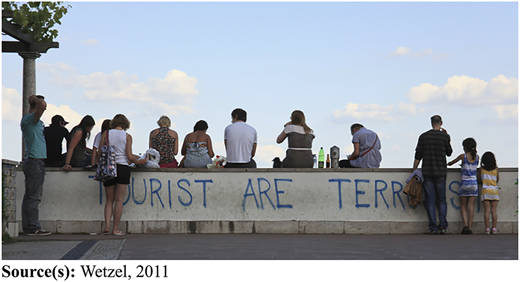
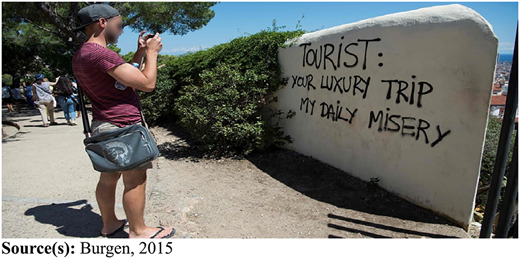
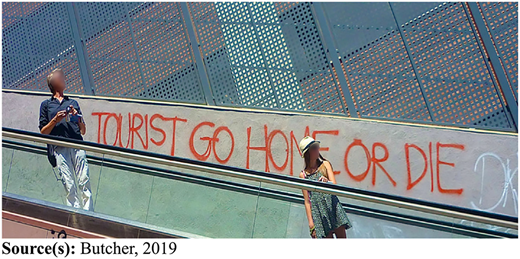
Locals can have a positive attitude toward tourists. However, tourists, who added color to their lives in the past, may become enemies that make their lives difficult later on. This hostility can be seen in graffiti and protests. There is graffiti on the walls and banners at demonstrations such as: “tourist, go home or die”, “this isn't tourism, it's an invasion”, “tourists are terrorists”, “tourist: your luxury trip my daily misery” (Wetzel, 2011; Burgen, 2018; Peter, 2017; Butcher, 2019).
The reaction to the unlimited growth of tourism caused the new term over-tourism and terms such as anti-tourism movements, tourism-phobia, tourist-phobia and overcrowding (Zemla, 2020). Over-tourism is a crowded tourist population that reduces the quality of life or experience for locals or tourists (Goodwin, 2017). After over-tourism in destinations, anti-tourism movements are seen (Karyotakis et al., 2019). Increasing social media shares is one reason for the tourist density in destinations (Oklevik et al., 2019). Efforts to create budget airlines and cruise ships are among the reasons for over-tourism. Flying to Barcelona for an amount equal to the amount paid for a pizza and a beer in the UK is possible, partly because of incentives (Francis, 2017). In recent years, changes in consumption-oriented attitudes have made the sharing economy an attractive alternative for consumers (Hamari et al., 2015). While Barcelona has an estimated 75,000 hotel beds, it is claimed that there are 100,000 rental property beds in total. Half of these rental property beds in Barcelona are rented through legal platforms such as Airbnb, while the other half are rented illegally (Plush, 2017). More than 2.5 million people stayed at properties booked on Airbnb on the 5th of August 2017. With four million properties in 191 different countries, it has more than the top five hotel chains' rooms (Cowen, 2017). Accommodation provided by Airbnb causes adverse effects on local people. These negativities drive local people to express their anger with graffiti (Tulke, 2020).
Many destinations host tourists many times more than their people. For instance, Dubrovnik, with a population of 42,000 in 2017, hosted 1.1 million cruise passengers and 1.2 million international tourists. However, with 4 million overnights, this tourist flow mainly occurs in four months, from June to September (Puljic et al., 2019). Ninety-eight destinations in 63 countries are faced with the problem of over-tourism (Francis, n.d.).
Obese destination is abnormal or excessive tourist accumulation that poses a risk to the destination. Physical, economic, social, environmental and psychological limits above tolerable levels in the destination are symptoms of obese destination. The more this limit is exceeded, the greater the obesity. Therefore, destinations should adopt sustainable tourism policies in order not to be obese. These policies should be like stringent diets when necessary. Table 3 shows some of the destinations showing the symptoms of obesity and the precautions are taken.
Over-tourism, a potential danger to popular destinations globally, may be unrecoverable if the problem is not managed sustainably (Sheivachman, 2016). However, the over-tourism problem can be overcome with technical and political solutions to be developed by addressing the economic relationship between people and destinations and social, cultural and ecological concerns (Milano et al., 2019).
The concept of sustainable tourism is a concept that should be emphasized to eliminate the harmful effects of over-tourism. Sustainable tourism can be defined as using today's tourism resources, while keeping in mind the next generations' needs (World Commission on Environment and Development, 1987). The benefits of tourism development with tourism policies created by considering the balance of protection and use will benefit all society segments. Sustainable development aims to generate economic benefits and provide better living conditions for all society members. Through sustainable development, economic, environmental and social progress can be seen simultaneously (Grundey, 2008). In this way, a more desirable atmosphere is created for locals and tourists in the destination with better living conditions. Eber (1992) listed the issues that need to be addressed under principles for sustainable tourism development in 10 items to discuss sustainable tourism development.
Destinations must use resources sustainably. Protecting and sustainable use of natural, social and cultural resources is critical and provide long-term economic contribution.
Destinations should reduce excessive consumption and waste. So, the costs caused by environmental damage eliminate and contribute to tourism quality.
Preserving diversity. Natural, social and cultural diversity is essential for long-term sustainable tourism and the tourism industry.
Environmental impact assessments should be taken regarding tourism planning included in national and local development plans to be considered.
Tourism should support and protect local economic activities.
To involve local communities in the tourism sector. Thus, it benefits local communities and improves the quality of the tourism experience.
Stakeholders and the public should be consulted to avoid potential conflicts of interest.
Personnel training should cover the understanding of sustainable tourism. Thus, sustainability can be seen in tourism products.
Responsible tourism marketing understanding. Providing complete and responsible information in marketing activities increases respect for the destination's natural, social and cultural structure and customer satisfaction.
To do helpful research that will contribute to problems.
Ecolabel is a symbol of environmentalism. Today, 456 ecolabels, covering 25 industries are used in 199 countries (“All ecolabels”, 2020). Some of these ecolabels are ecolabels that play a role in protecting tourism resources. With these ecolabels, environmentally conscious tourists can make their purchasing preferences more easily (Font, 2001). Nonecolabel is a label indicating a destination that shows obesity symptoms. Nonecolabel can be used just like ecolabel to protect tourism resources. The nonecolabel can guide responsible tourists on which destinations they should not choose for their trip. Stakeholders who generate revenue from any destination will not want such labeling. This way, nonecolabel can be addressed as a compelling factor for maintaining and regaining destination health that has exceeded its carrying capacity. Urban exploration is also a way to reduce the concentration of the tourist population in a region by spreading it to different areas (Robinson, 2015).
Demarketing, used in the health sector to reduce smoking and inappropriate health consumption, can also be applied in tourism management and planning (Beeton and Benfield, 2002). Demarketing, which Kotler and Levy (1971) added to the literature, can be an essential destination marketing tool to keep the demand at the desired level. Demarketing is an option for destinations if the carrying capacity is exceeded. Appropriate strategies can be determined to manage demand for destinations (Medway et al., 2010).
Obese destination classification
Exceeding the carrying capacity can occur at physical, environmental, economic, psychological or social levels. Each carrying capacity has its specific contents and appears in different ways. Locals' perspective is an excellent tool to measure the carrying capacity. Each part in Doxey's irritation index (1975) can find its counterpart in the obesity classification. Obesity classifications of a destination can be achieved through social carrying capacity, such as in Table 4.
Method
Since the study aims to describe the graffiti showing the obesity symptoms on the web pages, the research method is a content analysis, one of the qualitative research methods. Firstly, the images related to the destinations with over-tourism problems were searched by typing “over-tourism” into the search engines. Afterward, the prominent graffiti in images were searched one by one in search engines. The 50 graffiti obtained were classified according to their frequency and analyzed. The contents and frequencies of the graffiti used are given in Table 5.
Results
Some photos of the 50 graffiti showing obese destination symptoms are shared in Plates 1, 2, 3 and 4.
Over-tourism negatively affects the lives of local people. Local people may no longer have the quality of life they used to have in their hometown. Local people may complain about tourists because of their expensive living conditions. The local people's perspective toward the tourists can show how healthy the destination has a social carrying capacity. People can use different methods to express their emotions just as they use words. Graffiti is one of the ways people express their feelings. The abundance of graffiti expressing discontent with tourist destinations clearly says the obesity problem experienced. Dissatisfaction with tourists is seen in the 50 graffiti obtained for the study. Graffiti, which sees tourists as terrorists, asking them to return to their homes and wishing them to die if they do not return, shows that over-tourism is a significant social problem. Therefore, the policies required for obese destinations to attain a healthy weight should be determined and implemented as soon as possible. Sustainability should be the main starting point for these policies to be determined.
Discussion
This study aimed to reveal the problems experienced in destinations due to exceeding the carrying capacity. The study, which sees these problems as worsening the destination's health, suggested that the destinations could be called obese and used the social carrying capacity as an obese destination determination tool. Social carrying capacity is related to other carrying capacities. Therefore, exceeding the social carrying capacity indicates that obesity is at its most intense form. Graffiti expressing the feelings of the local people is used in the study. When fifty graffiti obtained from search engines is examined, it is seen that tourists are not desired by some locals in these obese destinations. The study's limitation is that the study's data were obtained only from graffiti on the Internet. Another limitation is that these data do not give the chance to see whether there are similar graffiti from each destination with obesity problems.
The study suggests that destinations that exceed their social carrying capacity should start obesity treatment. This treatment is possible with sustainable tourism policies. Protection of resources in destination, limiting consumption, preserving diversity, considering environmental issues in planning, protecting and supporting the local economy by tourism, ensuring that local people participate in tourism, avoiding situations that may cause a conflict of interest between stakeholders and local people and taking their opinions, ensuring that employees adopt the understanding of sustainable tourism, determining a responsible marketing approach, carrying out studies on the problem (Eber, 1992) is among the preventive measures to help obese destinations from getting rid of this problem.
If the obese destination classification is done, destinations that have exceeded their social carrying capacity are 3rd class obese. The graffiti in the study show that exceeding the social carrying capacity can lead to significant social problems. Tourists, seen as people who make their lives worse, are asked to leave the destination or die. No matter how high tourism contributes to the economy, if tourism arouses grudge and hates in society, tourism demand should be decreased. This issue has been swept under the rug due to COVID 19. However, with the removal of travel restrictions after COVID 19, the current problem will continue to grow. Therefore, the study suggests that mentioned sustainable tourism policies, should be implemented as a preventive measure.
Obesity for humans occurs after the human body reaches more weight than it should. Regarding destinations, obesity occurs after destinations have more tourists than they should. In both cases of obesity, problems are seen. Both issues can have a lot in common. For example, while obese individuals feel inadequate and their quality of life decreases, it is observed that locals feel insufficient, and their quality of life declines. In both cases, the discomfort can manifest in different ways. Overeat, which is fun at first, can cause discomfort afterward. In obese destinations, they may be happy with the presence of tourists who come to the destination, but then they may be disturbed by the tourist density. While the excess weight seen in individuals is a clear manifestation of individual obesity, the discomfort in local people that can be seen with graffiti in destinations is a clear manifestation of destination obesity. In this sense, personal obesity and destination obesity are very similar.
Conclusion
Obesity is a health problem after people consume more food than necessary. Obese people have trouble living a healthy life. Sociological, physiological and psychological difficulties experienced by obese individuals reduce their quality of life. However, obesity is a problem that can be solved with right measures taken. At this point, the obese individual must first show the determination to take the necessary steps to become a healthy individual.
Destinations may have specific problems when they host more tourists such as obese individuals with more weight. These problems decrease the satisfaction level of both local people and tourists. These problems can be sociological, physiological and psychological, as in obese individuals. For instance, after over-tourism, environmental damage can be considered a physiological issue. In addition, situations such as anxiety and discomfort seen in locals and tourists can be regarded as psychological and sociological problems. Destinations should continue their lives without becoming obese to avoid these problems.
In addition to the benefits of increasing tourism revenues in a destination, losses are also seen. These damages can be physical, environmental, economic, psychological or social. These problems reduce the destination's quality of life and cause issues between local people and tourists. Locals may lose their tolerance toward tourists due to the difficulties experienced and display a hostile attitude toward tourists. This loss of tolerance can manifest itself in protests and graffiti. The words used in the graffiti reveal how significant the problem is. As one of the research's graffiti shows, tourists are asked to return home or die. The hatred toward tourists that want them to die shows that social carrying capacity has far been exceeded.
Each destination exceeding its carrying capacity suffers from obesity. Destinations that have exceeded all their carrying capacities experience the most severe obesity. The first thing to do with these destinations is to determine and implement policies to prevent these problems' further growth. The destinations ' recovery period will begin if these policies are implemented based on sustainable tourism development policies. Regardless, sustainable tourism policies should never be compromised in destinations that regain their former health. Destinations must balance the use and the protection of the attributes they own. Destinations' characteristics should be available for today's people without harming future generations' right to use them. At this point, obese destinations should start dieting like obese individuals. Sustainable tourism policies will be an effective diet for obese destinations.
Early diagnosis is crucial in the treatment of diseases. Obese destinations should first realize their obesity problem when starting a diet. Tips that destinations will have this problem before becoming obese should be read very well. Thus, problems can be solved without seeing irritating graffiti. Studies to be done for early diagnosis are very important. The research to be done is one of the issues that should be considered in sustainable tourism development. Also, constantly exchanging views with the local people, listening to them and ensuring their participation in tourism can help to prevent the obesity problem. Developing scales to diagnose obese destinations is also crucial in future studies. At this point, applicable scales measuring each carrying capacity should be developed. Raising awareness of unhealthy destinations that exceed their carrying capacity may be more effective with the phrase “obese destination.”.
Revenues from tourism are significant for each destination. Naturally, destinations want to benefit from these revenues at a maximum level. However, ignoring the problems that may arise at the expense of increasing these revenues may cause destinations to lose more and more health day by day. Obesity mainly results from welfare. The desire to improve the well-being of the destination at all costs may lead to the death of travel desire to destination among tourists. At this point, it is necessary to manage demand. Demarketing can be used as an essential tool in managing demand.
Every destination is the shared value of human beings, and sustainable policies must be adopted to protect destinations' health. If destinations do not adopt sustainable tourism policies, nonecolabels, like ecolabels, can also be used for environmentally conscious tourists. Obese destinations can be labeled as nonecolabel. Tourists considering future generations may not be willing to travel to obese destinations. Thus, the decrease in the demand for the destination may cause a reduction in the revenues of the destinations. Nonecolabel labeling can provide a solid message to destinations that “care about your resources not to lose your welfare.” Nonecolabel labeling can be a powerful driver for obese destinations to start a mandatory diet.
This study reveals that the discomfort caused by over-tourism is been declared with graffiti. This study, which aims to understand the feelings of the local people through graffiti after being affected by the negativities of tourism, contributes to understanding the social carrying capacity with this method. The importance of not exceeding each carrying capacity is evident both for locals and tourists.
In this study, only the content of graffiti is examined, and its social carrying capacity is discussed. However, each carrying capacity can be measured in future studies. Moreover, researchers may directly get the opinions of the locals from the destinations with obesity symptoms.