This work progresses toward a deeper understanding of the role of travel inspiration in shaping tourism futures – in terms of how such inspiration is affected by the use of artificial intelligence (AI) and intelligent virtual environments (IVEs) in virtual destination tours, coupled with certain personal characteristics of the tourist.
An experiment is conducted, based on two factors: (1) a virtual destination tour using three levels of technology sophistication: one control version (featuring 2D static images), another with AI (intelligent chatbot) and another in an IVE (intelligent chatbot and VR with 360° images); and (2) the participants' need-for-cognition (NfC) (low vs high).
The results show that: virtual tours delivered via an AI format or an IVE exert a positive and significant influence on travel inspiration; tourist NfC significantly influences travel inspiration; and NfC moderates the effect of AI on travel inspiration. This moderating effect disappears when an IVE is used.
The findings extend and support the extant literature on inspiration and future tourism. Taking an original experimental approach, this study offers a new perspective that deepens our understanding of some of the factors that may trigger travel inspiration. The experiment analyzes the impact of AI and an IVE (within a virtual destination tour), together with NfC, on travel inspiration. The results thus provide a solid basis for destination managers to design effective strategies for developing future-oriented tourism offers, characterized by the growing relevance of smart technologies and personalized experiences.
1. Introduction
How and why do travel consumers start dreaming of visiting a destination? This question constitutes the starting point of the study by Dai et al. (2022), which highlights the importance of the pre-stay “dreaming” phase during which potential tourists seek inspiration. Inspiration is a variable increasingly recognized for its importance in the field of marketing, in general, and tourism, in particular, as it is a precursor to anticipation, which has been found to influence future tourist behaviors (Dai et al., 2022). In the context of tourism consumer behavior, inspiration arises in the dreaming phase at the very earliest point of the decision-making process (i.e. pre-stay). It can generate major alterations in the decision-making process of consumers, as traditionally understood, by providing a shortcut that moves the individual to take immediate action, switching directly from mere awareness of the destination to the active intention to visit it (Assiouras et al., 2024a, b; Dai et al., 2022). Similarly, inspiration can trigger the formation of emotions, expectations, preferences and engagement toward the destination, which may ultimately impact the visitor's in situ experience at the destination. Understood thus, travel inspiration becomes a key factor in tourism futures because, when correctly harnessed, it can enable destinations to anticipate and influence future tourist behavior and transform their marketing efforts. Comprehending what motivates travelers empowers destinations to design more effective and innovative strategies, appropriately adapted to a constantly changing tourism environment.
Today's digital era, characterized by offering an environment that is rich in information resources, presents significant potential to generate travel inspiration in the consumer. Thus, such online resources can enhance the possibility of actual future visits to a given destination, triggering a shift in the consumer – from being merely a user of online media to becoming a tourist (Dai et al., 2022). Furthermore, emerging technologies influence how potential tourists interact with destinations, strengthening their (literal and emotional) connection to them and influencing their behavioral intentions (Marasco et al., 2018). In other words, when a certain tourism-related information resource gives rise to new ideas and options that are well-aligned with the user's interests, preferences and tastes, inspiration is likely to ensue (Ki et al., 2022; Thrash and Elliot, 2004). That said, customer inspiration is not spontaneous – it is set in motion by external stimuli with high intrinsic value (Thrash and Elliot, 2004). And it is for this reason that the literature is starting to analyze how, exactly, online media content manages to inspire tourists (e.g. Dai et al., 2022; Fang et al., 2023). This kind of content can act as a valuable resource for users and become a source of inspiration by offering greater intrinsic value through the inclusion of images, text, audio or other elements, all of which can render it more “experiential” – such as in the form of virtual destination tours (Lu et al., 2021). Along with the more “traditional” online resources, new possibilities based on artificial intelligence (AI) are emerging that could increase the intrinsic value of such content, and there is significant scholarly interest in learning more about their ability to inspire tourists and, in turn, their impact on decision-making among potential tourists (Zhu et al., 2024).
Studies suggest that the use of intelligent chatbots, which incorporate advanced functions based on natural language processing (NLP) and machine learning (ML) (Ling et al., 2021; Zhang et al., 2022), can influence consumers' purchasing decisions (Zhu et al., 2024) and behaviors (e.g. Jin and Youn, 2022; Sands et al., 2021). That said, as the research addressing the use of intelligent chatbots is relatively recent, it also remains narrow (e.g. Jiménez-Barreto et al., 2021; Rafiq et al., 2022), pointing to the need for greater knowledge of their effect on key variables of consumer behavior, such as inspiration.
Another step in the implementation of AI is its inclusion in so-called intelligent virtual environments (IVEs) (Grundner and Neuhofer, 2021). These new environments, which bring together AI and virtual reality (VR) technologies (Luck and Aylett, 2000), are considered a pivotal development in the tourism-experience landscape of the future. They have the capacity to offer tourists greater levels of information, personalization, interactivity and immersion than regular online resources (Florido-Benítez and Del Alcázar Martínez, 2024; Grundner and Neuhofer, 2021; Loureiro et al., 2020), which could translate into greater motivation to visit the tourist attraction in question. However, unlike the present empirical, experimental study, the literature that currently deals with IVEs in tourism centers exclusively on the development of these environments from a computational approach and does not address their effects on consumer behavior or, in particular, on travel inspiration.
In light of the literature discussed so far, then, it seems reasonable to assume that these emerging technologies (AI and IVEs), which are capable of simulating tourist experiences prior to the stay at the destination by providing access to immersive, personalized and enriching experiences, also have the capacity to influence travel inspiration and, therefore, tourists' decision-making and future behavior. Indeed, AI can be understood as a disruptive technology that is already shaping the future of tourism (Abidin et al., 2025; Filimonau et al., 2024; Postma and Yeoman, 2024; Urquhart, 2019; Yeoman, 2025).
Turning to another important question, that of the personal characteristics of consumers, Böttger et al. (2017) find that these can influence how inspiration is formed. It is therefore important to progress toward pinpointing hitherto unidentified personal variables that may have an effect on the formation of travel inspiration, such as the tourist's need-for-cognition (hereinafter: NfC). NfC is a personal trait referring to a person's intrinsic tendency to want to engage in effortful cognitive processing and to enjoy doing so (Cacioppo et al., 1996). When exposed to resources that are information-heavy, users with low and high NfC may produce different outcomes. An online user with high NfC, by definition, is more naturally motivated to spend time thinking and enjoy doing so (Cacioppo and Petty, 1982), which may lead them to reach higher levels of motivation and performance when it comes to acting on an information-laden resource. In contrast, a user with low NfC will tend to prefer to make less cognitive effort to process that same resource, and this may result in a lower level of motivation and performance when reacting to and acting on the information contained therein. These considerations suggest that it is important to analyze the effect of NfC on the formation of travel inspiration.
These fundamental differences are crucial when it comes to anticipating how different types of potential tourists might interact with emerging technologies in tourism, and taking them into account could enable destinations to adapt their future development strategies accordingly. Considering, then, that the level of NfC can influence how individuals engage with the task of information processing and, consequently, that their respective responses to the use of different technologies may also differ, the question arises as to whether NfC moderates the effect that AI and IVE technology exert on travel inspiration. This is important to discern because NfC may intensify or dampen the technology's effect on the inspiration felt by a tourist. While the literature has identified that there are certain personal variables that moderate the formation of travel inspiration (e.g. Fang et al., 2023; Xie et al., 2023), to date, no study has analyzed the moderating role of NfC specifically in the effect of AI and IVE technology on such inspiration.
All of the foregoing considerations point to the important role played by inspiration in not only the decision-making process of potential tourists but also the developmental trajectory of destinations themselves (Dai et al., 2022). Indeed, there is an emerging body of literature grounded in the study of travel-inspiration-formation that calls for greater knowledge to be generated, particularly when it comes to understanding the role of developing technologies in tourism, such as AI and IVEs, and personal variables inherent in individuals, such as their NfC. To address these gaps, the following research aims are proposed: (1) to analyze the effect of the use of AI- and IVE-based technology on travel inspiration; (2) to analyze the effect of online users' NfC on the formation of travel inspiration; and (3) to study the moderating effect that the tourist's NfC may exert on the effect of AI and IVE on travel inspiration.
To achieve these aims, an experiment is designed consisting of two factors: (1) a virtual destination tour incorporating three levels of technological sophistication: a control virtual tour (using 2D images only); a virtual tour with AI (which incorporates 2D images with an intelligent chatbot); and a virtual tour with IVE (which incorporates 360° VR images and an intelligent chatbot); and (2) the NfC of the participants (differentiating between low and high NfC).
This study contributes to the extant scholarship not only by proposing a novel research model but also by presenting findings that illuminate the future tourism landscape by anticipating potential future scenarios and their impact on the sector. Tourism is undergoing continual transformation due to the emergence of innovations such as AI and IVEs, combined with an evolving tourist profile. Specifically, the findings provide insights regarding how to optimize travel inspiration and also regarding the impact of inspiration on the decision-making process of potential tourists. In particular, the study points to strategies that can help maximize the effect of AI and/or IVEs on travel inspiration, considering individual factors such as NfC, which can act as a moderator in this relationship. The overall findings offer valuable data that contribute to predicting how the interaction between tourists and smart technologies will evolve – an understanding that is crucial in shaping the contours of the tourism of the future (Yeoman and McMahon-Beattie, 2023). Moreover, these data reinforce the validity of the theoretical frameworks proposed in the scholarship dealing with tourism futures (Abidin et al., 2025; Filimonau et al., 2024; Postma and Yeoman, 2024; Urquhart, 2019; Yeoman, 2025).
2. Literature review
2.1 The contribution of smart technologies to future tourism trajectories
While the future of tourism is impossible to define within a clear time horizon, what we can predict is that, due to rapid technological advances, among other factors, it is likely to evolve in a market environment that is volatile, uncertain, complex and ambiguous (VUCA) (Yeoman and McMahon-Beattie, 2023). Here, it is worth highlighting in particular the transformative and disruptive role of AI (Postma and Yeoman, 2024; Tuo et al., 2025; Yeoman and McMahon-Beattie, 2023) and VR (Yeoman and Yu, 2012). Emerging technologies such as intelligent chatbots (Liao et al., 2025; Yeoman, 2025) and virtual environments such as the metaverse (Abidin et al., 2025; Filimonau et al., 2024), for instance, are already positioned in the literature as fundamental pillars in the optimization and transformation of future tourism (Chon and Hao, 2025). Such technological innovations redefine the very way that tourists plan and experience their trips (Ferrer-Roca et al., 2021; Yeoman, 2025), and, therefore, substantially modify consumer behavior (Filimonau et al., 2024), constituting a watershed in tourist–destination interaction (Urquhart, 2019; Yeoman and Yu, 2012).
Not only do smart technologies transform how tourists access information (regarding both planned trips and potential future travel), but they also influence how consumers imagine destinations to be and how they establish emotional connections with them before making any physical trip (Chon and Hao, 2025). In this context, travel inspiration – understood as a psychological process that fuels the desire to undertake a trip following an appealing external stimulus (Böttger et al., 2017; Thrash and Elliot, 2004) – is starting to be recognized as a key mechanism through which emerging technologies can influence tourist decisions. Therefore, comprehending the factors that may trigger inspiration becomes essential to anticipating and influencing future tourist behavior. For example, the use of technologies such as AI and IVEs enables destinations to design more immersive and personalized digital experiences with the capacity to stimulate travel inspiration and, consequently, shape visit intention. Framed thus, the role of virtual technologies in travel inspiration can be understood as a strategic tool that can encourage more sustainable tourist behaviors, support proactive, sustainability-oriented destination management (Ferrer-Roca et al., 2021; Li et al., 2025), and contribute to mitigating phenomena such as overtourism (Seraphin, 2019; Seraphin et al., 2018). These transformations are especially relevant in the tourism futures context because technological innovation must align with sustainability goals and smart planning (Chon and Hao, 2025; Liao et al., 2025; Tuo et al., 2025; Yeoman, 2025).
Yet, notwithstanding the pivotal role that smart technologies are expected to play in the future development of tourism, the industry remains in the early stages of understanding and adopting AI (Li et al., 2025). Research in this sphere is also in its infancy and is currently limited in scope (Rather, 2024; Urquhart, 2019). The study of the future of this industry must be approached with academic rigor and based on solid data that can guide decision-making by tourism destination managers effectively. This rigorous approach is also necessary in order to steer tourism development toward fulfilling the appropriate objectives and goals for the desired future (Postma and Yeoman, 2024; Yeoman and McMahon-Beattie, 2023).
2.2 Travel inspiration during the pre-stay phase
Inspiration is a state of motivation that drives a person to transform a newly obtained idea into action (Thrash et al., 2014). Inspiration is considered to evolve through two stages: “inspired by” and “inspired to” (Thrash, 2021). In the inspired by stage, a person is “awoken to the (perceived) intrinsic value of an elicitor object” or stimulus (Thrash, 2021, p. 15) (a process associated with evocation and transcendence); and, when this initial awakening evolves further, it leads the individual to feel inspired to (moved to) take action to realize that idea (which is related to motivation).
In the context of marketing, Böttger et al. (2017, p. 129) propose that customer inspiration is a “temporary motivational state that facilitates the transition from the reception of a marketing-induced idea to the intrinsic pursuit of a consumption-related goal.” As these authors explain, inspiration – in this case, to travel – influences the online user's own awareness of an unsatisfied need by providing something new (ideal state) that they may desire and that may trigger the need-recognition process. Travel inspiration is brought about by an external stimulus, which triggers positive emotional, attitudinal and behavioral responses in the individual (Böttger et al., 2017; Thrash and Elliot, 2004). Therefore, we conceptualize travel inspiration as a motivational state that drives a potential tourist to turn the new travel ideas to which they have been exposed into reality.
The academic literature on inspiration-creation in tourism is limited, especially vis-à-vis the pre-stay stage (Assiouras et al., 2024a, b; Dai et al., 2022). The extant literature generally focuses on travel inspiration during a trip, considering it a salient aspect of tourism experiences that is stimulated by high-quality products or services during a visit or hotel stay (He et al., 2021; Liu et al., 2022). Khoi et al. (2021) demonstrated that travel inspiration affects destination revisit intention by provoking emotional responses of delight and even transcendence. Kwon and Boger (2021) found that inspiration mediated the relationship between green hotel-brand experience and customer pro-environmental intention. He et al. (2021) found that, in the educational, entertainment, aesthetic and escapist dimensions, wellness-tourism experiences exerted a positive effect on travel inspiration, which, in turn, affected tourism engagement. Finally, Xie et al. (2022) found that the novelty of the “robot restaurant” concept – characterized by service robots – had a positive impact on customer co-creation intention through the mediation of customer inspiration.
In light of these notable contributions, it is interesting to consider the role of inspiration in the pre-stay stage – a period during which the online setting is particularly important as a source of information (Khoi et al., 2020; Tan and Chen, 2012). A better understanding of this role will help uncover how inspiration can influence tourist decision-making processes and, in turn, identify key factors that may contribute to generating travel inspiration. Considering the online context, dual-system processing theories may be of particular value here, as they are premised on the idea that, when making decisions, consumers can opt for two different and complementary routes or processes (Petty and Cacioppo, 1986): the peripheral route (heuristic) and the central route (rational) (Kahneman, 2011). Due to the information overload that is a mark of today's online media, the varying cognitive capacities (and limitations) of different individuals, and the time/costs involved in processing information, users cannot evaluate all possible alternatives that are presented to them online (Wattanacharoensil and La-Ornual, 2019). This is where inspiration comes in, because it is capable of firing the person's imagination and dreams, generating a high probability that they will use the peripheral route (heuristic) for decision-making. As an example, images of a destination conveyed through films can induce travel inspiration and impact the image of the destination that the individual holds even before they have visited it (Govers et al., 2007), thus creating a “mental shortcut.” Such shortcuts are then used by tourists in their decision-making process, ultimately leading to a potential increase in visits to the destinations featured in films. Hence, the potential importance of online media content as a valuable resource for users and a source of travel inspiration.
Online media users who come across stimuli that attract their attention and interest may also be awakened to new travel ideas (Meier and Schäfer, 2018). On this point, studies emphasize the capacity of social media content (Dai et al., 2022), short-form travel videos (Cheng et al., 2020; Fang et al., 2023; Li et al., 2024), VR (Assiouras et al., 2024a, b) and the metaverse to generate travel inspiration (Behera et al., 2024). Furthermore, alongside these digital resources, other possibilities are currently emerging that are based on new technologies – such as AI and IVEs – that potentially lend greater intrinsic value to online resources, and it is of interest to work toward a deeper understanding of how these evolving technologies may act as a source of travel inspiration.
2.3 The effect of AI and IVEs on travel inspiration
AI is increasingly being used in tourism, such as in the case of intelligent chatbots consulted by tourists during trip-planning or the pre-stay phase (Doborjeh et al., 2022; Tussyadiah, 2020). Intelligent chatbots incorporate functionalities based on NLP (enabling the chatbot to converse with the subject in a fluid and natural way) and ML (which enables the chatbot to learn from interactions with the user) (Ling et al., 2021; Zhang et al., 2022).
Despite the fact that chatbots hold great potential for use among tourists (Doborjeh et al., 2022), the research into their use (and, therefore, tourist–chatbot interaction) is relatively new and, therefore, limited (Jiménez-Barreto et al., 2021; Rafiq et al., 2022). Among the existing works, several are based on descriptions of intelligent chatbots, investigating their impact (during trip-planning or the pre-stay) on tourist behavioral intention variables regarding the tool itself. Such studies have centered on use intention (e.g. Lalicic and Weismayer, 2021; Rafiq et al., 2022) or continued use intention (e.g. Jin and Youn, 2022; Zhang et al., 2022).
In relation to understanding the effect of AI on tourist behavior, trip-planning or the pre-stay is a particularly relevant stage (Tan, 2018). In this pre-visit phase, tourists form their own image of the destination based on the information they have acquired about it from various sources (Tan and Chen, 2012), which ultimately affects variables such as visit intention or intention to recommend the destination, among others (Afshardoost and Eshaghi, 2020; Tasci and Gartner, 2007). This phase can be molded by destinations to some extent, thanks to the use of resources that are of high intrinsic value and are capable of inspiring the tourist. And it is this inspiration, which can encourage the tourist to form a “mental shortcut,” that prompts them to process their decision-making through the peripheral (heuristic) route (Thrash et al., 2014), rather than following a central (rational) route to arrive at their travel-related decisions (Kahneman, 2011).
AI-based tools such as intelligent chatbots can be helpful to tourists when they are planning their travels (Bulchand-Gidumal et al., 2023; Carvalho and Ivanov, 2024; Gao and Liu, 2022; Stoilova, 2021). These can enrich online resources by incorporating personalized information that responds to specific user preferences in real time. They also offer time savings by facilitating more efficient information searches, assisting the user in resolving their queries (e.g. Bulchand-Gidumal et al., 2023; Doborjeh et al., 2022), all while engaging in natural communication via a text or voice interface (e.g. Lei et al., 2021; Melián-González et al., 2021). In turn, when an information resource presents ideas that are well-matched with the potential tourist's interests or preferences, that resource not only acquires greater intrinsic value for the individual but also, thanks to that value, holds the capacity to inspire them (e.g. Ki et al., 2022; Thrash and Elliot, 2004). Against this backdrop, it is of interest to investigate how the use of AI, via an intelligent chatbot, might be capable of generating travel inspiration due to its capacity to personalize the tourist's experience.
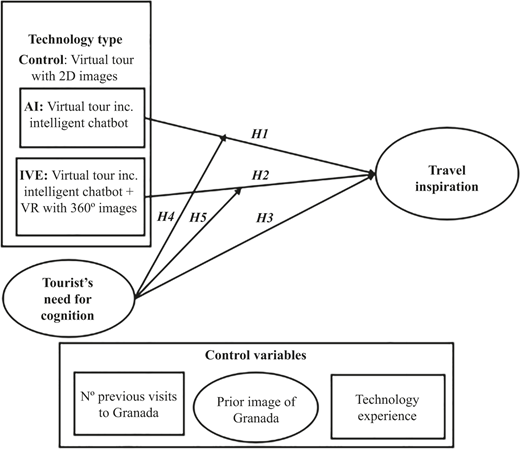
In light of the foregoing reflections, this study seeks to address the identified gap regarding the question of whether the use of an online stimulus based on a virtual destination tour featuring AI (through an intelligent chatbot) is capable of generating travel inspiration. The following research hypothesis is therefore proposed:
A virtual tour with an AI (intelligent chatbot) has a positive and significant effect on travel inspiration.
A further step in the implementation of AI in tourism is via IVEs (Grundner and Neuhofer, 2021), which are environments that bring AI and VR together (Luck and Aylett, 2000). VR creates multisensory experiences that are mediated by a computer (Cartwright, 1994) and include the visualization of 360° content (Beck et al., 2019; Cowan and Ketron, 2019). These environments implement AI through various techniques or tools. One of the most interesting and widespread forms is the use of autonomous entities – intelligent virtual agents (Aylett and Cavazza, 2001; Laukkanen et al., 2004; Liang et al., 2008). When incorporated into an IVE, these intelligent agents enhance the realism of the immersive virtual experience (Laukkanen et al., 2004), improve the interactivity and credibility of the virtual environment, and, consequently, enrich the content (Li and Miao, 2006). In the extant literature, we can find theoretical works that study intelligent chatbots that act as virtual guides during cultural tours (Deriu et al., 2021; Fuertes et al., 2007; Kiourt et al., 2017; Martínez Juárez et al., 2019; Yuan and Chee, 2005). According to these authors, among others, when these guides (conversational agents) are employed, the content of the virtual environment can be personalized (Kiourt et al., 2017), the interaction between the user and the virtual environment can be enhanced (Deriu et al., 2021), and, even during the pre-stay, a complete tourist experience can be created that is similar to those generated by an actual visit to the destination (Fuertes et al., 2007). In addition, the literature has proposed, theoretically, that incorporating AI in VR environments could intensify the user's sense of presence/immersion in this type of scenario (Laukkanen et al., 2004; Sharma et al., 2016; Trahan et al., 2019).
Although IVEs still constitute an emerging field within tourism research, it has already been observed that these virtual environments enable tourists to achieve richer information through a combination of images, texts and sounds, and a higher degree of personalization (Grundner and Neuhofer, 2021), in addition to offering more experiential resources. This kind of smart technology therefore has the capacity to offer experiences that are immersive (Sharma et al., 2016; Trahan et al., 2019), personalized (Kiourt et al., 2017) and enriched (Li and Miao, 2006), to the extent that they create experiences for the potential tourist prior to actually visiting a destination that can stimulate inspiration and the desire to travel there – thereby impacting their decision-making and future behavior.
However, the current studies dealing with IVEs in tourism are concerned with the development of these environments solely from a computational point of view (e.g. Deriu et al., 2021; Kiourt et al., 2017). This signals the need to advance toward a better understanding of their effect on consumer behavior, and specifically in terms of travel inspiration. Although not in the context of IVEs, the study conducted by Behera et al. (2024) proposes a metaverse-based model that integrates smart tools, such as virtual assistants and voice recognition, to facilitate the personalization of the tourist offer and encourage travel inspiration during the pre-stay. Therefore, taking into account (1) the characteristics of the IVE, (2) the positive impact of smart tools in this type of environment, such as providing realistic experiences (Laukkanen et al., 2004), interaction (Deriu et al., 2021), richer content (Li and Miao, 2006) and a sense of presence/immersion in the environment (Sharma et al., 2016; Trahan et al., 2019), among others, and (3) the finding that more “personalized” (Behera et al., 2024), “vivid,” and “experiential” resources can contribute to travel inspiration (Lu et al., 2021), the incorporation of an IVE with a virtual guide–chatbot into a virtual tour may lend greater intrinsic value to the experience and even inspire the potential tourist. On this premise, the following research hypothesis is proposed:
A virtual tour in an IVE format has a positive and significant effect on travel inspiration.
2.4 Need-for-cognition and its antecedent effect on travel inspiration
Böttger et al. (2017) observe that the personal characteristics of consumers influence the formation of inspiration. For example, the variable “regulatory focus” has been shown to be influential in the context of social media (Sheng et al., 2020), as has “openness to experience” (Khoi et al., 2020) in the tourism context. Building on these recent findings, this study aims to contribute to the quest to identify other personal variables that may influence travel inspiration – in this case, NfC.
NfC is defined as “people's tendency to engage in and enjoy thinking” (Cacioppo and Petty, 1982: 130), referring to the individual's natural inclination to want to invest cognitive efforts and to enjoy doing so (Cacioppo et al., 1996). These traits, predictably, lead people with different levels of NfC to achieve different results when exposed to information-heavy resources. Broadly speaking, online users with high NfC are characterized by: (1) enjoying mentally complex tasks more than simple ones (Cacioppo and Petty, 1982), which means that they can enjoy dealing with technically more advanced and complex resources; and (2) presenting more positive attitudes toward tasks that require greater cognitive effort (Cacioppo et al., 1996), which can enable them to process information in more depth and achieve more favorable attitudes toward the content delivered via an information-intensive resource. On both these points, the opposite is true for users with low NfC.
Turning to customer inspiration theory (Böttger et al., 2017), this explains that being “inspired by” corresponds to a cognitive state in which a person's attention is captured by an external stimulus and that this can transition into feeling “inspired to,” referring to a sense of motivation to actually do something as a result of that initial spark of interest (Oleynick et al., 2014; Thrash and Elliot, 2004). The NfC characteristic is a personal variable of the user that can directly influence tourist inspiration. This is because, in the case of high-NfC travelers, they feel a strong need to understand and make sense of the experiential world they inhabit (Cohen et al., 1955), which leads them to have a greater predisposition to analyze and explore in detail whatever information resources they are exposed to, including virtual tours. In view of this, it is of interest to understand the effect of personal NfC on travel inspiration in the online context. It may be that individuals with high NfC will be better-placed to achieve greater travel inspiration from an information-intensive online resource (such as a virtual tour), compared to individuals with low NfC, for whom such a resource will be less inspirational. The following hypothesis is therefore proposed:
The NfC of potential tourists exerts a positive and significant effect on travel inspiration, being greater among those with high NfC.
2.5 The moderating role of need-for-cognition in the relationship between technology and travel inspiration
Regarding the moderating effect of the personal characteristics of online users, the literature has focused its attention on their impact on the formation of inspiration. Particularly in the tourism context, previous studies have identified important personal variables such as regulatory focus (Xie et al., 2023), openness to experience (Fang et al., 2023; He et al., 2023) and neuroticism (Khoi et al., 2021). This study adds a further variable for analysis: the effect of NfC.
First of all, it is important to note that a person's travel inspiration can be shaped by exposure to a resource that is sufficiently powerful on a motivational level (Thrash and Elliot, 2004). Given that intelligent chatbots are capable of providing personalized information to users from a text and/or voice interface (Lei et al., 2021; Melián-González et al., 2021), these bots may constitute, in their own right, a valuable resource for users, regardless of whether they present low or high NfC. Furthermore, intelligent chatbots also have the capacity to manage and provide complex information contextually and in real time, based on user requests (e.g. Bulchand-Gidumal et al., 2023; Doborjeh et al., 2022). In this regard, using the chatbot's capabilities to generate rich and complex information may provide a more motivating user experience than a more superficial interaction with it. Taking greater advantage of these capabilities will naturally depend on what actions the user chooses to take; therefore, it is those individuals with high NfC who are more likely to make more intensive use of the bot's information management possibilities. These smart tools are able to satisfy the curiosity and desire to learn that characterize high-NfC individuals by offering them detailed and appealing destination information that may, in turn, heighten their travel inspiration.
It is logical to presume, then, that when it comes to information management, people with high NfC present more active and exploratory behavior in processing the information provided by the environment (Cacioppo et al., 1996; Chuanlei et al., 2019). Such individuals have been found to have a greater sense of curiosity (Li and Browne, 2016), a stronger imagination (Jonassen and Grabowski, 1993; Sadowski and Cogburn, 1997), a more open mindset (Cacioppo and Petty, 1982; Fleischhauer et al., 2010), a stronger inclination to search for information (Cacioppo et al., 1996), a desire to invest in deeper online information-search (Chuanlei et al., 2019) and the ability to achieve greater self-directed learning (Cacioppo et al., 1996; Kühl et al., 2014). This, in turn, renders them more likely than those with low NfC to perform well when exposed to an information-heavy resource such as an intelligent chatbot. Furthermore, when dealing with greater volumes of information, people with high NfC are less likely to experience the confusion that can arise due to overload or overly similar content from different sources (Lu et al., 2016), thanks to their stronger performance in relevant cognitive tasks (Cacioppo et al., 1996). They are also more inclined to make a significant cognitive effort when deliberating over the information they find (Cacioppo et al., 1983, 1986) and to use resources/technologies that involve cognitive effort (Cacioppo et al., 1996), which may contribute to their greater enjoyment of more complex and information-intensive stimuli, compared to their low-NfC counterparts. It is also important to note that the attitudes displayed by high-NfC individuals tend to be better predictors of intentions and future behaviors than those of people with low NfC (Cacioppo et al., 1986, 1996). All of the above leads us to suggest that the use of AI, implemented within an intelligent chatbot format, may be more powerful in terms of generating inspiration among people with high NfC, compared to those with low NfC. Therefore, the following hypothesis is proposed:
NfC moderates the effect of virtual tours with AI on travel inspiration, such that the effect of using AI (intelligent chatbot) is significantly greater among potential tourists with high NfC compared to those with low NfC.
Turning to IVEs, these enable users to access information in two ways: textually, with AI, and in a more sensory way, through VR. As such, these environments can be highly versatile, suitable for both users with high NfC (given that the advanced possibilities in information management and processing are maintained through a textual interface) and those with low NfC (who can access more immediate sensory information through VR images). That said, the attitudes of high-NfC individuals are more likely to be affected by issue-relevant information, such as arguments (central route), whereas those of low-NfC users are found to be more likely to be influenced by simple or peripheral cues such as source attractiveness (Cacioppo et al., 1983, 1986, 1996) or the interactive and aesthetic qualities of a website (Amichai-Hamburger et al., 2007). Indeed, the incorporation of VR can be particularly motivating and fit-for-purpose for users with low NfC. This is because the highly visual and aesthetic qualities associated with IVEs have been shown to influence low-NfC users in particular (Cacioppo et al., 1996), as they can be highly stimulating to them (Beck et al., 2019; Guttentag, 2010), and also because VR is known to be highly appealing to this type of user (e.g., Kim et al., 2020; Marchiori et al., 2018). Furthermore, as people with low NfC are less likely to make an effort to acquire information through thinking or cognitive tasks (Cacioppo et al., 1996), thanks to the VR component – which is associated with a greater sense of presence/immersion (Laukkanen et al., 2004; Sharma et al., 2016; Trahan et al., 2019) – they can still access valuable information but in a more sensory way that reduces the cognitive effort. Therefore, on the basis that an IVE can be considered a motivating and inspiring resource for both types of users, the following hypothesis is proposed:
Within an IVE setting, NfC does not moderate the effect of the virtual tour on travel inspiration, such that no significant differences will be found between potential tourists with high vs low NfC.
Figure 1 shows the proposed research model, indicating that the type of technology used in the virtual tour (AI/intelligent chatbot vs IVE/intelligent chatbot plus VR with 360° images) and the NfC of potential tourists will influence their travel inspiration. The model also indicates the moderating effect of the NfC of the potential tourist on the effect of technology type on travel inspiration.
3. Methodology
3.1 Sample and procedure
The sample comprised exclusively Spanish domestic tourists, given that they constitute a crucial public for Spain as a leading and well-consolidated tourist destination (INE, 2023). The fieldwork was conducted between June and August 2022 through a panel managed by Dynata, a company recognized for its extensive international research-survey experience and quality in the implementation of fieldwork.
Participation in this study primarily involved taking part in a virtual tour of the southern Spanish city of Granada, which represents a consolidated cultural destination both domestically and internationally (INE, 2023). The first phase of participation was designed to collect information from the subjects on the number of previous visits they had made to Granada, the prior image they held of this destination, their degree of experience with technology, and their level of NfC. In the second phase, participants were randomly assigned to one of three experimental treatments: the control virtual tour (with 2D images only), the virtual tour with AI (with 2D images combined with an intelligent chatbot) or the virtual tour with IVE (with VR 360° images, plus an intelligent chatbot). All treatments were based on virtual guided tours of the city of Granada and presented equivalent content. Before starting the tour, participants were briefed on the technical and operational requirements of the system so that they could derive the most out of the experience. For participation to be considered valid, the minimum exposure time to the treatment was controlled (4.7 min), and all individuals were required to complete the full virtual tour (also controlled). Following the tour, the third phase redirected participants back to the questionnaire, which covered topics related to AI and VR manipulation checks, travel inspiration and personal socio-demographic variables (Appendix 1).
The final sample comprised 477 valid cases. The distribution of participants among the three treatments was as follows: 186 cases in the control group, 165 in the group with AI and 126 in the group with an IVE. The sample's socio-demographic characteristics are captured in Table 1 (Appendix 2). The sample distribution largely correlates with that of the general profile of the Spanish domestic tourist (INE, 2023).
3.2 Experiment design: variables and measurement scales
3.2.1 Independent variable: technology-type (manipulable factor)
The experiment included a manipulable factor with three treatment levels depending on the level of technology sophistication, as detailed earlier. The route took in three iconic monuments in the city of Granada (the Corral del Carbón, the Cathedral, and the Bañuelo). All three versions of the tour included the same content conveyed through text, sound and image (see Appendix 3).
The textual content of the treatments was presented both in words and orally, through storytelling. This was delivered during the tour by a virtual guide created specifically for the research. In the AI-based stimuli (that is, in the virtual tours with AI or an IVE), this same virtual guide led participants around the destination, but this time, incorporated an intelligent feature via NLP and ML: a bespoke chatbot. The intelligent virtual guide–chatbot was designed and developed as a bespoke resource to meet the specifications of this research. The developer was provided with all the information that the virtual guide–chatbot would likely need in order to answer the participants' questions satisfactorily, which was drawn from publicly available official tourism sources together with historical and architectural guides to Granada produced by respected historians. We collated historical, cultural and general information about the three attractions featured in the cultural tour, endeavoring to anticipate the main queries or interests that visitors to this kind of attraction would be likely to present.
In these treatments (AI-based stimuli), participants were briefed to interact with the guide–chatbot by posing questions about the tour via a live chat feature, in a format similar to that of the main instant messaging applications. The visual content of the treatments was equivalent, only varying in format depending on whether or not the treatment included VR (360° VR images were included only in the treatment featuring an IVE, whereas static/2D images were used in the control and AI treatments). The 3D material was provided by the Fundación Descubre scientific information agency and was taken from its “Paseos Matemáticos por Granada” (Mathematics Walkabouts through Granada) project. Some of the 2D content was downloaded from the “Audiovisual Material of Tourism and Sports in Andalusia” Platform (https://media.andalucia.org/galeria/home); other images were sourced from the Google Images search engine under Creative Commons licenses; and the remainder were screenshots taken from the “Paseos Matemáticos” virtual tour.
3.2.2 Independent variable: need-for-cognition (non-manipulable factor)
To measure NfC, the scale developed by Zhang et al. (2017) was used, which was based on the original work of Cacioppo and Petty (1982) and Cacioppo et al. (1984). This was a 7-point, 7-item Likert scale. In line with the approach recommended by Cacioppo and Petty (1982) and Zhang et al. (2017), the participants were classified into two groups (high vs low NfC). For this purpose, the median of the pre-test (4.5) was used as a reference, so that participants with scores below that value were classified as having low NfC, while those who recorded a score equal to or above it were classed as having high NfC (Appendix 4).
3.2.3 Dependent variable: travel inspiration
Travel inspiration was the dependent variable in this study and was measured on a scale developed and validated among consumers by Böttger et al. (2017). This scale comprised 10 items relating to “inspired by” and “inspired to” (Appendix 4), and has previously been used in the tourism context (e.g. Khoi et al., 2020, 2021).
3.2.4 AI and VR manipulation checks
To evaluate AI, a 3-item scale was used that reflected the intelligent chatbot's ability to understand and respond appropriately to participants, thanks to NLP and ML. To check VR, two scales (relating to “presence” and “interactivity of the environment”) were used (these being considered relevant qualities in virtual environments (e.g. Burdea and Coiffet, 1994; Carrozzino and Bergamasco, 2010). Presence was measured on the scale by He et al. (2018), which was originally based on Slater et al. (1994), and comprised three items. For interactivity, the scale developed by Hudson et al. (2019) was used. This also comprised three items. In all three cases, these were 7-point Likert scales (Appendix 4).
3.2.5 Control variables (candidate covariates)
To verify that the technology-type factor unequivocally influenced the dependent variable, the following items were selected as candidates for covariates: the number of previous visits to Granada, the prior image that the individual held of Granada and their degree of experience with technology. All three variables were measured before participants were exposed to the treatments. In line with the approach taken by Kim and Hall (2019), the number of visits to the destination was measured using a single ordinal item, directly asking the participant about the number of times they had previously been to Granada. The scale by Drolet et al. (2007) was used to measure the prior image of the destination, using four 7-point semantic differential items. Finally, the work of Foley et al. (2016) was used to measure technology experience, based on a 7-point, 3-item Likert scale (Appendix 4).
3.2.6 Socio-demographic variables
Finally, the socio-demographic variables collected from the participants were gender, age and educational level. To measure age, four intervals were used (18–24 years, 25–44, 45–64 and ≥65). For the level of education, four categories were used: no formal education, primary education only, secondary education and higher education.
4. Results
4.1 Scale validation
The measurement scales presented adequate reliability and validity, as, in all cases, the indicators for individual reliability (Cronbach's α), composite reliability (CR) and variance extracted (AVE) exceeded the recommended thresholds of 0.70 (for simple and composite reliability) and 0.50 (for variance extracted) (Appendix 5).
4.2 Manipulation checks
To verify the correct manipulation of the experimental factor “technology-type,” analyses of variance (ANOVA) were conducted (1) to check the AI incorporated into the second and third treatments, and (2) to check the VR incorporated into the third treatment. The results showed that there were significant differences between the mean values in the AI check (M.AIno = 3.63; M.AIyes = 5.67; p-value <0.001), the VR “presence” check (M.VRno = 5.11; M.VRyes = 5.78; p-value<0.001) and the VR “interactivity” check (M.VRno = 4.39; M.VRyes = 6.03; p-value<0.001). These results indicate that technology type was manipulated appropriately.
4.3 Concomitant variables (covariates)
According to Kirk (1982), there are two requirements that must be met for a variable to be incorporated as a covariate in a model: (1) the existence of a certain correlation between the covariate and the dependent variable and (2) the absence of any correlation between the covariate and the independent variables. In relation to the first condition, the results showed a significant correlation with the variables “prior image of Granada” (rprior image = 0.39, p-value<0.001) and “technology experience” (rtech experience = 0.26, p-value<0.001) but no significant correlation with regard to “number of previous visits to Granada” (rn° of visits = 0.03, p-value = 0.51). These results indicate dependence between each pair of variables, except for “number of previous visits to Granada,” meaning that this variable was no longer a candidate and would be excluded from the following verification.
With respect to the second condition, an ANOVA was performed for the two remaining candidate covariates, using the covariate as the dependent variable and the different experimental groups as independent variables: static virtual tour/control – low NfC; static virtual tour/control – high NfC; virtual tour with AI – low NfC; virtual tour with AI – high NfC; virtual tour with IVE – low NfC; and virtual tour with IVE – high NfC. For both variables – prior image and technology experience – there were significant relationships with some of the experimental groups (F = 4.56, p-value <0.001 for prior image; and F = 4.40, p-value <0.001 for technology experience). Hence, they did not meet the second assumption of independence and were thus not incorporated into the model as covariates.
4.4 Testing the hypotheses
In order to apply an ANOVA, the literature points to three basic statistical assumptions: (1) normality of the dependent variables, (2) equality of variances (homoscedasticity) of the dependent variables and (3) independence and randomness of the sample (Tabachnick and Fidell, 2007).
The results of the Kolmogorov–Smirnov test showed that travel inspiration did not present a normal distribution, while Levene's test showed the existence of heteroskedasticity in the main effect of technology-type on the dependent variable. However, in this case, the lack of normality and homoscedasticity was not an insurmountable problem because the sample size was relatively large and there was a good balance between the sizes of the experimental groups (Uriel, 1995). Finally, the conditions of independence and randomness were met, since the research was between-subjects, and individuals were randomly assigned to the different experimental groups.
Turning now to the hypothesis-testing, which was performed using the ANOVA technique, the results were as follows:
The main effect of the type of technology applied in the virtual tour on travel inspiration was significant (F = 12.19; p-value<0.001). The mean for inspiration in the case of the tour with AI was greater than in the static (control) tour (MAI = 5.71; Mcontrol = 5.53), as was the mean in the case of the tour with IVE compared to the static one (MIVE = 6.06; Mcontrol = 5.53). The difference between means was significant for the influence of both the tour with AI (p-value<0.001) and the tour with IVE (p-value<0.001) on inspiration. Therefore, H1 and H2 received empirical support.
The direct effect of NfC on travel inspiration was also significant (F = 12.32; p-value<0.001). Furthermore, the mean travel inspiration of tourists with high NfC (M = 5.88) was higher than that of those with low NfC (M = 5.55), with the difference between the two means being significant (p-value<0.001). Therefore, H3 also received empirical support.
Regarding the moderating role of tourist NfC in the effect of technology-type on travel inspiration, for the virtual tour with AI, users with high NfC achieved greater inspiration (MAI = 5.83) than users with low NfC (M = 5.51), with significant differences being found between the two groups (F = 4.84; p-value = 0.028). Therefore, H4 found empirical support. In the case of the tour with IVE, users with high NfC again achieved a greater level of inspiration (MIVE = 6.19) than users with low NfC (M = 5.91), albeit here the differences between groups cannot be considered significant for p-value = 0.05 (F = 2.83; p-value = 0.093). These results indicate that H5 also obtained empirical support.
5. Discussion and conclusions
This research deepens our understanding of travel inspiration as a key concept in an emerging technological environment and provides empirical evidence on the growing and transformative role of AI and ICTs in the future of tourism (Abidin et al., 2025; Postma and Yeoman, 2024; Yeoman, 2025; Yeoman and McMahon-Beattie, 2023; Yeoman and Yu, 2012). The present findings help enrich the existing body of knowledge vis-à-vis the tourist experience, tourism marketing and destination management, and constitute an advance toward a more robust and theoretically grounded research approach in this continuously evolving field. The study also offers insights into how certain personal characteristics of the tourist may influence their interaction with smart technologies, which is critical for designing more effective and personalized marketing strategies and travel experiences in the context of tourism futures.
Travel inspiration is an emerging topic that is increasingly gaining traction in tourism studies (Fang et al., 2023), due to its major role in the decision-making process among potential tourists and, therefore, its implications for the future developmental trajectory of destinations (Dai et al., 2022). Inspiration can generate positive emotions, expectations, preferences and engagement toward the destination, all of which influence consumers' behavioral intention toward it – and may even translate into an actual tourism experience there. In this sense, the present study started from the premise that potential tourists can derive inspiration prior to the trip, which may not only accelerate the process of selecting a destination and progressing directly to make a booking (Dai et al., 2022; Gretzel, 2021) but can also ultimately generate ideas for their actual trip, once at that destination (Gretzel, 2021). Travel inspiration can, thus, help define the tourism marketing strategies of the future because it can assist destinations in anticipating potential tourists' future behaviors in increasingly digitalized and constantly evolving environments. The literature calls for further research that contributes to our understanding of the factors that may trigger inspiration before any trip has been planned (Fang et al., 2023; Dai et al., 2022), which would also contribute to building greater knowledge around how to improve marketing strategies for tourist destinations (Fang et al., 2023).
In addition, the major impact of technology on tourist behavior, including the resources available today in online media, must also be taken into account (Cheng et al., 2020; Liu et al., 2020), as these, too, can help fuel travel inspiration (Lamberton and Stephen, 2016). However, there are very few studies examining the effect of online resources on travel inspiration (e.g. Fang et al., 2023; Khoi et al., 2020). Alongside the more well-established resources found in online media, technological advances are bringing new possibilities to the fore that are based on AI (such as intelligent chatbots) and IVEs (in which AI and VR are combined). The study of the effect of such technologies on user behavior constitutes a very new field (Grundner and Neuhofer, 2021) that corresponds to a high demand for knowledge. This perspective is framed within the broader discourse on the tourism of the future, where AI and immersive technologies are expected to play a fundamental role in transforming tourist participation in experiences, opening up new opportunities for destinations to innovate as they envision how they want to evolve (Filimonau et al., 2024; Postma and Yeoman, 2024; Urquhart, 2019; Yeoman, 2025). In this study, we sought to determine the extent to which incorporating AI and IVE into online tourist-facing resources could render these more motivating and inspiring for potential destination visitors.
It is also of interest to identify the effect of potential tourists' own personal characteristics on the formation of travel inspiration (Böttger et al., 2017) and on the effectiveness of AI and IVE technologies in forming that inspiration. A key aspect in the evolution of tourist experiences within the sector of the future is the role of technology-driven personalization, which can act as a catalyst for the creation of new forms of participation in those experiences (Urquhart, 2019). The present work has thus contributed to the study of (1) the effect of AI and IVE on travel inspiration, (2) the effect of the NfC of potential tourists on travel inspiration and (3) the moderating role of the NfC of potential tourists in the effect of AI and IVE on travel-inspiration-formation. An experiment was conducted in which two factors were analyzed: (1) technology-type (on three levels of sophistication: a virtual tour featuring 2D images only (control); a virtual tour with AI/2D images and an intelligent chatbot; and a virtual tour with IVE/360° VR images and an intelligent chatbot) and (2) the NfC of the participants (differentiating between two levels, low and high).
The contributions made by the findings of this research to the literature dealing with tourist inspiration and tourism futures are detailed next.
First, the results show that AI and IVE, implemented in virtual tourism tours, positively and significantly influence travel inspiration.
This insight represents an advancement in the literature, complementing previous studies that found that online resources (Dai et al., 2022; Cheng et al., 2020) and short-format travel videos (Cheng et al., 2020; Fang et al., 2023) constitute inspiring resources for potential tourists, given that the incorporation of AI and IVE into online resources provides greater intrinsic value to the resource, which translates into a greater ability to influence travel inspiration.
This finding thus makes a timely empirical contribution to the literature – specifically, by providing support for the predictions and trends produced by previous studies dealing with tourism futures, and deepening our understanding of these trends. On the one hand, this work empirically validates the perspectives offered by theoretical studies predicting that these new smart technologies will make a major impact on the shape of tourism in the future (Ferrer-Roca et al., 2021). Specifically, smart technologies are beginning to reshape multiple dimensions of the tourism industry, including marketing, the visitor experience and destination management (Chon and Hao, 2025; Tuo et al., 2025; Yeoman, 2025).
On the other hand, this finding demonstrates that the application of these smart technologies in the design of virtual tours is an effective means of generating travel inspiration, supporting the idea that these technologies can enable, facilitate and enhance the tourist experience (Urquhart, 2019). These technologies are generating a profound transformation in how individuals go about discovering what destinations have to offer and how they engage with them. Crucially, they facilitate immersive virtual experiences that enable potential tourists to explore a given location during their decision-making processes, as a preliminary step prior to actually visiting the destination (Abidin et al., 2025; Chon and Hao, 2025; Filimonau et al., 2024; Yeoman, 2025). In particular, the ability of smart tools to generate multi-modal content (blending text, image, video and audio) opens up new possibilities for innovation in the tourism sector, as they lend themselves to designing more immersive, personalized and emotionally meaningful experiences during the pre-stay phase, when travel inspiration and behavioral intention toward the destination are forming (Li et al., 2025).
Second, this study offers some novel contributions regarding the influence of potential tourists' NfC on travel inspiration. When potential tourists are exposed to an information-heavy resource, it is those individuals with high NfC who are likely to be better placed to benefit from it and derive a more motivating experience from it. This reasoning is corroborated by this study, which verifies that NfC positively influences travel inspiration, this effect being stronger among potential tourists with high NfC.
This finding is consistent with previous studies showing that such travelers will be naturally inclined to willingly make greater cognitive effort to assimilate information-intensive stimuli and will enjoy the process more (e.g. Cacioppo and Petty, 1982; Cacioppo et al., 1996) than those with low NfC. This finding contributes to the body of literature concerned with identifying antecedent factors in the formation of travel inspiration (Böttger et al., 2017), and particularly the personal characteristics of potential tourists that may be influential (e.g. Sheng et al., 2020; Khoi et al., 2020).
The present results also show that tourists' receptivity to personalization and information is not uniform but is influenced by certain cognitive characteristics of the individual – in this case, NfC. This underlines the pivotal role played by the personalization of the tourist experience, which constitutes a key area in the future development of the sector, driven by smart technologies (Abidin et al., 2025; Chon and Hao, 2025; Li et al., 2025; Tuo et al., 2025; Urquhart, 2019). Ultimately, these results provide a deeper understanding of consumer behavior in terms of personal characteristics, which will contribute to tourism's developmental trajectory.
Third, while the literature identifies that there are personal variables that moderate the formation of consumer inspiration (e.g. Xie et al., 2023; Fang et al., 2023), this study provides empirical evidence of the moderating role of NfC in the effect of technology-type (AI or IVE) on travel inspiration. On the one hand, it has been corroborated that, although AI constitutes a positive tool for users with both high and low NfC, because it contributes to travel inspiration among both types, it is those users with high NfC who are likely to benefit to a greater extent from AI. This is because, according to the present results, AI exerts a significantly greater effect on travel inspiration among such users, compared to users with low NfC.
This finding can be considered consonant with previous literature dealing with NfC, given that AI has the ability to work with complex, contextualized, real-time and textual information (Bulchand-Gidumal et al., 2023; Doborjeh et al., 2022), which requires greater cognitive effort to process on the part of the users. Hence, users with higher NfC are more naturally inclined to be willing (and even keen) to invest in such a mentally demanding task. In sum, the use of AI can be considered more motivating and inspiring for users with high NfC.
This finding is also fundamental when it comes to understanding the interaction between smart technologies and the human factor – another critical area for the future of tourism. The extant literature already recognizes that smart tools such as chatbots can improve the overall customer experience by offering on-the-spot assistance to users. However, the effectiveness of these tools is not homogeneous across the board, as their value also depends on user-related factors (Liao et al., 2025). The present research provides empirical evidence confirming this variability: while AI is universally beneficial, its inspirational capacity is amplified when this technology is applied among users with high NfC. Therefore, this research provides a basis for designing more effective AI tools that are tailored to different types of users.
Fourth, the present study found that the use of IVEs exerts no moderating effect on travel inspiration – that is, IVEs enable users with both high and low NfC to attain similar levels of travel inspiration. One possible interpretation of this finding is that, because IVEs combine AI and VR, they create information resources that, as well as requiring intensive processing (ideal for users with high NfC), also provide an important aesthetic (visual) component. This has the dual advantage of presenting information both textually (entailing greater cognitive effort) and in a more sensory way (through images). These characteristics render IVEs a versatile resource for users with both high and low NfC.
This finding highlights the transformative potential of IVIs for the future of tourism. This technology's multisensory richness and immersive nature (Abidin et al., 2025; Filimonau et al., 2024) help dampen the effect of personal characteristics, such as NfC, on tourism inspiration processes. Indeed, it is here that IVIs emerge as technologies that are capable of generating universally inspiring experiences, regardless of the user's NfC. This insight is particularly relevant for destination managers, as it offers new possibilities for designing effective and inclusive future-oriented tourism offerings (Tuo et al., 2025) that can inspire diverse publics.
Taken as a whole, the findings reveal emerging patterns in tourist behavior and provide key elements with which to anticipate consumers' decisions and attitudes – and influence them – vis-à-vis future scenarios. In line with the theoretical frameworks relating to the tourism of the future – as per the works of Abidin et al. (2025), Filimonau et al. (2024), Postma and Yeoman (2024), Urquhart (2019), Yeoman, 2025 – the present results not only respond to the changes brought about in the industry by the digital transformation but also align with the identified need to manage tourism in VUCA contexts (Yeoman and McMahon-Beattie, 2023). Smart technologies, such as AI and IVEs, should therefore not be viewed solely as operational tools but as structuring forces that redefine tourist experiences, decision-making processes and the emotional bonds that form between tourists and destinations (Abidin et al., 2025; Filimonau et al., 2024; Yeoman, 2025). In this sense, the aforementioned theoretical frameworks underline the importance of generating empirical evidence that serves to strategically guide both how digital experiences are designed and how tourism management policies that are more sustainable, resilient and value-focused can be formulated (Postma and Yeoman, 2024; Urquhart, 2019). This study, therefore, contributes to the advancement of knowledge in this direction by both interpreting the present and also building a grounded vision of how the tourism of the future should be helped to evolve.
In short, this study contributes to developing a more rounded theoretical understanding of travel inspiration and its possible future trajectories. Specifically, the findings of this research contribute to the debate on the future of tourism by showing that AI and IVEs are not only redefining how tourists interact with the destination before the trip but are also laying the foundations for the development of smarter, more sustainable and adaptable tourism ecosystems.
5.1 Management implications
The pre-travel stage is of major relevance for destination marketing organizations because this is when potential tourists start to actively search for ideas and information, begin planning their trip and/or form behavioral intentions toward the different elements of the visit (Hyde, 2008). In this stage, studies have found that tourists' use of online media stands out in particular (Tan and Chen, 2012); and more recent works have pointed to the relatively new prevalence of features derived from AI-based technologies, such as intelligent chatbots (Doborjeh et al., 2022; Tussyadiah, 2020) or IVEs, which, as we have seen, blend AI into VR environments (Luck and Aylett, 2000). This vision is linked to the tourism marketing of the future, where interactive, personalized – and therefore intelligent – content is positioned as a key differentiating element. From this perspective, research on the future trajectory of tourism highlights the strategic role of AI in shaping more resilient destinations that are better equipped for the challenges and opportunities ahead. In light of the promise that smart technologies hold in terms of destination promotion and awareness-raising, this study offers some interesting findings relevant to the professional sector. Not least, our study provides insights that will be of value to marketing professionals, tourism planners and digital-experience designers alike, offering a richer understanding of the potential ways in which future tourists will interact with environments that are increasingly automated, intelligent and adaptive. Furthermore, the findings identify strategies that tourism industry stakeholders can implement to maximize the inspirational impact of these emerging technologies, help predict the expectations of new profiles of tourists, and design more appealing experiences that are both personalized for the individual and sustainable for the future development of tourism.
First, the study shows the relevance of the travel inspiration variable, which entails a substantial change in the usual behavior of potential tourists during the pre-stay. Such is its impact that online media users can become potential tourists, showing destination visit intention (Assiouras et al., 2024a, b; Dai et al., 2022). The literature has shown that travel inspiration does not occur spontaneously but is the result of exposure to a resource that the user finds highly motivating and that prompts them to feel “inspired by,” which can then be elevated to “inspired to” (Dai et al., 2022). The present study provides empirical evidence that AI and IVEs (through an intelligent chatbot, or intelligent chatbot plus 360° VR images, respectively) incorporated into a virtual tour constitute such resources and are capable of inspiring users to travel. Hence, if tourist destination managers are seeking to generate resources powerful enough to awaken motivation and inspire users to visit, one online option is to incorporate AI and/or an IVE into the destination's digital promotional resources. A relevant approach would be to offer an intelligent chatbot in their online media and/or an intelligent chatbot combined with VR.
Second, it has been shown here that, in a virtual tour context, there are certain personal characteristics of potential tourists – in this case, NfC – that can influence the formation of travel inspiration. Greater insight into how travelers process and assimilate information will empower destinations to design more effective and engaging experiences that align with visitors' different cognitive abilities and preferences. On the one hand, among people with high NfC (those who tend to actively enjoy making cognitive effort and reasoning), the influence of that trait on travel inspiration is particularly marked and certainly greater than among those with low NfC. Additionally, it has also been demonstrated in this study that, while the use of AI can be considered positive for all types of users (regardless of NfC level), it is particularly well received by users with high NfC. These results suggest that managers must be prepared to design promotional strategies for tourist destinations that are suitable for people both with high and low NfC, and must make a concerted effort to reach people with low NfC who, a priori, will find it more difficult to achieve travel inspiration. In this sense, it has also been identified through this study that IVEs are capable of generating a high level of travel inspiration in both types of users, being a versatile solution that can maximize the travel experience of all users, no matter their level of NfC. Note how the moderating effect of NfC in tourist interaction with AI underlines the importance of incorporating psychological segmentation into future-oriented tourism strategies (Li et al., 2025), in addition to sociodemographic or behavioral segmentation. Here, the development of intelligent systems with the capacity to identify, adapt to and respond to tourists' NfC could represent a source of strategic competitive advantage for destinations, as it would facilitate the design of more personalized, relevant, and enriching experiences for different tourist profiles.
Third, and related to individual factors such as NfC, it is essential to promote multidisciplinary future-oriented training for tourism professionals (Ferrer-Roca et al., 2021). Such training should not only equip participants with the necessary technical know-how to use these smart tools effectively but should also ensure that they understand how the different features of the tools intersect with human and psychological considerations (Tuo et al., 2025), such as NfC. The ultimate educational outcome here is to empower professionals to design more effective, personalized and inspiring tourism experiences.
Fourth, managers are recommended to approach the generation of travel inspiration through intelligent systems as a co-creation process between the tourist and the tourism providers, in which both parties actively participate in the design of meaningful, personalized and inspiring experiences (Li et al., 2025; Urquhart, 2019).
Finally, from an ethical perspective, it is crucial to consider the persuasive power that intelligent systems could wield when it comes to influencing tourists' behavior in the future (Chon and Hao, 2025; Tuo et al., 2025). Processes such as hyperpersonalization, if not properly managed, have the potential to reduce user autonomy or unduly influence their decisions in subtle but significant ways. Therefore, it is essential that policymakers develop robust regulatory frameworks to keep the evolution of these technologies in check. These frameworks must ensure that the use of advanced technologies does not restrict tourists' freedom of choice or autonomy.
Comprehending these insights derived from the present research can help destinations and tourism firms to anticipate tourists' motivations, expectations, and behaviors, enabling them to create experiences that are more aligned with visitors' needs and desires – and, therefore, optimizing the tourism offer based on emerging technological trends. This insight from the proposed research model constitutes a key factor in the tourism of the future, in which destination resilience, based on innovation, will be a foundational characteristic necessary for effective and sustainable management of tourism resources.
In sum, the results of this research on tourism inspiration can provide tourist destination managers, as well as other stakeholders, with the necessary knowledge to make informed decisions that are consonant with the future challenges – and desired future outcomes – of the sector.
5.2 Limitations and future lines of research
This study presents certain limitations that may constitute the basis for which future lines of research can be identified. First, although a Spanish tourist destination recognized for its leading position in cultural tourism was selected, it would be interesting to replicate this study in other specialized destinations or contexts, for example, in sun and beach tourism or using a sample of international tourists.
Second, it could be of interest to replicate the study at different points of the tourism process, such as the stay or post-stay phases, and to analyze the process of travel inspiration-formation in these different stages and its effect on revisit intention. Third, AI-based applications (such as the intelligent chatbot) and IVEs (intelligent chatbots together with VR) were used in this study, but it would be interesting to carry out new studies employing other tools based on AI and IVEs, to continue expanding the knowledge base regarding their effect on tourist behavior. Finally, it would be of interest to consider other personal variables that may influence the formation of travel inspiration, such as openness to experience or the user's level of creativity.
The supplementary material for this article can be found online.